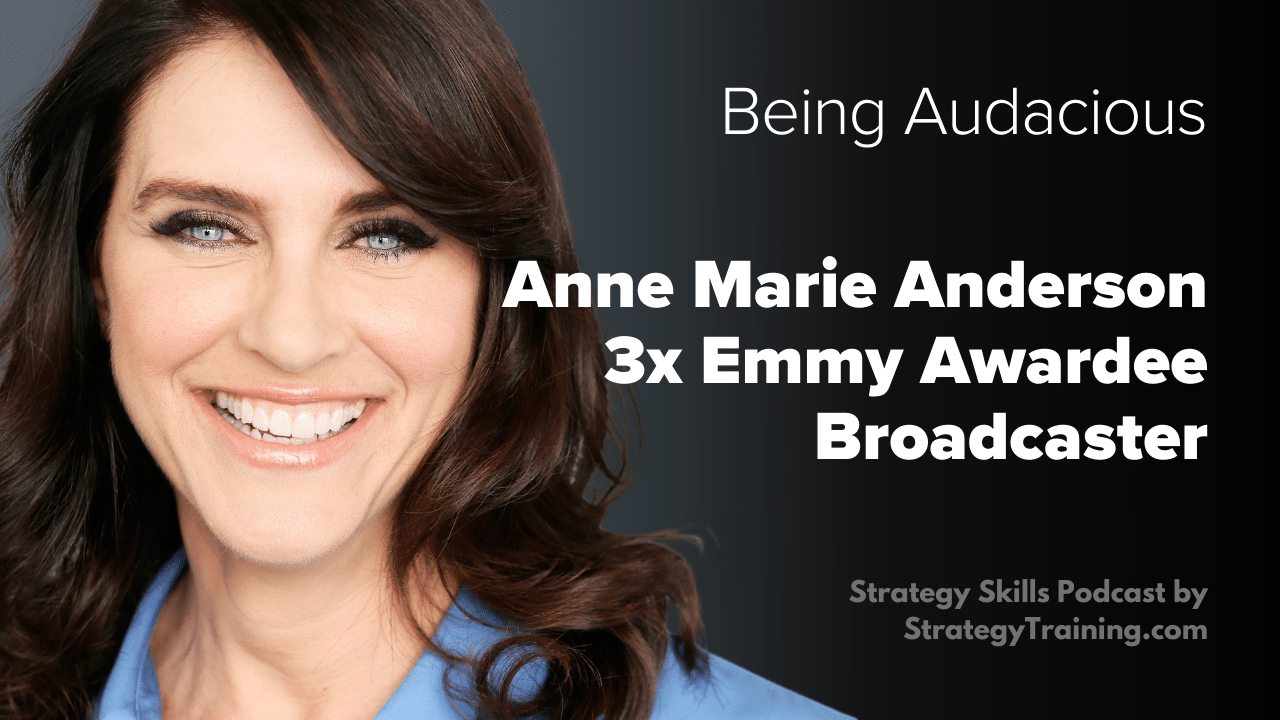
For episode 533 of Strategy Skills, we interviewed Anne Marie Anderson, the author of Cultivating Audacity: Dismantle Doubt and Let Yourself Win.
In this episode, Anne Marie Anderson shared her journey from being rejected by ESPN at 21 to working there for 35 years and becoming one of the most experienced female play-by-play announcers in the country. She discussed the importance of audacity, combining confidence with bold risks, and learning from rejection. In Cultivating Audacity, Anne Marie shares the system she developed to find the courage to confront hesitation and break down barriers that stood between her and the life she wanted.
I hope you will enjoy this episode.
Kris Safarova
Anne Marie Anderson is a 3x Emmy Award-winning broadcaster, keynote speaker and author of Cultivating Audacity.
Get Anne’s book here:
Cultivating Audacity: Dismantle Doubt and Let Yourself Win
Here are some free gifts for you:
Overall Approach Used in Well-Managed Strategy Studies
Enjoying this episode?
Get access to sample advanced training episodes
Episode Transcript:
Kris Safarova 00:45
Welcome to the Strategy Skills podcast. I’m your host, Kris Safarova, and our podcast sponsor today is StrategyTraining.com. If you want to strengthen your strategy skills, you can get the Overall Approach Used in Well-Managed Strategy Studies. It’s a free download, and you can get it at firmsconsulting.com/overallapproach. You can also get McKinsey and BCG-winning resume, which is a resume that got offers from both of those firms. And you can get it at firmsconsulting.com/resumepdf. And the last gift you have from me today is a copy of a book I co-authored with some of our great clients. It is called Nine Leaders in Action, and you can get it at firmsconsulting.com/gift. And today we have with us Anne Marie Anderson, who is a three times Emmy award-winning broadcaster, keynote speaker and author of Cultivating Audacity. Anne, welcome.
Anne Marie Anderson 01:49
Thank you. I’m happy to be here talking with you.
Kris Safarova 01:51
So such a great career so far, and of course, you have so much more to do ahead of you. You started at ESPN straight out of college. What was that moment like?
Anne Marie Anderson 01:56
I got rejected. I applied to ESPN when I was 21 years old, I needed a job or I was going to end up moving home with my parents, and so I applied and did not get the job. They said, I’m sorry, you don’t seem like what we’re looking for. They were asking me sports questions about stats and personnel that I didn’t know, and I went home so mad at myself because I froze and I never recovered, but I wrote a letter immediately and said, Thank you for the opportunity. I don’t think I did a very good job of expressing how I could add value to ESPN. And then I mentioned how I was different than who they usually had, and how I could help balance some things out, and Kris, they called me and offered me a temporary job for six months, and I have worked for them. I’m freelance now for 35 years.
Kris Safarova 02:50
This is such a common story. I’m not saying your story is common, but I’m saying for someone who is a high performer, and they achieved high above what an average performer would achieve, this is a such a common story, there’s a pattern. Even if you listen to our podcast, there are so many stories of example, someone who was an executive at Google, how they got that job, they actually drove there and set up the reception until someone was willing to come and get their resume. Stories like that. It is a glimpse of what you have done throughout your entire career to be where you are today.
Anne Marie Anderson 03:22
Yeah, it is something to be rejected. I mean, I sometimes I think, what if I hadn’t written that letter? It’s my entire career for 35 years. What if I had just said, Oh, they said, No, so it must be a no.
Kris Safarova 03:34
What do you think made you write that letter? Do you feel that there was something that people can learn from, that they can ignite in themselves in a situation like that. Because what happened also is you could have someone who is very driven person can add a lot of value, but maybe because they don’t have enough self confidence, they would not take that step.
Anne Marie Anderson 03:56
Right? And Audacity is confidence combined with the bold risk, right? So you might have the confidence that you’d be good, and maybe you think, well, they made a mistake in not hiring me. Audacity is confidence plus, right? It’s it’s also saying the risk. Look, Kris, I wasn’t working for ESPN, so they can’t fire me. So the worst thing that could happen was them saying no twice, and the reason that I wrote the letter was because I failed myself in the interview, I thought. And if they were going to decide not to hire me, I wanted them to at least see the best version of me and then decide I wasn’t right for them. And so it was more about kind of saying, Wait, I’m going to swing one more time and see what happens.
Kris Safarova 04:45
Do you remember some of the details of that letter? What do you think in that letter that made them change their mind?
Anne Marie Anderson 04:51
I have that letter. I actually still have it. It’s funny. It’s in the book too. I said you already had. With a number of people who can spit out stats and the things that they were looking for in the men, and the way that I can add value is and I talked about how I had already worked in our studios in college. And I think there’s often in work in corporations, especially this entitlement of like, well, why don’t you want me? And it’s all about me. And I made that letter about them, what I could offer them, how I could help them. And I think that is a critical mistake people make when they’re interviewing, but also when they’re working. They’re thinking about themselves instead of like, what can I contribute to this team, to this corporation that will benefit them?
Kris Safarova 05:43
Yes, because people are making decisions based on their self interest, so it makes sense to focus on how it benefits them. Yes. So do you remember your first day? What was it like? They actually start there?
Anne Marie Anderson 05:57
I don’t remember my first day. I remember, like, the first few years. And the theme, when I think about it looking back, it was competition every day, because with healthy competition, with, you know, other young people looking for the job. And I think my sports background helped a lot with that, because you don’t win every game. And I remember pushing myself constantly. One of the things at ESPN in those days was, you know, they wanted to hear ideas from people. And I was 21 and I was working with, you know, professionals that were 50 plus, and I had to force myself to propose stories and ideas that would get rejected and passed over, and but if I didn’t do that, I knew I was going to get lost, and so I competed every day.
Kris Safarova 06:53
So sports broadcasting has traditionally been male dominated. What were some of the earliest challenges you faced related to that?
Anne Marie Anderson 07:01
Early in ESPN. It was not a healthy environment for women. I love ESPN. I love the male colleagues I work with. It was just the era then wasn’t necessarily it wouldn’t fly today. So that was part of it. And then, you know, there’s one story that comes to mind. I was a producer before I ever went on air. And I was producing coverage of a Mike Tyson boxing match. And as since I was producing, I was in charge of our crew, which was two male cameramen, two male audio or actually one male audio person, a runner and the reporter. And as we are setting up, someone who’s with, you know, boxing the arrangers there came over. He was upset about something that we were doing, and he said, I want to speak to who’s in charge. And the crew pointed to me, and I said, how may I help you? And he said, I want to talk to the guy in charge. And I said, Well, I am in charge. How can I help you? And he looked at me, and I was very young. I was 26 or 2727 year old woman, and he said, I want to talk to your boss. And I was like, thinking, Okay, we’re in Vegas. My boss is in Connecticut. Like, what’s the issue? So I said to one of my colleagues, our camera person, Jeff. I said, Jeff, can you get this guy a chair? And I could see on Jeff. He had like, this little smirk like, Oh, she’s gonna blow him up. I just know she’s gonna blow him up. And I said, Please have a seat. And then I went back to my job. And Kris, I was just working, setting up things with my job. And after about five minutes now, the guy was really hot, and he said, Hey, is this guy ever going to show up? And I said, What guy? And he said, the guy in charge. And I said, I already told you that I was in charge. I got the chair so you could take a moment, sit down and wrap your head around it. That kind of stuff happened a lot.
Kris Safarova 08:57
What do you think you’ve done when you started, that allowed you to become a producer, be promoted, and get all the opportunities you ultimately were able to get for yourself.
Anne Marie Anderson 09:09
What did I do? I think I was open to learning. I just was open to learning and feedback. Many people don’t want to take feedback. What did i What do I need to do better? How can I cover this assignment? I worked with terrific people. I had mentors that I chose. Now, my mentors at the beginning were men who really invested in me. They saw that I would do the work, that I would be humble. I don’t know where I would be without them, and I think just being open to learning and feedback and listening more than I spoke really mattered.
Kris Safarova 09:48
Very powerful. Remember any of the defining moments in terms of advice you received from your mentors?
Anne Marie Anderson 09:57
I remember a lot of no’s. Yes, a lot of people saying no. And I feel like that is something that, when I look back, really defines my career. In that I learned that no for me was going to mean not yet or next. And one of the defining moments there was when I was, you know, 26 years old, living in Connecticut, shoveling snow, working six at night to three in the morning, with Mondays off, and I was earning $15,000 a year for it. And I went to my boss, and I said, I’d like to be la Bureau producer. I just wanted my life to look better. Kris, you know, it wasn’t even about the job. I loved the job. I just wanted my days and nights to be better. And he said, No, we already have an LA Bureau producer. And I joked, you know, I know that’s what makes this so awkward. Don’t you think we should have a second? And he said to me, how about this? Give us two more years here, and in two years, if we haven’t made you la Bureau producer, then you can quit and go. What will you have lost? And I said, two years in my 20s, and I gave my notice, and three weeks later, I drove cross country, and it took me five days to drive cross country when I arrived, that same boss hired me for some freelance work. He kept hiring me. Within a year, I was back with ESPN full time and making double the salary. And that’s when I really learned that I don’t make decisions for money, but sometimes it can be an unintended outcome.
Kris Safarova 11:40
Was it a difficult decision to decide to resign because it’s to get in the door?
Anne Marie Anderson 11:47
Yes, it was a very difficult decision, and I I’m very in tune with whether or not I am simply put, happy. How good of an employee? Could I be if I was becoming more and more unhappy in my life, and all I did in Connecticut, because it was so cold and I worked at nights, was go to work, come home, sleep, get up, eat, work out whatever, and go back to work. So it was difficult. But here’s the key for me, Kris, I always talk about, are these risks that you want to take? Are they reckless or worth it? For me, if I did that now as a mother with three kids and, you know, a mortgage, if I decided to up with no job and move some there, that would be reckless, but at that age, without all those bills, I thought it might just be worth it, and obviously it was.
Kris Safarova 12:43
So you moved across the country, and during that move, you were not sure yet if you’re going to have a job or not. What was your plan?
Anne Marie Anderson 12:52
That’s a great question, because I’m not sure I had one. I’m not a believer in plan B. I always think that plan B is easier than Plan A, and so if you have a plan B, go do that. I just knew I work, and I knew that I wouldn’t starve, that I would get a job wherever I needed to get a job to do it, and I had to recalibrate my relationship with rejection and understand that it wasn’t the end, and I put myself out there. And you know, as I mentioned, I was freelance for ESPN originally, and I went to every network and bang on the door until they would meet with me. And most of that was rejection, but it desensitized me a little bit to being rejected. And that was an important part, and still is an important part of my journey.
Kris Safarova 13:44
I love it. Your story explains the name of the book.
Anne Marie Anderson 13:47
It does. It’s cultivating audacity, because I definitely wasn’t born with it. I needed to grow it and to practice it. I don’t think anybody’s born with audacity.
Kris Safarova 13:58
You’ve covered legendary coaches, athletes who had the most profound influence on your perspective.
Anne Marie Anderson 14:05
Everybody contributed something, I think, like in a leadership sense, in a corporate sense, I was always most impressed by Phil Jackson. He was coach of the bulls and then the Lakers. I covered him at both and what he did really well that I think a lot of other leaders didn’t do, is he’s a shape shifting leader. That’s when I talk to corporations. I often talk about a shape shifting leader. He knew how to weed individuality into a powerful group culture, and he personalized his approach, recognizing what each person needed and what would engage them the most. And he was terrific. It’s it’s like turning your employees from disengaged employees into invested teammates, and when you were coached by Phil Jackson, everybody was invested. Because they knew he was invested in them.
Kris Safarova 15:02
Tell us more, because this is a very relevant topic for our listeners.
Anne Marie Anderson 15:06
A good example of it is when Phil Jackson was coaching the bulls in the final season that he was the head coach there, they knew it was going to be his last year, and he had a great team, and they were very clear they wanted to win an NBA championship. And one of the things that Phil Jackson has said is, you know, when you take your ego out of the equation and just focus on the goal, anything that doesn’t interfere with that goal you don’t worry about. And so, as he was coaching that team in January of that year, which is the middle of the NBA season, Dennis Rodman, who was a fantastic rebounder and a very different personality, unique personality, quirky, said to him, I need a vacation. Nobody takes a vacation during the NBA season. And Michael Jordan, one of the all time greats in basketball, said, if anybody needs a vacation, I need a vacation. But Phil Jackson said, Yes. And Jordan was really mad. He was like, What are you doing? And Phil Jackson explained that Michael Jordan needed basketball. It was his entire identity, and he needed it. But Dennis Rodman didn’t need basketball. They needed him. And so if him having a couple of days off of complete debauchery in Vegas, mind you, because that’s what he wanted to do, would keep him as part of the team, then that’s what he was going to do. And it was remarkable to watch, because Ron was crazy, and so a weekend in Vegas for him was exhausting, and media is trying to find him. We’re all running around, but he came back refreshed. It would kill most of us that kind of a weekend, but he came back refreshed, and that has stuck with me forever. He would have never done that for anybody else, but he knew, for this person in this situation, that’s what they needed to be an elite contributor to the final goal.
Kris Safarova 17:09
And in covering legendary coaches athletes, have you noticed any patterns, any specific things that you observed is common that made them who they are?
Anne Marie Anderson 17:20
Yes, I think they’re very clear with their expectations. In 1992 I was assigned to cover the Olympic Games in Barcelona, and that was the original dream team. The first time the United States had professional basketball players in the Olympics. It had just been announced. And so it was the big time stars, and Chuck Daly, who was the head coach of that team, he had been the head coach of the Detroit Pistons, brought his team in a closed door scrimmage against the best college players in the world. Now this is, I mean, we’re talking Michael Jordan, Magic Johnson, you know all of these pros against, uh, pros, I mean, against college players like Bobby Hurley and Jamal Mashburn and Grant Hill and long story short of that, in the first matchup, the dream team lost. It’s the only loss they ever suffered. And Phil Jackson talked to the team afterwards and said you were brought here for a reason. The team was sharing the ball and trying to find new patterns. And he said you were brought here to rebound. You were brought here to shoot. You were brought here to do this. I expect you to do the reason you made this team in the first place. And setting those expectations is critical. The next day they came out and there was no more of like, hey, let’s try something new. It was, do what you do, and they beat that same team the following day by 100 points. Set expectations so people know what the parameters are and what will define their success in your eyes.
Kris Safarova 19:01
Tell us, how did you go from behind the camera to being on camera?
Anne Marie Anderson 19:06
I was afraid to be on camera, and so for 10 years, I didn’t tell anybody that that’s what I wanted to do, because I was afraid of other people’s judgment, thinking, well, who does she think she is? She wants to be on camera. She’s not as good as the others, and so I was supposed to be. I kind of went a little back door. ESPN had a regional network, and they didn’t know me as the producer of six Olympic Games and all of that, and they offered me a eight regional football games in the Mountain West, a very small role. And first of all, my boss, when my producing boss, said, No, can’t do that. You can either take the eight regional football games, or you can keep producing or NBA playoff coverage in the Olympics and, you know, Super Bowl and all of that. And I credit my. Ex husband greatly for this, because he said, take the games. We’ll figure it out. And so I went back to my boss and said, I’m going to take the games. And he said, That’s crazy. That’s crazy. Why would you do that? And I said, I want to see if I can do it. So he said, Fine, we’ll let you do both. All of a sudden, there, I’d given myself a raise just by saying, No, I’m going to take the less money job. And then when I went on air, I didn’t go on regional television because somebody got sick and I got moved around, and all of a sudden, my very first time on live television was on ESPN two opening weekend of college football in ESPN two at that time, was in 70 million homes, and I was terrified.
Kris Safarova 20:49
So tell us. What was it like?
Anne Marie Anderson 20:51
I was so afraid that I was going to be bad on television, be exposed. I was producing for people that were on television, so I was afraid that they would see me be bad at their job, that I would be judged, that I would be embarrassed so much So Kris that I was outside the stadium crying minutes before going on air like just the confidence you want, you know, and you’re a reporter, but the time came, I, you Know, was kind of stiff and gave my report, and after the game, I was embarrassed and judged and bad at my job and exposed, and I survived. And that taught me a great lesson, because the things that I were afraid of was afraid of, actually happened. And that’s when I learned that the win in Audacity is in the action, not in the outcome. I did it, and the following week, I got up and did it again, and the only thing that was better about the second time was that it wasn’t the first. But that’s when I learned, like to the point where you’re so nervous that you’re sick, if you still do it. There’s gains to be there, and has nothing to do with the outcome.
Kris Safarova 22:04
When camera was rolling, you know, your life, did you have any challenges in terms of, for example, pounding hot and running out of breath, anything like that, that you were able to overcome? And how did you overcome it?
Anne Marie Anderson 22:18
You know, the biggest challenge for me was the thoughts in my head, because it sounds crazy, and it really went on for a few years where I would be speaking and I’d be like, Oh my gosh, I’m on television, and I’m speaking right now. Remember your words. Remember your words. Holy cow, I am really doing and like that chatter going on and on. Did I say that the right way? That’s the thing I remember the most about those early times on television. And I was so stiff, I wanted so badly to do a good job that I would write out my whole report, and it came out as if I was reading or as if I was trying to be careful. And some of the reporters that I produced for they were all very encouraging. Said to me, stop trying to be perfect. The audience doesn’t expect you to be perfect. They want to see who you are, your personality. And once I started to trust that I knew the material, that I was the best person for that job in that moment, that’s when my delivery got better, when I started having fun on television, because then I realized I don’t have to be perfect. I just have to tell the viewers, in that case, it was a sideline reporter things they wouldn’t know if they weren’t down on the field. That was my job, and I got really clear about that.
Kris Safarova 23:45
Did you do any training before you could be on camera?
Anne Marie Anderson 23:48
Well, I gave other people advice about being on camera as a producer, which is, you know, that’s just the job. And I did lots of rehearsals, but there isn’t any training. I mean, there are now media coaches who can help you. But for me, it was I knew what I should do because I was a producer, and I had hundreds and, you know, at this point, 1000s of times, seen it and produced it and done it. So it was a matter of, you know, finding my way through it.
Kris Safarova 24:21
How long did it took before you could stop that chat that was tripping you up?
Anne Marie Anderson 24:26
You know, Kris, I don’t know it was years. It really was years. I think actually, I do have an answer to that, because I was a sideline reporter the first maybe two years, and one of my friends, who was also a reporter, and a female said to me, this job is going nowhere as a sideline reporter. Eventually we will all get replaced by somebody cheaper, younger, prettier, whatever the thing is. And so I made the decision to go to play by play, where I’m calling the action during live games. And that was not a role. Occupied by women very often at all. Then when I got past the open which was on camera in those games, and I was just there calling the action, engaging my analyst, that’s when the chatter stopped, because then I became more authentic in my delivery and as a fan watching the game as a curiosity, because the analyst is always an expert of some kind, an Olympian, a collegiate player. So actually, I do know in the chat, I never thought about it before. Thank you for asking. But it stopped when my mind started to focus on others and what they were doing, rather than what I was doing. It’s great question.
Kris Safarova 25:43
And why do you think they gave you this initial opportunity to be on live television, given you never have been on live television before?
Anne Marie Anderson 25:50
I honestly think they forgot or assumed that I had been there because I had been around all these big events, NBA Playoffs. You know, it had been 10 years. I’d been at everything, and so it seems crazy to say that the regional television, they gave me the job, because those jobs go to like first time people and I had put together a little reel of, you know, me behind the mic that I had taped after I helped my producers. They would say, jump on and give it a go, but I think the shift to that ESPN two game, I mean, I just don’t think people were paying attention that clearly that wouldn’t happen now, but back then, maybe.
Kris Safarova 26:33
What was the hardest time during those years? Maybe you could share one story of being a producer and another one of being on camera.
Anne Marie Anderson 26:42
Being a producer. I mean, the tough thing was working with difficult personalities at times, and just knowing that I needed to keep my cool no matter what the situation was, even if I was being dismissed or rejected because I was female on camera. The difficult thing with that, originally, is just all the rejections. It’s incredibly rejection, heavy business, and I had to recalibrate my relationship with rejection and see it as not the end, you know, I finally learned that fear is an invitation to grow. That’s what it is. Staying the same ensures no growth is possible. And if I wanted to grow and get better and learn and do the thing that scared me the most, I was going to have to accept rejection at breaknecks, breakneck speed, and I just kind of leaned into it. Honestly, there were times where I tried to get rejected.
Kris Safarova 27:52
Yeah, you need to have certain type of personality to not take it too hard every time.
Anne Marie Anderson 27:57
Yeah, but I think you can learn it. I mean, I don’t think I was born with that personality either. I had incredibly thin skin. So I always tell people I wasn’t born audacious. You know, I’m an introvert by nature. I’m shy. If we’re at the same party, you’ll find me in the corner. So it was about training myself to take risks, to put myself out there, knowing that no matter what the outcome was, I would survive it.
Kris Safarova 28:27
During your years as a producer. So looking at behind the scenes, if someone not familiar at all with that type of job, what do you think we don’t understand some crucial core things about that role that you understand because you’ve done it.
Anne Marie Anderson 28:44
Yeah, it’s interesting, because now on camera, I can rely on knowing that I’ve done so many different roles, right? I was a camera operator, I was a graphics producer and stuff. So for producing in the role that I had, you need to be flexible, because your reporter, it’s their face on camera and it’s their words, and so it becomes about what they’re comfortable with. So you can have a great idea, but if they don’t want it, it’s not going to be authentic coming out of them. You need to be actionable and take as much off of their plate as they can. I really love it now when I have a great producer, because I know how much they are doing taking off the work, and I think you need to be decisive. I found when I look back and when I talk to my friends who I used to produce for, they tell me I was really good at, like, making the decision, whatever it was, what you know, how should we phrase this? And I would say it, when should we do this? And I would go, did I always know it was the right thing to do? No, of course not. But I had to make a decision, and I didn’t want to waffle.
Kris Safarova 29:57
Yes, you have that stunt about you? That I think was comforting for people.
Anne Marie Anderson 30:01
I think so I like a lot of this. I say, No, I didn’t have that, but I think that part I had, I think that’s rooted in my history as an athlete, right? As a I was a division one volleyball player in college, and I, you know, was captain of every team I ever played on, and because it was about just being saying to people, everything is going to be okay. It’s that mothering thing, right? Everything is going to be okay. And when we were getting ourselves just absolutely crushed in college, when we would come out to California and play the best teams, I would just look at my team and be like, let’s just one point. Let’s just focus on that. So I agree with you, that part I have.
Kris Safarova 30:47
You definitely have it. So, now on camera, what do people don’t understand about being in that role? Whatever it takes the core that makes a person really successful in that role.
Anne Marie Anderson 30:57
What makes you really successful in this role is not valuing everybody’s opinion. There’s a lot of criticism, and they can reach you now on social media and stuff. And so my friend Laura gasner Otting wrote a book called limitless, and in it, she says, Don’t give a vote to anyone who shouldn’t have a voice on camera. You’re being criticized all the time and judged by people who have not been where you are, and so I got really careful at picking who it is, whose feedback I valued, and taking that in and blocking out the rest of the noise, because I don’t know who’s got my best interests at heart with, you know, somebody on Twitter wasn’t really thinking about my goals. So I think blocking out a lot of the noise was very helpful, and understanding it’s a craft, and each time you should be getting 1% better.
Kris Safarova 31:57
If you could go back to that girl who was writing that letter to get that first job, and you could give her advice how to have even bad experience. Is there anything you would tell her?
Anne Marie Anderson 32:08
I would tell her to swing bigger earlier? You know, I didn’t really go on air until I was 32 and I didn’t go all in like, Forget everything else and turn down producing, because that was hard for me, because I would still get offers to produce, which is money, which I needed. But I decided I wasn’t going to do it until I had my first child at 37 because I was like, I I want to show my children that sometimes you have to take bold WORTH IT risks, and I think that’s when I got super brave, is when I had kids.
Kris Safarova 32:46
How did having kids changed you?
Anne Marie Anderson 32:50
Beyond that, it changed so much. I had a tragedy when I was at ESPN, very young, at 23 years old, where one of my co workers, who was 37 and newly married, landed his dream job at ESPN. I had interned for him in college in Denver, and so I was just so excited for him, you know, good guy got his dream job. I was really excited. And his name was Peter Rogat, and on his sixth day at work. He hadn’t even been on air yet. He came in and said hello and went back to his desk. And a few minutes later, somebody came running around the corner asking, Does anybody know? CPR, you know, and I do, and my roommate did. And I expected to find anybody except Peter there, but he was on the floor, and Peter was 37 Super Fit athlete. I just couldn’t understand it, like we we thought he was choking, but he wasn’t. And we administered CPR, and it did not work, and Peter died right there on sports Center’s floor. And I remember sitting back, I believe I was 23 at the time and thinking, if you can be 37 and newly married and land your dream job and have it all ripped away in a moment, I’m not ever going to wait for anything ever again. So when I turned 37 I realized this is all bonus time for me, and I have treated the last many, many years as bonus time, and I think that’s why having children at that time and recognizing that I was the age that Peter was when his life ended, really vaulted me into a new you know, why not me? Kind of category, why not me, if not now, when and if not me, who.
Kris Safarova 34:46
And what happened to him? Why did he die? I’m so sorry to hear about that.
Anne Marie Anderson 34:50
Yeah, I believe was a brain aneurysm. And, you know, I wrote a little piece on it at one point, and it became kind of popular, and his brother. I saw it and called me, and I thought, oh gosh, you know, did I do something wrong? Like, did I hurt you? And he said, No, we’d never heard from anybody who was with him when he passed, so I was able to tell him about that, and I called his brother, and we keep in touch a little bit. And I asked, Can I use that story at the beginning of my book cultivating audacity, and he said, Absolutely, you know, he’s happy that I’ve kept his brother’s name alive, and I’m grateful for how much I learned from that experience and the robot family allowing me to share it with other people.
Kris Safarova 35:39
So 37 you’re having kids.
Anne Marie Anderson 35:43
That’s when I had my first, yeah.
Kris Safarova 35:44
And how having children further changed you?
Anne Marie Anderson 35:48
I take more risks than I did before because I want them to be bold and their choices, I think outside of myself, much more than I did. I’m not quite sure if I would be as service minded if I didn’t have kids, so I’m very grateful for that from them. It helped me recognize I don’t think I would have written the book if I didn’t have kids, because I want them to find joy in their life, and it isn’t just about their career, it’s about their entire life, and I write about that a lot in the book, and so I wanted them to see how their father and I made decisions, not about money, but about the quality of life that we Wanted for them. They changed my life for the better, greatly.
Kris Safarova 36:45
And how did you saw your career and being a mom? Because for many people who are having a great career and invested significantly in their career, it becomes a difficult choice. Do I start a family? Will I be able to manage both? They then will erase everything they have worked for up to now.
Anne Marie Anderson 37:04
Yeah, it’s tough in that. I remember before I had kids, I went to other women in the business, and I said, How do you do it? And they said, You just do and now, with people asking me all the time, how do I do it, I mean, that really is the answer. I have given up a lot of opportunities for different advancement in my career because of my children, and I assure you, I don’t regret any one of them, but that was tough because you think, Oh, the big jobs to be, you know, the anchor of this big show to make this much money. I can’t do any of that because I don’t want to spend that much time, you know, away and doing that. So those decisions were made. I left ESPN, actually, again. I left ESPN a couple times because I needed to work when my kids had health problems. Everything’s good now, but I needed to stay closer to home, so I went to the PAC 12 network, which was based here on the West Coast, and I could get, you know, I could drive to work some of the times or get there within an hour flight. So there’s a lot of decisions to be made. And you know, my male counterparts are making those decisions too. Now, you know where they’ll they’re, they’re considering family first, a big part of living audaciously is about creating a life you’re excited to wake up to, not just a career, not just a job. And sometimes creating that life may mean leaving a situation, whether it’s an unhealthy relationship or a workplace that you’re not valued, and other times it may be moving towards something.
Kris Safarova 38:43
Talk to us more about creating a life you’re excited to wake up, though.
Anne Marie Anderson 38:47
I think so many of us get invested in like climbing, climbing, climbing, our career. And then you find a place where you say, Is this all there is? And so I have actually an exercise in the book, where it’s kind of a funnel, where you’re talking about the things that are important to you, based very loosely on the concept of an icky guy, which is centered around four questions, primarily, at least the westernized version of it, which is, what do you enjoy? What are you good at? What does the world need? And what can you be paid to do? And when you really consider those questions, and I run them through the funnel, it comes down, you know, to a few different things. And as I was writing it out, you know, I enjoy talking about sports. I enjoy gardening. I enjoy this that I’m a terrible gardener, so it didn’t even make it past the second tier of what are you good at? And so at the bottom of my funnel was I’d love to travel internationally. I love talking about sports on television. I love helping people create the life that they have wanted to and I love. Spending time with my kids. So my life, the life I’ve always wanted to dream of. I talk about sports on television. I keynote speak and help corporations and individuals, you know, find the very best systems for them to have productivity in all the right ways. I have a job where I travel overseas in the summer calling professional athletics, the professional teams from each country, and they let me bring my kids. So like my boys are coming to Saudi Arabia with me this summer, my daughter’s coming to Istanbul. So even though I travel for work quite a bit, they come. I brought my daughter to Chicago with me last week on a book tour. So the four things that I said I wanted to have is exactly what my life consists of. And I think a lot of times, people aren’t thinking about, What do you enjoy the most? What are you good at? What does the world need, and what can get paid for? And when you do that exercise, it’ll trickle down into exactly what you want. It also works. Kris for corporations, what is your company good at? Right? What do you enjoy? What does the world need from your corporation or company? And how can you have the best profitability?
Kris Safarova 41:23
And you only mentioned that everything after 37 was a bonus time. Do you think that this mindset, did it only help or also hurt in some way?
Anne Marie Anderson 41:33
I think it only helped, at least the way that I interpreted it was, don’t waste it. Don’t waste that time. Don’t waste the day after that. You know, my mother always says she’s 94 now, and it used to annoy me when I was younger, and she would say, This too shall pass. But what I recognized eventually was it’s true for all the good things too, like life just ebbs and flows. And it wasn’t until much later in my life that I learned to be present in the good times. Things right now are good. My career is going well, my children are healthy. The book is getting nice reviews. I’m speaking a lot, but I also know that there will be a time when things aren’t so great. So this great time will pass some tough challenges will come up eventually, and then we’ll cycle through. And I think by doing that, I stay present in both, you know, the happy times and in the bad times, when I’m in a spot where, you know, something hurts. Recently, I lost my dog. I don’t try to shove it down. I sit in it and go, Okay, this really hurts. It will eventually pass, but right now, it deserves to be acknowledged in my life at this stage.
Kris Safarova 42:51
Over the last few years, beyond what we discussed today, were there any other aha moments, realizations that really changed the way you look at life or the way you look at business?
Anne Marie Anderson 43:02
Yes. So my oldest child is 20, and recently, within like, the last year, there a network that I had worked for the got a new boss, and the boss said, No, we’re not hiring her. I don’t like her voice. And it was a job I really enjoyed, and I thought that’s so disappointing, and I was so upset. And I had a date with my son that night, so we went out to dinner, and he didn’t say much, you know, I shared it with him, and about a week later, he said, Can we eat lunch? And I thought, sure, yeah, anytime a kid asked you to have lunch for sure. Let’s go to lunch. And as we sat down to lunch, he goes, I’ve been wanting to talk to you about something. And I thought, are we having a meeting? You know, like, did my kid call a meeting with me? And he said, you said that that shook your confidence when that guy said that he doesn’t like your voice. And I said, Yeah. And he goes, why? I don’t get it like you talk about, you know, your front row people having a vote, and you don’t pay attention. You’ve never even met that guy. You don’t know his motivations. He’s and he’s like, leaning over to me, my own kid, and he’s like, Mom, you’re a killer. Okay, you’re a killer. And you know you can. And I the experience of being coached up by your own child is pretty incredible, and I think these last several years, I’ve learned to parent a little bit differently, like, like, I’m just watching their lives unfold and giving them some guardrails and rules. It’s a little less controlling than I think I was. It’s always easiest for the little later kids, because you get you learn, right? So my 12 year old has a much easier time than my 20 year old did, but I really liked that realization of like, you know, these individuals have their own ways of moving. Through the world, and I can learn a lot from them.
Kris Safarova 45:02
Do you have specific practices, success, habits? So to say that, allow you to be that amazing, driven person, not just amazing because you’re driven, but also amazing person overall, being great mom, caring about your work, caring about adding value to the world.
Anne Marie Anderson 45:19
One thing I am doing this year that I have never done before is, you can’t see it behind me, but I have a little jar. Actually, it’s not that little. It’s not this big and ever and it says good things on it. I’m not an artist by any minute, but I like drew on a New Year’s Day and put it in. And every day I write on a little post, tiny post it note something good that happened. Doesn’t matter what it is, and I fold it and I put it in there so that, like on New Year’s Eve, I can open it up and read all the good things that have happened in the year. And that has made me very aware of looking for the good every day in every situation. So currently, that’s one of my success habits. I’ve always done gratitudes with the kids. What are you grateful for at the end of the day? Three things, and it’s really interesting to hear the kids do that now on their own, like my son is at college. But I think when you look for the good, more good happens when you look to help other people. I start my day by texting somebody, one friend of mine, how can I help you succeed today? And that’s been life changing for me as well, and I intended to do it for somebody else, but, you know, I just get really excited when people you know are creating a life that they want, and by every day saying, How can I help you succeed, I get to be a part of their journey.
Kris Safarova 46:48
That is incredible. On that last point that you mentioned, how I can help you succeed, you mentioned it is life changing. How did it change your life?
Anne Marie Anderson 46:55
I think the more I become, less about me and more about others, the more I enjoy my life. I can get in my head, right? You know, how is this going? Why didn’t I get that job? I need to find this. I need I need to get this, you know, Keynote. And the more I started thinking about other people consistently, the more I got out of my own head and enjoyed my days even more.
Kris Safarova 47:22
Thank you, Anne. Where can our listeners learn more about you? By your book, anything you want to share?
Anne Marie Anderson 47:28
Sure my website annemarieanderson.com, there’s an E on the end of Anne, is where you can find information on the book. You can reach me. There’s a contact page if you want to inquire about keynote speaking as well, and you’ll find me on social medias social media as well. The website for the book specifically is cultivatingaudacity.com.
Kris Safarova 47:50
Our guest today, again, has been Anne Marie Anderson, check out her book. It’s called Cultivating Audacity. And our podcast sponsor today is StrategyTraining.com. If you want to strengthen your strategy skills, you can get the Overall Approach Used in Well-Managed Strategy Studies. It’s a free download, and you can get it at firmsconsulting.com/overallapproach. And you can also get McKinsey and BCG-winning resume, which is a free download, and you can get it at firmsconsulting.com/resumePDF. It is a resume that got offers from both of those firms. And you can also get a last gift for today, and that is a book we co-authored with some of our amazing clients. And it is called Nine Leaders in Action. And you can get it at firmsconsulting.com/gift. And thank you so much for being here. I enjoyed our discussion and for everyone watching and listening, thank you for being with us today, and I’m looking forward to connect with you all next time.
Leave a Reply