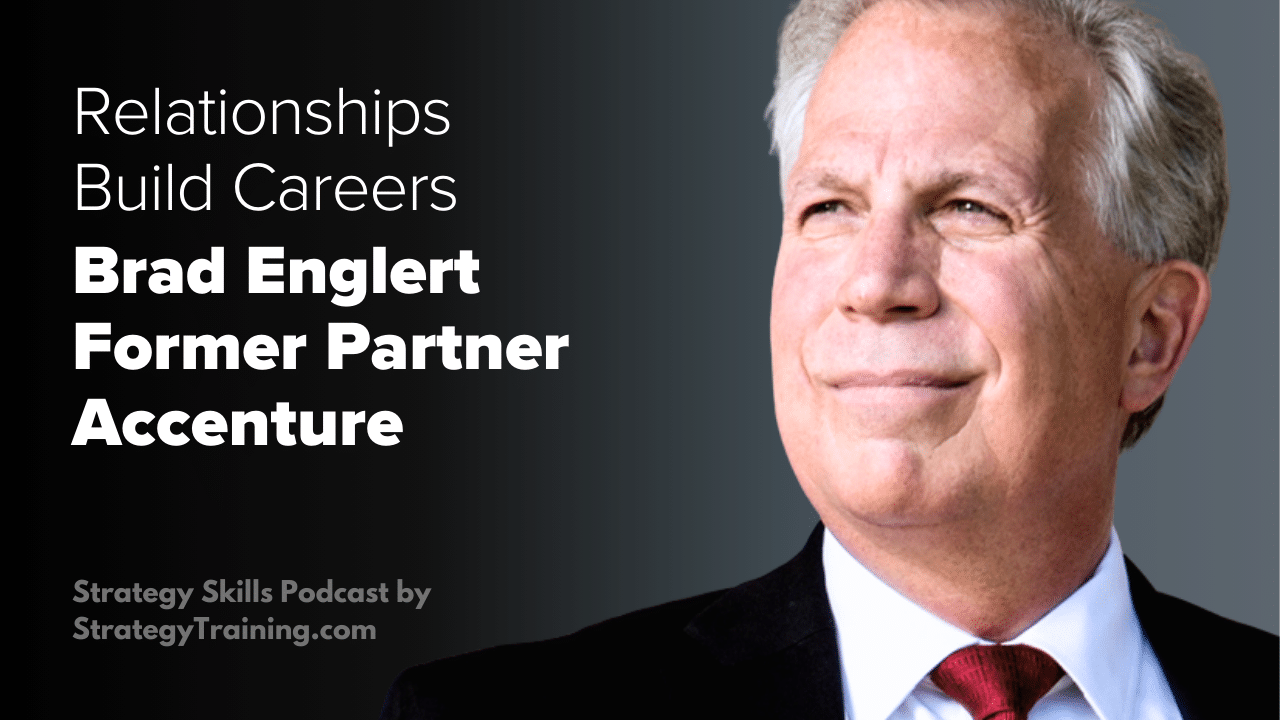
Brad Englert, former Accenture partner, IT strategist, CIO, and author, shares how building genuine relationships has been the cornerstone of his career success. From his early days in technology consulting to leading large-scale initiatives, Brad reveals the mindset and habits that helped him grow, earn trust, and thrive in a competitive corporate environment.
In this episode, we discuss why relationships are the ultimate career multiplier, opening doors to opportunities, mentorships, and partnerships that skill alone can’t guarantee. Brad’s story offers actionable insights for professionals who want to grow their influence, navigate organizational politics, and create long-term career success.
What you’ll learn in this episode:
- How Brad’s career path took him from hands-on technology work to Accenture partner
- The role relationships play in promotions, opportunities, and leadership roles
- Practical strategies for building trust across teams and organizations
- Lessons learned from consulting at the highest level
- How to create a career that’s resilient to change
Brad Englert is a former partner at Accenture, where he spent decades advising clients on technology and strategy. He is the author of Spheres of Influence.
Get Brad’s book, Spheres of Influence, here: https://shorturl.at/GWYuE
Visit Brad’s podcast here: https://bradenglert.com/podcast
Here are some free gifts for you:
Overall Approach Used in Well-Managed Strategy Studies
Enjoying this episode?
Get access to sample advanced training episodes
Episode Transcript:
Kris Safarova 01:07
Welcome to the Strategy Skills podcast. I’m your host, Kris Safarova, and the show is brought to you by our firm, FIRMSconsulting.com, the team behind StrategyTraining.com. If you want to become a stronger strategies, the stronger leader, we have built StrategyTraining.com to be your go to platform. We offer advanced training used by clients at major companies and consulting firms, and you can get started with some of our free resources. Number one is the Overall Approach Used in Well-Managed Strategy Studies. You can get it at firmsconsulting.com/overallapproach. You can also get McKinsey and BCG-winning resume example, which is an actual resume that got offers from both of those firms. And you can get it at firmsconsulting.com/resumePDF. And lastly, you can get Nine Leaders in Action at firmsconsulting.com/gift. And today, we have with us Brad Englert, who has spent 22 years at Accenture, including 10 years as a Partner, and then he served the University of Texas at Austin, including seven years as the Chief Information Officer. Brad, welcome.
Brad Englert 02:17
Thank you. Thanks for inviting me.
Kris Safarova 02:21
Oh, it is my pleasure. I’m so excited to speak to you. Such an incredible career so far, and you have begun as a teacher in Australia, then moved into government consulting and then higher education leadership. Could you give us a little bit of a story of how you ended up here doing the work you’re doing today?
Brad Englert 02:41
Sure. Well, I was an exchange student in Australia and in my last year of high school, so I was fortunate to be able to go back to the same high school and teach for a year and a half, which was a lot of fun, and I realized that I wanted to go to graduate school, so I put a map of the US out on the kitchen table. I grew up outside of Chicago. I didn’t want to be cold anymore, so I said, I think I’ll go to Austin, Texas, because they have a great university there. And so I came to Austin and studied public policy and was also working for the federal government, and I was the payroll officer, and they decided to implement an online data entry for payroll instead of using punch cards. That’s how old I am. And the programmer was a guy with a short sleeve, white shirt, skinny black tie, big, thick glasses, black and a pencil protector. And I said, you know, I don’t want my timekeepers to type 8888, for two weeks in a row, times 6000 employees twice a month. You know, I want all the eights to default. And then if someone’s sick, you know, they just type in when they’re sick or on leave, and the programmer goes, I can’t do it. Well, I didn’t know anything about programming, so he scurried off. He came back a week later, go, I can do it. So he was taught to say no to anything I asked for. Go, ask the boss, and if the boss approved it, then he could do it. And I realized that I needed to get some technical training, otherwise a guy like that would hold me hostage for my entire career. And when I finished my master’s degree, I was studying the use of computers in government. This is our early 80s, and things were really taking off, personal computers and everything. And I was fortunate enough to interview with Arthur Andersen, which became Anderson Consulting, which became Accenture, and they had basically a three year apprentice. College training program, and they taught me and others to code, how to design programs, how to manage coders and designers. And after 20 years, I was managing 20 to $30 million projects with 200 people. And so most of the work at Accenture was in higher education. So my customers were the Ohio State University, Columbia, Vanderbilt, Michigan, Illinois, Cal State, Texas, A and M, everybody but the University of Texas at Austin, they didn’t need any help, and I happily retired and from the firm, and about a year and a half later, I got a call from the chief financial officer, who I had known. He was in private sector before the University, and he said the President would like an IT strategy. He’d like you to serve, because he wants someone who knows higher ed, but outside the university. And of course, you know that’s you. So I started in October, hour week pro bono, so they’re too cheap to pay for my parking or my dry cleaning. And by March, I was half time. By June, I was full time. And eight years later, I retired again, but my first year was h1, n1, swine flu. And the President asked, Could we go online? Well, we have 54,000 students, 4000 faculty, 21,000 staff. Our equipment was eight to 10 years old. Our email system was 18 years old, custom built, and the answer was no, we could not go online. And over the next eight years, we moved as much as we could terms of IT services to the cloud. So the learning management system, student email faculty and staff email the HR Payroll system. So in March 2020, my successor was able to increase the VPN, increase the zoom, and more than 70,000 people went online to do, teaching, research and work and so, but it took eight years.
Kris Safarova 07:27
Such an incredible story. Could we zoom in a little bit on your consulting days, starting with your interview with Arthur Andersen? Very few people can say that. Can you tell us what was it like?
Brad Englert 07:38
Well, the firm has a culture that continued on with Accenture, which is, they highly valued training and mentoring and coaching. And you know, I needed the technical skills, and you know, they provided that, but they also provided the mentoring and coaching to make sure I got the project management skills and got the experience. And I actually went through 22 years of annual reviews, and I read all the coaching they gave me every year. And I’ve frankly, when I finished the book, I talked to my my partner who hired me, and I said, You did a great job. You know, you set out the expectations and and gave me stretch roles so I could act as a manager when I was a senior consultant. I could act as an Executive Associate partner when I was a senior manager, and then you put me in a partner role when I was an associate partner. And the beauty of that is you get to it’s kind of a less risk environment. It’s a learning experience. And you know, if you if it doesn’t work out, well, you didn’t get the job and it didn’t work out, you know, you were able to try it out, and it really was a good cure for imposter syndrome, because you actually worked. I worked as a partner for nine months on a big project before I got promoted to partner. And, you know, I just thought that was wonderful. So I’ve always enjoyed the mentoring and coaching, even as a senior partner. Three months before I retired, I was expected to teach in our training center outside of Chicago global Training Center. I was teaching with other partners. We had 200 people from around the world learning project management. And you know, it’s just such a joy.
Kris Safarova 09:42
Well, they were lucky to have you, and you were lucky to have such an incredible person to help guide you. Not every person has something like that. As you were going through the levels within Accenture, what were some of the skills, or maybe one or two skills that were the hardest to learn?
Brad Englert 09:59
Hmm. Yeah, I think moving from doing technical work to managing people, the wonder, the wonderful thing about technical work is you don’t have to talk to anybody. You’re working on a program and it’s black and white, it’s either going to work or it’s not going to work, you can find the answer, but when you’re dealing with people, it’s a lot harder. So just that transition to manager, where you’re expected to be responsible for the work getting done, but you’re depending on all your your staff, your team and people make mistakes. So just getting used to, you know, being responsible for things that are outside of your control was a skill I had to learn.
Kris Safarova 10:51
And this is such a common issue people are dealing with. What will be your advice? Because I know a lot of listeners now listening to you and saying that is exactly what I’m stuck in with.
Brad Englert 11:01
Well, a woman who was my, one of my mentees, asked me when I made Parker. So what’s it like to be a partner? I think she envisioned a beach umbrella and me drinking iced tea and, you know, not working. And I said, You know what? It is very hard, because instead of spinning plates, you’re spinning platters, and when they fall and break, they make a really loud noise. But I think to answer your question, it’s really working with your peers, working with your boss to so when you run into issues, you know, you get the help you need, and it’s better to ask for help than not ask for help. And there was one of my bosses had a phrase, I want good news fast and bad news faster, because he could help me.
Kris Safarova 11:59
Of course. Do you remember your first sale?
Brad Englert 12:03
Wow, yeah, it was a strategic plan for a Texas state agency that was responsible for water. Well, we don’t have a lot of water in Texas, so it’s kind of like oil, it’s very important. And, you know, I just, we just put together a team that had all the skills and the CIO, who I was working for, I had worked with on a prior project at another agency. So we had a history of successfully working together, and so, you know, it was really fun to reconnect with her and then have a successful project, and actually two more that followed from that.
Kris Safarova 13:01
For many of our listeners, becoming a partner, one of the challenges is, of course, making sure that they bring in enough business. What would be your advice for someone who is struggling with that?
Brad Englert 13:11
Well, I think you need to get out of the office and you go, need to go meet with your customers. You need to ask, what are their goals and aspirations? If you can help them? Then talk about how you can help them so set and manage expectations. And frankly, I was bad at that early in my career. I got better at it later in my career, and then third, genuinely care about their success. And so probably 80% of Accenture’s clients are repeat clients, and these are the top Fortune 500 companies and organizations. Well, why is that? Because success breeds success, and you build trust, and it’s if you’re trying to sell, it’s easier to sell to an existing customer and less expensive than just sell to a new customer. And so we were always taught to when we finished a big project, you didn’t just let go of that relationship, you would continue nurturing that relationship. And you know, from day one, I was taught that the person I work with, whether it’s my client or my peer, might be my boss someday, or they may be a customer someday. And 2527 years after I started with the firm, I became Chief Information Officer at the university. The same year that a fellow I started with became chief information officer of a huge organization. And same year, 27 years later, so and he became a client.
Kris Safarova 15:07
Brad, and you mentioned that it was difficult in the beginning, and then you got better in terms of managing so on. What helped you get better?
Brad Englert 15:15
So, great question. I read a book called Managing expectations. And a woman named Naomi carton, who was a psychologist, who went into it, and so she had these techniques of you know how to better manage expectations, especially with people who want everything faster and better and blah, blah, blah. And her, one of the her techniques was just say, whoa. So I had a type a partner who everything, whenever you talked with her, everything sounded urgent, urgent. And so one evening, I was trying to leave on time to have dinner with my wife, and literally, five o’clock the phone rings and it’s the partner, Brad. I need a white paper. Oh, white paper. And I was scared, but I literally said, Whoa, because if I said no, they’d get her upset. But I just said, Whoa. I said, When do you need this white paper? And she was, oh, let me check my calendar. I need it in two weeks. Okay, how many pages do you want this white paper to be? Oh, three pages. I was thinking, 10. Do you have an example of a white paper that I could use? Yeah, yeah, ask David. I did one on XYZ Corp 10 years ago. Well, guess what? I went home and had dinner with my wife. Now, before, before I learned to say, Whoa, I would have called her and canceled dinner, upsetting her and me. I would have stayed up all night and delivered the next day a 10 page paper, and then I’d get yelled at for not meeting expectations just by using Whoa, it created some mental space and time To really understand what was needed. And after that book, I never missed a vacation, I never missed training. I just got I found balance in life because I used my words. And, you know, if I needed something, I would set those expectations.
Kris Safarova 17:39
This is such a great example, because I can’t even imagine myself when I was a management consultant and the partner calls you and says they need something, your answer is yes, exactly. Maybe only because you asked all those questions. She said, two weeks, and if someone said yes, I will get it done by tomorrow, she would say, Yes, great. Thank you.
Brad Englert 18:02
Yeah, that’s right. So I had a client, a large university in the Midwest, who asked me to lead this transformational project all their administrative systems. Great client, a wonderful place, and they had everything to be successful. And this was, you know, January, I was interviewing with them, and I said, I’d love to come help you. However, next June, I have a long standing vacation planned to Australia. I was an exchange student there last year was my 25th high school reunion. I had to cancel it because of work. So my wife and I have passports for us and the boys, we have plane tickets, and it’s three weeks next June, and the provost, the CFO, said, Well, sure, yeah, no problem. So we started the project. And in March, we had a major milestone. Yay. April, another major milestone. And in the monthly meeting with the President, the provost and CFO, I said, Mr. President, wanted to remind you, as I have the last three months, that in June, I’ll be going on vacation to Australia, and his hand started shaking, and so in slow motion, I’m canceling my vacation, whoa. And the chief financial officer said, Brad, wait a minute. Hold on, Mr. President. When Brad joined us in January, he talked about this long planned vacation. It’s important for him and his family. We should, we should let him go. Diane’s going to be in charge. He’s Brad. Says this is a good time for him to be gone. So I went to Australia. Did not check email, did not check voicemail. Yeah, and 10 years later, and Diane did a great job, by the way, so 10 years later, I’m in that Midwestern city having dinner with the CFO and his wife and and my spouse and he we talked about that time, and he said, Brad, when you were gone, the provost and I were scared to death, but they committed to let me do the vacation, and they stood by it, even though they were nervous about it. So my client actually supported my vacation.
Kris Safarova 20:36
And anyone who is in consulting now understands what it was really like, because usually on those projects, you don’t even have time to sleep. You’re talking about vacation to Australia.
Brad Englert 20:48
Well, and they’re paying us a lot of money. So if they should be there, I would be there.
Kris Safarova 20:54
I know. And maybe that’s why they said you should go, because they knew how committed you are and how important it was for you to spend time with your family.
Brad Englert 21:01
Best client.
Kris Safarova 21:02
I have a question on wall. I think that’s an amazing approach. One concern that I immediately had, it seems a little casual. Did you ever felt that way? Did you ever had people reacting why you’re speaking like this? This is a professional environment.
Brad Englert 21:20
Well, you don’t always have to say the bow, you know, it’s, it’s when you’re dealing with a type A personality that is impatient. But with my client, I just used my words, you know, I just said I set the expectation, you know months before. And I have two phrases in the book. One is, use your words. So if you want something, you need to tell people, whether it’s your boss or your direct reports and and the other phrase I have is people are not mind readers. So when I was the boss and I asked someone to do something, I would stop myself, and we’d discuss when it needs to be done, what kind of help they need to get it done. You know, I would not just bark an order, you know, and expect them to read my mind. So I was always conscious of taking the time to set those expectations.
Kris Safarova 22:28
Makes a lot of sense. And I think even if you just say it in your head, Whoa, it’s just kind of stop and then set expectations. Don’t jump into saying yes.
Brad Englert 22:38
Yeah. I had one of my direct reports, read the manuscript, and she said, you know, the thing you did with me is you slowed me down. Because, you know, she’s super smart, super achiever, and she would always rush to the solution. And, you know, I would say, whoa or not, whoa, but slow, I said, let’s understand what the problem is. And yeah, it kind of drove her crazy in the beginning, but she’d learned to think, if I spend more time on what the problem is, maybe I don’t have to rush to a solution. I had one of the techniques I described in the book, is intentional foot dragging. Sometimes I would drag my feet on a decision just because it didn’t have to be made, right? It was a decision not to decide. And you know that that takes some discipline.
Kris Safarova 23:39
It does, but it is a very smart thing to do in many situations, because if you can allow more time, you can get a lot more information and then make a better decision. That’s right, absolutely. Or you can make some decisions, but you know, it is temporary and you’re still gathering information. Yep. So you mentioned earlier, and of course, everyone in consulting knows that is the case, that once you finish a project, you need to maintain the relationship with the client. What would be your advice on how to do that for someone who is just starting out as a more senior leader within consulting and needs to learn how to do it?
Brad Englert 24:16
Well, well, the people you start with early in your career will most likely follow you as you rise in your career. They will rise in their career, just like my CIO friend and so just staying in touch with those people where you’ve had a successful outcome, you know, it doesn’t take much. It can be once a quarter have lunch. It could be hybrid. It could be virtual. Yeah, I could stay in touch with my Ohio State client on the phone. You. And, you know, it’s, it’s always, how can, how can I better understand, you know, their goals and aspirations. If I can help, I’ll help. Sometimes I can’t help, but I, but I know someone else who can help. And then, you know, just reaching out, letting them know you care. And I’ve never had anyone when I asked, What are the goals of aspiration? Say, oh, you know, I don’t want to talk about it, or I don’t know, some people good at expressing it. Some are not so good. But you have to ask it, it’s, it’s, it’s a learnable skill. You don’t have to be born with the ability to build an authentic relationship. By authentic, I mean mutually beneficial and trusting and enduring. And I’ve had a client call me at the university. It was that client at that water agency. This is 15 years later, maybe 20 years later, and her son was moving to Austin to and he was applying, he’s an attorney, applying for a job at the university. And she said, What do you talk to him? I’m just like, Of course I will. And it was like, we hadn’t stopped talking. You know, it just, we just picked up where we left off. Now, I knew her son when he was five years old. That’s when I first met him. He’s an attorney, and so I talked with him, and I said, Look, in higher education, everyone shares information with each other. So all the CIOs talk to each other. All the lawyers talk to each other. There’s the Association of University attorneys. They have a website. You can list all you see, all the issues they have that they’re dealing with. And when I needed a contract with Google, I didn’t start from scratch. My attorney contacted the University of California, Berkeley attorney who had a Google contract, and we used their contract, and you know, so he studied all those issues, and he got the job with your help.
Kris Safarova 27:13
That is incredible. Such strong relationships kept over many, many, many years.
Brad Englert 27:19
You know, when I, when I applied for the partnership, you know, the candidacy, we had to list all the C suite level relationships we had, and that couldn’t be a black sheet of paper. You know, you need to so starting early in your career and just continuing with that, you know, when I got to the university, my direct reports didn’t know the importance of getting out there and talking to people, so I set the expectation that I would meet with my peers across The University. So the VP for public safety, the Vice Provost for curriculum, the Associate Dean in engineering. You know, my peers and I would meet with them, usually on a monthly basis, and just find out, you know, what are they working on? I share with them what I’m working on, and just like clockwork would show up. I expected all my direct reports to do the same. So go meet with your peers. So we basically talked to 70 to 80 people a month to get feedback and how we’re doing and how we can improve. And another one of my direct reports read the manuscript. She said, Brad, you don’t have my story. I said, what story? When you ordered me to go meet with this manager who hated us? I said, Oh yeah, I remember that. I said, I’d rather have that manager in the tent with us than outside the tent, throwing rocks, and there was some past bad behavior by the prior regime, and so I said, just go out and apologize for all those bad actions. Let them know we’re not going to do that anymore. And after about eight or nine months that manager became an advocate for us, and her boss, who also didn’t trust us because of past bad behavior, also became an advocate. That doesn’t happen if you’re hiding in your office or hiding behind a screen all day.
Kris Safarova 29:37
Very true. It really pays off to try to build relationships with executives that don’t like consultants, maybe because of your firm doing something that they didn’t like, or even another consulting firm they just had that experience. So you already partially answered this question, but I wanted to talk a little bit about it so asking clients about their goals and aspirations that can reach. Organization went beyond just goals and aspirations for the department of the organization so all, or even maybe beyond the client’s professional goals, but also maybe going into the area of family goals and so on. Can you talk a little bit about that?
Brad Englert 30:19
You know, people are usually ready to share that information. When I was on the other side of the table, I was the customer, and I had vendors. I would get really impatient with a vendor who showed up and had not taken the time to look at my website, you know, on the central IT website, we listed our values as an organization, our mission, our vision, and listed all the strategic projects for the year, and that was updated every year. So new learning management system, new student email, new faculty staff email box for file sharing. You know, it’s all there, and they would show up and didn’t even do their homework. And that was pretty frustrating for me. So I looked at all our vendors, you know, we were spending millions dollars a year on different vendors. I didn’t meet with all of them, but I prioritized who are my most strategic vendors. And I would meet with them, my account rep, the account reps, boss and their boss quarterly, and we would talk about, you know, what our major initiatives are we they’d share with us new products that are coming out. And I had the purchasing director there and his staff. And sometimes we would just ask, how’s the relationship going? And being a huge bureaucracy, sometimes we’re late paying bills, you know, I need to know that, and because I want to be a good citizen, you know, they, they need be paid on time, and so, you know, that was a really good way to align, you know, them, When we built a data center, $32 million data center we had budgeted for the current line of network year. Well, a year later, the next version, the new line of network year, came out much more capable. Would last three to five years longer than the old and I just went to the network vendor and said, Look, we only buy your stuff and we buy millions of dollars. Could you discount the new gear to what we budgeted for the old gear? And I said, I will be the best reference he ever had. And you know what they did that they discounted it. We were one of the first large universities to use the new gear, so that was helping them. And you know, it lasted five to three to five years longer. So just knowing, you know where they were headed and where we were headed, and then how we could mutually help each other. You know, I had another vendor who only showed up once a year to get their check, their maintenance money, which was always 10% more than the prior year, very unresponsive. Their software. It was the learning management system. So all the courses for 54,000 students and 4000 faculty were in this old 1990s software. And the students favorite word was, it’s clunky. And so I met with the Vice Provost for curriculum. She was frustrated with the tool as well, which we could not securely connect email to it, which is really unconscionable. And so we went to the market, reviewed 15 products. The faculty and students picked the new product, which was in the cloud, so no on premise. It was modern. It looked like Gmail, very intuitive. It used industry standards, so we could plug tools in in hours securely, not never insecurely. And it took us two years to transition because we’re so big. And her the Vice Provost team, which Center for Teaching and Learning, her team helped faculty in the classroom. Room and my team, we work the technical side, and sometimes they needed changes from the vendor. Well, I had built a relationship with the Vice President of Sales for the this new company, and I would ask him, can you make this change for us? It’ll make your product more valuable to large universities like us. And you know what? He did it, and he would call me once a month for two years just to see how things were going. He didn’t have to do that. And I still talked to him. He’s on two more companies later, I still talk with them, because there was just mutually mutual respect there, and he cared. And I’ll never forget, after we finished the two year transition, an email was sent to the President, copying the vice provost and me. I just saw it. I thought, Oh, I’m going to get fired, because we basically irritated everybody on campus, but they loved the new product, so there was kind of a natural pull. And this email was from all the department liaisons, saying how much they enjoyed working with the Vice Provost team and my team, and what could have been, you know, 1000s of issues gone wrong. You know, we worked with them with humility, and we even had some laughs along the way. And it was this very complimentary message to the president, which the vice provost and I were very happy to see we had a big celebration. The campus. We have a bowling alley. We had pizza and cake and everything. I had a cake made that was in the shape of a tombstone, and I had the name of the old vendor on it. Rest in peace. And you know, the account rep for the old vendor was so clueless. He didn’t even know we were transitioning for two years away from his product. I mean, you know, he didn’t even know he’s being fired.
Kris Safarova 37:12
It just so hard for me to comprehend, because it just such a natural thing to care about your clients and making sure that they succeed with whatever you offer.
Brad Englert 37:22
This some sales people are worried about transactions and numbers, and they don’t really care, you know, if they can keep the numbers going. And I had two account reps that were not truthful, and so in that because I had built that relationship with the account reps, boss and the boss boss, because we were big enough that I could go to them and say, here’s what happened. I need a new account rep. And so I swapped out two account reps who were not truthful.
Kris Safarova 37:56
And that is very important to though, Brad, I want to make sure we have enough time to speak about your book. So you recently wrote the book, what would you like people to take away? What are the key things you want someone to take away after they read in it? Some of the key things I know you cannot summarize everything, but maybe a few things you want them to take away.
Brad Englert 38:15
Well, I want people to know that this is a learnable skill to build relationships that are authentic and that you just need to put it on your calendar. You know you and you don’t have to meet all your customers. You know be strategic and intentional. Who are your best customers, your vendors. You have to meet with all of them. But who are your most strategic, your peers? You know, I didn’t work much with the vice president who generated electricity, but I certainly worked a lot with the Vice President for Public Safety, because it was not if something would go wrong, but when it goes wrong, and what do we do? And we had a bomb scare, we had a shooting, we had a murder, you know, we had to work together over eight years, and we did very effectively. So just be strategic and intentional. And, you know, just start with your boss, start with your direct reports. You know, start small, and just try to understand goals and expectations, set, manage expectations and care. And because that’s those principles apply to all business relationships, it’s an Amazon bestseller three categories, leadership, training, mentoring and coaching and customer relations. And I was pleased about that, because that was the goal when I started writing the book, and it’s really for aspiring and established leaders.
Kris Safarova 39:47
And by the way, that means now much more than it used to, because Amazon just changed the algorithm in around June, May, June. For a while, no one knew, did they change the algorithm, or is it a glitch? But then in June. Became clear, they changed the algorithm, and now it’s much harder to become number one seller. So it is a huge testament to the quality and the value that you’re delivering. Where do you think readers will struggle the most? So someone diligent, they are like you and me, they’re they’re very responsible. They want to do everything they can to succeed and to deliver value and to be the best professional they can be. And so they’re reading your book, making a lot of notes, and they decide to implement things. Where do you think most people will struggle, most people who diligently want to implement what you’re teaching them?
Brad Englert 40:33
I honestly think it’s inertia. You know, it’s easy to let a month go by, two months go by, three months go by, and we’re so busy being busy that, you know, there’s a cure for it, and this is what I asked my direct reports. Just put it on your calendar in a recurring meeting, and it’ll pop up. It’ll remind you. And then, before you reach out. Think about, you know, what do I need to be talking to this person about? You know, what am I doing that they should know? You know, we replaced 21,000 phones. That irritates everybody. So, you know, I need to let them know it’s coming and what we’re doing to mitigate but, you know, I think I’ve seen where people just let it slide, and you don’t have to do that. And with my direct reports, I just asked to put it on their calendar and and send an agenda before you go ask for feedback. I had one peer who’d call me with rumors. You know, it’s like, Hey, I heard a rumor that you don’t have enough diesel in the generator at the data center. You know, that’s a darn good rumor. I’ll go check. You know, I checked, and diesel was topped up every month, and once a year we flushed it, you know it was, everything was fine. So I called him up and said he could, he can stop that rumor right now.
Kris Safarova 42:06
Very interesting. So for someone who’s listening now and thinking, you know what, I would like to call clients more, but they never know what to talk to them about, how do I make sure I’m not bothering them without a reason, without them reaching out to me and asking me for advice. What would you say to someone like that who feels uncomfortable that they will be bothering someone taking up their time?
Brad Englert 42:28
I think you need to just get around being uncomfortable. You need to take a risk. And you know, my experience is, someone asked me the other day, you know, did any of your peers not want to talk to you? I said, no, they all wanted to talk to me. They were glad that I came to talk with them, you know, and Mark and we were bad, you know, the before we changed the culture. We were very reactive and rewarded heroics. We were a bad partner. And, you know, I worked with VP for facilities, 16 million square feet of buildings. They all have it. How do we work together? I literally sat down so I want to be a better citizen. I want to be, you know, we’re building this data center. We’re doing it together. What can I do to be better? Yeah, people in welcome that. And when I was the boss, I always welcome someone my direct reports asking for help, or I had a brand new director, probably weeks two of him working for it. He had a this big project that was due in the summer. And he said, Brad, I don’t think it can be done by the summer with quality. And I said, well, one, thank you for having the courage to say something. Two, it took us 40 years to get this way. What’s another six months? It’s just, you re look at it, come up with a plan. Let’s talk about resources. That’s just an arbitrary day, and the old director is gone. So we can, we can reset it.
Kris Safarova 44:20
And that’s such a smart thing to say, because rushing and doing a bad job, that is why.
Brad Englert 44:27
Many IT spending the date and doing a bad job is not a way to do it.
Kris Safarova 44:31
Absolutely not for someone who is still kind of struggling. Let’s say they want to maintain good relationships with a client, let’s say it isn’t consulting. Are there maybe one or two phrases they can use when they, for example, reaching out their client via email or giving them a call?
Brad Englert 44:50
You know, I would do my homework first. You know an organization’s mission, vision, values are all on their website. Yeah, so do your homework, and sometimes you can even see budgets and everything you know. So just especially in the public sector, but even private sector, you know, a company’s website and Starbucks has a vision, you know. So just do your homework and then ask yourself, how could I help? And, you know, throw out some ideas.
Kris Safarova 45:25
That’s such a good question. How can I help? Who doesn’t want some help? We all have so much on our plate, and we all would like some help.
Brad Englert 45:35
You know that VP for public safety earned his doctorate at The Ohio State University, which was one of my best clients. I walked into his office and he has all this Ohio State stuff all over the place. We bonded immediately. I mean, it was like, I love Ohio State. He loves Ohio State. You know? It was just an immediate connection.
Kris Safarova 46:00
Of course, that is another important point. Find a way to connect on something personally. There’s always a way. We went to the same school, we lived in the same country, we speak with the same accent, all kinds of things. Kids.
Brad Englert 46:15
Of course, children.
Kris Safarova 46:17
So I want to wrap up our discussion today with one or two questions that I love to ask when there’s an opportunity, when there’s still enough time. So first one, my favorite question, over your entire career, your entire life, can you share with us two, three aha moments, realizations that you feel comfortable sharing that really change the way you look at life or the way you look at business.
Brad Englert 46:40
I think I’ll go back to the mentoring I got at the firm, which was, you need to treat everyone you work with with respect and empathy, because you just never know. 20 years from now, you know where people will be, and whether it’s the executive assistant to the Chief Information Officer, you know you need to you know, be professional and and respectful. Be a good person.
Kris Safarova 47:18
100%. Any other aha moment or realization that comes to mind?
Brad Englert 47:24
Just get out of the office and let people know you care virtually or hybrid.
Kris Safarova 47:31
Such a good phrase. Do you have any success habits that you really rely on to allow you to be an effective leader, great father, great spouse and so on?
Brad Englert 47:45
Well, I am a big believer in communication often. So when I started at the university, I had that central IT group 330, people, $40 million dollar budget, but it was a fire drill culture that rewarded heroics. And over 789, months, we turned it into a proactive, customer focused organization. And you know, three out of seven directors left, and so we brought in fresh perspectives. But I wrote a blog once a week for eight years, very short, maybe 200 words, and the blog would talk about our values. The blog would talk about major projects. It would talk about kudos for staff who were lauded by the customers. I would apologize when we screwed up and okay, we had an outage. I’m sorry it happened. This is what happened. This is what we’ll do to keep it from happening in the future. Please forgive us. And that blog went out to 330 people on my team, and it went to about 300 other people on campus or other university campuses interested in it at UT. And I learned the hard way that as the leader, you cannot rely on your direct reports to communicate your messages, because some managers are bad at it. Some don’t know you should do it. Some hold the information for power. So forget all that. I’m not going to have the grapevine work. I’m going to have my consistent messaging, you know, once a week, short for eight years. And you know that’s the way to change, change the culture and build up confidence in your customers. You. Communication, open and honest, so important. And apologize when you mess up. Don’t over apologize, but you know, in appropriate measure.
Kris Safarova 50:13
Of course, Brad, thank you so much for being here. Where can our listeners learn more about you? Buy your book? Anything you want to share?
Brad Englert 50:22
I’m on LinkedIn, so you can join me there. I have my website is bradenglert.com and I’ll send you a link to my website so your listeners can get a free sample the book, a tab on how to buy the book, and a tab to schedule time on my calendar.
Kris Safarova 50:41
Amazing. Our guest today was Brad Englert, author of Spheres of Influence. This episode is brought to you by StrategyTraining.com. If you want to strengthen your strategy skills, you can get the Overall Approach Used in Well-Managed Strategy Studies. You can get it at firmsconsulting.com/overallapproach. It’s a free gift. You can also get McKinsey and BCG-winning resume example, which is example of a resume that got offers from both of those firms. You can get it at firmsconsulting.com/resumePDF. And lastly, you can get Nine Leaders in Action, which is also a book that went to number one bestselling multiple categories, and it is at firmsconsulting.com/gift. Thank you so much for tuning in, and I’m looking forward to connect with you all next time.
Leave a Reply