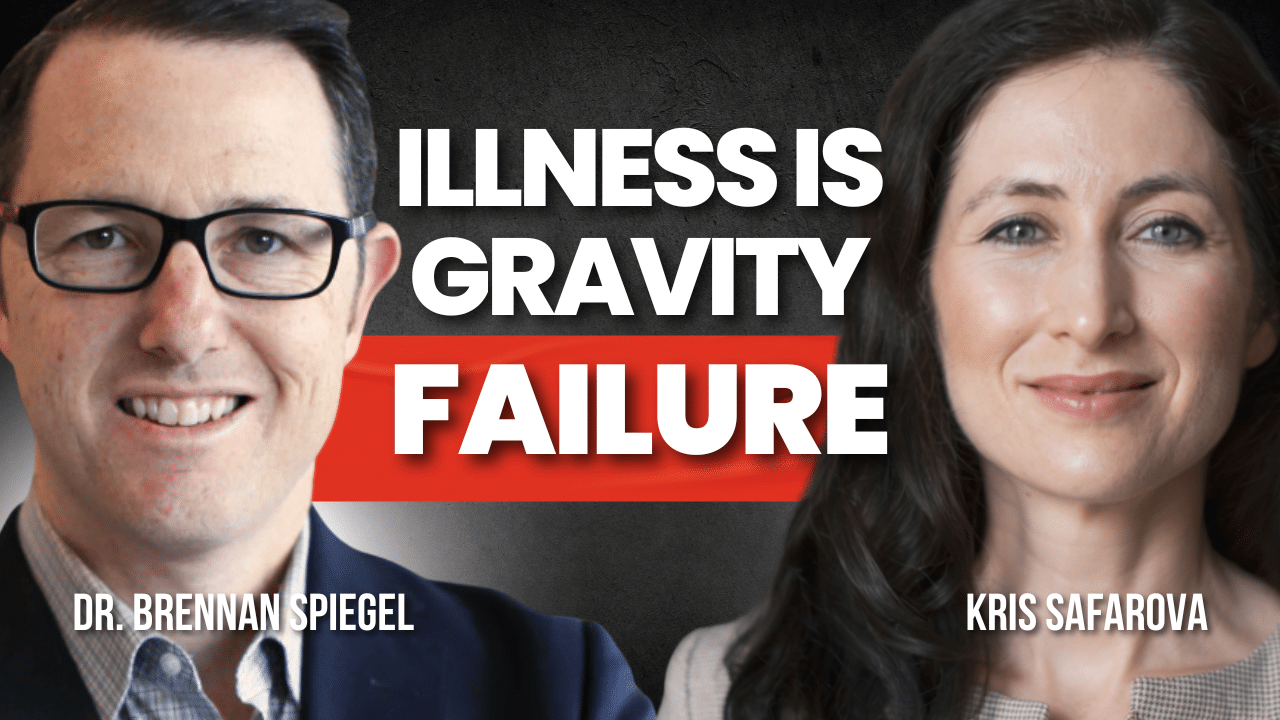
Dr. Brennan Spiegel, Director of Health Services Research at Cedars-Sinai and Professor of Medicine and Public Health at UCLA, author of the book Pull, explains why illness is often a failure to manage gravity.
He describes how our relationship with gravity defines strength, balance, digestion, mental stability, and emotional health.
Take the Gravotype Quiz at BrennanSpiegelMD.com to identify how your body manages gravity.
Key Insights and Action Steps — Dr. Brennan Spiegel
“Every single cell of your body evolved from this force of gravity. Physics came first, and biology came second.”
Illness arises when we fail to manage gravity. Every organ, tendon, and cell depends on that relationship.
“When you stand up straight and lift your diaphragm, it pulls up this sack of potatoes that we all have in our belly. When you open up the gut, it opens up digestion.”
Posture determines how well the gut, diaphragm, and circulation function. Sitting compresses digestion and lowers energy.
“Your balance and relationship to gravity is a predictor of how long you’re going to live.”
Balance, grip strength, and posture are measurable indicators of longevity.
“The inner ear is like a gyroscope constantly keeping track of your position in relation to gravity.”
The nervous system continuously measures gravity. Inner-ear disturbances can create dizziness, anxiety, and panic.
“When you’re depressed, you can’t get up out of bed. Your body is slumped over. It’s almost like there’s so much gravity pulling on your body, it’s like you’re in a black hole.”
Depression mirrors an excessive gravitational load. Emotional heaviness is a physical experience of being pulled down.
“Strong negative emotional experiences can permanently change the way the brain forms… the mind has learned to be pulled down emotionally, physically, socially.”
Childhood trauma reshapes how the brain perceives gravity, making the body feel heavier and slower to rise.
“The feet are a gravity management surface… only five percent of the body’s surface area but holding one hundred percent of the weight.”
Feet are the interface between body and planet. Strengthening them restores alignment and balance.
“Your relationship to the planet, both latitudinally and altitudinally, will determine your health.”
Altitude, light, and environment influence serotonin, immunity, and microbiome function.
“Serotonin itself is a gravity management substance.”
Serotonin regulates mood and physical stability, linking emotional and gravitational balance.
“When it’s stimulated, it activates the rest and digest phase and helps release serotonin.”
The vagus nerve is the primary connection between body and mind, calming the system and improving serotonin flow.
“I pretended I was on a bigger planet… I became stronger and stood up straighter.”
Carrying additional resistance through weighted movement improves posture, strength, and metabolism.
“When we lay down to sleep, we give our body a break… the blood easily flows into our brain and flushes out amyloid.”
Sleep restores gravitational equilibrium and supports brain recovery.
“Gravity doesn’t change, but your relationship to gravity does.”
Long-term health depends on strengthening that relationship physically, mentally, and emotionally.
Here are some free gifts for you:
Overall Approach Used in Well-Managed Strategy Studies
Enjoying this episode?
Get access to sample advanced training episodes
Episode Transcript (Automatic):
Kris Safarova 00:49
welcome to the strategy skills podcast. I’m your host, Kris Safarova, and this episode is sponsored by strategytraining.com and you can access the key insights and practical action steps from today’s discussion, which will be a very important one at firms consulting.com forward slash action, and today we have with us Brennan Spiegel, who is the Director of Health Services Research for cedars, Sinai Professor of Medicine and Public Health at UCLA, and the author of pull how gravity shapes your body, steadies the mind and guides our health.
Brennan Spiegel 01:26
Brennan, welcome. Well, thanks so much for having me. Appreciate it.
Kris Safarova 01:30
Such an interesting topic. Most of our listeners will have no idea what you’re going to talk to us about today. So where do you think we should start?
Brennan Spiegel 01:39
Well, there’s so many places to go with this topic, which is all about your health, about your well being, and about how your relationship to the planet itself and gravity will help determine your longevity, both at work and outside of work. So we can go in many directions.
Kris Safarova 02:01
You write that every cell in our body evolved to manage gravity. What actually happens in the body when we start losing that ability?
Brennan Spiegel 02:11
Yeah, so I like to think of our relationship to gravity almost like a fish in water. You know, a fish is designed to survive and to thrive and move through water. It doesn’t, I don’t think, no, it’s in water, but that’s how it evolved. And we are the same way with gravity. Every single cell of your body, every tendon, every organ, evolved from this force of gravity, physics came first and biology came second. And so if we don’t manage this force, we start to break down. You can think about low back pain, one of the most common causes of work productivity. Loss of pain is a consequence of gravity intolerance. You might get swelling around your ankles. That’s a form of gravity intolerance. You may feel dizzy and get lightheaded when you stand up too fast or feel like you’re spinning. That’s also gravity intolerance. And if you look at almost every single chronic illness, and this is what I talk about in my new book. It can be tracked back in some way to mismanaging the force of gravity,
Kris Safarova 03:30
and to test how far this goes, if someone has gum issues, is there gravity involved?
Brennan Spiegel 03:37
Well, that’s really interesting because, you know, it’s almost like a like a game. Every single condition we think of is there’s some way of tracking it back to to gravity, and that’s a tricky one, but I will say that even in your mouth, okay, gravity pulls everything to the floor of your mouth, and when you have something like acid reflux, where acid comes up and gives you heartburn, sometimes the acid comes all the way up into the mouth, and then gravity settles it down into the bottom of your mouth, and it can start to cause lower gum problems, as opposed to upper gum problems, it even can start to erode the enamel on your teeth. Now, this is an interesting example, but even something like that has to do with the fact that you’re always upright and the bottom of your mouth is great, is more exposed to certain to saliva, to acid, to bacterial content. So, yeah. I mean, hadn’t never thought of that before, you asked. But sure, we can even tie that back to gravity.
Kris Safarova 04:46
Brennan and you mentioned, physics came first and biology came second. Can you elaborate on that? Yeah.
Brennan Spiegel 04:52
So you know, we are a product of this planet. We are a consequence. Kris of this planet, and our ancestors, we think probably, came from the oceans where, you know, there was gravity, but it was a floating world. And then once these amphibians came on to land, they got hit by gravity, and so they needed to find ways to stand up and stay up through developing pumps and tubes, hydraulic systems in the body. And this has all sorts of consequences for how we live today. We all have a little bit of the ocean inside of us. We brought it with us with this salt water, and it’s mandatory for us to survive outside of the ocean. So just think about, for example, why it’s so important to drink fluids to stay well hydrated. If you’re at a standing desk at work like I am right now, I need to have enough fluid to pump blood and oxygen up into my brain, just like you need it in order to speak with me right now, we have to maintain this hydraulic pressure inside the body. That’s one of hundreds of examples of how our bodies every second, are managing the force of gravity. And even your nervous system is even your mental health is tied into gravity management in really interesting and unexpected ways.
Kris Safarova 06:25
Brennan and you said that illness is a failure to manage gravity. Can you explain to us, how can we know if our body is at a point where it is struggling to manage gravity?
Brennan Spiegel 06:36
So in the book that I published called Poll, I talk about eight different gravi types, and everyone falls into one of these eight different categories. And I actually have a quiz online that you can take. It has 16 questions, and you answer the questions, and it will tell you which of the eight gravity types you belong to and so the questions are things like, you know, how long can you stand on one leg without feeling like you’re going to fall over your balance, in relationship to gravity, is a predictor of how long you’re going to live. Do you get lightheaded easily if you stand up quickly from a seated position, you might ask yourself, How long can you hang from a pull up bar? Not even. How many pull ups can you do just if you were to hang and defy gravity, like the song says, How long could you do that for before you give out and get pulled back to the ground. There are many examples like this that you can look at how strong is your grip that also predicts your survival. All of these are related to how well you literally stand up to this force of gravity and stay up for as long as you can and as well as you can, until eventually gravity pulls us back, physically, back down to where we came from. So yeah, there’s a quiz you can take, and on my website, Brennan Spiegel, md.com, you can, you could find a link to that and get some get a report,
Kris Safarova 08:14
and most of our listeners would be extremely driven successful, push themselves to the limit for decades, and their bodies are starting to show signs of issues. And I think that many people going through the quiz will realize, hold on, how do I fix it now? Now I know there’s a problem. I had no idea I had. How they fix it. Where did it start? Yeah.
Brennan Spiegel 08:39
So the way it works with these gravi types, is it gets broken down into three parts. And the first part I call gravity fortitude. And this is just literally, how strong are you? How well can you stand up? And when you stand up straight, and you have a strong back, you lift up your diaphragm, and you bring your shoulders back. And when you lift up your diaphragm, it pulls up this sack of potatoes that we all have in our belly. That’s the gut. Now I’m a gastroenterologist, so I spend a lot of time thinking about that part of the body, but that part has to get pulled up. And when you open up the gut, it opens up digestion. Whereas, if you’re constantly sitting down at work or in airplanes or traveling and sitting down and compressing your belly and leaning over screens, you’re literally compressing the gut, and it’s causing a stagnation. It can lead to bacterial overgrowth, problems with serotonin production. So this is the first part of the gravitype is, how strong are you? How well are your pumps and tubes moving your muscles and bones, your back, your abdominals? How much weight are you carrying around? How much pressure is. On your bones, and that’s the first part. The second part is the nervous system. How well is your nervous system detecting the pull of gravity itself? So the inner ear, we all have a vestibular system, which is like a gyroscope that’s constantly keeping track of your position in relation to gravity, and it helps you not only stay balanced, but it literally helps you stay focused as an individual self. We are all individuals, and your vestibular system grounds you in your body, physically and emotionally even the third part is your mental gravity. How up or down are you? So this is not just a metaphor. You know, when people take psychedelics, they say that they’re high. Think about that word high is up. When you’re depressed, you’re down. You feel down in the dumps, down on the ground, down on your luck, heaven is up and hell is down metaphorically. And when we’re falling physically or metaphorically, we get gut feelings. Think about on a roller coaster when you’re falling, your belly lights up. Some people hate that because they feel that all the time. My patients who have chronic abdominal pain and anxiety often feel like they’re on a roller coaster even when they’re not. That’s mental gravity, and this is the idea that your emotional relationship to gravity determines how you feel and act in the world. So those are the three big categories, and that quiz helps you get a score for each of those and tells you which of the eight gravitypes You’re in and what to do about it.
Kris Safarova 11:51
Brendan, so if someone has something like Candida that may be related to the first one, how strong you are?
Brennan Spiegel 11:59
So that’s an interesting question. So, yeah, Candida is, you know, typically a fungal infection, right? Is that what you’re asking about, and it can affect, especially the esophagus. So we see this condition in individuals who have, you know, low immunity. For example, people with HIV or AIDS will have Candida and so even there, you can imagine how gravity fortitude has something to do with it. If you’re upright all the time and swallowing and the fluid is going down, it helps to clear out the esophagus, but at nighttime, when you’re lying flat, you don’t have the clearance. And that’s one way that a fungal infection can take hold of your esophagus, because you’re not literally clearing it out. Now, in another example that’s more common, back to acid reflux disease. A lot of people get heartburn. They eat too much food too late at night, they’re overweight, they get heartburn, acid comes up the esophagus, and at nighttime, they can get really bad heartburn and burning and wake up in the middle of the night. That’s a gravity problem too. And what we tell patients is at nighttime, including if you have Candida, is try to lift the head of the bed a little bit, either with blocks underneath the legs of the bed, or with a wedge pillow to help shift up your body about 10 degrees, to help use gravity to clear out the esophagus at nighttime, so that you aren’t at risk for acid reflux disease or stagnation, which could promote candida overgrowth. Let’s say if you’re at risk for that.
Kris Safarova 13:42
So interesting. And then the second one was nervous system. And you spoke about how well regulated nervous system supposed to be, allowing you to focus well. And then it made me think about people with severe ADHD symptoms. And you probably have read the book The Body Keeps the Score and how there was a study done, and if I recall correctly, 80% of people who went through childhood trauma had ADHD symptoms were diagnosed with ADHD. So ADHD is very much related to gravity as well.
Brennan Spiegel 14:16
Then, yeah, well, you know, I’m not an expert on ADHD per se. But you know, that’s a very important book. And in fact, I refer to that book in my own book, Paul. So the idea of the body being, you know, connected to the mind, is part of this. We are in a body. We have a physical body. We are an extension of the Earth. We’re connected to it. Now, astronauts aren’t, by the way, and we might want to talk about them, because they get issues. We are connected and grounded on this planet, and we are intimately related to it, and so our relationship with it was. Help determine our physical and mental health and the idea of being an individual person in an individual body, okay, helps determine your mental relationship to the world. Because our body is like a computer that’s taking in all this data all the time through the nervous system. It’s collecting data from only two forces, gravity and electromagnetism. That’s it. There are only four fundamental forces in the universe. One of them has to do with stars. Has nothing to do with us. There’s the weak nuclear force and the strong nuclear force. One of them has to do with us not exploding, right? So once we’re not exploding, there’s only two more things we manage, electromagnetism, gravity, and so our bodies are taking in those two forces, compressing the data like a computer compresses data and more and more efficiently until it eventually arises up into our brain, and we have a perception of the physical world around us. And if anything goes wrong with that process, we can start to feel as if we’re not in our body. Feel as if we are not an individual self, feel depersonalization, derealization. There’s a breakdown in our literal, physical and mental sense of oneness. And you can imagine how a wide variety of mental health conditions could evolve if you are not literally aligned, physically and mentally with this only thing that we’ve known our whole life, and that’s the pull of the earth on our body.
Kris Safarova 16:30
Brandon, and I know you are not an expert on this, but how do you think childhood trauma, abuse during childhood impacts your ability to deal with gravity?
Brennan Spiegel 16:40
So there’s so much to say there, because when we’re young, when our brains are developing, we are incredibly impressionable as children, and there’s this neuroplasticity, where the brain is constantly rewiring itself and even into adulthood, of course, but when that process is happening aggressively and rapidly and dynamically, as it is in childhood, strong, negative emotional experiences can, in some cases, permanently change that way that brain forms. And so the idea of these kinds of traumatic events, physical, mental, sexual and so on, are literally depressing. And I mean down, as in physically down like you are being pulled down harder. The brain doesn’t develop a healthy relationship to the body or to the world, because that mind has learned to be pulled down emotionally, physically, you know, socially and what happens over time is a perception as if there’s too much gravity on the body. Think about what it feels like if you’re depressed. You can’t get up out of bed, you’re exhausted, you’re looking down at your feet all day. Your body is slumped over. You’re quiet in your voice. You’re disengaged with the world around you. It’s almost like there’s so much gravity pulling on your body. It’s like you’re in a black hole where time stops. Time itself feels like it slows when you’re depressed. It’s like a mental black hole. And there’s a theory about this called mental gravity that was developed by Lachlan Kent in Australia, and he likens depression, including PTSD and related conditions, to a form of a mental black hole. And in fact, it’s not just a metaphor. There’s part of the brain that processes gravity. It’s called graviception, the perception of gravity itself is highly impacting your mood and mental well being. And there’s a part of the brain called the insula that actually processes gravitational signals. So yeah, it’s all the way embedded and woven straight into our nervous system.
Kris Safarova 19:21
Do you think that standing on Earth with bare feet helps somehow heal yourself? Yeah, part of figuring out how to help your body manage gravity better?
Brennan Spiegel 19:32
Yes, absolutely. And in fact, in my book, poll, in the first chapter of the book, I start with the feet, because the feet, the feet are a gravity management surface. It’s only 5% of the body’s surface area, but it holds 100% of the weight of the body on that small surface, and so the feet need to be respected as the Kris. Contact point between you and Mother Earth, and I happen to be a runner. And years ago, I started running in these they’re called barefoot shoes. So they’re shoes, but they’re basically just a covering. It’s called the Vibram Five Finger. And I was able to take about 20 minutes off of my marathon time once I learned how to strengthen the foot itself and ground the foot into the earth. Each one of us has a unique foot. It’s like a fingerprint. But if you surround the foot in thick almost mattress, like shoes like hokas, that could be fine, but it also numbs the foot up so you never get to develop your unique impression on the earth. Whereas when you when you learn to run barefoot again, there’s ways to do this safely, and people can injure themselves, to be clear, but if you do it safely, and I’ve been doing it for I’ve run over 1015, marathons now, on them, you strengthen your foot so it becomes a gravity management surface, and when you ground your foot, everything else pulls up straight from there. This is called the Alexander Technique, which was developed years ago by a stage actor named Matthias Alexander, who realized he was losing his voice while on the stage, and he figured out it had to do with his feet, which is surprising, because that’s the other end of the body. And he realized his feet were tense and he needed to ground and relax his feet into the stage. And it helped relax his legs, his torso, and eventually opened up his chest and his neck, and he was able to speak and more clearly as a result of realigning his entire mechanism, as he put it, with the force of gravity itself. So very much starts with the feet.
Kris Safarova 21:53
And how does it impact us if we live in the house versus we live on the 30th floor?
Brennan Spiegel 21:59
Gravity? Yeah. So as we go, so gravity, of course, pulls the atmosphere down towards sea level like a blanket. And that’s where oxygen density is highest. It’s where the barometric pressure is highest. And as we start to move up, the pressure decreases, the oxygen density decreases, and this is all because of gravity. Some people, when they go up into an airplane, I’ll get to 30th floor in a second, but just start up in the mountains or in an airplane. Some people get jet belly, where their belly starts to swell up. They get gassy. They get abdominal pain. Some of my patients with inflammatory bowel disease will have a flare of their colitis when they go up into this into the airplane. Some people, when they go into high altitude, get all sorts of GI issues. In particular, even the trillions of microorganisms in your body, the microbiome also evolved at sea level, and it also starts to change as you go up in altitude, to the point where astronauts have all sorts of issues with their microbiome and their serotonin biology. So the question is, What about just 30 stories? Well, you know, like when you have a head cold, and your sinuses and your ears are all you know, stuffed up. You can feel it when you go in an elevator, like just an elevator may be enough for somebody with a head cold to start feeling a little bit of ear pain. We are so exquisitely sensitive to our altitude. In fact, there’s evidence that high altitude living is associated with more depression and even more suicidality, which is striking people that live high up in the mountains or live in, let’s say, a high altitude in the Rockies in Colorado. There are, there’s plenty of evidence that this increases the risk of significant mental health distress. I’m not saying you should move, and some people are better adept at that than others, but your relationship to the planet, both latitudinally and altitudinally, will determine your health, and that’s really what this is all about. So yeah, it might be for certain people, living at 30 stories is not as healthy over the course of time as living at floor one. But, you know, that’s just a possibility. And I wouldn’t say anyone’s at, you know, health risk if they’re in the living in an apartment, but it’s something to think about,
Kris Safarova 24:37
and it’s very interesting, because you mentioned now that living on top of a mountain is also difficult on your health, but you have earth right there. It’s different from living on the 30th floor, where the ground is really Yeah, down below. How does that work?
Brennan Spiegel 24:53
The earth is right there, for sure, but the atmosphere around you has been. Pulled down below you, and you look down at these towards sea level, and that’s where the atmosphere is concentrated. So even though you’re standing on Earth, you have been pushed up through the atmosphere just enough that gravity’s effects have changed the barometric pressure around you, and that will affect your immune system, your microbiome, your serotonin, biology, and serotonin itself is a gravity management substance, and I talk about that in the book. We could talk more about why that is and why it’s important to boost serotonin to help you fight gravity, physically and mentally. But all of that’s what’s happening at the top of a mountain. You know, in a 30 story apartment complex, you know, you’re still much closer to the sea level, assuming you’re at sea level, the building is at sea level. But even still, you know, the earth itself has been artificially raised, and you’re still standing on a structure that’s connected to the ground, but you have a slightly different relationship to the atmosphere, and it may be so slight that you just can’t imagine it making a difference. Except we’ve never known anything but this planet, so every part of us is exquisitely sensitive to where we are on the planet, and there’s like a Goldilocks zone. Some people have too much gravity for their body. Some too little. And it’s about finding that Goldilocks zone for your individual well being and physiology.
Kris Safarova 26:35
And it’s interesting also that people say that people living in mountains live longer. Maybe that’s related to other things, such as more clean air. What are your thoughts on that?
Brennan Spiegel 26:45
Yeah, so it’s not all or none. I wouldn’t want people to think, Oh, my God, I shouldn’t live in the mountains. I’m gonna be suicidal. I mean, that’s very strong, striking language to use, so I do want to be clear about that, although it’s true, there are relationships there, but there are, of course, benefits. So you know, being in nature itself is a mood elevator. Remember, elevate means up. And when you’re in green spaces, there’s something called biophilia, a love of biology, but a love of green spaces and trees and natural environments. And this is because that’s all we’ve known our entire history. Evolutionary history is being in nature. It’s only in the last couple 100 years, really, out of 1000s and 1000s of years, that we’ve compressed ourselves into artificially constructed cities, and that’s all we’ve known. But that’s not all our bodies have known. Our bodies have evolved to be biophilic, and so being in the mountains is essentially being in nature, and nature itself can boost serotonin levels naturally. So can natural sunlight exposure that boosts serotonin levels. And when you boost serotonin, not only do you feel your mood Elevate, but the pumps and tubes inside your body that we talked about earlier, they actually are stronger and more capable of defying gravity by keeping you literally upright when serotonin is coursing through your body. And so that’s part of what I talk about in the book too. Is how do you boost serotonin naturally? And part of it is just living in natural worlds, the natural environments, like up in the mountains,
Kris Safarova 28:44
you also mentioned experiencing a feeling of awe. For example, when you look at sunset, by the way, when you experience in a feeling of awe. Is there any difference between you doing it with other humans or you doing it alone?
Brennan Spiegel 28:58
Yeah, well, we are social creatures, and being with other people is also a serotonin boosting activity. It helps with a variety of neurohormonal functions that improve and again elevate mood. This feeling of awe, a W, E, ah, is very interesting. It’s a feeling like you’re part of something greater than yourself. So astronauts who are in the International Space Station will look out the window and see the Earth and feel chills through their body. They feel like they’re looking at something so majestic that they feel very small, but that can be scary, but it’s also overwhelmingly beautiful, and it’s what awe is, is an interesting combination of overwhelming, almost ecstatic happiness. And overwhelming fear, because you get chills the same way you get chills when you are scared at a, you know, a movie, let’s say, or you see something horrible happen. God forbid, you get the same feeling when you hear beautiful music, like you might listen to Pacha Bell cannon and feel chills down your back. In fact, part of our reaction to music is, in some cases, it almost sounds like a harmonic scream, like a violin playing a very high note. It’s like a beautiful scream. And you can get chills, and that is the sense of awe. Not everyone gets it, by the way, but it is an elevating sense, and the way you engage with that sense of awe and part can determine your mental well being. Do you take it as an existential threat? You are alone in the universe, the Earth is in this cosmos, and we’re alone? Or is it an incredibly beautiful thing that we’re part of this universe, single story universe, and I am a physical and emotional part of it. Awe is a very interesting emotion that can be interpreted different ways in different people. And I do bring it back to this discussion about gravity,
Kris Safarova 31:23
I also wanted to ask you about vagus nerve. You called it our internal connection cable. Can you explain what you mean by that? And also, how can people tone that nerve?
Brennan Spiegel 31:34
Yeah, so the vagus nerve is the longest nerve in the human body. It starts at the brainstem and it works its way down through the neck, through to the heart, to the lungs, to the intestinal system. And it works its way and meanders its way all over the body. Vegas means wandering, and so that’s where that term came from. Now, what’s interesting, among many things about the vagus nerve is that when it’s stimulated, it activates what we call the rest and digest phase. It’s the opposite of fight or flight. It’s the relaxation phase, and it helps actually stimulate serotonin production, both in the brain and in the gut, and most of your serotonin comes from the gut, not from the brain. And so the vagus nerve is like a spigot that you can turn on serotonin with if you activate the vagus nerve. Now there’s different ways to do that, slow meditative breathing, especially through pursed lips, can activate the vagus nerve. There’s also something called vagus nerve stimulation, and I talk about this in the book as well. This is a technique where you can use a very small electrode and either put it on your neck, over the carotid artery area, or even in your ear, and it will buzz a little branch of the vagus nerve, because the vagus comes right down the neck, and you can just slightly buzz and activate the vagus nerve and lead to serotonin release in the gut and in the brain. And for some people, can be very relaxing. So yeah, the vagus nerve is a very interesting tool to help you manage gravity, and it does a lot more than that, but that’s that’s a quick overview
Kris Safarova 33:28
and how safe it is to try to stimulate it. Yeah, I remember when somebody once mentioned to me that you should massage it, but to me it seemed a little dangerous.
Brennan Spiegel 33:40
Yeah, so the carotid massage that says it’s called, will activate the vagus nerve and something called the carotid body, which can slow down your heart rate, and it is sometimes used for people who are having an arrhythmia like atrial fibrillation. We do a carotid massage to try to break that palpitation or that arrhythmia in general, carotid massage is, you know, not. You need to be careful. Some people, for example, who have coronary artery disease or have plaques in their carotid artery, you don’t want to over massage something like that and lead to compression or plaques actually breaking off of your carotid artery. So we do want to be a little careful about carotid massages, unless you’ve talked to a doctor and they maybe even done an ultrasound, the vagus nerve stimulation is quite safe. Now. The most common side effect would be low heart rate. So if you have low heart rate or low blood pressure, then you need to monitor the heart rate when you’re starting to use vagus nerve stimulation, and it’s a good idea to talk to a doctor and before you initiate something like that. Now that said, for most people, it is very well tolerated. It doesn’t significantly decrease heart. Eight. And what it does do, though, is it increases something called heart rate variability, or HRV. And it turns out your heart rate is just how many times you beat per minute, but the heart rate variability is how the heart slows and speeds ever so subtly in relation to your breathing. And this too is a gravitational effect. It has to do with how the blood is pooling in the base of your lung, and that’s where oxygenation is maximized. And as you breathe in and breathe out, there are two pumps that are working together, the heart and the lungs. And the heart will slow down and speed up and slow down, speed up, and that’s a good thing. And actually, the vagus nerve can help increase that variability in your heart rate, which is a sign of relaxation. If you’re very stressed, the heart rate variability drops, and you can measure that with Apple Watch or the aura ring or other wearables that can monitor your HRV.
Kris Safarova 36:02
Let’s talk about nervous system a little more. For someone who feels that they really need some help with that and they now realize how much it negatively impacts the ability to deal with gravity, what would be some of your recommendations?
Brennan Spiegel 36:16
Yeah, so when we talk about the nervous system in gravity, there’s a few different ways that it is tracking Earth’s pull. So the first way is we could talk about is the inner ear and the vestibular system is, you know, your inner ear, and in it you have these tiny little tubes. It’s really amazing, these teeny, tiny little tubes that are oriented in three axes, three dimensions, X, Y and Z planes, just like we live in a three dimensional world, your inner ear has 3x Y and Z, semi circular canals, they’re called, and they have fluid moving back and forth. And there are very specialized cells in there that trigger the nervous system to tell you if your head is moving left or right or up or down and so on. Now it turns out some people have issues they don’t even realize in their inner ear, and they may not know it. They may get a little dizzy. Sometimes they may even just get anxiety, and they don’t know why. They might get panic attacks, and they don’t know why, and in some cases, it’s because their inner ear is thrown off. They may have a little tiny stone, a little tiny piece of calcium that is floating around in that canal and triggering the nervous system to think that the body is moving in relationship to gravity when it’s not Now I happen to know, because I have this problem, and I talk about it in the book. I once got hit in the head when I was young, and it knocked loose some crystals in my ear, and I started getting spinning and dizziness and vertigo. And it wasn’t just a concussion, it was actually the inner ear getting thrown off, and you can check for this. So you can go to an ear, nose and throat doctor, or even just a regular doctor, if they know how to do this, and they’re going to look at your eye. And there’s something called nystagmus, where the eyes beat quickly back and forth, if you move your head around. And we can check for this. And there are rehabilitation programs that people can do to help restore their vestibular health, so that they feel better aligned with their body and with the Earth itself. It’s very important. Now the other part briefly is what we call proprioception, which is the sense that of how you are moving in relation again, to the earth, you know, but this is now not the inner ear. This is all the nerves that go down your legs and arms, and it’s keeping track of your body’s position and space. I actually use a balance board at work, so I have a standing desk. I will wear a weighted vest. Typically, I’m not doing it right now, but I often do, and I stand on a balance board, and what that’s doing is it’s constantly teaching me to re kind of what I want to say is I want it to move my body back when it’s moving out of alignment. So I’m constantly training my proprioception subconsciously to enhance balance. And it’s amazing how gymnasts, for example, when kids do gymnastics early in life, they often grow up to be very confident physical people. They are not only physically confident, they can stand up and balance, but they’re also also very emotionally confident, because they have spent their lives walking on little balance beams with people staring at them, waiting for them to fall. They’re literally learning how to defy gravity. And it turns out, their nervous system is so finely tuned that when they grow up, they often become leaders. They often are confident giving a lecture. Or giving a speech, or, you know, getting themselves out in the world, in part because I think they’ve learned how to engage with gravity through their nervous system.
Kris Safarova 40:09
So you gave some ideas, not all our listeners with kids, yes, what they should be doing in free time for someone listening to us right now. On top of everything, we already covered, any other additional things they can incorporate into their daily routine, certain habits they can incorporate that can really help.
Brennan Spiegel 40:28
Yeah, so I mentioned that I wear a weighted vest. I might want to talk about that a little bit more. So in the book, I talked about an experiment that I did. I called it operation gravitate. And basically what I did is I pretended like I was on a bigger planet for eight weeks in a row. And I did that because a bigger planet has more gravitational pull. I did that by weighing my body down. I used a 20 pound weighted vest. I put ankle weights on. Initially it was 10 pounds per ankle, and I eventually went up to 20 pounds. So it was 60 pounds of weight on my body. And I’m not recommending everyone start like this, and then that balance board and standing desk. And what was amazing to me was just doing that alone, I became stronger. I stood up straighter. My back and shoulder muscles got stronger. The spine is like a chassis that holds you, your whole body up. I also was able to increase my leg strength, and I surprisingly lost weight without trying. I lost about four pounds, and I didn’t necessarily change my diet, I wasn’t exercising anymore just by having this constant tension on the body. Now you have to be careful. Don’t overdo it, but having some passive weight if you’re doing chores around the house, if you’re out walking the dogs, if you’re at work, it can really help strengthen your body and allow you to even lose weight. And I go through the science behind that and how to do it in the book Paul and so that’s one activity that I think people can take home. The other is, as I mentioned before, you know, hanging bars, dead hangs. See how long you can hang from a bar, however long you can do it, try to come back the next day and go farther and longer. And if you can get up to two minutes, you’re doing great. So two minutes is a really that means you’re very strong. Even one minute is excellent. Some people, when they’ve never done it, they can maybe do 10 seconds, 20 seconds, it’s actually very difficult. There are other things you can do, like yoga, inverted yoga positions, getting your head down below your heart. Some people do that to help restore their balance with gravity. Or you might use flotation tanks. Some people will float. Go to special places where you float, like in you’re in the Dead Sea in Israel, a very salinated water. And it you want, they warm the water up, and you just float in it, and you feel like there’s no gravity on your body. And this can actually help with mental health support too. So I can go on and on, and the book goes through about 50 different ways that you can change your relationship to gravity, depending upon which of those eight gravi types you fall into. And what is your
Kris Safarova 43:19
advice on sleep, how to improve sleep for people struggling.
Brennan Spiegel 43:23
So sleep is also a gravitational effect, right? Everything is gravitational in this conversation, because if you think about it, we’re up all day long. Our brain is the farthest part from the ground, so we’re constantly our body is constantly forcing blood up against the force of gravity, pressing it up into our brains. That’s why we need to drink a lot of fluid. That’s why you have to have strong muscles to help pump the venous return back up into the heart. All that stuff’s really important. When we lay down to sleep at night, we give our body a break, and all of a sudden, the blood easily flows into our brain, and it’s flushing out amyloid, for example, it’s allowing the brain to just get oxygenated and perfused at night, there’s evidence that the better you sleep, the less your risk of dementia, for example. And in fact, there’s reason to believe that human intelligence itself exploded once we moved from sleeping up in trees to sleeping down on the ground, because that’s when we didn’t have to be upright all night. We were able to flatten ourselves down and rest our brains. It’s gravitational. So you know getting sleep is really important. That means try not to eat a late meal, not having a whole bunch of food in your stomach at night and getting heartburn. It means not using a lot of screens at nighttime, which will activate you know your you know your optical systems, which is can change melatonin signaling. Up. You know, it means exercising during the day, where you can to help, sort of, you know, drain your bodies that you sleep at night, and particularly putting aside the time to sleep, ideally, eight hours or so. But everyone’s different. So, you know, again, I’m not a sleep expert, but I look at it through the lens of gravity
Kris Safarova 45:20
and in terms of not eating late, if someone goes to sleep at 10, what will be the latest they should eat?
Brennan Spiegel 45:26
Generally, it takes about two hours for food to empty a healthy stomach, and the farther you are between their last meal and dinner, the less food there will be to reflux up at night, so about two hours before would be a pretty good rule of thumb.
Kris Safarova 45:46
Very interesting. Any other critical topic that we haven’t covered, that we could cover in a few minutes?
Brennan Spiegel 45:52
Oh, boy. I mean, I think we’ve covered a lot of the ideas in the book and some of the, you know, practical things that you can do. You know, I think what this is all about is a change in mindset. This is about thinking of yourself differently, as a gravity fighting machine. And when you think of it that way, everything comes into view a little bit differently, a little more clearly. Maybe I shouldn’t be sitting down as often as I do. Maybe I should be strengthening my core muscles. Maybe I should be losing weight because I’m getting pulled down by this planet. And gravity doesn’t change, but my relationship to gravity does and am I fighting back? Am I battling this force and actually using it to my advantage? Because, you know, this is all we know. Most of us are not going into space. And by the way, when you get out there, those astronauts get a lot of issues too. So we need gravity, but we need to use it to our advantage. And really that’s a mindset change that most people never think about it, just it’s just a part of life. It’s just obvious that we live in gravity. It’s so obvious that we have forgotten about it. We have become sedentary, we gain weight, we eat ultra high processed foods. We throw off our microbiome and our serotonin production. We become depressed and anxious, and in many ways, if we tie it back to the most fundamental forces of our universe, what’s happening is we are losing our battle against gravity as a species as we move into this modern era of convenience and comfort. So it’s time to think differently and start fighting back.
Kris Safarova 47:52
And a quick follow up related to sleep, is there preferred positions to help your body get better at managing gravity? Yeah.
Brennan Spiegel 48:01
So everyone should be comfortable, but if you lie on your left side at night, you actually have less risk of acid reflux coming up into the chest at night. So it’s been studied pretty carefully that whether you sleep on your left or on your right can make a little bit of a difference. Now, for people who don’t have this problem, it doesn’t really matter, but for people who do get indigestion at night or wake up with some liquid or or food coming back up into their throat, we call that regurgitation, in addition to tilting the head of the bed a little bit, or using a wedge pillow at night, sleeping on the left side can actually help quite a bit.
Kris Safarova 48:46
And you mentioned for humans, it was actually good not to be this way, but actually be horizontal when we’re sleeping. So then we don’t need to talk about some beds that allow you to lift yourself up. Yeah.
Brennan Spiegel 48:58
Well, you know, everyone’s different, but in theory, and I don’t think anyone studied this, but in theory, the flatter you are, the more your brain gets perfused at night. You know, some people don’t use a pillow at all. I’m not one of those people. I like to use a pillow, but, you know, it almost makes you wonder, if you like completely flat, do you get better rest at night? You know, I don’t know. I’m not telling anyone what to do with their sleep habits. But these are interesting, almost, research questions that this line of thinking helps us. You know, open up.
Kris Safarova 49:32
Brandon, thank you so much. I really appreciate you being here. Such a fascinating discussion, fascinating book. Where can our listeners learn more about you? Buy your book. Anything you want to share?
Brennan Spiegel 49:42
Yeah, well, thank you so much for having me on definitely interesting discussion. Is the first time I’ve gone from discussing Candida and the gums in the mouth all the way down to mental health and sleep, and we cover it a lot. So the book is called Paul. It’s how gravity shapes your body. Studies. Mind and guides our health, and it’s available wherever books are sold. You know, Amazon, Barnes and Nobles, etc. There’s also an audio book, if your listeners like to listen, so you can hear the audiobook. Also have a website, and that’s where you can find the gravitype quiz. So it’s my name, Brennan Spiegel, md.com, and maybe there’ll be show notes. Can put a link to that, perhaps, and yeah, there you can learn more about my research here as well. I’m a professor at Cedars Sinai and at UCLA in the School of Medicine, where I teach medicine and public health as well.
Kris Safarova 50:38
Definitely, we can include that in the show notes. Brennan, thank you so much again. Really appreciate you being here. Our guests today again have been Brennan Spiegel, a director of health services research for Cedars Sinai and Professor of Medicine and Public Health at UCLA and the note of pull and you can access the key insights and practical action steps from today’s discussion at firms consulting.com forward slash action. And we also have some gifts for you. You can get access to how to build the consulting practice level one at firms consulting.com forward slash build. You can get the overall approach used in well managed strategy studies at firms consulting.com forward slash overall approach. And you can get McKinsey and BCG winning resume example, which is a resume that got offers led to offers from both of those firms. And you can get it at firms consulting.com forward slash resume. PDF. Thank you so much for tuning in, and I’m looking forward to connect with you all next time.
Leave a Reply