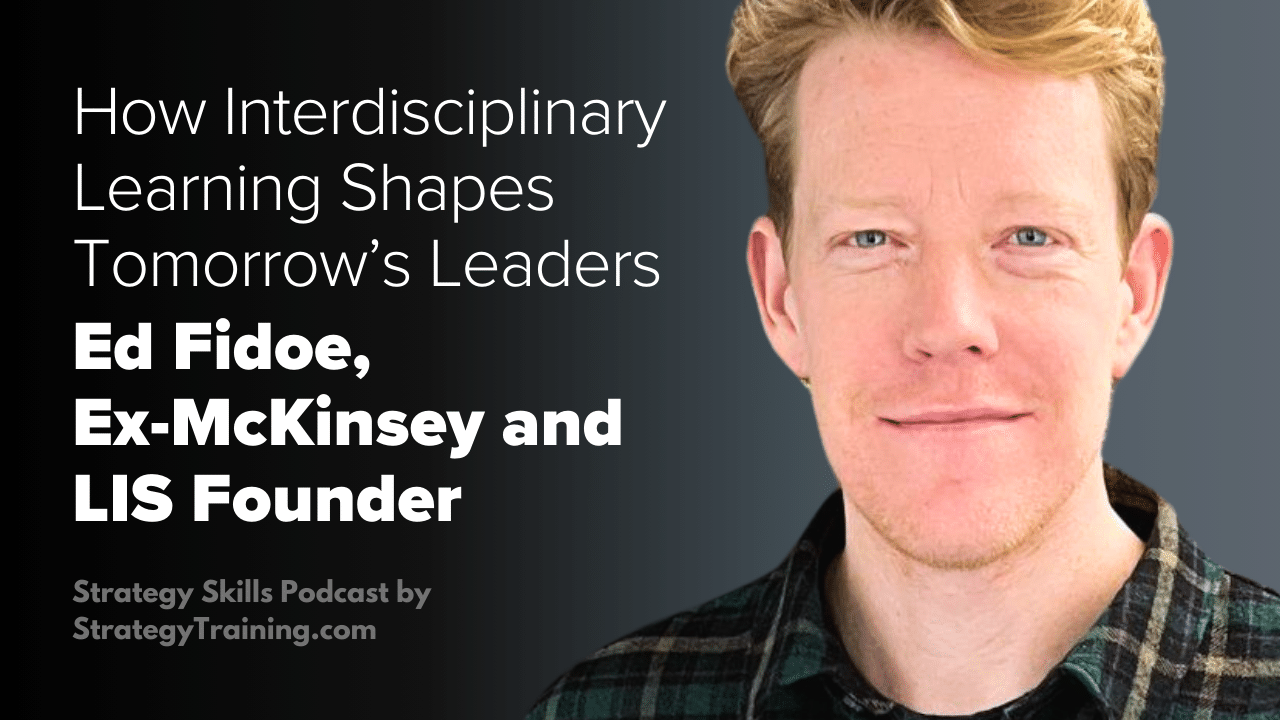
Welcome to Strategy Skills episode 502, an interview with Ed Fidoe, the founder and CEO of the London Interdisciplinary School (LIS), the first institution in decades to be granted degree-awarding powers from inception in the UK and offers an innovative, interdisciplinary curriculum focused on tackling complex global issues such as inequality, sustainability, ethics, and AI.
In this episode, Ed shares his journey from child actor to McKinsey consultant to educational innovator. Throughout the conversation, Ed emphasizes the importance of broad intellectual curiosity, the growing impact of AI on education, and the need for future leaders to develop skills beyond traditional academics. His story illustrates how combining consulting expertise with educational vision can drive meaningful change in learning institutions.
Before LIS, Ed Fidoe co-founded School 21, an acclaimed school designed to nurture children from diverse backgrounds, achieving Outstanding Ofsted within two years. He also founded Voice 21, a leading oracy education charity. Ed’s latest endeavour involves expanding the LIS’ offering to include a future-proof MBA challenger, alongside the existing undergraduate, masters, and leadership programmes.
From his early days as a child actor on ‘Woof!’, and setting up a theatre production company with Oscar-nominee Matt Charman, to his tenure at McKinsey & Co., Ed’s journey exemplifies resilience, innovation, and a relentless pursuit of change. His transformative vision has attracted educators from esteemed institutions worldwide, united by a shared belief in LIS’s mission to reshape higher education. Ed’s narrative is one of passion, innovation, and purpose, promising to inspire and challenge conversations about the future of learning.
Learn more about Ed Fidoe here: https://speakonpodcasts.com/
Here are some free gifts for you:
Overall Approach Used in Well-Managed Strategy Studies
Enjoying this episode?
Get access to sample advanced training episodes
Episode Transcript:
Kris Safarova 00:45
Welcome to the Strategy Skills podcast. I’m your host, Kris Safarova, and our podcast sponsor today is strategytraining.com if you want to strengthen your strategy skills, you can get the overall approach Houston, well managed strategy studies. It’s a free download, and you can get it at firmsconsulting.com forward slash overall approach. And you can also get the McKinsey and BCG, meaning resume, which is a resume that got offers from both firms as an example if you are currently updating your resume. And you can get it at firmsconsulting.com forward slash resume PDF. And today we have with us Ed Fidoe, the founder and CEO of the London Interdisciplinary School, which is the first institution in decades to be granted degree awarding powers from inception in the UK, and offers innovative interdisciplinary curriculum focused on tackling complex global issues such as inequality, sustainability, ethics and AI. Ed, welcome.
Ed Fidoe 01:42
Thanks very much, Kris. It’s good to be here.
Kris Safarova 01:43
So let’s start with your career. Could you tell us a little bit about the journey that led you to what you’re doing today?
Ed Fidoe 01:49
Yeah, well, I mean, you know, a lot of people have what we call squiggly careers, and I’ve definitely got a squiggly career. So I did quite a lot of acting when I was a child. I did I was on a TV show, but it wasn’t something I wanted to do professionally, so I went off to university to study mechanical engineering, but I kept going with my theater hat on, and I ran a theater production company for a few years after I graduated from Imperial. And so I was putting on plays with a friend of mine until my late 20s, but then I decided I needed to make some money, because I wanted to start a school, a K 12 school, at that time. And so I joined McKinsey when I was 28 and they were the only people actually who gave me an interview. So I applied to Bain and BCG and Booz. I don’t know if Booz were even still an independent consultancy, but I applied to them, and none of them gave me an interview, other than McKinsey, and I later discovered it was arguably a mistake, because it was somebody who was new to screening CVS, because I had a very peculiar CV where I’d been putting on plays in various different parts of the country. But anyway, she thought it was interesting, so I went for my interview there. Got the job. I worked there for four years. I actually enjoyed it a lot more than I thought I would. But I left in 2010 to start the school, because the government introduced a policy called free schools, which is like charter schools in the US. And so I left McKinsey in 2010 to start a school, and that was a K 12 school called school 21 we opened in East London. Started with just 150 students. Now there’s a there’s 12, 1200 students there. But by 2016 2017 I was starting to plan the university, and then got going full time on that, and we opened the university in 2021, so that’s a sort of in a nutshell, what I’ve been up to since, since I left university in 1999.
Kris Safarova 03:34
So you had this dream to open the school before you worked at McKinsey. Where do you think this dream came from?
Ed Fidoe 03:40
Yeah, yeah. I, you know, I think sometimes with these kinds of ideas or dreams, it’s sometimes hard to pinpoint where they really come from. But in some senses, it’s easy, because I went to a school when I was four years old that was a brand new primary school, so I’ve been started by some very young teachers in their 20s, essentially in their own home. They’d sort of converted it into a school. So it was always the case for me that I thought, oh, you know, you can, you can just go to a school that people have created, or you could start school yourself. Yeah, so that was the first point. And the second point was that it was, it was a wonderful place, and they had lovely values, and they really looked after us, but they were very, very focused on exam results, which is fair enough. But I also felt that there was a lot more that school could have given us in terms of mindset, and as mindset and attitudes, in terms of a sense of what’s possible, rather than just this narrow focus on nothing matters except for grades and which university you go to, which felt to me like it was sifting people and ranking people, and it didn’t really work for a lot of the people that were at the school. It wasn’t really what they needed. So I suppose that instilled in me this idea you can both start a school and perhaps not like the one I went to. And yeah, that. And then I developed that as through my 20s. And I think as well, I thought it was a meaningful thing to do. And, you know, and I enjoyed McKinsey, but I think at the end of each project, I’m not sure how much I cared about the work I did, I learned. Huge amounts of met fantastic people. And I can talk more about McKinsey, if you want, but you know, I felt like I wanted to do something that had real meaning.
Kris Safarova 05:07
I think one of the reasons you mentioned, not in those words, that it could be done better, and I’m just thinking back going through my educational journey, even in school, and I had a music school, and it was just a tough time, because they were all five from home, and very little focus was on learning and enjoyment and curiosity, and it was more about the grades and exams and so on. And so there’s a lot of stress, especially on young children, and they’re not ready for that kind of stress.
Ed Fidoe 05:36
Yeah, I think that’s right, it’s it’s too narrow, and I think a big, specifically a problem for us at Las is or for me, for me, and my motivation to start las was that it gets narrow and narrow. This is particularly true in the UK, where you choose nine subjects at 14 years old, you choose three subjects at 16 years old, and then you choose one subject to do at university. And this seems crazy. And what it means is that you usually, you stop doing any drama or art or music at 16, typically, if, even if you’re still doing it at 1415 which is also unusual, you know, or you might stop maths entirely. You might stop doing any kind of physics or anything, any numeracy after 16. And this doesn’t feel sensible in a world that is, well, it’s an interdisciplinary world in which we live. You know that we, everybody has to work with numbers and data. In some ways, there’s very few jobs now which we’re not touched by data collection, analysis, communicating insights from that data. There’s, there’s so many industries that relate to the media in some way, many, many of the largest companies in the world now are essentially media companies, one way or another, and so understanding the arts and performance and how to appeal to sort of human passions and needs and wants is vital, and to stop doing that at 16 feels like we’re we’re not preparing people for success.
Kris Safarova 06:59
Very true. Let’s talk a little bit about your experiences during your McKinsey time, and then I would love to transition to what you’re doing now, when you joined McKinsey, this is such a big difference compared to what you have done before. What surprised you?
Ed Fidoe 07:12
What surprised me in first in part, was the attitude of the people was outward looking and interested in the world at McKinsey in a way that in theater, it was the opposite and that, and I’ve seen this true in other industries as well. So there’s some sectors. I think medicine is one to some extent. Certainly the performing arts and theater politics is one, where people cannot see that there’s another world outside of that sector, and they think that you’re either successful in this sector or you’re nothing. And in theater is this zero sum game? There’s only so many theaters and investors and actors and parts and that it, you know, you need to get ahead at the cost of somebody else. Whereas in consulting, most people didn’t pretend that they were deeply passionate about consulting and that there was nothing better in the world than consulting, but they were very interested Kris, very, very smart people who were interested in learning, and most of them were talking about what they might do when they left. And therefore, necessarily, no one’s not. Everyone’s looking out and thinking, what’s out there in the world. I’m interested. And so I found these people to be I made many more friends at McKinsey than I had done in the theater. So something about the people, the fact that McKinsey, I did. I focused entirely on learning, basically. So I wasn’t interested in ever making partner and staying I was two years away from partner when I left, but I wanted to start school. I’d never had any intention of making partner, which it freed me to choose lots of different sectors. So I worked across 14 different sectors in those four years on about 18 different projects. And what’s what I loved was that every time I’d moved to a new team, there’s a new group of three or four really smart people you’d get to know. And you could go up this learning curve really quite quickly and become kind of an, what they would call an instant expert. Are you? Of course, you’re not a, really a true expert. You’re not contributing to the field. You couldn’t, you know, really, really do the job. But you can learn surprising you can grasp a surprising amount of content in a very focused few weeks of working on something. And we can come back to this. But this is a very important thing for our approach at Las, which is that we, we think that people are, you know, have too many silos around what they think they know and what they don’t know.
Kris Safarova 09:24
How were you able to acquire the skills so quickly? Because your background was so different, it’s not as if you were preparing to join a consulting firm and have a problem solving skills and all the skills that consultants need too.
Ed Fidoe 09:37
I suppose. The other thing, the other thing, yeah, okay, so I, you know, the other thing that surprised me, and this links into how I learned, the thing that I found hardest to understand was what the output was, what was the work? Because, remember, I was used to putting on shows which are extraordinarily tangible. So, you know, you rehearse with you have a script, you rehearse with actors after having auditioned them. You have to then sell tickets if. The higher the venue you make. You make the posters, you go. So, you know, all this stuff, you’re, you’re, you’re creating a product, and you watch it, them all on the stage, and then people clap. You go, Yeah, we made that. That’s something we made and that people consumed, and we did it. And then you’re in a, you know, the back of a taxi or heading home from a client, and your team are kind of tapping into their laptop, and they’re making slides. And I’m like, Yeah, but when do we do the real work? The slides are the work. And so this took me a little this may seem obvious to people who have done more research as to what the job was, but it took me a little while to realize that it was essentially, you know, advising is far less tangible. So it took me quite a long time. What helped me was I was good at two things. I was very good at maths. I’ve done engineering at university, and so I could do any of the analytics reasonably straightforwardly. I wasn’t quite an analytical mind and engineering training. And I was a good communicator, which was more useful when I was a little bit more senior, when I was promoted to manager. So then, then it was then it was useful. But also I was used to working in these kind of short bursts with a group of people towards a frantic deadline and delivering on time and not panicking and being good under pressure. And those were a lot of skills I had as a child and television and then, and then as an adult, in in theater, they did stand me in some good stead, but I learned a lot, and it took me at least a year, if not more, to really get in my head around what the job was of being a management consultant. The thing I found hardest was the structuring, because that’s a big part of what the job is, right? You’re sort of structuring people’s messy problems, and I found learning those tools and getting good at that, but once you learn them, you never forget them. You can kind of never go backwards.
Kris Safarova 11:43
If you could give yourself advice before you started at McKinsey, what would it be?
Ed Fidoe 11:49
Well, I think, you know, quickly, learn the tools and practice, practice, practice, and some of these tools that everyone knows issued, you know, structuring using issue trees and kind of disaggregating a problem, picking it apart, all this stuff’s really important. But actually, I think the thing that people might miss there is the network. The network, if you go to a McKinsey or Bain BCG, doesn’t land in your lap. You have to work for it. It’s not a it’s not a thing. It’s not a plug that you plug into when you leave and you suddenly, you’ve got the alumni. The alumni is simply the people that you met there, really. And so in my third year there, I made a very deliberate effort. I thought, if I’m going to stick around, I want to meet as many people as possible. So I got involved in a lot of kind of whole organizational activities. A lot of them sort of fun and social, but they would mean that I would not, you know, they were constructive. We were kind of working on projects together, but they were not to do with work. So it was in the extra time that you don’t really have, but you meet a lot. I met probably 100 150 people across McKinsey, and it’s not a huge office in London, 400 consultants through doing that, and I still and I met them and got to know them well enough that even though I left in 2010 all those people I could still get in touch with and regularly. Do you know I met a guy today who who came to visit the University, who’d worked with me back in 2008 nine, and we vaguely remembered each other, and we chatted a bit, but he’d knew me because I’d done these projects, and we had a fantastic hours conversation about what we’re both up to now. So that’s you know, you’ve got to put yourself out there
Kris Safarova 13:18
From your time at McKinsey. Do you feel there were maybe two, three things that you learned that really changed the way you look at business or life, even now?
Ed Fidoe 13:28
Yeah, I do. I mean, let me be clear, there was lots I learned that McKinsey was fantastic, but also McKinsey’s approach has inspired a lot of what we do at LIS in, as in, it’s the reverse of what you do at McKinsey. Okay, so, you know, so, so McKinsey’s extraordinarily good at taking a problem and organizing it, and structuring it and presenting and presenting it back, or kind of organizing it in a way that it can be analyzed. And it’s a reductionist approach. So you break problems up into bits, analyze each bit, put it back together in a slide deck, and you kind of do your exact summary on the front page right. And this is very, very useful for CEOs who have no time to do this organizing in their head. They’re finding prioritization hard. They’re finding visualization of the problem hard. And you are, you know, this is a really, really important skill that it almost comes to the point where you go this is so simple. What we’re doing is this really valuable, but coming up with a nice, clean way of structuring a problem, you know, this is the three ways you can think about it. Or here’s the two by two matrix. There’s a famous thing these. These are very, very helpful tools which CEOs just don’t really have time to use. And even now, when I’m running LIS, I don’t use them enough because my head is is not in the right kind of mental space. So the consultants can come in and have that clarity of thought. So I still use all the time. I use, I use two by twos with my team. I use issue trees to some extent. I find, actually too many. I find coming up with original two by two grids is strangely satisfying for everybody else as well. And they go, oh yeah, yeah. That’s interesting. So. So, you know, one recent one we used was we were, we were trying to figure out what kind of students we should be trying to attract to the undergraduate and we want to attract academically talented students, but we also want to attract students that wouldn’t normally go to university. And I was saying, Look, on one dimension, let’s think about students that are probably not going to get into Las but, but, you know, maybe they will push versus very academically strong. And on the other axis, we have people that are in school versus people that have been out of school for three or four years. And then we realized actually what we need to do in school. We’re never going to get the students who are strong academically and from a widening participation background, as in a poor background, because they are all the universities are competing for them. What we’re going to be able to do is go after the students who have been out of school for two or three years haven’t gone to university yet. Those are the people that we should focus on. And just being able to use these tools helps communicate to the team. Okay, there’s these different segments. Sounds very simple, but people don’t take time to do it in real life.
Kris Safarova 15:58
Definitely, was it difficult to make the decision to finally go on your own after four years, you had good momentum going. You could continue just two more years, very partner,
Ed Fidoe 16:10
yeah, yeah, but I had no intention. I didn’t want to be a partner. I didn’t I joined to start a school. And then it suddenly dawned on me that this plan to make, you know, sort of a 15 year plan to go to McKinsey, then perhaps start a company and make lots of money and then start a school. The new government policy meant that this whole horizon came a lot closer, and I could quit in 2010 and possibly open a school within two years, which is what we did. I I was explicit to my mentor there at McKinsey. I said, you know, after three years, I was there for you. After three years, I said to her, Look, I have no intention of being promoted again. Is that okay for me to sort of stick around, but I’ll say no to things that are like extra work that will get promoted, but like, you know? She said, Well, as long as you adhere to our values, then you’re not gonna get fired for that. I mean, eventually you might, you’ll either get promoted, or you’ll get or you’ll get fired because you haven’t done all the things to tick all the boxes. But people would phone me up and say, I’m going to Davos. Can you write me this speech? Because I and I just say, No, there’s loads of people would want to do that, and that’s not me sorry, because I don’t, I don’t need to do it because I’m not interested to get promoted. So I had this philosophy where I’d stay until I did a project which I didn’t enjoy, and I was still enjoying it. And then the the election happened in May 2010 and so I quit as soon as the election happened. And I didn’t I didn’t regret it, but I never regretted going to McKinsey. It transformed my ability to do the school, and it completely transformed my ability to do the university that I would not have been able to do the university without what I learned at McKinsey, the people I met at McKinsey, and the credibility, actually, that it gives you as well. So it is hugely valuable.
Kris Safarova 17:44
Definitely, you mentioned few times you didn’t wanted to make a partner for listeners now who are considering that path. What were your reasons? Why not?
Ed Fidoe 17:53
Because I went for a different reason. So, and what you tend to I went to, I went with a very specific I basically went and your plans never tend to work out, right? But my plan was go to McKinsey for two I was a theater producer, and I wanted to start a business I was not going to get built to borrow money from a bank or get a VC backing with a theater background. So I thought, if I go to a top consultancy, it doesn’t really matter which one, maybe I can borrow money from a bank or go to a venture capitalist. And instead, I stayed a little longer because I thought this policy thing might happen. So I stayed four years, not two so. And a lot of people stay longer than they than they say initially, but you they are very, very good at keeping you there that, and so you have to keep an eye on that. The other thing I would say that I can give advice to people who think they don’t want to stay too long, right, and don’t want to get trapped, that I can give you advice because I can give you advice, because I think it’s a fantastic place to go for a short amount of time and to learn, but you can get trapped. One way to get trapped is to get used to the money, and so I was trying to live within my means. I lived in a, you know, an ex ex Council, ex local authority house for most of my time there. So it meant that I could leave at any point and not have to worry too much about paying my rent. Another way to get trapped, or sort of to go off the rails, is to start to focus on something like making partner, which is something you never necessarily wanted because you’re there, you suddenly seems like this really important thing. And I would just sort of say, well, maybe, but, but I saw a lot of partners working very hard and not looking very happy, and then not learning that much more money. And more money until they get very senior. So just, just think carefully if you want to make partner. Yeah, there’s other people you should talk to, because I’m I didn’t make partner. But basically, you know, you have to go there and accept that you’re going to learn. You have to listen and learn, and you have to be interested, and then you have to kind of follow your passion there and find something that you really want to focus on. That seemed to be what most people were doing in my partner.
Kris Safarova 19:48
And before we move on to the things you have done after you loved McKinsey, I feel we need to step back to your time as a child being on TV. What do you think it gave you? In terms of weight in life, skills, mindset, anything that could be used for our business.
Ed Fidoe 20:05
I think there’s something big it gave me, and it wasn’t skills, actually, it was mindset. So, so what it did for me was it, it debunks the idea that there are certain things that are not possible. So it made me think so, sitting as a child, eight, nine years old, you think, well, being on television, in fact, I said to my mom, I’d like to be an actor. Can you do that? And my mom said, no, no, that’s, you know, you need, you need, you can’t be on television. You You know, there’s various things you’d need to do, to do that. Also, any certain people can do that. And then, by some fluke, I went to this local audition, and one thing led to another, and the show became very successful. But you’re there sitting watching the show being made. You’re watching how the sausage gets made, basically. And it’s not sexy, it’s not magic, it’s a it’s a diverse group of people, some of whom are just like the people that live down the end of your street. Most of them like everybody, right? Except maybe the director, who’s, you know, very experienced, very talented. There’s only a few people like that around, but you can see that this is just a bunch of cameras and wires and trailers, and you know what? You know, clothes in wardrobes and makeup. It’s just straightforward. And then you can kind of see how it then gets put together and edited and and put on television. So the mindset was, hmm, you can think that something’s not possible, but if you start to think about what actually it takes to make it, to make it, or to get it there, and you pull apart each piece, you think maybe it’s possible. So when I said to people, when I was leaving McKinsey, and I said, I’m going to start school, only 50% of me believed I actually would be able to do it. The other half of other half of me thought, What are you doing? You’re an idiot. Of course, you can’t start a school. But when people said, How do you do that? I said, Well, what do you think? What do you think? How do you How would you start a school? And most people would say, Okay, well, I guess you need to find a site to find some teachers. You need to convince the parents to send their children. I’m like, Yeah, that’s a list. So start putting a list together, and let’s try and let’s try and find, you know, let’s try and find a site, because there’s no point convincing parents unless you’ve got a school nearby, so you need to find a site first. And so I was speaking to the government to try and find a site. And it’s not rocket science, it just sounds like this fantastic idea. So I think that’s what it taught me. And the other thing it taught me is that I don’t want to be famous because I didn’t like getting recognized, and that was quite important as well.
Kris Safarova 22:23
Yeah, then do you remember at what point you decided you didn’t want to be famous?
Ed Fidoe 22:27
Yeah, I enjoyed getting recognized the first time when I was about 10 years old. And I don’t, I don’t think I enjoyed it again, not in a very kind of negative way, but sometimes in a pretty negative way. Nothing, nothing weird or awful, but it’s very, very, very invasive. And this is before social media or camera phones. I can’t imagine what it would be like now. I would get, you know, people following me around a supermarket or something or a shopping center, saying they’re just bored kids, so you just got nothing else to do on a Saturday, so they just follow you around with your friends. And your friends say, you know, Ed, you’ve been recognized. Should we just go home. Yeah, okay, you know. So that’s just boring and intrusive and the low level, you know. Or I’d be in the supermarket and I’d say to my mom, I think someone’s recognized me. Can we leave please, you know, because I just feel so uncomfortable, and I turned into a dog in the show, so people were just shouting dog noises at me. So, yeah, so, so what? And I thought, you know, what? If I’m more successful, then I’m going to get recognized more. And if I’m not successful, and I saw quite a lot of unsuccessful or not that busy, adult actors coming to the show to work on the show, and they would be sitting doing very little all day, reading the newspaper, getting bored, go and do their 15 minutes of filming. And I thought to myself, and this is a day where you’re working, so you know, what are you doing when you’re not working? So I just thought, well, acting for me was either being more famous, which I didn’t like, or not having much to do at all. So by 1617, and it was very important to me to go to university. My family hadn’t been to university before, and so I really wanted to do that. And so I I liked acting, but I didn’t like acting on television.
Kris Safarova 24:03
Thank you so much for sharing it. So let’s move on to what you are doing after McKinney take us through that journey. Yeah,
Ed Fidoe 24:10
So I left, and I had to generate income. I wasn’t independently wealthy. I was still living in my quite cheap flat, but I needed money, so I did two things. I started the project at the school, so I had to find a head teacher and a site. And I was lucky enough to get introduced through my McKinsey network to a fantastic head teacher, a guy called Peter Hyman. So that was one half of it, but that was going to make me no money, and I was never going to be a teacher there, so I wasn’t ever going to make any money from the school. So I needed an income. And the thing, the other thing that McKinsey gave me, which was brilliant was credibility in setting up a small consultancy, which I focus mostly on education clients like Eton College, which was a famous school in the UK, Cambridge University, LSE, some other school chains, and then some media companies like the Guardian newspaper and I did some consulting projects. Colleagues, using some old McKinsey colleagues, sometimes to work as team mates. And so yeah, I had a little, a little consultancy company named after some teachers at my little school and and I ran that. Actually, I ran that. It for six or seven years, and that paid my bills, helped me buy a house, paid paid for my food and my living and paid for me to be able to spend three or four days a week working on school for years. So yeah, that it was a modest income, but it was I was only working on it most of the time, one or one or two days a week. So I was doing that. And then we were trying to start school. And so then we opened the School in East London, in a very disadvantaged part of town, very ethnically diverse, but not very economically diverse. Everyone was pretty poor, sort of 20,000 equivalent, I suppose, of 20,000 US dollars household income, so not very wealthy at all. And we had a very different approach to education. So we did a lot of project based learning, a big focus on speaking skills or oracy, big focus on the students well being, and we were quickly considered judged to be outstanding by the regulator in the country. And by year five, our students were starting to take the national exams, and we were in the they were achieving the top 5% of scores despite being really in the sort of bottom 20% of income. So the model, though it was innovative and very different and very project based, was also getting outstanding academic results. And that was quite a journey. It was. It was an extraordinary thing, very moving, way less intellectually challenging than doing into, you know, consultancy projects at McKinsey. So, you know, you’re off. I was working with builders because we were renovating a school for about two years. So I was working with builders on kind of prosaic things about what kinds of concrete should be going in the foundations. And when you’re running something or involved in running something, it’s 5% strategy or 2% strategy. When you’re working as a consultant, it’s all strategy, right? It’s all fascinating intellectual. But there was a difference between, at the end of the year, the satisfaction and purpose, sense of purpose I felt through having started the school was very great, but my intellectual stimulation hadn’t been as much. I would still really love my one day or two days a week going and doing consultancy projects, because it because it was really testing my brain. So so I liked having that mixture, but I really wanted to make sure that my next challenge combined purpose and intellectual stretch, and
Kris Safarova 27:28
With the school, there was no way for you to generate income for you. That’s why you had to have a consultancy firm on the side.
Ed Fidoe 27:34
No, no way. No. It was a state, state funded school. Yeah. So I would go back to the McKinsey alumni events, and they would look at me strangely, saying, what’s the EBITDA? You know? And I’d say there’s no, there’s no EBITDA, because it’s not like a private school or international school. It’s a state funded school, so it’s just the same as sort of a school you go to for free, your local school, but it’s control. We could design entirely the curriculum, and we were running it basically without government interference, but we got money for every people that came from the government, but no one could make money. There’s no way of making a profit, no and there’s no equity to sell. So although it was hugely successful, and we got to the point where 1000 people, we had 1000 visitors a year, paying to come and look around and learn these were teachers or school leaders, we would basically considered the most innovative school in the country by year three, year four. To some extent, we still are, which is kind of sad, because this shows there’s not been much innovation. But yeah, no, there was no there was no exit. It is essentially. It was a charity, essentially.
Kris Safarova 28:37
So what happens next?
Ed Fidoe 28:39
Well, then, so I’m sitting there in the school and thinking, Hmm, a lot of our students are doing interdisciplinary projects. They’re learning how to, you know, have an impact in the world and create work of value. And none of this will be recognized by the universities when they apply to universities. The universities in the UK are only interested in one subject. You know, how good are you at physics, or how good are you at history? And they want to see your exam results, and really nothing else that’s true. And most and all admit this. This is not hugely controversial perspective. This is, this is generally what they would, they would categorize it as true. So I thought, how do you, how do we change this? Because it’s having this narrowing effect on the entire school system. In the UK, we just take it as read that we have to go from nine to three to one, so, subjects so, so how do we change it? Can we change what the universities do themselves? So I thought about that. I thought about, can I go into government somehow and and legislate for universities to demand a breadth of subjects, or to understand there are people’s ability to work in teams. And because if you say, if the universities were to say, we need to understand, your ability to communicate, your ability to problem solve, your ability to work in a team, if the universities demanded that schools overnight, would change everything they were doing to try and make sure they were training, is the biggest lever in the entire. Education system is university entrance requirements. That’s the biggest lever in the education system in the UK and in most of the developed world. And but it is very hard to change because the control of that sits in the faculties devolved away from the center in the university. So it’s very, very hard to change it. So I thought, well, maybe we can start a new university from scratch. And then you start to think, well, then what do you teach? So then we said, well, let’s go full interdisciplinary. So it’s a degree where you study complex problems, you don’t study subjects. So you study in term one AI and ethics or sustainability, and then the next term, you move on to a different kind of urban challenge that you know, to looking at the complex challenges we get from the urbanization of the country, and then the students look at complex problems that they choose themselves, and they’re having to use these different disciplinary perspectives. Look at using data science or machine learning tools, or law and ethics, if they’re you know, or philosophy, if they’re thinking about AI, or they might be using material science and neuroscience if they’re thinking about sustainability or inequality, and what we want to do is try and develop young people who have an intellectual breadth and an ability to make connections between subjects. So, so we so the the task then, so the task then, was, how do we get the regulatory approval to do this. And how are we allowed to do something so wildly different? How do we fund it? And all of these challenges were hard in starting a school, because the legislation was very, very it was a very difficult hurdle to get over. And actually we had to raise, we had to spend about a million and a half pounds and get a team and launch a brand, and get students applying and hire academics before we had even had regulatory approvals. So it was a big chicken and egg situation, and we just went for it. And so there was a big hurdle, really a big barrier to entry, which, now that we’re through it, I don’t mind. And then the question of funding, we was no government money this time, plenty of government money for the school, no government money for the university. So I decided to, this time, set it up as a private enterprise. So we’re funded by investors, family offices, and actually now one of the major business schools in France has just taken a third of the equity. So we’ve raised over the last four or five years, about 25 million pounds to get to where we are now, which is we just graduated our undergraduates and master’s graduates. And so we’re we’re well, we’re well, on the way, but it’s been a very different project, in that sense, to the school.
Kris Safarova 32:35
And now you no longer need to run a separate business. Can it support your life,
Ed Fidoe 32:40
I don’t, because the difference now is that I am the I’m the chief executive, so I have a proper salary. I report to the board, you know, like any, any chief executive has to do, so I have a proper salary, and I also own equity. And so there’s also the chance of, you know, be able to sell their shares later. But, you know, I don’t, I and and with this job, being a chief executive, I couldn’t be doing, I don’t have the mental capacity or the time to be doing the consulting anymore, so I had to let that go in around 2017
Kris Safarova 33:14
Once you got regulatory approval, what were the next few steps that had to be taken to get things going.
Ed Fidoe 33:21
So the trick we had to pull off was to try and create something that was seen as prestigious or a challenger to the prestigious universities. But that was new, and that is hard, because in the UK, you most of the prestige of an institution is directly correlated with holders. You can actually look at this. Look at this in the data you look at to prove this is how the grade requirements go up and up and up depending on how old the institutions are. So Oxford and Cambridge are the oldest institutions, St Andrews and places like that. And then you only kind of move through the different ways of universities. And typically the grade tariff is a little lower each time. So we wanted to be harder to get in and try and create that prestige, so we had to try and take on those brands. So building a brand from scratch for a university is very challenging because you’re dealing with the oldest brands in the world. I don’t think there’s older brands, Guinness. Guinness, drink is a very old brand. It’s about 180 100 and whatever, years old. But the Oxford and Cambridge are older, so they’re about 1000 years old. So you’ve got to take on these brands which are very, very old and very established and very personal to people. So we had to put a team together and think about how we did that in an unusual way. So we didn’t hire anyone from the education sector. We hired people, actually with some backgrounds in FMCG brands, our agency had mostly worked with restaurants in the past, but they were really smart and really got what we were trying to do. So they we were really happy with how we created that initial brand. We had to get press and we had to, you know, fake it till we make it. So we were on the front page of the times in early 20. 19, when there were only a team of six people, we’d raised about 200,000 pounds, you know, so that. And it said, you know, the first UK’s first new university in 50 years is going to launch, and it’s looking for polymaths. And that was amazing momentum that we got. But you have to be brazen. You have to be brave enough to say, yeah, like, you know, we’re going to do this. And okay, this is a little ahead of, wasn’t ahead of the truth, but it was certainly ahead of the reality. Like, you know, we were not ready. But when you’re in the newspapers, people think, Oh, this is happening. This is real. And that’s very helpful to actually make it real. So you have to sort of slightly be ahead of things all the time. We had to recruit so that, you know, had to recruit students. So we had to get heads together with them and figure out the way to do that. I had to learn about performance marketing, you know, on social media and so on. Was very important, particularly then for us. And we had to recruit faculty that were willing, academics that were willing to take a risk and leave Oxford and Cambridge and LSE and Berkeley and Harvard and all these places that they did end up leaving and convinced them to come. That was probably the easiest bit, which surprised me. There’s a lot of risk seeking academics out there who knew but convincing 17 year olds to take this risk that’s hard to come and join you for an undergraduate, that’s challenging when they could go to an established university. What
Kris Safarova 36:23
Did it look like in terms of applications? So when did you started really gaining momentum with people applying and trying to get in?
Ed Fidoe 36:31
Well, I think we had a big surge on when we first opened, because people wanted to be part of a completely new university. So we actually got 700 applications the first time out. And we’ve never we still haven’t matched that. So the first year was still the biggest intake, because it got all this coverage in the press and people wanted to be the very first of a brand new university. The second cohort, third cohort, fourth cohort, have been a little smaller. Next year, it looks like it’s going to grow back up again to a different a new size. What’s different is that in year two, we launched a master’s, and that is growing like crazy. So that’s growing from 10 students to 40 students to 60 students this year, which is very fast for a master’s. You know, these are still quite small numbers of people, but that is still very quick for a new master’s, because it’s older. Learners really get this idea of interdisciplinarity. So yeah, so we, so we, we kind of there were different markers about when you thought this is going to happen and it’s going to be successful. One was when we were front page of the times. Although, honestly, when I I found out, when I first saw the newspaper, was the first time I realized that we were on the front page. I didn’t know until, like, because I was there, I get looking at it very early, and I just thought, oh my god, we’re actually on the front page. And I actually felt completely naked. I felt completely vulnerable. Because I thought now’s the time that everyone comes out of all of the kind of different rooms and says, This is why it’s a terrible idea. But that didn’t really happen. So that was a moment where I thought, Gosh, this is and then you’re on the radio, and there’s all the sort of you get all the interest, and you get all the excited people coming to you, going, great idea. Great idea. Great idea. So that was a moment when we started to get students with straight A’s applying, because that’s something that I didn’t necessarily know if that would happen. And then we had fantastic academics applying. And you think, Wow, this. People really want to be part of something. And I think the thing I learned from it is if, if you try and do something that sounds a bit impossible, you can attract some really extraordinary people. And by trying to do be ambitious, people want to do things that are ambitious with their lives, so that they want to be part of that. And then once you’ve got a small number of fantastic people, they attract other fantastic people because they want to work with them. And so you get this kind of upwards feedback loop. By the way, the opposite can happen very quickly. So as soon as you start hiring average people, and they hire even more average people, the really good people want to leave because they don’t want to hang out with all these average people. So you know, so then you get this downward feedback loop. But certainly in the early days, we could attract almost anyone we wanted, because they thought, yeah, I’ll try and do that. I open a university. Let’s do that for two or three years. That sounds mad. And there’s all these smart people trying to do it. So great. And then you start to think, Wait a minute, we can do it with these people. You know, with with we can do it with this team.
Kris Safarova 39:16
What was the most challenging during those early days?
Ed Fidoe 39:20
I think there was, there’s, there’s a few moments. There was one moment when we thought the regulator maybe didn’t really want us to exist, and this was because we were not we. We’ve done a lot of the hard work, the hard things that the regulators would ask, and we fell down on essentially the easiest bit, which was the administrative bill, the bureaucracy. We fell down on that, because we were a startup, and we were really bad at bureaucracy, and we just missed a lot of things we were supposed to do, and it looked at one point that they were just not going to let us through. And I I remember going outside on my balcony after a certain call and just crying, thinking, do. Such a shame. We’ve got such a great team. There’s all these students who are interested, and it’s not going to happen. So that was, that was a challenge, and that was and I was frustrated because it was such a silly reason, and I thought to myself, this is that they should want us like we’ve got a good idea, and we’re a good group of people, we’re high quality. We’re going to really look after the students. But, you know, I thought, and my co founders were saying to me, we’re toast. It’s still going to happen. We should probably move on and do something else. So and we had to delay a year. In fact, I forgot that even we had to delay a year. And it’s funny at the time that sounds like it seemed like the end of the world having to delay a full year and say, well, we’re not going to open in 2020 we’ll have to open 21 but some really good mentors of mine, some friends, one or two, said to me, within a year or two, he’ll have forgotten that you had to delay a year, and it will be fine. And there I did. I just forgot again. I’ve already forgotten. In 2024 I’ve almost completely forgotten that we had to delay a year, because you move on so quickly. But that was difficult, and I was frustrated, because I think momentum is very important, and we had it, and then the regulator punctured the balloon, and we had to delay you, and we had to generate all that momentum again. And that is when it really in terms of leadership. I think it’s only in those it’s in those times where you have to really be a leader, because you have to phone the investors, you have to phone the journalists that you just told we were definitely open in 2020 to phone them up and say, No, we’re not. Sorry, that’s not quite right. You phone all the students that we phoned, all the students that had applied. We phoned 700 students, the team. I didn’t do all those calls. And you know, that’s hard, and you have to look at the team in the eye. Go, we’re going to do this, but we’re going to have to do it a year after we planned. Then COVID came, and I was glad that we delayed, but that I didn’t know at the time. It was late 2019 that we delayed. It was very difficult decision.
Kris Safarova 41:43
Interesting. Happened just before COVID. So how did you fix that problem with the regulator?
Ed Fidoe 41:48
So we basically it wasn’t clear to us. So there are some problems where I think it’s all about playing by the rules. And there’s other problems where you sort of reject the rules, and you say we’re going to go in a different direction. We actually don’t agree with the rules. We think the rules need to be rewritten. And at various times, the regulator I had gone down to meet with them and said, look the way you’re the demands you putting on us to be financially secure for five years right from the start is a bad rule. You’re not going to get new entrants. You won’t get us. You’d have to think about this more like a startup. We’re going to get funded in waves every year, every 18 months. Why don’t you put in checkpoints? So we got them to rewrite the rules with the bureaucracy bit that we failed on. We needed to play by the rules, and I am not great at that, right? So what I did was take somebody in the organization who is an absolute expert at figuring out what the rules are, and getting an A star every single time, getting a first class every single time, and that’s what we needed. And I said to me, you’re a dictator. You have complete control and powers. The entire team is at your disposal. We will do what you want to do. I will help. But, you know, you know how to do this. You can figure out how to do this better than me. I gave him two of our best people to have a sort of 24/7 and, you know, in three months, he cracked it. And, you know, we gold plated it. We weren’t quite sure how high we had to jump over the hurdle. So I think we jumped over the hurdle by the second time, by about a mile. We wrote a million words in our application, a million words, something like it was 1000s of pages of of documents that we submitted. You do it all with chat, GPT now, probably. But this was 2019, or 2020, then, and that’s how we solved it. So it’s a sort of, I wouldn’t even call it a complex problem. This was, this was a complicated problem which required a certain expertise, which I didn’t have. We also got better external advisors, and we just said, Look, we’re gonna, we are going to get an A star. We’re not even worried about getting a pass. We’re going to make sure that we that we pass this because otherwise we’re dead because we would have failed it second time. We probably would have packed up and gone home, right so? And then, in the meantime, I’m focusing on all the more, slightly more complex things of, how do you get 17 year olds to come? How do you build a brand that’s prestigious but new? These are Messier problems, and basically hived off this team to think about this much more structured, bureaucratic problem.
Kris Safarova 44:19
Anything else you want to share that maybe you wish I asked you and they didn’t.
Ed Fidoe 44:25
Well, I mean, a little bit about our new MBA, if I may, just talk about that. So, so we’re now launching a challenger to the MBA. I met a lot of people at McKinsey who’d done MBAs, and they’d had a fantastic time, almost entirely, but with both what they’d learn and what I learned at McKinsey, which was hugely useful. I felt there was a chance or an opportunity for people to go and learn something that was more about messy, complex problems than neat and tidy case studies that you could kind of learn about from the past that were written on 10 or 20 pages. That was more for. Focused on systems, that was more focused on the shifts that are happening in the world. So we’re launching a new MBA next year. You can’t apply yet, but you will be able to February next year, which is where you’d learn the physics of the energy transition. You might learn some of material science and look at sustainability. You will learn about the human condition and how humans interact with artificial intelligence and how intelligence is evolving. You learn about trust and the sort of falling of or the decreasing trust in global institutions, and the impact of that on organizations, governments and businesses. So this is a an MBA where you would kind of really broaden your range intellectually. And we think the modern leader, the leader of the future, needs a much broader intellectual range, and needs to be able to embrace complexity rather than just oversimplify. So, yeah, that’s my pitch, but it’s, it’s still quite new, but we launch in the new year. So we’d love, we’d love your listeners to look out for that.
Kris Safarova 45:55
What is your vision in terms of what you want to do within 10 years, 20 years. Do you have that already? Are you currently just focusing on launching the MBA program?
Ed Fidoe 46:06
You mean for LIS or me personally?
Kris Safarova 46:07
You, personally.
Ed Fidoe 46:08
Oh, I think for the first time in my life, I don’t have a vision of what I want to do, because I was I was thinking about the school for a long time. I was thinking about the university for a long time. I was thinking about, I guess, theater and stuff. For a long time, when I was younger, I’ve thought about politics. Well, let’s put it this way, the problems I’m interested in, so inequality in housing. I care a lot about. I care a lot about low quality that we have high employment in this country, but quite low quality jobs. I clear about areas of the country that have been left behind. I’m from a left behind part of the country, in the in the Midlands, in the UK. I’m not from London, and I live, I’ve lived here 25 years, but I care about that. And these are problems that can’t really be solved by business. I They, they, they’re solved best, but I think by government and and I’ve looked at government and politics and so on. And I’m not sure that’s what I want to do because of other reasons, right? It is just, doesn’t, you know, it doesn’t look hugely attractive. And so I’m in a bit of a by now, I’m enjoying running LIS so probably I want to try and create this job or shape this job so that I can do it for as long as I’m good at it and afterwards. I’m not sure. But thanks for the question,
Kris Safarova 47:17
What do you think will happen within 510, years in terms of changes that we will experience in the world because of AI?
Ed Fidoe 47:25
Well, I think I thought most about this from a perspective of education and but most of your listeners have either been through education, going to go through education, or have children that are going through it. So, you know, if you think about our education system, a large part of it in the humanities have been about writing an essay, or, you know, writing about something, and there’s this very big question about how important writing is going to be as a skill in the future. So organizing our thoughts is useful, editing and spotting errors is useful. But how do you educate in a world where essentially, you’re not going to be able to write an essay that’s better than chatgpt Unless you are in the top one or nought point 1% of the population? What should we be and how do we educate for that, when that is a tool that just exists everywhere? And I think that is a that is a big challenge I would imagine. I mean, my personal feeling is that the current time in AI is a little bit like that time after electricity was invented, electricity was invented, but it wasn’t really being used and applied by factories. Factories haven’t reorganized from being steam powered to being electric to electricity powered. So Henry Ford hadn’t yet got said, Hey, this can all be on one level. We don’t need to organize this around a chimney. This can all be flat on one level, and we can create an assembly line. That was 40 years after electricity was invented. So I think we’re in this in between time with AI, where we’re starting to do a few small solutions like, you know, some some, some teams who are looking at certain risks might have moved from 14 people to three people because they’re using AI, but very few people have thought, how can you completely reorganize an entire organization, but actually a sector and industry by using artificial intelligence. I think people are scared of that. People are talking about how it’s going to happen, but it’s not happening yet, but, but I’m not sure we need much more technology for that to be possible. I don’t think it’s going to take 40 years. Let’s put it that way. So I think we’re going to start seeing some major, major changes to the shape of organizations, and people are only just starting to get to grips with the implications. I talk to people that leaders at PwC, KPMG the Big Four, and they’re not employing as many junior people because they don’t need to, because of AI. And so the shape of their organization is changing from a pyramid to something that looks more kind of pear shaped. But then what does that mean for their leadership progression and their pipeline of people in the future, and they’re still wrestling with this thinking God like but where does it end? Because once you start to pull on that thread, the whole organization could look completely different. And I don’t think people actually want to think that through yet, but they’ll,
Kris Safarova 49:54
They’ll need to. But people listening to us now, leaders within Bucha organization. Mostly, what do you think is a skill many of them may not be paying attention to, but they should be focusing on strengthening or acquiring.
Ed Fidoe 50:08
Yeah, so I feel strongly about this. I think they need to think about broadening their range of knowledge in a way that is not just focused on being instrumentally useful to work. Let me explain why I think this is important. So we get criticized a lot saying, How is this applicable? How is it useful? And we can become a little obsessed with efficient learning. I want to learn this because it’s going to help me do that, but broadening and understanding reading and just kind of dipping into different fields, like the arts, like sciences, revisiting things you maybe started at school, but have forgotten looking at history, you never know when you’re going to need what you might consider redundant knowledge, and you’re going to need to draw on it. It’ll help you reframe something in an unusual way. And when we face crises which we struggle to tackle in the future, like we struggled with COVID, like we struggled with wars now, because we’ve, you know, in many parts of the world we haven’t had wars for a while. We’re going to need to draw on this unusual knowledge that we don’t normally need by definition, to come up with new, inventive solutions. It’s not going to come from the things you’ve been using every day, because otherwise this wouldn’t be a problem. We’re going to need to create new solutions and draw on knowledge that we’ve gathered, that not everybody else is doing. That may have seemed random at the time, but it really broadens your intellectual mind. I think there’s a benefit to broadening your intellectual range, so be careful about over narrowing and over fitting your knowledge. I think it can create fragility and it can make you not very resilient. If there’s a major shift in your industry and you need to re skill entirely, it could be a dangerous place to be.
Kris Safarova 51:42
Yeah, then for yourself personally, are there specific topics you particularly paying attention to in terms of acquiring that knowledge?
Ed Fidoe 51:49
I think no. I’ll deliberately say no, because if I prescribe it, then we go again. We get constantly finding concentration or or a key to unlock. I think the secret, if there is one, is to get is to get good at reading and long form reading. So revisit again, books, maybe fiction as well, but non fiction in areas which you find really interesting, try and avoid kind of quick fix books, the sort of books you might see in the airport, which is you sort of, either here’s just one thing you need to know, and it’s the way read books about from people that have studied certain fields, like sociology, anthropology, psychology, neuroscience, and they’ve looked at these their whole life. They’ve looked at it for long careers, and they’re writing their best works. You know, be very discerning about what you’re reading, but I have in the last three or four years gone really deep into areas, particularly around class and social mobility, and read around it and around and it is just helped me understand people and society in ways which I’m sure helps me do my job. You can’t can make connection very easily, but it makes me feel like I understand the world better. And once you start to learn in this way, it becomes addictive. And honestly, people will find you more interesting. You will be able to draw on this in whatever work you do, because humans enjoy, you know, human behavior, if you understand it, it’s not, you know, it’s changing in some ways, but there’s, there’s something about the human condition which will endure for forever, I think so. You know, spending time understanding is never time wasted.
Kris Safarova 53:22
And where can our listeners learn more about you, anything you want to share?
Ed Fidoe 53:27
Well, I mean, they can follow me on LinkedIn at Fido. I’m not on other social media, actually, but I do post on LinkedIn every now and again. And the las.ac.uk is our university. So do go have a look. You can find out lots about it on the website, and you can follow LIS on Twitter and X Instagram. So on there.
Kris Safarova 53:49
Thank you for the work you’re doing for the world. I actually really personally appreciate you as a person and your drive to do things that really lift people up and lift them up long term. I think that’s very, very important work you’re doing. And I think I’m actually really looking forward to see what you will be doing next. I’m sure it will be something very worthwhile. And I’m looking forward to maybe having round to discussing your next adventure and journey and the contribution to the world.
Ed Fidoe 54:17
Thanks, Kris, well, I’ve really enjoyed the conversation. It’s very nice for you to say all of that. I think my partner wants me to take a rest for a bit after this project. But let’s see. Let’s see, maybe, maybe it’ll be something exciting.
Kris Safarova 54:26
Bye, everyone listening. Thank you guys for listening to us. Our guest has been Ed Fidoe, and our podcast sponsor today is strategy training.com if you want to strengthen your strategy skills, you can get the overall approach used in well managed strategy studies. It’s a free download, and you can get it at firmsconsulting.com forward slash overall approach. And you can also get McKinsey and BCG winning resume, which is a resume that got offers from both firms. And you can get it at firmsconsulting.com forward slash resume PDF. Thank you for tuning in, and I look forward to connect with you all next time.
Leave a Reply