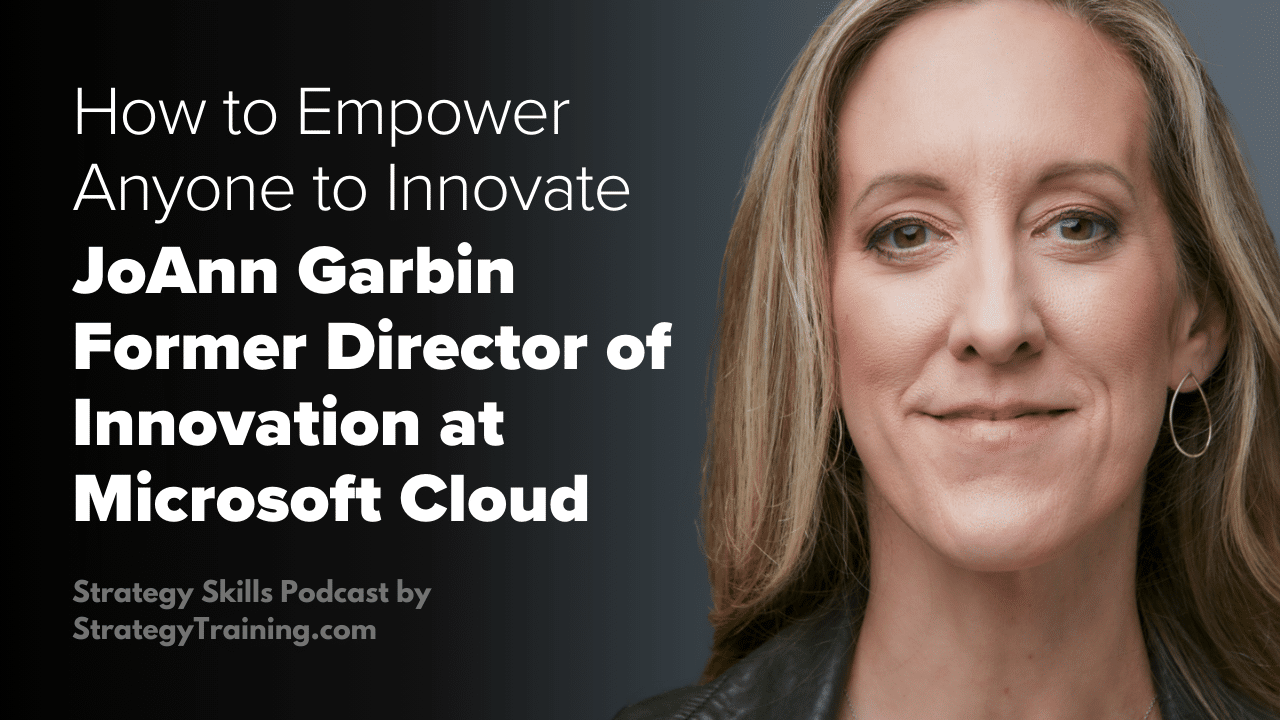
What if the key to driving real innovation isn’t genius, but orchestration? Innovation is often seen as the domain of visionaries or tech geniuses. But in this episode, JoAnn Garbin, former Director of Innovation at Microsoft Cloud and co-author of The Insider’s Guide to Innovation @ Microsoft, shows that true innovation is a craft: one grounded in discipline, collaboration, and conscious leadership. JoAnn brings a rare lens to the conversation — an engineer with a background in philosophy and performance, a systems thinker who has lived through startup exits, corporate reinvention, and a life-altering cancer diagnosis. Her approach to leadership, creativity, and risk is grounded not in theory but in lived experience. We talk about:
- How real innovation happens inside complex, slow-moving organizations
- Why orchestration, not brilliance, is the most underrated leadership skill
- The critical role of community and trust in long-term innovation success
- How to build political capital without becoming “political”
- What cancer taught her about control, clarity, and letting go
- The mindset shift that makes innovation more accessible (and less magical)
JoAnn also shares how she navigates uncertainty with structured frameworks, how she invests in her learning every day, and why innovation, especially in an AI-powered future, must be inclusive, sustainable, and human-centered. Whether you’re leading change, launching something new, or trying to stay relevant in a fast-shifting world, this episode will expand how you think about creativity, courage, and what it really means to build something that lasts.
JoAnn Garbin is a former Director of Innovation in Microsoft’s cloud business. She is the founder of Regenerous Labs, where she focuses on building practical solutions across industries that integrate sustainability and innovation.
Get JoAnn’s book here:
The Insider’s Guide to Innovation at Microsoft
Here are some free gifts for you:
Overall Approach Used in Well-Managed Strategy Studies
Enjoying this episode?
Get access to sample advanced training episodes
Episode Transcript:
Kris Safarova 00:45
Welcome to the Strategy Skills podcast. I’m your host, Kris Safarova. And our podcast sponsor today is StrategyTraining.com. If you want to strengthen your strategy skills, you can get the Overall Approach Used in Well-Managed Strategy Studies. It’s a free download we prepared for you, and you can get it at firmsconsulting.com/overallapproach. You can also get McKinsey and BCG-winning resume, which is a resume that got offers from both of those terms. And you can get it at firmsconsulting.com/resumePDF. And you can also get a copy of a book we co-authored with some of our listeners, some of our clients, and it is called Nine Leaders in Action. And you can get it at firmsconsulting.com/gift. And today, we have with us JoAnn Garbin, who is a former Director of Innovation in Microsoft Cloud business. She’s the founder of Regenerous Labs, where she focuses on building practical solutions across industries that integrate sustainability and innovation. JoAnn, welcome.
JoAnn Garbin 01:49
Thank you. Thank you for having us.
Kris Safarova 01:53
What is one decision early in your career that set the foundation for everything that followed?
JoAnn Garbin 02:02
These are great questions. It’s so hard right to pick apart back to the beginning, but there’s two, one internal decision, and there’s one kind of community decision. I’ll start with the community the university I decided to go to Villanova. It’s outside of Philadelphia in Pennsylvania. It wasn’t something that was an obvious choice. Nobody thought I would go to a Catholic institution that’s small and private, but I went there because when I showed up as a high school senior, junior, the the everybody in the engineering department came out to meet me and get to know my name and went to lunch with me. So it was very personal, and I felt like compared to some other schools, for me, it was really important that I knew the people I was studying with. And I have to say, Villanova has paid dividends throughout my career. The my mentor is a villanovan. I collaborate with a lot of villanovans. It’s just a very strong community that I belong to now. The other one was more internal, and that was the decision early on, that I don’t want to just be an engineer. I study art and music and philosophy and a whole bunch of other complimentary and widely divergent things, and that combination has really enabled me to do what I do, which is lead innovation.
Kris Safarova 03:45
Two very unexpected and very important insights you shared with us. So let’s start with the replicating community that you created by making this choice. What do you think people could do to replicate your success in some way, especially if they are already not at the kind of a university age, and they already, let’s say, in their 40s, and they don’t feel they have strong enough network?
JoAnn Garbin 04:14
Yeah, you have to invest in other people so, and It’s not just for the college age. So my lab that I just founded, regenerous Labs, I founded it with seven people. So there’s eight founders. We’ve all worked together for 1020, 25, years. So as we’ve moved through our careers, we kept bringing each other along, and we kept calling each other up and saying, Hey, I’m working on this cool thing. Do you want to come help? And so they’re the people that I have all of this run time with. So when we get together to work on something, we don’t have to explain ourselves or how we. Work we know, and that means we can be faster, we can go further, we can explore things more wildly. There’s high trust, but all of that comes from investing, right? I put time into them. They put time into me. Microsoft, I’ve only known deeply for five years now, maybe six. I started in 2019, but through the book The Insider’s Guide to innovation at Microsoft, we got to know people throughout the whole company, and we got we listened to their stories, and we we amplified their stories. We invested in them. So now my community at Microsoft has come rapidly forward, you know? So it’s not just one community, it can be many. I can say the same of my neighbors, like we spend time together, we help each other. So really, anywhere that you belong in the world. Just invest in the people that invest in you, and you can develop that community.
Kris Safarova 06:08
And then the second point was on integrating philosophy, music and so on, as part of your education and how it helped you. Can you explain why do you think it helped you? And how can someone in their 40s bring other domains into their head, into their heart? And how can that help them become better? When it comes to innovation?
JoAnn Garbin 06:30
Number one, it’s critical. So we talk about the T shaped individual, and a T shaped individual, you know, you go real deep in one or two, maybe a narrow set of things, but that breath across the top, you have to get dangerous in a lot of things, so that when you’re sitting with somebody else who’s really deep in those things, you can ask good questions and you can participate with them. You don’t just take everything they offer as face value and then not press forward. You’re able to collaborate on their domain as much as they can collaborate on your domain. So the necessity of being broad and deep in innovation is apparent. But how you do it in your 40s is the same way you do it anytime in your life. You ask questions, you talk to people, you explore books and movies, and you travel and you go to museums. You pay attention, right? You You walk around the world looking at things, and if you don’t understand it, you ask questions, hang out with a five year old for an afternoon. You’ll you’ll learn a ton about the world that you know looking at life through their eyes is completely different than being a 40 something. The way I do it is all of those things, and I’ve added new disciplines since I’ve gone into the professional world. My white rhino partners brought psychology and behavioral science into my life, where, you know, I knew habits and I knew triggers and but they took it to a new level and gave me frameworks and mental models and tools. And now I’m on a dangerous level with those topics. So when I sit down to collaborate with them, we can really talk about how to energize people and move them forward in the innovation process.
Kris Safarova 08:42
So how did you end up joining Microsoft?
JoAnn Garbin 08:46
It was through a community, and I was, I have been a sustainability professional for as long as my career, 25 years and counting, maybe more, and in that world, I’ve been both a sustainability and a technologist. And so early in that world, the community was very small. There was like 20 of us at the table in the US anyway, back in 2000 and then as it grew to a couple 100 we interacted, you know, this core group kind of stuck together as we grew the whole network. One of the other early members of that was Brian Janis, who most recently was the VP of energy at Microsoft. Now, when Brian joined Microsoft, he wanted to grow the sustainability discipline, and so he was looking for people to join the team. And he’s like, I remember this woman in Philadelphia and and so he called me up. And over the course of a few years, because I was, I was the chief innovation officer of a company at that point in Boston. And so it wasn’t like, Oh, let me drop everything and come but over a course of a few years, we build up a rapport. And then eventually I made the move in at the end of 2019 but I came in in the space of innovation, the other side of what I do, because sustainability, you know, there’s the marketing, there’s the reporting, there’s the governance, but innovation is where I’ve built the most value by driving innovation with sustainability.
Kris Safarova 10:32
What skills did you develop that you think made you indispensable in innovation focused roles?
JoAnn Garbin 10:39
Yeah, I have a natural inclination to go big. I like shaken up the norm. I’m not somebody that you know holds on to the status quo. I like change, which is, I know weird. I just it’s always been interesting to me. I grew up in a very fluid environment as a kid, and I think I just got very comfortable with changing situations. That comfort gives me the ability to not fear blowing everything I know up and trying something else. So that lack of fear gives me a comfort and an ease in the process. But what my teammates say I do really well is I’m the orchestrator. So if you think of the innovation team as an orchestra with cellos and flutes and violins and timpanis and everybody has their talent, and you have to bring it together to create something awesome and beautiful. Um, I’m that person, like I said, I’m a little bit dangerous and all of the instruments, and I recognize the brilliance of others and their deep talents, and I figure out how to bring them together and pair them and partner them and score the initiative. And so I’ve really become strong at the orchestration role of innovation.
Kris Safarova 12:20
And building on that, what do you think you did differently from your peers that allowed you to rise faster and further?
JoAnn Garbin 12:29
Yeah, I got very fortunate that my mentor, the Villanova, and I mentioned Joe Turk. I met him through Villanova. He’s 31 years my senior, and a couple of things converged. The Villanova connection brought us together right at a time of the early sustainability world, right at the time of early cloud technologies, Software as a Service, was brand new in the market, couple years old, and we both had the desire to have a small company doing big things. We didn’t have ambitions to be 1000s of people. We wanted a dozen people that could work like 1000 people. And so that environment allowed me, in my early years to wear a lot of different hats, and in the first eight years of my career, I did everything, I designed product, I sold product, I ran finances and marketing, and I hired people and trained them, and just so many experiences that would take someone in a corporate environment or a bigger group decades, maybe, to obtain, and then we sold the company, and that was yet another early career experience of going through that acquisition process, negotiating buyouts and all of that business side of business. So it complemented the engineering and the philosophy with really strong, deep business practices. And I think having the set really helps me see the full picture in innovation.
Kris Safarova 14:17
And what do you think you did to make sure you were ready when opportunities came up, like the one you had to join Microsoft?
JoAnn Garbin 14:25
I one I frame this came out in another interview with a great host like you, I was on finding mastery with Dr Michael Gervais, and kind of dug down, and he’s like, ah, framing, I see what you do, and it’s I frame challenge as opportunities. So the first thing I think I do flipping that is, if an opportunity comes, I look at what the challenge is. If it’s not challenging, I’m probably not going to do it. Even I play piano. I. I practiced, and, you know, learned as a kid, and my teacher then would even, kind of, he’d like, smack my fingers a little bit. He’s like, you practice all the hard parts, but you don’t practice the easy parts. And I’m like, yeah, the hard ones are fun. Like, I want to overcome that challenge of the hard trill or whatever. So I think first and foremost, I look for something that’s going to stretch me and teach me something new and keep my life interesting and bring new things into my world. The move to Microsoft, for example, when I when I looked at the opportunity, I had the challenge of leaving my community of 20 years in Philadelphia, where I had home base, and I sat there, and I love my friends and neighbors in Philly, and I miss them. We and they’re brilliant. They’re artists and musicians and designers. But I said, you know, I can really, kind of see what my life is going to be if I stay another 20 years in Philly, I have no idea what my life is going to be if I uproot it and move it to Seattle, it’s worth a shot. Let’s give it a go. The worst that happens is it doesn’t work, and I can always go home. So that was part of the equation, too.
Kris Safarova 16:26
I know what you mean when you said you practiced the most difficult pieces. When I studied piano, I remember I decided to play Rachmaninoff, one of the musical moments, and my teacher was saying, you will need to play it slowly five hours a day. You cannot miss a day, just this piece, and then you have all the other pieces. So you will end up practicing nine hours a day. And they thought, I could do it, I will do it. And it was, it was worth it. It was a beautiful piece. I know what you mean, and you do learn a lot in those situations.
JoAnn Garbin 16:59
Oh, that’s impressive that you play any rock on and off, I always find I can’t quite reach all the keys that he can reach.
Kris Safarova 17:07
Yes, you have to go fast like this. Yeah, what do your peers often misunderstand about what it actually takes to deliver innovation?
JoAnn Garbin 17:19
I would say my my actual peers do not misunderstand what it takes. That’s something we have in common. We all understand. It’s a craft with practice and tools and skills that you get better at over time, that you are constantly learning from others, and that you just show up and you do the work. There is no sit back and relax and hope it happens. And I think that’s the alternative. A lot of people mistake innovation as as serendipity and lightning strikes, it doesn’t, doesn’t do us any good. That, you know, a lot of times, innovation is represented by the lightning bolt. Yeah, there are those aha moments, but the moment doesn’t mean anything. Like you have to incorporate those breakthroughs into something real, and you have to move it forward through a very long process that involves everyone in your organization eventually. So to go from nothing to something is really, really hard, and then go to something to scale is a different kind of hard. So I would say my peers understand the loopiness of innovation, the forwards and the backs, and the continuous process of it, whereas outsiders to the innovation process kind of think it’s magic, but it’s not, and that’s why we wrote the book. We wanted to break through that magic shield and show everybody no this is really a discipline. And if you do the work, you can learn it.
Kris Safarova 19:04
JoAnn. And if you think about innovation at Microsoft, how would you define it?
JoAnn Garbin 19:10
I would say, I mean, we could go a lot of different directions with that, right? But because what we really embraced with, with our research, was the 50 year history, and just that milestone of a big company innovating and reinventing itself multiple times across many, many products. And they used underneath of it. They use different models to do that. They use mergers and acquisitions. They used startups within existing businesses and carve outs of new businesses like there’s no one model that they used ultimately, but what is certain and consistent is that they. We were continuous and adaptive. They didn’t rest on Well, here’s our mission, put a computer on every desk in every home, and that’s the mission for 50 years. They’re like, well, the mission is going to be realized one way in the first five years, and then another way in the next couple years, and then as we add different products, it’s going to it’s going to have different needs and wants. And so they were very adaptive in their approach to both technology and business culture, all of the pieces and parts that that make it possible.
Kris Safarova 20:41
And how do you manage your time and energy when leading very ambiguous, demanding, multi year initiatives?
JoAnn Garbin 20:49
Have a plan. I know it sounds really boring and not magical at all. It’s it’s one of those. Have a plan. I don’t want to say loosely held, but have a flexible plan. So, um, again, just saw a great interview with a director, Judge Apatow, and he was talking about, you know, you write the script, you set the scene, you direct the actors on what you want from the scene, but then you kind of have to step back and let a little bit of it just happen within those guardrails. So in the innovation world, we talk about, establish your values, your mission, your vision, and your guiding principles. And guiding principles are those guardrails. They don’t dictate what you’re going to do and how you’re going to do it. They define kind of the boundaries of your direction forward, and that gives you that room to bounce around and flex. So every day, you can wake up and say, Are we on path? Am I in my guardrails? Am I following my own principles and my own values? Okay, have we moved forward? If you if you haven’t moved forward since yesterday, you’re probably not doing the right thing. So what do you have to change so that you can move forward? So things like that.
Kris Safarova 22:16
What does your decision making process look like when the stakes are high? Data isn’t complete?
JoAnn Garbin 22:22
Yeah, uncertainty, ambiguity. I just I define what I can and we do that at the start of our strategy. We we document our assumptions, and when decisions, big decisions, come along, we use those as a framework to make the decision. So we actually will build out a decision matrix. We talk about this I believe in in pattern number one in the book of how to take those guiding principles, turn them into a pseudo quantitative, qualitative assessment tool, that when your emotions get high and you’re really invested now and things are happening, you have this grounding. Why did we start this? Who’s it for? What will they value? What did we say we wanted to achieve? So that when those decisions come along, you can compare back against that score it and make a decision that gets you further, so long in your in your strategy.
Kris Safarova 23:36
And are there specific, consistent, non-negotiables you build into how you manage any of your projects?
JoAnn Garbin 23:44
For me, yes, the non negotiable is, I only work on things that move us toward a sustainable future. I don’t want to build widgets and whatnots or anything that is out of the box going to destroy nature and the quality of life. So that’s a non negotiable for me. Challenge, you know, putting my time to worthy causes with worthy people. You know, not worthy people, everybody’s worthy, but people that fill me up and give me energy and joy. So those are non negotiable, who I work with and what I work on. Beyond that, I’m pretty flexible. I’ve built software, hardware, buildings. I’ve built pure businesses, service oriented businesses, so I’m not too confined in that the means of innovation or the mode, but just who and what.
Kris Safarova 24:48
JoAnn and one of the critical challenges that many of our listeners have is navigating politics within such organizations. How did you build political capital inside Microsoft and other spaces without becoming political.
JoAnn Garbin 25:06
Okay. So full disclosure, not my strong suit. But thankfully, I have a co author, Dean carrignan, who’s 21 years at the company, and I’ve learned a ton from him over the the last couple years of collaboration, um, I this is, I think, part of why I really enjoy small organizations, because the return on politics is so muted there. You know, if you build it right, there is no politics like my lab we there’s no politics there. We are all equals, and we all respect each other, value each other, and we don’t need to maneuver Dean though in our latest podcast episode, does a great job explaining that capital investment that you need to do in a big organization, and it could take a couple years, and you need to do it. You need to build that capital with the people before you need their help with anything. You can’t be doing it while you’re asking them for help, you need to reach out and build that rapport and friendship and connection and common vision well before you ask them to do anything to help you solve your problems. So one way to do that is by going and helping them solve their problems. The other thing I really love is a very tangible tool. He introduces about heat map of your organization. He actually color codes the organization chart red, green and orange, and he uses that to direct his energies. He’s like, Oh, well, you know, I really haven’t built the rapport I need with this part of the organization. So I’m going to go out and build bridges with them, I’m going to meet them, I’m going to buy them a coffee, I’m going to see what they’re working on. And he does that all the time, and I think 21 years in the company is proof that he does it well, so I’ve learned a lot from from his experience in that.
Kris Safarova 27:27
Let’s talk about risks, taking risks. What risks did you take that others avoided, and how did you calculate them?
JoAnn Garbin 27:35
The long list, I have peer. Like I said, I have plenty of peers that take them too. You know, the move was a huge risk, and a lot of people don’t do that in their you know, mid to late 40s, Solo was just me and a senior dog, and then three months later, the pandemic hit early in my career, I took a ton of risk that were very visible, like when I graduated from engineering school, I was the only graduating senior that didn’t have a job lined up or going into grad school. I just felt like we had been in school so long. I wanted time to go do things, and so I worked as a carpenter, and I moved around a lot for a year and a half, two years, helped build a cruise ship in Italy, like dis as a subcontractor for Disney. I I was a performer. I was a mascot in high school and college. So I did semi pro mascotting for a couple years, and just worked in the world of performance and theater. And so there’s there’s big things, but then on a daily or smaller, just every opportunity basis, I send the email right like, if I see somebody I want to know, I reach out if there’s an idea I want the CEO of Microsoft to know about. I emailed it to them. Every once in a while, I actually got a reply, you know, and I went to book club with executives, just so that they’d see me and know my name, because I was one of 200,000 people in the company. I show up for stuff, you know, other people’s book launches and other people’s webinars, and I’m like, in two weeks, I’m going over to Ireland for a series of summits with a bunch of innovation leaders that I only know online, so Rita McGrath and ADA McCullen and Kai and krippendorf and just this whole group of people who are doing amazing things that sure I could just. Just stay online. It’s easy to dial in from home, but I’m like, No, I’m gonna buy the plane ticket. I’m gonna go over there, I’m gonna hang out with them for four days. We’re probably gonna have an amazing time, and I will build that community with them. So those are, like, the everyday risks I take. I bet big on myself and my team. I know that we will show up and do the work, so whatever investments we make will be worth it.
Kris Safarova 30:29
I loved what you said about I reach out, I show up for stuff. I write to a CEO if I have an idea that I think he will like, this is brilliant. Let’s talk about mentors and sponsors? Yeah, I get a feel that you are really good at it. And you already mentioned you had and have some good mentors for someone listening to us right now, and they kind of struggling to find a mental sponsor within the organization. Let’s say they’re working for Microsoft or another large organization. What would be your advice? And I think some of it you already gave go and help them. That is what I always tell clients as well. Yeah, anything else you want to mention?
JoAnn Garbin 31:07
Based it on genuine connection. So especially with a mentor like Joe Turk and I have shared values. Villanova was great for that, because we knew coming out of there, we had that really big platform in common, but in our first conversation, we just clicked on so many levels, and we talked about so many things. My mentor once told my mom, he’s had more lunches with me than she has, right, and I’m pretty sure he’s right on that count, as far as like meeting new people, identify people who have done things that you want to know how to do, and again, reach out. Say hello. People are more open than you probably think you know, not withstanding very busy schedules. So like I know right now with the book tour, I can’t respond to as many requests as people send me, but I love it when students reach out, when younger employees reach out, when peers reach out. I always learn something from it. So I think that’s maybe the first thing is approach it as if it’s valuable for them as well, to meet you, and then you will get that value back. Does that make sense?
Kris Safarova 32:44
It does, definitely. Also wanted to ask you, how do you invest into your continuous learning?
JoAnn Garbin 32:52
Every day, every day, I wake up over my morning tea, I listen to podcasts, I read books, I read journals, I write. So a lot of what my learning comes back to is listening and reading, but then writing it, processing it into something that makes sense to me, and applying it to whatever it is that I’m thinking about or working on, or just curious about, talking to people. I mean, Dean and I talk about just how much we’ve learned since launching the book, and it’s like we’re the ones that wrote the book. We did the three years of research, but we put this book out there, and now people are asking us really challenging questions and then telling us their stories. And we’ve adapted new mental models. We’ve picked up new, you know, thoughts and sayings, and we have new stories. And so I think there’s actually a really good framework I love out of MIT. So I believe it’s Clayton Christensen’s old teammates, and they call it the one. So observation, networking and experience. So you can go from question to Association by observing, by networking and by experiencing. And I would, I would put reading and writing and things of that under experience as well. So I think there’s plenty of tools out there. It’s, are you paying attention? I think is the key, right? Like, if you’re doing a lot of mindless things, which we all need to do, like, I love being mindless. If that’s all you do, though, you’re limiting your opportunity to learn, sometimes all it takes is walking down the walking. Down the trail and paying attention to things.
Kris Safarova 35:03
How do you think AI, and generally, advancements in technology will change the world in the next two to five years? And then it’s very hard to predict. But what are your thoughts on this?
JoAnn Garbin 35:13
I think it is definitely an inflection point, as Rita McGrath would call it, it is. It’s big. It is a powerful tool that people embracing it and playing with it, not just the people creating it, but the people taking the raw material of it and playing with it, are going to figure out all kinds of ways to use it, to accelerate creativity and innovation, to supercharge their skills, to better connect with other people and learn. I’m really excited about the impact on education and just the accessibility of education. The Microsoft education team created this tool reading coach, and I think it’s a great early example of how AI tools can help individuals, not just groups and organizations and workflows, but like individuals, by partnering them with an AI reading coach that helps them with their pronunciation and their comprehension and I think we can solve really big, important problems that impact us at the community level, because we’re moving out of this place for the last few decades, where a few people, in the global sense, have been creators, and the rest of us have been users of their creations. Now this knowledge economy that’s been percolating since the dawn of the internet, now the tools are becoming sophisticated enough that anybody can essentially be a creator, and that means, wherever you are in the world, whatever problem you’re facing you, you’re going to have better tools to help solve it in economically viable and regenerative ways. So I’m really excited to see more people come into the creative part of innovation, not just the consumption part. That’s yet another reason we wrote the book. We feel creativity and collaboration are the true skills needed in the era of AI and beyond.
Kris Safarova 37:58
And how do you think leaders can stay relevant? What can they do? What skills they should invest in strengthening or building?
JoAnn Garbin 38:06
There are all kinds of leaders for different things. One thing I would say is embrace the loopiness, right? Things are not going to stay the same, so you have to embrace change. So that, to me, is where most things struggle. Leaders wanting us to stay, stay consistent and keep the pro like, set it and forget it process. That was never a good idea. But now with this rapid acceleration of technology change, you really can’t do that anymore. Your things are going to move a lot faster going forward, so you have to get comfortable moving that fast.
Kris Safarova 38:56
Just to dig a little deep on that, what is your advice on getting comfortable to move in that fast?
JoAnn Garbin 39:04
The more you do it, the easier it gets. It’s practice. It’s it’s conditioning. Just like a runner can’t go out and run a marathon on day one, right? They have to start with maybe a 5k and work up to it, and you hurt a lot after the first run, the more you just do it, even though you’re scared, even though it’s overwhelming, even though you think it’s all going to blow up in your face. The more you do it, the more confidence you build in doing it, and it makes it easier to show up and do it again the next day.
Kris Safarova 39:43
Very true over your lifetime, and this is my favorite question. I used to say over two to three years, but it really limits people. So over your lifetime, what were two, three aha moments, realizations that you feel comfortable sharing that really change the way you look at life or the way you look at business?
JoAnn Garbin 39:59
I like this. This is a good one. I will say. I’ll go back to the I’ll start chronologically in late 80s, early 90s. I think it was 89 or 90. I went to Croatia with my grandparents, so they were immigrants to the US from Croatia in the 40s, and so they went back for a few months every year, we have a lot of families still there off the coast of split. And they offered to bring me and my brothers with them one summer, and both of my brothers declined. And I was like, Sure, let’s go. And it was a really cool age, right? Like, I was probably 13, really tricky age for a kid, right? You’re looking at high school, especially for girls, there’s a lot of stuff going on, and it just opened me up to wow. Look at this world like Kris is a very different place than I grew up in New Jersey and Philadelphia and Croatia couldn’t have been more different in 1990 from New Jersey in 1990 and I met all these interesting kids from all these other countries, and we drove around Europe, and when I saw like five different countries, that was pivotal. It just made me see how big the world was, but also how easy it was to go out and see the world. Now flip to the most recent big change for me, which I’ve shared publicly before, which is I went through cancer, and I it was in late 2022 early 2023 I got diagnosed. So the remainder of 2023 and most of 2024 I was in treatment. And it’s real interesting experience, especially for somebody who’s a future thinker, planner, build what I want, create what I want. Person you don’t really have much say, like you make choices in the beginning that dictate the next year and a half of your life, and you make a lot of choices along the way, if things go sideways, but ultimately, the cancer is in charge. Your body is responding and you’re doing your best, but you don’t have a lot of control over the situation or any, really. And what I loved about it, which sounds weird, is I got very good at letting go. It took me a while. And my, my medical team, my my caretakers, they were like, Oh, we see people like you all the time. You think you can plan. You’re already thinking about what you’re gonna do after treatment ends, but don’t do that. You don’t know. You don’t know what’s gonna happen. And it takes a while. It probably took me half of my chemo regimen to be like, Oh yeah, I really don’t know what’s coming, because it was a surprise every time. And I’ve, I’ve held to that since treatment ended. And I now wake up every day and I and it gives you this great piece of clarity, which is, if I wake up tomorrow again with cancer, how am I going to feel about how I spent today? Was it good? Did I did I enjoy it? Did I learn? Was I happy? Did I do the things that matter to me? And it sounds so trait like live in the day, but cancer makes it real, because your life really does go sideways the day they tell you that you have it and you need to go through chemo and the rest of it, and I’m still recovering, and it’s, you know, it’s been a bit since treatment ended, and it has a long tail, but it’s a wonderful test of how I’m spending my time and energy.
Kris Safarova 44:31
I’m so sorry you had to go through it. I know the health issues are the hardest ones. I’ve been through some of it, and I think you’ve been through harder than me, and very sorry you had to go through it. And those are also, I noticed the opportunities for significant growth.
JoAnn Garbin 44:47
Absolutely, yeah, um, it. You wouldn’t wish it. You don’t want it. But if it happens, it happens. So what are you going to take from it? What are you going to do with it? Yeah, right. And I’ve I’ve had other people go through much worse episodes than what I went through, and their grace going through it helped me have strength and go through it as gracefully as I could and process how fortunate I’ve been on the flip side of it, but thank you.
Kris Safarova 45:24
And in moments like that, you really look at your life from a completely different perspective. You look at it and you think, I remember, for me, it happened. I had three times in my lifetime that were really hard health related, all of them not knowing if you’re going to survive this. And it really changes. Everything becomes so clear.
JoAnn Garbin 45:48
Yeah. I’ve talked to other cancer survivors. We talk about how you didn’t think that you were walking around, assuming you would live to 85 but then you realize you really were walking around thinking you would live to 85 and then all of a sudden that that delusion disappears, and you’re like, Oh yeah, there’s no guarantee. There’s there’s zero guarantee of any of it. And for me, I’m somebody, um, I fight hard for the things I believe in, and I spent a lot of time and energy trying to convince people to to come with me and see what I see and work with me on what I see as possible. I’ve always had a good core group of people that we just moved together. But what I really one of the things I realized, as far as it applies to innovation, is I spent far too much time and energy trying to convince those other people, and now I have a real clear just, Oh, you don’t. This isn’t for you. No problem. I’m moving on. I’m gonna there’s plenty of people I’m fine with that. You said no, that’s fine. That’s your choice. I’m gonna go find somebody who says yes, or at least maybe right. And that clarity came from how am I spending my time and my energy because I don’t want to be convincing people and and arguing points. It’s just not a good way to spend my day.
Kris Safarova 47:32
JoAnn and to start wrapping up for people who will read the book. What are the key things you want them to take away?
JoAnn Garbin 47:39
The number one thing I want Dean, and I want them to take away, is they can do it. Innovation is not magic. It is not the domain of a select few. It is a craft with tools and process. And if you do it and you practice, you will get better at it. Every single person has a role to play in it, so read the book to find your role. It may it. You may not be the orchestra conductor, you may be the first violin or the drums. Find your role. Dig in on those practices and try them out. Experiment. Use them at home to solve a problem if you don’t feel comfortable using them at work to solve a problem. But the more you do it, the more you practice, the better you’ll get.
Kris Safarova 48:35
Where can our listeners learn more about you? Buy your book? Anything you want to share?
JoAnn Garbin 48:40
Yes, please come over to http://www.innovationatmicrosoft.com. That is our book website, but it links through to Dean, to me, to our community. We have a free insider community where we share new articles and podcast episodes and new chapters of the book. We’re doing bonus chapters, so there’ll be new lessons that we add. We already have done one, and we’re building tools to help you put the practices to work. So all of that’s at http://www.innovationatmicrosoft.com.
Kris Safarova 49:20
Thank you, JoAnn. Appreciate you being here, and I’m so glad that you’re okay.
JoAnn Garbin 49:24
Thank you. Yeah, I appreciate this was really fun. And one last note that all the book proceeds support STEAM education charities, so you’re helping invest in the future innovators as well.
Kris Safarova 49:37
Thank you, JoAnn. Our guest today again has been JoAnn Garbin. Check out her book. It is called The Insider’s Guide to Innovation @ Microsoft. And our podcast sponsor today is StrategyTraining.com. If you want to strengthen your strategy skills, you can get the Overall Approach Used in Well-Managed Strategy Studies. It’s a free download, and you can get it at firmsconsulting.com/overallapproach. You can also get McKinsey and BCG-winning resume, which is a resume that got offers from both of those firms. And you can get it at firmsconsulting.com/resumePDF. And lastly, you can get a copy of a book we co-authored with some of our amazing listeners. It is called Nine Leaders in Action, and you can get it at firmsconsulting.com/gift. Thank you so much for tuning in, and I’m looking forward to connect with you all next time.
Leave a Reply