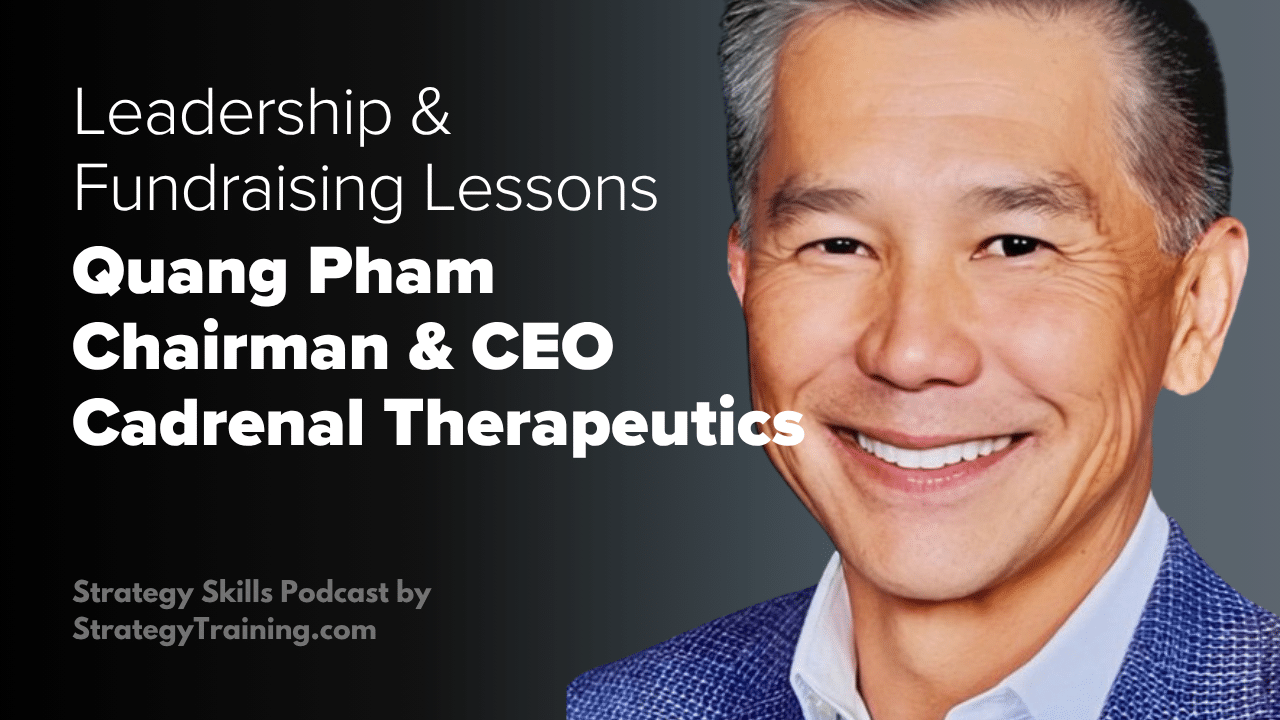
Quang Pham went from being a 10-year-old refugee airlifted out of Vietnam to becoming a Marine pilot, and the CEO of a NASDAQ-listed biotech company. In this conversation, he shares the exact lessons that guided each transition.
Key insights, with verified quotes:
- On decision-making: “As a young officer, we were taught to make decisions… there’s not enough time to consult with everybody. You gotta make a decision to keep moving and then adjust along the way.” This became his foundational leadership principle across sectors.
- On capital discipline: “In the private sector and entrepreneurial world, resources are scarce… you have to treat it with the utmost respect and spend it wisely.” Military spending habits do not translate to startups.
- On performance and promotion: “You work hard, but you have to produce results.” Early in his corporate career, Quang Pham assumed promotions would come automatically. They did not.
- On defining success: “You have to follow and pursue what makes you happy. Not what your family or your culture or society wants.” As a Vietnamese refugee, choosing the military was going against all cultural expectations.
- On raising capital without pedigree: “I lacked the skills to present to venture capitalists… so I spent a lot of time at Toastmasters picking up new speaking skills.” Within 90 days of leaving his corporate job, he secured venture funding as a first-time CEO.
- On pitch strategy: “You have to get to the key points… in the first seven or ten minutes, if not sooner.” Investors have limited attention. Quang Pham focused his pitch on buyer, payment frequency, and execution, not theoretical market size.
- On cold outreach: “It was just three sentences. Who I was, what my company did, something about our common [background].” This approach led to two successful VC rounds.
- On leadership transitions: “I knew that I had the skills and the backing and that the baton had to be passed… the company flourished and I was then just a shareholder.” Founders must be willing to step aside to scale.
- On AI and decision-making: “There is somebody making decisions for AI, the decision to use AI, the decision to pay for AI… at the end of the day, we still need entrepreneurs and leaders.”
This episode offers practical reflections for those navigating leadership transitions, capital formation, and decision-making in complex, resource-constrained settings.
Get Quang Pham’s new book here:
Underdog Nation: Zero In on Effort and Results for Success
Here are some free gifts for you:
Overall Approach Used in Well-Managed Strategy Studies
Enjoying this episode?
Get access to sample advanced training episodes
Episode Transcript:
Kris Safarova 01:04
Welcome to the Strategy Skills podcast. I’m your host, Kris Safarova, and our podcast sponsor today is StrategyTraining.com. If you want to strengthen your strategy skills, you can get the Overall Approach Used in Well-Managed Strategy Studies. It’s a free download, and you can get it at firmsconsulting.com/overallapproach. You can also get McKinsey and BCG-winning resume, which is a resume that got offers from both of those firms. And you can get it at firmsconsulting.com/resumePDF. And it’s always a good idea to keep your resume up to date and in good shape at any level of seniority. And lastly, you can get a copy of one of our books. It’s called Nine Leaders in Action. That book went to become number one bestseller in multiple categories on Amazon. And you can get it at firmsconsulting.com/gift. And today, we have with us. Quang Pham, who is a founder of Cadrena Therapeutics, a NASDAQ-listed biopharma company. He is also a Marine Corps War veteran and author of underdog nation. Quang, welcome. Such an incredible career so far, maybe we could start with just briefly overviewing your journey that took you to this moment when we are speaking today.
Quang Pham 02:26
Well, 2025 is a major milestone for myself and my family and the people of South Vietnam. It was 50 years ago at the Vietnam War ended and less than 1% of us had the fortune of fleeing as refugees and accepted to this country when the former capital of South Vietnam fell to the communists in April of 1975 so number one, we’re very grateful and blessed that we were able to come to United States. Secondly, I think the land of opportunity called America still exists today as it did 50 years ago for us, and that’s in terms of freedom, education and tremendous opportunities for underdogs. And underdogs in my life means not just sports underdogs, but economic underdogs, refugees, people with disabilities, other deficits to be able to overcome by not just working harder, but producing results and putting in the effort. So very grateful to be in America and alive 50 years after the Vietnam War ended.
Kris Safarova 03:31
It is such an incredible country, and we are definitely very blessed. Do you think there was a core belief that you took throughout your entire life that really shaped your leadership philosophy, both in the Marines and also in business?
Quang Pham 03:48
Yes, I think my my leadership style, you know, looking back through my entrepreneurial career as well as my time in the big pharmaceutical biotech company started in the Marines after undergraduate studies at UCLA. And I think as a young officer, we were taught to make decision. That was the number one. When you are faced with leading young marines and flying combat missions, as a young pilot, you’re taught to make decisions. There are no there’s not enough time to consult with everybody, like in the business world, there’s no time to get consensus. You do have to check, you know, with your peers and your subordinates and your superior, but you got to make a decision to keep moving and then adjust along the way. So that’s probably the earliest decision making lesson I learned that I brought to more in the entrepreneurial world. You can’t have all the intelligence, you don’t have all the funding in place, but you’ve got to you as the leader, the founder, have to keep the mission, whether it’s making a product or a service, to go get that first client and keep moving. I think you learn along the way. You just can’t. You know, debate it forever, and so later on in my career, I also learned that things that you can’t take away from the military is that when you’re in the service or work for the government, it’s really not your money, it’s taxpayers money, and you keep spending flying, burning the gas, shooting, practice, training, but in the private sector and entrepreneurial world, resources are scarce. Investor at these moments, getting investor money is very hard, and you have to treat it with the utmost respect and spend it wisely. So there’s that first lesson, and there’s things that don’t apply.
Kris Safarova 05:39
Could you describe to us, how did you navigated a transition from active duty to civilian leadership?
Quang Pham 05:46
That’s a very good question. And a lot of Americans that serve in the military face that it’s probably about 250,000 or 280,000 a year that come into the military and about the same lead the military, whether as 20 year retirees or more or just like myself, serve anywhere from three to seven or 10 and leave with an honorable discharge. So I think most of us in the officer ranks have the advantage of having a college degree already. I think the challenges I think we should focus around is the young enlisted active duty, especially the ground troops, like the Marines and the Army, soldiers that went to Iraq Afghanistan over the last 25 years. They’re young Americans that just have a high school degree and are going to need the GI Bill to go back to college. And I think that’s the bulk of troops that we should focus our attention around this to make sure they come back, taken care of and resume their education. As part of the transition back as far as the officer rank, I think we require less because we already have a degree, we have the training and a number of large corporations like young officers that come out, and then I think you have to retirees that come out after 20 plus years in the military, and so they’re fit into more of a large corporation, consulting to the government and those kind of positions. So and I think that, and I think that the number one is, what does the individual want to do, and where does he or she want to live after the military, and that sets the tone for a career track. And I always advise young officers to take that big job, the first job out of the military, to go work for a big corporation. So you can see how procedures, how big corporations move and act as compared to the military.
Kris Safarova 07:40
And do you remember some of the most challenging moments for you as you were going through that transition?
Quang Pham 07:47
Yeah, I think the number one is, is really not the job itself. So my first job was a pharmaceutical sales specialist in the Los Angeles area. So the challenge was not actually learning the ropes of being in a big company like Astro Merck, one of the largest companies back then, it was more of an identity and affiliation. Because when you first leave the military, you have, you know, you have the tendency to remember all the good things, but not all the not so good things. And so you have this strong identity. I think everybody goes through the first few years of clinging back and going back to, hey, I did this in the military. This was the way we did it. And when you’re around corporate people that didn’t serve in the military, that could only go so far. So I think that transition period when you let go of the past, appreciate it, take the best of what you’ve learned and move on into the new corporation, except the culture and the mission of a private company or a public company in the private sector. So I think that transition of identity is more challenging and actually learning the actual new career, a new job.
Kris Safarova 08:56
Do you remember some of the key mistakes that you feel comfortable sharing that occurred during that time?
Quang Pham 09:04
Yes, I think my early mistake was to assume that I was going to get promoted at a certain pace. Because when you’re in the military, you don’t make a mistake. You’re pretty much assured of at least two or three promotions as a young officer, Second Lieutenant, First Lieutenant, Captain. That’s pretty much assured in the private sector, nothing is assured. You have to produce results, and you have to take on more initiatives, because there are a lot of competitive people that have more experience than you. So when you come out of the military, as I did with seven years I was a brand new sales representative, competing with people had been in the pharmaceutical sales for 1015, 20 years, and so when I didn’t get that first promotion after the first year or two, I realized that I had to not only work hard, because everybody said, you work hard, things will fall into places. No, you you work. Hard, but you have to produce results, and that’s the goal setting process that a corporation usually goes through, instead of just getting those first three promotions automatically to it in the military. So that was the first mistake that I made. I learned very quickly to make sure that the following years that the results were there?
Kris Safarova 10:20
You wrote that success begins with defining your own terms. What was your personal definition of success? Let’s say at the age of 25 and how did it change over time?
Quang Pham 10:31
So at the age of 25 I was a young pilot, and I defined success was I was able to achieve my childhood dream, which was to be like my father, a South Vietnamese pilot, fly, flying in in the war, and supporting the Americans as allies. So I never imagined when I was evacuated at the age of 10 that I could come to America not know anybody, not have any money. Didn’t know the language that they America and the US Marines would let a young refugee boy with a college degree come into its ranks, become an officer and a pilot, and trust me, to fly a large helicopter with the with the crew and flying 10 to 12 Marines into harm’s way. It was a tremendous opportunity and responsibility that I took very seriously. But at the age of 25 that was my definition of success, to be able to be a part of a team and have fellow Marines trust me with that mission. As I’ve gotten past the military in our culture, the Vietnamese refugee community, it was expected that you weren’t going to become a military person. It was outside the norm. You were expected or guided or encouraged to go to be a dentist, an engineer, a doctor or a pharmacist. So what I meant by you define your own successes. Each individual has to not only fight their perceived family norms and expectations, but also their culture, especially for immigrants or refugees. And I think you can identify with this. There is that expectation, and so some people don’t find those career tracks to be rewarding. I never found it to be worrying. So I always encourage young people to like, Okay, you have these family norms and expectations in your culture where you came from before, but make sure you follow and pursue success that makes you happy. And once you do that, then you’re on the track to achieving what you want, and not what your family or what your culture or society wants. And for me, was outside the norms to go in the military as a young refugee.
Kris Safarova 12:45
Do you remember the defining moment when you decided that is what you’re going to do?
Quang Pham 12:49
Yeah, so I had, like I said, a three track career, the military, Big Pharma and then the entrepreneur career. So each of the each of the time, I remember that I reached something or a milestone in the military that persuaded me or changed my definition of success, meaning there was a point in my Marine service that I decided that was not going to be a career military officer, and that was when I was serving as a general aide, right next to a two star general. I saw what it took, I saw how long it took, and I decided that I did not want to wait that long to be able to be in the higher making decision position. When I left Big Pharma, it was after five years, I realized that big companies had the same kind of stepping stones. You just can’t step into a VP or CEO role that quickly until due to in order to make that decision, I reached my fifth year working for a large biotech and I had been promoted, but it was still going to take me a number of years more likely 10 years before I got into high level decision, that’s what I made, the decision to become an entrepreneur, leave a very comfortable, high paying job to go out and look for venture capital. And I count my lucky stars. I was able to do that with the 90 days of leaving a big company and starting my own company with the back of venture capital in 2000 so I remember exactly those moments of and I remember the third step, when I decided to leave my first startup. It was a very hard decision, but I knew that I had the skills and the backing and that the baton had to be passed to a more senior executive to lead the startup into its next phase that I as the founder, needed to move on so that there’s no more insert asserting my influence and my thinking on the company, and the company flourished, and I was then just a shareholder, and I was a happy shareholder that the company took. Off after I left, and that’s a good mark. I think, for entrepreneurs that have to think about venture capital, there is going to be a point where the founder needs to move on, so that, you know, the company can have new ideas, new leadership and new capital.
Kris Safarova 15:13
Can you take us through those 90 days that allowed you to raise funds?
Quang Pham 15:19
Yeah. So I think what one portion of my book under dog nation is you have to do more. Working hard is not enough. Producing results is what we want. And effort the we call it, going to the ER effort and results. And so the first 90 days leaving active duty, I had been preparing for it, I think this is the part where you have to straddle your current job and your next move. And for me, I had a theme throughout my career that you have to love what you do until you can do what you love, so you can’t flounder your current job and moonlighting to start something else, because it’s going to suffer where you are, and you really never give the effort to do a startup. So I gave it my all my last year in the service, and it set me up for the private sector. So my last year at the biotech company, I was the top producer, and that really gave me a lot of confidence that I went outside and I was, you know, I had done a lot of presentations to senior officers, flight briefing, mission briefing. I was very comfortable speaking in military terms and pharmaceutical terms, but I knew I lacked the skills to present the venture capitalists to convince them to make an investment in a company led by a first time entrepreneur. So I spent a lot of time at Toastmasters picking up new speaking skills in that one year. So when I stepped outside of the biotech world, I was ready to go in terms of knowing what was missing in this new pharma database marketing, but also my new speaking skills and pitching skills as the first time CEO. So that gave me the confidence to make sure that I can convince investors that despite not having an advanced degree from a Ivy League, despite not leading a company before, despite not raising monthly before they could entrust me with the dozens of million Well, three rounds of funding to get this database, pharmaceutical marketing company started and on its way.
Kris Safarova 17:17
When you were preparing during that year, working on your speaking skills. What are some of the key things you picked up in terms of speaking skills that changed the way you were able to pitch and present?
Quang Pham 17:30
Yeah. So I think for all of us that do not have English as our native tongue, native language, first language, it’s always a challenge, and you have to constantly work at it, whether you are a young student, a young professional, mid career or senior executive or retiree, if you don’t work at your speaking skills, it’s going to falter. And so just yesterday, I gave a talk at the local Rotary Club. When I left the military, I had a transition from a very formal, mission oriented flight briefing, and we did a lot of that, a lot of preparation. They’re very formulaic. There’s a, you know, there’s a model that we have to copy, the enemy, the situation, the weather. And then after we flew a mission, we had a debrief, and that that was very formal as well. But when I transitioned into pharmaceutical biotech sales, it’s a very regulated industry, you cannot just show up and tell the doctors the benefits of a drug without telling the side effects and so forth. So it’s the fair balance part of it, and that was very formal as well. What I found out about venture capital pitching is that there is also a formula, but I also learned that investors need to trust you. Investors need to know that you have the flexibility and just not be rigid, because being in a startup is very fluid. And so I learned how to relax more. I learned how to work on my facial expression. I was not a big TEDx watcher, because that’s another way of presenting. So you have to be comfortable in your own style, but you have to work at it. You can’t just not go speaking or presenting and show up somewhere and think that you’re going to either entertain or educate people. I think finally, I tell young entrepreneurs, you’re not there to educate people or entertain people. You’re there to persuade them to make an investment, a high risk investment. So you have to be credible. You have to be convincing, and that’s what you need to work on without looking like you are a robot and just reading off the slides.
Kris Safarova 19:40
And for those of our listeners who are about to try to raise money, they heard you saying there is a formula for pitching. So I have to ask you if you could share what this formula is for those listeners?
Quang Pham 19:52
So what I did 25 years ago, and this is during the.com era in the 2000 and you know, I also. Raise in the 2015 to 2017 for pharmaceutical product company. And now I’m raising money for a biotech drug development pre revenue. So they’re the different investor appetite. So I think you have to decide, are you going to be a service or a product company? Okay? And I think the second is you have to, you have to tell the investor who is going to pay for this, and are they going to pay for it again and again, or just one time? I think those probably two the top important questions, and I think you should gear your presentation towards that. I think what I see when people and entrepreneurs ask me for help, when I see their deck, is they spend a lot of time talking about the space, how big the market is, and if they can only get 1% the company would be a billion dollar company. That’s where most of the conversations go to. Whereas now, I think that people and investors, attention span is so short that usually, in the past, you can have 3040, minutes, I think you have to get to the key points of persuading investors in the first seven or 10 minutes, if not sooner, in the first three to five slides, you don’t have, you’re not there. That tells a story. You have to get to the point very quickly. And you may not make a meeting if your deck or your executive summary, you know, does not show, you know, the does not catch the attention right away, and that’s just a way that you know that’s, that’s the world we live in now. Very short attention span get to the point and show why you and your team and your product or your service should warrant a second meeting or an in person meeting. Some people don’t even get through the screening. So you have to get through the screening. You have to convince either, you know, the Vice President, not even the partner, you know, just the analyst. Then you get through that you may meet one or two partner, then you have to come in and meet everybody in the firm via zoom or in person. So there’s three or four steps, but if you had to get their attention to get through the screening, or you had to get an introduction, fortunately for me, I was able to raise money twice by doing non solicited calls, cold calls. I don’t recommend it, but it worked for me. There’s also an art to that without bugging people or being annoying, of coming back to them all over and over again, usually, a yes comes very fast. A no takes forever. I may never come.
Kris Safarova 22:31
Well, I have to now ask you, how did you made those calls? What was different about how you made those calls?
Quang Pham 22:38
Yes, so you know, I think you have to be relatable to people as you and I know we have our foreign born names, and my mother decided to keep our names exactly the way it was when we were born in South Vietnam, Saigon. The only difference is, in Vietnam, our first name comes after our last name. So in America, your first name comes first and your family comes second. So right away, people have either receptive indifference or negative reaction when you don’t have Joe Williams or Mary Smith come in. So you have to be cognizant that’s the world we live in. And so what I did was I try to find something in their background, something that’s relatable, something in common, and I put that in a very short email. And I think both times I get the second call was within just three sentences, who I was and what my company did, something about our common and I’ll give you the first AdVenture Capitalist had invested me. He was a US Naval Academy Annapolis graduate. So there was one sentence in there, and then how I am different than whatever is out there. I never put down. We’re entering a $10 trillion space. Okay? The second time I got funded unsolicited, it was somebody who had attended the University of California like I did, and that it was just one short thing, and it was not just a long winded thing. So I think you have to be brief, you have to be relatable, and sometimes you need a little luck, but if you don’t try, Your luck is zero. And so I went against the odds. I went against advice of reaching out to these people, and I was fortunate enough to get a second look. There’s never go. There’s no guaranteed funding. What you want to do just advance the conversation, to get through the email screen, get through all the PowerPoints or decks that they get, and then you’re there. You know, it’s up to you to convince them to bring you in for additional meetings. And that’s that’s how you advance through the funding process. And you know, it’s different for everybody. Some entrepreneurs probably take two or three meetings because they have the credentials. They have done it before. They have created great returns for certain funds, and they automatically get funded the next time they go around, because they have a track record. If you don’t have a track record. Good with certain funds or in the industry, it’s going to take a little longer. It’s not impossible, though. Really, nothing’s impossible. It’s only impossible if you don’t try, if you don’t call, if you don’t send out emails, you just get keep at it and change it when it doesn’t work. I think one more comment I gave to an entrepreneur that got 30 rejection I said, Well, you have to pause. Okay, so the next 30 you send out, change something, and send it out to five, and never send it out to the top tier investors, you know, try it out to, you know, tier three or tier C investors, and then adjust along the way. But just don’t send the same pitch to 30 people or BCC, because you’ll never get a reply that way.
Kris Safarova 25:42
Oh, yes, that’s such a bad mistake to make. So you raised your first round for the first company. You raised money for the first company the first round. What happens next?
Quang Pham 25:53
Well, once again, you know, I have to be you know, that was 25 years ago when money was a plenty. 10 years ago, the money was harder when we raised money for about, you know, a biopharmaceutical company that had revenue, and then we raised money and we took kadrina therapeutic public in early 2023 and that’s a different group of investors. So, you know, you have your angel, Angel, private investor series, a early stage venture capital and the different tiers, right? There’s tier A, B and C. The number of firms are going down, though there’s a consolidation and people moving around. And so I would say now, if you raise the seed money, you have to be able to show how long it lasts and how you’re going to spend it, and what that gets your company towards a milestone. People call it value inflection points. You have to give them the confidence that they’re not going to lose their money, because investing private companies can generate great returns, but it can lose money for angels very quickly. So I think you have to keep in mind these people are giving you their savings, their hard earned money, and so you have to give them confidence that you’re not going to be out there and run out of money with their seed investment in 12 months or 18 months. I think secondly, you have to put your money in the game. You have to put your own money in and not take a huge salary, and this is for a private startup. If you’re not able to do that, I’ve made this recommendation before that some people should stay at their corporate job and put more money in the bank before they venture out, because if you think you’re going to leave your corporate job started a new private company and get investor money to pay your salary, it’s just not a reality. You have to be able to go without pay or put in your own money, which means you need more money in the bank before you come out and ask people to fund your company and pay your new salary. It’s just the reality of being a credible entrepreneur, especially the first time, because I see people that approach me and other folks that have been around for a while, and that’s what they put in their model. And you see the salary and no money in no skin in the game.
Kris Safarova 28:06
What do you think are key principles you believe in? And you already mentioned some, but maybe you want to add anything that you think are very important and played key role in your success in life.
Quang Pham 28:17
I think I was able to learn that any assumptions you make, there’s no sure fire. There’s no sure thing. So if you think you’re going to close around in 90 days, it’s not going to happen in 90 days. Things just take longer. So that was my my first time getting funded exceeded all but after that, everything took longer. And so that’s the reality. Any assumptions you make assume that it’s not going to happen in the way you think it’s going to happen and in the amount is going to happen. My other endeavors have been in writing books. Now under dog nation just came out as my second book. My first book, a sense of duty, came out in 2005 was by Valentine Random House, and it took me four years and 30 rejections to get published by a major publisher. So I think people have great ambition, and I certainly had great ambition and anticipation, but things just take longer. So I think one of the things I look back and learn is that assumptions that I’ve made just took longer, and sometimes it’s okay you have to be flexible, and just have to build that into your own financial or mental model.
Kris Safarova 29:34
And of course, I have to ask you about AI. Your thoughts on that. What should leaders start doing now to prepare for how AI will change the world in ways maybe we don’t even understand yet fully?
Quang Pham 29:45
Yeah, AI is a tremendous capability. And, you know, I have a joke in the biotech world, I care about AI, but I care about AE more, and that’s adverse events of our drug, but AI is. Going to make jobs less available for humans. I think you can see that in the big Wall Street Journal article a few days ago with Amazon and the big companies letting AI take over for certain roles. It’s going to speed up things. It’s going to speed up due diligence. It’s going to speed up financial modeling. It’s going to speed up legal filings. It’s going to speed up patient recruitment. Everybody, including us, have to build that into it. But at the end of the day, there’s somebody making decisions for AI, the decision to use AI, the decision to pay for AI, and the decision to align human resources versus technology. So at the end of the day, we still need entrepreneurs and leaders to make decisions with the assistance of AI.
Kris Safarova 30:51
What do you think leaders or listeners should do now to prepare for what is ahead?
Quang Pham 30:58
Well, I think leaders, and it depends on leaders in which organizations right, whether it’s large military or government organizations or fortune 50 companies, they’re going to have different priorities, and AI is going to have big ramifications for those organizations. So I can only speak for the small cap biotech company that’s in drug development. We are preparing to see AI from the entrepreneur company side as well as the government side on the FDA. So I think both sides, and I think the investor side as well, everything is going to be greatly analyzed. Everything is going to be sped up. And so once again, there’s that whole anticipation thing, you think it’s going to be happening faster because of AI, and sometimes it doesn’t, because there’s still a human behind final decisions such as financing, such as FDA approval or delays. And so I think leaders, you have to factor in that AI, not only in your company, but also in the interfacing of your company, and for us, the government, the FDA, and with larger pharma as well, in terms of partnering.
Kris Safarova 32:08
Quang, if you were given one more hour in a day, every day for the rest of your life, but you would have to commit to spend it in a certain way. What would you spend it on?
Quang Pham 32:19
If I had one hour more each day on this earth, definitely, either in person or in zoom with people I want to spend time with, and that’s family and friends. It is just, you know, either scheduling conflicts, geography or preference, that that’s what I would spend more time on.
Kris Safarova 32:40
And what is one trap you used to fall into that you have trained yourself out of?
Quang Pham 32:47
The one trap that I used to fall into, assuming people know about my company and me before a meeting. Okay? I think everybody assumes that just because I made you know the the effort to look at people’s LinkedIn or Google or Public domain before a meeting, you can’t assume that they know everything about you or your company going into a meeting, and so you have to be prepared to take the conversation quickly into the details, or be able to spend a few minutes getting up to speed. You can’t assume that people got to know everything about you and your company going to a meeting the way you prepared, the way I prepare. And that was the trap I used to fall into earlier in my career, and then I would have to back up and slow down and start because I find out sometime, when I go meeting people have no idea why we’re there in some cases.
Kris Safarova 33:46
With the book that you have written, your second book, what do you want readers to take away from it after reading it?
Quang Pham 33:55
Yeah, I think the key things I want readers of underdog nation, first of all to acknowledge and appreciate that if you’re an underdog, I sense before it doesn’t have to be either by race, creed, gender, handicap or anything. If you don’t feel like you are cream of the crop with all the help and the credentials. Just know one thing, there’s no better place to be an underdog than in America, where you have a lot of opportunity. So I think Bobby, that’s the top takeaway. And number two is that you have more fans than foes. I think when you’re an underdog, you think the world, the company, the organization, is against you and you’re never going to get promoted. But it’s not true. That’s a mental mistake people make, and you just have to make sure that when you’re not being the favorite candidate, when you’re not the favorite person to get funded, that you have to go back and look at your ER. You have to go to the ER and look at your effort and results. Make sure you know what the results are going into a meeting, starting a company advanced. Seeing a company and look at the effort you put in to get to those results and make the adjustment, though, those are the top things, I hope readers and they have, they’ve been emailing me about the book, and certain reviews have said they that best. So I’m very happy and very proud of the work that Forbes book and I to get this book out and to be able to share those messages for people.
Kris Safarova 35:24
And the last question for today, of the last, let’s say 10 years, or even your entire lifetime, what are two, three aha moments, realizations that you feel comfortable sharing that really changed the way you look at life or the way you look at business?
Quang Pham 35:39
I would say, when going back 20 years, you know, when I when I wrote a sense of duty, and I have this in the underdog nation, people have to come to closure with non business issues, whether if they don’t talk to their parents, a sibling, a friend, or something in their path, that They fail to come to closure with an open wound for me, coming into America, becoming American citizens, serving my country, having my dad come to America had still didn’t complete my quest to find out what happened to the Vietnam War. Why did so many people die? Why did Americans, you know, perish for us, and then took us in. Upon finishing the book, I realized that I had come to terms with the Vietnam War as an American, as a Vietnamese refugee, as an adult, as a father, as a son. So that was the first personal closure for me, when I finished the book a sense of duty and have it published 20 years ago in 2005 the second part of realizing that my career was going to be in the entrepreneurial consulting, eat what I kill, produce what I you know, as far as results and not be part of a corporate track. Was sometime when I was in the biotech giant, I knew that after serving in the military and after being in a big company for five years, that I was more comfortable operating faster, more nimble, more high risk entrepreneurial setting than I was made to be, you know, in bigger corporations. So those are the two moments, and they came about the same time, in the late 1999 to 2005 timeframe.
Kris Safarova 37:38
Quang, thank you so much for being here, for serving our country, for everything that you have done in your career so far. Where can our listeners learn more about you? Buy your book? Anything you want to share?
Quang Pham 37:49
Oh, yeah, and like I said, I have a website for my books and some unlimited speaking, it’s quangxfarm.com. Thank you Kris for having me today.
Kris Safarova 38:02
Our guest today again have been Quang Pham, author of Underdog Nation, and our podcast sponsor today is StrategyTraining.com. If you want to strengthen your strategy skills, you can get the Overall Approach Used in Well-Managed Strategy Studies. It’s a free download, and you can get it at firmsconsulting.com/overallapproach. You can also get McKinsey and BCG-winning resume, which is a resume that got offers from both of those firms. And you can get it at firmsconsulting.com/resumePDF. And lastly, you can get a copy of one of our books that actually was co-written with some of our listeners, some of our amazing clients, and you can get it at firmsconsulting.com/gift. Thank you so much for tuning in, and I’m looking forward to connect with you all next time.
Leave a Reply