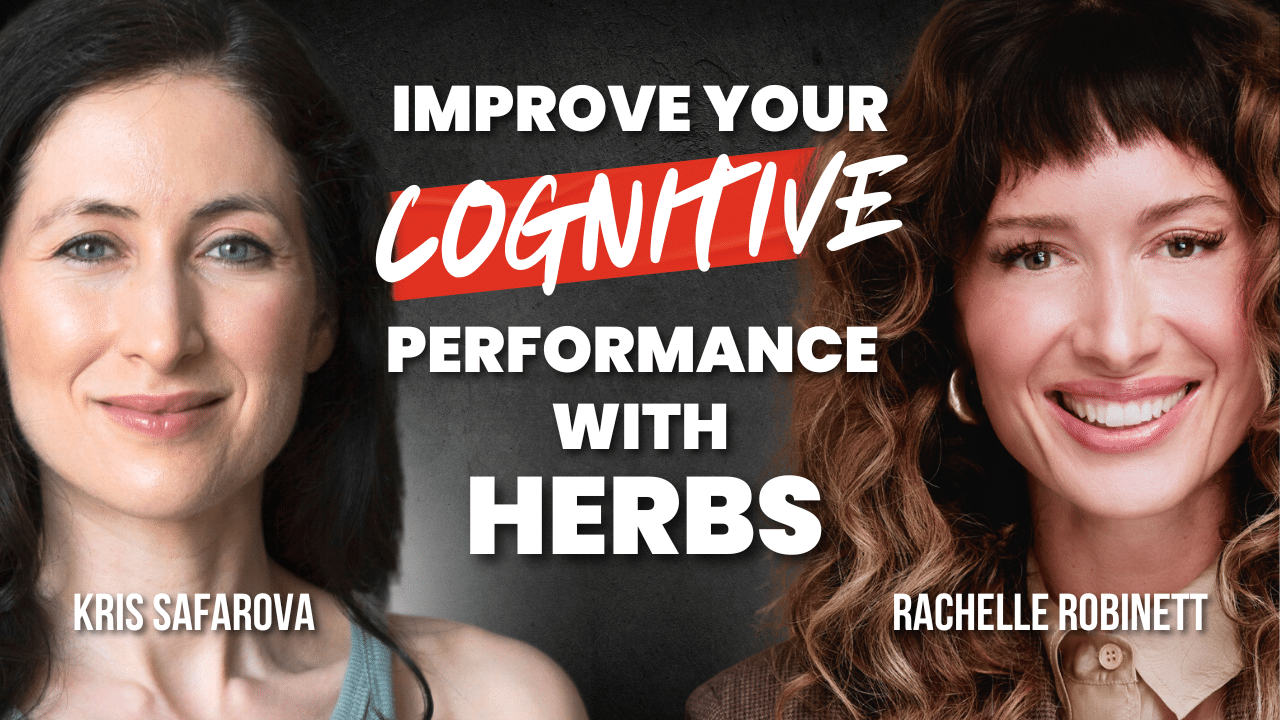
Rachelle Robinett, founder of Pharmakon Supernatural and educator in holistic health, offers a clear, science-aware framework for supporting energy, focus, and stress regulation, without defaulting to pharmaceuticals or overstimulation. In this episode, she explores how plant-based medicine, nutrition, and daily practices can be woven into practical, long-term routines that support resilience and cognitive clarity.
Robinett challenges the assumption that performance must rely on synthetic energy or end in burnout. Drawing from her work at the intersection of herbalism and evidence-based wellness, she shares actionable strategies for optimizing physiological readiness through balance, not intensity.
“I’m really interested in how we can live well without needing to biohack or rely on pharmaceuticals or stimulants or even supplementation all the time.”
Key insights from the conversation include:
- Stimulants Borrow, Not Create Energy
Robinett explains that caffeine and similar compounds don’t give us energy; they “just turn off the signals of fatigue.” Instead, she emphasizes rhythm management, aligning with circadian patterns and energy cycles: “You don’t have to be on all the time. And if we try to be, the crash will always come.” - Herbs Should Be Matched to Mechanism, Not Trend
She encourages listeners to move beyond marketing labels like “adaptogen,” noting that compounds like rhodiola (stimulating) and reishi (sedating) serve very different roles. “Match your plants to your goals… It’s kind of like caffeine; if you don’t need it, don’t take it.” - Sugar Is Energizing, But Often Disruptive
Robinett discusses how sugar can be paired with fiber, fat, or protein to reduce its volatility: “Sugar is biologically energizing… but we tend to use it in ways that give us a spike and then a crash.” - Daily Practices Outperform Sporadic Interventions
Light exposure, meal timing, and breathwork help regulate the autonomic nervous system more effectively than isolated hacks: “What we do daily matters more than what we do occasionally… so many people don’t understand how profoundly their breathing patterns are affecting their state.” - Recovery Is an Active Recalibration
Robinett distinguishes between activities that feel restful and those that actually reset the stress response system: “Sometimes the things we think are relaxing are not—Netflix, alcohol, even yoga. True recovery is shifting the nervous system.”
This conversation reframes wellness not as indulgence or optimization, but as physiological literacy—a disciplined, systems-level approach to mental clarity and endurance. For professionals seeking alternatives to overstimulation, Robinett offers a sustainable path toward long-term resilience and regulated energy.
Get Rachelle’s book here:
Naturally: The Herbalist’s Guide to Health and Transformation
Here are some free gifts for you:
Overall Approach Used in Well-Managed Strategy Studies
Enjoying this episode?
Get access to sample advanced training episodes
Episode Transcript:
Kris Safarova 00:45
Welcome to the Strategy Skills podcast. I’m your host, Kris Safarova, and our podcast sponsor today is StrategyTraining.com. If you want to strengthen your Strategy Skills, you can get the Overall Approach Used in Well-Managed Strategy Studies. It’s a free download, and you can get it at firmsconsulting.com/overallapproach. You can also get McKinsey and BCG-winning resume, which is a free download as well. And you can get it at firmsconsulting.com/resumePDF. And today we have with us Rachelle Robinette. She’s a writer, herbalist educator, life-long naturalist, and she’s the author of Naturally: The Herbalists Guide to Health and Transformation. And I know it is a very unusual topic for us, but I think that it is an important topic for us if we can incorporate certain simple things into our life as leaders and have higher cognitive performance and just being a lot less tight and so on, it can make a huge difference. So Rachelle, so great to have you with us.
Rachelle Robinett 01:47
Thank you so much. I’m very happy to be here.
Kris Safarova 01:51
If someone wanted to incorporate herbs to improve their health and cognitive performance, starting this week, where should they begin?
Rachelle Robinett 01:59
Absolutely so in herbal. I mean, any herb is going to improve our health. And when our health is improving, you know, because everything is connected, there’s a cascade of benefits that we can see in energy, in sleep, in mood and focus in performance. Broadly. That said, there are a cat. There’s a category of herbs that is particularly well suited for cognitive performance, for memory, focus, concentration, decision making, these sorts of things. And that category of herbs is called nootropics. And nootropics, by definition, enhance memory, focus and concentration. So if somebody wanted to start today, I would recommend finding a blend. It can be in a capsule, it can be in a tincture, it can be a tea format. It can be a gummy, anything that is easy to use. And we can use every day that contains some of these nootropic herbs. And I can mention someone specific, if that’s helpful, and begin using it. You know, every single day, commit to some consistency and begin reaping those those rewards.
Kris Safarova 03:10
Rachelle, and assume that most of our listeners know very little about what we’re talking about here today. So even the word here using is just not something that is very familiar to people. So maybe you could really explain to us how to select the right ones, because when it comes to also herbal medicine, that a lot of providers and not all of them are creating high quality product.
Rachelle Robinett 03:31
Yeah, of course, so many of us use supplements, vitamins, or, you know, you know, pills of any kind, and even in the supplement world, you and actually in the supplement world, kind of outside of herbalism, you see this term quite often, nootropic, and it’s applied to ingredients like L theanine, for example, these nutraceuticals or supplements, vitamins, minerals, whatever it is that help to improve our our brain function. And some of those ingredients are herbs as well. So for example, peppermint, or any kind of mint, is a really wonderful ingredient for improving our mental performance. So we could be drinking a mint tea, you know, or, as I mentioned, you know, selecting a supplement. So when we’re looking at, you know, vitamins or these sorts of things, a lot of times they already contain herbs. And it is the easiest way to begin working with herbalism, I think, is to find a, you know, capsule, a pill of some kind that is made from herbs. And again, in this case, we would look for something that’s focused on brain health, you know, mental performance, that sort of thing. And when selecting herbal products, I really like to, I like to recommend that people. Apply the same criteria to their supplements that they would to their food. So for example, if organic is very important to you and accessible, and that’s something that you know is is a criteria that you apply when you grocery shop shop, or order at a restaurant or something like that, then we can look for an herbal product that is also organic. We can look at, I like to work with companies, meaning use their products. Companies that are 40 years old or 50 years old, and have been making these herbal products that long. They’re often founded by herbalists, and so you have people behind the product that know what they’re doing, that are putting together the right combination of herbs. So really, when shopping for an herbal product, you want to look for the same kinds of things you might look for in a multivitamin or in a protein powder or in a, you know, piece of produce that you’re buying. Can, you know, is there transparency in terms of where the herbs are sourced from? Do they show any sort of studies that indicate the quality of the product. Are they transparent about the fact that this is a company that is founded by herbalists, that there are herbalists on staff, herbal herbalists creating the formulas, and then we can trust those blends and those products. And I think that really is the easiest point of entry, unless someone wants to start with tea, and tea is always effective in a really nice ritual to have in a day, even a very busy, stressful desk found day, as we so often have.
Kris Safarova 06:33
Very true. So obviously, this is not a medical advice. But are there supplement providers you particularly trust?
Rachelle Robinett 06:40
Yeah, absolutely, absolutely. So I love Herb Pharm, and that’s P-H-A-R-M, Herb Pharm. They’ve been creating mostly liquid extracts, so tinctures for about 40 or 50 years now. They grow a lot of their own herbs, and they’re very easy to find, wide distribution. I really like now foods as well. Now is distributed globally and has a lot of herbal countless array of herbal products in mostly capsule format. Gaia herbs is also fantastic, another older company with a lot of herbalists on staff. I would say those are some of my top three. There’s there, oh, another that I really love for non alcoholic tinctures. So these are made with glycerin, for anybody who wants to avoid any, you know, alcohol consumption. It’s minimal when we’re using a tincture. So for example, this is a tincture, you know, comes in a dropper bottle and and it’s this company that I also love nature’s answer. And they have a, again, a long history of a really special kind of extraction process that makes very strong tinctures that are alcohol free. There it’s a really pleasant product to use. So those are four that are excellent.
Kris Safarova 08:01
Thank you. That’s so helpful. Saved people a lot of time doing research and trying to figure things out. Of course, you mentioned teas. Would you say that tea potentially more potent than getting a capsule or not?
Rachelle Robinett 08:16
Typically, capsules are the most potent. Typically, yeah. Typically, capsules. We’re able to concentrate herbs in a way that is a little difficult to do in in tea, usually it’s capsules are the most potent. Tinctures follow the capsules. Then you have kind of powders or syrups, you know, if you’re adding a powder to a smoothie or powder, to a drink or something like that. Those can be the next most potent, and then teas are generally the gentlest. And actually, you know, if someone is pregnant, for example, or nursing, herbalists will often recommend that they just stick to teas, because teas are effective, but they are mildest, typically in terms of their potency.
Kris Safarova 09:01
Do you have particular teas that you you really make sure that you have them with you when you travel with you at home, because you really rely on them to help you maintain your health and your high performance?
Rachelle Robinett 09:16
Absolutely. I use herbs all day long. And when I had a cafe, I drank tea constantly, constantly. It depends on the weather, you know, if you want hot or cold, but you can absolutely have cold teas as well. You know, some of my favorite herbs are, I use a lot of herbs for my mental health. So I really like Panax ginseng, for example, otherwise known as Asian ginseng. This herb is used for supporting longevity, energy levels without over stimulation and healthy kind of neurotransmitter levels in the. Brain. I use a lot of I use some herbs in combination with each other. So example, one capsule that might contain four or five herbs that are all beneficial for resilience to stress. So that would be, for example, ashwagandha, rhodiola. These are the adaptogenic herbs. They’re called, their adaptogens. And I would say my favorite tea is nettle tea comes from the stinging nettle plant, and it’s essentially equivalent to drinking a multivitamin. Has a really nice earthy flavor. It’s a bright green tea, and it’s very rich in vitamins and minerals, iron, you know, chlorophyll, these things that we get from eating a largely plant based diet but drinking it in tea format is, you know, like I mentioned, equivalent to taking a sort of multivitamin. So I use, I use all of that and more My desk is, you know, at this point, because I’ve been doing this so long, I just have herbs woven throughout my day, from morning until I fall asleep. So there are a lot. I use herbs instead of alcohol. I use herbs to help improve my sleep. So they’re here.
Kris Safarova 11:17
If you’re comfortable sharing, could you give us an overview of what your day looks like and which herbs you take at which time? In which form?
Rachelle Robinett 11:25
Certainly, certainly, and I’ll do this with the with the additional caveat that I have been practicing herbalism for a very long time, so I ingest a lot of herbs, and by no means does anyone Ever have to ingest as many herbs. But it’s also a good example of, number one, the amount of, you know, ways and opportunities there are to weave herbs into a daily life. And two, I think a great case, you know, case in point that mixing herbs is safe and actually ideal. And that’s a common concern that exists in the market, you know, is it safe to combine these herbs? And I always like to remind people that, historically and globally, herbs are used in blends, in combinations, in formulas. They work better that way. And a common example of that is turmeric and black pepper. You know, black pepper helps us absorb the active constituent and turmeric, which is curcumin. A lot of people are familiar with that combination that exists throughout herbalism. So for my day, I wake up and I have some coffee, which I blend with herbal coffee. And in that herbal coffee blend. There are functional mushrooms, there are the adaptogenic herbs, and there are some good herbs for digestion, and it brews really dark and it blends really well with coffee. So I have sort of a half and half blend, and then in my cabinet, I have my supplements organized in little rows. So there’s morning, midday and evening, and that makes it very easy for me to remember to take everything that I want to take at a certain time of day and not have to think through or shuffle or look for anything. It’s just like this is the row for the morning, afternoon, evening. In the morning, I take some mood supports and hormone balance primarily, those are the two sets. So there are herbs in blends like black cohosh, Don Kwai, licorice and chaste or Vitex, and those are all great for female hormone balance. And then there’s the blend that I mentioned, with a Panax ginseng and some other ingredients that are really helpful for mood, providing sort of serotonin and dopamine support throughout the day. Then with my lunch, I’ll take some herbs that I know digest better with food, or that like to have a little bit of fat. So for example, curcumin, or turmeric, is really well absorbed when we eat it with a bit of fat. So I have a supplement that includes turmeric, curcumin and frankincense that’s really helpful for reducing inflammation from life in general, from stress or from exercise. And then I have, you know, and I have an herbal multivitamin I will take liver support. So milk thistle is my absolute favorite herb for liver support. And I think it’s very important in this day and age that most people use some sort of liver support. This is in my top three. I recommend it to everyone, and I especially recommend it to women, because supporting our liver is very important for helping support hormone balance, and that’s not commonly connected. A lot of times we think about herbs for hormone balance or supplements for hormone balance, we don’t realize the liver is critical in that process. So I’ll use milk thistle every day, even though I don’t drink. Alcohol. I think it’s important. Milk Thistle helps improve liver function and also regenerate any damage to the liver. There are probably some others in there. I use some tinctures, you know, in my water drink, nettle tea, like I mentioned on my desk, I have a variety of the nootropics that I mentioned that category that improves mental function, because I’m often working at my desk in the afternoon. So I have rosemary essential oil. I might drink a peppermint tea. I have some tinctures here for you know, again, memory, focus, concentration, and they include rhodiola, which is great for supporting dopamine levels, which are often part of the flow state that we get into presenting or working, or any of these sorts of things. Lion’s Mane mushroom is in one of those blends that’s really wonderful for focus. And then, if I want a happy hour, you know, if I want something to kind of change my state after work, before, you know, dinner after dinner, or something like that. My favorite herb is Kava. I love kava as an alternative to alcohol. It’s something that helps relax the muscles in the body, relax the physical body, improve kind of sociability and these sorts of things. But doesn’t drunken. You know, the mind. We don’t feel altered cognitively, we just feel more relaxed and sort of happier. I always travel with that herb. I love it for use on airplanes. I love it for any kind of tension, even tension headaches. It can be used for sleep. It’s one of my absolute favorite herbs. And then, before sleep, I will use I have an herbal blend that I love for sleep that includes herbs that are great for the nervous system, that category of herbs are called nervines, and then also some sedatives. So there are lots of herbal sedatives that we can use that don’t have negative side effects, Valerian, California, Poppy, hops, these things I also really like tryptophan before bed. So I use a combination of kind of, you know, vitamins, minerals and nutraceuticals along with my herbs. So that’s essentially my day in herbs.
Kris Safarova 17:21
Thank you. That was helpful, and a lot to think about and experiment and to research and see what feels right for everyone listening to us right now. Of course, you previously talked about herb categories. Tell us a little more about it so that we could start getting a better understanding.
Rachelle Robinett 17:38
Yeah. Thank you so much for asking that it’s very, very important. So when you know, when we’re new to herbalism, you know, it can appear to be this sort of, you know, catalog of 1000s and 1000s of herbs. How do we even begin? How do we narrow it down? How do we find the ones that we need? And the way that we do that is by understanding that herbs are categorized based on how they affect us, so based on their actions, on our bodies and minds, we categorize them, and it’s so important that that’s what I structured my book. You know around each chapter is dedicated to our category of herbs. Those categories also correspond to body systems, the nervous system, the brain, the stress response system, otherwise known as the HPA axis, the gut, you know, our ability to sleep. So each each category corresponds to a need state, essentially. And some of the biggest ones, some of the most common ones that we work with are nervines, which are great for the nervous system. These herbs work specifically to calm the nervous system down, to restore balance in the nervous system, and even to heal the physical nerves themselves, if there’s actually been nerve damage from any kind of injury or something like that. Another category that’s very popular right now is adaptogens. And adaptogens are about a dozen herbs that work specifically through the HPA axis in the brain, the hypothalamus pituitary adrenal axis, to help us become more resilient to stress so we can respond appropriately and recover quickly, as opposed to being kind of shocked or in that state of fight or flight longer than we want to be. These are phenomenal for any kind of performance enhancement, mental, physical, you know, in a high pressure environment, we are in the fight or flight, flight state a lot, and the ability to not burn out from that the ability to recover and respond again when we need to is really well supported by adaptogenic herbs. We also have the nootropics that I mentioned, you know, specifically beneficial for memory, focus and concentration. There are sedatives, there are afro. Desiacs or antidepressants, which are great for lifting low moods, supporting depression anxiety, enhancing any kind of arousal. If we’re looking for an aphrodisiac like experience, there are bitters, bitter herbs support gut health, digestion motility, reducing any kind of symptoms in that system, improving detoxification, these kinds of things. So those are some of the main categories, and those are some of the the ones that I focus on. And naturally as well.
Kris Safarova 20:32
This is so interesting. And you started your career elsewhere, and then you had that story of your colleague asking you to teach you, and then it started your journey. How long did it took you to really understand this world of herbs and which ones to select to create this perfect blend for your situation?
Rachelle Robinett 20:52
Yeah, I love that question. So I did have a career elsewhere. I was working in fashion prior to herbalism, that said, I have been studying plants and healing systems and the body’s relationship with nature. From the time I was a little kid, I was always fascinated in this. So in one sense, and I was, you know, I was tinkering. I would I would experiment with myself. I would try things again, from the time I was quite young all the way through my career in fashion, you know, until I became an herbalist. And you know, for example, when I was working in fashion, I was sober, I was raw vegan, I was, you know, using my vacation days to go to Peru for Ayahuasca retreats. Like I was definitely studying at that point as well. But, you know, I really doubled down on herbalism when I realized how holistic it is and that it’s not just plants as medicine. It actually takes the entirety of a person into account. You know, what is your diet, your lifestyle, your physical fitness, your community, your spirituality. How is everything in your life you know affecting your vitality? And where do we begin to make you a better person? And how do we do that naturally? That’s really what herbalism is about. And of course, there are herbs that can be used as medicine, but we might start with nutrition, and we might never go beyond nutrition. If that’s all someone needs to feel fantastic. That’s actually the goal, you know. But you know, one thing I would say is that because we’re discovering new plants all the time, because science is still working to understand all of the different ways that these herbs work on our bodies, just like medicine is continuing to evolve, just like nutritional science is continuing to evolve. You know, there is no end to how much we can learn. So I am constantly learning more and adjusting my own routine. But I would say, you know, some sometime after deep studies. You know, some years after deep study, and also seeing clients one on one, all day long, I had a full private practice, as well as teaching to very large groups and seeing the herbs work in people’s lives, change their health, change their lives. You know, my approach and my preferences began to narrow and focus to, you know, what I present in the book now as my absolute favorite, tried and true, you know, methods for holistic health, as well as the herbs, you know, within them. So in some in some senses, it’s really hard to kind of pinpoint exactly how long it took for me to sort of know a thing, because it’s gradual and continual. You know, like so many fields of study are.
Kris Safarova 23:49
Of course, and as you were doing your studies and learning more from childhood about this world of herbs, was it difficult to find reliable sources of information?
Rachelle Robinett 24:02
That’s a great question. You know, I would say it was less difficult when I was studying than it is now, because it’s become the wellness industry was not what it is now then, you know, and I started before the very, very early stages of the current wellness industry, kind of complex is development. So I it was, it was sort of comical. I had to pull information from very disconnected sources as I was putting these things together. So I was reading scientific studies in one area I was, I was learning about herbalism in very sort of witchy, crunchy, you know, funky like websites and shops and from teachers who, you know, I love, I love herbalists, and I love herbalism, but there’s a, there’s a brand, there’s a there’s a look and feel. That generally predominates, you know, herbalism, and it’s and it’s specific. So I was studying there. I was spending time in chat rooms, or like these boards, you know, chat boards, and I remember what they’re called now, of bodybuilding communities, because they were very early, you know, biohackers, and they were using supplement stacks and doing these sorts of things. And I was seeing, you know, things or connecting dots and kind of doing that, and then writing about it. And then slowly, over time, all of these communities have now converged, and we have the wellness industry. And of course, once that happens, you know, we have companies entering the frame and marketing and advertising and products and, you know, influencers and experts and all these different people. So now it’s much more challenging, and the Internet has changed as well, you know. So I did a lot of when I was younger. I was, I was reading books, you know, I was reading classic medicine books about, you know, traditional Chinese medicine and Ayurveda and these sorts of things. Not that books are always reliable, but they’re generally more reliable than the internet, I find and social media was not a thing, you know. I mean, it was, but not like it is now. So now it’s much more challenging. And I really do, you know, recommend avoiding, like, a general Google search or these sorts of things. If someone likes science, read the research. I have a lot of research in the book. I really like the science behind herbalism. I think for me, it’s a great way to understand exactly how plants are doing what they’re doing in the body. You know, in the same way we understand how medicine is doing what it’s doing. You know, there are receptor sites, there are mechanisms of action. There are specific, you know, things that are happening that we can trace, not always, but often and and then I also like to work with teachers who have been teaching this for decades. My favorite teacher has been teaching herbalism for 40 years, maybe 50 years. It works with medical institutions all over the world. And so I think, you know, finding a few reliable sources is far preferable to Tiktok or Instagram. I mean, I’m on Instagram, but you know, I don’t recommend starting there.
Kris Safarova 27:23
In addition to your book, can you share a few sources people can go to if they want to learn more?
Rachelle Robinett 27:30
Absolutely. So let’s see some good sources for learning more about herbalism. I do love. Let’s see. Let me think about that one for a minute. It’s tricky. So that’s part of the reason why I wrote this book, is that there are not a lot of modern resources for herbalism that sort of presented in the way that you know we need in our lives today. You know, one of the books that I mentioned, I do love. It’s a classic. It’s the web that has no Weaver. And this book is specifically about traditional Chinese medicine. It’s a little bit more, it’s geared a little bit more toward the practitioner, whereas my book is geared toward anyone, anyone at all. I am happy to name my favorite teacher in the herbal space is David Winston, and he, as I mentioned, has been teaching for a very long time and has consistently phenomenal information. I would say, you know, the greatest resource for herbalism information today is the American herbalist guild. The American herbalist guild has a long list of the best books, the best schools, videos, podcasts, communities, events, and it’s the organization that organizes and structures and kind of vets practicing herbalists today, and we can, we can trust, you know, that anything that’s been approved by them and that’s being shared by them is valuable and is accurate. So I would recommend the the American herbalist skill, and that’s just our website.
Kris Safarova 29:20
What are some biggest aha moments you had as you were discovering the most powerful herbs?
Rachelle Robinett 29:28
So many I feel like this, this, this practice is full of aha moments. You know, one, one moment that I will never forget is the day that I was making my very first tincture, just a DIY at home, kind of experiment. And I went and I bought this herb, mugwort. Mugwort is a very, you know, bitter plant, and it has a lot of history and kind of folklore. And I thought, this seems magical. I’ll make a tincture with this. Kris, and I made the tincture. You have to wait, you know, six weeks, and finish the tincture and open it and smelled it and tasted it. And I just, I was like, this is, this is alchemy. This is, like a perfume. This is like, you know, I just made medicine out of this, this plant. And it was so I remember, I just remember that moment thinking, like, this is it? This is incredible. And then I walked out of my apartment in Brooklyn and realized that growing right in front of my door was a big patch of mugwort. I thought, okay, not only is that incredible, but we are surrounded by this medicine. It’s growing out of the sidewalks in Brooklyn, of course, you know, we don’t want to make medicine out of that plant that’s growing out of the sidewalks, but to realize that herbalism is absolutely everywhere already. It’s already in the spices in our kitchen. It’s already in, you know, in our environment, no matter where we live, and that it is medicinal, that it is natural, that it’s effective, all these things. That was a that was an incredible stage for me. And I know a lot of people who begin in herbalism, and then just all of a sudden see the environment differently and realize what nature has to offer us. It’s a very powerful aha moment. And you know, the other, I think, is not one, but the continual, the continual sort of flow of aha moments of seeing herbalism work in the lives of my clients and my students and without fail, without fail, every single person that came in contact with herbalism that I witnessed had some improvement for the better, that inspired them, that made them feel more empowered, that just that improved their lives. And it would bring me to tears. Sometimes it would bring them to tears. Sometimes it’s it’s an incredible thing, because once again, it’s accessible, it’s sustainable, it’s natural, it’s everywhere, so that I I’m forever humbled and grateful to be able to see it improve people’s lives. It’s, it’s plants, it’s incredible, yeah.
Kris Safarova 32:25
And what is interesting is it’s so powerful, and it is so underutilized by humans.
Rachelle Robinett 32:32
By modern humans. Yes, it’s, you’re, you’re absolutely correct. And you know, historically, again, historically and globally, it was part of everyone’s lives. You know, we all, we all have herbalism in our past. We all, you know, in it was, it was a way of life, and it is, it is available right now to become a way of life again, for anyone, for everyone, even if it’s one tiny, you know, action a day, but yeah, it was, it’s, it was our past. I hope it’s our future, because it could absolutely change. You know, medicine, healthcare, quality of life. You know, so many of the diseases of modernity can be just changed, changed by by what herbalism has to offer.
Kris Safarova 33:29
What are some of your favorite herbs when it comes to heart health, lung health and liver health?
Rachelle Robinett 33:37
Yeah, absolutely so for heart health, I think the greatest herb for that is Hawthorne. Hawthorne is, is fantastic for heart health, and it’s also, it’s all it’s used. I forget which country exactly in Europe now has it approved as a sort of, you know, like herbs have claims, or there are certain claims we can make, you know, for herbs or for supplements or for medications. And Hawthorne has been studied and proven to be so effective for heart health that it actually gets to carry a claim. Again, I forget where exactly in Europe that is. Might be Germany, but Hawthorne is a berry. There’s a flower and also a berry, but it’s very easy to find in a capsule format. And it’s, I would say it’s the most effective heart, you know, plant medicine that we have. So I would go straight to that for lung health. I love mullein. Mullin is a Mullen is a common weed in most places, a very soft, kind of fuzzy green plant. And it’s full of, like mucus, almost like, we call it mucilage, sort of like a marshmallow, or, you know, it’s a slippery, slimy kind of substance that’s that’s excellent for any. Any other like tissues in our body that are also moist or like to be moist and hydrated. So think sinuses, throat, lung, gastrointestinal tract. And Mullen is a fantastic or long term use for lung health. There are also a lot of herbs we can use if lungs are feeling kind of congested or compressed, you know, we can use herbs like eucalyptus to open up the respiratory tract. Mints are really good for that. There’s kind of aromatic like improvement of the the airways and the airflow and the breathing process. If there’s excess mucus in the lungs, for example, we could use more drying herbs, like thyme, for example, to kind of dry up that mucus. There are herbs that can specifically help us, like, expel that mucus as well. If we, you know, getting over a cold, you want to cough and sneeze and kind of get it, get it out. And, you know, as a lot of people like to hang eucalyptus in the shower, for example, and breathe those essential oils you know, that just come out naturally. So that’s a really nice way to treat the lungs. And then for liver health, I go to milk thistle. Milk thistle is my favorite, and specifically silymarin, which is the extract in milk thistle. That’s a that’s my number one for liver health. There are other herbs that are great for liver health, like licorice, for example. We call these herbs hepato protective because they’re protecting the liver. So a hepatic herb is focusing on the liver. Hepatoprotective protects the liver. The other thing for liver health that’s really important to know is that, you know, it’s directly connected to our digestive system, so ensuring that we have enough fiber in the diet and that we’re using maybe those bitter herbs or eating really well, so that our motility is functioning well, and we’re eliminating, you know what we need to making sure the digestive process is running smoothly is hugely beneficial for the liver as well. So we can support the liver. But if our digestion is not good, we kind of, we, we sort of muddy the system, and have to our liver has to work over overload. So if we’re doing liver support, I really like to make sure there’s enough fiber, water and gut health is optimal.
Kris Safarova 37:24
Thank you so much. And then I have to ask you about anxiety. So especially now with so many changes in the world, people are very worried about potential layoffs and so on. What would be your recommendation?
Rachelle Robinett 37:36
Yeah, definitely stress and anxiety as one word was the most common complaint that I received, you know, over over the course of my career. So for anxiety, I really like to work with both the nervine category of herbs, so the herbs that are beneficial for the nervous system and then the adaptogens, which help with stress resilience. And the reason I like to do that is that the adaptogens work sort of longer term, and they build this foundation that helps our body be more resilient to all these ups and downs, but the nervines work immediately to help us feel better in the moment. So we’re feeling anxious, we can use the nervines to help mitigate those symptoms, and we can also make sure we have the adaptations below that, you know, kind of working long term. So one of my favorite blends is, I called it nerve less, and that was a tea. It’s one of the gummies that we produced. It was this, this formula I used over and over and over again for the last decade, and it includes ashwagandha as that base, and then it has Oat. So the the oat plant, and specifically herbalist will harvest the oat plant in its sort of young stage. We call it milky Oat. So if you sort of squeezed the plant, there would be this white milk that comes from it. So milky. Oat is a nervine, and it’s the best, it’s the best herb we know for sort of nourishing the nervous system, helping to rehabilitate it, helping to recover from or prevent burnout. We call it a tropho restorative. It’s restoring that whole system. It’s like food for the nervous system. So I use ashwagandha, oat, Lavender. Lavender is a plant that I disregarded for a long time because I thought it’s so basic. It’s we know this one. It’s common, like it’s cute, it can’t be that effective. It is phenomenally effective for so many things. It’s the plant for peace. It helps us feel less anxious. It can help us sleep better. It’s not a sedative, it’s more of a nootropic. It helps us brain function. It’s sort of this calm, calmness inducer. So I call it a plant for peace. I think a lot of times when, you know, when CBD became very popular and everybody. Was looking for the sort of effect of CBD, the promise of, you know, less anxiety, more peace, but you’re not sedated. You can still function throughout your day. I think a lot of people were let down because a lot of CBD didn’t deliver that effect. Lavender does, and it can be used in tea form, tincture, capsule, food, like, however you like it. So I love lavender and that that’s sort of a, that’s a, that’s a template, if you will, for the herbs that I would use to treat anxiety. I would put it, you know, an adaptogen as the foundation, something sort of nourishing for that nervous system, and then something that works acutely, quickly, immediately, to help us feel better in the moment. If we’re having panic, then you can use herbs that are more sedative. For example, Valerian is very common to use to treat panic attacks. It calms us down quite quickly. It sort of suppresses the the not the nervous system, but the fight or flight response and the reactivity in our body, very, very quickly.
Kris Safarova 41:09
I remember growing up in Russia, and neighbors would come and ask if we have valerian.
Rachelle Robinett 41:15
Amazing. I love that, like the most distinct aroma, though. Yeah, I love it. Do you like? Do you like the way that valerian smells or tastes? I feel like it’s very polarizing.
Kris Safarova 41:29
I only took it few times in my life to try to sleep better. In Russia, it was cups, little tablets with the smell you’re talking about. It would be interesting.
Rachelle Robinett 41:44
Yeah, it’s a little bit. People describe it sometimes as, like, ripe cheese, like, it’s a very, like, earthy, kind of funky scent. And I love it, but it’s definitely something that you know you love or you hate, and if you don’t like it, then you can definitely use, you know, tablets or capsules. You don’t have to to breathe it. But some people love, you know, in the way that you might like, appreciate wine or some kind of complex, you know, flavor or scent, like valerian has that it’s very complex, so I love it in a tea format. But yeah.
Kris Safarova 42:20
And then I have to ask you about ADHD. Just another day, sent out an email to our community about how I manage the symptoms, and so many people resonated with it. So I think it will be very relevant, if you could give some advice on that.
Rachelle Robinett 42:35
Absolutely, yeah, that’s such a ADHD is is fascinating, and there’s been some recent, recent writing regarding our understanding of it, or our lack of understanding of it. Was a good piece in The New York Times recently about that. So there’s one herb in particular that is quite beneficial for ADHD and anybody that has symptoms similar to ADHD, and that herb is called Bacopa. Bacopa, sometimes it’s referred to as Brahmi as well. But Bacopa is used to improve our memory, improve our retention of knowledge, improve focus, produce a state of of calm, focus, and again, treat sort of ADHD related symptoms, or ADHD itself. That’s the that’s the one that we really recommend in general. I would say, in addition to that, you know, it can depend on somebody’s specific constitution, but if there are other symptoms like agitation. If there’s a physical agitation, you know, we can use herbs that help to calm the physical body. For example, there’s an herb called skullcap that is really helpful for reducing physical restlessness, physical tics, twitches, restless leg syndrome, any kind of like, agitation in the physical body. So you could, you know, use those two together. Or, you know, find a blend, again, that contains Bacopa. A lot of herbs are really nice for circulation in the brain, reduction of inflammation in the brain. For example, turmeric, I would say one. Other thing that’s fascinating about that is, you know, turmeric can be used as an antidepressant herb because it’s reducing inflammation in the brain. And we’re finding that inflammation in the brain can cause symptoms, you know, such as low mood or anxiety or trouble focusing brain fog, all these different things. Those are some examples. And the one thing I would add, too is, you know, and this, this advice applies throughout all of every, you know, herbal recommendation I’ve made, and any other herbalists will make, make diet and lifestyle first, you know, the. Those are the most important pillars of health, and herbalism works. On top of that. It can work to help improve those but the diet and the lifestyle matter more than anything else.
Kris Safarova 45:11
Yeah, and you probably heard some information about how you have to be very careful with taking supplements. They actually can be very bad for you and so on, what are your thoughts on that?
Rachelle Robinett 45:23
Yeah, I’ve heard, I’ve heard versions of that over the years. For sure, I know sometimes people are concerned about the safety of using herbs or supplements. Sometimes people are concerned about mixing them. Definitely, people are concerned about mixing them with medication, which is a valid concern. It’s very rare for herbs to interact with medication in a negative way. A more common example of what’s happening is that herbs are making our liver function more effectively, and our liver is detoxifying the medication at a faster rate than is ideal, and so therefore the medication becomes less effective. That’s more commonly, like an herbdrug interaction. That said, anybody who’s using prescription medication or birth control and wants to use herbs should always run that by their healthcare practitioner first, in terms of safety. You know, as I mentioned, herbs are most commonly used, and have been used this way for centuries, in combination with each other. So mixing herbs is generally ideal. And the way that a beginner can, you know, do that or approach that without having to worry about their own mixing and matching, is to work with herbal products from reputable sources, buying good quality herbal products, like we’ve talked about before. And the other thing that I like to remind people of is, you know, we’re talking about plants in the same way that we might be aspiring to eat a primarily plant based diet, and you know, these ingredients are generally phenomenally beneficial and quite safe. There’s a spectrum of potency for herbs, and it ranges from things like garlic and ginger and blueberries and cayenne and all of these things that are considered herbs. They’re food grade herbs. So we can have, you know, as much of them as we want. We have some more medicinal herbs in the middle, like, you know, lavender, ashwagandha, functional mushrooms, and then really, you know, potent herbs on the other side of the spectrum, and the really potent herbs that might have negative side effects or need to be treated really carefully. They’re not available in the marketplace, you know, because they’re not safe for that reason. So if we’re buying from reputable sources, and we’re following the guidelines on those products, take two capsules in the morning with food, then we’re in a we’re in a great place. You know, the other thing that that my one of my teachers says that I love is, you know, we know that we need to eat vegetables every day to be well long term, right, or to feel better. So we eat vegetables and then we feel better. Like do we then stop eating vegetables? No, like we continue, you know, and herbs can be, and often should be, used in that way. We can, we can integrate them into our lives, to help improve our health, to help improve our life, and use them as long as you know, we want to. And that’s how you see. My routine is so full of herbs because I’ve just, you know, acquired more and more over time. So from a safety standpoint, I think it’s a matter of, you know, buying good quality products, following the directions and not mixing them with prescription medications or birth control unless the healthcare provider has, you know, reviewed the products.
Kris Safarova 48:55
And the last quick question you already touched on it, but I will ask it as a separate question. In case you want to add anything for people who are focusing on detoxification and some people are doing difficult things, such as not eating for a few days and so on, what would be your recommendation on using herbs? And what are your thoughts on actually not eating for a few days?
Rachelle Robinett 49:15
Absolutely so if someone has experience with fasting or has done their research or research, or has a, you know, medical support for doing a multi day fast or that sort of thing, more power to them. I, I’m, I love fasting. I don’t, do, you know, 24 hour plus fasts myself, but I practice intermittent fasting, and there’s a lot of benefit to doing that, I think, you know, as with anything we want to make sure that it’s well informed and safe, herbs can absolutely support the detoxification process, either in a fast after a fast, before a fast, or just in daily life. And my preference is to support the detoxification process. Us every single day so that we don’t feel like we need to do cleanses. We can do a cleanse. And definitely sometimes we need to, for example, somebody has surgery, you know, and has ingested a lot of medication or these kinds of things and wants to, like, clean up their body. On the other side of that great time for a cleanse, you know, in terms of detoxification, you know, I really like milk thistle. You know, silly Marin is the extract from milk thistle is my favorite herb for supporting the liver. I think you know, as I mentioned, digestion is is critical, maybe even more important than supporting the liver. Specifically, if we ensure that our digestion is working really, really well. We are cleansing all day long every day, and our body is detoxing all day long every day. It’s what it does, you know, and we’re exposed to things all day long that need to be detoxified. So, you know, what I like to do is, number one, try to reduce the inputs in terms of toxic exposure. So consider the environment that you’re in, consider the products that are going on your skin or your hair, considering what, consider what you’re eating and drinking, and the first step is to exclude as many of those quote, unquote, toxic inputs as possible. I don’t generally like to use that word, but we’re talking about detoxification. So I think it’s, it’s, you know, simplest, for example, reducing or eliminating caffeine, reducing or eliminating alcohol, reducing or eliminating refined sugars, these kinds of things make it, give our bodies less work, give our livers less work to do. They can then they can work internally, on, you know, whatever’s accumulated in our brains or our fat cells or those sorts of things support the liver function. We have licorice, we have Schisandra, we have milk thistle. Can get a blend of herbs that you know, specifically targets the liver and then ensure that digestion is working really well? Use herbal bitters, eat lots of fiber, drink lots of water, concentrate on green foods, and sleep well and exercise. So a little bit of that, you know, every day, if possible, and our bodies will be running quite cleanly on a regular basis.
Kris Safarova 52:21
Special. Thank you so much. Where can our listeners learn more about you? Buy your book? Anything you want to share?
Rachelle Robinett 52:27
Thank you so much. Yes, so Naturally: The Herbalist Guide to Health and Transformation is available wherever books are sold online bookstores, there’ll be an audio book, book, it’s it’s available everywhere, and you can find me at rachellerobinett.com and I’m on Instagram as well, @rachellerobinette.
Kris Safarova 52:49
And I definitely want to thank you for being here and for being so generous with your advice information. It can be incredibly helpful and saved people a lot of time trying to research. If you just gave a category, then it requires so much research to try to get to anything useful that you can actually then implement into your life. So I really appreciate your openness and generosity.
Rachelle Robinett 53:14
With pleasure. Thank you so much for having me.
Kris Safarova 53:18
Our guest again has been Rachelle Robinette. Check out her book. It’s called Naturally: The Herbalist Guide to Health and Transformation. And our podcast sponsor today, StrategyTraining.com. If you want to strengthen your strategy skills, you can get the Overall Approach Used in Well-Managed Strategy Studies. It’s a free download, and you can get it at firmsconsulting.com/overallapproach. You can also get McKinsey and BCG winning resume, which is a resume that got offers from both of those firms, and you can get it at firmsconsulting.com/resumePDF. Thank you so much for tuning in, and I’m looking forward to connect with you all next time.
Leave a Reply