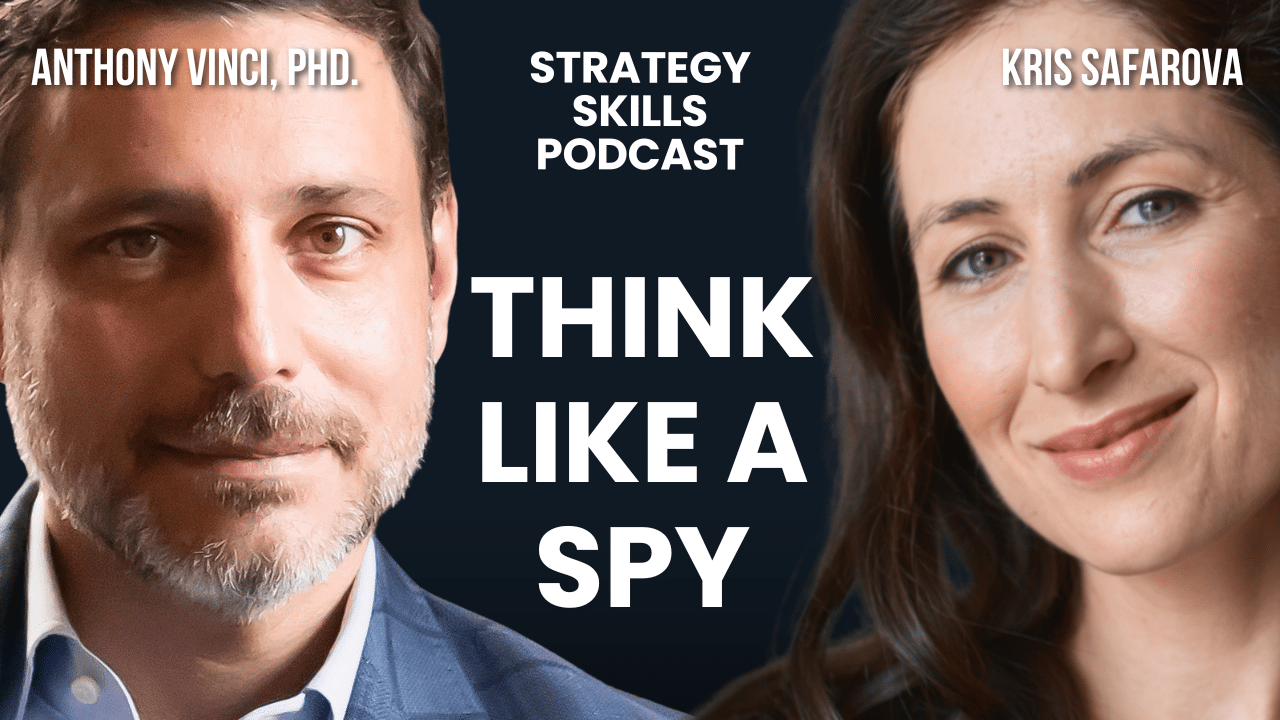
In this conversation, Anthony Vinci explains that “AI is going to be able to do more and more of what people do.” He describes a future where “AI is going to get better and better at doing what people do,” and highlights that leaders must understand “how do you figure out what AI is good at and then implement it to do that” and “how do you manage your workforce so that they are able to partner with that AI.”
He warns that leaders often “overestimate what AI can do and underestimate it at the same time,” and stresses the importance of “getting that balance right.” As he shared, “sometimes they can sense that, oh, AI can do anything,” while others say “it will never do that,” and both assumptions can mislead decision making.
He offers direct guidance for staying relevant: “The number one thing I would recommend is literally to just go use AI for thirty minutes a day.” He urges leaders to “push the envelope” and “see where the holes are, what it won’t do.”
Vinci describes how workflow—not just technology—defines whether AI succeeds. Implementation requires understanding “the process and the workflow,” recognizing that AI adoption “is going to be small parts,” and building “those pieces over time.”
He explains the subtle dangers of influence, noting that AI can “change your mind” without you realizing it. The threat is not dramatic deepfakes but “what if it just changes one word?” or “an adjective and makes something seem slightly different.”
To stay resilient, he urges people to “think like a spy,” recognize that “there might be a bad actor on the other side,” and build habits of “triangulating information.”
He emphasizes cognitive agility: “We still need to learn to do it so that you can think about mathematics and understand mathematics,” and he connects this to thinking and writing in an AI-driven world. Even with powerful tools, “you’re still going to have to keep yourself sharp.”
Vinci closes by discussing perspective, explaining how “living abroad” showed him how much people assume about how the world works. He encourages listeners to embrace the belief that “maybe this assumption that you have in life is wrong,” because “the difference between being okay or good at something you do and being great is this ability to take a step back and question whatever you see in the world.”
Here are some free gifts for you:
Overall Approach Used in Well-Managed Strategy Studies
Enjoying this episode?
Get access to sample advanced training episodes
Episode Transcript (Automatic):
Kris Safarova 00:47
Welcome to the strategy skills podcast. I’m your host, Kris Safarova, and this episode is sponsored by strategy training.com and you will be able to get key insights and action items and potentially some resources we may discuss from this episode that is going to happen right now. You will be able to download this at firms consulting.com, forward slash action for the other recent episodes, because we just introduced it as a new way to make sure that you guys make the most from this sessions. And we also have gifts for you. You can access episode one of how to build a consulting practice at firms consulting.com forward slash build. You can also download the overall approach used in well managed strategy studies at firms consulting.com forward slash overall approach. And you can get McKinsey and BCG winning resume example, which is a resume that got offers from both of those firms, at firms consulting.com forward slash resume PDF. And today we have such an interesting topic, such an interesting guest, Anthony Vinci, who is a former senior US intelligence officer, field operative in Iraq and across the globe, and tech entrepreneur. And He is an author of the new book, The fourth intelligence revolution, Anthony, welcome.
Anthony Vinci 02:04
Thank you. Thank you so much for having me so you
Kris Safarova 02:07
have such an interesting background. And since we only have one hour today, I would love for us to specifically focus on AI and tech, because this is just such an important topic right now, and many leaders are worried about it. They’re not sure how to approach it in the best way. So maybe we could start with, where do you think AI is going if we think about it in terms of, let’s say, when you look at the next 10 years of AI and check what capabilities will separate relevant leaders from irrelevant ones?
Anthony Vinci 02:39
Great question and a question that really speaks to my heart, because this was my role when I was CTO of this agency, Nga. And I think about it. I’ve been thinking about it for years now. In my view, what AI really does, why it’s different from software that we’re used to, is that it, it, it replicates what a person can do, how a person thinks or makes decisions, and over the next five or 10 years, like that timeframe you mentioned, I think what’s going to happen is that AI is going to be able to do more and more of what people do. So today, we’re already seeing it where AI can write an email, probably about as good, maybe even better than we can. I mean, I find myself, and I bet, like a lot of the listeners out there, kind of running an email past chat, GPT, here and there, AI is also getting very good at doing legal work, able to write contracts, not yet as good as the best lawyer. I don’t think anybody’s saying that. It’s, it’s and in in my book, as I mentioned in that it’s able to do what intelligence analysts do, even, again, not as good as the best ones out there, but to some degree. And so over the next five or 10 years, I feel like what’s going to happen is that the AI is going to get better and better at doing what people do, and that’s going to have a major ramification for businesses. And to your point, what’s that mean for a leader? Well, I think leaders in these organizations, whether that’s a company, whether that’s a government agency, whether that’s a nonprofit or a school even, it’s going to be about, how do you do two things? How do you figure out what AI is good at, and then implement it to do that, knowing that it’s ready, that you’re willing to take that risk on AI doing that work. And then how do you manage your workforce so that they are able to partner with that AI and that that’s, in many ways, the trickiest part is managing the workforce, not so much managing the AI in the future.
Kris Safarova 04:52
If we think about how most leaders right now think about AI, especially leaders who don’t have technical background. On, what do you think are some of the biggest conceptual mistakes leaders make when they think about AI, what is happening? What is going to happen?
Anthony Vinci 05:08
It’s interesting how you put it. You know, leaders without technical experience, which I would say is really most leaders. In fact, it’s actually pretty rare that someone is a CEO of an organization and has a technical background. And you know what? Even if they had a technical background like, you look at like a Mark Zuckerberg or something, probably day to day, they’re not doing that much technical work anymore. So it’s actually almost all leaders. And I think that what I see happen is kind of leaders today, at least on the whole sometimes
Anthony Vinci 05:44
overestimate what AI can do and underestimate it at the same time, and I’ll explain what I mean. Sometimes they can sense, sense that, oh, AI can do anything, and we can implement it immediately, and it will just do the work.
Anthony Vinci 05:58
That’s not really true. Ai still has a lot of limitations, and the demo might look great. And when you use chat GT chat GPT, or you use Claude, or use Gemini at home, that can seem so amazing, but when you actually implement it, it doesn’t do everything. So sometimes these leaders are overestimating it at the same time, sometimes they’re underestimating it as well, and sort of thinking, Oh, it will never do that. Like I’ll give you one example. A lot of leaders that I talk to will say, Oh, well, AI is great at copying something, but it’d never be creative, right? That’s what people do. And actually, when I look at it, I think sometimes AI is actually getting pretty creative. And when you look at Sora, for example, which is a video making app, I mean, it’s pretty creative because it’s just copying what people do. And frankly, you know, a lot of people aren’t doing the most creative thing either. They’re kind of copying what other people did. So sometimes they’re underestimating where it’s going to go. And I think the key thing for a leader is to get that balance right, and getting that balance right, I think, means, yeah, you’re going to have to understand the technology, but you’re also going to have that have to have the right advisors by your side, like CTOs and so forth, who kind of get the technology and and the one thing I would recommend is actually having a committee of people, some of whom are very, very bullish on AI, and some of whom are very, very bearish, so that you can, as a leader, kind of see both sides and kind of converge on what’s probably reality.
Kris Safarova 07:29
And if you have somebody who feels they are falling behind because they were not paying attention, and now they realize, hold on, I have to start paying attention. They have to catch up. If they had 30 minutes to an hour a day they could allocate on a daily basis, maybe a little more over the weekend. What would you recommend they do? Maybe specific training routine they could follow to catch up and stay somewhat on top of what’s happening and the skills they need to have.
Anthony Vinci 07:58
The number one thing I would recommend is literally to just go use AI for 30 minutes a day. And that can mean at home, just using using Claude or using another AI system. It can maybe in the office, see what your employees are using right now and try it out yourself. Don’t trust them to show it to you see, try it out yourself or get a demo. There’s so many AI systems out there right now, and so many AI companies that would love nothing more than to show the CEO a demo. Get, take those demos and see what it’s like, but don’t just listen to what they’re showing you. Like ask if you can kind of get on and try it out yourself, because that’s the best way to know what it’s really capable of doing, to see where the holes are, what it won’t do. Because if they show you a demo often, they’re not going to show you the part where it doesn’t work. And when you try it out at home, you’re going to see how far it can go, like, try to push the envelope right and see, okay, well, what happened if I asked this really, really hard question, then what happens and see, see if it is creative, and make up your own mind so it’s getting out there and using it. That’s probably the best thing you could do. It’s better than reading an article or anything like
Kris Safarova 09:13
that, and then building on that. What should they start doing with their teams? How they should start thinking about integrating AI and automation into the workflows.
Anthony Vinci 09:23
There’s two parts to the question of implementation. One of those parts is technical. How do I implement it into our other software? How do I bring in data from other parts of the organization? What do I do about my cloud strategy? Right? In my view, that’s not so much a CEO’s job. That’s a CIO and CTOs job. That’s a hard job, right? Like it’s it is hard. It’s very complicated. There are so many choices out there. You’ve really got to have some expertise to do that, right? For a CEO or a COO, maybe even a CFO, someone who’s thinking. About where to align it, I would say the other type of implementation is around workflow, essentially, process. You probably have a business that does something right? It’s processing something, it’s manufacturing something, it’s maybe performing some form of service that maybe you want to augment that service with AI, maybe you want to make that process more efficient or faster. You want to manufacture something more efficiently and or at a at a higher scale. And to do that, you really need to understand the process and the workflow, just like you know, this goes back 100 years of what you know coos and CEOs do is getting in there, understand the process and the workflow. But now, instead of going in from the mindset of, how can I change what people are doing going from the mindset of, is there this piece of technology that can do this piece of automation? And I think when you’re doing that, you can’t do it from the perspective of, like, there’s going to be magic, and I can just automate the whole thing at once, and I don’t think AI is quite ready for that. It’s going to be small parts, right? When I was at NGA and I was the CTO. I didn’t want to automate the entire analysis process. I just maybe wanted to do one small piece, which maybe is object recognition using computer vision, if I could just do that one piece, and I could, and even then, if I could only do it for certain parts of the process, certain pieces of the mission, not organization wide, if I can just get that one piece, that’s what I would focus on, and then and then keep building up those pieces over time. And that, to me, is probably the best strategy.
Kris Safarova 11:51
Makes a lot of sense. And would your advice change if you were talking to someone who is relatively senior but not at the very top, let’s say they are a partner at the major consulting firm, or they are very senior manager at Microsoft. They’re not at the very top, but they still have a team reporting to them,
Anthony Vinci 12:10
yeah, and that is the vast majority of people, right, and so you’re right that that’s who’s really addressing these issues, I think, in terms of I think it’s still similar in that there’s still this technical solution, which you may now have to partner with someone, but there’s still this workflow solution. If you’re that person who’s a Partner at a consulting firm, or you’re a senior VP somewhere, or a VP, you probably do know that. You probably do know your business pretty well. And I think for there, what I’m seeing in organizations is, can you get a small win that you can show your team looking down and say, hey, look, here’s a small win. Look, we did this, we automated this, we figured out the workflow. We figured out what people are going to do, what you the people who work for me, are going to continue doing. And by the way, it doesn’t mean you’re all getting fired tomorrow. You can see here now we’re just going to partner with technology in a different way, and then also going upwards. You can kind of show off these small wins and sort of say, hey, look, we got a small win here. We think we should double down. Let’s go a little bit bigger. Let’s try another one. Here’s what we learned. Here’s how we could do it better next time. So you’re kind of managing both up and down when you’re doing this.
Kris Safarova 13:32
And then can you share with us, if you feel comfortable, how do you personally use AI in your work and also personally in your life?
Anthony Vinci 13:40
Yeah, I find it is more frequently becoming kind of the second thing I do. So I will, for example, draft something myself, say it’s a document. Maybe I’m, you know, writing an email, or I’m writing something for sales in marketing, or maybe I just want to kind of get the right idea for a legal document before I send it off to lawyers. Then I’ll go to AI and sort of say, chat, GPT rewrite this for me, and I don’t necessarily take what it says and just agree. What I’ll do is sort of look and I’ll try and get a little bit and say, Oh, that’s a good idea. Then I’ll insert it into what I’m doing. Or I don’t like this. I like my way better, and so I’ll work with it. I think of it almost like this is when I’ve had a chief of staff in the past, or I’ve had a really good executive assistant. How would I work with them, right where I’m just like, hey, here’s, you know, here’s some bullets. This thing I want to do. Can you take a cut on this and then send it back to me? I’m kind of doing that with AI, and I find myself doing that at a wider and wider envelope of different activities.
Kris Safarova 14:57
So like an Assistant, can give you some tips on how. To improve something
Anthony Vinci 15:01
almost like a partner. Yeah, yeah.
Kris Safarova 15:03
So you’ve seen AI used inside government and then war zones, and thank you for your service. Thank you so much for everything you have done for us. Thank you. Do you think there are certain non obvious capabilities that you are noticing many corporate leaders are still underestimating?
Anthony Vinci 15:22
It can be hard to appreciate what sort of exponential scale really means. And I’m obviously not the first person to say that, even for me, and this is kind of what I do. I wrote a whole book on this, and you know, I’ve been in a CTO role. I’ve been in a CEO of a technology role. That’s what I do today. I’m CEO of an AI company, and even for me, it can be really hard to comprehend what it means to say that this tool can now, it’s not that it’s twice as fast as a person, it’s maybe 100 or 1000 times as fast at doing something. And so it can be hard to really figure that out in your strategy, you know, and and comprehend what that really means. And the the last time we saw this happen was kind of with the internet and marketing. All of a sudden, you know, an internet marketing ad or something. You know, we’re used to, maybe we’re used to Madison Avenue and traditional advertising. And all of a sudden, now you could have an ad that goes viral that you spent $100 on, or $1,000 or some fairly nominal amount of money, now gets out to half a billion people like, it’s like, like, people couldn’t even believe it when it was happening. Now, that’s like, common. I think it’s the same thing for AI can be really hard to comprehend what it means, like to say, not only can we do this and it’s not half as expensive, it might be 1000 times less expensive to use AI to do this, and I do it today with my own business where we’re doing, you know, analysis and forecasting for the finance industry. We haven’t launched publicly, but we’re doing that companies called Vico, we’re going to launch soon, but we’re doing forecasting. It’s not half as expensive as what I might have, you know, a consultant might have cost a year ago. I mean, it’s like, 1000 times less expensive, and that completely changes the game on product. You have to completely rethink product. You have to completely rethink how you’re going to have processes in your businesses in a way that you honestly can’t even comprehend in a strategy document. You just kind of have to start doing it, and then build that as you go.
Kris Safarova 17:43
So you selected one area where you can help, and congratulations on your upcoming launch. I know how much work goes into those things. For someone who is currently thinking, you know, I also want to take my expertise and align it with what the I can do and create something very valuable for the world, whether you see some areas where it just makes a lot of sense to create something where you use ai plus expertise and deliver a lot more value than you could just with expertise.
Anthony Vinci 18:15
Well, this is kind of the trillion dollar question, right? I think, as you know, we would it’s been hard to keep up with how fast AI is moving. Keeps doing more and more every time they release a new model. I personally think the sort of next area that’s going to be interesting for someone like you’re saying is figuring out how to partner with the AI in a way that is helpful to your customer. And I’ll give you an example from the intelligence world, because that’s kind of what I wrote the book on in intelligence, it’s kind of like consulting in a way, or market research. You are reading about what’s happening in the world as an analyst, you’re thinking about what might happen next, and you’re writing that down as an analytical report, and then you’re presenting it. You’re, you know, in the intelligence community, they call that dissemination, but you’re presenting it to senior leaders, who might be a president, by the way, but still senior later. And so what’s, what’s interesting in AI is that with AI, that that job, as I just explained, it might kind of go away, where the AI could read all those papers and put together that, that new analysis. So what you know, and I’m again, I’m sort of thinking five or 10 years ahead. That’s not happening today, for the most part, in small scale. It is but 510 years from now. So if you’re planning a business, where are things going to be in five or 10 years? I think what’s going to happen there is that there will still be intelligence analysts, but their job. Will be to partner with their customer, to be that go between to know what the customer really wants, really needs before they even know it, and to almost be the most senior analyst, where the AIs are kind of more junior analysts, so you’re sort of managing them in between them and the customer. And I use this example that I like, which is someone who runs a fashion boutique. So when you run a fashion boutique, your job is not just to, you know, buy and then sell clothes. Your job is to really know your customers and what they want and what they should want, maybe even before they know it, they come in and don’t necessarily know what they want. They kind of expect that you’re going to know that because you’re tracking the fashion and so forth. That’s really what it means to partner with somebody, right? And so the job of somebody running a fashion boutique isn’t to make clothing right, it’s to be that partner. And I think the same is happening in intelligence, and I would say the same is going to kind of happen in law, in other areas where it may not become the job of lawyer to just draft a contract. The job of lawyer maybe become to be that partner with your with your client, and have the AI draft the contract right, and then think big thoughts with them, to think through vision, to think through what they want. So to answer your question of, what’s the next business? It’s how can you tailor AI to do that? How can you make a services business, for example, where that’s what the service is, is just being those partners, where the people you hire really good at this kind of thing, maybe they’re great extroverts. Maybe they’re very they have very, very high EQs and can really understand people they’re not great at, like the analysis or the, you know, drafting contracts. That’s not what they do. But they’re great at being that go between and having that high EQ. That would be a great service business to still be in you’re still gonna have to understand AI and use it, but you’re doing something else. You’re being that partner, or maybe you’re making tools that make that partnership work better, more smoothly, allow you to present it better, and so forth.
Kris Safarova 22:16
Anthony and when you were deciding which business to launch, did you consider many different areas you knew exactly this is the problem I want to solve.
Anthony Vinci 22:24
Well, I had a job where my job was when I was CTO, and I sort of write about this in the book, to come and help the director of this agency figure out what to do about AI, and ultimately to use AI in the whole business. And that business was intelligence analysts, analysis effectively. And so I was still kind of caught up on that problem, and I had seen that no one had really cracked that code yet. And so I and I knew, you know, I’d been working on it for years. Like a lot of people form a business, used to be doing another business. You figure out a better way to do it, and you come in and say, I know that I can do it better, and so that’s what I wanted to do now. I didn’t necessarily want to just do this for government, and then, you know, just be a government contractor. I realized that intelligence analysis is really what a lot of people in finance actually do, like at an insurance company or at a hedge fund or a big bank. So so I put those two pieces together and said, You know, I want to replicate, you know, that same thing, like, how do I figure out how to do intelligence analysis? But what? Why don’t I do that for a really big customer like the finance industry? And so that’s how I put it together.
Kris Safarova 23:34
And as you were actually doing the work of preparing your product. So to say which I assume will be probably a combination of service and product. What were some big surprises that you had to face that you did not expect, some things that happened that you did not expect as you were building your product?
Anthony Vinci 23:52
Yeah, well, our our product, what I’m building is all technology, no no service whatsoever. And I think that’s the difference. Is it’s not software. It’s not presenting to a person to decide it is doing it, it’s, it’s doing the forecast, it’s doing the scenario enumeration. It’s teeing up that information for a decision maker. Now, so that’s, that’s what’s really hard. I would say this. You know, the biggest surprise was that llms can’t do everything. You know, it like, I, like a lot of people, got caught up in the hype of, you know, open, AI and anthropic and Google, that, you know, these things were magic and they could do everything. And what we found is we started building this product, is they fundamentally cannot. There are lots of things that LMS are just not suited to do. They’re great with words, as you might expect in a large language model, like they’re great at that. But if you want to quantify things, if you want things to be more deterministic, if you want things to be presented to a person in a way other than words. Like in graphs and charts, they’re just not that great at it. And so we realized pretty early on, we had to both be good at LMS and use them because they’re powerful, but we had to also use things like data science and good old fashioned software to kind of build this product.
Kris Safarova 25:15
Makes a lot of sense, and I’m glad that you mentioned it. I think that we could not have this discussion without talking about how to stay cognitively resilient against AI driven negative influence. I know that you talk about it in your book. If you had to make an individual cognitively resilient against AI driven influence, how would you approach that?
Anthony Vinci 25:37
Yeah, to me, this is one of the greatest threats over the next several years is that AI could be used to change a person’s views without them knowing. And you know, we’ve always sort of done that. There was propaganda in World War Two and maybe even 2000 years ago. I think they even the Roman Empire had propaganda, right? And there’s been, you know, even in a time of social media, things come out like, you know, during the Russia, you know, mounted a campaign, you know, against us voters. You know, that was effectively propaganda. It’s using advertisements to do that on Facebook and so forth. And we’re, in a way, we’re sort of almost used to that now. But what’s different now with AI is that AI is a two way street. It’s a dialog. It’s not just somebody’s just presenting you a piece of information. You can ask about that information, and it can potentially, over time, convince you to change your mind. And I think advertisers are going to do this, and they’re going to try to get you to buy a Chevy instead of a Ford or vice versa, right? Using AI, they’re going to it’s going to try to convince you like, like a person might, like a salesperson might, except this is a salesperson that could go, you know, this is like a billion salespeople, right? So the danger is that, okay, well, what if that powerful tool of influence was used by a bad actor, you know, by an authoritarian government and used against everyday people, maybe even children. I think it will be used against children, unfortunately, to try to change their mind. And there’s, there’s some evidence that Tiktok already is kind of showing what that might look like, unfortunately. And so I do think people have to become more resilient. And I think the way to become more resilient is, and I say this in the book, and it’s a little cute, I’ll admit, think like a spy. And the way a spy thinks is a few ways, like one, a spy thinks that there’s a there might be a bad guy out there, that things might not just be random or an error, that there might be somebody on the other side who’s a bad person. And you know what, we all kind of do that like with crime, you know, you park your car in a bad neighborhood, say overnight, you’re probably gonna hide your valuables, right, and not leave them out on the dashboard, because, you know, there might be a bad actor. We just sort of think that way. And cyber security is like that. We all know that there are hackers in the world now there are cyber criminals, and so we change our passwords. Well, we just have to start thinking that way about information and realizing there might be a bad actor on the other side of information. And once you do that, that’s half the battle right there, because now you can see, you can start to say, okay, maybe I should take some precautions. Maybe I shouldn’t believe everything I see, right? And I know it seems so simple, but it’s actually is like habituation. You’ve got to change your habits about how you think about it. And intelligence officers are habituated to do this. And I think everybody should probably be a little habituated. And now then, what can you do? Well, you could take some other precautions, like, for example, triangulating information. So could you go out, instead of believing the first news story you see, go check some other news sources and just make sure, hey, am I seeing this in several places? If I saw this on Facebook, am I also seeing it on the New York Times? And am I seeing it in the Wall Street Journal? And am I seeing it on Newsmax? And am I seeing it in, you know, the South China Morning sea post like am I seeing it on all these news sources? Then I’m more likely to believe it than if I see it in one place where it could have been changed by somebody. So that’s an example of really what you can do. Another example is just being more careful with technology. You know, we’ve lived through this amazing technological experience over the last 20 years where there’s new tech, like every day, a new phone, a new piece of AI, and we’ve grown to trust it because it’s generally been pretty benevolent. Well, now there might be some new technologies that are not so benevolent. And frankly, Tiktok is not benevolent. It’s owned by an authoritarian. In government or controlled by one through a company. You know, that’s just the reality, unfortunately, and you know it’s it doesn’t necessarily have your best interests at heart, so should be careful not saying you shouldn’t use it. Hopefully, you know, it is moved to an American ownership you can use it, but you should be careful, right? And you should start to look at technology as something let me assess it before I first start using it, so I can know where there might be a problem. So those are some of the things that you can do to make yourself more resilient. And if you make yourself more resilient, you’re going to make your community more resilient, right? You’re going to make your family more resilient. Ultimately, I think we’ll make the nation more resilient.
Kris Safarova 30:40
And this makes me think about how people also have emotional attachment. They think that they’re talking to a friend, for example, if they speak into chatgpt.
Anthony Vinci 30:49
I think that’s exactly how it works. In fact, the models are rewarded by by telling you kind of what you want to hear. And sometimes that means telling you, like the fact that you were looked up, you were looking up, but sometimes it means you continuing the conversation with it. That’s how it’s rewarded. You asking another question, you finding an answer that it said good. And that’s why a lot of these models, you see, they’re very cheerful, they’re very complimentary. Sometimes it to, like, an absurd level. It can feel a little weird, you know, it’s like, overly flattering and and so, but it’s also a trick, you know, it’s like, it makes you trust them more. It makes you believe them more. Like, that’s how they’re optimized. That’s what they’re optimized to do, which means you have to be, you know, even more careful, and not let yourself fall into a trap. It’s kind of like sometimes you meet these like really charismatic people in the world, you know, who you just like immediately. People used to say this about Bill Clinton, that President Clinton was was just like the most charismatic person. As soon as you talk to him, you felt like you know you were the only thing in the world that mattered to him and and he just really understood you. He was just that charismatic well. And so when you talk to those kinds of people, it can be tricky. It can be hard to take a step back. You just want to trust them. Well, a high is can be a little bit like that in conversation, and I think over time, we’ll get very good at doing that, because it will get to know you and really know what you like and what what makes you make a decision and so forth. And so we’re gonna have that means you’re just gonna have to have your guard up a little bit frankly.
Kris Safarova 32:38
And another issue that I’m noticing is, of course, it impacts our cognitive agility, our ability to do things we always were able to do once we learn them, critical thinking, writing, and then if we do it less, we start losing that skill. And on top of it, we have so much noise now that we are surrounded with what are your thoughts on? How to protect your mind?
Anthony Vinci 33:03
Well, you know, I think I think about this sometimes, you know, 60 or 70 years ago, everyone had to do long division, because that was the only way you could do division. I think you had to write it down. And then we invented the calculator, right? And all of a sudden you didn’t have to do long division at all. You just do it. You just type it in. You’re done, right? And but we still teach long division. In fact, schools still teach it in order, like, not because you have to do long division. Everybody knows. Like, I knew when I was in school, and we would always complain as students, right? Like, I’m never going to do it. I can use a calculator, and it’s true, like, maybe you’re never going to do it. We still need to learn to do it so that you can think about mathematics and understand mathematics, and by the way, so we can produce more mathematicians, right? Like, we need to start somewhere to produce more mathematicians, right? And that starts in grade school. And I think the same will probably have to be true of AI. It’s true like we’re going to exist in a world where you can just tell AI to go write whatever you want it to write, and you won’t even have to type it in. You’ll just talk to it and say, write me this email. I kind of want it to say this, and it will write the perfect email, or maybe even write the perfect book, but we’re still going to have to teach people and students to write and to think about ideas and to be able to do this themselves. And the same goes for us, who are already in the workforce, trying, you know, dealing with it. It’s still good to kind of keep yourself sharp and remember, by the way, just like probably your teacher told you who? And my teacher told me, You’re not always going to have a calculator. Remember, they would sort of say this, and it’s true. You don’t always have a calculator, and so you do. So still have to do some math in your head, like when you’re out, especially if you’re in business, right, like you, you still kind of got to be sharp enough to do this. Well, the same is true with AI. AI, right? Yeah, maybe you can do it, but I still have to have a conversation. I’m still going to meet somebody when I go out to a conference and I can’t just, like, have the AI talk to them, we’re going to have to be able to have a conversation. I’m going to have to be able to sell them my product, or, you know, get them to invest in my company or come work for me, right? And so you’re still going to have to do these things and still keep up that practice all the time.
Kris Safarova 35:24
What are things about the AI and technology, quantum computing, that bother you the
Anthony Vinci 35:29
most, that bother me the most, I mean, the the the scariest things are the subtlety of AI for me that I don’t worry about AI just being able to make videos of everything and copy what people look like. You know, we’re seeing those videos now where they can make, you know, a president, look like they’re saying something, or a CEO. I think we can kind of recognize pretty quickly that that’s not the case. And there are ways to look it up and say, Oh, wait, I just looked on the, you know, the corporate website, and they didn’t say this. What? What kind of scares me is more like, what if it just changes one word, what if it just changes an adjective and makes something seem slightly different? It’s much harder to look that up. It’s much more subtle, and it might change your view of something over years, right? And I talk a bit in the book about, you know, for you know, for national security, that might mean, you know, an information campaign by the Chinese that changes the view over time that America should defend an ally like Japan or Taiwan or something, right? And it just changes it slowly over time, maybe it takes years. The same might be true in, you know, commercial industry slowly changes people’s views that it’s okay for this company to have a monopoly, right? That that’s an acceptable thing, right? And it’s not. It’s not good to have monopolies in a capitalist system, typically, right? And so there, there are those. It’s that subtlety that’s the most worrying to me.
Kris Safarova 37:18
You mentioned thinking like a spy, and we spoke about educating ourselves about AI and technology. Are there specific books that you would recommend reading?
Anthony Vinci 37:29
Well, there’s a great book called The fourth intelligence revolution. No, I’m just teasing. You know, it’s so hard to keep up, right? Like the technology is changing faster than the books. I know this is someone who just wrote a book about technology. What was true a year ago when I handed in my first draft is not true anymore. So it’s really hard to keep up. But I do think you know there, there are some, you know, most of the new books coming out that talk about the foundation models, you know that are talking about open AI or something, are useful to read because it gives you an idea of where they came from and what their goals are. So that that is useful. But I actually have found that sub stacks and things like this by actual practitioners, and in whatever field you know, if you’re a CTO and you’re reading a more technical one, or if you’re a CEO and you’re reading kind of one that’s a little bit more general, like, that’s sort of where I’m seeing people really stay on top of things, and it’s where I kind of get some ideas. I think somebody even like, it’s can seem so old fashioned that, but op eds opinion pieces are, you know, they’re really, actually pretty sophisticated, and they’re out there seeing stuff pretty quickly. So I, I still read op eds in in the big newspapers, and that’s where I see some of the new ideas. They’re sort of being processed for you a little bit. And that helps you to then figure out, okay, this is actually what I should focus on, because you mentioned it earlier. There’s so much, there’s so much going on right now. There’s so much news. It can be hard if you, if you look at everything, you’re just going to see the trees. You’re not going to see the forest. So how do you get up of that a little bit and see the forest? You need somebody to pre digest a little bit for you, definitely.
Kris Safarova 39:20
And in terms of sub stacks, are there any specific ones that you would like to mention? If you feel comfortable,
Anthony Vinci 39:27
yeah, I Well, I’ll mention two people who have both sub stacks, and I failed to mention podcasts, which is another great one, who I talked to recently, and I was on their podcast, and who I think do a good job of processing this stuff. One is Michael Shermer, who does a great podcast on and he’s written books on conspiracy theories and things like this, and he has a very skeptical view, which is a great relief to everything that’s going on, where he’s. Um, you know, looking at it and kind of questioning it is, like, Is this really true, you know? And that’s for for what you’re saying, for, like, processing all this technology stuff is a great way to look at the world. So I’d recommend him. And then another one I also did his podcast was Andrew Keen, and he he’s also skeptical, almost to the point of being kind of argumentative, like he was argumentative with me on the podcast, but I think that’s great for a listener, because he’s sort of pressing and really trying to get at the truth. And I think, again, that could be so useful, especially to people in business, right? You don’t have a lot of time to process and read, and you just kind of, you don’t want the hey, you know, like, you don’t necessarily want the like easy button. You want what’s true, that’s what matters to you. And so when a person is getting in there and asking the hard questions, I think that can be so helpful when you’re making a decision as a CEO or CTO or something like that. Definitely.
Kris Safarova 40:56
What do you think are some of the key things that leaders do not understand about AI and check that we haven’t yet spoke about today,
Anthony Vinci 41:05
I think that the one of the key things is that these AI systems are not like old technology. They’re evolving and beginning to evolve on their own, in the sense that the more data they get, the better they get, right. And so when you bring them into your business right, and you enter, say, your proprietary information, typically at what I’m seeing, most businesses aren’t going to use an off prem solution and enter their proprietary information for everybody in the world to see. But maybe you bring an AI in and you enter your business information, your proprietary information, what’s going to happen is not it’s not just that the AI is really good at searching your information or sorting it or summarizing it, really good AI, and you’re going to see this more and more. Your proprietary information might actually make it better at what it does. And again, that’s something that’s hard to comprehend, right? That not only is it like you’re buying a piece of software that’s a good search engine, you’re buying a piece of software that’s just going to get better and better at doing what you want it to do. And that’s very different than we’re used to thinking about in the tech world, where it’s kind of like the solution is the solution, and maybe they add more features over time, but it, you know, it only gets better because a company comes and asks you how it can be better, and then they, they, you know, go and add a new feature. Now the systems may get better on their own, and we’re going to see this, and sort of already are with the foundation models like chat, GPT, like Gemini, like Claude and so forth. But we’re going to start seeing it in these on prem solutions that you bring into your business
Kris Safarova 42:56
you mentioned before, thinking like a spy. Anything else you could share with our listeners on how to learn to think like a spy. How can you have the critical thinking skills that only spies have?
Anthony Vinci 43:10
Yeah, well, I would one thing that I like to do, I guess, as a former spy, but also somebody who, as an undergrad, actually studied philosophy. Oddly enough, I’ve never used that degree for a job in my life, but it teaches you a skill that is shared by spies, which is to question everything, including yourself, right? And critical thinking is something. It’s very powerful tool. And I’ve noticed really good CEOs are great at this, right? They’re great at sort of looking at the world and saying, Do I really believe that? Right? And and thinking critically about it, and asking questions, right? Like that is a great skill. It’s what spies do. Spies look at the world and they’re like, I don’t know if I believe it. Whatever you tell them, you could be like, the sky is blue, like, I don’t know. And so that’s super helpful, but also turning that back on yourself, and saying, Is my bill, am I thinking about this? Right? That’s really powerful. And a play as CEO I saw who did that very well was actually Ray Dalio and I briefly worked at Bridgewater Associates. And Ray talks quite a bit about this, and other CEOs do as well, but he’s probably the most prominent, where he says it’s it’s all about this idea meritocracy and and turning that critical eye to yourself as well, and questioning your own views on things. And I think that’s a super valuable skill for these threats we were talking about, like Information Operations. Threats and, you know, questioning what you’re reading and how you’re thinking about things. Hey, have I fallen into this trap of thinking about it, but also just day to day as a business person, I use this skill every day as a business person, and I hear something in a meeting, and my I may have an immediate reaction and say, No, that’s got to be wrong. But then to turn that back, I try to do this. I don’t do it every time. No one can, but I try to take a step back and say, Was I too quick to judge that? Am I thinking about this incorrectly? Is there a better way to think about it? Maybe this person I’m talking to who I didn’t think was right, maybe they are right. What if that were the case? Then what would I do? Those kinds of skills, I think are the difference between mediocre CEOs and great CEOs, and mediocre investors and great investors. It’s something I strive to do, not that I’m saying a great I’m a great CEO or Great Investor. It’s like, that’s how I want to try to become a great one.
Kris Safarova 45:57
I agree. It’s very helpful to have the kind of mindset. What I demand of myself is I always leave a possibility that I am wrong.
Anthony Vinci 46:05
Yes, that’s a great way to encapsulate it. I want to wrap up
Kris Safarova 46:09
this amazing discussion we’re having today with one or two of my favorite questions, depending on how much time we will have over the last, let’s say, 20 years. 10 years, you can pick the period, what were aha moments, realizations that you felt really changed the way you look at life or the way you look at business.
Anthony Vinci 46:31
One in particular, for me was living abroad. I think a lot of people spend their whole life in America, and there’s nothing wrong with that great place, or whatever their country is. You know, whatever your country is, and you spend your whole life there. And when you move abroad, you see not only how other people are living your life, their lives differently, how businesses work differently, how culture is different. You start to look back at your own home and real it’s like now all of a sudden, you can see it completely differently. And you realize all these things you took for granted that like this is just how the world is actually, are contingent, right? And you think, Oh, this is the only business culture in the world. This is just how business is done. And then you move abroad, and you realize, actually there’s a completely different way to do business. I used to live briefly in Japan. They have a very, very different culture of business. They’re very different from America. And sometimes you don’t even have to go that far, you know, I go out I you know, I go to New York for business. A lot. I go to California for business. A lot. People do business in California and New York. Do it very, very differently. There’s a different time scale. There’s different expectations, right? That perspective just changed. My life was living abroad. And I think, you know, if I have one recommendation to young people who are about to get into the business world or really anything in life, it’s go live abroad for a little while. You know it’s worth it. It is worth spending that year or two years and seeing this different perspective in life, because it’s going to change your life, and it’s going to make you better at doing whatever it is what you do.
Kris Safarova 48:24
Thank you, Anthony. And last quick question, if you could instill one belief in every listener’s heart, what would it be?
Anthony Vinci 48:32
Excellent question. Well, I would say that it’s, you know, I would go back to what we were talking about before that, and the way you put it, that maybe you could be wrong. Maybe something you’re looking at could be wrong. You know, maybe this assumption that you have in life is wrong. And the difference between being okay or good at something you do and being great is this ability to take a step back and question whatever you see in the world, a piece of information you learn, an assumption about a business culture, or what someone’s doing, or an assumption about yourself, and to be able to take a step back and question that. And if you can do that, even if you can only do it a small percentage of the time, it’s going to make you better. I think it’s going to make life better, you know? I think it makes life more interesting. And, you know, I think it’s something the older I get, the more I think about it can be hard to take that perspective when you’re in your 20s and just getting started, and you think you’re immortal and everything is you know you’re great at everything, but that one belief, you know, questioning things including yourself, is probably the most important thought a person can have to make themselves better.
Kris Safarova 49:55
Thank you so much for being here. Where can our listeners learn more about you? By your book, anything you want to share.
Anthony Vinci 50:02
Thank you so much. Well, my book is called The fourth intelligence revolution, the future of espionage and the battle to save America. I would love for you to read it, but I would also think just because it says espionage in the title doesn’t mean that it’s only interesting about that. Actually, I tried to bring in technology and lots of things, and so I think a lot of people in business may find it interesting. It’s actually also a story about technological change in a big organization, and I think we’re all facing that. And I have a website, Anthony vincy.com where you can learn more about me in the book. You can buy the book at amazon or audible or Walmart or anywhere you want. And I also have a substack called the three kinds of intelligence, which you can access on substack, or you can come to my website. Anthony vinci.com, thank you so much for having me. This was such a great conversation, Anthony.
Kris Safarova 50:53
Thank you again. So much for everyone listening. Our guest today was Anthony Vinci, a former senior US intelligence officer, field operative in Iraq and across the globe, and tech entrepreneur. And you can get his book, The fourth intelligence revolution. And you will also be able to get a download based on today’s episode with key insights and action items at firms consulting.com forward slash action. And you can also get some gifts from us. You can get access to Episode One of how to build a consulting practice at f, i, r, M, S consulting.com forward slash build. You can download the overall approach to well managed strategy studies at firms consulting.com forward slash overall approach. You can get a McKinsey and BCG resume example, which is an actual resume that led to offers from both of those firms at firms consulting.com forward slash resume PDF. And lastly, you can get a copy of one of our books that we co authored with some of our listeners actually of this podcast. And you can get it at firms consulting.com forward slash gift. Thank you so much for tuning in, and I’m looking forward to connect with you all next time.
Leave a Reply