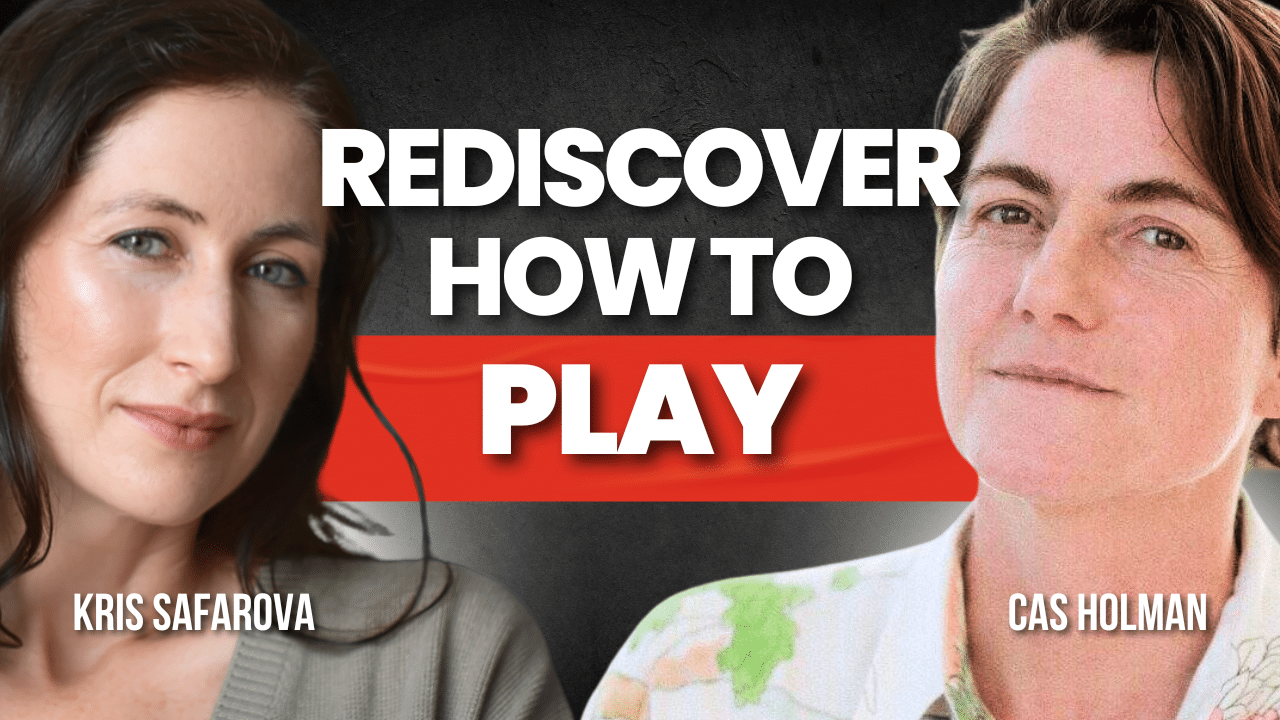
When was the last time you played, really played?
For Cas Holman, founder and chief designer of Heroes Will Rise and star of Netflix’s Abstract: The Art of Design, play isn’t childish. It’s the foundation of human creativity, resilience, and connection. She worked with LEGO, Disney Imagineering, and the LEGO Foundation and on a mission to help adults rediscover what children know instinctively: that play is how we learn, adapt, and feel alive.
“Play isn’t what happens after work,” Cas explains. “It’s how we manage uncertainty. It’s how we cope, experiment, and find our way through the unknown.”
In this conversation, Cas reframes play not as a distraction from productivity but as the engine of it.
She explains why play is essential for innovation, executive presence, and emotional agility, and how suppressing it has drained creativity from our professional lives.
“Playful thinking lets us reframe success,” she says. “It makes us flexible enough to keep moving when things don’t go according to plan.”
We discuss:
-
Why free play (activities that are intrinsically motivated, freely chosen, and personally directed) is the most powerful form of creative renewal.
-
How reframing success turns frustration into discovery:
“You came to play basketball, the ball’s flat, the court’s full, so what? Invent a new game.” -
Why curiosity and uncertainty are not threats to be managed, but conditions for growth.
-
How “breaking” systems or routines can reveal how they actually work.
-
And how adults can learn to release judgment, the internal critic that says “I should know the answer” instead of “let’s find out.”
Cas’s insights are strikingly relevant to the age of AI. As technology automates more of what we do, she reminds us that what matters most is how we create, not how efficiently we delegate creation.
“We’re outsourcing the wrong things,” she says. “Creativity wasn’t the problem that needed fixing. It’s what makes us feel alive.”
Get Cas’ book, Playful, here:
Here are some free gifts for you:
Overall Approach Used in Well-Managed Strategy Studies
Enjoying this episode?
Get access to sample advanced training episodes
Episode Transcript (Automatic):
Kris Safarova 00:48
Welcome to the strategy skills podcast. I’m your host, Kris Safarova, and this episode is sponsored by strategytraining.com and you will be able to download key insights and action items from this specific upcoming episode at firms consulting.com forward slash action. And I’m also going to share with you a few gifts, and then we will go right into our today’s session. So the first gift is access to Episode One of how to build a consulting practice. You can get it at firms consulting.com forward slash build. You can also download a free overall approach to well managed strategy studies. It is a one page will be prepared for you, and you can get it at f, i, r, M S consulting.com forward slash overall approach. And you can get a McKinsey and BCG winning resume, which is a resume that led to offers from both of those firms, and you can get it at firms consulting.com forward slash resume PDF. And today we have with us a very special guest. It is Cass Holman, the founder and chief designer of the toy company. Heroes will rise, based in Brooklyn, New York. CAS travels the globe, speaking about playful learning, the design process and the value of play in all aspects of life with teams, and has worked with teams at Google, Nike, Lego, Disney and art museums around the world, and you may have seen CAS in Netflix documentary series abstract.
Speaker 3 02:17
Kas, Welcome Hi. Kris, nice to be here.
Kris Safarova 02:21
So glad to have you with us. So play is the engine of meaningful original work. We can describe it that way, yet adults really engage in play. It is even something that people look down upon. So many adults desperately need more play in their lives. How can we unlearn how not to play?
Cas Holman 02:44
Yes, the there’s actually a movement called unschooling, which I think is a little bit related, right, where we kind of, rather than trying to learn something new, we try to unlearn how to not do the thing that we inherently know how to do. One of those things is play. And, yeah, I think that that for adults, it’s a little bit harder to access what we already know and what we might inherently trust about letting ourselves play, because we have, in fact, spent quite a good amount, if not most of our adult lives, suppressing the instinct and the urge to play in the interest of things like productivity and efficiency and and it gets a little bit wound up in what we consider to be successful, what we what we think we need to be as successful adults. And so, yeah, I’ve been thinking for some time about how to help adults get back to their playful selves and get back in touch with with what we already know about play, which is still inside of all of us, I believe,
Kris Safarova 03:49
Kris and for a child who doesn’t have parents that do not allow them to play or do not give them enough time to play, let’s say in the United States, For most adults, when do they naturally stop playing?
Cas Holman 04:03
You know, school has a big part of that. As children, we all become who we are through play. We as children and in our adolescence, we play in order to understand the world and in order to understand our place in the world and our place within our household, our place within our community, the dynamics within our you know, if we have siblings and other family and other neighbors and people around you know we approach understanding ourselves and our role within those communities through play, through both kind of figuring things out, trial and error, testing, different ways of being through kind of pretend play, and you can all you can see this if you’re around children, and hopefully through an exercise of just kind of remembering, you can get back in touch with and remember. What that was like to try to experiment and explore as a child and kind of start to understand, you know, that trial and error is play. And so I think starting with kind of a play memory is a way for adults to kind of reconnect with, like, Oh, right. That is something that I remember doing and that I know how to do, and from there, we can kind of start to reconnect with what play might look like for us as adults.
Kris Safarova 05:34
And before our listeners start thinking, hold on, Kris, why are we talking about play? Are you realizing what is happening in the world. Why are we wasting the now of our time talking about play? I think that let’s just talk about why it is very important for us to pay attention to this topic.
Cas Holman 05:50
Yeah, I think there’s a misconception that play is something that happens after we work, or play is something that happens, you know, when everything’s hunky dory and wonderful. But in fact, play is also how we cope with things that are really difficult. And in particular, I think how it might relate to your listeners, play is how we manage and and kind of find our way through uncertainty. And so in particular, right now, most people in the world are faced with a large amount of uncertainty in the US. You know, things are changing so rapidly in very unpredictable ways which are unsettling and unnerving. And I think that people either feel tremendously anxious around that, for a lot of people who are trying to plan their lives, or losing rights, or losing access to services and things that we need and take for granted up until now, is kind of a human right we play is actually a way that we can cope with some of that and and kind of understand that, that that these aren’t things that we can are going to maybe have any control over, for better or for worse. And so in in not just play as an act of kind of or an activity of enjoying ourselves, but play as a mindset. So being playful in how we think about what we’re doing, either in our work or just in our in our coping strategies, but but entering it playfully can mean being open minded and a much more flexible and agile amongst circumstances and situations that are uncertain, and so being playful when you’re going into periods of uncertainty. Doesn’t just mean, like, making jokes of it. It might mean actually just being more creative and flexible. And so going in and saying, like, Okay, this isn’t what I imagined or planned on happening right now, but with a playful mindset, we can kind of go in and say, Okay, this isn’t what I expected. But, you know, here’s what I have, and so how can I be creative with what’s here? How can I be creative with, like, what I what I can plan for and what I can’t plan for, and approach it with an open mind and embrace whatever possibilities there are, rather than getting really stuck and hung up on, wait a minute, it was supposed to look like this. You know, adulthood, or, you know, my, my planning was meant to look like this, and it doesn’t. And therefore, like I’m totally stuck right and and entering that playfully can really help us kind of manage it and work around what what we wind up with,
Kris Safarova 08:39
very true, and I think also to do outstanding work, you need to be an artist in that moment when you’re doing that work. And to be an artist, you need to be able to play you are in that state that is very different from being a serious adult,
Cas Holman 08:56
yeah, yeah. And I think that in talking to people about play, talking to adults about about play, and you know what, what playfulness, or even what creativity looks like. It’s interesting. I think that a lot of people associate creativity with art making, and will often say like, oh, but I’m not an artist, or I’m not creative and and when I point out or talk to them more about like, what they do in their work, or what their domestic lives are like. They are quite creative. And I think adults often like because we associate it with art and art making. And if we’re not an artist, then we’re like, oh, well, then I must not be creative. But in fact, the way that people run their businesses, the way that people kind of arrange their time and engage with their with their friends and family is often quite creative. It’s just ways that we don’t kind of associate as such, and then play is very similar. So for example, the the what our play looks like as adults might look quite different than than what we typically. Think of as play, right? Because we think like, oh, I recognize play in a five year old or even a 10 year old, and I don’t do those activities, so I must not play. But for example, I have a friend who is an avid bird watcher, and when she describes what’s happening for her when she’s bird watching. It’s the same thing as play. There’s flow. She loses track of time. She loses track of, you know, whatever worries and distractions she had before she started bird watching. She gets so engaged and she notices things. She’s curious. She kind of follows a trail that she doesn’t know where it’s going. And all of those are also elements of free play in particular, which is the type of play that I designed for. Free Play is a little bit different than sports or games, in that it’s something that’s intrinsically motivated, personally directed and freely chosen. So there’s, there’s kind of no extrinsic motivation or reason to do it. I’m not doing it because I’m gonna win. I’m not doing it because I’m gonna get a prize or a raise. I’m not getting paid. There’s no kind of incentive other than that. It feels really good and connects me to something that I need at that point in time. And so there’s this. There’s kind of also, I think, if adults think about one of the things that might keep and you, you brought up productivity, one of the things that might keep us from playing is the idea that it’s not productive. But in fact, like, you know, you could like eating well and sleeping enough. You know, in the way that we’ve shifted those to understand that eating well is actually productive and sleeping enough is productive because it, you know, not just because it makes you more capable at work, but it just makes you feel better. And that counts as productive. I think play is similar, you know, we can point to all of the ways that it helps with creativity and innovation, and also, if it makes you feel better than anything you do is going to, you know, feel better. And so in that way. I think the the idea that that we have to be productive with our timer, we have to kind of use time, rather than just kind of, you know, being in ourselves and and following our noses and our curiosity. I think that can also kind of sometimes be a hindrance to accessing what play might look like for us as adults.
Kris Safarova 12:38
And also when we talk about productivity, when you add some rest, you actually are more productive afterwards. So of course, it pays off. You can get a lot more done this way.
Cas Holman 12:50
Well, yeah, and, and also, I think even as we, as we let ourselves play more and reconnect with with how good it feels and and how much more kind of in touch. We are with our own needs when we when we play. We can also like we noticed like this, and research shows this as well. There’s less anxiety. We are more flexible when things come up that that in our like problem solving doesn’t just mean at work, right? So little things that come up in planning our lives are going about our day. You know, for example, I’m today, I’ve been having some computer issues and and, you know, I could say, like, okay, that’s, this is not working. I’m getting frustrated and kind of like everything would, would then be, I would, I would be moving forward from a place of frustration, and, you know, like, ah, technical glitches. This needs to be working. But I’m kind of, I’ve been all day. I’ve been kind of rolling with it and seeing what happens. And so I had to do things in different ways that I’m actually quite happy with now. I’m like, Oh, actually, maybe i i Like this browser better, or, Oh, this setup. I didn’t think I could be this close to the that part of the how, you know, where the router is in my office, and all the things. But in fact, like it’s making it interesting and and making me more aware of kind of whatever systems I think I need in order to do what I’m doing by kind of breaking the system every once in a while, right? And and in being playful, sometimes play means just kind of changing habits in order to then kind of be curious about what else might you know, what else is there, and also make me more aware of what it is that I actually need in order to be doing, you know, whatever it is I’m doing, which, in this case, is kind of work. But for me, my work is also kind of play, like this conversation feels playful. And so, yeah, I think that thinking about play, not. Just as an activity, or that the kind of something that we do outside of work, but an approach, right? That play is a is an approach or a playful is a mindset that we bring to everything we do.
Kris Safarova 15:13
How do you think being playful impacts someone’s communication and executive presence skills?
Cas Holman 15:20
Well, I think we can be really playful in our with our language, for one thing, and I’ll often when I’m when I’m in a conversation, I think of conversation is very collaborative. So as someone is talking, as we’re talking speaking right now, you’re, you’re kind of because, if because you’re you’re playful, or because you’re engaged, you are, it’s, it’s you’re collaborating with me in the understanding of what I’m saying, right? So by changing shifting words, kind of playing with how something is framed, we get to kind of reframe it and understand it differently, which I also almost liken to kind of break something in order to understand it better, which isn’t something that typically adults are comfortable or necessarily intuitively do. Because we we think like it has to be successful, right? We when we know how something works, we do it the right way, and we don’t want people to think we don’t know. So I think people often are in conversation, not very playful, because they don’t want to appear like they don’t know. There’s a misconception that adults are supposed to know everything right, or if you’re smart, or if you’re successful, you know everything, when, in fact, like that’s not. There’s not much to learn there. If you know everything, that’s not a great way to go in. And isn’t always very curious. And so I often kind of think of it as, like, failing in order to learn, right? We take something apart in order to understand it. Some of my play is that I have this, this property that’s I’m trying to build my studio is there, but it’s kind of, it’s, it’s not on the grid. It has varying degrees of functionality in terms of power and water and things like that. It’s in the woods and and so there are a lot of systems in this, in the buildings on the property that I never would have understood if they had worked from the beginning. But because they, when I bought the property, these the houses were the buildings were so broken that I’ve had to understand, you know, plumbing and electrical and wells and pumps and things and solar systems, I understand them more because they haven’t been working. And I think that that’s thankfully because I’m playful, it’s all kind of something I’m rolling with and learning from. And I think that’s something that in adulthood, we kind of think that the goal is that everything always works, which, of course, often it is. It would be nice if the power just consistently worked for me. However, by entering it with kind of a playful mindset, I’m able to learn so much more, and now I have a better grasp of of how this solar system, solar panel, electrical system works, which is really interesting, and I’ve been able to kind of adapt it more for what I need, and learn so much from it that I wouldn’t have learned it, like I said, if it had worked on the outset. And so there are opportunities to learn when when we don’t know and when we enter something playfully. So yeah, there’s, there’s this kind of like, in adulthood, our relationship to success and failure is another thing that will kind of like inhibit us from from entering something playfully.
Kris Safarova 18:56
And you could follow your curiosity with this studio in the woods, which sounds very, very, very exciting, very inspiring, to be able to come out and see the birds and the animals and the trees.
Cas Holman 19:10
Yeah, I think that the other part of it is that. And I do catch myself getting quite hung up on what’s not working, and I have to kind of remind myself that that I’m there for, you know, for the nature and the giant moon and the we have true dark. There are no there’s no ambient light. So I can see all of the star and all of the star. I can see so many more stars than I do in the city. I live in Brooklyn, mostly, and my studio is out in the woods and and so in order to kind of enjoy the process, I am hoping to, kind of, I am, you know, renovating it and trying to make the place more of a functional building. And in the meantime, I’m checking in with myself to kind of make sure that I’m enjoying the process. Which means embracing it where it is, and still having gatherings there, and getting bringing adults, and you have kind of an adult summer camp situation that happens a few times during the summer months, and still doing that, even though it doesn’t, you know, it looks a little different. It’s a little more like camping than I had originally imagined. And at some point I thought, Well, okay, it’s not ready, so I can’t have these parties yet. I can’t have these gatherings because, you know, the plumbing is still not working, and there’s not enough room for people to sleep and, you know, and I kind of said, well, wait a minute, you know. Let me reframe success. So then one of the tenants of adults and play, and free play in particular, is reframing success, right? What does success look like? Does success look like I have this, you know, beautiful, pristine house that people are staying in, or does success look like? We all come together and and have bonfires and conversations, and we swim, and we connect with each other for a few days. And if those are my goals, we don’t need necessarily, you know, spare bedrooms. And you know, we can do that camping. And so we do, and some people camp, and some people, you know, find other spots to to stay nearby, but we still come together. And so in order to do that, I kind of have to continue continuously reframe success, right? What are, what does success look like? And if success is that we’re all together, then it doesn’t, we don’t need this, you know, building to house us all. We just need a place, and we have that. So, you know, let’s, let’s craft, and let’s design everything else around that as the primary goal. And that happens quite a bit. I think that’s a larger example. And then in smaller examples, I think, you know, ways that that adults are even approaching being with friends. And, you know, say that you you, you get together to play basketball, and you have an hour. Everybody’s got to get back to their kids, or got to, you know, go and fix dinner, get groceries, or, you know, go back to work, whatever we’re doing. So we have an hour, and, you know, five people show up and you’re like, Oh, well, we’re playing basketball, so obviously we need six people, and, like, the ball is flat and the there’s this, the soccer field is open, but the basketball field is taken. So if we’re really hung up on, like, ah, we came here to play basketball and now we can’t do anything, then you’re not going to get far right. But if you come with a playful mindset, then you might say, okay, what are we going to do? What can we play we want, we all want to play together. What game can we invent with an odd number of people, a flat basketball and a soccer or football, a football net. And then from there, you get to invent something, right? Right? Because the goal probably is not to have a really rigorous Three On Three tournament. The goal was to hang out for an hour, move your bodies around, and, you know, laugh and be engaged in some kind of play. And so, yeah, so the playful mindset, you kind of reframe wait success means that we’re all together. So we have that and we have these other ingredients. Let’s just make it up as we go and see what happens.
Kris Safarova 23:26
It reminds me of a mindset I always demand of myself to have this view on the world that okay, things are happening for you. How can you leverage this situation in the best possible way? Also remind clients about this, and it makes such a big difference once people start adapting this kind of mindset, because as humans, we miss so many opportunities like what you described. Now, if you all showed up and were upset that the ball is not right and we don’t have a place to play, yeah, you would have missed out on probably one of the best games you had because you came up with it. And just use your imagination what kind of game you could play.
Cas Holman 24:02
Yeah, exactly. I mean which, which also happens when people are like, maybe not that that fits. Maybe you’re uncoordinated. Or, you know, in basketball as an example, there’s a big advantage if you have height. And so there’s an assumption that, like, if the goal was to be good, then you know, maybe you’re not going to have very much fun because you’re with a bunch of people who are tall and more physically able than you are. But in fact, the goal isn’t to win or to impress anybody. The goal was to connect with each other and have fun, and you’re going to have a lot more fun if you’re not hung up on being the best. And so it also kind of allows for their The goal is not necessarily winning again, like reframing success. The goal isn’t winning or being impressive. The goal is is to enjoy yourself, in which case, the shortest person might be kind of the best that’s.
Kris Safarova 25:00
Right, definitely. And if it feels right, I would love to share with community photos of the sky and of the studio, if you have any, if you will feel comfortable shade. And I think it would be very interesting for people to see that studio in in the forest. Sounds, oh,
Cas Holman 25:16
photos, yeah. I mean, it’s right now. It’s a barn. It’s a giant barn. And there are a couple other cottages on the property. One is quite crooked, and so we haven’t been able to we’ve been trying to save it from it had some leaks, so we kind of got the leaks on the roof sealed up, but it was kind of crooked and falling down, so we were afraid to do too much work until we got it straightened up and and, yeah, so there’s a number of different ongoing projects, but it’s all built around this, this beautiful pond. And so, you know, the again, kind of the the house or the place that we’re going to sleep is important, but not as important as the, you know, the thing that kind of is the focus of being there, which is this beautiful pond and the and the nature, I’d love to share a picture, and the barn just looks like a big kind of, it’s Not in terrible condition, but it doesn’t. We currently don’t have running water, and we periodically have electricity, but I stay there for weeks at a time. We make it work.
Kris Safarova 26:32
And I know what you mean, because I went through a house renovation that took a year was supposed to take four months. So I know how hard it is. It is so hard to renovate things. So let’s talk about adult free play. You mentioned that it needs to involve embracing possibility, releasing judgment and reframing success. Maybe we can. I know we spoke about reframing success. Maybe we can spend a little bit more time on embracing possibility and releasing judgment. Yeah.
Cas Holman 27:01
So embracing possibility is really just to say curiosity, right? That’s kind of to say be be open to what might come right, and this, in particular for adults, sometimes is tricky because, like I said, we have an idea of what something is going to be right, or we’re a little bit afraid of stepping into the unknown, because, for a lot of reasons in particular, that relate to school. As you brought up, you know, we shift our learning shifts throughout school, and I like to separate learning from school, because I think, like many people, are avid learners and love learning, but maybe had a hard time in school, because school isn’t always necessarily designed for learning. School is is often designed for, like, educating at scale, which means that it’s meant to work for, you know, 30 children in one classroom, and of those children, maybe half of them aren’t really being served in their learning style, right? But so I think that in school, the way that we learn is kind of toward a test, right? We learn what’s going to be on a test. We learned that there are right and wrong answers, largely, and so whatever we’re curious outside of what might be tested or what might be directly related to, kind of that lesson is kind of shaved off, and we’re like, taught to really hone in on the specific thing that is accessible and and has a clear correct answer. And so in that our curiosity, we get a little bit disconnected from our curiosity, right? It’s considered very disruptive if you keep asking questions that are unrelated to the lesson. And that’s understandable. Teachers have a lot of students, and they’re trying to stay on track, and they have these kind of very rigorous rubrics that they’re meant to stick to within a curriculum. And so unconsciously, we learn that to be kind of productive or to be successful, we need to keep going toward this one right answer that is defined and known and understood. But in fact, like there’s so much that’s happening outside of those right answers that’s interesting or fun or compelling or just unknown, and so so to be open to and curious about all of the things around, the things that we know is, I think, one of the things that can happen in a playful mindset and so embracing possibility is just to say it’s okay to not know, step into it and see where it goes, and maybe it’s nowhere, but that’s not always the point, right? And you know, we can also then point to that innovation and novel ideas come out of the unknown. But I don’t think that that alone is the reason to do it. Yeah, that can also be a side effect, but not, not the, not the primary objective. So and then releasing judgment, I think, is critical for adults in play, in a way that children, when they’re in their younger years in particular, don’t have any judgment around play. They’re, they’re not self conscious of play, right? They automatically and intrinsically are motivated to play there. That’s how they do everything. It’s how we all do everything as children. Is, is we play through it and and then at some point, through a lot of the things that happened, both in school and in puberty and in kind of growing up, we’re taught to suppress those urges, and, you know, be more serious, or be more on track, or, you know, all of the reasons why, you know, we need to get to school. You can’t start playing right now. Or got just, please put your shoes on. Don’t put your shoes on your hands. Put your shoes on your feet. You know, don’t make that all the things. So like these, these little, minor corrections that we have just in the process of, like, existing as children, we’re learning to not play. And so, you know, those are become part of who we are. So as adults, when we do feel the urge to play, or when we do play, there’s a lot of judgment in that. I think it comes from inside of ourselves. We have judgment around our own want or needs to play, and then I think we fear the judgment of others. I think that often, like for example, I will be conversationally playful while I’m in line at the grocery store. So I’ll kind of be chatting with the somebody in line and realize that if the if the person who’s checking out the groceries is talking to me, then it’s taking a little bit longer, right? And that I’m often very aware of, because I can tell the people in line behind me might be very aware of and they’re thinking, you are making this take longer. You should not be making the person chat. This is you’re making everything. And I’m thinking, then I have to remind myself, it’s 20 seconds, right? This interaction that is making us all feel more human is adding 20 seconds, and that is okay. And so I have to be continuously, kind of releasing my own judgment around, don’t talk to that person, like, let them do their job, you know? And then I’m also like, no, they can also, as a human, have a conversation while they’re ringing up my broccoli. It’s fine. We are human, right? So there’s this kind of like, it’s, it’s, it’s complicated, I think, for all of us to let ourselves play. So releasing judgment is just to say, don’t, you know, there’s no need to criticize your urge to play. Let yourself play. You know, if you want to chat in line, if you want to dance around a little bit if you want to sing out loud, there is no actual rule against doing that as an adult. And if someone thinks that you’re childish or silly because you’re doing it, then let them think that that is that. So releasing judgment is really kind of let yourself play. You know, be aware of the voice that is afraid of the judgment of others, and kind of let it go.
Kris Safarova 33:27
I agree with you 100% another thing that comes to my mind is playing makes you feel alive. That is something that a lot of adults don’t feel enough of. And then we have midlife crisis. We have people so unhappy with their lives, feeling that they feel like robots. Nothing is feeling right in their life anymore. They don’t feel alive anymore. How can we bring more of that feeling alive into our day to day?
Cas Holman 33:54
I would say, let’s see, from just from talking to to people about play for the last 25 years and designing for it, right? I’m a designer, so my my work has been primarily in creating conditions for free play to arise, and that it’s different than kind of game design or video game design and I, and the reason I don’t say that I’m a that I design play, is that is that I create that I designed for other people to design. So I want to create conditions, rather than creating kind of a script, right? Often a game or something with instructions. I think of it as kind of that’s like a play that you consume so so and that I think doesn’t actually to your question about feeling alive. I think that people feel most alive when they’re part of something, when they when we create and and when we I think we see this with like. People love to personalize things, or, you know, even if you buy a pair of shoes, but you got to, you know, choose that the soul was green and the laces are red, then we feel like that’s mine, like I put my touch on it, and which is such a minor shift, but it makes it a product, at least meaningful to someone. And so with, with anything, with, creative play in particular, I think that if it taps into us, or if it asks something of us and we are involved in creating it, then that is when we feel alive. And in a lot of play and free play, it’s tapping into something that we need. And then from there we go and find how to do it right, rather than having, like I mentioned, also that kind of extrinsic motivator of, like, my watch tells me it’s time to stand up, and it’s like, so all of these ways that we’re kind of getting out of our getting out of touch with, like, what I actually need. And so if something, if I’m standing up or because my watch tells me, and I’m walking to the store and back in order to get my steps in, those are kind of extrinsic motivators that then take us out of touch with with what I need, right? So this is just to say in in when with, with free play, when we’re in touch with what we need, and we’re we’re doing it intrinsically, and we’re finding it for ourselves and deciding, huh, I’m starting to feel a little bit like, grouchy, or I’m starting to kind of like, feel a slog, or like, I really, you know, this conversation that I’m going to have, I’m excited about it, and yet, like, I feel a little bit like, let’s see, or kind of not very excited, you know, physically or conceptually, what? How should I? Maybe I need to, like, stand up and jump around. Right before this call, I kind of went outside and raked some leaves and, like, just move my body around, not because it was productive. I think those leaves are all going to get blown around again, but because I just kind of needed to do something, you know, before I sat back down. So I think these are all ways that being in touch with with our own physical and and kind of our embodied needs and our creative needs and our connective needs with other people are part of how we feel alive, and those happen a lot in play and free play in particular, when we when we’re able to generate rather than consume the play.
Kris Safarova 37:41
Very true. Let’s talk about how being able to be more playful and fulfilling my life can help people deal with what is happening now when it comes to AI technology, we already spoke about dealing with uncertainty. Can you elaborate on that? How else play and being playful can
Speaker 3 38:00
help? Yeah, I think,
Cas Holman 38:04
I think that there’s kind of an assumption often that that easy is good, or that, oh, great if, if, if my computer can do this for me, then I don’t need to, and that’s good, or like that, that any work that we do is a bummer, and we, I think we kind of even see this where, like, there’s a movement back to people want to, you know, like, grow their own herbs. Like, like, yeah, sure, you could go and buy a beautiful, perfect bunch of basil. But we, if you grow it yourself, and it might be a little bit ugly and kind of spindly and small, again, like people are so proud of that and really excited about the basil that they grew, right? And so I think that that kind of points to that, that this the kind of outsourcing everything is maybe not the the gonna be the best thing, right? And so again, kind of thinking about, wait, what’s the goal? Is the goal that that I don’t ever compose a sentence on my own, because I don’t think that writing was really making anybody’s life that terrible. In fact, writing a sentence and like composing an email to someone, is a way that we, you know, can be quite creative and or just kind of puts us in touch with the people directly, rather than it being something that we’ve like outsourced to, you know. And of course, like we all know, kind of what it feels like to get an email that we can tell wasn’t actually generated by the person. And so, which is not to say that all emailing is wonderful. I if I had it my way, I think I would be handwriting notes and then, you know, carrying them over to people and handing them to them rather than emailing, which was certainly not efficient. But this is just to say I think these. Question that that the goal is to not do any work is is also assuming that the work was terrible, right? And so, in my mind, we’ve outsourced the wrong things. Like, we’re outsourcing creativity. And creativity was a thing that we really enjoyed doing. Like, I don’t know why we’re outsourcing art to AI. Art was a thing that we love to do, and we need to do. So I really, actually feel like it’s a mistake to continue doing what we’re doing with AI as it relates to creative tasks. And I just would like to remind people that we can still choose to not do that. There’s a strange in the conversations that I’m hearing about AI, and often part of there’s an assumption that it’s kind of a train that’s left to the station and it’s doing what it’s going to do, and we can’t control it, but, in fact, we can, we can decide to not do that. And I think we should decide to not do that, because it’s not helping us feel alive, right? And and, okay, so now that this thing is being done by someone that’s not you. What are you like? That’s freeing up your time to do what? And so that’s also the thing that, like some of those, those tasks that we do, if we do them playfully, if we can recognize that, in fact, like some of that, and, you know, I mentioned sweeping leaves, but a lot of these, the kind of smaller tasks that fill our days feel quite meaningful because they’re what make up, you know, making a house, doing work, communicating with each other, you know, drawing a picture for the sake of pulling something out of yourself, not for the sake of having a beautiful picture. And so again, it’s kind of like reframing success to some extent, and saying, What is our goal with this? And why are we? Why would why are we doing this? Why do I assume that anything that can be outsourced should be I don’t think that it should.
Kris Safarova 42:00
And you’re so right that we have a lot of control over situation, because as customers, if we stop buying those applications, then there will be no interest, or they will be a lot less interest. Yeah, make those applications available. And another important point there is that, for example, if we take art in terms of creating a picture, a painting, a lot of those things, the apps are able to do it because they’ve taken pictures by actual people, where they put their heart and soul into that work. And how fair is that? And yeah, the same goes for many other art forms, like writing and so on.
Cas Holman 42:34
Yeah, they those the they kind of, again, are taking the like they’re they’re disregarding or they’re forgetting. That part of why we make art is what we learn about ourselves in the process of making it, which is also to say that sometimes there’ll be a beautiful outcome of that, and most of the time it won’t look who it’s not about what it looks like. And I think in order to reconnect with this. If you are somebody who has children in your life, just draw with children the next time that you’re around kids who are drawing and kids, I think 98% of children love drawing and haven’t gotten to a stage in their education where they’ve been taught what a good drawing looks like. So they all are just like, there’s no judgment when they draw, and it feels great to draw with them, because it’s not about whether or not it’s good. You’re all just drawing and figuring out. You’re taking something from inside of you and putting it on a page and saying, what would it look like if I did this with the brush, or what would it look like? How does this pin blend with that pin? And so kind of trying to release judgment and again, also reframe success, even with being creative with if, whether it’s you’re making a craft sort of thing, or you’re drawing a picture, or, you know, maybe you’re even painting a wall in your home, that feels like that’s a kind of a functional, productive activity, but would feel really good, and maybe it’ll be a little bit messier than if you, you know, hired a professional, or maybe you do it in a way that’s a little more playful and allows for there to be a little bit messier, but you’ll have done it and it it feels good to do it, and that can be enough. It doesn’t. It doesn’t always have to be about the outcome. Not all art needs to live in a gallery or a museum. That’s not always the point. So you can make a drawing and then never look at it again, or you can make a drawing and then draw over it.
Kris Safarova 44:31
And there’s a lot of art that lives in gallery or museum, and then you compare it to an art created by someone in the home on Sunday. It’s not their job, and no one will ever see it. And it is the one you see from the person who’s just doing it as a hobby, just touches your heart and inspires you, and the one in the gallery just makes you feel depressed, right?
Cas Holman 44:54
Yeah, maybe I mean this, this is also the beautiful thing about art, is that it’s interpretation, and. And we may see something in we can see, we can see when there’s heart in it, right? And I think we all see it differently, different pieces will resonate with different people based on kind of what was, what was being brought out of the person who was making it very true.
Kris Safarova 45:15
Yeah. I want to wrap up with two questions, one or two questions stepping away from our topic for today, my favorite questions to ask, okay, the first one is, over your entire career so far, your entire life, so far, were there two, three aha moments, realizations that you feel comfortable sharing that really changed the way you look at life or the way you look at business?
Cas Holman 45:39
Yeah? When, when one happened with my business. Actually, I, when I was in graduate school for design, designed a toy called GMO that that originally was a sculpture, and kind of then was fun to play with. And so I re engineered it slightly, and then it was kind of this toy. And I thought, okay, yeah, I’ll have a toy company. And so I founded a business, and was selling this toy around the world. It was doing quite well. It was selling a lot, but I wasn’t necessarily supporting myself. There’s a misconception like, Oh, if it sells, then I made but, you know, profit margins, and there were batches that had something happened in shipping, so I actually couldn’t sell my first batch of inventory. So, you know, as as happens in business, there were all kinds of things that I hadn’t accounted for. And so I had, I was still had other jobs that were kind of paying for things on the as I was building the business, and at some point, everything just was continuing to go wrong on the business side, right? I mean, aside from that, it was people loved it, and it was having an incredible reception and lots of attention. But just, you know, packaging errors and things going wrong. And I had an aha moment when I walked past there’s a, we have a satirical newspaper in the US called the onion. It’s quite funny. And, and I was walking past a newspaper stand, and this the satirical newspaper. The front of it said, failure is now an option. Which was a play on the on the term failure is not an option. You know, which I think many of us like the stoicism of like failure, no failure. Never accept failure. Like, don’t accept defeat. Keep trying, like all of these motivational posters that we all kind of like have somewhere in our minds within capitalism, I think, and I it just like unlocked something in me, and I was able to really just kind of let it go. And I said, Okay, well, maybe I need to let GMO go like I again, in reframing success. I was in it because I loved design and I wanted to create toys that that had, you know, an interesting play value and engaged imagination. And so it was kind of doing all these things I wanted, but I never necessarily wanted to build a business. And so it kind of reframed what success was. And I thought, well, you know what? I’ve, I’ve been flown all over the world. I’ve, like, met incredible people. This toy is in 1000s of homes all over the globe. Like that is success by many measures. The fact that, like, I’ve yet to, you know, reach a profit in my business in spite of all of the demand, the fact that, like, you know, I haven’t launched in a second product yet. You know, all these things that the business metrics, I was a huge failure. But all of these other things that were happening. I’d learned so much I knew how to I had factories in in Japan and contacts all over. I visited Moscow and Seoul and London and and Tokyo, you know. So I was kind of like, Wait, this is actually a huge success by these metrics. And maybe I get to think of it as limited edition, instead of assuming that because this thing, there’s a demand, I have to keep selling it forever, because I really was not enjoying the sales part and and that was a huge shift for me, and I did. I let the inventory that I had at the time sell out, and I moved on to other things which built, which then built into a whole other, you know, all these other new products that I’ve that I’ve launched through my company and through others, but until I kind of had to had that moment of like, why am I assuming that this. Us to keep going in order to be a success, you know, like maybe my I’ve already achieved more than I ever hoped to in what I’ve learned, you know. So that was a that was a big turning point for me, and I think that’s present in everything I do, whenever I’m setting something up or, you know, thinking about a new design that might become a product, I kind of think, Okay, well, what role do I want to have in this? Will this let me keep designing new things, or will this become a thing I’m selling for the next five years? And if I don’t want to be selling it for five years, let’s kind of move on to the next thing instead.
Kris Safarova 50:39
Thank you so much for sharing this Yeah. And the last quick question is, if you could instill one belief in every listener’s heart, what would it be?
Cas Holman 50:49
I think it’s trust, trust yourself and trust the people around you who you might play with, trust that they, that they that you’re safe enough to play. In play, we become quite vulnerable. And I think that’s part of why it’s scary for adults in particular to let ourselves play, is that you know we’re we’re vulnerable to judgment, to feeling like we’re not good at something, or to feeling like a failure, like we’re not smart or serious, a lot of adulthood is is, like, contingent on, yeah, success and and so in play when you can’t win or be good at it, sometimes that’s really difficult for people, and requires that we can trust ourselves, that yes, I am still a productive member of society. And also I can be silly, you know, in this meeting, or I can, you know, rearrange my living room in a way that makes no no sense at all, but I’m going to try it, you know, or we’ll we’re gonna play test this silly thing, or I’m gonna wear a weird shirt and trust that it’s gonna be okay and and people will still like you.
Kris Safarova 52:12
Kris, thank you so much for being here. I really enjoyed our discussion today. Where can our listeners learn more about you? Buy your book, anything you want to share.
Cas Holman 52:21
Well, playful is available anywhere that you buy books online or ask your local bookstore. I love kind of playing in bookstores, so I always try to go in and find it on the shelves or ask for the book that I want in my local bookstore, and rigamajig.com is where most of the products are sold. And GMO actually came back. So we now do have GMO. It was limited edition, and then we did one more round, so we have some GMO for sale there. And then Cass holman.com and Cass Holman at Instagram for like events and things like that. We’ve been posting and answering questions as they come in as well about the book.
Kris Safarova 53:03
Thank you, Cass. Thank you. Thank you so much. I hope you guys enjoyed it. We had today with us, Cass Holman, and you can check out your book playful. And we are going to put together key insights and action items from this video. And you can get it at firms consulting.com, forward slash action. You can also download some gifts from us. So there are two downloads. One is a copy of McKinsey and BCG being in resume that led to offers from both of those firms. And as you probably know, the format that we use for our clients works really well, well beyond consulting, we have most of our clients are not even in consulting. It works really well with tech firms with all kinds of positions in major organizations, including at very senior level. So the first download is McKinsey and BCG resume example. You can get it at firms consulting.com forward slash resume PDF. You can also get the overall approach used to involve managed strategy studies at firms consulting.com forward slash overall approach, and you can get a copy of one of our books at firms consulting.com forward slash gift. Thank you so much for tuning in, and I’m looking forward to connect with you all next time.
Leave a Reply