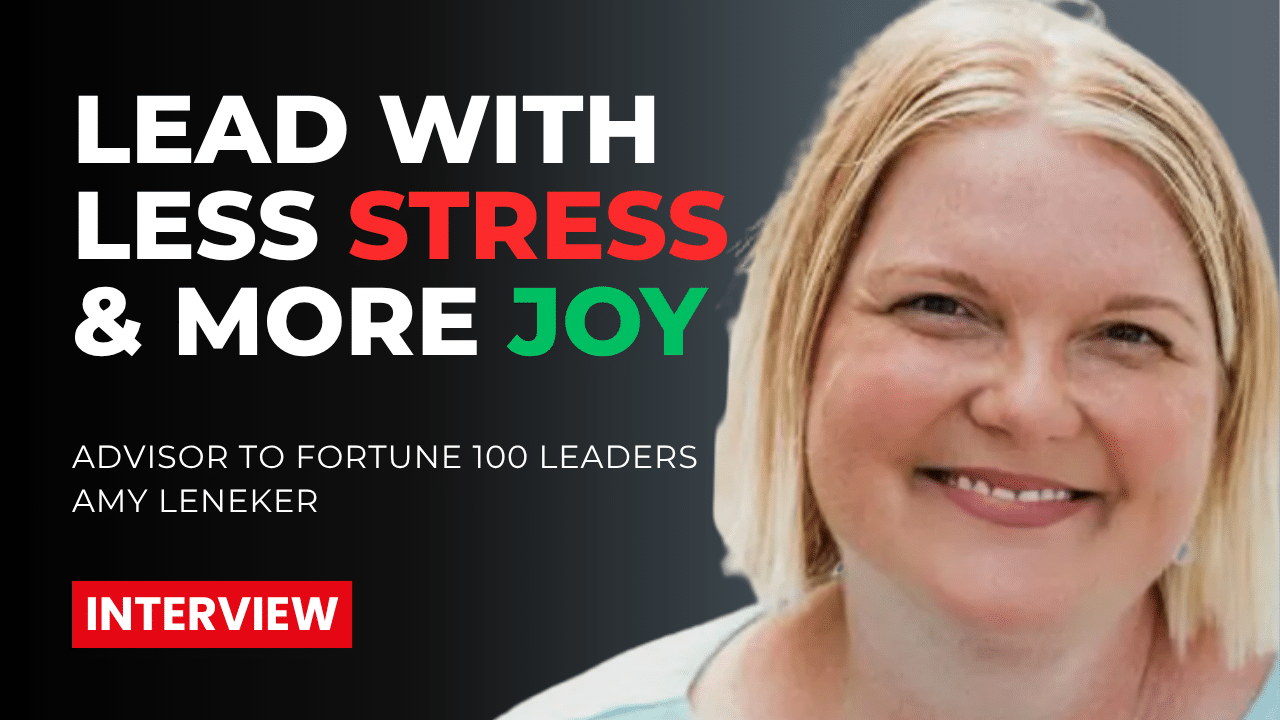
Amy Leneker, a former C-suite executive and advisor to Fortune 100 leaders, examines a common assumption in corporate life: that stress is an unavoidable cost of success. She argues that this belief is flawed, noting that when leaders feel disconnected from their values and priorities, “it doesn’t feel like you’re succeeding.”
The discussion centers on how stress operates at three levels: individual, relational, and systemic, and why each requires a different response. At the individual level, Leneker highlights the role of unexamined “stress stories.” These are internal narratives that shape behavior without conscious choice. By repeatedly asking “why,” leaders can uncover these patterns and decide whether to continue operating from them or to choose a different approach.
A second theme is the tendency to respond to pressure by increasing effort. Leneker cautions that working harder and faster under stress typically compounds the problem. More effective leaders “work differently,” which may include delegation, redefining workloads, or aligning roles with realistic expectations.
The conversation also addresses prioritization. Treating everything as urgent creates continuous pressure and reduces effectiveness. Leneker advises returning to the core purpose of the role and identifying a small number of priorities, while regularly reassessing them as conditions change. Without this discipline, priorities are set externally rather than intentionally.
At the organizational level, Leneker emphasizes that systemic stress cannot be resolved by individual resilience alone. Issues such as inequity or poor leadership must be addressed at the system level. When they are not, organizations tend to lose high performers or retain disengaged employees who have effectively withdrawn from their work.
The role of direct managers is particularly significant. Within the same organization, employee experience can vary widely depending on leadership. As Leneker notes, a manager can either add to daily stress or keep it within reasonable bounds, often determining whether a role is sustainable.
The discussion also examines burnout. Leneker describes it as both preventable and reversible, pointing to three indicators: exhaustion, cynicism, and reduced effectiveness. Addressing these begins with practical steps such as monitoring energy levels, adjusting mindset, and restoring a sense of capability through manageable changes.
Finally, Leneker reflects on the deeper drivers of overwork. In her case, persistent effort was rooted in financial insecurity from earlier life, leading to decisions driven by fear rather than intent. Identifying these underlying motivations allows leaders to set boundaries and design work patterns aligned with the life they want to lead, rather than reacting to inherited assumptions.
The episode offers a structured view of stress as a strategic issue. It suggests that sustained performance depends less on endurance and more on clarity, choice, and the design of both individual behavior and organizational systems.
Get Amy’s book, Cheers to Monday, here:
Here are some free gifts for you:
Overall Approach Used in Well-Managed Strategy Studies
Enjoying this episode?
Get access to sample advanced training episodes
Episode Transcript (Automatic):
Kris Safarova 00:47
Welcome to the strategy skills podcast. I’m your host, Kris sarova, and our podcast sponsor today is strategy training.com and we have some gifts for you. You can access episode one from how to build a consulting practice at firms consulting.com forward slash build. You can also get McKinsey and BCG winning resume, which is an actual resume that led to offers from both of those firms. So great template to take a look at and see what you can adjust on your resume, and it works for all levels of seniority. And you can also get the overall approach used in well managed strategy studies at firms, consulting.com forward slash overall approach. And today we have with us, Amy lenneke, who is a former C suite executive and leadership advisor to Fortune 100 companies.
Speaker 1 01:33
Amy, welcome. Thank you so much for having me. It’s great to see you.
Kris Safarova 01:37
Great to see you as well. Amy, so you recently wrote a book about how can we have less stressful lives, be more successful, have less burnout. So I would love to speak to you about some insights from the book and unpack it for our listeners. So the first thing I wanted to talk about is you mentioned that stress isn’t the price you pay for success. It’s the chief that steals it. And I think that when people hear it, they think there’s no way I can be successful in my role in my organization without stress. So how can that be true? What would you tell them?
Amy Leneker 02:16
Yeah, thank you for calling that out, because it really is the premise of the entire book, that we’ve really bought this exhausting lie we’ve been sold this soul sucking lie that stress is a price we have to pay for success. And I coach leaders every day who make that trade off. I’m going to take this promotion I know it’s going to mean more stress and more burnout, when in reality, when we’re feeling those high levels of stress, it doesn’t feel like success at all. When you start feeling disconnected from your values, disconnected from what is most important to you, it doesn’t feel like you’re succeeding. It doesn’t feel like you’re winning. And I think that’s why so many people have this, this notion of I’ve done all of the right things. I’m in this dream job. Why am I not feeling successful?
Kris Safarova 03:06
So if someone is in a situation where they are part of an organization, part of a department, where stress comes with territory, everyone is stressed. You look at everyone above you, they are all stressed. All the way to the top. What would you tell them? Why should they even listen to us today? Because maybe they may feel that hold on, Kris, look, usually your episodes are really good, but I think this topic is just not for me.
Amy Leneker 03:30
Yeah, yes. So what I would share is that a mistake we often make is that we misunderstand stress. So there is a good kind of stress, and you may be feeling it today, a good type of stress is what gives you energy, and it actually helps you perform better. And it’s short term. So if you think about you’ve got a deadline to meet, or you’re about to run a race that you’ve trained for, that kind of short term, good stress is going to help you be more productive. So if you’re at work and you’re looking at the people around you who are experiencing that, that’s a really good thing. What we’re talking about is chronic stress, really different. Chronic stress takes your energy away, and it actually makes you perform less. So if you’re looking around and you’re seeing people stressed and exhausted and burnout, that’s a red flag that’s really different than the kind of stress that makes you do even even better.
Kris Safarova 04:29
You spoke about stress sorting. Can you tell us more about that?
Amy Leneker 04:34
Absolutely, it’s the second part of the really simple framework. So step one is we’ve got to see it, which is what you and I have already done. We’ve got to see what’s out there. And then secondly, we have to sort our stress into actionable categories. Work stress is not just one big thing to manage. If we can sort it into five distinct actionable categories, then we can get to the root cause of it. And I. Work with leaders and teams every day who are solving the wrong problem. The ways that they’re trying to solve stress are creating more stress. So if we can divide it and sort it into those five actionable categories, then we’ve actually got a chance at doing something about it.
Kris Safarova 05:16
Can you talk us through those categories and also mention where people struggle the most, in terms of which category they struggle in the most to maybe identify or manage. Sure.
Amy Leneker 05:28
So category one is schedule, and schedule stress is when there just isn’t enough time in the day to do what you need to do. You might work through lunch, you might skip vacation, but whatever you do, there’s just never enough time. So that’s the first one. The second one is suspense, stress, and that’s when you’re waiting for something. It’s the anticipation. It’s when your workplace is filled with ambiguity and change and you’re not really sure what’s coming. So that’s second. Third is social, and this is the stress of relationships. When the people that you work with are making it harder to do your job than easier. I worked with the leader recently who said that their work would be great if it weren’t for the people. It’s like, well, work is people, so you really can’t say that. The fourth one is sudden stress. Sudden stress happens when something occurs out of the ordinary, something unusual, something urgent, something that demands your attention. That is sudden stress. And then the last one is system. System stress is when the very workplace system that we’re in is making it harder for us to do our work, things like inequity, things like unfairness, things like unmanageable workload, those things that are built into the system that make it harder to answer your question number five is not only the most common, it’s also the most detrimental. Because work work stress that’s because of the system. It can’t be solved by an individual, and so we, unfortunately can blame ourselves or shame ourselves for feeling stress that’s actually a result of a system that we’re working within.
Kris Safarova 07:23
Thank you so much. Amy for listing them all. So in terms of schedule, how would you what would you advise to somebody who is very driven and they have so much to do, and it can be someone working in a corporate world or a business owner, and they always have a lot more to do in the day they can possibly finish, and then a lot of those tasks they can’t really delegate as well. Yeah, it’s a
Amy Leneker 07:47
great point, because schedule stress will fill whatever time we give it. There’s never going to be an at least in my world, there’s never going to be enough time to do everything that we need to do. So it really comes down to prioritizing, and like you mentioned, with delegating, there are really simple hacks that you can do through the day that have a tremendous impact on your stress. If your listeners were to only remember one, I would suggest that starting today, they only have meetings that are either 20 minutes long or 50 minutes long to build in those 10 Minute buffers. There is new research from Microsoft that shows even that 10 minute break allows people’s brains to reset. It allows the brain to actually recover before you go into your next meeting. When we don’t do that and we’re on our 15th or 50th meeting of the day, what’s happened is you’ve had all of that stress compound through the day. So schedule stress. Step one is to prioritize, really what is most important, and then for step two, when you’re in those meetings, Are you really giving your brain a chance to reset between each of them?
Kris Safarova 09:00
That makes a lot of sense. Do you have any advice on prioritizing? Because even if you allow yourself 10 minutes to rest between meetings, but you still have 1000 things to do in your mind, you will feel stressed.
Amy Leneker 09:13
I do. My favorite comes from Steve Jobs, who has been said to have looked at signals versus noise. So signal is, this is really the and you would know the number, these are the three things I need to accomplish, or these are the five things, or maybe it’s even 10 things, and those are where you’re spending your time. Everything else is just noise. So he’s been reported to be really diligent, and have been really thoughtful about, was he focusing on those priorities and not getting distracted? And in fact, it’s rumored that in multiple sources that he would say things like, how many times have you said no today? What did you say no to today? So baking into the culture of how you work that by saying no to things that aren’t the biggest. Priority, you’re actually saying yes to those things that are the challenge. Of course, happens if you’re in a workplace where your boss’s idea of priorities might be different than yours, and that’s where a difficult conversation may need to happen in terms of what is reasonable, what is sustainable.
Kris Safarova 10:18
And another option is if you have multiple voices consulting, and you can just build on two projects at the same time, full time, and both senior partners will expect certain level of performance, but you only have 24 hours, even if you haven’t slept at all, you cannot do it.
Amy Leneker 10:34
Yeah, exactly. And I wonder if this is true for you, because it was certainly true for me, and when I read your story, our stories line up really closely, even to around the same timeframe. So around 2015 is when you and I both. I didn’t know you then, of course, but it’s when you and I were both sort of having this epiphany of working in a new way, and I was my own worst enemy. So even if my boss didn’t have maybe a better way of saying is that I had higher expectations of myself than even the people around me, and so sometimes, when it comes to work, stress, schedule stress, or any of those stresses, really, sometimes the source of it is ourselves demanding something of ourselves that’s just not reasonable. That is very true.
Kris Safarova 11:18
It definitely is something I had throughout my life, demanding of myself a lot. But I think at the same time, in many corporate environments, the demands on you are not realistic in terms of what you can do without significantly damaging your health.
Amy Leneker 11:35
Yes, yes, it’s so true, and unfortunately, that’s where the high stress behaviors start getting rewarded, you start getting recognized and maybe even promoted because of this extraordinary effort that you’re putting in that is causing a lot of wear and tear on yourself.
Kris Safarova 11:55
What would you recommend to somebody who is listening right now and they are in an environment like that? I think
Amy Leneker 12:01
Step one is to be kind to yourself, because unfortunately, and I’ve done this with 1000s of people all over the world, when we first talk, when we first start talking about stress, it can really quickly become a self criticism game where we start to blame ourselves and shame ourselves. So step one is to approach this exercise with kindness. And then step two is to really do an inventory. I think one of the best ways to do it is to take an energy audit, and it’s really simple, and throughout the day, I like to do at the top of the hour, because it’s easy to remember, but you could do it whatever works for you, just throughout the day, do a quick one to 10. Where’s my energy level right now? What’s my engagement level right now? And then, after only a few days, you’re really going to get a sense of where am I, where? Where is my energy? Where is my focus, and where do I want it to be? And I’m really grateful we’re having this conversation at this time of year, because I think holidays can exacerbate stress in so many ways. For many people, it’s a wonderful, joyful time of year, and for others, it just exacerbates stress. And so to do a thoughtful audit, I think there’s no better time of year than to do it right now.
Kris Safarova 13:17
Definitely you also can get a little bit more of a downtime without being judged, because you just expected that you will take at least a little bit of time off, at least to spend time with your children, with your family,
Amy Leneker 13:31
yes, exactly, and to have real time off. I spent so much of my career where I was technically off, but I was still on. I was still checking email, I was still thinking and and when I read your story, my guess is you did that to your brain is always in that other place. And so I love what you’re saying, which is, let this time of year be a signal to really unplug and disconnect and see what comes from, from that silence. And I think also
Kris Safarova 13:59
some working environments is just not a good fit. You just have to figure out how to live in a way that you don’t put anyone in a bad situation. You transition in a way that they can get the replacement, and the person is trained to do hard work that you’re doing right now. But certain places, it’s just a waiting place where you’re getting sick and sick every day, there’s no way you cannot change that system. It’s not worth the fight. There are so many more other things you can be doing in your life fighting for something much more worthwhile than trying to change the organization.
Amy Leneker 14:33
Yeah, absolutely. And I have so much empathy and compassion for folks who find themselves in that position where I had found myself because it can feel unfair. You’re like, wait a minute, I love this type of work. This is what I want to do, but you’re operating just like you said. You’re operating within a system where you actually can’t do the work that you want to do in a way that sustains you. And to me, that’s really where we have to. Let go of that myth that stress equals success. Sometimes the most successful thing we can do is choose ourselves instead of a system that’s wearing us down.
Kris Safarova 15:10
Yes, 100% so another one you mentioned the suspense stress. What would you like to share on that
Amy Leneker 15:19
with suspend stress, I would encourage folks to think about what is, what is preventable. A lot of teams spend their entire day in suspense stress, when in fact, some of that could have been anticipated. Some of that could have been planned for. And so are we planning for what we can and then reserving what we can’t plan for to be the real sudden stress. I’ve also found that there are some teams that just live there, that just live in that sense of urgency. And then the question becomes, I think what you had said just a few minutes ago, which is, can I be successful here? Is this an environment where I can thrive, and unfortunately, so often we make our own emergencies, someone else’s emergency. I didn’t do my deadline, and now you’ve got an emergency on your plate. So many times at work, we unintentionally create sudden stress for other people, perhaps without even realizing we’re doing it very true.
Kris Safarova 16:23
And I guess one example of suspense stress would be people being afraid to be laid off because of AI and technology advancements. Yeah, would be your recommendation? Yes.
Amy Leneker 16:36
And that example that you just gave is a great it’s a great descriptor of how one type of stress can be multiple types. So that fear that you’re describing, which is such a real fear, I’m afraid of losing my job, it creates sudden stress. It also creates suspense stress because you’re not sure if or when it can start to create social stress, because maybe now you’re feeling you’re feeling differently about work. You’re starting to get in conflict at work. So it’s such a good example of how one stressor can be many types, or even all five types of stress. Yes, 100%
Kris Safarova 17:15
your schedule becomes a bigger problem because you try to take on more and more to this irreplaceable, but you’re burning yourself out, and then you can be discarded as something that is not, not as a human, but as just a resource.
Amy Leneker 17:30
Yeah, well said, Absolutely, sudden
Kris Safarova 17:33
stress is very difficult to manage. We are not prepared. We don’t know what we need to know, and it happens for all of us at some point in our lives. Do you have any go to things that people should keep in mind for situations like
Amy Leneker 17:47
that I do, and thank you for asking that, because I think with sudden stress in particular, this applies to all of the stressors, but in particular to sudden stress is to recognize the physiology of what stress feels like for you. And stress can have a really strong physiology. And so when you’re placed in sudden stress where something urgent or something unexpected has happened, to know for yourself, what is it that allows you to start to reduce some of that stress? And completing the stress cycle is one of the most important ways you can do it, and it doesn’t take a lot of time. It’s actually really simple to complete the stress cycle. You just have to allow your body to go through that stress cycle. It can be a short walk. It can be connecting with someone that you feel close to. Studies have shown even listening to music and having some type of movement can help. What we often don’t do, though, in times of sudden stress, is give ourselves that time to complete the stress cycle, and so we just keep compounding that stress through the day. So that would be my biggest tip, is to really pay attention to the stress cycle, give yourself time to complete it, because otherwise your body is going to feel like it’s in sudden stress all the time.
Kris Safarova 19:09
Completing a stress cycle. Let’s go a little bit deeper on that, because it’s such a critical point for someone who is not familiar at all with how to do it, and who often feels stressed out. How do they know that they completed the stress cycle?
Amy Leneker 19:24
Yeah, you’ll know you completed it because you’ll feel different. You’ll feel it. So one of the best ways I’ve seen it described is in a book with a hilarious book title that zebras don’t get ulcers. I think that’s such a fantastic book title. And what the author writes about is that if you think about the animal world, and he uses a zebra as an example, and there’s a zebra who’s running from a lion, and that is sudden stress. So all of these things are happening for the zebra. The zebra makes it to a safe place, and what happens? Their body starts shaking. They relax. They go through this moment where their body completes the stress cycle and then they move on. Humans don’t do that, and we’re not being chased by lions. But when we’re getting a difficult email or our boss says, Hey, can you stay after work? I need to talk to you, that threat response is the exact same thing that happens. So our bodies are wired for these short term bursts of stress. We’re not wired for this long term chronic stress, where sudden stress is just one after another after another. So you’ll know that you’ve completed it, because your body will feel different. And if you can just take those few moments to find what works for you, whether it’s the walk or the connection, or any of those other things that we listed, you’ll start to feel the difference. One of the quickest ways that you can tell is where you’re breathing, and it only takes 10 seconds. You can place one hand on your chest, you can place one hand on your belly and see what’s moving when you breathe. And if your chest is moving, then you haven’t completed the stress cycle, because this is our breath of anxiety. If your diaphragm is moving, now you’re back to breathing having completed the stress cycle. I coach a lot of leaders, and I’ve taught them to do this in the middle of meetings. I’ve taught them to do it in the middle of mediations, where you can pretty nonchalantly, just place a hand on your belly without anyone noticing. You can do that quick check without anybody around you even knowing that it’s happening.
Kris Safarova 21:32
And you can even know without putting your hand on your chest, in your stomach, you can feel it
Amy Leneker 21:38
absolutely and I love that, because the once you’re in tune to it, you can’t unsee it. Once you know it’s there, you you can’t imagine ever having not lived that way before. But as you’re just starting to learn and just starting to practice the new skills, you’re exactly right that it might be a little different.
Kris Safarova 21:56
And if you look at little babies, that’s how they breathe. They beat the stomach moving out vaccine, they’re not breathing with their chest. And one of the areas of expertise of mine is working on the voice and be able to improve how someone sounds and, of course, what they say, but also how they say it. And breathing is, of course, foundational. And the lot of things that people want to be great singers also can be applied to great speakers. And breathing is, of course, critical there. And what is interesting when I work with clients, often it is a situation where person really struggles to shift their pragmatic breathing. Even when everything is calm and it is a calm session, there’s no threat. It’s very difficult, and we go through specific exercises and work really hard, because otherwise that is how they breathe, shallow breathing into the chest, and then, of course, it impacts your voice, everything else. What have you found?
Amy Leneker 22:56
Because I know, I know that you do this for a living. What have you found is one of those quickest shortcuts to get you back into the diaphragmatic breathing. What? What have you experienced? Works really well.
Kris Safarova 23:06
So for someone who really struggles, yeah, quickest way to do it is just to lay on your bed or your sofa or the floor, whatever you prefer, put a book on your stomach and pay attention to how you’re breathing, because you will automatically switch the left magic breathing, yeah, learn what is happening in your body when you breathe this way, and then learn to replicate it when you’re standing and sitting.
Amy Leneker 23:32
Oh, I love that. And the book, I love that because it applies just the right amount of pressure so that you’re able to notice in a different way. Yeah, that’s great.
Kris Safarova 23:41
So the next one is social, very complicated, and that is not only at work. Of course, we also have issues in relationships when it comes to personal relationships, family and so on. So what would be your recommendation for someone who has that stress, social stress of relationships at work or at home.
Amy Leneker 24:02
I think the most important thing with social stress is to not ignore it and to not avoid it, because very rarely does that ever work. I’m a certified mediator. I specialize in workplace conflict. I mediate hundreds of really hard conversations a year, and 99% of the time there’s social stress, because by the time they’ve reached out to a mediator, there’s a conflict between them that they’ve not been able to resolve. And so the most important thing, I would say is, don’t avoid it. Don’t ignore it. How can you address it in a way that’s going to allow you to rebuild trust? When trust goes away, it’s really hard to work together. And so to figure out, how are we going to rebuild trust so that we can work together again? I get asked a lot, well, do I really have to trust this person? And here’s my answer, if you have a shared responsibility at work. Then yes, you do have to trust them. If you never see that, or if you see them once a year, then maybe not. But if you have any work that shared, or anything you’re partnering on, there’s no way to be successful without trust. So for social stress, don’t ignore it. Don’t avoid it. Go into it with curiosity and with the intention of rebuilding trust and see what that does.
Kris Safarova 25:23
Amy and what will be your recommendation for situations where you’re dealing with somebody with whom you cannot reason, they don’t have your value system, they are not honest, so if you trust them, you know you’re putting yourself in
Amy Leneker 25:36
harm’s way. Yeah, this is where I would default to Stephen Covey’s notion about smart trust. So in his book, Speed of Trust, he writes about smart trust is extending trust to those who’ve shown that it’s a good investment of your time. And so if you still have to work with someone who’s just doing all the things you’re describing, then I think it’s about escalating. Then I think it’s about going to your manager or saying, I’ve gone as far as I can go. I need some help to be successful. It might also be when they bring in a third party a lot of times. By the time I’m brought in, it’s exactly the situation you described. One person is saying, this other person’s not reasonable, this other person’s not responding. And that’s when a third party can be helpful,
Kris Safarova 26:21
makes a lot of sense. And then the last one we have is system and you mentioned it’s the hardest one to deal with. How would you like to elaborate on this one
Amy Leneker 26:33
with system stress? I think the most, the most important takeaway, is that system stress has to be solved at the system level. You can’t ask an individual to resolve an issue of inequity. You can’t ask an individual to resolve something that’s unfair. So organizations really need to be listening and understanding to what are those systemic issues that are causing stress, and what are we going to do about them. When you look at system stress and the toll that it takes on individuals, it’s extreme and it’s significant, and what often happens is you’ll have high performers who leave, they’ll say, I can’t I can’t be successful here. So you’ll start to see talent walk out the door, you’ll also see this is where quiet quitting came in. You’ll also you’ll see folks who stay but they really check out. They might be there physically, but their heart is no longer in it. Systemic stress has to be solved at the system level.
Kris Safarova 27:38
Yes, and this is what we spoke about earlier today with some organizations that I done the right stuff is ready to leave, unless you’re senior enough that you can change things.
Amy Leneker 27:48
Yes, yes. And there’s the power dynamic. Isn’t that interesting what you just said? Because even the power dynamic that is such a key component of system stress is often what keeps it going. It’s often what creates have and have nots where system stress is harming this group of people and it’s not this other group and and those are really important conversations to have.
Kris Safarova 28:14
And even within the same organization, you can have pockets that are very nice place to work because of the leadership there, and then pockets that are a terrible, a terrible place to work. You’re literally going to age 345, times faster there, and your body will have so many issues by the time you leave.
Amy Leneker 28:33
Yeah, it’s so true. It’s all about it’s about those pockets. And I think the same way with school, where we say it’s all about the teacher, I think with work, it’s all about the leader. You can have one organization where people are having completely different experiences based on who they work for. It’s why the data is so clear that our own manager has a tremendous impact on our workday. Leaders can set a vision, but your manager is going to make or break your experience every day. And so really assessing that relationship is my manager adding stress to my day? Are they helping me keep it at a reasonable level? Is it’s a sometimes an eye opening question to ask,
Kris Safarova 29:18
and also of what you see inside the organization has nothing to do with how they try to portray themselves to people who are applying for jobs.
Amy Leneker 29:29
Yeah, that disconnect is huge. The latest study I show or that I saw, said, 85% of organizations have wellness programs. 85% have employee wellness, and yet stress is going up and engagement is going down. And I think what you’re saying is a part of it that a wellness program looks good, it sounds good, it looks great on a website, but is it actually working? And if stress is going down and engagement is going down, I’m sorry, stress is going up and engagement is going. Down then, then the evidence would show no, it’s not effective.
Kris Safarova 30:04
Yes, we earlier spoke about Steve Jobs and signals versus noise. Yeah. And we spoke about schedule stress that often, many of us will have so much, you know, to do this, that it is not possible to finish it this year, but somehow it’s all on top of our mind during that one day. So you spoke in the book about if everything is important, nothing is for somebody who is struggling to prioritize what is important, which is not such an unusual problem. What will be your advice?
Amy Leneker 30:38
It’s hard, and I remember when I first read that, I thought, well, who has, who only has three priorities that can’t be real? And yet, I think it is the only way. Because if we think of everything as important, if we think of everything as sudden stress, all it does is compound our stress. And so to really get back to your Why? Why am I here? What is the vision of this organization, what is the mission of my role? And really starting to get clear on those priorities, because without that, other people are going to define them for you. If you’re not clear on what they are, your organization is going to tell you what they are, or or the world is going to tell you what they are. And so to just keep coming back to that exercise of what is most important for me right now, I think we also have to give ourselves the the freedom to redo our priorities. Maybe what made sense last quarter doesn’t make sense this quarter, or maybe it doesn’t make sense now that you’ve had a key member of your team say that they’re leaving. So I think where we get in trouble is where we have priorities and we lock them in when they’re no longer real or when they’re no longer reasonable. So it’s a constant evaluation of what is most important
Kris Safarova 31:53
and what is realistic
31:55
and what is that’s the key, absolutely, for
Kris Safarova 32:03
someone who is a complete workaholic and works all the time, weekends, public holidays, all the time, doesn’t really remember what it is like to rest. What are some of the most effective ways to rest?
Amy Leneker 32:14
I love that you asked that because I felt so seen by that, because I describe myself as a recovery workaholic, because I was I worked all the time, and even if I wasn’t working, I was thinking about working. One of my lowest moments was when we had gone on a trip to the beach. This was when our kids were little. I had promised that I wouldn’t work, and I found myself in the bathroom checking email with the water running like this is not normal behavior. So the advice that I would give is to really start setting some boundaries, and in the beginning, they might have to be small, at least they were. For me, you might have to start with a small boundary, and then start to increase in terms of what is a really good work, life harmony look like. And to get clear on, why. Why are you working that much? Are you working that much because the job is unsustainable? Are you working that much because you’re bored? Are you working that much because you’re avoiding something you don’t want to deal with? I mean, there are some deeper reasons about why we work so much, and if we’re not clear on what those are, we’re never going to solve the root cause of the problem. We’re just going to be scratching away at surface. So I think it’s for me anyway, it was really hard, deep reflections on why in the world, am I working this hard?
Kris Safarova 33:43
If you feel comfortable sharing, what were some of the reasons you worked so hard?
Amy Leneker 33:48
Yeah. So for me, it was a huge eye opener in that I grew up in a house with a lot of love and very little money. There was never enough money in our house, and so without without choosing that story, without saying I’m going to go out into the world and work as if I’m always one paycheck away from crisis, that’s what I did. So even when I started my own company, I was a seven figure company. Within our second year, I was still working around the clock from a place of fear. It wasn’t from a place of I’m excited to build this thing. It wasn’t from a place of service. I want to do this good for the world. Really, at its core was fear that I was one paycheck away from the crisis of finances that had been my entire childhood. So that was a different amount of work that was a different kind of healing that I had to do to release the fear and choose a schedule that was based on the life I wanted to create, not a story that I had carried with me that I didn’t even know was running my entire life as an adult.
Kris Safarova 34:58
In the end, Kobe. You able to rewire your mind to stop letting that story run your life, because it is deep in a subconscious mind, and it’s very, very hard to rewire.
Amy Leneker 35:11
My therapist gets all the credit, and I’ll tell you with the most successful leaders that I work with, and I wonder if this is true for you, the most successful leaders I work with have either a therapist, a coach, or, most often, both. So I could not have done that alone. I It was a lot of work with a really good therapist, and I have an executive coach. I have a leadership coach who holds me accountable. And so it was really through both of their support that I was able to uncover these stories that were having just a tremendous amount of destruction in my life, and so to release those stories and do something different is wildly freeing.
Kris Safarova 35:55
Definitely, in the book, you mentioned, working harder and faster isn’t the way working differently is the way we touched a little bit on what do you mean by working differently? But what else you want to add to that picture?
Amy Leneker 36:09
Yeah, thank you. I think that unfortunately, in times of stress, some of us double down on high stress behaviors. We try to work faster, we try to work more. We try to take on more projects, and the outcome of that is inevitable. Of course, we’re going to feel even more stressed than we have, and so to start working differently. And differently, might be delegating more differently. Might be having a conversation about what is a reasonable workload for someone working differently, might even be starting to recognize what is an ideal schedule for you, what’s an ideal job for you. So that’s what I mean by working differently. It’s not just more of what you’re doing. It’s different. It’s working differently, not just adding, not just adding to
Kris Safarova 37:01
makes a lot of sense. You also mentioned unexamined stress stories around your life and examined ones give you choices. How can someone identify that they have unexamined stress stories that are running in their life?
Amy Leneker 37:16
I think it takes a lot of reflection. I think it takes a willingness to ask yourself hard questions and to keep coming back with, why. So, why am I doing this? And then you answer that, well, why am I doing that? And you just when you keep asking, Why, eventually you’ll uncover, at least, that’s how it was for me, eventually you’ll uncover, what is that, that underlying story? And then you get to choose. So for me, I had a choice to make. Do I want to choose to run this company from a place of fear? Do I want to continue to choose to operate as if finances are insecure even when they’re not? And so I chose something different. But if we don’t examine that stress story, then we don’t get to choose. We’re just operating on I on autopilot, doing what we’ve always done. And organizations have stress stories the same way people do. You may have a team with a stress story that says, this is just who we are. This is just how we work around here. Well, is that true? Does that need to be that way? Or is that a carryover from a previous leader or a carryover from a previous administration? So the examining of stress stories, it can happen at work just as well as it can happen in our personal lives.
Kris Safarova 38:36
And you also know, the young in me didn’t just lack confidence, she lacked choices. For someone who feels they lack choices, what should be some of the things they need to think about.
Amy Leneker 38:48
Yeah, thank you. And it was true at that moment, I did lack choices. I was in a job with a terrible, horrible, no good, very bad leader, and every instinct was telling me to leave, but financially, I couldn’t. I wasn’t in a position to walk away. And so what I would say to my younger self is two things. One to be figuring out, what is that exit strategy? How do I always have an exit ramp? This is true for everyone, but I think especially for women. How do I always have an exit ramp that I can walk away from something that’s not serving me. And the second thing is, it is just not okay to be treated that way at work, regardless of the options you have or don’t have. It is simply not okay and so to make sure that you’re caring for yourself in that way too, and having really clear boundaries on what’s okay and what’s not okay, and when am I going to need to walk away?
Kris Safarova 39:47
And it is so critical to really hear you right now. For anyone who is in a situation like that, if you’re really abused, you should not put up with it. You need to walk away. Yes, other opportunities. Because I can tell you as a business owner that if someone delivers value, a nice person to work with, why would you not want to have them on your team? And every business owner in the world feels this way. Just be a person who adds value, more value than what is required in terms of your compensation.
Amy Leneker 40:20
Yeah, absolutely. And unfortunately, when there’s unchecked power, and this is where we go back to systems dress, it’s really destructive and it’s toxic, and you’ve got people in systems where completely inappropriate behavior is happening, and they’re the ones now that are trying to figure out what to do, versus an organization who’s ensuring that you can come here and do your best work in a way that’s healthy and productive.
Kris Safarova 40:47
Amy and for someone who feels they are already at the level where they are going through burnout, but they cannot stop as well, because today, in a situation where they have to make a living for their family, what are some of the things you could share that could help them at least start recovering, because they cannot just take time off. They have to still work really hard.
Amy Leneker 41:08
Absolutely, the benefit or the hopeful piece, because I always look for where the hope is is that burnout is preventable, and if you’re already there, it’s reversible, so you’re not stuck there. So I so often hear from people who say, I’m stuck here. I’m going to be here forever. But that’s actually a story that’s not true. Burnout is reversible, and it can start in really small ways. So if you look at the three indicators of burnout, the the way out of it is inherent in those three. So the first one is when you’re exhausted, and so starting to really pay attention to your energy. That’s where we went back to that energy audit of, well, how am I doing? Where is my energy coming from? The second piece is when we start to feel cynical about our work. So if you start to notice that you’re feeling negatively about work, or you catch yourself saying something that’s not what you would typically say, there’s your mindset shift, and then the third piece is around our own our own self efficacy. We start to feel less effective. We feel less confident. And so your cues are those three things. When you see those three things happening, you know that you’re on the cusp of burnout. And so to recover from it, it’s trying to undo those three things. It’s trying to get back to where you were before those three burnout is just unmanaged chronic stress. And so to anyone listening who says, Well, I’m not, I’m not burnout right now, great, that’s where we want you to be, and we want you to stay there. Because while it is reversible. It’s much harder to reverse it than it is to prevent it.
Kris Safarova 42:45
If there is one tip you would want to share for someone who needs to incorporate something to help recover from it faster, what comes
Amy Leneker 42:54
to mind? What comes to mind, to me, is identifying what is, what is going to allow you to have some rest? And there’s different kinds of rest. So I would encourage them to think about what is that? Because if you imagine your stress level here, what is the type of rest that’s going to allow you to just make a small shift? You don’t have to change everything overnight, but what is one small thing that you can do, and then those small things stack up and stack up and stack up. Unfortunately, high stress behaviors lead to other high stress behaviors. But the same is also true for low stress ones. When you start putting small shifts of a low stress behavior in place, then it starts to have a momentum of lower stress behaviors. So to find out for your own self, what is that lever for you? What is that first small lower stress behavior that can start it in motion?
Kris Safarova 43:50
And thank you so much. I really appreciate you being here with the last few minutes. I wanted to ask you briefly, for someone reading your book, anything else you wanted to share that you would want them to take away, of course, to fully benefit. Obviously, you can never cover in one hour what is covered in a book. So definitely the best next step is to dive in. But anything else that we should have mentioned and we didn’t?
Amy Leneker 44:15
Oh, I thank you for asking. I think if I could share one other thing, it would be that we’ve spent a lot of time talking about stress, but joy is just as important, and so stress and joy can coexist. We can be feeling stress at the same time that we recognize these moments of joy. But the challenge is, I like to think of them as two people in a car, so that my that’s my metaphor. You’ve got stress and you’ve got joy in the car. They can both be in the car together, but only one of them can drive at a time, and stress is a really crappy driver. It’s going to, it’s going to it’s going to get there fast. It’s going to skip Starbucks. It’s going to do it’s going to get you where you need to go. But it’s. Not going to be very fun along the way. So the one thing I would add that we haven’t talked about so far is to be really mindful about who’s driving your life. Are you letting stress drive your life? Is Joy driving your life? Because the outcome and the entire journey is going to be different based on which of those two things. And it’s not about toxic positivity. I think pretending everything’s fine when it isn’t, acting like everything is okay when it’s not, that increases our level of stress. So it’s about less stress, more joy and zero toxic positivity. That’s the key.
Kris Safarova 45:38
That is interesting, that people say toxic positivity, because in my experience, when things are really hard and stressful, if you put a smile on your face, even if you don’t feel like that, you still feel better
Amy Leneker 45:50
you can’t Yeah, there is some science to that, that when you smile, your body starts to follow along. Yes, I think toxic positivity, for me, where it gets dangerous is when it’s actually part of system stress. So I’m in a system where I’m being treated poorly, or I’m in a system that’s inequitable, and I’ve got to act like it’s not I’m being forced to smile when it’s not to me that that’s corrosive. What you’re describing is good science. I’m trying to I’m trying to feel my way to a better spot. It makes all the sense in the world. Yes.
Kris Safarova 46:23
So everyone listening, if you feel bad, just put a smile on your face. You will feel better. Change your physiology a little bit. That is not toxic positivity, that is right. Amy, thank you so much. Where can our listeners learn more about you? Buy your book, anything you want to share.
Amy Leneker 46:41
Oh, thanks for asking. Amy lenneker.com, is the best way, and the book is available everywhere books are sold, so anywhere it’s there waiting for you,
Kris Safarova 46:51
and the book is called cheers the Monday. Yes, our guest today was Amy lenneke, a pharmacy suite executive and leadership advisor to Fortune 100 companies? Her upcoming book, cheers to Monday, the surprisingly simple method to lead and live with less stress and more joy. So I’m very glad that you brought up joy at the end, because of course, we have to mention it in this discussion. And our sponsor today, our podcast sponsor, is strategy training.com which is what was created after 2015 or actually, yeah, kind of around that time before that, actually. And we have some gifts for you. You can access episode one of how to build a consulting practice at firms consulting.com forward slash build. You can also download the overall approach used in well managed strategy studies at firms consulting.com forward slash overall approach. You can get McKinsey and BCG winning resume example at firms consulting.com forward slash resume PDF. And you can get a copy of one of our books that we co authored with some of our listeners, actually, and some of our clients at firms consulting.com forward slash gift. Thank you so much for tuning in. Please put a smile on your face more often, you’ll feel better. Thank you for listening to us today, and I’m looking forward to connect with you all next time.
Leave a Reply