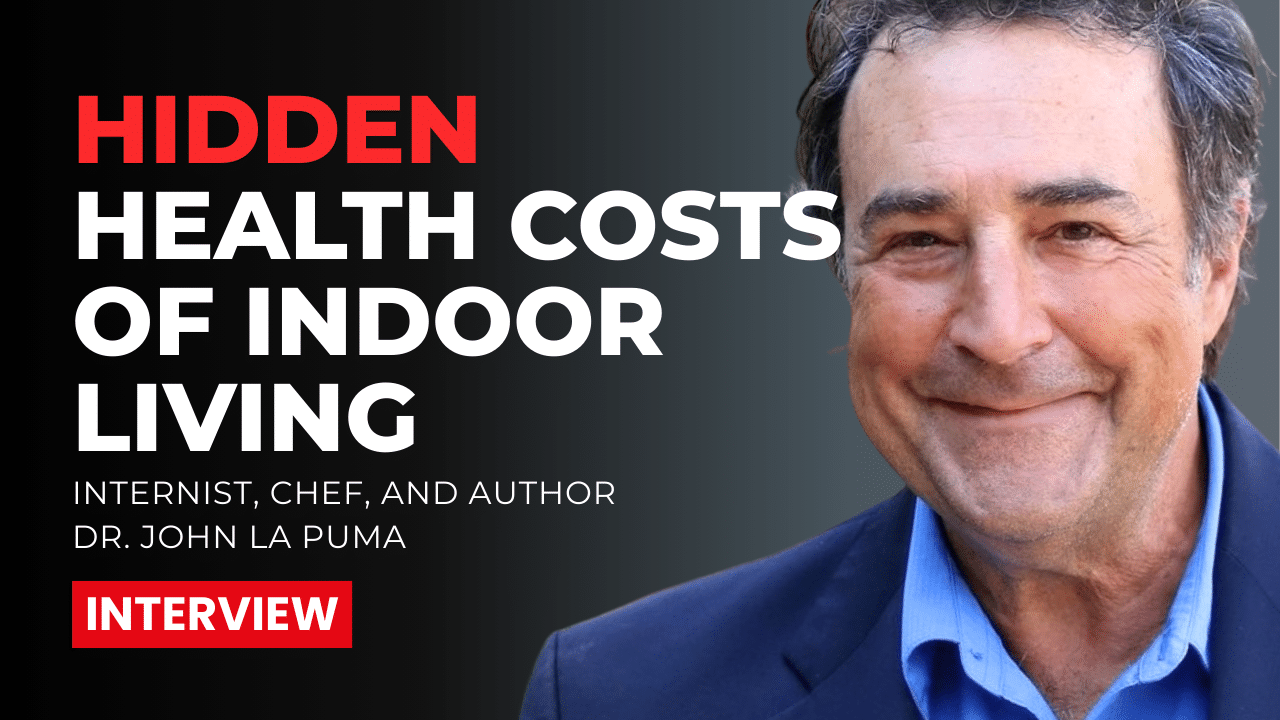
Dr. John La Puma discusses how everyday environmental choices shape sleep, cognition, and long-term health. Drawing on research from medicine, neuroscience, and environmental science, he explains why many professionals unknowingly experience what he calls “cognitive drag,” the gradual decline in mental clarity caused by indoor lifestyles, poor light exposure, and excessive screen use.
A central theme of the conversation is the biological importance of natural light. Morning sunlight triggers a cortisol activation signal that helps set the body’s circadian rhythm and supports deep sleep later in the night. Without that signal, the cycle of melatonin release and restorative sleep becomes disrupted. Even simple routines, such as spending time outside shortly after waking and obtaining brief midday sunlight to support vitamin D production, can help restore these rhythms.
The discussion also examines how physical environments influence mental and physiological health. Dr. La Puma distinguishes between green spaces and blue spaces. Forests, parks, and other green environments are well studied and associated with measurable benefits, including exposure to plant compounds such as phytoncides that appear to stimulate natural killer cells in the immune system. Blue environments—water, coastlines, or lakes—seem to affect the nervous system differently, often producing a more meditative and calming response.
Several practical habits follow from this research. Indoor lighting late at night interferes with sleep signals, and small sources of artificial light such as indicator lights in bedrooms can disturb rest more than many people realize. Managing exposure to screens in the evening, reducing unnecessary light in sleeping spaces, and prioritizing consistent sleep hygiene all contribute to improved recovery and cognitive performance.
The episode also addresses what Dr. La Puma describes as “digital obesity,” the accumulation of sedentary screen time that gradually replaces movement, sunlight, and outdoor experience. Reversing that pattern does not require dramatic lifestyle changes. Regular outdoor exercise, time in nature, and brief daily exposure to natural light can produce measurable improvements in mood, sleep quality, and attention.
For leaders managing demanding schedules, the implications are practical: the environments in which we live and work are not neutral. They shape the biological systems that govern energy, concentration, and long-term health. Understanding those mechanisms allows individuals to make small, deliberate adjustments that support clearer thinking and sustained performance.
Get Dr. John La Puma’s book, Indoor Epidemic, here:
Here are some free gifts for you:
Overall Approach Used in Well-Managed Strategy Studies
Enjoying this episode?
Get access to sample advanced training episodes
Episode Transcript (Automatic):
Kris Safarova 00:47
welcome to the strategy skills podcast. I’m your host, Kris Safarova, and our podcast sponsor today is strategy training.com. You can get some gifts from us. You can get five reasons why people ignore somebody in the meeting at f, i, r, M, S consulting.com forward slash on the room, you can access episode one of how to build a consulting practice at Friends consulting.com forward slash build. You can get the overall approach used in well managed strategy studies at Friends consulting.com forward slash overall approach and McKinsey and BCG union resume example at firms consulting.com forward slash resume PDF. And today we have with us New York Times best selling author, Dr John La Uma. John welcome
Dr. John La Puma 01:34
Kris. Thank you so much for having me.
Kris Safarova 01:36
This is such an interesting topic. Let’s start with a quick overview of the key things you would want people to take away from your recent book.
Dr. John La Puma 01:47
I love starting away with starting with takeaway points. When I did consults in the hospital as a generalist, I always put the recommendations first, instead of history, present, illness, medications, allergies, so great. Here are the takeaway points. One, your indoor environment, your indoors is biologic information for your brain and body, and it’s inhibiting performance, accelerating immune deficits, insulin resistance, insomnia, cognitive fading, attention, fatigue and myopia, just to name six. Two, that cognitive drag is insidious and also impacts longevity and reduces telomere length in measurable ways, documented through 2200 studies that I’ve reviewed for this new book, indoor epidemic three, this is a reversible problem that we can reverse using time that we’re already spending outdoors, but doing so in a specific, intentional way, in blue and green spaces, through 100 different types of options, actually 200 or more, also detailed in the Book, some of which I’ll discuss today and four, it’s easier than you think, and has not just huge personal ramifications, but implications for productivity, for creativity, and for health span, which is The time that you’re alive, that you’re healthy, which currently is about 10 years different than our longevity, which is the time that we’re alive. On average, the age of death in America is 79 around 69 on average, people begin a slow decline and lose quality of life, including both mental and physical illnesses, but that, again, can be compressed in part by doing some of the things that I suggest.
Kris Safarova 04:11
So this may be one of the most important conversations we ever have on this podcast. John, thank you for writing this book. Let’s get into some details on what people could do, I think that we intuitively knew what you were going to say, but it was never on top of our mind, for most of us, and now that you raise the awareness, we need to figure out how to fix this, not just only for ourselves, but for our children, for our spouses, friends, parents, for our team, where it is applicable, where we have some level of control, maybe we can spend some of our meetings working in a park. Well, maybe there’s a park next to the office and so on. Let’s start with what are some of the simplest. Things people can implement this week.
Dr. John La Puma 05:02
I love that you want to focus on fixes before we start really describing the problem. But we can do that, although, candidly, I think it helps to understand this as biology and chemistry and how human physiology and medical science, because it’s a pretty simplistic thing to say, go outside, you’ll feel better, and it might even be true, but without some structure to it, and without understanding the the mechanism by which nature changes cellular function, changes body chemistry, changes brain function, changes blood pressure and pulse and cardiovascular risk and risk for dementia? I think we lose something. So instead of saying, let me answer the question with one the first thing, which I think is the most important thing, and it’s simple, like all of this, and then tell you why it works, the easiest thing to do for most of us is to get 10 or 15 minutes of morning light within 60 minutes of waking, which means that you stand in a doorway or you open a window and you look outside and You see the morning light, and you do this within that hour, 90 minutes of waking for just 10 or 15 minutes, and in that time, you do something that you like, if you have a garden, you pull weeds, if you if there’s ice on the ground, then you break it up, and you’re careful, and you’re putting on your shoes correctly so that you’re not slipping. And you try the place that was slippery last night to see if it’s still slippery. You are engaged in something. Maybe you go get the mail, maybe you open the gate, maybe you take your dog out for a walk. You do something that you like outside, intentionally in a green or blue space that is near water or near trees or a garden or plants or fountain and and that 10 or 15 minutes is life changing, because if you do it without sunglasses, and you do it when there’s any light in the sky. It can be a cloudy day, you give yourself a natural cortisol activation boost. Your cortisol gets a big bump, more than 100% in the morning, which wakes you up. It has also sets your melatonin for release 12 or 14 hours later, so you become sleepy at the right time. It also allows you to get sets the primer for deep sleep or slow wave sleep, which is the type of sleep. There are four phases of sleep, the type of sleep that you need for brain cleaning, which is the glymphatic system. The glymphatic system in your brain, which was only described in 2013 and the Nobel system was given in 2017 is a system that washes your brain, quite literally, of metabolic byproducts that were created during the day, including the proteins tau and beta amyloid, which are implicated in dementia, especially Alzheimer’s dementia and and that buildup occurs even if you miss a Day, which then gets washed out, but it still rides around for that time. The brain actually shrinks 40% in deep sleep for the glymphatic system to wash, to clean the brain of these proteins and of other metabolic pride products, if you don’t get this 10 or 15 minutes of morning light to reset your circadian rhythm, which is what’s happening, then you don’t get adequate deep sleep and your brain cleaning and bone building, which happens only during deep sleep, and muscle repair also during deep sleep, don’t happen as well or as effectively and bone building is especially important for women with osteoporosis or osteoporosis concerns, because bone reformation only occurs during this time. Bone breakdown occurs throughout the day, so morning light, 10 to 15. 15 minutes, no sunglasses outside, do something you like that’s you want to do it between that early time, that early hour or 90 minutes, because that’s when the retinal receptors in the back of your eye are most receptive to the wavelengths of the sunlight that are giving you this circadian rhythm.
Kris Safarova 10:21
This is very interesting in terms of selecting when to go outside, so 60 to 90 minutes when you wake up. Is it best to do it really early in the morning, when the sun is just rising, or is it better when the sun is already up?
Dr. John La Puma 10:36
You can do it. The wavelength is a good question. The wavelengths are of any time, the wavelengths change from early morning to mid morning, let’s say, and the sun often gets brighter mid morning. So outside can be 25 to 50 times brighter, even 100,000 Lux mid morning, which is more powerful for the brain. So if you happen to have a screwed up sleep system, and you go to bed at four in the morning and you get up at 10, you do set your your brain circadian rhythm at 10 o’clock with very bright light. Bright Light is 25 to 50 times brighter outside than inside. Even when inside feels like it’s brighter, it’s not. Most interior lights 100 to 300 Lux. Most outside light is between 10 and 25,000 Lux, and that’s important biologic information for your brain. So it’s really best to do it early morning, because then you’re going to have a deep sleep that night. Even though it’s not quite as bright as later, it’s still way brighter than anything you get inside.
Kris Safarova 11:48
Of course, makes a lot of sense. And if it is still dark outside 60 minutes after you wake up, just go as soon as the light is starting to come out. Yes.
Dr. John La Puma 11:58
So a lot of executives have this problem. I do it well recently. And so if you get when it’s dark, it’s five in the morning, and you’re working or you’re doing other things, suns on up till 630, or seven, daylight savings time is coming, march 18, and and excuse me, march 12, and that’s going to be important and change.
Dr. John La Puma 12:26
You want to be able to do it at the time that’s most convenient. You.
Dr. John La Puma 12:35
It’s important to do it at the time that you wake up when you can and have the kind of bright start signal that your brain needs for the cortisol boost, for the deep sleep cleaning, for the bone building and for the muscle repair,
Kris Safarova 12:53
John and beyond this 1015 minutes within 60 to 90 minutes from waking up, how important it is for us to be outside and get some sun throughout the day. What are the pros and cons?
Dr. John La Puma 13:07
You certainly want Sun throughout the day. In midday, you want to be able to make vitamin D on your skin. You only need about 15 minutes on your arms and legs to make a couple 1000 units of vitamin D that will last for several days. Sunblock is important. We’re not promoting skin cancer here. We want people to particularly affect their faith, to block the rays from their damaging face and other delicate skin areas, the back of your hands, the tips of your ears and your eyelids, which also very sensitive. Bright light throughout the day, reinforces the blue light signals that you get, telling your body that you’re awake. And in the evening, we want to look at the dusk when we can, the sunset when we can, because that gives us red and amber light. That is the only light that doesn’t suppress melatonin, that allows the melatonin to be released that evening so that we can sleep. Want to go back to the question that I think I skirted by by accident, and that is, what do you do if you need this double anchor? And that is, you need a double anchor. If you get up at five in the morning, use a 10,000 Lux light that’s close to your face, maybe six to 812, inches, depending on the manufacturer. And that will give you some of the cortisol activation response when you are when you get up, if you’re getting up when it’s dark. And then get a double anchor. Go outside when the sun does come up, and get the natural rays of the sun, because there are other wavelengths in that, in that natural light that are not duplicated even by the light therapy lamps that are given for seasonal affective disorder, which are often effective for mild seasonal effective disorder, which is. A form of depression very common, actually, women more than men, and it can be a serious problem, just like other depression can be and and yet is ameliorated, improved by having a 10,000 Lux light that’s close for 20 minutes in the morning, but it needs to be supplemented by this double anchor of outdoor light with natural sunlight to reset the whole circadian rhythm. It’s a shortcut that is okay, better than nothing, certainly, but not as good as getting outdoors, and that’s why you need to do both.
Kris Safarova 15:35
Thank you, John and you mentioned your Cardinal. Goes to 100% some of our listeners may think, John, what are you talking about? I already have too much cortisol in my system. Maybe it is even bad for me to do that. So let’s pick up. So in your book, you said that high cortisol is literally aging you from the inside out. So what can our listeners do to
Dr. John La Puma 15:57
Yeah, fix that. So as I also say in the book, cortisol has gotten a bad rap. It’s if we have high cortisol all the time that’s terrible for us and most of us, many of us do. We’re running around. I think, you know, most executives are what I call digitally obese. We’re consuming more pixels than we can metabolize, and just like too much sugar burns out your metabolism, too many pixels burn out your brain. That’s what’s happening to a lot of our workers and and to us. So we want to avoid this, and can avoid this digital obesity state and it it needs to be improved with specific intentional time in green and blue spaces,
Kris Safarova 16:47
green and blue spaces. Let’s talk about Blue spaces. First, blue space is just as beneficial as green, just in a different way. So it’s more meditative. It’s better for your nervous system in some ways, perfect.
Dr. John La Puma 17:01
Yes, exactly right. Blue spaces are even the color blue, which is the best teaching color as you, as you know, is thought to be perfect for the eyes, because and for rest and for relaxation and for meditation, in part because that’s the color of the sky and that’s the color of the ocean, and we have this native affinity for it. It, it is the opposite of a cortisol boost, right? It’s meditative. And a cortisol boost, by the way, to return to the previous point, is very different a big activation of cortisol in the morning, and then the drop during the day is exactly what you want. And our cortisol levels are high all the time because we are stressed, because we are digitally obese, because we have too many things to do, because our adroit adrenergic nervous system and our sympathetic nervous system have an overdose of adrenaline and noradrenaline, which are the fight or flight hormones, and not enough of the parasympathetic nervous system, which is what nature engages. And the parasympathetic nervous system is what allows you for exactly the kind of response to Blue spaces that you cited, it allows you to use your senses. And what are your senses? They’re touch, listen, see, smell and taste all in your face, and we forget that because we don’t use them in work. Indoors is a great place to do cognitive work. It’s focused, it’s creative, it’s productive. It has way too much carbon dioxide. You often upgrade the room just by opening a window, but it’s a good place for cognitive work. It’s a bad place for our biology. It’s biologically poor, cognitively rich, biologically poor. It gives our brain all the wrong signals. It tells us we’re in a confined space. It makes us feel smaller. It gives us the VO twos and the off gassing of and the microplastics and the chemicals that are used for cleaning and that buildup of carbon dioxide that I cited is real, or a number of corporations that have installed CO two meters inside, because they know that once the carbon dioxide levels get to 1000 parts per meter, there is a drop in cotton function by up to 15% and it’s a linear relationship on the way up, and that’s a real impairment when you’re trying to run big companies or even small ones. So so we want to upgrade our. Our indoor environments. We want to take advantage of the tools that are given to us outside. We want to break out of this digital obesity state where our lives are ruled by monitors, but they don’t have to be
Kris Safarova 20:15
John and in terms of blue spaces, would you say it is as beneficial as green spaces, but in a different way. Or would you say green spaces is still more powerful in terms of your longevity, your overall health and well being?
Dr. John La Puma 20:29
Green spaces are more well researched. Blue spaces do not have the kind of research databases that that green spaces do, which is interesting to me, because blue spaces have this natural color going on. They have a natural for moving water, which has some advantages over still water. There is a at 50 to 60 decibels, babbling brook sounds, gentle rain sounds, ocean wave sounds are very comforting and they there’s a neurologic reason for that, which is that your brain waves shift from an agitated beta to a more calm alpha and theta state when listening to These sounds. So before a big meeting, before sleep, before any kind of when you want to feel more relaxed, those kind of blue sounds are actually very helpful. But the research database is not just not as robust for green spaces, there is an enormous database that just the 2200 studies is not even most of it and and that is that ranges from reduced antidepressant prescriptions that are when living even living near dense vegetation, to to reduce Kris for dementia, for gardeners to to the opposite, which is using waking up with bright light at night. Did you know that there is if you’re get bright light between 1230 in the morning and six in the morning and 40% of America goes to sleep with a lamp on or a TV on, you have the people who do that the most have a 50% greater risk of our heart attack, or slightly more, actually, a 50% greater risk of afib, 30% increased risk of stroke, and 30% increased risk of heart failure. This is a huge study done in the UK, published this last year in JAMA, showing that this night light effect is as hazardous for cardiovascular health as smoking or as a bad diet. And it’s basically not well known, except for this remarkable study published in a really prominent place. And yet it’s something that shows the power of what we can do with light and how our indoor environment is hurting us. When we go to Blue spaces or green spaces, we can engage those benefits for insulin sensitivity, for insomnia, for for mortality and telomere length, for cognitive attention, for myopia, there’s an epidemic of myopia. Familiar with myopia, nearsightedness, so that if you have my phone is not here, if you have a phone in front of you, like this, your eye actually elongates slightly over and over again. It’s an epidemic. 90% of people in Singapore and Hong Kong are myopic, about 40% here in California, and that’s not so bad yet eye drops or glasses, but over about 5% of myopic turns into high myopia. So by the time you’re 30, you can have corneal problems or retinal problems and even have blindness because of it, and there’s no reason to risk that. And so this is just one of the problems brought on by the pandemic, but with a horizon reset, if you’re trying to actually stall myopia, you do it by looking at the horizon five minutes an hour. So you don’t need a forest for this, for forest bathing, you need a sky view. So go to the window, and this window is okay. We’re not It’s not using natural light. You’re just using you’re relaxing the ciliary muscles around your eyes and the headache that can come from their tension and from headache that can come from other tension and fatigue from looking at a screen and you look at the furthest point you can see, at the horizon. If you’re trying to reverse myopia or stall it, you do that for five minutes if you just need a break from work. Work. You do that for one minute. It resets you. It allows you to use your senses, but you’re not using when you’re doing cognitive work for the most part, and then you can return, you know, calm but alert, John.
Kris Safarova 25:12
I am enjoying this conversation so much. I hope you guys are taking notes, and really, well, not necessarily by hand, taking notes, but in your mind, I hope you’re taking notes. I think what you mentioned about waking up between 1230 and 6am and being exposed to bright light. This is something that no one talks about, and this is something so many people exposed to, because it’s completely normal. People go to the bathroom in the middle of the night, they put on light, and then they go back to sleep.
Dr. John La Puma 25:37
And although that, you know, when I travel, I have a roll of electrical tape that I take with me, and I tape over all the little bright lights. And may seem weird, but it actually does interrupt your sleep in a way that you don’t realize until you until you do it. So an electric tape is cheap and fun. It’s black and goes in your suitcase just fine.
Kris Safarova 26:00
And then what you mentioned about phones is so important as well, because we are looking at our phones way too much. Would you say that it is healthier to look at the laptop screen versus a phone? Let’s say you’re reading a lot New York Times and so on, and you you can read on your laptop or on your phone. What would be your recommendation?
Dr. John La Puma 26:18
It’s really the same Kris. What can help on both of them? Not it doesn’t help completely, but it it’s an improvement. And I’m sure you already do this is to enable on your phone. On an iPhone, it’s called night shift. I’m not sure what it’s called on Android, but I I’m sure that they have something equivalent, and that changes the wavelength of the light in your settings, so that at night, you’re you’re not getting blue light, you’re getting red and amber light, and it’s not as stimulating to the back of your eye, so it doesn’t keep you Up. Bright Light within 30 minutes of bedtime suppresses your melatonin by 80% and for an hour and a half. So if you’re going to sleep looking at your phone, your Kindle, your laptop, your iMac, your whatever, your television, you’re impairing your ability to get to sleep, stay asleep, and your brain’s ability to clean itself, and you want to avoid that, so they both So enable night shift on both your phone and if your MacBook doesn’t have it, or your laptop doesn’t have it, look for an app called F dot Lux, which is Very old. I think I used it 20 years ago, and it still works. And all it does is the same thing, but it changes the wavelengths of what the light that comes out of your device, so that they’re not as stimulating to your retina. They don’t suppress your melatonin as much. They’re not as good as not using bright light within actually, I suggest at least an hour before bedtime, and you can create all kinds of other rituals before bed. This way, you can read a book, you can have a cup of tea, you can talk to your partner, you can do all sorts of things. There are lots of suggestions in the book, over 200 actually, of the kinds of ways that you can use outdoor green and blue space to not just deepen your relationship with nature, but more importantly, really change your biology, so that your brain works better, that your body works better, and that you have better longevity And healthspan. You’re familiar with healthspan, of course, of course,
Kris Safarova 28:44
John and also regarding what phones are doing to our eyes, yes, say that it’s better to read on a laptop.
Dr. John La Puma 28:52
No, I think it’s actually ready better to read on a on paper, because you’re not getting artificial stimulation from the light that the problem is not really though to be candid Kris the monitor when you’re reading on a reading a book, it’s the digital obesity, it’s the overstimulation. It’s the constant need for pixels. It’s the idea that your brain can needs to operate on more pixels. And actually we want to get away from that. We want to get away from the overwhelming sense that of confinement that those pixels give us we need to do work. I love technology, by the way, I have lots of devices, and I’m quite interested in it, but it has a place, and at its place, is not eight hours a day for kids under 1011, hours a day for kids under 17, and up to 12 hours a day for adults. And that’s what’s happened. It’s taken over, and it’s had biologic effects. That I think we’ve been unaware of, not just addiction to screen, but social isolation and loneliness. You know, loneliness has the mortality risk of 15 cigarettes a day, three Kris a pack a day, and and you can reduce all cause mortality with green exercise, something that a lot of these kids don’t do by mixing your exercises. It’s not enough to just go to the gym and work out, although I like doing that too. A lot of people do. You have to do outdoor exercise, and the outdoor exercise that is uniquely more than any other, tennis, swimming, soccer, uniquely improves mortality. Risk from respiratory disease is heavy, chopping and digging, stuff we used to do many of us, and that’s what you do if you’re a serious gardener. And 71 million Americans are gardeners. So and gardening itself has beneficial effects, not just on your microbiome, which changes their immune system, on your skin, in your lungs, in your GI tract as you work in the soil, but also on your vegetable intake, your fruit intake. Gardeners eat more fruits and vegetables and non gardeners, and there’s data to associate less dementia in gardeners, particularly lifelong gardeners, 37% less than non gardeners. So there are many benefits to being outdoors and having and when you read. I’d like you to read a book. I’d like you to use a physical journal. It puts you in touch with yourself and makes you think of your thoughts instead of just letting Claude or chat GBT think of your thoughts and and it makes you more participant in the world. There aren’t you don’t have to be perfect here. I’m not going for perfection. I’m I’m saying, I’m trying to call attention the fact that none of us optimize our own biology for using the world as a health tool, nature as a health tool, but the prescription of it for that purpose is new, and that’s why I wrote an outdoor RX. That’s why there’s a 7% solution. 7% of your waking time needs to be spent in intentional, specific ways, in green or blue spaces. And that’s why this is much easier than you think. As you say, take a walking meeting. Have a lunch on a park desk. Have a lunch in a park on a bench. Don’t just step outside to pick up the delivery from DoorDash. Walk down the block and see what the neighbors are doing. B if you live in a city, remember it’s you don’t need a forest. You need a Sky View. Step outside. Look at the sky for a minute. Every hour it’ll give you a horizon reset. This is much easier than most people think, but it does mean being intentional. It’s not just you know I’m outside now what it means doing the things that I suggest and seeing what works for you,
Kris Safarova 33:19
John, and in your book, you speak about how working in a forest is incredibly beneficial. It just overall makes you so much healthier and more resilient. Would you say that in California, specifically Los Angeles, for example, we actually what we have here is more bushes, not the trees in national parks? Would you say it is equivalent, or not really, to working in a forest. Well, I think it’s equivalent
Dr. John La Puma 33:46
the you know, when we think of forests, we think of huge forests, the redwoods, the Rocky Mountains the northeast, all through Vermont and the great forests in even in Minnesota, there are wonderful forests, but you don’t need a forest, as I’ve said before. You need a sky view. If you happen to be in a forest which is really just among dense trees, let’s just say that’s what it is. You get all kinds of microbial benefits that I think people are unaware of forest bathing, which is offered from everybody from the Harvard arboretum to the Santa Barbara botanical garden. And hospitals now offer forest bathing, as do luxury hotels around the world. Forest bathing is simply immersion in the forest and letting as it’s been defined, the forest be the therapist, and the walk in the forest be the therapy. And what that means is that what you’re doing in a forest for 20 or 30 minutes minimum is cycling through your senses, which I just did, and you practice this. You listen for a sound. We did this with the UCLA physicians. You practice listening for a sound for 30 seconds, you try to identify unique sounds, and then you listen for another 30 seconds, you try to identify two more unique sounds. And everybody thinks that they’ve got the unique sounds like the first 30 seconds, but they inevitably hear more than two in the next 30 seconds, and it’s because you’re becoming your senses are becoming aligned with that of the natural world. And you do this for each of your senses. And you walk and you notice patterns, which are called fractals, often in nature, that are comforting and easier for the brain to process than other complex patterns. And you inhale the phytoncides that trees make. Phytoncides are the active immune chemicals that trees make to ward off predators, bugs that eat them, and also to tell other trees that they too need to change their leaves chemical composition so they too can ward off predators those phytoncides which are aromatic, like alpha pinene in hinoki Cypress, which is what the forest bathing was first done with by King leaves and immunologists in Tokyo are transformative, not just for trees, but for people. And as you say, they increase natural killer cell count, which are the white blood cells in your bloodstream that kill cells that are infected by viruses and kill cells that are infected by tumors and other cancer particles. And they do this by releasing proteins like granules in that that do just that. A lyce cells that are bad for you, that are in your body that should go away, and they increase this activity by 56% and that activity lasts for a month with just a two hour session in a forest. So fight insides are part of why the forest is so effective as a therapist, but it also drops your blood pressure by about seven millimeters, systolic and your diastolic by about four millimeters. On average. There are numerous studies, and I cited this earlier of green interventions and not really as good at studies for blue interventions. I wish there were, because, you know, even though I lived on an organic farm, and I love being outside and having your hands in the dirt. My comfort nature place, which is a term that we’ve coined, is actually more the ocean. I like looking at the ocean and listening to the ocean. If you give me one natural environment to like, that’s it and and that’s true for many people, and that itself is fascinating. Kris. Because, you know, for someone raised in Arizona, it might be that that those beautiful stretches of open sand and occasional cactus and a scrub brush is really perfect for them, that might be their comfort, nature, place, and they might think a forest is like is scary. And there are cultural reasons to think that for African American people, for example. And that makes sense, too. In fact, a lot of underprivileged people have, do not have adequate access to nature and and that’s a whole nother, very interesting, important discussion to have about how to give them access and how to make nature more accessible. Nevertheless, what we want here is for people to know that this is easier than you think, and that the solutions are many, and simply trying those, finding those that work for you, can be exactly the right path to changing your own biology and making nature work for you.
Kris Safarova 38:40
John, and probably the last question to make sure we can complete it on time, because I’m saying you have something coming up. We spoke about 1230 to 6am so I think now some of our listeners are worrying, because they generally may have insomnia, and they kind of wake up really early because they just cannot sleep. And what do they do? Because obviously they don’t want to have those things that you described coming into them in terms of the much higher risk factor for very scary things. What can they do if this is their situation right now?
Dr. John La Puma 39:16
You know, if I put my doctor hat on even more firmly, there are lots of reasons for waking up in the middle of the night. Aren’t there? Everything from not having the right sleep hygiene, having a cool, dark room to having a bed partner who’s disturbing, whether it’s a person or an animal, animals don’t belong in bed, in my opinion, as a physician, it’s disturbing even if you’re not consciously So, alcohol before bed famously disrupts sleep, even within three hours of sleep, and caffeine at the wrong time after two in the afternoon certainly disrupts sleep. There are a lot of reasons to have disturbed. Sleep, not to mention psychological and interpersonal problems or worries about the day ahead or the day of but something in your control right away is this morning light idea. Is the idea that you set your circadian rhythm in the morning with 10 to 15 minutes, within 16, not 6090, minutes, of waking without sunlight, glasses, looking to a screen if the weather is horrible, or standing outside and doing something that you like, and sunset, where you are seeing the sun go down, enjoying the red and amber waves, and also not having bright light before bedtime, those three easy things and having a night routine that allows your brain to power down a little bit to your temperature to drop, which is normal, to prepare you for sleep and rest so you can be alert the next Day. Those things are are fixable, and the things you can do tomorrow, the other things that I mentioned that are important for sleep generally are just as are also important for sleep. But what 93% of us are missing is the 93% of time that we spend inside, and that 93% of time that we spend inside causes, exacerbates, and in some cases, really accelerates insomnia and sleep problems, but that’s fixable. Try the things that I’ve mentioned, get the morning light and see if there’s some improvement.
Kris Safarova 41:42
John and the Quick clarification, so if someone wakes up at 2am should they try not to be exposed to light? Well, that would be a waste of time as well. They would have to find something effective to do with their time if they cannot sleep. So what is better? Do they have that lamp that you described? And then within 60 to 90 minutes they expose but then there is this concern that you mentioned that if you expose the bright light in that time, it’s actually really bad for you.
Dr. John La Puma 42:07
What’s better is to try to go back to sleep and not have bright light in the in that till 30 to 6am window certainly set your device so that you use night shift, certainly use your other devices that don’t have night shift, for F dot Lux, to change the wavelength of the light, if you do happen to look at a phone or a monitor, certainly turn the TV off. Don’t go to bed with a lamp on or the TV on. I mean, I think that’s really the first logo. If you wake up in the middle of night and you can’t sleep. I would get out of bed and spend 15 minutes going back to sleep. You can’t get out of bed. And if you want to use a red or amber light to read a book, to journal, to have a cup of tea, to do something calming, to pet your dog, please do. But if you give yourself a big dose of of light, it’s it’s a lot for your brain, it’ll feel stimulated and it’ll be hard to go back to sleep. You know, accidents happen again. We’re not trying to be perfect. We are trying to set ourselves up for the best sleep we can, and the easiest and simplest way for most people is to not have go to sleep with a lamp or a TV, which, as I said, 40% of us already do. That’s a huge change for many people, knowing that you need a dark, cool room, knowing that you need peaceful bed partner as well, knowing that you ought not to have a pet in the room, knowing that the temperature really ideally for sleep is 65 to 67 degrees, and everybody has a preference. I understand that, but the data show that that’s probably the best resting temperature. There are a lot of ways to improve sleep, and using nature as medicine is one of them, John, thank you so much. It’s a pleasure. Kris, thank you so much for having me.
Kris Safarova 44:07
Our guest today was New York Times best selling author, Dr John La pomer, I think that this is a book definitely worth reading. The book is in the epidemic. And most importantly, I hope you guys going to implement at least some of the things we discussed today. Consider, of course, what is best for you, speak, video, talk, that you have concerns, and so on, but I think that some of the key things we learn today can make a huge difference long term. Thanks so much. Okay, guys, let’s wrap up for today. Our podcast sponsor is strategy training.com you can get some gifts. You can get five reasons why someone ignores people in the meeting. And you can get it at firms, consulting.com forward slash, on the role. You can access episode one of how to build a consulting practice at firms, consulting.com forward slash, build. You can get the overall approach used in well managed strategy. Studies at firms consulting.com forward slash overall approach, and you can get McKinsey and BCG winning resume at firms consulting.com forward slash resume. PDF. Thank you so much for tuning in, and I’m looking forward to connect with you all next time.
Leave a Reply