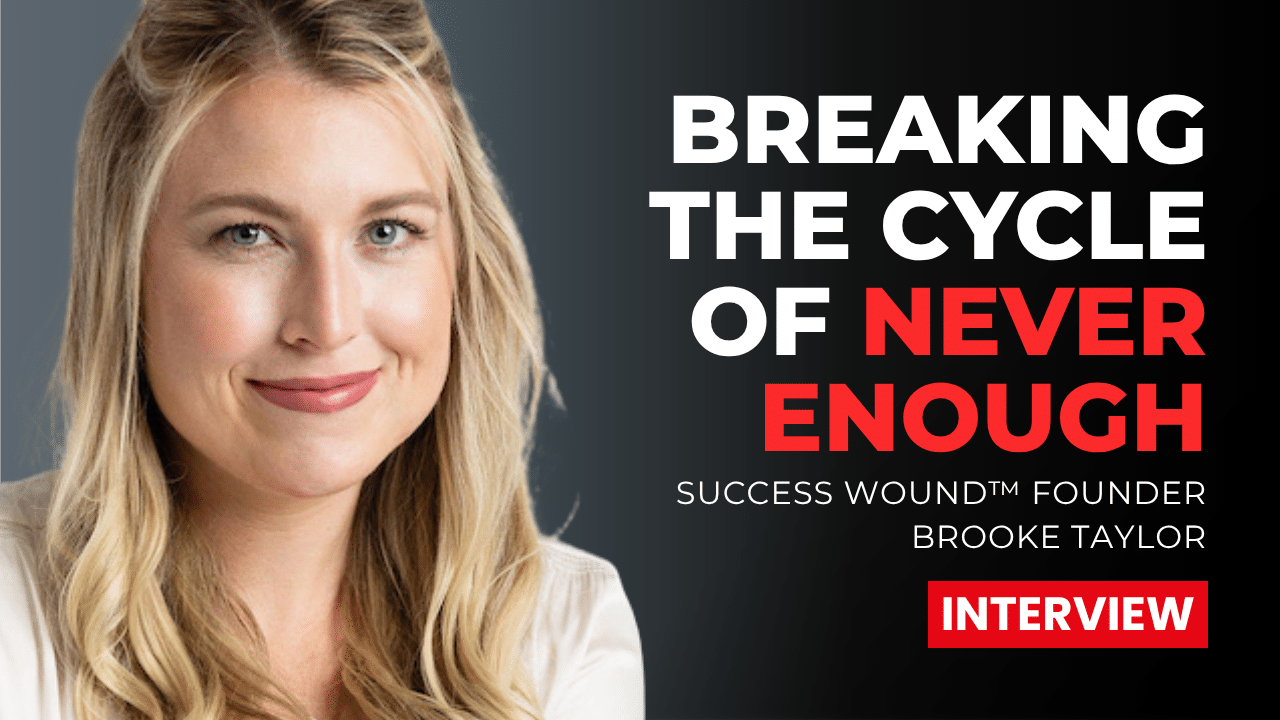
Brooke Taylor spent more than a decade inside high-performance environments, including leadership roles at Google, before turning her attention to a question that many accomplished professionals quietly wrestle with: why does achievement so often fail to produce a lasting sense of fulfillment?
In this conversation, she examines what she calls the “success wound” — the tendency to attach self-worth to performance, recognition, and external measures of success. Drawing from her own experience with burnout, addiction recovery, career advancement, and entrepreneurship, she explains how these patterns develop and why they continue to shape behavior long after professional success has been achieved.
Among the key insights discussed:
- The root cause of many workplace struggles is not a lack of capability but an unhealthy relationship between achievement and identity. When self-worth becomes dependent on performance, even meaningful accomplishments can feel insufficient.
- Many high achievers operate from a small set of recurring beliefs, including “I have to prove my value through productivity,” “If I fail, I am a failure,” or “I am only as valuable as other people’s opinions.” These beliefs often drive behaviors such as overwork, perfectionism, people-pleasing, procrastination, and chronic dissatisfaction.
- Sustainable fulfillment comes more from how work is approached than from the specific role, title, or employer. Taylor argues that changing working habits and thought patterns frequently produces greater satisfaction than changing jobs.
- Emotional regulation begins with recognizing how stress, fear, and inadequacy are experienced physically. Rather than suppressing difficult emotions, she outlines a practical process for identifying them, understanding what they are communicating, and responding with curiosity rather than avoidance.
- Lasting behavioral change requires action, not insight alone. Taylor explains why taking deliberate “opposite actions” can be more effective than endless analysis when attempting to break entrenched habits.
The discussion also explores addiction recovery, the role identity plays in sustaining behavior change, the hidden cost of codependency in professional life, and why many forms of burnout stem from carrying responsibilities that do not belong to us.
Throughout the conversation, Taylor offers a thoughtful perspective on ambition, personal growth, and leadership. Her central argument is that professional success becomes more sustainable when it is no longer asked to answer questions of worth, belonging, or identity.
For leaders navigating demanding careers, the episode provides a practical framework for examining the assumptions that drive performance and for building a healthier relationship with achievement itself.
Get Brooke’s book, Healing the Success Wound, here:
Here are some free gifts for you:
Overall Approach Used in Well-Managed Strategy Studies
Enjoying this episode?
Get access to sample advanced training episodes
Episode Transcript (Automatic):
Kris Safarova 0:46
Welcome to the Strategy Skills Podcast. I’m your host, Kris Safarova, and this episode is brought to you by Strategy training.com You can get some gifts from us. You can access episode one of how to build a consulting practice at firms consulting.com forward slash build, you can also download the overall approach used in well-managed strategy studies at firms consulting.com forward slash overall approach, and you can get McKinsey and BCGB in resume, which is an actual resume that led to offers from both of those firms, but it works at any level of seniority, and you can get it at firms consulting.com forward slash resume pdf. And today we have with us Brooke Taylor, who spent years as a marketing lead at Google, and she now works with companies including Goldman Sachs, McKinsey, Uber, Salesforce, Coinbase, Meta to help leaders decouple their self-worth from their achievements. Brooke, welcome.
Brooke Taylor 1:46
Thanks for having me. I’m excited to talk to you.
Kris Safarova 1:48
Let’s start with your career. You had such an incredible career so far. Maybe you could take us to the point right now, and then from there we can speak about your current work.
Brooke Taylor 1:58
Yeah, so I grew up in Silicon Valley before it was the Silicon Valley we know today, so I was imbued with, you know, tech culture and entrepreneurialism, and, you know, my dad worked for himself, so that was kind of what was all around me, and I promised I would never do what my parents did, I was like, I will never, you know, I’ll never go into tech. I’ll create a career that’s different from that, but then, of course, when I graduated from university, I got a really exciting job at Google. I was in advertising sales at the beginning, kind of like at the beginning of the small and medium-sized business boom that Google had, which was like very much like the engine of Google’s growth for a long time, and at that time it was like kind of a big sell to big brands to say you should move some of your television dollars over to YouTube, but that was my job. I loved it. I felt finally felt like I had arrived, like I had, you know, the brand equity and the title that I couldn’t wait for people to ask me about, and I really propped my identity against that job, and that took me to some dark places. It allowed me to have a very like work hard, play hard mentality, you know, doing my very best, and maybe overworking Monday through Friday, and then needing to blow off some steam on the weekends, so drinking, partying, and it became this really vicious cycle that came to a screeching halt when you know my dad got diagnosed with terminal cancer, when I had to go through some of my own kind of personal burnout addiction recovery, I realized that I couldn’t keep drinking, and so that led me to hit my knees and just start asking some questions about not just what I was doing for work, but how I was working, and so I was able to switch jobs internally at Google, find a job that was much more aligned with my strengths, my interests, and that’s when I took a job that was delivering workshops to C-level executives around how they can use Google’s advertising strategy to meet their needs online, but at the same time I had this interest in personal development, career development, and I ended up getting a coaching certification and helping other high-achieving women to kind of confront the things that drove me into addiction and into burnout, which is what I call the success wound, and the success wound is the pain that comes from mistaking success for self-worth, and that’s been my interest, that’s been the subject of my research those years while at Google, and then leaving Google to start my own coaching business, where I help super high achieving women in tech, finance, and law, healthcare, etc. to create a relationship with work and their worth that feels deeply fulfilling. So I’ve been doing that full time for the last seven years, and now I have a book coming out May 26 called Healing the Success Movement, which is kind of like a culmination of my perspective on. High achieving women, and how we can create a career that actually feels deeply fulfilling.
Kris Safarova 5:05
On the bright side, at least you had play hard part. Many of our listeners just work hard, no rest, practically. So a reminder for all of us to take enough breaks on this. For our audience, we don’t need to remind people to work hard,
Kris Safarova 5:21
sure,
Kris Safarova 5:22
we need to remind them the other side.
Brooke Taylor 5:24
Yeah, well, the interesting thing about the work hard, play hard, and you know, I’m sure we’ll get into this, is that it’s almost just as insidious as the grinding, because the relationship, you know, it’s almost like the grinder gets relief from doing more, right? It’s like getting the illusion that I could finally get on top of my to-do list, but the play hard, the work hard, play hard, it’s on this, this pain pleasure seesaw, this dopamine loop, where there’s no kind of, there’s no, there’s no real rest, right? It’s exhausting to wake up, you know, hungover, or knowing that you betrayed your values in some way, or to have overspent on your credit card, or to have done something that might, you know, put your family or your body into a harm’s way. So, yeah, they’re all just, you know, different sides of the same coin, aren’t they?
Kris Safarova 6:15
Of course, Brooke. And if you’re comfortable talking about it, I think it could be very valuable. So, the addiction part, because we never really speak about it, but of course alcohol is something people get addicted to, and it’s very hard to stop drinking. Do you have any advice for a group of our listeners? I’m not saying there are many, but there will be some people who are listening to you and would want me to ask your advice on how you were able to stop.
Brooke Taylor 6:43
Yeah, it’s my favorite subject, because I didn’t know that just not putting a substance in my body and looking at the reasons why I drank in the first place could transform every area of my life. I don’t have anything today, my husband, my son, my house, my career, without that decision that I made then, and that I make every day to not drink alcohol, and what I learned through my recovery process is that the root of addiction isn’t the substance, it’s not the alcohol that you’re drinking, or the way that you’re gambling, or using your credit card, the root of addiction is what they call a spiritual malady, so a god-shaped hole, but in a psychological context, that’s that’s that feeling of like restlessness, irritability, and discontentedness, the feeling like you want to crawl out of your skin, that feeling like something’s missing in your life. Addicts treat that with alcohol, but I think high achievers, and maybe some of your listeners, treat that with approval, significance, productivity, more so. We think in a lot of ways we all have this spiritual malady, this soul sickness, this hunger for something else. Addicts just wear it in a more kind of like obvious way. So, my first step for getting sober was going to a 12 step meeting, but what the reason I knew that that was something that had to be done was I lost the power of choice as it relates to alcohol, so I no longer had choice in how much you know I would go out being like I only have one that you know, even if it wasn’t 20, even if it was three, I was still going back on my promise to myself it was preventing me from progressing my life in ways that I wanted to progress it, and it was taking more than it was giving, so to me the math wasn’t adding up, and I ended up, you know, getting sober. So that’s something that your audience can take from you. It’s like, have you lost the power of choice? Is it failing? Is it meaning that it’s failing to progress your life in some way? And is it, is it taking more than it’s giving?
Kris Safarova 8:48
And then there are, of course, milestones as well. It takes time for people to even admit that there is a problem.
Brooke Taylor 8:54
Oh yeah,
Kris Safarova 8:56
they remember the moment when you were able to admit it to yourself, and anything that helped with that.
Brooke Taylor 9:01
Yeah, you know, they say your bottom is when you stop digging, and it doesn’t have to be a huge moment. In fact, my darker moments with my drinking were more like when I was 2021 but I didn’t get sober till I was 24 It was a couple things, it was the fact that, you know, my dad had been diagnosed with cancer, and how could I keep living this way when he was fighting for his life. I think the other part was the fact that I was working in a way, my relationship with alcohol, and it’s the way that it was kind of tied up with achievement, and the only thing that I knew how to relieve the pressure. I was like, I just don’t think that’s right. So, it wasn’t the moment came when I had actually went up to somebody who I deeply admired, who I knew was sober, very publicly, and I was like, how, you know, I think I have trouble with alcohol. She’s like, have you been to a 12 cent me. I was like, no, absolutely not. I could never possibly do that. She was like, here’s my cell phone number, call me, I’ll take you there. So it took somebody who was very public about their sobriety and somebody who I admired. I want what she had. It had, so although I knew I had trouble with drinking for probably six years leading up to that, it wasn’t until you know that person was kind enough to like break their anonymity, which is why I’m so public about it, because it’s what helped save my life. So you know anybody who’s listening to this who wants to talk about it, you can send me an email, that’s something I’m so open to.
Kris Safarova 10:35
And I’m so sorry about your dad. Is he okay?
Brooke Taylor 10:38
He passed away in 2018 but you know what’s crazy is that my book comes out the day that he passed, so his anniversary, and I think I didn’t choose that publication day, but I think he did, so you know he passed away three years after his diagnosis, and that was just something that you know caused me to want to live very urgently, and I think made this whole process of me getting sober, me looking at my life, and me wanting to write this book and leave Google and have this career in life, because I was like, there’s really no time to waste,
Kris Safarova 11:17
and I’m so sorry,
Brooke Taylor 11:18
thanks,
Kris Safarova 11:19
Brooke. And then another milestone, as you know, is when you decide no, it’s not acceptable to be, no matter what will be the cost. I’m going to stop, obviously not hurting other people, but whatever is the cost to me, however hard it will be, I’m going to do it.
Kris Safarova 11:34
Do
Kris Safarova 11:35
you remember that moment, and what helped you make this decision that is very hard for people to make,
Brooke Taylor 11:42
you know. It was a moment, I think. I think the moment was I had been speaking with a mentor of mine. I’m trying to remember, because it was 10 years ago now. The exact sequence of events, I went to that meeting with that mentor, and then I went out that night, and I drank again, and then I woke up the next morning, and I was like, you know what, I, it’s not a logical thing, Kris, it’s often a very, it’s not something you concoct, or you can kind of recreate for yourself, it’s just this kind of like inner breaking, where you just kind of like surrender, and you’re like, okay, I think I think this is it for me. And again, your bottom is when you stop drinking. So I went out that night, I was like, you know, I think I’ve done every version of this, I’ve gone to every version of this party, I’ve had every version of this hangover, I’ve had every cocktail I could possibly consume. I know what this life looks like, but I don’t know what the sober life looks like. And I think that idea was inspiring to me. I think a lot of people that would feel scary, and there were parts of it that did, but I was like, you know, I think if I give this a chance, there’s no saying the beauty that my life could hold, so why don’t we try it? But again, I think it was really like they say it’s a spiritual moment, and it’s really kind of like a god shot, and that’s the only way I can contrive of it, because I tried to stop drinking for eight years and none of it worked, so I wish I could bottle that up and give it to people, because I’ve seen 10s of people, hundreds of people, kind of come in and not get it, and then leave, but I’m just so grateful that I did, and your bottom is when you decide to stop digging, you know.
Kris Safarova 13:41
Can you elaborate on that phrase? Your bottom is when you stop digging.
Brooke Taylor 13:46
Yeah, it doesn’t have nothing. No sort of bad habit or pattern has to deteriorate or impact your life in an extreme way in order for you to want to change it, so let’s just take an example of either drinking, or maybe it’s people pleasing, or maybe it’s, you know, working path, working in a way that’s really harming your health. You can decide to stop immediately, and readiness is a choice, it’s not a feeling, you don’t have to feel ready in order to stop that pattern, and I think the first step is to admit that it is a problem, to admit to somebody that it is a problem, not just to yourself, but to probably to somebody else, and to know, like, on a deep level that it’s going to be scary to stop that pattern, right? I write about in the book the five ways that you know our success wound manifests in our career, and all of them are our comfort zone in some way, whether it’s overworking or whether it’s hiding in our comfort zone, or whether it’s people pleasing or working hard and playing hard. It’s scary to give up those habits, but I. Readiness is a choice, not a feeling, and you know, really doing the math around, is this taking more than it’s giving, because a lot of people stay in that black and white thinking, like, okay, well, How could I possibly operate without this? How could I possibly operate without, you know, opening my laptop at 8pm or how could I possibly operate without, you know, being on everyone’s good side all the time, knowing that it’s not, it’s not black or white, it’s not this or that, it’s not laptop at eight, or you’re only working two hours a day, because a lot of people are like, well, then I’ll be lazy, or then I’ll be fired, no, there’s like a million other ways of working, there’s so much more gray area that exists, if that makes sense,
Kris Safarova 15:38
Brooke, and then once he went to the first meeting, what happens?
Brooke Taylor 15:43
Yeah, what happens then? You sit in a chair and you look around the room, and there are people from all certain walks of life. You sit next to somebody who is a banker, next to somebody who was a stay-at-home mom, next to somebody who maybe was unhoused next to people who look like you from all different walks of life, and that’s the beauty of it, is that when you listen and when everybody opens their ears and hears people’s story about their drinking or their alcoholism, everybody’s really the same, they tell the same story that they were maybe misunderstood as a kid or they didn’t get the love that they think they needed, or they had a really great childhood, but they felt off or different in some way, and they talk about how their drinking, you know, first was fun and maybe used to create connections and bonds, and then it starts to create problems, and then it’s just problems, it’s not fun anymore, and everybody shares a story about how you know, similar to mine, there’s a tipping point that they couldn’t have contrived or predicted, but that maybe a higher power put in their own, put in their fields, and they were brave enough to ask for help to find a 12 step meeting, and to attend that one, and so what happens is you start to hear your story over and over again. I know I heard my story, and it’s really through that relatability that somebody else feels the way that I feel, because I felt alone and isolated again. I was 23 years old, working at Google, living in New York, paying my bills, I’m from the Bay Area. I’m extremely privileged, like I didn’t go to rehab, like it’s not a perfect, you know, what you’d think of as, like, an alcoholic, right? And yet it was super clear to me that if I wanted my life to progress, I needed to give this, you know, give up this substance, and it took a while for me to feel better. The first year without alcohol, you feel like you’re just an open wound, right? Because you no longer have your band aid, so you’re just pain. You’re like everything feels very raw, everything feels very exposed. But then things start to get better, and you start to relearn how to socialize, and how to have fun, and how to introduce yourself without alcohol, and you retreat, you retrain people in your life how to interact with you. And I was speaking with somebody earlier who’s French, and she’s like, you know, I’ve been really considering giving up alcohol, but it’s so cultural for me, and she’s never been able to drink, for she’s never been able to be sober on her own for more than three weeks. Three weeks was like, so hard for her, but she’s like, “Am I really an alcoholic? The only requirement to for membership to a 12 step program is the desire to stop drinking. So, if you have the desire to stop drinking but can’t drink on your own, that’s enough.
Kris Safarova 18:37
There are some studies on how you cannot just stop, your body is not ready for that, and so basically you have to still drink to some degree and slowly get yourself off it. What are your thoughts on it? Because I know people who just stop, and also people who are very worried about that.
Brooke Taylor 18:56
I can’t comment on that, because I don’t have enough medical expertise, but if that is the case, they have something called outpatient programs, where you can go and they will like wean you off, but you can like either you can go and stay, that would be like an inpatient program, and you can, you know, get treatment, or you can like still live in your house and you can go and they’ll like slowly wean you off of it. Look, I wasn’t a daily drinker, so that wasn’t the, that wasn’t medically necessary for me, but yes, like, if you are a daily drinker and your body’s become dependent on it, it is probably medically necessary, although I don’t feel, I don’t feel super qualified to speak on that,
Kris Safarova 19:34
of course, so once you go to the first meeting, how easy it is to stop,
Brooke Taylor 19:40
um how easy is it? You know, the beauty, the answer is different for everyone. The truth is, is that you get to work on the first step, and that first step is, you know, it’s called a 12 step program, so there are steps. Steps to recovery. The beauty is that there is a process, there’s a program, there’s a program of action. So, if you’re a doer, I find, like I am, I found that thrilling. I was like, great, there’s things I can do to help make me feel better. And that first step is getting a sponsor, getting somebody who has been through the steps and who can be like your companion, your guide. They’re not your, they’re not your coach, they’re not your therapist, they’re not your mom, but they’re your guide, and they help you to recognize the ways in which you know alcohol has become a problem in your life, and the ways in which you are powerless over alcohol, meaning you’ve lost the power of choice, that alcohol is running your life more than you’re running it, and I know that might be very difficult to imagine. Again, I had a job, I had friendships, my family had no idea what was going on, like from the outside it looked, it didn’t look that way, but I knew for years that I wanted to stop, but I couldn’t, and I couldn’t control my drinking, and when I wanted to control my drinking, it wasn’t fun anymore. I couldn’t drink the way that I wanted to, and so it’s looking at the looking at those consequences and recognizing that you’re powerless over this, that substance, and when you recognize that you’re powerless over it, there’s this surrender, there’s this relief, there’s like this, okay, like this is no longer on the table anymore, like if you were to offer me, you know, and I think the transferable thing to work is that we all have these identities, and if you were to offer me a drink today, I wouldn’t say sure, like I’ll have a little bit, or yeah, sure, I’d say no, I’m sober, I don’t drink, so notice how it’s now part of my identity. I am sober, and I think, like in the workplace and so many other parts of our lives, we have these identities that dictate our behaviors, and so you know, luckily now I’m sober, so linked to my identity that it dictates my behavior that I’m never going, you know, I don’t, I don’t drink, but if you’re the grinder or the get shit done person or a people person, right, that’s what’s going to dictate your behavior more than anything else. So, if you’re looking to change any habit in your life, you have to look at the ways in which it’s linked to your identity, and you have to work at that level too.
Kris Safarova 22:19
That is very true. You have to be very careful what you say afterwards. I am.
Brooke Taylor 22:24
Yes, exactly. Those words determine your reality, don’t they?
Kris Safarova 22:27
And there’s a lot of pressure. I remember, even for myself, unfortunately, I did not have to go through this difficult experience of stopping to drink. I was just not drinking, and I remember, for example, in banking, there was a lot of pressure. Why are you not drinking, and so on. And I remember when someone very senior told me, Kris, but can’t you at least hold the glass?
Kris Safarova 22:49
But why
Kris Safarova 22:51
is it not acceptable that person just decides not to drink?
Brooke Taylor 22:55
Yeah, that’s a good question that I always find that that says more about the individual than about you, the people who have the biggest problems or objections to your choice not to put a liquid in your body, it’s because it, because it illuminates something within them that they don’t like to look at, to you know, it makes them uncomfortable in some way. So nowadays I don’t have, I tend to surround my people. I tend to naturally attract people who don’t care one way or another, but yes, I remember in my early days at Google, was like, why aren’t you drinking? What happened? Is this a cleanse or is this a problem? You know, all of those types of questions. And ultimately, those, the people who questioned the most are the people who had a problem themselves,
Kris Safarova 23:41
Brooke, and is it still daily situation where you have to be alert not to go back, or were you able to completely let go of that, and it’s not even something you have to worry about and be on guard for.
Brooke Taylor 23:55
Yeah, the beauty of it is that it’s really not something I have to be alert for, be on guard for it all, but it’s because I, I, I recover spiritually, and so they, again, the root of addiction is not the substance, it’s the spiritual malady. I create the conditions in my life such that I don’t have a hole that I feel like needs filling, and I don’t have a hole that needs filling by alcohol, by validation, by you know, achievement, sure, that can like sneak up a little, you know, in different ways, but that’s the beauty of it, is that it feels alcohol feels very neutral in my life, and it has for a very long time, almost from the first day I stopped drinking. Now, other things feel overwhelming, like emotion, the reasons I drink in the first place, emotions, codependency, difficult relationships, workplace stress, all of that. Those are the things that I get to address now, such that I don’t have to numb out in unhealthy ways.
Kris Safarova 24:56
So, let’s talk about how did you address the things that alcohol. Used to help you numb those things, never really address them, actually probably make them much worse.
Brooke Taylor 25:06
Yeah, yeah. So I had mentioned that in 12 step recovery meetings, they talk about the spiritual malady. What I realized is that that spiritual malady is part of the human condition. All humans have this yearning for something else, but what, and this desire to connect, to grow, to expand, to to be curious, to want to again connect with others, to create. We all have this innate hardwiring in our, in our mind, in our body, in our spirit, but what happens is that things kind of obscure or redirect that yearning, and we become convinced that work or validation or more or better or the next promotion or the next shiny object will satisfy that yearning, but it never does, and it never can, and that pain that comes from thinking that that thing is going to satisfy us is what I call the success wound, and the success wound is the pain that comes from mistaking success for self-worth, and so what I realized is that as I recovered in this one area of my life, my career got better too, not through my willing it to, not through any sort of intentionality, but my self-worth increased, and my confidence grew, and the clarity around who I am, what I wanted, and why that mattered came into, came into living color, and that is because I was able to kind of like address this success wound at the core of it, and so people started asking, they were like, I want what you have, what’s going on, you’re different, you seem happy, and I was like, I actually I am, and I ended up like getting promoted faster than I ever could have imagined. I got a manager, a junior manager role faster than I ever could have imagined. And again, it wasn’t through effort, it was truly like effortless at the time, and I was genuinely shocked. And so that’s that’s been the.. I was like, what is this, right? Like, how can I bring these principles into a corporate environment, and that’s what I’ve been researching for a long time. So, if I can’t, you know, the success wound comes from three things. It comes from, first, a childhood experience where people learned that the more that they lived up to a cultural or a familial ideal of success, the more love and belonging they would achieve. The second is this empty cup feeling, this restlessness, irritability, and discontentedness. This feeling like no matter what they do, it’s never enough. And the third is a habit of chasing external validation, significance, approval, productivity, and achievement to fill that empty cup feeling, that void. And so that is the thing within all of us that’s driving things like overworking, underworking, procrastination, imposter syndrome, perfectionism, etc. And so, when we, when we look to address this success wound, the rest of it tends to clear up, or at least the intensity, intensity of it dials down considerably, and so that’s really the aim of my work, is to help people heal that, and I can share more about what that looks like.
Kris Safarova 28:29
Definitely, let’s talk about healing success. Want,
Brooke Taylor 28:32
yeah, so we heal on three levels: we heal on the level of emotion, the level of thought, and the level of action. You know, emotion, when what my success wound sounds like these days is, you know, if you would only just worked harder six months ago, you’d be better off today, or there’s always more that you could be doing, or you know, her career looks good, why don’t you do that, or if I relax a little bit, I might lose my edge. I’m only as good as my last piece of feedback. They’re their opinion of me dictates, you know, how I should feel about myself. All of these thoughts that we have every single day, that is our success wound, that feeling of inadequacy that shows up in work over and over and over again. And when I think one of those thoughts, what happens? I get a pit in my stomach, I get a tightening in my throat, and I get this sense that for me it’s like deflating, it’s really demotivating, like it really takes the wind out of my sails. For others, it makes them very anxious, for others it makes them depressed, for others it can even like catapult them into action, right. And so when we look at the level of emotion, we want to locate that feeling in our body. What happens when we have that thought of, like, no matter what I do, it’s never enough, or I’m not on the right path. Again, pit and stomach, tightness in throat. So you want to locate that feeling in your body, and you want. To give it three adjectives, so tight, fiery, tingly, for example, and then you want to ask that feeling a few questions. You want to ask it the question, you know, why are you here? What do you want me to know, or what are you afraid would happen if you didn’t show up this way? And let the answer come from the feeling, not your head. This takes a lot of practice, right, and that’s why I say, locate the feeling in your body, give it three adjectives, you can create that separation between that deficiency feeling and you, because when you ask that part of you a question, it creates what’s called a listening response, or a relaxation response in your body, so your nervous system is able to regulate when you’re listening with curiosity, so that takes the sting away, and you’re able to harvest information from these emotions that you wouldn’t previously. This is called emotional regulation, and even in the realm of corporate, we’re often talking about, like, emotional intelligence, but the worker on emotional intelligence doesn’t teach us how to handle the difficult, sticky, ugly emotions that show up when in those moments that matter, like, oh my god, my boss said I’m not hitting the mark. What does that mean about me? Like, am I going to get the catastrophizing in the spiral? Am I going to get fired? Or, you know, coming home from drinks, or after a friend’s birthday party, and being like, God, you know, all those people have it figured out, like, I’m such a loser, whatever those thoughts are for you, and so that’s when it’s time to tune into the body and ask it a few questions, and that’s how we heal on the level of emotion. There’s a lot more in the book around this, but that’s just like a quick step. Then we go to the level of thought, and I’d let you know, everybody kind of has a core thought that their success wound comes back to over and over again. For me, it’s something along the lines of, like, I should have done more, or I’m lazy, or I could have worked harder. For others, it might be like, if I relax, I’ll lose my edge. For others, it’s like, it’s not responsible to go after your dreams, or, you know I’m just going to stay safe right here, and so locating that kind of core thought or belief, and asking yourself the simple question, is it true, just yes or no, is it true, is it universally 100% unequivocally true, and 99.999% of the time no, it’s not true, you can’t know universally if that’s true, but just asking it that one question, and again, there are many, many, many tools around this, but just that one question helps stop the spiral, because you can’t control your first thought, but you can control your second thought, and working on reframing those thoughts is essential, and then finally, on the level of action, this is why I’m a coach and not a therapist, because I believe we can act our way into a new way of thinking faster than we can think our way into a new way of acting. So, identifying what your default success wound or unfulfilled achiever action is, and it sounds simple, but taking the opposite action. When you’re tempted to open your laptop at 9pm my recommendation is keep it closed after 7pm and see and do that for 30 days, and see how your life changes, or if you’re tempted to stay small and stuck in your comfort zone, take tiny little turtle steps outside your comfort zone and see what happens. So, really, it’s just asking yourself, okay, opposite action, what’s my typical habit or default, even in the level of drinking, right? It’s like this is how I got sober, my default would be to drink, okay, I’m gonna, I’m gonna pick up the phone and call my sponsor instead, or I’m gonna go to a workout class instead. Filling that space or that habit with something else that’s more esteemable is going to train your brain faster than trying to think or analyze or therapize your way into a new way of working.
Kris Safarova 33:35
Brooke, and for our listeners who will struggle with identifying core thoughts, success won’t come back to
Speaker 1 33:42
sure.
Kris Safarova 33:43
What is your advice on how to dig it up? Identify it.
Brooke Taylor 33:47
Yes, I’m going to quote myself. I identify that there are five types of unfulfilled achievers, and an unfulfilled achiever is somebody who has big dreams for their career, but secretly doubts if they’ll be able to have the depths of fulfillment that they desire, it’s the person who falls into one of five categories: grinding, hiding, pleasing, seeking, and working hard and playing hard. The grinder is the person who wants to have more, be more, and do more, and they believe I have to prove my value by how much I produce and do. The hider says if I fail, then I’m a failure, which keeps them stuck and tethered to their comfort zone. The seeker says until I find the next job, I’ll never be happy, and this belief keeps them in perpetual dissatisfaction, no matter what place they’re in or what job they’re in. The pleaser says I’m only as valuable of other people’s opinions, and this keeps them, you know, the need for constant approval, and the work hard, play hard says, if I’m not booked and busy, I’m not living, and this mantra leads them to oversubscribing and needing to escape or hit the numb button in order to. To write that kind of pain pleasure seesaw, so those are the core ones. I’ll repeat them again. It’s I have to prove my value by how much I produce and do. If I fail, I’m a failure. Until I find the next job, I’ll never be happy. I’m only as valuable as other people’s opinions, and if I’m not booked and busy, I’m not living in my research with over 10,000 people. Everyone boils down to one of these core thoughts, core beliefs. Now, you’ll, you’re going to have 170,000 other thoughts a day, but it’s likely that a third of them come from this one belief, and so the work is to maybe identify, you can first of all, you can take the quiz, Brooke Taylor coaching.com/quiz to figure out which type you fall into, whichever one you identify with most. For me, it’s the hider, if I fail, I’m a failure, that’s the one that I come back to over and over again, and then I have a million different thoughts that kind of like spawn from that core belief, and it’s taking it through, reframing that core belief, and now I have the tools to say, you know, something like the only failure is in not trying, or back to identity, I’m somebody who tries, or I’m somebody who moves forward one teeny tiny step at a time, and momentum looks like, you know, it can look small, but that’s all I need, you know, because my hider would have me believe that if I, unless I’m making these big changes in my life, or moving really, really fast, or having as much success as the people I see online, then I’m then it’s better for me not to try, you know, I might as well just like stay where I am, that’s good enough, you know. So it takes a little bit of work, but those are the core beliefs.
Kris Safarova 36:46
Thank you so much for sharing it. I remember reading a book called Flying Without a Net, specifically about Haiders.
Brooke Taylor 36:55
Interesting,
Kris Safarova 36:56
and I think many of our listeners, they will resonate with the high day. If I fail, then I’m a failure. What would be your advice on rewiring that belief? You already mentioned a little bit on what can be done, but if we could build on that.
Brooke Taylor 37:11
Yeah, yeah, so there are kind of three primary tools. The first are things like power questions, so taking that core belief through a series of questions that helps you to kind of reframe. I shared one, you know, is this universally true? Another is something along the lines of, like, you know, what would my values say to this? So, if I have a value of freedom, like, what would my value of freedom say to my higher belief? My value of freedom would say I want to grow, I want to expand, I want to be free in my mind, and it would challenge a belief in that way, or you know, you know, another way to think about this is visualizing your life from a higher perspective, closing your eyes, almost like imagining that you’re 10,000 feet above and watching your hider behavior like a movie, kind of like below you, almost like you’re in a plane looking down, and you know from this neutral 10,000 foot view perspective, what do you see? Like, do you like that behavior? Is that something that you’re proud of? Is this something you want to change, and again, from that 10,000 foot perspective, from that level of healthy detachment, what advice would you have for that person down there? And you’d be shocked at the answers. I’ve done this with 1000s of people, and the answers always come back with the most kind of compassionate and wise voice. People will say things like, you know, again, the only failure is in not trying, or life is about experimentation, you know, there’s so much learning that’s available through this, and I can be creative with my choices, there’s no right or wrong, it always comes back to this, like, higher perspective, this place where there’s so much more space for possibility than just the kind of, like, limitation and fear that our success wound would have us believe, because our success wound wants us to stay safe, certain, and in control, that’s it, safe, certain, and in control. So, what does it want? It wants you to repeat the same patterns over and over again, so you know you’re in your success wound. If you’re doing the same thing and expecting different results, you’re not able to progress in some way. And guess what? Ding, ding, ding, that sounds like addiction, right? We’re addicted to these habits and behaviors, and it’s really difficult. It can be difficult to break them, but that’s why we need a program of recovery, and that’s why you need to heal the thing at the root of it. If that makes sense,
Kris Safarova 39:46
definitely. You earlier mentioned living urgently. How would you define it?
Brooke Taylor 39:53
Yeah, I would define living urgently as knowing. That fear is going to be a constant companion, but it doesn’t get to call the shots anymore, and it’s not urgency in the sense of, like, oh my god, there’s not enough time, I’m behind, that’s not urgent living. Urgent living is I am going to put one foot in front of the other in the direction of the person that I want to be, because I know that that’s what matters, and that’s what’s going to live, lead to a life that I love, and I think we all kind of like get there at one point or another, where we’re like, wow, this life is actually not that long, whether it’s a diagnosis of a close loved one, or maybe it’s a certain birthday, or maybe it’s seeing your kids and thinking, “Wow, I was.. I wasn’t.. I was that age not too long ago. You know, we all have those moments, and so not letting those moments pass us by, but allowing them to be a portal where it’s like, “Okay, let me take inventory. What are the things that I’ve been putting off for a later date that I actually need to tackle now, not just productivity or projects, but it’s like, is there a certain bucket list item that I’ve been putting off, or a certain habit that I know is not good for me that I need to take a look at, and just allowing that to kind of float into your consciousness, and not again, not putting it off. That’s what I think urgent living means,
Kris Safarova 41:26
Brooke. And if you’re comfortable sharing, how did motherhood change you?
Brooke Taylor 41:31
Oh, I love that question. It’s in its most basic way. I cry a lot more. I feel like I live with a much more open heart, things that used to, I used to not, you know, maybe get or understand, I understand a lot better movies, songs, even my own mother, I get it now, and even just looking at other people and being like, oh, that’s somebody’s child, I think, has made me a lot more compassionate. It hasn’t changed my identity. It even hasn’t changed my career very much. If I’m honest, I still feel like myself. I still feel clear on my ways of working. Sure, maybe I’m not able to get as much done in a day, because I have to, you know, tend to, you know, I have to stop working at a certain time to be with him, but I think it’s just made me a lot more like open hearted and compassionate, and maybe tapped into my nurturing side a little bit more,
Kris Safarova 42:39
and for those of our listeners who are not sure what you mean by open hearted, can you define
Kris Safarova 42:44
it?
Brooke Taylor 42:44
Yeah, open hearted to me means greeting the world with arms wide open rather than walls up, so allowing myself to, you know, look somebody in the eyes instead of looking down, or to feel sad or allow that emotion to come in when I normally would have buried it down, or to forgive maybe a little faster than I would have, because again, that’s somebody’s son or daughter, and I know what that feels like, and having gone through a lot of challenging things, like we all have in our lives, I think I think it’ll, it either creates walls within us or it breaks open our hearts, right? And I think, especially with my father passing, with the addiction, with a lot of other things that have happened, my walls really came up, and I armored up a little bit, but I think my son has helped me bring those down a little bit more.
Kris Safarova 43:48
Brooke, and have you noticed any issues with energy, especially as you were getting older? You’re obviously very young, but we are all getting a little older every day, and many people are struggling now, but sometimes not having even enough energy to do everything that is required for them to do at work, at home,
Kris Safarova 44:08
and
Kris Safarova 44:09
so on. Any advice in that area? Anything that you learned,
Brooke Taylor 44:13
that’s a great question. I want to answer it very intentionally. You know, I looked at.. I didn’t realize how much energy was draining me through my codependency, and I don’t mean codependency in, like, a romantic context. I mean all the ways that I tried to manage and control other people’s emotions, perceptions, and experiences, friends, colleagues, clients, my parents, you know, all the ways that I was just so wrapped up in other people’s worlds, and how draining that is. And for a lot of my clients, burnout isn’t that, doesn’t just come from long hours, it comes from being codependent, it comes from. Are taking on things that aren’t yours to own, or taking on outcomes that are completely out of your control, and just as soon as you start to realize how much codependency really runs your life, how much we all, you know, are powerless over people’s opinions, other people’s energies, and certain outcomes, it’s like revelatory, so if you’re somebody who tends to spiral or catastrophize or be anxious about either relationships or worried about how you’re going to be perceived, that’s taking a lot of your energy. It’s almost like you’re running, I don’t know, Claude cowork on your phone all day long, like that’s going to drain your battery in the background, right. And so I think it’s absolutely revelatory to even just in the morning I visualize the fact that I almost like have a ball around me with like a semipermeable membrane, meaning like I’m allowed to send energy out, but no energy is allowed to come in, and I’m able to expend it, but nothing, you know, I’m not responsible for carrying other people’s stuff, and it causes me to even just like sit back in my chair, it causes me to, you know, if I feel somebody’s neediness coming through the phone in the form of an email or a text message, or they’re making their urgency my emergency. I’m able to take a deep breath and be like, okay, that’s in their bubble, that’s not in my bubble, right? Like, that’s not for me to own. Of course, there are times where you have to take ownership over things, or you have to respond, yes, but I like starting from there, like this is my bubble, that’s their bubble, that’s your bubble, and we’re all responsible for our own bubbles, and people can try to, you know, put stuff on my plate, it’s not mine to own, that really helps with energy, like, pay attention to that, and you’ll notice, you know, how much energy gets drained on, you know, trying to take care of others in so many subtle, subtle, subtle ways,
Kris Safarova 47:04
and when you do deep work, for example, identifying the emotion and finding it in your body and speaking with it, which is a very powerful deep work that you can do. Do you find that it is, in a way, almost bottomless work, because
Kris Safarova 47:21
there’s so
Kris Safarova 47:21
much that accumulates over your lifetime
Kris Safarova 47:24
and
Kris Safarova 47:25
it’s not that it is not worthwhile doing, it’s actually extremely powerful, but How do you speed up the process of working through the issues?
Brooke Taylor 47:36
I don’t think they’re speeding up, I don’t think there’s any speeding up. I think it’s about what I hope to have done with my work, and with this book specifically, is to give people all of the best tools and resources specifically for healing the success wound that I possibly could, and you know, I think that will save people a lot of time, but yeah, I think some things are just like the journey of a lifetime, you know. For example, I’m launching this book right now, and I’ve been confronted with my own success wound over and over again, the ways that I’m comparing, the ways that I’m feeling like it’s not enough, the ways that I, you know, wish it was different, and having to kind of continue to come back to my primary purpose, to my definition of what’s enough and successful, and when I, you know, that’s because I’ve been working on this for 10 years, and I just can’t, I can’t imagine what playing big lot by like launching a book or launching a business would look like if I was running it from my success wound, like I would be exhausted, burnt out, depleted, feeling bad about myself in constant comparison. I’ve been working on this for 10 years, and it still feels overwhelming. I can’t even imagine, you know, what I mean. I can’t imagine, because I would work with people on this every day, but it’s like you don’t have to live that way. So, there is a solution,
Kris Safarova 49:03
Brooke, and over your lifetime, so far, could you share two, three aha moments, realizations that changed the way you look at life or business that we haven’t yet spoke about today?
Brooke Taylor 49:15
Sure, I think the first is fulfillment comes from how you work, not what you do for work. There’s an obsession with what do you want to be with when you grow up, or your five year plan, or where do you see yourself, or you know, title, etc. So many people come to me being like, I hate my job, I’m miserable, help me find a new one. But once we work on their success wound and their working habits, 70% of those people end up staying in their job, not because they’re lazy or can’t find another job, but because their experience of the job has changed their fulfillment and satisfaction so significant, so significantly. So, the first one is fulfillment comes from the how, not the what. The third thing is that the. I say this with so much love, but the job’s probably not the problem. You’re the problem if you’re tempted to point the finger at your boss or a toxic culture. I would encourage you to look at the ways in which maybe you’re not giving something. Now people are going to come at me and be like, oh my god, a toxic culture, like you know, or my boss really is that okay? Yes, of course, there are exceptions to that, but I think we’re so quick to blame things outside of ourselves without looking at what you’re contributing to the situation, and I think it’s both, and it takes two to tango. So, what I love about this is that it is – there’s a lot of agency in that, like, what’s my part? Like, am I not bringing my strengths to the table, is there a conversation that I’m not having? Am I not being as clear as I could, or is it time for me to move on, but I’m too scared to move on, so I continue to blame the culture, right? Or is it my work again, my working habits? Oh, this job is going to be the death of me, it demands so much of me. What part are you playing in that, right? Like, is there a conversation that you need to have, so that’s the, that’s the other one, and then finally, if you want to go big in your career, you have to go deep, you have to go deep inside yourself, just like a tree, right? Like, the bigger the tree goes up, upwards and sideways, the deeper the roots have to be, if you want to run a team with 1000s of people, if you want to manage a PNL, you want to launch a product, if you want to write a book, if you want to do public speaking, you have to be grounded in yourself, you have to be able to regulate your emotions, you have to have to be able to know your patterns, and you have to have a primary purpose, because without those things, you’re going to get knocked over, right, and so that’s my third
Kris Safarova 51:44
Brooke. Thank you so much. Where can our listeners learn more about you by your book? Anything you want to say?
Brooke Taylor 51:50
Yeah, you can follow me on Instagram, Brooke V Taylor, or you can find me at Brooke Taylor coaching.com If you want to order the book, it’s called Healing the success wound, align your ambition, find lasting career fulfillment, and end the cycle of never enough.
Kris Safarova 52:06
Thank you again. I really enjoyed our discussion today.
Brooke Taylor 52:09
Thank you.
Kris Safarova 52:11
Our guest today was Brooke Taylor, and our podcast sponsor today, Strategy training.com You can get some gifts from us. You can access episode one of how to build a consulting practice at firms consulting.com forward slash build. You can also download the overall approach used in well-managed strategy studies at firms consulting.com forward slash overall approach, and you can get McKinsey and BCGB in resume, which is an actual resume that led to offers from both of those firms, but it works at any level of seniority, and you can get it at firms consulting.com forward slash resume pdf. Thank you so much for tuning in, and I’m looking forward to connect with you all next time.
Leave a Reply