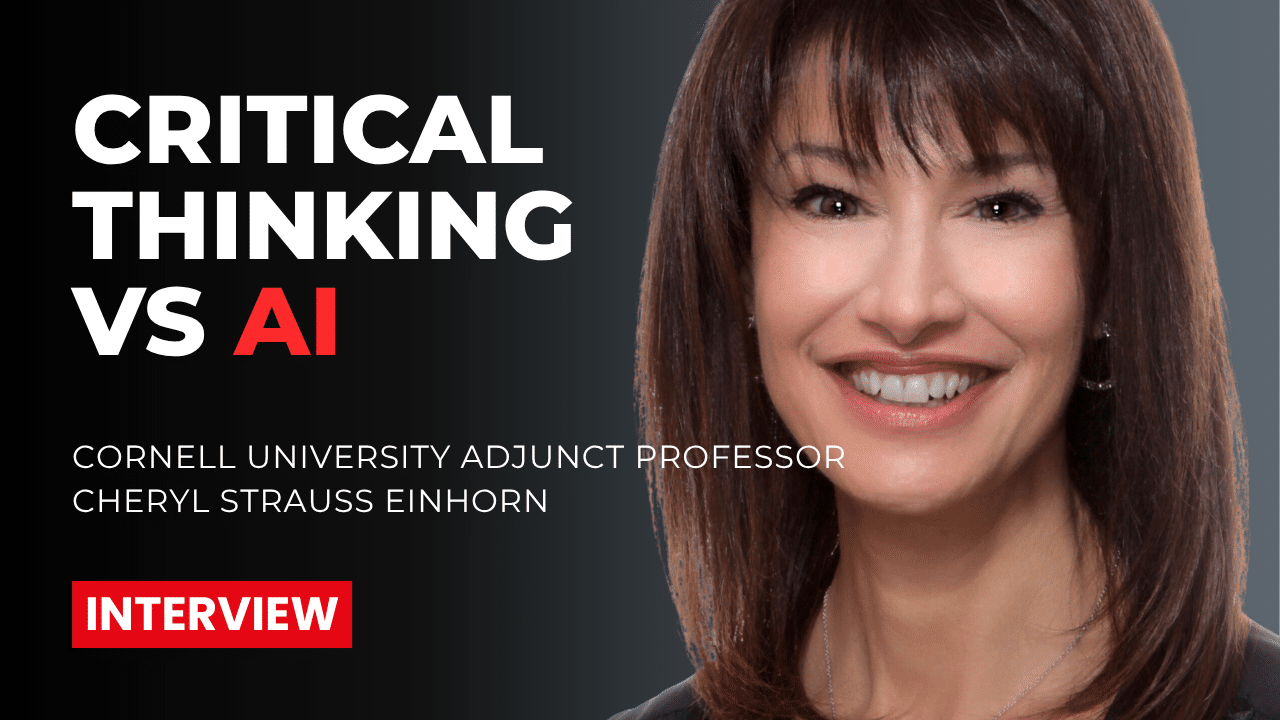
In this conversation with Cheryl Strauss Einhorn, the discussion examines what happens to judgment and critical thinking as AI becomes embedded in daily decision-making.
Drawing on her background as an investigative journalist at Barron’s, Einhorn explains how questioning assumptions and searching for disconfirming evidence shaped the development of her AREA Method for decision-making. She argues that AI should not be treated as an authority, but as a tool that requires active scrutiny and human judgment.
Several points throughout the discussion:
- Use AI to challenge assumptions, not simply confirm them
- Ask for opposing viewpoints and missing evidence when using AI
- Verify citations and sources carefully, as hallucinations remain common
- Build expertise deeply enough to recognize flawed outputs
- Clarify the problem and your priorities before using the tool
- Treat discomfort in decision-making as part of serious thinking, not something to avoid
The conversation also explores the growing risk of overreliance on AI, particularly among professionals who may begin outsourcing too much of their reasoning process. Einhorn argues that decision-making, contextual judgment, stakeholder awareness, and critical thinking will become more valuable as AI systems grow more capable.
At its core, the episode is less about technology than about preserving independent thought. The central question is not whether AI will become more powerful, but whether people will continue exercising the skills required to think clearly, question effectively, and make decisions with conviction.
Get Cheryl’s book, The Human Edge, here:
Here are some free gifts for you:
Overall Approach Used in Well-Managed Strategy Studies
Enjoying this episode?
Get access to sample advanced training episodes
Episode Transcript (Automatic):
Kris Safarova 00:47
So, welcome to the Strategy Skills Podcast. I’m your host, Kris Safarova, and this episode is brought to you by Strategy training.com And if you have ever felt overlooked in important conversations, I recommend getting a gift from us. It’s called Five Reasons Why People Ignore Someone, and you can get it at Firms consulting.com forward slash on the Room. You can also access episode one of How to Build a Consulting Practice at Firms consulting.com forward slash build. And today we have with us Cheryl Straus Einhorn, who is an adjunct professor at Cornell University. Cheryl, welcome.
Cheryl Strauss Einhorn 01:27
Thank you so much for having me.
Kris Safarova 01:29
Cheryl, so let’s start with your career. How did you end up doing what you are doing now? Maybe you can take us through your journey briefly.
Cheryl Strauss Einhorn 01:37
Thank you so much. It was really an accident, you know. I never thought that I would be thinking about decision making as a career and helping people solving problems in quite the way that I am, because my background is in investigative journalism. I spent over a decade at the business magazine Barron’s, which writes about mostly publicly traded companies, and while I was there, I ended up specializing in what you would call the bearish company story. Those stories that take a skeptical look at a company’s finances or at their strategy, and when those stories came out, there was often a very outsized reaction. Often a stock exchange might halt the shares of one of the companies that I was writing about, because there was so much trading activity that they needed a pause to reassert an orderly order flow. At times, regulators would get involved. Over half a dozen companies went out of business, and for one of my investigative series, a CEO actually ended up being sentenced to 10 years in jail. Now, when the stories came out, although journalism really does celebrate truth to power, the stories often sat a little uneasily for me, because behind all of these stories are people, and that meant you could have people who have their money in the shares of these companies saving for their retirement, or you could be somebody that works at one of these companies and is therefore depending on the stability of that job, or if you are a consumer of one of the product or services of a company that I’ve written about and asked tough questions about you might worry about using that product, and for one of the companies, they were the largest maker of diabetic test kits in the United States. That’s a company that is making a product that people are using multiple times a day as a baseline on their well-being and their health, and so I just started to think about how do I know that I’m telling stories that are true and should be told, that I’m marshaling the right evidence, that I’m checking my own assumptions and judgments, and it really led me to think about, is there a way that I could have a system that could help me think about cognitive biases and these mental mistakes that we all make that help us make many decisions quickly every day, but often mean that we’re looking at the world through a dirty windshield of the past or through too narrow a perspective than what actually is taking place, and when I realized that there was no system out there. I put one together for decision making that I call the area method, and then I began to just use myself to do a more ethical job at work, and that led me on this new journey of being in the field of decision making. I was then invited to teach at Columbia University, both in the business school and in the graduate school of journalism, it ultimately led me from there to be working with individuals and companies on problem solving, on decision making through consulting and coaching and training and speeches and presentations, and now today. A to four books, of which my newest one was published on Friday, The Human Edge: Smarter Decisions in the Age of AI.
Kris Safarova 05:09
And congratulations on writing the books and publishing your latest one. Thank you. I guess before we dive in into your current work, I would like to get your input for our listeners on what did you take from journalism that you think make you uniquely insightful in a way, or uniquely effective decision maker?
Cheryl Strauss Einhorn 05:32
Look, it was.. it’s.. it’s been one of the biggest gifts of my career, and I actually give all the credit to my dad, and the reason why I give all the credit to my dad is I have a very shy father, and growing up the only way to get to know him was to ask him questions, and it gave me kind of a love for questions when I asked a question, and he opened up, and I got to know him better. We were able to really begin to develop the beautiful relationship that we have now. Now, when I realized that questions could do that, I thought, I want to do something with questions. What can you do with questions if I can use it to get to know people and understand how they think and what they’re doing? Wouldn’t that be a wonderful thing to do? And journalism allows you to do that. Investigative journalism does it in a very specific way, because you’re often bringing to light something that needs some disaffected to it, and while I found that very exciting, what I ultimately realized by creating my area method is I could shift from questions that probe and unearth potential wrongdoings to actually using questions to help on the prosocial side of life, to help people to strengthen relationships, to understand themselves better, to help people have self-reflection that can give them greater confidence and conviction. So, I think this through line of the question has been just a huge gift for me.
Kris Safarova 07:21
Let’s dive in into your current work. First of all, what are your thoughts about what is happening now with AI? How do you think about it, and how do you make peace with what is happening, and your approach to dealing with uncertainty?
Cheryl Strauss Einhorn 07:36
Yeah, there’s a couple different questions in that single question, so let me see if I can take them one at a time. The first one, about what do I think about this technology? It’s not just a transformational technology, it’s a cultural change. It’s changing the way that we live our lives, the way that when the phone came out, it’s changed the way that we live our lives. So that’s the first thing, and I think, therefore, the question is not should we use it or shouldn’t we use it, or is it a good technology or a bad technology. I think the fundamental question is, how do we use it well for human purposes? What does it mean to use it in a way where we protect our own thinking and we remain the chief decider in our own life, and then I think the second part of what you brought up, and the turbulence – I kind of like the idea of turbulence, because AI is supposed to make things easier for people, and at the same time, people generally like the idea of moving faster and easier, so the things that reduce friction are considered valuable in our society, and we could talk about whether or not they should be, but if you think about, like, sort of the law of nature, even when you have, like, two rivers that are running downstream and moving smoothly when they get to the confluence, there’s turbulence, and that turbulence is a sign of something important. We don’t want to eradicate that turbulence. I think we want to use it as a signal, like at the confluence, where the two rivers need to be able to adjust to one another. We want to use that friction between us wanting things to be easy and smooth in our decisions and the machine wanting to make things easy and smooth, and take advantage of that friction to say we’ve got two things that are at odds with one another that need to figure out how to actually form a new kind of relationship, and I think the best relationship that we can have with AI is one of tension and one of turbulence, where we are actively questioning and wrestling the output that AI gives us, because it doesn’t care about us and it doesn’t care about consequences, but it is a. Machine foundationally about decisions, it’s meant to solve problems, and so when we come to it, we’re coming to it for decision making. Decision making is our path to the future. We can’t get to our future unless we take a choice, even if it’s to not decide, that’s a choice. So when the machine gives us an output that is not necessarily about us, but is about its algorithm. We need to be able to press back on it to be able to ask it, How did you get to this result? Why would this be right in this situation? And what could be wrong about what it is that you’ve shared with me,
Kris Safarova 10:41
I know it’s very hard to predict, but what do you think will happen two years from now, five years from now, even one year from now, in terms of how things will change.
Cheryl Strauss Einhorn 10:49
So, of course, I don’t know the answer to that. In the future, we’ll always be uncertain, but I can say that we probably didn’t expect that AI was going to get so much better every day, the way that it has, right? If you’ve used the machine a month ago, and let’s say you didn’t use it for a month, I think you’d be really surprised. For those of us that are using it every day, we still see the improvements, which means that even the incremental change is noticeable. So, what my book, The Human Age, tries to do is say, okay, agnostic of how this technology changes. What are the foundational human tools that we need to have to remain the chief decider in our own lives?
Kris Safarova 11:33
What made you write the recent book?
Cheryl Strauss Einhorn 11:36
Yeah, so what made me write it is, so I have about 30 years of background in decision making, and as soon as Chat GPT came out, and I realized not just transformational technology, but cultural change, I realized we’re going to be using it for, for everything, personal and professional, we’re going to be using it in lots of ways, in and out of our days and our weeks, and so I really wanted to help people have the right tools in order to be able to burnish their critical thinking skills, better be able to bring forward what matters to them in their decisions, and to know how and when and where to exercise their human judgment when using the tool,
Kris Safarova 12:20
and do you feel that for most people AI actually improves critical thinking skills or leads to deterioration of
Cheryl Strauss Einhorn 12:27
it? I can’t speak for most people. I can say that obviously there are those people who are over relying on it, and they’ve stopped asking themselves, what do I care about, what matters to me in my decisions. And then there are many people who are saying, you know, what, I’m not sacrificing that, I’m not going to hand over my cod, the nib load, and those people fall into a couple camps, those people who are actively looking for books like The Human Edge and tools and recommendations for how to use the machine well, and people also, who are saying, “You know what, I don’t actually need to use this that much. This isn’t something that I really want to be incorporating in a big way. And I think there’s going to be a great sorting between these groups in figuring out what’s right for each person individually, and then what happens when you go to work and your employer is making decisions about how, when, and where you’re using the tool.
Kris Safarova 13:30
Do you do anything to protect your own skills, the cognitive agility that you have?
Cheryl Strauss Einhorn 13:36
Yeah, absolutely. Every single day, first, I always ask myself first before I go to the tool. Why am I going to the tool? What do I think I’m going to see? What problem am I solving? So I’m always foregrounding my own thinking and judgment and values. And then second, when I am working with AI, it’s not a transactional interaction, it’s a conversation, which means I’m also talking to AI after I’ve gotten its output. Why did you give me that output? I’m reading it critically, I’m asking it where it got its sources from, and I’m checking those things, and then I’m reflecting back, did the output from AI impact my thinking in what way do I agree or disagree with that. So I’m always turning to myself first and after,
Kris Safarova 14:31
and then working with other people. Let’s say with your students, are you noticing deterioration and people’s ability to think critically because they’re using AI too much on average?
Cheryl Strauss Einhorn 14:40
Well, you know, like I said, different people are using it in different ways. I just finished a course this spring teaching with the new book at University of Miami in the Business School, and that course was specifically to teach students how to use AI to preserve, protect, and even. Strengthen their human thinking, and certainly along the way, I had students who were over relying on AI, and that’s a teaching moment, right? I mean, I think that’s something that we’re facing in our homes as well as in our classrooms, is that’s a moment to say, hey, I don’t see evidence of you in that output in what you turned in, or it’s missing depth or nuance. Let’s talk about what you were doing, and how you were using the tool. And while you have some students who come back and say, “Look, I want to turn in something polished, or “I’m using this at work this way, I always would want to come back to them and say, “You know what, in this class we’re not going for perfect or polished, we’re actually driving towards learning outcomes and upskilling you for the rest of your life. And I didn’t get any pushback from that, you know. I think that everybody recognizes that there is a real concern that your brain is a muscle and if you don’t exercise it, it can atrophy. It is a
Kris Safarova 16:04
definite concern,
Kris Safarova 16:05
and
Kris Safarova 16:05
people need to be very careful with that. It’s a tricky thing, because you cannot fall behind from the same time. You have to be very careful
Kris Safarova 16:12
to
Kris Safarova 16:13
make sure that you continue developing yourself. So, you thought throughout your career a lot about cognitive biases. You mentioned it today during the call. How do you think that changes now with AI and technology in terms of how people view it and how much people pay attention to it, and so on?
Cheryl Strauss Einhorn 16:34
I actually think it’s, it’s really important because oftentimes we turn to the tool to confirm a favored hypothesis. Right, we’re looking for the fact that confirms something that we already think, and really the best way to use AI would be, can you share with me what the biggest critic of this particular path forward would say, or if there’s disconfirming evidence, you can have a lot of evidence in favor of a hypothesis, but if you have one insurmountable hurdle, that hypothesis is going to break, and it’s not going to work for you, and so I think recognizing that you know the tool probably can find something to support your path is actually something that we want to stay very present about, so that instead we can be using the tool to look for disconfirming data. If there isn’t any, you can feel even better than about the path forward.
Kris Safarova 17:31
What scares you about
Cheryl Strauss Einhorn 17:33
the eye? I think the fact that people really could over rely on it. I think if people don’t recognize that they need to ask themselves first that they need to constantly think of their brand like a muscle, and they need to exercise it the way that you might go out for a run or lift weights. If people are not thinking about that, you can get to the point where you’ve created a habit where you’re asking this tool what you should do, whether it’s what you wear in the morning, the meals that you’re putting together, or the decisions that you’re making, big and small. And so I think we all need to be really intentional about how and where we use the tool.
Kris Safarova 18:14
And one of the tests for that can be if, for some reason, you cannot access your AI tools for a few days and you feel you cannot function, you cannot think, you cannot make decisions. Some adjustments are required.
Cheryl Strauss Einhorn 18:26
Yeah, and I think you know thinking can cause discomfort. It’s not easy to wrestle through a problem. And we were talking before about efficiency and making things easy. I don’t really think that that’s the way that you know a lot of the things that really matter in life are when you’ve got a big decision about a career or your family or your health, and you wrestle with it, what you are puzzling through is what matters to you. What are the ramifications and the risks of the different options and what happened and to really support the path forward, so sitting in that discomfort, recognizing that thinking has moments of discomfort and that that’s okay, because it means that there’s something for you that has some conflict in it, and conflict isn’t necessarily bad, it’s telling you that there is something to be worked through, and so recognizing that going to the tool is easy, that’s very different than satisfying, or different than what’s right for you,
Kris Safarova 19:36
based on your journalistic background. Do you have certain questions that you tend to ask as you’re working with AI that most people would not know that they need or can benefit from asking.
Cheryl Strauss Einhorn 19:48
Oh, I appreciate that question. I generally want to ask about disconfirming data, and you know, how could this be wrong? The other thing that I really like to turn. To AI for, and this was a surprise in researching and writing the book, is how useful it can be at stakeholder perspectives, so you can ask it to play a role and to help you, you know, understand something that you are puzzling through from the vantage point of your customers, or from the vantage point of somebody who’s an expert in the field, or from the vantage point of somebody who’s a real pessimist or antagonist about what you are going to say, and all of that can actually strengthen your thinking and give you a more fulsome understanding of the problems you’re solving, so those kind of questions I find really useful, and I wouldn’t have expected that the role playing and stakeholder piece was necessarily going to be something that was so eye opening, but it is.
Kris Safarova 20:57
What are some of the common biases you are noticing, as you’re working with AI,
Cheryl Strauss Einhorn 21:03
I think you know, I was telling you about confirmation bias, but certainly availability bias is a huge one. Availability bias is the bias of, you know, something that is very quickly accessible. So, let’s say in the algorithm it gives you an answer because there’s something that is very prominent in what it knows that doesn’t mean that it’s the best piece of information, right. You then might come back to it and say, I see that you gave me this. You know, how did you choose this, right? What was it in your process that brought this up as the answer that you gave me? Might there be something that is less well represented but has real credible evidence behind it that I should know about as well, right? So you know, really battling with the machine about our own biases like that, but also its biases, right? In the second case I was telling you about availability, and that the first one, confirmation bias, and that’s a big one for us humans,
Kris Safarova 22:04
and any areas where you always looking for flaws, some issues with AI, any areas you found that most of the time there’s some issue there. Let me,
Cheryl Strauss Einhorn 22:14
anything, anything related to citations, you have to check the citations, it hallucinates, and it can make up the citations whole cloth, so you need to actually check when it says that somebody wrote this in this journal, you need to check that, because I have found in my own experience it gave me a citation of a researcher I’m familiar with, whose work I admire, in a publication that certainly sounded like someplace she’d published on a topic it sounded like she would certainly opine on, and none of those things were true when I checked the citation.
Kris Safarova 22:54
It’s very interesting, the world believe in it’s so different because both you and I, we lived in a very different world, and I think it’s also very beneficial that we have seen a different world. It gives us a lot of depth and allows us to help other people avoid a lot of mistakes they would have otherwise made.
Cheryl Strauss Einhorn 23:12
Yes,
Kris Safarova 23:13
as you were working on this book, have you had certain moments where it was kind of an aha moment? Wow, I didn’t expect it. Oh, this is so surprising. I didn’t think it was this way.
Cheryl Strauss Einhorn 23:26
Certainly, I mean, you know, there were a couple chapters in particular that I really wrestled with. The research chapter, for example, you know, we think of that as one of AI’s great strengths, right? It can pull together information faster and more vastly than than we can, but you know, how is it that we should actually think about doing quality research with AI? Because if you type in, you know, I want to learn about the War of 1812 it’s going to give you too much information, you have no idea where to start. So the question really becomes, how do you guide AI in the research, and I needed to think about, is there a conceptual framework that I can give people where almost anybody would say, I got it, I understand what she’s talking about, and I see why this is going to be effective, and what I stumbled on was Netflix, right, when we are searching for a new TV show? The first thing that we’re generally doing is we’re going abroad. I want to watch a crime show. Now you get too much information, there’s too many crime shows, but then you suddenly notice that some of the crime shows are British crime shows. Now you say, oh gosh, I can learn about another culture and watch a crime show at the same time, so now you go deep and you look at all the British crime shows, it’s a smaller subset, so you’ve gone from breadth to depth, but then what happens, you see that some of them are an hour long and some of them are actually. For only 20 or 30 minutes, and you say to yourself, I really only want to watch a short thing before bed, because I tend to fall asleep. So now you’re going to go broad again. What are the crime shows that are British crime shows that are only under a half an hour, and quality research and directing AI becomes important, because we don’t want too much information, we don’t want analysis process, so if you think about the way you would use a Netflix or a Spotify, you’re broad, you’re deep, and then you’re broad, and it’s a cycle that repeats itself over and over to keep you from the downside of AI, which is just too much that you don’t know what to do with
Kris Safarova 25:44
another of the dangers of using AI is not understanding in some cases that if you don’t have depth of experience in a particular field, AI can be telling you things that are completely wrong confidently only when you mention if you have the experience, the knowledge, and you say no, this is not correct, this is actually why it is wrong, then AI immediately corrects and finds the information to support your claim, usually, but I think that the danger is that, especially with people who are just starting their career, and this is their career. This world, and then not developing the depth, because they feel they don’t need to. They need to be brought and just know how to use technology without the depth in the particular space. You will not know when it is completely wrong, and you are being put in the wrong path.
Cheryl Strauss Einhorn 26:39
Yeah, I would say that’s true in general. That’s not just true for AI. If you read a story in the newspaper about something that you’ve developed an expertise in, you can see the holes and the shortcomings in that story. If you don’t know anything about the topic and you’re reading the newspaper, it’s entirely different, and you may fall prey to an authority bias, right. It was written in the New York Times, therefore it must be true. And so I think being new to anything is actually a really wonderful moment to bring that beginner’s mind and to ask yourself what else could be true, right? What might be missing here, and so I don’t think it’s just true with AI, although certainly it’s a concern with AI. I think it’s generally a predicament that we fall into when we’re new to anything.
Kris Safarova 27:33
I think the danger now is that before the path was you go and you learn, or you will not know what’s going on, but now there’s this some confusion exists. How much you should learn? Is it even valuable to learn, or should you just focus on being really good at using technology? Because AI knows everything, and why should they invest time? But you actually need to have expertise, otherwise you will not be able to deliver at the level you could to contribute, at the level you could, and you can make really bad mistakes as well.
Cheryl Strauss Einhorn 28:06
Yeah, I don’t think expertise is just about delivering. I think that, you know, developing an expertise in something gives you a true appreciation for a topic. If you’re somebody who learns how to play the piano beautifully, you understand music, and you understand the different speeds, and you understand so much more than somebody, let’s say, like me, who loves to listen to music, but doesn’t, has never been able, despite so many years of piano lessons, to be able to actually play the instrument well, so I do think that there’s something that the texture and the contours of our world gain much greater meaning and depth when we allow ourselves to develop some expertise in something.
Kris Safarova 28:57
Yes, I’m glad that you brought up meaning, of course, meaning is critically important for humans. What would be your recommendation to our listeners who feel that they don’t have a lot of meaning in their life, even though they are very successful?
Cheryl Strauss Einhorn 29:10
Oh, don’t have a lot of meaning, that’s there, that’s not just a big question, that’s a hard question, you know. I think that I think that meaning is very important, and I think all of us want to feel like we have meaning. We want to mean something to other people. We want to feel like our contributions are valued, and so I wonder sometimes when people feel like they’re missing meaning, and they’re looking for sort of a big vision if they’re also not necessarily appreciating all the contributions and ways that they mean things to other people in their everyday life. Right, I think you know, developing meaning. Is not just about having some big calling, but it’s, it’s in a lot of the small moments of appreciating a conversation with a friend, or being able to just get up and walk across the room without pain, and there’s so.. I hope people feel like they mean something, that they don’t have to look for something that is, you know, beyond what is going on in their every day, and can appreciate that they’re already creating meaning with what they’re doing.
Kris Safarova 30:33
What they think most people misunderstand about AI,
Cheryl Strauss Einhorn 30:37
I think what they misunderstand is that, you know, working well with AI is not really just about the technology at all. It’s really about what does it mean to be human, and what it means to be human is to be able to think and to process information, and to feel things, and to have values, and to have empathy, and so if people recognize that working with AI is very much an invitation to learn more about yourself and what matters to you, I hope that that means that they will really fight hard to protect their own thinking and to make sure that they use AI only after they’ve turned to themselves first,
Kris Safarova 31:24
given everything we’ve said so far about AI, for somebody who is in their very late 30s or early 40s, what would be your recommendation on the skills they need to develop if they’re already quite successful in the corporate world or in running their own business, but most of our listeners are in the corporate world, relatively senior or very senior, and of course we have listeners who are much older or somewhat older, people who are younger, but just for that group, let’s say 38 to 46 what kind of skills you think they need to focus on developing.
Cheryl Strauss Einhorn 32:01
Yeah, you need to focus on your decision making skills. Do you actually have an ability to access for yourself what your decision making process is? Do you know how to define a problem? Identify your motivation, understand your contextual factors, conduct research analysis and understand the diagnosticity of your data. Are you able to challenge biases? Do you know how to include stakeholders effectively? And then come to conviction. Those are the skills that you’re going to need, no matter how the tool develops over time, in order to be able to rely on yourself when you’re using the machine and rely on yourself when you’re not, are they still areas when it comes to working with AI that you’re trying to understand? You feel it is not clear yet how to best handle it for your own business or how you approach AI generally. Yeah, look, I assume that the way that I’m using AI now may look very differently a year from now, so that’s something that that I’m keeping an eye on, and I think the other thing is, what’s going to happen with all of the hallucinations, is that something that people are going to be able to figure out what’s happening inside the black box. Are we going to better understand how AI actually, you know, quote unquote thinks? I feel like there are so many questions that we just don’t know about this technology, and, and so I’m very curious to see sort of how this develops and what happens with the real growing resistance that there is to the technology, and how that either changes how it is developed or if it just simply changes the rate of adoption,
Kris Safarova 34:00
and having lived before AI, and even before other advancements both of us had, what do you feel you can see about the world that people who, let’s say, they started their career in the current world, they cannot see because they don’t have the experience.
Cheryl Strauss Einhorn 34:18
Yeah, look, I agree with what you said earlier about how fortunate you know I was to not grow up with a phone to, to really be able to play and interact with other people, to fall in love with reading, and to read all sorts of books, and you know, so I really hope that you know in the world of education and parenting, and, and just in society, as we move forward, that we really find ways to continue deep and meaningful human connection without the machine.
Kris Safarova 35:00
What are some of the new things you plan on working?
Cheryl Strauss Einhorn 35:03
Some of the new things I plan on working on. You know, I’m interested in conducting some new research about decision making, both with the tool and just to better understand some of the types of problems that business leaders are facing now, how different are they? Even if they involve the technology, is it the same questions plus the technology, or are we really coming into a leadership phase where we’re sort of thinking about and asking problems that we haven’t seen before? That’s one of the things that I’m very curious about,
Kris Safarova 35:43
what could be your advice to people who don’t feel comfortable with what is happening? They feel a lot of anxiety, they feel fear of being laid off, fear of becoming irrelevant.
Cheryl Strauss Einhorn 35:55
Yeah, I think these fears are very real. I was traveling over the last week and a half as the human edge was getting ready to come out to talk about the book with a variety of audiences and everybody that I met, from the taxi cab driver to the person who I asked directions from when I got lost, I asked them, you know, what do you think about AI and are you using it, every single person said that they feel very mixed about it. Every person, it didn’t matter what level of work or what industry they were in. Now, what I would say is the concerns are real. There’s no reason to sugarcoat this, right? We’re worried about how it’s going to impact the environment, and we’re seeing already resistance and concern about water usage and energy prices and the quality of silence, right, and so I think that there is there is a real need to have these conversations about how and where we want to be very intentional about using the tool and making sure that we’re looking out for one another if we see somebody over relying on it that that we’re all in conversation with each other to try to keep the interactions healthy and human centric,
Kris Safarova 37:22
they miss being a journalist.
Cheryl Strauss Einhorn 37:24
Yeah, I still write articles a lot, but they’re mostly, you know, about decision making. I do miss, you know, getting to interview other people, and, and, and talk to them about their stories, and that’s why this summer with my colleague Emma, I am very excited to be doing some research and to be learning from other people, and hopefully asking them good questions to learn about
Kris Safarova 37:52
them. And when you were a journalist, what was the hardest part?
Cheryl Strauss Einhorn 37:56
I think the hardest part, and honestly, it comes back to developing the area method was the fear that I could be getting something wrong, you know. When I was writing these stories, it was one story to me, but it was everything to the person who had built that company, or was running that company, or who had all of their wealth tied up in that company, and this idea that because I’m human and because I’m flawed and because I see the world from my own perspective, that I could miss something important and hurt somebody, that’s what worried me.
Kris Safarova 38:37
Yes, angry, I would be very worried about that.
Cheryl Strauss Einhorn 38:41
Yes,
Kris Safarova 38:41
I probably would not be a good journalist because of that. I would just feel just to be safe,
Cheryl Strauss Einhorn 38:47
you know. Something though, I think it made me work very hard to try to really notice where I could be making mistakes, you know, to ask the extra question to read over my notes again to make sure that you know I did the fact checking, and our fact checking department really came at me with tough questions, because it matters,
Kris Safarova 39:12
of course. I also wanted to ask you, in your personal life, are there certain success habits, so to say, you relying on to help you be effective.
Cheryl Strauss Einhorn 39:23
Yeah, I like that question. Lately, I’ve been thinking a lot about that, as I feel like I need to reinforce things that have worked for me in the past. One of the biggest ones is that I like to start tomorrow today, so before I get up from my desk, I look over the things that are unfinished, and I make note of where and how I might want to fit them in in future days, but I also look at tomorrow to just remind myself what am I getting ready for. Or what do I need to prepare for, and I, I have realized lately that that’s something that really used to make me feel good when I went to sleep at night, and and I realized that as life has gotten very busy, and in everybody’s life we have periods where we’re much busier than others, you know. Some of that I’ve loosened up on, and I’ve, I’ve really noticed that I can’t afford to do that. It’s a critical success habit, so that I don’t miss out on small things that are actually not that small at
Kris Safarova 40:38
all. Cheryl, and you live in New York City, that can be very stressful, and we live in very stressful times. How do you deal with stress? How do you minimize it in your life as much as possible?
Cheryl Strauss Einhorn 40:50
One of the things I feel truly grateful for is meditation. You know, I do it every day, and I think that it really helps you recognize all the noise that’s rattling around in your head, some of which is in your awareness, and you know that you’re sort of thinking about in the back of your mind, but there’s all sorts of other things that come up that in that stillness after a few minutes when you begin to drop into it, you didn’t necessarily know you were thinking about it all, and I find that ability to sort of do the noting and letting go is a really wonderful practice.
Kris Safarova 41:29
And is there a particular meditation you find most effective, something you enjoy the most?
Cheryl Strauss Einhorn 41:34
I just like the quiet. Some people really like to have, you know, they’ll go to YouTube and they’ll put on something that will guide them. I just like starting by breathing all the way to the top of the breath, breathing all the way to the bottom. I will do that for a few minutes, and then I find myself that I’m off and running, or often in the stillness.
Kris Safarova 42:01
What about some incredible moments in the meditation that you feel comfortable sharing?
Cheryl Strauss Einhorn 42:06
You know, when you can sort of laugh at yourself, or when something that you didn’t recognize was on your mind all of a sudden comes to the top, and you say to yourself, I am so glad that that was brought to my awareness. It might be an offhand comment that somebody said, you know, that they were having an important moment in their own day and in their own life. Then it can remind me to make that phone call and check in on that person and ask about that, and I love that, because you know, I want the people in my life to know that I care about them.
Kris Safarova 42:46
What do they think makes someone a good human?
Cheryl Strauss Einhorn 42:49
That’s a good question. I think a good human is somebody who cares and is able to both listen to other people and, and to express and let somebody else know that they care, who’s kind and nice,
Kris Safarova 43:08
Cheryl, and over your life so far, what were some aha moments, realizations that you feel comfortable sharing that really changed the way you look at life or the way you look at business?
Cheryl Strauss Einhorn 43:20
I think the first question that we talked about, about questions, that’s a big aha, and I think the transition from using the questions to investigate and sort of, you know, bring sunlight to areas that may have been in darkness to using questions for prosocial ends, those, those were really two seminal things.
Kris Safarova 43:50
And is there something that you used to strongly believe in, and kind of it used to guide you in your life, and how you made decisions, how you lived your life that changed, and now you strongly believe something else.
Cheryl Strauss Einhorn 44:02
Oh, and now I believe something else. Well, my dad once gave me a sticker when I was little, that is a statement from Henry Ford. If you think you can or if you think you can’t, you’re absolutely right, and I love that, because that was about self determination, motivation, and perseverance, but what I recognize is you also really need some luck, you need some luck, you know, and it’s not just perseverance, and it’s not just motivation, and it’s not just self-determination, right? And so you know, really, really sort of making sure that you surround yourself with good people, you know, that those are people who can really help guide you along the way, and and be that, be that luck that you need. To help turn good ideas into great thinking,
Kris Safarova 45:03
and the last question for the day, if you could instill one belief in everyone’s hearts, all of our listeners’ huts, what would it be?
Cheryl Strauss Einhorn 45:12
Make the decision, you know, a lot of times we’re faced with big decisions, and we wait for more information, and what I would say is most decisions, most not all, most decisions can be undone, right? There’s some consequence, there’s maybe some discomfort, but you can make a new decision after it, and so if I could help people feel greater confidence and conviction that they can move into their good future, that would make me very happy. So, make the decision, take the chance on yourself.
Kris Safarova 45:52
This is a very powerful advice. And when we have things that we haven’t decided, they drain so much energy.
Cheryl Strauss Einhorn 45:58
So true. Thank you for the conversation.
Kris Safarova 46:01
Thank you, Cheryl. We can our listeners learn more about you by your books, anything you want to share?
Cheryl Strauss Einhorn 46:07
Thank you, Sam. I hope people will connect with me on LinkedIn, Cheryl Straus Einhorn, and on Instagram, Cheryl Einhorn, and that they will visit my website, Area method.com and you can find all of my books, including my new book, The Human Edge, on Amazon and Barnes and Noble, anywhere where you get your books.
Kris Safarova 46:32
Our guest today again was Cheryl Straus Einhorn, who is an adjunct professor at Carnegie University, and our podcast sponsor, strategytraining.com You can get some gifts from us. You can get five reasons why people ignore someone in a meeting at Firms consulting.com forward slash on the room, and you can also get McKinsey and BCG winning resume, which is basically just a really good resume template, and it doesn’t have to be used for applying to McKinsey or BCG, just a great regimen to use for any applications at all levels of seniority, and we use it with all our clients, and we have mostly very senior clients who are not applying to McKinsey or BCG, often they are partners looking for the next opportunity, or they are very senior executives, the executives, the senior people in industry, and you can get [email protected] forward slash resume pdf. I just think it is a good time to have your resume ready, because we live in such uncertain times, and you want to be ready. You don’t want to have this as an additional worry. Be ready for other opportunities if needed, and be a strong performer, so any organization would be lucky to have you. And we discussed today how to do that in some way, and of course, we discussed it in other podcasts as well. But thank you, guys, for listening in. I hope you enjoyed it, and I’m looking forward to connect with you all next time.
Leave a Reply