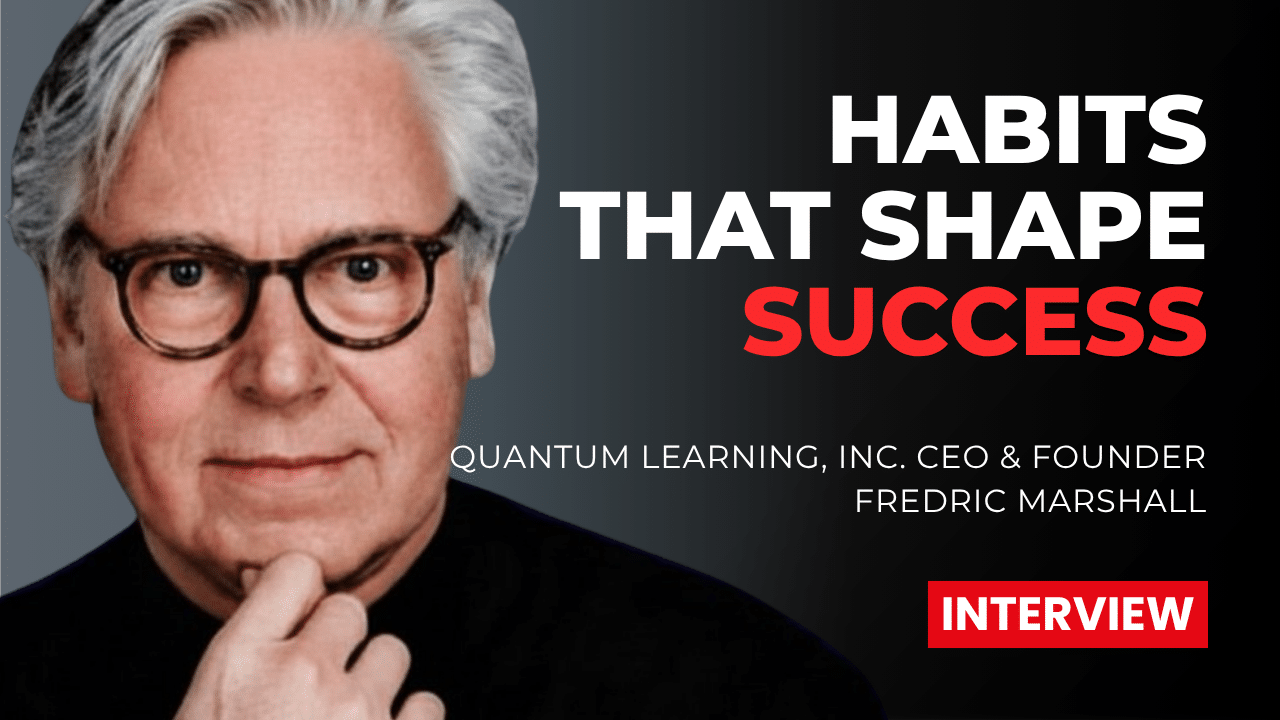
Fredric Marshall spent decades helping companies including Apple, Pfizer, and Genentech solve problems in sales effectiveness, product launches, and organizational change. In this discussion, he explains why he views sales and leadership primarily as change management challenges: helping people move from where they are to where they want to be.
The conversation centers on several practical ideas that shape long-term performance. Marshall argues that strong systems reduce stress because “the system is carrying the load, not you as a person or the team.” He explains why high-performing people consistently invest in infrastructure, technology, and environments that remove friction and preserve attention for higher-value work.
The episode also explores Marshall’s “Super Eight” framework, which includes the neural net, biological health, relationships, systems, assets, and contribution. One of the central themes is that attention shapes outcomes. “Whatever you feed [neural nets], they get better at,” he explains, arguing for greater discipline around information intake, habits, and social environments.
Other insights from the discussion include:
- Why emotionally intelligent and externally focused people often elevate entire organizations
- How successful professionals balance initiative with responsiveness rather than operating in constant reaction mode
- Why many entrepreneurs underestimate the value of their own time and capabilities
- How journaling, repetition, and evidence gathering can gradually replace limiting beliefs
- Why wealth creation often depends on investing simultaneously in productive assets and personal capability
Marshall also shares research from his work studying top performers, identifying three recurring characteristics: action orientation, external focus, and the ability to question assumptions others accept too easily.
The discussion is ultimately about building a life and career intentionally: curating what enters your attention, surrounding yourself with the right people, and constructing systems that support the future you are trying to create.
Get Thrive: The Antidote to Future Shock, here:
Here are some free gifts for you:
Overall Approach Used in Well-Managed Strategy Studies
Enjoying this episode?
Get access to sample advanced training episodes
Episode Transcript (Automatic):
Kris Safarova 00:47
welcome to the Strategy Skills Podcast. I’m your host, Kris Safarova, and this episode is brought to you by Strategy training.com We have some gifts for you. You can get the overall approach used in well-managed strategy studies at Firms consulting.com forward slash overall approach. You can access episode one of How to Build a Consulting Practice at Firms consulting.com forward slash build, and you can get a copy of a template of a resume. It is actually an actual resume that ended up leading to offers from McKinsey and BCG, and we use it with clients of all levels of seniority. It works very well, and you can get [email protected] forward slash raising my pdf. And today we have with us Frederick Marshall, who spent decades helping clients like Apple and many other very well-known companies, and he’s a recognized expert in change management, launching new brands, Salesforce effectiveness, and well beyond that. It will be a very, very important discussion, and I’m looking forward to diving. Welcome, Fred.
Fredric Marshall 01:56
Oh, thank you. So, so glad to be here with you today,
Kris Safarova 02:00
Fred. So, maybe we can start with an overview of your career, incredible career so far, and then we will build from there.
Fredric Marshall 02:07
Okay, well, I started out as a biochemist and molecular biologist. My dad was a doctor, and everybody wanted me to be a doctor, and I didn’t want to do that, so I sort of semi followed the path and got involved in pharma that way, the biopharma world, but very quickly realized that being in a research lab was not for me, and so I shifted over to sales and marketing, and in training, sales training, sales in marketing, and training, and really thrived in that world. It was like I’d come home, all my instincts made sense and worked, plus I tried to apply the rigor of science to change management and sales, because the way I saw sales and marketing was as not an influence problem but a change management problem. Customers here, they want to go there. How do you help them get there? Help them achieve what they’re trying to achieve, and that’s been the backbone of my work for 30 years, and when we help companies like Pfizer or Genentech or Apple launch new products and grow them, we’re really using the change management approach to helping people adopt and internalize and get the most use out of something new in their lives, and so that’s that’s what I’ve been doing for 30 years, yeah, a little more than 30 years. Hard to believe.
Kris Safarova 03:28
Could you take us through some of the key lessons you learned along the way?
Fredric Marshall 03:33
Yeah, you know, there’s so many lessons in so many different places. Just any particular area you want me to focus in, or should I just dive in?
Kris Safarova 03:44
I think anything that really stands out as something that changed how you view the world, how you approach work.
Fredric Marshall 03:52
Okay, well, I think one of the biggest lessons that came to me early on as an entrepreneur was the importance of having really good infrastructure and good systems in place to get stuff done, because as a solo entrepreneur, you know, I started out with it was just me in the very beginning. It quickly became apparent that I couldn’t do everything, I couldn’t even do it as well as other people, and I got maxed out very quickly, you know, not enough memory, not enough time, not enough energy, and so I had to build systems, and even when I started bringing people in, I noticed that what they tended to do was to use the systems that were there rather than reimagining whatever those systems were to build the future that they wanted and get better alignment, and that has been a lesson that has really stuck with me, because if you dial in the systems in your own life to be aligned not with optimizing the present but optimizing what you’re trying to build for the future, it’s a completely different process, and it may be a little harder short term, and there may be some heavy lifting to do short term, but it pays off so much more long. Term, and it helps you manage stress, because the system is carrying the load, not you as a person or the team, and really leveraging technology that was kind of the biggest through the entrepreneurial lens, that was the biggest lesson, one of the biggest lessons, and then the second biggest lesson was the importance of finding the right people. It became really clear to me that I was hiring the wrong people, and they were struggling, and we were struggling. And then it started when I hired this one person, and she was just like magic. She changed everything, and I thought, okay, that’s really interesting. Affected other people in the company, elevated everybody else, elevated herself, and it was the quality of her emotional intelligence. It was the quality of her ambition. She was very ambitious person, but she was also a very other focused person, and was very much into helping other people succeed, and that was like magic, and she became began attracting other great people, and so between great systems and great people, it’s it’s pretty hard to lose when you’ve got that combination going
Kris Safarova 06:14
right. And could you give us advice on how to build systems correctly, because some of our listeners may not feel that they have a good grasp on how to do it properly.
Fredric Marshall 06:24
Yeah, so let’s talk about the different kinds of systems. You know, we have systems for everything. We just don’t think of them as systems, you know. You have a system to brush your teeth, you start in one place and work your way around, and maybe it’s a good system, maybe it’s a good system, maybe it’s not a good system, and the gear that goes with it, you know, regular toothbrush is okay, but the oral bee that spins and stuff, it cleans a lot better. The data show it does a much significantly better job. And so a good system is a combination of a gear and a function and the tool and little protocol, and maybe appropriately some people, and dialed in to a purpose, so that’s just one like super simple example of a system. Another system might be the system that I use to run podcasts, you know, behind the scenes here, there are lights, there are microphones, there’s gear, there’s a space to make it happen, and I just have one little switch, I hit this button, and the whole thing lights up and is ready to go, and it’s not hard. I got it at Amazon, you know, it’s just something I plug into the wall, and everything is tied to that, but I can shut it on and off, and I can go, you know, back to my regular whatever I was doing before, and then five minutes before podcast pop down here, hit start, and just go. That kind of productivity and efficiency is a great system of a workout system, and it’s not sophisticated, you know, it’s not complicated, it’s just a yoga mat and a couple of those weights that you dial in, you know, that can go 510, 1520, pounds, one of those things, a little yoga mat, a little stepper, and then agility ladder, which I unfurl, or you know, roll back up, and that’s it. And I can do incredible workouts with that. Oh, there’s an iPad too, and a person, her name is Laura Lynn, who is my coach, and she’ll dial in, and she’ll, you know, tell me what to do. And one day we’ll focus on this, that’s our protocol. Another day, we’ll, you know, like pull muscles, another day it will focus on push muscles, so those are kind of simple examples of systems that are dialed into a particular purpose, but the magic happens when each system in your life is dialed into something larger, maybe it’s health and longevity, or maybe it’s, you know, great relationships, or maybe it’s making money, whatever, whatever the larger vision is. If you can get all those systems working together and kind of pointing in the same direction, that’s good. They balance and reinforce and support one another, and that’s how you get a kind of compounding action going, and your life can really accelerate. It gets exciting fast
Kris Safarova 09:05
when you were learning to build systems for your work side of life. What are some of the key things that you learned along the way that allowed you to do it much better?
Fredric Marshall 09:17
Well, this is sort of a bias that I have, it’s both something I learned, but something I believe in. I believe that technology is important, and as soon as good new technology comes in, I’m quick to adopt early and bring it in and test it where it’s relevant, and so the lesson is, you know, never always assume that whatever system you’ve got can be improved. Now, is it worth it to improve every system? Maybe not, but some systems are really critical, and I can give you a pretty interesting example. I came across recently Ben Affleck, who’s the famous actor, but he’s also a producer and a director. And he owned several companies, and one of the companies he started was a company called Inter Positive, and they’re in the filmmaking business. So, in filmmaking, you’ve got these three phases: you’ve got pre production, that’s all the stuff that happens before the actors show up and you start filming, there’s production, that’s when you film, and then there’s post production, that’s where you take what you got from the film filming, and you string it together into the movie. You make, you build the movie. Well, what often happens is you get into post production, and you find that the scene that you thought was going to work, you worked so hard in pre production to make sure it would work. You get to post production is not working. Oh, great. You know, the sun’s on the wrong side of the hill, or there’s a, there’s a telephone wire showing up where you didn’t even, nobody noticed that there was a telephone wire. It’s supposed to be a movie on Mars, and there’s telephone wires in the background. Like, what? How do we miss that, you know? Or the acting wasn’t quite right. So, Ben Affleck and his co-investors, big idea was, what if we took all the footage from the shoot and we loaded it into an AI, and then the AI could generate the scene that’s missing, or the pieces that are missing, so we can build that scene and make it work. And he recently sold this company, Interpositive, to Netflix for an undisclosed amount of money. I think he got a lot of money. I hope he got a lot of money for this, but the lesson from it is in every business there’s some place where things are not working or they’re consistently problematic, and if you can pinpoint that big area and then come up with a solution to unlock the potential, that can be huge. It can change the nature of the business dramatically, can fundamentally lower the costs, because it’s very expensive to bring everybody back and rebuild sets, and oftentimes you literally can’t do it, because the actor, you know, the main actor that you had in the movie, is now doing the next project. So I think having a nose for what the big bottleneck is in your business model, the rate limiting step, or is the, as my venture capitalist friends like to say, the unlock, what’s the unlock? How do we unlock the potential of this business? What is that? And then point your technology, point your systems to solving that, and you do that, you’re going to do really well, and that’s true in life too, you know, not just at the business level, but everyday life level, and that’s I think that’s a really good example of somebody who is smart about picking the right area, applying the right technology, and succeeding in solving the problem or unlocking the potential,
Kris Safarova 12:45
in your book you write about Super Eight framework, can you take us through it?
Fredric Marshall 12:50
Yeah, so one of the problems that I have struggled with personally, and I’m sure other people listening or watching this podcast can relate, is you know there’s so much going on in your life. How do you, how do you manage everything? How do you navigate everything? The world is so complicated today, there’s so many things calling for our attention, distracting us. What are the fundamental units of a great life? And so I try to boil it down and ask, what are they, and and rather than looking at things that are outside, you know, in the world, I just asked for me personally initially, and then later looked outside. The first building block of a great life is your neural net. Now, I didn’t say mind, I didn’t say brain, I said neural net purposely, because our brains are formed of neurons, but they are organized as a neural net, and neural nets have very specific qualities, and we see that in things like Chachi BT and other AI models that are out there, but one of the things about neural nets is whatever you feed them, they get better at, so be careful how you train your neural net, be careful what you feed your neural net, and our attention is the gateway to our neural net. So be careful what you let into your life. Be careful of the news feeds. Curate, I think intelligently curate what you let into your world. Good things like this podcast, or great books, or great people, or great technologies be mindful about what you let into your world, because what you let in ultimately ends up shaping your future and your destiny. The second super eight item is, is I call it your biological self, and that’s your physical body, the cells and the tissues that make up who you are. We forget we’re made of cells, about a trillion of them, a little more than that. And each one of those tiny little machines, those little molecular machines, needs to be taken care of. They supply all the energy, they do all the thinking, they pump blood through our vascular system, they do all the heavy. 15 of life, and lots of times we don’t treat those cells very well, right? We don’t get enough sleep, we eat junk food, we’re stressed all the time, and that’s signaling ourselves in bad ways. So, you know, managing your health is the way people tend to say this is really huge, and I think maybe you’re starting to see a pattern. It’s like, what do you let in, and how do you signal yourself? Signal yourself with food, with exercise, signal yourself with the what you curate and let into your life, the books you read. The third element of the Super Eight is relationships. I think if you had to pick one thing that maybe is the most pivotal thing in determining your future, is who you hang out with, who you spend time with, both in the real world and virtually, and today, increasingly virtually, they shape your beliefs, your habits, they normalize some things, you know, there are people who normalize telling little lies all the time, or, you know, making excuses, or there are other people who normalize pushing themselves harder and stretching and trying to do more and become more, and so, depending on who you hang out with, unconsciously we just pick up those attitudes and those habits and behaviors. The fourth is systems, like we were talking before, the systems that you use to run your life, to take the friction of living and simplify things for you. So, those are the first four. There are others I can go through them really fast, that the physical spaces that you inhabit and make them beautiful, make them clean, make them simple, take the complexity out of them, and you know, make them high functioning and beautiful. I think it’s important to do that. The fifth is assets, or sixth is assets, those are things that grow in value or generate cash flow, independent of your personal time and energy. If you have assets that make money while you sleep, that’s good. Building that portfolio of assets that make money while you sleep, that’s even better. Next story experiences, we all love to have experiences. I think of sort of epic experiences and magic moments as being that category. And then the last one is contribution, you know. What are you giving back? How are you helping others? How are you making the world a better place? So, the game is, you know, for most people those eight things are just pointing in different directions, or living on their own islands, or not really helping each other. And the game is, get them lined up and roughly pointing in the same direction, so they support and amplify one another. And when you do that, then things really, really take off.
Kris Safarova 17:44
And on the first one, What are your thoughts on rewriting negative beliefs? What are the most effective approaches?
Fredric Marshall 17:53
That’s a great one. And would you mind my asking, why? Why do you ask about that particular
Kris Safarova 18:00
one? Well, because it’s so important, it is holding back so many people. Everyone has negative beliefs, and most people don’t know even what they are. They know some of them, they don’t know all of them, and they are not spending time rewriting those beliefs, so they no longer hold them back.
Fredric Marshall 18:18
Yeah, I love this question, because sometimes the beliefs that we have are, we’re consciously aware of them, as you pointed out, but a lot of times we don’t even know we have those beliefs, and those beliefs can be about anything, they can be about our potential. One of the beliefs that I’m particularly interested in helping people rewrite is beliefs about AI. Right now, the dominant narrative about AI is it’s going to destroy jobs, it’s going to set back humanity, it’s going to consume vast amounts of energy, it’s going to raise utility bills. There’s a whole narrative around that, and if you read the news, you’re going to start adopting that narrative, but if you want to rewrite that belief, you can use what my friend Peter Diamandis describes as evidence-based optimism, and so it means gathering evidence to support the new belief. For example, in 150 years ago, the lifespan of human beings was was 20 years lower than it is today, all 30 years lower than it is today. What was going on? Well, children were dying, that was a huge part of the problem. Today, hardly any children die of diseases that took out 20 30% of children, newborns didn’t make it to their 10th birthday 150 years ago. Wow, that’s a huge improvement. Food availability, you know, you can go down the list of all the things that are better because of science and technology, and we forget that we focus on the negative and not the positive. So I think the primary. Mechanism to answer your question is to create a new narrative, and I’ll give you a couple examples of what that could look like. Let’s say you have this limiting belief that goes something like this: I’m unlucky and bad things often happen to me, and that I really don’t have any control. It’s the world is screwing me up, that’s what’s going on. It’s the world’s fault. Why I’m unhappy, and all this, and that’s a narrative. And you could run with that, or you could say, you know, I hardly ever make mistakes. I usually figure things out. I almost always find a way. I can learn from this, even a disaster. I can learn from it, and grow from it and become more because of it. That narrative is what turns one situation from, oh, this is just another example of how messed up I am to, oh, it’s hard. It’s really not like me to mess up like this. I almost always succeed. That shift in narration sounds silly. Sounds like a small thing. It’s a huge thing.
Kris Safarova 21:05
What are your go-to ways to ingrain the new belief and making it stronger than the old
Speaker 2 21:12
one?
Fredric Marshall 21:13
I think you know the practice of doing it over and over again on a regular basis, that consistency, literally saying it or journaling and writing it down. There’s something I don’t.. we still don’t understand exactly why this is so powerful, but when you have a thought, and then your body takes the time to translate that into the written word on a page, and then you reread it and hear the words in your imaginary head. Something big happens to the neural connections that rewires them, and if you do that consistently over time, and then gather more and more evidence, and then review it. So, a practice that I have is I’ve been keeping a journal since I was 22 I’ve got a whole massive bookshelf full of these journals, and I go back and I’ll reread what happened, and you know this terrible thing happened. I got bronchitis right in the middle of when I was supposed to do the audio for this book. 10 weeks I had bronchitis, I kept having to postpone the recording dates to do the voiceover, and I captured that in my journal, and I was pretty unhappy about it, but I also captured what was working, what I could do, and to go back and reread, it’s like, oh yeah, that was a real pain in the neck, and I overcame it, I found a way, and we literally just submitted the audio yesterday for the audio book, so it should be out in about 10 days, but sometimes things happen, and if you, if you document, and then review, there’s something powerful about that in rewiring your neural net, that sort of consistent documentation, consistent self-talk, consistent review, and then the last thing I would add is gather evidence to support the belief that you want sort of selective curating of things, not naive curating, not blind curation, but maybe more accurate curation, because if you read the news, the whole world’s coming to an end, and we’re all going to be, you know, done, but that’s that hasn’t been true yet, and I don’t think it’s going to be true.
Kris Safarova 23:20
I agree with you on writing. It’s incredibly powerful. I have been doing various practices, including writing to rewire my beliefs for over 20 years, and writing definitely does something powerful and helps you to get there faster. There are other things as well, but writing is a great place to start, as you mentioned. What are you?
Fredric Marshall 23:40
What have you found? I’m curious, what have you found that works for you?
Kris Safarova 23:44
Oh, there are so many things. I think that doing it just before you go to sleep and just after you wake up is very powerful. Incorporating emotion when you are trying to ingrain a new belief is very important. There are all kinds of things you can do, and you also want to try to don’t take a lot of steps back, so you take some steps forward. Try not to take steps back throughout the day as well, by allowing thoughts that confirm your old belief, such as in the example things I don’t even want to repeat it, because it is all going to be uploaded those
Fredric Marshall 24:22
conscious
Kris Safarova 24:23
mind, so I think also being very careful about what you are saying, especially something that goes after I am, and
Fredric Marshall 24:32
then
Kris Safarova 24:32
the statements are very, very important, and
Fredric Marshall 24:35
those, those identity things, the identity things, I am resourceful, I am creative, I always find a way, versus, you know, negative, negative definitions of identity, that’s cool, I like that a lot. I recently heard somebody said something that caught my attention in this vein, and it was, you know, if you are having trouble with your marriage and you go to a marriage counselor, it’s usually a rehearsal. All the grievances, and so that often doesn’t end very well. He, this guy argues that the solution is to go out and do stuff that’s fun together, and stop rehearsing it, rehashing what isn’t working, and put your attention on stuff that’s fun and interesting, and having new shared experiences, and I thought that’s so simple, but so beautiful. You know, you’re having trouble, go to the beach, go swimming, go buy some stuff, do something fun together, whatever it is. And then you have a new set of tracks that are laid down in your nervous system, and you’re not just reinforcing the old stuff that’s not working.
Kris Safarova 25:39
And when you’re doing it, also allow the other person to be themselves and not trying to fit whatever you want them to be.
Fredric Marshall 25:46
Yeah, I think that’s maybe the biggest relationship secret of all. Is it not? My wife and I early on decided that we were not going to try to change each other, that we were accepting of each other, you know, warts the good, bad, ugly, everything, it’s all one package, and you know, just work with it and accept that, and, and, and it works a lot better,
Kris Safarova 26:12
definitely, Fred. And what are your thoughts to stay a little bit longer with the beliefs topic? What are your thoughts on rewiring negative beliefs related to money, because that is another big issue, and those are often not even on top of your mind,
Speaker 2 26:29
but
Kris Safarova 26:30
they are blocking you from what you can do and how much you can contribute.
Fredric Marshall 26:35
You know, I’m glad you brought that up, because I do know a lot of people who kind of have a weird relationship with money. It’s like, oh, you have a lot of money. Oh, you must be evil at heart, you know? Or you must have stolen it, or you must have done something wrong, or there’s so much baggage attached to wealth, or you must be so you’re selfish. That’s how you got that money. You’re selfish, and it plays to identity too, right? I’m not selfish, therefore I don’t have a lot of money, you know. These things can all wind together to me, and this is, you know, this isn’t necessarily advice I’m giving to other people. It’s just what works for me. I think money is energy, simple as that, you. If you think of it as energy, then the math changes energy to do what? To build things, to create experiences, to do good in the world, to handle problems that come up. If you have energy, you can fix stuff. If you don’t have energy, it’s hard to fix things. If you’re depleted, personal energy wise, it’s hard to muster the energy to take action and fix things, repair, but if you have an abundance of energy, abundance of money, then everything becomes simpler. I know a lot of really wealthy people, millionaires and billionaires, a bunch of them, and none of those people think about money all the time, it’s not what’s most important to them. They’re thinking about the contribution they’re making to the world, they’re thinking about how to optimize some business process. Their goal wasn’t to accumulate money, it was to do things, to build things, to create a different kind of future. And I find that fascinating. I’m sure there are people, I’m sure there are billionaires out there who just want the money, but you know, I think the right way to rewire the belief, at least for me, is having an abundance of energy is good for everybody. Having a lack of money or energy is bad for everybody. Think of all the bad things that happen in the world when people are desperate for energy or money, that’s not good. So, let’s create a world of abundance and make the world a better, more beautiful place. And I think one other thing, you deserve to have money. I think a lot of people feel like they don’t deserve it. I don’t know if you’ve had that experience where people will kind of feel like, well, I’m really not worthy, I’m kind of faking it, I have, you know, imposter syndrome, or those kinds of things. I feel like I don’t, I don’t, I don’t really bring value, therefore I don’t deserve this, and that’s just not true. Everybody has value, and everybody deserves to thrive, and everybody deserves to have an abundance of money in their life, I think, and the world is full of money. My God, there’s so much money everywhere – trillion, literally trillions and trillions, hundreds of trillions of dollars. You know, why not have a piece of that? Here’s another way to think about it. One last thought, a visual. So every time I go to New York, I spend a lot of time in New York, it’s fun. I love that town. I look at all those buildings, and I think to myself, that was somebody’s dream. That building was somebody’s dream, and that building now stands. And many of the buildings in New York are gorgeous, they’re beautiful. I was just last weekend, we were in New York for my wife’s birthday, and the Flatiron Building is one of the most. Beautiful buildings, they’ve been repairing. It’s almost done, and it just is shiny and gorgeous. And I thought somebody had that dream, some architect had that vision, and now that vision lives. You can do if they can do it, you can do
Kris Safarova 30:16
it right. And what are your thoughts on identifying beliefs you may not know you have? Let’s say, if we’re staying with money here, and someone, they feel weird about, for example, someone buying their services, as if someone is paying the last dollar for this, even though it’s not true at all, and people buy all kinds of things that are much less helpful, for example, maybe this person provides something very, very beneficial for their clients, or we can take any example that comes to mind for you that is easy for you to use, but how to identify what is going on there in subconscious mind that is blocking you. Let’s say, as it relates to money, maybe you know some of them because your parents told you certain things, such as money, don’t grow on trees, and it keeps on running in your head, but you also know there are other things, but you don’t know how to verbalize them.
Fredric Marshall 31:08
Yeah, that’s a very interesting challenge, because a lot of the beliefs that we have are unconscious or semi-conscious, kind of buried deep. We don’t really know the root of them, and they’re operating, but we can’t see them. Yeah, it’s a fascinating problem. Therapy is the traditional model to go in there and find that stuff, but you know, I think that the general problem that I’ve seen, and I’m sure you’ve seen it too, is somebody doesn’t think that they’re what they’re providing is worth x dollars. I see that happening a lot with certain entrepreneurs in business. They’ll go like, I can’t charge $300 for that, and I’m thinking you should be charging $1,200 for that, like four times what they’re thinking, and they’re going like, $1,200 that’s nuts. I would never pay 1200 Well, just because you would never pay 1200 doesn’t mean I wouldn’t. A simple example for me is I have an apartment to rent and needed to be painted. I had to paint it fast. The guy said it was 12. It happened to be exactly 1200 bucks, and I said, can you get it done by Monday? He said yes, done. I know I’m paying him twice what I should pay. I don’t care. The time is more important than the money, and so I’m happy to give him the 1200 bucks. He’s going to get it done. I don’t have to think about it. I can focus on other things. It’s really underestimating the value of your own time and your own energy and your own effort, and, and I think a good, a good rule of thumb, this is – I know this is a funny way to think about, but I, that’s how I think about it. You know, you’re worth at least a million dollars a year. So, take that and divide it by 365 and divide that by eight hours, and then figure out what number that is. That’s how much money per hour you’re worth. Okay, is what you’re going to do right now worth that? Maybe not, maybe it is. You know, never underestimate the value of your time and energy. It’s often way more than you think. And I know I’m not answering your question about how you get at the belief, but I think if you start talking like that, that belief will show up in self-talk. Well, I can’t do that. My time isn’t worth a million dollars a year. That’s nuts. Okay, wait, now we know you don’t believe that your time is worth that much. Okay, you could ask where that came from if you wanted to, but I think it’s better to say all right. Well, how could I make it worth a million bucks a year? What would be worth that? Well, what if we built a podcast and reached 100,000 people? Well, that’s one way. That’s 10 bucks a person. That’s doable. That’s not, that’s not crazy, you know? If you want to make more money, touch more lives, that’s kind of a saying that I have in my head: touch more lives, make more money, create more impact, impact people at scale. It’s just a different way of thinking, I think, is what we’re talking about. It’s not just beliefs, although that’s really important, but it’s also taking the next step. Well, now I have it. It’s taking the next step to operationalize the belief you want. In other words, if you embody the belief that you want, your body will adopt that belief. So, if you start thinking about your time worth, you know, 500 bucks an hour, you’ll start your.. it’ll change how you think if you operationalize that. I’m not going to mow the lawn, that’s $30 an hour stuff, or $50 an hour stuff. I’m $500 an hour. I’m going to hire somebody to do it, and I’m going to do something more useful instead. And having that way of looking at things is useful, I think.
Kris Safarova 34:53
I agree 100% I think what you said about your worth at least $1 million a year, your time, obviously not you as a human, I. But your time,
Fredric Marshall 35:01
yeah.
Kris Safarova 35:02
Can you elaborate on that? Because I think it can really shift things for somebody listening right now.
Fredric Marshall 35:07
Yeah, so I have a funny story about that. So this guy worked for me, and he was late to work one day, and I said, “What’s going on? Are you okay? Is everything okay? And, and he said, “Oh, I got caught up, I was ironing my shirts, and, and I said, “Oh, you’re ironing your shirts, okay? Do you don’t take them to a cleaner and have it done for you? You know, they press them, they fold them, and put them in little plastic sleeves. You can throw it in your suitcase and fly someplace, and it’s all ready, good to go. You do that yourself. Yeah, yeah, I do it. And I said, “Oh, is it to zen out, you know, because I know some people like to do things with their hands, and it kind of calms them down. He says, “No, no, I don’t really enjoy.. I’m trying to save money. It’s always said to him, “Do you.. I know how much I’m paying you, so I know what you cost me, and I know what you’re worth when I bill him out to clients, and it’s a lot more than the cost of the dry cleaning to do those shorts, so what are you thinking? I didn’t quite say it that way, but that’s what I was thinking in my head. It’s like, for God’s sakes, don’t waste your time ironing shirts if you have options. If you have options, focus on making a higher contribution and let the dry cleaners take care of that for you. I think that’s that kind of thought process is important.
Kris Safarova 36:28
Very true. And what is interesting is that those negative beliefs don’t just disappear once you become a millionaire, multimillionaire, and so on and so forth. You still have those strange beliefs, and you have to keep on working on it, because some of the listeners may think that once I go over a certain level of compensation, I’m good, but it doesn’t work that way.
Fredric Marshall 36:52
I’m sure you’ve heard the metaphor of the thermostat, that everybody has a thermostat in their head of how much money they should be making in a year. This was, I think, at first was revealed through sales people in their compensation that the salesperson said, “You know, my number is $120,000 a year. Let’s say that was the number, just for fun, 120 and what would happen is, if they did better in the first part of the month, that was much greater than that, they would kind of coast and take a day off and mess around and not do what they were supposed to do to make sure that reality came down to where they saw themselves and I thought that was so so fantastic and I thought, well, why not just reset your thermostat, say, hey, you know, my life never below x, ever, ever, I don’t tolerate it, and you kind of do this. My wife does this thing called I call it the Nancy Chop, where she goes, “See if I can get this for the camera and not break the microphone. She goes, “No, no, it’s like anything less than this number, no, it’s not allowed. And if you kind of get that in your body, then when you come along, it’s like we’re not there yet, we need to get going and fix this, and your body will figure it out, your brain will figure it out. So I say, set your thermostat to something you know, cool and interesting and inspiring, and and trust that your brain and your body will figure it out, because it will.
Kris Safarova 38:18
Do you have any studies on setting the thermostat higher? Any successful studies where people succeeded in setting it
Fredric Marshall 38:25
higher. I have a bunch, I have a bunch, you know, for me personally, of course, but, but my daughter, actually, she was, you know, kind of struggling musician, and she had a number in her head that she felt, you know, would be cool, and and I told her the story about the thermostat, and she set it higher, and the next, I forget the timing of this, I might have the timing a little bit wrong, but it was within a couple of months, or three months, she got a synchronization deal, and one of her songs was used for a television show, and boom, she blew past her number, it’s like, how about that, how about that, and then later on, she got a Super Bowl commercial. It’s like it works, it, because what you’re doing is you’re creating dissonance, you’re using dissonance to your advantage. So, what, what I mean by that, if you have in your head that you know I want to make X, and you set that as an expectation, like nothing less than x will do, that’s sort of the feeling behind it, and then your body knows that you’re below that, because your body can look around and see, yeah, well, I look at the bank account, I look at the cash flow, we’re not there, and that tension between what you expect and where your body knows you are creates energy and dissonance, and you don’t want to, you want to leverage that energy, you don’t want to dissipate it. So, what a lot of people will do is, they’ll go like, well, that’s okay, it’s a bad economy, and they’ll lower their expectations, primarily to relieve the tension that they’re feeling in their body. I say, don’t do that. Let the tension ride. Let it work for you. Let that dissonant energy cause you to be sharper and more focused, and look for opportunities around you, and find something. It opens your awareness. Those opportunities have always been there. They’re floating around, randomly distributed across time and space in your life, but when you have that dissonance, you’ll spot them, you’ll go, “Oh, well, that’s a way I could close that gap, and “Oh, that’s another way I could close that gap. I think that’s the mechanism by how it works. I think it opens up your brain to spot patterns that will solve the tension. So, in this case, you’re using anxiety in a, in a good way, right? The tension between where you are and what you want, using it in a good way, and trust that you’ll get there, because you will.
Kris Safarova 40:49
Going back to Super Eight framework, would you like to share with our listeners about assets?
Fredric Marshall 40:57
You know, there’s a framework that I have called the two-sided growth engine that is such a simple but powerful way of looking at the world, and it sits on this foundational belief, this mindset, really, of investing your time, energy, and attention in things that matter, and not letting distractions or TikTok or Instagram or YouTube, other bits of noise take your attention away, and so when you have an investment mindset, what that means is it means being willing to consistently invest in something that’s not going to show up for 235, years, but when it does, it’s going to change your future for the better, and so the two-sided growth engine is a beautiful mechanism to do that in the realm of money and finances. So one side, the picture in the middle, you’ve got – I’ll do it this way – in the middle is cash, and that cash has two sources: your day job and assets that you have that generate cash flow, like an apartment, or at the very least a savings account, but maybe something better that has dividends, and so you’re pouring money into that now. What could you do to build more assets to bring more money in? Well, you could invest in stocks, you could invest in bonds, you could buy treasuries, you could have, you could go in with a friend and buy a duplex. If you don’t have enough money yourself to do that, you could buy a duplex together, maybe get two or three people and syndicate it and buy duplex. That’ll add more cash flow in on that side, but you also want to invest in yourself, your own skills, your own capabilities, your the contribution that you can make, the scale and the impact with which your contribution can touch other lives. You know, your boss will pay you more money if you have greater impact. Always a no-brainer, of course, they’ll give you more money, because I don’t want you to go. You’re bringing value, you’re touching more lives, you’re creating greater impact. Of course, I’ll give you a raise, and a lot of people forget that, like, if you’re productive, they want you to stay, and they’ll pay you to stay. If you’re an entrepreneur, so investing in yourself and investing in assets gets this positive loop going, and now you’re driving more and more cash in, that goes down to the net cash that’s available. You could add debt to that if you wanted to, not bad use of debt, like buying stuff that you don’t need, but good use of debt, buying assets that create more value and bring in more money, and so you use a little debt and some of your free cash flow to buy the duplex or a rental property and get that side going, but use some of that money to invest in yourself, and it’s kind of like the two pedals on a bicycle, you get them pumping together, and you can really get traction fast. So, quick story about that, I have a really good friend who took every penny that he had, and he used it to buy $125,000 home, which is just this teeny little ranch house out in the middle of nowhere, and but there was a community college nearby, and he rented it out to students in the community college. He lived in the house and started just by renting out a bedroom, actually two bedrooms, to students who were going to that community college, so resourceful, then when he got a little bit more money from that, and saving money that he was making in his day job, he bought another ranch house. This time he didn’t live in it. It was another 85 or $95,000 house, tight, you know, very inexpensive, tiny in the middle of nowhere, but near that same college town, and rented it out to more college students. Well, pretty soon he had 52 doors, is the term that he uses, 52 rental properties. He did that across 10 years, that’s a lot of rental properties, and he used the growth and cash flow of one to help finance the next one, and he daisy chained his way up. It’s, it’s a powerful strategy. The two-sided growth engine, I think, is the hidden secret of wealth creation.
Kris Safarova 45:10
Merita, when you have a few minutes left, there’s a question I want to ask you. It is connected to the Super Eight framework,
Fredric Marshall 45:18
okay? Probably
Kris Safarova 45:19
mostly connected to the number one, again, it’s important. We ended up talking about it a lot. We can do around the talk about other things.
Fredric Marshall 45:27
It’s foundational. I agree with you.
Kris Safarova 45:29
You know, a lot of people who are very successful, you’re successful yourself. What are you noticing is different about their mindset, how they view the world?
Fredric Marshall 45:38
There are a lot of things, but let me, let me share a little bit of research that I did over several years at Quantum Learning that, that really pulled out what I call the three predictors of success. It was really the methodology that we had, was we had people who are top performers and middle performers, and we traveled and spent time with them in their world, in their ecosystem, and observed their behaviors, and from that research we were able to pull out a lot of different things, and three things just kept showing up over and over and over again. The first predictor is your action orientation, so do you tend to take initiative or do you tend to respond to the initiative of others. Do you wake up in the morning and look at email and start reacting to what’s incoming, or you put your phone down and spend the first 45 minutes or even 90 minutes of your morning focusing your attention on what you want to create and do, and then once that’s done, then open up the phone and check email and start reacting to the world, that that sense of always leading with initiative, it doesn’t mean you’re not responsive to other people or other things, but it means that you tend to lean in, and I think the ratio is two thirds initiative, 1/3 responding to the initiative of others, that’s the first dimension, and that’s highly predictive of success. You don’t see a lot of super successful people who are always responding or reacting to the world. The second is sort of a horizontal axis, is external focus or internal focus, and what that means is, if you’re internally focused, it’s all about you, you know, how you’re feeling, what you’re thinking about, what’s important to you, and if you’re externally focused, it’s what’s going on in the world around you. How is this other person feeling? What’s going on in their lives? What’s happening in the external environment? And the top performers are very consistent about that. They’re about two thirds externally focused and about 1/3 internally focused, and what’s most interesting about that to me is that it’s the internal focus 1/3 of the time that they, if they have stuff that they need to do for themselves, they’ll do it, like I’m going to get this done because it’s important to me, they’ll make sure it gets done, but mostly they’re externally focused and helping other people do and get what they need, and so those two kind of form an interesting little graph, and the sweet spot is where you’re leading with initiative, but still, you know, like two thirds initiative, 1/3 responding, two thirds external, 1/3 internal, the third predictor of success, and this is really true for entrepreneurs. All three really are is not making assumptions, recognizing when you’re making an assumption, testing whether it’s a good assumption or not, and also pushing the boundaries about assumptions. You know, we assumed we could never do this. Why are we making that assumption? Maybe technology has brought that thing within range. Now, I think one of the things that technology does more than anything else is something that used to be impossible is now possible because of technology, and so challenging your own assumptions and pressure testing them is really, really valuable, and it’s something that, you know, the people who I’ve been hanging out with for the last seven or eight years, who are building great companies and changing the future, they all do it, whether they were trained to do it or not. I don’t know, but they all share those three characteristics.
Kris Safarova 49:17
Very powerful. Thank you so much for sharing it. Anything else you wanted to share about the book, about your current work, that maybe we haven’t discussed yet today?
Fredric Marshall 49:26
The only thing, maybe, maybe to leave everybody with is the idea that everyone deserves to thrive, and I would even go so far as to say the person listening right now or watching to recognize that you deserve to thrive, you do. The world is so abundant, it’s not evenly distributed, that’s the problem, but it’s, it’s overwhelming with abundance, and I believe that everyone deserves to thrive, and if you have that belief system deep inside. You’ll figure it out, you’ll find a way. Surround yourself with the right people, curate what you let into your neural net, take care of yourselves, build good systems to simplify what you’re doing, but align with the future that you want. Lead with initiative to do that, it’ll all work out.
Kris Safarova 50:18
Fred, where can our listeners learn more about you, buy your book, anything you want to share.
Fredric Marshall 50:23
If they go to Thrive Future you.com they can learn more about the book. There’s samples that they can download, or you can just go to any bookseller you know near you, and just either order a copy online at Amazon or Barnes and Noble or other retailers, online retailers worldwide.
Kris Safarova 50:42
Thank you very much. Thank you for being here.
Fredric Marshall 50:44
Thank you.
Kris Safarova 50:46
Our guest today was Frederick Marshall, and our podcast sponsor today is Strategy training.com And you can get some gifts from us, you can get the overall approach used in well-managed strategy studies at Farms consulting.com forward slash overall approach. You can also get a copy of a McKinsey and BCG Benin resume, which is the actual resume that led to offers from both of those firms, and you can get it at F I R M S consulting.com forward slash resume PDF, and you can also get a copy of one of our books, main leaders in action at firms consulting.com forward slash gift. Thank you so much for tuning in, and I’m looking forward to connect with you all next time.
Leave a Reply