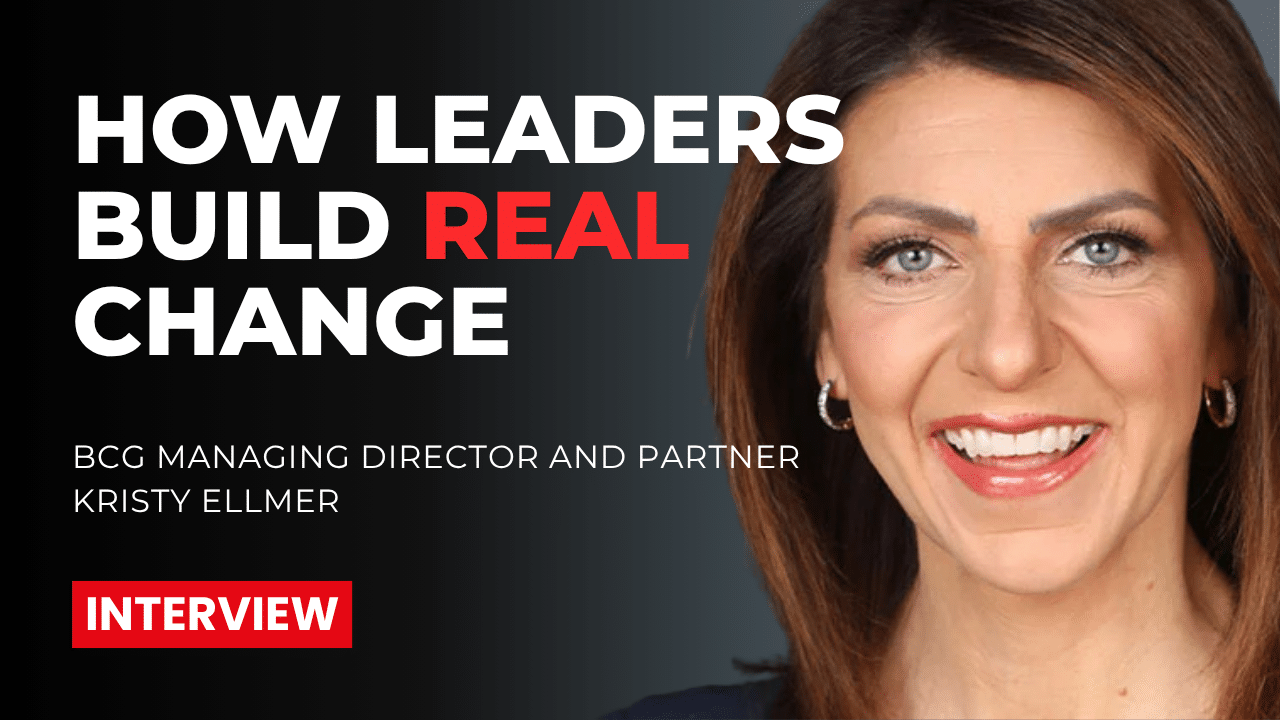
Kristy Ellmer has spent her career leading large-scale transformations across industries, countries, and operating environments. In this conversation, she explains why most change efforts fail — not because of bad strategy, but because organizations underestimate the human side of execution.
A central idea from the discussion is the imbalance between the “what” and the “how” of transformation. Leaders spend enormous energy defining strategy, targets, and operating levers, but far less time on the behaviors and systems required for adoption. As Ellmer explains, “transformations or change are failing… on the elements of the how. It’s not because there was bad strategy.”
She argues that many executives rush from alignment into execution before the organization is ready. One of the most counterintuitive lessons from her work is the need to pause after agreement is reached: “You need to take… up to two months to get organized.” Without the right operating structure, early momentum eventually stalls.
The conversation also explores why momentum must be designed intentionally. Discussing transformation work at Aetna, Ellmer explains the importance of visible early wins and helping employees understand “what’s in it for you.” She emphasizes that leaders are “responsible for momentum,” not just strategy.
Another major theme is resistance to change. Early in her career, Ellmer believed that “everybody will just get on board because things are right.” Experience taught her otherwise. Different groups respond to different incentives, fears, and motivations. Her advice: “Be curious” about why people resist rather than assuming they are unwilling to change.
She also challenges traditional views of change management, arguing that communication plans and training sessions alone are insufficient. “There is real science now out there on how humans really change,” she says, and organizations that ignore that science struggle to achieve lasting adoption.
The discussion also covers:
- why long transformations create fatigue when organizations never create “endings”
- how senior leaders should think about AI adoption versus AI hype
- why most companies are integrating AI as a workflow tool rather than fully replacing human work
- what separates successful consulting partners from those who simply “tick boxes”
- why career growth often comes from “leaning into uncertainty”
Throughout the episode, Ellmer returns to one principle: organizations execute change more effectively when they treat employees with the same intentionality they would apply to external customers. “It’s your job to sell the change,” she says — not simply announce it.
Kristy Ellmer is a Managing Director and Senior Partner at BCG and a former Chief Transformation Officer, with decades of experience leading multiyear transformations inside global organizations. She is a coauthor of the book, How Change Really Works.
Get Kristy’s book, How Change Really Works, here:
Here are some free gifts for you:
Overall Approach Used in Well-Managed Strategy Studies
Enjoying this episode?
Get access to sample advanced training episodes
Episode Transcript (Automatic):
Speaker 1 00:00
And became sort of the formative things. So from there, I went on to AstraZeneca pharmaceuticals, where they were doing nation as well. And that gave me the opportunity to start different countries and understanding, how do you help people move through change that are in different cultures? And I really enjoyed that. And then I sort of had the opportunity to join consulting, and the idea was, in consulting keep going from different transformations to different transformations, because at that point in my career, I had decided that’s all I wanted to do. And so I’ve now been in consulting for about 15 years, and had the opportunity to work across, you know, 20 something different countries, many different industries, all leading transformation and change, though, with that theme, sort of throughout no matter what I’m doing.
Speaker 2 00:45
Kristina, and when you joined BCG, what surprised you? What did you not expect?
Speaker 1 00:52
I think what surprised me about BCG, in a way that is actually a very is a great surprise in terms of how I think about change is BCG is very focused on an individual level. So while it’s a large company, there’s sort of this mantra of the segment of one and how do we think about people as individuals and what they need and what they can uniquely contribute? And as I thought about transformation and change, it’s remind me how I think transformation needs to be managed. So what’s been great about it has been this idea of, how do I personalize and experience even though we’re at scale? And I think that’s something that BCG sort of has at its core that I’d heard but I think until I joined, I didn’t really understand and I think that’s been a differentiator for BCG, but also very aligned with how we think about driving transformation.
Speaker 2 01:41
Do you remember the first day you started? What was your experience like?
Speaker 1 01:46
I do. You know, it’s interesting. It was the first day I walked into my office. There was flowers on the desk. There was a bunch of BCG swag. They had about 10 managing director partners call me and welcome me to the firm I had that week. Had already set up a bunch of interviews for me with different people, so that I got a chance to sort of talk about my experience. So it was all very well managed. And it was interesting that same week was like Wellness Week at the office. So it was one of these days where, like, there was always something fun happening, including, you know, I think, I think there was pigs one day that you could cuddle with pigs in the office. So I had a very, I had a very good start. BCG did a really good job actually looking at, how do we onboard somebody in a way that’s going to be have this great experience from the onset.
Speaker 2 02:34
Very interesting. Never heard about the pigs. That is very, very interesting. It could be very fun as well. When you transition to consulting. Was it difficult? Because it’s, it’s a big difference working in industry versus consulting. It was the other way. So I went to consulting then, then that was shocking experience. And then back to consulting.
Speaker 1 03:00
Yeah, it was a shocking experience. You know, having been in industry for, I think, you know, probably about 10 years before I joined consulting, I had been used to sort of managing these teams. I had PNM, I was responsible for certain parts of a business, and consulting often as a lateral hire, as they will call them, is you’re sort of put in a different role. You’re sort of asked to act like a team member on the case team, so that you can really learn the roles of a consultant. And when I first started, I didn’t understand what that meant. Meaning, you know, you have your sort of daily check ins, and everyone wants to know what’s on your calendar and who are you meeting with, and as an executive coming in, sort of questioning, why are they micromanaging? Why do they want to know my calendar? Why do I have to tell people what I’m working on? And it took me a little while to sort of understand that working model of we’re actually going to move faster, and what everyone’s got today, who has what’s top point, which touch points with who and how can we sort of work together as a team, and that there was real need to make sure that all of these teams sort of formed and normed and stormed very, very quickly. And once I understood that, it made a lot more sense. But I think coming in as a sort of former executive, and then coming in to sort of being just part of a case team and how they operate really took me, I would say, almost six months to sort of get my head around how I needed to operate differently, and what was the benefit of that operating model.
Speaker 2 04:27
Kristina, was it difficult to make made decision to transition to consulting already at an executive level.
Speaker 1 04:36
It was, you know, I thought about it for a while, but I think company and wait for them to want to transform, or do a big change, or that once it was done, I would be looking for the next thing. And because I was so focused on wanting to drive big, meaningful change, the alert of consulting was I could keep doing that. So once one client was done, you could go. To the next. I also really liked the idea of being a bit industry agnostic, and so the opportunity to kind of work in mining to high fashion retail, and for me, that was interesting enough to say, I don’t really know what I’m signing up for yet. I don’t know how this is going to work, but the opportunity that that brought was worth sort of the shift. I think the other thing that I recognize I had the opportunity to work with consultants when I was in industry, and one of the things that really resonated with me was this idea they constantly seem to be focused on continuous improvement. How are they getting better themselves? How are they sort of challenging and doing new things? If you talk to a lot of consultants, they always had sort of these side projects they were doing or, you know, whether it be on personal health or some skill they weren’t learning. And I really liked the idea of being around groups of people that really wanted to challenge me to be a better version of myself. And so that in itself, was exciting enough to me, not that that doesn’t exist in industry, but I think in consulting, you end up with people who are really driven at scale, at pace, and so that idea of being around that environment, giving you the opportunity to be better. So ultimately, it’s how I got to the decision of, you know, how bad could it be? Right? Like you might as well try and see what you can get from these opportunities.
Speaker 2 06:17
Kristina, and as you were going through your first engagements in consulting, what you were noticing you had, in terms of your skill set experiences, something you were bringing to the table that someone who grew up in consulting didn’t have.
Speaker 1 06:36
Yeah, it’s, it’s, I always talk about this with my teams now in that I think having sat in the industry, I have a much better understanding of when consultants are making recommendations or when stuff’s coming at them, the understanding that it’s just a piece of the day for an executive so it might be the only thing the consulting team is working on. And oftentimes, you know, consultants are sort of paid to do the strategic part, not necessarily an implementation part, but as the leader or the person who has to go execute it. That’s all you’re thinking about. Right? When you get to that end stage, it’s like, how are we going to do this? What are my employees going to think? What are the challenges? And so what I have found that I brought uniquely coming from industry, was that real perspective of what it feels like to be part of the team environment and the executive environment, where that’s just one thing you’re working on, or if it is, you know, a big part, like a big transformation or change, you’re still running the business, and so there’s still a lot you have to do. And I think you know when I when I meet with my teams now, and I train my transformation teams, in particular, I spend a lot of time thinking about I want you to be in the client shoes. What are the 10 other problems they are being faced with today? And so therefore, how are we going to make sure we’re as crisp as we can be and we’re as thorough as we can be? You know, in industry I saw there was many times where we had hired consultants, and there were great recommendation decks that were just sitting in drawers that had not been taken anywhere because people didn’t know how to implement it didn’t implement it, didn’t have the time, really hadn’t thought it through. And I remember when I joined consulting that wasn’t going to be my work, because nobody wants that. The consultants don’t want that. The clients that hire them don’t want that, right? Everybody wants to do something good with it. But unfortunately, depending on what’s going on in the context, or depending on if you were just hired to do the strategy without an implementation plan, it can fall down. And so even in my teams, where we might be doing high level strategy work, we’ll spend time saying, what’s the three or four pages to say? How do you start implementation? Because it’s really important that I think you at least give them some insight or a head start. Otherwise you run the risk of that document just going into a drawer.
Speaker 2 08:41
Kristina and some of our listeners are relatively senior, I would love to get your advice for them on what does it take to make it to executive level?
Speaker 1 08:58
I think it’s a couple of things, especially in today’s age, there’s so much change happening so fast. And, you know, one thing I always tell people is to actually lean into uncertainty. If you look at my career, I have gone very quickly through certain periods of it, but because the reason was, I always said yes, when there was an opportunity, if there was something that was unclear, how this was going to work out, or, you know, it was something big, and people hadn’t really figured out, was it going to be successful or not? I usually said yes. And those turned into big opportunities. They turned into exposure. And usually what that led to was career other opportunities. And so the first thing I say is, like, if there’s an opportunity to lean into it, even if there’s uncertainty, you will learn something from it, and most times, you will actually sort of grow from it, which is then helping you build, sort of your own skill set, but then ultimately potentially getting exposure. The second piece is, I think being a learner, so often we get into these roles, and we’re all. Is doing, doing, doing, which is super important, but there’s so much happening in change, and there’s stuff that’s happening maybe in your company that you’re really close with, but you don’t necessarily know what’s happening in the industry. And so to move into leadership, you really need to have a broad perspective, and you need to sort of understand what’s going on in the current day and how you’re going to take, sort of your team and the work that you all do to that next level for the future state. And so it’s often one of the things I see a lot of leaders sort of step back from when they’re get really busy. One of the first things to go is, okay, I’m not going to go to that conference. I’m not going to go read that additional sort of set of things. I’m not going to study these other companies, because I’ve got to get my work done, or my team’s work done, and that is actually sort of hurting your future. And so what I would always say is, are you carving out real time to make sure that you’re understanding what’s happening in the industry, what’s happening sort of in macro trends that you need to be aware of, because doing that’s going to allow you to talk about your work and the things that are going on and to your executives, this is actually being much more broad, and that’s important in sort of moving into leadership. And the last piece, I would say, is really identifying other leaders that you can really learn from. And we also talk about sponsorship and mentorship and how this is important. I can’t underscore enough about how much it matters being in the room. So even a leader that you work with saying, Can I join you in that meeting? Because sometimes sitting in some of those executive meetings really starts to change your perspective on your own thinking and how they do their work. And if you’re not there to see it, it’s hard to emulate it. So there’s about sponsorship, get mentorship, but through those, or even through your own leaders, at least be in the room and to better understand the way that the place operates, and help executives think absolutely. Help you grow
Speaker 2 11:56
definitely and volunteering for certain projects help helps as well work with senior leaders in your free time you end up sitting in some of the meetings that you would never sit at your level. I also wanted to ask you, have you maybe observed also certain things that were keeping high performance from being promoted?
Speaker 1 12:23
Yes, I have. And we see actually a lot in transformation. You know, when we actually kick off these transformations, you start involving a lot of people. And I’ll tell every CEO, there are stars that you don’t know yet in the organization, because they’ve been sort of either, you know, just held back because of a leader, maybe a poor leader ahead of them, some cases where there might be leaders who feel threatened by them. And so as we design transformations and we have more people involved, you really see some rising stars. It happens in every organization. And I think you know, one of the things, if you’re a high performer and you’re not getting traction, is, you know, you might need to go look elsewhere within the organization for something there it does become a place where, you know, if you don’t have really strong leadership around you, it might be hard for you to actually continue to sort of Excel. It’s fine to give it time, but over time, I think you have to realize that there’s been points in my career where I’ve worked with some great leaders who put me front and center right make sure that I was getting recognized and had the opportunity to continue to be high performing. And then I had other leaders who, in the past, maybe weren’t so supportive. And so over time, you realize what that difference looks like. And I think you have to make a choice for yourself to say, How long am I willing to deal with that versus, like, look for another opportunity. And that comes back to that sort of leaning into uncertainty. It might feel a little uncomfortable. Little uncomfortable to go to a different part of the organization with a new leader. You don’t know, but it might just be your big opportunity as well.
Speaker 2 13:50
And Were there certain things that you believed about business, how things work, how to work with people successfully, early on in your career, and then later, as you progress through the ranks, you realize, no, this is not how it works.
Speaker 1 14:05
I would say, early in my career, I was very much a there’s a right and a wrong, and we have to go forward, and everybody will just, you know, get on board, because things are right. And I learned over time that that is not true. And we talked about this in the book in terms of, like, earning take up, what I have learned is one of the most important skills to learn is influencing and how you actually different stakeholders, different people, ways. And so learning how to like be a little bit of a chameleon like have your North Star, you’ll have your own values and the way that you operate, but working within subcultures or different groups of people, they all have their own ways of working. And so if you want to be effective in working with many different people, the idea of, how do I influence different groups? And I understand what their motivators are, and how I can get them on board to something is a critical skill, and something that I wish I had learned earlier in my career, but once I did, it’s more impactful. And. And so often we’re so focused on our own style or what we need, versus how can I get that group of people on board? What do they need to be successful? And making them successful in the process is actually going to be more impactful and allow you to have more impact.
Speaker 2 15:16
And then I also wanted to ask you about succeeding in consulting, for the part of our audience who are in consulting, who, let’s say, someone who is at the partner level or trying to become a partner, or someone who just was promoted to partner and wants to succeed. What would be your advice for a relatively senior level, maybe just before you get promoted to a partner, what does it take to get to the next level?
Speaker 1 15:44
Yeah, first piece of advice I would give is to not put too much pressure on yourself. It’s such a high pressure time, and so many of the partners that I work with get so anxious about I have two years. I have this, I have that. And the reality is you want to be a successful managing director or partner, right? And that, and so many people are so worried about getting elected. And what we see is, if you focus so much on that, on the other side, you might not actually be successful, because you’ve, you’ve really tried to get to a place where, like, I’m ticking boxes, right? It’s like, this is what they said would get me elected, and I’m doing that. And we really try to reframe the thinking to say no, that is a time where you are apprenticing to make sure that you can be a successful Managing Director and Partner or partner, whatever title you know they use at the different firms. And I think that’s a really important mindset to start with, because too often you can get yourself wrapped up and be very anxious about the election. The second part, I would say, is really understanding, what is it that’s going to make you accretive to the firm? So if you think about it, there’s a set of sort of, you know, equity partners, and they’re saying, we want to elect more people into our partnership, and what is that person’s unique value add, and how are they going to be accretive to the firm? And again, rather than sort of tick boxing things and saying, Okay, I’ve got this, I’ve got that, really thinking about what is that story and where do I uniquely add value? How am I going to be accretive to the organization? And that’s being clear on what your platform is, what your potential clients are, but honestly, just where you think you can add value, and making sure that the people around you, working with you are supportive of that, because too often it’s like they try to sit in a box and say, Okay, well, I, I executed this, I helped sell this, and I did this knowledge document. Okay, make you a great, you know, associate partner, or, you know, partner in the BCG language, but not managing director partner. It’s going to be about that sustainably over time. And so really thinking through the longer game is really important, and working with your sponsors and your other leaders to make sure that they are helping you with that, but that they’re also making sure that they challenge, is that really there? Because there have been too many cases I have seen where early elected partners who looked really strong on paper weren’t doing that, and so even though they got elected, they weren’t successful on the other side. And that is something you don’t want, right? The other piece is, I would say, is you really own your story. I have seen so many people who you know, they have their sponsor, they’re out talking about them. You have to be the one, being your own advocate and being out talking about everything you do. The equity partners are typically extremely busy, right? And they have a lot of client demand. Some of them have internal roles, and they are well intended, but often strained for time. And so if you’re expecting them to go have 10 conversations, they might well intend to be but they might only get to five. And so making sure that you have those 10 conversations with the people that are maybe on the committees or are going to represent people on the committees, so people really know your story and how you’re creative is really important. And so the ones that I see that are successful actually own that themselves. They rely on their leaders a little bit, but not completely.
Speaker 2 19:10
Thank you, Kristina, this is so helpful. And for someone who was just more the partner, what would be your advice? Yeah, first,
Speaker 1 19:20
you have a small window of time to be successful. So I think I’m done right because, again, it’s, there’s so much anxiety that goes into the election. And so I think recognizing that, you know, particularly in this environment, there is a window of time that you have to be successful. And so again, if you’ve done it right, getting into election, you have a strong platform, you’re probably okay. But if you’ve just gotten there and got elected, and you don’t have, you know, a really strong platform in terms of what you’re working on, what Mandy says, You will struggle. And so I think being very clear, right? You. And make sure that you’re executing that stuff really important, but at the meet, at the same time continuing to do your business development, because some of this stuff can take a while, and so you have to think about as two tracks. Now I am actually executing because that’s expected of sort of more junior partners, but at the same time, I’m building my my business, if you will, my business development side. So I need to be doing that in parallel. And those are really important things. The other thing, I would say, is working with your your leaders, to make sure that if there’s opportunities, you’re still raising your hand quite well. Some will go, some will not go. So you have to sort of be pretty available early on, and then you start to build, not just with one or two, you know, senior partners that you’ve worked with, you’re actually working with a broader group so that as time by as a MDP or a partner, sorry, MDPs, Managing Partner, BCG, as you as that time goes by, you’ve built enough of a model of Many people to work with, versus a small set
Speaker 2 21:04
you recently wrote the book. Congratulations. Thank you. What are the key things you want people to take away after reading how change really works,
Speaker 1 21:17
I really want senior executives to take away that first, they’re part of the problem when it comes to transformation and change. So a lot of time with board members and CEOs, and we talk a lot about successful and failed change, and often I see a lot of well, the organization didn’t take this up, or we did all these things, and people weren’t accountable. And there’s all these reasons when you’re leading a big change, it is really important to look at yourself first and understand what you might need to do, particularly if you want different outcomes from an organization or from anything you’re trying to do. So anyone that’s leading change, I would like them to first step back and look at themselves and say, What am I doing now that needs to be done differently for this to be successful, because what got us here is not going to get us to the next place that includes myself. And so I think that’s the first premise. The second is really being intentional about change as a service to sort of your internal customers, the idea that if we go do all this change and transformation, we don’t spend enough time actually thinking about the people who will have to change in the organization. Is this something they would buy? Is this something that they would say, yes, sign me up for and like, think about the Delta example that I was saying when I when I worked there in bankruptcy, they spent so much time getting employee feedback and bringing the employees into it, that when things were made or changes were made, we felt we had designed it. We felt we were a part of so we had sort of bought into the idea of the change there. And so whenever you’re looking at doing a big change or transformation, what I want people to get away from the book is that, as a leader, it’s your job to sort of sell the change and transformation and make sure that people are buying it and treat it with the same sensitivity you would as external customers if they’re not buying your product or your service. And I think the third one is, change really can be much easy, much more sorry, change really can be easier and it can be a bit more fun too. There are hard moments in it, and they’re really tough decisions. I don’t want to I don’t want to overstate that, but there’s a lot of good that can come from change, and so more of a tried and true playbook. It really can have better outcomes. And I think this idea of, you know, being Change is hard and people don’t like it, can overtake this idea of actually, there’s pretty good pattern recognition on what it takes to have good change, and it really can be better. And I really hope that people walk away feeling hopeful, that there really is a lot of great opportunity and change, and that while we live in this very uncertain environment, and there’s so much change coming at us, and it’s so fast that actually it can be done better, and we can wait a bit more.
Speaker 2 24:07
Maybe we could take one example and show some of the key things that were implemented to
Speaker 1 24:19
take an example of, yes, so if
Speaker 2 24:23
we could, maybe you could take us through one example where specific things occurred that allowed that change effort to be successful.
Speaker 1 24:36
Okay, I think so. First, if we think of you know, we have a bunch of examples in the book. Maybe I’ll take momentum. The Aetna Insurance company right now is in the middle of their transformation. And one of the things that Katrina, the leader, wanted to do when she was kicking off was to build momentum. And I think this is where transformations. Can stall out is they don’t spend enough time actually building momentum, and the idea that the leaders are actually responsible for momentum. And so when she kicked off her transformation, she had a bunch of big meetings, right, making sure everybody was excited about it. But at the same time, she spent a lot of time making sure there were early wins and that there were cultural elements to make sure that people understood that this was going to be a long term transformation, and not just about dollars and cents. And so I think her real intention of actually saying, when we kick this off, we’re going to talk about why this is good for you, what’s in it for you, very specifically, how we’re going to have early wins against those things. So people felt that they they could actually see things happening, and they could be a part of it. Was really important to building momentum. Think another example, I would say, if we, if we continue on the Delta thread, Delta did a really good job involving employees in and we talked about creating agency in the book. They do something called the velvet rope tour. They started it in bankruptcy. They still continue to do it. And it’s basically engaging with very frontline employees and other sort of corporate employees, and hearing from them on what’s working, what’s not working, retraining people. But it’s a real investment of time and money, and they do that so that they make sure the changes that they’re doing have the voice of sort of their internal customers. And so when things happen, people sort of feel like they have the opportunity. And I think, you know, really great example of needing to build momentum, but then also make sure that you’re involving employees in the conversation.
Speaker 2 26:37
What I did in how change really works is most consistently misunderstood.
Speaker 1 26:46
The part that’s misunderstood is this idea of the science behind it. You know, so often we hear we need to do more change management, which ends up being high level communications, maybe a couple of workshops, and maybe some training, and it gets sort of Peanut Buttered of, you know, we’re doing change management, and there’s real information now out there on how humans really change and what they need to do that. And this idea that there’s out there that proves out very specific tactics or very specific fundamentals on humans, how humans change that, I think, is not well known enough. And if you understand that, you really change your strategy on how you’re going to do change and transformation. And I think that, you know, we have this historic thing around change management of it’s going to be some HR team that’s going to do some, you know, communications and some training, and then we’re done. Change management’s been done. And the reality is that’s not doing anything to really get people to take up. It’s an important piece of it, but it is only a piece. And if it’s not done in a way with the science in mind, you actually end up with people who are sort of disappointed and how things roll out. And so for me, this idea of there is real science that is known and very easy to apply if you understand it,
Speaker 2 28:07
was there something that you changed your mind on while doing this work in terms of understanding what makes change successful versus not?
Speaker 1 28:18
Yes, I think you had my co author, Julia dar on, and, you know, I her and I met probably five years ago, and I was actually a chief transformation officer at the time, and she was in, I was seconded there from BCG, and I was struggling with a few of my work streams since I asked her as my Reporting because I kind of came at reporting to say, you’re either on track or off track. It’s red or green. There’s not even Amber. And I showed her the reporting, and she said to me, Kristina, you’re losing people left and right because you’re you’re not allowing them to see a path. So she looked at some of the reds, and she said, Are you How long have these people been in the red? And I said, some of them three or four months. And she kind of said to me, you have completely lost parts of the organization. Then. So the reporting and everything to sort of show people a path to success, so that they could see momentum. And so I think for me in my journey, one of the things in terms of learning, the behavior that even though it feels black and white, that it never is. And if you understand pieces of the science, you can actually have better impacts. And so for me, that idea of it doesn’t have to be yes or no, black or white, right? It can be shades of color in this example, and that will actually get you better outcomes.
Speaker 2 29:45
Kristina and in the book you write about how executives often over invest in the what, or invest sufficiently in the what, but not invest enough in the How can you speak about that so our listeners can avoid this mistake?
Speaker 1 29:59
Yes. It’s something we talk about all the time. And, you know, we often see there’s so much effort put into the transformation or the change that’s going to happen. And what we call the what, and it’s what are the levers we’re going to do? What is the P L impact we’re going to have? What’s the share price change that we expect to have? What’s the strategy, you know, and gets, you get into a lot of detail on at a high like, what are those elements that we’re going to drive and then everybody gets excited and wants to go start the change from there, the particularly the executive team, but very little time and very little dollars are spent on, okay, well, how can organize around it? What behaviors need to change in the organizations to achieve those new results. How are we going to actually govern this work? How are we going to help people change as part of this process? So, you know, in our model, we’ve developed what’s sort of called the why, the what and the how, and it’s really starting with on the why. Why are we doing this change? On our executives very clear in their minds as to what is the from to and why do we need to do this for what purpose, and on the what side, it’s very much those typical, the levers, the measures, what is it that we’re actually changing? But then on the how it really starts with culturally. What are the behaviors that need to change? What’s the new culture that needs to happen to deliver these new outcomes? How are we enabling leaders? How are we engaging people? And then, how are we actually focus through that work? And what we see is teams will spend 10 to 20% of their time. We would argue it’s equal amount of time, because transformations or change or failing, it is all on the elements of the how. It’s not because there was bad strategy. It’s not because they didn’t pull some of the levers. It’s usually an execution problem driven by humans not wanting to sort of change.
Speaker 2 31:50
Yes, and they have been a good reason for that. That’s right.
Speaker 1 31:55
That’s right. And if you think about it, some of it is because there hasn’t been investment, there hasn’t been a really good case, there hasn’t been incentives built around it, or you haven’t made the process easier. You haven’t designed it with them in mind, and so because of that lack of focus on the how, you really haven’t got them to buy into your change.
Speaker 2 32:12
Yes, are there specific behaviors, behave that you would recommend our listeners to make after reading the book as a priority. Of course, there are many things they can do, but most important things you would want people to do,
Speaker 1 32:30
I would say, to be curious in science behind pieces. So you know, when I’ve been leading transformations myself, and even in my career, I’ve having always like, here’s my opinion, and here’s my thought to let me be curious about why that person might be acting that way, why they might be thinking that. And that’s really allowed me to be much more thoughtful about how I lead in my own organization, how I lead change with my clients. And so that idea of, and you know, if you read it in there, you start to see all of this academic research and all of this science, you start to realize some of the whys. And so I would really want people to walk away very curious. So the next time they sit in a meeting and they see somebody behaving badly or behaving in a certain way, actually saying, like, why would they be responding that way? What might be causing them to act this way and really start to sort of challenge your own thinking, but challenge your response, saying, okay, there must be some good reason. I don’t know what it is, right, but why? And so I think that ability to sort of be curious on the behaviors, and curious on why things might be happening, and then just curious, I think, on the science, because I have found, for me at least, that has been dramatic in changing the way that I operate and understand how to get sort of the best out of my teams and the best out of the clients that I work with.
Speaker 2 33:52
Kristina. And have you noticed beginners over focusing on specific things related to drive and change? I it those who never managed change efforts before.
Speaker 1 34:07
For them, it comes back to often they are so focused on delivering results, and so what they tend to do is focus on getting started so they can get early wins on the board, but not necessarily thinking through the overall transformation and how this is going to go. And so what happens is, you inevitably start with a bunch of momentum, and we’re like, okay, we need to get moving. I have a bunch of questions, but we need to do these couple of things, and they can and then all of a sudden, as bigger things come up and it’s time to move on, there’s no system around them, no structure that’s really organized in a way, for them to handle new things, bigger things coming in. And so what we find is the new leaders to change really want to start much faster than they’re actually ready to. And we talk about this in the book, but we get to sort of what we call the mathematics of misalignment, where if you don’t put real time into getting the agreement, and really. Building the system of how things are going to operate, that you run into a place where things just start to stall, because you can only sort of push the momentum through a small group of people for a certain period of time, and then ultimately many people in, and many more people changing. And so we find they rush too much to this, like just get started, because they feel pressure to show wins and show that they’re making progress, versus feeling comfortable saying we will do all of that, but we need some time to make sure that we’re getting organized and in the right way to make this successful over the long term.
Speaker 2 35:33
And for the same type of listener, someone who, let’s say, right now, they’re managing something, they are managing change effort, but they never really manage something like that before. Do you notice that beginners often miss something important about change management and change leading change Yeah,
Speaker 1 35:57
I think what they miss often as a first time person is the idea of, they sort of look at the tick box of what is basic change management, and, you know, it starts to go to, okay, well, we communicated, and we told people what they needed to do, and we did some training, and so they feel like they’re done. And even if they’ve done that, what we don’t see them do is actually come back to it right to say, Okay, how is the training being applicable? Is it working for you? Numbers, and it becomes much more well, why aren’t they doing this? We did all of these things. And that idea of it doesn’t just end when you’ve actually finished the tasks. You need to make sure that things are actually happening, and it happens for a lot of the first time change leaders, because I think there’s so much going on and there’s so much you just want to get done. It feels good to say, hey, these things are done, right? Moving on. Yes. Get people to take things up that are different. Takes more time than that. And so I think for for new leaders of change understanding that that’s just sort of a part of making sure you do those things. It’s actually following up and making sure you even check in with people to say, like, did those things work? You know, I was on with a client earlier this week, and they said, Well, we did the training two months ago. I don’t know why they aren’t doing this. We and the reality has, well, it is a change. Leader, you’re, you’re you’re delivering the outcome. So the fact that they aren’t doing it is actually your problem, and it can’t be that we just gave them this and like, let it go. And so I think leaders have changed really, particularly for the first time, haven’t had that experience yet to understand that that’s going to come and how they’re planning for that.
Speaker 2 37:37
In your book, what do you think is the most counterintuitive finding? But change fails.
Speaker 1 37:51
I think the one that people will, or at least the one that I find the executives struggle with the most, is the idea of carving out planning time. Many CEOs I meet with, when we walk them through and say, Okay, these are the phases of change. So the second being sort of planning for it, and then sort of starting persisting and ending that planning phase tends to be the most controversial, because we would say, as an executive team, you’ve gotten to agreement now, you know, they were really information, and we actually argue you need to take, depending on the size, you know, up to two months to get organized. And I think that’s the counterintuitive part, because it’s like, well, we’ve agreed on doing all of these things now we need to get started. And if you’re an executive, you could have been working on this for six months to a year in terms of what we’re going to work on, what the change is going to be, what the transformation is. So you’ve been on the journey for a while, and now you’re just anxious to get starting. And then we come in and say, No, you can’t start yet. Two months to get organized. And I think that is the hardest part for the executives to get their head around. Many CEOs I meet with always look at that part and say to me, are you going to be the one to hold me accountable to not start and tell me when we’re going to make sure we’re ready? Because they know it’s inherent and like they want to get moving. So I think that’s probably the most counterintuitive in terms of what we’re suggesting. The other one I would add that is, I don’t think it’s counterintuitive, but it’s sort of new, particularly in this environment right now, the environment we’re in now, there’s really this mode sort of go always on transformation. There’s so much happening. We can’t slow down. We’ve got to keep changing. And what tends to happen is you might have a transformation program going, and as things are getting delivered, you starting to it. You start changing what it’s going to look like. You add another module or something. And what we found in the science is that that is what creates some fatigue in the organization, that people really need endings. You know, your brain is looking to close the neuro circuit. So if you said we’ve kicked out this transformation, here’s the numbers we need to deliver. Here’s how we’re going to deliver. It. Here’s the timeline in which we’re going to deliver it. People are looking for that to end, and if you keep adding to that, it never ends, and they don’t get the satisfaction of actually feeling like we were able to close that out. And so what we suggest in the book is actually a phase called ending change, where you actually call an end to the stated transformation and you give a break to the organization, meaning you stop the transformation. Often, you stop the change, the governance, whatever it is, and you actually use that time to have people reflect on, what did they achieve during that period of time, and what were they surprised, and how did they grow? Because what you’re doing is actually building their own confidence when you do that, and then you can launch another transformation or another change. But really creating a break is really important, and that is how you will combat change fatigue in the organization. I have many transformations that I work with that are sort of, you know, hey, we’re a 789, year transformation. We’re really having we have so much we have to change. The argument to them is make it in chapters. How do you break it says so that you can give the organization the what they need in terms of closure, to close out, and then you can and then you can go again. And I think that is a part that I don’t think it’s counterintuitive, because I think you look at your own life and you look at big milestones and how you celebrate them, and how you sort of move on to the next thing. We do it naturally, but in organizations, we’re really bad at it.
Speaker 2 41:30
Kristina, and you mentioned the environment we are in right now. Of course, AI advancements, technological advancements, and a lot of uncertainty. A lot of changes are happening very fast. What would be your advice to our listeners, who are many of them are very senior leaders, how to remain competitive, how to remain relevant going forward, as individuals, as professionals. Yeah, it is an
Speaker 1 41:59
interesting time. And I think the first thing I would say is there is a lot of speculation out there, right? And I think, you know, it can create a lot of anxiety, versus sort of saying, again, what can I uniquely add, where do sort of, I have value? And making sure you’re clear on that, and then looking at this environment and saying, okay, is that going to change and what’s going to change about it? So then, therefore, where do I need to invest my time to learn? I think first is, like, just some of it is, some of it is really, some of it is real, some of it is noise. And trying to delineate those two things is really important. You know, I was with a board today. So I met with a bunch of board members this morning, and one of the things they said to us was like, this, AI, transformation at our company is going to take us six years. But if you hear from the employees, and you hear from sort of the people that are working with them, they’re saying, This is gonna be six months. And I think there’s a reality here that sometimes we aren’t seeing in terms of what things really take to change and adopt. It doesn’t mean there will be some companies that go faster or others. So I think there’s one of just like, what is noise, what is reality? Getting very clear on that second is really, what is the value add that in a future environment that you deliver today, but in the future environment, what you’ll be able to do, and how do you again be a continuous learner? And that, I think, is the most important part. I am a very different transformation leader today than I was even five years ago, because I continue to lean into learning and understand what other pieces I can pull in from different sciences or different practices to say, how do we keep getting better at this? And so I think in this environment, it’s important to be a learner to make sure that you are continuing to get better. What might that future look like, and how am I evolving and learning my own new skills or different tools to be able to be part of that future?
Speaker 2 43:56
Kristina, are there anything, any things that you can mention that you believe on noise but people think I do,
Speaker 1 44:04
yeah, I think on the noise part, I think I there’s a lot of speculation on time to adoption on AI, right? You’re hearing lots of things out there. About 20% of people off, 30% of people off. When we meet with a bunch of CEOs and board members. They recognize that that might be possible. They also recognize that there’s a lot more opportunity, rather than just we’re going to sort of cut jobs. And so I think it’s understanding that match of time, and I think there’s a lot of motion by different people, and I feel very overwhelming for people, and the idea of looking at what are companies really doing, how many companies are really driving, like, to that kind of timeline, and you’ll find that it’s a lot longer than people are sort of communicating. So I think that is one of them. The second is this debate of like, I. Is AI sort of taking over, or is it a tool? And the more and more you get into it, I think you’re seeing that yes, there will be very AI forward organizations, but in many places, it will be acting as a tool today. And so I think there’s going to be differences in how different organizations actually see AI and use AI. Some will treat it as being AI first, and then some will actually use it as a tool. And I think there’s everybody sort of is moving that direction of it will be an AI first world, and everything will be around that. I just the more we talk to senior leaders and board members and what’s really happening in organizations and their view on it, I think there’s a lot more noise in that, versus like this sort of different types of archetypes of companies that will exist.
Speaker 2 45:47
Thank you so much, Kristina. And are there specific real things you can mention where people maybe not giving it enough attention?
Speaker 1 45:55
I think on the real side, one of the things we’re starting to see in adoption of AI is people actually challenging their view on what role of technology plays in society. So, you know, I think there was a lot of excitement, a lot of productivity that’s been gained even in your personal life, right? You know, I get a reputation for a party I put it in AI, right? So the people like that piece, but what you’re starting to hear and see and push back a little bit more in organization, not just fear of losing my job, but it’s actually a much deeper question of, how much do I want technology in my life, and how much is that role, and how intrusive do I want it to be? And so I think there’s real examples we’re starting to see it clients, where some of the pushback on adoption is not about fear. It’s more about a values driven question about, what does this mean for society? How does this play out over the long run? And I don’t think we there was some comments about that early on, when sort of a we’re seeing a lot more of it now, and I think that’s an interesting thing to see how this plays out, because you have different demographics and different groups of people feeling differently about it. But there is quite a bit
Speaker 2 47:10
of pushback on that. And the last quick question, Are you noticing certain things that people are doing in terms of using AI that is not effective, and maybe quick advice you could give on how to use AI more effectively.
Speaker 1 47:25
We are seeing places where it’s used very effectively, and then others where it’s just it’s kind of used as a tool to do, you know, interesting things like, I’m going to write a paper today. So it’s I start there to get my view, and then I go off and finish my paper. It’s not really integrated into the workflow. And so if you don’t have it integrated into your workflow, you’re using it as, like a nice to have and a nice sort of starter on things, versus actually helping you get your own individual productivity. And so you know, depending on what tool you’re using, that idea of, like, really thinking about your own personal workflow and how these tools fit into them, and how you might have to design workflow to be different. I think some of us kind of go on with our day, and it’s like, oh, I can use Claude TPT to help me with this, but if it’s not integrated, then you’re not really getting the benefits of it, and I found that, you know, and again, there’s many people who are doing this the right way, but there are many who are not, and they’re just not keeping up with the productivity that they think they’re supposed to be getting, but it’s because they haven’t really thought through their own workflow. And, you know, do I need five agents for myself? One that person that thinks about, you know, how would Kristina respond to this kind of email? And so if you don’t put it into your workflow, you’re really not going to get the productivity benefits, even for yourself.
Speaker 2 48:53
Kristina. Thank you so much. I really enjoyed our discussion today. Where can our listeners learn more about you? By your book? Anything you want to share?
Speaker 1 49:01
Yes, I so you can find me on LinkedIn, at Kristina, and on x as well a bcg.com how change really works website, as well as we have our own how change really works website. And so you’ll see a lot of content, new articles coming out on that. I also have a TED talk, so please take a take a look at that, and we’re excited to hear what your feedback is on the book.
Speaker 2 49:28
Kristina, thank you again, so much for being here.
Speaker 1 49:31
Thank you for having me. I enjoyed the conversation. Our guest was
Speaker 2 49:35
Kristina, and as you probably remember, as I mentioned in the beginning, she’s a managing director and senior partner at BCG, and the former chief transformation officer with decades of experience leading multi year transformations inside global organizations, and the co author of the book how change really works. Calm. You can get some gifts from us. You. You can get how to you can get the overall approach used in well managed strategy studies, consulting.com forward slash overall approach. And you can get one of our book firms consulting.com forward slash gift. It is called Nine leaders in action, and it is CO written with some some of our clients. That’s all for today. Thank you so much for tuning in forward to connect with you all next time.
Leave a Reply