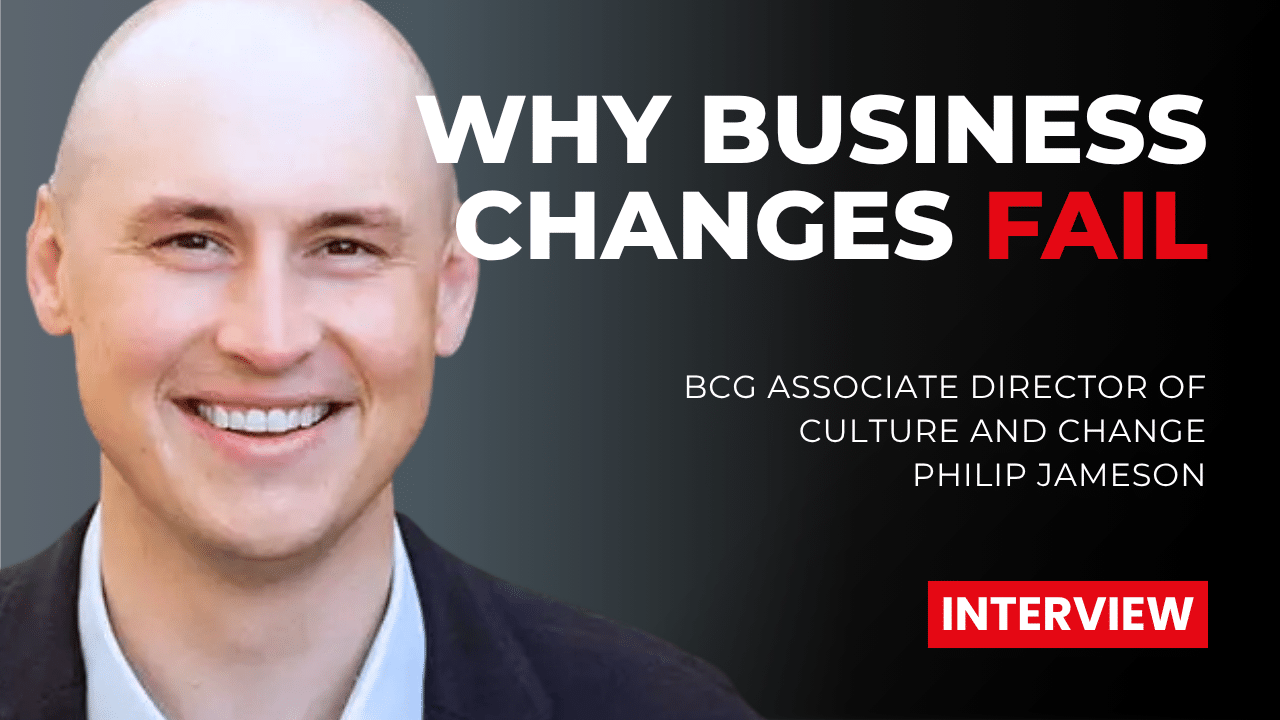
Philip Jameson discusses why most organizational transformations fail despite strong strategic intent, significant investment, and broad awareness that change is necessary.
Drawing on his work at Boston Consulting Group and the research behind How Change Really Works, Jameson argues that the core problem is often not strategy itself, but a poor understanding of “how humans behave during periods of change.”
The conversation begins with Jameson’s unusual path into consulting through classical music and leadership at the Sydney Symphony Orchestra. He reflects on the orchestra’s temporary departure from the Sydney Opera House during its renovation and why the experience fundamentally shaped his thinking about institutional change.
“It was an experience that I had had of really a change gone right,” he explains, “and it made me passionate about giving the gift of great change to as many people in my life as I could.”
A major focus of the discussion is what Jameson calls “false alignment” — situations where leadership teams behave “as if you’re more agreed than you really are.” He argues that many transformations fail because executives believe they share a common vision until operational specifics expose deep disagreements.
The episode also explores why leaders often avoid disagreement altogether. Citing behavioral research from Julia Minson, Jameson explains that people routinely overestimate how damaging disagreement will feel in practice.
“It is much worse to imagine having a disagreement with someone than it is to actually have a disagreement with someone,” he says.
Another major theme is agency. Jameson draws on the “IKEA effect,” the tendency for people to value outcomes they helped create themselves. In successful transformations, employees feel they have “their thumbprint on the design of the change.”
“Change really works,” he argues, “when the people affected by that change… feel that they have contributed meaningfully to it in some way.”
The conversation also examines why organizations frequently underestimate barriers to adoption. Jameson outlines seven common reasons employees resist new tools, systems, or behaviors — including skill gaps, lack of time, lack of perceived benefit, and fear of losing status or value inside the organization.
Rather than treating resistance as irrational, he argues leaders should approach adoption with “deep empathy” and structured thinking about human behavior.
Another important thread concerns rituals and operating cadence during transformation. Jameson describes successful change efforts as highly disciplined systems with consistent decision-making rhythms, clear forums, and predictable escalation paths.
“In great changes,” he says, “there’s a very consistent drumbeat.”
The episode also explores storytelling as a strategic tool during periods of uncertainty. Jameson outlines three recurring narratives used in successful transformations: the threat story, the fitness story, and the destiny story. The strongest organizations, he argues, usually commit to one clear narrative rather than mixing several competing explanations.
The latter part of the discussion turns to AI and organizational adaptation. Jameson views AI transformations primarily as behavioral transformations rather than purely technical ones.
“Maybe you think of it as an AI change,” he says, “but really it’s about human beings.”
Throughout the conversation, Jameson returns to one central idea: organizations rarely fail because they lack intelligence or ambition. They fail because leaders underestimate how difficult it is for groups of people to change behavior collectively and sustain that change over time.
For executives, operators, and transformation leaders, the episode offers a practical framework grounded not only in strategy, but in the behavioral science of how change actually happens.
Get Philip’s new book, How Change Really Works, here:
Here are some free gifts for you:
Overall Approach Used in Well-Managed Strategy Studies
Enjoying this episode?
Get access to sample advanced training episodes
Episode Transcript (Automatic):
Kris Safarova 00:47
So, welcome to the Strategy Skills Podcast. I’m your host, Kris Safarova, and our podcast sponsor today is Strategy training.com And we have some gifts for you. You can get five reasons why people would ignore somebody in a meeting. You can download it at F I R M S consulting.com forward slash own the room. You can access episode one of How to Build a Consulting Practice at Firms consulting.com forward slash build, and you can get a copy of one of our books at firms consulting.com forward slash gift, and it is called Nine Leaders in Action. And today we have with us Philip Jameson, who is an associate director of culture and change at BCG, and who works at the intersection of behavioral science and transformation, and he’s a co-author of the book How Change Really Works. Philip, welcome.
Philip Jameson 01:42
Kris is a real pleasure to be with you. Thank you for having me on.
Kris Safarova 01:45
I would love to start with your career at BCG. Maybe let’s start with that story you mentioned just before we started recording on the defining moment, and we’ll go from there.
Philip Jameson 01:56
Of course, well, I actually started my career as a musician, so classical composer for string quartets, orchestras, choirs, that kind of thing, and also a classical conductor. These things still mean a lot to me, by the way. And the big turning point in my career was when I was fortunate to be the chief of staff at the Sydney Symphony Orchestra. Sydney is actually my hometown, and just before I came on board, the symphony had been told that the Sydney Opera House, where they had played for 50 years, was going to be renovated, and that the symphony couldn’t play there for two years now. This was a really emotional time for the symphony. You might know that for symphony and orchestra is where you play is not just about where you have seats in a stage, it’s really your home. Musicians, the 100 musicians of the Symphony Symphony Orchestra have their possessions at the venue, it’s like a home for them, so this was quite an emotional time. What we were able to do in the end was find not one, but two venues in Sydney that could, where the symphony could play for two years, and then they successfully came back to the Sydney Opera House after that. And actually, if you fast forward to today, they still play in all three of these venues and many others as well, so they get to enjoy all of these, these places, and what it meant for me was that it was an experience that I had had of a really a change gone right, and it made me passionate about giving the gift of great change to as many people in my life as I could, and it really motivated me, and is my motivating force to this day.
Kris Safarova 03:49
They feel that playing and composing music changed the way you think, because, as I mentioned before, you started recording, I started my career as a pianist as well, and I actually used to be a composer as well, and I realized that using fingers from early age a lot does something to your brain and allows you to think differently.
Philip Jameson 04:12
Yes, I completely agree with that. For me, I think it has affected the way that I think a lot when I write music. Sometimes you write from the front, and sometimes you write from the back, the start and the end, and sometimes you meet in the middle. Sometimes you actually start writing in the middle, and you build outwards, and you figure out the beginning, and you figure out the ending. And I think, for me, this is a great analogy for how a lot of hard problem solving works. Sometimes you have to start at different points in the problem where you gain experience, gain knowledge about the problem, and you build out from there before you figure out what the full answer is. So, this really affected me. I think about it all the time.
Kris Safarova 04:57
Incredible. And actually, cognitive. Exercises that you can do with your fingers, but being a musician involves a lot more than the simple cognitive exercises, so it must have a huge impact on the development of the brain. It
Philip Jameson 05:13
does. There is, there is a very large body of research on the benefits of music from a young age on the human brain, which has been well known for a long time, and I think in practice as well. I think people understand that this is a great thing to be able to do if you’re lucky enough to be able to do it. I’m very fortunate that I was able to do it from the age of, I think it was three, and it’s really become a, it’s become a part of a big part of my life. There’s not a day that goes by when I don’t listen to Music and appreciate Musick in some way, no matter what else is going on.
Kris Safarova 05:50
Do you feel that there are a lot of compositions in you and you’re not getting them out?
Philip Jameson 05:56
I definitely feel that I am a I have an impulse to create things. There’s no question about that. And you know, we’ll talk, I’m sure, later in the conversation about the book that I’ve written with two remarkable colleagues of mine, and a lot of the parts of our writing journey for that book felt similar to the experiences that I had had for years writing music, so it’s definitely an impulse inside me. I’m glad to be able to express it in different ways at different times for different audiences.
Kris Safarova 06:35
I still have music just come to me, songs come to me, they just, you cannot stop it. You need to write it, but it’s not your primary focus, of course, anymore, not yours and not mine.
Intro 06:47
Do you write a little as well? Do you write music a little?
Kris Safarova 06:50
Yes, but almost, because I have no choice. It just comes so good, and at least need to capture
Philip Jameson 06:59
it. I completely understand.
Kris Safarova 07:01
Let’s talk about you joining BCG. How did that happen?
Philip Jameson 07:05
Well, I have always had different parts of my brain. The music part of my brain was a very important one from a very young age. Then, for me, there was always a, an economics part of my brain as well that got hungrier and hungrier until I decided that I had to do something with it and so joining BCG was just a really important thing for me and I loved it from the moment I walked through the door I spent a few years at BCG. I actually then had this experience that I told you about at the top of our conversation about the Sydney Symphony, and then from then I understood what I wanted to do and be, and that took me through the next, the next years of my career.
Kris Safarova 07:59
Philip, and when you joined BCG, what did you think the work would be like, and what was different from what you thought it would be like?
Philip Jameson 08:08
That’s a good question, Kris. Actually, it relates to a lot of what we write about in the book. I think I perhaps imagined that at BCG we would do a lot of strategy work, which is absolutely the case, that is the foundation of the firm. What I didn’t expect so much was how important it was to be able to execute and to actually help our clients not only with the formation of strategic ideas but with real discipline in execution, and I learned quite early on that being able to not just have the right idea, but take it all the way through to the end till all of the value is delivered is administered difference between success and failure, and actually it’s that part of the job which I became more and more passionate about. I love doing the strategy work. I do the strategy work all the time, but now I find myself having more and more conversations with companies around the world on not only what’s the right idea for our company, but how can we set up an environment and set up systems in our company to help us execute this reliably and be part of the 25% of changes that succeed rather than the 75% that very sadly fail. So that has been a growing acorn inside me that I just find more and more fascinating and more and more rewarding.
Kris Safarova 09:42
Philip, from your vantage point, now what does it actually take to succeed at BCG?
Philip Jameson 09:47
I think it takes in indispensably, it takes curiosity. I think if you were a curious person. Uh, you do well at BCG, and people express that curiosity in many different ways, but you can tell when you’re talking with someone who just has a burning curiosity inside them, and it’s infectious, and I think actually one of the great things about BCG that I have really appreciated is that it’s now cultural at BCG, it’s cultural to be curious, it’s cultural to learn new things, it’s cultural to have heretical ideas that no one has had before, and all around the world, where I’ve worked with BCG, the company’s attitude towards new ideas is yes, let’s see what’s in it, rather than no, we don’t do things that way, and I think that rewards it’s rewarded me, and it’s rewarded many people who I work with.
Kris Safarova 10:54
What do you think separates people who do well early on at more junior levels versus those who go all the way to senior partner,
Philip Jameson 11:03
I think actually there is not some big delineation between the two groups of people that you describe. Think people take different, different journeys. Everyone who joins BCG at a at a junior level as an associate or as a consultant learns a set of skills that is a universe, a universal set of skills, it’s a timeless set of skills. Even in the age of AI, we can talk about that, and having spent a few years learning those skills, people want to apply them in different ways. Sometimes people want to apply them in industry, we think that’s wonderful. Sometimes people want to apply them by continuing to work with with clients with PCG, and we think that’s great as well. But actually, the basis of the skills that they have is is the same, and it’s really rewarding actually to talk to people as I do all the time, who have joined BCG a long time ago, who spent a few years, who went away and did something else, and now you’re talking to them, maybe many years on, they still have that same curiosity, you still see the footprint of the problem-solving skills that they started with, it’s actually very rewarding. It’s like seeing a long lost sibling or something like that.
Kris Safarova 12:28
Philip, and they feel that you learned so far. Obviously, you have huge career ahead of you still, but you already had an amazing career so far. Do you feel that you learned from your colleagues something that you probably would not have learned outside of BCG.
Philip Jameson 12:44
Well, I don’t know whether I would have learned it outside DCG, but what I certainly learn every day is persistence. That’s what I admire most about the people around me. They are just incredibly persistent, and I will shout out my two co-authors here, Julia Da and Kristy Alma are two of the most persistent people in my life, and some of the challenges that they’ve taken on and we’ve taken on together didn’t look possible at the beginning, but through sheer persistence have come to grow. I feel like I learned that from them. Feel like I learned that from a lot of people here, and I’m very grateful for
Kris Safarova 13:28
it. Of course, during your time at BCG, so far did something change in culture in how you approach working with clients? Anything that you could share?
Philip Jameson 13:38
I mean, I will, I will, I will tell you that the underlying culture of curiosity is one that, by my perception, has remained the same since I joined many years ago, and I really value that. I know that many people around me, and I’ll include myself in this group think that that should never go away. Of course, the thing that is changing right now is AI, and there is a big embrace of the possibilities of AI inside BCG, both for PCG itself and for DCGS clients, which is really exciting, because we can do things that we could never do before. We can work quicker on solve problems more quickly than we could solve them before, and it actually opens up for me the all kinds of possibilities for how we can help PCGS clients in ways that we couldn’t have imagined before, so this is a big topic on everyone’s lips, and as it should be. So I’m excited to see where it gets,
Kris Safarova 14:49
of course, definitely. And what do you think will happen? I know it’s very hard to predict, but from what you think based on your experience so far, what you see is happening. Mean, what do you think will change in the next two to five years in terms of how AI will impact our day-to-day lives and how things are done in United States, and so on.
Philip Jameson 15:11
I mean, it’s a, it’s profound, it’s a profound change. There’s no question about it. I think when we look at a lot of AI changes, AI transformations. The thing that really strikes us about them is how behavioral they are. So, maybe you think of it as an AI change, but really it’s about human beings, or human beings do when they come to work, what is their best and highest purpose? What are the things that we have learned that actually we can do in other ways to free them up to do things that are even more valuable, and so it’s really important that we all gain a lot of expertise in AI, as we all have a responsibility to do, and as we are doing now, but it’s also important that we gain expertise in human beings, because our understanding of the human being is going to be more and more and more important two to five years to come, and for us that’s actually a big reason that we are putting out these ideas into the world, you know, our principles for successful change, there are seven of them, are highly behavioral in nature, they come from the behavioral sciences, they have a scientific literature behind them, and they tell you not just at work but also when live, how is it that humans behave, and specifically, how do they behave during periods of change? So, I think it’s a time for learning about AI, and it’s a time for learning about human beings as well. Both are going to be critical,
Kris Safarova 16:58
Philippe, and for someone listening to us right now, where they feel they are falling behind, they’re afraid they’re not going to be relevant. People who are listening to us, they’re very successful leaders, but obviously we are all concerned about how things will change and how we can make sure that we can navigate that change. What would be your advice to somebody who feels they’re falling behind.
Philip Jameson 17:22
Look, I’ll offer a personal philosophy on this, which is there will always be demand for human beings who can work with other human beings to get something done well, and sometimes quickly. I think there will never be a lack of demand for that, and perhaps the way that we apply those skills will change the domains in which those skills are most valuable, will change the extent of them, might change, but I have no doubt there will be an ongoing demand for human beings who can do those things, and so that’s what I personally focus on quite a lot, and if there are people out there who are asking themselves the same question, that’s the encouragement that I would give.
Kris Safarova 18:06
Let’s talk about the book. So, maybe we should start. Is could you maybe share with us, what are the key points you want people to take away from reading the book?
Philip Jameson 18:17
Yeah, so companies need to change themselves all the time for many reasons, and the sad news is that mostly those changes are not successful. 75% of them are not successful. The better news is it doesn’t have to be that way. There is an extraordinary body of both practice and science, 50 years of high-quality scientific literature on the on the science of the human mind that tells us exactly the conditionals that need to be present for a group of people to change the way that they do things, and what has frustrated me, what was frustrated by two co-authors. Is for some reason those insights from the behavioral sciences haven’t really made their way to the leaders who need them around the world, and that is one of the reasons that changes are still failing at very alarming rates. So there are a set of principles that you can apply to make change much more successful. There are seven of them for us. Maybe we can touch on some of them today. And so this is a book about those seven principles. It’s a book about the science behind them, and it’s a book about how to actually apply them in practice.
Kris Safarova 19:39
Let’s talk about the seven principles. Maybe you could list them, and then elaborate on the ones you want to elaborate on. If you want to elaborate on,
Philip Jameson 19:49
well, let me, let me sort of take you through the seven of them briefly, and then we can figure out together where to go. So, the seven of these, the first is get. True agreement, not false alignment. So, in great changes, leaders have a clear, well-articulated, agreed understanding of why change is needed, what the changes are, and how they will occur. The second principle is increase agency, not just involvement. So, in successful changes employees feel strongly that they have their thumbprint on the design of the change in a way that makes them know through their practice that they have impacted the way the change was designed meaningfully, the third is expect take up to be earned, not automatic. So, in great changes, leaders don’t assume that the ways that they’re asking their people to behave differently will happen automatically. They think ahead, they identify the barriers to take up, and they take action to reduce those barriers. The fourth principle is about emotion. Understand emotion through feedback, not instinct. So, this is straightforward. In great changes, leaders actually measure the emotions around them, rather than relying on their gut instincts to diagnose the emotions of dozens or hundreds or 1000s or 10s of 1000s of people, five user use a process with rituals, not reactions, so in great changes as a very consistent drumbeat, is what a client of mine calls it, a very consistent drumbeat for how decisions get made, when, how, when, with whom that frees up people’s cognitive capacity to focus just on what the best decisions are, and not on how the decision needs to be made, or when the decision needs to be made, or what room to meet in. Number six, share stories and symbols, not just dollars. Great changes have great stories. We have a couple of kinds of story: the threat story, the fitness story, the destiny story, that we see a lot. And in great changes, they’re supported by symbols. Then the final, the final principle is create momentum throughout, not just at the start. And so many changes have a great kickoff, but they run out of steam in great changes that never happens, because leaders are always attentive to how they can create the continual knowledge of progress, share stories of small wins across the organization with everyone, so that they can see the change is working, and my effort to make progress on my part of the change continue to be worthwhile and valuable. So, those are the seven very brief explanations of each of them.
Kris Safarova 22:54
What are some of the typical reasons why false alignment occurs?
Philip Jameson 22:58
Yeah, so maybe it’s helpful to explain, actually, what we mean by false alignment. So, this is a thing that happens between leaders, and it’s so common that we have this term for it, false alignment. The definition of the term is, you’re in false alignment if you’re behaving as if you’re more agreed than you really are, so you might say, well, that’s that’s a very funny thing. Why would that ever happen? Why would people do that? And there are typically three reasons why it occurs. The first is you haven’t gone deep enough into the thing you’re trying to agree on to realize that you don’t agree on the specifics, maybe you agree at the top level, but you haven’t dug down, so you know a very brief example of this might be, let’s say that you and I run a business, Kris, and we have both agreed that we need to do some form of margin improvement. Okay. Well, as a very simplified example of this, until we go down and talk about whether the margin improvement is going to come from the revenue side or the cost side, or maybe some of both. We haven’t given ourselves the opportunity to discover whether we really agree on what this change is really going to be. That’s the first reason. The second reason is, is that sometimes people are pretending to agree in order to avoid conflict, there’s some very strong behavioral science behind this, led by Julia Minson at Harvard. She describes it as what she calls an affective forecasting error, and so what that means in plain language is we fear that our disagreements will turn into interpersonal conflicts much more often and much more seriously than they really do in practice. There’s actually a wonderful experiment that we can talk about that demonstrates that. So, sometimes people don’t want to disagree because they feel that it will damage their relationships with their colleagues, which is usually not the case. The final reason is that sometimes people. People put off agreement because they think that they can solve it later, so maybe you and I are starting a change, Kris. We know that we’re not fully agreed on exactly what the change is, but we say, ‘Hey, let’s just kick it off, and we can figure out in the weeks and a month to come what we really meant by this. This is not a crazy idea in principle there are lots of things in life and in business where the right answer is to plan and act simultaneously. It just so happens that in this case it usually doesn’t go very well because the ripples of the disagreement flow through the teams that are trying to implement the change and they get very confused, they either go into a state of paralysis or hyperactivity. Sometimes they get tunnel vision. We can talk about all of those things, and so actually, whereas you and I might have expected that this debt, this debt of that disagreement is something that we would pay off in a week, you know, we’ll agree next week on what this really is. What usually happens is that it takes many weeks or many months, or it actually never – we never really agree on what the change is. So, between these three reasons, these are the reasons that people end up in a situation of what we call false alignment, makes it very difficult for their teams to execute well against the change,
Kris Safarova 26:21
and it is especially surprising to hear that it is so widespread. Of course, we know it is widespread because we see it in companies, and I consulted myself. Of course, you see it, but at the same time, logically it doesn’t make sense. It doesn’t add up, and the reason it doesn’t end up is because to become an executive, to get to that level, you have to be a certain type of person, a type of person who is not afraid to speak up and actually say that they disagree. I remember when I worked for, I worked for two major consulting firms, and I worked for the first one. We were presented, the Dai Consulting team from all practices were presented with a huge change, and when they presented it to us, I went to the head of consulting and said, this is a very bad idea, those are the reasons why it is a bad idea, explained to him everything, and he said that you need to be very careful when you give feedback like that to people, in terms of that, he appreciated it, but then also people can take it in a bad way, you should not be disagreeing with people who are so much higher up than you. I was very genii at that time, and the change did not work. It was a very bad idea, and a lot of resources went into it, unfortunately. And I’m just thinking, people who go high up, they speak up generally. Why do you think that happens? Why executives, who you would think would be people who speak up in depth pretending to agree or misunderstand not speaking up enough.
Philip Jameson 27:48
Yeah, well, the answer is they’re human beings, just like all of us, and actually it’s very difficult, even for any human being to disagree with other people where they fear that that disagreement might turn into something more, a conflict. There is a great, there’s a great experiment on this by Julia Minson from Harvard University, and I’ll just briefly tell you, because I love it so much. Julia brings a group of people into her lab, and she quickly gives them a questionnaire to find out what their political views are. Then she splits them into two groups. The first group has to watch a seven minute video of a politician who does not agree with him giving a speech. They have to watch the video, they have to sit through all of it, and then at the end of that experience, they have to write down on a scorecard how unpleasant they found the experience. Okay, now to the other group. The other group doesn’t have to watch the video, but instead they just asked to imagine watching the video, just imagine what it would be like to hear someone who doesn’t agree with you politically speak for seven minutes, and they write down how unpleasant they expect it would be, or they imagine it would be on their scorecard. And, of course, the point is to figure out is imagining what, how unpleasant it will be, is it worth or better than how it actually is? Kris, do you know this study? Do you, or do you want to have a guess at the outcome?
Kris Safarova 29:25
I’m not familiar with the study.
Philip Jameson 29:27
So, the answer is, it is much worse to imagine having a disagreement with someone than it is to actually have a disagreement with someone, and that’s why she calls that affective forecasting errors. So, the three words we are looking ahead, we’re forecasting affective means emotions, we’re thinking ahead about how we will feel, but we have errors when we’re not able to tell accurately how we will feel about this, and so this is what is really affecting even executives who know that their responsibility is to. Disagree well with each other sometimes from having these kinds of disagreements.
Kris Safarova 30:06
Very interesting, it still doesn’t end up in my mind.
Philip Jameson 30:10
I mean, you are right, Kris, that it is incredibly widespread. It’s more widespread than you would imagine. I, one of my co-authors, actually had a very memorable experience at a company. They were putting together a change very broadly. The purpose of the change was to prepare that company for sale, and she was with them, and she just asked them some very simple questions about the change that they had to write down, independent of each other. So, the first question was, How clear do you feel about this change? And the majority of people on that team said, Oh, I feel very clear about what we’re doing. Then the second question was, All right, How clear do you think your colleagues are on this team about the change? Think everyone is quite clear on what we’re doing. So, then my co-author says, all right, please write down the ways that the company will be different after the change, and everyone has to write down in a few sentences what will actually be changing, what will actually be different afterwards, without reference to each other. Then, of course, you put the answers together and see, do these people really agree, and you can imagine the result of which, which is that they don’t at all. One person says, “This is really about better operations. Okay, another person says really, there’s nothing, there’s not much changing at all. And then a third person says, this is really about opening ourselves up to international markets. So three completely different answers to a question that they all believed sincerely that they were agreed on. And so you’re quite right, this happens all the time, and it is our first principle in the book, because without this true agreement between leaders of a company on exactly why change is needed, exactly what will change, and exactly how it will occur, it’s very difficult, it’s very difficult to recover from disagreement or misalignment about that, and many changes are lost right then and there.
Kris Safarova 32:28
Yes, it’s foundational. You have to agree, otherwise you’re just all trying to get to the different destination. Write in your book about the importance of employees having high agency mindset, it’s one of the principles, and you mentioned social cognitive psychologist Albert Honduras defining agency as to be an agent is to influence intentionally one’s function and life’s circumstances, and then you defined it as the capacity to make choices and act on that. Let’s talk about given employees agency. What does it actually mean, and how can our listeners implement this?
Philip Jameson 33:13
So it’s the most remarkable study. It’s actually something that is very intuitive to us, but it wasn’t really proven until 2012 It’s an experiment from Michael Norton at Harvard, which is really quite remarkable. This is what he does. He and his colleagues, he brings a bunch of people into his lab, and he splits them into two groups, and the first group he gives an unassembled IKEA box and a set of instructions, and he says, “Okay, go away, please knock yourself out, please construct this IKEA box, this IKEA box based on the instructions. People go away and do that. Then, when they’re done, he asks them, “Okay, you built your box, how much would you pay for it? So people have to bid for how much they would pay for the box that they built, so Professor Norton notes down the notes down the results, and then it goes to the other group. Now the other group doesn’t have to build their boxes, the other group receives boxes that are professional built, and so they get to inspect them and get comfortable with what the box is, and then they get asked the same question, How much would you pay for it now? Let me, because you don’t, haven’t heard of the study before, Kris, let me ask you, Who do you think is going to pay more, the people who built their own boxes or the people who received boxes that were professionally built?
Kris Safarova 34:35
Well, people value something they build themselves more.
Philip Jameson 34:39
Yes,
Kris Safarova 34:40
when they co-create something, they value it more.
Philip Jameson 34:43
That’s exactly right. And so, and maybe you can guess how much more, how much higher do you think the bids were for the boxes that people built themselves?
Kris Safarova 34:52
I would say maybe three times more, three to four.
Philip Jameson 34:56
So, the answer is, you’re right, that it’s big now. The answer is 60% And people bid 60% more of the boxes that they built themselves, and this is what we call the IKEA effect, because of the nature of the experiment, and you put it perfectly when you put your own effort into something you value it more, and so this is at the heart of a lot of great change, change really works when the people affected by that change, most often the employees or parts of the employee base, feel that they have their thumbprint on the design of the change, they’ve contributed meaningfully to it in some way, doesn’t mean that they had a decision right on everything in the change, they contributed in some way, so your question is, well, what does this look like in practice? It typically looks like a few things. We talk about experiences of decision making, so how, as leaders, can you give decision making experiences to as many people as possible who will be affected by the change? That’s very powerful, even if you’re not able to give everyone a decision-making experience, how can you give them an experience of influence, right? So, not making the decision yourself, but influencing the person who makes the decision, and seeing how your own influence had an effect on the decision that was ultimately made. And then there’s a third kind of experience, which is also important experience of representation, so even if I didn’t get to make any decisions about the change, and even if I didn’t have any opportunities to influence the person who made the decisions, I can still feel agency if the person who did make them I feel represents me, so maybe I’m in a sales team, and the person who’s making the decisions about the change is the most respected salesperson in the sales team. I trust them because they’ve been at the company for 13 years. They really know what we do here in the sales team, they know what we need, and I trust that they’re going to get the right outcome for us. These are all really practical ways to give employees who are affected by the change an experience of agency that will meaningfully change the way that they feel about it, and the likelihood that the change will succeed.
Kris Safarova 37:13
Philip, and a tricky type of change that is happening right now in many organizations related to AI is that people are asked to lose one last leverage they have, which is knowledge in their mind and put it into processes automation, and then be replaced. And I recently was speaking to one of our clients, and his wife works for one of the major organizations, and one of your colleagues was a go-getter type of person, so when the leadership asked to implement AI automation, this person went above and beyond and put everything they know into the agents and were able to automate things and were immediately laid off after that. What would be your recommendation on how to handle a change like that from a perspective of an employee, and here we’re still talking about senior people, relatively senior people, successful people who have been working for many, many years, acquiring knowledge, putting in on our sacrificing things for the organization, and now they are in this type of position. What should they do?
Philip Jameson 38:26
So, I think what we’re talking about is a form of what we would call take up, so a lot of tools, a lot of AI tools, when they are being implemented. Pose a take-up question. You can build the tool, you maybe even build it in the right way, in a wise way, but will people use it? And what we actually find is that there is a relatively short list of reasons why someone might be reticent to take up a new tool, take up a new process, take up a new way of doing things. It includes some of what you’re talking about in your question. Either there might be a skills gap, there might be a knowledge gap, there might be time constraints. I just don’t have time to do this. Might be resource constraints, I need, I need people or money to do this thing. There might be permission gaps, so you’re asking me to do a thing, but actually there’s a permission structure in my company that prevents me from doing that thing. And then the final two get to exactly what you’re talking about, they’re more psychological. One of them is I feel that I have little to gain from doing the thing that you’re asking me to do, and the final one is I feel that I have something to lose from doing the thing that you’re asking me to do, and so collectively these seven describe all of the reasons why most. Most commonly, a new tool or a new process will receive or take up, and what we recommend for leaders is understand what these barriers are in a deeply empathetic way. Really, put yourself in the shoes of your employees and ask, if I was asked to take up this new tool or process, policy, or behavior, whatever it might be. What are the reasons that I might not do it? And therefore, now back in the shoes of the leader, what can I do to help people lower those barriers to take up, so that we can all do this together. We find that there’s often not enough structured thinking about these questions, which is really empathetic and really structured around these common reasons. Often it’s the case that people who design these tools or processes just kind of expect that they will be taken up because they think it’s, it’s a good thing, or it’s been well built, and that is rarely the case with human beings.
Kris Safarova 41:10
Let’s talk about rituals. What are some of the rituals that you found to be very effective?
Philip Jameson 41:16
Yeah, so what we mean by rituals in our work is decision making forums processes habits that are deeply ingrained and that give people who are decision makers in a change the opportunity to come together with each other very regularly, very reliably, with total predictability and make decisions about the change that are important and so one way that we often see it occur is a standard weekly schedule that is totally committed to across an entire transformation team for exactly who will meet and when exactly what decisions they will make, exactly where they will meet, exactly the agenda, and a real cultural commitment to that consistency and predictability. It might sound like an obvious thing, but actually very often when you observe transformations out there, they are not doing this. Decision making is very inconsistent, people can never get a hold of each other. I’m always, you know, I get stuck on a part of my change today, and it’s not until three Wednesdays away that I can talk to the person who can really help unstick me. This really kills transformations. So, what we mean by rituals is the opposite of that, which is this absolute predictability in decision making, how it’s done and with whom.
Kris Safarova 42:45
Philip and on stories and symbols, what are some good examples?
Philip Jameson 42:50
Yeah, so we think there are actually in our observation three kinds of really effective story about change. Maybe let me actually let me wind back for a second, and just say storytelling during a period of change is absolutely paramount. I won’t tell you the entire scientific experiment, but there is a big body of scientific literature on why narratives move people more than exposition. People are just better at taking in stories than they are taking in essays. In fact, they remember them better, they’re quicker to read it, they grasp the details better. There’s a long body of literature on this. So, what are the kinds of stories that you can tell in a period of checks? That’s your question. We find that there are three, so there’s the threat story. The threat story means something like there is a threat out there, it’s coming at us, and we need to change in order to mitigate the potential effects of that threat. And so, a good example of this would be would be fought in the 2000s battling renewed competition from Toyota. The second kind is what we call the fitness story. The fitness story, in the fitness story, the threat isn’t out there coming at you. Actually, the problem is yourself. There’s something about you that you need to change. We need to be faster, we need to be more collaborative, we need to be more analytical, we need to be more rigorous. There’s something about us, some way that we need to get fitter. We need to go to the gym as a company. Actually, many changes fall into this bucket. A good example would be Lego, again in the 2000s were very public in saying we think that we have lost our focus on our core products, we need more focus on our core products. It’s a problem with us, not a threat out there. Then the final story that we see is no, very common is what we call the Destiny story. In a destiny story, there’s actually no problem. There’s not a problem coming out from out there. There’s not a problem within. In a destiny story, there’s something special about what you’re doing that you feel that you can give to more people and more markets than you’re currently giving it. So, destiny story is very common in smaller companies that are scaling up fast. There’s nothing wrong with what we’re doing. We just need to give it to more people in more ways. So, a great example of this is actually John Deere recently had a whole campaign about a change they were doing, and they talked about the two things that made them special that no one else could replicate, that they wanted to give to more people: sweat and smarts, these were the things that they identified that they wanted to give more of to the market, so threat is destiny. Now, your question might be, can’t I just do all of these things, and actually, what we see the strongest changes is that companies tend to pick one, they pick a lane because one story is much more memorable than three, and you need your story to be memorable, so that people can recall it at all times as they’re working through their part of the change.
Kris Safarova 46:11
And another principle you have is understanding emotion through feedback, not instinct. Maybe you could share with us one or two situations that made you realize this is such a critical principle to include.
Philip Jameson 46:26
Yeah, I can, I can, I can share one from, I can share a few. Actually, the real turning point for me was discovering a study from a person whose name is Leif Van Buven, an incredible study. What he did, very briefly, was he stood in a university gym with a clipboard, and he asked people to participate in his experiment. And when people said yes, he gave them a simple story. Story was one paragraph. The story basically described two hikers getting lost in the Colorado wilderness. The story describes the sun going down. It describes them getting concerned about their situation. The story ends with a simple question that the experimental subject has to answer. The question is, Do you think the hikers will be more affected by hunger or by thirst. Now, here is the catch: half of the people that Leaf thump over and asks haven’t worked out yet. They’re standing around in the gym gear, but they haven’t worked out yet. And those people think, well, it’s probably 5050 hunger and thirst. 50% people say they’ll be affected by thirst, 50% say they’ll be affected by hunger, but when Lee Fan Bergen asked people who have just finished working out, what do they say? Well, now 90% of them think that the hikers will be affected by thirst more than hunger. Why? Because they’ve just been working out and they’re thirsty themselves. And so this is a demonstration of what we call social projection, our tendency to even when we don’t know it, take our own emotions and sensations and experiences and project them onto other people. So, for me, this was very important. For all of us, this was very important, because we realized, you know, what you can’t actually, if you’re a leader at the heart of a transformation, you can’t expect yourself to instinctively understand the emotions of all of the people around you. There might be hundreds or 1000s of 10s of 1000s of them. How could you possibly understand all that emotion, and how could you possibly prevent your own emotions from affecting how you think other people are feeling? And so, instead of relying on gut instinct, what you need to do is what scientists do, which is to measure it, and there are great ways to measure how people are feeling and their state of mind when that, whether they are ready for change or not. So, for me, that was the big turning point,
Kris Safarova 48:57
and it is surprising study, because you would think that people at the university level generally would know that you need water ahead of food without water.
Philip Jameson 49:10
I’ll be sure to follow up with all of those experimental subjects and make sure they have the latest medical advice. You’re quite right,
Kris Safarova 49:19
Philip. Thank you so much for being here. I want to wrap up with my favorite question to ask over your career so far. Could you share with us two, three aha moments, realizations that really changed the way you look at life or the way you look at the business? It can be something that happened to you personally or professionally, anything you feel comfortable sharing, even one.
Philip Jameson 49:40
I mean, for me, my experience at the Sydney Symphony was just transformative for me. It helped me to understand what great change can look like, and it made me passionate about delivering great change as widely as I could for as many people as I. I could. It really changed my life.
Kris Safarova 50:03
Where can listeners learn more about you? Buy your book, anything you want to say.
Philip Jameson 50:07
Well, our book is called How Change Really Works. It’s published by Harvard Business Review Press. It comes out on the 19th of May, 2026 but pre-orders are available now on Amazon and in other places, so I look forward to starting a great conversation with you, Kris, and many of your listeners about some of our ideas in this book.
Kris Safarova 50:32
William, thank you again for being here.
Philip Jameson 50:34
Kris, thank you very much.
Kris Safarova 50:36
Our guest today was Philip Jameson, who is an associate director of culture and change at BCG. The book is called How Change Radio Works. And our podcast sponsor today is Strategy training.com You can get some gifts from us. You can get five reasons why people ignore someone in a meeting. You can download it at F I R M S consulting.com forward slash on the role. You can access episode one of how to build a consulting practice at firms consulting.com forward slash build, and you can get a copy of one of our books at firms consulting.com forward slash gift, and it is a book that we co-authored with some of the listeners of the podcast, some of our clients, and it is called Name Leaders in Action, and it went to number one bestsell on Amazon, and I hope you guys enjoy it. Thank you so much for tuning in. I hope you enjoyed this very interesting discussion, and I’m looking forward to connect with you all next time.
Leave a Reply