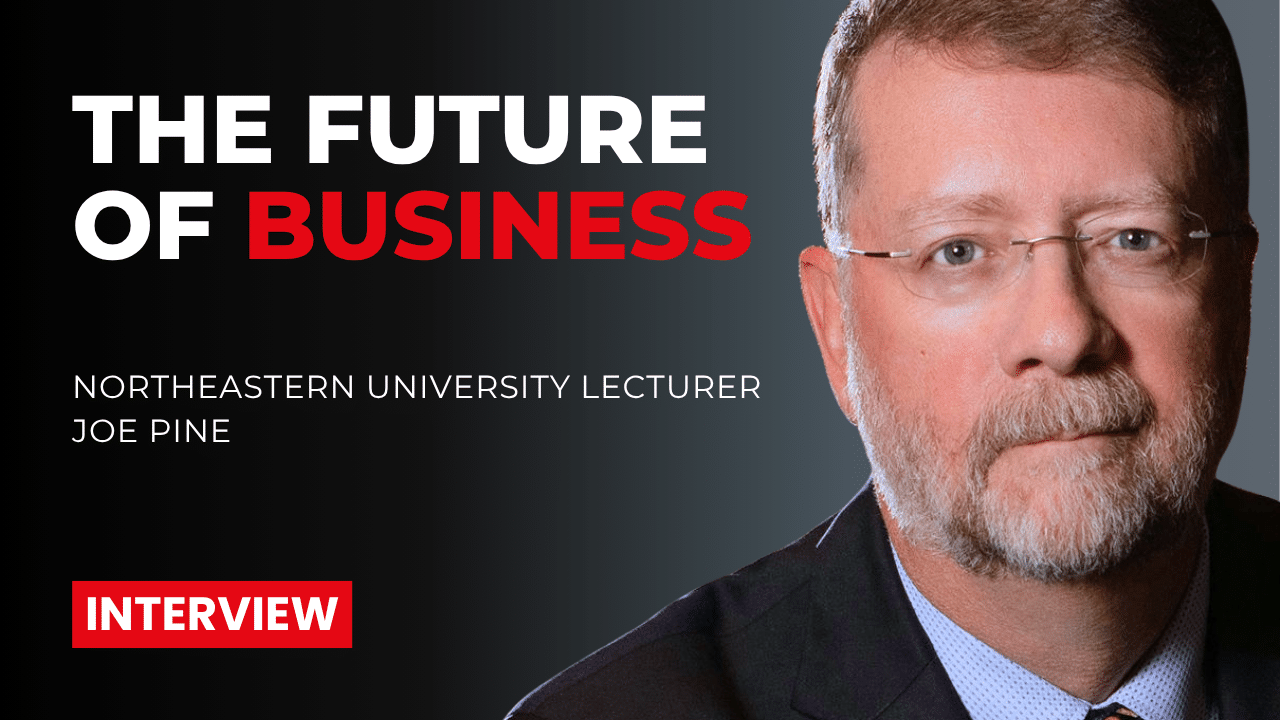
Management advisor and author Joe Pine explores a question that sits beneath most business strategy discussions but is rarely addressed directly: what business is ultimately for.
Drawing on decades of work spanning mass customization, the experience economy, and his latest research on transformation, Pine argues that many companies misunderstand the real value customers seek and therefore stop too early in how they create value.
The conversation begins with the progression from goods and services to experiences and transformations. Pine explains that transformations differ from experiences in one critical way: they must endure through time.
“Memories of experiences fade over time,” he says, “but transformations have to be sustained through time, or you did not in fact transform.”
A central idea throughout the episode is that “all transformation is identity change.” Pine argues that meaningful transformation is not simply behavioral improvement, but a shift in how people understand themselves, whether through enhancement, expansion, cultivation, or complete metamorphosis.
The discussion also explores where aspirations come from. One of Pine’s deeper observations is that many aspirations emerge after disruption, trauma, illness, divorce, loss, or failure. The traumatic event changes a person immediately; the transformation comes afterward in the effort to become whole again.
Pine is careful to distinguish between what companies can and cannot do. “You don’t transform people as a company,” he explains. “They transform themselves. You create the conditions under which” transformation becomes possible.
Another major theme concerns how businesses price value. Pine argues that companies often reveal what business they are truly in through what they charge for. Commodities are priced as undifferentiated inputs, services as activities, experiences as time, and transformations as outcomes.
“You are what you charge for,” he says repeatedly throughout the discussion.
The conversation ultimately expands into a broader philosophy of business itself. Pine argues that the true purpose of business is not profit maximization alone, but “to foster human flourishing”, helping people become “more of who they are meant to be.”
In this framework, profit is not the purpose of business, but the result of creating genuine human value over time.
The episode also examines resistance to identity change, sustaining long-term transformation, coaching and guidance, the future role of AI, and why Pine believes artificial intelligence will function primarily as a tool that helps people live and work more effectively rather than replacing human purpose altogether.
For executives, consultants, educators, coaches, and operators, the conversation offers a deeper framework for understanding differentiation, customer value, and the growing shift from selling products and services to guiding lasting human transformation.
Get The Transformation Economy here:
Here are some free gifts for you:
Overall Approach Used in Well-Managed Strategy Studies
Enjoying this episode?
Get access to sample advanced training episodes
Episode Transcript (Automatic):
Kris Safarova 00:47
Welcome to the Strategy Skills podcast. I’m your host, Kris Safarova. This episode is brought to you by Strategy training.com If you ever felt overlooked in important conversations, I recommend checking out five reasons why people ignore somebody in a meeting at Firms consulting.com forward slash own the room. If you are building or considering to build a consulting practice, you can access episode one of How to Build a Consulting Practice at Firms consulting.com forward slash build, and if your goal is to strengthen your strategy skills. You can download the overall approach used in well-managed strategy studies at Firms consulting.com forward slash overall approach. And finally, for those targeting firms like McKinsey and BCG, or looking to change roles, you can access a proven winning resume example at Firms consulting.com forward slash resume PDF. And today we have with us Joe Pine, who is a management advisor to Fortune 500 companies. He’s the co-author of the best-selling book you probably all guys are familiar with, The Experience Economy, and the lecturer in the Strategic Technology Leadership Program at Northeastern University, Joe. Welcome.
Joe Pine 02:07
Thank you, Kris. It’s a pleasure to be with you. My voice is a little scratchy, it seems, right now, but look forward to our conversation.
Kris Safarova 02:13
Your voice sounds great to me. Let’s start with an overview of your career so far. You join me so far, how you ended up doing the work you did now, but what took you there?
Joe Pine 02:25
Well, how much time do you have?
Kris Safarova 02:28
We have an hour.
Joe Pine 02:31
Yeah, so I, I started. I’m a nerd from way back, you know. Started using computers in the 1970s My dad was in the computer industry from the ground floor. I got an applied math degree, joined IBM, and very technical jobs, but worked my way up into management and strategy. I had a strategy job for a while, where I discovered the concept of mass customization, about efficiently serving customers uniquely. It was coined by Stan Davis, and when I read his book, Future Perfect, from 1987 a long time ago, but still beautifully apparable day, just a beautiful book. He had a chapter on mass customizing, and I said, you know that when I read that, it was like the heavens opened up and the angels sang, explained everything I was seeing at IBM, that we needed to stop mass producing and start mass customizing, so I got that into our plans and strategies, and not too long later, for a reward for a project I’d done, more or less, IBM sent me to MIT for a year to get my master’s in the management of technology, and I immediately said, well, I’m gonna do a thesis I can turn into a book, so I decided to do a full book on mass customization, and that came out in 1993 And I left not too long after that. We used it in IBM Consulting Group, where I was at the time. We used it for our clients, but I decided to go out on my own. IBM gave both my wife and I six months salary, and I said, well, let me see if I can make it on my own, and you know, 33 years later, my wife’s still not sure it’s going to work out, but you know, so far, so good, and so that led to the experience economy, where I understand that mass customizing a good automatically turns it into a service, and as well, what does it turn a service into? I shot back, it turns a service into an experience, and went, you know, just came out of my mouth. It was providence, and I started studying that. I said, well, if that’s true, then experiences will be a distinct economic offering, as distinct from services as from goods, that, and that meant that there would be an economy based off experiences, like they go back to the commodities level, the agrarian economy, the industrial economy, the service economy, and I could foresee that we would go into an experience economy. Took on a partner not too long after that, Jim Gilmore, and so we came out with that book in 1999 updated twice. Last time was in 20. Be 20 and but at that time in 1994 when I first came up with the idea I went again. Well, okay, what does it turn an experience into? And I realized if you design an experience that’s so appropriate for a particular person that you can’t help but turn into what we often call a life changing experience, an experience that changes us in some way. So that’s a transformation. So, the what I publish in the latest book has been there from the beginning. In fact, it was in the last two chapters of The Experience Economy, although a lot of people seem to forget that, even though they told me they read the book, you know. But, and then many other people who did understand it and liked it, you know, been asked me for 25 years, when you’re going to write a full book on it, and I finally decided a few years ago, well, the world’s ready for it now. Was it before the world’s ready for it? I know so much more about it. You know, the time is now. And so that book came out in February of this year.
Kris Safarova 05:53
Congratulations, incredible journey so far. As you were writing the book, the latest one, what did you understand deeper about the people I seek in transformation now.
Joe Pine 06:04
Oh, so much more, so much more. One example is originally I sort of, I sort of, you know, the key with transformations is you’re guiding customers to achieve their aspirations, right? They have an aspiration to become someone different in some way, and and I always used to think of sort of like the blue bird of happiness came down and lit on your shoulder and whispered in ear, oh, you’ve got an aspiration, I never thought about where they came from, and so one of the frameworks in the new book, the chapter three is on understanding aspirants and aspirations, and so I want to develop a framework of where I came from. One of the things my research showed is that a lot of aspirations actually come out of trauma. The trauma immediately changes you, right? You are, it’s a metamorphosis, you’re not the same person if you get cancer, if you, the loved one dies, if you get divorced, and so forth, you get injured, and whatnot. Then that, that you immediately changed, and so the transformation is to recover from that change, to get back to whole. You’ll never be the same person you were before, but you can become someone who has overcome that trauma in some way, and so that was a big thing. Another one is understanding that all transformation is identity change, that it’s identity that you’re changing now, it’s self identity, it’s how we identify ourselves, and we either take on new levels of identity, or we are, we enhance or expand current levels of identity, and that was a big understanding. I did, I did a presentation on this before the book came out in London in January, and one of the people there, one woman told me, he says, “You need to say that at every presentation. I got the most out of that one statement, that all transformation is identity change, you know, everybody gets something different out of it, and so now I do that. I do say that in every transformation, or every presentation, or workshop that I do. So those are a couple of the big ones. Another one is, I, as I realized, and I have no idea what questions you’re going to ask as it gets into some of your questions, but one of the things I realized too is that there’s all I always know that there are there are gray areas between the offerings, right, between commodities and goods. When you refine a commodity, you know what point are you changing it so much that it now becomes a physical good, and with services and experiences, you know, what point does it rise to the level of memorability to create that experience, and so it is here, and I’ve long thought that meaningful experiences are a half step towards transformation, right? That memorable experiences engage who we are, meaningful experiences connect with who we are through to our identity, and that’s why it felt like a half step to a transformation, lazy lead to one, but I then figured out, well, actually, there’s another level of experience of transporting experiences, transporting experiences that get out us out of who we are, that give us all, or get us into flow, or transcendence in some way, and and then finally, are the transformative experiences. I always knew we only ever change through the experiences we have. All the five genres of economic offering in the progression of economic value, as we call it, all build on top of the others. You have to have all of them in order to create the highest level that you’re working on, and and so there always were transformative experiences, and and so it’s just a fourth level there, sort of little, little hierarchy of experiences,
Kris Safarova 09:51
and that is also bad news for many people, because many people are looking for shortcuts, here there is a realization that you need to change your. Identity, and of course, anyone who have been through progress in their own life, where they’re on purpose, want to be more impactful and more competent, and grow not as everyone else, but like this. It always requires identity shift, and when you work with clients, you see it, you can give everything, all the steps that needs to be taken, but if the identity shift has to come along with it, you have a different person to be at a different level,
Joe Pine 10:30
and they, they have to do that themselves, right? You don’t transform people as a company, they transform themselves. You create the conditions under which, and as the old saying goes, you can lead a horse to water, but you can’t make it drink, and so they have to, they have to eventually come to that level, that point where they change their identity slowly or all at once to be able to make that transformation, and then also the other thing is that transformative experiences generally aren’t enough in and of themselves, because you also have to sustain them through time, that that transformation, the memories of experience fade over time, they dissipate in that some last last as long as you’re alive, but you don’t have the same level of detail of those memories that you did right after that experience happened, but transformations have to be sustained through time, or you did not, in fact, transform, you know, if you go through a, a weight loss program, maybe you’re using GLP ones to do that, and you lose 20, 3040, pounds, whatever your goal is, but then you stop the program, and or they stop the program, often it’s like, okay, you met your goal, we’re done. And then you start to gain that weight back. Well, then you weren’t truly transformed, right? You got it. It has to sustain through time to be a transformation as a distinct economic offering.
Kris Safarova 11:54
That is very true. And identity is, of course, very connected to beliefs. So, let’s talk about that.
Joe Pine 11:59
Well, beliefs is one of the elements of identity. In fact, is what your, your beliefs are, which you manifest in your worldview or your mindset, in your values. Those are all elements of what I think are core identity that that really, really define yourself. There are other things that are more on the periphery about how you know your way of being in the world and other aspects of identity for those, if you’re changing a core identity, then it is truly going to be a metamorphosis again, a change in who you are versus just an enhancement of who you are, an expansion of who you are, as it is with changes that are more in a enhancing your current levels of identity, becoming more of that.
Kris Safarova 12:51
Let’s talk a little more about types of transformation.
Joe Pine 12:55
Yeah, so there are there are four types of transformation that all relate to four different types of aspirations that you have, right, and so it’s based on whether it’s a two by two, obviously, if there’s four of them, it’s based on whether your change is in a current level of identity or whether it’s in a new level of identity, and then whether it’s small scale or large scale, and so a small scale change in current identity is when you are enhancing some level of identity, so maybe for example you’re a cigar smoker and you decide to become a cigar aficionado and you just learn more about it and enhances that level of identity that you have, if it rises up to a large scale change, maybe you’re a golfer and you want to become a single digit handicap golfer, then that’s an ambition that you have, and so where you can enrich or enhance aspirations of that small scale change, you expand with ambitions, right, that you expand in order to be able to attain those ambitions that you have. If it is adding a new level of identity, that also can be small scale or large scale, and it can be where your, you know, it’s a cultivation that I call it, that you have, and that cultivation of something new. Maybe you would decide you want to be a gardener, and so you take classes in gardening, you go to workshops, you try it out, you try things, you talk to landscape architects, and so forth. But it’s always a hobby, as opposed to a core level of identity, right, you, you don’t have to necessarily do that for the for the rest of your life, but it’s a new level, and that’s significant, so you got to cultivate those sorts of things, and then the large scale change in new elements of identity is metamorphosis, right, you have an aspiration of metamorphosis, you want to make a wholesale. Change, and some core, one or more core levels of identity, and there it’s about, it’s about those are life-altering transformations, or business-altering, if you’re selling to businesses, right, so you’re altering them to take on a new level of identity that replaces elements that were afforded, that doesn’t just enhance them,
Kris Safarova 15:20
and aspirations are the starting point, but the challenge there is you can only aspire to something that you’re even aware is possible for you, and you may be aware that it exists, but you have that another element that you may not believe it is ever possible in your situation,
Joe Pine 15:39
right? There are some times where you couldn’t hope to achieve something that in fact is possible for you, and you may do some interim levels of transformation to be able to get to the point where you realize, hey, I really could be that, that, that, that, it is that the possibility opens up to you and your thinking, and then you can gain that new aspiration or greater level of aspiration to to become something that you didn’t think was possible before, or
Kris Safarova 16:07
you can have somebody who can see what is possible for you, because
Joe Pine 16:11
for you
Kris Safarova 16:12
think
Joe Pine 16:12
right, and you think about that, that that that’s often the case, for example, with parents and their children, right, the parents have aspirations for the children that the children may have, like, you know, playing piano, for example. You know, my wife made our kids take piano lessons, so they didn’t like it at first, and they simply said, “Well, you have to take it through this point. I think it was like three years, right? And then, and then you decide not to take or not, and they agreed to that. And at the end of three years, they were pianists, and they loved it. They enjoyed it, and they kept it up, you know, out of their own. Finally, they gained that intrinsic motivation, whereas extrinsic, before you’re doing this because your mother tells you to do it, then it becomes intrinsic within them. But I’m sure it was something when they started out, they didn’t, they didn’t dream of that. And there are many, there are many situations where I’ll say the customer, the one who’s paying the money, right, is the customer, but in fact the beneficiary of that transformation is somebody else, right. Mostly you see that in parents with their children, it could be also organize your businesses for their organization or for their employees as the beneficiary of the transformation is another possibility. Communities, as well, you may want a community transformation, and everybody in the community benefits, but not everybody pays for that.
Kris Safarova 17:31
Very true. As you may research in this topic, what did you learn about the resistance that is there when you’re working on changing your identity and how to deal with that resistance.
Joe Pine 17:44
Right, right. Well, there’s often in any change there are antibodies that come out. Sometimes those are external. If you look at an organizational change, then there’s always going to be antibodies that want to keep the way it is before, and there may be you have friends or loved ones like that don’t believe you can do something, and they, they denigrate it, or they believe that it would be bad for you, and they try and convince you otherwise, or sometimes it just would be bad for them that their life, you change your life in that way, then I have to change my life, and I’m not sure I want to do that. For example, if one part of a couple decides to become a vegan, and that may be well and good, but then does the other person have to become that vegan as well? So they’re going to have that resistance or create that resistance for you, but there’s also resistance inside of us that, that you know, life happens, we’re busy people, we don’t always have the time to do everything we absolutely don’t have the time to everything we generally want to do, and that includes things that will change us in some way, and so over time that that you can have these internal resistance, or at least a tension that draws that says, am I putting too much time to this, I’m therefore forsaking other things, should I be doing those, and whatnot, and that can derail transformations, and that’s where the key is to, is to have a commitment, right? You need to make a commitment, particularly, I mean, in the smaller scale ones, that’s not always needed, and it’s fine, like if you start on a transformation, you don’t, it’s not going to change your life dramatically, but on the large scale ones, you really need a commitment.
Kris Safarova 19:24
When I immigrated the first time, I immigrated three times in my life. So the first time I immigrated, I realized that my degree could not even be found in a database. So my diploma from Russia, being a pianist, by the way, it does not exist wherever I studied, even though it was very prestigious there in Russia, and so I went. I was working part-time and studying as well, and when I started, it was so hard, because I barely spoke English, and I had to translate every word in a book. I remember my first economics book, I had to translate every word with a pencil above it to understand what it is even mean, and. But I committed to myself that I’m going to get all A’s. Initially, I wasn’t sure I could, so it’s interesting. This, this, what we’re discussing, exactly, a real-life example. Initially, I was afraid I’m not going to pass because of my English, and I had somebody who told me, “No, you’re not only going to pass, you’re going to get all A’s, and once I got all A’s, the first time I realized, yes, I can do it, and then I got all A’s, and it never stopped after that.
Joe Pine 20:31
The I always, I was sort of similar, as I, you know, I was always a very good student, I understood everything, but didn’t always apply myself, and so I got A’s and B’s, and you know, through school into high school, and my parents said one time, I remember, you know, you’re going to go to college, you already go to college, right? Yeah, planning going to college, get an applied math degree, is what I ended up with, but something like that, or computer science, math, or computer science, and I said, well, you ought to start, you know, really up in your grades, is okay, I’ll get all A’s from now on, and I did, except for one course, which is the only course in my life where I feel I got cheated out of an A, because it was an English course, and my English teacher wanted me to go out to one of her plays. She managed the theater in there, and I wish now I wish I did, because I understand the importance of theater now in business, but then I didn’t, and so I think that’s why I got only a B plus on that, but to make up for it, then I got I got all A’s in college, except for fencing and volleyball half credits, I don’t, I don’t even remember why I did, I felt like I did pretty well in them, but there was one course where I thought I didn’t deserve an A, and I got one, so I, you know, it sort of evened out. And then, when I got my master’s at MIT, I got all A’s, you know, just so every time I moved up a level, actually, my GPA went up.
Kris Safarova 21:54
That is amazing.
Joe Pine 21:55
You do, do you still play the piano?
Kris Safarova 21:57
I do not know. I don’t have a piano. I live in a hotel for piano, so no piano, but when I visit somebody and they have a piano, they usually ask me to play, but yes, I can still play, but not something I do on a day-to-day basis, and of course we also have subconscious mind, and we are not aware of all the beliefs that are running our life. What are your thoughts on figuring out what are the beliefs that are running in your life that you need to reprogram to change your identity?
Joe Pine 22:32
Yeah, I haven’t spent a lot of time thinking about the the subconscious mind and how it relates to all this, but there are things rambling around in there that can affect your conscious and what you’re looking for. There may be things where you, you gain an aspiration, but you don’t know where it came from. And I mentioned the bluebird of happiness earlier, but it’s actually maybe something in your subconscious that releases something that happened in the past and makes this connection that said, hey, this would be a good thing to do, and so, so I think there are things that come that can come out of that, and also the subconscious is great at, at sort of like getting you to come up with things that that you’re wrestling with, that’s why you know people come up with great ideas in the shop. It’s not because they’re thinking about the ideas, but their brain is thinking, they’re not consciously thinking about the ideas, but their brain is subconsciously thinking about all those things, and all of a sudden you get this insight that comes out of
Speaker 3 23:35
it.
Kris Safarova 23:35
Could you maybe take us through an example from your own life when you, on purpose, we’re working on your identity, something you feel comfortable sharing, where people can see it happening step by step, and then they can think how they can do that process for themselves.
Joe Pine 23:51
Well, an easy one in relation to what I talked about before is becoming a book author, right? So, a statement of identity, I am a book author, and or I am an author, and that’s an identity that I gained, and I gained it intentionally. I’ve always loved books from the beginning, and always been a big reader. I remember having other arguments with my wife with the kids, where she’d say, you know, stop, it’s a beautiful day outside, stop reading on the couch, and go outside and play, and I sort of said, never tell your kids to stop reading, you know, I think that’s the best thing that you could do, and now the grandkids are turned into big readers, so and the daughters were so so it was always this notion of being affiliated with books and loving books, you know, sort of all kinds, and and then after I joined IBM, and I decided, okay, I wanted to go into management. I had a thought of, well, maybe I’ll go into management, and you know, I’m never going to be CEO of IBM, so maybe I’ll go to like 40, maybe 50, and then I’ll quit, and I’ll go back, get a PhD, and become a professor, and write books, and the only issue is whether it be in business or. In theology, so I thought of that, and that’s why when I got that opportunity to go to MIT and do a, and do a thesis, like immediately my mind went to, “Oh, I could write a book instead of just write a thesis, I could write a book, right? and become a book author, so that became an explicit aspiration while I was at MIT to do that to get a book contract when I went out and to then and then you know that’s ever since that’s what I am, I you know you can define what I do a lot, but I always start with with author, I’m an author, speaker, management advisor, but author is always first,
Kris Safarova 25:40
such a great example.
Joe Pine 25:41
There’s there’s a big thing going on now about great inflation. There’s an article, I think, in the Wall Street Journal last week about how Harvard was going to cap the number of A’s. I think it was 50% and I found late in the article I assumed that was A’s and A minuses, but later in the article, no, that was just the straight A’s and A pluses, A minuses are different, and it talked about how you quoted many students that, like, are going through psychological trauma that they might not get straight A’s anymore, because probably because they identified as a straight A student, even though they really weren’t, you know, if they really were straight A, to it, this wouldn’t bother, because that’s okay. I’ll be that, that top 50% doesn’t, wouldn’t bother me at all, and wouldn’t bother you as well, but so sneaking in the back of their mind was this realization, you know, I really didn’t deserve all those A’s that I got, and now they got this distance between thinking their identity is I’m a straight A student, realizing well, it really isn’t, it’s only because they’re inflating the grades that you are, and they just don’t know how to react to that. I think that can happen in a lot of elements of identity,
Kris Safarova 26:48
that is very true. And those of us who develop this identity of straight A’s, the danger with that is we work ourselves so hard and continuously after that as well, that our health gets impacted, we need actually some help for students like that to make sure they understand that your health is still your number one asset,
Joe Pine 27:11
right? Right. And for them, at some level of trauma,
Kris Safarova 27:14
yes,
Joe Pine 27:15
right. Again, to get back to that,
Kris Safarova 27:17
especially if it is your way out of poverty for someone reading your book, what are the key things you want them to take away?
Joe Pine 27:26
So, several of them. So, one key takeaway is to recognize the opportunity that you have to get into the transformation business, right? And there, the recognition is understanding that whatever you sell today is a means to an end, right? And ask why you can. Do your customers buy this offering from us, whether it’s commodity goods, service, or experience. And then, okay, why do they want that? Why do they want that? Right, good string of five whys, as we say in manufacturing, until you get at the core aspiration, recognize you can be in that business, you can provide not just the means, but the end, and so encourage companies to ascend to the proposition that you’re in the transformation business, and many businesses should be that just don’t recognize that, you know, one of the things I say is that any business that’s in the business of being healthy, wealthy, and wise, to use an old English proverb, is is in the transformation business, but very few act like it, very few understand it, and simply making that proclamation, making that commitment again, that you’re in the transformation business, that will cause you to do things differently, and therefore you will, you will then be able to figure out what it takes to transform your customers, so that’s one key thing. A second thing is to understand that the raison debt of business is to foster human flourishing, and this is really key. It’s something that was like a small little, like maybe paragraph at the end of a chapter, and in my original outline became the focus of an entire chapter. Is this fact that business exists to foster human flourishing? Again, it’s a proposition you need to ascend to, because most businesses don’t realize it, but if you, whatever economic offering you sell, customers only buy that offering if they think it’s going to better themselves in some way, even if momentarily, and as with, as with experiences, you know, and with like sweets, and, and, and things like that, and they don’t give up money out of their wallet, their purse, or their account, and that to give it to you for your offering, unless they think they’re going to be better off. So that’s human flourishing, right? It’s making people better off than they are today, and, and so it’s always been the case that, that you know, capitalism is based off of this. It’s part of what Adam Smith talked about in The Wealth of Nations. And also in his other book, The Theory of Moral Sentiments, that not as many people in business actually read, was a great philosophical book that also that talks about this, and the term human flourishing goes back to Aristotle, actually, there, but there’s mentions of it in the Bible that predate Aristotle, right, so it’s been a concept that basically has always been around, and and companies will be better off themselves if they understand that this is why they exist, and this is why capitalism exists. This is why capitalism been the greatest force for good in the history of mankind, where you know, since capitalism was basically invented, it’s been a hockey stick of growth, and not just economically, but economic growth helps people grow in flourishing, right? Where we used to live lives that were nasty, brutish, and short, now we can live lives of abundance. The amount of abundance we have today is, it would be unfathomable to kings, you know, hundreds of years ago, they couldn’t imagine being able to have what we have today, and and so it’s not the case that you are, that you’re a prop, profit-seeking enterprise, right? Profit should never be your goal, but many people treat it like that. It’s profits are your measure of how well you help your, your customers flourish in particular, but then to do that, you need to help your employees flourish and help them flourish. Need to help your community flourish, and society overall, and the planet overall flourish, right? Are you a net contributor to human flourish, flourishing? If not, as my friend Stan Husted likes to say, if you, if you don’t contribute to human flourishing, then you’re a racket, right? And don’t be a racket. There are many companies today that try to addict to their customers on their products, right. We’ve seen that in the news recently, and, and that’s it’s morally wrong to be able to do that, right. You have a particularly, as a transformation guider, you have a fiduciary responsibility to do what’s best for your customer, even if it means you lose money in the short term or don’t gain as much money in the short term. When the long term, you will be better off, you’ll be able to create a business that, as my colleague Kim Korn says, can thrive forever if you focus on human flourishing and develop the right ways of managing your business, where that is the top goal of what you’re trying to do, not making money. Money, money will come as a result of that.
Kris Safarova 32:30
Joe, and when do you think people will struggle implement this?
Joe Pine 32:34
Well, it’s a mindset change, right? So you need an identity change of your mindset to be able to accept this premise, right? It’s not something I can prove, obviously. It’s not – there’s not a mathematical equation for this, but it is something that, if you understand and accept it as a premise, then you will benefit. Your people will benefit, the country in the world, but especially your customers will benefit as a result of that, and again, the profits will come over the long term.
Kris Safarova 33:05
As you were writing the book, doing the research, thinking about this topic, what surprised you the most?
Joe Pine 33:11
Well, it did surprise me how important that became in the writing, that I thought it was a little thing. Another thing that surprised me is I wanted, I wanted to come up with a model for types of transformations, and I actually, I wrote the book, actually on Substack. I have, you know, 1000s of Substack subscribers that have gotten the entire book, actually they’ve gotten like 125% of the book, because I edited it down with me and my editor, and on Substack before it’s published, so the access to much more, and I had two different frameworks for types of transformations, and I liked them both, but but they were different, and one I really liked one of the quadrants in this two by two, and the other one I really liked another quadrant in the two by two, and so I didn’t know what to do. Didn’t make sense to have two of them, so I put it out on my Substack, and basically said, “Hey, here’s what I’m thinking of. Here’s two different frameworks, but which one do you like best? And I got feedback that most, I don’t know, close to most, maybe it’s like 40% of them like both of them, but, but then a significant percent, 20% or so, didn’t like one or didn’t like the other, and just seemed like too much of a, of a negative mark on each of them. I said, just throw them away, and that’s where I then went into my, my conference room on the other side of this, my wall on this side again, all bookcases on this side as well. I have a conference room with a whiteboard wall, and I went on the whiteboard. I started doing all this stuff, put the frameworks up there, started thinking, started developing things, and called my consigliere, Kevin Dulley, who illustrates. All of my ideas, when I give presentations, so forth, he makes them sing, and so knows them better than me, knows my ideas better than anybody else. So I talked to him for a lot about him, and and this is like a Friday afternoon, and then next, the next day, I spent another several hours at that board, just thinking about these, and then the following day, it’s not in the shower, it was actually in church. I was listening to Serve It in Church, and all of a sudden, out of my mind pops this way now called the Delta model, which looks like a Delta, Delta being the universal symbol for change. So I always shorthand transformations with a Delta symbol, and with three different segments, and then the bottom segment is the experiences that I, that I mentioned before, memorable, meaningful, and transporting experiences. And then in the middle segment, the transformative experiences are part of that, but don’t kris the whole thing, because you need to have other things, you just sustain it through time, in particular. And then the top was a was the top segment, which looks like a delta itself, right, since it’s also a triangle with the extra stuff on the right side, that was for changes in core identity, that was for metamorphosis, and and to recognize that that was so much more than than the other ones, and so, like I said, you know, with just in seconds in church, I write it down on this delta model and notes and knew what it was, and everything, so I think of that as providence again coming out of my mind, and not knowing where it came from. I think it came from God, that said, “Okay, during a sermon, I’m going to show you what the model is, and so that was a big surprise, and coming out of that,
Kris Safarova 36:37
and I love that you did not just say, “Oh, it’s good enough, I’m just good, include both of them,
Joe Pine 36:42
right? That’s what my, my high school physics teacher taught me, right? Don’t be good enough, right? Be what you can be. Wait, let me also further define human flourishing. Right, what is human flourishing? There’s, there’s a lot of.. there’s been a renaissance in positive psychology over the last 2025, years that talk about human flourishing, a lot of measurements of everything of it, and I remember one that was something like, well, if you’re at a certain level of these four out of out of any four out of seven things and you’re flourishing, I was like, well, that is so totally arbitrary, and it differs from everybody, we come from different, we’re different people, we come from different, a different heritage and history of who we are, and so forth, and what our beliefs are in that, and so if I decided that the best definition was human flourishing is the extent to which we are who we are meant to be, right, that’s flourishing, and everybody can increase their flourishing, no matter where they are, there some people may not be capable because of where they were born, when they were born, circumstances of birth and life that prevent them from doing certain things that others can do, but but the question is, Can you become more of who you are meant to be? And that’s what transformations again help us
Kris Safarova 37:59
do. The way I think about it is, if when you die, you meet God, and God tells you, okay, this is who you could become, to be as close to that person as you can be,
Joe Pine 38:09
right? Exactly, it’s exactly the way I think. I had a.. I had.. after I say that in the book, I write presence, parenthetically, no matter who or who, capital W, meaning God means you to be, and there’s somebody on LinkedIn just the other day that said something about, you know, my great fear is that I’ll die, I’ll be to who I was meant to be, right, and not even recognize the person. No, don’t let that happen to you,
Kris Safarova 38:41
very true. I think anyone who is listening to our podcast, they are driven people who are working very hard to be the most they can be.
Joe Pine 38:49
Yes,
Kris Safarova 38:50
in all aspects, not just professionally, financially, but also as a human,
Joe Pine 38:56
right?
Kris Safarova 38:56
What do you think people will most likely misunderstand after reading the book,
Joe Pine 39:02
they.. it’s a good question. Also, got to think about a little bit, but I think they might not understand what it truly takes to be a transformation guider, that they’ll stop short of it, that they won’t do the sustaining afterwards. They’ll say, okay, they were transformed, you know, job’s done, go on to the next customer, sort of thing, but there’s so much more value that you can create and sustain that, and having a lifelong relationship in many cases with people. I plan on having a lifelong relationship with my golf coach, right, who helps me improve my golf game, or at least maintain it where it is, and there’s opportunities in doing that, and also that they won’t go forward far enough in, and what you need to charge for to truly be in the transformation business, right. All these are distinct economic conferences, so there are many service companies, even goods companies, for example, that are experiential, but not. A full experience that are transformational, but not a full transformation, and part of that is understanding that you are what you charge for, right? You are what you charge for. If you charge for undifferentiated stuff, you’re in the commodities business. If you charge for tangible things, you’re in the goods business. If you charge for the activities your people perform, you’re in the services business, but in the experience business, it’s if and only if you charge for time, the time your customers spend with you, and that means an admission fee or a membership fee of some sort, sort. And it’s probably the biggest thing that Jim Gilmore and I, we wrote The Experience Academy, that we got pushed back on, is actually charging a mission fee, and because there weren’t that many examples back then, other than the obvious ones that are traditional experiences, you know, sporting events and concerts, and and theme parks. Then that’s what I point to. Look at all those things that you know are experiences. All of them charge for time, right? They charge for the time the customer spends, because that’s what they value. That you eventually have to align what you’re charged for with what your customers value, right? And experiences that time. Well, with transformations, it’s outcomes, it’s the outcomes they achieve, it’s achieving their aspiration. So, you need to charge for the demonstrated outcomes that your customers achieve. And again, we said that in 1999 in the original edition of the Experience Academy, without very many examples of that either. I’m trying to think if we had any thing about it, I have to go back and check, but now you know hundreds, you know, and there are 1000s of companies that do this, and some great stellar examples, and where they make more money because they charge for outcomes, because what does it do? Is it’s a catalytic mechanism that says you and you have to do everything you said you’re due, you have to make sure that your customers transform and sustain that transformation, or you don’t get all it’s in and out 100% but you don’t get all of your money, you don’t get paid the full amount you could have, and so you do things differently based off of that. So I think that’s the, that’s the also the one thing that people won’t fully embrace, that they say I really don’t have to go to that level, you know that I can just charge a premium for what I’m doing, and eventually that catches up to you, because you’re misaligned, you’re not, you’re not charging for what your customers value, so you won’t, you will often, in many cases, not give them what they truly value, only give them some portion of it, and so you’re not creating as much value, and eventually that’ll affect your pricing as well.
Kris Safarova 42:23
Joe, you think about things deeply. I want to ask you a question about AI. I know it’s very hard to predict, but what do you think the world will look like in one year, two years, three years from now, and how people should think about what we’re living through.
Joe Pine 42:37
Well, I always, I always think change happens faster than it really does, and so it’ll take a long time, that you know, so when I, when the experience county came out, I used to have to argue with people that this is happening, and, and sometimes vehement arguments, and have to get into a lot of detail, look at the economics and things to be able to show them, and around the maybe 2005 2010 that basically all went.. it was actually earlier 2010 so maybe four or five, it all went away. As I would say, it people go, “Oh yeah, I get that. Right, became part of the air we breathe. We all understand we prefer experiences over things today, and so you can’t help but ascend to that proposition about experiences, so so I’ve not had any arguments with anybody about transformations, right? Like I said, I think the world is now ready for it, and so, so I’m not arguing with them, so I’m hoping things will proceed faster, particularly that since you can point to so many places, you know, the healthy, wealthy, wise, of which I expand in the book to health and well-being, wealth and prosperity, knowledge and wisdom, and also there’s a fourth one, which is purpose and meaning, and everybody can put themselves in there and understand that, yes, people value that, so, but still, it’s going to take a long time for them to fully embrace everything, particularly the charging for outcomes, it’ll take, you know, you know, a decade or two or three to get more and more companies to do that, but if they did at the beginning, it’d be so much easier to get to the level of transformations and so much quicker than they would if they leave that they that part out, so there’ll be there will be more and more companies that get into the transformation business, more and more companies that at least become transformational, if not full transformation. The obviously you know the thing everybody’s mind in 123, years in the future is AI, and what effect that’s going to have. I’m a big believer that AI is just a wonderful tool, that it’s going to create another like industrial revolution. It will eventually create more jobs than it eliminates, like every other tool that we’ve created. There’s not – this is not an exception to that. I don’t believe that artificial general intelligence is. Is even possible, right? That’s not what these machines do, because to have that, you got to be able to think about thinking and have emotions about things, and so forth. And I’m also not worried about the Terminator scenario, where they turn against us, although it is, it is possible, but I think the more likely scenario is the Wall-E scenario. I don’t know if you saw the Pixar movie Wall-E, where we’re all fat, dumb, and happy. We just let the AI serve us, and which, in the end, means we’re serving it instead of using it as a tool to help us do our jobs better, to help us live our lives better, to help us become who we want to become, because AI will be a great benefit for transformation guiders.
Kris Safarova 45:45
Thank you, Joe. Anything else you wish I asked you, and I did not
Joe Pine 45:49
always want to get human flourishing in there, but you did ask. Allow me to ask that later, or to answer that earlier, I should say, so well, the one thing you could ask is, well, what’s after transformations?
Kris Safarova 46:07
Let’s talk about it.
Joe Pine 46:09
Okay, nothing. I mean, no more economic offerings. I fully believe that there are five and five only economic offerings, and so we’ll, as the others diminish, and I mean, we’ll always have commodities, good services, and experiences, but it will take fewer and fewer people to be able to produce them, and they’ll be less and less a part of the economy, part of GDP, and they’ll be subsumed more into experiences and transformation offerings, and it’s because of this heuristic core to the progression of economic value, where I talked about customization earlier. What customization is, is the antidote to commoditization, right? Think about strategy, right? One of the things that strategies do is avoid commoditization, right. We’re, and if you do nothing else, commoditization is like the law of gravity. Eventually, you will be commoditized, where people buy you on price and convenience customization lifts you up. Customization is the antidote of that. If you customize, you can’t help but be differentiated, because you work with each individual customer on exactly what they need, or very close to exactly what they need. So that breaks down at the transformation level, which is that you can’t commoditize transformations in the same way as experiences, which, which can be commoditized. Look, what’s going on. Starbucks is doing is trying to get out of the commoditization trap it found itself in, it managed itself into, it strategized itself into, and the because the customer is the product with transformations, does inputs don’t matter, only outcomes, right? That’s why you have to charge for outcomes, because the inputs don’t matter. You charge for inputs, you know, they don’t matter. It’s only did I get to achieve my aspiration. The customer is the product, a change customer is the end result of your offering. And human beings cannot be commoditized, you know, pretty much by definition. We all are unique in every way, every human being is unique, and from can’t say from, but every human being is unique, and so you can’t commoditize them, and so what happens when you customize them, right? It breaks down there as well. On the commodity, and I’ll mention, too, is that we, we have this innate human thing where we rebel against people commoditizing human beings and bodies, you know, selling body parts, for example, and even selling themselves in terms of prostitution, and that is that we have this innate rebellion against that idea. So, what happens when you customize a transformation, when you design a transformation that is so appropriate of this particular person? Well, the only thing that I think of that isn’t just another transformation, is that you would perfect them and have no need of any further transformations, and that’s not the province of economics, that’s the province of God, right? God’s only one that could can perfect us, can sanctify us, and further, I’ve tried and can’t think of any other way that you could charge for your offerings, other than as stuff, things, activities, time, and outcomes. I had a friend a couple of years ago trying to convince me that she came up with a sixth economic offering, and I’m open to it. I could be wrong. This is how I think about it. And say, okay, let’s talk about I said, well, okay, that’s a transformation, but what makes it a distinct economic offering? She argued tomorrow, I said, I don’t see it. I said, okay, let me ask you this. This will convince me, what do you charge for that’s different than these other five things? And she couldn’t come up with anything. I said, all right, when you come up with something, then come back to me and say it’s a distinct economic offering.
Kris Safarova 49:38
Yeah, thank you so much. I really enjoyed our discussion. I love the last question you came up with. That was a perfect question for the engine. Where can our listeners learn more about you? Buy your book, anything you want to share.
Joe Pine 49:51
You can buy a book wherever it’s sold, as they say. Amazon is easy, and go directly to Harvard Business Press, particularly if you want to buy in quantity. If you get quantity. Get a better price, and they have some customization options. There you can find me on LinkedIn, very easy enough, Joe Pine. Look that up if you want to connect. And then our website is Strategic Horizons with an S, Strategic horizons.com and we’ve got a page there slash integration where you can learn a lot about transformations. There’s a transformation toolkit for how to do all of this stuff, and then I’ll mention my Substack, if you’re interested in going into the depths, and I continue to write on and continue to learn new things from conversations I have, such as with you, Kris, and that’s at Transformations book.substack.com
Kris Safarova 50:42
Yeah, again, thank you so much for being here.
Joe Pine 50:45
Thank you, Kris, I appreciate it.
Kris Safarova 50:47
Our great guest today was Joe Pine, and our podcast sponsor is Strategy training.com You can get some gifts from us, you can get some reasons why people ignore somebody in the meeting at Firms consulting.com forward slash on the room, you can get first episode of how to build the consulting practice. Access to that episode, you can get it at firms consulting.com forward slash build. If your goal is to strengthen your strategy skills, you can download the overall approach used in well managed strategy studies at firms consulting.com forward slash overall approach, and if you are targeting firms like McKinsey or BCG, or looking to change roles, you can access a proven win resume example at firms consulting.com forward slash resume pdf. Thank you so much for tuning in, and I’m looking forward to connect with you all next time.
Leave a Reply