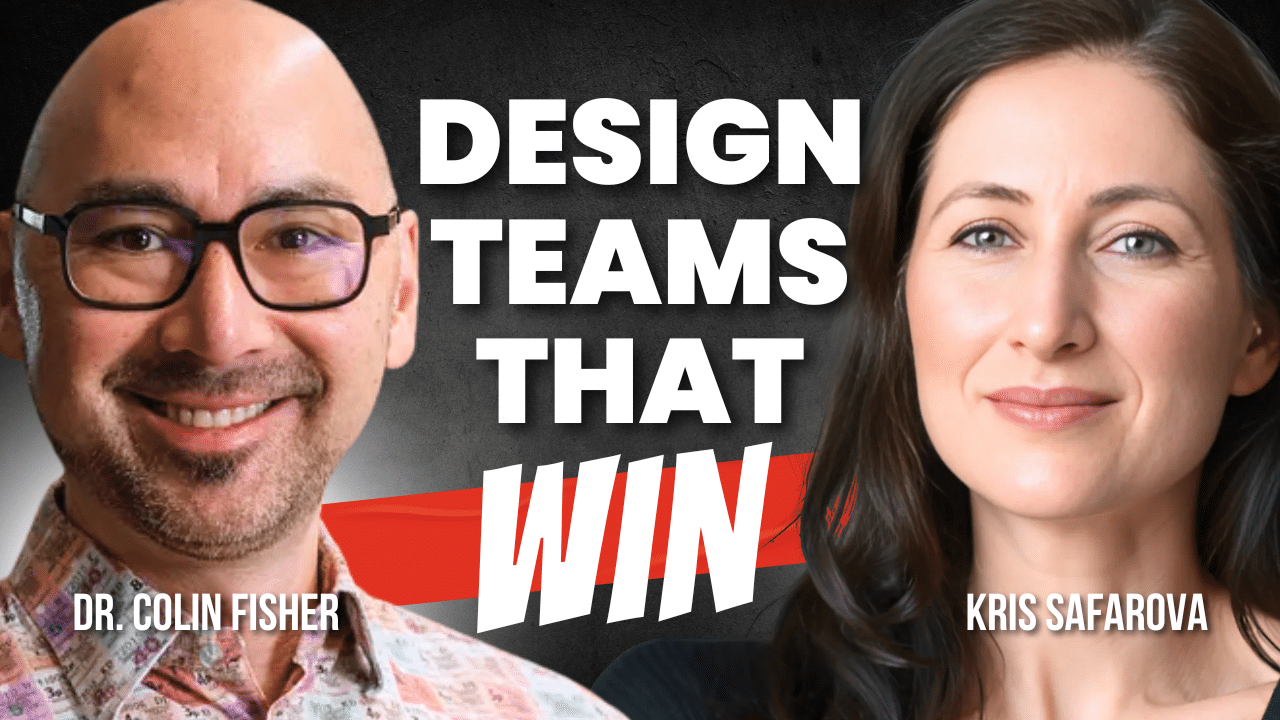
In this rigorous and insight-rich episode, Dr. Colin Fisher, author of The Collective Edge, deconstructs high-performing teams using decades of organizational research and field-tested frameworks. If you lead, manage, or influence teams, the insights here can recalibrate how you build and guide collaboration.
We explore four foundational elements (Composition, Goals, Tasks, and Norms) and dismantle prevalent myths that often derail even experienced leaders.
Key insights include:
- Composition: A team’s effectiveness begins with clarity. In a landmark study, only 7% of top management teams agreed on how many people were actually on their team. “We can’t compose the team thoughtfully unless we agree on who’s in the team in the first place.” The ideal team size? 4.5 people. Why? It balances task performance and member satisfaction, minimizing coordination cost while maximizing cohesion.
- Goals: Most teams fall apart not because of conflict, but because “members don’t share the same understanding of what the group’s goals are.” Dr. Fisher emphasizes that goals must be clear, challenging, and consequential, repeated often, and refined constantly.
- Tasks: Don’t assign group work to solo tasks. Effective team tasks must require interdependence and diverse expertise. Leaders must provide “clear goals but autonomy over process.” Micromanagement erodes both accountability and innovation.
- Norms: Often invisible yet decisive. Norms around psychological safety and information sharing distinguish resilient teams from dysfunctional ones. Without them, even the most capable groups collapse under miscommunication or fear of speaking up.
Dr. Fisher’s core thesis is deceptively simple: The secret sauce is sustained attention to the basics. His research confirms that elite leaders are not mystical intuitives but methodical questioners and attentive listeners.
If you care about sustainable performance and intelligent team design, this conversation delivers a precise blueprint.
Get Colin’s book here:
Here are some free gifts for you:
Overall Approach Used in Well-Managed Strategy Studies
Enjoying this episode?
Get access to sample advanced training episodes
Episode Transcript:
Kris Safarova 01:15
Welcome to the Strategy Skills podcast. I’m your host, Kris Safarova, and our podcast sponsor today is StrategyTraining.com. If you want to strengthen your strategy skills, you can get the Overall Approach Used in Well-Managed Strategy Studies. It’s a free download, and you can get it at staging-df81-firmsconsulting3.wpcomstaging.com/overallapproach. You can also get McKinsey and BCG-winning resume, which is a resume that got offers from both of those firms. And you can get it at staging-df81-firmsconsulting3.wpcomstaging.com/resumePDF. And today we have with us Dr. Colin Fisher, who is an associate professor of Organizations and Innovation at University College London School of Management, and the author of the new book The Collective Age, and his work has been profiled in prominent media outlets such as BBC, Forbes, NPR, the Times. Colin, welcome.
Colin Fisher 02:10
Thanks so much, Kris. I’m really looking forward to it.
Kris Safarova 02:13
Do you remember a moment, a defining moment, when you decided I’m going to write this particular book?
Colin Fisher 02:20
I think this book’s really been brewing in my head for a long time that I’ve been fascinated about groups, even leading back to before I knew organizational behavior was a field, before I got into this line of work, I used to be a professional jazz trumpet player, and I was fascinated with how groups in jazz could sometimes be transcendent and so much more than the sum of their parts, and sometimes the same group of people could be really mediocre. And I got really interested in the processes that groups were using to work together, well, to learn, to collaborate, and that from that interest, I got interested in the science of group dynamics, which event eventually led me to study this during my PhD and to teach about it. And so I’ve been kind of accruing this knowledge of about groups for decades now. And I think it was, it was really an interesting confluence of events that led me to write the book where there was sort of a, there was a controversy here in the UK a while back with Boris Johnson’s government, where one of his advisors, Dominic Cummings, left the administration, and he was accusing the administration of groupthink, and so I wrote a brief piece about, here’s where groupthink is, here’s what we know about the science of it and how to avoid it, and that’s something I’ve been teaching about for a long time. And I was approached actually by a literary agent who said, I love the way you’re explaining this. I think we don’t know enough about group dynamics, I think this would be a great book. And so it was actually sort of this pull process where it seemed like people really wanted to know things about groups that just weren’t breaking through into the mainstream. And so from that conversation, I ended up deciding, hey, this, this would be a great book to write, and I think I’ve been preparing for so long to write it.
Kris Safarova 04:23
What do you think most people fundamentally misunderstand about how groups function?
Colin Fisher 04:29
I think people misunderstand at a couple of different levels about about groups. The first level is that they sort of miss the influence of groups all together, and that, I think our brains are really wired to understand the world as individuals. Obviously, we go through our lives experiencing things inside our own head, inside our own body, and so we think from the perspective of an individual who has a lot of control. Over what happens at work, what happens in our lives, but we also have this bias in our brain that psychologists call the fundamental attribution bias, which leads us to attribute the causes of other people’s behavior to their individual traits and dispositions, and this leads us, when we see how things are unfolding in the world, to go, oh, things are going well for that company. It’s because they have this genius CEO. Oh, things are going badly on my team, and it’s because I’ve got this one rotten teammate who’s undermining everything. And so we attribute all of these outcomes to individual causes, and this kind of bias towards individualistic thinking means, first of all, we just don’t even see the influence that groups are having on our lives. And the second thing I think people get wrong about groups is that when they do think about groups, we see and we experience group process, so we see how well we feel like we’re communicating. Does it feel like other people hear me? Does it feel like I’m in conflict with my other group members, or that we’re working at odds from one another, and that when we then try and solve problems in the group, we try and directly solve the problems around the process. So we go in there and we say, Oh, we’re fighting. Let’s try to not fight. Let’s see if we can improve the relationship between these two people who seem to disagree. But where I think that’s a mistake is that often the causes of disagreements in groups of bad group processes where people aren’t trying as hard as they can, where people aren’t coordinating. Well, come from what I would call structural causes. And by structural causes, I mean we’ve got something wrong with the composition. We have the wrong people in the room. We don’t have the skills, knowledge or perspectives that we need to complete this task. We don’t all share the same perspective on what our goals are, or how to balance different goals at the same time. So if we’re if two people have different perspectives on what the end goal that we’re trying to achieve is, it’s no wonder that we’re going to fight about process. It’s no wonder that we’re going to disagree about what it is we’re doing because we’re trying to get to two different places. It’s because we don’t have well designed work tasks, or we don’t have good norms to understand how we’re supposed to be interacting. And so these four aspects of group structure, composition, goals, tasks and norms often get ignored in favor of directly trying to manage the process. And so I would say that’s probably the most common problem I see where managers have a problem in their groups, and they say to me, Colin, you know, I’ve got this problematic team. What do I do? I’ve tried everything with managing the process. And so I would say to them, Well, have you actually gone back and done an analysis of your structure to make sure that we have the right people. We’re all clear on the same goals. We have well designed tasks that are well suited for group, and we all know what the norms are that we’re supposed to behave by, and that that sort of wrong headed intervention that we see from leaders actually is borne out by research. So there was one study where they gave people a scenario where their group was had very clear structural problems, and they asked people, what did they want to change? Did they want to change the group structure? Did they want to change the group’s composition, or did they want to change the group’s process? And over 80% of people wanted to change process, but only if I remember correctly. About 4% of people wanted to change what was actually the correct answer to group structure. And so this is something that almost everybody gets wrong, because that’s, that’s what captures our attention.
Kris Safarova 08:59
This is very interesting. So let’s talk about each of those composition goals, tasks and norms. So starting with composition, let’s elaborate. Unpack it for our listeners.
Colin Fisher 09:09
Yeah. So composition is a really interesting and really tricky issue, especially when you’re talking to people in organizations, because very few people feel like they have full control over the composition of groups. Even sometimes CEOs and top leaders don’t feel like they have full control over the composition of groups. So there’s a great study by Ruth Wagman and of her colleagues where they talked to, I think it was 111 top management teams, and they asked them a really simple question, how many people are on your top management team? Now, if you think, how many of these teams even agreed on this very basic question, only 7% of top management teams agreed on the. Number of people on the team, 93% of them disagreed. So the first level of composition is having clear boundaries and knowing who is on the team and who is not on the team, because we can’t compose the team thoughtfully unless we agree on who’s on the team on the first place. So it’s shocking how often that teams don’t know this, and that a lot of organizations I’ve worked with have a lot of people who are sort of ambiguously on or off the team. They’re advisors, they’re in some meetings, they’re not in other meetings. And so one problem that you need to correct is who is the core team who is supposed to be getting this work done and is accountable for the outcome. So once we have a sense of who is on the team, there are a few questions we need to answer. One is, how many people should be on this team? Now this is something that research actually has a fairly clear answer to, and I like to say the ideal number of people on a team is 4.5 you should have 4.5 people on your team. Now that’s pretty difficult, because obviously you can’t have a half person on your team. But there’s two different outcomes that we’re trying to balance with when we’re thinking about this number 4.51 is task performance. So there’s been a lot of research on exactly how many people are going to perform best, and that you get answers depending on the task, anywhere from three to seven people usually are ideal for a team in terms of performance outcomes. But then we don’t just care about performance, we also care about the experience that people are having when they’re on this team. So are you satisfied with your membership of this team? Is this a net positive for the members, and are these people willing to work together again, which is pretty darn important if you’re trying, if you’re forming teams, even if you’re performing well, if everybody hates each other at the end and won’t ever work together again, that’s not really a good outcome. So one study asked people, when do you feel like your team was too big, and when do you feel like it was too small? And that when you chart the data and you look at these where those lines cross the too big versus too small, that’s where we get the number 4.5 that people feel most comfortable in teams that are between four and five members. That’s where everyone feels like they can be heard. They can keep track of all their relationships with everyone else. The coordination costs don’t start to outweigh the added value having additional members. And this is actually a fairly robust psychological phenomenon where there’s only so many relationships we can keep track of at the same time. And when you start to have 789, 10, or even 20 people on a team, it gets very hard to know who knows what, who, who you’ve talked to about something, and that sometimes, when we have these very large teams of 2025, you may not even know everyone very well. You may not get a chance to talk, talk to all those members. And so getting the team, getting teams down to the size of the task. So when we’re saying we have this particular task that we need to get done, it’s a project we need to report written. We need something like that. We need these smaller teams of between three and seven people, ideally four or five people to be to be doing these things. So we’ve got clear boundaries. We’ve got a small team of three to seven, or ideally 4.5 people on this team. And then we have to say, Okay, well, which people? So this is, I would say, another thing that a lot of people get wrong in organizations. So there’s a lot of folk wisdom about what are the traits of people who are going to be good team members, who are going to work together well? And there have been a lot of people who’ve tried to find different constellations of personality types, different sort of psychological strengths or dispositions that are going to work well together. The science around this is very, very murky, such that I think the best study I’ve seen of this by John Matthew and his colleagues at the University of Connecticut looked across all the studies of different constellations of traits and team membership and basically concluded there’s no one recipe for using personality or strengths to compose teams, and by strengths, I mean more psychological strengths, I’ll get to, like cast specific skills in a second. So instead, there’s, there’s been research that really tried to say, well, there must be, there must be something right that we can use to. Help us predict which teams are going to perform better as a as a unit, and which are going to perform worse. So Carnegie Mellon, Professor Anita Woolley, her colleague, Kris Jabri and a number of their colleagues, done research on what they call collective intelligence, which is the capacity of a group to perform well across a variety of different kinds of tasks, and they checked every trait under the sun to see what’s going to predict us, not just doing well on this one task, but doing well across tasks. And you would think that intelligence would be a good predictor. The average level of intelligence or the maximum intelligence on the team would would help us predict performance across tasks. I mean, that’s kind of what intelligence is supposed to be. But intelligence, in fact, is not a good predictor of collective intelligence, of collective capacity of the group. Instead, there was only one thing that they could measure that they found predictive performance across a variety of tasks, and that’s something they called social sensitivity. Social sensitivity is our ability to intuit the emotions of others without them telling us so the average level in a group of our ability to know something about how each other were feeling as we’re performing the task actually helps us perform well across a variety of different tasks. So that’s one thing, that if you can select for it, that there is research that suggests that’s good for group performance, but often at work, we don’t have very good access to information on who’s more socially sensitive and who’s less socially sensitive, or we’re just guessing, in which case you should really emphasize what I think is the most important aspect of figuring out who should be on a team, which is looking at the task you want the team to do, saying, What are the knowledge and skills necessary for accomplishing that task? And then making sure you have a diverse array of those knowledge, skills and perspectives, and that if we make sure that we have analyzed the task and said, What do we need? Is there public speaking involved? Is there writing involved? Is there mathematical analysis involved? Is there industry specific knowledge involved? And we make sure we have that on the team. We have a small number of people there, then we’re often doing the best we can, and that, this is what I would say my main lessons for composing a group are, it’s bound. We know what our boundaries are. It’s relatively small. We’ve got the necessary knowledge, skills and perspectives, and that they’re diverse as possible, and that if we still have some bandwidth left over, we happen to know about social sensitivity, that’s a great thing to to also take into account. But anything else, if you’re hearing that, oh, we should use the Myers Briggs Type inventory or something like that, that generally has not held up well to scrutiny, and that that, for the most part, is just a waste of time.
Kris Safarova 18:07
Colin and as you were researching composition, what surprised you the most, something you did not expect?
Colin Fisher 18:13
I think the thing I have found the most surprising in looking both at the research on composition, and in talking to managers about this, is how resistant to having small teams people are. So when I when I present this research to managers, I No one’s arguing that having a small team is bad. It’s just that people feel like it’s out of reach. The that they want to include other people for political reasons, for reasons that aren’t about task performance, and they feel like this idea of having only four or five people on on a team is kind of unattainable. And so I find it surprising how hard it is for people to use this idea repeatedly, because they’re not just worried about Taos performance, they’re worried about how things appear to their superiors. They’re worried about offending people by leaving them out of meetings. And so I think even though the research has been is robust on this, we’ve known this for for quite a long time, it’s so challenging for people to actually implement it.
Kris Safarova 19:27
Colin and in terms of ideal number of people, four and a half, four to five. Is there any information in terms of how it translates when we think about a group of friends, group of family members? So to parents, to children, what are your thoughts on that?
Colin Fisher 19:43
Yeah, I think that’s a great question. I and I would love to know if, if there were research on whether families are happier around the same number, I mean, descriptively, in most Western countries, that is, in fact, the about the size of a nuclear family. So it seems like people are. Implicitly making that kind of decision. I think the research definitely applies when we think about this idea of again, coordinating. So it’s like, how big of a group gets to be too big of a group to coordinate with? So it’s like, how many people are we going to go to dinner with? How many people are we going to go to the movies with. How big do we want the this dinner party to be, so that everybody can actually talk to everybody, and that that’s where that number really comes from, that I’m sure we’ve all had this. If you have a group of friends that goes to dinner and there’s seven or eight people, the likelihood is that we’re going to split off into separate conversations. It’s going to be very difficult for us to all have one conversation where we’re all focused on the same issue and understanding one another. And the same is true in the family that if you start to get above this number of 567, people us having a single conversation, and everybody feeling like they have input into it, the chances just really go down. And that’s very basic math, so I think it’s very likely to apply in a lot of situations, to families, to friends, and it’s most relevant when we’re trying to get something done, when we’re trying to have a conversation or a meeting all of us and to coordinate, and that just this is the constant battle in any group that we’re pitting the added value of having another mind, another pair of hands on on the Job, against the cost of coordinating with that person, and that every time we add somebody, the the marginal value of having another person goes, you know, gets smaller and smaller and smaller. So adding the 19th person to an 18 person group is way less important than adding the fourth person to a three person group and and so as we keep going up, we just get to this number, this critical number that, like I said, does seem to be right around that 678, area, where the group tips over from feeling like a small cohesive unit that can coordinate easily to one that starts to feel like a small organization.
Kris Safarova 22:21
Next, let’s talk about goals. Very important topic. What would you like to share?
Colin Fisher 22:26
So goals? There’s been, I mean, I’m sure listeners to your podcast have heard so many people talk about goals that this is one of the most talked about things in leadership and organizations and strategy, and it’s talked about a lot, because it’s really important that if you tell me you’re having problems in your group, and I had to have just one guess at what’s going going wrong, I might guess that your team’s too big. That’s That’s a candidate, but tied for number one there would be that members don’t have the same idea about what the group’s goals are. And so the prescription here is that we need to have goals that have three criteria. They need to be clear, they need to be challenging, and they need to be consequential. So what I mean by that is, we talk a lot about clear goals. So most of the time, when you when you hear people talk about goals, they’ll talk about smart goals, or they’ll talk about, you know, the having these very clear Kris goals, where everybody knows where we’re trying to get to. And that is indeed really, really important that if you know we’re trying to coordinate a group of people and say, Hey, I’m going to meet you in California, that’s not a very helpful direction, right? That. And if some of us interpret that is, oh, let’s go to San Diego, and some of us interpret as let’s go to San Francisco. It’s no wonder we’re going to end up coming apart as a group, right? We’re going to fall apart because we don’t have the same idea of what it means to go to California, and that most, most goals at work, have this exact same character where we say, Oh, we want to perform well. We want to satisfy the client. Well, that’s a big space. It’s a space that’s as big as California, and we need to be more specific about where it is. We need to end up. What are we trying to satisfy them with? Are we prioritizing cost? Are we prioritizing on time, delivery? Are we prioritizing high quality. And these are often trade offs that if we have different ideas within the group, and one say, well, we’ve got to hit this deadline, and somebody is like, No, we’ve got to hit all of our quality criterion, well that can lead the group to come apart the same way as if we’re trying to go to two different places. So clear goals is sort of the base. Line for coordination. If we don’t have that, then we’re likely going to work work ourselves into different directions. And the way that we cope with that is that we don’t just talk about it once, that great leaders of teams don’t just say at the beginning of the task, here’s our goal. Okay, everybody knows it, they keep repeating it every time, and that I like to have a very short description of the goal stated in writing at the beginning of every meeting. So it’s just sort of, anytime I send out an agenda, it’s right there at the top. Now we can have a discussion about that and say, Hey, do we need to adjust this? Is this still right and that we should have that ongoing discussion, but we have to keep this collective understanding, this shared understanding, of where we’re trying to get to now, challenging goals a second attribute again, this is part of most, most learning about goals that we work harder when we’ve got a goal that it’s going to be hard for us to achieve if we think it’s easy. We, as humans, we’re a little bit inherently lazy. We will try less hard when we think, Oh, this is going to be a piece of cake, then when you think, Oh, this, yeah, there’s a chance that we’re not going to reach this if I don’t give this my best. So we need to set these challenging goals as well as them being clear. And it needs to be clear the end, the third attribute is it’s consequential. It needs to be clear why this is important to me, why this is important to us as a collective, and sometimes why it’s important to the world, and that this is again, an ongoing thing that we’re trying to repeat. Because if we lose sight of why this is important to achieve, and we get mired in the minutia of any project at work, we’re not going to try as hard, and that we’re probably not going to coordinate quite as well.
Kris Safarova 26:51
So these three attributes don’t seem to incorporate what is right for the organization, what is right for this particular situation, whatever team is trying to accomplish. What are your thoughts?
Colin Fisher 27:03
So this is, again, the, you know, trying to say, what does it take for a group to stay motivated and coordinate with one another? These are the attributes it takes. Now, is that good? Is that bad? You know, that’s up to two leaders of the group in the organization to determine so this would apply just as well to a group of people trying to do evil as it would to a group of people trying to do good. It would apply to somebody doing things very much per organizational and and against the organization for within this bounds of that group. And that’s why organizations are huge. Are, you know, you can think of them as nested teams of teams. And so at the bottom level, you know, we have these kind of frontline groups and organizations who have these attributes for the group that’s doing the project and delivering to the client who’s delivering service, or whatever it is. And then above them, we should have, but often this is lacking, teams of managers who are coordinating and sharing information about what all their various teams are doing. And then again, we should have teams going all the way up to the top management team who are making sure that we have the kind of alignment between organizational goals and frontline team goals that you’re talking about. And this is again, where sometimes things break down, that frontline teams are very common in organizations, and top management teams are again, almost ubiquitous, right? Almost everybody’s got a top management team. But do we have a team of middle managers? Do we have cross functional teams that are sharing information across the other levels that are in between the front line and the top of the organization? And this is where things are lacking. And so there’s again, really interesting research on this by again, Willie Mark Mortensen and Michael O’Leary, who talked about multi team systems in organizations. And how do we design not just one team, but a network of teams that are going to talk to each other effectively? And so this idea that we have representative of all teams, forming another team and forming another team is essential to keep this kind of strategic goal alignment within an organization. And as suggest, it’s easy to imagine that that alignment can come apart often because we don’t have any team in between the top and the bottom of the organization.
Kris Safarova 29:41
Makes a lot of sense. So those are attributes we need to keep in mind when we think about performance of the team. But still, there’s another element here, of course, that someone needs to make sure that it is also the right goal for the team to pursue.
Colin Fisher 29:57
Absolutely. So let’s talk about tasks. Yeah, so tasks, again, is is something that it’s easy to overlook, that where, first, sometimes we give teams tasks that we don’t really need a team to do, and again, we’re giving a team a task because we’re trying to kind of give more input or more perspectives from different parts of the organization. Sometimes we’re giving a team, you know, the responsibility to, say, write a report, or, you know, be a task force that that does research about some aspect of the organization. But we don’t actually have easy ways to coordinate within within that team, and so things like writing a report. Yeah, I as somebody who teaches a team’s class to master students and executives, it’s very, very rare that a team writes a report together, right? That’s a that’s a hard task for people to coordinate. And often we’re giving teams tasks not because this is really a team task where there’s different facets of it that we can put together diverse skills and perspectives. We’re giving a team a task for for other reasons, because we haven’t really thought through what else to do. And this, this is true, you know, for class assignments, and it’s true in organizations. So first of all, a team task needs to require interdependent and diverse knowledge, skills and perspectives, and so what I mean by that is, if it really is just doing the same thing over and over, like we’re in the old days, where we’re stuffing letters into envelopes or something, that’s not a real interdependent team task, like we could, we could make it up that way, but really what We need is what we would call a co acting group. So we just need to add up different individual inputs and that if you know we’re shoveling snow out in the yard, or we’re stuffing envelopes, or we’re doing something that’s relatively repetitive and doesn’t require a diverse set of skills and perspectives, we don’t need what I would call a real team that’s working interdependently, that’s having meetings, that’s making decisions collaboratively. We can just assign individuals to that. And call centers tend to be organized this way. A lot of things where they have individual work, but they’ll sort of have a team in name only. So those aren’t great team tasks, right? Team tasks tend to be better when they’re complex, when there’s not a routine way to solve them that already exists in the organization, when there’s diverse and specialized expertise. So if we think of a surgery team, if we think of a sports team, if we think of a musical ensemble, right that we we need people who play different instruments. We need people who have different expertise. We need a radiologist and an anesthesiologist and a surgeon, right? Those are good team tasks. So first, we need to have a task that has those attributes. But then second, and this is the tricky part, we need to give the team accountability for that task so that they can see, see it from beginning to end. And too often in organizations, what happens is, we give a team the you know, the responsibility. You’re a task force. You’re going to do some research, you’re going to write this white paper, and you’re not going to know what happens to it after that, right? That like that you don’t know where where your labor went, and that tasks are most motivating when we actually can see the impact of our labor on the clients of the work. So when we if we’re writing a piece of research that’s going to feed into organizational policy, we want to see what happens to it. We want to see what the users of that research thought. If we’re a project team doing professional service team doing something for a client, we want to see what the client does with it. And if you don’t have offered the team the opportunity to see that whole piece of work, to see their individual contributions in it, what we call task identity, then it’s going to be much harder for the team to stay motivated. And then last, sort of related to what I said about routines tap, we need to give teams autonomy about how to do the work. And this comes back to the idea of goals. So sometimes leaders will take clear goals to mean, oh, I need to tell my subordinates and my teams how to do every aspect of that this task, and that’s me being clear. I’m going to tell you exactly the process to follow. Now, research shows that that’s a very dangerous. Strategy, and it should be really used sparingly, that people are most motivated when you tell them what the outcome they’re trying to achieve is, but you give them autonomy on how to achieve it, and when teams lack this autonomy, when you give them the process you need them to follow in a lot of detail, when things go wrong, they blame whoever gave them that process. They’re not going to experience accountability for the outcome anymore, and that really harms the motivation of the team. So when we give teams this task, we want to give them clear goals, but autonomy over process. And so that idea of autonomy over process, task identity, task importance and task for skill variety. Those are the things that make a task a really good team task.
Kris Safarova 35:52
I think one challenge with not outlining how the task need to be performed. Let’s say you’re a manager and you have people who are performing specific tasks. If you have a lot of experience and knowledge and you know exactly the steps needed to get the outcome you want, you often can give a superior path towards the result. What are your thoughts on that?
Colin Fisher 36:17
So there’s a difference between requiring a team to follow certain steps and giving a team help and advice how to achieve their goal. So good managers, absolutely, hopefully, they do have some expertise how to do, how to do a task, and they share that expertise in ways that makes it available to the team, but they don’t start requiring the team to be accountable for doing things exactly the way they think things should be done. So the one of them so research I did with Teresa mabele and Juliana pilmer were studies that help us differentiate leaders who were seen as giving help from leaders who were seen as micromanaging. And as you say, often, the information that leaders are giving is quite similar that they’re saying. Here’s my expertise, here’s how we can get this, this task, done, but the leaders who were able to convey that information to their teams and be seen as helpful rather than micromanaging, were the ones that offered it as help or advice, that offered it as guidance and say, Hey, you can decide how what’s best for you in This situation right now, but I’m here as a resource. Here’s some things that have worked for me, but I’m not going to check up on you and see whether you did things exactly the way I told you to do them. I just care about the outcome. So if you get there some other way, if you learn something new, I’m still open to that, but I’m still a resource. And if you need help, if you want advice, at any of these stages, I’m going to be there to offer, offer that to you, and that, again, this has the benefit of people being more motivated, and people seeing, seeing anything that’s going wrong as their responsibility right? Like and when you start making people accountable for this process, you’re taking away both their accountability for when things go wrong and their sense of pride when things go right. Whereas, if you say, Here’s my advice. I, you know, I, I’m happy to help you, but if you discover something new, it’s great too. Then the win, the wins are theirs. They still have this autonomy over how to achieve the task. Now, as as you might imagine, it’s a delicate balance. You don’t want to turn a group of people who’ve never done something before and have no expertise in it completely and totally loose without any instruction. But usually those teams don’t want that, that most of the time, if you have a healthy culture, if you have a healthy relationship with your subordinates, they’re going to ask you if they need help, if they don’t know something, and that you’re going to be able to give them help, advice and information without them feeling controlled, but that this danger of people feeling controlled and feeling micromanaged is a big one, right? That that’s one of people’s primary complaints about their managers when they feel like they’re being micromanaged, and so you you really do need to be cautious about this, even if you do think you know better than than your team and your subordinates, that I would still err on the side of giving them autonomy, because the dangers once you’re seen as a micromanager, I think, are just not worth the risk.
Kris Safarova 39:51
When you teach this and companies trying to implement this, where do they struggle the most?
Colin Fisher 39:58
This comes back to. This can come back to really basic assumptions about how managers think about their relationships with their subordinates. So for some managers, they’re so used to seeing their employees as not worthy of the trust to have this autonomy that they fundamentally just don’t believe. If I if I let go and I relinquish control, you’re going to be motivated and you’re going to try and do things. Try and do things well. So in that, in that situation where people are having trouble giving their giving their subordinates autonomy, giving their teams enough autonomy to do the work. I would again go back to these same structural ideas that if your team doesn’t seem to be able to handle autonomy, are the goals really as clear as you think they are? Do you actually have well structured teams with you know the small numbers we’ve talked about, with the right mix of skills and perspectives and expertise, and often, the problem in giving a team autonomy lies in these things that you know it doesn’t do any good to give a team autonomy if they don’t have the skills and perspectives to get the work done. It doesn’t do any good to give a team autonomy if they don’t know what they’re supposed to be achieving. But human beings surprise us when we give them these outcomes. There’s a quote I had from General George Patton in the book, that was something like, never tell people how to how to do the work. Tell them what goal to achieve, and they’ll surprise you with their ingenuity. That’s that’s not quite right, so, but it was something, something along those lines. And I find the same thing is true, whether even in teams where we would think the work is kind of low skill work. So there have been studies of people who used to work in grocery warehouses where they were just, you know, taking boxes of of groceries off the shelf and fulfilling bulk bulk orders. And the this organization called CNS grocer did a transition to self managing teams. And these were, you know, often, these were like high school kids working a summer job. They were not people who had any expertise. They were the kind of poster children for what we would think of as people who might want to slack off on the job or might make bad decisions about how to do the work, but moving to self managing teams once they had clear goals, once they had these small, interdependent teams, improved productivity and workplace safety. Improved almost everything about the organization, because once people have that autonomy, most people want to do a good job, that we have a deep psychological need to feel competence and to feel like we belong, and that managers can take advantage of that when they fulfill our other basic psychological need, which is the feeling to control our own destiny, autonomy, and when we don’t feel like we have that At work, all kinds of bad things happen. So if people are having trouble implementing this, I would again, do the structural analysis of your teams, but then just try it give you have to watch what happens when you let go of the reins a little bit, and you’re never going to know until you try. And that almost every study shows that teams do better when they have this sense of autonomy.
Kris Safarova 43:47
And lastly, with a little bit of time we have left, let’s talk about norms.
Colin Fisher 43:52
Yeah, norms are the other really overlooked part of group dynamics, that they’re so invisible that we take them for granted. It’s like the fish who you ask, you know, how do you like the water? And the fish says, Well, what’s water? I don’t know any different in that social norms are the same. Social norms are the ways we get through all these different interactions during the day, whether it’s greeting other people, whether it’s being in a work meeting, that help us not have to make decisions all the time. But the problem is, most of the way our brains wired to think about social norms are geared towards conformity. They’re geared towards fitting in, blending in, and not being kicked out of the group for seeming like they’re the member of the wrong tribe, and that when we take these things to work, that’s not very functional, right? We don’t want people who are just going to try and blend in and not stick out. We want people who are going to bring their. Ideas who are going to suggest different things. That’s the point of having diverse groups, right? That we’re going to have different perspectives, we have different expertise, and we’re going to offer that expertise. And so the important thing with social norms is that we are encouraging people to speak up. We’re encouraging people to disagree productively without making negative personal attributions, in other words, without saying, Oh, we’re disagreeing because, Kris, I think you’re you’re a bad person, and you’re out to get me that we need to disagree because, hey, we have different expertise and different perspectives, and sometimes that means we reach different conclusions. And so we’re trying to set these social norms that ultimately create an environment of what Amy Edmondson calls psychological safety, where it’s this feeling that it’s safe to speak up, to ask questions, to admit fault, without fear that other people are going to ostracize you, they’re going to make fun of you, or they’re going to kick you out of the group and in some way, and that the so there’s these norms that are about speaking up and sharing what we know and contributing to the group, but then there’s also really basic norms about how we’re going to share information and communicate, and I would say in new groups, this is where things go wrong the most frequently. So in a lot of the student groups I’ve seen, you’ll have people say, oh, yeah, we’re going to communicate by whatsapp. But one person doesn’t have their WhatsApp notification set. They miss a bunch of messages, and then everyone else thinks, oh, this person’s lazy. They don’t want to be part of the group. But the same stuff happens at work, where some people are on the Slack channel, some people aren’t, some people are on email at certain times of day, and some people aren’t. Some people, you know, have everything set up so they’re getting notifications when our shared folder is being edited or commented on, and maybe some people have the notifications turned off. And so groups that in their first meeting are explicit about where’s our main communication channel. When are we going to how often are we checking these communication channels, and when are we going to worry if we don’t hear from somebody? So what’s the timeframe we expect these messages to be be set in? Is it, you know, twice a day at the beginning and the end of the day? Is it once every two days? Is it more or less frequently than that and that we’re agreeing on where we’re sharing information and where we’re and where we’re not sharing information? So what are these media? And on some level, it doesn’t matter that much what the communication channels are, what the media are. It matters that we all know where the information is supposed to be and how we’re supposed to communicate. And so setting those norms is, again, really, really important that even within a single organization where the organization mandates a way to share information and collaborate, there’s still variation. So here, here at my workplace, we’re supposed to use OneDrive for everything, but not everybody does right like I so some projects were over in Dropbox, some projects were in OneDrive, and some project were in the Google suite, and that unless we know where information is, we’re likely to fall apart. So the those two sets of norms, norms about communication and information sharing, and norms about speaking up and sharing things comfortably, are the two really important sets of norms that we set right from the beginning, but the most important thing is that we talk about it at all, that so many groups just take whatever happens to happen in their first meeting there. You know, whoever talks a lot, that’s what we do, whether we make small talk or we don’t, whether we look at our phones before the meeting rather than interacting, they’re not thoughtful about what norms are going to be comfortable and helpful for this group doing this task and just having that discussion, what should our norms be? And making sure that you hit those two big areas of communication, information sharing and psychological safety, makes things go so much smoother. So that’s what I would advise leaders to think about in terms of norms.
Kris Safarova 49:26
And are there specific norms that you have noticed are critical to consider including?
Colin Fisher 49:34
So the that are most critical are the norms that are inherent to psychological safety, that when we have a question, we’re going to speak up when we do an experiment and it doesn’t work, and I make a mistake, that we’re going to be able to discuss that within the group, that we’re going to offer our perspective and our expertise when we think it would value the group. So. So those norms are critical, and that really groups cannot function well without psychological safety, that the likelihood that things go awry is so much higher, and that, as I said, then the norms for information sharing and where those store information, sharing and communication. I actually don’t think which norms you follow are that important, but it’s important that we all have norms and understand them similarly. There, there is research that suggests that when we communicate virtually, so when we’re mailing that so that they’re more effective, do tend to sort of cluster their communication in time. So what, what the researchers called burstiness of communication. So if one person chimes in, then a whole bunch of people kind of all chime in around the same time. And that does seem to help groups that when one person speaks up, everyone kind of speaks up for for these brief periods. But personally, I haven’t enforced those kinds of norms. And that, I think when you have a psychologically safe group and clear norms around communication, that those things just kind of happen at at key moments. So I would say those are, those are the main norms. I would advise people to make sure that they try to implement and discuss.
Kris Safarova 51:24
Let’s wrap up with a quick question. I’m going to make it shorter than I usually. I usually ask for two, three aha moments. I’m going to ask you for just one over your entire lifetime, was there one aha moment or realization that you feel comfortable sharing that really changed the way you look at life or the way you look at business.
Colin Fisher 51:44
So I had a really important aha moment when I was working on my dissertation research, and my dissertation was about the timing of team coaching interventions. And what I had thought was that sort of like, jazz improvisation, there was going to be these kind of real experts who could Intuit what the group needed, what was going on with the group, just by kind of observing group dynamics and know exactly when to jump in And what to do. And certainly that’s how it feels in music, that like we’re not talking about stuff, we’re just kind of observe, observing, listening closely. And so I thought there’d be some kind of analog in business, and I had, I worked with a consulting firm, or two different consulting firms, actually, where they nominated people who they thought were the best team coaches in their organizations. And I interviewed them about about what they were doing that I thought made made them so special, that made people in their organization recognize them as these great team coaches. And I was expecting them to tell me about how they noticed these different details, or how they have these like, set ideas about what a healthy group looked like and what an unhealthy group looked like. But instead, and maybe this shouldn’t have surprised me, what they said is, oh yeah, when I start working with a group, I ask a lot of questions about how things are going, and then I listen to the answers, and when I compared the the responses that people were nominated as great coaches to those who were nominated as being not so great coaches, that was the big difference, that great coaches ask more questions and they listen more and maybe that shouldn’t have surprised me, but I had built this kind of whole dissertation around this idea that there were going To be people who were noticing things that us, normal humans weren’t noticing about groups. And I think that aha moment was there are secrets of group dynamics, but those secrets are revealed by just paying attention to them, the people who think about them more, who are more thoughtful, who ask more questions about them, and who listen to groups and really hear what they’re what they’re being told, those are the people that help groups the most. And it’s not this magical, Arcane knowledge. It’s paying attention to things that are at the very basics of organizing and leadership, things like goals, things like, who works on what things like, What work are we going to do? And that if we pay more attention to those things, I don’t just think organizations would be better off. I think the world would be better off that there’s so many of these things, whether it’s in governments, whether it’s in families, where we just take group dynamics for granted, and we just don’t pay as much attention to it as we can. So I would say that was kind of the AHA that there, on some level, was I was looking for something else, this other level of things that I thought was there, and that I’ve become more and more convinced that that’s not what the secret sauce is. This. Secret Sauce is paying attention every day, that people who don’t just think about it once, but keep on this, that leaders who stay in touch with their groups, who keep asking questions, who keep re articulating goals, making sure we stay on the same page, who keep learning and revising the way the group is working together. That’s really the secret.
Kris Safarova 55:22
Colin. Thank you so much. Where can our listeners learn more about you buy your book? anything you want to share?
Colin Fisher 55:28
So the best one stop shop for the book and everything I’m up to is at colinmfisher.com, so minimum number of letters you can spell it with, C, O, L, I, N, M, F, I, S, H, E, R, and that there you can learn about my book, my newsletter, and all the other wonderful speaking and research that I’ve been up to.
Kris Safarova 55:53
Our guests today, again have been Dr. Colin Fisher, check out his book. It is called The Collective Edge, Unlocking the Secret Power of Groups. And our podcast sponsor today is StrategyTraining.com. If you want to strengthen your strategy skills, you can get the Overall Approach Used in Well-Managed Strategy Studies. It’s a free download, and you can get it at staging-df81-firmsconsulting3.wpcomstaging.com/overallapproach. You can also get McKinsey and BCG-winning resume, which is a resume that got offers from both of those firms, and you can get it at staging-df81-firmsconsulting3.wpcomstaging.com/resumePDF. Thank you so much for tuning in, and I’m looking forward to connect with you all next time.
Leave a Reply