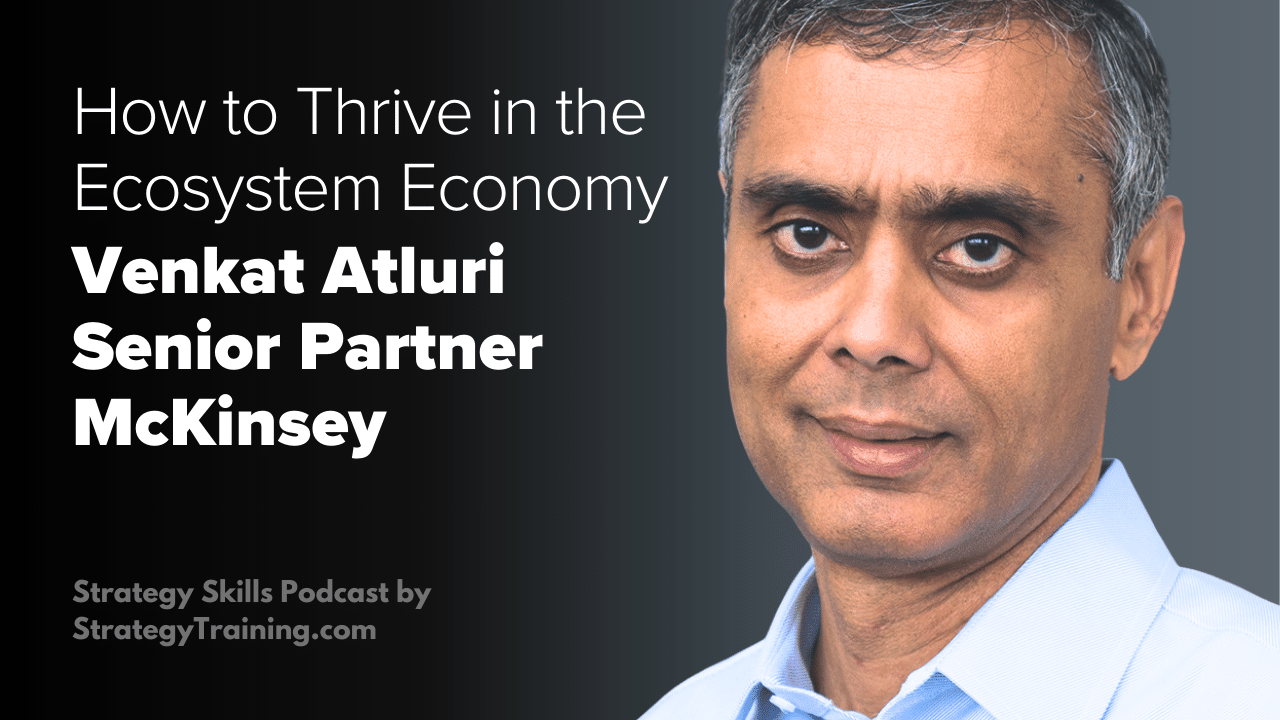
Venkat Atluri, McKinsey senior partner and coauthor of The Ecosystem Economy: How to Lead in the New Age of Sectors Without Borders, explains how value creation is shifting from stand-alone enterprises to coordinated networks of collaborators. Drawing on two decades advising leaders in technology, media, and telecom, he outlines what makes ecosystem businesses distinct from traditional conglomerates—and the governance required to make them work at scale.
Atluri emphasizes that ecosystems aren’t about diversification for its own sake, but about following a customer-led thread:
“Start with the customer and then follow the thread—what other problems does that customer have that you can solve together with partners?”
Key Insights from the Conversation
- Beyond Suppliers: Many firms mistake a supplier list or procurement process for an ecosystem. Atluri is clear:
“A supplier list is not an ecosystem. An ecosystem is about mutual value creation and sharing in the upside. - Role Clarity Matters: Some firms will anchor the platform, continuously raising the bar for developers and users. Others will participate as contributors, protecting privacy, quality, and customer experience. Scale only comes when “responsibilities, incentives, and accountability” are explicit.Discipline in Operating Models: He advises executives to integrate ecosystem thinking into strategy, but then run deeper, dedicated workstreams to define roles, economics, and governance.
- Competition Is Ecosystem vs. Ecosystem: Scenario planning must account for new types of disruptors and ask, “What would an ecosystem leader do here?” Over time, Atluri expects the economy to consolidate into a few macro-ecosystems with multiple micro-ecosystems nested beneath them.
- History as a Control: Symbian and BlackBerry illustrate that large user bases are not moats.
“Unless you keep raising the bar on your proposition, you lose.”
- Customer Experience Sets the Standard: Consumer expectations now apply in B2B as well:
“If something doesn’t work out of the box, that tells you the company is focused on itself, not the customer.”
Practical Takeaways for Senior Leaders
- Map a customer segment’s biggest problems and use that to prioritize expansion.
- Deliberately choose whether to anchor a platform or participate in one—and align capital and talent accordingly.
- Replace vendor transactions with value-sharing constructs that reward partners for enlarging the pie.
- Establish governance, metrics, and cultural norms that enable collaboration at scale.
- Continuously improve the platform to keep developers, customers, and partners engaged.
Atluri’s message is simple but powerful:
“Ecosystems win when they deliver ever-rising value to customers and fair economics to contributors.”
Companies that treat ecosystems as procurement exercises will stall. Those that treat them as strategic systems will build compounding advantages over time.
Get Venkat Atluri’s book here:
Here are some free gifts for you:
Overall Approach Used in Well-Managed Strategy Studies
Enjoying this episode?
Get access to sample advanced training episodes
Episode Transcript:
Michael 01:07
Our podcast sponsor today is StrategyTraining.com. If you want to strengthen your strategy skills, you can get the Overall Approach Used in Well-Managed Strategy Studies. It's a free download, and you can go to staging-df81-firmsconsulting3.wpcomstaging.com/overallapproach. That's staging-df81-firmsconsulting3.wpcomstaging.com/overallapproach. And if you're looking to advance your career and need to update your resume, you can get a McKinsey and BCG-winning resume template as a free download at http://www.firmsconsulting.com/resumePDF. That's http://www.firmsconsulting.com/resumePDF. Hey, Venkat, it's great to have you on the show. How are you doing today?
Venkat Atluri 01:55
I’m doing great. Thanks for having me.
Michael 01:57
Well, there’s a lot we can talk about. I’m familiar with your work. I like the topic in your new book, and I think it’s quite relevant today. But before we start, I think it’d be a good idea for the listeners to get a sense of your background, how you ended up specializing in this topic.
Venkat Atluri 02:15
Yeah, sure. Thanks again for having me. So I’ve been with the firm, with McKinsey and Company for 20 plus years. Over the last two decades, I’ve moved the firm. I’ve been focused on working primarily in the area of tech, media on Telecom, a bit on consumer and bid on Industrial Tech as well. I work spanned across advising and driving impact, working with executives on boards and also investors, for that matter, on variety of topics. And I’ll get to how I got into the ecosystem economy and how the whole thing transpired. I’ve had the keen interest in future of technology, especially at the intersection of different sectors of the economy. And at that interest really drove me to look into opportunities for us, for our clients, for investor clients and for industrial clients, and other other clients that we serve at the intersection of new technologies and emerging business models. That interest drove me to really deep dive into just taking a look at how the economy is evolving, especially driven by some of the developments in technology and consumer preferences. And then that, you know, really led me to do a lot more digging into various aspects of you know, what could be coming, coming ahead of us, yes, and then, and then developing a point of view on that. And that’s kind of how did this book culminate in itself. And then we know, prior to McKinsey, I was at 3am and GE and at McKinsey, I’ve held different positions. I would ran our i Currently I run our tech, media and telecom, sorry, talking telecom practice, and also is one of the co founders of our IoT practice a few years back. And then before that, I bled several initiatives and several leadership roles within the digital, digital, digital transformation aspect of our forum.
Michael 04:19
So it sounds as if that you were serving these companies in media and so on over many years, and you were trying to find out why some of them were performing better than others, which is how you came up with this concept of an ecosystem company. Is that a good way to think about it?
Venkat Atluri 04:37
That and also, I took a pretty broad and also comprehensive view look at where and how value is getting created in the economy, and how that value is getting captured or getting accrued to different different constituents in within the economy.
Michael 04:55
So let’s start for the listener who may not use the same terminology McKinsey users or may not have a consulting background. Let’s start by defining what is an ecosystem economy.
Venkat Atluri 05:07
Yeah, so ecosystem economy is an economy where you have a set of ecosystem oriented businesses. When we say ecosystem oriented businesses, what do we mean by that? Is community of interconnected they could be digital. They could be physical businesses that collaborate with each other by sharing assets, sharing information, sharing resources, to create value beyond what they would have been able to do on their own, individually, and the result is they’re able to with this ecosystem business concept, they’re able to serve their customers better and create better value for their customer. And in doing so, they’re creating or capturing some of that value. They’re taking some of that surplus and accruing to themselves. And then they’re not just sharing the pie that exists, but expanding the, you know, so to speak, the business pie. So that’s our definition of, you know, broader ecosystem economy, ecosystem oriented businesses, if you will.
Michael 06:05
So I’m going to ask a question that I think some listeners would be thinking about in your book, the ecosystem economy, how to lead in the new age of sectors without borders, which I thought was a very well written book. By the way, you used Amazon and several companies as an example, and you talked about how Amazon moved into retail, streaming video games, cloud computing, physical supermarkets, and many other areas. So this was the question that I think people would be thinking about. So back in the day, when I used to be a consulting partner, 90s, and then senior partner, early, 2000 a lot of companies will take banks as an example. Created the supermarket model, whereby they tried to branch out from retail banking into investment banking, into insurance, into a whole host of areas, and they got hit with a conglomerate discount. So what makes Amazon and the tech companies able to expand into so many areas and create value, when for a long time, companies that did that destroyed value. What makes these companies different?
Venkat Atluri 07:07
Yeah, so it’s a very interesting question. We wrestled with this question as we were embarking on writing, writing the book. So if you step back and think about conglomerates versus ecosystem oriented businesses, there are a couple of very interesting differences. The first and foremost, perhaps the fundamental difference, is conglomerates typically, not always, but typically go after diversification of their own business portfolio. Yeah, that’s their main aim. If you look at a lot of the conglomerates, you know, going back, you know, maybe even 100 and 150 years back, a lot of the conglomerates are okay, I’m in business in Sector x. I’m going to go to Sector Y, because that’s that way I can diversify my portfolio, right? Versus, if you look closely, look at the ecosystem oriented businesses, they tend not to do that. They tend to follow what customer need, what customer common thread, can I rely on, or can I use to continue to offer better and more services for those customers? So Amazon’s case, you know, they got in. They started with books. They expanded books to electronics and electronics to other other aspects of consumer goods, and so it kind of expanded to apparel. So that’s that way they have a common thread of, okay, when, when consumers shop, you know, I’m selling them books, but what else can I sell them with the same convenience as you know, I’m selling books to them? That says that’s really following what we call consumer need and fulfilling consumer needs and getting into their pain points. And also, we would call that following the consumer a customer journey, more so than going after diversification aspects of it. So actually, those are the few differences between a conglomerate and and and ecosystem business. Let me highlight maybe one or two others. The other, other big difference is in ecosystem oriented businesses, you have a common platform. In Amazon’s case, they have, you know, web present, a web platform that others can come in and either buy or or host and sell and things like that. They look common platform. In conglomerate, lot of conglomerates, you see, they don’t have a common platform. Again, they’re just because they’re not built around customers. They’re built around driving, you know, driving diversification. And then the other difference I would, I would highlight, is typically in in ecosystem oriented businesses, you tend to drive expansion of the pie, meaning, so if you take in any of the ecosystem or in the businesses that we’ve highlighted in the book, by combining resources, sharing information, you’re actually expanding the market that you’re serving, and you’re serving them better, and then whatever value creating to the customers, you’re capturing some of the. Back, and you’re sharing some of that with the ecosystem partners, and some you’re keeping because you’re one of the instigators or the anchors of the ecosystem. Right? On the other hand, it conglomerates. You don’t have, in many cases, expansion of the pie as one of the key outcomes or one of the key focus areas of you know what conglomerates did historically?
Michael 10:19
I like that. That’s a very articulate explanation of the differences. So I’m going to paraphrase this back for the listeners, right? I remember many years ago, working with a very large beer company, and they went through a process of diversification, whereby they looked at the excess cash they had on hand, and rather than thinking about what their customers needed, they simply said, Well, we have all this cash that we’re going to buy a chain of casinos. We’re going to buy a cement company. So that’s an example where you’re saying they’re diversifying to put their cash somewhere, but it doesn’t benefit the consumer. It’s not being led by the consumer. Is that a good way of thinking about it?
Venkat Atluri 10:58
That’s a perfectly appropriate way to think about.
Michael 11:03
Yeah, and coming back to that, because the guys who ran the beer side of the business had no capabilities to run the cement side in the business. There was no combination of competencies, there was no economies of scales, there was no common platforms. They ended up destroying value because there were no synergies. Is that another difference that you’re highlighting?
Venkat Atluri 11:23
Yeah, that’s it. That’s definitely another difference. You know, the it’s interesting, if you look at some of the conglomerates, even in the past three or four decades, yeah, you realize that they’re either saying that I have bunch of this cash, I’m going to invest this cash on behalf of my shareholders, or they’re saying, because I’m in these diversified businesses, I can train my managers and executives, and they can, again, move them around, and they can run better businesses. Those two models, by the way, the first model I went to University of Chicago, so And we’ve always been taught that the teachings of English Chicago is that the investors themselves can do a much better job of diversification than corporations can do on their behalf. So I believe in that. So if you subscribe to that, that obviously the first, you know, rationale is a fallacy. The second rationale for taking different executives and moving around, you know, moving them around in different businesses and gaining having them gain experiences. I don’t know that may have been true decades and decades ago, with this day and age and the amount of ability and technology and the other ways in which that you could train, you know, train and have your executives gain experience. I think the second reason, second one of the second rational, is also somewhat of somewhat of a becoming somewhat of a fallacy as well.
Michael 12:42
Yes, it seems to me, are we going to use Amazon as an example? Because it’s a pretty good example, but you could welcome to introduce others. But it seems that what Amazon is doing, and the examples you’ve highlighted very well, is that they go where customers want them to go, so they serving the same customers different needs, whereby conglomerates tend to move into new sectors and find new customers, but they’re different customers, which now brings me to the next point. What is it about tech companies that make them so successful at this? Because the examples you’ve provided are predominantly tech companies. Is there a reason for that?
Venkat Atluri 13:17
Well, I know the by either by the fact that they needed to develop this ecosystem to survive, or by sheer just luck in you can kind of have your own judgment on that. Yes, they were the pioneer in developing these ecosystems. You know, back in the day, you know, when there was a PC versus, you know, Mac a fight or competition, I should say, right? And both, both sides went on, went on to develop these developer ecosystems. They attracted, they have, they have this computer product, but they needed, you know, both users and they also needed bunch of, you know, developers develop application so, and then you can kind of take examples like that in the tech industry, whether it’s hardware to software or other aspects of the tech industry, by just for, you know, survival. They needed to develop these ecosystems oriented mindset. They needed to rely on others, and that that really gave them a bit of a head start compared to the other sectors of the economy. And by the way, the one other very interesting thing that happened was because the tech companies took the pioneering role in establishing this modern day ecosystems. They also with those ecosystems, set up, not set up, sorry, set expectations for consumers. And I’ll give you an example. When you are take like, you know, five or 10 years ago, right? When you’re at home doing all your business. You. On Amazon, where it’s very easy. You can go buy, you know, anything you want to buy from different aspects. There are different aspects of what you want to consume. And it was so easy, right? You just go online, you double you do one or two clicks, and you buying, and you go to work, and let’s say you happen to be in the procurement department of a corporation, right? And the same expectations you have, are you buying as a consumer, they don’t translate to the corporate or the the work world, because, you know, you don’t even have all the technology pieces and everything else required in place. Now that’s a good example of how these tech companies that are consumer oriented are setting expectations on what to expect from a service and, you know, delivery standpoint. So I think that that really shift happened in the last decade or so, and then the shift is continued to happen. So if I step back and kind of synthesize right, the tech companies either by your need to survive or just for the way that they grow technology. Were the pioneers in this, in developing and establishing ecosystems, but they also, at the same time, are the pioneers in setting the customer expectations on what customers could expect, not only in their personal life and their professional life as well. And I think those two things together grow tremendous amount of the evolution of revolution. How you want to see it in the ecosystem orientation, or ecosystem oriented businesses.
Michael 16:37
That makes a lot of sense. So so let’s get back to the role the customer plays in leading the companies into these new areas. So I’m obviously like you, a customer and a user of Amazon, Google, Apple and so on. At no point is Apple or Google ever asked me what I needed. So how do these companies decide where they will go? What’s the criteria and decision making process to say that this is where we’re going to expand because our customers are they telling them to go there. How do they make that prioritization? How do they know?
Venkat Atluri 17:12
So, it’s a very, very interesting and very important question. It’s hard for me to speculate how they did it, but I could tell you some of this is probably just a luck here that they happen to be in an area where they made a couple of moves in billing, ecosystem oriented businesses, and they kind of took a life of their own, and they developed into something really bigger and better for both sides, for the ecosystem oriented business, and also for consumers as well. That’s kind of one aspect of it where, you know, they happen to be in the right right on the right place, in the drove, throw that. But there’s the other aspect, I would argue that there actually are quite good at and then they’re doing it in a very, perhaps, you know, thoughtful way. That is, if you, if you read, you know, any of the annual reports, if you read any of the public domain information on some of these ecosystem oriented businesses or oriented companies, one thing you always are stuck with is the fact that they’re highly, highly customer focused. They have a maniacal focus on customers. So with that focus, they’re not only figuring out or they’re not only focused on really delivering what they’re supposed to deliver but the current service they’re offering. But they’re also continuously finding ways in which they could expand their services to their customers in a true interest of adding more and more value, whether it’s convenient, whether it’s better price, whether it’s better delivery, what have you. And I think that that fundamental focus on, how do I create more and more value from our customers, whether it’s, you know, wow, or with a better service and so on and so forth, right? I think that’s what really drove them to develop the very compelling, very differentiated ecosystems. In my view.
Michael 19:19
I like that. And just to you know, paraphrase it for the listeners, what you’re saying is that they pick an area to go into. Sometimes it’s luck, sometimes it’s they have a process, but it’s not so much the area they pick. Once they go in, they’re constantly iterating and adjusting and learning and tweaking and trying to improve things to create value, which is why they succeed. And sometimes, when they don’t succeed, is it fair to say they also then quickly pull back and redeploy resources?
Venkat Atluri 19:45
Yes, yes. And there are bunch of examples of, you know, companies that didn’t succeed and they failed fast, or, you know, pay sometimes, you know, painfully slow, and then they kind of abandoned that and moved on.
Michael 19:58
So if you’re expanding into all. These different areas, to some degree, they must have people they are collaborating with, companies, they are partnering with and so on. Is collaboration a big part of the rules for success in an ecosystem economy?
Venkat Atluri 20:12
I think the collaboration is a very big part and along with the collaboration, sometimes this is explicitly discussed and agreed upon, and sometimes it is implicit. That is what role each of these players are going to play in that ecosystem oriented business or ecosystem economy. Yes, here’s what I mean by that. In some cases, if you have a platform like Amazon does, or others do, you could be the anchor for the platform, and you try and bring as many players to participate on that platform as a participant, right? And then you have to have a model in which you know it’s economical, you’re sharing the value, and you’re making it equitable for everyone, right? And the other case is, you may not have the platform. You may be a very active participant in the ecosystem to make the to enhance the ecosystem and make the ecosystem valuable for everyone involved. And then you by doing so, you’re also creating value, and you’re sharing some of that value. So I think collaboration is very important. Along with the collaboration comes with a with a clear eyed view of what role are you going to play? Am I going to be the anchor that maintain the platform and drive the platform, you know, and continue to improve the platform, or am I very active or different kind of a participant that on somebody else’s platform?
Michael 21:38
I like that, so I’m going to play out a scenario, Jon, tell me if my thinking is correct. Okay, let’s assume I run a mining company, and I mine in some really difficult parts of the world, and I have a series of mines across I’m not going to name any countries I don’t know who’s listening here. Let’s say it’s a difficult part of the world. There’s not a lot of security, there’s not a lot of infrastructure, and so on. And the companies that are picking up my all from the port because of where I’m located, they cannot get the insurance. They need to get their ships in and out. So I’m thinking about my customers, and I’m thinking, Okay, this is a customer need. Maybe I need to set up a business that sets up insurance for ships bring in and removing material from my mines, and I’m following what my customers are asking me to do. Now this begs the question, What business Am I in if I start following what my customers need? Because traditionally, a mining company would say, hey, we would never get into insurance, but in this situation, our customers are saying, we need it. It’s profitable. It makes sense. So my question to you is that when companies follow the ecosystem model, doesn’t it blur the boundaries of what businesses they’re in?.
Venkat Atluri 22:55
It does it definitely burst? That’s why, you know, the We the subtitle for our book is the sectors without borders, or say, as the borders with sectors that are blurring and more and more of these opportunities are becoming very attractive. In that mining example that you just cited, you could, as a mining company, get into the insurance business. You can also say, Listen, I need an ecosystem where I have the shippers, I have the insurance players, they have the other player, the service players that can serve the ships and the trucks, etc. Why my mining is the physical platform I Why would I develop an ecosystem around it. And you can go and in a partner with and have some insurance companies be your pure ecosystem partner on that ego, on the mining ecosystem, where you have a specialized, perhaps an offer for ensuring you know the equipment and other parts of what you need to be successful in the mine. I think that’s the beauty of this in the this whole ecosystem setup. And let me just make one other point on this, right? That my example you gave because you didn’t have insurance, right? Yes, the pie of you know what you could do from a value creation standpoint may be smaller, but if you bring in an ecosystem player, or you be yourself after the insurer, for example, right? So you’re expanding the pie because you can, you know, you can extract and perhaps you can mine more, you can, you know, ship more, right? That’s a good example of how ecosystems tend to have this pie expanding effect, yes, at the end.
Michael 24:37
But that’s a good example, because what you’re saying is that once you follow what your customers need in sticking with the example here, they need insurance for their ships. There are different ways to do it. The mining company could do it itself, where it doesn’t have the experience, it doesn’t have the scale, it’s probably not going to offer the best experience. Or it could go to someone in London, for example, and say, Look, we have these ships. They lack insurance. Why don’t you work with us, and you bring in your know how transfer to these companies, and in that situation, more value is created because the partners are experts at what they offer. Is that the right way to think about it?
Venkat Atluri 25:15
Yes, yes. Then yeah. And then you’re, by the way, you can have that, that that relationship could be in one, one end of the spectrum, a vendor supplied relationship, right? Which is really not an ecosystem relationship. You can just say, hey, I need, you know, insurance for these bunch of ships. You know, come in and give us and, you know, go after that, you go away, right? So to us, that’s not as exciting. But on the other hand, you can say, Listen, Insurance Company X or Y, Z come in. Here is the mining ecosystem we’re trying to develop. We would like you to be part of this ecosystem. And if you’re part of this ecosystem, here is the collective value we can create. And by the way, we actually can have an economic model where we may actually end up sharing the upside that we create together, rather than just, you know, giving you a fee. It’s a fine model, in some cases, to have a vendor supply relationship. And, you know, have pay them whatever you want to pay it, you know, whatever the market is. And then, you know, be done with that. It’s a fine model. In some cases, it works fine. But more and more companies are figuring out a way to not just do vendor supplier in some cases, that’s very appropriate. But in in other cases, this ecosystem mindset, ecosystem orientation of having relationships and having the model, not only to have your have the needs you know fulfilled, but also have a model to share the value. That’s a really quick key component of, I know a successful what makes this model successful?
Michael 26:43
It’s a good example, because oftentimes when I’m going to stick to this example of a mining company is dealing with shipping companies, and if a shipping company doesn’t have insurance, the mining company will say, well, we can’t work with you until you figure this out. But what you’re seeing an ecosystem model here. The mining company is going to try to create a solution by bringing in specialized partners so that everyone benefits. The pie is bigger, and it doesn’t take on all of the risk on its own balance sheet, which is a very big difference from the way conglomerates operate, whereby they take the risk on their balance sheet.
Venkat Atluri 27:18
That’s right. And I think the balance sheet risk is one example of it, yeah. And the conglomerates typically try to own that, or have some sort of relationship that, where you know they’re, they’re the accusing, some sort of accuser, right? Yes. And again, again, the model could go, there’s a broad spectrum, right? One end you have vendor supply relationship, and then the other end of the spectrum is you have a true ecosystem oriented partnership. You’re creating value in you sharing the website.
Michael 27:48
Another good example that I was just thinking about is apps on the Apple App Store. One model Apple could have went for is to build every app itself. But it didn’t do that. It created a common platform encourage people to build on it. And obviously, the PI grew much larger than it could have possibly have built by itself if it built every app in house.
Venkat Atluri 28:09
That’s probably the best example that I could think of in terms of, you know, an example that everybody can relate to.
Michael 28:15
Yes, I remember the conversations that telecoms companies were having in the late 1990s early 2000 when they were debating how much of their platforms they should open up to the market and how much they should keep in house. And most of the debates fell on the side of we need to build these things in house so we can get the greatest benefit, whereby Apple said, Well, you know, we don’t have to build it in house, because the universe would be much bigger if we create a system, or a sort of a street on which everyone could open a shop and we just took a transaction fee. It’s a different way of thinking. In hindsight, it’s easy, but what I’m trying to get it is that that’s the apple example. But I’m trying to think of, how do we get executives to think about how to create a bigger pie with partners in their own industries? How do you encourage executives to think about that?
Venkat Atluri 29:12
So the first and foremost thing we think that we need to influence the executives on it. Every corporation you know, small, medium or big, you go through some sort of a strategic process, strategic development process, or strategy development process, in which you know some part of the year depending on your you know, the different cycles in the business. You sit down and say, Okay, so what’s where are we with our strategy? Where are we going, and where do we need to be? You know, two years from now, five years from now, etc, right? In those conversation where you primarily focus on the market you’re in, what competition Do you have, etc, etc, right? It’s the seldom you. So you really have a discussion around what ecosystem Do I belong to, or do I want to belong to? What ecosystem Am I in? Am I in an ecosystem? Do I have an ecosystem opportunity to create an ecosystem, either I as the platform provider or the or the anchor, or do I have an opportunity to go participate in a set of ecosystems that can create a ton of value, right? That thinking, that discussion, does not happen as much as we would like it to happen. And that’s the first step you need to take. Is to figure out in your strategic process, how do you inject ecosystem oriented thinking on where do you want to play. Where do you want to play? In that your brother, existing ecosystem, or other non an ecosystem you want to build value. That’s the first, first step you would take.
Michael 30:53
So, that’s an interesting point, because you talked about strategy planning sessions with executives, and I was recently in one where I was facilitating it. And I can tell you that 90% of the discussion was what business we’re in, but I don’t think the word ecosystem ever came up. It was seeded into the discussion, but the participants didn’t want to think of an ecosystem. And I’m not saying that they did anything wrong. It’s possible they didn’t see the value of it. So how do we get executives to see the value of thinking about ecosystems?
Venkat Atluri 31:24
I think there are two ways that I found it and I found it, you know, somewhat conducive to have the conversation. One is, don’t think about in this strategic discussion or strategic planning discussion. Think about yourself, but think about your customer, or customers, yes, and what value can you add to your customers? How could you expand the amount of value, or the level of value that you can add to your customers? And if you have that discussion, and it’s lot easier for you to go into the going go down the path of, okay, you know, as on my own, I could add this value, gee, if I have this kind of partnership, this kind of collaboration, you know, the the amount of value and the leverage I could deliver value for our customers is going To be a lot higher. So I think having that customer back view and a customer as a common thread, customer thread view would be quite, quite a quite unhelpful way to think about it, at least. You know, have the in this discussion, the groups open up to ecosystem thinking. The second is, I often found that if you think about competition, and if you really force yourself to think about non traditional competitors that are truly disruptors that could come in and take part of your market or or compete with you. That makes it very challenging for you to compete with them. Take that view, and more often than not, you get into the ecosystem discussion. And you know, going back to your example, on Amazon, right, there was lots of discussion about Amazon and getting getting everywhere they get into the distribution. They’re getting industrial distribution, etc, etc, right? So, just by the fact that you inject Amazon into the conversation, into a strategic planning conversation, and say, Hey, what? What would Amazon do? You know, is there an angle for rehearsed either work with Amazon or that would be competed with Amazon case, right? So, and that’s just an example of how you could take competitive discussion not based on who is your competitor that you’ve been competing with for last 10 or 20 or 30 years. It’s more about who is a competitor that could be disruptor in your industry, that could you could potentially compete with, or the threat that you could get five years from now, 10 years from now, I think that’s the other way in which that you could open this conversation up the ecosystem, or into thinking I liked it.
Michael 34:05
That’s very well explained. I remember recently speaking to the Chief Strategy Officer of one of those buy now, pay later, e commerce, transaction companies, and I was asking, how did he convince all these American retailers to allow an Australian company that’s only three years old to allow this Australian company’s technology to be integrated onto these American e commerce sites, allowing customers to buy now and pay in installments. And it’s he said something very similar to what you said, whereby he went to the retailers and told them that their customers want this ability, and unless the companies, these American companies, could give it to them, someone else was going to figure it out, and they’re going to lose those customers. And it was a good way of thinking, of adding in the competitive. Environment whereby if customers want something and you can’t give it to them, then you have to find a way to partner with someone who can give it to them. Otherwise you get left behind.
Venkat Atluri 35:11
Yes, and several pages in the book that we we highlight the fact that you know this is not a you know, a concept that this is not a luxury, this is an essential concept that you need to really get your head around. Because, yes, you don’t, you will be left behind. Exact, exact phrase, we used it several times in the book, that it’s imperative on you to think through this. But if you don’t, there is a very high risk of you being, you know, left behind.
Michael 35:41
What’s striking to me is the concept seems intuitive. It seems obvious that you need to do this. I wouldn’t think you would need to use a lot of examples to convince people or executives that you need this ecosystem model. But I think the challenge for people is always that it’s a new way of thinking. It takes time to understand how they can build a business model in a new way of thinking. And of course, you’ve got to convince so many people in your company that this makes sense, but you did say something which I thought was very insightful, is that if you want to have a discussion about ecosystems, don’t do it in the strategy planning exercise, because I think those are two separate topics, and one is going to dominate and the other one is going to be sidelined, and then you have a half baked discussion going forward.
Venkat Atluri 36:23
That’s right. I think you need to. You can start with strategic planning discussion, but once you decide that I’m going to be an ecosystem oriented player, or I’m going to be a participant in a larger ecosystem, you really have to think through their step three, step four and step five. Of that is okay for me to do that. How do I make sure that I’m having, I have the right role, meaning I’m not, you know, I’m either I’m the anchor or the platform developer or participant. And then, once you decide on that, now you also, you might, you may also need other, other partners that you want to you need to bring in Amen. You still may need to do a set of partnerships to really fulfill whatever the customer needs that you’re trying to fulfill. Yes, and then I would, I would also emphasize that this is, this is where most companies fall apart. That is, you just need a different governance model, different performance management model. I would use the word culture. You also would need to foster a set of cultural norms that are conducive for this ecosystem oriented way of operating your business and oftentimes. And you know what I what I observe is that executives and leaders kind of say, Okay, I want to build an ecosystem. And they kind of get very excited about the first couple of steps, and then the last step of building the right foundational element, they fall apart. And then, you know, the ecosystems are going. Those businesses don’t go anywhere.
Michael 38:03
Yes, that’s well said. I don’t know if you’ve ever done this or you see a need to do this, but when I meet executives, amongst many questions, I ask them, one of the things I want to know is, have they mapped out their ecosystem? Do they understand what their ecosystem looks like? Do you think that is something companies are doing or should be doing?
Venkat Atluri 38:23
Interesting, very interesting question. So I did ask a question, by the way, many times, and majority of the times the answer I get back, we have an ecosystem. We have suppliers, we have vendors. Yes, our customers and and I say, okay, so how many of those relationships do you have in a way that you send them an RFI, and you send them an RFP, and then they respond, and then you get a price, and then, you know, you have some sort of a contract, and you’re done with it, they’ll say, oh, that’s part of the case. Probably they’ll say, yeah, that’s okay. We have a great procurement department. We do that 100% now say, okay, you know, then you don’t have an ecosystem. By the way. I’m not suggesting that’s wrong. Yes, yes, but that’s not how ecosystems work. Ecosystems don’t work by saying that, you know, here are the six things I need. Give me the price, and you know, I’ll get the best price or best service, right, by very definition you’re putting on the table. Here’s what I’m going to give you. What are you going to give me? What? How could we share that together? And I’m going to create better value, right? That’s not a typical vendor supply relationship, see, in the broader in the broader economy. So that’s the to go back to your question. That’s what I get when I say, Have you mapped our ecosystem? So tell me more about that. And they’ll say, we got this, and we got the RFPs and RFIs, etc, and we got a great procurement department, and we’re doing great. I think that’s where the fundamental gift to going back to your earlier point, a shift in thinking has to happen.
Michael 40:00
Yeah. Years, and I don’t think enough companies do that. I think what they’ve mapped out is a map of relationships, which is not an ecosystem, right? And what they’ve done is they’ve worked out the amount of money they spend with with supplier, x, y, z, and then they segment their customer groups into five customer groups, how much spend they get. But they’re not thinking about, how can you create a solution that increases the size of the pie so that we both benefit to a great extent, as opposed to what most companies do now is they try to lower the price of a transaction whereby one person benefits.
Venkat Atluri 40:33
Yes, yes. And you know, some sectors are notorious for this, right, where I need 2% 3% 4% cost reduction every year by very definition of that. And by the way, I’m not suggesting that wrong. There’s some great companies are very successful at doing that. I’m not I’m not suggesting that. I’m not taking a point of view on is wrong or right. I’m just saying that is not what we’re talking about when we talk about ecosystem.
Michael 41:00
Yes, both parties need to benefit, and the pie should increase in size as you find a ways to serve your consumers in better ways to create more value.
Venkat Atluri 41:11
And I also add one more thing that is that is both parties also have a very important role to play, and they have to play that role very carefully and very thoughtfully, and they have to have accountable for that role. And here’s again, I’ll give you, you know, a couple of levels of detail on that, right? If you are an anchor, if you’re a platform owner, you have a huge responsibility on your shoulder to continually improve the platform. Going back to your apple example, right? Apple has huge responsibility for you to keep your developers attracted to continually improve and get better features and you know better waste or faster ways to develop assets, etc, right? Yes, similarly, if you’re a participant, right, you have a huge responsibility to make sure that you’re contributing in a way that you know none of the nefarious ways in which, you know, the platform could get undermined, or in the ways in which that you know, it’s easier the apps are easier to get consumed and in there, you know, security wise and policy privacy wise, and etc, but it all these relationships are very intertwined, and they’re one’s adding value on the other, and then The other, the other. So that’s kind of how we kind of built on its own and creates a critical mass, and then it builds on it.
Michael 42:27
Yeah, remember the early days when companies used to buy mainframes? A lot of the discussions were for the fortune 1000 company buying those mainframes from IBM and Oracle and so on. A lot of the discussions were, how do we get IBM and Oracle to sell us at the lowest possible cost and then help us with maintenance? And then Amazon comes along with their system whereby they allowed companies to rent space on their servers. And as Amazon became better at managing its servers, it could pass on more savings to companies. So it is a win, win situation. As Amazon became better, the company renting space on their servers, ended up getting a better service. And then it’s an example like Apple’s App Store, whereby they created a solution, whereby everyone benefited from it. Is that another way to think about it?
Venkat Atluri 43:17
Yes, yes, and and oftentimes, ecosystems get started and they start with the right intention, but there is oftentimes, or at least in a few examples, where they do lose sight of what value are we adding to customers.
Michael 43:39
Could you give me an example of that, if you have a public example?
Venkat Atluri 43:44
So you know the it’s easy for me to do you know the historical examples and and in these examples, you know are less controversial nature, in the sense that, you know, there is no conflict for me to talk about, right? Yes. You know, back in the day when Nokia was around in cell phone market, right, you had Symbian as the operating system, yes, at one point, I think there’s a public domain information that suggests that they had massive amount of users on that, you know, you go on the on Symbian ecosystem, they’re developers that are in all kinds of different people that are, that are part of that, right? And, you know, by and large, they met certain needs of the customers. You know, there were gains from Symbian. There were small applications. And Symbian, this is, you know, predates Apple ecosystem, and that ecosystem was probably the largest mobile ecosystem at that time, and it’s got really millions and millions of users on it, and then probably not in millions of developers, but there decent. On developers on it and and 10s of 1000s of developers at least on it, right? And you know, between 2007 eight, I should say, when App Store started, you know, forming, and 2011 and 12, those four or five year time frame, that ecosystem completely fell apart. Why did so obviously, with with Apple and Android and the emergence of those two ecosystems, they were so convenient and their customer value and the customer propositions are so clear, so simple and so easy to use. And comparatively speaking, that simian ecosystem were not able to compete with that. And and, you know, nobody wanted to use that, and there was no developers had, you know, started losing incentive. And obviously users, from usage standpoint, you know, more attractive for Android and iOS ecosystem because it’s so easy to use, so clean, so everything is, you know, very, very, very compelling, right? That’s, that’s a good example of, there is a bit of, you know, what’s the next best alternative point?
Michael 46:18
Just about to say that, yes.
Venkat Atluri 46:21
Yeah. And you know, they for simply an ecosystem. There is a much better alternative that came out in that emerged in the market, that completely undermined their proposition when it ran away. I mean, it is, it is so interesting how fast that ecosystem ran away?
Michael 46:43
Yes. I mean, you could say this anywhere, BlackBerry, right?
Venkat Atluri 46:47
Yeah. I would, I would, you know, I use Nokia or Symbian as an example, but you could, yeah, you could put, you could put BlackBerry in, in a similar bucket, and Blackberry had really exponential, meteoric rise. Yes, in the early days, I remember I was, I felt, you know, as if I’m half naked, not having a Blackberry in my hand.
Michael 47:14
Really, actually, exactly.
Venkat Atluri 47:17
But they wrote their role. They developed a massive ecosystem around email aspect, you know, there, there are a couple of apps and and in, you know, that that actually, that really continued even, you know, a little further than the Nokia single ecosystem I talked about. And, you know, now Android and iOS.
Michael 47:37
The problem with Blackberry is that there wasn’t enough apps.
Venkat Atluri 47:42
Yes. And again, this goes back to what customer proposition and go back to my earlier point, right? It’s not only what customer proposition Are you delivering today in your ecosystem, but how are you evolving those propositions? How are you continually adding more and more and more value. And if you don’t do that, somebody else would come in and add more value. I think, yes, you know you have a great moat around you, but I think you know the fate of Symbian could come to any one of these places.
Michael 48:13
Yes, well, see, you’ve raised a very good point. It’s not enough to have an ecosystem. It has to be an ecosystem that creates a value for the users.
Venkat Atluri 48:22
And continuously improve it, right?
Michael 48:25
Yes, that’s a good point, because people forget how bad the initial iPhone was. Yeah, it was not good. I never bought the initial iPhone because I thought it didn’t do what I wanted to do, but they kept improving it.
Venkat Atluri 48:36
Yeah, I don’t know if I would say no, initial iPhone was bad, but, but, but, you know, I see your broader point about there is a need for continuously improving. By the way, not only need, it’s a responsibility in a you know, you’re accountable as a platform owner to continuously improve it. If you don’t, you don’t, you’re really going to pay a pretty high price for that, because somebody else would come in and put better value. By the way, that’s the reason why. On one hand, you can say the ecosystem oriented businesses are creating a tremendous amount of value, and there they have great market caps, etc, etc. And you can also argue the flip side of the coin, they also have a huge responsibility, and they have to continually improve and continually show improvements and continually add value if they don’t, and somebody else would come and take that away from them.
Michael 49:29
Yes, I like this discussion. So what we’re kind of heading towards is that strategy is a battle of ecosystems between companies, which really is a battle of alliances between companies. Because when we think about companies competing, we’re really talking about different ecosystems competing, assuming you have an ecosystem, and those ecosystems are held together by a series of alliances that companies create, between partners and so on. Is that a good way to think about it?
Venkat Atluri 49:57
That is a good way to think about and I would expand that by saying. Mean, I think we are probably in the early innings of this ecosystem evolution, right? So obviously, with the mobile and with Cloud, yes, migration, you know, we’re seeing some of those ecosystems formed. You know, in the book, we talk about how there is a potential for the whole economy could to coalesce itself into maybe 12 or 10 or 12 different ecosystems. And I don’t think we know, I think that’s our, you know, best guesswork speculation, right by the way, there could be no couple of or 10 or 12 macro ecosystems underneath them, there could be some micro ecosystems. And a good example would be your you have iOS as an ecosystem or Apple as an ecosystem, right? Yes. And you have iPhone and iPad, etc. And underneath that, you have ride sharing app, as you know, have their own micro ecosystem.
Michael 51:02
Yes, with restaurants and so on. Yeah, that’s true, yeah.
Venkat Atluri 51:05
And any of you know, ride sharing app for Uber as an ecosystem, Lyft has in the slightly different ecosystem, you could argue, and you say, do the same thing for delivery, food delivery, goods delivery, etc, right? So I think that whole the evolution is clearly happening in the consumer space. I think this evolution is going to, or revolution is going to continue to happen in the other sectors of economy, in in home, home could be around home. Could be one interesting ecosystem. The whole healthcare area could be different ecosystems. In the book, we talk a bit about, know what these potential evolution could look like, and we get into a couple of examples about how that could those evolutions could potentially add more value for consumers, or whether you’re a consumer in terms of, you know, as an individual, or the consumer in terms of, you know, as a corporation, or bunch of different corporations. And I think that’s where thinking through that, and we get very excited on how that evolution could go on for decades, and you would see 50 years from now, or, you know, you pick your your own timeline, completely different economy compared to what you see today.
Michael 52:18
It also changes the way you’ve got to think about strategy, and what’s your competitive advantage and what’s your core competency. How do you maintain these shifting alliances? How do you keep a partner within your ecosystem and ensure they don’t break ranks and partner with another company and take a key capability you need? It changes the way we think about strategy, because what we realize is a lot of the things we need to be successful are not always things we own and can directly control, right? And I like that, because it reduces the pressure on companies to do everything in house. But on the other hand, it makes it very difficult to coordinate everything. And what I’ve seen is a lot of executives don’t really think this way. They still have the old school style of thinking. I’m not saying it’s wrong, but to focus too much on what their companies can do own, control and manage on their balance sheet, versus understanding a large part of the value they create doesn’t reside on their balance sheet. It’s a different way of thinking about it, and hopefully more executives think in that way,
Venkat Atluri 53:22
Yes. And you know, you asked me the question early on, you know, how are tech companies influencing this? I think some of the most successful tech companies also are extremely product focused, yeah, but that product focus, the product focus, typically doesn’t come, you know, with internally product focus, I think the product focus, you know, some of these companies come from, what can we do with this product that can wow our customers? I invite you, just taking that view, those companies inevitably get to this, okay, I can’t do everything on my own to allow my customer. I need x y and z. For me to get x y and z, I need to go do something else with the others.
Michael 54:05
Yeah, so, well, what you said is true. It’s there’s a difference between being a product focused company that’s run by engineers and a product focused company that’s run by the needs of customers, right? And of course, you know, Apple is great products, but I do feel they build products that are useful for me, as opposed to satisfying some internal quota for the engineering team.
Venkat Atluri 54:28
Oh, totally, totally. I think you know what some of the most successful companies have, that common thread.
Michael 54:34
It’s an easy check to make, right whenever I buy something electronics, the companies that put their customers first, the process of opening the box and pressing the start button is usually very easy. Companies that don’t put their customers first, the process of opening that box and figuring out how to start the product is really a painful process.
Venkat Atluri 54:56
It’s probably a very, very practical way to catch.
Michael 55:05
Yeah, I’ve watched what seven Wi Fi enabled printers, and I’ve never figured out how to connect my wife, but to send them all back. And I’m just hoping that Apple makes a Wi Fi enabled printer one of these days.
Venkat Atluri 55:20
See that is, that is a perfect example of how the tech companies that you deal with in your personal life are setting expectations for your work life. Perfect example, Yo, you are not willing to live with those five or eight or six or seven, you know, Wi Fi printers to be bought because your expectation is that, you know, those products should be working with one or two button presses, not you know me figuring out by opening up my manual and then spending two and a half days figuring out how to connect them.
Michael 55:50
No product should ever ship with a manual. That’s if you have to put a manually redesign your product.
Venkat Atluri 55:56
Yeah, exactly. I mean, that’s it. That’s really a great example of how in the consumer oriented companies, with maniacal focus on consumers, are setting expectations for, you know, for the enterprise use.
Michael 56:08
Yes, a very good example, because we have this expectation. We’ve seen it, it works, we like it, and then we punish companies. Punish an inverted commas, who don’t meet that expectation, right? Venkat, thank you so much. I really enjoyed that conversation. I think our readers and listeners will as well.
Venkat Atluri 56:28
Great. Yeah, I really, again, want to thank you for having me, and likewise, it was a very exciting and exhilarating conversation. And again, thanks for giving me a chance to spend some time with you.
Michael 56:43
It was our pleasure, and we hope to have you back again soon. Take care.
Venkat Atluri 56:47
Yeah, take care. Bye, bye.
Michael 56:55
As we wrap up, today's podcast is sponsored by StrategyTraining.com. If you want to strengthen your strategy skills, you can get the Overall Approach Using Well-Managed Strategy Studies as a free download. Go to staging-df81-firmsconsulting3.wpcomstaging.com/overallapproach. And if you're looking to advance your career and need to update your resume, you can get a McKinsey and BCG-winning resume template example as a free download at http://www.firmsconsulting.com/resumePDF.
Leave a Reply