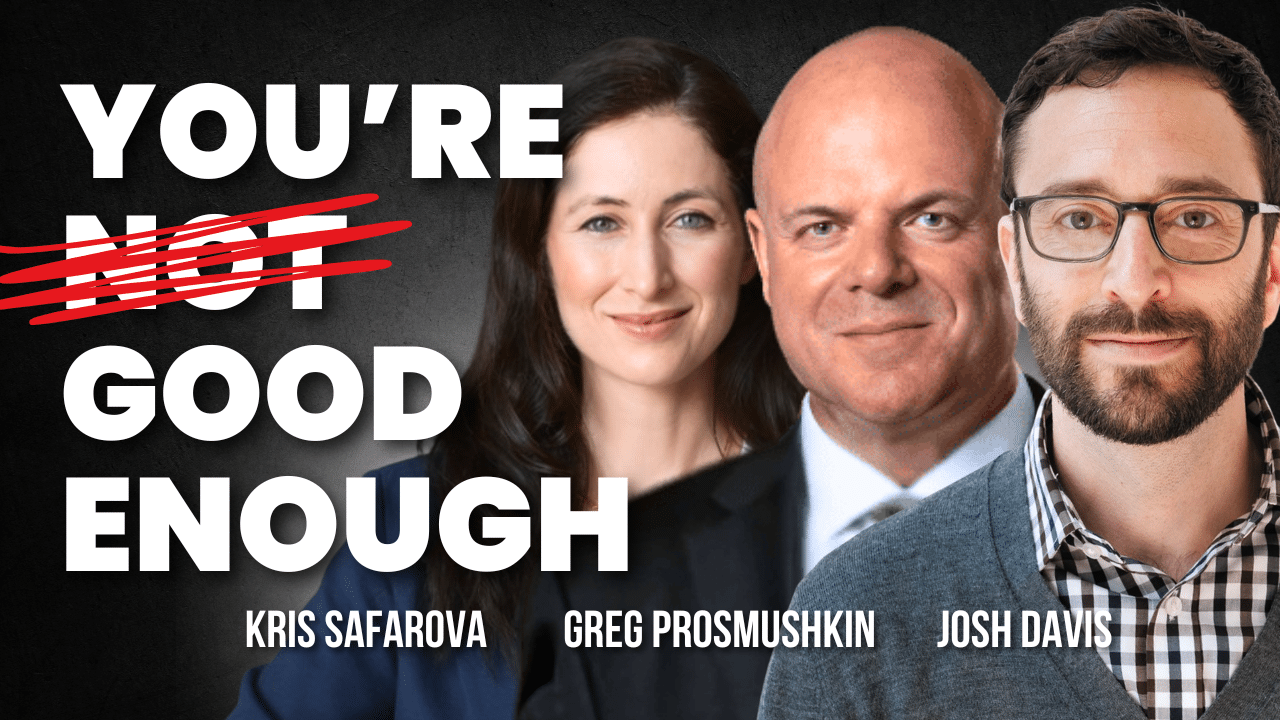
In this conversation with Josh Davis, PhD (psychology & neuroscience, Columbia University, NLP trainer) and Greg Prosmushkin (trial lawyer turned entrepreneur), we unpack:
- Why top leaders and consultants battle with imposter syndrome
- How invisible mental models shape every decision and client interaction
- Why strategy, frameworks, and technical skill aren’t enough if this belief goes unchallenged
- Practical NLP tools to shift your mindset, reframe limitations, and lead with confidence
- How to communicate with influence by understanding someone else’s mental model
Why do even the most successful executives and management consultants secretly struggle with the belief that they’re not good enough? Whether you’re leading a strategy engagement, preparing for a board presentation, or positioning yourself for partnership, this discussion reveals how to break through limiting beliefs and unlock executive presence.
Key Takeaways for Executives & Consultants
- The real cost of “I’m not good enough” in leadership roles
- Why curiosity and modeling are underused tools in consulting
- How small language shifts transform client influence and team leadership
- A proven process for reprogramming your internal dialogue
Get Josh Davis & Greg Prosmushkin’s book:
The Difference That Makes the Difference: NLP and the Science of Positive Change
Here are some free gifts for you:
Overall Approach Used in Well-Managed Strategy Studies
Enjoying this episode?
Get access to sample advanced training episodes
Episode Transcript:
Kris Safarova 01:07
Welcome to the Strategy Skills podcast. I’m your host, Kris Safarova, and the show is brought to you by our firm, FIRMSconsulting, the team behind StrategyTraining.com. If you want to strengthen your strategy skills, your leadership skills, we’ve built StrategyTraining.com to be your go-to platform. We offer advanced training used by clients at major companies and consulting firms. And to get started, you can get free resources we prepared for you: the Overall Approach Used in Well-Managed Strategy Studies. You can get it at firmsconsulting.com/overallapproach. You can also get McKinsey and BCG-winning resume example. You can get it at firmsconsulting.com/resumePDF. And the last gift today is Nine Leaders in Action, which is a book that we co-authored with some of the listeners of this podcast with some of our clients. And you can get it at firmsconsulting.com/gift. And today we have with us Josh Davis, who has a Doctorate in Psychology and Neuroscience from Columbia University and who is a certified trainer and Master Practitioner of NLP, and Greg Prosmushkin, who is a trial attorney turned entrepreneur who has built multiple successful ventures across industries. Josh, Greg, welcome.
Josh Davis 02:24
Thank you. Great to be here.
Kris Safarova 02:28
So, what early experiences most shaped how you think about human performance, being top performer, being influential, being able to contribute at a much higher level than average?
Josh Davis 02:41
What early experiences. I like this question. You know, I’m reflecting back my brother and I, we, we both felt like almost to a fault. We had heard this message from our mom again and again about that we really came to believe that if we weren’t doing something, it was on like doing something, well, it was on us. Is that we, you know, we, of course, could, is just we hadn’t figured it out yet. And this had a plus and a minus. It was like we put ourselves out there and would try to do things that other people would say, Well, you know, what are you doing, you know, and starting our own businesses. And, you know, as adults, but as kids, you know, all kinds of things too, creative projects and so forth. But it also caused us to persist in these endeavors and not just take the safe path. And sometimes we spent, you know, years feeling like, Hey, how come things aren’t going right yet? Why haven’t I made a breakthrough yet? And of course, now that we’re older, we’re, we see, we see it for what it is, and we’re, you know, I think both of us are very happy with where we are, but my mom worked hard to put that message into our minds, and she got it, you know, she grew up with it, but I think she really solidified it with NLP, because she was one of the early people, first, first people to get involved in.
Kris Safarova 04:05
Greg, what about you? We grew up in the same country. I’m looking forward to your answer here.
Greg Prosmushkin 04:11
Well, it’s an interesting question, Kris, because when I came here in the 70s, when I was 11 years old, I came from a very different environment. It wasn’t even Russia. Was the USSR. And when you’re were raised in the USSR, there were certain beliefs that were instilled in you, right? Yeah, there were presuppositions. NLP has presuppositions. So did the USSR, and the presuppositions war, probably most significant was that we live in a material world, that there is no nothing spiritual. There’s no religion. You are where you are. In other words, there is no God, there is no creator, there is no whatever you believe. There is just the material world. So you know when they say, these are teachers, since. Cool when they sent job, when they sent Gagarin into outer space, if there was a God, he would have seen him. And obviously, since he came back, he didn’t see anybody out there. There isn’t so when you when I came here, it was random and chaotic, because you’re if you believe in nothing, you believe in something, you believe that you’re at the mercy of the environment, and you’re a victim, and you sort of live that life, until you realize that there is a different paradigm out there. And I was introduced to that paradigm in my 20s, where, you know, I learned that really, life is what you make of it. If you want it to be good, it’s good. If you believe it’s bad, it’s bad. If your belief is that you have to work hard and struggle. You were working hard and struggle all your life. And if you believe that life is magic, and if you truly believe in magic, magical things happen that also happen. And that’s what LP is, really. NLP is the ability to incorporate certain beliefs in your life with those beliefs. I mean, it’s a part of it, but it’s a big part.
Kris Safarova 06:07
This is beautiful. I do a lot of practices working on all kinds of blocks for myself all the time so that I can realize my full potential and help my clients as well. And I was doing a practice yesterday, and I asked myself a question, what are you trying to prove to whoever, your parents, God, anything, the world. And it is so interesting, the answer to this question, if you really go into your heart and you really pay attention, reveals so much about your life.
Josh Davis 06:38
I love that there’s a presupposition in that question, that you’re trying to prove something. And just by asking that question, it opened me up to the idea that I’m trying to prove something. And then that begs the question to whom, who am I trying to prove it? To myself, to my to my parents, to somebody else, my wife, to my kids. And, yeah, well, my mind is going down a rabbit hole right now. Of all the things that I’m trying to prove, I think mostly to myself about largely can be bucketed into. Am I good enough?
Kris Safarova 07:14
Yes. And I think that is a very common thing that is going on in people’s subconscious mind. Am I good enough? Many don’t think about it consciously, but if you dig it’s just under the surface and blocking them from many things in life. So before we go deep and deep into NLP, for those who may not be familiar, could you explain as clear terms as possible what is NLP and how it is different from other approaches to personal and professional change?
Greg Prosmushkin 07:45
So the way Josh and I have things set up in general, just you’ll probably figure this out by now. He’s a smart one, so Okay, and I’m the guy who comes in and explains it to guys like me who don’t understand the smart guy, so I’ll let him start, then I’ll jump in and I will simplify for the rest of us.
Josh Davis 08:07
So of course, of course, course, I see Greg as a genius in the way that he picks up on things that I’m missing. But we can argue about that later. The I would say this, NLP, first, what it is, then, how it’s different. NLP is a collection of tools and a process for helping people to make changes quickly and in a lasting way, whether you want to make some change for yourself or another person. So this could be, you know, a health change. I want to change how I’m eating or my exercise or something like that. It can be a relationship change. I really want to, you know, finally, nurture my friendships, you know, and not just have them drift away, right? It can be a, you know, professional change, whatever it is, or it can be trying to influence somebody else do something. The reason it works as it does is because it’s not just about a behavior like, what should you do, or what should you say, Right? Or what tricks or anything like that. It’s it’s about recognizing that for every person we live in this mental model of the world, I have certain beliefs about who I am, what’s possible, what’s important, what I’m capable of, and so forth. And I operate in that world. And in that world, my behaviors make sense. And if you can identify what is that mental model, you can find the difference that will make the difference which will be different for each person, but the process of finding it is the same. NLP gives you that process, and gives you that ability to kind of unpack somebody’s mental model, your own or someone else’s, and very quickly figure out, what is that difference that’s going to make the difference, or at least figure out what to experiment with. So, you know, it’s not stuff we invented. It’s. Been time tested for 50 years, and it comes from looking at what were these pioneers 50 years ago, pioneers in psychotherapy. Now, all of it’s research backed stuff. It’s been 50 years, but at the time, they were pioneers in psychotherapy who were having phenomenal breakthroughs with people that had taken years before or never got anywhere, right? And they’re doing it might take them months, but it could even sometimes happen in a single session, right? And where they’re really getting people and we’ve all had the experience where change can happen in an instant. You can struggle with something for years, and then somebody says something to you, and you think differently, right? And then now I’m going to go and relate to my kid differently forever. That kind of thing has happened, right? I used to hate writing, and then there was this one week where I did something, and then I loved writing, and it’s just has been that way since. So we it can happen. It just doesn’t always happen. So it’s about, how do you get there? And so taking these tools from these change makers, which are now backed by research, and we’ve shown how in the book, you know, you can follow that and use that to unpack someone’s mental model and get to change so that’s how I would say it. Oh, the piece about what’s different than other change models. It’s not just about a set of behaviors, you know, it’s not a trick. It’s like it’s a process. The other thing is that the specific, the specific approach in NLP is that the founders of NLP gave us also the tools that they used to learn how these great psychotherapists work, what they call modeling, and that’s what the essence of NLP is. So you can take any new skill that you want, that somebody else does, or that you do in a different context, and you can learn from it. So that also is something unique to NLP.
Greg Prosmushkin 11:48
I describe a little differently. Kris, I say it this way. We’re born with a very powerful computer, probably the most powerful computer in the world, our brain. But the problem is, or the challenges. I don’t believe in problems. The challenge is, when we’re born, they don’t give us an instruction manual, so it’s all trial and error. So we do the best we can. Sometimes you get it right, sometimes you get it wrong, and we don’t, generally don’t learn very many lessons with NLP is it’s that instruction manual. It teaches you how to speak to yourself and to others in a way that both yourself and others are receptive to your communication. For example, Kris, I assume you speak Russian, English, Azerbaijani, anything else?
Kris Safarova 12:32
Only Russian and English and tiny bit of French.
Greg Prosmushkin 12:36
Okay, so if I came in and started speaking Chinese to you, you would be like what I hear him but, but I’m not getting him, so I would have to figure out a language that you understand. So I started speaking Russian to you, or in English, we would have a communication. I’ll have a much better chance of influencing you than if I was speaking Chinese. And that’s what happens a lot of times. We’re speaking to ourselves in Chinese, we’re speaking to somebody else in Chinese, and we’re expecting them to get our message, and they’re not, because they’re not living in our world where they speak Chinese. So what NLP does? It gives us techniques and tools to figure out what language we speak or the person we’re speaking to speaks and to speak their language, and when you speak their language or your own language, you’re more likely to influence than if you speak Chinese to a person who doesn’t speak if that makes sense?
Kris Safarova 13:25
Yes, it does. So, in your book, you wrote that the core idea of NLP is people don’t react to reality itself, but to the mental models of reality. Can you elaborate on this?
Josh Davis 13:40
Yeah, there is, there is. Nobody has a lock on reality. All three of us see the world differently. All three of us came to this conversation with different expectations about what’s appropriate but what the purpose would be. All three of us came with different emotions. All three of us came with different, even different interpretations of what facial expressions mean, right? So I might look at you and think, Oh, she’s smiling, but somebody else might look and say, Oh, she’s like, frowning, or she’s concentrating. Or somebody else might say, Why is he, you know, or that laugh means that she’s not taking me seriously. And someone else would say, that laugh means she’s getting me we have all these equivalents for the things that we see, and it’s based on prior experience which can’t be the same for any for the three of us, right? It’s based on beliefs which are not going to be the same for the three of us. There might be overlap. There’s enough overlap that we get by in the world, but we don’t just want to get by. So if I can come in to any interaction presuming that I don’t know your world exactly that, and if I can just be super curious about it. Okay, what is it that she believes, even something as subtle as you said, Who? What are you trying to prove? Well, it occurred to me, I don’t know what, like who she’s talking about, prove to whom. And you know. What would it take to prove it? And, you know, and, and to Greg’s point about the the way we talk to ourselves, you could say, what’s wrong with me? Or you could say, What am I trying to prove? Or you could say, What do I want? Or you could say, Who do I want to be? Whatever the question is you ask yourself leads your mind in a whole different way, right? You just can’t help it. And, so the questions we’re asking ourselves also creating a different reality. So if I want to actually connect with you and influence you, or, you know, if I if I want to have the chance, I should meet you where you are. And I have to just get curious, because I can’t know. I have to come in saying, I can’t know what she thinks, what’s important to her, you know, I can guess, but let me use it as a hypothesis. Let me try to ask her and and find out, you know? And before we started, I was, you know? I was like, You know what? I don’t exactly know what she thinks matters to the listeners. So I asked, right? But just trying to be when we start to be aware that other people have a different reality that they’re living in, essentially, then it becomes easier to get curious about that reality because, because when you when you can help them expand and enrich their mental model of reality, that’s when they have new options.
Greg Prosmushkin 16:13
As a trial lawyer, my job is to influence and convince people every day, judges, other lawyers, clients, witnesses, juries, and unless I know what influences them, I’m guessing. So I need to it’s not just i Everybody when we are whether you’re a consultant, you’re a lawyer, you’re a housewife, whatever you do, whenever you are involved in an interaction, the first step, you need to know what your outcome needs to be. In other words, when we did today’s podcast, I’m assuming you wanted a good podcast with good guests that will interest your listeners and have them tune in and listen to us. We want it to be interesting and get our message across so people go out there and buy a book because it really is a good book. So and Josh asked. He said, Okay, Kris, what are your listeners like? So if we know what your listeners are like, we know what to talk about. For example, if your listeners are executives and people in in the consultant world, if we go in there, start talking them about how to sell a car, what the heck. We don’t want to hear about this. This is, this is not for us. So going back to what Josh said, NLP gives you the skill set to figure out where somebody lives and then come into their house and talk to them on their terms. So if I, I’m willing to bet, if Josh spends five to 10 minutes with you, Kris, asking you some questions, he will understand your world, and he will be able to talk to you in a way that’ll be much more compelling him, or much more convincing that if he didn’t know where you come from. So it’s, you know, it’s, it’s one of the first presuppositions of NLP, everybody’s map of reality is different. You know, with the three of us, as Josh said, can go to a party, I can have a great time, and you do that. Oh, my God, this is the worst place ever been to. What is he doing? And the question is, what do we focus on? These are the questions we constantly ask ourselves, what do we focus on? What do we focus on mean to us? Because meaning is what we assign to it. So you could go to an event and I can assign certain values to it, you can assign some values, and Josh can and the three of us will assign different values, have completely different experience, and all three of us will be completely right, nobody will be wrong. So if you go to a party, you have horrible experience for me to in to be even have a shot of influencing you. I need to understand what it was that didn’t resonate with you. And if I know that, I can start a conversation with Kris I understand and if I understand you, you’re more likely to listen to me.
Kris Safarova 18:57
And I think also, one of the dangers I see with many people is they think they understand the other person. They are convinced they understand the other person, but the way they describe that person is completely not aligned with what this person cares about. Believes in how they behave. What are their intentions? So what are some of the key questions people should use to try to figure out the mental model of the other person.
Josh Davis 19:21
So, so I think before, if I can step back before the questions, we’ll get to that. But if I can just step back before the questions, that there’s an attitude that when NLP is really taught, right? We we lean into this heavily, which is to to be curious, almost to take curiosity to an extreme sport level, right? It’s just like and it comes to this first thing you mentioned, of everyone’s reality is a little bit different, and they react to their reality, not to reality per se, right? So I want, my goal is to have a shot at. Being heard. You can’t manipulate someone. You can’t get them to do things they don’t want to do. It just isn’t possible. And I don’t think you should anyway, right? It’s short term. It’s not going to get you anywhere long term anyway. But what I do want is to have a shot at being hurt. So for example, you know, earlier you asked this provocative question about early life experiences, and then another one about, what are you trying to prove? And, you know, and my mind went to and ultimately, am I good enough? And we can get more specific about it, but if that’s a if that’s what I’m sorting for, and that’s how I’m categorizing information I’ve just revealed to you, something this of value, this is something I’m thinking about, right? So if you can talk to me about, like, think, you know, am I good enough? And does it answer the question, and what would it mean to be good enough, right? You’re really gonna get somewhere with me. You’re speaking my language, right? And so when people tune in, like, people tell you what’s important to them, and if they and if you’re not sure, then you just ask. So that’s number one. Is just to have that attitude, let me listen in their language, they’re going to reveal things, and if I’m not sure, I should ask. Now there’s a real art to recognizing when you’re not sure, and this is where having some specific questions to start with, actually not just to start with. I still use them, and I’ve been around this stuff for 25 years, and then they’re like work horses for me. Horses for me. But there’s some specific question, actually in our book chapters 12 through 16, we get into these in more concrete terms with examples and research and so forth. But, but these questions, how? Specifically? What? Specifically? Who? Specifically, right? Recognize that a lot of the time we don’t have that information, and if you just get curious about it and ask some version of those questions. And there’s a couple more we get to also in those chapters, but then you will, Oh, also, how is it serving you and what’s stopping you? There’s a couple other good examples you will really unpack a lot, and so just kind of go into the conversation pause. Remind yourself, Wait a second. I’m just gonna look for as we’re talking who, specifically, how specifically, what specifically are we talking about? Are you talking about? And you know, anytime it’s not adding up in your mind, you gotta keep checking for that, and then just ask another question, or if something doesn’t make sense, well, what’s stopping you? Or it’s like, you know, I’m doing this thing. I don’t want to do it. Okay? How is that serving you? It must be serving them in some way, right? And you just start to with these handful of questions, you can really unpack a lot, but you’re not going to ask them unless you go in being curious. And if you just take a few seconds before every conversation, be like, Wait a second. I don’t know. I don’t know their mental model. Let me be curious when I hear it. If I’m not 100% sure who specifically like, what are you trying to prove to whom? Right? That’s a really important question, and I didn’t know the answer, right?
Greg Prosmushkin 22:59
So you ask it, and the people will gladly share with you. When a client comes in my office, I often ask, what is the outcome that you’re looking for? Because a lot of times it’s not money, it’s something else. So if somebody is motivated, but they want a social change, they want a safer playground for their kids. You know, I can tell them, I’ll get you a million dollars, but it’s not going to move the needle in them trying to hire me or not, because they want the guy who’s going to go out there and make the environment safer. So that doesn’t happen again and again. I think Josh is absolutely right. People want to share what they want. Unfortunately, oftentimes, like you said, Kris, we assume and we don’t ask, and our assumptions are generally wrong. So I believe that, you know, there’s a there is a concept, and come in, it’s a presupposition, really, of NLP, that says the meaning of communication is impact on the listener. So what that means? It doesn’t really mean a goddamn thing, what you want to what you mean. It’s what the other person hears. So it’s incumbent upon us to say, Did you hear what I think, what I think I meant? And if they tell you, No, I didn’t, it’s our job to get them to hear what we’re saying. And that’s really important, because a lot of times we just say something like, oh man, he doesn’t, doesn’t get it, and we move on, not realizing this our responsibility to make them get it, not theirs.
Kris Safarova 24:19
Very true. And you mentioned a question, what is stopping you? That is such a powerful question. I just stumbled on it sometime back. And what I noticed about that question when I asked that question because I was procrastinating on something, and I was trying to understand what is going on here, and I kept on thinking, and then I asked myself, so what is stopping me? And as soon I saw what was stopping me without even fixing that, just putting flashlight on that, the procrastination went away.
Josh Davis 24:47
This happens so often when you kind of just put a flashlight on the mental model, you figure out how the person is actually thinking, like, what’s the thing they’re trying to serve, or what’s the belief, or what’s what? You. You just shine a flashlight on it. You don’t need to be smart or skilled to fix it, right? It’s just like, oh, okay, that’s where we can make some changes. You know? I don’t need to limit myself in that way. Are you comfortable sharing what this specific example was?
Kris Safarova 25:13
I don’t remember the details. It was something about producing specific type of content for a lack of a better word, and I couldn’t understand why I was hesitating. And then I don’t remember what was stopping me as well, because it was many years ago, but I remember as soon as I realized it just putting flashlight on, it was enough. It was no longer stopping me. That piece just needed attention from me.
Greg Prosmushkin 25:39
Just needed attention. Josh, listening to Kris, would you say she’s a kinesthetic, auditory, or a visual person?
Josh Davis 25:46
Oh, you know what? I wasn’t paying attention to that piece of her language. It’s there’s so much to pay attention to. What were you picking up?
Greg Prosmushkin 25:53
I think that you’re a kinesthetic person, Kris, am I right?
Kris Safarova 25:56
Yes, I agree with you. But why do you think that?
Greg Prosmushkin 26:00
Because you are so spoken, you speak slowly based on your breathing and the your choice of words, and that’s a shortcut to your listeners. You can determine what type of person a person is just by paying attention. Are they more kinesthetic, or they visual or auditory? And kinesthetic means more in their body more feeling auditory is listening and visual seeing, and if you’re trying to influence a person and you can determine their type. So I can talk to you all day long and say, Kris, do you see what I’m saying? Can you hear me? I mean, I can see result in me saying like I feel what you’re saying. Do you get the same feelings that I do, and I think it may resonate better with you than me using the other predicate. So I just think it’s a shortcut your listeners can take in. Is that if we listen carefully, we pay attention, we can, we can build the bridge of rapport, just by adopting just that little piece, if the person is visual, auditory, kinesthetic.
Josh Davis 27:07
Let’s just test that right now. I’m curious, Kris, where did you feel like you were more on the same wavelength with Greg when he was using more of that kinesthetic body language?
Kris Safarova 27:17
Well, I must say that I think I have a combination. So I think auditory, visual and kinesthetic, but I know that I think I’m primarily kinesthetic, but because of the way I learn, if it is something difficult, I need to do it to fully grasp. But maybe it’s because I really go for depth. I really need to understand something 100% for me to feel that I understand it. Many people, they only know the surface, and they feel very comfortable. But when Greg was saying, do you hear me? Do you see me? Can you feel it? I could connect to each of those, because I can see things, I can visualize very well, and they can hear things. I can learn things just by hearing it. So I think I’m blessed that they can learn through each of those, and they can connect with the person through each of those.
Josh Davis 28:04
Well, there’s actually all people use all parts of their brain, and humans have more kind of brain processing power associated with visual processing than the others. That is my understanding. And you know, so there’s a lot of visual stuff happening. We’re all capable of auditory as well as kinesthetic. Sometimes we’ll notice that a person in this will change from conversation to conversation to can depend on the topic that they are using more language about. Well, is how I’m feeling. They tend to be looking down more, maybe connecting more with their body and so forth. If you’re detecting that, then you might explore using that kind of language and trying to breathe with them. And it’s interesting, unconsciously, what starts to happen you sort of, you sort of get more in rhythm, in tune. And if they’re talking about, like the big picture, and you know what they see in their mind’s eye, and you start painting a picture for them, you know, and it’s probably gonna resonate. But so we encourage people to play with that kind of thing and also recognize that even if you have the, you know, learning styles, the research shows people learn equally well in any format, but they have preferences and but this is so it’s one of many things so that you can kind of pick up on and try to join a person there in order to kind of just get in sync with them. When you do, it’s part of earning the right to communicate.
Kris Safarova 29:32
What are the most common distortions you see in the way people construct the mental models of reality?
Josh Davis 29:39
I can’t and I should, are huge distortions. Yeah, it’s almost never the case. When you say I can’t, that something’s impossible. It is sometimes it is right, but usually it means that there would be some problem in your belief structure. Like, if you were to do it. And so a great way of somebody saying, I can’t, or that would be impossible, or it’s, you know, and yet you don’t think it’s actually appropriate for them to stop right there, you know, it’s fine. Sometimes you’d be like, Okay, fine, don’t do it, right? No big deal. But if it’s a case where you’re trying to explore this, or you want to get yourself to do something, the mind is stopping at that point when you’re saying, I can’t. And so there’s several things you can do. What you really want to do is, how do I just move to the next step and explore that you’re just trying to because typically, the person is trying to avoid that next step psychologically. So you just say, what would happen if you did? Let’s just explore that. What would happen if you did? And they sort of say, well, so and so would be upset. Oh, so you can’t do it. It’s like, well, no, I just, I want to do it in a way where I don’t do this. Oh, that can be a breakthrough, right? So I can’t, and I should this. You know, these are ways I can’t I should these. These reflect limiting beliefs about I should is like a heavy thing. I have to. It feels very different from I get to and I want to, right? And, and sometimes just changing the language, does it just say, Okay, what happens if I truly were to think like, oh, you know what? I get to be on this podcast right now? Okay, it’s different. I have different energy, different emotions, right? It’s a different attitude, different goals, different outcome, just from that one little language switch. So those are two very common limiting beliefs. If you catch yourself saying, I can’t and I should, and yet it’s something that you want to do, there’s limiting beliefs there. And we can just say, well, what would happen if you did just take yourself psychologically to the next step? Just be willing to explore that next step of what would happen? What would it mean? So forth.
Kris Safarova 31:38
So let’s say someone is listening right now, and they’re thinking, you know what this is about me. I tell myself all the time I should and I can’t. Then they dig a little deeper, following your guidance, and ask, what will happen if I do it, for example, and they kind of stuck there. They’re not sure if there was any shift inside that really removed. I can’t. How would you recommend them to go deeper?
Josh Davis 32:01
It would help. If we have a specific if we can work with a specific example, then people listening can also probably, is there one that you have in your mind?
Kris Safarova 32:09
Perhaps, yes. So one of the common things, and it already came up earlier today, I’m not good enough.
Josh Davis 32:16
Okay, and so I’m not good enough for what?
Kris Safarova 32:20
For whatever person wants to do. So, for example, maybe they want to build a company that will have certain level of impact as an example.
Josh Davis 32:28
Okay? And what would happen if you did build that company?
Kris Safarova 32:32
Well, I will have to play the role of the other person. It will change the world. It will help a lot of people.
Josh Davis 32:36
Okay? So it will change the world. Will help a lot of people. And you’ll have to play the role of the other person, of this other person, which other person?
Kris Safarova 32:46
Well, this is a common issue for clients that they see who are incredibly successful, and everyone in their life looking at them and think this person really made it in life, and they’re so successful. But then for them to break out of their orbit again, they need to remove this belief. Right?
Josh Davis 33:05
What I’m hearing is as we’re having this conversation, and we’re sort of trying to have it on behalf of many people at once, so it’s a little bit of like a cartoon version of it. But still, there’s I would have to take on a role that’s different from my current role, in terms of, like, how I see myself and how other people see me. Am I picking that up right? And and we can explore other things too we could. And what else would happen, right if you did that, or what would happen if you took on that role, and we might come up with, well, I’d have some financial uncertainty, right? Or I would, you know, have to start over. Or are some people would see me as a novice, or some people would, and as we get into that, we just have these, this curiosity in mind, of, like, Okay, who specifically would see you as a novice? How do you know they would see you that way? We’re doing some mind reading. So how do you know, right? We can’t know what other people think. Okay, and it’s like, and you might get to that point where you just say, why does it even matter, right? Or you might get to a point where you know what I’m really concerned about, what my wife thinks, and you know, I’m gonna go and ask her, you know, what does she think of me doing this? And you might be surprised, or you might find out some really important information that she does not want you to do this, right, you know? And find out why and how do you serve her needs, because she has a good reason for you not wanting to so. So what happens is, we tend to get specific. We as we get closer to our monster, right? And then it becomes something that we can really hold and solve. And as people break down, okay, what is it that I’m really concerned about? What would happen if I took that next step, who specifically, and so forth, then we start to it starts to become easier to solve, essentially. And we can apply that question of what’s stopping you too. It’s another version of it is, how is it serving you? And so, anyone listening right now, who is thinking of taking that and. Step like this, how is it serving you? But, oh, thinking of taking that next step, but you’re still feeling like I should do it, right? So there’s some internal struggle about, how is it serving you to not do it?
Greg Prosmushkin 35:12
And I think NLP deals with this elegantly on two levels, on the micro level, the way Josh just explained, and on a macro level as well, one of the pre sub before I say that, I think most not. I think it’s a fact, most successful people suffer from imposter syndrome. Everybody me, you Josh, at some point we just say, am I full of shit? Is this? Is this? Am I getting credit? I don’t deserve that. I just get lucky, you know? And that’s a question a lot of us ask. And what NLP does, it also handles it on the macro level, one of the preset positions that we invite everyone to adopt is, if it’s possible for anyone in the world, it’s possible for me. And once you have that belief, it’s huge. And then you go to the next belief is that I have in me what I need to take the next step. For example, let’s say Josh and I want to be podcasters. So I may not know how to start a podcast today, but I can certainly go on Amazon and buy a book on how to start a podcast, or I can google how to start a book. So if you have the belief that, if anybody can do it, and I have what’s in me to take the next step, and you go to the next thing in NLP, that Josh talked about very elegantly earlier, modeling, if Josh and I spent two days with you, Kris, and we model and learn everything that you do. If we ask you the right questions, we learn every step that you take along the way. Then if we do the very same steps, we may not be successful as you are. Well, we’re certainly going We’re on our way to have a successful podcast. So I think it’s 80% psychology and 20% mechanics, we have to adopt the belief, if anyone can do it, I can do it. And once you have that, all of a sudden, you kind of take away a lot of the you know, the claws, the imposter syndrome sinks into you, very true.
Kris Safarova 37:17
And the belief I’m not good enough, usually almost every time, if not every time, originates from childhood, usually from your parent, often from your mother. So do you feel that the exercises, the digging, is ever enough to actually erase that deeply ingrained belief that was there for decades?
Josh Davis 37:37
You know, if you’ve held onto a belief since childhood, then at some point, at least, it really helped you accomplish something that you didn’t have a better way to accomplish. Maybe it motivated you to work hard. Maybe it got you to behave for your mother in a way that you got certain approving attention or some kind of attention you wanted. And now that you’re a grown up, you have learned many new things, many new skills and habits of mind, and you have a new identity, and you’re a different person, and you may not need that belief anymore. You may have better ways to accomplish it, but that younger part of you is still kind of afraid, and it is possible, and this is another thing that was found in NLP. We can learn how to be an ally for ourselves. We can learn how to travel back in time mentally and help that younger part of you grow up and say like, you know what you no longer need to serve this function of let’s say you know another presupposition in NLP. In NLP. Presuppositions are beliefs. We encourage people to presuppose in all situations. Another presupposition is that every book, every behavior, has a positive intention. So I’m coming in assuming that if you’re saying I’m not good enough that had a positive intention. It wasn’t just to sabotage you. It was because probably it protected you, or it got you a certain attention, or something like that, right? Or it made you work hard. Those are positive intentions. Now that you’re old enough, you know how to keep yourself safe, you know how to motivate yourself, you know how to get the attention you want. You don’t need that anymore, and it doesn’t need to be done in the way that a scared child would do it. And so you can let that child be a child. We all have parts of ourselves that are children, right, that are playful, and you can take that over. And so it is possible to actually, you’re not getting rid of the belief, right? You’re honoring the importance of it, and you’re allowing yourself to use these new tools to serve that belief. This is kind of a paradigm that you’ll see again and again in NLP, if every behavior has a positive intention, then let’s find the positive intention, and let’s find a better way to serve.
Kris Safarova 39:55
And for someone who has this belief, I’m not good enough. And I think so many of our listeners right now feel that it is something they struggle with. Any additional exercises you could share that could really help?
Josh Davis 40:09
I would say, Let’s invite people to do this on their own, if they have that belief is to you know and and like you said, many of them will have it since childhood to allow yourself, you may even want to close your eyes to go back with that belief in mind. Let the belief kind of guide you to whatever your unconscious offers you as the first time, first memory you have that’s associated with that belief. And you may be surprised at what your unconscious mind brings up, and that’s okay. It’s doing it. Your unconscious mind it’s an amazing pattern recognition system. It’s offering something because there is a connection. And you can trust yourself, trust your unconscious mind as you go back, whatever those early memories are, earliest or early, and you may want to find another memory too. And you can explore, how old are you at that time? And you can, with kindness, turn towards that part of yourself and thank that part of yourself for showing up to this conversation, and let that part of yourself know that you really do know there is a positive intention here. And go ahead and ask, what is your positive intention for me, for us as a whole, and just be open to what comes up. And it may help to step into the perspective of that younger self. You can do so right now, you’ve been you. You know how to step into that perspective and look back at the adult. You What is my pot as this younger self? What is my positive intention for us as a whole? And whatever is coming up, you can allow that to come up, even if you don’t know the answer. Just explore what comes up, and in whatever way makes most sense, you can make an arrangement with yourself that you will reintegrate as a whole, so long as all parts of you are willing to find new ways to serve that Positive Intention. And when that happens, because it will happen, won’t it? When that happens? How will you feel as this new version of yourself, who knows that? Of course, she’s good enough. She brings a great deal of value, don’t you? And of course, there’s a reason that it’s you doing this work, doing what you do, isn’t there couldn’t be anyone else you know that. I know that.
Kris Safarova 42:50
Very good. Thank you. Josh, I also wanted to ask you about hidden resources. What are the most common hidden resources people overlook in themselves?
Josh Davis 43:01
Greg, you are quite resourceful. I often feel stuck, or I, you know, I’m like, Wait, how are we going to do this? And I start diving right into logistics, and then you snap me out of it. How do you do it?
Greg Prosmushkin 43:19
How is the enemy of getting anything done? I truly believe that. I think most people get hung up on the how, how am I going to do this? And that what that does is it kind of discounts our abilities. I think the better question to ask is, why? Why do I want to do this? You know, there’s a saying, if the why is strong enough, the How will happen. So again, I don’t have a classic background of psychology, of you know, I’m not a neuroscientist. I’m just a guy who fell in love with NLP at an early age, and I’ve used it to my benefit, in in law, in businesses, in writing this book with Josh. And when Josh and I talked about writing this book, Listen, I’m not an author, he is. I’m not. Why now. And you know, I never thought I’d be a USA Today, Best Selling Author, but, but here we are. And you know, when we talked about writing this book, Kris, we never talked about the how, we talked about why. First we talked about the what, and then the why, the what was we needed to write an NLP book. It was initially for lawyers, but then we’ve, you know, we’ve shot it back and forth and decided to make a little broader, but then the why, why is the book needed? And we came up with a lot of compelling reasons why the book was needed, and once our psychology was on board with the why, the how just happened. Yeah, we said, Okay, I just started writing. And we were just writing for the trash can, I think, initially, and at some point I said, Why don’t I send it to my to my agent, Giles. Giles Anderson, great guy, by the way, props to Giles, and he sends the manuscript. Is like, dudes, I love it. This is great. This is exactly what the market needs. So I think people get too hung up on the details about the hidden resources and things like that. I think anytime anyone wants to do anything, they just have to have a big why, why. And if you have enough reasons, you know your subconscious actually will push you forward to get it done, the How will happen. So this is not, I’m sure you were looking for something, you know, little more scientific, but that’s the best way I can answer about hidden resources. Is there, they’re hidden, and we don’t necessarily need to know what they are, as long as we give ourselves the compelling future that we push ourselves forward.
Josh Davis 45:59
Now, you have a belief, though, which is that we have the resources within us to take correct the next step at all times. That’s always true. So all I have is already within me. We have all these resources. You have at times, been creative. I know everyone has. You have at times, you know had righteous indignation. You have the ability to take perspective, you have the ability to learn, you have the ability to work. It’s all in there. It just may not be applied in these contexts or in these ways, right? And then, you know, there, yeah, many ways to tap into it. And Greg has always kept us focused on the why.
Kris Safarova 46:36
Let’s wrap up very quickly, because I know we are running out of time for our great discussion on this very important topic. Maybe we can wrap up with from each of you, how NLP helped you the most in your life. What was the most profound specific tool that helped you and the change it created for you?
Josh Davis 46:55
For me, the most profound specific tool is modeling, and that’s something we we teach people how to do in the book, we get into it in that, you know, you mentioned that that chapter two, where we talk about my reality and your reality, and tools for modeling. And the appendix we have, if you want to go out and try to model the skills of somebody else, a series of questions you can ask. You don’t even have to be a skilled NL peer to do it. The reason is that with modeling, I can, if I’m stuck right, I can just unpack. And actually, I just recently published an article in Fast Company about this, teach me how to do it wrong. Teach me how to fail. I can unpack what exactly it is that you would need to do to fail, just as I failed, because I’m recognizing It’s a strategy based on a set of beliefs and an identity and those things. And if I unpack all these pieces, it’s going to be very clear what to do, right? So this skill of modeling, and if I want to learn skills, if I want to want to learn skills from Greg, you know, if I want to learn skills from you know, import resources from one area of my life to another. So it’s led to breakthroughs in, you know, how I, you know, show up for my wife. It’s led to breakthroughs in how I parent and how I can let things roll off my back that bother other people. It’s led to breakthroughs and being able to write and to love writing. It’s led to me starting my own company, it’s led to, I mean, it’s just like, what is it not led to? So modeling is the essence of NLP for me, and it’s, you know, that’s, that’s where the magic is.
Greg Prosmushkin 48:33
I agree with Josh, but for me, it’s a little different. For me, it’s being taken out of victimhood. Most of us, when something doesn’t go our way, blame three things. We blame events, we blame other people, or we blame ourselves, right by the limiting beliefs that we have. I’m not good enough, I’m not athletic, I’m not a good reader, I’m not good at math, I’m not good with numbers, and that gives us excuses just to live in victimhood, because, well, you know, it’s my parents, it’s the way, it’s my boss, it’s my girlfriend, it’s my wife, it’s my husband, whatever the case will be. But if you adopt the two beliefs, which I encourage all of us, include all of your listeners, to adopt, and we just talked about them, if it’s possible for anyone, it’s possible for me, and all I need is within me already. So if anybody can do it, that means I can do it, and I have it in me to do it, then I can pretty much do anything short of play basketball for professional basketball team at 57 but other than that, I think, you know, at 56 Josh, you know, Josh is a little younger than I am, but at 56 I became a best selling author, which is, I didn’t think that was going to happen. I lost about 40 pounds in the past two years, and I at one point. Know, when I was on my 30s, I said, You know what? I like drinking. I like eating. I’m never going to be in good shape. My lifestyle is just too unhealthy. And then I said, Well, you know what? If it’s possible for others, it’s possible for me, and I have what, what I need to take the next step, and you take the next step, and you take the next step and you take the next step, and each step gets easier and easier. And as you get milestones which are measurable, that’s proof that it works. And once you get proof, it gets easier and easier. So for me, NLP is a science of self empowerment. It takes us out of victimhood, and it says, You know what the world is, your oyster, man, you can do whatever you want with it. Just just follow the steps that others laid out, you don’t have to create anything, nothing Josh and I talked about, which is crazy, is ours. We have created none of them. We just took something that was created 50 years ago by really smart people, like the best in our fields, and what our claim to fame is, we’ve simplified it to a point where a non clinician just a regular person to read the book and say, Ah, that’s how you do it.
Kris Safarova 51:07
Thank you guys. Where can our listeners learn more about you? Buy your book? Anything you want to share?
Josh Davis 51:13
NLPdifference.com. And you can also talk to the book. Greg created this really cool AI bot. And you can say, hey, book, I have this challenge, what should I do? Or what should I ask myself? Or how should I approach it, or whatever. And you can talk to the book. And so it’s a companion to the book, but go play with it now and see what you think.
Greg Prosmushkin 51:37
And buy our book.
Josh Davis 51:41
Yeah, yeah. So the book’s available on audio, Kindle and in print, and very soon, oh, actually, no, I think it has now come out also in overseas as well. But in the book, here’s here’s how to get when you come to the reflection questions and we say, hey, think of a situation in your life like this, even if you’re out jogging or driving just like, you know, pause it for a second and think about that. Have that in mind. Ask yourself those questions. That’s all it takes to apply it. That’s how the magic happens, right? And then, you know, and if you’d like to write, there’s space in the back where you can write your answers to these questions too. But you know, doing that reflection is all you need to do to apply it and all you need to do to be able to then use it again after reading the book.
Kris Safarova 52:25
Yes, the answers are within you, like Greg was saying, everything is within you, including the answers that you need. That’s right. Our guests today were Josh Davis and Greg Prosmushkin, co-authors of The Difference That Makes the Difference: NLP and the Science of Positive Change. They loved us with a powerful reminder, we don’t respond to reality itself, but to the model of reality we hold in our minds, which we can change. Very important thing to remember. And I really loved the reminder about that, if someone could do it, you could do it too. I was saying it for years. This is very important belief to have, and if today’s conversation inspired you to strengthen your own executive skills, we have some free resources for you, from StrategyTraining.com. You can get the Overall Approach Used in Well-Managed Strategy Studies at firmsconsulting.com/overallapproach. You can also get McKinsey and BCG-winning resume example, which is actual resume that got offers from both of those firms. So you can take a look, compare it to your resume, see what you want to improve. And you can get it at firmsconsulting.com/resumePDF. And lastly, you can get a copy one of our books, which is also bestseller, and it is called Nine Leaders in Action. It is co-written with some of the listeners of our podcast, some of our clients, and you can get it at firmsconsulting.com/gift. I look forward to continuing that journey that we are all on together during our next episode of the strategy skills podcast. Thank you for tuning in, and I’m looking forward to connect with you all next time.
Leave a Reply