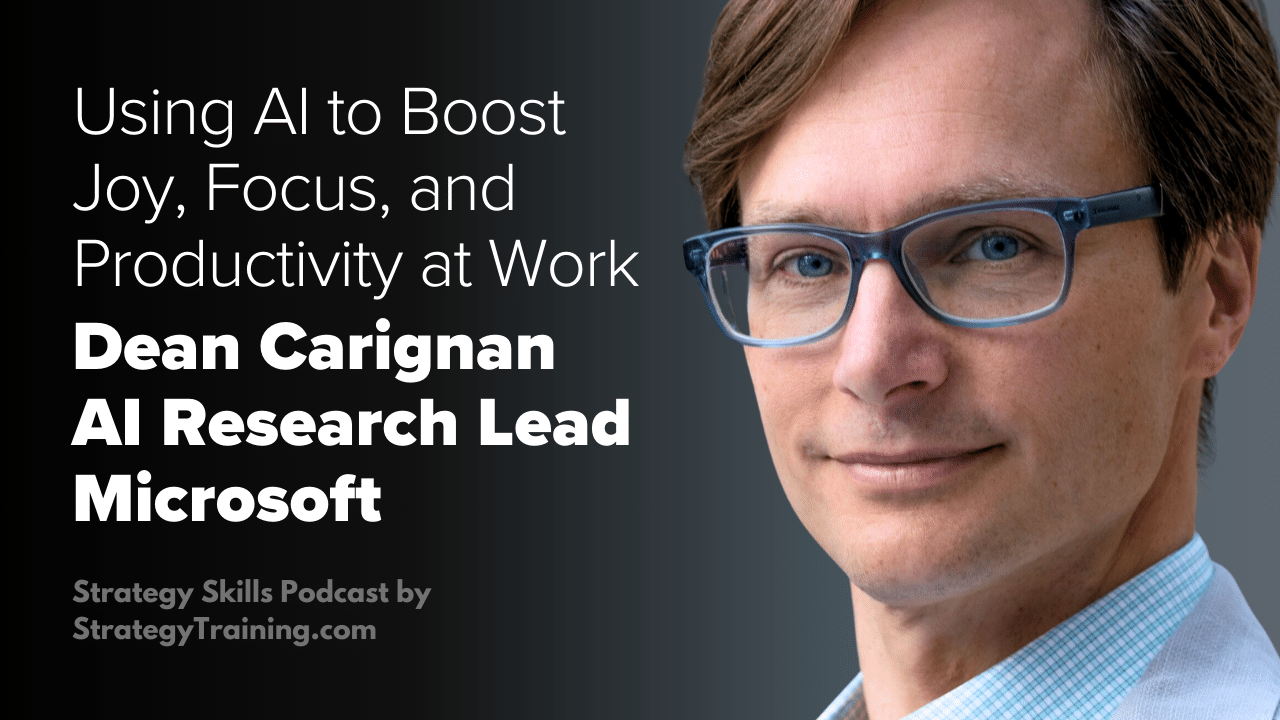
This week on the Strategy Skills podcast, I spoke with Dean Carignan, a senior leader at Microsoft with over two decades of experience across AI, Xbox, research, and product innovation.
He discussed how AI is reshaping work today, not just by providing answers, but by acting as an agent to handle routine tasks, freeing people to focus on higher-value activities. Dean emphasized that leaders who experiment with AI agents (beyond simple chatbot use) will gain a meaningful edge.
Two areas where AI’s global impact may be most profound over the next 3 – 5 years:
1 – Bringing critical services (like healthcare support) to under-resourced areas through mobile and voice AI.
2 – Accelerating scientific discovery by reading thousands of papers, proposing experiments, and automating lab work.
AI will take away the drudgery of many jobs and enable people to focus on the aspects of the work that excite them.
Dean Carignan’s career spans international economic development, startup ventures, and strategic roles in technology. He is an alumnus of Georgetown University and INSEAD, he was a charter member of McKinsey & Company’s advanced technology practice.
During his 20 years at Microsoft, he has guided new businesses including the early internet division, Xbox, and multiple Al efforts through the critical growth phases to their first billion dollars in revenue.
Most recently, Dean has focused on leading Al innovations within Microsoft Research and the Office of the Chief Scientist. His intrapreneurial spirit, deep institutional knowledge, and expansive internal network made the behind-the-scenes perspective of The Insider’s Guide to Innovation at Microsoft
Get Dean’s book here:
The Insider’s Guide to Innovation at Microsoft
Here are some free gifts for you:
Overall Approach Used in Well-Managed Strategy Studies
Enjoying this episode?
Get access to sample advanced training episodes
Episode Transcript:
Kris Safarova 00:45
Welcome to the Strategy Skills podcast. I’m your host, Kris Safarova, and our podcast sponsor today is StrategyTraining.com. If you want to strengthen your strategy skills, you can get the Overall Approach Used in Well-Managed Strategy Studies. It’s a free download, and you can get it at firmsconsulting.com/overallapproach. You can also get McKinsey and BCG-winning resume, which is a resume that got offers from both of those firms. And you can get it at firmsconsulting.com/resumePDF. And if you like books on leadership, I have another gift for you. It’s a book on leadership, co-written with some of our listeners and clients, and you can get it at firmsconsulting.com/gift. And today we have with us Dean Carignan. Dean has spent over 20 years at Microsoft leading high impact businesses, including early internet efforts, Xbox, multiple AI initiatives. Dean, welcome,
Dean Carignan 01:45
Yeah, thank you.
Kris Safarova 01:47
You have an incredible career, and of course, you have a huge career ahead of you as well. You’re so young, so maybe we can start with an overview of how you got where you are today.
Dean Carignan 01:56
Yeah, I started my career in international economic development. I work for the World Bank and USA ID. And what I really loved about that work, development work was two aspects. One is you’re trying to solve really hard problems. You know, working with countries that are aspiring to grow and to kind of improve their lot in life and and that combination of solving hard problems in ways that help people was something that just inspired me right from the start. And so in kind of the next phase of my career, I had an opportunity to go and work for McKinsey and Company at a time that they were just starting their technology practice. And that was amazing experience, because I got to help to build a new institution within McKinsey. And of course, you know, we were helping our clients to solve really hard, challenging problems in ways that benefited them significantly. I mean, this was kind of during the Internet revolution, and at a time that every company was thinking about, how do we reinvent ourselves? I then went and got an MBA. I attended INSEAD, did the extension at the Wharton School, and started at Microsoft, actually, now, just over 20 years ago, the thing I loved about Microsoft was, again, the opportunity to solve really hard problems and have impact in people’s lives by making Microsoft’s software and products and tools better and more useful. I worked in a variety of product teams across company, but probably the single most important moment was when I decided to go from building software to doing research, and I did this in 2015 because I could kind of see AI really starting to take off, and there was a huge investment in Microsoft research to set up dedicated teams to really go and get onto the frontier of AI, and so I moved over there to do that. I was always something we’ll talk about in the context of the book, but I was always what we call in the book a boundary crosser. I was always living between two worlds. So I was in the research organization, helping the researchers, but I was always with a foot in the product world, helping to make the research real and useful and practical for the teams that were building out our software products. And for me, that intersectionality has always been just inspiring to kind of work across two groups. And we’ll probably talk about it, because it’s part of the book. In 2020 my manager, Eric Horvitz, was asked to create a new office within Microsoft that was called the Office of the Chief Scientist. And the rationale for that was science. It’s. All the hard sciences, physics, chemistry, Biomedicine were becoming so intertwined with computer science that the company needed a chief scientist just really thinking about that intersection and what it meant for our customers. And so I moved over into that organization. Well, we created the organization. We built it up from nothing, and we do a combination of research technology transfer to product groups and then a certain amount of outreach to the outside scientific community. And so that is where I work today. It’s the place where I wrote and launched the book, and it just maps to my passions, solving hard problems in ways that benefit people. So that’s where I am today.
Kris Safarova 05:48
When you worked at McKinsey, what is the most memorable moment from that period of your life?
Dean Carignan 05:56
Yeah, the week I started at McKinsey, I went to an internal presentation, and one of our senior partners was gave a presentation on microeconomics and made it relevant to the Internet revolution. And it was this moment that I sort of realized that there’s a huge body of work outside technology that can help to explain technology. And I was living in the midst of the hype of the Internet revolution. People even talked about the new economy and how everything was changing. And this one presentation made me realize that even though a technology itself may appear completely unique, completely different, completely transformational. There are patterns of how technologies roll out and are adopted and deliver value that date back decades, even to the Industrial Revolution, and I think that was the moment I, like, absolutely fell in love with McKinsey. I was just like, you know, here’s an organization that captures this knowledge, codifies it, synthesizes it, and then brings out the relevant parts for any customer or client when they’re kind of facing this transformational moment, or this moment of, you know, radical change. And it’s a lot of how I’ve tried to run my own, you know, career ever since then is being deep inside the technology, but bringing that outside perspective of economics, sociology, other fields that really help you to contextualize technological change, I guess. The other thing, and I’d be remiss if I didn’t say it is the real passion for client service at McKinsey that really it was something that I already had and was innate to me, but it was just so powerful to be in a community that just cared deeply about helping the clients and just to be surrounded with people who kind of shared that passion.
Kris Safarova 08:08
Do you remember your most difficult project during that time?
Dean Carignan 08:14
Yeah, there was one where, well, there were many. The one the one that I think was difficult was a government agency that wanted to recruit technological talent and wanted to pay them commensurate with what they would get in the private sector, but was not going to be allowed to do that by virtue of government budgets and things. And they had kind of gone into the engagement with the view that that’s the only way we’ll get talent, is just by paying what they would make in the private sector. And it was really hard to work around that kind of going in assumption that the client had brought. In the end, we were able to convince them that money is only one of many motivations, and in fact, mission and impact and contributing to positive outcomes for society are often even more inspiring, you know, than an actual paycheck. So I would say that was a very hard one, because we had to change this so sort of overall mental model of the client. But I think we did a good job of it, and we helped them to operate within the constraints and see a broader perspective on what motivates people to join an organization.
Kris Safarova 09:46
And the last question on your consulting days is, before you joined McKinsey and consulting, you have certain thoughts about what it will be like, what surprised you once you were in?
Dean Carignan 09:57
Yeah, I think how. How, how the vision of McKinsey was absolutely true when I got inside. You know, people think of McKinsey as very rigorous, very data driven, very cognitively oriented, but also passionate, and, you know, kind of very caring about the Benefit They’re delivering to clients. And when you read that from the outside, it sounds great, but you’re kind of like, is this it really true? Is that the marketing and it was absolutely true, profoundly true. And for me, that was a learning in terms of the importance of culture. You know, McKinsey has been this way from its earliest days. One of the things that they give you when you sign up is is a book written by the founder, Martin Bauer, and it’s his book is called Reflections on McKinsey, and it’s everything that he believed about McKinsey, and it’s everything that he tried to instill in the culture. And you read it the day you arrive, and you internalize it, and you really see it lived out. And so culture just has this sustaining power that enables, you know or institutions, to keep operating at a level of of sort of quality that no amount of process or management or top down management can deliver. And so I think the power of culture was something that was just really, really impressed deeply upon me.
Kris Safarova 11:33
And then after MBA, you joined Microsoft, and you stayed for 20 years. What made me decide to stay for such a long time?
Dean Carignan 11:41
Yeah, in fact, when I joined, I thought it would probably be two years. I would get Microsoft on my resume, and I would move on to my next thing. The thing that kept me there has kept me there, continues to keep me there, is the fact that I like to say I’ve had four or five different careers at Microsoft, and the thing that attracted me to the company when I recruited was they were interested in my technical skills, but they were more interested in me as an individual, the way I work, my disposition, how I partner, how I collaborate. And I really saw that they were making an investment in me, not necessarily just renting, you know, whatever technical skills I might happen to have at the time. And that’s why I chose Microsoft over other technology companies. And two things have been true since I’ve been there. One is the opportunity to collaborate is massive. It’s this idea of being a boundary crosser that I alluded to. And although the company is vast and it is divided into divisions and teams, there’s this huge openness. We all feel like we’re Microsoft. We’re one community. So when you reach out and you say, I want to partner, I want to collaborate, the opportunities are really significant. And over the course of 20 years, what I’ve typically done is started collaborating with another part of the company and then gone on to join that other part of the company. I’ve done this four different times, and it’s an in almost every every occasion I’ve been able to create my own job in the new business, it starts as a collaboration. We’re working on an opportunity that we see. As the opportunity matures, I’ll typically say I would like to move to your organization and create a new role that does the following things, because through collaborating, we can now see that those things are needed, and so for me, that has always kept it fresh. It’s kept me growing, it’s kept me challenged, and it’s made me not feel like I need to leave the company to keep growing. Then the other factor is just really personally resonating with the mission of the company to help every organization and individual on the planet to achieve more. It’s just an amazing mission to be part of it. It aligns to my passion for helping people. And so I think it’s the two things, the ability to challenge myself and then the opportunity to have a good impact. But it did not start out as a 20 year plan. It was more like a 20 month plan at the beginning.
Kris Safarova 14:25
Dean, and you recently, co wrote the book. What are the main messages you wanted to share with the world as part of that book?
Dean Carignan 14:32
Yeah, the inception of the book is interesting here, because my co author, Joanne Garbin, joined Microsoft. So at that time, I was about 17 years she was just new, and she was setting up an innovation team in Azure, and we met as peer mentors, and we started exchanging stories and ideas about how innovation happens. And even though she had spent most of her career. In smaller companies, startups and mid caps, and I’d spent my career in the corporate world, there was a real similarity, I would say, almost commonality, of the patterns and practices that we observed and we struck on this idea that innovation is a universal practice. It’s not different in a startup from the way it would work in a corporation, from maybe a government institution. It’s all about people and motivating people and aligning people around a common mission, and that is cuts across to all size and types of organizations. So as we came to that realization, we thought, let’s write some case studies, maybe, you know, put them out on on the internet. So we started interviewing different teams, Xbox, office, Bing, cognitive services, Microsoft Research, and we realized that these case studies were really rich and really interesting. Again, not just within Microsoft or in the tech sector, but to any company that wants to become more innovative. And so that was the point where the idea of a book hit upon us, and we managed to find a publisher, and we had a number of case studies in flight. So we finished the case studies, and then we distilled them into these four patterns that come at the end of the book, which we call innovating every day, innovating over the years, innovating with everyone, and innovating more than technology. And so we decided to set the book up in a way that if you’re in a hurry and you just want the synthesis, you read the four patterns, and if you really want to understand the detail and go inside these case studies, then you read the case studies plus the patterns. We’ve gotten incredible feedback on both sections. But what, what people say about the case studies is they, they say, I feel like I was inside Microsoft, you know, I feel like I was part of that team that was launching the first Xbox, or, you know, pivoting office to AI. And that’s exactly what we hope to achieve, to help people to live those experiences viscerally. Because that is the hardest aspect of innovation is the struggle that it entails, and the setbacks and the failures and coming back again and again and again, even though it looks like you’re never going to succeed, and then finally reaching that moment where you get past a certain milestone and you can’t articulate that in the abstract you have to tell stories to communicate that you have to literally show all the steps, all the setbacks, all the, you know, redirection that had to take place. And so when you read the case studies, you live that experience. And that’s what we were trying to communicate through that part of the book.
Kris Safarova 17:59
And from 2013 you focused heavily on AI, so let’s spend some time talking about this topic, because it’s such an important topic right now. What excites you most about the next wave of AI enabled work?
Dean Carignan 18:13
Yeah, it’s a great question. I really deeply believe that AI will take away the drudgery of many jobs and enable people to focus on the aspects of the work that excite them. And we’re already starting to see that in a lot of studies that have come out from big tech, from academia, that people are able to take repetitive, routine, formulaic parts of their jobs, and hand that off to AI and take the time that is freed up to do the things that they’re really excited and passionate about and and that frankly, make better use of their skills As humans. I’ll give you just a personal example. I used to spend at least a half hour every morning going through tech news, trying to figure out what was, you know, important, what was significant. I use a tool from Microsoft, now called researcher, agent, part of Microsoft, 365, copilot. And I just say, summarize the news. And it goes off and it reads every news story. It kind of based on criteria that I will give it. It’ll filter it. So I’ll say, summarize the tech news with a focus on AI. I’ll give it that much specification, and it will come back with a nice Kris, well written summary. And then I can ask it questions, because it’s read all this material that is summarized. So I can say, oh, you know, tell me more about, you know, this paper that came out from Stanford University, where they’re, you know, look. At human AI interaction, and it’ll give me that. And then eventually I might just say, well, give me the link to the paper, because I’m going to read the whole thing. So it allows me to go deep where I need to, but it gets me that surface level view that has transformed my ability to consume technology news and make sense out of it. Most exciting is taking drudgery away.
Kris Safarova 20:25
Can you please speak more about how do you personally use AI in personal life and as part of your work? What you can share?
Dean Carignan 20:33
Yeah, so obviously, the the kind of staying on top of news and research is is a big element. I do use AI as a writing coach as well, and we did this during the book every every word in the book was written by Joanne or me or combination. But we did use co pilot for feedback evaluation. Sometimes, when we were blocked, we would just kind of speak to it and have it kind of do a first draft of what we wanted to say. We could write something two ways and have it give a critique of which one sounded better over time. Joanne created kind of a little agent that was familiar, you know, with the book, and so we can use that to get ideas for future interviews or, you know, maybe kind of podcasts that we’re going to do. So so, you know, we’ve, we’ve used it to keep our perspective on the book fresh and give us a way. And instead of sitting down and flipping through the book, we can just ask our, you know, our GPT, hey, remind me what the key points of the Xbox chapter was, or get me a quote from Phil Spencer that, you know, speaks to this, you know, kind of topic. And so just having the ability to interact, you know, kind of with content we’ve already created is quite powerful. The area that I think everyone should be thinking about, and that I’m, you know, starting to do more across my whole team, is using AI to prototype new products. And we really are in a world where you can describe an experience using natural language, you know, you could say, hey, you know, I need an agent that is going to look at weather patterns in my area over the last three years. And, you know, find the best time to plant my garden, and it’s going to go out and it’s going to crawl a bunch of web data and bring it back and analyze it. And so that’s a bit different from a chat bot. You know, a lot of our AI experiences are chat bots today, and we talk to them agents, really, you know, do things for you, and if you have a sense of a workflow and a set of things you always do, you can create an agent to do that for you. And so I really encourage people to think about that, because often we’re trapped in this chat bot paradigm where you’re like, Well, I can talk to the AI and they can give me information, maybe could do a web search, but there’s so much more that they’re able to do. And I think people that embrace agents as a way to extend their work or hobbies are actually going to be at an advantage over people who don’t. And so, you know, I always say that that is an area people should be proactively experimenting with. And you know, I’ll say even for me, it took effort to get out of my historical ways of doing things. You’ve built so many habits over decades in a career that you tend to say, Well, an email came in and they want this information, so I better go and start personally searching for it. That’s exactly the kind of thing an agent could do extremely well. And the frameworks, you know, for m3 65 co pilot as an agent builder may not be broadly available yet, I don’t know, but with a few lines of natural language, you can describe what you want it to do. Won’t get it right the first time, but you can start iterating. So I really think thinking of AI as not just saying things, but doing things is an important area, and it’s one that I’m working on personally and pushing my whole team to do.
Kris Safarova 24:42
For our listeners who are not familiar with building agents. Can you give a little more details?
Dean Carignan 24:47
Yeah, yeah, an agent is just something that does work on your behalf. And you know, in the physical, real world, we have property agents who research property for us. We have used to have travel agents. Who would you know? Book travel for us is less so, but an agent is just something that does work on your behalf. And the interesting thing about and there’s many agents out there, every time you know you you search the web through either Bing or Google or another website, on the back end of that, there’s an agent that is going through an index of every website and matching to the keywords that you typed in and trying to find the best matches, summarizing them, putting them in links. So we’ve had agents working for us for decades in technology. But the interesting thing about AI is that the agents now speak our language because of models, you know, like, like the GPT models from open AI and others, and the phi models from Microsoft. So there’s a lot of work at Microsoft, and what we call declarative agents, which is where you tell the agent what you want it to do, just in whatever your native language is. And then the agent will go off and try to do it. It will come back and tell you, maybe where it found where your instructions were unclear, or where it hit something it couldn’t do, or where it made a mistake and you iterated, but you know, a good example, a classic example, would be, read my email every morning, sort it into things that are specifically asking me to do something, you know, emails that need me to act, versus maybe emails that are just an inform and put it into two separate boxes, you know, inboxes, so I can focus initially on the things that require my, you know, my immediate action. And then, if you wanted to take that one step further, you could say, prioritize those emails for me based on, maybe, which ones have an urgent note, or which ones contain the word ASAP, or which ones came from my, you know, management chain. And then, if you wanted to go further, you could say, create an initial response, right? What you think would be the response, and then I’ll come in and edit it. But you can kind of see how just a very simple workflow of read my email, and if the if the agent gets that right, then you could give it some criteria to prioritize, and you could take additional action. And so that would be just as a simple example, where you can create an agent just typing in natural language, and you can iteratively build it up. There’s a risk, of course, with agents, that we give them too much scope, you know? And so eventually you might just say, well, respond to every email on my behalf. And and, of course, that’s not a good thing, but you can kind of see where we’re building up to it step by step will give you a good sense of the capabilities of the agents and what they’re able to do, and you can approach it safely and responsibly just by adding a little incremental capability once some of the basics you’ve kind of figured out.
Kris Safarova 28:18
Over the next three to five years, how do you think AI will change the world even further than what only day occurred?
Dean Carignan 28:24
Yeah, two areas for me, I think in the developing world, and I think of my World Bank background here, AI is going to have this extraordinary impact for a couple of reasons. One is the fact that AI is multimodal now, and you can talk to it as well as type to it. There’s huge swath of population that doesn’t have access to a laptop and keyboard, but they might have a mobile phone that they speak into. The other thing is the ability to bring services into areas that have been historically underserved. So that could be medical services where, if you’ve got, you know, a local health clinic that is short staffed, maybe they don’t have a doctor except once a week, maybe they have a nurse who could then use AI to extend their medical knowledge, or kind of build on on the training that they’ve had the ability of a single doctor to serve as more patients, because they can bring AI in to augment their work and accelerate diagnosis and, you know, better kind of reading of patient data. So in the developing world, I think there’s just this massive opportunity, and I’m grateful that Microsoft, we have two organizations that look at that. One is we have research lab in India that about a third of their portfolio is AI for developing countries. We also have an organization called AI for good that looks purely at, how do we make the world a better place with AI? Are independent of all the productivity work that we do, and they do a lot of programs with developing countries. So I think the developing world is a massive opportunity. The other is AI in science and the process of scientific discovery, and we’re not hearing as much about that in the popular media, but it’s really actively discussed in the research domain. And so, you know, you think about the typical bottlenecks in the scientific discovery process. One is just, you know, a shortage of scientists who can read all these papers and understand what’s happening in a given field and synthesize. Ai excels at that. AI can read, you know, 1000s of scientific papers, internalize the content perfectly in ways that humans just aren’t really set up to do. Increasingly, we’re finding that AI can help with experimental design as well. So it can think about, you know, 1000s of permutations of how you might design and run an experiment, evaluate the strengths and weaknesses of each and come back to a scientist or researcher with, you know, the start of a experimental plan. And then, in terms of scientific education, I think there’s just a huge, you know, we need more scientists and we need more engineers, and by understanding this massive body of scientific information, AI can help learners to kind of come up that that curve and be a complement to, you know, human teachers. So we’ve even seen, you know, some advances in terms of automation. You know, a lot of experimentation, especially in the life sciences, takes place in a physical laboratory. But a lot of those processes inside the lab are repetitive. They don’t necessarily require a lot of scientific thought by the human it’s just, you know, repeating a experimental protocol that’s well documented, and we’re finding that, you know, AI and sometimes combined with robotics, can actually implement a lot of the more repetitive aspects of running experiments in physical labs. So you can kind of see all these points in the scientific discovery process where AI can contribute. You absolutely need human scientists guiding that process, right? And it’s it’s one of those things where human judgment is critical, but you can see AI maybe taking some of the drudgery out and allowing the scientists to really do what they’re best at, which is thinking creatively and thinking about, you know, the rigor of the experimentation and other things.
Kris Safarova 32:56
To those listening to us right now, and they feel they kind of fall a little bit behind when it comes to using AI. They may be using ChatGPT for basic things, but they understand that they kind of fall behind. Are there specific AI tools you would recommend resources? People to follow? For someone to get up to speed fast on how to use AI tools that are already available for leaders?
Dean Carignan 33:19
Yeah. I mean, if you’re already using either chat, GPT or co pilot or both, you’ve got the platform you need. And I always say use AI to study AI and basically start asking questions. Just ask it. What were the most important developments this week in AI? And then, when you see a word that you are technical term that you don’t understand, ask the AI to explain it. And you can even say, explain it to me as if I was a high schooler, or explain it to me as if I was a retiree, and that’s the beauty of AI is it doesn’t get tired, it doesn’t get fatigued, it doesn’t get annoyed because you’re asking it to, you know, explain something in simple terms, and So start just asking and inquiring and following your curiosity, and also the and then what is great is that, right now, you may think of chatgpt or co pilot as just a chatbot, something you talk to, but we are always Giving them tools that they can use. So let’s say you got a piece of information, you know, you were talking about a trip to Europe, and then you’re like, okay, but now I need to think about the hotel. You can just ask the AI say, Hey, could you go and do a search on these dates, on these travel. Sites and bring me back the hotels that you know match my criteria. And it’ll tell you I can’t do that yet, or it’ll probably, in that specific instance, it’ll go off and do it for you, and it’ll bring bring it back. So don’t be afraid to ask, inquire, and assume there’s a lot of capability sitting behind this chat interface. I always tell people ask it to draw you a picture. That’s one of the coolest things is, you know, the artistic, creative capabilities. So I, you know, I will never, I will never buy a car, a birthday card. If I can avoid it. I’ll just create one, you know, based on some ideas I have. You can say, grab this photo and eliminate all the people in the background for me. And it’ll it’ll do that. So just Ask and inquire. And then the other thing I encourage people is to engage in a process. The fancy word for it is metacognition. The simple word for it is thinking about thinking and reflect on your own thought processes. And as you work through a big problem or planning process or something, think about how you approached it, how you broke the problem down how you made decisions, and the more you understand about how your own brain works, the easier it is to contextualize what the AI is doing. It’s not doing exactly what you’re doing, because they do operate in ways that are different from the human brain, but you’ve got this amazing, you know, example of intelligence that you carry around every day. And the more you think about that, the better you’ll be able to kind of think about how the AI is working and what it’s doing. And then ultimately, what we all want is that human AI complementarity. We want humans to do the things that they’re good at, and AI to do the things that it’s good at. And the more we’re all thinking about those two domains, you know, the better we are going to be at hanging on to the things that we do well and that we enjoy, and then better understanding the AI to get it to complement that.
Kris Safarova 37:19
Dean, thank you so much for being here. Where can I listen to about you buy your book? Anything you want to share?
Dean Carignan 37:24
Yes. So the book is available everywhere, both physical book, Kindle and audio book. So you can purchase anywhere that books are sold. And then if you go, we would really encourage everyone to go to our book site, http://www.innovationatmicrosoft.com at the bottom of the first page is a link to sign up to become what we call insiders. Insiders for a book get the first view of any new content that we put out, or any breaking news or anything related to the book, we’ll also be building that into a community of people who just discuss innovation as a, you know, a practice and a discipline. And so it’s fast growing community. It’s free to join, and we would encourage everyone to go to our book site and sign up.
Kris Safarova 38:18
Thank you so much again for being here. Our guest today, again, has been Dean Carignan. Check out the book he co-wrote, The Insider Guide to Innovation @ Microsoft. And our podcast sponsor today is StrategyTraining.com. If you want to strengthen your strategy skills, you can get the Overall Approach Used in Well-Managed Strategy Studies. It’s a free download, and you can get it at firmsconsulting.com/overallapproach. You can also get McKinsey and BCG-winning resume, which is a resume that got offers from both of those firms. And you can get it at firmsconsulting.com/resumePDF. And lastly, you can get Nine Leaders in Action, a book we co authored with some of our amazing listeners and clients, and you can get it at firmsconsulting.com/gift. Thank you so much for tuning in, and I’m looking forward to connect with you all next time.
Leave a Reply