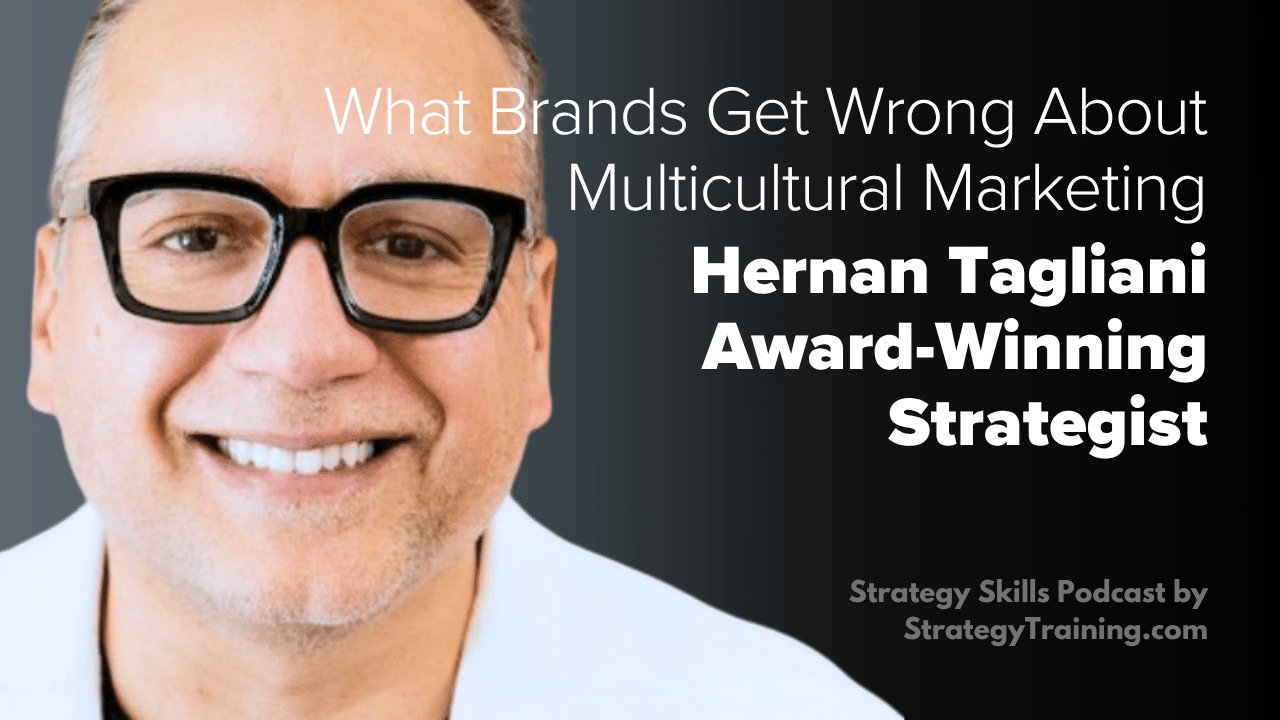
What if cultural relevance isn’t just a marketing strategy but a business imperative? In this episode, I speak with Hernan Tagliani, a multicultural marketing expert, award-winning strategist for Fortune 500 companies, and author of The Hispanic Market for Corporate America and Multicultural Mainstream that explains how brands can drive lasting growth by truly understanding and serving Hispanic consumers.
Born and raised in Buenos Aires, Hernan shares how he rebuilt his career from the ground up after moving to the U.S., started his agency with a single client, and went on to lead multicultural strategy for some of the world’s most recognizable brands. His approach? Culture before language. Data before assumptions. And storytelling that builds trust, not just transactions.
We explore:
- Why many brands are missing out on long-term growth by overlooking multicultural strategy
- The biggest myths corporate leaders still believe about U.S. Hispanic consumers
- Why translating a campaign isn’t enough and how “transcreation” builds loyalty across generations
- How Hernan helped a national brand go from pilot campaign to national success by earning trust first
- What it takes to create a brand that reflects, and respects, the communities it serves
- How AI and digital media are reshaping what it means to be culturally relevant in real time
Hernan also shares personal insights on leadership, reinvention, and why taking risks, even when it’s uncomfortable, is key to becoming a purpose-driven entrepreneur.
Whether you’re building a brand, scaling a business, or trying to connect with today’s fastest-growing consumer segment, this episode offers practical strategies and a powerful reframe on what it means to lead with culture, not just campaigns.
Get Hernan’s book here:
Multicultural Mainstream: The Power of Hispanics In Consumer Marketing
Here are some free gifts for you:
Overall Approach Used in Well-Managed Strategy Studies
Enjoying this episode?
Get access to sample advanced training episodes
Episode Transcript:
Kris Safarova 00:45
Welcome to the Strategy Skills podcast. I’m your host, Kris Safarova, and our podcast sponsor today is StrategyTraining.com. If you want to strengthen your strategy skills, you can get the Overall Approach Used in Well-Managed Strategy Studies. It’s a free download, and you can get it at firmsconsulting.com/overallapproach. You can also get McKinsey and BCG-winning resume, which is also a free download at firmsconsulting.com/resumePDF. And lastly, you can get a copy of a book we co-authored with some of our amazing business, amazing clients, and you can get it at firmsconsulting.com/gift. And today we have with us Herman Tagliani, who is a multicultural marketing expert, award-winning strategist for Fortune 500 companies, and a business speaker. He is the best selling author of Multicultural Mainstream: The Power of Hispanics In Consumer Marketing and a contributing writer for national publications including Adweek, Entrepreneur Magazine, and Forbes magazine. Hernan, welcome.
Hernan Tagliani 01:54
Thank you. Thank you. It’s a pleasure to be here. Thank you for having me.
Kris Safarova 01:58
What key experience early in your career gave you a lens others didn’t have that ultimately got you to do the work you’re doing today?
Hernan Tagliani 02:07
Well, definitely discipline and persistent. You know, I was born and raised in Buenos Aires, Argentina. I work in the marketing and advertising industry for a little over 33 years. So I moved to the United States around 23 years ago, even though my experience in marketing and advertising was very strong when I moved here, different culture, different way of doing business, and I have to basically reinvent myself, readapt and learn everything so through discipline and persistence and having purpose in life, that’s what get me where I’m at right now. I’m very passionate on what I do, and my passionate with service making other companies, brands and executives better to fulfill the goals. That’s when passion turns into purpose, and that’s what I’m driven. I’m driven about purpose with passion. So having fun and getting paid at the same time.
Kris Safarova 03:14
Take us to the early days of your agency. Was there a gap that you’ve seen in the market that no one was feeling?
Hernan Tagliani 03:23
Yes, definitely. It was part of that. I work in different ad agencies when I when I moved here, learned their culture, the way of doing business, and then in 2006 is when I decided to branch out and open my own business, focusing on a specific niche, that it was Hispanic market, and of course, now we evolved more into the multicultural marketing, but it was a need, an opportunity that I saw, especially in the market I was, and I’m still located at this Time, in Orlando, Florida. So I started with with one client from my house, and then from there, start growing the business. And now we’re very successful at agency, being in business very close to 20 years right now.
Kris Safarova 04:15
Tell us about that first client. How did you sign that first client?
Hernan Tagliani 04:20
That first client, the way I sign it, it was basically through a network event. It was in the real estate development and they were opening new communities in the Orlando market, and in this area they called Kissimmee area, where they had a highly population of Hispanics, and currently have so they needed help with catering to potential Hispanic homeowners in promoting the opening of this new community so they can sell those condos and houses to the Latin. Community. That’s how I started with the first client, and then start adding more and working with some of the national brands and top 500 companies, which I’m very proud of, the trajectory and the growth of the business and the opportunity to work with these globally known brands.
Kris Safarova 05:20
When you did work for this first client, what did you do differently versus what you would have done if you didn’t have that specific focus of your agency? What did you do differently versus any other agency they would have hired?
Hernan Tagliani 05:36
Yeah, so what I did differently is for being Hispanic. We know how to engage brands with them, how to trigger consumers behaviors with them. You know, it’s about understanding the cultural nuances a lot of the brands right now, well, a lot of them, but not all of them. They’re still see this opportunity to reach to this niche through a language standpoint, which culture is more important than language? And that’s when campaigns, they don’t, they don’t create and generate the results that they are looking for. Is not translation based, is transcreation, is creating a campaign that truly appealed to the cultural nuances and speak to their needs of these consumers. So it’s not language, it’s culture, and that’s what we do different. We’re very big on data. We’re very big on research. We’re very big on understanding the consumer’s DNA, the ones needs desire, understanding the whole consumer journey and how they engage with brands, and then from there, what are the expectations and once that purchase has been done, of that product or service, how you keep that consumer engaged? Which is a part a lot of times brands, they don’t pay attention on it. They are more focused on the sale rather than the long term relationship.
Kris Safarova 07:00
So what are some cultural differences of Hispanics in the United States?
Hernan Tagliani 07:06
So they’re very family driven, very strong family values, very proud of their heritage, their language, and they tend to be very loyal, so understanding how they engage with brands, what are the priorities that they have in many times depending on products. It tends to be a family decision more like a me decision. So and when you reach out to younger audiences as well, they tend to live in a multi generational home, so the alders plays an important role on that purchase process. So understanding the dynamic of that household, understanding how they think, understanding that trust, is very important to create and generate from them in order to turn that consumer into a long term and loyal consumer and customer is crucial. So that’s why the data part, the research part, is important. And I address this very often with brands. This is not just a simple translating English to Spanish is understanding their their culture and how to gain that trust once you have it, once you gain the trust and you earn it, you tend to have a very loyal customer from generation to generation.
Kris Safarova 08:34
Could you elaborate on how to earn the trust?
Hernan Tagliani 08:38
Sure, so earning the trust is starts there. What I always said is understanding the consumers DNA wants and desire. Earning the trust is understanding what truly resonate to them and how to create through storytelling of advertising the perfect lifestyle that truly appeal to their needs, but where you can position your product or service that will definitely solve that challenge that they have or make their lifestyle better. So people tend to resonate to situations or customs within their culture that you know, they are very, uh, ordinary in the way they have been raised and and they perceive them as as the right one, as correct one. So, or even give them some flashback of their when they were younger, for example. So there’s so many different angles that on an advertising standpoint, it can help you to earn that trust, to create that trust from the beginning. That’s why doing the diligence first understanding the consumer it is, it is crucial, and that’s where the research and data will basically help you to build that roadmap and. And and then, of course, partnering with experts into these niche market niche will help you make that campaign and that message stronger, authentic and more believable.
Kris Safarova 10:15
Hernan and could you share with us? How did you sign your first well known global brand as a client?
Hernan Tagliani 10:23
My first world global brand as a client. Basically, I met one of the regional directors in charge of the southeast region of United States. So through having conversations with her and sharing our value proposition, our expertise, taking into consideration the southeast is very diverse and a strong presence of Latinos community. So that’s what she mentioned. Look, this could be a great opportunity to talk to corporate office, our chief marketing officer, and I will set up this meeting with him to bring you and your team in so you can share where the business opportunity is for us and how maybe we can start something on a market by market or Regional Base, see the momentum that we create, the results that we create, And then take this into a national type of campaign. So that’s how I started working with this global brand. The regional opens the door to talk to the corporate level.
Kris Safarova 11:33
Very good. So tell us what happened. So you go for that big meeting, how things unfold once you’re there?
Hernan Tagliani 11:39
Well, it was a lot of hesitation. And sometimes it depends on how open minded executives tend to be right. So in this case, it was a lot of hesitation because this person, at that time, the Chief Marketing Officer, didn’t have enough information about the Hispanic consumers. And also it was a little bit of personal bias on how the company overall, for decades, they have been doing business in a specific way. So when you present a new idea, a new business opportunity, sometimes it’s a lot of resistance, resistance for the for the unknown, resistant of potentially making a mistake and and, you know, as human beings, we try to control things in life that the more control you’re trying to have, the less control you have. So you got to take risk, and you have to take leap of faith, and it’s the only way that a human being can can learn. So that’s why, in the in the first meeting, it was challenging because he felt that the Hispanic market wasn’t a priority for him and a business opportunity for him. He had other priorities, but the regional director, who is the one who brought us in, she’s like, Look, you are complaining every week on the marketing meetings that we keep losing market shares and sales right now and there are more competitors in the market. I’m not saying these agency and these people have the solution to our problem, but definitely they are experts on something that is very strong in the market, that we have a presence on. So we should give them a shot and try. And that’s how we started. We started with a pilot campaign to get their feet wet and see and show them the potential that they have. And then from there, after we show the performance and results, that’s when other markets, other states, they start adding and then taking this campaign and initiative into a national campaign that there is data, of course, supported behind that has been working.
Kris Safarova 13:50
Tell us about the pilot campaign. What did you do and what were the results?
Hernan Tagliani 13:55
Well, what we did is they gave us two markets to specific DMA for six months. They gave us a budget, they gave us some promotions they wanted to announce and advertise, and they gave us specific KPI. Of course, they wanted a lot of food traffic to their store, and we did a lot of branding campaign. First of all, introducing the brand to the Hispanic community something brand new for them. So people need to be aware of what the brand was all about and what is the value proposition and how welcoming they were going to feel when they were walking inside the retail stores and do business with them. So we started with some store activations and specific events to generate that, that interest, and then sales start coming and stores managers calling corporate saying, hey, usually our stores on Tuesdays, we there’s not too many customers. Now we have a lot of customers. They’re. Here for this particular activation engage event that this new agency put together, we would love to have these more on ongoing basis. So how can we work these out? So that’s how this this started with this pilot campaign for six months. It was a lot of branding activation, and then that droves traffic and drove sales, and that’s what basically gave the the message to corporate, like, there’s a lot of money we’re leaving on the table by not doing this in other markets. And that’s how all these started.
Kris Safarova 15:38
Tell us more about activation events.
Hernan Tagliani 15:43
Activations event, in this case, for example, we partner with radio stations. We did a lot of live remotes. We promote specific soccer games, sport events to come to. This is a QSR restaurant to come to this restaurant, and then we also supported by some community events. So concerts, Hispanic entrepreneur events, they give awards, or it’s a gala event with dinner. So the brand sponsor that. So we started that way to show the return on investment. So that was part of the activation. How we started.
Kris Safarova 16:31
And when those customers were coming to the store, how did you make sure that they actually did feel welcomed? How did you make sure that the store was able to deliver on the promise you were making?
Hernan Tagliani 16:44
So it was a process by phases. Of course, clients, when they start reaching to other audiences, is there are certain things that they have to take into consideration, like, in this case, having bilingual employees in stuff. So it was something that it didn’t change overnight one in two months. It was a process that it took, you know, more than six months, but they started implemented year over year to make sure in certain stores that they were very catered to the Hispanic community. They have bilingual people in staff. So if somebody comes and feels a little more comfortable in speaking with somebody that speaks Spanish, so then they have that option available for them. So that was number one. Number two is to have somebody bilingual collateral materials in these stores when we were doing activations. So in a way of seeing we hear you, we see you, we recognize you, and we respect whatever language you want to speak. In this case, of course, Spanish, if you want somebody that speaks Spanish, we have it in the store. So most of the stores, they had some whether it was the cook or whether it was the person who was working at the front desk. But then, as the time was going passing by, then they start bringing more employees and more diverse employees into their team. So at the end of the day, we need to make sure that they reflect the community they serve. That’s how you make people feel welcome as a starting point.
Kris Safarova 18:26
Hernan, and can you take us through your thought process of how that budget that you had for six months had to be allocated in the most effective, efficient way?
Hernan Tagliani 18:36
Well, the thought process is it was basically dictated by the KPIs. And, you know, the clients wanted, uh, two strong KPIs. One was increase of sales, and the other was increase of food traffic, and the third one was increase of website visitors. So based on those KPIs, we were, you know, my team figured it out, okay, how can we get the most amount of people in a shorter period of time on this activation to show momentum and that being reflected into cells? And that’s when we came with this proposal of that included some traditional media at that time, and then having a bilingual website, of course, our landing page, and then partnership with different media to bring people into the store and create and generate the sales so the client can see the return on investment. So it was more on the we call it a short term type of goals, and that’s how we work with clients. We help them depending on what they’re trying to to achieve. We’re more interested into the long term growth and the short term gain. Needs, but we understand it’s a process to take. So there are certain things to get where the client needs to be. You gotta show and prove value to them. So most of the time, you start with short term goals, and then from there, that’s when you can start having the conversation, okay, how can we take this brand to the next level. As you just showed me, in a short period of time, you’re generating sales, you’re generating food traffic, and there is a business opportunity for us.
Kris Safarova 20:30
And then in terms of actual allocation of the budget on various categories of spending, how that decision for that client?
Hernan Tagliani 20:40
Well, the decision, as I said before, was based on how we can bring the most amount of people to the retail store. And that’s why we came with activations, you know, bring people in getting to know the brand the product. Can experience it. Can see it, and now you know, now more than ever, with social media, is very important to spread the word. So that’s why it’s important. Also, while people are coming to your retail store, let’s say then you’re is a great opportunity to create content. So on one end, that’s why activations is very important. But also you have to support that with some traditional, non traditional media. And right to bring people in, you need to run some advertising campaigns on certain certain media, such as could be radio and digital and social. So depending on what the goal is of the campaign, then there’s certain media. They have their weaknesses and they have their strength. You know, everybody would love to do TV, but sometimes TV is not the right media for you. It’s too expensive, and maybe it’s not the right moment if you don’t have the budget to create that momentum that you’re looking for. So budget dictates basically what media budget and KPI detects what media will work better based on the goals the clients are trying to reach.
Kris Safarova 22:12
Of course. And if you were working for this client right now versus then, what would you do differently?
Hernan Tagliani 22:19
What I would do differently? Definitely, I would have a stronger presence on multicultural consumers, not just Hispanics. We are becoming a very diverse audience. 44% of consumers are multicultural, and by 2027 that number will jump to 48% so that’s where the growth is coming. So that will be my message to these clients and to any clients out there, start thinking how your your company and your brand is going to evolve, and how you’re going to keep it authentic and relevant. And the way of doing is to appeal to these younger generations that are driving this growth, and they’re going to be the main consumers, or they already are your main consumers. So that’s my, my, my, my, shout out to a lot of marketers and CEOs. You know we are facing consumer evolution, adding to, you know, technology now with the AI, the power AI. So we’re going through all this process. It could be sound very overwhelming, but it is. The reality is, whether you embrace it or you’re going to be out of business.
Kris Safarova 23:39
You recently wrote a book. What are the key things you want people to take away from your book?
Hernan Tagliani 23:46
Well, the key things that I would like people to learn from my book is number one, as I said before, we’re becoming a multicultural mystery. We already are a multicultural mainstream by 2045 the census is talking about that, why consumers will become my majority minority. Sorry, so as a brand and as an executive, you gotta keep in mind and embrace the trends and the how consumers are evolving this particular Gen Z’s and millennials. So that’s number one, understanding where the growth is coming and what are the tools and resources and plans that you should have in place to embrace this consumer evolution. Number two, I would love for people to learn. There’s still a lot of stereotypes out there about the Hispanic community, a lot of promoted by the media and some you know politicians as well, that if you look at the numbers, you know it’s all out there on the internet. The. It is not true. The Hispanic community is very vibrant and growing community. 70% of the population are US born. 45% are second generation. So you say domestic growth, 68% are part of middle to upper class. 11% is affluent. So these people that, first of all, they are Americans, they are second generation of Americans. And number two, they have the disposable income to expand. So that’s another thing that I address this book. You know, there’s a I talk about some myth of the Hispanic market that a lot of corporate executives have. And I address those, those myths in the book. And last but not least, I like to give a message in my book of, you know, running a company or running a brand, you you gotta take risk is you’re gonna make mistakes as part of the growth is part of being a successful entrepreneur, but also is having a deep understanding and a sense of what’s going on in the market, and staying away from from personal bias. So just the fact that you have been doing business in a specific way doesn’t mean it’s the right way. So you cannot be drinking your own Kool Aid. That’s how I live my life in my agency. I have the open door policy. I love everybody to put their thoughts and points of view when we are dealing with with new brands, no matter what department is, everybody is welcome to collaborate. We see ourselves more than a team is more like a family. And for me, titles doesn’t mean anything I like to learn. I feel these have a lot of things to learn from young people as well. It’s never too old to learn and never too young to teach. So that’s how I live my life, and that’s what I talking in the book. You gotta you gotta take a leap of faith. You gotta try new things. You gotta innovate, you gotta evolve. You gotta embrace market trends if you really want to stay in business, be an authentic brand and and being culturally relevant as well.
Kris Safarova 27:31
What are executives missing? Do you think they assume multicultural strategy is optional?
Hernan Tagliani 27:38
They are missing that it’s not optional. It is a business imperative. They are missing that, you know, we tend to be a very reactive society instead of a proactive one. So they are also missing. They’re concentrating in the short term gains rather than the long term growth. And when you appeal to a new audience that is going to be driving your growth. You get you need to give time things time. You know the same way when you meet a new person, right? So you’re not going to get married next day, so you’re not going to expect results in in a week. So it takes time you need to nurture that relationship. You got to earn that trust. But once you go through that process, you’re going to start seeing your return on investment. You’re going to start seeing how sales or market share that you have been losing by your competitors from the general market, you are balancing that loss of sales by appealing to other consumers, which means multicultural consumers. So those are things that I that I see in the corporate world, that leaders are are missing out and then, and last but not least, yeah, at the end of the day, if you want to run a successful business, you have to represent the community you serve. That’s key.
Kris Safarova 28:59
If a company starts today with a blank slate, how should it be built for cultural relevance from day one?
Hernan Tagliani 29:09
That’s a very, very great questions. I think. How they should start? They should start by understanding the consumers, by researching, by learning. That’s where it starts with doing the research. That’s why I always encourage all my clients, a lot of them, you know, they’re big brands, they have the research department, and they tend to tell you they have a lot of research out there, and a lot of them, they do, but a lot of them, even though they have a lot of research, there’s still research and questions that they haven’t been answered yet. So that’s why we always like to digest all the research that they have, if they do have it, and then come up with some solutions or some things that, hey, we see a gap here and there that this will help to. Tell the overall story, and will help to craft that strategy that we can help you put together based on the information that you have, plus adding a little more that needs to be done. And sometimes we work with clients that they don’t have anything you know. They don’t have any research done for multicultural consumers. They have some research done for general market, but maybe it’s three or four years old. So that’s kind of like a blank slate for us, because it’s starting from ground zero ground up. So that’s when we start putting all these research in place, understanding consumers journey, and then do the crossover, right? So once we have all the research from, let’s say, Hispanic market, okay, how can we cross over that with the general market? And then how we can find things that they have in common and things that they are different? And then how can we address that into the communication campaign. Of course, when you do these type of campaigns for multicultural consumers, something that I want to address on is the look and feel of the campaign has to be aligned with your overall general market strategy and campaign at the same time. So whether you see the ad in English or you say in different languages, it has to have that look and feel, and that’s what we’re expert on. You know, not only we follow suit or what the brand guideline that the client has, but we know how to craft that message that appeal to the cultural nuances and makes that message and brand relevant and make that person say, hey, I want to do business with this brand. I want to buy this this product or service.
Kris Safarova 31:47
What are the values and preferences of us Hispanics that brands often miss? I know you mentioned earlier some preferences, but which are the ones that brands often miss, even when they try to focus on that particular market segment?
Hernan Tagliani 32:02
Yeah, the what, what brands tends to means is they use the general market campaign, for example, and then they tend to just put people that resemble Hispanics or resembles, let’s say, African Americans or Asian Pacifics. But then, when you look deep inside, what is the message? It’s just a little translation of the English campaign into other languages and putting people that resemble these audiences. And when you do that, you take the risk of that strategy, not only to be misunderstood and deluded, but also you’re not showing respect. And what I mean with that is, when you translate a campaign that you have for the general market and try to force it in other languages, you’re basically forcing a strategy that was never upon intended to reach to other cultures, to other audiences. So you’re just hoping and praying that by this translation, people will understand, the message will resonate to them, and that’s it. Check. Well, the reality is, is not going to create the results that you’re looking for, because you do not have an authentic campaign that was flashed through it to appeal the cultural nuances of these consumers. I always say like this. It’s like saying that Australians and Americans are the same because they speak English. It is incorrect. They speak English, but they have different you know, the way the culture is different, so you gotta make adjustments of that campaign on the market you’re running. The same happened with the Hispanic market. You had to speak both languages, English and Spanish. As I said before, 45% of the consumers right now are second generation Hispanics, so the younger they prefer to speak English. The older they tend to prefer to speak Spanish. So you have to have a campaign that appealed to to both. But what companies tend to do wrong is, oh, that Hispanic that was born here and speak English, I don’t have to make adjustments on the campaign is it’s same campaign. I just put somebody that looks Hispanics, and that’s it, and that’s the risk that you take. You’re not coming authentic, you’re not appealing to the cultural nuances, so you dilute the engagement and the brand recall and at the end of the day, that translate into less sales, and that translate into low engagement of the campaign and results. So that’s why, as I said before, culture is more important that language at time of execution. That’s the key.
Kris Safarova 34:50
What do you think is the most important trend in Hispanic consumer behavior right now?
Hernan Tagliani 34:54
One of the most important trends in Hispanic consumers behaviors are. Um, definitely, I think the social media is, is, is very important trend right now to have content, culturally relevant content available to them in English and and in Spanish. There is a lot of brands out there, they have a very strong followers. But when it comes to other audiences, or when it comes to Hispanics, there’s not enough content that appeal to these, to these highly influential consumer market. So even SEO in Spanish, for example, is another important thing to consider. We know we are living right now on this moment of transformation, but at the end of the day, numbers don’t lie. You know, it’s all out there, and that’s the direction that we’re going. We our the growth of the Hispanic community, say, domestic growth, higher household income, higher education, bilingual by culture, and they tend to spend 90% of the disposable ink. So that’s one of the of the trends that I see very big on social media and well, as we know now with AI that we are on the kind of like early stages right now, and it’s going to change very soon. We’ll see where this will take us.
Kris Safarova 36:36
If you had one hour with a CEO on this topic, what would you prioritize?
Hernan Tagliani 36:43
Well, I think they, in one hour that will prioritize is addressing the myth that they are still out there about the Hispanic consumers. So starts with, there. Starts with educating, educating the opportunity that they have, the business opportunity they have, educating how vital and important these consumers are, and then help them craft the right message that will definitely be aligned with the overall vision and mission of the organization, but in a culturally relevant well, that culturally relevant way that it will look authentic, it will feel authentic, and it will sound authentic. So that’s, in one hour, what I would like to address. I will hone in into educating, educating this executive about the consumer and the business opportunity they have.
Kris Safarova 37:48
Has AI changed the way you run your campaigns today?
Hernan Tagliani 37:53
Well, it does. It always does, especially with, you know, social media, depending on what type of clients you have, you know, if you have a client that is on hospitality, definitely digital social media are 80% of the budget. So the market is changing. Is evolving. Streaming right now is very big, and I foresee, you know, moving forward, that’s the direction that we’re going. You know, ratings, it’s going to be something of the past. It’s going to be more on relating, on conversions and engagement. So that’s where we are right now, on on evolving into digital, social media streaming, and then with with AI adding into it. So that’s why we were going to be going through some interesting times. And me, personally, I’m doing some coming up, doing some AI courses, and embracing this is something that I foresee moving forward for anybody looking for a job like the old times, they used to ask you, how is your knowledge on Microsoft Word products? It’s going to be coming up very soon. What is your knowledge about AI and the prompts, and how expert or experience do you have in applied them? So the time to act is now. So I highly encourage everybody to start learning.
Kris Safarova 39:29
What are some key lessons you have learned so far from experimenting with AI in your work, from things you have learned through all those courses you’re taking?
Hernan Tagliani 39:39
Things that I have experiencing. Definitely right now, I’m using AI. I’m excited about this course that I’m going to be doing and learning all these different prompts, definitely has been helping us as a source of inspiration. Even in my team, they create a team, they use it a lot when. Got to create new campaigns, come up with some headlines based on the consumer demographic we’re trying to reach. So they they use it as a source of inspiration. In my case, yeah, definitely. I use it as a sort source of research. For me, it’s very important when talking to new clients or existing clients, and have an understanding what’s going on in the market. I use a lot of AI on a research standpoint. Also, you know when, when it comes to crafting certain emails. So I use it a lot too. So it has been very, very, very helpful so far, and it is the direction that we’re going and looking forward to learn more on how to implement AI on my daily life in certain things.
Kris Safarova 40:54
And to wrap up, I’m going to ask you one or two of my favorite questions, depending on the amount of time we will have. So first one is of the last few years, what were two, three aha moments, realizations that really changed the way you look at life, or the way you look at business?
Hernan Tagliani 41:12
Great. So the way I look at life, I would say, you can get the life you want by changing the way you think, the way you think determines your life. And I also learned that the greatest mistake a man can make is to be afraid of making one that was kind of like against the way I was raised. You know, I was raised by an Italian family, you know, very conservative, very male dominant, and so always, like I, we don’t want you to make these mistakes. We already make those mistakes, but it’s the only way that you can learn. That’s why the greatest mistake in my campaign is to be afraid of making one for sure, and success is on the other side of fear is not what happened to you that will determine how far you’re going to reach into life. It’s how you handle what happens to you. And things happen for a reason, but things don’t happen to you. They happen for you. So that’s part of what I learned in my life, that it has been helping me to go through different challenges and be patient in and go through the process and believe things happen for a reason, and what are the lessons learned out of it, and that’s how a person will grow, right but learning, adjusting, making those mistakes and move forward. You always have to move forward, and then, from a business standpoint, that’s the way I am. I like to be very upfront and transparent with clients and set the right expectations. That has been very successful to me, and also learning to say no, many times we have the opportunity to work with some brands that we’re like, oh, this is a huge opportunity to work. But through the process of going through getting to know us, the proposals and all these. Then I came to the conclusion this, this company, is not aligned with the direction I want to take my business and I want to grow together. So yeah, it sounds really, really nice on paper, but learning and getting to know the leadership on the way they think and their goals and perspective is not aligned where the type of clients I want to work with. So I have many times to say, no money is good, but it’s not aligned with the purpose. So for me, it’s working with clients that really they need help, and they need the help of an expert of a team who can help them propel that brand and take it to the next level. So I know, as an entrepreneur, for for some of them, is is very hard to say no, because you have bills to pay and all that stuff. But I also learned working with the wrong clients is not the right investment, because it brings the morale down of a lot of your employees, frustration, a lot of stress and and then it’s not an effective business. So people tend to do business with people they like. And is the energy is, is the click when you meet a client, you’re going to feel it if it is the right client and and that’s how I like to do business.
Kris Safarova 44:47
Thank you. And the last question, if you could instill one belief in every listener’s heart and head right now, what belief would you instill?
Hernan Tagliani 44:57
The belief is, do, never, ever, ever. Give up, as I said, before success is on the other side of fear and follow your instinct. Is better to take the risk and find out. Well, maybe this is, this is wasn’t for me, and what did I learn from it? That’s better than having the remorse of not doing it and then have that why I didn’t do it, you know, maybe I lost an opportunity. So that’s why I always tell tell people, take the risk, go through it, make the decision. If it didn’t work, okay, what did I learn from it, and then move on. As I said before, it’s part of human beings. We try to control things, we try not to suffer, we try to minimize risk, we try to play it safe and being comfortable, but the more you try to control your life and decision, the less control you have.
Kris Safarova 45:59
Thank you, Herman. Really appreciate you being here with us today. Where can our listeners learn more about you? Buy your book? Anything you want to share?
Hernan Tagliani 46:06
Thank you. They can find my book on amazon.com also they can visit my website on hernantagliani.com, and the books is also available on different bookstores in the US and the UK, including Amsterdam and Spain and Italy.
Kris Safarova 46:28
Our guest today, again, has been Hernan Tagliani. Check out his book. It is called Multicultural Mainstream: The Power of Hispanics In Consumer Marketing. And our podcast sponsor today is StrategyTraining.com. If you want to strengthen your strategy skills, you can get the Overall Approach Used in Well-Managed Strategy Studies. It’s a free download, and you can get it at firmsconsulting.com/overallapproach. You can also get McKinsey and BCG-winning resume, also free download we prepared for you. And you can get it at firmsconsulting.com/resumePDF. And lastly, you can get a copy of a book we co-authored with some of our amazing clients and listeners, and you can get it at firmsconsulting.com/gift. Thank you so much for tuning in, and I’m looking forward to connect with you all next time.
Leave a Reply