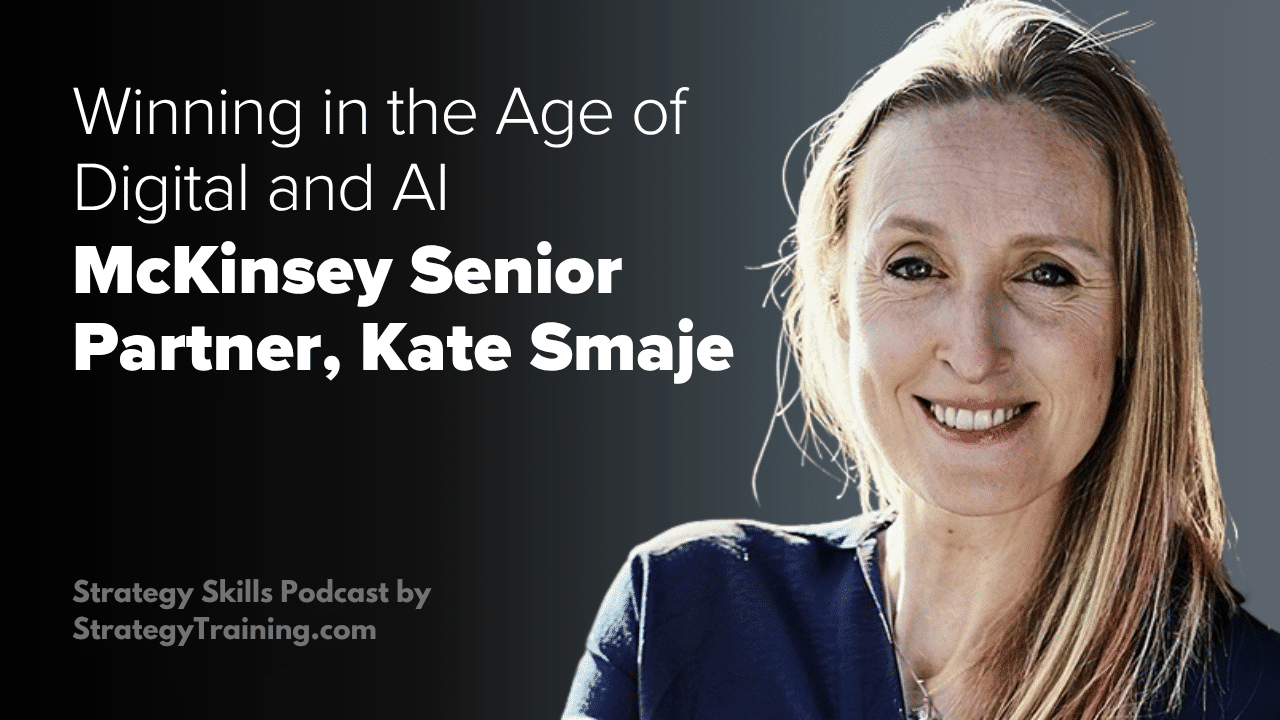
In this episode, Kate Smaje offers a clear-eyed and disciplined perspective on what it takes for organizations to succeed in digital transformation. Drawing from deep client work across industries, she outlines a practical, results-focused view of how digital can be embedded into the operating core, not treated as a parallel initiative or buzzword.
Kate Smaje challenges conventional narratives around innovation, urging leaders to look beyond technology adoption and focus instead on talent systems, cultural alignment, and strategic clarity. “We often start with a conversation about tech, but the value comes from the way you bring it all together,” she says.
“If you think digital is the job of the digital team, you’ve missed the point. It’s about how the whole organization behaves.”
Key Takeaways:
- Digital Transformation Must Be CEO-Led and Enterprise-Wide
Smaje emphasizes that meaningful transformation requires the involvement of the full organization, not just IT or digital teams.
“Digital is everyone’s job. The companies who really succeed have a CEO and leadership team who are actively engaged.” - Shift Metrics from Volume to Value
She critiques outdated performance metrics:
“If you’re just measuring lines of code or hours worked or features shipped, you’re not measuring outcomes.” - Technology Without Architecture Is Just Chaos
Many companies overemphasize agile practices but underinvest in foundational tech and data coherence.
“You can’t run 300 agile teams and not have an architecture that supports it. It’s like having everyone run at speed but in different directions.” - Product Ownership and Cross-Functional Clarity Are Essential
Successful organizations empower teams with clear product mandates while maintaining enterprise-wide alignment.
“The product owner model is about creating real accountability, with multidisciplinary teams who have the context to make decisions.” - Leadership Behavior Drives Cultural Change
Where leaders focus their time is a key signal:
“One of the biggest indicators of success is how leadership spends its calendar.”
This conversation is essential listening for senior executives who want to move beyond surface-level digital initiatives and embed durable capabilities that support both innovation and performance. Kate Smaje leaves no doubt: digital excellence is not a side project—it’s a leadership discipline.
Get Kate Smaje’s book here:
Here are some free gifts for you:
Overall Approach Used in Well-Managed Strategy Studies
Enjoying this episode?
Get access to sample advanced training episodes
Episode Transcript:
Michael 00:46
Our podcast sponsor today is StrategyTraining.com. If you want to strengthen your strategy skills, you can get the Overall Approach Used in Well-Managed Strategy Studies. It’s a free download, and you can go to firmsconsulting.com/overallapproach. That’s firmsconsulting.com/overallapproach. And if you are looking to advance your career and need to update your resume, you can get a McKinsey and BCG-winning resume template as a free download at http://www.firmsconsulting.com/resumePDF. That’s http://www.firmsconsulting.com/resumePDF. Hey, Kate, it’s great to have you on the show.
Kate Smaje 01:31
Well, thanks so much for having me. It’s wonderful to be here.
Michael 01:34
So, I’m going to get right into it, because we’re in an exciting time. Everywhere I look, people are talking about AI. I feel like I went to sleep in 2022 I woke up in 2023 and the world has gone crazy about AI. So as a starting point, because there’s so much noise going on, what’s happening in the world of digital and AI at the moment?
Kate Smaje 01:55
Yeah, so look, I think this is one of the most interesting times to, frankly, be alive in this space right now. And I think you’re absolutely spot on that it feels like the pace of change has never been so quick in this and I think what’s going on is, you know, the world is maybe not waking up, but certainly embracing technology, AI and so on, at a very different level to what we’ve, you know, ever seen previously, and part of that is because it’s become so usable, it’s become so wired into our everyday lives, whether that’s, you know, anything from checking the weather in the morning to ordering a taxi through to, you know, dealing with our own bank accounts, it just is the way that we exist. And I think particularly what what Gen, generative AI and things like chat, GPT and so on, have done is they put this incredibly powerful technology in the hands of people that don’t know how to code, that maybe didn’t have any kind of technology background, but can suddenly use it for all manner of things that just make life easier, better, faster than it’s been so far. So very, very exciting time.
Michael 03:05
Is it fair to say that we’ve always been using AI, but only recently have we realized the sort of scale and impact of AI because of chat GPT, or is it just happened overnight?
Kate Smaje 03:19
No, I think we’ve been using this for we have been using this for a long period of time, and in some ways, you know, the level of buzz, the level of hype around chat GPT has sort of thrust it into the into the mainstream. But this isn’t new. You know, AI has existed for a long time in this kind of space, so no, not new, but certainly has garnered a level of platform that perhaps did not exist before the start of this year.
Michael 03:48
If I’m a CEO, right? I’ve got 10,000 things on my plate, from climate change to diversity and equity and inclusion, and now my team is telling me I’ve got to focus on AI so as a starting point, seeing what’s happening, how should management think about what’s happening in AI?
Kate Smaje 04:08
Yeah, I love that question. So I think there are a couple of things I would highlight right. First and foremost, it’s never about technology for technology’s sake. Whether that’s AI you know before with Blockchain, you know, with quantum computing, it’s never about just falling in love with the technology. It’s always about what that technology will unlock in terms of value creation potential for for your business, let’s say, if we are talking about CEOs. And so the first and probably most important thing is, you know, can you get your top team pointed in the right direction in terms of where and how AI is going to create value for your business? So, you know, many, one of the mistakes I think lots of people often make is they sort of jump headlong into just getting on and doing stuff, and they short chain. Change the need to really understand, you know, and be clear about where is it you’re trying to go, and what’s a real roadmap to get there, and how much value and in what ways is a go AI going to change our business and rather, unfortunately, see a lot of people just sort of dive in and miss the bigger picture around this.
Michael 05:19
So at times, I’m going to paraphrase things for the audience so they can follow the interesting insights you’re putting forward, so I hear you correctly. You’re saying that AI is a tool that supports the business and its strategy, and the starting point is to understand where the business is going, and then how AI can enable that. Is it a good way to think about it?
Kate Smaje 05:37
I really like that. And look, I’m not a fan of what’s my AI strategy. You know, as a business, have a strategy. AI is just, as you say, the tool or the enabler or the means to the end of achieving that strategy. It is not something that is separate and off the side and treated discreetly. And I think that is, unfortunately, something that many companies miss, perhaps in the well intended effort of just trying to rush to take action and rush to make progress.
Michael 06:07
Now, one of the things that struck me about your work is, I like the way you phrased the questioning, which is, we’ve gone through different types of transformations or upheavals in the space of digital over the last 30 years, so we do have an established playbook in terms of how we think about this and respond. So why is it so many companies seem to be always caught like a deer in the headlights when these things happens? What’s the reason for the surprise and the apprehension when there is an established way to respond to these things?
Kate Smaje 06:37
Yeah, look, it’s a great question, and frankly, it’s one of the reasons why we’ve written this, this book is because, you know, day to day I work, you know, I see many, many executives struggling with how to really drive and deliver value from their digital transformations. And as we’ve kind of pared back and looked at hundreds upon hundreds of transformations, actually, the menu. The ingredients are not rocket science, right? Excuse the pun. There is actually quite a simple set of things that need to get done. Now, I’m not saying it’s easy. Of course it isn’t. If it were lots and lots of companies would be, would be doing this and sailing off into the sunset, but, but what it is is about being incredibly rigorous around six key steps that we believe, you know, really separate out those that are managing to capture value and have fundamentally rewired their business to do so, versus those that are struggling. Maybe it’s they can get onesie twosie use cases out, but they’re not able to do that at scale, or they create a little bit of value, but it’s not anywhere close to what they believe the full promise of digital was going to be, and ultimately, they’re not out competing as a result.
Michael 07:52
And do you find that there are some sectors that are better at adapting to AI than others, or is it best practice that is not linked to a specific sector, but linked to certain types of management styles, approaches to the way they run their business.
Kate Smaje 08:09
Yeah. So we absolutely, we do see some sectors kind of getting out maybe ahead of others on this, and there’s always been a sort of maturity curve approach to do this. But what’s interesting is the playbook that that we posit in the book is industry agnostic, right? There isn’t one playbook another one for Life Sciences. It genuinely is agnostic. Now, how you apply some of the individual parts of that, of course, are going to have lenses for different sectors, but, but the point here is there is one way, genuinely one way, to do this risk across sectors. And I think if you have asked this question a couple of years ago, you know, we’d have said, you know, certain, certain sectors are well ahead on that maturity curve than others. And the you know, the difference between the leaders and the laggards from a sector basis, you know, is, is big. What you now see is in every, you know, right at the top of the maturity curve, and right at the bottom, you can have the same sector. So what’s actually happened is, those that have got this right are separating, you know, from the pack, as it were, within their sector, rather than, you know, hey, it’s, it’s banking, and it’s telco at the top and it’s, you know, mining and whatever else at the bottom. Yeah, that it’s less like that anymore. So what we’ve now seen is the stretch out within a sector, rather than just one sector versus another.
Michael 09:32
So if you were talking to a CEO, as I’m sure you do weekly and daily, someone who’s trying to think through these issues, how would you advise them to go about doing it? Assume that it’s someone who is who knows AI and digital is making big changes, but they’re not sure what the starting point is. So how do they start to move the organization to respond to this?
Kate Smaje 09:54
Yeah, so I mean, one of the first sort of mindset shifts that I would think about in. This is almost the difference from doing digital right, trying to put a bunch of you know, digital epithets at the start of every other, every other project, versus being digital right. And being digital requires businesses to really rewire how they operate and how they build the sets of capabilities that are going to generate value over time. So the first thing is just to make sure that that mindset shift is there. And then, as I talked about earlier, you know, the single most important starting point is getting your top team pointed in the right direction. You know, if I look at someone like a GDS, and this is one of the stories that we tell in the in the book, you know, their journey began with really taking executives to a whole raft of other tech startups, interestingly, not other banks, but other tech startups, to figure out, what does it take to become the leading digital bank, right? So didn’t want to just compare themselves to their peers, but to say, what’s it going to take to step out in our industry? And that journey becomes a lot easier once all of the bank’s leadership team understood where exactly they are going. So that strategic roadmap, that first step of the playbook, you know, you really can’t get under the skin of any of the other pieces until that is is clear, and that, I think, as well, requires any leadership team to have what I call a, you know, an audacious aspiration. Because this isn’t just can I be incrementally a little bit better, right across any industry, certainly that I’ve spent time in, it takes a real leap of faith to say, now, if I really rethink this, if I really think about where the puck is going, if you like, in terms of value, that requires a jolt, and that’s why that sort of audacious aspiration is really key, but it has to be done as a team.
Michael 11:54
So one of the feelings I got from reading the book is that we’re in an age whereby transformational change is ongoing. You almost need a leadership team that’s going to be okay with the fact that this never really ends. Yeah, you’re always going to have to be on there’s always going to have to be some change going on. You can never set up a business model whereby we’re going to say we’re going to change it over the next 18 months, and then we’re going to take our foot off the accelerator and we’re going to reap the rewards for the next four or five years. Is that a good way to think about it?
Kate Smaje 12:24
Yeah, it really is. And maybe that’s the sort of the slightly arresting part of this book, is, you know, we believe that digital transformation is never going to be done. One of the reasons I personally, at least, don’t really like the term digital transformation, or AI transformation is transformation implies that at some point we will be done, right? We’ll all pat each other on the back and say, we are transformed. Well done us. And that’s not how life works in this space. What a real digital transformation does is it builds the muscle memory to keep getting better, to use technology in ever more innovative ways to unlock that value. But you know, none of us has a crystal ball, and who knows what technologies we’re going to be talking about in five years, 10 years time, but your ability as an organization to be ready for that, to be able to scale against it, to move faster, or at a faster metabolic rate, if you like, than your competitor. That’s where the real beauty in digital transformation is. So no, sadly, I think, I think you’re never quite done.
Michael 13:31
And in your experience, best practice that you’ve seen. How do companies manage this always on model without burning out their employees? How do they keep things moving, keeping up with the competition, staying ahead of the curve? How do they do it, while treating their workforce in a way where they don’t want to all retire after 18 months?
Kate Smaje 13:52
Yeah, it’s just, it’s a super point. And you know, for anyone out there on this podcast, who’s, who’s done, you know, one or multiple of these transformations, they are, they are tiring, right? They are tiring. You’re because you’re effectively trying to move the organization as a higher metabolic rate than it, than it has hitherto worked at. And so, by its nature, you know, it is, it is somewhat exhausting. But what I would say is, you know, at the core of any digital transformation is a people transformation, right? This is one of the reasons why I don’t believe that you can outsource your way to digital excellence. And so once you know where you’re going to this point on strategic roadmap, you have to be able to get the people to get you there, some of which is, you know, upgrading of your of your talent bench, maybe hiring and from outside, maybe reskilling, upskilling, you know, from within. But it is about really understanding, how do we create an environment for the best and brightest of our of our people, by the way, not just technologists, but also, you know, the non technologists, the business people are. As well. How do I help them to really thrive? And a lot of that early work in a digital transformation is creating that people engine that can self, self sustain, the ability to move fast. And if you get that part right, I’m not saying, you know, you eliminate burnout completely. You know, we’re all just human at the end of the day, but, but it does mitigate, or does reduce the risk of doing that, because then you’re not trying to just do more with the same people. You’re really changing the people, and even the people you are keeping and upskilling you’re you’re equipping them with very different tool, tooling, very different mindset, very different ways of working that will enable them to do more. So you know, you can’t just, you can’t just load more and more onto an organization. You have to teach it to have that people transformation as well.
Michael 15:55
There’s one thing I do want to check with you in terms of your perspective on this. I remember many years ago, decades ago, when downloading came out and the media labels fought those companies, took them to court and so on and tried to shut them down. I think they succeeded. So initially, traditional businesses fought digital changes, but it seems that today, the response has been different. Rather than companies overwhelmingly trying to shut down these businesses. They’ve been more responsive about thinking about, how can we bring it into our business model? Have you also seen that change in the way established businesses are responding towards digital changes?
Kate Smaje 16:33
Absolutely, I think it’s, it’s very, very well put, and some of it is passing recognition, right? Of just seeing that, that closing the door doesn’t doesn’t always work right in how to in how to do it. So some of it is definitely pattern recognition, and some of it is, I think, you know, almost as organizations. And maybe this is a more ethereal point, but we’re becoming more porous, right? We it’s not just the confines of of my company, and how I think about my company, it’s actually, you know, how do I work with others? I need, you know, maybe part of an ecosystem. I have many partners that are helping me to do whatever it is that I need to do. I need to work with different data sets. I need to work with folks that maybe are not immediately within my, you know, my definition of my industry, but perhaps a really key players or have control points within my my value chain. And so I think as organizations, we’ve become more porous, and therefore more open to thinking about, you know, not just a simple equation of, you know, who’s my competitor and who isn’t. But, you know, sometimes it’s a frenemy, and sometimes it’s, you know, collaborator, and very different ways of thinking about it. So yeah, I think you’re absolutely right. There is an openness to that based perhaps on that pattern recognition, that just a fully closed door doesn’t doesn’t work.
Michael 17:58
I was speaking to a senior party at another consulting firm, and it was an off-the-record conversation, and he was telling me one of the concerns that has been brought forward to him from his more junior team members is the fact that they’re being asked to work on AI at the same time, employees feel that they’re being asked to train a system that’s going to be replacing them. One of his struggles is, how does he manage this? Because, to some degree it is true, these systems are going to replace some employees, while at the same time creating great opportunities for other employees. How do you see other companies dealing with this kind of disconnect or tension? Have you seen it in your work?
Kate Smaje 18:41
Yeah, very, very much. So, right? And it’s, and it’s where, you know the traditional fear, you know, right back to the to the Luddites, you know, I apologize, I’m a history major
Michael 18:55
I can see that, yes.
Kate Smaje 18:58
But you know, what I see is a couple of things. Number one is, it’s really important to remember that it is about activities changing, not not often whole jobs, right? And so actually understanding which are the activities that can be enhanced by AI, for example. And therefore, you know, may give back some time, but what are you going to do with that time? Because it isn’t necessarily a whole human and therefore a whole job. And often the companies, I think are really leaning into this are thinking through, well, is there an even better way to deal with that? You know, what would it take me to get to a very different version of the working week that was more inspiring to, you know, to attract even better talent to my company, or what would it take to be able to free up the oxygen for that employee to do what only they can do that might actually be far more energizing to them than otherwise, but, but there is a, you know, there is a reality that I think with certainly, when we’ve updated our research. Around this, you know, Gen AI on top of AI is absolutely going to lead to, you know, activities changing, and certainly the level of challenge in, you know, what the human needs to do within, that will change as a result. The other thing that I would say as well is, I’m also deeply humanist around this. I’m not in the camp of this. Technology takes over the world, and, you know, we’re all going to be out of a job, and it’s, you know, it’s sort of Armageddon and so on. I believe that technology at its best makes the human better, right? Technology at its best makes the human better. And so I think what I would encourage, and where I see the most forward leaning companies go is they’re trying to think about how to use that technology to create, as we would call it, even within McKinsey superpowers for our people. And what’s the nature of that? And you know, we’ve seen it, of course, with coding. You know, some of the best coders in the world now talking about getting 7080, plus percent of their of their code through something like a GitHub copilot. You know, that is an incredible difference in the level of productivity of software engineering, for example. And so I think, if you can think about, therefore, what does that human do with that 20% of their time. Wow. You know, that’s an incredible gift. So, you know, I am a humanist, and I’m also much more excited actually, by the productivity benefits that AI will generate than I am about the cost effectiveness.
Michael 21:37
A good parallel for me, anyway, is I was around when digital spreadsheets, Microsoft Excel, arrived on the scene, and there was always this thought that it would put analysts out of work, but it actually had the opposite effect, because it was so easy to use, it allowed more people to get interested in financial modeling, but It allowed us to focus on the most important parts of financial modeling versus doing the things that could be automated away. Is that a good analogy to think about the opportunities that could be created here.
Kate Smaje 22:12
It’s a super analogy, and I think if I can take it one stage further, what it then also did is it raised the after the possible, right? Or maybe people ask the possible about what, you know, how sophisticated modeling could really get. Because we now sort of almost chuckle a little bit that we were building these things in Excel 10 years ago, relative to the, you know, the power of some of these models today. So I think it absolutely does that, and it creates inquisitiveness about what the art of the possible really could be that drives innovation.
Michael 22:47
Yes, so let’s switch gears a little bit. I want to focus a little bit on macroeconomics here. So we’ve got a new tool, and we’ve spoken about how it’s going to impact companies, but to some degree, we need a workforce that’s educated to deal with this. One of the conversations I’ve seen a little bit about is how we’re going to be training university students and high school students to become more equipped to deal with this technology. Now, obviously that conversation is happening at companies as well. What do you think needs to happen for employees to fully be able to benefit from these changes.
Kate Smaje 23:25
Yeah, wonderful question. So let me take it a couple of different directions, because in some ways there’s the employee piece and there’s also the what does this really mean for education more broadly, which might be a bigger topic, but if I think about from companies perspective, not everybody needs to have hands on keyboard, right? And in fact, I think as we, as we go forward, actually, there’s with a push towards low code, no code, kind of solutions. I think in some ways, fewer people will have hands on keyboard, but, but what they do need to be able to understand is, well, they need to understand the nature of how technology can unlock things that they want to be able to do. So they need to be able to ask the right questions, and they need to be able to have a level of curiosity around technology. That means that they will play with it, you know, even just in their own lives, right, that they their technology forward in, you know, in the things that they try, the way that they do things and so on, so that. So there’s a there’s a level of understanding, but there’s also a level of participation, personal participation, in this world that just means that they’re, you know, inquisitive, and they’re learning. And then I think the third thing I would say is, because this is changing so rapidly, one of the things I’m seeing some folks lean into is is actually starting to hire people less for skills and expertise and so on, and more for their capacity to learn. Right? Call it. Call it what you will learning quotient, right in the same way as we have EQ and IQ and so on. But. And and that becomes important, because none of us really knows what, what is going to be the next big thing. What we know, though, is we’re facing into an unprecedented level of change. And you know, I don’t think the world is ever going to get slower than, than than it you know that it is today. And so what you want is a workforce that that has a capacity, an innate curiosity, you know, the sort of cognitive ability to learn faster than your competitors organization. And so there are elements like that that are becoming just as important as what you teach them. You’re teaching them how to learn as well.
Michael 25:37
I like that. I like the word participation. You don’t hear that often, because it’s about engaging and being part of the conversation and so on. I think that’s a good starting point. So switching gears in the book, you talk about what to do and great solutions, I think the word is fails to deliver full value. I like that because most books and advisors don’t really want to have that conversation. In your experience, what are the best practices in unlocking value?
Kate Smaje 26:04
Yeah, so you’re absolutely right. It is, and it is one of the reasons why we’ve written this book is many execs are struggling with it, right? There’s been a wonderful promise of value, you know, maybe that you know, over the next five years, or pick your number, the promises is huge, but capturing that value, really delivering it to the bottom line, has been elusive to date for many, many companies. And so, you know, how do you actually separate out? Well, let me, let me go through maybe another, another couple of the parts of the book I’ve talked already about. Okay, you’ve got to have singular laser focus line of sight to the you know where and how value is going to be created. And you’ve got to be able to, you know at your core, once you know where you’re going get the people that are going to get you there. There’s then a couple of other capabilities that are critical. The first is, you know, being able to actually rewire the operating model. We call it agile operating model in the book itself. And this is really the difference between being able to support a handful of teams and hundreds of them, right? And it’s often the difference, by the way, between a transformation that fails and one that succeeds. Because you’ve got to be able to create an operating model that you know, can build around products and platforms and provide teams with operational independence to get after what they need to be able to do. And some of this as well as, if you think about it as maybe you’ve gone on a big journey to, you know, to hire in some of the best and brightest technical talent. But if that technical talent can’t be wildly successful in your organization, well they’re going to leave. And one of the things that we see is a real differentiator between the leaders and the laggards, or those that create the value and those that find it elusive, is that ability to not just hire in, but really think about rewiring procurement processes so I can spin up new environments fast, or the legal processes that allow you to deal with some of the trickier things around data, ethics and responsible product management. You know, those kinds of topics take a real rewiring of the operating model. So that’s the first sort of big difference, big capability. The second, or at least the fourth in our in our six, is you’ve got to give the teams the technology that they need in order to innovate. And it’s not just about, you know, building proprietary technology, often far from it. It’s actually about building a distributed technology environment where hundreds of teams can access the data, can access applications, software development tools, etc, so that they’re able to rapidly deliver, you know, secure, high quality solutions to the organization. So that the teams have got to have a technology environment that scales, and they’ve got to be able to make the data consumable. So, you know, if you like giving or democratizing that data, available data, so that teams can use it to make better decisions, to trigger better solutions. And I think the core of that as well becomes really, really important. So, you know, we’ve talked about the need for the roadmap, we’ve talked about the talent transformation that goes alongside it, and then, of course, it’s the next three of agile operating model, the technology and the data in a federated, democratized way. And then we can come on to the last one in a little while, which is much more around change management. If that helps.
Michael 29:35
Oh, definitely it will help. But before we get there, you brought up a very important point. We often talk about talent and the need to hire the best, train them, develop them, give them a home, make them feel welcome, and so on. But the area that you focused on, which I liked, is about how do we give them the tools so that they can do the best work? And you spoke about distributed innovation and so on. It would seem to me that you’d need a very. That structure to be able to run something like this, otherwise it would die with all the hierarchy. Is that correct? The way I’m thinking about it?
Kate Smaje 30:08
Yeah, and for me, the flatness of the structure is less about the boxes and lines, if you like, and more about the way in which the organization works. And what’s critical in this is, are those teams often, you know, smaller teams of better people. Are those teams empowered to work differently? And that’s where the flatness, if you like, that comes into its own. Because what you need is, you know, multi disciplinary product teams to be able to move fast enough, because they have, you know, all of the skills readily at hand. They can make decisions. They’re empowered to go after outcomes and key results that the organization is excited by, and it’s their job to go make that happen in a traditionally hierarchical organization. Of course, you’d be going back and forth for approvals and running up the line and bringing it back down, and it’s all of that kind of clag or friction in the system that slows it down. So flatness, yes, but not from a boxes and minds point of view, more from an empowerment and real ability to move quickly, because you have everything you need to do.
Michael 31:16
So yes, I like the way you explain that the fact that companies have a traditional way of managing innovation, testing it, putting it out there, getting feedback and so on. And for some companies, that could take months, if not a year, to get approval, how do you manage the fact that you need to be moving faster while still making sure you don’t break anything? What’s the best practice in terms of getting that right?
Kate Smaje 31:42
Yeah, and then making sure you don’t break anything is quite an important part of it for many organizations, particularly if you’ve got regulatory or other factors at play as well. So how do you move fast? You move fast by really understanding what you need in order to make decisions. And what you find in many organizations is that there’s an awful lot of things that get in the way of what actually you needed to make that decision, whether that’s, you know, meetings that have 15 people in when actually you only needed one to make that decision, whether it’s processes that have multiple steps in them that are really not necessary to be able to move from A to B. There’s a one of the early parts of any digital transformation is trying to strip back and remove that to make it as simple as possible. And I described it earlier as of taking the friction out of system, right? But it is a really key part of this, because if you do have to go through 25 steps every time you want to approve something, I mean that talents just not going to stay because they’re used to moving fast. So that’s one part. The second is, you know, I never a fan of the old sort of Zuckerberg quote of, you know, move fast and break things. Someone really likes breaking things. It’s not, it’s not something you particularly aspire to do. But I think what underlied his comment was, you know, we are going to get some stuff wrong, and that’s okay. And so what you see in these organizations that are moving fast is they are, they’ve worked out where they can take risk and they will, you know, give, give that air time to be able to do that, and they’ve worked out, by the way, where they can’t take that risk as well. And so it isn’t a one size fits all across the whole organization, and a free for all, where you can just do whatever, and if anything breaks, who cares? You know, it’s not that. It’s really getting clinical about you know, where can we start to move faster and take some risk, and it’ll be okay. And it’ll be okay because we’re going to see it as a learning opportunity. You know, one of my, one of my colleagues, always used to describe the important, the sort of imperative word within machine learning is learning. It’s not machine and it’s always stuck with me as remembering that, because what you’re really trying to get to and how you avoid breaking things you don’t want to break is by instituting a learning loop that’s moving faster, right, faster next week than it was last week, faster in a month’s time than it was, you know, yesterday, or whatever. That that’s really the key in this. But it shouldn’t be just a straight all out. We can do whatever we can do whatever we want, because the reality is, organizations can’t work that way, or many organizations can’t work that way. So work out what you care about, where you can start to do things a bit differently and starts to pull away. The process of that has, you know, held down organizations over over time, and that’s, frankly, just not necessary.
Michael 34:44
But what I like about this conversation is that we’ve been talking about digital and AI, but the majority of the discussion has been about how the company has to arrange itself and organize itself to be able to make the most of this tool. And I think that’s something. Gets lost in the conversation about AI, because everyone talks about the coding, the technology and the product, but many people tend to forget that you’ve got to organize your business to be able to exploit this opportunity, and if you fail at that task, then the odds are very high that whatever you do in AI is not going to be as successful as it could be.
Kate Smaje 35:21
Yeah, exactly right. And it’s one of the reasons why we settled on the word rewired for this book is, you know this, we talked at the top about every executive is going to be digitally transforming for in some ways, the rest of their career. Yes, exactly the journey, right? And this is a very important sort of fundamental part of the book is it isn’t how do I get done on this? It’s how do I go on a journey where you know the successful will understand the value that they’re going after. They’ll understand what capabilities they need to capture that value, and they’ll understand how to really change the guts of the organization to ensure that they get and I think you know that that rewiring is is really the playbook for how you do that, because everybody, in honor everybody, but many people have a very clear sense of what they’re trying to do the problem, and the hard bit is in The how? And that’s what we’re trying to answer with this with this playbook.
Michael 36:24
I want to switch gears a little bit just for the audience, because there’s so much noise around the subject, what is AI and what’s generative AI? What’s the difference?
Kate Smaje 36:35
Yeah, great question. So, so really, you know AI as artificial intelligence is really just, you know, your ability to use technology, use the machine to help you, to do things, maybe faster, better, etc, than you you’ve been able to able to hitherto. I think what’s been interesting about generative AI, albeit it’s, by the way, not an overnight sensation either. Is it’s a set of large language models that really kind of burst on the scene, if you like, or at least have a common origin in some of the Google transformer models that were published back in sort of 2017 timeframe. And you know what? What turned out is, you know, the effectively, what was built as a translation model, right, predicting what word was going to come next, and solving some of the problems around word order differences in in different languages, is, it turned out that that same mathematical structure, which is essentially, you know, probability based prediction, can be used for many, many different problems, whether that’s, you know, biological you know, molecular sequencing, whether it’s computer vision and, you know, probably also generating the many poems that people have sent it to each other as a result of using some of this tooling and all of the kind of generative AI models that are in use today, whether you’re a major company, a major technology provider, right through to the startups, basically have that heart in common, partly because they’re built by a small, sort of closely connected group of people. What’s been fascinating, I think, is over the last couple of couple of months is just the pace of advancement in this tooling. So even just, you know, three or four months ago, we were all sort of musing how GPT three was getting lots of things wrong, the hallucinations that we talked about. And now you look at the almost human level performance that GPT four is, is able to produce that is, you know, able to span essay writing to coding to, you know, better computer vision, taking more exams, you know, psychology, protein folding, you name it. And I think that’s just been the real acceleration within this.
Michael 38:59
And so we’ve talked about ChatGPT, which I think has gotten the most attention on the subject, but the generative capabilities can apply to audio, video, across a whole wide range of spaces. Is that correct?
Kate Smaje 39:12
That’s absolutely right. And, you know, I think particularly in how to create new content, that’s it’s becoming really exciting in that space you know anything from marketing messages and press releases, right sort of text creation through to image generation, designing a new packaging for, you know, for this product, even you know, entire Creative outputs, whether that’s artwork, writing of songs, writing of of books and so on. So very wide application of this that is true, kind of creative content.
Michael 39:49
And we’re going to briefly delve into the legal area, because it’s going to come up. So there’s obviously legal issues in terms of ownership of content generated by generative AI. I has that conversation come up with clients you’re working with, where’s the conversation going on that?
Kate Smaje 40:05
Yeah, very much. So, I mean, you know, one of the I don’t know if I can say this is a downside, I’m not sure it is yet, but, but certainly, one of the outcomes of the technology moving so fast is that actually, the legal, regulatory, you know, ethics, or those frameworks, have not moved as fast as the technology is moving. And now, on one level, there is a sort of, you know, group that will be panicked by that and say, gosh, we need to shut this all down. It’s moving too fast. What I’m seeing with the conversations that I’m having with clients, you know, every day, is actually what generative AI is doing? Is it shining a spotlight on issues that were already there? Right? Model, bias, model, explainability. You know how you know what level of data we should really be pulling into products, and where is the bar on responsible product management, not just I’m going to pull everything in those issues have existed through product management and for like normal AI, already, what generative AI is doing is it’s shining light onto that. And from my perspective, that’s a great thing, because it means that companies are having the discussions around this that that, in all fairness, they should have been having, you know, over the last couple of years, but maybe it wasn’t bubbling up in as you know, real and visceral away. And so I think, you know, there are justifiable concerns that that some of this technology advancement is is outpacing some of these frameworks. And, you know, I think the the crux here is making sure that we’re using this as a moment in time to have those discussions around well, you know, how should we be thinking about this? So maybe I’m an eternal optimist on these things, but I see it as a generative AI as a force for good in shining a light on the need for these conversations. But that need isn’t a new one.
Michael 41:57
And another way to think about it is that we’ve never been able to stall the progress of technology. It’s not as if we have the option to just say, well, all the work that’s been done, around the math and so on around the field, let’s just stop the work. It’s never going to stop. So it’s a question of, how do we responsibly let it develop, as opposed to trying to stop something that can’t be stopped.
Kate Smaje 42:17
I think that’s absolutely well put. And, you know, I think, and I hope, that generative AI, you know, at least in the glass half full view, will prove to be an accelerator for some of these risk discussions that were already brewing, from data privacy to cyber security to bias risk job displacement, as we talked about earlier, IP protection, as well as Things like, like geopolitical concerns around it as well. So these risks aren’t unique to generative AI, but it does put them further in the spotlight. And as I say with glass half full, my hope is that that means that we do discuss them, and we do run them to ground in a responsible way.
Michael 42:56
Yes, I remember when Netscape Navigator first IPO many I think it was 1994 or something like that. Nobody could have predicted how wide ranging the changes brought about by the Internet and E commerce would be. And while many people are scared about the birth of AI, in some ways, I’m very happy to be around during the birth of AI, because it’s going to be really exciting to see the changes that come about in the next 510, 1520, years. Can you imagine the possibilities if people took that mindset to say we’re about to catch a big wave? How do we ride this wave in the best possible way. To me, it’s more excitement than fear that should be the conversation here.
Kate Smaje 43:46
Yes, I love that. And I, you know, I was having a conversation with someone the other day. You said, you know, many of their, many of the folks that they’re talking to us are stuck somewhere between FUD, fear, uncertainty, doubt and FOMO, right? Fear Of Missing Out. And actually, neither of those ends of the spectrum are particularly helpful, right? If I’m in fear, uncertainty, doubt, I can’t move. I do nothing. And if I’m in FOMO, possibly I move too fast, without really understanding how this is going to change the nature of my business, business models, you know, etc. So I’m hoping that the dialog around this gets us somewhere, maybe not in the middle. Maybe it’s closer to FOMO than it is to FUD. But, you know, I really think that there are those camps today, and you know, we shouldn’t forget that neither of them are particularly, particularly productive. But from from my glass off, all perspective, I just think this is a fascinating, really fascinating time to not just live through, but to shape right. This is, this is, you know, our gift to be able to shape this era and to hopefully get it, get it right, but the level of promise, the level of possibility that AI and generative AI within that can create and. If you just look at anything from medical advancement, R and D on drug discovery and so on, through to just how it will make all of our lives easier and better in the way that we engage with brands, engage with needs in our own lives. I mean, the promise and possibility is huge. So I truly hope that, you know, more and more companies will start to embrace what this can really mean. That will, you know, will help us as consumers, but at the same time making sure that they’re spending the time to do it responsibly, to do it while generating what I would call real digital trust in the, you know, in the equation as well.
Michael 45:40
Yes, I’m speaking to the CEO of a large insurance company, and he was very concerned that they’re being left behind the curve by their competitors around the integration and use of AI. And one of the things I pointed out to him is that the first 10 search engine companies are no longer around today. You don’t have to be first, as long as you do it smartly, exactly, and as long as you move fast, fast, but don’t panic about it.
Kate Smaje 46:06
Exactly. I think it’s well said. Good advice.
Michael 46:10
Okay, thank you so much. That was such a wonderful conversation. I really enjoyed it. I think our audience is going to love it as well.
Kate Smaje 46:16
Wonderful. Well. I hope it’s helpful before we wrap up? No, I think we’ve caught a lot. I guess I think we’ve covered a lot.
Michael 46:25
We’ve left some homework for the lawyers at the end. So that’s good.
Kate Smaje 46:28
Yes, exactly, exactly.
Michael 46:31
Thank you again. We’ll be in touch, and we look forward to having you on the show again in the future.
Kate Smaje 46:36
Wonderful. Thanks so much. Really lovely talking to you.
Michael 46:39
You too. Take care. Bye, bye, all the best. As we wrap up today’s podcast is sponsored by StrategyTraining.com. If you want to strengthen your strategy skills, you can get the Overall Approach Used in Well-Managed Strategy Studies as a free download. Go to firmsconsulting.com/overallapproach. And if you’re looking to advance your career and need to update your resume, you can get a McKinsey and BCG-winning resume template example as a free download at http://www.firmsconsulting.com/resume PDF.
Leave a Reply