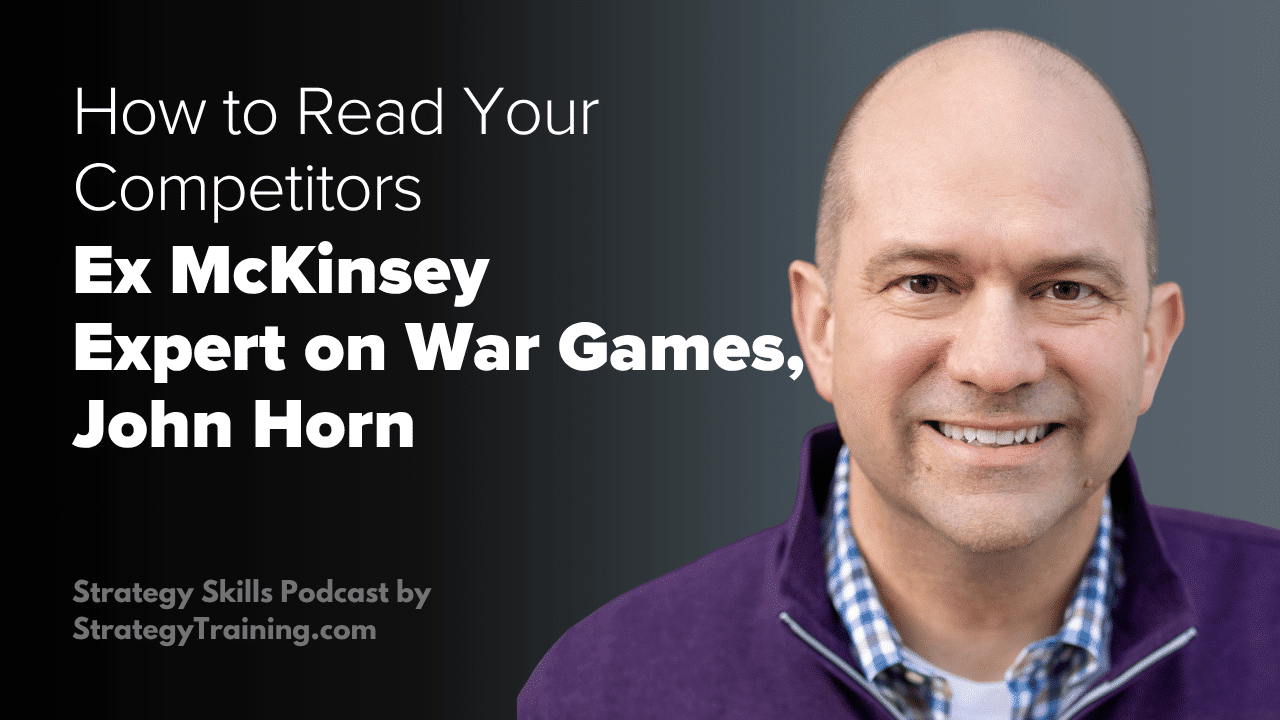
John Horn, professor of economics at Washington University’s Olin Business School and former McKinsey strategist, shares a disciplined framework for understanding competitive behavior by applying game theory and structured simulations. In this episode, he explains how companies can elevate competitor analysis from basic intelligence gathering to actionable strategic insight.
- Horn begins by debunking the common misconception that many competitors behave irrationally. As he puts it:
“Every single time a client said the competitor is irrational, I could ask them… two, three questions which would explain… why the company was being rational in what they were doing.”
- He outlines a four-step framework leaders can use to model likely competitive behavior:
- Observe what competitors say and do, including press releases, earnings calls, and other public data.
- Assess their assets, resources, and capabilities, and imagine what you’d do in their position.
- Identify the decision-maker and their background to infer how they think:
“If you grew up as a marketer and you became a CEO, you’re going to look at the world from a marketing perspective.” - Make a short-term prediction, write it down, and revisit it:
“It becomes a virtuous cycle of getting a better insight into how that competitor thinks.”
- Horn emphasizes that many firms fall short because they stop at step one or lack mechanisms to feed deeper insights into decision-making. He also stresses the role of empathy—not sympathy—in strategy:
“I do have to empathize, understand why they’re making the choices they make.”
- War gaming, in Horn’s view, is a powerful simulation tool, not theater.
“It’s a chance to practice business choices in a risk-free way… and just a much more realistic discussion.”
- For entrepreneurs or under-resourced teams, Horn offers a lighter-weight version called “War Gaming Lite,” which enables rapid, structured thinking about competitive responses using only internal knowledge and role-playing.
- He also discusses how human biases, short-term incentives, and lack of time make both your firm and your rivals more predictable than you might think:
“People really are predictable… It’s not rocket science—it’s about being disciplined.”
Whether you’re a startup founder or a Fortune 500 executive, this episode offers practical steps to improve your strategic foresight and competitive positioning, grounded in empathy, behavioral realism, and iterative prediction.
Get John Horn’s book here:
Inside the Competitor’s Mindset: How to Predict Their Next Move and Position Yourself for Success
Here are some free gifts for you:
Overall Approach Used in Well-Managed Strategy Studies
Enjoying this episode?
Get access to sample advanced training episodes
Episode Transcript:
Michael 00:46
Our podcast sponsor today is StrategyTraining.com. If you want to strengthen your strategy skills, you can get the Overall Approach Used in Well-Managed Strategy Studies. It’s a free download, and you can go to firmsconsulting.com/overallapproach. That’s firmsconsulting.com/overallapproach. And if you are looking to advance your career and need to update your resume, you can get a McKinsey and BCG-winning resume template as a free download at http://www.firmsconsulting.com/resumePDF. That’s http://www.firmsconsulting.com/resumePDF.
Kris Safarova 01:29
Hello. This is Kris Safarova, CEO of StrategyTraining.com and FIRMSconsulting.com and co-host of Strategy Skills podcast. And we are here today with John Horn. John spent nine years at McKinsey and now a professor of practice in economics, my favorite subject, and he’s currently at Olin Business School at Washington University. Welcome John. So great to have you with us today.
John Horn 01:55
Thanks for having me, Kris. I’m excited to be here.
Kris Safarova 01:59
John, let’s start with setting some context. How did you end up focusing on this work?
John Horn 02:07
I started focusing on understanding competitors when I first joined McKinsey. I When I started at McKinsey, I started in the strategy practice. I was hired in specifically to be someone who had an economics background that could help be a strategist. My the person I was replacing, I talked to them and said, What did you do? And they said, Oh, I did a lot of game theory workshops, and I had done game theory as an undergrad, and as in the PhD program, had done a little bit of game theory, and I’ve always attracted me. And so I said, Oh, that sounds really interesting. And I honestly, I don’t know why I said this, or how I said or what brought this up, but I said, Did you actually play games? Did you like do Wargaming? And this person said, No, we just sort of walked through how to think game theoretically. And I said, Oh, well, Wargaming might be interesting. And so I asked around if people had done it, and the few teams had, and I synthesized what they had done, and I put it out to the firm and said, Hey, here’s how you do War Gaming, best practices. And people started calling. I said, Oh, you’re the Wargaming expert. And I said, Sure. And so from then, I started doing war gaming, and it always struck me as a really useful way of thinking about competitors game theory itself, I know it gets a really bad rap, and when I teach it to my students, I say part of the reason game theory gets a bad rap is because when you bring in a game theoretician, an academic, and this is not to knock academics at all, but a lot of times, they’ll assume a game, oh, this sounds Like this game I’ve studied, or sounds like this other game that we talk about in academic, certain, in research circles. But the key is really to understand the game you are playing and to design that game you’re playing. And that’s really what a war game is, is designing what is the game that we’re playing, and then you play it out. And when you play it out, you actually get to experience what it’s like to make those choices. And that led, oftentimes, to my clients saying, well, that we can’t role play this out, or we can’t role play this competitor, because they’re irrational. And it just, at first I thought they were talking about behavioral economics, but then I realized they really think they’re irrational. And it just, you know, McKinsey doesn’t usually have competitors. The clients we work with don’t have competitors that are large, major companies that have acted irrationally for years and years and years and gotten that large. So something was a disconnect, and that sort of led me down this path of, how do you understand a competitor when they’re not irrational? And why do we think that competitors are irrational when they really aren’t?
Kris Safarova 04:44
John and let’s not assume that every leader listening to our conversation right now is convinced yet that they must be focused on their competitors and their actions because they have certain results they’re responsible for and they can get by without focusing on competitors. So before we dive into this conversation any further, let’s step back and highlight why a better understanding of competitors is very important for any leader.
John Horn 05:13
I think it’s really important when you’re thinking about big strategic moves to think about competitors at at the basic level. If you if you think about, why are you creating a big strategic move in the first place? When you ask most companies, you know, why undertake this big effort to come up with this new strategy, etc, it’s like, oh, to gain an advantage in the market, or to, you know, stake out a position, or to, usually, there’s something where it’s going to have an effect on the market. If it’s not going to affect have an effect on the market, it’s not that big of a deal anyway. So you’re starting with the presumption that we’re going to come up with a new strategy that is going to have an effect on the market, and then to assume that our competitors are not going to react, that they’re just going to sit there and say, Wow, that was a brilliant move. Nothing we could do about it just doesn’t make sense that they are going to react, especially if that’s the whole point, why you’re coming up with this strategy in the first place, even if it’s about it’s a growth market, and we’re trying to grow in a growth market. Well, yeah, so your competitors, and if they see you growing faster than them, they’re going to say, Well, why are they growing faster? We need to grow faster. So at a surface level, strategy is about thinking about how you position yourself relative to competitors and the, you know, one of the arguments I get a lot lately is that, oh, you know, strategy has changed. It’s about platforms and ecosystems and partnerships, and it’s not a, you know, cutthroat competitive market anymore. And my answer to that is that’s true, that there are these different relationships that companies are forming with each other, but you are still, as a collective creating value, which you are then competing with each other to capture that value. You don’t go into a partnership and say, I wouldn’t enter a partnership with you and say, okay, Kris, we’re going to generate, you know, hundreds of millions of dollars, and you keep it all, that’s okay? No, I’m going to want to keep some of it for myself, and you’re going to want to keep some of it yourself. And unless we completely agree on what that split is, it’s a competition. So everything in business, at some level, there is some competitive aspect to it, and to me, that’s why you have to think about your competitors, even if they’re not purely a competitor. Rarely, if ever, even if you’re a monopolist, there are other companies out there trying to take a piece of what you’ve got and to not think about what other companies are doing, or other actors in the ecosystem, in the market, are doing. You’re setting yourself up for running right into a brick wall, and that’s never going to be a good outcome.
Kris Safarova 07:40
That is very true, and we should cover a little bit late in our discussion, that that thinking that you are teaching in your book, in your work, is applicable not just when you think about other companies, but also when you think about individuals. And so that makes it even more relevant for every leader that is listening to it. So now that we hopefully convinced our listeners that this discussion is applicable to them, let’s return to a question of whether competitors act irrationally. You mentioned that that was coming up quite often from clients?
John Horn 08:16
Yeah, I, I heard it so often that it, it’s it became something I heard all the time. I really noticed it, and what it boiled down to me most often was a situation where the competitor is doing something that we would not do, and therefore it’s irrational because we wouldn’t do it. And of course, we’re smart. We know what the best choices are in the industry, or the competitor is doing something that’s not good for us. And why would anyone do that? And in both cases, that’s not irrational. In the first case, the competitors or another company, right? Like you said, this could be applied to ecosystem partners or supply chain partners or distributors, whatever, if they’re doing something which is not what you would do that sort of is strategy, take a competitor, like every every business leader is taught and told, you need to find a unique, differentiating niche. You need to find customer segments that no one’s going after. I mean, this is sort of what Blue Ocean Strategy is all about, right? Finding something that no one else is doing and being differentiating and unique and innovating, etc. Well, if every company is doing that, every company should be making different choices. So on its surface, I should expect my competitors to make making different choices, not the same choices I make. And the second one, oh, they’re doing something that I don’t like because it’s not good for me. Well, again, that’s what competition is about. They’re not going to make choices which are good for you. They’re going to make choices which are good for them. And when that’s really sort of the genesis of how to think about competitors. If I turn around and say, if I look at the world from their viewpoint, what are they trying to achieve, given all the different unique assets and resources and capabilities and positions and viewpoints they. Have on the on the market, and knowing that they’re also trying to beat me and all my other competitors and distributors and etc, I every single time a client said the competitor is irrational, I could ask them, you know, two, three questions which would explain, I wouldn’t explain to the client. The client would explain to me why the company was was being rational in what they were doing. So it’s not that the companies are irrational, the competitors are irrational. It’s that we’re not taking the time to understand the world from their viewpoint and the and the reason why that’s really a problem is because once you say the competitor is irrational, you are essentially ascribing a pejorative term to them, a negative sense. You’re saying they’re making a bad decision, a wrong decision, a decision that no one would make. And once you assume that about someone else, you stop trying to understand them, because who can understand someone who’s irrational? So this knee jerk reaction of saying, Oh, they’re irrational, is harmful, because it cuts you off from saying, no, let me try to understand what they’re doing and why they’re doing it, so I can then figure out what’s best for me to do.
Kris Safarova 11:12
When I work with clients, I often tell them we have in the conversation, and I ask them a question, and they say, I don’t know, and they often remind them that I don’t know is you’re giving yourself permission to not think further. This is very similar when you say someone irrational, you’re giving yourself permission to not think about what are their goals? What are their reasons? Because everyone is pursuing self interest in some way. So what are what? And it is also assuming that we are all the same and we are not.
John Horn 11:45
Exactly. Yep, exactly. So once you start thinking about that, once you start from and break those two assumptions, then you can understand them. And that’s that’s what’s so powerful about this frame, this idea and this framework in this way of approaching it. Is it you, once you get over that hump of saying they’re they are to use the word rational, that there is an explanation for why they’re doing what they’re doing, then you can explain them. And once you can explain them, you say, Oh, I see what they’re doing, and now I know what I should do instead.
Kris Safarova 12:19
So I think that’s a good place to start diving a little deeper into how to explain it, and you have four steps. So maybe we could speak about the steps.
John Horn 12:28
Yeah, the main framework in the beginning of the book, and this was based on an article I wrote with two other colleagues when I was at the firm. The first step is what I say most companies do when they do competitive intelligence, which is, we collect analyst reports and collect earnings calls and annual reports and just pay attention to what they’re saying and doing. And that’s what a lot of companies do when they do competitive intelligence. I like to use the phrase competitive insight. It’s actually a phrase that a head of a competitive insight function at a company told me once, and I really like it, because it’s moving beyond just collecting information to actually forming insights that you can actually act upon. And that second stage of it is beyond just paying attention to what they say and do is to think about the assets and resources and capabilities that they have. And that’s essentially saying, If I were running their company, and I would say this to clients all the time, it’s, you know, I’d use the name of the city where their competitor was, and say, if you were sitting in, you know, Sao Paulo at this time, what would you be thinking? And if you had their their warehousing space, if you had their production facilities, if you had their supply chain set up, if you had their distribution outlets, if you had the country footprint, etc, what would you do if you had all that stuff, things in addition to what they’re saying, how does that align with what they have? And that’s step two. The third step moves beyond sort of that black box of it’s an organization with assets and resources and capabilities to it’s a set of people who are making decisions, and in particular, there’s usually one person who ultimately ends up making that decision, and usually you can pretty much figure out who that person is going to be. And usually it’s someone who’s Senior enough that you can find out what that person’s background is. So do they have a marketing background or an operations background? Do they always work in this industry, or do they come from a different industry? What was their educational background? Etc. Because once you frame what their background is, you can start to understand how they view the world. The way I like to put it is, if you grew up as a marketer and you became a CEO, you’re not going to start optimizing floor, factory floors. Now that you’re a CEO, you’re going to look at the world from a marketing perspective, and so understanding who that person is making, the decision, their functional background and industry background, et cetera, informs how they’re going to look at using those assets and resources to accomplish what they say they’re going to do. So that’s step three. Is. Who’s the person making the decision. And then the fourth step is actually make a prediction. Make a written prediction, write it down, and then come back and revisit it, not five years later, but six to nine months later. And again, these predictions should not be like eight or 10 Year predictions. They should be shorter term, and then come back and see, did we get it right or wrong? And if you’re right, that doesn’t mean you have everything right, but you know you’re on the right track. If you’re wrong, you can then go back and say, Did we miss something they said step one, did we? Did they use an asset or resource or capability that we didn’t focus on? Step two, or was there a different person who made the decision I didn’t understand their background that step three? And so now you know what look to look at in steps one, two and three better, and then make a new prediction. It becomes a virtuous cycle of virtuous cycle of getting a better insight into how that how that competitor thinks.
Kris Safarova 15:49
And those are powerful steps. What do you see is actually happening in terms of companies applying the steps? So they usually play the first step and what happens afterwards?
John Horn 16:02
Usually what happens is, the first step is, is collected, and you most companies that do competitive intelligence, unfortunately, under resource, under staff the operation, and so the group that’s in charge of that doesn’t have time to synthesize it by saying, what are the assets, the resources, and who’s the person making the decision. What’s the background? Generally? What happens is the executive in charge of making the strategic decision contacts the Competitive Intelligence Group says, What do you know about this competitor? And they get a bunch of files dumped on them, and they don’t have time to look through and so nothing happens. Or the other thing that happens is you have a really good competitive insight group that’s really good at really good at analyzing and assessing and making insights into competitors, but then there’s no mechanism put into place to actually get that information to the people making decisions. And that sort of is the real challenge inside an organization. Is resourcing up the competitive intelligence function or competitive insight function, enough so that they can actually turn information into insight, actionable insights, but then also setting up the mechanism and having senior leadership support, which forces, if you want to use a lack of better word, sort of forces people to start using that information once the cycle starts, once You see the people at the front line who actually get the information and see it’s valuable, they will start saying, give us more information. And the return for that is, we’ll feed more information to the competitive insight group. And it’s I like to I like to think of it as like an entrepreneurship opportunity is that you need to come up with a minimum viable product in the competitive insight group, which is going to be useful to the people in the organization. And once you do, you’ll get feedback on how to make it better, and you’ll earn the right to actually grow and expand. That’s sort of how you think about translating that concept, moving beyond just the step one of we collect and sort of put in files or on the shelf, the annual reports of the competitors.
Kris Safarova 18:02
And diving a little bit deeper into step three, which is considering the human factor. There’s this element your work you talked about in your book, and of course, it’s very important. I seen it so much in organizations where I worked, understanding the individual incentives of the people executing the decisions. Yeah, could you speak a little more on that?
John Horn 18:25
Yeah, the, you know, someone asked me at a different talk I had recently, or someone had a question about culture, and how does culture fit into understanding the competitor? I think this fits into that step of understanding the person making the decision. We like to you know, I started with saying that the organization has an objective. It’s trying to grow market share. It might be trying to grow profit or profit margin or expand it into new market. One of the surveys that I talk about in the book, we asked the the respondents, what was your objective, as the respondent, so you’re the competitor making the reaction, what was your objective, and was it market share? Earnings are short term or long term or net present value. And we sort of expected everyone to say net present value, because that’s what we’re taught to you know, very few people did. The biggest ones were actually short term market share and short term earnings. So companies are focused on short term decisions and short term objectives and goals, and when you step back and think about that third step of the person making the decision, I’m not going to be around 15 years from now to think about whether my decision today is actually going to lead to higher earnings. 15 years from now, I’ve got to survive and get a good result, a good feedback. I’m a good review so that I get promoted to the next level, or at least keep my job. And when you think about that, from that personal standpoint, that the person making the decision is focused on making sure that they’re putting out the fires, and they’re doing what they’re doing, and they’re doing what they need to do to respond, it makes a lot more sense that, yeah, they’re, they’re not, they’re they’re not focusing on these big why? Build, you know, long term sort of objectively correct answers. They just want to make it through, and they just want to survive. And that’s where a lot of the power in that third part comes in, of the person making the decision. You know, another element is, if I’m someone, you know, even if it’s I’m some, we’ve, I’ve seen this before where, like, the CEO would announce and say, we’re going to, you know, increase prices, because that’s what we want to do. Want to do as a company. And then all the sales force was still compensated based on commission and getting sales. Well, if you’re out there talking to a customer and saying, hey, you know, we’re raising our prices, and the customer says, Well, I you know, got to go someone else, because, you know, I don’t like that price increase, there goes my commission, like, I’m going to cut price. So all of us individually have incentives. They can build up into group incentives. But individually is there’s someone who has an incentive, and that sort of gets back to this whole idea of rationality, is that we’re, we’re trying to achieve some objective as people, we’re trying to achieve some outcome. And when we when we step back and understand that in almost every case, yes, there are some cases where it might not be true, but in almost every case, in every case I’ve seen, you can explain the behaviors based on what the person is trying to achieve. And that’s really the challenge is, how do we understand what that person is trying to achieve? And that’s where that four step process comes in.
Kris Safarova 21:21
Very true. And this brings us to empathy, being empathetic, asking ourselves, if I was in his shoes, what would I do? And working the proverbial mile in someone’s shoes, yes. So for someone who is struggling with that, what would you recommend?
John Horn 21:39
So one of the things I saw a study a few years ago as I was starting to put the book together, that part of the background research I had done was this idea that there are these neurons in our brains which fire when we see someone else doing something. And it’s this primitive neural structure that even, you know, tests on mice and monkeys in particular, show that like, if a monkey sees you grab or another monkey grab an object, that monkey’s brain starts to fire the neurons that would force the monkey’s hand to move. And the same thing happens with we think happens with people. We can’t do the same type of brain experiments, but one of the things that they can do for their magnetic resonance imaging MRIs is they can see where the brain is firing. And this group did a study where they took people with very senior leadership positions, and they put them through the this the MRI machine while they were making certain types of decisions, and their neural activity was reduced in the area of the brain where these neurons fire, and what they concluded, you know, it’s, you know, early research, but the Indicative conclusion was that as we get more senior, it’s harder for us to understand the position of other people. And I think that is sort of natural, because we tend to look at, well, I got to be successful because the choices I made. You know, there are lots of behavioral insights into this, and once I start to feel like my decisions led to my position of why I’m Senior and I got promoted because of something that was identified in me, it just is harder to empathize with someone else. It’s harder to take someone else’s position. And I say in the book, it’s not about sympathizing. I don’t know to feel sorry for my competitors, but I do have to empathize, understand why they’re making the choices they make, and I think that’s where the four step process comes in, because it it’s not something just saying, well, you should do it. It’s an actual set of steps to walk through. And if you do those four steps, it sort of forces you to take the position of walking a mile in their shoe, and really forcing yourself to be what I call caught, what’s called cognitive empathy. It’s not emotional empathy. It’s about understanding in with our cognitive you know, insights why someone does what they do. And that’s really, again, I don’t You don’t have to feel sorry for them, you don’t have to sympathize with them. You don’t have to like what they did. You don’t have to. It’s really just about I now know why they did what they did, and so now I can better predict what they’re going to do in the future. And as with any game we play, if I don’t know what you’re going to do in the future, I’m going to lose pretty much every time. But if I know what strategy you’re playing, I at least have a better chance of winning. And ultimately, to me, that’s better strategic decision.
Kris Safarova 24:21
That is very true, John. And of course, the situation is a little bit different for entrepreneurs. So some of we have a group of listeners who are currently building their own businesses. Open it as a consulting firm. They worked for a large consulting firm, and they went and started a boutique firm, how would you adjust the process for them, given that what they have to deal with is a huge lack of time?
John Horn 24:49
Yeah, one of the things that is really powerful about the three part framework is, or the four part framework of making the predictions, is that it doesn’t. Acquire a lot of time. It doesn’t take months and months and months of effort, particularly if you think about someone who left an organization to start up a new company. You have lots of insight already. And you’ve probably hired other people away from other consulting firms to start up your own firm. They have insight into other consulting firms that they used to work at, and in an hour and a half, two hours, you can sit down and just go through the four steps and say, Okay, what do we know? You know that the big firm that you came from, what where are they focusing in the next three to five years? Yeah, obviously, with, you know, non disclosure agreements and inside information, you’re not about revealing that, but it can be focused on the publicly available stuff that they put out. Like, what have they been publishing? What have they been saying? What have they said at conferences? What have they said in the news? What have they said in their press releases, etc? And then the second part about what assets and resources and capabilities that really you know, where have they been hiring from, which schools, from which disciplines? Where are they opening offices? What types of you know, have they acquired some boutique firms and rolled them into their organization? That’s sort of getting at that insight there. It’s you probably know most of that already. And when it comes down to who are the partners at the firm that I would be competing with for the same types of clients we’re going after, you probably know those people too. And you probably know incentivize, how the partners at the different firms are incentivized to, you know, grow their client base, et cetera. So there should be enough information, you know, if you’re a consultant starting a boutique, to at least talk through that. It doesn’t take days and days and days. It could be like an hour, hour and a half conversation with the rest of your senior leadership team, and as long as you have a basic idea of, okay, these are the, you know, we think this is going to be something that, you know, Consulting Firm A is going to really push back on, but the other two, or other three that we’re we care about really aren’t well now you have a better position to at least think about how to compete against competitor a when you’re going to talk and pitching to clients, as opposed to just going in and ignoring it.
Kris Safarova 27:00
That is very true. And then another topic I wanted to talk to you about, and you speak a little bit about it in your book. It is, of course, very important in strategy. And this is one of the common errors I see with my clients, is they they’re not thinking few steps ahead. They’re thinking only one step ahead when you can very easily predict what will most likely happen in return. And it’s not only about even dealing with competitors, it’s also about dealing with people, just even dealing with internal people within the organization, dealing with clients. So let’s speak a little bit about this, because you have such wisdom of knowledge in this area, and I think it can really help people.
John Horn 27:41
It goes back to what I was saying before about why game theory sort of hasn’t been picked up as game theoreticians love this idea of, well, I make a move, and then you make a move, then I make a move, et cetera, back and forth. And in theory, yes, that’s how you should analyze game theoretic situations. But one of the things that came out of the survey, as I mentioned before, it’s about short term earnings and short term market share changes. One of the questions we asked was, how many moves ahead are you thinking? And there was a large share. I think it was about almost half. The people said, we’re not even thinking. Of a reaction. Now, the survey base was a group of executives who were remembering a situation where they reacted to a competitor move, so they were the reactors, and they said, Yeah, we were reacting to this big competitor move. We were actually spending time reacting, but we didn’t think they would react back to us, which, again, just sort of, I was like, wait, what you were actively trying to think about how to react, but they’re not so we at first it was confusing, but then it sort of gets back to this idea that we just don’t have time. We don’t have time to plot out 35 different responses. I mean, the analogy I give is, you know, these are big strategic moves, and the CEO walks down to your office and says, Hey, Kris, we just heard that our major competitor is launching this new product in Southeast Asia. Can you take nine months to sort of figure out, like, 50 different responses we could have, and sort of plan out what those options would be, and then come up with, you know, maybe what you think the right answer would be, and come back, you know, give me a report back in six months, and then we’ll figure something out at nine months. It’s no it’s end of the week. What do we do? And when it’s the end of the week, what do we week, what do we do? Sort of timeline? You don’t have time to figure out and plan lots of different creative and brilliant strategies. You figure out like, what we do last time, did it work? What sort of the Can we lower prices? Because that usually works. What I read about someone else who did something that seemed to work. Let’s try that. It’s, it’s those obvious reactions that you probably know already, because they they don’t have time to come up with brilliant strategic options. And in fact, one of the questions we asked was, when did you find out that the initial competitor actually made the move? And again, there was like, you know, I don’t want to say it was like 15, 20% of the time. Company. Said it wasn’t until they actually launched in the market, and sometimes it was after already been in the market for several weeks. Like this idea that competitors are like, just ready to pounce on you. That’s not how companies behave, because, to your point, we’ve got a ton of other things we’re focusing on. So when you when you step back and say, Oh, that’s right, that’s I don’t I’m not paying attention to my competitors all the time, so they’re probably not paying attention to me, which means I have some flexibility, and they’re not going to be having these massively wild, creative strategies. I could probably predict what they’re going to choose.
Kris Safarova 30:32
And it is very interesting when you look back at your life, at least I can sit with me. I can sit with my clients. You can actually predict the errors when you when you did something and then there was an action from the other side that was actually detrimental for you in some way. You could have predicted it. It was the most obvious action back. And it’s just creating that discipline within yourself to think few moves ahead versus just one move.
John Horn 31:04
Yes, and oftentimes, because competitors are not thinking multiple moves ahead, you only have to think one move ahead of them. So if they’re not even thinking about how to react to you, you just have to think about one reaction yourself, and you’re already a step ahead of them. So it doesn’t require the I do this, then you do this, then I do this, and you do this, then I that’s not how the world works. It’s just that, okay, I’m gonna, I’m gonna launch this new product in Latin America. You’re probably gonna drop your price in response. And so I’m just gonna actually increase my marketing that shows how the quality justifies our new price. I’m done like, I don’t need to think about your reaction to my advertising campaign, because you’re just like, drop price and hopefully we don’t lose market share. That’s a reaction. So it’s it. I don’t want to say it’s not complex and it’s not hard. It’s hard, because I think what you said is, is the real insight is it’s hard because you have to be disciplined. It’s not natural. It’s not instinctive to think this way. You have to be disciplined. But once you are disciplined and you put in place those procedures, it becomes clear, you know, I talked about war gaming. I had so many war games, war games, and for those that the listeners that don’t know, I assume most do, but they’re just simulations, where you simulate what this your choices and what competitors choices might be. In response, it’s risk free, because if the whole you know the industry blows up and you go bankrupt, who cares? It’s in a no one knows about it. So it’s just a chance to sort really is practice, practicing strategic choices of business choices. And I had so many games where my clients would say, well, we can’t, we can’t have that competitor in the game because they’re irrational, or there’s no way to predict what they’re going to do. No one can replicate them. And every single time at the end of the game, after we ran the workshop, those same clients would come up to me and say, Wow, that’s scary. How close it was, that company, that group, role playing the competitor. That’s exactly how they behave. And I was like, Yeah, because it’s not that hard to set you up, as long as I set you up with the right background and put you in a position to actually think through it, you can think like the competitor. It’s just you have to have that discipline to do it.
Kris Safarova 33:12
That is very, very true. So for someone who I feel that the audience now wants me to ask you more about war games, because it sounds very exciting. So let’s talk a little more about that. Could you tell us some stories, some insights from doing that work?
John Horn 33:26
Sure, I, I ran war games for all kinds of issues and all kinds of industries and all kinds of geographies. What I love about war games are that they the way I define them is they’re just, they’re simulations that allow you to practice in a risk free way the choices you would make in the real world. The The problem is, once you make a choice in the real world, you can never take it back that any choice you make. You know, decades later, we still remember, you know, these, the classic business failures, even though they were pulled back within weeks or months, because we remember those. So if, as a company, you make a choice in in the market, and it was a bad choice, you can’t undo it and say, Hey, let’s go back three months and like, start over. But you can at a war game, you can start over. You could start with different initial conditions. What a war game allows you to do is to is to think about all the different actors that are going to affect you and that you’re going to affect, and just it’s like playing a game, really. That’s where the the game part comes in you. It’s your your role playing to see how people are going to react to each other. And they can be resource intensive to set up, especially if you’re going to have a simulation model which allocates market share or profitability, etc, to the different groups. Building that model takes time, the pulling together, the fact packs for the teams and the industry, that doesn’t take as much time, because, again, most companies have that information somewhere within the organization. It just has to be collected and collated. Running the game only takes, you know, a day, day and a half, depending on how complicated. Related you want it to be. So really, the big exercise is, how do we build that model? And for some games, and for some organizations there, you need to have that objective analytic model so that people believe the results. But it actually most cases, what I found is that that’s not necessary, that it’s really more about having, I’ll keep going back to this word, having the discipline to think about how the world is going to evolve, not from our viewpoint. When most companies have strategic discussions about how the industry is going to evolve, you generally approach it from what’s good for us, or how are the choices we’re going to make be successful, and you’re ignoring all the choices from all the other companies sitting in their offices doing the exact same thing. And what I started to develop, what is, what I call, I call this in the book War Gaming light. And what it is, is, it’s essentially a model, is version. The analogy I like to use is, is when you teach someone a game for the first time, like card game, you play several rounds where your cards are face up. Now I don’t necessarily want to tell you why I want to play certain cards, or I don’t necessarily tell you what I how quickly I want to win the game. But I will go through the game and we’ll play rounds, and you can say, Hey, John, why’d you play the Queen of Hearts at that point? I say, well, because that’s going to take that Trump trick and Oh, can we go back and play that hand? Yeah, sure. So with the war game light. We start with making our choices, and we go around the table and everyone says what they’re going to do, and then you can have an open discussion, Wait, why’d you lower prices in that region? And it’s not about, well, because we want to maximize market share, because we want to increase profitability that you want to keep hidden. But you can say, well, because you lowered prices. Oh, interesting. Okay. And you can go back and say, Well, what if we had raised prices by 10% Well, I still would have Well, I still would have lowered prices. Oh, interesting. Good to know. So it, it’s less resource intensive, but it still gets that back and forth dynamic of a more realistic of, yeah, we’d like to raise prices, but if we do, everyone’s going to attack with lower prices. That can’t help us. Whereas I, I’ve seen more of those industry discussions where it’s much more about the Well, naturally, we’re going to introduce these products, and we’re going to capture this market share, and we’re going to win the day. But that’s that’s not how the world really works, and introducing that war gaming idea of now have other people bring to bear, from their perspective of the competitors or the distribution partners or the supply chain partners, or the complimenters, whoever it’s a more realistic discussion, and really, that’s what wargame is about, having the interaction between the different players, not just what we want to happen.
Kris Safarova 37:33
John and after running so many war games, I wonder what insights about human decision making, or any other insights that came up for you after doing it, after doing it many times, versus in the beginning when you just started.
John Horn 37:52
I think the biggest insight that came out to me is that people really are predictable, that when I first started with strategy, sort of, you know, when I first joined the firm, there was, sort of, I kept hearing that, well, you know, we can’t understand this competitor or this it’s this big mystery of we have to make the strategy without knowing what’s going to happen, etc. And by sitting down and doing the war games, you know, as I said, I had so many clients come up say, Wow, that’s scary. How accurate that competitor was, or that team role playing the competitor, because it was always played within the organization itself. We didn’t bring people from the outside in to play the games. And I think that’s what was the insight, and that’s sort of what drove, sort of the book, was you can predict that there is this. It’s not formulaic, and it’s not something which is an algorithm which says here’s how someone’s going to make a choice, but by asking a very few set of questions, we can position ourselves to think about, how would that person approach this question, or how would that organ, person within that organization, approach this question? And more often than not, you can get a pretty good estimate of how that person’s going to make that choice. And it’s not, you know, I don’t, I don’t want to say it’s not rocket science. It’s not about this really complex set of interactions and choices and understanding deep motivations of, you know what happened when they got their bike when they were five years old? It’s, it’s really much simpler than that. Again, it goes back to, we’re just under so much time pressure. I remember when I first joined the firm, my brother was working at Procter and Gamble at the time, and he said, Oh, you’re so lucky. As a strategist, you can just sit back and think big thoughts. I’m putting out 50 fires a day. And that’s true for most companies, is they don’t have time to every time we ran a war game, besides the comment of, Wow, that’s spooky how closely we could replicate the competitors. The other comment I got most often was he was so nice to step back from my day to day and just think strategically. And when you put those, when you frame things in that that way, that your competitors don’t have the luxury to sit back and think strategically, they are just in the flow of trying to get things done. Right? And when you step in and put yourself in their shoes, it becomes really clear how they’re thinking, and you can make good predictions about what they’re going to do.
Kris Safarova 40:07
John, and could you share some key questions that helped you understand how a person will make decisions? I know it will be a little bit different in different situations, but maybe a few that people could could start with.
John Horn 40:20
I think it really comes back to the the that four part framework. I think number one, well, when I think about game theory and how game theory helps make strategic decisions, there, there. There are five questions I tell my students you have to answer. And those five questions are ones that are normally assumed by academics when they’re doing game theory research. And that’s where that disconnect comes in, is that if you assume what those five answers are, you’re assuming a particular game. What you really have to do is figure out your game. And those five questions are, first of all, who are the players? Like, who is this? Who’s the competitor I have to care about, who are the ones that are going to interact with me. The second question is, what are their objectives? We assume it’s net present value or long term profits, etc, but I want to get promoted. I don’t want to get fired. I want to make sure we have hit our earnings per share this year. I want to make sure this product doesn’t fail. I want to make sure we don’t lose more market like, what are they trying to do, because once you understand what they’re trying to do and make it, helps you narrow down what they can do to achieve that goal, which is the third question, what can they do? What are the actions they can take? And that gets back to what assets and resource capabilities they have at hand they can they can use. The fourth question is, what information do they have? And for the most part, you can assume they know what you know. There are sometimes you know stuff they don’t know. But for the most part, it’s the publicly available information. Pretty much most companies in the sector will know that stuff. And they sort of know, you know, how this is going to play out. Like, when are these things going to, you know, happen in the real world? And the fifth one is, what are the payoffs? How do I think about what they’re going to get, and that ties back to what do they want to achieve. So if they want to achieve market share, how much market share are they going to get? And if you can define those five things, who are the players, what? What do they want? What are their objectives? What can they do? What do they know, and what do they get? That defines the game I mean this. This goes back to my undergrad days, when my game theory teacher said, you know, if you tell me the players, the rules, the strategies and the payoffs, I can solve any game. That’s really what it is. It’s about defining the game you’re playing, as opposed to solving the game. And once you define the game that sets up the war game if you want a role played, and if you just want to sort of sit around a table and talk about as a team, you’ve defined the game you’re playing, and so you can think about what the outcome is going to be based on that game. I like to say, you know, if I gave you an eight by eight checker, eight by eight board, you know, with different color squares, and I said, let’s play a game, your first question would say, is it checkers or chess? You shouldn’t just start saying, Oh, I’m going to start moving pieces. You. You need to know a little bit like, is it me and you, is it like teams me and you, do I get to have a grand master standing behind me? So you want to understand the game you’re playing before you can start saying, well, let’s, you know, go, start moving these pieces.
Kris Safarova 43:12
That is very true, and I promised at the beginning that we will speak a little bit about how this thinking is applicable to dealing with individuals. So let’s speak briefly about this.
John Horn 43:24
Yeah, I this, this ex, you know, you said earlier, it’s about empathy, and it really is about empathy and empathy. I can be empathetic to any individual. Ultimately, I’m not being empathetic to an organization. I can, you know, an organization is made up of individuals that are making choices within the organization, and usually there’s one person who’s making a decision, or no one’s making a decision, which actually, in a way, is kind of nice for you. As long as you know they’re ignoring you, there probably won’t be much of a reaction because they’re ignoring you. But when you think about it, from an individual making a choice, this means I can step back and say, Ooh, my joint venture partner is making a choice, my supplier is making a choice, my distributor, my ecosystem partner, the regulator’s making a choice. And the really hard thing about competitors is I can’t talk to them directly. I can’t call you up and say, Hey, what markets are you going to be going into next year and what products are you introducing? What’s your price level going to be? I can’t ask you that. So you go back to like the consultant, even if I came from, you know, if I called up a partner in McKinsey, I couldn’t say, hey, what, where’s what clients are you focusing on in terms of your competitive strategy work? So I know where to go. That’s illegal. You cannot do that. So this stuff’s really important for competitors. But I also say that you know, if you’ve ever walked away from a discussion with a supplier or a distributor or a joint venture partner, someone said, I don’t think I got the whole story. I’m not sure they really told us everything I need to know. The same process works. And if you’ve ever doubted, well, I mean, they always tell us the same thing, again, reverse it. Do you always tell your joint venture partners and suppliers and distributors everything about what you’re doing and everything you’re bringing to bear? No. So why would you assume that they do the same thing? It’s easier because you can’t talk to them. But whenever you walk away with that feeling of, I’m not sure I got the whole answer. I’m not sure that’s exactly what’s going to happen. The same process can apply, because it’s it’s not necessarily just about competitors. It’s about any individual. It’s about understanding a person.
Kris Safarova 45:30
That is very true, John, and let’s assume that our listeners bought into this idea that, yes, I actually need to dedicate time every week, understanding competitors, planning what are the next moves. Approximately. How much time do you think per week an average leader, not average, that they are average, but kind of taking an average leader within a large organization, taking their responsibilities and so on. How much time do you think per week they should dedicate to understanding competitors?
John Horn 46:07
So where I suggest people start is to pick one competitor and pick one type of strategic decision. So, for example, it might be, you know, if you’re thinking about like the let’s take the consulting entrepreneur startup, I want to focus just on Bain and I want to focus on where they’re recruiting, or I want to focus on BCG. I want to focus on which markets they’re growing in. That’s it. If you focus just on that the where are they, who’s the one company and this one type strategic decision, it narrows down what I have to listen to, what assets, resources, capabilities, they can bring to bear, and who’s making the decision. So I can be much more focused in how I think about it. I also can then talk to other people who I’ve had conversations with in my organization who are open to these ideas and saying, Okay, I’m going to focus, say, on BCG, you focus on Deloitte, and you focus on strategy and and you can either pick the same decision entry or a different one, because that’s where we’re sort of running into trouble with those companies the you know, more broadly, if you’re, say, like an automotive company, say, who are, Who are the companies that always sort of surprise us, or we might sort of knee jerk reaction, say are irrational. Pick those companies. And then you can also say, Well, what kind of decisions sort of always trip us up? Product introductions, great. That’s where you start. And you focus. You focus on one company with one choice. You have a couple of people around you, you know, part people in the organization that you work with or interact with who pick another one, if you set up like an alert on your you know, through Google or through something else, to just say, hey, anytime that company’s name with pricing comes up or market entry comes up, just send me a notice. It shouldn’t take more than 15 minutes, half an hour a week, to really just sort of scan through and say, Okay, here’s what we’re finding out. Great. And then, you know, maybe it depends on how fast moving you think the industry is. Get together once a month, maybe once a quarter, and just sit down and say, Okay, I’m going to talk from the position of Bain you’re going to talk from the position of BCG. Someone else is going to talk from the position of Deloitte. Let’s just talk about what we think we’re going to do, what’s going to do, what’s going to happen in the next year in terms of where companies are going to focus, whether they’re going to hire, where they’re going to onboard, etc, whatever those decisions are. And once you get good at that, and you could start to put together a position, then you can start sharing that with the rest of the organization. The organization says, Oh, great. Can you also talk about this competitor or this decision, or this decision? It’s like, yeah, you know, do you want to follow that competitor? And it’s about that minimum viable product and then building up over time. So start small. Start focused. One company, one decision. Start tracking them. You’ll see that it doesn’t take, you know, hours and hours and hours a week. It over the course of a week. I would spend no more than half an hour total over the entire week, and you could probably get by even with just a 15 minute scan. And that, even just that little bit, you’ll start to get in a pattern and a habit and a discipline of paying attention to that stuff. And the more you pay attention, the more those little bits of notice. If someone walks in your office says, Hey, did you hear about you know, did you hear that bees? You know, Bain just opened this new office in Kuala Lumpur, you’re like, oh, ding, it starts that registers, whereas before it might have just slipped through. But now that you’re focusing all that a little, all those little pieces of information now start to register, and you remember them more, and you get better and better at understanding the competitor’s viewpoint.
Kris Safarova 49:35
Thank you for giving specific steps people can take and just give a little bit more clarity when they have this monthly meeting, what should be the objective of that meeting and approximate structure?
John Horn 49:47
So I would set that meaning for whenever you normally, as a group, have a let’s talk about strategic planning for the future, or thinking about the industry. So if you do that once a year, great do. It once a year. If you do it once a month, that’s how often you should do it. And just again, it’s not having an hour and a half or two hour conversations. Let’s set aside half an hour just to talk about what’s going to happen in the industry, because we’re normally doing it, but instead of us talking about it from our viewpoint of what we want to happen, let’s talk about it where I’m going to say, oh, okay, so here’s what we think is going to happen. You know, the government’s going to introduce regulation, and that should be good for us. And then you say, Well, actually it’s going to be better for us. Why? Well, because we’re the one lobbying for it. Oh, that’s right. Oh, it’s a much more realistic interpretation and seeing how those complex interactions are going to evolve than just from our viewpoint of what we want to happen. And so it’s not really changing the types of discussions you have. You already should be having those discussions anyway. It’s about adding that realism of other voices and other perspectives outside of your organization because someone’s role playing them, as opposed to it’s always from our perspective of what we want to happen.
Kris Safarova 51:00
And what would be the objective of such meeting, just to understand what’s happening in the industry?
John Horn 51:05
I think the objective is a couple of things. It could be one, if so there, there are three things that come out of the war games. One is, what? What did you learn about the industry from role playing your competitor? So what did you learn about, sorry, first, what did you learn about the company you’re role playing? And that can be something which comes out of like, oh, we now understand that the real threat is from this startup consulting firm, not from BCG or Bain or McKinsey. The second thing is, what did we learn about the the industry or that we didn’t know about before? That, again, could come out from that conversation is that there’s gonna be a lot of stress in Africa, but there’s not as much in Latin America, because no one seems to be talking about it. And the third thing that comes out of that is, what don’t we know? What are the points where we’re sitting around the table saying no one knows what’s gonna happen with pricing, or no one knows what’s gonna happen with this regulation in India, or no one knows what that then says, Okay, let’s go get smart about that. Let’s actually spend time, and not hours and hours and hours and hours, but detail someone to say, Hey, can you spend 15 minutes just sort of scanning and see what India’s gonna do in terms of their consulting regulations going forward? Sure. Instead of just trying to, you know, use the phrase boil the ocean to find everything out, it narrows down what we don’t know. So by having that discussion, you can figure out, what did we learn? What do we still want to understand, what don’t we know, and what we learn about the competitors, what we learn about the industry, and what don’t what do we need more information about? They’re, they’re, they’re all information. They’re all things which are going to help you be a better strategist by making better decisions, and they will come out of those discussions.
Kris Safarova 52:45
And then probably also particular action items that may become obvious based on the discussion.
John Horn 52:51
Yeah, so it could be that, hey, you’re tracking BCG, and so I need you to go figure out, because we don’t know where BCG is recruiting this year. Go dig into that. And you may not have to do it, but you can task someone to doing that, or we know that there’s gonna be a lot of competition in Africa. Let’s set up a team, because that’s more than we can handle, and we know that that’s a big strategic priority for us to go into Africa. And so the CEOs can be like, Oh yes, absolutely. Let’s put a team together because we sat around and we all were competing in Africa, and none of us knew how we’re going to win in Africa. Let’s actually spend some time there, because there is no obvious answer that would be something the CEO would probably want to know. So it the outcome is, is information that you can start putting together the next day or even that afternoon, if it’s a morning meeting, that will help you build up that fact base, which you can then use to make your future strategic decisions.
Kris Safarova 53:48
Thank you, John, that was so helpful. My last question. This is a question I love asking, and it is not specifically about this topic. Over the last few years, what were two, three aha moments, realizations that changed the way you look at your work or the way you look at life?
John Horn 54:11
Big aha moments. I think it’s this is going to sound maybe a little bit weird. I think the one thing that’s really led me to even believe that this is more important, is the shift in focus on big data and AI and tech solutions. There have been when I first started writing the book, I was talking with some folks about building a competitive Insight dashboard, because there really wasn’t a good one out there, and there have been some that have been built in the subsequent couple of years. And with, you know, the AI generators, the bots that are coming out, my my feeling, and I’ve been getting a few questions since the book came out about this is, you know, is AI going to be able to predict competitors? And as I step back and think about the more, I believe that no. No, they can’t. And the reason I say this is because for gathering data and collecting data and synthesizing data and storing data and searching data, they’re fantastic, and for patterns of behavior that are consistent over time, they’re great for finding those patterns. But for the stuff we’ve been talking about today, it would be really hard to train a bot to say, oh, Kris raises her prices when this other company raise introduces a new product in a market where she’s got at least 25% market share. And that’s the pattern. All the bot sees is, you lowered your prices, but without that connective tissue of what led to you making that choice, it’s not really that insightful for uh Oh, guess what? There’s another market where she’s got 25% and we’re entering she’s going to lower prices. The bot can’t do that. And the other thing that AI can’t do is if you decide to change because you’ve hired a new CEO, or you’ve changed your market focus, or you got acquired by someone, or you acquired a new company, or something changed. The AI is trained on historical patterns, and understanding what that’s going to be for the future is really hard. So the I used to give a case example to students who want to interview for consulting. And as part of the case, the the three companies each had about equal market shares. And over the previous five years, one company had gone from 33% up to like 36% one had stayed flat and one had gone down to 30% and the question always, that I always ask is, who should you be worried about? The company that gained market share or lost market share? Because you’re the company that was flat? And they always said, Oh, the company that gained market share? I said, why? Well, because they’re getting market share. I said, what if it was an accident? If it was an accident? They didn’t know they were gaining it, and they’re just like, Well, that was a happy accident. What if the company that lost the market share is like, oh my gosh, what’s happening? We have to dump tons of money to regain the market share. Or what if they said, Yeah, we’re getting rid of that market because it’s a bad market for us, and so they wanted to keep going down without understanding the why that outcome happened. You have no idea what the prediction change is going to be in the future. And that’s where the human element comes in. I think AI absolutely can support it, but there has to be that human element. And that’s where that empathy comes in. It’s, I don’t think we can train AI bots to be empathetic yet. And so for me, the aha moment is, yeah, big data is important. We got to do it, but there’s still that human element. And it’s going to be crucial if we want to be better at understanding our competitors.
Kris Safarova 57:28
This is a great place to end the session before we do that. John, do you have anything you would like to add or share?
John Horn 57:35
No, it’s been a fantastic conversation. I’ve really enjoyed it. Thank you so much.
Kris Safarova 57:39
Thank you, John, such a pleasure to have you. Thank you so much for sharing, sharing so many very useful, actionable tips and sharing your framework. I highly recommend everyone to go check out your book. I enjoyed reading it myself. Where can listeners find you? Where can they get your book?
John Horn 58:01
So the book can be purchased from most bookstores. There’s an audio version, there’s an e book version, there’s the hard copy. If you go to MIT or search MIT Press, and then the name of the book inside the competitor’s mindset, there’s a link there to all the different bookstores, but your local bookstore, if you ask for it, they’ll be able to order it. And then most online sources, I do know, for listeners who are in China, that there is going to be a Chinese version, which is going to be coming out in Mandarin, so if you’re interested in that, so yeah. And then for me personally, you can either find me at WashU. If you search my name and WashU, my faculty page will come up. And then I also have an LLC where I do my consulting work, Gateway, competitive insights, which is you can also find me there.
Kris Safarova 58:58
Thank you very much, John. Thank you, everyone again for tuning in. Our guest today, again has been John Horn. Check out his book. It is called Inside The Competitor’s Mindset, something that everyone needs to know how to do, and I will see you all next time.
John Horn 59:16
Thank you, Kris.
Michael 59:19
As we wrap up, today’s podcast is sponsored by StrategyTraining.com. If you want to strengthen your strategy skills, you can get the Overall Approach Used in Well-Managed Strategy Studies as a free download. Go to firmsconsulting.com/overallapproach. And if you’re looking to advance your career and need to update your resume, you can get a McKinsey and BCG-winning resume template example as a free download, http://www.firmsconsulting.com/resumePDF.
Leave a Reply