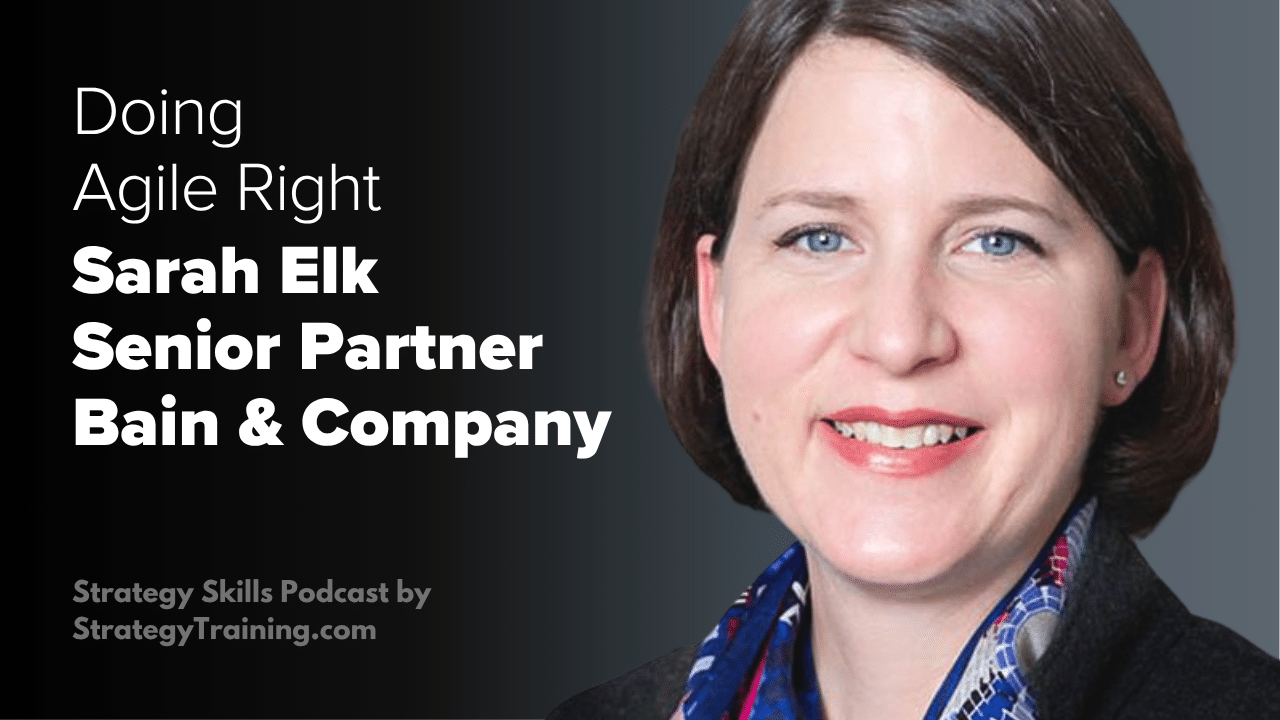
Sarah Elk, Senior Partner at Bain & Company and global leader of its operating model work, brings a clear, pragmatic lens to why so many large-scale change efforts fail to stick. Drawing on decades of advising multinational organizations, she diagnoses the structural and behavioral traps that cause transformations to stall—and shares the disciplines that make change durable.
Elk emphasizes that transformation is not a one-off program but an enduring capability that must be “led from the top and embedded in the culture.” She cautions against outsourcing responsibility to a program office:
“If the CEO is not leading it and the leadership team isn’t engaged in the change, you might get something done, but it will erode quickly.”
Key Insights from the Conversation:
- Clarity on Non-Negotiables
Many failed transformations lack a shared definition of the “non-negotiables” in the new operating model. Without them, execution becomes fragmented.
“You have to be crystal clear on what’s standard and what’s flexible.” - Outcomes Over Activity
Successful change efforts anchor to measurable business results—not just activity metrics or generic benchmarks.
“It’s not about hitting 80 percent of a checklist. It’s about whether you’ve moved the needle on the outcomes you care about.” - Leadership Alignment Is a Continuous Process
Alignment isn’t built in a single offsite; it requires ongoing dialogue, joint problem-solving, and confronting decisions that challenge entrenched interests.
“You need the leadership team acting as one—every week, every month—not just at the kickoff.” - Manage Change Fatigue
Overloading the organization erodes momentum. Sequencing initiatives and celebrating visible early wins tied to strategy helps sustain energy.
“People get tired. You have to show progress and give them space to breathe.” - Governance, Incentives, and Talent Must Evolve Together
Elk warns that without parallel changes to systems and structures, “behavior will revert to what it was before.”
The discussion reframes transformation from a high-profile event into a muscle organizations must build and maintain. For executives seeking change that endures beyond the initial push, Elk offers a blueprint grounded in operational rigor, leadership accountability, and cultural realism.
Get Sarah Elk’s book here:
Doing Agile Right: Transformation Without Chaos
Here are some free gifts for you:
Overall Approach Used in Well-Managed Strategy Studies
Enjoying this episode?
Get access to sample advanced training episodes
Episode Transcript:
Michael 00:46
Our podcast sponsor today is StrategyTraining.com. If you want to strengthen your strategy skills, you can get the Overall Approach Used in Well-Managed Strategy Studies. It’s a free download, and you can go to firmsconsulting.com/overallapproach. That’s firmsconsulting.com/overallapproach. And if you are looking to advance your career and need to update your resume, you can get a McKinsey and BCG-winning resume template as a free download at http://www.firmsconsulting.com/resumePDF. That’s http://www.firmsconsulting.com/resumePDF. Hi everyone, and welcome to another Strategy Skills podcast. Today’s guest is Sarah Elk, who is a Bain Senior Partner. Just a brief background is she leads the operating model practice, and she’s a senior member of the retail practice, which at some point, I think, was headed up by Daryl Rigby, and she’s based in Chicago. In today’s episode, we’re gonna have a pretty interesting discussion, because what Sarah has done with her team is they focus on applying agile management practices to large corporations, or any corporation for that matter, and we’re going to go through this with Sarah. But when I mean agile, I mean the principles that Silicon Valley startups have been applying for a very long time to get out minimum viable products as quickly as possible. They use different techniques. They use sprints. They set up things very differently. They manage it differently. And the results, I think we can agree, have been pretty astonishing. If you look at the composition of NASDAQ and the FTSE 100 and so on. I mean, these digital companies, the new wave of tech companies, have done pretty well, and a large part of that success has been driven by the way they manage rollout of different initiatives. Sara has been a big part of that, working in retail, but across many different sectors. And what I really liked about this episode is that while she has obviously a clear understanding of the principles and the strategy and so on, she also has the ability to dig in to talk about specifics of how it was done, because she’s been a part of those initiatives. So it’s one thing to talk about the strategy of agile and so on, but it’s another thing to go into the detail and say, You know what? When I worked with this executive or this team, this is what we experienced, this is what we recommended. So I enjoyed this episode a lot, and I think for many people who want to learn best practices from the leading edge tech companies. This is a good podcast to start with. Hope you enjoyed this podcast as much as I did. Hi, Sarah, how are you good? How are you excellent? A good place to start is maybe just to introduce, if you could just introduce yourself to the audience, because I’ve read about your bio and so on, but it’s a brief background of where you’re from and how you ended up at Bain and the work you’re doing there.
Sarah Elk 03:42
Sure. So let’s see how far back do you want me to start? Like, college.
Michael 03:48
Yeah, let’s go to college. It’s always good to see the formative years.
Sarah Elk 03:51
Oh, goodness. Um, so I thought that I was going to save the world as an environmental engineer. Yeah, I became passionate about environmental engineering in high school, and at the time, there weren’t that many programs that were strictly about environmental engineering. And I was lucky enough to get into Northwestern and studied engineering there, got a great job in healthcare with a pharmaceutical company doing environmental engineering. And like most good college kids, started work and then realized that that was not the career for me. So about a year into that, I decided to get another degree, decided to pursue an MBA, was going to go part time, and then studied for the GMAT, took the GMAT and did well enough on the GMAT that I was like, well, maybe I should consider going full time. And my husband, who’s amazing, was super supportive and said, Yes, you should definitely apply. And we were on the east coast at the time, so I applied to the part time school that my employer would pay for, plus a handful of other big names and. And didn’t really know what I was doing, and I was lucky enough to get into Stanford, which I still don’t know how I got into Stanford, my manager hand wrote one of my recommendations, which I think is astounding,
Sarah Elk 05:13
Yes, looking back. But you know, I grew up in Iowa, like I’m a simple girl from the middle of the country, and had never been to California, so we moved to California, did business school at Stanford, graduated in the downturn in oh two, oh wow. And was trying to figure out what I should do. I had an offer to go back into pharmaceuticals, which I didn’t want to do because I didn’t want to do engineering, and I wasn’t really excited about a sales role, and decided to go into consulting. I could park myself there for a year. My husband actually decided to go back to business school too. He was a year behind me, and so I needed to be mobile and flexible, and so I figured I’ll just do consulting for a year, and I got a great offer from a boutique firm, yeah, and I ended up really liking it. So I did five years of consulting with a boutique firm, and then ended up switching into Bain when the boutique firm did an acquisition that I thought was a bad idea. And have been at Bain ever since.
Michael 06:18
Wow. So you’ve been in pain a really long time.
Sarah Elk 06:21
What has it been now? 2007 I joined Bain. It’s been a while. I don’t feel that old, but thank you.
Michael 06:29
You’re amazing. You have to worry about anyone using the word old to describe you. And now you, you have multiple roles at Bain, right? Can you give us a summary of that?
Sarah Elk 06:38
Yeah. So I, you know, I came in as an as an experienced manager, hire, which is a little bit unique because I switched firms, did my path to partner. I was in the LA office at the time, and then was promoted to partner on a major tech transformation. Then did a bunch of work in healthcare, doing large healthcare transformations. In part because I needed to get to the Midwest, my mom’s health was failing, and so I transferred to Chicago, and Bain was super supportive, but my passion was more of the engineering kind of stuff like I liked things with engines and machines, and I had done work in automotive, and so then I did a bunch of work in aerospace and other big things With engines, yes, and then had an opportunity to do work for a large retail client where I’ve spent the bulk of my time the last several years, and so I’m a little bit of an anomaly. And then I’ve moved around practices, but the common thread is sort of large corporate transformations. I’m just fascinated by big companies trying to do great things. And that has led me to a hat that I wear which is leading our operating model solution, which is our organizational transformation solution area within Bing. You know, I still lead one of our large retail accounts with another colleague of mine, and then I wear various other sort of internal role hats as well.
Michael 08:01
So is this how you got into Agile and Lean Thinking because of the transformation work you’re doing?
Sarah Elk 08:09
Yeah, and you know, driving change at very large companies is hard. Very hard. When you spend a lot of time thinking about that. I was approached by my colleague, Darryl Rigby, who I think is an absolute genius. He would be embarrassed if you heard me say that he he’s an incredible person, and he approached me last January and said, Hey, I’ve got, you know, this project that sort of fell in our lap. He had been approached by HBr press, and do you want to team up and do it? And so we built a cross functional team. Darryl is an expert in Agile. I’m an expert in organization, and Steve Perez is an expert in tech. And the three of us came together to write the book.
Michael 08:59
So basically, the book is a summary of the work you’ve been doing over many years.
Sarah Elk 09:05
Yeah, the book represents our client experience. It represents our beliefs. And I think part of the impetus for writing it is what we were seeing in the market around agile, almost becoming a fad for, you know, a lot of negative press are sort of people turning away from it. And in our view, it’s a really valuable and practical tool, and we didn’t want it to end up on the scrap heap of management topics over the years.
Michael 09:34
So I just want to touch on something here, because you said that people are turning away from agile. So my view is that not enough companies using agile practices for them to even begin turning away from it. It’s something that can still be adopted by more companies.
Sarah Elk 09:51
Yeah, it’s interesting, because a lot of companies have experimented, particularly in their IT department, yes, yes, yes, not. Everyone but but many, and because it’s isolated and not well connected to the business, it hasn’t reached its full potential. And depending on your beliefs going in, and there’s lots of different beliefs about, you know, agile as a silver bullet, yes, you know, some executives are disappointed in saying, well, agile is not living up to what it said it was supposed to be. And so there’s just a lot of confusion over what it is what it isn’t. Is it a team methodology? Is it a mindset? How do I apply it? And we just wanted to set the record straight on our experience in a really pragmatic way, on what it takes to do it well, because when you do it well, you unlock so much potential in your business.
Michael 10:47
So let’s go back to some basics here, just for the audience, right? When you say agile, you are referring to a way of managing the business, or you’re referring to the dictionary definition of agile, because I think the audience is going to get confused on that.
Sarah Elk 11:02
Yes, and so do companies. So it’s a great question. We think about agile at sort of three different levels. There’s agile team methodology, so perhaps that’s something like Scrum or Kanban, which is a specific way of working that a team might deploy. Okay, there is agile at scale. So when a company gets many agile teams running.
Michael 11:28
Just to explain this to the audience, that means as many teams using Kanban or Scrum, right?
Sarah Elk 11:33
Yeah, or whatever methodology they choose, there’s, you know, companies also come up with their own methodologies, but it’s, it’s a particular way of working on a team, where you have small cross functional teams that are have a specific mission with a specific way of working, typically geared towards innovation or some sort of change that’s very customer focused, with a heavy prototyping or sort of test and learn approach.
Michael 11:57
Okay, good way of thinking about it. What is the third way?
Sarah Elk 12:02
And so then you get many of these agile teams and that, you know, we sort of call that agile at scale. And then there’s becoming truly an agile enterprise.
Michael 12:11
And the whole organization is operating in an agile way.
Sarah Elk 12:16
The whole organization isn’t necessarily running agile teams, but you have to change your business process and what we would call your operating model, and we can talk about the components of that in order to allow traditional bureaucracy, which we think is still valuable, to work at its best alongside and in conjunction with Agile innovation teams. So we are not believers that an entire company should run exclusively on agile teams. There is still a strong role for traditional bureaucracy, sort of what you would think of as a traditional org chart, where you have a supervisor in direct report. Yes, you know, accomplishing tasks, because that’s where you start to have quality repeatability. You know, all the things that Lean Six Sigma would espouse are necessary and good for activities that are well suited for that type of of operating model or organizational structure. But not all work is well suited for that.
Michael 13:23
So what you’re saying is that, in an ideal situation, the parts of the companies that benefit from agile should go Agile, and the parts that don’t benefit should stay the way they are, but learn how to support the agile teams. Correct? Okay, I like that and ask a question that everyone’s going to be thinking, if a company goes to the most mature level of being agile, is that the same as saying that it is very flexible in being able to respond to what’s happening in the market.
Sarah Elk 13:51
If you also change a bunch of other things?
Michael 13:55
So what would be the other things we would need to change? Right?
Sarah Elk 13:58
So just having an Agile team, in and of itself, means that you could have one specific mission that that team is focused on with fully dedicated resources, doing that in a highly productive and customer centric way. Great, that’s good progress. Okay, not make you into an agile enterprise. The difference in how we think about that is that agile enterprises focus on creating this agile business system, and the components of that cut across all the aspects of your operating model. So when we think about how we define an operating model, it’s not just your structures and accountabilities. Ie I set up an Agile team. It also includes your management system. So how do you do budgeting? Yes, resource allocation, reviewing of your business. It includes your leadership and culture. So broader like, how does the leadership team work? You know the top. Team, for example, the CEOs direct reports need to come together in a different way and spend their time differently. It includes changes to your talent system and the talent that you have in your company, and it includes changes in what you have set up and how you use technology and data, and ultimately, your underlying business process that then connects all those components evolves.
Michael 15:23
So let’s start with some basic questions, right? So what makes agile so different from the I suppose, traditional approaches companies are using to manage innovation and being more responsive to customers?
Sarah Elk 15:35
Well, it’s all of those things, right? If you’re going to be.
Michael 15:38
A very broad question, let me just bring it down to something very simple, right? So let’s assume you’ve got two teams trying to get out an app. One is using a traditional approach of excessive planning, budgeting, spending two years to get it out. What would be different about a team pushing out an app if they were using the Agile approach?
Sarah Elk 15:56
Great, so common problems. Let’s imagine you’re the team doing the traditional approach. You probably have fragmented resources, yeah, so I have 10% or 20% of my time as part of this team, versus being fully dedicated, which I’m just going slower. Yeah? I don’t have access to leadership quickly to get my issues resolved or get the input that I need. And so I end up waiting between milestones, whether that’s sort of an initiative review or a steering committee, you know, I can’t quickly pivot or get the resources that I need. I’m probably working on something all the way until the end before I test it with customers. That’s a big one, yeah, and so my actual end solution is not nearly as good as it could have been or should have been, yes, because I haven’t gotten the right level of feedback. The direction that was set out at the beginning by management may have been dictated by their experience, as opposed to what testing results would say. And so, yeah, I like to say that leaders should stop speaking for customers. Yeah, yeah. That’s a good one. That’s a good point. Customers speak for themselves, yeah. So you end up in, you know, and I could go on and on and on, you probably don’t have the right talent, or people on the team. It’s not cross functional. It’s too hard to get those people pulled out and applied, and so you’re probably working too much in a silo, you know, on and on. But the net impact of that is that you don’t end up with as good of a solution. You don’t end up with a solution as quickly as you could have or should have, and then you end up with the problem of it was done sort of in the vacuum and on the side and not connected to all of the people who are running the business, typically, and then you can’t scale it, because the hardest part is not actually generating the solution. The hardest part is getting the solution embedded in your business, driving results and allowing you to to have that solution be at scale and serve your customers well.
Michael 18:05
So what’s interesting here is that the word customer came up, I think 13 times I counted. So it sounds as if, if you it sounds as if you’re shifting the focus away from doing what bureaucracy wants you to do to doing what customers need you to do, which is a bit scary, because you’re telling a team to engage with a customer and push out things to customers. And I’m guessing companies like banks and pharmaceuticals like to go through 10 years of testing.
Sarah Elk 18:32
Yeah. And so to be clear, leadership is setting the direction right. So if the leadership team is coming together as an agile strategy team themselves, then they’re spending more time on the backlog and setting the missions of what these innovation teams should go.
Michael 18:47
Okay? So they are setting the overall priority right?
Sarah Elk 18:51
So they’re, they’re commissioning and decommissioning teams.
Michael 18:55
Let’s say I like that you have.
Sarah Elk 18:57
You know the number of teams you have will vary based on your company and your business context and industry context. So you might have lots of innovation going on. You might have a little innovation going on. I use customer generously to mean external revenue generating customers as well as internal customers. Okay, so I may have, you know, actual consumer facing or B to B customer facing solutions, but those may also require changes in process and technology where I’m trying to improve my skill set. So if I’m, you know, let’s say I’m a retailer, and I have, you know, merchants who are buying goods that I then sell, I may need a suite of tools for my merchants that’s an internal customer.
Michael 19:47
Yeah, but still important, very important, yes.
Sarah Elk 19:52
And so as we think about digitization and where we need to apply tech and data and create holistic experiences, they’re not. Just for our external customers. They’re for our internal customers as well. And so I have all of the activity going on.
Michael 20:06
Is it fair to say that this is hard to apply if you don’t have access to internal, external customers?
Sarah Elk 20:12
I really think that it could apply to any business. A business has a mission and a purpose and needs to continue to improve and change how it’s doing whatever it needs to do in order to deliver on that mission and purpose.
Michael 20:26
Not referring to different businesses. I mean, if you’re setting up a team that’s using agile, that team has to have access to customers, whether internal or external, so they can get real time feedback in terms of what they’re doing. Yes, so I would say that’s one of the conditions for Agile to work.
Sarah Elk 20:43
Well, yeah. So if you are going to prototype something, you have to have a way to get customer feedback.
Michael 20:50
So to ask you the question that I was thinking about right at the beginning, if you look at the companies that have applied agile, and the articles by Ben give a few examples of that good examples, they’ve done very well. So why is there now a sentiment that Agile is not working? What’s driving that?
Sarah Elk 21:06
I think people have done agile poorly. There are companies that we would say are doing Agile wrong. Okay, I think they’re or, you know, or it’s insufficient. Again, it’s expectations versus what it takes to actually transition to a more agile enterprise. Just standing up a team is insufficient. That team will be successful. For example, there are misapplications of Agile. You know, agile is a tool, not a strategy, yes. And you know, just like you wouldn’t use a chainsaw to do heart surgery, you know, there are places where you shouldn’t apply agile. And so if you start applying agile in, you know, places where you should have bureaucracy, yeah, you’re probably going to be upset with the results.
Michael 21:56
So the government is never going to have agile thinking, is what you’re saying.
Sarah Elk 22:00
Well, I mean, I wouldn’t go so far as to say that. I think there are lots of places where we would all agree the government needs to innovate and do things differently. So, you know, there’s that. But bureaucracy is great for where you want hierarchical authority, where you want specialized division of labor, where you want standard operating procedures. I don’t want to get on a plane and not have my pilot check the safety checklist. Yes, true. You know, like standard operating procedures are good and necessary, that’s what makes operations have minimal variability. You know, the application of proven practices, it makes them repeatable and scalable. Those are all good things. And so, you know, there’s another sort of set of problems where Agile is being misapplied. A third area would be agile being used for abrupt cost cutting. So we’ve seen a lot of examples where companies have gone in and taken 30 or 40% of their head count out, lost expertise, done it in what we would call a big bang approach, and all of a sudden you’ve got all of these people in new jobs, and you haven’t rewired how things are going to work. And it’s not meant for cost cutting. Will you get efficiencies from becoming a more agile enterprise, of course, but that will happen over time, as you start to shift and realize what talent you need, when you start to dedicate people more to specific innovation missions, you’ll realize you don’t actually have the right people that you need. And you’ll start to find efficiencies and shift things around. And a bunch of the innovation that’s probably going on in your company isn’t the right innovation anyway, once you apply the right lens to it and start to prototype and test and actually get that customer feedback, so there are efficiencies to be gained, but that’s not the reason why you do it, and I think there’s missteps around believing it’s this panacea of cost cutting that also has created some issues.
Michael 23:58
So you’ve sort of led me into this question, which I’ll ask. So what is the number one reason for introducing agile, and if it’s appropriate, scaling it in your organization?
Sarah Elk 24:10
Just to create a better way of achieving the ultimate purpose or mission of your company? Today, I am too bureaucracy focused and not changing enough, and we live in a world of disruption. Yes, most companies are trying to figure out, how do I be more innovative, have more adaptability? How do I keep pace with competitors? And this is a great tool to enable you to do that, if you have clarity on the direction and strategy that you’re trying to go. And so we talk about it as balance and striking the right balance across these pieces. And every every company that I’ve seen needs more balance across. Us sort of run the business and change the business.
Michael 25:02
I would imagine it introduces quite a lot of tension, because imagine you’ve got a team that’s operating on agile. They start off and then as they progress and they learn more about what works with customers what doesn’t work, they’re going to be making changes to their budgets all the time. It isn’t that. How does it work with companies that generally work on a yearly budgeting cycle. How do you manage that tension?
Sarah Elk 25:23
So you end up having a way that you’re staffing your agile teams and the budgets that they need, and you do that more frequently than annual so if I’m an Agile team and I get stood up, I probably have sort of initial seed money, let’s say if we’re applying, you know, venture capital terms. And I’m going to say, here’s, you know, the idea, or the mission that I’m going to give this team. Here’s an initial set of money, because we don’t really know what it’s going to cost. Yes, typically teams are 4x off. They’re either 25% of what they thought it was going to cost, or they’re 400% yes, you know, here’s an initial set of money, you know, go learn, and they come back with what they’ve learned and then more clarity on the direction that they need to go. And so you end up, let’s say, releasing funds much more frequently for your innovation. But we’re not yet to the point where those need to scale. And once you’re further down the path, and say you’re not sort of early stage, you’re more late stage venture capital, or, you know, you’ve you’ve got a more proven idea, then you’re ready to build it into your annual operating budget, and you’ve got a much better sense of the value and cost that’s actually required as you move that from, you know, the handful of places that you’ve tested it, whatever is appropriate for your business, to a full rollout to the entire company.
Michael 26:51
So the role of finance moves away from command and control to support. Is that a nice way of thinking about it?
Sarah Elk 26:57
Part of the role of finance, right? Remember, we’re still running the business. We still have, let’s say we’re manufacturing plants, or whatever else our business entails. Annual budgeting doesn’t necessarily go away. You just need to layer on and treat how you fund innovation in a more fit for purpose way to innovation, instead of funding it like you would fund your traditional bureaucracy.
Michael 27:24
So finance has to realize that different parts of the business need to be run in different ways.
Sarah Elk 27:29
Yeah, and the you know, the historic way of handling change would be really detailed business cases with five year plans and you may not know all of that upfront, and so you have to adapt finance needs to adapt how they approach the aspect of sort of funding and control around innovation.
Michael 27:56
And in your work, have you found that some parts of the world are more open to the style of doing Agile, where maybe other cultures are more leaning into more traditional long term planning, or you find that it’s the same across the world.
Sarah Elk 28:12
I think I’ve seen more differences by industry than geography. That’s interesting. But industry, yeah, so industries that are much more disrupted are much more leaning in so financial services would be a great example, or insurance retail as an example. You know, these are industries that are ongoing, and, you know, I don’t want to say they’re sort of in chaos, but there’s just, there’s just a lot more external pressure.
Michael 28:42
There’s a lot of excitement. Let’s say that.
Sarah Elk 28:44
Yes, there’s, that’s a perfect way to say there’s a lot of excitement. And so given the level of excitement there’s, there’s an openness. You know, we’re starting to see much more demand in consumer goods where, you know, traditional approaches to innovation and consumer packaged goods are not keeping up with insurgent brands, yes, and insurgent companies. And so that is that will change
Michael 29:12
Which sectors are more taking longer to be more open to this?
Sarah Elk 29:22
You know, sectors that are probably less consumer driven are more longer or heavier CAPEX and longer CAPEX cycles?
Michael 29:34
Like building up power stations, maybe something like mining.
Sarah Elk 29:37
Yes.
Michael 29:40
Yeah, that’s true.
Sarah Elk 29:42
Is a you just need agile loss again. It’s not that. It isn’t not it’s it’s there. It’s just not as critical.
Michael 29:50
Mining response times work in years, right? Right. So versus consumer products, where you can work in weeks if you want to.
Sarah Elk 30:03
Yeah, right. Big one year life cycle is, is just a different ballgame.
Michael 30:09
But even so, there are opportunities to use agile within mining companies and resources companies, right? Absolutely, absolutely. It’s just about, I think what you’re trying, what you’re saying is that it’s about making sure the executive team knows the appropriate way to use agile given the type of sector they’re in, right?
Sarah Elk 30:27
And did you know? I mean, no, no. Said another way. No business is static, yes. No business is completely chaotic, yes. From a market standpoint, you want to find that happy medium, yeah, and it’ll be different by industry.
Michael 30:45
Yes, you know, just a good way of good point you’re making. It’s not as if you can take agile and there’s a playbook which you just throw into the company, and everyone does it the same way. You’ve got to adapt it for your organization, correct?
Sarah Elk 31:00
And I feel maybe that I need, even if we’re in the same industry, the balance I need, given my strategy, may be completely different than the balance a different company needs. Yeah. I mean, I’m trying to drive how much change I’m I’m wanting to introduce what my starting point is for my leadership and culture.
Michael 31:16
If you look at just banks, for example, right? Some banks are big into wealth management. Others have the bulk of their profits and revenue coming from other types of banking. So I’m guessing, if you just look at banks, you’d say they’re the same sector, but depending on how they make money, the way they’re going to introduce agile would differ, because they are very, very different sources of revenue and the cycles around their revenue, right? So talking about banking, I’m gonna use banking as an example here, but feel free to use whatever sector you comfortable talking about. You spoke earlier about the need for there to be bureaucracy in some companies, because following regulations is something we need because it obviously protects consumers. So in an example, like a bank, and how do you get that balance between letting teams be agile and then at the same time using bureaucracy to protect consumers? I think people want to know how that what’s the best ways of doing that?
Sarah Elk 32:16
I wouldn’t think of bureaucracy as only being necessary where you have regulation. Okay? Again, it would be anything where you’re trying to have high quality, repeatable efficiency, so some of that work will get automated over time. So if you think about any kind of processing work, whether that’s mortgage processing or, you know, an insurance like claims processing in retail, it’s, you know, stocking shelves. Yes, there are standard operating procedures and routines that are helpful, that somebody may be a different innovation team may be working on making those routines or standard operating procedures better and testing those but the vast majority of people who are in those types of situations are, so to speak, running the play right? There’s a way to do it that has been defined as the best way to do it based on everything we know right now, and what those types of activities are will obviously be different for every company in the examples I just gave, but every company will have a mix of bureaucracy and innovation, and for many companies, the vast majority of people will be doing the exact same jobs they’re doing today. So even if I fully transition and become an agile enterprise, you know, 70% of my workforce is doing this sort of repeatable core business, you know, traditional, traditionally structured, bureaucratic work. And that’s a good thing. That’s not a bad thing. It’s that I need to get the innovation side further invested in and rebalance. I need a different way of working there, and that will require changes on the more traditional side. But it’s not that you’re completely turning it upside down or turning that into agile teams. They need to be able to accept the changes and realize those and so it’s more about how are you building in the connection across innovation and bureaucracy versus not honoring the bureaucracy side?
Michael 34:25
Yeah, I like what you saying. It’s a good choice of words. It’s about saying A company needs a variety of skills, and each side needs to respect each other and work together, as opposed to agile, replacing everyone and making them redundant, which is what some companies try to do. Just a bad way to do it, right?
Sarah Elk 34:42
Yeah, I often use a retail example, because it’s sort of easy to wrap your head around. Everybody understands what it means to go into a grocery store, for example. And so if you’re a store manager of a grocery store, and you know, if retail is being really disrupted, I’m going to be changing probably how I receive. Truckloads of goods, I’m going to be changing how I stack the shelves and automation and sort of handheld tools for employees to do that, how my employees team together in the store may be different. I’m probably moving to more self checkout, or changing the technology and equipment at the front. I may have an app. I may be doing pickup and delivery. You know, there’s a lot of changes that I need to be able to catch and implement at the store level, even though I’m sort of the bureaucracy side of the business that’s running the play. And so it isn’t that there’s no change for for those people. It’s that I’m just not asking you to invent the solution. You may be part you may be a test store, which would be something to be celebrated. You know, you may get certain things before other stores because of your connection back to certain innovation teams. But then when things are ready to roll to all stores. You need to be able to receive them and implement them. And that’s the piece that’s new and different as we think about the connection across. And there’s lots of ways to support landing that change in in the store successfully, if we use that as an example.
Michael 36:17
Yeah, that’s a good example. I like that example. I was thinking about a sports analogy. It’s almost like football or soccer, whereby the coach calls the play. He knows that the opposition has a weak defense. He’s going to put in a lot of strikers and attack the defense. That’s the play he calls, but he gives the striker a lot of freedom in terms of how he’s going to execute the play. It’s a good way of thinking about it, and then the strike has to work closely with the other team members and make sure that they know what he’s doing. But he’s got the freedom to innovate on the field.
Sarah Elk 36:51
Yeah, I think it’ll vary by context, right? Yes, if I’m running inventory, let’s say a certain way, in a store in order for the accuracy of my inventory data to be right, I probably need to run the play more exactly, as the coach called it, because not doing that means my day my data may be wrong, and then the customer won’t know what I actually have in the store. Yes, there are probably other situations where there’s a lot more flexibility in how it gets implemented. So I think that may vary.
Michael 37:25
Yeah, so you actually don’t want your accountant to be very creative and innovative when you’re submitting your tax returns. That’s basically where you don’t want too much creativity.
Sarah Elk 37:34
Well, it’s where you channel it, right? I mean, the frontline has amazing ideas, which is why prototyping and testing through the front line and with customers is so valuable, that’s a good thing. It’s just, you know, when do you actually move that idea to test, and how do you move that idea to test? So taking the idea that the striker may have on the field, is that something that they should implement right now, or is that feedback that you provide to the coach and you run it on the next play in a systematic way where you can learn from that and then build it into the solution? Or not?
Michael 38:11
So does this mean that B2C companies tend to be more easier to implement agile versus B2B companies, which tend to operate in slightly longer cycles, or is there no distinction?
Sarah Elk 38:24
Depends on the the so the cycle time is more important than B to C or B to B? Yes, the cycle time the feedback loop, right? So some B to B companies, you know, are get a lot of feedback. And so I think you’d have some B to B companies that would be upset by that statement, but certainly long side.
Michael 38:42
I don’t mean to offend any B2B so we clear.
Sarah Elk 38:46
Yeah, you’re listening. Don’t be offended.
Michael 38:49
That makes sense. Like a company that deals with the back end of software powering other companies, they’re getting real time data 24 hours a day. So their feedback loop and feedback cycle is very short, very compressed, and they should be able to respond faster.
Sarah Elk 39:06
But even an even an automaker, right? So if my cycle time for buying a car is I don’t know, let’s make it up seven years. There’s still lots of ways to get feedback and drive improvements. And so how are you creating a way to release improvements, even if it’s a long cycle time. And what are the different mechanisms by which you can capture that feedback, whether that’s data coming from the car directly, or, you know, other interactions that you can be pulling data from? There’s so many different sources of data now.
Michael 39:42
And it’s also having the ability to push out changes rapidly, having the infrastructure to do that, right?
Sarah Elk 39:48
You would need a, you know, a Tesla like release cycle, where you can push out new software to the car. Or, you know, create mechanisms by which. You can drive improvements for customers even though you have a long cycle time product.
Michael 40:05
Yes, so that’s interesting. So let’s just step back a second here, right? Because we the reason for the book, and one of the reasons for the book is to get executives to understand that agile, if done right and applied appropriately, could have the results they want. So if I’m an executive and I’m running an initiative to roll out Agile, doesn’t matter on the maturity and scale. What are the things I should be thinking about to see if I’m doing it correctly or incorrectly? How do I assess this?
Sarah Elk 40:39
So agile wrong versus agile right. Let me just sort of give you some phrases or ideas that we think about. So Agile is a panacea versus a balanced agile system. Okay? Quick, Big Bang transformation, versus using Agile approaches to increase agility, so sort of agile in your way to agile, using test and learn appropriate for your organization is the way that you get there. Okay, applying bureaucratic program management versus, again, using an agile way of working to get there, thinking that Agile is only for your subordinates, versus applying Agile principles and mindsets at the top. Sort of this notion of the top team being an agile strategy team as an example, and where leadership time goes changes, thinking that Agile is only for it, versus applying agile broadly across lots of areas of change in your company, thinking Agile is for layoffs, versus agile being more for you know, innovation and improving capability in your company, using agile as a cover for micromanagement, Which happens, versus truly embracing agile for the learning, coaching and unleashing of the full potential of people, that is what should be happening, you know. And then, you know, using Agile rigidly, almost like there’s rules, versus really tailoring and applying Agile to what’s going to work in your culture and your environment and your company?
Michael 42:22
I like that. That’s a very good set of principles to think about, because I don’t think you can give people a test. It’s every company has got to look at this and say, is agile working for me against these considerations you’ve provided in that list, you mentioned something about the management team using Agile principles to run the company. And in one of the articles I read, I think it was one thing Darryl wrote about how companies can use agile to develop their strategy. Is it something we can talk about more? Because most companies are used to setting a strategy over a few months and then running it doggedly for two years and then seeing the results. So how has agile changed that?
Sarah Elk 43:03
So at the top, you would have, you know, a sustaining purpose or mission, or, you know, specific, maybe financial goals, sort of longer term, three to five years. Or maybe, you know, your everlasting mission, you translate that into the different things that you you think you need to go do to achieve that, and the leadership team holds that set of ideas. And when you transition to an agile leadership team, you basically run that as if it’s the backlog for the leadership team. So you know what ideas you’ve resourced that are out there, that are being worked in the business, and you know the set of ideas that you would love to filter in that maybe you don’t have the resources for right now, and you’re you’re managing that dynamically as you’re describing so you’re standing down things that you think aren’t working. After some sufficient time period, you’re adding in new things. You’re shifting resources. Knowing what’s on your backlog means you can do better talent planning. But the net impact of all of that is that for leadership teams that make this transition after about three years, they go from spending 10% of their time on strategy development and growth to about 40% of their time across all of those types of activities that I described.
Michael 44:23
But that’s good thing, because they’re actually doing things, as opposed to just planning right.
Sarah Elk 44:27
Right? So they’re understanding the customer better. They’re doing more marketing, competitive analysis. They’re prioritizing and sequencing the ideas and initiatives that they want to go after as a leadership team, sort of putting your hat on for the greater good of the company, versus just representing your silo. You’re thinking about business case, development strategy, alternatives and choices. You’re operating in a much more transparent and collaborative way as a team. And the net impact of that is that if you’re. Shifting much more time towards strategy and strategy development and growth. You’re taking that out of operations management, and so you are attending, you know, fewer, usually low value operational reviews. You might be doing your financial reviews and delegate some of that down. You’re probably focusing less on administrative work, or, you know, other things that tend to suck up leadership time, that seem like crises at the moment, but are not actually. And you know, this whole notion of delegation comes up a lot when we get into this topic, and it makes leaders really nervous. And what we aren’t saying is to blindly delegate your business down to the next level of leaders. Yeah, what we are saying is that it’s a leader’s job to build the trustworthiness of their team. So in the same way that I wouldn’t give my teenage son the car keys the day after he gets his driver’s license and tell him, Hey, go take your five favorite buddies and like, cruise around town have fun. You know, I would give him the car keys and say, Can you run to the grocery store on the corner and get a gallon of milk and come back and hopefully he doesn’t get anything on the way? Yeah, so you’re, you’re you’re building that trust with intentionality, and it’s, it’s on the leader to do that, which is a different way of thinking than most leaders have thought about it in the past, at least based on our experience. It’s not that all of a sudden you’re blindly handing operations to the next level down and hoping that your business stays on track.
Michael 46:49
No, it’s a purpose. So two points jump out to me. One is that it sounds if you do this right, you are allowing different parts of the organization to focus on the things they should focus on, like management can spend more time thinking and planning and strategy. But the other thing I noticed is that, and I could be wrong, but it sounds as if that if the agile teams are interacting with customers, internal, external, they’ve got to be able to feed what they’re seeing quickly up the organization, so that the management team can force rank things and set priorities. Does this cause almost a flattening of the organizational structure? Or is that just, you know, it doesn’t really matter if Agile is done right.
Sarah Elk 47:29
You create stronger connection between the innovation teams and the leadership team. Does that definitely happen? Yeah. So one example of that that we profile in the book is Bosch power tools. So they, over the course of three years, worked their way through all of their six business units within power tools to make this agile transition. And in one of the business units in particular, they have a bunch of agile teams set up, and there’s a cascading way that that communication happens across three levels from what they call their sort of business owner, who’s sort of the head of a certain entrepreneurial part of the business, can raise an impediment or a problem or something they need a decision or input on to the next level of management and then ultimately to the top and the business unit leader has their 40 most important sort of change initiatives and priorities that they run as a board and, like, a, literally, a physical board on the wall, yeah? And they have a daily, well, not a daily, they have a twice a week stand up, where the leadership team, or the people that are required come together around that board, and there’s somebody that facilitates. And for, you know, you get sort of one to two minutes to raise your issue, and you either make the decision right there. You decide that it needs a separate discussion, or they reserve the back 30 minutes of the they block an hour. They run the front part for 30 and they hold the back 30 minutes for smaller group discussions on specific issues. But that allows you to have two times a week that you can escalate an issue where, you know, you’re trying to decide if you want to pivot left or right, if it’s a sales or a growth problem, or, you know, some other impact of the business, or, you know, something where the team needs input, and you can get that much more quickly than if you were having, you know, monthly steering committee meetings or something like that. And so it’s completely changed the way the leadership team runs.
Michael 49:45
So is it fair to look at it as a almost a portfolio of agile initiatives they’re running, and they’ve got to think about which ones are going to be prioritized as new information comes up.
Sarah Elk 49:57
So the teams drive that process. Bottom up, but yes, initially, the leadership team said, here are the 40 most important things that we’re going to create visibility to for this escalation. And meanwhile, you know, sales is still selling power tools. We’re still manufacturing power tools. We’re, you know, we’re still doing all the things that we need to do, but where we’re trying to drive innovation in the business, where we’re leading it and managing it completely different with much greater frequency and connectivity across the organization.
Michael 50:33
And then as the agile teams roll out and they start doing things and testing things, they start feeding that information back to the management team to help them understand what’s the priorities?
Sarah Elk 50:44
Yeah, so if a priority needs to change, then that would come out of of the learning. Otherwise, it may be, you know, here’s how we are shifting to do it better, or, you know, here’s we have a resource need. You know, a lot of it is resource needs, whether that’s people OPEX or, you know, based on what we’re seeing, that is the best customer solution. That may mean that we actually need to pivot manufacturing in a certain way. Do we want to explore that? Is that on the table or off the table? Because that might have been outside the boundary of my specific mission as a team. And so does that then create a new mission? Or does somebody else look into that? Or how should we handle that?
Michael 51:31
Okay, so here’s a question, just as examples. It could be anything.
Sarah Elk 51:35
But those are some examples.
Michael 51:37
Most people, I’m going to take a stabby and say a lot of people, maybe not most people, the exposure to Agile has been watching the HBO hit comedy Silicon Valley. There’s a whole episode dedicated to Agile. And don’t know if you’ve seen it, but it’s interesting. I’ve heard about it, but I think you should watch it. So if you are meeting an executive who has heard about the concept of agile but doesn’t know what it is. So has asked you, Sarah, to talk to him about, how do you explain to someone what is agile who doesn’t have necessarily thought it through, but has heard of all these other concepts in management? How do you get them to understand what is different and and how they should think about this?
Sarah Elk 52:20
Well, I would first start with, why is agile appealing? And it’s appealing because it addresses the needs of so many stakeholders, so customers you know, have needs and frustrations that need to be addressed. Business leaders want to lead great companies that can thrive in this unpredictable world of accelerating change. Employees want to live and work like humans and reach their full potential and often feel like they’re capable of doing far more than what they’re allowed to do. Yes, shareholders want more profitable growth. Companies want to take longer term perspectives. You know, communities want companies to find more creative ways to serve society. All of those things are easier when you use agile as a tool to drive change in your business, and when you shift to being this more balanced enterprise. So I think it starts with a clear view of why.
Michael 53:25
I like that.
Sarah Elk 53:26
And then you can get into, okay, well, what does that mean? That means that I’m going to have teams that are working in different ways. And then here are the other things that need to change, ultimately, and how my company operates and my operating model that need to support those teams in order for the whole system to be successful.
Michael 53:47
Word in that entire description, because everyone thinks, and they know it comes from the tech side, but you’ve explained it purely from a business interest side.
Sarah Elk 54:00
Yeah. And to be clear, agile was around long before tech. So where does agile originate from? You know, this is where we need Daryl to like.
Michael 54:09
I’m guessing that somewhere there was government funding with the Department of Defense. I’m almost sure of it.
Sarah Elk 54:15
But I know that it’s been used for over 30 years. I mean, it’s been used in the manufacture of complex aircraft and things like that for years.
Michael 54:26
So, so it came from outside software, and the software adopted it correct originally. The principles predate software.
Sarah Elk 54:35
Yeah, that’s my understanding. Well, that would make sense. I’m not a 40 year expert in Agile. So those who actually wrote the manifesto can come after me with pitchforks, but, but that’s my understanding.
Michael 54:48
Yeah. So what’s the future of Agile? I mean, what are the changes? What are the leading adoptees of agile doing that other people will maybe do in three to four years? I hope that we.
Sarah Elk 55:01
We find more companies adopting it for all the reasons that we’ve talked about, but with an understanding that it’s a tool that should be applied in certain places with appropriate use, so that it’s so that you realize the benefits that you should be realizing.
Michael 55:18
Okay, makes sense?
Sarah Elk 55:23
So that’s really the, you know, we want Agile to become and be viewed as the valuable and practical tool that it really is, rather than a frustrating frad. And I like that. That’s very good. My view is that all of that hype happens when things are overused or misapplied to the actual problem that it’s trying to solve, because when you do it right, your organization and your people are far happier and more successful, and that we, you know, a great outcome would be that we have more people looking back in five years with pride and fulfillment about their agile transition, because you can do it without generating fear, and you can and you should be having fun? Yes, our overarching principle is that if you’re not having fun, you’re not doing it right.
Michael 56:10
Yeah. I mean, I like that. It’s a very good answer, because what you normally find with any management concept or tool idea that gains traction is that when management starts thinking about it, they forget it’s just one of the things you need to use, but they have this view it’s going to solve every problem if they go all in. And what you’re saying is that you got to have a mature way of thinking about it and how you apply it in your organization, and then you can get the results you want. Is that a fair way of thinking about it.
Sarah Elk 56:40
I think so. If there’s a level of pragmatism here, yes, and that’s really what’s going to drive results.
Michael 56:47
Yeah, I like that pragmatism, because people, whenever they hear about a tool, see articles in the Harvard Business Review, they don’t take the time to think about, how do I make this work for me? How to take a mature way of rolling this out slowly, in phases, testing it, getting results, adopting it for the unique needs of my business, and then scaling it. It’s about being pragmatic or mature in the way you think about it, and then you can get the results you want.
Sarah Elk 57:15
And applying it as you’re saying to your business, and the way that’s going to work for your business. You know, for the love of God, please do not take tribes and squats and copy the Spotify model and just roll that into your structure and call it done.
Michael 57:31
I love a company that case studied Spotify and adopted everything that Spotify did, and it was an absolute disaster for them.
Sarah Elk 57:41
Yeah, tailored. And by the way, the structure change is the least important part.
Michael 57:45
Yeah. And also, don’t use words like tribes. If you live in an emerging markets economy, it has a very different connotation that obviously going to fail. It’s about these cultural differences that you must understand. And in that particular CEO was a big fan of Spotify the business model, and he adopted it without thinking through just the nuances of tailoring things.
Sarah Elk 58:09
Yes, this is, this is not a topic to cut and paste and copy on. So hopefully that was already clear to everyone.
Michael 58:21
I think, that, you know, obviously you have a lot of passion for the topic. You know a lot about it. If you read the work Darrell and your colleagues did. I mean, you guys understand it, but I think sometimes, when the reader looks at it, they sometimes forget that enthusiasm doesn’t mean it is the solution to everything. It’s about applying the solution in a thoughtful way. Absolutely, that balance is very important. I enjoyed speaking to you so much. Essentially delightful person to chat to. Is there anything you want to add before we wrap up?
Sarah Elk 58:51
No, I, you know, hopefully everybody was entertained. It’s a passionate topic.
Michael 59:00
You know, I read a lot of articles and books, but this one was very interesting to me, because I obviously have seen agile implemented in different places as a consultant, but I’ve never had anyone take a helicopter view and say, This is what’s happening at agile across the world, across industries. These are the trends. And I’ve never, ever heard anyone anywhere in the world, partner or consultant or anyone ever tell a client, hey, you got to step back and make sure you’re doing it right, because most people do quite a hard sell of a concept. So I must give you a lot of credit for being really thoughtful about the way clients can hurt themselves if they misuse a concept, because not many people do that.
Sarah Elk 59:39
Well, you’re very kind. And there’s more stories in the book. You know, the book tells several company examples, so hopefully it’ll be a good, entertaining read. It comes out May 26 fantastic. And it’s on pre order online, you can find it.
Michael 59:58
Fantastic. I’ll make sure I put the details out when we released the podcast. Sarah, I really enjoyed speaking to you. Good luck with everything. I’m sure the book’s going to be great and you’re going to be a mom for the fifth time. Always good news.
Sarah Elk 1:00:09
Yeah, awesome. Thanks. It was a lot of fun. We’ll talk soon. Bye.
Michael 1:00:15
As we wrap up, today’s podcast is sponsored by StrategyTraining.com. If you want to strengthen your strategy skills, you can get the Overall Approach Using Well-Managed Strategy Studies as a free download. Go to firmsconsulting.com/overallapproach. And if you’re looking to advance your career and need to update your resume, you can get a McKinsey and BCG-winning resume template example as a free download at http://www.firmsconsulting.com/resumePDF.
Leave a Reply