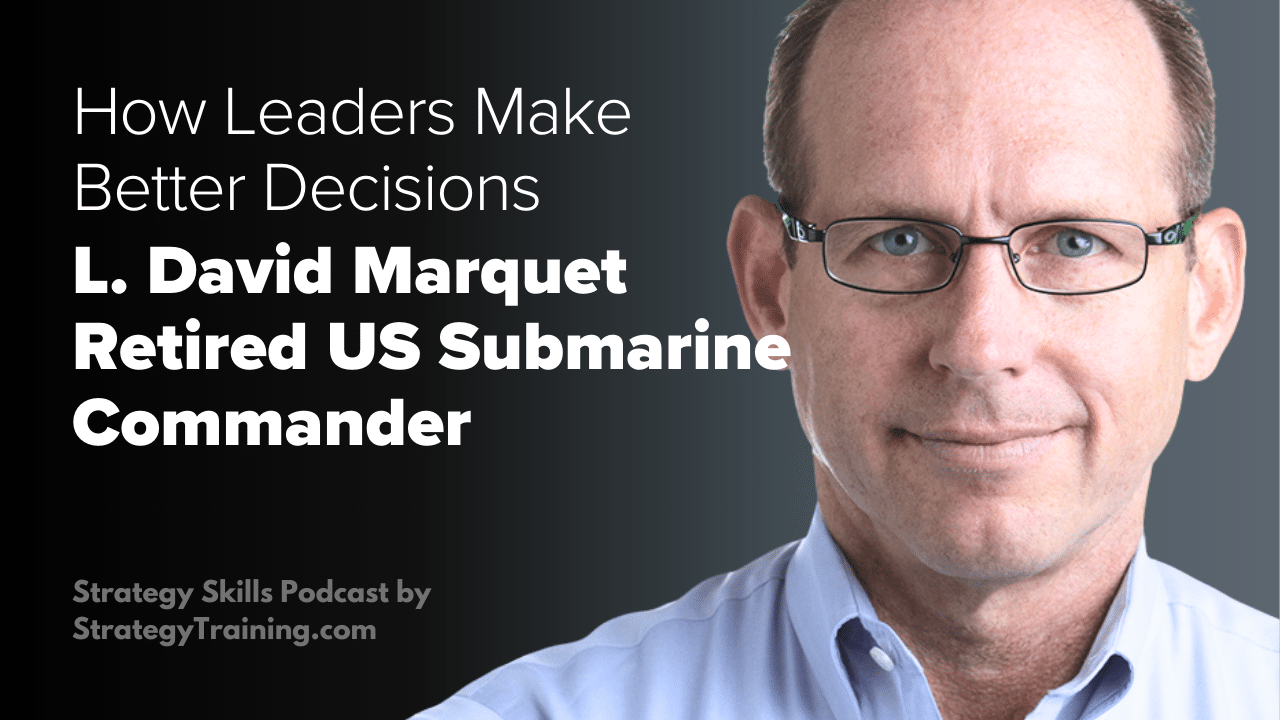
L. David Marquet, former nuclear submarine commander and author of Leadership Is Language, shares a precise, operational approach to leadership, one that replaces command-and-control with a language designed for clarity, ownership, and adaptability. Drawing on his experience turning the USS Santa Fe from one of the worst-performing submarines in the fleet to one of the best, David shows how seemingly small shifts in language can radically improve decision-making, learning speed, and execution.
David rejects the traditional leader–follower model in favor of a leader–leader framework, where decision rights are pushed “to the people closest to the information.” He explains how questions, statements, and the timing of communication directly shape whether teams think critically or default to compliance.
“What we say and when we say it changes what people do. Language is a leadership technology.”
Key Takeaways:
- Replace Permission with Intent
Moving from “Can I…?” to “I intend to…” changes accountability and ownership:
“When people tell me what they intend to do, they’re already owning the decision.” - Protect Redwork and Bluework
David distinguishes between redwork (doing) and bluework (thinking/planning) and stresses keeping them separate:
“Mixing them degrades both. You want focused doing and focused thinking.” - Sequence for Thinking, Not Speed
Meetings often reward quick answers over thoughtful ones. Asking the most junior person to speak first helps reduce conformity bias. - Use Language to Invite Dissent
Adding uncertainty—“I’m not sure, but…”—creates psychological safety and surfaces crucial information that might otherwise stay hidden. - Leaders Design Systems, Not Just Give Answers
The leader’s job is to build communication structures that distribute thinking and enable faster adaptation in changing conditions.
This episode is a practical blueprint for leaders who want to operationalize empowerment without losing control. By deliberately changing how they speak and listen, executives can create teams that are more resilient, accountable, and high-performing.
Get L. David Marquet’s new book here:
Distancing: How Great Leaders Reframe to Make Better Decisions
Here are some free gifts for you:
Overall Approach Used in Well-Managed Strategy Studies
Enjoying this episode?
Get access to sample advanced training episodes
Episode Transcript:
Kris Safarova 01:29
Welcome to the Strategy Skills podcast. I’m your host, Kris Safarova, and our podcast sponsor today is StrategyTraining.com. If you want to strengthen your strategy skills, you can get the Overall Approach Used in Well-Managed Strategy Studies. It’s a free download, and you can get it at firmsconsulting.com, forward slash/overallapproach. You can also get McKinsey and BCG-winning resume, which is a resume that got offers from both of those firms. So if you’re currently updating your resume, you can take a look see what you can learn from the resume in an example we have, and see what you can adjust. And you can get it at firmsconsulting.com/resumePDF. And lastly, you can get a copy of one of our books, which actually was co written with some of podcast listeners and some of our clients. It is called Nine Leaders in Action, and you can get it at firmsconsulting.com/gift. And today we have with us a very special guest. L. David Marquet, who is a former nuclear submarine commander, Wall Street Journal best-selling, author of turning the ship around now introducing his fourth book called Distancing. David, welcome.
David Marquet 02:44
Oh, thanks for having me on the show Kris. And welcome all listeners.
Kris Safarova 02:47
Such an incredible background. I would love to start with your story, especially the part about being a nuclear submarine commander. Can you share a little bit with us?
David Marquet 02:56
Yeah, so I was a nuclear submarine commander. Well, when I grew up, our countries weren’t friendly with each other, and so I went down the path. I was a geek and sort of quiet, introverted, but math, science focused person. And the place you go, if you want to go in the military, what is, is the submarines, because those are the geekiest of the geeks. And when I went to the submarines, they taught me that leadership meant making good decisions and getting the team to do it, do them. So it was about you being smart, you figuring things out, and then you getting the team to go along with you and to put all their energy into whatever your idea was. Now, sure we had a little I call it, we sprinkle fairy dust of empowerment. Say, Oh, it’s good to know what your team thinks, too, but mostly to if you want to be good, you got to make good decisions. And I was really good at this. And so I kind of rose up through the ranks, and I and I got sent to places that needed help. And through seeing, Oh, you know, don’t do it this way. Do it this. Oh, we need to do this. And I got rewarded and promoted, and my team got pat on the back, and then they say, Oh, you’re gonna be a submarine commander. And at the very last minute, after all my training, they shifted me to a submarine that was the worst morale, worst performance, but it was a different kind of submarine I’d ever been on was one of the newest in the fleet. So now and everything changed. The physics and the theory was the same, but the way the submarine operated, the equipment, the reactor plant, we had missiles I never was, quote, trained on, and so you show up as the captain to fix the worst submarine in the fleet and all this, I’m going to tell people what to do is not going to work, and intellectually you know it. But your your whole body, you’re just tuned to as a submarine commander, you to give orders, and the Kris tune to follow orders. Is. And on the first day that we went to see we submerged, I gave a bad order. Couldn’t be done. Nothing got no no one got hurt, nothing got damaged, but it just the sailor just started, shrugged and said, We can’t do that on this submarine. It doesn’t have that setting. And so it really rocked me back, and I made a deal never to give any more orders. I said, that’s the last order I’m going to give. Because when you give orders, when you tell people what to do, then they it gives them a pass on thinking. And we bemoan as leaders. We say, Oh, I wish my team would think more. Oh, I wish I hear their ideas. I really, I mean, and we truly want to hear their ideas. But then we immediately go back into, Oh, my job is to make things happen. So therefore the best way to do it is for me to tell them what to do. And, oh, by the way, I can see better. I can see further out on the horizon, whatever the reason that. And then we go back into that. And then we shut down their thing. And so that worked really, really well. And I and we got really good. So step one was I stopped giving orders. Step two was the officers would come to me saying, not saying, Well, I’d like permission to do this, because then I would still say, okay, I’d like permission to submerge the ship. Then I would say, submerge the ship. So that’s still an order. So they would say, Captain, I intend to submerge the ship. And I would say, okay, and I would just sit there with my cup of coffee. And then they would just do it, because they already told me that they were going to do and I could ask questions and stop them. But every once in a while, officer would come to me and say, Hey, I intend to, like, the engineer would come you say, Hey, I intend to do this. And I was like, Man, that is a crappy plan as a good plan for engineering, but it’s a crappy plan for the submarine as a whole. And one day, I was tired, and I was like, I just don’t want to deal with this. And then so I said, Stay here. Stay here for a minute. And I went down, got a cup of coffee, came back, and I said, Hey, if you were me, what would you do? Actually asked him. I said, hey, when I come back, I’m going to ask you this. So he was kind of thinking about it, and I come back. So if you were me, how would you handle a situation? And I come back and like the words coming out of his mouth are totally different. He didn’t have time to talk to anyone. Didn’t have time to look anything up. There was no new information. But just because he thought about it from the perspective of not him, his mind was opened up. And then I started asking different questions. Like I would say, Hey, if you could talk to yourself, you’re six months in the future self. Let’s look at a calendar. And we I actually had a calendar that was a paper calendar that was always set six months in the future. So if it’s the first of August. We say, Okay, it’s the first of whatever February. And say, hey, it’s first of February. Now you get to talk to your future self, and your future self is going to tell you what to do now. What do you think they’re going to say? And of course, the future self wants to solve the problem. You just want to get through today. So you just say, Oh, I got to deal with this. And you’re so and you’re captured by all your previous conceptions and all your previous decisions. And so that’s getting out of yourself is is so powerful because it clarifies reality and and I hear people talk about, oh, we need to be more self aware as leaders. And there’s this sort of sense of, I need to go deeper into myself. Well, that’s the opposite. If you want to be self aware, you need to get, like, ask a friend, Hey, how did I seem in that meeting? Oh, you were tense. Oh, you barked. It Kris like I didn’t bark. Yeah, you did. You kind of did, because those people outside you can see you more accurately. But the thing that’s really magical is just by us imagining ourselves as not us, and then looking back at ourselves in imagination, it also drops that. And there’s we start. We start the book with a story, a strategy decision that Intel had to make back in the 80s. And so at this point, Andy Grove and Gordon Moore running Intel, they were rich and famous because Intel was growing, they made memory chips. And it was, it was obvious to everybody, their their customers, most of the team and even to them, in a sense, the memory chips are being commoditized. And in fact, the punk company posted a loss in 83 but they had this little tiny thing called a 4004 microprocessor. They weren’t a microprocessor company, and they had to make this decision, do we shift to microprocessors? But because their identity was, well, we’re no, no, no, we’re memory chip makers, not in an overt way, but their brains just could. We couldn’t handle the idea that what we’ve done over the last two decades to make ourselves rich and famous and build this wonderful company is no longer working. Their brains just kept trying to convince them, and so groves writing about it and. In his book, only the Paranoid Survive. And he says, Look, for a year we were futzing around. We couldn’t do it where our identity was memory chips. We just couldn’t give up memory chips. And finally, one day, he’s sitting in the office and tells the story. So I look out the window, far away, so this is key, so we’re anchoring distance. Distance is like visually. And he says, if we got fired and replaced by two guys to run the two other people to run the company, what would they do? And and more immediately, says, well, let’s shift to microprocessors. Obviously, is oh, why don’t we do that? Why does this work? It’s because all those past, accumulated decisions and perceptions and everything your brain now goes, it says, oh, that must be right, and it wants to make you feel good about yourself. So it’s going to reject the evidence that, hey, not necessarily they were wrong, maybe they were but it’s just like the world isn’t like that anymore. And so we all know companies where they stuck too long. And we all know situations where hikers, you they were getting close to Everest, and I should turn around. They set a time, but they didn’t. You know, we’re so they keep going and they die, and it’s all because of this, because our brains are trying to make us consistent with our past. So you got to get out of yourself and distance.
Kris Safarova 11:22
Do you remember when you started using distancing for your own career?
David Marquet 11:29
Yeah, so I tended to be kind of, I think I was, I was victim to this. Well, not, not really victim, but I was definitely a prime candidate for for helping me, I would feel, for example, we have a lot of inspections. During these inspections, people are going to judge you. They’re going to give your submarine a grade. They’re going to give you a grade, personal grade, and it’s brutal. And I would feel I use the word performative. Now, I would feel like I needed to perform. I needed to do good. So in sports, it’s like, oh, I need to run the 440 or 400 meter I used to run 400 meter track. I, you know, I I need to get around the track as fast as possible. And in that performative mindset. I felt stress, I felt pressure, I felt self conscious. My heart rate would kind of be elevated. I might have sweaty palms. My breathing would be shallow, and my vision was my would become myopic. I would just sort of be locked into my head. And it was really late. It was about, I was the captain of the submarine, and I just said, you know, we could. We had this big inspection coming up, and I had done some, I’ve done this thing on the submarine where I decided not to give any orders, and so this was going to be sort of a big report card on, how did this we even work, and was I going to get fired? Who knows? I didn’t think we would, because there are a lot of indications. Was going really well, but I cast myself in the in the future, and I say, Well, how am I going to think about this in six months? And I said, this is a great learning opportunity, because during these inspections, you get to do all kinds of things that you don’t normally do. You get to shoot missiles and exercise torpedoes with they have dummy warheads, and you get to take your submarine through all kinds of radical maneuvers. And you have these experienced Submariners there, and they’re standing with clipboards, writing down all these notes, but they’re also a source of and I was like, man, we’re gonna really we’re gonna learn a lot. It’s gonna be so much fun. And guys on my crew thought it was crazy. This is the night before. Normally it’s super stressful. Like, what? Like, yeah, think about like, we get to do this and this and this. You get to do these. There’s a certain maneuver that puts a lot of stress on the propeller, and you can only do it a couple times a year. You have to keep track every time you get to crash back and I’m again, all this cool stuff. And I just remember standing there in the control room the night before, normally I would have been kind of like, hope everyone does good, and I hope they don’t make a mistake. And there was this sense of like, childlike excitement and curiosity, and my heart rate was low, and I was calm, and I was like, Oh my gosh, what’s going on. This is amazing. Well, how come I only figured this out at this point in my life.
Kris Safarova 14:28
This is such a perfect example. Thank you so much for sharing it. So you describe in the book you and your co-author how ego filters perception before it even reaches consciousness awareness. How should leaders train themselves to detect when they’re being misled by their own curated reality?
David Marquet 14:49
Yeah. So I wrote the book with a mike Gillespie professor. Michael Gillespie, he’s got a PhD in psychologist, psychology. So there’s science in the book. I. Can assure you lots of good science. So there’s a study in Canada several decades ago. So you know, these are nice people, where they ask the husband and wives, and they separated them and asked them independently, how much of the housework do you do? What percentage of the housework do you do? And they from right down, and they had to pick a number. And if you add the two numbers, you can guess it added up to more than 100% so how going to be more than 100% well, because people overestimate their contribution. Why? Because I know when I emptied the dishwasher. I know when I took out the trash. And even though I come and I see, oh, the trash barrels are out, my wife must have taken them out, and I might say, hey, thanks. It just in your brain, it just doesn’t register as strongly as when, as strong as signals when you do it. And so your brain is naturally increasing the stuff that you do and reducing the stuff that other people do, and so you think you’re contributing more than you are, and it’s not you don’t need to be a bombastic egotist, and you don’t need to be a bad person. It’s just this is how human beings are wired. So what you want. And there are times when this gets worse, anytime you’re under pressure, anytime you feel time pressure, anytime you feel like it’s very public, anytime you feel like you’re in a performance, like maybe you’re the CEO doing a quarterly investor call, or do not doing your quarterly earnings call, and things can go quite as well as the market expects, then you’re going to feel, you know, it’s going to some, you know, I’m going to get some hard questions here, or something like that. And so any of those moments. Now, what happens is you start getting more and more and more immersed, and when, as soon as you become immersed, you kind of collapse back into this perspective where everything is here and everything’s so important to me, and you spilled coffee on me and cut me off in traffic, and it just gets worse and worse and worse. And there’s a great scene, if you want to see this in action, there’s a scene where, a couple years ago the Oscars, Warren Beatty and Faye Dunaway announced the wrong movie has all the hallmarks. First, those, it’s performative. They’re not there to Oh, let’s see what we can learn here tonight at the Oscars, there’s like performance. They’re actors. So that’s comes kind of naturally, and it’s very public. Yeah, there’s this. It’s not only the viewers on on camera, but there’s this whole theater full of everybody’s and everyone who’s anyone at Hollywood is sitting out there. So you can you see him, and he sees that he gets the they get the card for Best Actress, accidentally, not best picture. And you could see him kind of struggling. He looks in the envelope a couple times. It’s like, well, what do I do? But he’s co he’s collapsing. His brain is collapsing into how does this affect me? Not? How does it affect the Oscars or the Kris, or the K the cast and crew the movies, or Fay, or anybody else. And in that me, in that me moment, the best thing to do is just go along with the show, because I don’t want to be the someone who wears a hand and says, Oh, I let’s see if there’s a problem. I see something unusual that’s cut to commercial, even though we all know how simple is that it’s not scary. You’re in Hollywood. There’s no one trying to sink you. The ocean’s not trying to cause your submarine to implode. The enemy not shooting torpedoes at you. It’s just Hollywood. But our brains process it like this, and inside that immerse self. He’s like, No, and he gives it to Faye, and she reads it, and it’s wrong, it’s very embarrassing, and that kind of thing. But it’s classic, classic, classic human psychology. And it’s, it’s so those are the moments when you want to step away and say, Okay, let’s call the first thing is, let’s call time out. We got to stop the clock, basically. And one of the metaphors we use in the book is, be your own coach. And so your coach, you like do, if for me swimming, or you playing piano, you know you do a little piece for me. I swim down and back. Says, Okay, stop. I need you to your arms entering a little too close. I need you just, you know, we enter the Okay. Try it again. And so your coach is the one stopping. So you want to be your coach at that moment.
Kris Safarova 19:52
And I actually have used a lot of what you guys wrote about in a book throughout my life. And it is incredibly effective. And similar to you, I would discover something for myself, and I would think, why did I not realize that I should do it earlier? Because it’s so powerful. However, sometimes in very difficult situations and a lot of stress, it’s easy to forget what is happening. Yeah. What is the best way for leaders once they realize that they can use distancing and all kinds of approaches you guys share in your book to help them make better decisions? What can they do in very difficult situations when it’s easy to forget?
David Marquet 20:32
Yeah, so there’s a couple of things. One is, you can make it a habit. So this is a very simple thing, but if you keep a journal, which I think is a good practice. Typically, we’ll say, Hey, David, had a good day. David’s nervous about filming this thing tomorrow, whatever. And so I’m writing in my journal as well. I say, I’m doing this. You’re you’re probably, I had eggs for breakfast. So you’re writing in first person. That’s an immersed person. But if you shift to say, Well, David did this, or, let’s say you’re coming up to an evaluation where your boss is going to give you quote feedback, and that that’s also a situation where people tend to get defensive, and they get they regress a team retrospective, where we have to evaluate how we did and others. So you’re coming up to this, and you’re kind of thinking through it, then shift it to third person, oh, the product team. Don’t say my team, because my team makes it more it elevates the weight of me. So oh, the product team. Oh, David’s having this evaluation. I wonder what he’s going to learn from it. And so you’re writing, so if you do that regularly, you kind of do this, basically this temporary you jump out. You’re like, oh, well, people come up to me after a speech, and someone says, Hey, can I give you some feedback? Well, I can tell you, after a speech, I don’t really like, I don’t really want your feedback, right? I mean, theoretically, of course, I love feedback. So I say, Yeah, David loves feedback, right then, so, but there’s the other thing. Is, if you can, you can get a friend. I would give, gave the guys in the submarine these little yellow cards, like the soccer referees have earned the whole card. And I would say, you can’t say hey, if I’m, if I’m just acting like a jerk, yellow card me. But so something specific, like, if I don’t, I would work on different things if I don’t, if I’m not listening to you, if you don’t think I’m listening to you, and you’re just getting ready to say the next thing. Yellow card me. If I give you an order, that’s where we started. If I give you an order, I want you to yellow card me, because I made a decision not to give orders, because I know the impact of that downstream. Yellow card me. So you get this external perspective. And you say, hey, if I start for me, if I start talking faster, if I start jumping in right at the end of your sentence, because I’m so eager to say the very next thing, yeah, but yeah. But then then these are all symptoms. But again, when it’s in me, it’s hard to see. So I say, Hey, if you see me doing this, then yellow card me. Now you don’t always have that person, so the next best thing is to understand the situations where you’re likely to be tricked triggered like this. I live in Florida, and I ride my bike there, and there’s some not great moments where we had these big cars and these big pickup trucks, these big windows, and we had arrived with a group on Saturday, and this truck went by with this window, and I went, you feel the air, and I just try and be cool, but the guy in front of me was like, you know, well, you don’t want To do that when a guy is driving a 6000 pound truck and you’re riding a 20 pound bicycle. That is a bad place. So I just had to give him a quick lesson on distance. But you know, in those moments, hey, I got cut off. Hey, someone spills. Hey, someone talked badly about me. Hey, I just got on. You know, someone just gave me a book, a one star review. Hey, but that’s the moment when you don’t want to make any decisions. Step away from the keyboard.
Kris Safarova 24:30
Very true. Do you feel that there are dangers in taking it too far?
David Marquet 24:35
Yeah, that is really interesting. There’s examples we talk in the book about different people talking about themselves. So this idea of is called Ilias, and this idea of writing in your journal of Danny David, and for example, you probably remember Simone Biles at the Tokyo Olympics, got the twisting. Her like her body wasn’t reacting correctly, and, and she, she comes off the, I think it was one of the vaults, and she comes off the platform, and she’s kind of talking to herself. She says, Come on, you know, Simone, we’re, we’re not going to, you know, we’re not going to do this or something like that, but she talks to herself using her name, so she applies this to this to herself. So this is good for yourself, but if you go around work saying talking about yourself and the third people are like, so Well, David, so you can be overused, and we’re not suggesting that you spend your life in this distance state. Your default state is to experience life from you immersed in the here and now. You’re running along a trail in Switzerland, and there’s a big drop off. You don’t want to be distanced. You want to be right there. You want to be looking for every the next rock where you’re going to stick your foot so, so most of the time, it’s fine and but you you just need to pick those critical moments when you’re making a decision, when you feel stressed, when you’re reliving a past traumatic event, when you’re thinking about what you should be doing in the future, when you’re when the stock markets are going wacko, you just lost 20% of your retirement portfolio, and your brains on tilt, and you’re like, Oh, I got to get out. I got to get out. I got to get out and and then you sell out. Well, that was the worst thing you could do right then. And we know. So we know from years and years of study that individual investors are poor. Our poor investors. We, they, we under perform the market as a whole. And there’s a bunch of reasons for that, but the and the more you basically you trade, the bigger the gap is. But that’s not the problem. The problem is we were at we actually think we’re good investors, because, like the study in Canada, even we remember, our brain will, oh, yeah, I brought I bought Nvidia at whatever, and I made all this money, but your brain will sort of filter out all the other things that you did wrong and convince you, oh, you’re doing well. You’re a good investor. And the only way to do this was hard data is where you say, Okay, here’s, here’s, here’s how I’m doing. Here’s what the benchmark is. Hey, if you beat the benchmark consistently, fine, go. You know you don’t need to be watching this podcast. But that’s not most people.
Kris Safarova 27:35
David, and when people leaders learn what you say in the book, and they try to apply it in their life. Where do they struggle the most?
David Marquet 27:46
On average, there’s a couple things. The first thing is, you don’t even realize that you’re in your own head, because it’s so that’s how we live our lives. We don’t we don’t realize that I’m going more and more into my head, and I need to, I need to break out. And then we don’t really explore far enough how it is to be not us. I’ll get people say so. So there are three dimensions. You can be someone else, like Gordon Moore Andy Grove, did be some time else. So like, be your future, six months in the future. We use that on the submarine a lot, but you can go all the way to the end of your life. Hey, when I’m 80, what do I wish I did right now? Or be some time else which is or somewhere else which is like a fly on the wall, I’m hey, if I were in the balcony looking down at me, what would I be thinking like right now? How would I be observing the situation? So, so I talk to people, and they say, Oh, I consider the future when I’m making a decision now. Well, that’s not quite the same, because what that is is I’m in my I’m in my here and now self. I’m here, I’m now, I’m in my brain, and I’m thinking, if I do this, how is going to affect me in the future? Well, if that worked, people, no one been drinking, all these sugary drinks, no one would be smoking, no one would be doing, we’d be saving more for retirement. We’d have all these much better behaviors for the long run. So if that only works at a limited level, it’s much better to actually transport yourself into the future. Imagine yourself like, Where are you living? What are you wearing? What are you sitting on? What did you have for breakfast? What? How are you feeling about life? And this is a really hard part. You can sort of imagine. You can use facial you can use the super scary, I don’t know if you’ve done it, but you can go in and say, Hey, what do I look like 20 years now, age you, but those things are actually good. Because then you say, oh, okay, like, I’m not going to be the same. And and so you want to inhabit that other experience and then look back at use. And so you you see yourself as the other person, not seeing our future self as the other person. And that is a more powerful transformation. It’s cognitively more difficult. It requires energy and a deliberate decision to do that, but you it helps drop all those filters much more strongly than you just still being you, but saying, Oh yeah, consider the future. That’s good, but you can do a lot better than that.
Kris Safarova 30:44
David, and out of all the approaches you guys shared in the book, which are each quite powerful, what are your go to most powerful approaches that you can see that the most effective for you?
David Marquet 30:55
Yeah, for me, I have 211. Is in be someone else. I don’t know about you guys, but I tend to experience my life. I call it like I’m the quarterback of my team. So if you, if you watch American football, it’s like the quarterback I’m calling the plays the other team’s there, and I’m looking through the helmet, and my my my vision is sort of obscured a little bit. And when the other one of the big guys on the other team hits me hard, I was like, Oh, that happened to me. It’s and, and, and. So what I try and imagine in these moments is being with the coach so I’m sitting on the side of the field and I actually elevate myself, like, couple rows up, and I’m looking out, and you get hit hard, say, quarterback gets hit hard, sacked. And the coach is like, yeah, that hurts. That’s gonna hurt. And then you come off the field, you’re talking to the coach. Well, coach doesn’t care. It’s like, yes, okay, so what? What are we gonna do next? That’s the only thing that matters. And the coach is looking forward, and the coach is being productive in terms of, like, what are we going to do? And the coach doesn’t have all that emotional reactance connected up with what happened. So I like, what would my coach say if I were my coach right now? What would what would coach say? That’s number one. And then I really like the future, jumping into the future. Be sometime else. And we know, for example, when Bezos had to make a decision about whether starting Amazon, he he fast forward. He said, I imagine when I’m 80, what am I going to what am I going to regret? And what happens is when you So, right, right. Now, one of the things we’re thinking about is, Hey, should I, like, How long am I going to write books and speak and I really, you know, just want to hike mountains and but you know, what am I going to do? And should we move to France and have all this? And it seems kind of, it’s my brain is framing it as like, oh, it’s changed, Oh, it’s scary, oh, it’s different, oh, it’s like, well, this seems to be working for you. Why would you do something different? But when you’re on the far side of the decision and you look back, it frames it like regret. What did I miss? And when you think about it that way, and the other thing is, when you’re far from something, you just see a lot more clearly. There’s a theory called construal level theory, which is, when we’re far away, either in distance or time, or you’re in your brain, you just see the big picture, because you visually see the big picture. And when you see the big picture, you see what really matters to you. You you get closer to your true why, in essence, if you’re trying to find out, like, well, what’s my why? Like, don’t be in the nitty gritty. Like, zoom way out and you say, Well, you know what, I don’t why am I scared of I can just do do that. So that’s really good and operational. Things like running a company. I think that six months is a really good time, because six months makes you think long term, like, I’ve got to really solve the problem once, or if I solve the problem I want, like, I need to build a team of thinkers, rather than just being the guy who has all the answers. Because then six months from now, you’re still going to be and you’re going to be trapped, because it’s how it felt to me. I was always trapped. I couldn’t put my cell phone down, I couldn’t, really couldn’t leave the ship. So be sometime else, and then be your own. Imagine yourself as coach.
Kris Safarova 34:34
And as you were talking about distancing, seeing the big picture. It reminded me how powerful it is sometimes to go on vacation, or even on a work trip, and be away, and you start seeing your entire life from a big picture perspective, more than when you even try to see that way, when you’re in your normal routine, at home, work and so on.
David Marquet 34:54
Yeah, that’s a great example. We distance. We were, I don’t go on vacation. Vacation at the office, or else. So that’s a good example. I mean, you’ve made some big changes in your life, so you must have thought about it like, how? And I don’t know if, I don’t know if they seem scary to you or or what, but for a lot of people, a big change kind of feels scary, and we just keep doing the same thing.
Kris Safarova 35:23
Yet we have to change. We have to grow, because we never really stay still. If we’re not growing, we’re going the other way.
David Marquet 35:32
Yeah, I think so too. And I think this learning, this growing and learning attitude is really, is really part of it. But if you’re only stuck in like, what matters today. Every day, I have to run the 400 meters as fast as possible. You’re never going to grow, because you never do the thing where your body recovers, you relax, you analyze what’s really going on here. How do I can I change my stride? What’s my tempo need? I need to speed up my leg rotation at the second half of the rate. You never do that, because every day is like, Oh, I gotta go as fast. We all know that performance kind of goes like this, and you need these little dips. And I go on vacation, and I think about it, and I’m kind of sitting on the beach going, hmm. And those are really key insightful moments for people.
Kris Safarova 36:20
We touched a little bit on it today, but I want to ask it as a separate question, because it’s so critical, why do so many organizations persist with legacy strategies even when external evidence suggests obsolescence?
David Marquet 36:35
Yeah, well, this is exactly, this is exactly the problem that Gordon Moore and Annie Grove had, and many, many, many, many, many, many, many other companies as as you, as you know and suggest, and I think, I mean, some people talk about sort of organizational decisions. I don’t think teams make decisions. I think individuals make decisions. And it may look like there may be a team there. Well, the Board of Directors decided, well, yeah, I don’t know, but really, you know the CEO is telling so, Martin winter corn, CEO Volkswagen, says we’re going to build these diesel engines, and they’re going to be have good performance and meet all these environmental specs. And the engineers say, well, it’s really very difficult to do that. We have to increase costs. No, we can’t do that. It’s going to stay cheap too. And so basically, and then people say, Well, you know, Volkswagen made a decision, not really. It was individuals making decisions to comply or not comply, and unfortunately they went along with because he was a bully. So the problem is, we identify ourselves with our past success, our past success. So we we make film, we do rent videos. We do, you know, we use Betamax, whatever it is. It’s kind of obvious in later, looking back, and we can kind of joke and chuckle and say, Oh, Blockbuster had a chance to buy Netflix for 50 million way back when, but they didn’t, because blockbuster was here and Netflix way down here. So it’s this identification, and I think it comes at a very personal it’s a very personal thing. I think of myself. I was always a smart guy growing up my like my my nickname in high school was Einstein. I wasn’t I wasn’t Einstein, but I was a pretty clever person. I was on the math team and so and so. And the problem is this kind of bakes into your you, and so you think that. And so when I went to the new submarine, your brain is like, Oh, you’re smart. You can figure it out, even though I only had two weeks. And normally you have a year, and you have a year to learn everything. So there’s no way it may it makes no sense, but your brain is convincing yourself, oh well, because you’re this kind of, because you’re you’re ambitious, because you’re nice, because you’re a good tennis player, whatever it is that’s threatening. When I started speaking, there was no reason why I would be a good public speaker or an author, and I had no ego in it, because I never did it before. So I my first 100 speeches, I was I was like, Oh, yeah. So how that goes? Really exciting, you know? What can I learn? What can I do better? What should I talk more or less about? And but then, and I don’t really realize, well, I don’t really remember when it happened, but then I started thinking, Well, I’m actually pretty good at this. People are giving me this money, and I go all over the world and blah, blah, blah, blah, blah, well, that’s, that’s beginning of the end, when you start thinking that. And I. I remember talking to Simon Sinek one day in my you know, so the introduction that they read before you go on stage, it said summary, Captain, expert in leadership. And he’s like, Well, you should change that and say, you say you were a student of leadership. And I was like, That’s genius. And so I changed it. And so now, even so still weird, it’s weird though people still sometimes say, but I say, I’m a student elite. I’m not. I’m a student. And that really refreshed my attitude toward the whole thing, because I was, I was going into a place where, oh no, I’m good. Like, what do you know? And it’s not good. And things change, and technology changes, and audiences want shorter, pithier, happier, faster, and funnier, whatever. You know, who knows if this audience is different than last audience? So if you’re not, you’re not a student mentality, you’re you’re going to be right for now. It’s like the stopped clock is right twice a day, kind of thing, you’ll be right. Everything will be fine, and you convince yourself that, and then you’ll be wrong, and the company will go bankrupt, or people will die. Even worse.
Kris Safarova 41:11
Yes, it’s such a dangerous place. I’m so glad that you mentioned it. Then things will happen in life. To correct for thinking that you are you made it. You never need anything. You don’t need to learn anything else. And, right? What do they know?
David Marquet 41:25
I’m an expert, right, right? Well, how many speeches have you? I remember thinking one day, lady was telling me something, and I’m thinking, Well, how many speeches have you give last? But that’s dangerous. It’s bad thinking. But the thing is, when life tells gives you those signals, your brain has a three step argument for discounting and ignoring those signals. First is, no, that’s not right. That didn’t happen. Just say, oh, you know when you said it. Say, No, I didn’t say that. So two is, you’ll discount the person. Oh, well, how many speeches did you give? What do they know? And then three is, you kind of get to this point. Well, maybe that happened, but I’m still good, or I’m a good human being. And you kind of go, I tried hard, I did the best I could. I was surprised by the you guys change the time, whatever it was, and so, so this is three phase defense that your brain uses in these situations. And it happens so it happens automatically before you can think about it. And there’s also a story in a book where the pilots come in and land a plane in San Francisco, and they coming, they ended up coming in too low. They were coming in high initially, but they but they throttled all the way back in the engines, thinking the autopilot was going to control the engines, but it wasn’t. And so the plane was dry. It was basically a glass 777, so not a glider was sinking. And there are these lights on the runway that tell you you’re high, four white lights, and then it goes three and 1221, and three, and then four. Red is you’re really, really low. And so they were. They were cascading through the sequence very quickly. And the pilot net afterwards, the plane, the tail hit, broke off. Three people were three people died and so. So the planes come in and they go to these four red lights. And the pilot afterwards said he never saw the four red lights. Now the plane, of course, is getting closer and closer to the runway, which is where the lights are. So the lights are getting bigger and bigger and brighter and brighter. He saw the four white, the three, one, the two, two, the one and three. So there’s no reason, there’s no physiological reason why he wouldn’t have seen for red, but a, he was being evaluated his first flight on the 777, so Okay, remember, we that pushes us. An immersed our brain is trying to brain wants to pass the evaluation. Wants to think good B they top pilots had previously talked about, oh, if you get to four red you’re probably going to fail your evaluation, because that means you’re too far off track. What? So in his brain, he’s worried about failing the evaluation, not crashing an airplane with almost 300 people on board. That’s what your brain is doing in that immersed state, and so it it filters it literally, I think it’s a case where the brain just blocked the image from your consciousness, and that’s a dramatic example, but this happens all the time in small, small ways, just like I’ll just dial that volume down A little bit on that’s bad news. I’ll dial that down. Oh, that’s good news. I’ll dial that up. And so you get this distorted. We call it a curated reality, the reality that you think you see, which is so true. And this is exactly fact in the way it is. It’s not it’s curated by your brain with the objective of making you feel good about everything. You did in the past. This is the core reason why we hang on to all that legacy stuff that made us successful in the past, because our brain is convincing us that’s the path forward.
Kris Safarova 45:13
David, I want to wrap up. Unfortunately, we have only a few minutes left, and such an important discussion, but limited time. So I want to wrap up with my two favorite questions. Okay, one or two, depending on if we will have time. So the first one is over your entire lifetime. What were two, three aha moments, realizations that you feel comfortable sharing, or even one that really changed the way you look at life or the way you look at the business?
David Marquet 45:39
Well, certainly one was when I ended up giving an order on the submarine, and the crew tried to follow. The officer gave the order and then, and it was, it was a bad order. It was a order you couldn’t do. It was like shifting into second gear on an engine with only had one gear. And I asked him, and he said, Yeah, that I knew it was wrong, but you told me to do it, and it was just like a giant hammer hitting my head. Because my whole life was about being right, giving orders, and getting the team to do it. And it was just totally fell apart at that part I also had. And then after, at the end of my Navy career, I had a health scare, and I had the doctor had a problem with my heart, and doctor said, Well, look at this table. It’ll tell you what your life expectancy is. He wouldn’t tell me the number, and I look it up, and basically my age and my weight and how, how well my heart was running my life expecting was seven years as was 15 years ago, and I was like, I don’t want that. I I want to see my kids get married and graduate from college and and it just seemed like at that moment, everything that we think is so important really wasn’t all that important. And we get so excited about little tiny things that don’t matter. And like, someone, someone in the airplane knocked their drink over and it was tomato juice and lands on my leg. Oh, I’m so sorry. Like, that’s fine. We’re a crowded place. Things happen. And I really it’s just like none of that stuff matters, when, when, when these things happen. I kind of got through that, and I have been I got medication and exercise, and I’m living forever now, but I, but I just try and remember, try to keep remembering, like, what is really what’s really important, and what is it that I’m just my brain is telling me is important right now, but it’s not really that important, and live your life like that.
Kris Safarova 48:19
And I’m so sorry that you have to go through it, and I’m so glad that you’re okay now.
David Marquet 48:24
It was freaking scary. I remember lying with my head on the pillow, you know when you’re going trying to go to sleep, and you can hear your heart with some, some, some, some. And I was just like, oh, you know, please don’t quit on me in the middle of the night, I really want to wake up tomorrow morning and have a cup of coffee. I guess the coffee’s big for me?
Kris Safarova 48:41
Yes, in those moments, you really see life so differently. It happened to me a few times as well, in a big way, two times. Every time, it really just changes a lot for you. The big reset. I feel that in my experience, also, it happens when you kind of heading in the wrong direction a little bit in life is possible.
David Marquet 49:01
Is possible? I was in a terrible job, in a terrible situation, and I needed to get out of it, and I had to, because I was medically not fit to keep going what I was doing. So maybe that was and then I ended up writing the book, which changed my life, and it’s helped a lot of people.
Kris Safarova 49:22
Last question for today, if you could instill one belief in the heart of every listener right now, what would it be?
David Marquet 49:31
I think a book that really struck me hard was Carol Dweck mindset book where she crystallizes this idea that we tend to be very we have this performance mindset. I need to do this. We go to and it’s coded in our language. We we go to work to do our jobs. We want to get things done. We don’t talk about we go to work to think our job and. And we want to, but we know, as humans, we love solving problems on the subway, and everyone’s, you know, doing little games on their phones. We’re solving problems. And I think this idea that if you, if you jump out and say, Well, what about, what about six months from now, it’s just like, be more in the future. What am I going to want? Well, I’m going to want to be better at this than I am now. And so you go into things, getting things done is important. So I always say two vectors, so there’s getting it done, but then there’s the learning, or building the team, building the capacity to get it done. And we tend to neglect this vector, and so it’s the growth factor. And so I always want to invest in whatever activity. I always want to say, Okay, now, am I really it’s deeply in performance mode, or I’m going to learn? So I have this be curious, childlike curiosity, what’s going to happen? How’s it going to feel? What I forgot my water bottles on a bike ride a couple of months ago, and and I was, I was initially really irritated myself, and I’m in Florida, so it’s really hot, so you lose a lot of fluid, and you get to it. And as I think about, well, maybe just go home, you know, screw it. And then I said, Nah, you know, this will be an interesting experiment. I want to see what it’s like to ride for two hours hard in the Florida heat without water. Was I’m going to sort of just be really aware of what’s going on with my body, and how does it feel. What’s my power, you know, how’s my power reacting? And that kind of made it like that changed the whole experience. That was fun. It was interesting. I wouldn’t recommend it do well, but in my brain, it just changed it for being stress and anger and mad to see what happened.
Kris Safarova 51:57
Yes, it’s so important to change perspective in a situation like that. David, thank you so much. Thank you for being here. Thank you for being the person that you are. Thank you for all the work you have done for your country, for our country, and such a pleasure to spend this hour with you. Where can our listeners learn more about you? Buy your book? Anything you want to share?
David Marquet 52:18
Yeah, my website’s davidmarquet.com and I talk, I have a page talks about my books with links to all the books sellers to buy the book. And I have a YouTube channel called Leadership Nudges, where I make these really, I try and make them short, like 60 to 90 seconds. It’s a little, just a little tiny tip like this, some of the things we talked about, like yellow card may or when someone brings you a problem, don’t solve their problem. Have them work at least for 30 seconds on solving it themselves. And ask questions like, if you were me, what would you if you were the board, if you were your kids, if you your replacement? Get them out of their heads by asking these questions. Don’t solve the problem. Don’t say, oh, did you think about safety? Did you think about the client? That is an annoying way to do it. Don’t do that. Just get them out of their head. And so YouTube channel, it’s called Leadership nudges, and then, and then, I’m on LinkedIn. So connect on LinkedIn. Say hi, and say you watch the show. And, you gotta tell me. Tell me a little bit about what what you got, what you’re doing, what you guys are doing.
Kris Safarova 53:25
Thank you, David again, cheers. Our guest today again have been L. David Marquet. Check out the book he co authored with Michael Gillespie. It’s called Distancing. And our podcast sponsor today is StrategyTraining.com. If you want to strengthen your strategy skills, you can get the Overall Approach Used in Well-Managed Strategy Studies. It’s a free download, and you can get it at firmsconsulting.com/overallapproach. You can also get McKinsey and BCG-winning resume, which is a resume that offers from both of those firms. And you can get it at firmsconsulting.com/resumePDF. Thank you so much for tuning in, and I’m looking forward to connect with you all next time.
Leave a Reply