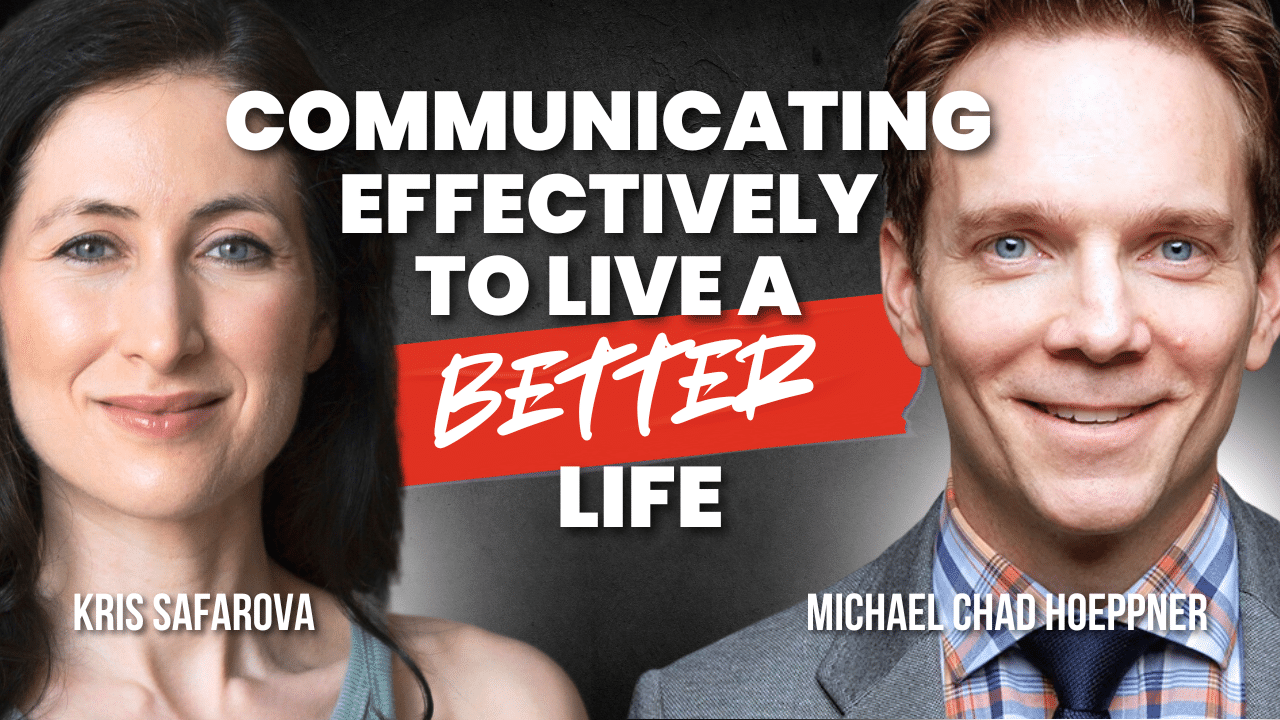
Michael Chad Hoeppner, CEO of GK Training and adjunct professor at Columbia Business School, brings a deeply practical lens to one of the most undervalued professional skills: spoken communication. With roots in professional acting and over two decades coaching executives, Hoeppner challenges conventional wisdom, arguing that most communication advice is either vague (“slow down”) or abstract (“just be confident”), and fails to address the real issue: communication is physical.
In this episode, he shares specific, kinesthetic methods that help clients speak more clearly under pressure. From using Lego blocks to build well-structured thoughts, to timing answers with a wiffle ball in political debate prep, Hoeppner demonstrates that improving communication is not about talent, it’s about training behavior.
“Speaking is movement. We put air into action—that’s what talking is. And you can learn to do it a lot, lot better.”
Key Insights:
- Delivery is Undervalued, but Often Drives Perception
“Most coaching hyper-focuses on content and completely neglects delivery,” Hoeppner explains. Yet “delivery really, really determines much of the impression your audience makes about you.” - Rambling, Fillers, and Anxiety Are Physical, Not Mental, Problems
He critiques typical advice like “don’t say um” as “thought suppression” and instead teaches clients to physically anchor themselves. One client stopped chronic blushing mid-session by simply learning to ground her feet. - Tools Like Lego Blocks Make Structure Tangible
“Pick up a Lego block, say your first idea, and put it down in silence. That pause gives your brain time to think,” Hoeppner shares. These physical anchors help clients avoid word salad and clarify complex thinking. - Founders with Growth Mindsets Improve Fast
“They’re not held back by ego. They care deeply, they want to improve now, and that means they practice,” he says. In contrast, those with fixed mindsets (“I’m just a bad speaker”) often plateau. - AI Will Make Delivery the Strategic Differentiator
As language models democratize content, he argues, “delivery, how you say it, will matter more than ever.”
The episode closes with a powerful call to reframe communication not as a soft skill, but a trainable, high-leverage behavior, one that can transform not just boardrooms and keynotes, but daily leadership and presence.
Get Michael’s new book here:
Don’t Say Um: How to Communicate Effectively to Live a Better Life
Here are some free gifts for you:
Overall Approach Used in Well-Managed Strategy Studies
Enjoying this episode?
Get access to sample advanced training episodes
Episode Transcript:
Kris Safarova 01:26
Welcome to the Strategy Skills podcast. I’m your host, Kris Safarova, and our podcast sponsor today is StrategyTraining.com. If you want to strengthen your strategy skills, you can get the Overall Approach Used in Well-Managed Strategy Studies. It’s a free download, and you can get it at firmsconsulting.com/overallapproach. You can also get McKinsey and BCG-winning resume, which is a resume that got offers from both of those firms. And you can get it at firmsconsulting.com/resumePDF. And lastly, you can get a copy of one of our books. It’s called Nine Leaders in Action. And you can get it at firmsconsulting.com/gift. And today, we have with us Michael Chad Hoeppner, who is an adjunct professor at Columbia Business School and the CEO of GK Training, a firm dedicated to giving individuals, companies, organizations, the communication skills necessary to reach their highest goals in work and life. And his clients include the Boston Consulting Group, Columbia University Business School, NYU Law School and Macy’s. Michael, welcome.
Michael Chad Hoeppner 02:38
Thank you so much. It’s a pleasure to be here.
Kris Safarova 02:41
So communication skills. Out of everything you could have been doing with your life, why you decided to focus on that?
Michael Chad Hoeppner 02:48
It’s a great question. Because, you know, life is a big topic. Could do many, many things. I suppose there’s a few answers to the question. One is that it is a completely overlooked factor of our life. I don’t mean that we don’t think about our communication. We do, but we rarely think about how much of our life is spent communicating. We say upwards of 10,000 words some days. And imagine if you could do that activity, saying words just a little bit better 10,000 times a day, what an impact it could have on your life. So that’s one answer. The other answer is that people tend to get a lot of terrible coaching when it comes to communication, and so they’re really mired in some either negative patterns or even dire patterns that are undermining their sense of self even. And if you can help people get even a little bit better, it’s a tremendously gratifying thing. And essentially, I’m helping people, which is a you know, there are worse ways to spend your life than trying to help people.
Kris Safarova 03:56
100%. And I agree with you that communication skills, the ability to change the way you speak, to enhance it. It is life-changing. It can change everything. And people don’t realize how much you can improve the way you speak. People think that this is how I speak, but they don’t realize that a lot of it they picked up from their parents, from people around them when they were growing up. A lot of bad habits were developed throughout lifetime. I used to sing. I used to be a concert pianist and singer at the beginning of my career, and a lot of what I learned as a singer can be used for speakers to change the way they speak. And many people don’t realize that.
Michael Chad Hoeppner 04:35
I could not agree more, and I would go even further, that not only can the same tool set that you learned as a singer be used for speaking, if you’ve ever trained as a singer and you’re not using that when it comes to speaking, you’re leaving a tremendous tool set on the side. It’s essentially the same activity you’re turning. Air into sound and then amplifying and altering that sound to turn it into words that can be understood. And as a singer, you understand this that you are a musical instrument as a singer, of course, but we’re also musical instruments as speakers. We’re a little bit like a woodwind instrument in that we have a read, you know, our vocal cords, which you know well from your training as a singer, and those vocal cords flutter when we allow air to move past them, and that little sound vibration that happens in our vocal cords then gets amplified throughout our entire body, and we alter it with this miraculous act of enunciation we do with our mouths. So it’s a physical activity, just as singing is a physical activity. And yes, you can get much, much better at this. And communicators are not just naturally born brilliant and then everyone else is terrible. Like singing, it’s a skill you can practice and get better and better at so good for you, for embracing both the journey to get better as a singer, but also recognizing how that skill can transfer to speaking.
Kris Safarova 06:10
100% agree with you and I have been teaching clients what I know, and usually when you work in a group, and you can change the way someone speaks very quickly. People cannot believe it. It is the same person. All of a sudden, they sound like a Indian movie star, or they have this deep, amazing voice they didn’t realize they have.
Michael Chad Hoeppner 06:32
Yes, I there’s nothing more to add for me than that, which is, I’m sure that they appreciate that transformation, because it’s powerful.
Kris Safarova 06:40
Michael, so tell us about the defining moment you realized that you wanted specifically to focus on teaching people this skill.
Michael Chad Hoeppner 06:50
Sure, I trained as a professional actor, kind of like you came from an artistic background. You from singing, me from acting, and I worked in Broadway, in film and TV, and I got my MFA at NYU, and I enjoyed that career very much. But what I discovered was that even more interesting than I found portraying another character, I was even more interested in watching how people learned to do that thing, and it was really quite captivating. And then, as I got more interested in helping people learn how to use their voices and their bodies to be compelling on a stage, what happened was I began to build a whole suite of kinesthetic tools to help non actors and non performers learn how to do the fundamental building blocks of speaking, tolerate silence, enunciate their words, structure their thoughts, and I began to use Lego blocks and wiffle balls and masking tape and balance beams and these sorts of tools to create a whole bunch of kinesthetic activities that people could do to get much, much better at speaking. All this distilled into a six word story that I like to keep in mind, five days a week, not seven, but five days a week when I’m working and that is focusing on others, I found myself so this six word story idea is, it’s an apocryphal thing that goes back to Ernest Hemingway, supposedly, apparently, It may not be true. But anyway, the theory is, is that he challenged a drinking buddy to see who could write the best short story, and he wrote a six word story. Hemingway did. It’s a terrible story, by the way. Do not Google it. Okay? Tremendously depressing story, but the idea of an incredibly brief story can be powerful for folks. And so, in fact, if you’re listening and you want to try this exercise, challenge yourself to write a six word story about your life and mine was that very thing, focusing on others. I found myself. And as I became more and more interested in teaching people and trying to help them, my entire life made more sense, in fact, and I began to enjoy my minute to minute, hour to hour, day to day, existence more, and I really felt as though this is how I want to spend my professional life.
Kris Safarova 09:09
So tell us about Lego blocks.
Michael Chad Hoeppner 09:13
Sure, Lego blocks are a kinesthetic tool that is profoundly helpful to teach people how to tolerate silence, how to use thinking time, how to structure their ideas. And I developed this exercise using Lego blocks because it takes some time to click them in place. But the exercise that I will teach to you now and to the listeners right now, you can really use a whole bunch of different props. I’ve just found that Legos are by far the most useful. They’re the most effective. So the way this works is the following, if you know about yourself that at times you tend to ramble too much, you go on too long, you get into the weeds. You say. A um and uh at the end of every single sentence, as opposed to a bunch of reductive feedback, like, try to keep it, you know, more high level, or try to keep it at a 30,000 foot view or or just tighten it up. None of which works, all of which is way too general. Instead, pick up a stack of Lego blocks and then do the following. Share your ideas, share your content, but share it one idea at a time, pick up a Lego block in silence, say your first idea. You could think of this like the first sentence, and then at the end of that first idea, put the Lego block down in silence. You have to be silent as you put it down, still remaining silent, pick up the next Lego block, share the next idea, or the next sentence, if you think of it that way, at the end of that idea, put the Lego block down in silence again and stack it on the previous one. So you’re building a bit of a tower of communication. Remain silent again, pick up a third Lego block, share the third idea at the end of that idea. Again, in silence. Click that Lego block in place with the previous and keep going. Thought by thought by thought, as you use those blocks to see how well structured and how concise can I make my comments. And when people do this, what happens is they unlock what I call the virtuous cycle of good communication, because all of a sudden, in those pauses, they can do a miracle, which is they can actually think about what they want to say next, and so they begin to use their brain for what it’s intended to do, which is powerful decision making, as opposed to just letting everything pour out of their mouths at once.
Kris Safarova 11:54
Why do you think people don’t place enough importance when it comes to communication skills, it seems that people don’t realize how important it is to invest in building that skill. Not everyone, but many people don’t realize. Many leaders are not realizing this.
Michael Chad Hoeppner 12:12
My first answer to you is, I don’t know, and I’ll give you a couple of data points. I now work with some of these institutions, so I know that some places are trying to adjust this a little bit, but many of the law schools and even the academic institutions that are going to graduate and give to the world the next Generation of professors, don’t offer classes on speaking skills. These folks are going to graduate from PhD programs, and they’re going to be hired or not, in large part based on a couple high stakes communication situations like a job talk or dissertation defense. And then they’re going to make a living and also make a mark on the world with their academic work, by teaching in a classroom, standing up in front of people talking and yet, in all of that academic training, very few programs actually give their students teaching training or speaking training. More to your point, I don’t know why that is. I find it completely baffling. So that’s my first part of the answer. The second part is, it goes back to the first things we talked about is, I think a lot of people think these skills are innate. They’re a fixed quantity you either have or you don’t. So what is the point in training? Instead, you should just try to feel more confident, and you know, embrace, I don’t know, embrace your power, or something like that, these very vague things that people really can’t do. And so I think they discount how learnable these things are, and if you learn them, what a tremendous difference they can make. And
Kris Safarova 13:57
I think another point, building on what you have said is also as a person who was a corporate world and did an MBA and so on, and you yourself as well, went through all this education and so on. You also probably noticed that even when we do have training on how to improve your communication skills, it does not cover a lot of the powerful things we are talking about today.
Michael Chad Hoeppner 14:18
Yes, you’re 100% right on this most of the time, and it’s true for those places and those venues you’re talking about, those institutions, but it’s true just broadly about how we teach communication, is that we hyper focus on content and we completely neglect delivery. And so you know, content and delivery probably sounds self evident to your listeners. Content is what you say, delivery is how you say it. Content is the vocabulary the words. Delivery is everything besides the words, enunciation, vocal variety, breath, gestures, posture, stance, i. Contact everything else. And when people tend to get coaching on their communication, it always focuses on the content. Speak in threes, share personal stories. Give a giant thesis to the whole thing you’re saying, or, you know, distill things to one big idea. Use an attention getter, these sorts of things. And that’s all good advice, by the way. I’m not dismissing it, but it tends to be the only focus. And in fact, delivery is tremendously, tremendously neglected. And if you focus on it just a little bit, it can be so profound in your life for two reasons. One, it matters a lot. Delivery really, really determines much of the impression that your audience makes about you. And number two, you probably haven’t focused on it that much. So imagine if you have an entire area of uncharted territory that you’ve not looked at, how much better could you improve just by a little bit of attention in that area.
Kris Safarova 16:03
Very true with some of the clients I worked with, when they discover some of them have unbelievable voice that I never heard from them before, working with them on other programs before, specifically focusing on communication skills, and then they feel a little bit bad that they did not uncover that unbelievable voice, because it can be so incredibly helpful in personal life and professional life. Can you tell us some stories on working with people and specifically focusing on delivery and the process of transformation that people go through?
Michael Chad Hoeppner 16:34
Sure, I’ll share one that I mentioned in my book, because it’s it was so stark I and I write this in the book that I one time changed this person’s life in four hours. And I don’t mean that to brag about me. I’ve given the same kind of coaching and training to many people around the world, and sometimes they take it and run with it and it changes their life, and other times they don’t practice it at all. And then there’s a cap to how much better they can get. But this person took this and ran with it, and she was stuck in a vicious cycle in which she was so afraid to be in front of a group that she would just turn bright red, flush completely, and lose all of her train of thought and instantly go into massive fight or flight. So she came to me and she said, I need to stop blushing. I said, Well, maybe let’s take a look. And so I put her through some exercises, and I had her give some speeches, stand up and do some public speaking in front of me. And yes, sure enough, within 10 seconds, she turned bright red and was sweating bullets, and every bit of content and anything she wanted to say flew right out of her mind. It was gone. And she said, See, see, see, I have to stop blushing. I have to stop blushing. And I said, Well, instead of that, what about if we just focus on anchoring your feet to the floor, and she looks at me, why? Why should I do that? So I showed her some video that I had quickly taken, and I showed her that, in fact, she was shifting her feet constantly, not even every second I’m talking like every half second, back and forth, back and forth, back and forth, back and forth, endlessly, shifting her feet in a pattern that was completely different about how she spoke in real life, that she was just talking to a friend in the hallway, or something like that. So I literally got down on the floor with her, and I held her feet in place on the floor, and I gave her feet that tactile feedback that they needed to feel what being anchored to the floor felt like. And then I had her talk, and then, as though it were magic, she stopped blushing. Now I knew that would happen, or at least I had a very strong hunch it would happen, because what she was trapped in, really was this vicious cycle where one bad habit was compounding and taking all of her communication in a bad direction. And as soon as she began to speak more like how she spoke in real life, grounded feet, allowing breath to drop in, and allowing her diaphragm to drop down, her lungs to fill with air, that physical bearing all of a sudden calmed her down, and she didn’t blush. And as soon as she didn’t blush, she had this realization that she was not blushing, she felt a huge boost of excitement and encouragement, and all of a sudden she could think of a smart idea. And so she said a smart idea, and she heard herself say out loud, a smart idea, and not crumble and break down. And that gave her incentive to think of a next smart idea and to keep her feet grounded on the floor and to continue to breathe. And within minutes, she had this realization, I have been trying to do the wrong thing for decades, and I just learned how to do the right thing, and I bet you I can practice. Practice this right thing and change a lifelong problem, a bugaboo, a pain point, I can change that almost instantly, as long as I keep doing some hard work. And that’s what she did, and it changed the course of her career.
Kris Safarova 20:16
And she was very lucky to have you there, because not every teacher would get on the floor and keep her feet to the ground until she stopped doing it. How long did it took for her to break that habit?
Michael Chad Hoeppner 20:28
She broke she had the initial impulse, the learning moment, almost instantly, and we were doing a half day session. That epiphany happened about 30 minutes into that half day session. So we then practiced this for about three and a half hours, and she left the session in the category of what I call consciously skilled meaning when she’s aware of it, when she’s thinking about it, she can do better, but then her job was to build that into muscle memory so she didn’t even have to think about it anymore. And in that category, I would put listeners attention on the the frameworks and the timelines that you already know about. You know, call it three months or so. To build a new habit. She practiced doing that in some way every day for call it three months or so. And once she done that, that really became a habit that sticks around with her to this day. Now I’m not trying to say that as some sort of, I don’t know, shortcut or something, because on the one hand, three months might sound like a long time. Oh my god, three months. But on the flip side, you might have spent three decades trying to do something that is not effective, like just slow down, or don’t talk too fast, you’ve probably thought of those things countless times, and have they worked? No, probably not. So three months is not that long a time. On the other hand, once you’ve accomplished that, within three months, you probably have to come back to it every once in a while, because remember, just like singing, you’re building physical habits, and you have to keep those habits strong. But the short answer is, you really can get significantly better, very quickly, and then build that into habit in a matter of a few months, not years and decades.
Kris Safarova 22:13
And you will see the progress throughout this three months. It’s not like you’re going to be a very bad communicator for three months, and only then going to see the progress.
Michael Chad Hoeppner 22:23
You’ll see the progress in hours, not even months. The months is simply to build that into muscle memory so you don’t even have to keep it front of mind anymore. But no, you can see progress almost instantly. And a big reason is because people are always practicing the wrong stuff. I mean, the reason I called my book don’t say um, is it’s supposed to bring a smile to people’s faces of recognition as they realize, Oh, that’s right, there’s all this garbage feedback I get all the time that is essentially thought suppression. I mean, I mentioned this in the previous answer a little bit, but most fast talkers get terrible feedback. First they get thought suppression, which is, don’t talk too fast. Okay. Well, now all you’re thinking about is a negative and the thing that you’re terrible at, which is talking too fast. So you’re only going to fix it on it more. And then the next thing they get is some totally general piece of feedback. Just slow down. Okay. Well, if it were that easy, I would have done that already. And then the third, third thing they get is a mental reminder for what is a physical activity. So the mental reminder might be remember to breathe. Okay, but breathing is a physical thing. It’s not a to do list item you have to remember to get to you would never try to remember how to do some aspect of your golf swing or a tennis stroke. You would build that muscle memory. And so lots of the coaching is very poor, and therefore people don’t get better. And I don’t mean to put down the field of coaching, I really don’t what I’m trying to offer here is actually some comfort and some relief and some optimism people who have not improved in a given communication area, very often it’s not that they can’t improve, it’s that they may have been trying to improve in the wrong way.
Kris Safarova 24:17
Yes, they just don’t know the technique to learn to improve. What did you notice about your students who improve the most? What do they do differently?
Michael Chad Hoeppner 24:27
The people who improve the most are often the founders that I work with. I work with lots and lots of startup founders, usually in the climate tech space or trying to make improvements and and dramatic breakthroughs in the fields of sustainability and how we can have a more sustainable world and deal with some of our challenges ecologically. Anyway, these people tend to improve at a lightning fast rate, and here’s why, because they care deeply about what they’re doing, and they care deeply about getting. Better right away, and they have no ego and a huge growth mindset, so they’re willing to entertain the idea, I can get better. I can get better with some hard work, and I might even be able to get better quickly. And of course, they’re trying to do that with their companies and the ventures that they’re building, and they will often think of their communication is just one aspect of that. So they’ll often get better. In 60 minutes of a coaching session, they’ll learn a skill, apply it, build a little bit of muscle memory with it, and then they’re off and running. Now the flip side, you didn’t ask this question, but I’m going to answer the question anyway. The flip side is, who does not get better? And the people who tend to not get better are the folks who come in with a tremendously fixed mindset, whether they recognize it or not. And that fixed mindset is usually something like, I’m a terrible communicator, or, you know, there are these natural, just aura orators and rhetoricians and speakers, and I can’t be one of those folks. So that’s the first thing. The second is, because of that belief, they’re actually not willing to put in the hard work, and I don’t mean lengthy work. It could be as little as five to 15 minutes a day, but they’re not willing to put in that work because of that belief. And those folks, if you coach them for years, they will get better. They really will, because you’re still spending some hours of time each month and in each quarter and each year focused on these skills, but they do not get better as fast as those founders who are willing to jump right in with a huge growth mindset and potentially transform their communication very quickly.
Kris Safarova 26:43
Michael, and what do you ask your clients to do 5 to 15 minutes a day? So I know for my clients, I have specific exercises I give them to do. Do you have specific things that you ask clients today as well?
Michael Chad Hoeppner 26:57
Sure. So the Lego exercise I mentioned, that kinesthetic tool that’s very effective for things like avoiding rambling, structuring your thoughts more logically, removing filler language, slowing rate of speech, embracing silence and pausing that sort of work. So if a client really needs those skills, that’s the exercise. I have them practice, sometimes in perceptible ways, actually using Lego blocks, and sometimes in imperceptible ways as an example, imperceptibly while being on a remote call, on a zoom or a teams meeting or something like that, and they just place their hand down on a table or a desk. And I actually coach a let me see how I should phrase this, a administrator at a fancy schmancy University. We’ll say it that way. Who does this actual activity when leading meetings, pick up their hand, speak a little bit, allow that hand to remind and they’re going to share one idea, not 15 one. And at the end of that idea, they gently place their hand down on the table, and they pick it back up to say the next idea. Now they’ve been doing this long enough that they don’t even have to do that activity anymore, but that’s a way to practice in an imperceptible manner. But there’s a whole bunch of other kinesthetic tools that I’ve developed, including ones for filler, language, for stance, freedom and ease, with gestures, vocal, variety, all of these things. So it depends on what the person needs. And then there is a kinesthetic tool to address that that they can then practice each day, both perceptibly and imperceptibly.
Kris Safarova 28:53
Very powerful as you were going through your own journey of developing strong communication skills and technique to teach your clients. Do you remember specific aha moments that really were the most exciting for you in terms of, oh, wow, this is so powerful.
Michael Chad Hoeppner 29:09
Yeah, there’s a lot. I’ve been at this leading my own company 15 years. I was working in the industry five years before that, so I’ve been at this a generation. So there’s a lot that come to mind. I suppose that here’s one I was working with a guy and very senior executive, essentially leading an entire firm, a firm that many listeners would know, and this person believed that they could not memorize. They knew that in a small group meeting, they could be incredibly powerful. They were focused on other people in the room. They were focused on the job at hand, and they were incredible, really. But when shifting to giving a speech, doing public speaking, standing in front of an audience with a podium and. Microphone and all that kind of thing. They absolutely were shaking with fear. And a big part of that was they had this idea that they could not memorize anything, so therefore they could not use a script that was intended to be more or less word for word, and they would have to read the entire thing. And they did not like how they read off of a page. So this entire formula made them very, very nervous. And this person, I asked the person to stand up and deliver a speech for me, and this person used a speech that they had been working on very hard, and they got about six words into it, and they crumbled. Couldn’t remember what came next, even though they had the page right in front of them, had to look down. Got so mad at themselves. I’m so stupid. I can’t remember why can I not remember anything? I can’t memorize anything. I’m such an idiot. I mean seriously, this kind of very, very destructive, negative self talk had them do it again, again, the exact same pattern, even down to forgetting the same word. I had them do it a third time, same exact pattern. Now that didn’t surprise me. I had a good guess as to what was going to happen. Then I said, look, let’s just move past that word. Let’s start on the seventh word of that first sentence, see where we get. And all of a sudden, they spoke about three sentences without having to look down. And so what this person began to realize, with my help, is that they had actually memorized the mistake. It’s not that they could not memorize stuff. They actually memorized it too well. They physically memorized forgetting after that sixth word, beating themselves up relentlessly and screaming at themselves with the same exact narrative they always did, which is, I’m an idiot. I can’t memorize anything. My brain is useless. And as soon as we got around that pattern, they realized that’s not true at all. And it was almost like a spool of thread unraveling when they began to realize, God, what I thought was a problem is not a problem at all. And then they were able to put their attention on the right thing and get better virtually instantly. When this happens, people feel a tremendous sense of gratitude, and they feel grateful to me, but I’m doing a good job. I like to think that I’m good at my job, but it’s only a small part of it. What they’re really feeling is this epiphany that they’re better than they thought, and that if they give themselves just a little chance for success, their brain can do what it needs to do, and even their body and their breath can do what it needs to do, and it can feel like liberation.
Kris Safarova 32:53
And for someone who shakes with fear before going on stage, but they want to go on stage, or they feel they have to go on stage. Do you have any advice on how in that moment when they feel the heart is pounding and they cannot breathe and they start shaking, how can they calm themselves down and get themselves in a good place to be able to deliver that speech?
Michael Chad Hoeppner 33:18
Honestly? We could do an entire podcast just on that one question. So the simple thing to do, I have a chapter in the book called navigating nerves, and I give that chapter away to people. Anyone who wants it, I’m going to keep it free. So honestly, just go to don’t say um.com that’s just the URL for my book. Don’t say um.com and you can have the Navigating nerves chapter for free, and it will be free there for anyone who wants it anytime. But hilariously, by the way, folks, that chapter does not come until I think either chapter 16 or 17 in the book. Notice it’s not chapter one or two or three, because even in where I put it in the book, I want to give this gentle reminder to people that your nerves are not the most important thing. Stop giving them this primacy of oh my god, my nerves are the most No, they’re not the most important thing is you and the message you’re trying to deliver to your audience. So anyway, the chapter has a bunch of aspects, physical and vocal. Warm ups to release physical tension, mindfulness exercises, an idea about distraction and distance. But it’s a meaty question, and the chapter goes into it at length.
Kris Safarova 34:35
It is a very important thing for some people to deal with, and what is interesting to me as well, because I have that sometimes happening to me before going on stage, when that happens to me now, because I have done all kinds of performing, as a pianist, as a singer, as a speaker, in my mind, I’m not stressed at all, but sometimes your body have life of its own, independent somehow of your mind, and then you have to use certain tricks. To get yourself back to calmness so you can do your job.
Michael Chad Hoeppner 35:04
Yeah, and the distinction you’re drawing between your body and what, what your body is doing, what your brain is thinking, is a crucial one, because often, one of the things that feels the most liberating to people is that they can kind of let their brains do whatever their brain is going to do. I mean, anyone who’s ever tried to do meditation knows how squirrely our brains are. They just go all over the place. Much more trustworthy is to put your focus on your body. And so if you can release some of that that nervous tension and that anxiety physically and prepare your body to communicate, then you can put the brain in the back seat and just focus on the physical things that you can do that allow you to perform. And eventually, what happens is that people get a great deal of confidence, but not because they’re trying to feel more confident. They gain confidence from this demonstrated track record of being able to perform when they want to. And anyway, so that’s some of the terrain that I visit in the chapter, but it’s such an important topic, and it deserves to be unpacked in a methodical way, so that people feel like they have actual things they can do, as opposed to the kind of pablum you hear about. You know, just think of your audience in their underwear, or this kind of stuff that’s quite dismissive and ultimately, I don’t think very helpful at all.
Kris Safarova 36:25
Especially in a situation where, in your mind, you’re completely calm about it, you’re not worried at all. So what is going on with your body is very interesting. Interesting to even study that further. How is that happening in working on your own communication skills? What was the most challenging thing you were focusing on to fix for yourself, if anything.
Michael Chad Hoeppner 36:46
I’m pausing for a long time because the answer is going to sound a little bit arrogant, and I really don’t mean it arrogantly, but communication has always been relatively easy for me in terms of choosing the words I want to say and then saying those words with some level of commitment. But so you know what you might put in the typical categories of I don’t know, filler language or vocal variety, or enunciation or even thinking of something smart to say, I don’t relate to those challenges quite so much as some other people might. But what I do relate to a lot is this kind of dilemma we were just talking about in the previous answer, the previous discussion, which is, what takes the lead your feelings or your actions. And the feelings can be, you know, any of the negative feelings we all fall prey to every day, whether it’s anxiety or nerves or imposter syndrome or, you know, feeling of unworthiness, anger, hostility, any of those emotions, and then getting stuck in a position in which those emotions are so problematic that they change all the stuff that’s coming out of your mouth. And I don’t mean you say inappropriate or mean things, I mean that it stifles what you can do as a communicator, and I do relate to that very much. So the revelation for me and my career has really been discovering how I can put my focus and my attention on behaviors. And not only do those behaviors allow me to communicate more in the way in which I want to the miracle is the more that you focus on those behaviors, eventually, just like an actor working with an outside in kind of mentality, eventually, those behaviors can actually begin to affect how you feel. So some of the feelings of anxiety or anger or hostility or or even boredom fade as you just focus on the behaviors, and you just do your job as a communicator. So I know that’s a somewhat lengthy answer to it, but that really is the single biggest aha moment that I had as a communicator.
Kris Safarova 39:15
For someone who is struggling with breathing. So let’s say they already understand diaphragmatic breathing, and they breathe diaphragmatically, and the stomach comes out when they breathe in and goes back in as they speak, but they still feel that they’re not getting enough air as they speak, so they’re kind of struggling a little bit. Do you have any advice for them for a situation like that?
Michael Chad Hoeppner 39:37
Yeah, usually what you want to do is find ways to physically relax. And I don’t mean like yoga, although yoga is powerful lying in like shavasana, the flat yoga position, rest position, yes, that’s very powerful, but I mean actually active, dynamic relaxation. So usually that is something that people like to do physically. So if you enjoy dancing, if. You enjoy some sort of sports or athletics, anything you can do to physically free up all that holding and tension that you’re likely doing is really powerful, and here’s why, your body knows how to breathe. It’s the first thing you did when you came into the world, a huge breath in and let out a giant scream that you know you were not too happy to to be outside the warmth of the womb. You know how to breathe. Your body knows how to breathe. But we accrue to your point earlier, it just through life, through our families, our history, all sorts of things, we accrue a bunch of bad habits that sometimes really corrupt how we breathe, so you have to reset that a little bit. And often people can reset it really quickly, just by finding some sort of dynamic relaxation in activity. I will also have people practice a fun activity that has to do with singing, and I’m sure you probably do this as well with folks, is have them sing a little bit to connect to that breath. But very often, if they’re singing some fun song, something that they have a relationship to, what they realize is they can breathe much more than they actually think, and much more fluidly than they actually think. This also goes not to get too technical, but sometimes, when they are studying their breath that much, they actually begin to go to the other side, meaning they almost hyperventilate with the amount of air they’re taking into their bodies, and trying to use all that air and expel it. It’s sort of a flip side of the coin, but it ultimately comes down to the same thing, finding physical ease, finding physical relaxation, dynamic relaxation, so the breath can exit and enter the body, as it’s designed to do.
Kris Safarova 41:48
Is there something about communication skills? Learning communication skills, the technique where you’re still trying to study something and figure something out?
Michael Chad Hoeppner 41:58
Yeah, I do. I am interested in neuroscience, and I’ll give you an example of this. I’m becoming more and more interested on this kinesthetic relationship between what our body does and what thoughts we think. And I’m by no means the first explorer on that. I mean, I would literally be studying at the behind others who have been pioneering this for a long time, but from a scientific kind of perspective, what I have seen over now, 20 years of coaching folks in very high stakes situations, so presidential candidates and fortune, 500 CEOs and folks like that, is that very often, if you can unlock some kinesthetic relationship for them between what their body is doing and what their brain is thinking, all of a sudden, all their communication capability just comes pouring out. And I don’t have the technological ability in the training sessions I’m doing at some someone’s corporate headquarters to scan what has happening on the inside of their brain, but I’m very fascinated and curious with what that is. So, you know, I may begin working with some neuroscientists or something like that, to try to examine what’s going on. The second part is, I’m also fascinated by what AI is going to do to how we communicate. I have a tiny two page chapter in the book on AI. Hilariously, by the way, people were saying to me in the industry, like, I don’t think you need a chapter on AI. I don’t think it’s going to be that big of a deal, which is hilarious. Anyway, the chapter is about two pages long, because all I’m sharing is one big idea, which is, I am of the opinion that large language models and AI may make delivery even more important, because it may be very soon that we all have a teleprompter of sorts in a contact lens inside of our eye, or some sort of, you know, Communication chip in our ear, or something that tells us at Any moment, all the information we might need to have. So if content, and in fact, if expert content, is ubiquitous and free for everybody all the time. Well, not free. I mean, depends on, you know, how open AI and others are charging us for it, but you get the idea accessible. I’ll say it that way, if that expert content is accessible to anyone, anywhere, anytime, guess what makes your content stand out? How you deliver it? And because the book is all about delivery, I am of the opinion that, well, I’ll say it the other way around. The reason I wrote the book all about delivery is because I’m of the opinion this may matter more and more and more even as AI transforms our world.
Kris Safarova 44:46
Especially since most people don’t realize they can change the way we believe the content, yes, big secret somehow, yes.
Michael Chad Hoeppner 44:56
And it’s so obviously apparent. Right? Like, do you say a big secret? It should not be a secret. It should be as straightforward as, can you get better at riding a bike, yeah. Can you get better at swinging a golf club? Yes? Can you get better at, you know, any physical knitting, any physical activity? Yeah, speaking is moving. We put air into action. That’s what talking is, and you can learn to do it a lot, lot better.
Kris Safarova 45:28
So you had incredibly interesting coaching sessions. What were your most memorable moments of coaching presidential candidates?
Michael Chad Hoeppner 45:37
I used a wiffle ball in an exercise for debate prep. And what was the most interesting thing was watching this person’s really quite dazzling mind work once they were set up for success just a little bit, and we would do debate prep. We would throw questions to this person, they would answer the questions. And what came out was one of two things, either very generic messaging that sounded like talking points, or a bunch of unstructured, rambling, incoherent, although impressive, but still incoherent word salad. Well, why was that? The debate prep, of course, was simulating all the elements of anxiety that a high stakes debate creates. No time to think gotcha questions, opponents trying to attack you from every side. And so this wiffle ball exercise that I did with a client or with a candidate, I should say simply involved. I would frame a question, you know, a mock debate question, but the rules of the game were that candidate could not start speaking the answer until I threw them a ball and they caught the ball. Now, once they caught the ball, then they could share their answer. But here’s the trick I got to be in charge of when I threw the ball. So sometimes I would ask the question, I would wait five seconds before I threw the ball, and other times I would wait one second or anywhere in between. But even one second of thinking time is actually quite a lot. So what began to happen was this candidate built the muscle memory of realizing they didn’t need to speak until they were ready. And this candidate is a very, very intelligent person, and their brain, with just a little bit of fuel time and oxygen could all of a sudden come up with much smarter things to say. And that shift from oh my gosh, I have to answer something to No, I get to be in command of how I answer this. And even when I answer it, set them up to say dazzling, provocative, unexpected, innovative things, as opposed to either pablum and messaging or word salad.
Kris Safarova 48:07
I’m going to wrap up with two of my favorite questions. Number one is, over your entire lifetime, can you share with us two, three aha moments, realizations that you feel comfortable sharing that really change the way you look at life, or the way you look at the business.
Michael Chad Hoeppner 48:23
Can I share one to start, and then I’ll see if I get to two or three. Okay, all right, so I have two kids. When my first kid came into the world, I, like many expectant parents, had tremendous nerves. What this? What is this going to be like? And in the delivery room, I think different than what the idea might be that many people have. I was petrified, and there’s this screaming, red faced baby, and I’m thinking to myself, What have I done? Who am I? Who is this person? I don’t have a clue what’s going to happen next. And then I went to the kind of recovery room where, you know, my wife was still in the delivery room, and they give the baby to the other caretaker often, and I’m pushing the baby in this little kind of stroller device, because they don’t want you to drop the baby if you faint. But I’m pushing it. I get to this recovery room, and my sister is there. She says, you know, I’m saying, What do I do? She’s pick up your baby. So I pick up my baby, and I look in my baby’s eyes, and I’m not exaggerating one little bit. I swear it felt as though my kid shot grappling hooks through their eyeballs, deep into my eyeballs, through my brain, and as though the grappling hooks like locked onto the back of my head, and I was forever bonded and connected to this little being. And it happened like that. Now I know not every parent maybe relates to that, and in fact, from my. My second kid, it was a very different journey when they first came into the world, but that moment, honestly may have been the most powerful moment of my entire life. And once that happened, a few things dawned on me over the next 10 days. One of them was that part of our mission as humans is to communicate. It is one of our superpowers. We have access to this utterly Byzantine world of words and language because our superpower is to be able to team up and to create groups and societies so that we can accomplish more, you know, without horns and teeth and claws and other species by teaming up. So in a way, this aspect of communication, it’s not something we learn to do. It’s almost baked into us. It’s almost in our DNA. And in a very visceral way, my little kid communicated to me that day in this one very specific behavior. So that was one insight I had from it. But then 10 days later, here’s the other hilarious insight, I had to go to work briefly. 10 days later, I had very short paternity leave, and well, paternity leave for my own company. But anyway, I had to go back to work. And I remember on that 10th day having this tremendous feeling of disappointment, because I realized, for some dumb reason that morning, I was grouchy about something, or I was annoyed, and for the first time in 10 days, that blissful period I had been in, it broke, and for a moment I was annoyed and I was grouchy, and I realized I’m not eternally changed having this incredible, miraculous being has not totally transformed who I am to some sort of enlightened being who will never have a negative thought again, and in a way that was very enlightening about communication too, which is that we are Totally fallible. We have dumb, ungenerous, you know, selfish mean unhelpful thoughts every day, they fly in and out of our heads. And our job is ultimately the same, which is just keep putting one foot in front of the other and trying to focus on what we can do to help other people, to help the world be a better place, and to help our fellow communicator and the negative emotions are going to come and go. The best you can do is stay focused on trying to execute those behaviors.
Kris Safarova 52:26
And keep going. Thank you so much for sharing this. I’ll leave it at that one.
Michael Chad Hoeppner 52:30
As opposed to two others, because I think that’s an it’s a big enough moment my life. I don’t think two or three other aha moments are necessary. We’ll leave it at that one.
Kris Safarova 52:38
It’s hard to match it with something else at the same level of meaning. So last very quick question, if you could instill one belief in all of our listeners hearts and minds, what would it be?
Michael Chad Hoeppner 52:53
I would say it is worth it to keep going and try to do good things. It is worth it. So what I mean by that with communication is the following, people get stymied. They get stuck. They get trapped with ineffective advice or coaching, like, don’t talk too fast, slow down, remember to breathe, and they think they’re stuck forever. But the way to get free of that is to buy focus on behavioral things that you can do, like the kinesthetic tools I was talking about earlier. But it could be other things as well, but behavioral things that you can do and keep doing and proceed. And from that, build a step by step pathway out of these negative habits that may be hurting you. So it is worth persevering. But on a bigger level, it is worth continuing to try to do good things. And communication is one place in which you can try to do tremendously good things for the world. The world can get dark, and the situation in life can look dire. But if we all continue trying to put one foot in front of the other and trying to do good things and stay focused on what we’re trying to accomplish, maybe we have a chance to marshal that communication superpower that humans have, that I talked about, maybe we have a chance to marshal that and improve our circumstances. And I think we have a bit of an obligation as a species to keep trying to do that.
Kris Safarova 54:27
Michael, thank you. Where can our listeners learn more about you? Buy your book? Anything you want to share?
Michael Chad Hoeppner 54:34
Sure. Yeah, so the book is quite simple. The URL is very straightforward: dontsayum.com, My company’s name is GK Training. That’s just g k training, and the URL is just gktraining.com, and then on LinkedIn is the best place to connect with me personally. That’s just Michael Chad Hoeppner at LinkedIn,
Kris Safarova 54:58
Our guest today again, have been Michael Chad Hoeppner, author of Don’t Say Um, and our podcast sponsor today is StrategyTraining.com. If you want to strengthen your strategy skills, you can get the Overall Approach Used in Well-Managed Strategy Studies. It’s a free download, and you can get it at firmsconsulting.com/overallapproach. You can also get McKinsey and BCG-winning resume, which is a resume that got offers from both of those firms, and you can get it at firmsconsulting.com/resumePDF. Thank you so much for tuning in, and I’m looking forward to connect with you all next time.
Leave a Reply