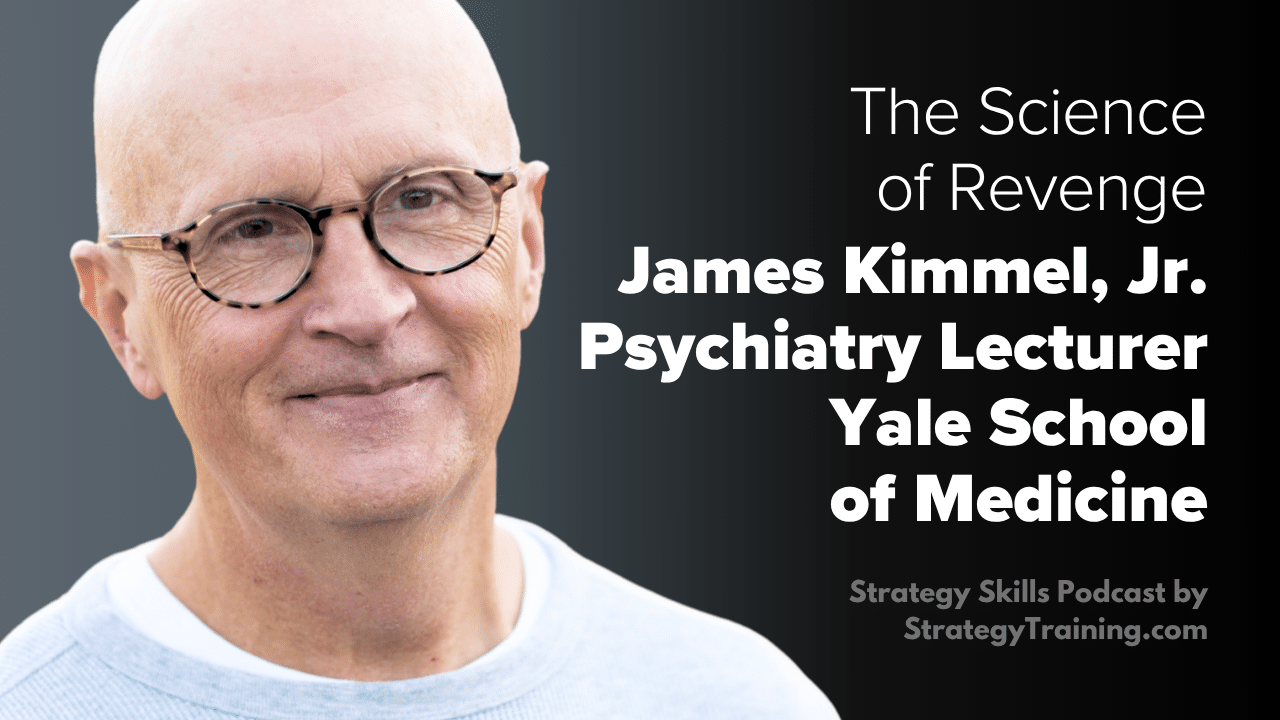
James Kimmel, Jr., lawyer, Yale psychiatry lecturer, and author of The Science of Revenge, joins us in the Strategy Skills podcast to explore the neuroscience and behavioral dynamics of revenge. Drawing on law, psychiatry, and over two decades of research, Kimmel offers a sobering view: revenge is not a form of justice, it’s a “pleasure-seeking behavior” that operates like an addiction, fueled by unresolved pain.
He opens the conversation with a deeply personal story: as a teenager, after years of bullying, he chased down his aggressors with a loaded revolver. In a pivotal moment, he recalls, “The cost of getting the revenge I wanted was far more than I was willing to pay.” That flash of insight redirected his life and seeded a lifelong investigation into how grievance, retribution, and healing operate in the human mind.
Key insights from the discussion include:
- Revenge Mimics Addiction in the Brain
Kimmel explains that “your brain on revenge looks like your brain on drugs.” The cycle begins when a grievance activates the brain’s pain network, followed by a surge of dopamine in the reward system. Over time, the craving for retaliation can become compulsive, forming habits akin to substance abuse. - Grievance Retention Impairs Judgment
Unchecked rumination can degrade executive function. “If that prefrontal cortex does not stop you,” Kimmel warns, “and you really crave it… it doesn’t matter how many laws there are.” This impaired self-control is what allows otherwise rational individuals to commit extreme acts of violence. - Social Exclusion Can Be a Form of Revenge
“If you’re ending a relationship not for present harm, but to punish someone for a past wrong, that’s retaliation,” he explains. Even subtle acts like ghosting or ostracism can activate the same pain circuitry in the brain as physical harm. - Forgiveness Interrupts the Revenge Cycle
Neuroscience shows that imagining forgiveness “shuts down the brain’s pain network, silences addiction circuits, and reactivates executive control.” Kimmel calls forgiveness a “human superpower… It doesn’t just cover up the pain like revenge does, it takes the pain away altogether.” - Revenge Can Be Prevented, Like a Heart Attack
Kimmel proposes a new public health framework: treat revenge attacks like cardiac events. “There are warning signs,” he says, grievance fixation, revenge fantasies, acquiring weapons, and they demand the same level of emergency attention. - Legal Systems Often Deliver Revenge, Not Justice
Kimmel reflects on his time as a litigator: “Lawyers get paid to sell revenge under the brand name ‘justice.’” He urges professionals to be aware of how sanctioned systems can enable and normalize compulsive retribution.
For leaders in high-stakes environments, the message is clear: understanding the mechanics of grievance and retaliation isn’t just psychological, it’s strategic. Kimmel’s work offers actionable frameworks to recognize revenge-seeking before it becomes destructive, and calls for a deeper integration of neuroscience into how we define justice, manage risk, and lead with compassion.
Get James’s new book here:
Here are some free gifts for you:
Overall Approach Used in Well-Managed Strategy Studies
Enjoying this episode?
Get access to sample advanced training episodes
Episode Transcript:
Kris Safarova 00:45
Welcome to the Strategy Skills podcast. I’m your host, Kris Safarova. And our podcast sponsor today is StrategyTraining.com. If you want to strengthen your strategy skills, you can get the Overall Approach Used in Well-Managed Strategy Studies. It’s a free download, and you can get it at firmsconsulting.com/overallapproach. You can also get McKinsey and BCG-winning resume, which is a resume that got offers from both of those firms. And you can get it at firmsconsulting.com/resumePDF. And lastly, you can get a copy of one of our books. It is called Nine Leaders in Action, and you can get it at firmsconsulting.com/gift. And today, we have with us James Kimmel, Jr, who is a lawyer, a lecturer in psychiatry at the Yale School of Medicine, and the founder and co-director of the Yale Collaborative for Motive Control Studies, a breakthrough scholar, an expert on revenge and forgiveness. James first identified compulsive revenge-seeking as an addiction. James, welcome.
James Kimmel 01:51
Thanks very much for having me on your show. Kris, appreciate it.
Kris Safarova 01:55
Maybe we can start with what made you passionate about this particular topic. It’s an unusual topic to dedicate your career to.
James Kimmel 02:03
Sure, there’s the long version of that that goes back to my teenage years, and then there’s a maybe a half length version of that. So which do you want? Let’s do the long one. Okay, well, then let’s go for it. So when I was a child, around 12 years old, my parents moved my brother and I our family, to my great grandfather’s farm in central Pennsylvania. And the reason this is important is that, you know, when we landed on the farm there, my dad was an insurance agent, not a farmer, but our farm was surrounded by, you know, big farms, big dairy farms with lots of dairy cattle and lots of equipment and and lots of kids. And I wanted to befriend them as I moved into that area and reached out to them, but they were not really having it, and I think that was in part because, you know, their dads were up in the morning milking cows at maybe four or 5am and my dad was maybe out of getting out of bed around eight or nine and into his office by 10, wearing a suit. And so there was a difference there. And we really were outsiders to for that group. As I got older, in my teenage years, I really wanted to be part of them. I actually my my number one career goal at that time was to become a farmer, not a lawyer and not a researcher at Yale or anything else like that. I really liked and enjoyed that life, and so I was persistent and continued to try and befriend those guys. But they, you know, when their shunning of me wasn’t sufficient to deter me, they they moved on to bullying, and that started with, you know, mean words and, you know, small forms of abuse. And then as we got older, that increased to more significant, but still reasonably mild levels of violence, like shoving and pushing or kicking and things like that. That is, until one night, my, you know, my folks and I were asleep at home, and we were awakened to the sound of a gunshot, and we lived on a one lane country road, and we raced to our windows to see, you know, what was going on. And I could see out my window a pickup truck owned by one of the guys who had been abusing and bullying me, and that pickup truck took off, you know, down the road. So we looked around the house. Didn’t see any damage, fortunately, and we went back to bed. But the next morning, one of my jobs before going to school was to go out and. Take care of our animals. We had a small herd of Black Angus cattle, and we had some pigs and chickens. We also had a sweet Beagle hunting dog named Paula, and while I went to her pen, I found her lying dead with a bullet hole in her head in a pool of blood. Just pretty shocking, as you can imagine, for me, for my family, and it was, you know, even more shocking to imagine that these guys who I merely wanted to befriend had, you know, over the years, come to this point of just brutality for no reason against an innocent creature. So my parents called the police, and they came and take took a look. This was in the late, early 1980s and there wasn’t much that they were willing to do or thought they really should do. They, you know, they thought it was a bad thing, and, you know, they were sad about it. They told us, you know, we filed the report, and if it got worse, you know, they would intervene, but probably not at this stage. So about two weeks passed, and I found myself home late at night. My parents were out, so I was there by myself. I’m not really sure remembering where my brother was, but he wasn’t there either, and so it was just me. And you know, I heard a vehicle come to a stop in front of our house. Again. We lived on this one lane country road, and when I got up to look out the window to see what was going on. There was a flash and an explosion, and that same pickup truck owned by one of these guys, you know, took off through the smoke down the road and left our mangled mailbox in its wake behind. They had, you know, put an M 80 inside the mailbox and blew it up. And, you know, with that explosion went, you know, what was left of my self control. I had been, you know, abused by these guys for a long period of time. I’d never really confronted them. Certainly hadn’t retaliated against him to that point. But I, I wanted revenge now, and you know, growing up on a farm, I had been shooting guns since I was probably eight years old. We had plenty of guns for hunting in the house, and I grabbed a loaded revolver and I jumped in my mother’s car and I went off after them, screaming and shouting at the top of my lungs, in rage at what what they had been continuing to do. And I eventually caught up to them, after driving at a pretty high rate of speed, and cornered them on one of their farms up against a barn. And so at this point it was, you know, my car behind this pickup truck with my bright beams on, and there were three or four heads in the rear view window. And these guys started, you know, climbing out of the truck and squinting back through my high beams to see who had just chased them down this long road into their farm. And what was clear to me at that moment was that they were unarmed as they got out of their truck, but they would have no way of knowing that I had a gun, and so it would be very easy to go through with what I wanted to do. And so I started to get out of the car and grab the gun and open the door, but then I had this flash of insight at the last second, very fortunately, that and this insight was that the cost of getting the revenge I wanted was far more than I was willing to pay. And that is to say, obviously, if i i would have to identify myself as a murderer for the rest of my life if I went and shot these guys, and I might go to jail for a very long period of time. I might be killed in the process. There’s just no telling when something like that occurs, but it was just enough for me to reconsider and put the gun back down on the passenger seat and pull my leg back inside the car door and back down that road and go home. So it was a pretty intense moment of revenge seeking, in which, you know, my life pivoted on a matter of seconds. And I want to be clear, you know, it wasn’t that I had renounced revenge or the desire for it. It was just that it was more exp you know, it was more costly than I was willing to pay. But I knew that I that I wanted it in some way. I just, I just wasn’t willing to pay the price that I thought I’d have to pay to get. It that way on that night.
Kris Safarova 10:03
I’m so sorry you had to go through this, and your dog in just a terrible situation. And I’m very familiar with what it feels like because I had similar situation. I’m sorry. We actually also had a dog that was killed. Oh, and I was punched in the face as a little girl, and my face was shoved in the snow, I couldn’t breathe, all kinds of things like that. I was constantly told get out of Russia because I didn’t have the Russian name. So I completely understand. This is very interesting. Why do you think children are generally can be so cruel in such a young age?
James Kimmel 10:35
Yeah, I think we have some answer for that now, in in terms of behavioral research. And I think neuroscience research is and as well. And I talk about this at at at significant length in the book, from different angles, but it seems pretty clear that the number one root cause, root motivation of bullying. So the reason bullies, bully, research shows, is because they see themselves as victims of somebody or something themselves. So they’re they’re victims who have grievances of their own. Perhaps for instance, you know, as an example, you know they may be abused at home by a parent or some older sibling or they or some other relative, they may be abused by an older child at school, and so out of their perception, real or imagined of victimization, they will want to retaliate just the way I wanted to retaliate after what they had done to me. And what we know about revenge, one of the many things we’re learning is that the target of revenge, by no means must be the person who caused the original pain. It can be a proxy for that person. So for instance, you know a kid who’s been being bullied by, let’s say, a parent or another adult in their life, or older person, and therefore is unable to retaliate directly against that person, because they might be seriously harmed, or, you know, I don’t know, thrown out of their house, a lot of bad things could happen. So they still have the desire to retaliate. They just can’t focus it on the original source of their pain, and so they’ll choose a proxy, somebody who is more readily available, somebody that they can retaliate against much more safely. And so it may be, and often appears to be, that bully bullies feel this sense of victimization and are acting out their revenge desires against a kid who’s done nothing to them but who represents, for them, the person who wronged them. And so maybe in your case, which is terribly tragic, and I’m so sorry to hear that, but it may be that if you’re able to get inside of their lives, you might find a lot of real or imagined victimization in their own lives and that that ended up the desire to retaliate for that was was ultimately directed very unjustly at you.
Kris Safarova 13:34
So maybe they want to feel strong with somebody who they think is weaker than them.
James Kimmel 13:40
Well, it’s probably more than just wanting to feel strong. I think that in order to motivate somebody to commit acts of violence, like like this, like bullying or cruelty, then the desire to feel strong that can be expressed in so many ways, if you think about it, you can go to a gym and lift weights, or you can compete in many forms of competition, football and soccer and all sorts of sports. You can there’s just, there’s a lot of nonviolent ways to manifest your strength. So it usually, I think the research is showing to produce this strong motive to actually harm someone. There needs to be a activating or triggering event of victimization, like I said, but it can be real or imagined so if they imagine being insulted or humiliated or betrayed by someone that can that is usually what’s needed to start that this process of revenge seeking, which is just an, you know, as a way of saying, inflicting pain upon someone because pain has been inflicted on you. Mm. Yeah, and this happens in the workplace, you know, every day. So it’s, it’s something that’s part of the human experience as early research is shown as the toddler years, and then, of course, all the way through the senior years. So it happens throughout the lifespan, and it happens in all domains. It happens in workplaces. It happens in schools, as we’ve been discussing. It happens in neighborhoods. It happens inside of families, outside of families, and it happens between communities and groups of people, all the way up to nation states, with acts of you know, warfare, retaliatory acts of war.
Kris Safarova 15:43
James and another interesting thing to explore here is why people have such different reactions. So for example, whenever things like that happened to me, I never wanted to hurt those people. I just wanted them out of my life. Why do you think people react differently?
James Kimmel 15:58
Yeah, there are some. I think there may be a host of reasons for that, so getting them out of your life, so leaving a toxic relationship is an important adaptive strategy, right? I mean, we can’t stay in toxic relationships without great harm to ourselves, but and so there may be, for instance, since the toxic relationship is ongoing and is presenting imminent threat of harm to our to ourselves, the departure from that release relationship to to end or to at the end of that relationship, the ending of it is more properly, I think, thought of as a self defense strategy, right? Um, you’re defending yourself against an imminent threat of present or future harm. And that’s compared to revenge seeking, in which revenge seeking is always past looking, which is to say it’s always punishing somebody for a wrong of the past, and the threat is now gone, and yet, maybe hours, weeks, months, years, decades ago is when the harm occurred that we’re that we may still be retaliating over. But I guess I wanted to say that with regard to ending the relationship as a strategy or getting, let’s say, ending a relationship even if it’s no longer toxic. But your your motive is to socially exclude that person from your life for something they’ve done in the past, not for something that they’re continuing to do in the present. That’s a form of retaliation. And we the research shows that social exclusion like that can be very, very painful to the person who’s being excluded. And so it is. It can be a form of revenge. It depends on whether you’re using it for self defense or for pleasure, and we should talk about that, you know, in a moment, is why do we want revenge in the first place? And the quick answer is, because it gives us great pleasure, and it helps us feel pleasure after we’ve experienced the pain of a grievance. And so I guess the final point I wanted to make with regard to your specific question, why do people use social exclusion, whereas someone else might use violence or an insult or a betrayal or some form of sabotage, I think that people decide their type of retaliation based on a cost benefit analysis right of what you know, as I did that night with the Farm guys and in my car, what? What can I? What am I willing to pay? What price will I pay? If, will my retaliation be safe or or result in a backlash of even greater pain on me, which is what, clearly, I was doing at that time, and so social exclusion, I sort of engaged in that myself. I, after that night, I was going to have nothing more to do with those guys or the farm life. And I gave up my career as a farmer and went on to be have a career as a professional revenge seeker, unfortunately, which is another way of saying lawyer in part, or a litigator who’s a lawyer.
Kris Safarova 19:20
It’s very, very interesting, because I’m trying to remember that time, and I did not feel that I wanted to hurt them, but I think I wanted to stay away from them, because I knew that it can happen again, and also I knew that they weren’t good people, and so there was no point in having any kind of relationship with these people. But it’s very interesting how people react very differently. And as you were talking, I had a thought, you know, how some people react to danger, by running other people, freezing other people, fighting. Do you think it is somehow connected to how we react to abuse?
James Kimmel 19:55
Yeah, and I think you that brings up kind of that point that I was also. Are trying to make, which is the fight or flight instinct that we all have is something that we’ve evolved to have in order to survive, right, to protect our lives and or in order to pass on our genes to the next generation. And so the fight or flight instinct is different from the revenge instinct, which is inflicting pain on someone even when we’re not under threat. There’s no you know, there’s no harm, there’s no risk to us. But what we’re doing is we’re remembering some act, some wrongful act, that they did in the past. And we’re now, you know, here we are, like I said, months, years, whatever it is, trying to still punish them for that. And that’s very different from the fight or flight mechanism. It The leading theory on why we seek revenge for wrongs of the past is that it is also an evolved strategy that humans have. So we all and it’s been found in in in virtually every society around the world, the revenge desire, or instinct, after, after, after we’ve been wronged. So it’s very common in it revenge itself, that that urge isn’t what is so dangerous or potentially a form of an illness or pathology, but it is when that desire for revenge can no longer be controlled, despite The negative consequences, which becomes the definition of addiction, and that’s what we’re finding in the neuroscience, is that your brain on revenge looks like your brain on drugs for people who are compulsively seeking revenge, despite the negative consequences for it. So that is, I mean, I think that is the distinction is that run, freeze or flight is kind of a separate evolved instinct from the revenge desire, which the reason that it is theorized to be an adaptive, evolved strategy is because we all have it when humans started to live Together, let’s say around the Ice Age, or, you know, they’re about somewhere in the Pleistocene epoch. But as early as maybe 11,000 years ago, to live in societies, humans need, still need, a way of causing the people in the society to comply with social norms, you know, the rules of the society that allow the society to survive, and we also need a way of deterring bad conduct like coming and stealing your food. So those are when revenge is used to save you, know, or promote society, for instance, or to maintain your food supply or your your access to your spouse or your significant other, then revenge looks adaptive, but when revenge is taken, not for those causes, but to make yourself feel better because your Ego has been harmed because you’ve been insulted, for instance, then it looks much more pathological, right? It looks far more like a disease because you’re doing something that has no survival or propagation of the species. Goal, it’s merely to maintain your own image of yourself, and people kill to maintain their own image of themselves. And we see this all the time. We and I have many examples of this in in the book itself, from common, you know, intimate partner violence all the way up through totalitarian dictators like Hitler, Stalin and Mao.
Kris Safarova 24:04
For someone who may be thinking, now maybe I am experiencing certain level of revenge, or some of our listeners may be thinking they’re trying to figure out, is it something that is applicable to me, or do I not need to worry? Are there warning signs? Are there some ways they can evaluate if they need to deal with it, or is it just a normal and safe reaction to someone doing them some kind of harm?
James Kimmel 24:26
Sure. I think one of the first ways to answer that question for yourself is to look at and this could be either for yourself as an Avenger or as a potential victim of an Avenger, right, who’s being attacked. And one of the questions is, well, is my behavior or my desired and fantasized course of behavior that I’m significantly thinking about acting on? Is that a behavior with negative consequences for me and other people or no. So if it has negative consequences that should be of concern to you, those negative consequences are important for you to listen to, and there are a host of negative consequences with revenge seeking the the most prominent, maybe or most common or most familiar, is probably the risk of of backlash, retaliation against you, right? So your act of justice seeking in the form of revenge because you feel wronged upon someone triggers in them the instantaneous experience of being victimized and treated and mistreated on treated unfairly mistreated, and they’re going to immediately want to retaliate back against you, and that’s where we get these, you know, endless revenge cycles going on and on and on of retaliation. And so that’s a negative consequence that you should consider other negative consequences of revenge, if it’s not violent revenge, or if it’s minimal, violent revenge that I think people overlook until it’s too late, are you know, studies show that revenge seeking, it makes us feel really good for a very short period of time, just like drugs or narcotics, revenge acts like a drug inside your mind. And you can think of it that way, and so you get this dopamine burst, this hit of dopamine when you simply fantasize about or go out and try and get revenge against someone, which is to say, punish them and cause them pain, because you know you feel like you’ve been victimized, that pain, or that pleasure, though, which is your brain trying to overcome the pain of victimization, and it makes sense to do this, but it’s short lived, and afterward. People who have been studied after they’ve gotten revenge, it’s been found that they experience higher levels of anger, not reduced levels of anger, higher levels of anxiety, not reduced levels of anxiety, depression and other sorts of undesirable feelings, as opposed to this instantaneous good dopamine high that you feel right afterward, you know, and you can imagine, you know, you’re driving down the road and somebody cuts you off in traffic, and if you retaliate, you’ll feel good right away, but then afterward, and it won’t take long, you’ll start to ruminate on these things, and you might feel some guilt for putting yourself in harm’s way, or other people in harm’s way. You can feel increased anger for having gone through all of this self doubts, all of those things are negative consequences of revenge seeking and and we should think about that. But on my website, I have a website. It’s just James Kimmel jr.com, my it’s my personal website. There’s a quiz, there’s a 10 question quiz. It’s free. You can just it’s kind of a fun quiz, but it will give you some information if you go and answer the 10 questions, and it tells you how to interpret the results, but it would give you some answers about your own level of revenge seeking in your life, and whether or not it should be of concern to you. Now, it’s not a diagnosis of anything. It’s just for informational purposes, but I think it’s useful for people if they want to kind of get a sense of where they might stand in revenge seeking on the upper extreme end my book and on another website that I maintain, called savingkain.org that’s saving the word S, A, V, I N, G, C, A, I N, like Cain and Abel. Cain. Savingkain.org is a website that I created to help prevent mass murders and violence. And on that website, and in my book, suing for I’m sorry, in my book, The Science of revenge that we’re here talking about in part in that book as well, I include the warning signs of what I define as a revenge attack. Revenge attacks are like heart attacks, or should be treated like a heart attack, but we don’t do that right now. And what I mean by this is, we all know if, if you’re experiencing, you know, pain in your left shoulder and shortness of breath, you ought to be pretty quickly thinking about calling 911, and getting medical help because you might be experiencing of life threatening illness. Well, there are similar types of signs. It’s not pain in the left shoulder. But it are. The signs are things like constant rumination over a grievance and inability to move past it, constant fantasizing about acts of violence in retaliation for that grievance, identifying a target, identifying or acquiring. Weapons identifying at a location in which to act out a an act of revenge. When you know when those types of signs accumulate, you ought to be thinking in this or we all ought to society ought to be thinking in the same way. Okay, that’s a life threatening medical emergency, no different from a heart attack, and you could call the 988, you know, crisis hotline, or 911 or go to an hospital, er, or go to a police station. There are a lot of things that could be done to prevent an act of violence before it occurs, if we’re aware enough to look for those signs. So that’s another place that listeners can can go to to see and if we think about workplace violence, if you have, if you’re in a workplace where a co worker, or you’re a supervisor and one of your subordinates, whatever it is, but you have a worker in the workplace who’s just, you know, seems to be unable to manage their grievances and their desire to retaliate. And they’re expressing these thoughts. And it looks like it might be funny or it might be safe, but they regularly express it, and they express ideas like like that. They are acquiring weapons or things like that. Those are signs that should be taken seriously, and that person should be offered help and and, or the workplace needs to consider, you know, mechanisms and ways for securing itself until that person is has been evaluated and be and been shown to be okay and well, so that’s a way. I mean that workplace violence like that is, you know, fortunately, murders aren’t intensely common, but they’re not they’re not rare either. You know, they happen, and we should all be aware of these things.
Kris Safarova 31:56
And if someone realizes they are the target of another person’s revenge, what should they understand? First, about the psychology driving that DACA, how can they start understanding what is going on in this person’s mind?
James Kimmel 32:09
That’s a great question, and I think it’s really helpful. I mean, the best, probably the number one, best way, in my view, to prevent retaliatory violence is to understand what really how the brain works. So let me just kind of go over that really quickly. So a grievance, a real or imagined sense of mistreatment, humiliation, betrayal, victimization of any sort, that activates this area of the brain called the anterior insula, which is the brain’s pain network. So when you experience these forms of mistreatment or injustice, it’s a real, physical pain that your brain is experiencing, and your brain wants that pain to go away, and so it will try and balance the pain with some pleasure. And the way that the brain we’ve now seen in brain scan after brain scan for people who have a grievance and are given the opportunity to retaliate, is that when you have this grievance, very shortly afterward, the pleasure and reward circuitry of the brain That’s act that activates for other addictions, like, you know, narcotics addiction and gambling addiction, behavioral addictions, activates for revenge seeking. And so we begin pretty quickly to see that this area is called the nucleus accumbens, which is kind of the craving area of the brain, and the dorsal striatum, which is the habit formation part of the brain. Those two areas activate and so and dopamine begins to surge inside the brain, which is the pleasure that you’re getting from even thinking about retaliating. So retaliation is pleasurable at first, but then the this dopamine level, it drops pretty quickly, and when it drops, this leaves you in this state of wanting or craving more. And what you’re wanting or craving more of is retaliation, and so it this is driving it begins, driving people to the next step, which is committing an act of retaliation, which could be up through and including violence. And we know from other public health data, from law enforcement data and behavioral studies, that revenge seeking is, is the is the primary motivation for almost all forms of human violence, from intimate partner violence to street and gang violence to violent extremism, terrorism and war. So that entire range is primarily motivated by some person or some group of people feeling mistreated, and they’re all, I mean, this can happen at group level, right? So an entire group of people can feel victimized and then begin this retaliation crisis. Craving process. And we see this all the time in the news. We see it on social media. Social media can now, you know, broadcast a single grievance to millions of people at once and cause everybody to feel victimized at the same time, and then give them a platform for retaliating through mean tweets or planning a real world act of retaliation. So we’re seeing this at all levels of society, but that’s what’s going on. And then the last step of it is this area of the brain that’s supposed to provide you with self control, and that’s the prefrontal cortex of your brain, and that part of your brain is the executive function center, and it’s to enable you to make cost benefit analyzes. So it was apparently working for me the day that I was sitting in the car with my hand on a gun with the farm guys. But for many other people, and I would just say, anybody that has committed a violent act and is in jail. It wasn’t working that day, and it was either inhibited or hijacked. And there are a variety of social and economic and other and psychological factors that go into this hijacking. But if, if one of those factors is a lifetime of revenge, gratification and revenge pleasure that becomes habit forming, that can also be part of it. So that’s the last step of the process. And if that prefrontal cortex does not stop you from engaging in an act of retaliation and you really crave it, then it and we’ve seen this. We see it in the news. It doesn’t matter how many laws there are that say we’re going to have a cap the capital punishment, and if you kill people, you’re going to be put to death. We see people committing those crimes anyway. The threat of punishment is not sufficient to stop people from committing serious acts of violence, so a percentage of people now, for most of us, most of the time, it is sufficient, and it’s helpful to have some sort of a of a of a threat. But for other people, it doesn’t work, and unfortunately, the threat becomes the societal act of revenge seeking that can just continue on the the the habituation of revenge seeking. And so it would be better to come up with a new and different strategy for shutting down all of that circuitry. And there are two, one that that I talk about at length in the book are addiction and prevention and treatment strategies, the same strategies we use for drug and alcohol addiction and tobacco and gambling addiction, those should be helpful in assisting people in controlling their revenge desires, and we can use them then, as a way of preventing and treating violence, which is a really novel concept humanity up until this point. You know, 5000 years plus of recorded history hasn’t come up with a way to prevent or treat violence, and we may now have one as a result of this research in the book. The other way of doing that is called forgiveness, and I can talk about that separately, but I should probably stop and let you ask your questions.
Kris Safarova 38:23
Thank you. I appreciate your in depth answers. So since you mentioned forgiveness, let’s talk about it.
James Kimmel 38:30
Okay, great. So this is the most exciting part of any discussion I ever have about revenge. Is and revenge neuroscience is that the neuroscience of forgiveness is just as amazing as the neuroscience of revenge, showing us that your brain on revenge looks like your brain on drugs. Your Brain on forgiveness is completely the opposite. So neuroscience studies show that if you simply imagine forgiving a grievance or a person who wronged you, you will immediately begin shutting down that pain network, that anterior insula that activated when you felt victimized and mistreated and treated unjustly. And so what’s important about that realization is that with revenge, you get this temporary dopamine high. It covers up the pain for, you know, minutes, an hour or two hours, something like that. But it doesn’t last long. With forgiveness, on the other hand, it takes the pain away altogether. It’s like the most amazing I mean, we really need to think of forgiveness as a wonder drug, because it actually takes away pain. It doesn’t just cover it up. The second thing that it does, besides shutting down that anterior insula is it also shuts down the pleasure and reward circuitry of addiction. So it also stops activation in that nucleus accumbens, in the dorsal striatum, area of addiction. In, and that’s really important, because it now is taking away these nagging cravings that we all feel, or nagging desires, if you don’t like the word, craving to go and, you know, plan some retaliatory event, and we can get caught up in this, and it can really ruin lives if you spend lots of your time thinking of, how can I get back at or pay back or retaliate against somebody who’s wronged me? And you know that’s starting to infect and ruin your present and your future and your ability to have success, either in your professional life, in business or in your personal life, in any aspect of life. So forgiveness stops that ruminating, craving experience. And then the last thing that forgiveness has been shown to do in brain studies is it reactivates that prefrontal cortex, that executive function and self control circuitry, so now you’re suddenly able, once you forgive, to see the you know, to see the whole circumstance more clearly and to make great decisions for yourself that don’t involve negative consequences, and to be able to more clearly weigh the cost and benefit of different types of decisions and actions. So I really, I think, you know, forgiveness is sort of this human superpower, this human wonder drug. That’s, I mean, think about it. It’s in you’re hardwired to do it. It’s right inside your head. You don’t need a doctor, you don’t need a prescription. You don’t have to pay anything for it. You can use it as often as you want. It’s there all the time. It really is quite a beneficial thing, and it has. And I guess the last point is, is that the neuroscience shows that forgiving a grievance or forgiving somebody who has wronged you is not of benefit to the person who wronged you. It’s of benefit to you. It is, you know, in American society, we, you know, we were very scornful of forgiveness. We think it’s a weak way to respond, or that it’s going to open yourself up to a repeated attacks and abuse. That’s not true at all. You This has nothing to do with self defense. You can absolutely defend yourself and leave a toxic relationship or defend yourself from a present threat of future harm, but this is a way to heal yourself from trauma and wrongs of the past by using your own brain’s healing circuitry. So that’s my sales pitch for forgiveness.
Kris Safarova 42:40
I 100% agree with you, and I think for many people, we need to start with forgiving ourselves.
James Kimmel 42:45
Yes, thank you for that. And self grievance, self revenge is a thing. I there are, there are. There’s some research that shows that self revenge is, is or can be, a motive even for suicide, right? The ultimate form of self revenge is suicide. But we often have times in our lives when we feel that we’ve betrayed ourselves, that we have failed, that we’ve acted inexcusably, that we, you know, don’t deserve even a life and forgiveness of self is so essential, sometimes on a daily basis, in order to again move past these prior self grievance grievances, and into a present and a future of of success, self love and human love.
Kris Safarova 43:36
Critically important. Is it ever possible for the person who is targeted to disarm revenge? Maybe by offering empathy, trying to repair relationships somehow, especially in a situation where you’re not even sure what you have done, you always try to only help this person, and all of a sudden they hate you.
James Kimmel 43:55
Disarm the Avenger. Okay, oh, that’s a really interesting question. And you know, that’s to say I don’t specifically cover how to disarm an Avenger in the book. And now that you bring that, bring this up, and that, I mean that that book took me 20 years, and yet I feel like that’s a really great and keen question that I wish, I wish I had included at least a little section about, well, I’m going to say a couple of things. So the research shows that what Avengers seek. They not only want your pain, but they want to make sure that you know that the pain that they’re inflicting on you is because of some pain that you inflicted on them, so they want to know that, and they also they like it even better. Or we, and I don’t want to say they, because we all this is how we’re all wired. We also want when we’re in the when we are acting as Avenger, which is to say a victimized person who’s seeking revenge. We all. Want to know that our act of retaliation, painful retaliation, not only do you know that the pain is because you’ve behaved improperly, but that you express an intention to not do it again, right? You’ve, in other words, learned you’re going to learn something or have learned something now. So those are good expressions, right? Because that’s one of the things Avengers are seeking. But we also know, and this happens all the time, too often, that people will, I think people instinctively know that’s probably what this person wants. So I’ll tell them, and sometimes the Avenger will just keep on going for the pain, even though you’ve, you know, tried to give them what they’re seeking. And I don’t, I’m not aware of any studies to this effect, but I wonder if that’s because the, you know, the desire for that dopamine high is so strong they’re they’re happy to know that you’re in pain, and they’re happy to know that you’re going to not do it again. But they still want the pain. That’s the problem. They still want that pain. And so the only extra way, and I think we maybe don’t do this enough. I mean, we’ll often say I’m sorry, but probably we don’t say I’m sorry nearly enough to people who we might have wronged, and particularly, even if we don’t know that they wronged them, we wronged them, or we don’t believe we’ve wronged them, but they think you did wrong them, and so if you’re a target first, apologizing is going to be a very beneficial strategy for you, but more than just, hey, I’m sorry, but like, What? What? What trauma doctors will say is that victims of trauma, in order to get that over their psychological pain, and why it takes so long to do is because they they rarely ever get somebody who acknowledges that they’ve been wronged and who expresses some form or desire to be accountable for what they’ve done they want to. They will accept, I’m sorry, they’ll Express and I caused your pain, and I’m really sorry, and and I, and I know that you’re in pain, and I and I know what happened. So those types of expressions can help defuse or dis, you know, disarm, as you say, an Avenger who is trying to attack you. It won’t always work, however. And somebody who’s committed to getting that dopamine rush of revenge may go through it anyway, but you might reduce the intensity of it and or you might stop it altogether. There’s, there’s really no guarantee. And somebody who’s committed to a serious act of violence, well, what we’ve seen, I have some examples in the book, where a mass shooter, you know, picks and chooses from among similar looking targets, but one person, they kind of feel a little differently about. Maybe there’s somebody who’s acknowledged their pain in the past and they’re like, I’ll let you go, but you over here, sir or madam, who has caused me nothing but torment and belittled me, I’m coming after you, and I’m not going to stop for any reason. So you want to be on this, on that other side of that equation, which probably means all of us being more forgiving and more gentle with each other and more respectful to each other and respectful of each other’s feelings of victimization, even if we wouldn’t feel that way ourselves.
Kris Safarova 48:51
Such an important topic, we could talk about it for a very long time. For today, I’m going to wrap up with two of my favorite questions. One is over your entire lifetime, what were two, three aha moments, realizations that you’re comfortable sharing that really changed the way you look, either at life or at business?
James Kimmel 49:12
Oh, really an interesting question. You know, I think we’ve been talking about in different forms of it. My first enormous aha moment, which is that revenge is this addictive craving, compulsion process and that, and and that changed my life in many ways because, and we didn’t talk about it very much, but I, I moved on from, you know, being a teenager to being a lawyer and a litigator, because I wanted, I found out that lawyers get paid a lot of money to sell revenge to people, and lawyers have the only license in society to, you know, prescribe, manufacture and distribute legalized revenge under the brand name, justice, right? Right in the way that doctors prescribe opioids, they just call it, you know, Oxycontin, and it’s okay, but if you call it heroin, it’s not okay. And so both of these professions have sort of this dark side to them, and I was caught up in my dark side in my profession of the law quite severely, and it was ruining my life. I did it for about 20 years as a litigator, and although I was good at it, and I felt great, dopamine rushes in every case that I handled, I it also leaked over into and contaminated my personal life, and I was kind of an Avenger with my family and friends and things. And so what I would say is that that insight that I might be a revenge addict, which I think I am, but I’m a recovering revenge addict now, critical insight. Second insight was the power is the power of forgiveness to actually heal any wound that I’ve ever experienced since, and to stop the pain dead in its tracks and enable me to free myself to flow forward towards other successful ventures in business, or my writing projects, my academic projects. I mean, I I went from being wanting to be a farmer to being a lawyer to being a researcher at Yale School of Medicine. That’s a pretty weird journey for somebody to take, but I think that was in large part by instituting a forgive everything as fast as it happens to you, kind of process, and I can’t recommend that highly enough.
Kris Safarova 51:40
And the last question for today, if you could instill one belief in all of our listeners, hearts and minds, what would that be?
James Kimmel 51:48
Forgive everything as fast as you possibly can every day. I mean, it is really, to me, the number one secret of success that I’ve ever seen. And it’s just, and I now have neuroscience for I mean, the neuroscience in the book is so strong. I mean, it really supports the ancient forgiveness teachings of people like, you know, Jesus in the Buddha I mean, it’s, it’s kind of the first time that we have, you know, brain biological proof that what they were teaching us or telling us, 1000s of years ago actually has an impact inside your brain, and therefore it will impact your life.
Kris Safarova 52:27
And the quick follow up on that, if someone is struggling to forgive a particular person or themselves, do you have a tip for them?
James Kimmel 52:36
Yes, I’m thank thank you for bringing that up. So I have a there’s another website that I maintain. It’s called the Miracle court.com the word miracle court all one word.com, and I’ve created and studied at Yale for the last 14 years a process called the non justice system, or the or miracle court. And what it is is anybody who’s ever been wronged or victimized or feels a grievance. This, this process, which this is a free app that you can use anytime. There’s no no money, and there’s nothing and there’s no advertising. It’s just there. And it’s in the book. The written script for it is in the book as well. It’s the science of revenge, but what it allows anybody to do is put on trial anyone who’s ever wronged you. But during this trial, this imaginary trial, inside your mind, you play all of the roles yourself. So you are the victim, you’re the defendant, you’re the judge and jury, you’re the warden, administering any punishment that you’ve chosen. But in the last step, you become the judge of your own life, and you decide whether or not vengeance or revenge is really right for you, and seeking justice is useful to you, or whether it’s actually been cost you more than you ever imagined by going through the trial. And then it invites you to experience in a comfortable way by just imagining. And your listeners could do this right now. If you can think of a grievance inside your mind, you can close your eyes, you’ll think of 30 grievances right away, because we all have them every day. Pick one and just imagine what how you would feel if you forgave it. And no matter who I ask that of I’ve rarely had anyone who has said anything other than, Oh, I would feel better if I forgave, and that’s just what I can explain. That neurologically, because your pain is going away, forgiveness is shutting down that pain network, and you feel better again. So this miracle cordon enables you to safely release your revenge desires so you can gratify them, but you do it inside your mind where you can’t hurt anyone or yourself. And it frees you from these revenge desires, and it gets you over this compulsive desire for revenge, and then enables you to explore a real solution like forgiveness.
Kris Safarova 54:59
Very powerful. Oh, James, thank you so much. Where can our listeners learn more about you? Buy your book? Anything you want to share?
James Kimmel 55:06
Sure. So my book, The Science of Revenge, it’s available everywhere, Amazon and all bookstores. My website that I mentioned before, I’ll mention again, is jameskimmeljr.com, then there’s savingkain.org that’s that mass murder and violence prevention website. And there’s the Miracle Court app, which is at miraclecourt.com. It’s not in app stores. It’s on the website. It’s a web-based app. So those are probably the best places. I’m also @jameskimmeljr on Twitter, and I think the same thing on Blue Sky.
Kris Safarova 55:43
James again, thank you so much for being here.
James Kimmel 55:47
Yeah, thank you, Kris, wonderful interview. And I really appreciate your time and the opportunity to share this with your audience.
Kris Safarova 55:54
Such a crucial topic. Our guest today again, have been James Kimmel, Jr., author of The Science of Revenge, and our podcast sponsor today is StrategyTraining.com. If you want to strengthen your strategy skills, you can get the Overall Approach Used in Well-Managed Strategy Studies. It’s a free download we prepared for you, and you can get it at firmsconsulting.com/overallapproach, you can also get McKinsey and BCG-winning resume, which is a free download. It’s a resume that got offers from both of those firms, and you can get it at firmsconsulting.com/resumePDF. And lastly, you can get a copy of a book we co-authored with some of our clients and listeners. And you can get it at firmsconsulting.com/gift. Thank you so much for tuning in, and I’m looking forward to connect with you all next time.
Leave a Reply