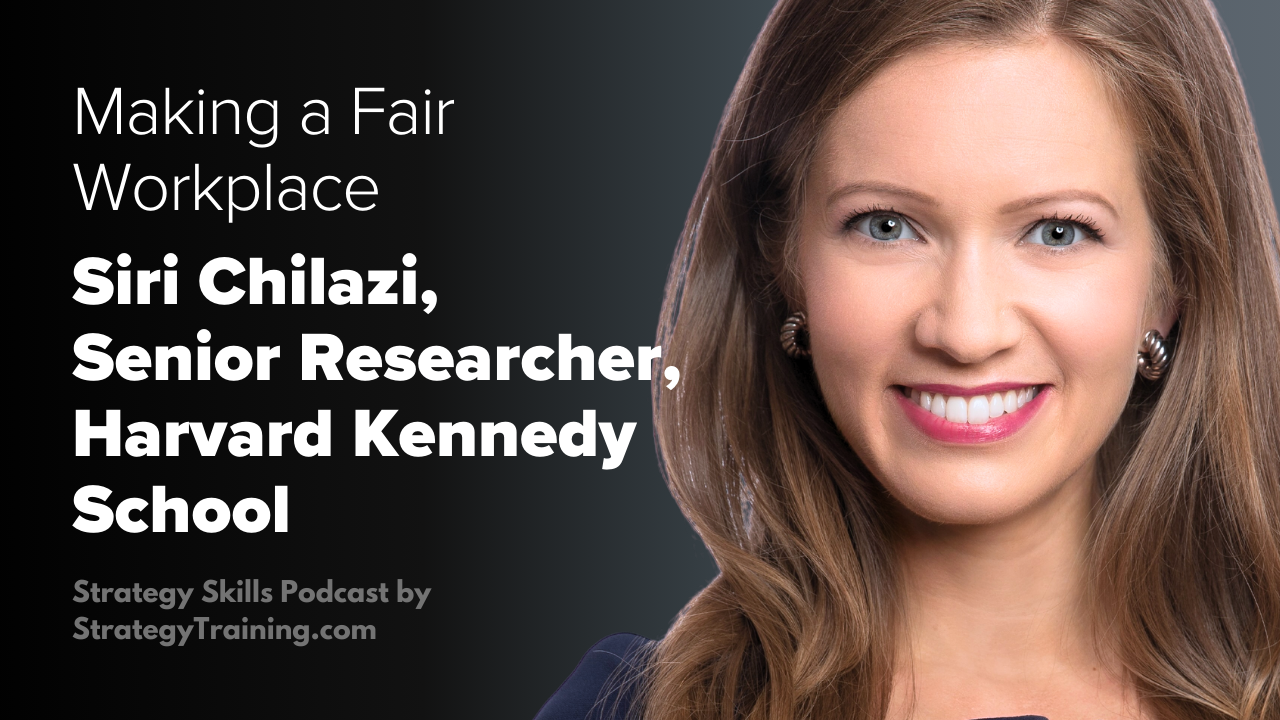
Our Strategy Skills episode 527 is an interview with the coauthor of Make Work Fair: Data-Driven Design for Real Results, Siri Chilazi.
In this episode, Siri shares her path from studying chemistry to researching workplace gender equality. Based on her experience and academic work, she explains how workplace systems shape behavior more than individual choices. Siri advocates for practical changes like redesigning resumes and conducting regular pay audits rather than focusing on diversity training. Siri discusses how to create fairer workplaces and suggests that small changes in organizational culture can lead to significant improvements in gender equality.
I hope you will enjoy this episode.
Kris Safarova
Siri Chilazi is a senior researcher at the Women and Public Policy Program at Harvard Kennedy School whose life’s work is to advance gender equality in the workplace. Siri has an MBA from Harvard Business School, a Master’s in Public Policy from Harvard Kennedy School, and a BA in Chemistry and Physics from Harvard College.
Get Siri Chilazi’s new book here:
Make Work Fair: Data-Driven Design for Real Results
Here are some free gifts for you:
Overall Approach Used in Well-Managed Strategy Studies
Enjoying this episode?
Get access to sample advanced training episodes
Episode Transcript:
Kris Safarova 00:45
Welcome to the Strategy Skills podcast. I’m your host, Kris. And our podcast sponsor today is StrategyTraining.com. If you want to strengthen your strategy skills, you can get the Overall Approach Used and Well Managed Strategy Studies. It’s a free download, and you can get it at firmsconsulting.com/overallapproach. And you can also get McKinsey and BCG-winning resume, which is a resume that got offers from both of those firms. And you can get it at firmsconsulting.com/resumePDF. And today we have with us Siri Chilazi, who is a Senior Researcher at the Woman in Public Policy Program at Harvard Kennedy School whose life’s work is to advance gender equality in the workplace. Siri has an MBA from Harvard Business School, a Master’s in Public Policy from Harvard Kennedy School, and a BA in chemistry and physics from Harvard College. Siri, welcome.
Siri Chilazi 01:31
Thank you so much. Kris, I’m thrilled to be with you.
Kris Safarova 01:36
Siri, so your academic background spans chemistry and physics, then Masters in Public Policy, then MBA. Can you share what motivated you to pursue such diverse fields?
Siri Chilazi 01:54
I think the common thread is that I’m a nerd and I love school and I never wanted to leave, which is when I became an academic. But in all honesty, I I always grew up loving math, chemistry and physics, and so that was just those were my favorite subjects growing up. And so I initially actually entered college thinking that I was gonna go and get a PhD in one of those fields and become a professor eventually. And once I got into the lab as a it as an intern, as an undergraduate, and saw that most of the work of my professors was actually research and applying for research grants rather than teaching. And the nature of scientific research, at least in chemistry and physics, is often very solitary. You know, that caused me to to re evaluate, but in the end, I ended up coming full circle and landing in academia anyway, except in the social sciences rather than the hard sciences.
Kris Safarova 02:50
What were the internal debates, or maybe external influences that eventually allowed you to focus on gender equality and workplace fairness?
Siri Chilazi 03:01
Mom would tell you that I was a feminist from the moment I entered this world. But actually, it wasn’t until after I exited the school system and got my first job out of college in management consulting that I consciously encountered gender inequality in the world. You know, at least in my case, the educational system and my family and my friends growing up and just the environments that I had found myself in had insulated me from seeing the worst effects, I would say, of gender inequality, until I started working a for profit company. Very typical scenario, you know, entry level is roughly 5050, women and men, but when you look to the top, less than 10% of the partners were women. I was paid less than my peers, maybe because of my gender, maybe because of other reasons, but I felt it was unacceptable nonetheless. And of course, we know that gender pay gaps are very well documented and very real around the world. I witnessed some unfortunate incidents of sexual harassment that happened with other people. I saw how senior people who were very powerful, got away with some of that bad behavior because they were the rain makers in the company, because they brought in a lot of money. I saw how that distorted how people got treated. And so that’s kind of the thing that opened my eyes and made me realize, wow, even in the 21st century, these problems are still very real and need to be fixed.
Kris Safarova 04:27
I feel, before we move to your life outside of school, we need to stay a little longer there, because this is a very, very unusual background to study such different things, all of them at Harvard. Could you take us a little more deeper through the evolution of your interests while at Harvard and realizations you had that ultimately led you to what you’re doing now?
Siri Chilazi 04:50
Well, I think for me, actually, the real pivot point was in that time when I was working in between undergraduate so. College and then my graduate studies. So I mentioned already how I had kind of witnessed a lot of things in my own workplace and in talking with friends, and, you know, the experiences they were having in their workplaces. But this was also around the time in 2012 2213 when Sheryl Sandberg published her book Lean in, which was a paradigm shifter, right? And it shaped the conversation forever. Entered the vernacular even today. More than a decade later, people who never read the book know the term Lean in and use it. And Marie slaughter, who was at the time, a senior, former senior official at the State Department, published a very highly read article on the Atlantic called why women still can’t have it all. So these conversations were really rising to the fore in a way that I hadn’t seen them rise to the fore in my lifetime. And I had this realization that I was so much more passionate about reading these books, having these conversations, thinking about these issues, than I was about the important work that I was doing as a management consultant, serving clients every day, and when I sort of noticed that, I said to myself, it’s life is too short not to do things that you find meaningful and that you bring a lot of passion and curiosity to so then when I came to graduate school, I already had it as a personal agenda item to sort of explore what career in advancing gender equity could even look like. You know, what would be the potential jobs available? How might one make this into a lifelong career? And the beautiful thing about being in school is that you have a lot of opportunities to explore through coursework, through meeting with faculty, through internships in the summer. And so that’s kind of what I did during my graduate studies, exploring what would a path look like if I wanted to work on these issues for the rest of my life as a full time career. And I actually landed in academia by accident. I got the opportunity to work with Kathleen McGinn and Jessica Lee Porter, two other academics on a year long research project right after graduation. And at that time, I hadn’t necessarily been looking for research roles, but the opportunity to came up to work with these two people whose work I knew and really admired, and the topic was understanding the effects of gender bias at the senior levels of organizations, so I kind of jumped in. It was just something that called me, and then that’s what set me on my current path.
Kris Safarova 07:23
So you spent a year doing that research project, and then you realized, you know what, that’s what I want to continue doing for the rest of my life.
Siri Chilazi 07:31
Yes, yes. I think I discovered that my passion is at this intersection of Yes, doing research, generating more knowledge and insights, which is, of course, very important, but also making sure that the insights that we generate through rigorous academic research make it into the hands of practitioners of real people in organizations doing the daily work of managing, hiring, promoting, creating products, delivering services. Because as academics, at the end of the day, we don’t have our hands in the weeds. That way. We are not out there actually doing the work. We can help to equip those people with insights that enable to do their better their work in better and smarter and fairer ways. So those are kind of the two parts of my work is it’s generating the insights, but then also bringing the insights to the world.
Kris Safarova 08:20
And of course, Harvard is known for its vibrant ecosystem of ideas. How did your interactions across different Harvard schools help you shape, ultimately shape, your vision for a more equitable workplace?
Siri Chilazi 08:33
One of the sort of richnesses of the the academic environment, and to your point is the schools are very different. So for example, I did a master’s degree at the Harvard Kennedy School focused on public policy, but also a master’s in business administration at Harvard Business School. And one of the things that struck me early on in that joint program was how we would often be talking about similar issues or the same challenges, but coming at them from two different perspectives. Think about industries like financial services or anything having to do with energy, you know, that are heavily regulated industries. They’re sort of the business perspective of to them. And then there’s the regulatory public policy perspective. And I think that was really enlightening to realize, and to be able to look at an issue from multiple perspectives, from the standpoint of multiple stakeholders, notice where there’s overlapping and shared interests, but also notice where incentives and interests are competing. You know, I think about the question, for example, right now, of remote and flexible work, which from where I sit as a social science researcher, the evidence is pretty clear that in many cases, having access to remote and hybrid work improves employees productivity. It improves job satisfaction, life satisfaction, it increases retention of employees. It reduces. Says work life, conflict that employees experience so in many ways, it’s a very good thing. But then you talk to mayors like Mayor Eric Adams of New York City, who says, I want people in offices, but what’s the perspective that he’s coming from? Well, one of his main considerations is the city’s economic vitality, and he wants people to come into offices, because he wants the real estate development sector to be happy. He wants businesses that serve office occupants to be booming, the cafeterias, the coffee shops, you know, the lunch places around the corner where if no one coming to the office, those businesses are also suffering. So it’s not that either argument is more or less valid. It’s all you know, it’s all true, it’s all evidence based. But as we think about the holistic well being of society and its occupants, we have to navigate how to balance those concerns.
Kris Safarova 10:53
And in doing this very important work you’re doing now, what surprised you?
Siri Chilazi 11:00
That’s a great question. I would say, I get surprised every day by something or another. One of the biggest things that had has humbled me, as someone who studies how why humans behave the way they do, and if we want to shift those behaviors, how we might be able to do that. One of the things that really humbles me is how much our behavior is shaped by external forces such as our physical environment and the processes and systems that surround us, rather than our own conscious, deliberate thinking. I at least used to go through the world thinking that, Oh, I’m making all these really intentional decisions every day, and I’m weighing options, and it’s all me making these conscious decisions. And research shows that so much of what we do on a daily basis is actually a function of the system that we find ourselves in, and when the system around us changes, our actions change. Let me give you a quick example as a study that I love from the University of Washington that looked at women in computer science classes a few years ago, nationally, women make up only about 20% of computer science degree recipients at the college and university levels, and the University of Washington tested a small intervention to try to help more women wish to take computer science courses and then continue taking them to eventually get a degree. This small intervention was that they went into the classrooms and discovered that the pictures on the walls of their computer science classrooms in the beginning were pictures of Star Wars characters and computer games and very sort of masculine stereotyped movies, action heroes, action characters. So in some of the classrooms, the researchers went in and without telling the students anything, they replaced those very masculine stereotyped images with pictures of nature, landscapes that are kind of more gender neutral, that have really nothing to do with computer science. And as I mentioned, the students weren’t told that this was happening. They just kept going to those classrooms, taking their courses, and the researchers tracked how students felt and how they expressed their sense of belonging in computer science, but also whether those students continue to take more computer science classes in the future. And in fact, what they found is that just that change of the pictures on the walls led to more women continuing to take computer science courses, and led to them reporting a higher sense of belonging in computer science. And that’s just because the pictures on the walls were changed. So it just goes to show you what a profound influence systems and environments have on our decisions and our choices.
Kris Safarova 13:50
100% agree with you. I think it’s a very powerful way generally, to think about life in terms of systems. So how could we adjust our systems so that we could have more workplace equality?
Siri Chilazi 14:02
It often comes down to making small tweaks to the things that we’re already doing, rather than instituting new programs or kind of add on activities. In fact, I think that’s one of the problems where the kind of corporate diversity equity and inclusion initiatives of the last few years have really taken us down a wrong path, not intentionally, all well intentioned, but one of the main activities that we’ve spent a lot of money and time and attention on have been various trainings, diversity trainings, unconscious bias trainings, cultural competency trainings, and those trainings have actually been around for More than a half century, even though they’ve really proliferated recently. So because they’ve been around for a long time, we’ve also been studying them for a long time, and there’s a mountain of evidence from hundreds and hundreds of studies that shows that these trainings are just not effective at changing people’s behaviors. In some cases, they are at. Effective at increasing awareness in the short term, people leave the training and say, Yeah, I love the training. I learned a lot. I’m really motivated now to tackle the effects of bias in my work. But then when we follow up months or years later and see if any actual behaviors have changed, we find that they have not. So that’s trainings are an example of a ubiquitous programmatic practice that just doesn’t have the evidence base behind it. But what does, instead have really a lot of convincing evidence behind it is making small tweaks, as we were saying, to the systems and the processes that we already have in our organization. So let’s take the example of hiring all of us. I’m sure everybody who’s listening has a resume that you’ve used at one point or another to apply for a job. Well, the typical design of a resume will list your work experience with the dates attached. So you’ll say I was a management consultant from 2010 to 2013 one of the things that this kind of design does is it makes gaps in your work history very apparent. So if at any point you took a year or two or five or 10 between two jobs to take care of children or take care of elderly family members or work on a personal venture or go travel the world on a sabbatical. It doesn’t really matter. The reason that’s really obvious to employers, and empirically, employers tend to penalize candidates for these career gaps, even though there’s actually no evidence to suggest that people with career gaps are in any way less competent or skilled. So our colleagues in the UK tested a very simple tweak to the design of the resume whereby your work experience was expressed with the amount of time instead of the associated dates attached. So you would say management consultant three years instead of the dates. And what that redesign did is it obscured the career gap, so that it was less obvious to employers whether they had been a gap or not, and lo and behold, the research found that both women and men were about 15% more likely to get invited to an interview, and employers were able to make better matches between their open roles and the actual skills that they needed to have in candidates filling those roles. So that’s an example of a really small and simple tweak to an existing system that’s just a better design than the current design that helps to level the playing field for everybody.
Kris Safarova 17:34
Siri, and what are the critical issues that you see with the system now that need to be addressed as a priority,
Siri Chilazi 17:40
I would say at a high level, it comes down to making sure what we need to do and what’s not happening today, in light of the evidence, is giving all people an equal chance to succeed, both to succeed in getting the job and then once they’re employed in an organization, getting the chance to do their best work, build new skills, advance and grow through the organization, and get rewarded and remunerated fairly along the way. It’s very, very clear that that’s not happening. There’s, for example, more than 300 studies that show that when you send the exact same resume to employers, but you vary the gender of the applicant or the race of the applicant, or whether the applicant has a disability or not, people don’t have the same chance at getting invited to an interview and getting hired. That’s not a meritocracy, because if we lived in a true meritocracy, which is defined as a system where people advance according to their talents and their skills. Then if two people had the exact same resume, and one of them was black and one of them was white, they should have an equal callback rate. You know, that’s the same likelihood of getting invited to an interview and getting offered the job. But that’s just not the world that we live in today. Women and men have shown to be shown to receive differential credit for group work. So when there’s a group project and you know, five different people, group members are listed as having contributed, we assume that the men did more work than the women, without any evidence, in one large global organization, 1000s of 1000s of employees, researchers showed that when women and men got the same performance evaluation ratings that translated to faster advancement and higher monetary rewards for men. So again, that’s not fairness. That’s not a meritocratic system. So what it comes down to is de biasing the existing processes that we have, making them better, making them more objective, and ensuring that we’re not putting barriers in some people’s way that prevent them from doing their best work for the benefit of our organization.
Kris Safarova 19:58
Why do you think as a society? See, we tolerate these things?
Siri Chilazi 20:03
Yeah, that’s a really deep question that, to be honest, I feel as a little outside of my scope of expertise. But, you know, pay is a very interesting example. There’s been some great work done looking at the evolution of professions that flip from being female dominated to male dominated, or vice versa. So, for example, Parks and Recreation workers, you know, that was a profession that flipped from being female to male dominated from the 1950s to Today in we see that when a profession becomes more female dominated, its average pay goes down compared to other professions. And then we see that professions like tech coding, software programming, which actually during its origins in the 1960s was a female dominated profession. Now, of course, today, starting really from the 80s onward, it’s been heavily male dominated, and tech and science, technology, engineering and math, STEM occupations are some of the most highly paid across the entire economy. So it’s not a coincidence. There’s a systematic pattern there, and I would argue that it reflects a society wide devaluation of women’s work. We just simply don’t feel like the work that women do is equally as valuable as the work that men do. And another place where we can see this pattern is when we compare occupations that are very similar in terms of the skills required and the tasks done. An example of this would be janitors and house cleaners. The job is very similar. Think about what a janitor does, they’re cleaning, what a house cleaner does, same thing, except it turns out that janitors are mostly men and house cleaners are mostly women, and janitors, on average in the United States, more than 15% more they make more than 15% more than house cleaners for essentially exactly the same work. So as a society, we have to reckon, I think, more deeply, with where does this devaluation come from? The devaluation of women and their work and their contributions to society.
Kris Safarova 22:19
Where do you think it is coming from?
Siri Chilazi 22:23
I don’t have a hypothesis. Of course, some of it’s historical. I mean, women have historically been shut out by law from working at all, from working in certain occupations, Sandra Day O’Connor, for example, who went on to become the first female Justice of the United States Supreme Court. She graduated from law school in 1952 and at the time, the only job she could get as a trained lawyer was that of a legal secretary. She wasn’t allowed to practice law as a lawyer until many years later. So there were a lot of barriers like that, really kind of overt, institutional and structural barriers that prevented a lot of different groups of people from participating fully in the workplace and in society. Women in America didn’t get the vote until 1920 you know, that’s really a, you know, big marker of participation in society. Black people in America didn’t get the right to vote fully until the 1960s so I think that history in the background is definitely playing a role and continuing to shape some of the kind of residual attitudes, even though those overt barriers, such as the right to vote, such as the right to work in any occupation, those have, of course, largely been dismantled now, but there are vestiges that remain, and a lot of those vestiges are more the unconscious, unconscious and less visible barriers that we’re confronting now in the 21st century.
Kris Safarova 23:53
And what do you think women can do to actually ensure they are getting paid as much as a man for the same role. Let’s say it’s a large management consulting firm. You know how well you perform. You even have it documented, because there’s reviews and so on, so you get in a rating versus a male colleague. How can you ensure you’re getting paid fairly?
Siri Chilazi 24:15
I’m going to answer your question in a second, but I want to suggest that the real solution to this problem does actually not rest in the hands of women. It rests in the hands of organizations that are setting compensations, any compensation, right, and making decisions about how to pay people. It is actually their job to ensure that people are paid fairly. It’s not the job of the people who are currently being underpaid to kind of fight. So the real solution would be for organizations themselves to run regular pay audits to make the process of setting compensation more structured and more formalized, so that managers have less discretion to give. More bonuses to the people that they like, or, you know, raise this person’s pay just because it’s their favorite employee. So we need to have some accountability and oversight to ensure that bias doesn’t creep into those decisions. And then we have to keep checking the data regularly, maybe twice a year, maybe once a year, to make sure that new gaps don’t arise after we’ve closed past ones. Salesforce, the company, was very vocal a few years ago about what happened with them, which is, they had done a really thorough pay audit, they had spent a couple of million dollars closing gaps, and then a few years later, they re ran the audit and noticed that some gaps had reappeared. So it’s a conscious and constant effort to ensure that we have fairness and pay that would be the genuine solution. But I do want to answer your questions, because you asked me, Well, what can women do? So gain as much information as you can by talking to your colleagues in your organization, but also finding external benchmarks, talking with people you know in other firms, using public data available from websites like Glassdoor about what a person in your industry, in your type of company, in your role and seniority, what they get paid on average, ask HR, make sure that if you’re getting that comparative information, it doesn’t only come from other women, but that it comes also from men, because again, we know the data tells us that women, on average, are underpaid. So if you’re comparing yourself to other women, you might not be actually getting the accurate benchmark. And then negotiate and ask whenever you take on new tasks, a new role, increased responsibility, maybe you, on top of your day job, agree to participate in some kind of internal initiative of the company. Those are all opportunities to negotiate recognition for those increased responsibilities.
Kris Safarova 27:01
And do you think that sufficient number of organizations actually doing this, they’re actually taking steps to try to make sure that people are paid fairly? Or is it just something to be a fantasizing about? We’re dreaming that that is the best solution, but nothing actually happening in terms of sufficient steps to fix this.
Siri Chilazi 27:17
It’s happening in many places, and that’s the good news, and that’s something that my co author Eric safane and I wanted to do with our book, is we highlight the success stories of individuals and companies around the world that are doing the right things, that are putting evidence based practices into practice with Excellent, measurable results. Because I think it’s having those role models, you know, having real examples to point to and say, Oh, wow, it can work, and here’s how it worked, and here’s how they did it. That’s so important in giving other organizations and other individuals the confidence to say, okay, we can do this too, but it’s not a one and done. You know, I like to ask senior leaders this question. When they kind of asked me, like, Siri, you’re telling us we need to do this every year. I said, Okay, so when you’re selling your product, right, and you’re trying to make a profit, if you get a great profit in one year, does that mean that you can stop working the following year? So of course not. Next year we want to make even more profit and we want to launch a new product Exactly. That’s the point. We need to manage fairness exactly the same way as we manage our core business, which means we’re always improving. We’re always striving for more, because the work is never done.
Kris Safarova 28:32
And do you think there are specific changes that women should try to implement for themselves? Maybe the way they behave, the way they think about things that also negatively influences them.
Siri Chilazi 28:46
So let me give you the analogy of a running race, the 100 meter dash. Let’s say let’s imagine that we have two sprinters who are identical. They’re equally as fast, and now we have them run this 100 meter race, which one of them is going to finish first? It’s not a trick question, because they’re equally as fast. They’re going to finish at the same time, right? But that’s actually not the reality in our workplaces today. The situation that we have is much closer to a scenario where one person starts at the current zero meter starting line and has to run 100 meters, and the other sprinter starts at a line that’s 10 or 20 meters behind. Well now who’s going to finish the race first? If our sprinters are equally as fast, of course, it’s the Sprinter who gets to start closer to the starting line. When we look at this scenario, we could say to the second sprinter, oh, we need to get make you faster. Let’s give you a different pair of shoes. Let’s change your outfit, let’s change your running technique so that you move your arms in a different way, right? Those tweaks might make that second sprint. Enter marginally faster, but it’s never going to make up for the fact that we’re forcing them to start the race 20 meters behind. So I am arguing that instead of trying to fix the sprinters, we should just make sure that everyone gets to start on the same starting line and then run as fast as they can. May the fastest person win the race. So I fundamentally believe that the way to make our workplaces more fair is not to try to fix women, or men, for that matter, or any individuals, not the players, but the game. Fix the playing field instead of the players.
Kris Safarova 30:38
So let’s see, someone listening to us right now who is managing their practice within a large consulting firm? So they have certain level of influence they have. What specific steps would you recommend they take to make things more fair?
Siri Chilazi 30:52
It’s a wonderful question, and I think it has to start, as it does in the management of our core business, with data. Every team, every organization, has different challenges and different strengths and different opportunities, but until you have the data, you don’t really know where you are. So I would invite and encourage those managers to look at who’s on their team, who’s speaking in meetings, who’s getting promoted, what kind of performance scores. Are women and men getting are they on average, the same, or are there differences? Do certain groups of employees spend a longer time in a given role before they get promoted? We already talked about pay are there pay gaps? And then that data analysis will allow you to diagnose where you have gaps that need fixing. I’d like to share the story of Roz Atkins, who’s a journalist at the BBC, because I think he’s such a wonderful example of how to do this in practice. Roz has been at the BBC for two decades. He’s a experienced career journalist, and he wants to generate the highest quality journalism possible, which means that it needs to be representative of the world. It’s reflecting but a few years ago, Roz he was, at the time, the anchor of a nightly prime time new show for an hour every day he was on the air, he realized that he had no data about who he was featuring as guests and expert contributors on his show. He thought he was doing a pretty good job of reflecting gender balance, but he didn’t have the data, so he didn’t actually know. So Ross Atkins convinced his team that they would spend two minutes at the end of each night’s show just quickly counting. Who did we feature tonight? How many women, how many men on screen? And after they’d counted for a month, they discovered, to their great surprise and shock, that only 39% of their contributors were women. It was a much lower percentage than they were expected. So now they had the data, now they had the baseline to actually know what was happening. From there, they set themselves a goal of getting to 5050 they continued measuring every day, they continued tallying up the data at a monthly level, and within four months they had gotten there. They had reached 5050, gender parity. And in fact, they kept it up for years. But then what happens next is really interesting. They could have stopped and declared success and declared victory, but because they discovered a system that helped them make their work better and fairer. They decided to start sharing it. They started speaking to their colleagues on other teams, on other TV shows and radio programs, saying, Hey, we discovered this methodology that made our journalism better. We know you care about high quality representative journalism too, so So let us share our learnings. Let us share our tools. We have a simple spreadsheet, and we’ll be happy to help you implement this on your show too, if you if you’re interested. And within a few years, more than 750 other content creating teams at the BBC had joined, and it became to be known as the 5050 the equality project. So one person, one team, sparked a massive change in a global organization, which then actually also spread to more than 150 external partner organizations outside of the BBC, that included other media companies, journalism schools and even corporations. So to any person out there, whether you’re a senior leader, manager or the most junior member of your team, I hope this story inspires you to find an aspect of your own work that you can start measuring and tracking and then armed with the data making ever so slightly better and more fair.
Kris Safarova 34:40
Siri, this is such a great story. Very inspiring. Do you have another story like that that you could share with our listeners?
Siri Chilazi 34:47
I’ll share another story that’s not attached to a particular person, but this is another strategy that we all can use at the individual level to change. Culture, I find that often when we talk about culture, everyone is agrees that oftentimes there needs to be culture change, but it sounds really big and really intimidating. What is culture? How do we even start to tackle changing it? So as a behavioral scientist, I am admittedly biased towards behaviors and concrete actions. And in fact, my co author, Eris and I, the way we define culture in our book is culture is the way we do things around here. I’m sure, when you started for the last time, a job in a new organization that you weren’t familiar with from before, as part of onboarding, they gave you a bunch of manuals to read that explain the company’s formal policies and vacation time and reporting and this and that. But those formal onboarding materials don’t tell you things like, is it okay to challenge a senior leader in a meeting? Do decisions get made in the meeting, or is there a meeting before the meeting that actually determines what’s going to happen if you want to get promoted. Does your manager need to put your name forward? Do you yourself need to raise your hand? Do you need to create an application? Do you need to have one on one meetings with senior leaders to convince them one by one to support your case? This is, by the way, a personal story. I had no idea of any of this. I was lucky enough to have some senior colleagues who were watching out for me, who came to tell me, Siri, you should apply for a promotion now, and here’s how do you do it. That was never written down anywhere. I would have had no clue. So my point is that sometimes these informal ways of working, ways of working, these norms or our shared understandings, but often unspoken understandings, of what behavior is actually expected and accepted, they shape our behavior more profoundly than do the policies on paper. And for that reason, norms are one important way to change culture, because once we start changing the way we do things around here, our expectations of what’s okay and what’s not okay also start to shift. So think about the meeting culture in your organization, and if there was one thing that you’d want to change to make your meetings better. Maybe it’s that they start and end on time, or maybe it’s that there are no interruptions, or maybe it’s that everybody actually has a chance to contribute in that meeting. And then think about, okay, once you have your goal identified, what’s one simple way that you could start role modeling that goal and maybe recruiting a few colleagues to do it with you. So let’s take the example of interruptions. If you think that your meetings would be made better by having less interruptions. Next time interrupt the interrupter, when someone interrupts another person, chime in immediately and say, Oh, Kris, I’d love to hear your point, but could be first have Jessie finish hers, then we’ll come back to you, and once you do that a couple times, then maybe another person, emboldened by you also does that a few times. Very quickly, we’re starting to shift the norm. A new norm is emerging that says actually, we’re not tolerating interruptions in our meetings, and the interrupters will start to expect that they’ll get called out, which makes them less likely to interrupt going forward, that’s the power of norms, and all of us can change them in our daily work.
Kris Safarova 38:31
Very powerful. I want to wrap up today with some questions, probably two outside of this topic. One is, what are so to say, success habits that you use on a daily or weekly basis or monthly basis, that really allows you to remain this full of life, so much positive energy, pushing forward, no matter how difficult the challenge is, I’m going to make it work, you know?
Siri Chilazi 38:56
I think the real key is everyone needs to find what works for them, but I’m happy to share what I have found that works for me. One is exercise, daily movement. You know, some days it’s just a walk outside for 30 minutes, and some days it’s something more intense and longer. But we humans are whole beings. My mental, the physical, the emotional, it’s all talking to each other. It’s all influencing each other. So that’s one. I am a big fan of the zero inbox, and so by the end of each day, I do respond to every email that I receive, and whatever can’t be responded to quickly, then there’s a reminder or a to do list that reminds me to follow up on kind of the bigger and longer term items, but that just gives me a sense of control, and something that I actually just started this year, it was a bit of a New Year’s resolution of mine is when there’s small things that need to be fixed. So maybe there’s a shirt that’s hanging on the door because it needs to be ironed or steamed, or those dishes in the sink that need to be put in the dishwasher, I just do those small things in. Immediately, so that as I’m walking around the house, there’s not reminders of all these little things that require my attention. And for me, it’s freed up a lot of mental bandwidth. It’s made me feel a lot more on top of things0
Kris Safarova 40:12
Incredibly helpful. And if you ever experience, for example, a challenging situation in life that really brings you down, they have a tip on how to get out of it.
Siri Chilazi 40:22
I have to refer here to the wisdom of my 90 year old grandmother. She just turned 90 very recently, and I asked her for her reflections on you know, wow, you’ve lived a long time. You’ve seen so many things change in the world, in society. What a cool perspective. How does that make you feel? And she said, Siri, always keep moving forward, never look backward. Don’t spend any more time than you have to thinking about the sad things and the nasty things. Think as much as you can about the happy things. This was her advice, and I thought about it in the context of, you know, in a historical perspective. Again, my life’s work is advancing gender equality, so that’s why my brain always goes but I think about the women in the 19th century here in the United States, who were fighting to get the basic right to vote and to have their voice heard in society. They had to fight for that right for decades, probably much longer than they ever thought, and they were taking on that fight while society was telling them that they were so worthless and so devalued that they couldn’t even be trusted to vote on par with men. And yet they didn’t get deterred. Yet they didn’t stop. And we are resting today on their shoulders having that right and that power. So when I look back and think about how far we’ve already come and how much harder in some ways, past generations had to fight. It kind of gives me that renewed push and motivation to keep going. And so if they kept going, we today, in 2025 can keep going as well.
Kris Safarova 41:55
You have the touch in your hand, and you need to keep going exactly. And they also wanted to ask you my favorite question over the last few years, or any amount of years, what were two, three aha moments, realizations that really changed the way you look at life or the way you look at business that you would feel comfortable sharing with our audience?
Siri Chilazi 42:16
Well, I’ll share two. The first is, I sort of alluded this too. I alluded to this earlier already, but my academic research has really made me very humble about our own decision making as humans, and sort of this idea that we are objective and rational beings. I mean, the more we study humans, the more we realize that that’s not the case. And it’s always easy to think of that in the abstract, but it’s more difficult to apply it to yourself on a daily basis. You know, when I’m giving presentations and I’m sharing the results of some studies with folks, a very typical reaction is, oh, sure, sure, I believe your study. But that wasn’t done in our company. We don’t have that here, and I think at the individual level, we often react the same ways. We say, Oh, well, those other people are biased and they are irrational, but not me. So that’s been something that I’ve just kind of tried to bring it home and think about my own decision making and how I perceive the world, and to remind myself that it’s often very fallible. And, you know, multiple perspectives are valid. So that’s the first thing I wanted to share. The second is, humans are complex in multiple things can be true at the same time. This is something that I remember my high school teachers and my college professors saying, We have a saying at Harvard that a lot of us use, which is, reasonable people can disagree. And so one thing that I’m thinking about, especially in the current moment, is, how can we take people who, on the surface, have very differing views on an issue like fairness at work. In How can we start from a place of shared values and a common denominator? So how can we identify the place where we can actually agree on something, maybe an end goal, like fairness or meritocracy, and then building from that shared understanding say, Okay, where do we actually differ? Maybe you prefer strategy A, I prefer strategy B. Well, what does the evidence say? Is there a third strategy, strategy C, that would be better than both A or B. So that’s something that I’m thinking about a lot these days, is, how do we expand the conversation? Invite more people into the conversation with trying to start from common ground and shared values.
Kris Safarova 44:47
Siri, thank you so much for being the kind of person that you are. You really bring so much joy and so much positive energy to the call. I really appreciate it. I think people really need it now. Where can our listeners learn more about you, buy your book, anything you want to share.
Siri Chilazi 45:02
I’m very active on LinkedIn, so I would love to connect with you there. Siri shulazi, the website for the book is make workfare.com the book is available anywhere books are sold. But also on the website is a little button to sign up for my co author here says and my newsletter, we hear periodic insights on the latest, new research coming out, and sort of actionable insights that are relevant to all about how we all can make our work and our workplaces more fair. So I hope to connect with you there as well. And thank you, Kris for having me. It’s been really such a pleasure.
Kris Safarova 45:35
Thank you everyone for tuning in. Our guest today, again, has been Siri Chilazi. Check out Siri’s book. It’s called Make Work Fair. And our podcast sponsor today is StrategyTraining.com. If you want to strengthen your strategy skills, you can get the Overall Approach Used in Well-Managed Strategy Studies. It’s a free download, and you can get it at firmsconsulting.com/overallapproach. You can also get McKinsey and BCG-winning resume. If you’re currently updating your resume, this could be very helpful. It’s a resume that got offers from both of those firms, and you can get it at firmsconsulting.com/resumepdf. And the last thing I will share with you is a gift copy of a book I co authored with some of my amazing clients. And you can get it at firmsconsulting.com/gift, and it is called Nine Leaders in Action. Thank you again for tuning in, and I’m looking forward to connect with you all next time.
Leave a Reply