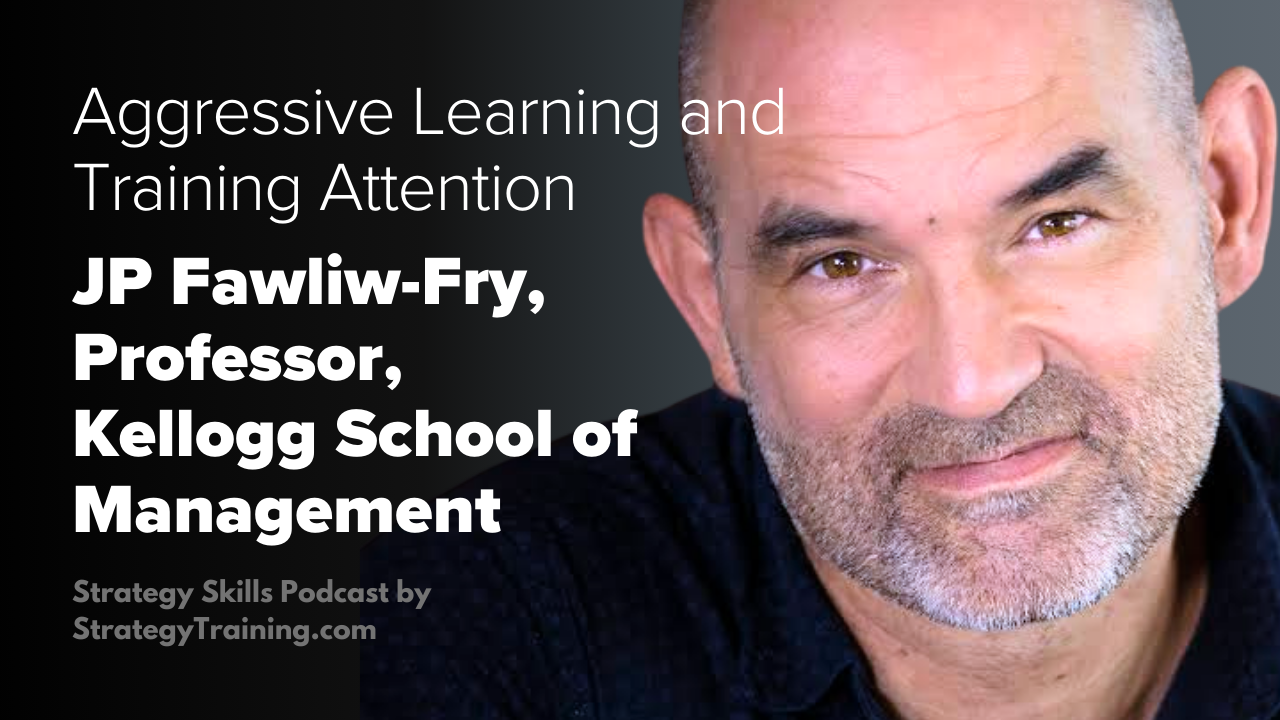
For Strategy Skills episode 528, we interviewed the author of Performing Under Pressure: The Science of Doing your Best When it Matters Most, JP Pawliw-Fry.
In this episode, JP walks us through the concept of pressure management—how to reduce pressure in our personal and professional lives to better excel in whatever we do. He also discusses the importance of self-awareness, especially under pressure, and the concept of ‘aggressive learning,’ where high performers extract more information from experiences. JP shares how meditation can change one’s relationship with stress and improve focus.
I hope you will enjoy this episode.
Kris Safarova
JP Pawliw-Fry is a world-renowned keynote speaker, and the author of the New York Times bestseller Performing Under Pressure which was named INC. Magazine’s Best Business Book of the Year. He teaches a leadership course at the Kellogg Graduate School of Management. Over the last 25 years, JP worked with leaders and high-pressure performers around the world — from Navy Seals and Olympic athletes to executives at global organizations like Intel, Coca Cola, and NASA.
Get JP Pawliw-Fry’s book here:
Performing Under Pressure: The Science of Doing Your Best When it Matters Most
Here are some free gifts for you:
Overall Approach Used in Well-Managed Strategy Studies
Enjoying this episode?
Get access to sample advanced training episodes
Episode Transcript:
Kris Safarova 00:45
Welcome to the Strategy Skills podcast. I’m your host, Kris Safarova. And our podcast sponsor today is StrategyTraining.com. If you want to strengthen your strategy skills, you can get the Overall Approach Used in Well-Managed Strategy Studies. It’s a free download to be prepared for you, and you can get it at firmsconsulting.com/overallapproach. You can also get McKinsey and BCG-winning resume, which is a resume that got offers from both of those firms. And you can get it at firmsconsulting.com/resumePDF. And the last gift I have for you today is a copy of a book I co-authored with some of our amazing clients. It’s called Nine Leaders in Action, and you can get it at firmsconsulting.com/gift. And today we have with us, JP Pawliw-Fry, who is a world-renowned keynote speaker, the author of The New York Times best seller, Performing Under Pressure, which was named Inc Magazine’s Best Business Book of the Year. He teaches a leadership course at the Kellogg Graduate School of Management, and over the last 25 years, JP worked with leaders and high pressure performers around the world, from Navy Seals and Olympic athletes to executives at global organizations like Intel and Coca Cola and NASA. JP, welcome. So such an interesting career so far. Let’s maybe focus a little bit on your story and then go right into your work.
JP Pawliw-Fry 02:11
Yeah, it’s interesting. You say, you know, it’s a interesting career. My mom still doesn’t know what I do. It’s like you go and talk to organizations. What is that? You go and give speeches? What is that? So I’m not sure she even knows what I do.
Kris Safarova 02:28
Could you give us a little bit of an overview how you ended up doing the work you’re doing now?
JP Pawliw-Fry 02:33
Yeah, it’s a great question. I mean, I had a very science, you know, human biology background, and, 35 years ago, I found myself, you know, even though I was brought up like Roman Catholic as they come, in a Buddhist monastery in in Asia several but over a couple of years, I spent a bit of time in different monasteries And and for someone who has a bit of ADHD, which I do, it was a revelation that there’s an internal technology available to anyone that can be helpful in training attention and impulse control. And it grabbed me, and I was like, wow, and that mean that’s really the start, and then there’s lots more, you know, academic and other endeavors to get to where I am. But that was the first part, I would say. The second part I was teaching working in a psychiatric hospital with patients with stress and chronic pain, and some business people and some athletes said, you know, they took the course I was teaching. They said, Can you teach us? And it’s funny, because it didn’t even occur to me, even though I kind of love sports in a certain way, although I’m not really a fanatic, but, and I did, and then before I knew I was working with Olympic athletes and and business people were saying, Hey, can you teach us how to, you know, manage our brain under pressure? And so that’s really the origin story of, you know, that was like 30 years ago, and then we started a company 26 years ago, and we’re doing what we’re doing, what we’re doing, and loving it.
Kris Safarova 04:17
Can you tell us a little more about your time at monasteries? That is an experience that most of us will never have.
JP Pawliw-Fry 04:24
Yeah, I mean, it was, I got a bit of a seeker. Even though I was doing all the science curriculum in in my undergrad degrees, I did take some religion courses. I’ve always been a bit of, you know, interested in something more than just the science. And I remember being in Bangkok and meeting this, you know, Swiss and American fellow, and they were telling me about this, you know, Silent Retreat. And that’s interesting. So, you know, I went to the south of Thailand and tried to get in for this. 10. Day silent retreat. And to be honest, my very first experience, they didn’t have any room, but they had just transcribed the 10 day retreat into, you know, onto like 80 100 pages of notes. So I paid 100 baht, maybe, which is, like, $3 it’s the best $3 I ever spent. So I actually went to a different monastery where they don’t take Westerners. Normally, they don’t speak English. And I asked, Can I, you know, sit my own retreat here? And I did, and it was just, you know, kind of one of those life changing experiences. Most people don’t know that they have this experience of input of stimuli in the form of any of the senses or interacting with someone and instantly right after a story about that those stimuli or that interaction, we have a story that follows almost every experience, every kind of sensation, sense experience, that we have a story and we don’t know that, and that story is often wrong. It’s based on, you know, a very little bit of information, because of the way our brain works, we jump to judgment based on less than 5% of available information. But we don’t know this. We don’t know that we are not our thoughts or this story. We don’t know that. And because people don’t know that, they cause themselves a huge amount of suffering and a huge amount of angst, and they’re not very effective under pressure. I mean, we know, you know, we shared some of the research in the book performing under pressure that you referenced, that we do worse under pressure, not better under pressure. It’s a total myth that, you know, we think, Oh, some athletes are better under pressure. No, that’s not true. Everyone is diminished under pressure. It’s just those who are the high performers are diminished less than everyone else. They’ve learned some tools of self regulation. And so that was a revelation to me, and this is, of course, a 2500 year tradition. This has nothing to do with any insight I have, but that was kind of a an eye opening experience. And then I thought, hey, I want to bring this to people. I didn’t think of business people or athletes at the time, but that’s what it’s evolved to.
Kris Safarova 07:30
That transcript that you got for $3, what are some of the key things you learned from it?
JP Pawliw-Fry 07:37
Gosh. I mean, like, do we have five hours? I mean, not that I can remember it that well, but I mean the just the richness of wisdom is just so here’s a bit of a myth that I think people have about meditation or mindfulness. They think it’s about a practice to calm your mind. It’s most definitely not. Has nothing to do with calming your mind. It’s total myth. It might have the kind of effect, a consequence of calming your mind, but the real thing that’s going on is you’re changing your relationship to whatever is going on in that moment. That’s what it was in that transcript, right? So you’re frustrated that you’re late, you’re upset about a relationship, you can’t sleep over something, you whatever, and we don’t realize that we have a relationship to that, and most of us are trying to control things we can’t control. And so what was in that manuscript was, can you watch your reaction to learn something about yourself, which then will help you be more effective, and if you’re an aggressive learner, that’ll help you grow a certain amount of wisdom, which means the next moment, you’re going to be a little bit more effective, little less effect, less affected by what the events. And this is what’s going to help you live with a little bit more ease, a little bit more focus. And so, so it’s actually more of a wisdom. It’s probably, you could say it’s a wisdom, and it’s a compassion tradition, more than it’s a calming your mind tradition. So when you see things as they are, that sounds so airy fairy, I imagine. But when you see, when you see your mind and how it just jumps from topic to topic to topic, and you realize I don’t have to get too attached to that. That grows a wisdom when you realize that if you grow some compassion, first and foremost, for yourself, that changes so much of your neurochemistry, by the way, but also your experience of another person, of seeing. Big picture, and on and on and on. So, you know, and all of this can be trained like, that’s the part probably in the transcript. More than anything. You got to put the time in. You got to sit down. You got to watch and, you know, just think about it. We train lawyers for how many years, doctors for how many years, academics for how many years? Makes sense. There’s skills, really. So you’ve got to train. We don’t do that for the mind, and yet it’s the most important thing. We really do need to train.
Kris Safarova 10:27
That is very true. So once you had the transcript and you went through it, you went and created your own meditation, silent meditation retreat. Can you through that experience?
JP Pawliw-Fry 10:39
Sure. I mean, it’s not that like, I mean, so I went to it was, I got the transcript in the South of Thailand, and where I went was to the kind of North of Thailand, not north, but just outside of Bangkok, a couple hours, three, three or four hours, chanbury Province, of all places. And, you know, I don’t know how I chose that one? But you know, the head person, or one of the people, spoke passable English, and I just said, Look, I here’s my story. Could I, you know? And he was like, Sure. And so, you know, you and this, this, actually, this is, maybe this is interesting, because this is all new to me, but you wake up at three or four in the morning, and essentially, you either sit for 45 minutes an hour, or walk walking meditation for 45 minutes an hour. And you do that essentially all day till, you know, 8pm at night, and then you go to bed and you have one meal at, you know, 11 o’clock ish, and that’s what you do, I mean. And what’s interesting is it like you kind of think, oh, that sounds boring. It’s not boring. It’s hard work, by the way, because you sit there at times and you’re meditating, then you have the story, you have this memory, but your brother or your sister or a friend, where you got Re and you get agitated. You go for 10 or 15 or 20 minutes, maybe an hour, and you’re you’re agitated, and then you realize, a couple hours later, oh, that came in. It went and that’s some big insight, how whatever was upsetting me an hour ago has, has has gone away, has pat this too, has passed. And so you’re like, Huh? I mean, what happened? I mean, nothing happened. So why can’t I get to sooner to that place of letting it pass? And that’s like, this huge insight, you know, I’ll give you a good one in the retreat, there was this, I don’t know if it was called a macaw bird. I really don’t, but I read that somewhere that there’s Macaw birds, and they make this sound, so we’ll call it a maca bird. But it was like this, you know, outside, like a very, you know, rich in trees, like a tropical kind of forest kind of feel, and like, above the monastery, there is this bird going and just at a particular time for a particular length of and then it would at first, and then it felt like it was all the time. And then all of a sudden I get, of course, agitated to hear this, and I’m just like, Oh, would you stop it? And you’re like, Oh, my God, that damn bird. And you know this whole story, then at some point you’re like, Okay, it’s just a sound. Then what’s my reaction, my relationship to the sound? Again, right? And that’s everything in life. So that would be, you know, and then I eventually left, and was fortunate to go to other monasteries, but, but that was the one that probably had the biggest impact on me, because, you know, it’s just like, you don’t know what you don’t know. It was such an eye opener for I don’t know if you’ve ever scuba dived. Have you ever scuba dived? Okay, so if you, I mean, I’m not a big scuba diver, but for those who are listening, if you scuba dive, there’s a moment where you’re under the surface, kind of for the first time, and you’re like, oh my god, there’s a whole world under here. I didn’t know that existed, because on the surface, you just see this flat water, and, you know, it’s, it’s almost a mirror, like you don’t, you can’t see inside, then you’re underneath. You’re like, Oh my gosh. Why didn’t somebody tell me? You know, that’s the same experience. I would say that that meditation, mindfulness can be such an interesting explanation of this.
Kris Safarova 14:22
So you compared it to going scuba diving and seeing the world. And so how is there a world that we don’t know about when we do meditation beyond what you explained that we are reacting to things versus being able to be kind of above it and let it pass and not let it hurt us unnecessarily. I’m trying to understand why you compared practice of those 10 days of doing 45 minutes per hour from three to eight meditating to being underwater and seeing this whole world you haven’t seen before.
JP Pawliw-Fry 15:00
Yeah, I think it’s just, it’s almost like we don’t know what’s going on in our mind, like we don’t know what’s under the sea, so to speak. And you’re, you’re, you’re kind of shocked that it’s there. Like you kind of, you know not you kind of, you cannot believe for a heartbeat, you literally cannot believe for a heartbeat that there is this, you know, under the surface, there’s these fish, and there’s, like, it’s incredible, like, it’s beautiful, it’s mind blowing, and that you’re like, wow. And maybe it’s even more powerful, like, it’s visually beautiful, obviously, under the sea, but in meditation, you know, we’re all kind of suffering with something. There’s some angst, like, you have some, I have some. You know, my dog here has some. Everyone listening has some. And we kind of almost accept it, like, well, this is life, and, you know, it’s kind of, I don’t say it’s hard. Well, it is hard, and this is just the way it is, and we don’t really question, what could we do to change our relationship to it? And so that might be as much. The big revelation is, oh my gosh, I actually can do something about this. Wow. You know, like, I think that, to me, was almost as much as anything. And then, you know, the more you practice, the more you realize you’re a little bit more self compassionate, right? When I make a mistake, I make as many as anyone, there’s just a little bit more tenderness that I have towards myself because of this practice. There’s no question about that. Do you think I’m better to come into a meeting after making a mistake and having some self compassion, I’m now in that next meeting, or I’m now trying to think, you know, strategically, let’s say, Do you think I’m better in that moment? Because I don’t have that angst and that dis ease, course, right? That’s that whole internal technology that’s available to us. And so that, to me, was so it was revelatory. I think it’s just that both were revelatory because they’re there and you don’t know they’re there.
Kris Safarova 17:08
JP, and can you tell us what happened over time? So I would assume something changed. Was there some kind of defining moment for you when something shifted as you were going through the meditation practice?
JP Pawliw-Fry 17:20
Well, I mean, as any, if anyone here who’s listening has done any of this, there’s, there’s a couple of things where you get really painful in the body, and again, it’s just like the bird. It’s just another thing. So I think it’s just the number of the the big aha, was, you know, changing your relationship, like it’s, it’s, for instance, and we know this in, in, in, you know, our world of, of neuroscience, that We actually don’t feel emotion. Now, everyone’s going what? I’ve been frustrated. I’ve been angry. Of course, there’s emotion. No, there’s actually just sensations. There’s fact, there’s only two sensations that the brain recognizes, pleasant to neutral to unpleasant, on a scale, so pleasant or energy physiological arousal, we call it charge from highly charged to neutral to not very charged like so that’s that’s it, right? But what the body does is that it takes in these sensations, it compares it to the experience template that we all have. It, it makes a prediction because it compares it to what’s happened before, makes a prediction, am I okay? Am I not okay? And the label it puts on that prediction is what emotions are. And so what’s interesting is that, and this is not my big insight, that you know other people talk about this, but it’s like neuroscience and this Buddhist mindfulness tradition are really saying the same thing, which is mind blowing, really. And so that was part of the revelation for me. And then it’s just the more you practice. So it’s been 35 years for me, the more you practice, the more you get a little bit better at it. You get a little bit more at accepting. For instance, you know the stuff that you can’t change, right? You know, there’s like this, this under this appreciation of the the kind of the the joy and sorrow that that is this experience and that just comes. And so now you just have a relationship. You accept it. You also take action on the stuff you can but you like learning that acceptance, that things are as they are. You know, that is that was really revelatory for me.
Kris Safarova 19:52
That is beautiful to be able to get to that place faster. Accepting. Are you currently able to accept immediately, or do you. Still need to go through certain period of turmoil inside.
JP Pawliw-Fry 20:04
I think it’s probably best to ask my kids or my wife, really. But I you know, this is a hard one, because I think it’s degrees. I think I know compared to 35 years ago, I know that I’m I accept way more I’m I’m easy. I’m able to flow with things and not get, as you know, overwrought, there’s no question. But it’s not to say that there aren’t times, especially when it’s an important relationship with my kids or something where, you know it it like it keeps me up at night. You know that I’m like, sitting there going, you know, are they okay? And are we okay, kind of, so it’s still there, but, but even there, I’ll say this to know that. So this is a this, to me, is maybe part of what you’re asking, and it took me a minute to get here. But when you’re in the middle of a kind of a storm. We call it a pet storm, physical sensation, P, emotion, E, and then thoughts, stories, P, e, t, when you’re in the middle of a pet storm, which is just you know, your your front, you’re up at night, or wherever it is, if you’ve been through it many times. It’s kind of like some of the athletes I work with have. If you’ve been through this multiple times, and you see that it comes and it goes, and it comes and it goes, and it’s really a sine wave all of a sudden, when you’re in the middle of it, you have that little awareness to say, You know what? I felt this before. In fact, I’ll feel it again. Just let it be, not try and push it away, by the way, because that gives its power. But just let it be for as long as it’s there. And just don’t add to it a second arrow of, you know, oh, I shouldn’t be feeling this right, but the first arrow is just whatever we’re feeling. The second is feeling bad that we’re feeling it right. No, just let it be, and then it just goes away on its own. That to me, you know, it was, was that’s where I’m probably better now than I’ve ever been before. I can just see it, accept it, know it’ll pass and, you know, and then have that kind of a relationship to it.
Kris Safarova 22:15
Would you say you’re, in a way, an observer of what’s happening, versus being inside of that black cloud.
JP Pawliw-Fry 22:22
Yeah, Kris, that’s a, I mean, really, that’s a tremendous way to think about it, because that’s it, right? Can’t, can we sit there and see what’s going on? Have a bit of perspective, absolutely, and that is almost the experience, it’s like there’s this space between whoever, whatever I am in these thoughts and these, you know, this kind of pet storm, but, and you sit there, and there’s a space between me and it, and it gives you a bit of perspective. So, yeah, absolutely, and you, and you kind of see the long view, right? Like, again, I, you know, a month ago, a week ago, a year ago, I had whatever, and now it’s gone. Where did it go? You know, it’s not like I and some stuff. Look, you got to take action on for sure. It’s not about being passive, by the way, for anyone listening, but there’s this sensation where you go, huh? I can just sit here. I can just let it, you know, be, and it’ll pass on its own. Which, which is where we have our real control and our power.
Kris Safarova 23:27
For someone listening now, who wants to try this? And they have tried meditation, they’re doing meditation, but they’re not getting the results they want. What would be your recommendation?
JP Pawliw-Fry 23:37
Yeah, that’s a great question. That’s a really good question to me, it’s, it’s a you kind of have to let go of results. You know, it’s like when I work with athletes right, in high pressure, like, you know, Olympics, or work with NFL teams, you know, NBA teams, stuff like that. There’s a real attachment to outcome, right? We got to win. And actually, that’s why we underperform under pressure, because we’re too attached to outcome. We got to let go of outcome. Just focus on, you know, this moment, next task, next task. And I would say, if anyone’s struggling, that is the same coaching I would give them. The other thing I would suggest is, if someone has come to you know, this practice and it’s interesting to them, and they’re doing it kind of on their own, an hour a day, I would say it’s going to be really hard to do that and make progress what you really want to do. And there’s some great centers. I’m happy to give some ideas, but in North America, where you can go for a longer retreat, five, seven, I would suggest 10 days personally, because it’s almost like it’s going to a boot camp where you the same what you might get done in the in fact, it’s not even the same, because that hour a day, you don’t. You don’t build that continuity of practice to see the insights. So in fact, you know, I try to do a 10 day retreat once a year now, because of COVID that’s been thrown off. But that, to me, is what actually helps my daily practice be stronger. And so both two things for anyone who’s struggling, you know, not making progress, not getting traction, let go of outcome, you know, and and just drop into what are the things I can control and really the process of it all, next task, next task, like the athlete, and then go and find a center where you can do this retreat, you know, with some guidance, with some people who are little ahead of you, that, to me is, is you know how you’re going to get traction in a way that makes you feel like you’re making progress, even though we don’t want to be too attached to progress.
Kris Safarova 25:55
And for someone listening who have no idea what to do when they’re doing meditation, could you explain to them what they could do while doing walking meditation and while doing sitting meditation? If those were different for you.
JP Pawliw-Fry 26:07
Sure. So, I mean, so I love both, and both are really important to do. It’s really the same thing. You’re just you’re using an anchor to watch something so your breath when you’re sitting could be your body when you’re sitting, and then when you’re walking, your body, you’re just feeling your feet on the ground. You know, for instance, for everyone right now, just to feel your feet contacting the ground, feel the warmth, feel the coolness where your foot is not touching the ground. And you’re just like, Ah, okay, that’s your that becomes what you’re focusing on, and or your breath when you’re sitting. And it doesn’t really matter what activity you’re doing, you’re just focusing on one of those, let’s say, and then, you know, if we do it long enough, fact, you know, just everyone just sit close your eyes for a moment and just feel your breath at your nostril, if that’s comfortable, and feel it come in and go out. So just feel the breath come in, feel a sensation. Then go out. Where does your mind go? What story took it away and just let go of the story and come back to breathing and just opening our eyes. I mean, we could do this for a long time. But what’s interesting is that for a lot of people, they’ve never had that awareness that I’m watching my breath or my feet or when I’m walking my body, whatever, and my mind wanders, and it goes to story, and then all of a sudden, you’re like, oh my god, what am I doing? Like, I’m off. And that’s, that’s one of the insights. It’s just like, wow, okay, there’s what’s happening, and then there’s this. It’s almost like, it’s a theater of the mind. It’s like a movie, right? And we don’t know this. And so that, to me, is, you know, some of the instruction, that’s that, that is what you want to cultivate in this practice.
Kris Safarova 28:23
Thank you. That is very helpful. And you also mentioned you can give some recommendations of the centers.
JP Pawliw-Fry 28:29
Yeah, yeah. I’m, I’m, I’m very, very happy to do that. And, and, you know, probably the first one, just off the top my head, for people listening, if they don’t go to the show notes, and we’ll share more there. But is something called Insight Meditation Society. IMS. It’s in the middle of Massachusetts, just north of Worcester, in Barremass, B, A, R, R, E, Barremass. It’s just a beautiful, you know, old nunnery. It’s been there 40 years and 50 years, probably, I think, and it’s just like a tremendous place with great teachers. I had one of the athletes that I work with just finished retreat there a month, maybe a month ago or so, and he was just like, Oh my gosh. JP, like, like, he’s been trying to, he has been practicing, but he’s like, it’s kind of that same instruction we were mentioned earlier, wow, I went there and all of a sudden is like, there’s just so much more learning. And, and, you know, if you’re an aggressive learner, it’s like, it’s fascinating. And, and I’ll just say this, there’s no, no beliefs that you have to have, right? I was brought up Roman Catholic. You know, there’s people from every background there. There’s no belief. You have to believe this, because it’s more a psychology of the mind more than a belief system. So, you know, if that scares anyone you know, don’t, don’t let it.
Kris Safarova 29:55
Thank you so much. So you mentioned a term, aggressive learner. I. Don’t think I ever heard anyone saying that. What do you mean by that?
JP Pawliw-Fry 30:03
Yeah, so I mean, we survey 40,000 people a month, so we’re, you know, attempt anyway, to do research and survey people. And one of my favorite stats of all of the data that we and others really have collected is this one that high performers make mistakes like anyone. In fact, they might make more mistakes because they take more risks. But high performers make mistakes, but they extract three to five times more information from the same opportunity to learn as an average performer. So they have a meeting that doesn’t go well, they have a process or a project or a new product, whatever, and it goes well, doesn’t go well, but they’re able to learn from the going well or not going well, and they’re able to take that learning and put it into use, and they grow wisdom like you know. The truth is, if we’re if you and I and all of our listeners are lucky enough to still be alive in five years. I hope we’ve used the five years of experiences and grown from those five years so we’re just a bit wiser, right than we are now. That’s the point that I think that’s more than anything about being an aggressive learner, and in organizations, you can absolutely create a kind of an aggressive learning organization. You got to be mindful and intentional about it. But leaders can absolutely grow that. And it’s critical, of course, if you want to innovate, if you want to do really good strategy. I mean, what is strategy? Really strategy is making some choices, of course, but it’s informed choices. And think about it, if you have people who are aggressively learning about their customers the environment, then there’s so much change today. So they’re aggressive learners, and they’re able to dig into the hard stuff, you and, you know, this idea of the last 8% right of a conversation, and maybe I’ll explain a bit more of that in a second. But if, but if you have a team that is able to engage in that level of really, you know, at times hard, but, you know, kind of really productive conversation, and they’re aggressive learners, you’re gonna have a better strategy. There’s no question you are.
Kris Safarova 32:27
Can you go deeper into this last 8%?
JP Pawliw-Fry 32:30
Sure. So what we know is that for a team to be high performing, there’s one characteristic that is the most important above all, and that is to take risks. Take sufficient risk. What do we mean by that? We mean interpersonal risk and strategic risk. Let’s talk interpersonal you’re on a team. Do people speak up when they see something wrong or they have an idea that they think could help? Do people naming convenient truths on the highest performing teams, they do. They take that interpersonal risk. Now they do it even though there’s the chance that they might be, you know, looked on as they don’t know they’re incompetent. They might get humiliated, but, but the best teams build norms so they can take risks. But back to the last 8% so we wanted to quantify risks that people needed to take, and so we did a study of 34,000 people. We found that there’s this gap between the risk that you and I and everyone listening knows in our bones we should be taking, having the hard conversation, making the strategy risk whatever it is, but there’s this in our gut, we know there’s this risk we should be taking, and then there’s the risk we actually take. And there’s a gap at 7.56% that’s what our research found. And so, you know, we rounded up to 8% but it’s, that’s where, it’s a hard stuff. It’s, it’s the the zone, you could say, of risk. But boy, because most people don’t go there, if you go there, that becomes a competitive advantage for you. Now you’re going to have the conversations that come up potentially with a better strategy, with the better execution of a strategy. And so our work is really around helping individuals, teams and organizations, because we do this at scale, helping organizations build a culture courageous, culture of courage, really, at scale and at speed, tools to move into the last 8% to close that gap so that they can do great work.
Kris Safarova 34:36
Many leaders wake up at 3am or am and their minds racing, or they struggle to fall asleep. What strategies have you seen work best acquired the mind before, but, or when you wake up and you cannot sleep?
JP Pawliw-Fry 34:50
Well, I’m so not the person to ask, because unfortunately, and I’m trying not to, but I still darn well look at this phone. I. Before I go to bed. That’s such a bad decision. When I’m on my game, I’m a bit better, but that’s a challenge. So, I mean, boy, I mean, I’m not really a sleep expert, so I I’ll give you some, you know, working hunches, because it’s something actually, we do a lot with athletes, because they have trouble. Of course, when they’re pre, you know, night before a game, they get quite worked up. Actually, here’s a place to start. If anyone’s on listening and they’re like, oh my gosh, I’m not sleeping, and it’s the night before my big presentation. Don’t worry about it. It doesn’t matter. It’s actually two nights before your presentation that matters for performance, not the night before. So that’s that’s helpful to know. Number one, number two. I mean, really it is, it is. There’s some physiology around temperature. You know, you need to be cool that that’s important for the body. And then it’s, you know, I meditate when I kind of can’t sleep, but honestly, I don’t want to, like, I don’t want to tell you something where it’s not really my area of expertise.
Kris Safarova 36:13
Thank you for sharing. It’s still very helpful. Maybe you would have had something. So I also wanted to ask you, what do you think is the most underrated skill for leaders when they navigate in high pressure environments.
JP Pawliw-Fry 36:25
Yeah, great question. I mean, probably self awareness, just to know how you show up when you’re under pressure. You see, you know the truth is, is that people are not good at reading emotions on faces. In fact, they’re horrible. We think we’re good, we can’t we really can’t read emotions on faces. So if you’re a leader and you’re walking in and you have no self awareness about how you’re showing up, maybe you just came from a meeting. You’re frustrated. Well, people on your team, as you come into that meeting, they don’t read faces very well, and they will misjudge your intention, right? They’ll see this face that looks severe, they’ll think it’s about them. They’ll confuse the impact that you’re having on them for your intention. And so that’s going to throw off, you know, the the performance of the team. So if you can have some self awareness to know, first of all, people can’t read me, so I’ve got to clarify my intention. There’s ways, when we work with organizations building high performing cultures, there’s ways to enter a meeting so that you actually let people know kind of where you’re at, where everyone’s at. And it’s a real great gage to build first kind of that connection. But then the second part, it allows people not to awfulize when they see, you know, behavior like this. The other thing I would say is, in terms of, you know, leader is it’s really about courage. You know, can you step in and be uncomfortable. You know, can you sit there and do something where you potentially feel like you might be humiliated? By the way, humiliation is the most damaging of emotions, just for the record, and so if you’re a parent out there, be very careful. If you ever get close to humiliating your child, it is the worst thing you can do, truly. But having said that, I think so probably self awareness and Kris, you asked me for one. I gave you two.
Kris Safarova 38:30
Thank you so much. To start wrapping up our time together, which was so interesting. You recently wrote a book performing under pressure. What do you want people to take out of that book?
JP Pawliw-Fry 38:42
Yeah, that’s a great question. Probably, to become a, to be a student of human behavior, that’s all of our work. But certainly that book, right? The best investment you can make is not in a 401, k or a, you know, investment account. The best investment is right here. It’s understanding your brain, your mind, understanding you know, your patterns. I mean, that’s literally what we do with athletes and leaders. We help them understand their their what we call their predictable default behavior. And when they understand that, all of a sudden, they can navigate a little bit more easily through the hard stuff, and that makes all the difference in the world. And so, I mean, that book is, is really, you know, it’s the science of human behavior. And then there’s like 22 kind of different solutions in the middle part of the book that you know, and not all of them will work for you, because we’re all different cats. We all have different, you know, ways that we go about things, but that comes from our practice of working with, you know, these people under pressure. And so there will be one or two or three, hopefully that can really help you, you know, have a little bit more control over this mind, this experience, so at the end of the day, you can show up and be not your bad. Best under pressure, because you won’t be better than you’ve been before, but closer to your best and and so we kind of maybe one final point is, if you know that there is a chance that you will, there’s a higher likelihood that you will make a mistake under pressure, and you will, then when you make the mistake, you can let it go more easily. You’re like, Oh, of course, right, and that’s that. That’s what high performers do. They’re better at kind of managing when things go right, when things are challenging, they have a different relationship. And so, you know, if, if if you tell yourself a story, I need to be perfect as I go into a big presentation, a big, you know, Strategy Session, whatever it is, I need to be perfect to be successful when you’re imperfect, which you will be if you’re under pressure, then if you believe that story, then you’re like, you go into this downward loop. Whereas if you go and you go, okay, you know, I expect that. I probably something will happen. It may not work out perfectly, and that’s okay, and when it does, I’ll just continue on and just water off a duck’s back. That is a bit of a superpower that not many people possess.
Kris Safarova 41:14
JP, thank you so much for being here. Where can our listeners learn more about you by your book? Anything you want to share?
JP Pawliw-Fry 41:21
Yeah, probably just our website, which is i h h p, so I is an institute, and then h is in health. Another H is for health, human potential, and I h h p.com, so you know, there’s lots of information there and but listen, it’s been my joy, Kris, to spend time with you. Thank you. I think the work you’re doing is really important.
Kris Safarova 41:49
Thank you so much, JP. The work you’re doing is also very important, and I really appreciate you being here and being so open and generous with sharing your experiences and learnings so far, and I’m looking forward to see the big things you will continue doing in the world. Thank you very much. Have a great day. Our guest today, again has been JP Pawliw-Fry. Check out his book Performing Under Pressure. And our podcast sponsor today is StrategyTraining.com. If you want to strengthen your strategy skills, you can get the Overall Approach Used in Well-Managed Strategy Studies. It’s a one-page a download to start with, and you can get it at firmsconsulting.com/overallapproach. And you can also get McKinsey and BCG-winning resume if you’re currently updating resume. It’s a great resume to take a look at, and you can get it at firmsconsulting.com/resumePDF. And you can get a copy of a book I co-authored with some of our clients, and you can get it at firmsconsulting.com/gift. Thank you everyone for tuning in, and I’m looking forward to connect with you all next time.
Leave a Reply