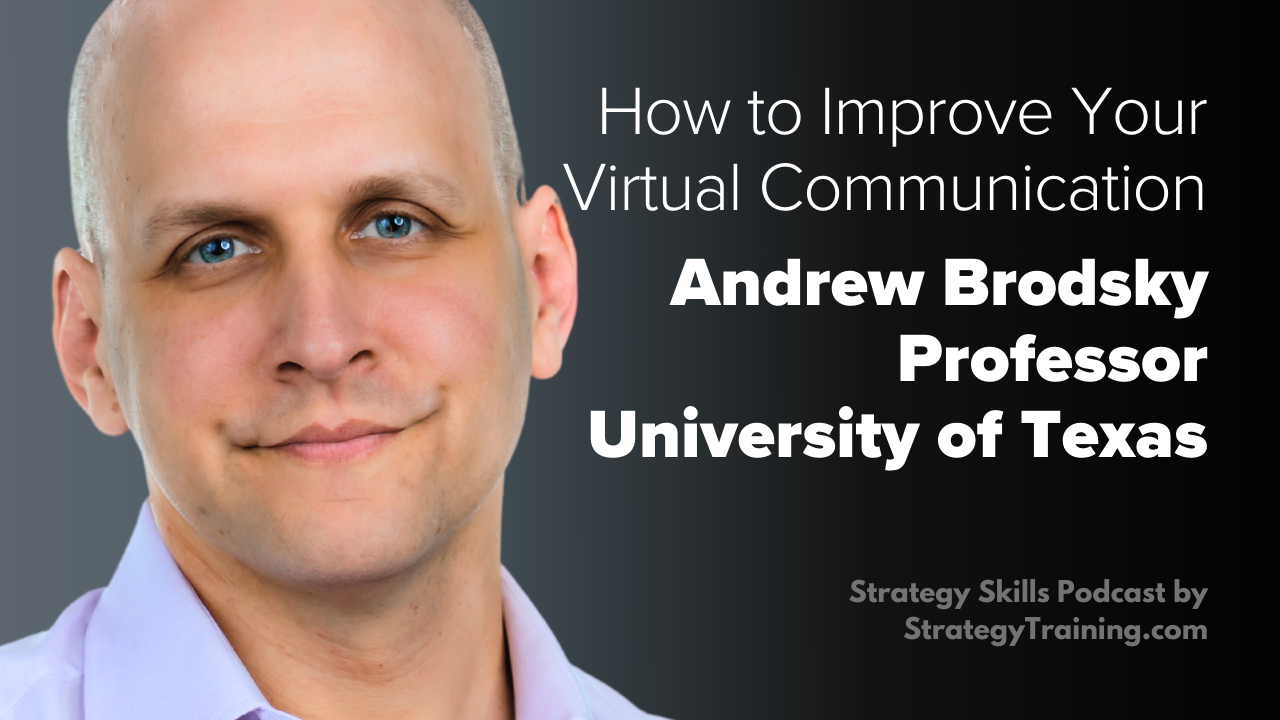
Welcome to Strategy Skills episode 526, an interview with the author of Ping: The Secrets of Successful Virtual Communication, Andrew Brodsky.
In this episode, Andrew shares the nuances of effective virtual communication in the workplace. He introduces the PING framework (Perspective Taking, Initiative, Nonverbal Behavior, and Goals) and discusses how different communication modes suit various objectives. Andrew also touched on strategies for maintaining creativity in virtual settings, building trust in remote teams, and the importance of leading by example even in a virtual environment.
I hope you will enjoy this episode.
Kris Safarova
Andrew Brodsky is an award-winning professor at The University of Texas. He is an expert in workplace technology, communication and productivity and serves as the CEO of Ping Group. Andrew earned a PhD in organizational behavior from Harvard Business School and BS from The Wharton School. He currently lives with his wife and two rescue dogs in Austin.
Get Andrew’s new book here:
Ping: The Secrets of Successful Virtual Communication
Here are some free gifts for you:
Overall Approach Used in Well-Managed Strategy Studies
Enjoying this episode?
Get access to sample advanced training episodes
Episode Transcript:
Kris Safarova 00:45
Welcome to the Strategy Skills podcast. I’m your host, Kris Safarova, and our podcast sponsor today is StrategyTraining.com. If you want to strengthen your strategy skills, you can get the Overall Approach Used in Well-Managed Strategy Studies. It’s a free download we prepared for you and you can get it at firmsconsulting.com/overallapproach. And there’s another gift we prepared for you. It is a McKinsey and BCG-winning resume, which is a resume that got offers from both of those firms. And you can get it at firmsconsulting.com/resumepdf. And today we have with us Andrew Brodsky, who is an award-winning professor at the University of Texas. He’s an expert in workplace technology, communication and productivity, and serves as the CEO of Ping Group. Andrew has a PhD in Organizational Behavior from Harvard Business School and BS from the Wharton School. He currently lives with his wife and two rescue dogs in Austin. Andrew, welcome.
Andrew Brodsky 01:48
Great. Thanks for having me on the show.
Kris Safarova 01:51
Andrew, so such an important topic today. Virtual communication, so relevant for everyone listening. So maybe we can start with a question of, what are the key differences between the effective virtual and in person communication?
Andrew Brodsky 02:05
It’s a good question to start with. So virtual communications, any communication that we have that occurs electronically. So it could be instant messaging, email, video calls, audio calls, or camera off calls, because they now happen to be our smartphone these are all types of virtual communication. And the interesting thing about virtual communication is it varies on a whole lot of different dimensions that in person interactions don’t we can have asynchronous communication. We have communication with fewer different kind of cues. So it’s an important area to try and understand, okay, how do we choose the best mode? And then once we’ve chosen a mode, how can we best leverage it?
Kris Safarova 02:44
What do you think are habits that differentiate really effective virtual communicators from those who are less successful?
Andrew Brodsky 02:52
So that’s a big question about how do you become an expert virtual communicator? So in my new book, ping, I spend pretty much the whole book describing this, but if I had to break out a few key things, the first thing would be that you’re mindful and strategic about your approach to communication. So most people, when they communicate, they just use whatever mode tends to be used. So we always meet to do this, or we always send an email and it’s this, or whatever is easiest. And the problem with that approach is it ends up undermining your outcomes. So the reason so many people complain about having hours and hours of extra meetings is because no one’s questioned. Should that meeting have been an email? And on the other side, it’s often worth questioning. Is this email chain better as the meeting? Because we’re spending weeks going back and forth in what could have been solved in a quick conversation. And the second thing that’s really important is understanding the research behind virtual communication. There are hundreds of studies, many of which I talk about, that get to this point of, okay, what’s best and when, and how can we best leverage the mode of communication?
Kris Safarova 03:59
So let’s talk about what is best and when? How do we decide? Should we send an email? Should we have in person meeting, or maybe a zoom call will be sufficient?
Andrew Brodsky 04:08
So the approach that I usually take is, you first want to establish your goals, because I wish I could say there’s one best mode of communication that would it’s better than all of them. Just choose it. You’re good to go. But it can vary depending on your goals. So for instance, let’s talk about meetings with cameras on or cameras off. Research talks about the Zoom fatigue, or video conferencing fatigue, that most of us have heard about, but it’s this idea that being on camera can be really exhausting. We’re spending all our time just staring at ourselves, looking at our own nonverbal behavior, and it can be really, really stressful. So research shows that having your camera off can reduce fatigue, can reduce stress, and there’s a whole lot of benefits to having camera off meetings, because you can focus more on the conversation as opposed to what exactly. Exactly you’re doing and displaying. But on the other side of that, if you’re thinking about, I want to build a relationship here, or if it’s important to you to show that you’re present and attentive, then cameras on are better. You could think about a situation where you don’t know what someone even looks like. In that situation, you probably don’t feel very close to that person. So the idea here is that cameras on can be better for that kind of thing when you want to build relationship, when you want to show that you’re attentive and engaged. So here’s just an example of thinking metrical. Is it to, you know, reduce fatigue? Is it to reduce stress? Or is it about here, you want to build a strong relationship. You want to appear more attentive. And in that one particular example, what would likely determine that answer is, is this an early stage interaction where I don’t know the person well, or is the one where we’ve already built really strong impressions of each other? We already know each other well, and there’s no reason we need to see each other, so we might as well just turn our cameras off and have an easier go of it, in terms of the meeting.
Kris Safarova 05:58
I can tell from my side that for most executive coaching calls, when it is one on one, I do it off camera, and even with a new client, you can go much deeper and accomplish much more when you’re not distracted by camera.
Andrew Brodsky 06:13
Yeah, and that’s a great point too, is because you can focus more what you’re saying as opposed to what you’re doing in that situation. And the good news is, in that kind of interaction, talked about, there’s not really question about whether you’re paying attention to them, because you’re really responding deeply to their questions in meetings where the other person might be concerned that, hey, is this person really checking their email? Are they actually listening to me? That might be one of those cases where you do want your camera on just to show them, like, Hey, I’m here with you. But again, the answer the camera on, camera off question really depends on what are your goals.
Kris Safarova 06:45
And I think if you’re in a situation when somebody is doubting whether you are paying attention, there’s also issues with trust and overall relationship, because you would think that if one person is taking the time to have a meeting, the other person is paying attention and listening.
Andrew Brodsky 07:02
That’s a very optimistic view of the world. I think. In the workplace, very often, managers are thinking that their employees might not be as engaged as they should be. Employees often have the same view of their manager. They think their manager is too busy or just doesn’t care about what they’re saying. So in some situations, going a little bit the extra mile can be useful. But you know your ideal interactional situation is one where there’s that strong existing trust that you’re talking about and where you don’t have to worry about if the other person thinks you’re attentive or not. So this is the ideal relationship that we’re aiming for, that you’re describing.
Kris Safarova 07:34
Yes, the only exception I make for one on one calls is when we specifically focus on executive presence communication, because then I need to see the person and they need to see what. We need to adjust, not only in what they say, but also in how they say it, yes, but in all other times. In all other situations, camera off works much better.
Andrew Brodsky 07:56
It’s a great point about non-verbal behavior. I actually have a framework in my book paying that’s the P, I N, G framework, and we’re going backwards here. But G is goals n of the ping framework is nonverbal behavior, because there’s so much extra nonverbal behavior that matters over virtual communication that doesn’t necessarily matter in person. So when we’re in person, maintaining eye contact’s not a weird thing, for example, but during a video call, it gets a whole lot more awkward because your camera is usually not the same place in your screen where the other person’s face is. Or if you’re sending an email, you have to worry about things like, how quickly should I reply? Should I use emojis? There’s all these different nonverbal behaviors that come into play there that are interesting that and you’re talking about the importance of them on video calls as well, which is a really useful topic, definitely.
Kris Safarova 08:44
So let’s talk about the framework. So you mentioned G at the end of ping is for goal. Talk us through the framework.
Andrew Brodsky 08:52
Yeah. So let’s start at the beginning, now that we’re kind of worked our way there the framework I talk about in the book. So the ping framework for the ping book. So it’s easy to remember I like frameworks, because there’s when you particularly when you have a lot of advice and a lot of lessons. It’s nice to be able to tie together something memorable. But in the framework, it starts with P perspective taking. So this is the idea that when you’re interacting with someone virtually, it’s often you don’t often realize you’re interacting with human as much as when they’re standing in front of you, because if you’re doing an email or instant message, you’re just staring at text, even in video calls, the person just a small square on your screen. And as a result of this, research shows that we tend to be less likely to take the other person’s perspective. This is one of the main things that is the reasons why we often write email messages that seem clear to us, but suddenly the other person gets it and they misinterpret it, because we’re not putting ourselves in their shoes as much as we should be next. I That’s initiative. So when it comes to virtual communication, one of the important things to do is to take initiative, to add back things that are in person, that are missing from virtual communication. Information. So for instance, small talk, it’s one of those things that many people hate, because small talk feels like a waste of time, and research does show that small talk does reduce productivity. But on the other side of that, small talk is really useful for building trust. When you don’t feel like you know the other person, we don’t trust them, and small talk helps give that personal information. It helps create that bonding, that bonding, that kind of schmoozing. So for instance, if you’re writing an email, research shows that if you just add, you know, a couple sentences saying, Oh, hey, how was your trip that you mentioned this, that you took this past weekend, I did this. I’m not talking about writing like a five paragraph narrative about yourself, but just squeezing in a little bit of extra small talk can help remind the person on the other side of their screen that, hey, I’m actually interacting with a human being here, even though I don’t necessarily see them. And then next, as I mentioned, n is nonverbal behavior. So understanding all the different nonverbal behavior, we’re sending virtual communication, whether it’s emojis, whether it’s punctuation, whether it’s how quickly we respond, or time of day we respond to messages or eye contact on video meetings is really important to making sure your communication is as effective as you want it to be. And then lastly, G goals is key for understanding within a situation what is best. There’s often pros and cons to every single choice. So understanding in this situation is productivity, the most important thing is building relationships, the most important thing, and that can vary what you end up choosing. So for instance, email may be the most effective way to send a note. It may save you time. But on the other side of that, having a short video call might be better for the relationship. So within any given situation, being mindful and determining your goals first is one of the key steps to taking to make sure you make the right choices. So that basically brings together the whole pink framework there.
Kris Safarova 11:55
And on small talk, I recently heard about the study done that proved that people who had a little bit of small talk at the beginning of a meeting actually had more productive meeting overall, and also stayed in touch more after the meeting. So the relationships that were developed were deeper relationships.
Andrew Brodsky 12:14
Yeah, and that, it’s a great study, and there’s also a similar one in negotiation research that showed in text based negotiations, there tended to be more impasses or no deals, but when they had participants in the study engage in a little bit of small talk right before the negotiation began, which didn’t happen normally in text based communication, those those pairing that did that ended up reaching more deals and more agreements, because that little bit of interaction, social interaction really can be useful for helping to build trust.
Kris Safarova 12:44
Andrew and with elements of the framework, when you are teaching students and clients, where do they struggle the most?
Andrew Brodsky 12:51
I think there are two areas that I see people struggling the most. The first is one I’ve already kind of noted, this idea that people just tend to default into what they always do, and they don’t take that moment to breathe to think, what is the best choice here? Should I go with what we normally do, or is there a more effective way to have this conversation? The second one that I often see involves that people tend not to make the implicit as explicit as it should be so within teams and organizations, there’s often not a conversation about, hey, how quickly do we expect each other to respond to emails? How quickly do we expect each other to respond to instant messages? What’s the best way to get in touch with you if you’ve got something urgent versus non urgent? And by not having these conversations within teams, it creates a whole lot of problems. You can imagine, for a situation where a manager wants to get a hold of someone, they expect a response quickly, but there haven’t been expectations set previously about that. Or a team where there’s often urgent things, but there’s also non urgent things, but people in that team are constantly having to check their email because they’re concerned something urgent is coming through. Whereas that team had said, Listen, let’s do low priority stuff be email high priority via instant message. That way you don’t have to constantly interrupt your work checking email. If you’ve got something important, it’ll pop up as an instant message, and then you can check your email, you know, two three times a day. That way you’re not constantly interrupting your work just to check every single thing as it comes in to see if it’s important. So making the implicit explicit is really useful when it comes to virtual communication within teams.
Kris Safarova 14:31
That is so true and people have specific preferences, and you can have much more productive team if you can adjust to what works best for certain people. And speaking about differences in Preferences, what are the differences in terms of how to communicate with someone virtually if the person on the other side is an extrovert versus an introvert?
Andrew Brodsky 14:50
So the question about personality differences is a good one, and it’s the same thing is true with virtual communication as anything else, we all have different preferences. Some. People like certain modes better, some like others better. My general advice when talking to people about this is not just to boil it down to one dimension, like introvert or extrovert, because there are so many different ways that we vary. For instance, for a working single parent, being able to communicate virtually can be really useful, because if their kids having a sick day in school gives them more ability to watch over them. Or for individuals who are disabled, different forms of virtual communication could be more or less useful. So for instance, video calls can be more useful for someone who’s who is hearing impaired because they can read lips a little bit better. Or video off calls may be better for someone who’s on the autism spectrum, because it’s a little bit lower. So little bit lower stimulation. So the piece of advice that I often give is, rather than try and guess what mode is best for someone, simply ask them. Most people, when they set a meeting with someone else, they just choose the modes. Say, Okay, video call and they send a calendar invite or phone call, send a calendar invite. One of the best things you can do is simply ask other person What’s your preferred mode. Do you want to do phone? Do you want to do video? Do you want to do cameras on or off? And there’s two benefits to this. One, you’re going to end up including a lot more people into conversations than might be otherwise. And two people are going to like you more and are going to like interacting with you a lot more if they can do it over their preferred mode of communication. So instead of trying to guess and assume what’s best, simply ask people, and you’ll find that it works really, really well.
Kris Safarova 16:30
Andrew, and do you think the psychological barriers that prevent people from fully embracing virtual communication? Do you think it is still prevalent given that speaking on Zoom became just completely normal, and people spend hours a day on Zoom. But do you feel there’s still psychological barriers? And if so, how do we overcome them?
Andrew Brodsky 16:49
One of the things I like to talk about is there’s a kind of in person default, where we’re always asking question of, you know, how is this better in person? We just kind of assume that in person is best, and in many ways this makes sense. Humans have been interacting for over 100,000 years. We’re really used to interacting in person. If you look at the scale of human history, most of the modes of communication we’re using now are only a thin sliver of human history. We’re just getting used to using them, and we don’t even understand their full potential yet. So there definitely is often a barrier I see to using these modes. And as opposed to asking the question of, okay, which mode is better? There’s also secondary questions, misses, okay, how can we use this mode even better? So it’s not just okay video as we use it is good or bad. It’s well, how can we improve our video interactions as opposed as opposed to just accepting that maybe they’re worse or maybe they’re better. So when I talk to people about how to get over that inertia of that, I often talk about pushing yourself out of your comfort zone, try things you’re not good at, and then if you don’t like it, don’t just stop there and say, I hate video or I hate telephone calls, ask yourself, Well, why do you hate it so much, and is there a way that you can make that part you hate even better so that it’s not such a bad experience for you.
Kris Safarova 18:14
And in adjusting the calls to make them more effective and meeting your objectives, How do you think can virtual communication be designed so we can force the creativity and innovation and not just productivity?
Andrew Brodsky 18:27
So this is a great question that relates to goals, in terms of, Okay, is there a situation here about productivity, or is it about creativity? There’s some really interesting research on virtual brainstorming, and for early stage brainstorming, it’s better to do it virtually and separately, because if you’re all sitting in a room a group of 10 people, there’s a number of constraints. Each of you can only talk one person at a time, which limits the flow of communication. You’re concerned about being judged by others, and you tend to hear someone else’s idea and they get anchored to it, so it’s limits your creativity. So what this research shows that early stage brainstorming, it’s better to do it separately and virtually. And then for latter stage, when you’re when you want to come up with an actually choose the idea, then it’s better to meet as a group and to decide as a group. Okay, this is the idea. So this is just an example of saying, Okay, what stage are we in, and what’s our goal, and then thinking about the pros and cons of each mode. And here’s a great example where email is great because it allows us all to communicate, or instant message, it allows us all communicate separately. We don’t get as anchored, and we don’t aren’t waiting for someone else to finish. So we can shoot out a whole lot more ideas together all at once. And then when it comes to that conversation about choosing where it really is, more back and forth and one person talking at time, then that’s better for a meeting, whether that’s video on or video off, or in person or not.
Kris Safarova 19:53
And let’s say there’s a brainstorming that is going on, maybe small groups, brain. And then they brought the best ideas, and then there’s larger group brainstorming going on. What do you think can be done to maintain the creative momentum on the call?
Andrew Brodsky 20:10
So now the question is, okay, we’re in a meeting. How do we make this better? One of the good things to do at the beginning is to set meeting rules. If you’ve got 20 people in a room, usually you’re going to have two or three people taking up almost all the airspace. So just coming in with some rules at the beginning, saying, Okay, we want to make sure everyone’s heard, so we’ll to start the meeting. We’ll give everyone just two minutes. We’ll go around the table randomly to make sure we can hear from everybody, on their perspective, because often the people who are more silent have some of the best ideas. And if you haven’t created that structure in that kind of meeting, you’re not going to hear from those people for the most part, because the loudest voices are going to be the ones that take up the take up the airspace in the meeting.
Kris Safarova 20:57
How does the perceived permanence of virtual communication? So for example, call is being recorded. Do you think affects openness and creativity, and what can we do about it?
Andrew Brodsky 21:07
The permanence and virtual communication is an interesting one, because there’s also this aspect of virtual communication, in some ways, feels a little bit more anonymous, too. On the other side of it that we often see competing against each other, because if you’re talking to someone in person, you’re not going to say mean things about them as easily. But when they’re you know, behind a computer screen, potentially hundreds of miles away, you’re not seeing them, you feel more comfortable saying things you might not in person, which is why we often see these emails going viral from organizations with really ridiculous thing that executives should have never put in email. But yes, the permanence of communication can also make people less comfortable speaking in certain regards, the fact that it is reported as well. So and there’s variations within that too. So people will often feel like email is a lot more permanent of a record, for instance, than instant message, for instance, just email feels like it has that greater permanence. So there are a few approaches to this. So one is you could potentially have a telephone call where it’s clear that you’re not recording the conversation in that situation, and with video call meetings, usually there’s alert that pops up that’s being recorded people might not feel as comfortable putting things in email as they might have in a meeting. So yes, definitely being attentive to that idea that it is permanent and that people might be afraid of saying things they would otherwise is really important in considering what mode you’re choosing for a given interaction.
Kris Safarova 22:40
What would be your advice on how to approach virtual communication if you are going through recruitment process?
Andrew Brodsky 22:47
So are you the recruiter, or are you the person trying to get a job?
Kris Safarova 22:51
Yeah, person trying to get a job.
Andrew Brodsky 22:55
So as the person who’s trying to get a job, you’re generally not going to get a lot of choice over the mode. So then the question becomes, how do you use each mode most effectively? So there’s a lot of research on virtual interviews, especially over video calls, and a few key things. One, you of course, want to address professionally. Two, you want to be thoughtful about your background. There’s research that shows that backgrounds involving plants and bookcases, they just seem more professional than your novelty background with like an iceberg and a walrus on it. So you don’t necessarily want to be doing something funny in the background, where it becomes a little bit trickier is with eye contact that I mentioned a bit earlier, because with video calls, you want to make sure that you have good eye contact. And research shows that eye contact and video calls during interviews actually predicts the interviewee, the interviewer’s rating of the person who is interviewing for the position. So a quick solution to this is to just make sure that you drag the other person’s screen that you’re looking at, you know, the picture of their video to write under your webcam, so that the area you’re focusing on your on your screen is as close to the webcam as possible. There’s also some, some, actually devices you can get, like hanging webcams, or webcams that stick on your screen to make your life easier with eye contact. So that’s some example of things you want to think about during video interactions. We’re interactions. When it comes to email interactions, it’s good to err on the side of over rather than under communicating. So ideally, you want to hit the optimal amount of communication. But that’s not clear to most of us. What you know? What’s the ideal amount of messages I should send, or emails should I send? That thank you, note or not. And the idea here, and what research also suggests is useful, is that under communication tends to be punished more than over communication, so if they send you an email that doesn’t necessarily need a response, it can be more useful to send a Okay, thank you. I got it as opposed to being radio silent, right? And if you think about it this way, let’s say you’re the sender of the message, which is worse to you. You send a message and you’re not sure if the other person even read it, or you send a message and they acknowledge it and they seem a little overeager. Obviously, the situation where the person seems a little over eager as opposed to inattentive is the side you want to be on. And just the last piece of advice I always have is Thank you. Emails are always a nice thing to do, even if it feels a little weird. Just writing a nice note that’s clearly personalized, you know, you talk about a couple things that you just spoke about in interview can go a really, really long way.
Kris Safarova 25:37
And then in terms of the dress code, what you say it should be the same as what you would wear if it was actual meeting in a physical environment?
Andrew Brodsky 25:46
Yeah. So this is always a great question that I get, and there’s a fun phrase that some researchers made, and they call it the Zoom wallet. The idea is where you wear professional clothes on the top and you wear just sweat pants or pajamas on the bottom and half of your body for important interactions, I always recommend being professional in both halves your body in case you need to get up for some reason, it’s rare, but occasionally you do, and in those cases, you don’t want to be caught in your underwear during that situation. But yes, I generally recommend dressing as you would during a normal interview, putting in that little bit of extra effort, again, if you’re just untrue in these situations, looking like you’re trying a little bit too hard is always going to be better than looking like you’re slacking off and don’t care. So if you’re going to err on one side, it’s being a little bit too professional is generally going to benefit you Andrew.
Kris Safarova 26:41
And what are your thoughts on using blurred background?
Andrew Brodsky 26:44
So it depends on your situation. Ideally, I would say you have you can always have something that’s very professional behind you. But realistically, many people are just in tiny apartments, or they’re in situations where they can’t have a great background. You know, maybe they have a small house and there’s kids behind them and things. So if you can’t have a professional background, my suggestion is generally to do a blurred one, because the reality is, we can’t always have, you know, one of those huge bookshelves behind us. So it can be a good thing that said, it does depend on the kind of interaction you’re having. So if we’re talking about an interview where it’s really supposed to be professional, sure, but if it’s a situation where you’re really trying to build a relationship with somebody, then on, blurring your background can be a really useful thing. There’s research that shows that when people have things in their background that you can relate to. So if you’re interacting with a parent, and you’re a parent too, and you happen to have a number one mom or number one dad mug behind you, research shows that that helps build trust. I would never recommend it, because you never know someone’s political interest. But again, research shows that when you have things indicating your political interest and it matches the person you’re talking to, then that builds trust. So I would never recommend having things that show your political interest in a workplace. But it gets to this idea that if you can show some personal things, that a good amount of people would potentially be find relatable and aren’t controversial, like politics, for instance, that can be good thing. Showing your life, showing your background is a good way to get people to trust you. And again, yeah, they’re trade offs. It might look a little less professional, but it’s gonna make the other person feel like they really got to know you, because they learned something about you, who you are as a human being, beyond just your work facade.
Kris Safarova 28:35
And what is your recommendation on framing yourself?
Andrew Brodsky 28:39
So in terms of framing yourself like in lighting camera, so you want to be careful of backlighting where there’s a big bright light behind you. In this situation, there’s, again, some research that shows that you want to have good lighting. You want to have a good webcam. I mean, these are things that, for the most part are pretty clear to most people, just we often don’t realize how impactful those little things can be, especially in new interactions, when first impressions are being made, the little things can go a long way. So just having a good camera, having good lighting, making sure you’re mostly centered and a good part of your screen can be really useful. That said, you know, all these things can be stressful and annoying. So the good news about this is, once you get to know someone, once you have those impressions, really built, the amount that those other things will matter are as much much, much more smaller. So you can take a breather. You can relax once you’re in an established team, once you’re in established relationships, because at that point you really built those impressions already. And whether your lighting is a little off or whether your camera’s a little blurry just isn’t going to matter as much.
Kris Safarova 29:56
Andrew and how do you think power dynamics manifest differently? Virtual communication compared to face to face.
Andrew Brodsky 30:03
So the dynamics in virtual communication, in many ways, are going to depend on the mode of communication. So in video interactions, they’re often fairly similar to face to face, with a few exceptions, one of the things that I talk about in my book is that even small differences in certain characteristics of media can have big impacts. So video calls are slightly less synchronous than in person interactions. So due to data transfer speeds, video calls have very slight amounts of whack which can be really awkward when you’re having a conversation, because they can result in situations where you’re accidentally interrupting each other, you’re waiting too long. There’s like these awkward pauses while you’re waiting for the other person to answer answer, because you’re not sure if they’re going to start and you don’t want to interrupt them. So those little things can matter. And then when it comes to email, there’s definitely differences. Email is great for relaying simple information. It’s nice because you don’t have to schedule time to meet. It’s straightforward, it’s quick. They can read it at their own time. The same for instant message. That said, when it comes to these text based modes, there’s often less back and forth, because when I receive an email, I have to decide, okay, am I going to deal with this and just accept it, or am I going to ask a follow up question? And if I ask a follow up question, I know it can take hours, or potentially, some cases, days, to get a response, and it could take a long time back and forth. So there’s this cost to ask and follow up questions that is often occurs in email as well. So there’s going to be a change in Dynamics no matter what mode you’re doing, but understanding the characteristics in which they vary and the implications of that is really key to ensuring that your choices end up matching your goals and that you succeed in your approach to it.
Kris Safarova 31:55
How do people’s unconscious communication habits, such as pacing volume, shift in virtual settings? When you have a call via zoom, for example.
Andrew Brodsky 32:05
So in terms of pacing and volume and zoom, there may be some good research on that. I haven’t actually seen it yet, where the exact tone of voice changes one way or the other, but you could imagine that you’re going to be interacting very differently when the camera and microphone are right in front of you, as opposed to if you’re in a conference room and it’s a long table and you’re talking to people all the way on the other side of the room, potentially that you’re going to be speaking a lot louder, that you’re going to be vocalizing more, and that you’re going to be reacting to more people’s facial expressions in those kind of situations. So I would expect that there would definitely be some changes between the two of them. I think that question is a big one that we’re still learning more about.
Kris Safarova 32:47
Though, what are the most counter intuitive findings from your research on effective, virtual communication and what also surprised you the most?
Andrew Brodsky 32:56
One of my most surprising findings that I think I’ve seen. And this gets back to the idea that people tend to default to certain modes, and in most cases, they tend to default to what I would call the richest or the least rich mode. So we tend to focus on video or in person, or we focus on email and instant message to extremes. But it turns out that there’s a good bit of research, including some of my own, that shows that middle ground audio interactions, whether it’s cameras off or telephone calls, can actually be the sweet spot and the best option. So one case is related to authenticity. There’s a lot of gurus and leaders who say, Oh yeah, you should always be authentic at work. And in my view, that’s really bad advice. There are sometimes where it’s completely okay to be inauthentic at work. So for instance, if you have a job that requires Service with a smile and you’re involved in customer service, let’s just say you’ve had a really bad morning because you got a fight with your spouse, or your child, failed the quiz, or you had just a really rough commute, you don’t want to interact with every customer, showing your stress, your anger, that’s going to make their customers experience worse, and it’s going to benefit nobody. Or, let’s just say, you have to congratulate a co worker for promotion they got that you felt like you should have gotten you don’t want to go tell the co worker you didn’t deserve it. I should have gotten it. You want to be nice and you want to congratulate them, and that’s best for your relationship. And what my research shows is that in those situations where you need to be inauthentic, but you want to seem authentic, video and in person, interactions are a bad choice, because our nonverbal cues leak through. There’s so many nonverbal behaviors when people can see us, our facial expressions, our hand expressions, our body language, and usually, things leak through a little bit, whether it’s just a small grimace your smile breaks, it feels forced. And on the other extreme, you can say, Well, why don’t we do email so that we can hide our emotions best? But here’s the problem with email is email just seems inauthentic when it comes to emotional situations. You. If I were going to send you a congratulations email or condolence email like it just seems like I don’t care, it’s low effort. So what I found in my research is that audio interactions are that sweet spot where, whereas, as compared to video or in person, audio interactions are great because you don’t have to worry about any of your body language leaking through whatsoever. It’s just your tone of voice and your choice of words so that they’re not detecting that emotional leakage. But on the other side, compared to email, it seems a lot higher effort than email, and it seems like you actually care as compared to email. So that audio load can really be that sweet spot, and so often we ignore that middle choice. And to me, that was one of the most surprising things that I’ve come across during my due to my research on this.
Kris Safarova 35:46
And Ruby spoke about nuances of negotiating virtually. What are the nuances of resolving conflicts virtually versus in person?
Andrew Brodsky 35:56
And it’s great question. You know, there’s all these great arguments over email that have gone viral, we get to see, you know, executives often going on each other, or these wars on X, formerly Twitter, between people, and they’re all saying things they wouldn’t necessarily have said in person if the person was standing, you know, a couple feet away. So there’s a few key things that you can do in this situation that I generally recommend so first, and this gets this idea of making sure you choose the right mode. Think about what’s going on with our emotions right now, and in some cases, it’s better to choose richer modes like video, because it allows us to hear each other and feel like we’re heard on the other side of that, if it’s a professional context, and you know the other person is not going to be inappropriate over email, because you know them, email can actually be better for some of those initial stages, because it prevents you both from saying things you would regret, and it gives people Time to cool down, because emotions tend to be fleeting. So in those situations, sometimes it can be better actually, to start with text based communication and then move to the richer mode once you both have had time to cool down. But if you’re going to have a situation where you are going to have people flaming each other over email, then you definitely want to go to those video calls or telephone calls or in person, because you don’t want that getting exacerbated because the other person is not standing there in front of you.
Kris Safarova 37:28
Very true. Another question I wanted to ask you is, how do leaders unknowingly often undermine the influence through poor virtual communication practices? And I know you already covered it a little bit today, but could be built on what you already covered.
Andrew Brodsky 37:44
Yeah, so when it comes to leaders, this relates to the under and over communication topic, but there’s actually research on leaders and the ideal communication amount, and it showed that leaders who under communicated were penalized more than those who over communicated. If you’re a subordinate, or you’re someone needs a leader, and the leader just isn’t replying to your emails, that’s going to feel like they don’t care about you, that you’re unimportant, whereas a leader that acknowledges they received your email, that acknowledges you can be really valuable to making you feel like you’re an important part of the organization. The other thing that leaders do, that I often see as particularly problematic, and this is true of people, especially those high in power. Gets back to this idea of perspective taking when you are low in power in an organization, you have to think about, how is this email going to come off to my boss? How is email going to come off to my client? The thing that happens as people move up in the organization and they become more powerful, and what research also shows is that they tend to engage in less of this perspective taking because they don’t need to. It’s less important to a leader how their support reacts the message than is to a subordinate about how their leader is going to react. So for leaders, it’s especially important to put yourself in the shoes of those you’re leading in terms of messages, there’s a great example I had when I was interviewing separately an employee and their manager. And the employee showed me this email, and they said it was one of the worst emails they had ever gotten. And I talked to the manager and managers like I thought, this is a great email, and the email was simply like, great job on this, but I think we can continue to improve it. And then they put a little smiley face and to the subordinate, this was very condescending, because they knew that they were the one working on it. So the leaders saying we made it feel like they were talking to them like a child, and they felt like the smiley face was sarcastic and coming off on that, whereas the leader thought they were trying to dampen the blow of that email with saying we and with the smiley face. So taking a moment to think about like if I was on the receiving end of this, how would I interpret this email? If my boss sent this to me, how would I feel about it, and not just. Thinking about that, thinking about, Okay, what do I know about this employee who works for me, and how they tend to react to things? And taking that moment can be really useful, because for those of us who are in power, for those of us in those positions where we don’t have to worry about these things, we don’t take the time to think about that. And that’s really, really key that you do that.
Kris Safarova 40:20
And which leadership traits do you think became more important now in a virtual world, and which became less relevant?
Andrew Brodsky 40:28
So in terms of the virtual world, I think, you know, there’s not research to match this. So this is just my own gut feeling based on what I’ve seen in the workplace. I think charisma has become a little less important, because a lot of our communication now is happening via text. So that tone of voice, that excitement that we have verbally, is not seen as much, but in terms of what’s become more important. It’s about communication ability and intentionality, making sure that you’re overly clear about things, whereas it used to be, you could be a little bit ambiguous. It’d be easy to pass in the hallway and ask a question. That doesn’t happen as much anymore. When you’re interacting via email and semester even video calls, there’s often more ambiguity and a lot more guesswork. I’m trying to film between the lines this email, like, What did my manager really mean here? So those leaders, those executives, those managers, who make sure they’re explicitly clear and don’t leave a lot of room for guesswork in these more ambiguous modes of communication tend to be the most effective in interacting virtually.
Kris Safarova 41:35
Now let’s talk a little bit about working remotely. What do you think are the strategies that employees can use to make their contributions more visible in the remote work environment?
Andrew Brodsky 41:48
With remote work, there’s a few interesting problems that happen, and these actually were true in the office. They just get more exacerbated when it comes to remote work. There’s some really interesting studies on something called the input bias and the FaceTime bias. And basically what these studies show is they have two different sets of managers evaluating a presentation. One set of managers see a presentation, for instance, was they were told the person spent about 20 minutes preparing the presentation, and the other set of managers saw a presentation, and they were told the person spent eight hours preparing the presentation, and then each set of managers rated the presentations. And the managers who were told the person spent eight hours preparing the presentation, they rated that presentation as better than the one so that heard the person spent only 20 minutes putting it together. But here’s the thing, it was identical presentation, and this is the problem with performance evaluations, is that oftentimes performance is not objective. There’s a subjective component. It’s hard to grasp. So what often happens is that managers use shortcuts or what’s more easily available. So in this case, managers were using effort and time put into the presentation as the metric to evaluate it. But this is a really bad idea. Which employee do you want, the one that can get the work done in 20 minutes and available for everything else, or the one who takes eight hours to do it? The less productive employee? Of course, you want the one who does it quicker. So when it comes to remote work, one of the problems is that managers can’t see their employees working. Which is one of the main drivers behind why managers don’t trust that the remote workers are actually working, is they don’t see them working. So one of the things you can do as a remote worker, to make to overcome this, to show your effort, is to think about your frequency of communication. So which employee, for instance, do you think would feel more productive to a manager, the one who sends a five paragraph long update on Friday about what they did for the week, or the one who sends a one paragraph update every single day of the week? It’s the exact same length of communication, but the latter employee split it up. And what happens in the case that ladder employee, it seems to manager, oh, they did something each day, whereas a person who just sent a five paragraph long email at the end of the week, it kind of seems like they did everything on Friday. So increasing your frequency communication, although not increasing the absolute length or amount of it, can be a way to have the same amount of productivity. In terms of communication, you’re not losing out, but show that you’re working.
Kris Safarova 44:24
And another question that people really struggling with now is, in the remote first workplace, how do you ensure organizational culture doesn’t erode over time?
Andrew Brodsky 44:34
So this question about organizational culture and remote work is an important one, and I think a lot of organizations, in some cases, are overstating its importance. Not every organization has a good culture. Many organizations don’t have a great culture. And it’s actually a good thing, in some cases, that it is getting weakened. But there’s this question, I think that gets more to the root of what. Organizations care about is we build a trusting relationship within our teams. How do we build this trust where people feel like they can rely on each other, that they don’t have to be looking over each other’s shoulders, that they don’t have to worry about being undermined. And I think in these cases, it’s really important for managers to lead by example. There’s research that shows that electronic monitoring software, for instance, tends to undermine employee trust in their organization, in their manager, and it doesn’t improve performance. The meta analysis of many, many studies of this has shown that there’s negligible effects in performance, but there’s very meaningful effects on employees satisfaction and trust. So what you should be doing as an organization is making sure that you’re coming up with metrics that objectively evaluate the right things, that objectively evaluate outcomes and decisions, as opposed to is this employee sitting at their computer every second of the day, typing on random keys. So leading by example and showing Yes, we trust you and being fair with those metrics. And one of the ways to be fair is talk to employees, give them a voice in this situation. Ask them, What do you think’s a good measure your performance that we can use? And creating this trust in these remote settings can be one of the best ways to do it, and when you come in leading by saying, we don’t trust you, we’re gonna monitor every single thing you’re doing, it should come as no surprise to anyone that employees don’t trust in their organization because you’re providing them with no trust in the first place.
Kris Safarova 46:33
What do you think is the biggest misconception about virtual communication that holds organizations back?
Andrew Brodsky 46:40
The biggest misconception about virtual communication, to me is that it’s not as good as in person interactions. What many people forget, and as I mentioned, is that we’ve been interacting as humans for over 100,000 years. Virtual communication is just a brand new thing. We’re still figuring out how to use it best. And the other misperception is that in person is best. That’s related to this and not and then the only reason we don’t do in person is we’re provided with a reason that emails better, or instant message better, or videos better. The best approach to the situation is come with a blank slate. Don’t assume that anything is best and then start with, okay, what are we trying to achieve here, and what we’ll do best when you come in with that blank slate mindset as opposed to this in person, default, you tend to make much better communication decisions that make everyone more productive, that strengthen relationships and make employees just happier and less trust on the whole.
Kris Safarova 47:40
And of course, we cannot have this discussion without talking about AI and how it will impact us. How should communication strategies change as AI tools become more prevalent and more powerful?
Andrew Brodsky 47:52
It’s been really fun getting to see all the advances in AI, you know. I remember when I was younger, I was interacting with smarter child on a well, instant messenger. You know, this is a chat bot from well over a decade ago, and at the time, it actually seemed pretty human, but the things we have now are just tons better. But when it comes to communication, they definitely serve useful purpose. They’re good for proofreading, they’re good for brainstorming. But the big question is, can I have aI write my emails for me? Can I have aI write my instant messages? Can I have aI write my communications for me? And you know, when it comes to repetitive, low stakes, straightforward communication, sure use AI, but when it comes to more complex, more one off, or more high stakes communication. My advice is always, no, don’t outsource your communication to AI. Here’s the problem, every so often, stone will realize that you’re using AI. Maybe it uses some word that you don’t normally use, like Elevate, or maybe it says something or indicates something that it know doesn’t know something that you do. AI will never know everything that’s in your brain, unless we get to that stage where, of course, we all those brain chips in our head, but it won’t know everything you know. So for instance, let’s say a co worker told you about a car accident they were in this past weekend, and then you have aI writing email to them, and it’s and you just send it off. And the email started with, I hope you had a good weekend, your co worker will very suddenly realize that you used AI, and there’s a lot of different ways that they can pick this up. And here’s the thing, it’s not gonna happen most times, but if a co worker, a client, a boss, whoever thinks that you used AI for a single message, they will question whether every single message you sent them used AI. And then they will question, Do I even need to communicate with this person? Does this person even care about this relationship that they’re just offloading all my their communication AI, they’re putting. No effort into interacting with me, and that could destroy your relationship, just from that one time that a hint comes through that you were using AI. And because the stakes are so high in this, your communication should be in your own words, that human touch is incredibly valuable for situations, for jobs where there’s still value in having a human there. So when it comes to your communication, you definitely don’t want to take yourself out of the equation.
Kris Safarova 50:25
Powerful words, I’m very glad that you shared this. I also want to ask you, what psychological needs does virtual communication fail to meet, and how can we compensate for it?
Andrew Brodsky 50:36
So in terms of what psychological needs does virtual communication failed to meet my argument would be none of them. It’s possible to build very strong trusting relationships virtually. Even before COVID, there were lots of people who made very strong friends over the internet. There are stories of couples who met on various online games and hadn’t met for years in person, then suddenly meet in person to get married. There are ways to do it. The problem is, we often don’t take those necessary steps to make it more effective. But in my view, and based on all the research, there are ways to enrich all of our interactions, whether virtually or in person, to make sure that nothing’s really lost between them, it just about being strategic and thoughtful about how you approach them and how you add back in what you need.
Kris Safarova 51:27
And what do you think leaders can do to build a sense of belonging among remote employees without relying solely on scheduled interactions?
Andrew Brodsky 51:37
Yeah, so this question about belonging is a good one, because you know this idea of trust is really key for team performance. And again, I think this is a great example. You want to lead by example. So starting as a leader, if you’re a leader who’s doing this self, disclosing a little bit of information about yourself, you know, whereas in person, you’re more likely to kind of talk about your weekend, your kids, your family, your dogs, your vacations, whatever. Virtually, this often happens less so starting by, you know, self, disclosing a little bit about yourself, showing that vulnerability, showing that humanness, and then making that extra effort to ask people about themselves, to show that you care about the relationships can set the norm, and can set the culture and the team that you engage in those kind of behaviors that you actually care about one another. And that tends to work a lot better than, you know, having a forced game night, for instance, where your whole team come and try and play Scrabble online together, just in those everyday interactions, leading by example and showing you care about the people that you’re working with can be one of the best things you can do to begin to build that culture of belongingness and trust within your team.
Kris Safarova 52:50
Andrew and the last question for today, my favorite question to ask over the last few years, what were maybe two, three aha moments, realizations you could share with us that really changed the way you look at life or the way you look at business.
Andrew Brodsky 53:05
So my two aha moments. The first one was how easily all of the organizations transitioned to remote work at the beginning of the COVID pandemic. Before COVID, every organization was saying, we can’t do remote work. It doesn’t work. There’s a very small number of people who are remote workers, and they’re usually only for very certain roles. But aside from people’s jobs who had to be in person, like grocery store workers, doctors, but all the all those other white collar jobs were in office, everyone went remote, and it went quite smoothly. I was surprised with how little disruption there was in the process. That’s not to say there’s a lot of stress in those first two months figuring out how to make everything work, but everything moved much, much more smoothly than I even expected in those situations. And I think my second biggest aha occurred as I was writing this book ping, and I was interviewing executives and different people about their communication. Is how many crazy stories people have about communication going completely haywire sideways, and, you know, where it blew up became a massive disaster in situations that would have only taken just a small fix to make sure that it went right. To me, just getting to hear those crazy stories has been so interesting, and it’s a similar thing where we see these viral videos of mass layoffs and went sideways, and just how little a fix it would have taken to make a situation that exploded have been a really positive one. Instead, Andrew,
Kris Safarova 54:44
Where can our listeners learn more about you by your book? Anything you want to share?
Andrew Brodsky 54:49
Yeah. So my book, Ping: The Secrets of Successful Virtual Communication, is coming out February 11. It’s available now and everywhere for pre order for. Amazon, Barnes and Noble, you can find me on LinkedIn under Andrew Brodsky, and I’m linked on my faculty website and my personal home page. So just Google my name and I’m guessing you’ll be able to find me, Andrew.
Kris Safarova 55:13
Thank you so much. I really appreciate you being here, sharing with us your knowledge, your experience. It’s a very important topic, and we all want to be better when it comes to virtual communication, because this is how we communicate now a lot of the time.
Andrew Brodsky 55:26
Great. Thanks for having me on your podcast. It’s really fun.
Kris Safarova 55:29
Our guest today, again, has been Andrew Brodsky. Check out Andrew’s book. It’s called Ping: The Secrets of Successful Virtual Communication. And our podcast sponsor today is StrategyTraining.com. If you want to strengthen your strategy skills, you can get the Overall Approach Used in Well-Managed Strategy Studies. It’s a free download we prepared for you, and you can get it at FIRMSconsulting.com/overallapproach. And you can also get McKinsey and BCG-winning resume, which is a resume that got offers from both of those firms, and you can get it at FIRMSconsulting.com/resumepdf. Thank you everyone for tuning in, and I’m looking forward to connect with you all next time.
Leave a Reply