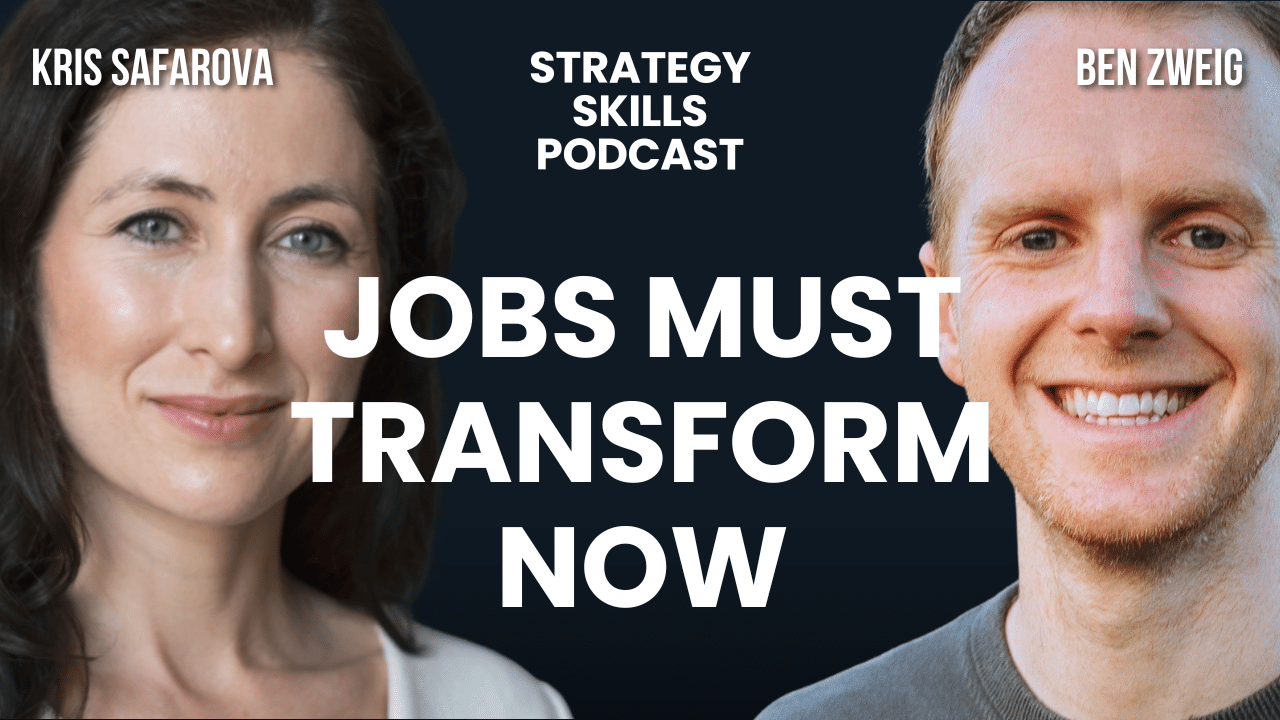
When most executives discuss AI, they focus on automation. Dr. Ben Zweig, NYU Stern professor and CEO of Revelio Labs, explains why the real disruption isn’t machines replacing people, it’s our failure to rethink how work is structured.
“Labor markets are not as sophisticated as capital markets,” Ben explains. “We allocate capital efficiently, but not labor. That’s a huge weakness in how our economy operates.”
In this conversation, we explore:
- Why every company must learn job architecture, seeing jobs not as titles, but as bundles of tasks that must constantly evolve.
- The three factors that determine whether AI causes unemployment:
- How quickly firms adopt new tech
- How individuals adapt their skills
- How flexibly jobs can transform
- Why middle managers now sit at the center of organizational adaptation.
“The top can’t really affect this meaningfully, it happens through line managers.”
Zweig challenges the old idea of “delegation.”
Instead, he calls for reconfiguration, a manager’s ability to reshape work as technology shifts.
“Don’t tell people how to do things. Tell them what needs to be done, and they’ll surprise you with their ingenuity.”
– General Patton, quoted by Ben Zweig
We also discuss the human skills that will rise in value: empathy, coordination, and the uniquely human ability to orchestrate complex systems.
“AI can execute tasks, but it doesn’t yet coordinate them,” he says. “That orchestration, what we call management, is still deeply human.”
For young professionals, his advice is both practical and hopeful:
“Manage a project from start to finish. Build something end-to-end. That’s how you train orchestration.”
Ben also shares how Revelio Labs uses large language models to build a scientific understanding of labor markets, and why “AI is only called AI until you understand it, then it’s just math.”
Here are some free gifts for you:
Overall Approach Used in Well-Managed Strategy Studies
Enjoying this episode?
Get access to sample advanced training episodes
Episode Transcript (Automatic):
Kris Safarova 00:45
welcome to the strategy skills podcast. I’m your host, Kris sarova, and this episode is sponsored by strategy training.com and you will be able to get key insights and actions from this episode if you go to terms consulting.com forward slash action. So it is f i r m s, consulting.com forward slash action. So for everyone driving, you don’t need to make notes. You can just go and get a download. And we also have few other gifts for you. Number one is you can get access to Episode One of how to build the consulting practice at f, i, r, M, S, consulting.com forward slash build. You can also download the free one page we prepared for you the overall approach used in well managed strategy studies at firms consulting.com forward slash overall approach. And you can get McKinsey and BCG winning resume, which is a resume that led to offers from both of those firms, and a great example to update your resume regardless of your level of seniority. It works very well at very senior levels as well. And you can get [email protected] forward slash resume PDF. And today we have with us Ben Zwick, adjunct professor at NYU Stern School of Business and the founder of Reveille labs, and we are going to dive into very interesting conversation.
Ben Zweig 02:10
Ben, welcome, yeah. Thank you. Happy to be here.
Kris Safarova 02:14
So we are going to talk about job architecture and building a language for workforce intelligence and how it is relevant to leaders listening to us. But before we go in that direction, I would love to get to know your story a little more. Could you tell us maybe some of the defining moments that led you to this moment? Now?
Ben Zweig 02:35
Yeah, for sure. So I think I really started my career in academia. I went to get a PhD in economics. I loved economics and and, you know, statistics and all that. So, so that was, that was kind of my passion for a very long time. And I think, you know, during during grad school, I, you know, while I was doing my PhD, I would teach a lot, and I’m still teaching. You mentioned I teach at NYU Stern, and I love that. I mean, it’s great. Love teaching MBAs and undergrads, and I teach the future of work and data analysis and stuff like that. So that’s great. I mean, that’s always been a passion. While I was in grad school, I had worked as a quant at a hedge fund for a little while, and it was so interesting, because data was everywhere, and everyone had a Bloomberg terminal. It was so ubiquitous. And just, you know, everyone in the whole industry had all the information they could possibly want and need, all really well formatted and structured and clean. So that was a very interesting experience, but I didn’t really want to stay in finance after I finished my PhD for a couple of reasons. One was because I realized I didn’t quite have the stomach for it. You know, I would, like, wake up nervous and be like, Oh God, how’s my portfolio doing? So, you know, you have to be kind of Zen, and and I’m not like Zen person, but another, another reason was I wanted to kind of see how goods and services get made in the real world. You know, I, you know, felt like, as an economist, I should see how real economic goods are created. So I went to IBM and and I worked in a group called the chief analytics office, which was kind of an internal consulting group. So we were, you know, we were like a data science consulting team. So we were a bunch of data scientists, you know, mostly with PhDs, some MBAs, and we, we were trying to advise the business units within IBM on how to improve business performance. There were a bunch of different teams, you know, some would focus on on, like sales effectiveness, and others would focus on, you know, channel partnerships and whatever. But what I was focused on was workforce analytics. So I eventually started, started running that team, and that was, you. Really interesting, because, you know, that was such a big part of how IBM made money. You know, was a big services company had the biggest white collar workforce in the world, I think, like, forge 1000 people and and it was also so not advanced, like it was really immature. And I think, you know, it was probably more advanced than other companies, but it was surprising to see that for a company that spends 75% of its money on people, it really was, was very behind in how, in how it allocated, you know, its workforce, and how to make, how it made workforce decisions. And then started realizing that lots of companies are very behind, and the whole industry is behind. I mean, labor markets are just not as sophisticated as capital markets. And I just thought, you know, this is a this is a big weakness in in how we operate as a society. And you know, if you deconstruct the economy into labor and capital, like, you know, it’s like two thirds labor, 1/3 capital, and we do allocate capital very efficiently. We don’t allocate labor very efficiently. So as a society, I felt like this is a really important thing to work on. So I started rebellio Labs, basically to make labor markets more scientific and rigorous. And that was the goal.
Kris Safarova 06:21
It sounds very interesting and definitely very promising, and I can see how there may be huge benefits. But at the same time, do we want to go even further to treating people like they are a resource? Yeah.
Ben Zweig 06:36
I mean, people are a resource, you know, I don’t think it necessarily has to be considered a derogatory thing, you know, I think, you know, firms are in the business of producing goods and services, and, you know, they use capital, labor, land, ideas, you know, all the all these different inputs, all these factories of production, and employees are a factor of production. I mean, that’s why we get paid to do jobs. You know that is, you know, we are, we are trying to take the raw stuff in the world and turn it into consumable goods and services. And, you know, as humans like we are a really good resource for doing that. I think in some way, it feels, you know, like, like nobody wants to feel like they’re a widget and just being measured and being reduced to, you know, some, some sort of thing you could do math with. So I get that idea. I mean, I think I’m sympathetic to it, but I also think that, like, if we, if we do get better. If we can somehow get better at optimizing the way that people get allocated toward the right work activities and working on the right output and working in the right firms, then I think that leads to more actually fulfilling work lives like I think we will actually be a more, you know, enlightened, happy workforce, if, if we’re, if we’re able to be allocated more efficiently. So I think sometimes, you know, like, when, when work really gets depressing. I think is, when is when there’s, there’s not the right match between the worker and the work. So, you know, if, if you’re sort of, you know, put into a job that doesn’t really match your skills and interests, if it’s not allowed to to transform quickly enough, if you’re, if you’re told to do things that don’t really make sense, you know, like, though, that can feel awful. You know that, that can be really depressing. But I think, I think a big part of getting the most out of people’s time is really about listening to them and giving them autonomy and initiative and reconfiguring things, you know, kind of actively. So I think that with a little bit more like math and science, we can actually a little bit counterintuitively, you know, give people real, real fulfillment in their in their work,
Kris Safarova 09:11
but and what they think is some of the most expensive misunderstandings leaders have about how they people create value.
Ben Zweig 09:20
There’s a few. So one is that, I think, I think organizations, you know, very often think in terms of jobs and skills. You know, they have jobs that need to be filled, and they have skills, which is, you know, are attributes of people. I think that that introduces some limitation it, you know, if you think about, you know, some, some like static alignment between skills and jobs, you end up being very prescriptive about how work needs to get done and, and that, I think, ultimately creates bad jobs and and the. Inability to adapt to change. So I think the I think a a better way to think about it, a different way to think about it, is that, you know, jobs are really just bundles of work activities, bundles of tasks. And, you know, skills are, importantly, like an attribute of of people, along with a whole other set of attributes. You know, people have experience and interests and attitudes, and, you know, ambitions and all these different things. Skills are one part of that. And all of those are really inputs into completing the work activities and and if you think about, you know, jobs in terms of their work activities, then, then you can reconfigure people’s jobs. Then you can say, well, you know that maybe someone was hired to do these 15 things, you know, have 15 responsibilities, but maybe one, maybe a handful of those are going to be automated by some new technology. That’s a big topic today. Maybe some of those are just not required anymore because of a change in business strategy. Maybe those, maybe some of those are required even more because of new client demands, or some, or, you know, people on the team leaving or something. But, you know, organizations are very fluid, like things, things change all the time. So I think, I think the, I think the best way to kind of make the most, you know, get the most out of your people, is to allow them to adapt to changes. So I think, you know, sometimes managers see their responsibility as, you know, delegating things to their people. You know, they hear what needs to be done, and they have to, like, you know, delegate to their team, make sure they’re, they’re well coached and and, you know, getting along well and productive and all that. But I think, I think the role of managers can evolve to to be more about reconfiguring people’s work. So, you know, you’ve got, you’ve got a team, and you’re aware of the organizational needs that are changing, and that requires people to do different things. You know, maybe, maybe you need to, you know, work with your team and say, hey, you know, there’s this extra piece of work that needs to get done. Who’s possible to do it? How do we shift the borders between sub teams. You know, there’s this other shot, there’s this new technology or vendor or automation, and you know, maybe we, we need to do less of this. So, you know, how will you spend your time and kind of working with their team to just kind of align with the needs of the broader organization? So I think, I think managers can play the role of, you know, the liaison between, you know, employees who are changing their work content and the organization whose needs change. So I think that is, is an underrated and powerful way to kind of manage employees,
Kris Safarova 13:03
and for someone who is listening to us right now, who has a team reporting to them, based on your research, your understanding on this topic, what should they do differently, what they most likely do in a way that is not efficient, not effective, not the best way to manage their team?
Ben Zweig 13:18
Yeah, I think they need to give their team autonomy to think about the best ways to get a job done. I think you know that there’s this quote from, I think, General Patton, where he said, you know, don’t, don’t tell people how to do things, tell them what needs to be done, and they’ll surprise you with their ingenuity. And I think that’s that’s getting more and more true in the age of, like, you know, disruptive technologies, where the ways of getting things done are are changing. So I think, you know, there’s an element of management, and there will always be an element of management that has to do with coaching. But I think more and more management needs to transform into, into, you know, more of a more of a partner with with the employees, more more about, you know, listening and jointly brainstorming, you know, different better ways of of getting some work done. So I think the, you know, the speed at which we can reconfigure jobs is really critical. If we can adapt then, then we’ll, you know, have a competitive advantage over firms that are more procedural, more bureaucratic. So I think the more adaptive organizations will be, will have an advantage, and managers really play a central role in that. I think if anything, you know, the top of the organization can’t really affect that meaningfully. I think this all kind of happens, you know, through through line managers, middle managers,
Kris Safarova 14:49
of course, and then for a person listening to us right now, let’s say they also worried about their own job. They very scared about what’s happening with AI and how they. See the organization playing off people. What would be your advice?
Ben Zweig 15:05
I mean, similar advice that, you know, jobs need to transform. Jobs need to adapt. You know, if, if AI can do part of your job, I think, you know, just, I think, embrace it. And, you know, let that, let that happen, and think of other ways to be productive. I mean, there’s no shortage of work that needs to get done. I don’t think anybody really thinks we are running out of important things to accomplish in the world. There’s, or even for any single company. I mean, there’s, you know, even in my own organization, you know, we have 70 people or so. And you know, there is an endless list of things we’d like to do if we had the time and resources and bandwidth. And I wish that that people had had more, more bandwidth. So I think if you find yourself, you know, able to be, you know, if you find your job able to be transformed or able to be augmented, I would say, embrace that as much as you possibly can.
Kris Safarova 16:11
What do you think will likely happen in the US now with AI advancements, and what will be happening with layoffs and so on?
Ben Zweig 16:19
It’s a great question. So I think there’s, you know, there’s a concern about about labor displacement, about technological unemployment, and you know, will, will people lose their jobs because of, because of automation? I think there are really Excuse me. There are really three factors that excuse me, that determine you know whether that will happen and what speed that may happen at. So one is about the elasticity of firms with respect to technology. So what I mean by that is how, how reactive can companies be to new technologies? Will they adopt new technologies very quickly, or will it take them a long time if they adopt, if they, if they adopt new technologies very quickly? Then, you know, maybe there’s more disruption. Maybe that’s that’s going to be harder to keep a handle on. If they’re very slow. Then, you know, let’s say firms just don’t adopt technology, then nothing changes. You know that then, then there will be no labor displacement. So I think that that’s that’s a a factor that, you know I’m paying attention to closely, like, you know our firms, you know our firm’s taking action, and at what speed are they taking action? And how is that distributed between big firms small firms, I think what I’m noticing is that it’s happening a lot faster within small firms, which, you know, makes me suspicious of the you know, the viability of larger, more procedural firms to stay competitive. So that’s one factor. Another is the elasticity of labor supply with respect to technology. So, so the idea there is, are individuals reactive to new technology? You know when, when new labor displacing technology comes out? Do? Do individuals change their careers? Change their skills, learn new things. If you know, if they do, you know if, if, if they’re completely responsive, if they’re super responsive, then you know, everyone will just train in something that’s not able to be automated and like great. You know, the world can react if, if employees, if individuals are slow to adapt, that’s troubling. So, so I think that this depends a lot on individual’s ability to to, you know, re, you know, reestablish themselves in new careers. And I think that that is, that is worrisome. I think, I think a lot of individuals take too long to to kind of, you know, adapt their their careers so that that’s something that is, is, is worth paying attention to, especially, you know, older, more established workers, you know, it’s, it’s hard, it’s hard for them to adapt. I think younger workers are, are choosing their careers a little bit more intelligently than, I think, previous generations. And the third most important factor is the speed at which jobs can transform. So back to, excuse me, back to this idea of transformation. You know, how, how quickly can can jobs reconfigure? So if, if jobs are very defined and rigid, then labor displacing technology can actually cause Technological Unemployment, like, if you know, if you have strict occupational licensing, where you know, if you’re a phlebotomy. Something you have to do a very precise thing. And if you do something that’s not related to that, you know, you’re like, slapped on the wrist, or in trouble or something that that makes me worried, because jobs do need to transform. So I think, you know, if there are certification boards like, you know, for accountants and lawyers and stuff like that. I’m very nervous about those. I think those, those are introducing too much rigidity to properly adapt. But, you know, something like consulting, in contrast, does not have that. There is no consulting board where they say, you know, if you’re a consultant, you’re allowed to do these 25 things, and you’re not allowed to do those 30 things. It’s not like being a doctor or nurse like you. You have the, you know, consultants have the flexibility to to, you know, adapt and reconfigure what they do and how they do things. So I’d be less concerned about the types of roles that can, that can adapt to new technology. I think, I think that is the most dominant factor which is going to determine whether we will have technological unemployment. I think what we’re seeing now is a meaningful reduction in the demand for young workers for entry level positions in in highly exposed, like in jobs that are more exposed to to AI tasks, to tasks that AI is suitable to substitute. And I think there’s, there’s a question about why that is. You know, one theory is that it’s because these firms are already replacing these, these entry level workers with with automation, processes with AI, I don’t think that’s what’s going on. I think, I think what’s more likely happening is that it’s, it’s the expectation of some uncertainty that is, that is making firms more conservative. So, what I mean by that is that, you know, if you are, if you are a company, and you don’t really know what’s going to happen in the future, you may want, you may want, to play it safe, and hiring more experienced workers is a safer bet. I mean, hiring younger, more entry level workers, it always takes a bit longer, you know, it takes time to train people, and, you know, it’s, uh, it’s lower cost, but like a higher risk bet. So entry level workers, you know, always have a bit more of a delayed payoff, a bit more of an uncertain payoff, than experienced workers. So I think, I think what we’re really seeing is a bit of a retrenchment, where, where firms are just being more conservative than they would ordinarily be if there were more certainty about the future. So that’s what I think is going on with with entry level workers, and that like big drop in demand that we’re seeing. So that’s, that’s worrying, and but, but I don’t think, I don’t think we have enough evidence that that’s really, like, you know, permanent phenomenon at this point.
Kris Safarova 23:10
And what do you think are the complementary human skills, or critical human skills that will rise in value as AI is used more and more?
Ben Zweig 23:20
Yeah, there’s, there’s a wonderful paper about this. I’m, I’m forgetting the name, but it’s written by actually forgetting, forgetting her name. But I can, I can look it up later and let you know. But it goes through these, these five, oh, epoch. Epoch scores, some acronym, EP, you know, but E is for empathy, and, you know, I forget what the others are, but identifies like five kind of uniquely human capabilities and and has, has shown credibly that there’s increase in demand for the types of skills and competencies that that complement AI and that are and that are less substitutable. Um, so I think, you know, there’s, there’s a handful of those. You know, certainly, you know, I don’t think you know child care and therapy and stuff like that are, are close to to automation. There’s also another factor, which is kind of more of like a meta factor that I would that I would say that I that I think is is safe, and that’s really around coordination. So, so, you know, we, we, you know, as as workers, you know, we all have jobs where we have a set of responsibilities. And I mentioned, you know, a job, you can think of a job like a bundle of tasks, but it’s not really just a bundle of tasks. It’s not, it’s not just, you know, you’re not just executing tasks in a job. You’re also coordinating between those tasks. You’re also playing the role of an orcas. Trader. So you’re deciding which tasks come first, what comes second. What’s dependent on what? How does it relate to what other people are working on? And you know, you’re, you’re orchestrating all sorts of things that are happening, and you’re figuring out how everything fits together. And that’s, that’s not something that AI is is doing today. Now, maybe with more agentic systems, maybe there can be some coordination between between subtasks. But you know, if that happens, then, you know, you can, you can call that a process, and that needs to be coordinated with something you know, that there’s no end to, like, the hierarchy of what gets considered a, a, you know, definitive task and what needs to be coordinated with what. So I think that that coordination, that that orchestration, you know, you could call it management, that management is, is, you know, is uniquely human, I think, and at least for now, and that’s something that I think, is probably also part of the story about why younger workers are doing more poorly than more experienced workers in the market today, because more experienced workers have more experience orchestrating things and coordinating and younger workers typically have been hired to execute on tasks and not manage processes. So I think that is a shift.
Kris Safarova 26:28
And for younger workers, which is a minority of our listeners, but still just to make sure we don’t just leave them there all set and with no hope, what would be your advice for them? Because obviously you can still have a very successful career, you just need to think carefully and take the right actions.
Ben Zweig 26:45
Yeah, for sure. I mean, I think, I think I really have two, two sorts of advice. I mean, one is that I think, I think you can train skills in orchestration, and I think the best way to do that is to manage a project from start to finish, and just deal with all the interconnectivities between those. So I think just build something, make a product. Make a, you know, little business like do, do something, you know, do something from beginning to end, just, just some end to end process that that you can figure out how everything fits together. So I think, I think, you know, taking on projects that are more holistic, I think, is good training. You know, if someone’s still in school, I’d say, you know, choose the classes that give you that that kind of end to end process. I think that that’s um, you know, or the professors who teach in that way, you know. I think that’s generally, you know, would be good advice. Another, another piece of advice is just, is just more networking. So I think, you know, social, the social elements of jobs are, you know, have been increasing, you know, over the last century or so, and and they’re continuing to increase. And I suspect that that will only become more important. And you know, even just finding a job is so has so much to do with networking. I mean, you know, every you know, once you’re in a domain, once you’re in a space, you really find that that it’s a small world. And, you know, feels like everyone knows each other, and everyone’s got a way of thinking and kind of sub language within that. And, you know, I think my recommendation would be to, you know, engage with the community and figure out how they think and talk and listen to the podcast they, they, they listen to and and just, you know, yeah, and invest in, in diving into a community.
Kris Safarova 28:45
But and how do you yourself keep track of what’s happening and make sure that your company does not fall behind?
Ben Zweig 28:53
I think it’s, it’s, um, it’s hard to stay at the cutting edge of everything. So I would say there are some, there’s some parts of the business where we want to be, you know, at the frontier. So, you know, for, for, for our business, you know, we’re workforce data company, and we rely on, you know, data scraping, and, you know, data science and natural language processing. And, you know, distributed systems and and, you know, we and economics, you know, labor economics, and so I think those are the domains where we really want to be at the at the cutting edge of something, and we want to hire people who are at that, at that frontier. And I think that pays off, because, you know, the best employees want to be working at the frontier, and so, so I think it’s actually like, you know, it helps us in recruiting. But then there are other areas where we just don’t want to be at the frontier, you know, and you kind of have to choose your battles. So, you know, we there’s a lot of things we just, you. Don’t do, you know, we don’t do SEO, and we don’t do, you know, we don’t try to optimize pricing. And you know, there’s, like, I don’t know. I mean, we, there’s, there’s just a lot of areas where, where we just don’t focus, or just kind of take a traditional rule of thumb approach. And I think that’s just about choosing your battles. So, yeah, I think we want to, we want to stay ahead of the curve in areas where we think that’s really important, in areas that are more like positive some but, you know, just to, just to go back to pricing for a sec. I mean, that’s an area where we feel like, all right, maybe we’re a little bit too high, a little bit too low, whatever it is, like, you know, it, you know, it’s probably not worth, you know, optimizing that too much, because, you know, if we make the wrong call, we’re probably not that far off. So there’s, there’s a lot of areas where you can kind of just, you know, not be super thorough and, and that’s, and that’s just, that’s just okay, maybe you’re leaving opportunity on the table. But you know, there is, there is a cost to, you know, taking on too much.
Kris Safarova 31:12
Of course, there’s only so much you can do, yeah, and to the degree for comfortable sharing. How do you currently use AI for yourself, for your business, anywhere where you integrated it in the workflows.
Ben Zweig 31:25
Yeah, so, so when, when we first started, I mean, we were a kind of natural language processing company, you know. So we’ve been using the earliest models of large language models, way back in 2018 2017 2018 really, right after, like, word to back and doc to vec, you know, came out as, like, the first real large language models, of course. Now, you know, we’re using transformers, which is, of course, what like, you know, GPT. You know, it’s the T and GPT. You know what all those are based on. So I think we’ve been very lucky to be in a space where, you know, we’re built on large language models, and those have gotten better and better. So we’ve been benefiting from technology just marching forward. So, so that that’s that’s really used as we as we do job architecture, you know, job architecture is really about creating categories of people, you know, into occupations, skills, work activities and the rd levels, and that that just wouldn’t be possible without, without llms, without large language models, because, you know, with capital data, you have, you know, entire professions who categorize financial data. You know they’re called accountants, like everyone’s heard of accountants that they are just is their job to categorize things, and there is nobody whose job it is to categorize employees, and that really has to be done by AI so so that that’s a huge part of what we do and and now we’re using it in processes that we never thought we’d use it for. So even you know for discovering new job posting feeds to scrape. You know that that’s, you know, we use AI in that process summarizing. You know, we have a lot of data from employee reviews, from sites like Glassdoor and stuff like that, where, you know, it’s a lot easier to just, you know, show, what do people like about this company, what do people generally not like about this company? And, you know, these are tools that can summarize, you know, 1000 reviews and write it in a paragraph that sound, you know, that actually is a good summary of what people like or what people don’t like. I mean, there, there’s so many, there’s so many ways that, you know, we can use it for labeling. You know, let’s say we create a category and, you know, we create some set of companies, and we say, yeah, here’s a set of similar companies. Can you label this industry? You know that that is, is easy now, yeah, there’s, and then just, just, personally, I mean, there’s, there’s one application that I love called notebook LM. It’s like from Google, but it basically takes, you know, any sort of paper or article and it turns it into a podcast. So I love that. As you know, podcast aficionado, it’s great, you know, I upload some academic paper and it creates, like, a conversation about the paper. And I’m just getting through a lot more research than I would if I had to, you know, read some 60 page paper myself, you know, things that would take me two months. You know, take 30 minutes while I’m like, doing dishes. So that’s just a wonderful tool. And, you know, yeah, I mean, it’s just very exciting to discover new applications all the time.
Kris Safarova 34:41
But, and you’re teaching MBAs and the graduates, what is the current state of mind for students, given what’s happening in the world?
Ben Zweig 34:49
It’s funny. I mean, yeah, so I started teaching the future of work during, I think, yeah, during covid. I think that was the first time I was teaching it. And since then, you know, every I teach it once a year. So every year is so different, you know, the first the whole conversation was about, you know, remote work and all that. And then, you know, right after that was the great resignation and the big, you know, recovery and how, you know, how people’s relationship with their with their firms were changing, and then there was all this, you know, pay transparency and quiet quitting and, you know, and now it’s all about AI, you know, now that that is such a dominant factor in what we’re paying attention to. And it’s really only been, like, a couple of years and and even even one year to another, even after that are, they’re just different, you know? I mean, the world’s changing so quickly, so I don’t know what, you know, I’m gonna, you know, teach again in January, and, you know, it’s been, I don’t know, six months or so since, since I last thought. I don’t know where people are, but I it’s always fun to kind of gage, you know, how, how people are thinking or feeling about about the state of the labor market. I mean, I think last last year, there was a lot of skepticism, and I think cynicism that was also right around the time when, like, dei was become, was kind of like, you know, disappearing, essentially, as as, like an initiative. And I think there’s been, like, disillusionment with with labor markets, with with firms. You know, layoffs are high. You know, there’s a lot less mobility in the labor market right now. So, you know, hirings at a at a at a low, and attrition is also at a low. People are just staying put. So it seems like there is some despair and disillusionment, and nobody really knows what’s going to happen. And of course, you know, neither do I, you know, and it’s anyone’s guess about how the technology evolves and how society adapts to it. But I think, I think kind of, you know, the best we can do is have good, good frameworks and theories for thinking about, you know, how labor markets function and how we should think about, you know, how work, what work is, and how it changes, how we how we measure that and how we think about that. So I think, you know, we really have to position ourselves to be as adaptive as possible to an uncertain world. Definitely.
Kris Safarova 37:30
Are there any information sources you feel comfortable sharing which you could recommend for someone who feels they are falling behind they weren’t paying enough attention to what’s happening with AI and technological advancements. And they want to catch up books, maybe, or newsletters, anything. Yeah.
Ben Zweig 37:48
I mean, so, so I will, you know, I’ll plug my own I, you know, I wrote a book called job architecture, which is really about, like, how how jobs are structured, and how to think about that. And you know, how it relates to AI and technology and organizational change generally. And then my company, rebellio Labs has a newsletter. So we send out a weekly newsletter where we, you know, we have a team of economists, and we write what we think is interesting every week. So we have, you know, weekly newsletter. It’s usually really short. It’s like few paragraphs and a few charts, just about something interesting. So just just today, we came out with a newsletter about, you know, the returns to certain skills. So, you know, in the age of, like, vibe coding, you know, what is the returns to, you know, programming skills, like, Should you still learn Python? And you know, is that, is that as important as, you know, learning, you know, AI ops, or something, and, and so, so, you know, we have a way that we think about, like, what is, what are the returns to these skills? And that, that’s, you know, an example, and next week, it’ll be something different. But I think that’s the goal is to help, you know, people just be informed about what’s happening in the world as it relates to employment and work. For someone
Kris Safarova 39:09
reading your book, what are the key things you want them to take away?
Ben Zweig 39:14
One thing is that, you know, we we do a lot of analysis, I think, as as you know, people who are analytical, you know, in you know, you know, analyzing organizations, analyzing HR, analyzing like organizational effectiveness. We, we’re, we’re very often analyzing groups of people. You know, the whole field of workforce analytics, people analytics is, is about analyzing segments of of employees, I think so much of of consulting and M and A integration and private equity diligence, and you know, all these different things is about. It’s about analyzing groups of people, you know, and. The way that those groupings get created matters so much so I think it’s, it’s very it’s very easy to just jump into an analysis and just use some, you know, functional breakdown or something. But if we’re not really thinking about the categories properly, then, then a lot of the analyzes we’re going to create will be, will be weaker than they could be, and and maybe, and maybe the results will be suspect. I mean, so many examples of projects that I, you know, worked on while I was at IBM, and, you know, we were analyzing groups of people, occupations, skill groups, and, you know, we did an analysis and then realized that, oh, you know, we’re seeing, you know, the best performing and the worst report performing are actually like synonyms for each other. And, you know, and we weren’t really categorizing people properly. And you know, there’s so many examples like that. I think, you know, anyone’s who’s worked on, like, you know, consulting projects, and, you know, probably has had the same experience that we often do, do some some segmentations. And you know, those segmentations are very often really bad. And, you know, just just being thoughtful about how we how we segment the world into taxonomies, whatever those taxonomies are, whether they’re occupations or products or industries or something, you know that, you know, good analyzes really live and die by how well you segment things. And I think that’s just something that becomes more and more important the deeper you get. So I would encourage people to just, you know, be really, be really thoughtful about, you know, how you’re categorizing people or or companies or anything.
Kris Safarova 42:01
But what do you think people don’t understand about AI, or most people don’t understand about AI?
Ben Zweig 42:07
Yeah, it’s a great question. I mean, you know, even what gets gets considered an AI? You know, what gets considered AI is kind of a moving target, um, you know, I remember when, you know any sort of machine learning was called AI, and, you know, regression was called AI, and you know, rule based systems were called AI. And there’s this expression in in the AI community that it’s only called AI until you understand it, and then it’s and then after that, it’s just math. And you know that there’s, you know, so much is being labeled AI, which is kind of a catch all. So I think you know the, you know what, what, what is commonly referred to as AI right now is these, these, these generative transformer based language models. And what those do really well is, is summarization, you know, I think they’re very good at, like, you know, having a mental model of, you know, all the information on the internet and, you know, providing information that that kind of aligns with that. So I think when, when people talk about hallucination, hallucinations and stuff like that. That’s, that’s really, that’s really AI not doing summarization, that’s trying to create something that that doesn’t have a good basis in the, in from, in the base information. And that is probably a little bit of a misuse. I think, I think the best uses of AI are still in summarizing information and distilling that in, like, efficient and effective ways. I mean, I think, you know, I don’t want to just say it’s summarizing existing text. I think there’s also a lot of inference that you do from when you go from from one idea to another idea. And I think it’s like, you know, they’re very powerful ways to do that. You know, can generate entirely new things based on the patterns that exist when, when summarizing online information. So I think it’s just, it’s, it’s, it’s such a powerful thing to do, but I would be very wary of taking that idea and extending it and saying, Well, you know, it’s good at stuff, it’ll just get better at stuff and then and then thinking like, All right, well, you know, it’s on this trajectory where it’s getting better and better at, like, performing tasks, and pretty soon it’ll just perform every task. I think that that type of thinking is is too much extrapolation beyond beyond what is reasonable given the base technology that underlies generative AI, makes sense.
Kris Safarova 44:57
I want to wrap up with one or two questions. So I love to ask, when there’s time, yeah, if you could instill one belief in every listeners heart, what would it be,
Ben Zweig 45:07
yeah, how about this? I mean, I think, yeah. I mean, one, one belief that, that that I have, that I think I that I’d love to, you know, instill in other people is that there’s a lot of there’s a lot of inefficiency in the corporate world and and there’s so much that can be accomplished just, you know, on your own, I think there’s a lot of returns to specialization. You know, within, within startups and vendors and just, you know, technology companies. And I think that you know, if someone really understands a domain and understand, you know, I think they, they’ll understand what, what works well in that domain, what doesn’t work well, what technology needs to exist, what you know, where, where people are relatively well served, and where they’re not well served and and there’s also, you know, some types of effort that really should be done by every organization themselves, and Some types of effort that that should be done once, a single time by one like, you know, centralized entity. And I think more people should start companies and create that centralized technology that needs to exist and should exist. So, yeah, I think there’s just so much that can be done by small companies more efficiently than what gets done by big companies. And yeah, you know, I’d love to see a world where more people, you know, take chances and, you know, pursue big
Kris Safarova 47:01
ideas, and over the last, Let’s even say, over your entire lifetime, where they want to Aha, moments, realizations you feel comfortable sharing that really changed the way you look at life or the way you look at business.
Ben Zweig 47:15
I mean, one, one thought that I that I heard, is really, um, is really that, you know, there’s a few like ways to think about, like, how to be, you know, you know, there’s, there’s a few like, one liners about, like, how to be a good, you know, CEO, like, people love to say, like, oh, as a CEO, you have one job, you know, don’t run out of money or something, you know. And people love to distill the job into, like, one, one thing. And I think the best, the best one liner I heard, is that if you take care of your team, they’ll take care of your company. And I think that is something that that has dawned on me more and more, that you know, people like I’ve just been, I don’t know if it like really happened in one moment, but at rebellio, you know, I see a lot of, a lot of the people who work with us, you know, like, there are people who’ve really put their heart and soul into what they’re building, and people who’ve really take pride in their work and just feel so, So proud of, you know, who they are professionally. And you know, they want to make their team proud, and they want to, they want to do what’s best for for their their co workers, and who are their friends and and, and they really get so energized by by big ideas. And I think, you know, there were a few moments where I really saw that and, and I just thought, you know, that’s that meant that needs to be nurtured as much as possible, like that, that’s, that’s everything there is, like, if you can, if you can, foster that type of dedication, then, then everything’s going to work out fine. And you know, if, and, you know, everyone wants to be in a place where, where everyone’s like that. So I think just, just trying to create an environment where, where people really, you know, take pride in what they’re doing and feel like they’re on, you know, an elite team. And, you know, it’s exciting for everybody, and it pays off. So I think that that really kind of shaped how I like to think about how to operate. That was, that was a big one. Yeah, thank you.
Kris Safarova 49:30
Ben, thank you. Where can our listeners learn more about you? By your book? Anything you want to share?
Ben Zweig 49:36
Yeah, for sure. So, so me on on LinkedIn. So I’m very active on LinkedIn. You know, always, always sharing thoughts on the labor market and data and taxonomies and all that. And my book, you know, it’s on Amazon, so job architecture, it’s, it’s there, coming out January 13. So, yeah, that’s, that’s what I recommend. And rebellious labs on, on LinkedIn as well. So. LinkedIn is really you know where we where we are the most active
Kris Safarova 50:04
Ben, thank you so much for being here. Really appreciate this conversation.
Ben Zweig 50:07
Thank you. Yeah. Likewise, our
Kris Safarova 50:10
guest today has been Ben swig, adjunct professor at NYU Stern School of Business and an author of a book called job architecture. And our sponsor today is strategy training.com and you actually can download key insights and ideas and action items from this session today at firms consulting.com forward slash action. You can also get access to Episode One of how to build a consulting practice at firms consulting.com forward slash build. You can get the overall approach used in well managed strategy studies at firms consulting.com forward slash overall approach. You can also get McKinsey and BCG winning resume that led to offers from both of those firms at firms consulting.com forward slash resume PDF. And lastly, you can get a copy of one of our books called name leaders in action. It went to number one bestseller on Amazon and multiple categories, and you can get [email protected] forward slash gift. Thank you so much for tuning in, and I’m looking forward to see you all next time.
Leave a Reply