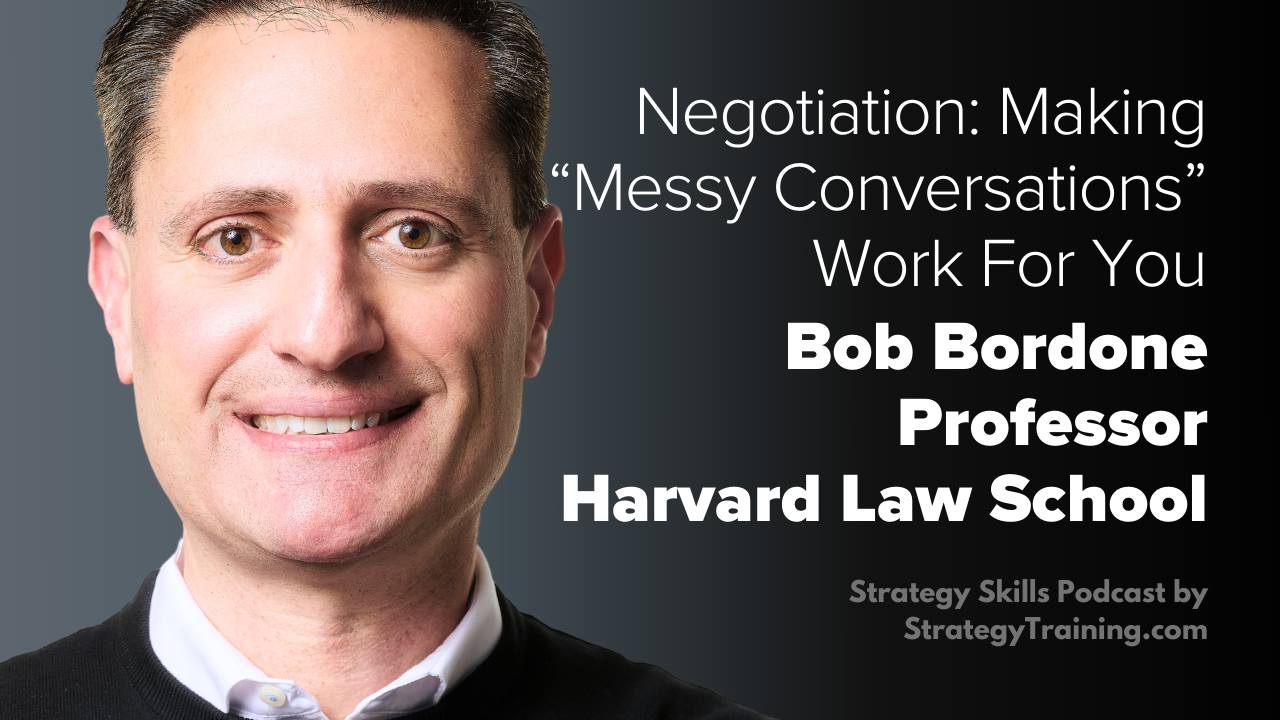
Welcome to Strategy Skills episode 531, an interview with the author of Conflict Resilience: Negotiating Disagreement Without Giving Up or Giving In, Bob Bordone.
Most of us instinctively avoid conflict, seeing it as a threat rather than an opportunity for growth. What if the conversations you dread most could actually strengthen your relationships and lead to better outcomes?
In this episode, Harvard Law’s Bob Bordone talks about negotiation and conflict resolution. He discusses seeing conflict as an opportunity instead of a threat, and shares practical tips for handling difficult conversations. The episode covers when to address or avoid conflicts, dealing with family disputes, and the importance of being a good listener. Bob also offers advice on understanding others’ perspectives, managing topic-switching, and dealing with uncooperative partners and difficult people.
I hope you will enjoy this episode.
Kris Safarova
Bob Bordone is a Senior Fellow at Harvard Law School and the Founder and Principal of The Cambridge Negotiation Institute, a boutique consulting firm providing coaching, consulting, and training in negotiation conflict resilience, mediation, and conflict resolution.
He spent 21 years teaching full-time at Harvard Law School where he founded the Harvard Negotiation & Mediation Clinical Program. He is co-author/co-editor of three books, including his latest, Conflict Resilience: Negotiating Disagreement Without Giving Up or Giving In.
Get Bob Bordone’s book here:
Conflict Resilience: Negotiating Disagreement Without Giving Up or Giving In
Here are some free gifts for you:
Overall Approach Used in Well-Managed Strategy Studies
Enjoying this episode?
Get access to sample advanced training episodes
Episode Transcript:
Kris Safarova 00:45
Welcome to the Strategy Skills podcast. I’m your host, Kris Safarova, and our podcast sponsor today is StrategyTraining.com. If you want to strengthen your strategy skills, you can get the Overall Approach Used in Well-Managed Strategy Studies. It’s a free download be prepared for you, and you can get it at firmsconsulting.com/overallapproach. And you can also get McKinsey and BCG-Winning Resume, which is a resume that got offers from both of those firms. And you can get it at firmsconsulting.com/resumePDF. And the last gift I have for you today is a book I co authored with some of our amazing clients. And you can get [email protected] forward slash gift, and it is called Nine leaders in action. And today we have with us Bob Burdon, who is a senior fellow at Harvard Law School and the founder and principal of the Cambridge negotiation Institute, a Bucha consulting firm providing coaching, consulting and training in negotiation, conflict resilience, mediation and conflict resolution. He spent 21 years teaching full time at Harvard Law School, where he founded the Harvard negotiation and mediation clinical program. And he’s co author and CO editor of three books, including his latest, conflict resilience. Bob, welcome.
Bob Bordone 02:07
Kris, thanks so much for having me on. I’m delighted to be here.
Kris Safarova 02:11
What first inspired you to pursue a career in negotiation and conflict resolution?
Bob Bordone 02:16
Yeah, thanks for that question. You know, I am not one of those people who went to law school for the purpose of doing negotiation or conflict resolution, but I was a very, very unhappy first year law student at Harvard Law School, and then was very fortunate that at the start of my second year I took an amazing course on negotiation, and that course kind of rocked my world, because it really aligned with many values that really mattered a lot to me. So I went to law school for the purpose of hopefully actually helping people and making a difference in the world. And what I discovered in the field of negotiation conflict resolution was just the the power of things that, frankly, I wasn’t very good at, like perspective, taking, like listening, like imagining the world from the from the position of the other party. And how do you frame issues? And so I was really compelled by the material. It impacted me in a very powerful way. And and for me, I thought of it as something I could do professionally that would be aligned with my values. I would say the other thing that’s really fun about the field is just how interdisciplinary it is and how applied it is, right, anyone in any business setting, if you manage anybody, if you lead anybody, this set of skills is just essential to success. And so I think for all of those reasons, I gravitated toward this and had not, you know, not changed since.
Kris Safarova 04:04
And I’m so glad you found something that you enjoyed. I know what it is like to be unhappy doing something a lot of the day. And so I’m so glad that it only one year, and after that, you were able to find something.
Bob Bordone 04:17
I am too. You know, Kris is really funny, because in my first year, my first summer as a law student, I realized that while legal issues were interesting to me, the day to day lawyering was maybe not for me, and that I actually spent my second summer at BCG. And had I not had a chance to return to Harvard Law School to start teaching, my plan was actually to go to McKinsey, and I’m sure I would have loved that, but I think part of what drew me a little bit more to the consulting over the law was that problem solving orientation, and I agree with you that finding something that makes you excited to wake up in the morning professionally is means the world.
Kris Safarova 04:59
Do you remember what specifically made you realize you know what? Yes, management consulting is very interesting, but I want to remain in the field of negotiations and mediation.
Bob Bordone 05:11
Yeah, that’s a great question. You know, I don’t have, like, some specific eureka moment. I will say that the way my career got started, I was making a choice after my clerkship to either begin a position as a lecturer at Harvard Law School and as a deputy director of a negotiation research project, or going to McKinsey and both. So I was super lucky in that way. But it occurred to me that if I went to McKinsey, the likelihood of returning as the lecturer was low, but if I did the kind of what seemed to be short term job at Harvard, that probably McKinsey would still be interested in me. So that’s not a big, powerful, profound story. But then what I found is, over time, the negotiation work just was really fulfilling. And there was a moment after about three years where I thought to myself, well, maybe I should do this consulting thing. And then I thought, am I bored? No, am I finding this challenging? Still, yes, I think partially because of the interdisciplinary and the Apply nature of negotiation and conflict, there was always more learn, and then the kind of deeply interpersonal aspect of it, the fact that you could really see results. And I thought, Gosh, this is clicking all the boxes. So I’m just going to kind of stick with this and and I will say, though what I do has grown and changed a bit, those essentials are still really there.
Kris Safarova 06:51
And I know that in your book, for example, you talk about how conflict can be an opportunity, not just a threat. And of course, many people try to avoid conflict because of many reasons. Some people feel uncomfortable and some people actually physically suffer because maybe of earlier trauma and then so they have this overreaction to even minor conflicts. So do you remember a personal experience, if there was one that convinced you that conflict can be an opportunity and not just a threat?
Bob Bordone 07:19
Oh, yeah. I mean, thanks for this question. I think, gosh, there’s so many personal experiences for me. I mean, I think at the most kind of just relational. What I have found in my own life is that the anxiety and fear about having a hard conversation or raising something that might ruffle feathers was almost always worse, always, almost always worse than actually raising it. I think, you know, I mean, I don’t know you somehow your your first question has cast me back into my law school days, and I remember just an early experience when I was, I think first kind of leaning into this idea that conflict was not the bad thing, it was how you handled it that could be bad. And it’s kind of a funny story, but a true story. Of I had a very dear friend who got dumped by his girlfriend, and I felt like for the three or four weeks after that, every single night, I would spend hours on the phone with this person, trying to comfort them, trying to problem solve, and I would say things like, you’re better than she is, or you’ll get over it, or maybe you should try again and she’ll take you back. And then I just had this realization that actually, in many respects, I was like filling in as the emotional support for this now gone girlfriend. And what I had to do is say something like, I can be a friend to you, but I can’t actually be a counselor, and I can’t also be your significant other. And that was hard for me, because it felt like I was letting someone down, right and a lot of us, and certainly high performing executives, we fear letting someone down, but the experience of saying, I’m just going to name this very directly in a conversation, actually, actually deepened our friendship. And I think if I didn’t do that, I would have probably exited the relationship at some point just out of sheer exhaustion, or we would have, I would have concocted some kind of fake fight to no longer say friends with this person. And I think that was the first time that I realized confronting something that would feel difficult in a relationship, that might cause something that would feel like conflict, or at least for me, it felt like that actually could have a good outcome. And actually. To be more deepening of the relationship, even if there was some disappointment on his end, that that would be better. And I think just through my life, whether in a professional situation, I could think about times when I delivered really tough feedback to someone who I was working with about ways that they didn’t live up to my expectation, and maybe it was an unpleasant moment, but that would help us figure out how to move forward, instead of saying some nice placating things and kind of hoping the problem would go away.
Kris Safarova 10:35
Bob and do you find there are exceptions and there are situations where it is best to just avoid trying to resolve something. For example, immediately, I’m thinking about few people that it seems it is impossible to find common ground when trying to speak to them.
Bob Bordone 10:50
Yeah. So this is a great, a great, great question, because one of the things that we talk about in our book is it’s a it’s really trying to get people to lean into the discomfort of their disagreement. So when we talk about conflict resilience, what we’re really talking about is not so much our ability to find common ground or problem solve, but rather our ability to join the other in the disagreement as a way to further understanding and to prevent demonization and to prevent the kind of dehumanization that we see happening in our polarized world. But your question is important, because we also talk a lot about limits, and there are limits. There are times when avoidance makes sense. For example, if you think the other person is not in good faith, then that’s probably a conversation worth avoiding, right? There’s no There’s no point that doesn’t mean that be skillful. So the question we talk about it’s not whether the other person could be skillful in this conflict, but whether they’re coming to it from a place of at least good faith interaction with you. If the answer is no, you probably want to avoid another domain or another time you might want to avoid there’s a difference between kind of engaging conflict, forthrightly and honestly and and and with courage and with good listening and putting yourself in the face of abuse or ongoing trauma. And if it’s going to be traumatic, that’s different from uncomfortable, but if it’s going to be traumatic, that’s a time not to do it. I think there are also times when there’s a conversation that needs to happen, but just the timing isn’t right, right? You know, as we’re recording this, we’re coming out of the holidays and spending time over the holidays with the family, let’s say where you have disagreement, finding some time to talk to them is a good idea. Doing it over the dinner table with the rest of the family there. Bad timing may be good to actually avoid. The other thing I would just say is, right, some problems do solve themselves over time, and sometimes the issue isn’t so important that it’s worth kind of pulling the roots out and examining it, and so having a set of diagnostic questions that help you assess whether this relationship is important enough, whether the stakes matter professionally, I think is really important. I think what we really try to emphasize, though, in the book, is that the notion that conflict is bad is wrong headed, or that if you avoid it, it’ll go away, or that the other side is just kind of intrinsically evil and wrong, are all ways of avoiding an important aspect of what it means to be a Good leader of an organization or a team?
Kris Safarova 14:01
This was such an exceptional answer to this question. Thank you so much.
Bob Bordone 14:06
Oh, so glad. Yeah, it’s a tough one because I mean, in my work, I mostly encounter people who are trying to avoid and who framed conflict in the most negative terms, but I worry about being misheard as well. You should always engage it. And you know, there’s no limit to this. And if you know like, the wisdom needs to come into play here, but we do need to think about, what are our defaults, and how do we break them? And I think that’s where, kind of the brain science aspect of our book, I think, is really valuable. I have a co author who is a brain scientist and neurologist, and he really tries to explain, or in our book, we try to explain, what is going on in our brain when we have that instinct to flee or to avoid or that instinct to kind of fight to the death, right, neither of which all. Are, most of the time the appropriate conflict handling set of tools that we need.
Kris Safarova 15:05
As you were talking now, it made me think of some of us have family members. Even many of my clients have a family member, where it seems to be based on what they share. It’s very difficult for them to find some way to not fight. And I know people come to you with that too. What would be your advice for our listeners who have a family member so they have, they want to maintain the relationships they love this person, but this person, let’s say one common example is people who seem to enjoy conflict, or maybe they don’t enjoy but they very quickly go there based on minor things that other people would never act like that.
Bob Bordone 15:43
Yeah, that’s such a great question. Kris, I mean, I think one of the things about whether it’s a family dynamic or maybe a friendship or even a work dynamic, where you have this sense of like this person makes everything into a fight, or they make a mountain out of a molehill, and you end up getting sucked into it yourself. Is that, as perverse as this might seem, there is bizarrely something comforting to all involved about the conflict. Now your listeners are probably tuning out and thinking this guy doesn’t know what he’s talking about, but let me just say a little bit more about that. The comforting thing about these especially family kinds of fights is that they are painful and they’re vexing and exhausting and they’re annoying, but they’re predictable. We know how they turn out, and there’s something out of that ritual that people are getting and so I think the first thing I would say here is that what makes it hard to break out of the pattern is its predictability and the bizarre way that it provides some kind of comfort. So then, what is the advice? How do you handle this? Well, one way right would be to wait to the moment of the fight and then somehow try to engage it. But I think that’s the hardest part, because at that point, we’re already emotionally aroused and we’re kind of magnetically drawn back into the conflict pattern. I think a better way if it’s a relationship you care about or that matters, or that you’re just stuck with because it’s your mother in law or your older sister, right, is to find some time when you’re not in that dynamic and see if you could have a conversation about what is going on for each of you when you get to this conference, what does it feel like? What’s hard about it? What do you like about it? What’s painful about it? And then the question is, is there some way that we could do this different like, what are the what is holding us back from the next time we’re in disagreement land or fight land, having that disagreement in a different way that still gives us the thing that we’re Getting out of it, right, which is maybe connection. I mean, I know that sometimes the only thing you get of something is the connection and the fact that they haven’t exited the relationship yet. How can we find a way to talk about this that keeps the whatever one or two good things, but that also gets us out of the terrible cycle. And I think the reason why people resist that is there’s not a script for it. We don’t know how it ends. And just to be completely direct with your listeners, it could go worse, but it also could go better. One of the things I do with my clients a lot of time is they’re often focused on the fears of having a different conversation or the fears of engaging the conflict, but often we’ll have them write out, what are the costs of avoiding having that conversation or conflict in a productive and more skillful way? And the costs are high, and if we could agree to that, then the negotiation is more about, how do we engage differently when the disagreement comes, than a fight over the disagreement? So I don’t know if that’s helpful or responsive, Kris.
Kris Safarova 19:34
Very helpful. And what are your thoughts on maybe now things that potentially can make them angry, and then just trying to avoid those areas and just trying to avoid the conflict?
Bob Bordone 19:45
Yeah, so, you know, I think I’m going to give the a lawyer’s answer to this, which is, it depends, but I think So listen, I think there are times when, if you know something is just upsetting to someone, you. Like saying this is not worth it is a good idea. Having said that, there are whole reams of situations where you know something is upsetting to somebody and you’re avoiding it. But there’s a cost to that, and the cost is that you have a track going on in your head, or it’s keeping you awake at night, or it’s imposing costs on everyone else in your life that you have to vent to. And if you find yourself in that situation, avoidance is not a good solution. It’s just avoiding with them and imposing costs on yourself, costs on your friends, costs on your family members, right? And so that’s why you need a different tool. And it’s in those moments when I think you need to say, not, oh, it’s not worth it. It is worth it. And you know, in our book, we talk about, how do you give a voice to the side of yourself that wants to avoid for sure, but also the side of yourself that feels that the only way you can be true to who you are is to give it some voice and to raise it. And every time we silence that side of ourselves as a leader, as a friend, as a colleague, we do some disservice, both to ourselves, which, by the way, should matter, but I would also say to the organization or to the relationship, because what we’re putting forward isn’t our full and best Self. We’re putting only a piece of it forward. And, you know, one of the things we we really talk about a lot in our book, is just this sense of we live in this moment where organizations have worked really hard to create diverse work environments. Or, you know, I was on the admissions committee at Harvard Law School for a bunch of years, and I know that we worked really hard to create a diverse student body, but that diversity doesn’t get us anywhere if when we’re in the room together, we avoid everything, and it’s like sweet, nice and boring. The whole reason why we have brought these different viewpoints together is to have them get hurt, which means they have to be spoken, which means we need skills for speaking, and also skills for listening and and that’s hard work, but that is the work of being conflict resilient.
Kris Safarova 22:37
And do you have any advice on what to do if you see persons getting angry just the beginnings the dragon is starting to come out. Is there a way to put the dragon back?
Bob Bordone 22:48
Yeah, yeah. I mean, the most powerful skill, and perhaps, you know, I would say most exhausting and critically important. And I suspect you know, your listeners are not going to be surprised by that, but it’s really good, deep, active listening, if you’re getting that from the other side right, like, how can you and where the listening isn’t sitting there quietly, but when you feel that emotion coming at you, reflecting that emotion back to them, we often avoid that for a number of reasons. One is when we reflect emotion back. Sometimes they come at us even more strongly. But if we reflect it back two or three times, almost always, the other person calms down. The other I think reason why we tend to avoid reflecting emotion back is, you know, executives, business people, right? We’re taught to be problem solvers, and so we try to stay rational and we try to solve the problem. Of course, the problem with that is, if they’re really emotional and they’re getting angry, they’re not listening to you, they’re not ready for your solution. It’s not that your solution isn’t a good one. They just aren’t interested in it. And so again, that listening piece, that deep, active listening piece, is so important, I appreciate. I may have misunderstood your question, because another way of thinking of your question is, what if you feel like the emotions are coming up in you? And I think this is, again, you know, there’s certain pieces of this book that felt very obvious to me, as somebody who has done conflict work for, you know, two, more than two decades. And then there’s certain pieces that, you know, the brain science piece was just so resonant and and and new to me, but just the power of a pause, there’s just this incredible amount of brain science that has this simple hack, which is pausing and actually breathing and deep, you know, literally. Is not a long time, right? A few deep breaths, because what happens when we are emotionally triggered is, you know, the brain, broadly speaking, operates at a conscious level and then the subconscious level, and that subconscious emotional center, controlled by the amygdala, is actually releasing a lot of chemicals like cortisol and adrenaline that are overloading the more rational side of ourselves, and so taking that pause helps us address what, what my co author has termed the limbic irritability of what’s going on. And in fact, Matt Lieberman, who’s a social psychologist at UCLA, and has done this research where he has shown that if you pause and just name the emotions going on inside of you, it reduces the amount of time that the emotional center is controlling the brain, as opposed to the rational center. So he calls this affect of labeling. So just a little bit of affect of labeling for yourself can help come and recenter you, and then you can make a decision, do I want to engage this more? Is this the right time and place? If so you should, or do you take a break and say, let’s set up a time to continue this when both of us can really engage. And if you do that, here’s the really important part, I think that I want to say you have to actually follow through. You don’t say set up a time so that you can never talk about it again, but then you actually follow through.
Kris Safarova 26:31
And then if someone had trauma in the background, especially if it is childhood trauma, then they may need even more time. They generally will need even more time to find the way back to feeling centered and peaceful.
Bob Bordone 26:44
Absolutely, you know, and I think one of the things, again, that we spend a significant amount of time in the latter chapter of the book discussing is, how do you distinguish what we might call extreme discomfort from trauma. And you know, we would say that, and I would say that, you know, if this is a re traumatization here, this is where avoidance, probably, if you can be handled done, is probably a wise right, subjecting yourself to re traumatization that’s not really being conflict resilient, right? That might be quite unhealthy. That’s different from, yeah, this is unpleasant. Or maybe, you know, a time that I in the past when I raised this kind of issue didn’t go very well, therefore, I’ll never try again. No. Like, listen, like conflict is hard. Like, even when you’re trying and doing your best, you can’t go. It’s not a script, right? Really good negotiators, people who are really good at being conflict resilient, they have a really good sense of the terrain, both substantively and with respect to their emotions and their identity triggers, what they don’t have is a script. Having scripts around conflict typically doesn’t work right? It’s much more like improv than it is like a hamlet play, or, you know, a Shakespearean play.
Kris Safarova 28:17
What are your thoughts on repeating the last few words the person just said as a way to connect with them?
Bob Bordone 28:25
Yeah, so repeating the last few words is, I think, a form of listening, or a piece of what listening might be. So somehow paraphrasing back or repeating, I think again, I’m going to give a lawyer like answered here, which is, it depends. I think here’s what is really worth doing. It’s worth capturing and repeating back the main themes of what they said in an accurate way, in a way that shows them that you heard them and that you comprehend what they’re saying. I think the reason why I’m not saying 100% what you don’t want to do, I think, is parrot back. So paraphrasing and parroting, to me are quite different if you’re just kind of repeating back exactly what they said and the exact way they said it. I think that can sometimes come across as condescending and even annoying. And then the other piece of advice, I would say, is when somebody kind of talks in chapters and books, there’s a lot of value to kind of paraphrasing and get and communicating to them that you’ve understood right when they start looping and repeating, part of what they’re looking for, I think, is some confirmation that you’ve heard them if they say something like, boy, it’s a nice day today. I think responding to them saying so you think it’s a nice day today. Is actually not helpful, and it’s kind of annoying and might not actually aid your cause, right? And so, so having that ability to paraphrase back and reflect back is really important in handling conflict, but doing it from a sense of authenticity and not mechanistic, is equally important.
Kris Safarova 30:22
Definitely. Is there a question people should ask themselves before approaching someone about the conflict so they know they’re going to talk to this person? Is there something they can ask themselves, or some way they can get the mindset right before they go into that discussion?
Bob Bordone 30:37
Yeah, that’s such an important question, I would say the I mean, there’s probably a bunch of questions, but the one that I would say is, what does the world look like from the perspective of the person they’re going to have this conversation with? Even more Well, I would suggest, if they can, to practice where they become the other person and they get maybe some friend or colleague to play them, right? So in in our book, we call this chair work, we talk about three different kinds of work, mirror work, which is understanding your own story, your own perspective, your own identities. Chair work, putting yourself in the chair of the other person and really imagining, how would they tell this story? What you know, what do they think of you? What do they think of the situation? What have they seen and observed? What emotions would they be feeling that is so important, and part of the reason why we call it chair work is we would say, if you could literally put yourself, physically in there, like in a chair, and say, I’m here, there in this chair, I’m going to sit in this chair and embody them. That may sound silly, but from our experience, right, the body experiencing sitting in a different chair changes our perspective, and that, I think, is going to be the thing that’s going to make you most successful in as you raise the conflict or difficult issue, not that you’ve been able to read their mind. You can’t go in with a sense of certainty, but it shifts your perspective. It shifts how you might frame some of the issues, and I think it develops some empathy for the way they see the world that will make you more skillful as you try to fill in the blank, persuade someone on your team to change how they’re doing something, maybe, you know, persuade your boss to adopt your approach to the strategy, to persuade your family that you should vacation in The, you know, whatever, in the Caymans instead of the Grand Canyon, fill in the blank.
Kris Safarova 32:44
I also wanted to ask you, let’s say you are having a discussion with someone and you have certain conflict you need to resolve, but this person is using a technique that people learn when they debate in school and they constantly change the topic, yeah, because, I guess the objective is to win rather than to resolve. How would you recommend the other person act in that situation?
Bob Bordone 33:09
Yeah, oh my gosh. This one is one you got one that really for us. You know, frustrates me. It’s this kind of switch tracking, and it’s another time I think when really good listening can be helpful. So for example, I would use a really silly example, right? But if I say something like to let’s say someone who’s working for me. You know, I thought we agreed that these presentations were going to be sent to the client on Thursday, and then they say something like, you know, well, I’ve really been working hard on the final report for this client. Just a way to handle that would be to say, okay, so it sounds like there’s really two issues to discuss. One is client a and the PowerPoint presentations, and then the second is where you’re at on the report. So it’s really good listening, because it’s not getting into a fight with them, and definitely not getting sucked into the other conversation, but just naming both. So it sounds like one thing we need to talk about is this, and another thing we need to talk about is this. I often see this kind of switch tracking happening in personal relationships, right? Someone says something like, you know, have you walked the dog yet? And then they say something like, I’ve cooked dinner for the past, you know, three weeks. Okay? Now there’s at least two things to talk about, right, the walking of the dog and who’s responsible for dinner. And there might be another conversation. There might not be in this moment, but. It might be, how do we divide household tasks? Or what does it mean to be responsible? I think that the kind of piece of advice I’d love for your listeners to stick with here is to be really good at listening, and in that moment when the topic changes, instead of either getting sucked into the other topic, where your topic never gets addressed, right, or alternatively getting into a fight about what you’re talking about, it’s a yes. And so you’ve raised this, which sounds like it’s important we should talk about it, and I also don’t want to lose this original thing, and, oh, by the way, are there other things we should be talking about that actually helps for the agenda setting of what really needs to get addressed. And it’s a way of, kind of calling out that other person, without embarrassing them, without shaming them, but taking them really at face value.
Kris Safarova 36:01
This is very helpful. You mentioned listening for understanding. Can you elaborate on this? Maybe some of our listeners not quite sure how they could improve. They already feel they’re trying to listen to understanding, but at the same time, they feel that they probably could have done better if they knew certain approaches that they don’t know yet.
Bob Bordone 36:19
Yeah, so listening for understanding, right? So at the most basic level, I want to distinguish listening from understanding, but listening for understanding from listening to debate with them, or listening to show the weakness in their viewpoint, or listening to respond. I mean, I suspect many of your listeners already get that, but that distinction is really important. Listening for understanding really means listening to understand or comprehend how they have come to see a particular issue the way they do. And I think where the block comes for many of us is that we aren’t that curious. And so the hack here, right? The big work is not what are the right words, although getting the right words does it do matter, but it’s, how do we hack into a sense of genuine curiosity, and that’s really hard, right? If you have a co worker that you think you know is stubborn, bull headed, a terrible listener and a jerk, right? Or if your you know uncle has viewpoints that you think are completely you know, off the deep end. Getting curious is really hard to do. So how do you do that? This is where I think there’s some internal work to do. You know, in a lot of our book, we focus, actually the first third of our book on internal work. And so what is an internal work? Well, it’s naming to yourself. Hey, there’s a side of me that is pretty certain this person is washed up, that wants to tell them they’re wrong, that can barely stand another minute. Then the question is, is there another side of you that wants to understand a little bit more? And maybe it’s just to build a relationship. Maybe it’s not for that. Maybe it’s because if I understood more, I’d be able to work better with them. Maybe it’s because if I understood more, I would be just a smarter person in the universe. But if you could tap into that side of yourself, then what you do in the Listening moment? I do this many times, right? I’ll name to myself the side of me that wants to disagree, but this little side of me that’s curious needs to be satiated, and I’m going to go with that side right now, knowing that even if I do it for five minutes or seven minutes, I can come back to my disagreement side. And if I can, though, give that side, that curious side, just a little bit of life juice, then I could become a more curious listener, someone who’s listening to truly understand. And once I do that right, then I could say, Okay, now that I, you know, understand, can I share my viewpoint? Here’s the other. Here’s what’s on offer. If you do that, this is like a negotiation. Negotiation tip here, one of the things that the brain science shows is part of the reason why our brain might default to, let’s say, disagree, or to exit or to debating, or taught to debate in high school, is our brain is trained that we get some kind of satisfaction out of that. Right when I debate you and bury you, I get a bit of satisfaction the way to reach. Train the brain is to be persuaded that there’s something that we call the BBO, the bigger, better offer available that will be more satisfying if we do something different. And the BBO of listening for understanding is that when you truly understand why they think the way they do and how they came to it, it actually makes you better at crafting an argument that would be persuasive to them, because you actually know what’s persuasive to them. If you don’t know what’s persuasive to them, if you just think about what’s persuasive to you or what you think should be persuasive to them. You’re not going to be asserting in an effective way, and you won’t be as effective as you could be as you were talking.
Kris Safarova 40:47
I also thought about how in personal relationships, you sometimes have people or one person who It seems they don’t really want to resolve anything or solve anything. So when you’re trying to resolve a conflict, find some solution. They just keep on bringing up some things from the past that you can never go back and change, and this person may misunderstand even things. And so there’s a lot of misunderstanding. Is this a situation where a person doesn’t really have good intentions and they just try to fight with you for some kind of benefit for themselves? How to handle it?
Bob Bordone 41:21
Yeah. I mean, this is a really tough one, right? I mean, again, I’m gonna always, not always, but I’m gonna go back to it depends. But part of what I would say in a situation like this is a few, few things you need to be doing, right? One, I think, is really thinking about how important is it that I continue in this conversation or relationship with this person? And the way you do this is by assessing what would it look like if I didn’t have this ongoing again, relationship or business interaction, etc, sometimes we have no choice, right? And when I say we have no choice, I mean, you know, I mean your mother’s always going to be your mother. Sometimes we have less choice in the short term and more choice with some work, right? So for example, at the moment, your boss would be your boss, having said that, right? You might say, hey, in light of the fact that I’ve tried a whole bunch of strategies, and nothing seems to be working here. What I need to do is take the next six months and work to expand the set of choices I have so that I can actually exit this right? You can’t exit your mother’s always be your mother, but your boss doesn’t always need to be your boss. The other thing I might think about though again, this is maybe a variation of what I mentioned earlier. Is, is there a way, not at the moment when you’re most annoyed, right, but at another time that you could approach them and say, there’s a dynamic that I’ve observed, and I’d like to get your sense of whether you recognize this dynamic, what your experience of this dynamic is, and I’d like to share with you what my experience of dynamic is. Both sides don’t have to agree. The other person might say, I think it’s a great dynamic. I love fighting in this way. I love seeing you riled up. It’s like entertainment for me. Well, in that conversation, you could describe how it’s not entertainment for you, and how it’s hard, painful, exhausting, and then you say to them, you know, does that matter to you? And if so, what can we do to change the dynamic? And then if they’re still not interested, I think that’s a moment where you say, like, you know what I I need to move on. Like I can’t. I can’t do this anymore, and nor should you. And so I think the case that I want to make is that many of us either kind of stay in the ongoing pain of something forever when, when there’s a whole set of moves that we could do differently, or we exit without trying. And so I always say that we can’t at the end of the day, right? I teach negotiation and conflict, right? It’s a lot of it is about this persuasion, but at the end of the day, my ability to persuade an influence is limited. The only thing I really can change is myself. And so am I doing? Am I using best practices? Am I being as skillful and resilient as possible? If yes, right, okay, then not. All conflicts get resolved or managed well, not all relationships end up well. But what I hope any good business leader cares about is being the very best in this skill set that they could be. I think what feels sad to me is because of the fear of conflict or the fear of the discomfort, we don’t develop this skill set, and I think the failure to do that has really high personal and professional costs and really high organizational costs.
Kris Safarova 45:31
Well, we are just the bottomless well of knowledge and wisdom on this topic. And we could talk for such a long time about this, but I know our time is coming to an end. I want to wrap it up with two questions. Yes. One is, are there any so to say, success habits, certain things you do on a daily, weekly basis that you feel really help you be an effective leader?
Bob Bordone 45:54
Yes, I would say the number one thing for me, and I can’t say I do this every day but, but anytime I find myself in a conflict or negotiation that is keeping me up at night, may not be literally keeping me up in mind, but that’s kind of on my mind, spending a little bit of time journaling. What came up for me, what are the feelings? What did I actually do? What could I have done differently? Why didn’t I do that? And what will I try next time could be five minutes, but that act of kind of self reflection will help you see patterns that you can work on, and will, I think, open up the behavioral repertoire space for You. So that is absolutely, I would say the number the number one thing I’ve seen in the most effective leaders. And I just got effective leaders as people who not only get really good results, but develop diverse, strong and winning teams of people who actually like working with him is this self reflective loop, this openness to learning and even to receiving coaching.
Kris Safarova 47:31
Very powerful. And the last quick question over the last few years, or any amount of years, were there any aha moments, realizations that really change the way you look at life, but the way you look at business.
Bob Bordone 47:44
Gosh, I always feel like an aha moment has to be some big euphoric thing. And I’m not totally sure that I’m going to have an immediate aha moment in that way. I will say that something that has been an insight for me over the past few years is that the more I lean into being authentic meaning, and for me, what I’m specifically thinking about here is, frankly, the writing of my book. You know, my co author and I, we got a book contract, and then we probably spend half a year not being very productive. And then, I think, with a with a very good coaching of our publisher and our editor, we’re really encouraged to just write, to tell the stories, right, to relate the research to real stories. And that process, I felt to be really empowering. And I think, you know, there’s so many things were being told. You know, as leaders, the do’s and the don’ts that we can kind of lose ourselves. And at some sense, I think part of what gets us to where we are is ourselves, and the more we can do that, not in an icky or kind of touchy feely way, but just like, you know, here I am, strengths, weaknesses. Like, here’s my story. Like, I think that that could be really compelling, and I know it’s something I’m still working on, but I think that is that for me, is kind of a goal and an insight and something, something that I’ve really learned in past few years, in many respects through the writing process.
Kris Safarova 49:40
Bob, thank you so much for being here. I really appreciate you taking the time and sharing everything you had and writing your book. Welcome our listeners. Learn more about you, buy your book, anything you want to share.
Bob Bordone 49:51
Oh, thanks, Kris, well, first, this was super fun. So thank you for having me well to learn more about or even pre order our book, which comes out on March 18. But. You can go to the website, conflict resilience book.com so conflict resilience book.com or to learn more about me, you could just go to my website, which is bobbordone.com, so B, O, B, B, O, R, D as in David, O, N, E, .com, so thank you again, Kris, for having me. I hope some, some of your listeners will find this useful and and really appreciate also the amazing set of podcasts you’ve put here, which are incredibly useful to anyone who’d want to be a leader.
Kris Safarova 50:35
Thank you so much, Bob. And I think this session will be incredibly useful. There were some really, really powerful moments here that people can immediately implement in their lives.
Bob Bordone 50:43
Oh, good. I hope so well your questions made it easy. So that’s I appreciate that.
Kris Safarova 50:48
Thank you. Our guest today again has been Bob Bordone. Check out his book. It is called Conflict Resilience: Negotiating Disagreement Without Giving Up or Giving In. And our podcast sponsor today is StrategyTraining.com if you want to strengthen your strategy skills, you can get the Overall Approach Used in Well-Managed Strategy Studies. It’s a free gift we prepared for you, and you can get it at firmsconsulting.com/overallapproach. You can also get McKinsey and BCG-winning resume template, which is a resume that got offers from both of those firms, and you can get it at firmsconsulting.com/resumePDF. And the last gift is a co-authored book I published with some of our amazing clients. It’s called Nine Leaders in Action, and you can get it at firmsconsulting.com/gift. Thank you everyone for tuning in, and I’m looking forward to connect with you all next time.
Leave a Reply