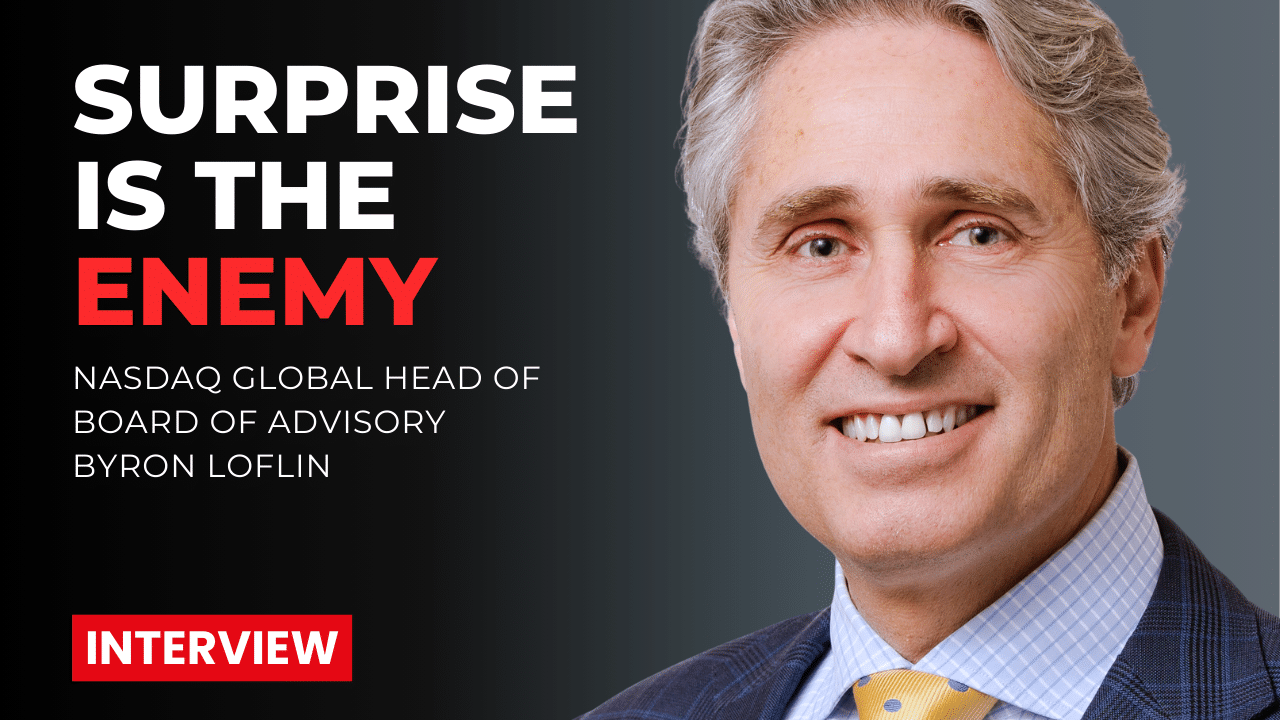
Byron Loflin, Global Head of Board Advisory at Nasdaq and co-author of CEO Ready, explained on the Strategy Skills Podcast why many talented executives never make it to the top.
“ Because you perform well isn’t going to automatically get you the job.”
Boards are looking for more than results. They look for humility, curiosity, and authentic relationships across stakeholders. Byron shared a personal lesson from riding with Ronald Reagan before he was president:
“He was genuinely interested in others. And that surprised me. I didn’t get the sense that he was a pompous or aristocratic kind of person. He was genuinely interested in identifying what are you interested in? What makes you tick?”
He also warned that unchecked ego is one of the biggest risks to leadership:
“Ego is a powerful motivator when it’s focused properly. But when it becomes dominant in one’s personality and drives inappropriate types of responses to the needs of others… Ego can become a significant problem.”
To counter ego, he recommended building close, truth-telling relationships. This is what Byron said about conversations with his children:
“I listen to them very closely when they speak to me and I invite them to speak truth into my life.”
And he reminded us that succession is political:
“Surprise is the enemy. Structure is your friend.”
Finally, boards now expect leaders to be fluent in technology and disruption:
“The expectation of management delivering understanding on the relevancy of AI to your organization with the emphasis on relevancy.”
Here are some free gifts for you:
Overall Approach Used in Well-Managed Strategy Studies
Enjoying this episode?
Get access to sample advanced training episodes
Episode Transcript (Automatic):
Kris Safarova 00:48
Welcome to the strategy skills podcast. I’m your host, Kris Safarova, and this episode is sponsored by strategytraining.com and we have some gifts for you. You can get the first episode of how to build a consulting practice, you can get access to that episode at firms consulting.com forward slash build. It is f, i, r, M, S, consulting.com forward slash build. You can also get the overall approach used in well managed strategy studies at terms consulting.com forward slash overall approach. And lastly, you can get McKinsey and BCG winning resume, which is a resume that led to offers from both of those firms. And you can get it at firms consulting.com forward slash resume PDF, and even our very senior clients, people even at CEO level, and people at the senior partner level and partner level within management consulting find our template very useful when they are updating their resume when it comes time to look for another role. So that’s all the housekeeping today we have with us Byron Laughlin, who is the Global Head of Board Advisory at NASDAQ, where he leads board assessments and boardroom training for NASDAQ governance solutions. Byron, welcome.
Byron Loflin 02:05
Thank you, Kris, it’s nice to be with you. So you
Kris Safarova 02:09
have both coached and observed hundreds of CEO candidates, if not more, what first drew you into the CEO readiness space, if we can call it that, and what personal experiences influenced your perspective on how succession really works.
Byron Loflin 02:28
I’ll start with the personal experiences. So I became interested in CEO level leadership as a young person because a neighbor who was the CEO of the local community bank, was a was a friend and became a mentor and and a person who helped me understand business early and understand the initially, the strategy of banking. He grew the bank significantly and ended up being a regional banker of the year, and he he merged several banks, and eventually was very successful with that and and that was an inspiration to me to see how banking affected the lives of people through lending money that would they could then buy homes, start businesses, imagine their future differently. So that was the initial inspiration for me at a I was around 13 years old when that started. And then I started a little business. I would deliver things like soap and newspapers, kind of the typical things that young people do, I hope today, and although they’ve advanced, they’re probably creating software and things like this today. Kris, I was inspired to look at and see capitalism and being an entrepreneur or being a CEO as as a vision for life, how one could one of the things that this gentleman, his name was Jerry, Jerry, influenced me deeply that each time he grew the business by either adding a new branch to the bank, he was helping the lives of others and Extending that assistance at the banking level all over the state. And I grew up in a small town in Michigan originally, and I learned a lot about small town kind of work. And now here I am at NASDAQ at Market Square. Call it we like to affectionately call it the crossroad of capitalism at Times Square. It’s a beautiful spot, fantastic company to work with and work for. I’m proud to be there and and governance is is key, because the first decision that a CEO, a person puts down on a piece of paper at the state the secretary of. State that they’re starting a company, they put down CEO. They’re an officer. They may put president, but lots of times, CEO President, as you know, are exchangeable. And many of the CEOs that I’ve known along the way all the way up today, and I want to emphasize that my co author of the book CEO ready, Mark, Mark Thompson, that Mark was a visionary CEO in the sense that he worked for Chuck Schwab early on, and he was, he was assigned the business of leading schwab.com and I remember when I had enough money to invest, the first place I went was schwab.com and here it is. I’m working with and and being able to write a wonderful book with a person with such character and inspiration to me today. So to kind of put bookends on it. Started out with with Jerry, and end up with Mark, and in between, where lots of CEOs, including the CEO at NASDAQ, who’s an inspiration to me and hopefully an inspiration to many Adina Friedman, who’s a wonderful person, in my opinion, and and delivers great leadership. So that’s my early inspiration, and all the way up to today,
Kris Safarova 06:27
Byron and most executives assume that they just need to have a very good track record. And speaks for itself. Why do so many get so to say, blindsided in the succession process, and what some of the early warning signs should they pay attention to, and some of the actions they should take that they are not taking generally? Sure?
Byron Loflin 06:51
One, I’ll start by saying, understanding governance is important today, and those who want to to ascend, let’s call it to be CEOs. In our world today, should understand the interplay of management and governance well, and being selected to be CEO requires a lot of layers, or several layers, of both interaction and understanding, you’re going to need to inspire others, and sometimes people are blindsided later when they had the chance to inspire others. And when I say inspires, there’s some core ingredients to to a deeper level of inspiration, one of them being humility. Some of the best leaders I’ve met in my life, and I’ve had the opportunity to meet some significant leaders, and the way they the way they initiated action or interaction, was significant. I wound up in a car one day with Ronald Reagan, and in the mid 80s and early No, it’s the early 80s, because he wasn’t elected yet. This was 1980 I met him again later, and he was taking great interest in me and the other people in this car very quickly, he was genuinely interested in others, and that that surprised me. I didn’t get the sense that he was a pompous or aristocratic kind of person. He was genuinely interested in identifying what what are you interested in? What makes you tick So, understanding the need to know the people around you, and as you grow in your leadership, understanding that the board of directors are all, in a sense, always watching, because their number one responsibility in this governance supply chain is to keep track of identify the talent that’s up and coming through the organization, because someday They’re going to have to select the next CEO, and so being aware that you’re that you’re in that if you want to be in that pipeline, that you are being watched, and you’re being watched subtly by Many around you. Another is because you perform well, isn’t going to automatically get you the job. There’s going to be the ability to diplomatically speak to the to the stakeholders widely. This could be, obviously it’s going to be investors, but it’s also going and board members, as I mentioned, but it’s it could also be key constituents in your stakeholder groups. It could even be how one interacts with the competition, how one builds rapport in the marketplace, particularly as you move into larger companies, where there are a highly it’s a highly competitive environment.
Kris Safarova 09:59
So. Boards often run extensive external searches, even when strong internal talent exists and even there is somebody they think will make it from your vantage point, what makes an outsider in situation like that suddenly look more attractive than an insider?
Byron Loflin 10:20
Companies experience life cycle moments, and this is more sensitive today than ever because of rapid transformation and transformational disruption. So as the internal candidate, and to use the term again, you could easily be disrupted, because the external candidate has the experience in transformational and digital disruption to the degree that they understand the competitive landscape more intuitively than Those on the internal now, that’s one type of viewpoint. Another could be that the that the company needs to be shaken up a bit, meaning we need to a renewed process of thinking about how we compete in the marketplace going forward. And it may or may not be tied to this idea of of digital transformation or technical transformation. It could be that it needs a new vision, or a renewed vision with a new strategic approach. And so board members are going to be looking in that direction, one because they have the responsibility to do a deeper dive today because of the information world that we live in, we can quickly identify the strengths and weaknesses of companies more quickly because of, frankly, AI is having a strong presence In in the analysis of companies and what companies need to be competitive into the future, and so understanding the subtleties of that has become increasingly important for both the internal and The external candidates. The internal candidate may have a challenge, here, because they are focused on doing their job excellently, and they may be successful at doing it well, while the external candidate is in a area of significant disruption, so they’re seeing how to competitive, to compete in a myriad of landscape and that could be a challenge for this decision process of internal versus external. The thing that we found in our research and our interaction with CEOs and boards is that don’t assume that you’re going to get the job because you’re the internal candidate, and that you have done the job well to date, they may be looking for someone to disrupt. So thinking about how might you be an internal candidate of disruption in a healthy way, I want to import, importantly, emphasize the type of disruption that we’re talking about. It’s like we use the term cannibalizing our own business at times that may be necessary to understand because the the power of tradition and holding tradition has as we’ve seen through companies like like Blockbuster versus Netflix, you see this devolution of a of a blockbuster because they assumed too long that companies, I’m sorry, that customers would would be buying through things like mail order or going to the store and and renting. And we’ve seen that as a significant example of the disruptive capacity of technology today.
Kris Safarova 14:07
Byron and for someone who is listening to us right now, and they know they want to be CEO of a large organization one day, they know it is a long shot, but they want to go for it. What are the key skills they need to be developing.
Byron Loflin 14:22
Okay, one I see that they are, are well spoken, diplomatic. They understand the benefits of constructive dissent and and and constructive feedback. Seek feedback aggressively. If, if it’s appropriate, seek it from board members, find the appropriate people in your organization, internally and externally. I technically, at this point in my career, do not do specifically CEO coaching. Mark does that my, what you might call coaching, comes through my interaction with board. Boards and CEOs on an ongoing year over year cycle of helping evaluation processes. I would suggest that the if you are seeking to be CEO and for in whatever capacity that this can be accomplished, that you can afford to hire a good coach, I would recommend today having a coach in the in the specific area of improving your leadership style, monitoring on an ongoing basis, how you’re presenting yourself publicly, how you’re interacting with the public, particularly bringing the coach along to presentations that you deliver where it’s appropriate, possibly to fellow employees, to your the team that you’re managing these kinds of opportunities that you have to just to hone your skills more effectively so others getting a check on ego. Ego is a powerful motivator when it’s focused properly, but when it’s when it becomes dominant in one’s personality and drives inappropriate types of responses to the needs of others, meaning leadership needs, ego can become a significant problem, and we’ve we don’t have to go far to in recent history to find where Ego has been damaging to companies. So ego checking, learning where to check your ego this so coaching, self awareness, ego checking, understanding, constructive input, constructive conflict, constructive dissent in your leadership style, understanding the balance between confidence and accountability, both for oneself and for one’s team, down through the organization, asking your team, do you feel sufficiently accountable? Do you feel that you are sufficiently bolstered in your confidence, going out and selling a product, delivering a product, building these or exercising these kinds of muscles of leadership are important, but getting that feedback is essential, and part of that is the humility that one, that one asks for and invites through this kind of process.
Kris Safarova 17:40
There’s a phrase Pride goes before the fall.
Byron Loflin 17:43
Yep, it’s a dangerous for
Kris Safarova 17:46
someone who is struggling with ego. Where can they start dealing with that?
Byron Loflin 17:53
The first place to and I will reflect on things I’ve heard from great leaders, first spouse, continue to build the right relationship, and that’s for people that have a spouse. If one does not have a spouse, the closer relationships that you have. What are the close relationships that are going to tell you the truth about yourself? Seek the truth about oneself in self awareness, and that could also include family members, if appropriate, and if they have that kind of relationship with you, children, particularly adult children, and having that kind of relationship I have. I have two sons, two sons and two daughters, and I live listen to them very closely when they speak to me, and I invite them to speak truth into my life and beyond there to have the kind of professional and personal friendships we all need say three to five relationships, because they are going to look at us from a different perspective, and having those relationships that will will speak truth into our lives in a beneficial way, so that we’re understanding ourselves more effectively going deeper to that point. So that invites humility. And I would, I would offer ask those people that are have this kind of closeness that I’m describing in your in that are in your life. Am I humble? And this can go to to to your boss relationships that Who do you report to sit down with them and have this kind of open discussion if you can. Sometimes it’s not easy. Sometimes the relationship I’m describing doesn’t exist at the work level, if it does utilize that. And and there’s a myriad of opportunity that you probably have around you, or that you can seek out to have this kind of truth spoken into your life,
Kris Safarova 20:11
very true. And also be careful about the input you’ve taken, because some people may tell you information that actually is not aligned with the truth. For example, if you’re dealing with someone who has even bigger ego and they blame you for everything in the world, you can change yourself, bend yourself so much you will lose who you are if you take the input very seriously.
Byron Loflin 20:36
So I think what you’re speaking to there is an important point, and that is most mapping and and having a matrix with that mapping of Who do I want to be like in my career? Because we all have people going before us, like I mentioned Jerry, my father, my mother, these are strong influences in my life, and so I I seek out and encourage others to seek out input from others that that are going to provide this open feedback.
Kris Safarova 21:14
Makes a lot of sense. Have you seen good examples of somebody who really struggled with the ego, and they were able to get it under control.
Byron Loflin 21:25
I want to be careful, because I wouldn’t want to list a lot of people. I’ve seen this a lot and and that’s why it’s, it’s, well, that’s why I’m an optimist, and I’ve maintained optimism, even though we see circumstances in business frequently in which it’s it’s the governance of an organization that’s gone off to a diff in a difficult direction that needs to be corrected, and anyone who’s worked for a company that’s gone through any sort of scandal, be it small or large, but let’s speak particularly to the companies that have struggled with smaller scandals may have hurt them financially significantly, but it’s it’s often in what the problem can be is that embedded in the culture is is something that carries a level of arrogance with it, or ego, excessive ego. And where I see that being corrected is strong leaders who say, stop. We have to stop and evaluate ourselves honestly. We have to have an honest gut check. And so if I would hope that people that listen to this podcast without me describing Too Much detail could think through the last 10 years, and many have been involved in organizations that have experienced trouble, or let’s go back about 17 years, because we can start with the financial crisis, and there were situations in which people’s ego caused their companies to struggle or fail, and a lot of it came down to individuals, and I would hope that those individuals who were a part of that failure or contributed to that failure, would recognize today that there were moments in points of history where, if they had subjected themselves more humbly to a constituency of, say, investors or regulators or other leaders, that they could have found other ways out of the difficulty. And as we see often, this can occur when it can occur because we need for that business to exist, and it’s important that that business exists so regulators may come in and change the board or change the CEO structure for one reason or another, but, but I would encourage that The The best way is for someone to subject themselves openly to what I’m describing as facing the reality of the future, one you’re not going to be CEO forever, therefore, humbly help build the Next Generation of CEOs. They don’t need to be your minions in a way that they will come in and in one way or another simply magnify your CEO Dom, you’re, you’re, what you did, the what I hear from more and more is the best test of the legacy of a great CEO, is the opportunity for success that that person leaves for the next generation. And I think that can extend from families to parts of our society and an important part. In business,
Kris Safarova 25:01
very true. You identify seven stakeholders who decide to see us fate. Could you list them and maybe share a little bit on this topic? Because I’m sure most of our listeners have no idea what you’re going to say now.
Byron Loflin 25:17
Okay, so the think of all of the stakeholders that impact your business and at some point may impact it significantly. Number one is anyone who has supported your business with an investment. Number two are the people that work in that business, because the people that work in the business are typically the innovators, the if you think of any great product, it wasn’t innovated by one person, the idea may have originated with one person, but it took lots of people to build these devices that we carry in our hand or that we’re Using to speak through today with software like the one we’re using. Next up is the vendors. That goes again to those inventors and those companies that provide to us the products that we didn’t make, that we’re buying or utilizing. Another is the communities that we serve, meaning the constituencies. And I’ll break that down into two. One is our customers and where we and our customers live. So thinking about stakeholders in a genuine and I’ll reference this in a Peter Drucker kind of way, because he was, he had lots of great sayings. You know, the business of business is to create a customer without a customer. When we go up this chain of stakeholders, we without the customer, the other people are unnecessary. Then also we have the the physical community. So you’ve got the community of people, and you have the physical community, and those are, are include the public, private relationships that we have between government. We need roads. We need to be able to fly in airplanes. We need to be able to deliver goods efficiently. And this is a public, private relationship. My first business was back in the early cell phone days. I got Jerry and my father to come together with me and form a little bitty company, and we happen to win a position to be able to build the cell phone towers in Northwest Arkansas, and it was called Arkansas cellular partners, little little company that we were able to obtain financing and build. The key to that was, is that we didn’t create the opportunity for cell phones. Somebody else created that. Somebody created the opportunity for us to be invested in that. So we were both a customer and we were entrepreneurs. That’s a fantastic thing about capitalism, and what I like to emphasize is multi stakeholder capitalism in the most capitalistic sense, and how it’s important for because core to what you’re doing Kris is helping the leadership of all of this in whether or not it’s at the business, The CEO of a large public business, a small public business, a large private business. All of this has to do with building and teaming together for great leadership, so having the roads and so on. So that leads us to the regulators and having strong relationships with regulators and pushing regulators to be beneficial to our organization and to help us authentically challenging their leadership. They need to be humble. They need to be engaging. They need to be diplomatic with us as we need to be with them, and then ultimately feeling blessed to be in our country or on this planet and taking care of it. And so that’s the stakeholder capitalism that I live in, and probably I’m willing to die for that’s important, and why I’m so passionate with Mark and other friends about great leadership.
Kris Safarova 29:37
Is there a stakeholder that tends to surprise candidates the most
Byron Loflin 29:42
you know, I’m very fond of I would say it does depend the stakeholders that are more dominant. Does depend on business a little bit and but certainly the people who are your team, your senior team is. Invaluable, particularly as you grow a company to a larger level. Because think of all you have to entrust in them, because the CEO of a company that has 100,000 employees, I mean, realistically, I know CEOs that would love to to know, to communicate to, and I’m saying for large organizations like this, like we’re talking about, at the large public level, they would love to communicate more deeply how much they care for all 100,000 employees, but realistically, they’re people too. They only have 24 hours in a day, and they need eight hours of sleep, so it’s important that we understand the the responsibilities that others carry in this way, and so it the the dominant in most businesses, the dominant stakeholder is going to be your workers, The people who are creating innovation and opportunity for that business to be sustainable long term into the future.
Kris Safarova 31:07
You talk about the Game of Thrones, nature of succession, what is one practical way for candidates to protect themselves from sabotage? By PS, this is something that happens a lot.
Byron Loflin 31:20
Yeah, that’s a, and this is a, this is one of the great challenges of CEO succession. It’s, it’s, it’s building the, well, I, each of us have a theory. I’m going to offer my theory, and that is, it’s relational. It carries a need for the spirit of humility, understanding, ego, and I don’t want to be redundant on that, but what I mean by this is, is building relationships authentically, learning to be authentic in your in your life, and leadership and that that increasingly what we’re seeing, because we every once in a while, we pick up the paper and we see a CEO who’s been caught doing something, and they’re marched out of the building embarrassingly. So sometimes I feel very badly for anyone who faces that kind of circumstance, but they chose something that they shouldn’t, probably shouldn’t have done, and and so what we’re seeing in business today is increased transparency. Social media does this, and that’s social media inside and outside a company, because we all have teams on our business, devices, teams and zoom and all of these various social media related activities, because there’s the internal social of a business, what we used to call water cooler talk goes on now around teams and things, and then we have the external, which is the your CEOs are being watched, particularly if they’re popular CEOs, they’re going to be watched more closely. But this extends down through to senior managers, and this idea you are being watched because you’ve sent a signal one way or the other. You’ve signaled a little bit or strongly that you want to be next. And that’s a part of the book we’ve written, CEO ready. It’s about understanding what it means to be next and and we go very deeply into these discussions in the book, by the way, and it’s based on seven Well, it’s based on more than 1000 interviews around the subject of readiness and succession, and it’s meant for both board members and anyone who is in contact with the CEO succession process, including coaches and advisors and consultants. So for those desiring to be CEO ready and to put a some defense in place as well as their offense. Because I think your question is a good one. How do you build the idea of, you know, it’s like football. You got to be having both foot both strong defense and offense. And it’s kind of fun. It’s the way I sometimes like to compare our football with the football, the Global Football, and see how offense and defense play together on with the soccer ball versus the oblong one that we call a football, and thinking, How do I build defense around me? One, authentic relationships. Two, sending a signal that you have the strength and the boldness to be more transparent. Others see you as a person that that can be relied upon, and in that there’s a lower level of surprise likely from you versus the. Other candidates. And what I mean by that, one of the fundamental principles, or rules of good governance is, is surprises the enemy. The second one is structure. Is your friend so communicating you’re reliable. And two that you lived in a disciplined environment that you’re disciplined in your work with others you respect their time as well as expecting respect for your time. And this kind of building the relationship that communicates to the board. Ultimately, because the CEO the current CEO, sits on that board, and that group together somehow. How it plays out who the strong personalities are on that board, it’s important to know also who’s got more influence on that board, and why do they have more influence, and how, what do they think of you? How can you build a relationship with them that shows your authenticity and your ability to master the areas required to be the CEO of this company that you’ve targeted, whether or not you’re the inside or outside candidate, and then if you’re being used by a search consultant, helping work with that search consultant to communicate this authenticity message effectively, because if you’re not communicating effectively, it’s going to be bad for the search consultant who buys into your sales of yourself when it’s not authentic and because they’re not going to look good if, if you’re fired Within two years and you’re not going to look good if you’re fired within two years. And so that’s what I mean by think about and communicate a message. I think that, from what I’ve seen, you should be communicating you want to be in this job at least, at least seven, if not nine years as a as a likely possibility, we’ve had short the average turnover of CEOs has been arguably too short. And a concern about this is depending on the product. It doesn’t even last an entire product cycle, and it’s something that’s been problematic. At least the experts argue that it’s problematic to have a four year tenured CEO, unless it’s a very special circumstance,
Kris Safarova 37:28
of course, and you already spoke a little bit about AI and how it changes things. But just to focus on this specific question, given what’s happening with AI and advances in technology in general, what competencies do you think distinguish someone who would be considered the future ready CEO from someone who will look like they risk obsolescence quite quickly?
Byron Loflin 37:53
One is the ability to assimilate ideas and and think about them strategically and quickly, or know how to have a a person on your team that does that. So there’s different opportunities for different people. One of the things we emphasize in CEO ready is the ability to self evaluate also. So this idea of, can you take a lot of information, put it into knowledge that you can convert to strategic ideas and or have people around you, or another person around you that works with you as a teammate, it may be somebody that reports to you, because the every strategy requires a strategist, as Cynthia Montgomery emphasizes in her book, the strategist. I love that book, and that it doesn’t have to be the CEO, but the CEO needs to know how to identify the strategic thinkers around him or her that can influence the company at a high level of effectiveness. So that’s one characteristic of self evaluation, and another is the understanding who are the important relationships to this organization on the long term and be able to communicate any differences that would cause the business to change in the future. What I mean by that, regulatory relationships, important vendor relationships, is the business, if you’re if you’re ascending to take over a business, is this business going to change significantly? Ai, it’s probably going to change to some degree. So understanding how AI is going to impact your business, to use what I’m saying as an example and. Having the skill of informed questioning and dynamic questioning. So being that person that asks dynamic questions of others, that produces knowledge and information that’s even confidence building in the person that you’re asking the question of so that’s another form of leadership and inspiration, asking good questions, not I gotcha, questions that some people call them, where that intimidate people, the type of question that causes somebody to want to work for you and work for you harder, because you ask great questions that inspires their their journey of innovation. That’s one of the key and frankly, it’s one that overlaps where people in the pipeline of CEO ascendancy and those aspiring to be board members. This is where the best of each of those groups ask great questions. They also and then also, when you’re asked a question, do you answer the question succinctly and directly, and are you able to communicate that effectively with the least amount of words? Because you start to enter into as CEO, you enter into a very fast paced world of conciseness and communicating a message. Unfortunately, sometimes we call it a sound bite that sends a bigger signal.
Kris Safarova 41:34
Effectively, makes a lot of sense. So to build on this, how can someone become better at asking the right questions and structure the questions in the right way?
Byron Loflin 41:49
Curiosity is is key to this, and discipline is key, because without discipline, you won’t have the time to manage and and arouse your curiosity in a in a beneficial way to what we’re discussing. So curious about people, curious about products, curious about the the supply chain, the complexity of slight supply chain in products, going out and visiting however you can the businesses that you’re interested in serving so as an aspiring CEO, knowing your customer better than your competition, and your competition being other people that want that CEO job. If you’re the person that knows the competition best, that’s going to be one attribute. If you’re the person that understands diplomacy. That’s going to be another attribute. Both of those have a lot to do with learning how to question. Well, learning how to question, well, I would surround, recommend surrounding oneself with others who question. Well, find, seek out those who are able to ask the question, rather than wanting to tell their story, more than they are curious about understanding others and what the opportunity is in the teams that we build and the others that we relate to In our business lives,
Kris Safarova 43:20
we started today’s discussion about Ronald Reagan and the story of how he was genuinely interested in others during your ride in the car, during your first time that you met him. Any other examples of something you observed in incredible leaders that really stood out for you that other people should build within themselves.
Byron Loflin 43:45
Yes, I will compliment another person. I was at an event that was a big event for a not for profit organization named just capital, and a the former CEO of of Best Buy was at, came in to this event. I had seen him before, and knew of him. And a friend wanted to introduce me, and we met, and we had a very nice conversation. Lovely conversation. He introduced me to his friend Hortense, who lovely person that does also does coaching very well. I understand, and this is the important part, though, because I could have met any CEO that somebody brought in the door an hour and a half later, some people had left. It was a, it was the reception time after a a an event where there were speakers and so on, and he wasn’t a speaker, he was an attendee. And we were having a reception, he was still at the event. He was asking people good questions. He was getting to know others in the room he could have left. I It’s this is his little stand. Out that I’ve observed there are those who are humble, and they are they are genuinely interested in others, and they know when they have the opportunity to get a few extra minutes with others, people that they don’t know, possibly new friends, possibly just acquaintances for the moment, and they take the time to get to know others. And and it stood out to me, and it and I, as a result, I read his book and and it was fascinating that to read about his leadership journey and going into the stores and doing the things that we’ve described here today, and that he spent the time to be in the room with others in the room that that hadn’t had exposure to a person like him, and and then doing a little research his company did Best Buy did very well during the tenure of his leadership, very impressive to see someone who communicates that communicates that care for others, and then now is teaching at Harvard Business School, and a place that I’m very fond because that going back to the program, they Have a three year program called OPM that really spawned my inspiration in my career mid level. That was 20 some years ago, 25 years ago, and I was inspired by leaders like this and like Mr. Jolie and and others that I that I’ve met along the way that have this extra sense of understanding and care for people kind of, you know, we have this term in governance around the duty of care, and the duty of care is a legal duty. It’s it’s not the emotional care. It’s more of an intellectual quotient of care, I would emphasize that care today, the duty needs to be both intellectual and emotional care for those around us when we’re leading organizations and influencing organizations, if you’re a consultant or a coach or A teacher at a business school,
Kris Safarova 47:21
100% agree with you. How do you see boards expectations evolving around AI adoption and risk management?
Byron Loflin 47:30
I think the expectation, and I’ll offer this to board members, the expectation of management delivering understanding on the relevancy of AI to your organization. With the emphasis on relevancy, I had a wonderful friend who was very deep into leadership in the coffee industry, Dave Olsen, who said to me one day, and I’ve always appreciated this when he’s been in boardrooms and and in basically CEO level responsibility, asking others, don’t tell me everything that can be known, because I can’t contain All of that. Tell me what I need to know so I can both build a sense of trust in the information you’re delivering and the information that I need to know to make a decision. Well, when it comes to AI, I would offer that that board members should be asking management teams that question, what information do I need to know to help make decisions? Well, emphasizing now the concept of well, that there’s authenticity in that information being delivered, that it’s not selling some point that one or a group of people want to emphasize that it is approaching the area of discussion, because we’re not just going to make the decision based on information. We need to have knowledge. And knowledge comes from through the conversion of information to knowledge, and that often is augmented by better discussion at a board level. And so the delivery of healthy information or robust information that can help that decision process is what boards should be asking for, specifically on AI,
Kris Safarova 49:34
makes a lot of sense. Byron, such an incredible discussion. Our time for today’s coming to an end, I want to be respectful of your time. Anything you want to say during this last few minutes related to your book. And of course, I think based on this discussion, it’s very clear that there’s such a depth of knowledge and wisdom that anyone interested in this topic should go and get the book and read. It, but any final words you want to share, related to what you want to get people out of the book, or anything else you want to share, and also, where can people learn more about you by your book?
Byron Loflin 50:10
The book is now available on Amazon. It’s it’s being published by Harvard Business Review. They have generously been promoting the book quite actively, and so it’s, I believe it’s available on pre order at most bookstores. Now i They’ve told me it’s at Amazon in the United States and Europe. It will be in Australia and other other regions around the world. And I would emphasize because writing a book mark and I didn’t write this because, I would offer that we didn’t write this because we wanted to be famous for writing books. It’s been our passion. We’ve been fortunate as a result of the great capitalism that we have in our environment today, and we want to foster that and foster great business. And it’s been our opportunity to speak with several 1000 leaders over the last 15 years, and so many of them have a great message of of wanting to build businesses that do good in our world today, and this book is about CEO readiness and for the next generation based on those interviews. And we hope you find it fun to read, because it’s a lot of sometimes funny, sometimes interesting, sometimes a little tearful, but there are examples of the kinds of things you and I have talked about today that are much more specific in the book, because they’ve endorsed. I don’t want to quote someone without specifically saying exactly what they said, and they’re with their endorsement. So the books has hundreds of these. We’ve been fortunate to have many come out and endorse the book because they found it to be something they’ve had been able to pre read some of it, and found it to be something that’s sort of missing and needed. In our world, there’s lots of great books, and I love reading them, and sometimes reread them. And this is, this is just a little bit of, also a carry on of Marshall Goldsmith’s book. Who Marshall was kind enough to write the write the foreword for the book. What got you here? Won’t Get You There. I would recommend getting both of the books if you don’t have them all already, both of them, and kind of reading them side by side, because the whole idea is helping people and companies get there. They’re being where they want to go is efficiently and as effectively and leaving a great legacy. If they, if they, as they deliver great leadership.
Kris Safarova 52:56
100% we had Marshall as well as a guest Byron. Thank you so much. Thank you for being here. Thank you for everything you said. I can see that we could talk for hours on this topic. So much wisdom and knowledge you have to share. Really appreciate you being here.
Byron Loflin 53:13
Well, I hope this has been helpful, and I hope anybody that listens find this helpful, that that’s the purpose. I can tell it’s your purpose. It’s my I hope I’m authentic in my purpose, and I’m always checking that in myself. Thank you.
Kris Safarova 53:27
I think you definitely are our guest today, again, was Byron lovely, Global Head of Board Advisory at NASDAQ, a co author of CEO ready, what he need to know to earn the job. This episode is sponsored by strategy training.com and you can download the overall approach used in well managed strategy studies at firms consulting.com forward slash overall approach. You can also get McKinsey and BCG winning resume, which is a resume that led to offers from both of those firms, and the great template to use, even for very senior applicants. And you can get it at firms consulting.com forward slash, raising my PDF. And lastly, you can access episode one of how to build a consulting practice level one, and you can get it at firms consulting.com forward slash, build. Thank you so much for tuning in, and I’m looking forward to connect with you all next time.
Leave a Reply