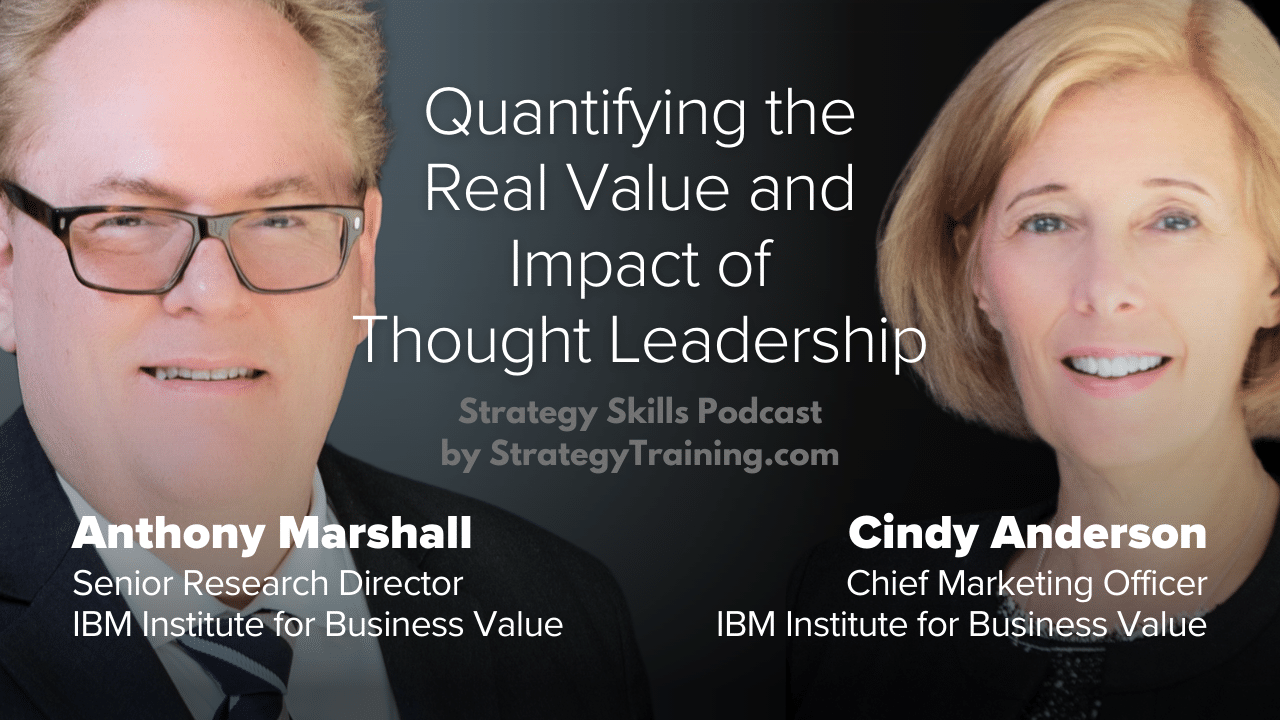
Welcome to Strategy Skills episode 525, an interview with the authors of The ROI of Thought Leadership: Calculating the Value that Sets Organizations Apart, Cindy Anderson and Anthony Marshall.
In this episode, Cindy and Anthony discuss how their work at IBM shaped their understanding of thought leadership’s value in building client relationships and explain the quantifiable benefits of thought leadership. They also address how AI is impacting thought leadership creation and consumption, and the distinction between thought leadership and sales content. They stress the need for independent, data-driven content to build trust and relationships, not for direct sales. Their insights stem from decades of combined experience at organizations like the Project Management Institute and IBM’s Institute for Business Value.
I hope you will enjoy this episode.
Kris Safarova
Cindy Anderson is the Chief Marketing Officer/Global Lead for Engagement & Eminence at the IBM Institute for Business Value.
Anthony Marshall is the Chair of the Board of Advisors for The Global Thought Leadership Institute at APQC and the Senior Research Director of thought leadership at the IBM Institute for Business Value.
Get their new book here:
The ROI of Thought Leadership: Calculating the Value that Sets Organizations Apart
Here are some free gifts for you:
Overall Approach Used in Well-Managed Strategy Studies
Enjoying this episode?
Get access to sample advanced training episodes
Episode Transcript:
Kris Safarova 00:45
Welcome to the Strategy Skills podcast. I’m your host, Kris Safarova, and our podcast sponsor today is StrategyTraining.com. If you want to strengthen your strategy skills, you can get the Overall Approach Used in Well-Managed Strategy Studies. It’s a free download, and you can get it at firmsconsulting.com/overallapproach. And you can also get McKinsey and BCG-winning resume, which is a resume that got offers from both of those firms. And you can get it at firmsconsulting.com/resumepdf. And today we have with us Cindy Anderson, who is a Chief Marketing Officer Global Lead for Engagement and Eminence at the IBM Institute for Business Value, and Anthony Marshall, who is the Chair of the Board of Advisors for the Global Thought Leadership Institute at APQC and the Senior Research Director of Thought Leadership at the IBM Institute for Business Value. And they are the authors of the new book The ROI of Thought Leadership. And I’m looking forward to have this discussion. Welcome both of you.
Cindy Anderson 01:48
Happy to be here. Yes, great to be here. Thank you Kris.
Kris Safarova 01:51
Can you each say a pivotal moment in your career that set you on your current path in marketing and thought leadership?
Cindy Anderson 01:58
Sure I can start with that. So the I was the director of marketing for an association called the Project Management Institute, and it seemed that every time I walked into a meeting, someone asked me what I was doing there and why thought leadership was important, and why we should spend our time on that instead of something else. And the implication, of course, was that it wasn’t valuable enough to actually be considered as part of the business approach or business strategy, despite the fact that the CEO had asked me specifically to set up this competency. And the reason that was a pivotal moment. Is because, if I had had the evidence that Anthony and I now have as a result of doing the research and writing this book on the value of thought leadership and the ROI that thought leadership can deliver to an organization, I would have had that kind of ammunition in my pocket. But that was the impetus for me to, you know, work with Anthony on this research and write the book and and start an association as well.
Anthony Marshall 03:06
And for my part, I think, you know, I’ve been consulting one way or another, probably for about 25 years, and certainly earlier in my career, when I was working with a lot of different clients, I found myself in a position where I it was incredibly valuable to bring thought leadership to the clients. And so I started working on thought leadership studies and adapting them to the areas that I was working on at that time, mainly banking and financial markets, just in my spare time, and and then back in back in 2011 I was asked in the first half of the year to come to head office at IBM, rather than the consulting to work on the commercialization of this thing that I didn’t know or understand at the time at all called Watson. AI intelligence, which is very important now, was that, how to commercialize that? And so I’d been doing that for several months. And then was, was it was asked, Could I, could I come and join the IBM Institute for Business Value to run the 2012 CEO study, which was put me into the mainstream of thought leadership. And so that was sort of my journey to into thought leadership, sort of being a practitioner and using thought leadership, and then being asked to be go into a role where I was actually creating the thought leadership. So very much. Seen, seen it on both sides of the coin.
Kris Safarova 04:35
And can you speak about how your roles at IBM shaped your understanding of what thought leadership means today?
Cindy Anderson 04:42
Yeah, I think, you know, being in a large organization that has a consulting capability the way that IBM does, it gives, gives you an insight into just what Anthony was saying in terms of how consultants use thought leadership to help build relationships. Their clients to help build the brand of the organization that they’re that they’re part of. You know, think about it, McKinsey’s been doing this. They’re McKinsey Quarterly, I think, is 60 years old this year. So there’s a lot of history. There’s a lot of evidence that thought leadership does deliver value, even though we haven’t been able to quantify it in the past. And I think working in an organization like IBM, and particularly in the consulting side with our consultants, it really brings home the value of content like thought leadership, as you’re trying to build those strong client relationships.
Anthony Marshall 05:36
Yeah. And I think from from from my part, you know, IBM has invested in the IBM Institute for Business Value in its current form for the last 23 years, and it’s because the organization has seen value from the things that IBM Institute for, which is IBV. So if I say IBV, that’s what I mean, and certainly for clients, we know from our research that 88% of of senior executives, C suite executives, consume thought leadership, and they consume thought leadership for at least two hours a week. And our latest research is showing that’s that’s really moving into about three hours per week, so clients see it as valuable. And I think IBM always realized that clients see it as valuable, and that’s why it’s been investing in it. But to Cindy’s point, what we’ve been finding over the past several years is, in addition to the sort of organizations like an IBM or other tech firm like a consulting firm, other organizations have really been moving into that severe, that domain of thought leadership because of its value, but without being able to demonstrate what that value specifically is. And so that’s what led Cindy and myself to sort of take that experience and take some of the analysis that we’ve conducted to justify the value of what we do to our own organization, and write the book and bring that out into the public domain.
Kris Safarova 07:07
And many of our listeners are consultants or major organizations. So I was wondering, what would be your advice on how should consultants use that leadership?
Cindy Anderson 07:17
Yeah, they should. They should use it to build relationships with their clients. So the way that the way, the way that we talk about using thought leadership with with our colleagues and and our consultants, is that before they can actually participate in creating thought leadership, everybody likes to, you know, wants to participate in creating thought leadership, but they really need to consume it. So they need to read it themselves, because it will give them insight into what the data is saying about what businesses and leaders and businesses care about, and once they understand what leaders and businesses care about according to the data, they can go have a really interesting and compelling and thoughtful business conversation with their client. Based on that research doesn’t have anything to do with selling a product or promoting a service. It has everything to do with demonstrating that they understand the challenges that business leaders are facing, because they have this background, like because they have this report, the study that’s based on research that’s come from the outside in so we tell our consultants that in order to use thought leadership the most effectively, they really need to read it, understand it, and be able to talk about it with a client. Then go get the appointment, have the conversation. Don’t worry about talking about a sale. Talk about what you understand about their concerns, and then the sale will come later.
Kris Safarova 08:45
So you mentioned that consultants should be reading other thought leadership. Are there specific sources that you recommend people really watch and kind of read carefully, because there are so many sources, there’s just not many enough hours in the week, in the day to go through all of it.
Anthony Marshall 09:01
Well, what we found in our in our research, is the typical executive, although, you know, they’re spending now three hours a week on thought leadership, consuming thought leadership, but they tend to only consume thought leadership from five organizations on average. And that’s despite this proliferation of content, this explosion of content from generative AI, and every week, we’re seeing new tools Come, come Come live to make it easier and easier and easier to produce content. So what we’re seeing executives spending their time really focusing on those areas of con those those organizations that produce the sort of content that they trust, that they perceive as being independent and high quality that they can believe in, and we know that they use that content to make business decisions, both business strategic business decisions for their organizations, whether that how they deploy or spend on technology, how they adjust their strategy. What are the big forces impacting them? So there’s there’s that side. I. From an individual and, you know, consultant, there’s sort of two, I guess, two answers here, really the official answer where, of course, you want to be consuming the things you know, the concept of content that operates directly to the imperatives of the business that you’re in, right, whether it’s broad strategy consulting or technology consulting or any, any specific type of consulting. But then there’s the sort of content you need to consume to build your own eminence. You know, when I was when I was a junior consultant, I always used to think to myself, Why would an executive even want to talk to me? Why would someone in the C suite open the door and let me in? What is it that I know that’s special about me, and I struggled at times to identify what that is, but the thought leadership, as Cindy was saying, allows you to sort of absorb and become an expert on things. And really, you don’t need to be five miles ahead of everyone. You just need to be a few 100 meters ahead of everyone in order to sort of be perceived as staying ahead and thought leadership could really help you. Help you achieve that.
Kris Safarova 11:07
Anthony and you mentioned five organizations. Let’s share with our listeners what those five organizations are.
Anthony Marshall 11:14
Well, it really, it really depends where, you know, we looked at different organizations that are consumed. As you know, these are the usual suspects you might you might suspect so in our own private survey, you know, the big players are, of course, the McKinsey’s, you know, they are way ahead of everyone else in terms of CEO sentiment, but also BCGs up there, and then you’ve got the tech firms up there, and you’ve got other, other organizations and specialist organizations, depending upon the industry that an executive might be in. But you know, these are no surprises to anyone. You know, the big consultancies have have mind sharing, you know, often in and one of the five for a lot of a lot of executives.
Cindy Anderson 11:58
The five that an executive chooses are unique to that executive. So there aren’t five globally that are, you know, the five that everyone chooses. Every executive says that they choose five, and it depends on what industry they’re in, as Anthony said, what you know, what their typical concerns are? So if somebody’s in a very niche industry, you know, they might not read any of the big five consulting firms thought leadership, but they typically read five. So there are about 11,000 organizations that are institutes, or, you know, that are producing thought leadership. There’s no way somebody could read content from even a fraction of those. And so what the research found is that they typically anchor on five people read a lot of stuff, right? But when they when they decide which thought leadership to use to help them make their business decisions, to help fill in the gaps in their organization, they’re picking five that they trust. And it’s not the same five for, you know, my fives probably not the same as Anthony’s five. That’s not the same as our colleagues five, but typically they’ll pick five.
Kris Safarova 13:02
If you’re comfortable sharing, could each of you share? What are your five?
Anthony Marshall 13:07
Maybe I’ll answer that, because we’ve given our role. We’ve got a consumer a lot more than five. Because it’s important for us to understand what’s happening out there. And so, you know, we work in the tech side, so we need to understand what other technology providers are doing. We certainly look at the big consultancies, you know, the big players. Cindy and I are both on the board of advisors of the global Thought Leadership Institute and the global Thought Leadership Institute for the past, I think three months, you know, it’s a new organization, new nonprofit organization that that is is being established to help develop standards and certifications. I think Cindy mentioned that earlier around thought leadership and the global leadership is now producing a weekly newsletter that’s available through LinkedIn that highlights five strange number that we selected the five of the top thought leadership pieces of the previous week. And so, you know, basically this, and it’s designed to give a broad, a broad set of possibilities. And there’s some fantastic stuff happening out there. There really is. And, you know, I think part of our job is to know what’s going on and making sure we’re different from it, because thought leadership is exactly that. It’s leadership, not followship. So it’s important to be differentiated and high quality and all of those good things.
Kris Safarova 14:31
So for someone who is a young partner, they just got promoted to partner maybe one year ago at a large consulting firm, and they are thinking, should they start writing articles? How should they think about thought leadership beyond consuming? What would be your advice?
Cindy Anderson 14:47
Yeah, well, I would repeat what I said before, which is before they ever think about starting writing, they need to consume a lot of thought leadership. They need to understand what their business priorities are, and then consume thought leadership. In that area to determine what their point of view is, right? Because thought leadership has data that’s behind it, you know, research that brings the outside in, plus an expert point of view. So if you in our in our book, we actually talk about eight archetypes of organizations or individuals that are developing thought leadership, and they’re based on three attributes, quality, uniqueness and reach. So if you have one but not the other two, your thought leadership isn’t as effective as you would want it to be. So you really need to spend a lot of time upfront. If you’re a young partner, like you mentioned, an early career partner, you would want to consume a lot from a lot of different sources, and then develop your own unique voice on a topic that’s meaningful to your business and that you think will be meaningful to your clients. And at that point, then you can start thinking about developing, you know, a cadence of drafting Articles and LinkedIn posts and blogs and, you know, work with the organization’s thought leadership function, if there is one, you know, to start producing that kind of content as well.
Kris Safarova 16:12
Once they are at the point where they have figured out what their point of view is and they have a lot to say on the topic, how much do they think they should be dedicating? How much time they should be dedicating to thought leadership versus other work?
Cindy Anderson 16:25
Gosh, that’s probably up to their supervisor. But you know, it does take a fair amount of time to to commit. And the other thing to realize is that thought leadership is really a long term strategy. It’s not enough to consume a lot, come up with your point of view, find your voice and then produce one piece and sort of sit back and call yourself a thought leader. Right? As Anthony mentioned, it’s thought leadership, because you’re very quickly become a follower if you’re not producing in for exciting, interesting, unique information on a regular basis. So you know, to give a number, I don’t know if executives are consuming thought leadership two hours a week, then it’s probably reasonable to think that somebody’s producing thought leadership should dedicate two hours a week to it as well.
Anthony Marshall 17:18
Yeah. And if you’re, if you’re produced, something to produce thought leadership that is part of your work. I mean, it’s part of you should be doing thought leadership around the areas in which you are working, because you already have expertise, you already have credibility in that space. And it really becomes part your experiences doing other things become part of the thought leadership that you’re you’re creating.
Kris Safarova 17:42
And staying with an example of a new partner, which is very, very common profile for people listening to us right now. What do you think are common misconceptions when it comes to thought leadership for someone with that profile, what do they not understand that they should understand?
Cindy Anderson 17:58
I would say that that one of the common misconceptions about thought leadership is, is that it doesn’t that you can’t quantify the value that it’s we’ve been told by some business editor types that it’s very squishy, and the data that we produced for our book really refutes that it’s not squishy at all. In fact, it’s the least squishy aspect of a marketing funnel at this point, because we’ve calculated the ROI of thought leadership. So it’s it’s a misconception to believe that spending time on thought leadership and spending time with your clients to talk about topics that are important to them, that don’t have a direct commercial impact that don’t have a direct sales pitch. The misconception is believing that those are not valuable conversations, because they are.
Anthony Marshall 18:48
I think, I think Kris, the other thing where people can get confused is to associate. So think thought leadership is marketing. It is sales and and all of the evidence. And Cindy mentioned, you know, the analysis that we did in the book, and we share this information in the book The strangely enough, it’s like a contradiction. It’s your thought leadership is most powerful to sell, to help you sell, when it is not actually trying to sell, and it is least powerful in in being part of a sale, when you try and make it part of a sale. And so you’ve got this contradiction where it can be immensely, immensely powerful, you know, we’ve, we’ve, we’ve demonstrated, on average, that the the ROI of thought leadership investments of a typical organization that’s producing it is 156% which is massively higher than a typical marketing program ROI particular. But that’s only if you orient it the way you should make, make sure it is independent of the sales process, but in integrated in the sales process. And so I think many times Cindy and I, when we’ve been talking to. Clients. We are in the room with account partners and other people whose role in the organization is to sell, but our role is not to sell. Our role is to speak to the data, speak to the analysis. And we are we become trusted advisors, trusted compatriots, in the discussion with the client, with the executive, and if it starts erring into the side of sales, we step back, we start being quiet. And then, and that’s another type of discussion, but it’s very important to keep that separation between the two.
Kris Safarova 20:32
Thank you so much for mentioning this. This is so important, so maybe we could dig a little bit deeper here. When it comes to marketing, some people say, No, you just need to offer a lot of value, and then people see that you have a lot to offer and come and want to work with you as a trusted advisor. Other people say, No, you should never do that. You should actually always mix giving value with actually marketing your services. And if you don’t, you will teach people that they just come to you for free value and they buy from other people. So maybe we could first explain what is the difference of a thought leadership piece that is all about providing value versus the one that has sales aspect to it?
Cindy Anderson 21:14
So maybe thought leadership has a few essential qualities that are different from other types of content. One of them is that it’s based on data, and the most valuable kind of data is primary research, independent research, that’s coming from the organization that’s producing it. And this all comes from the data that we collected, from the survey that we collected. It’s what executives told us they value in the production, in the when they consume thought leadership, what they value? So they value independent, unbiased research as as part of as the basis of the thought leadership. The second thing is that it’s got a point of view, right? There’s an expert voice behind it. And the third thing is that it’s independent of the commercial activity of the organization. And Anthony, I know we’ll talk about the premium that we see when we calculate the ROI for thought leadership that is trustworthy and that’s independent. So what I would say to people who don’t believe that, or don’t think that there’s value in, as you said, spending the time in that kind of a conversation with a client is look at the look at the results. Look at the ROI. Follow the money, right? The the ROI for a thought leadership program is nine times higher than it is for a typical marketing program which would have direct links to sales or, you know, products or services. So there’s, there’s absolutely quantifiable, proven value in a thought leadership program that’s built on the basis of the three or four things that executives tell us are the most important.
Kris Safarova 22:54
So what would be different if we’re thinking about this same person, we are talking about this person who I just promoted one year ago to become a partner at a major consulting firm, and they’re starting to write articles. They want to be a thought leader. They already know they have things to say. They have clients that love them and see them as a trusted advisor. How would it look different if they incorporate sales element versus not?
Cindy Anderson 23:17
Well, it would link to products and services, right? You’d have a direct link to, you know, and by the way, if you’re interested in this, you know, check out this product or link through to this product. So it’s, you know, it’s a nuance. Anthony mentioned, it’s an it’s a nuance. But thought leadership is really about developing a relationship, sales is about making a transaction, right?
Anthony Marshall 23:39
Yeah, it is. It is very nuanced. Because if you’re if you’re if you’re working, if you’re running a report, if you’re working in a consulting organization, there is absolutely nothing wrong with having a section. How can we help you? Absolutely nothing wrong. Perfectly fine. And indeed, it’s valued typically by the client, because they want to segue to actually find out how you can help them, because they know the reason why you’re doing it right. They know the but they want to trust the content. And so the content itself can’t be manipulated or adjusted or framed in terms of setting it up for the sale. It’s got to be robust and independent and rigorous. And the consequences of that, or the recommend. You know that the the the conclusions of it, and the the recommendations that drive from it, must be able to stand alone and be and be and be willing to be open to scrutiny. But the segue can be, how can we help you address that? You know, maybe you need to do massive organizational change, maybe you need to do an HR transformation, maybe you need to do any number of things. Certainly they would be aware that your organization, the organization you represent, can provide those services, but the analysis needs to be there to provide the business case, if you will, to actually engage in that second conversation.
Kris Safarova 25:00
That makes a lot of sense. So if I hear you correctly, what you’re saying is you focus on delivering value in your thought leadership piece, but then at the end, you can have a piece, a little section, saying, How can we help you? And this way, you are not manipulating your actual thought leadership piece to lead to some kind of sale, but you just mentioning that you are available to work with a client if they need help.
Anthony Marshall 25:24
That’s exactly right. Precisely right.
Kris Safarova 25:28
Have you come across any data on what other things people should keep in mind when they’re developing a thought leadership piece? How long it should be? Should they write from first person’s perspective or from an organization’s perspective, any of those elements.
Cindy Anderson 25:44
And then you want to talk about the the types.
Anthony Marshall 25:49
Yeah, so you know, certainly there are multiple, multiple types. And so when, when executives talk about consuming, thought leadership, and we said initially it was two hours. Now it’s more like three hours. That thought leadership can come in different forms, and so it can be a long form study. And in fact, you know, people sort of say people aren’t interested in long form study. Well, our analysis suggests quite the reverse. Executives really are interested in the substance and credibility that deep analysis and rich data can bring to a topic that executives are making business decisions that can involve hundreds of millions, if not billions, of dollars at times, right? So they are willing to invest their time in spending half an hour reading something, if it can help them frame a decision that has massive consequences. And I think this is what this is. One of the things that’s largely forgotten when people start talking about different types is that it’s not just reading and consuming stuff in isolation. The reason why executives consume stuff is because they are wanting to make business decisions as a consequence of them. And so it’s not just the investment in time, it is. It is also the implication of what is the consequence of the decision making that they’re making. But certainly, long form is still there. But it’s not just long form. Short Form is also very valuable. You know, video on YouTube is valuable. Podcasts, as we’re doing here, is seen as being very valuable. Around 55% of executives want to consume thought leadership through podcasts. Want to consume through thought leadership through videos. They read blogs. They write blogs. At times they’re engaged in all of this stuff. But that doesn’t negate the fact that you might have a piece of really deep, rich content that can drive out all of those other things, provides the content that can be used in all of these other media. So it’s almost like a portfolio of content where you’ve it’s almost but you need the backbone of credible research.
Cindy Anderson 27:56
One of the most results of our research, I think, is evidence that despite people thinking that PowerPoint is dead, I think it’s something like 6066, or 70% of executives said that they actually like consuming thought leadership through PowerPoint presentations and at events that have PowerPoint presentations in them. So, you know, we always hear, Oh, PowerPoint. You know, nobody should be using PowerPoint, and yet it’s immensely valuable as part of the portfolio of assets that Anthony mentioned. So don’t get rid of your PowerPoint, people.
Kris Safarova 28:32
That’s a good tip. Any other things that surprised you in terms of what executives actually enjoy when consuming thought leadership.
Cindy Anderson 28:41
I think that that was the big surprise in terms of, you know, we hadn’t expected that, because we often hear so much about, you know, the death of PowerPoint. I think again, the number or the amount of time executives spend on thought leadership was surprising, and the fact that we’ve seen it go up, I think is has been really interesting to us. So we’re curious to see what our next round of research will look like. But, you know, an executive that’s dedicating three hours a week, that’s a lot of time to spend with Thought Leadership, and that just kind of indicates the level of value that they have for the thought leadership. Otherwise, there’s plenty of other things they could be doing with that three hours, right?
Anthony Marshall 29:23
Yeah. And I think the the other, the other point is, is, you know, fashion comes in and fashion goes out. And I think we’ve all been environments where people come in long form is dead. It’s all, you know, bites and, you know, grab, grab attention, grabbing stuff. It’s not, it’s not and and, you know, the executive executives really do want the confidence of of feeling that what they’re reading, what they’re investing their time in, is is substantial and substantive, and it’s sort of in the old vernacular of consulting, because I’ve been a. Around for a while. We used to call it the thump factor. You know, the report has got to make a thump sound when it hits the table. Otherwise, it’s just paper or vapor, right? And so you’ve got to have that substance underpinning the other stuff. And you can have wonderful stuff, glitzy stuff, interactive stuff, really great stuff, that’s fun, and all that kind of kind of thing. But you need the you need the substance underneath it as well.
Kris Safarova 30:24
What would you say elements of most successful people within the organization who are thought leaders, anything that kind of common across them, they behave and so on.
Cindy Anderson 30:37
I think that the things that make really good thought leaders are being, being thoughtful. You know, the the ability to take input, a lot of input, and synthesize it into a Kris point of view, I think, is probably the most valuable thing we see when we’re looking for somebody to author a paper or to, you know, speak about a particular topic, so someone who’s really interested in learning and in, you know, consuming, really curious about why things are the way they are, and can take that data and then, like I said, have a have a business conversation with a client or With with another person about about that topic, because if, if they’re not really interested in it themselves, it’s going to come through in the conversation. Yeah, so I would, I would say that that would be what I would suggest.
Anthony Marshall 31:31
And Cindy mentioned earlier that we developed these eight archetypes, really for thought leadership organizations, but they’re equally applicable to individuals across these dimensions of quality, uniqueness and reach that Cindy mentioned is the content high quality. Is it uniquely differentiated, and is it getting to the people you want to get to? The first couple of archetypes, one of them, if you have quality without uniqueness or reach. We call that archetype, the academic sits there talking about stuff, and there’s no real necessity for accountability and all the rest of it in terms of someone that’s got reach, but without quality or uniqueness, that’s an influencer. There’s a classic social media influencer, right? If you look under the hood, lots of may not have much substance. The other one is someone that’s got uniqueness, but without quality and reach, which is my favorite, which is the narcissist, someone that really does it for themselves, right? They don’t have the quality, they don’t have the reach, but it’s just doing it for themselves, and that’s fine, but it’s sort of bringing all those things together, someone that can bring all those things together, that can support and project the quality, that has the uniqueness and point of view, and is able to actually get out there and communicate it with the stakeholders that are important to them and their organization. Then that is where it all comes together in a very powerful way.
Kris Safarova 33:04
Who or what has most significantly influenced you when you were developing your approach to measure thought leadership?
Cindy Anderson 33:13
The results from market has influenced me the most, which is, you know, not having the evidence of the value, we saw a gap. And you know, we said, if, if not us, then who is going to fill that gap? Who’s Who’s going to figure this out? So, you know, we took the practice that we do every single day, which is doing research on business issues, bringing it in, synthesizing it, analyzing it, and pulling it together in a thought leadership report, and we did that on the topic of thought leadership, right? So our book is essentially a thought leadership study on thought leadership that was we were after which we were able to calculate the return on investment. So I think, you know, just seeing the influence was not having that evidence as we were trying to build our practices, which made it much more difficult to get budget authority, and, you know, all of the things that you would like to be able to have as a person who’s doing something, you know, is valuable.
Anthony Marshall 34:13
So, yeah, I think the business, it was necessity, really, you know, we it was, it was a necessity. Ultimately, I mentioned IBM has been supporting IBV for 23 years. It now has very hard evidence on the value that that thought leadership drives for clients and for the IBV organization through driving value for clients. And it was, it was the the necessity, particularly, you know, as as as accountability for all of our actions deepens in organizations, we need to make thought leadership accountable and to demonstrate direct line of sight between the budgets that we have, the time we spend, and the outcomes for our clients and through our. Alliance, you know, for the organization, and then we both recognize that this was not just of immense value to ourselves, but to the wider community, that lots of people are sort of caught in this, this difficulty where people instinctively believe that thought leadership’s good and useful and valuable, but but actually having hard data to support that is a totally different matter.
Kris Safarova 35:22
And what are the key components that contribute to the return on investment of thought leadership?
Cindy Anderson 35:29
Well, I like to tell people the math on ROI is really easy, right? It’s you take how much you you make, you subtract how much you spent, and you divide by how much you spent. Right now, the difficulty, if only were that easy, the difficulty is the number, figuring out what goes into the number of how much you make. And there are a lot of parameters that could be considered there, and there are a lot of parameters that have a lot a lot of assumptions behind them. And for so for the first time, we’ve been able to quantify, rather than make assumptions about some of those parameters based on this research. So it would take another couple of podcasts to actually go through the specific criteria, but it’s all available in the book, and again, it’s all based on the research that we did that quantifies all of the parameters, you know, quality, uniqueness and reach. Are many of them, right? You need to know how, how far your thought leadership is making it into your client organizations. You know. You need to know how many people it’s reaching. You need to know. You need to know how much revenue you’re making as a result of it. So there’s just a lot of different things that we need to agree on that are the parameters of that number before you can calculate the really simple math that goes into the you know, that goes into the ROI.
Anthony Marshall 36:56
Yeah. And some, sometimes organizations have this data available for them. Some, some of the data may not be available. And what we’ve been able to do is, through this, this extensive surveying of more than 4000 business leaders, we’ve been able to quantify representative spend for an organization of various sizes and various locations. And so where people don’t have the specific parameter we’ve been able to provide them, not just through assumption or guessing, but through real data that gives them, hopefully, enormous confidence in being able to share them, these with their own board, their own C suites and or their own finance, CFOs, and sort of this is these are real numbers here, and this is the value that we’re actually driving. And indeed, you know, Cindy often says, you know, from being one of the, you know, Cindy was talking about squishiness, right, in terms of the thought one of the one of the most squishies part of marketing mix. It’s now the most rigorous part of the marketing mix, because we’re able to demonstrate real value from this thing, direct value and and that’s, you know, that’s really required in other parts of marketing mix as well.
Kris Safarova 38:12
And for someone listening to us now and thinking, you know what you mentioned, that executives only read from five sources, and my organization, while it is a major organization, international organization. We are rarely on that top five list. Is it even worthwhile for me to invest my time in thought leadership? What would be your reply?
Cindy Anderson 38:32
I think if you’re targeting your clients properly, then you are one of the top five. So again, the top five is not a static list there are, there are not five organizations that are on the top for everyone who’s consuming thought leadership, and that’s why you know, understanding what your business strategy is, understanding who your clients are, who your target audience is, and really getting the reach of your thought leadership into that target audience segment. It’s likely you’re, you are one of the top five. So, you know, I wouldn’t want anyone to walk away from this podcast thinking, if they’re a small provider or small producer or a small consulting organization, that they can’t get to the top five, because it’s not true. They can. They can absolutely get to the top five by segmenting the market and going after the clients that are going to be most essential and most important for their business. And that’s, that’s a really important point, because we’re not talking top five in terms of, what are the top five that The New York Times reports on, or what are the top five in Fortune or what are the top five in economists? That’s irrelevant. That’s, you know, you can have to spend hundreds of millions, if not billions, of dollars to get up there, and it’s incredibly hard, even if you wanted to do it right. What, what Cindy’s talking about is, if you want to drive value from your thought leadership, what you’re trying to do is engage your clients and engage your clients in different ways and and this is the vehicle to do that, and that’s how you. To drive the ROI of thought leadership not getting in the Wall Street Journal right? It’s going to be engaging your clients, and certainly the calculation and the the tool that we’ve provided in the book focuses on that. You know, I’ve sometimes been at conferences, or even asked to present at conferences or sit on panels where people have been talking about, well, what are some, what are the best thought leadership out there? And we’re given a couple of examples of what they say is the best thought leadership. And the metrics of that is that, yeah, it got more headlines in newspapers than other things. Well, great, but is that really driving value? You know? Is it, you know? Is is it actually driving business decisions? And so what we’re talking about is demonstrable value to provide a return on the investments that individuals and organizations are making in thought leadership, to drive value from that investment, which is the ROI.
Kris Safarova 40:58
And staying with this example of a partner who was promoted one year ago, and they are part of a big organization, but unlikely top five for many executives, what would be your advice on how they should engage clients with their thought leadership?
Cindy Anderson 41:14
I think it with what we talked about earlier, which is understanding what the data shows, understanding how that relates to the client’s needs, and then having a conversation with the client that demonstrates that understanding, that understanding of the business challenge, that’s based on the research that was done to produce the thought leadership, and that’s how you build trust. Anthony talked about being, you know, being trustworthy. And if you don’t have trust, you don’t have any chance of actually being in the top five. You have to build that trust in the way that you build the trust is by being, you know, understanding the data and being able to apply it to the client or to the prospects situation, and demonstrating that that’s the important, you know, the important conversation that that you need to have. And again, not sitting down and saying, Hey, I’ve got this thing that I want to sell you, you know, oh, by the way, there’s some data that proves that you should buy it from me. Right, wrong way to approach it, go in and have the conversation about understanding the business challenge and tying that back to the solution without a product or a sales pitch at that point, right that that, as Anthony said, it comes, it comes later. There’s the there’s the button, there’s the paragraph that you know, they’ll they’ll get in touch with you. In fact, I think LinkedIn did a little research a while ago that found only 5% of your target audience is in purchasing mode at any one time. So that’s why it’s important to get your thought leadership in front of people, even if it’s not a sales opportunity, right? Because then when that other 95% of your target market is ready to purchase. They’re going to think about you, and they’re going to be like, oh, yeah, I saw, you know, I can, I can reach out to Cindy, because she and I had that conversation about the thing that is, you know, keeping me up at night. So that’s where you want to get to with your thought leadership. Is to build that level of trust and then the loyalty that comes with a constant interaction, that relationship development, so that when your clients are ready to purchase, they come back to you.
Anthony Marshall 43:25
Yeah. Thought Leadership is a great door opener. So if you want to get it’s a great reason to knock on a door and to ask for 20 minutes of time. Can I show you this new study with new data that tells us this, it’s surprising the number of times an executive will say, Yes, I’ll give you 20 minutes or half an hour to talk about because they will find it value of value, and also, what’s what, what Cindy was talking about. You could summarize it in terms of thinking about it, is a relationship, transactional, or is it relational, right? Is it, is it a relationship you’re trying to build, or is it just a transaction you’re trying to execute? And so what Cindy was started is building the relationship. It’s all about the relationship, when, when, when big deals go south, it’s often because the relationships not there. When things succeed, it’s because there is a relationship there. And so the thought leadership is all about building that relationship and giving an opportunity to knock on doors you might not otherwise be able to have access to.
Kris Safarova 44:27
Makes a lot of sense. Do you see any emerging trends that will likely change the way organizations approach and measure thought leadership?
Cindy Anderson 44:35
I think the advent of generative AI is going to change the production and probably consumption, of thought leadership. It will change the way we collect and report on data. It will change the way we create our studies, the way we produce them, the kinds of assets we’re able to produce, the depth with which are into which we’re able to produce. You know, derivatives, for example, we’ll be able to go much deeper. We’ll be able to to get to the actual kind of point of hyper personalization where, you know, we might be able to speak to one client about that client’s specific needs, because Gen AI will help us produce thought leadership much more quickly, you know, at that level. So I think, I think that’s what that’s the biggest trend that I see for the future.
Anthony Marshall 45:26
And in terms of in the book, we talk about the content portfolio, and we talk about three different types of content. So there’s timely content, technical content, and timeless content. So timely content is stuff that happens almost like immediacy. Generally, it’s going to be incredibly useful in making it easier to scale timely content, technical content, data analysis, examples, those sorts of things. AI is still getting there, started language models and hasn’t really got into data, so that’s still evolving. And so, you know, there’s certainly a lot of potential, but it’s not there yet timeless content, which is about having a unique point of view that is sustained over a long period of time. I think it’s a decade away, personally, before generative AI can get anywhere close to that, because that that that require generative AI is, is about what, data is out there now, or looking backwards, timeless content about looking forward in very visionary ways. And it really the technology can complement the ability of humans to do that, individuals to do that, but that is really something that is uniquely human and and if we were giving advice to sort of people coming into the field right now, I think it would be to make sure you’re very clear about what you’re contributing. Because if you if your value proposition as an individual is something that can be replicated by a machine that’s not a sustainable model, you’ve got to be really focusing on those things that are uniquely human, the unique things that you can bring to the value proposition that are going to give you a successful career, ultimately.
Kris Safarova 47:04
And to start wrapping up our discussion today, I wanted to ask you my favorite question. Stepping away from the topic over the last few years, were there any aha moments, realizations that you could share, that you would feel comfortable sharing, that really changed the way you look at life, or the way you look at business.
Cindy Anderson 47:21
I think the aha moment is exactly what we’ve been talking about. I mean, you know, Anthony and I two years ago, you know, we’re just in the starting points of producing a book, and now two years later, we have a book that’s been produced. It’s, it’s, it’s filling a gap in the market relative to helping people understand that there is a quantifiable ROI for thought leadership. And we’re both on the board of a new association that we helped found, and so we, you know, we saw an opportunity to fill a gap in the market, to help our colleagues, you know, help the younger us coming out. You know, the people who are doing this that are that didn’t have this one when, when we were much earlier in our careers, and we took it, and two years later, we’re in places we probably didn’t imagine.
Anthony Marshall 48:14
I think the aha for me is sort of building on that. You know, we compete with peers fiercely in terms of our thought leadership. We’ve been very fortunate this year to be rated number one in terms of quality by source global we know that we’re certainly leaders in the technology sphere in terms of readership, but really fiercely competitive with others in the field to make our thought leadership better and more differentiated data all those things that you expect in a fiercely competitive environment. And it is competitive, but we’re able to put all those things aside, and we are on the board, both on the board with Accenture and McKinsey and Ey and KPMG and others, and because we all come together to try and make the practice of thought leadership better for everyone. And so sort of in one domain, we’re sort of still continuing to compete, but in another domain, we’re sort of coming together to share leading practice best experiences and to build the foundation of of standards and certifications that’s going to help the entire community. I think that was a very valuable learning that we both experienced and are building on now.
Kris Safarova 49:31
Thank you very much to both of you. Where can our listeners learn more about you? By your book? Anything you want to share?
Cindy Anderson 49:38
Yeah, they can. So the first thing to do is go check out the global Thought Leadership Institute at apqc.org/gtli, and that’s where they can find information about that. They can find our book, the ROI of thought leadership, on Amazon or on Barnes and Noble or any bookseller. Or that they’re interested in, and information about us on LinkedIn.
Anthony Marshall 50:05
And if you’re interested in the IBM Institute for business value and the content that we produce in our day, day jobs, that’s easily found on ibm.com, forward, slash, IBV, and that’s all of the you know, everything’s available completely free of charge for going back years and years and years on topics that you might expect, everything from quantum computing to talent to culture to all sorts of other topics as well.
Kris Safarova 50:31
Cindy Anthony, thank you so much for being here. Really appreciate you doing the work that you are doing. I think top leadership is very important, and as you mentioned, currently, AI is still using all the past information, and it will take decades to create visionary topics, maybe, and humans will always be able to create certain things that only we can create. So we cannot just give up only thinking, Oh, what is the point? We still have to be thought leaders and move the world forward.
Cindy Anderson 50:56
Thanks very much. It was a pleasure. Thank you.
Anthony Marshall 50:59
Thank you Kris. Great to be with you.
Kris Safarova 51:01
Our guests today, again, have been Cindy Anderson and Anthony Marshall. Check out the book. It’s called The ROI of Thought Leadership. And our podcast sponsor today is strategytraining.com. If you want to strengthen your strategy skills, you can get the Overall Approach Used in Well-Managed Strategy Studies. It’s a free download, and you can get it at firmsconsulting.com/overallapproach. And you can also get McKinsey and BCG-winning resume, which is a resume that got offers from both of those firms. And you can get it at firmsconsulting.com/resumepdf. Thank you so much for tuning in, and I’m looking forward to connect with you all next time.
Leave a Reply