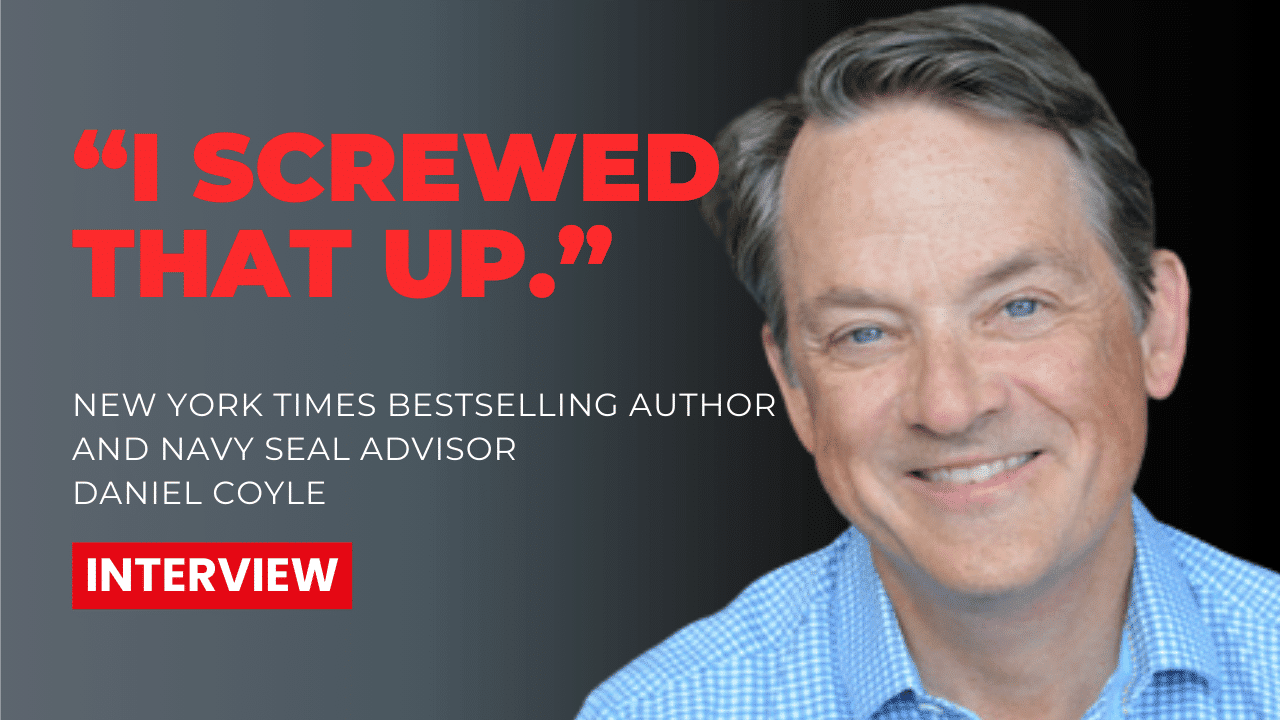
Daniel Coyle, New York Times bestselling author of The Culture Code and adviser to organizations ranging from Navy SEALs to global technology companies, joins the Strategy Skills Podcast to explore what truly drives leadership, performance, and flourishing.
Drawing on decades of research into elite performers and high-functioning cultures, Coyle explains why performance alone is not enough, and why many highly successful people still experience emptiness and burnout. He shares pivotal moments from his work observing leaders, including a defining insight from a Navy SEAL commander who described the four most important words a leader can say: “I screwed that up.”
The conversation challenges conventional thinking about leadership, power, and problem-solving. Coyle distinguishes between complicated problems that can be solved with instructions and complex problems that require experimentation, learning, and trust. Through examples ranging from kindergarten classrooms to professional sports teams and Pixar’s creative process, he shows how psychological safety, vulnerability, and group flow enable people to add up to more than the sum of their parts.
The episode also moves beyond the workplace to examine what it means to flourish in a world that is accelerating, fragmenting, and increasingly uncertain. Coyle discusses attention, meaning, community, and the small practices that help individuals and groups create energy, connection, and resilience over time.
Key Insights
1. Leadership begins with vulnerability
“The four most important words a leader can say… ‘I screwed that up.’”
Coyle explains that the best leaders are not those who appear flawless, but those who openly acknowledge mistakes. This signal of vulnerability creates trust and invites others to contribute honestly, allowing groups to solve problems together rather than hiding behind certainty.
2. Psychological safety outperforms raw intelligence
“The kindergartners outperform the CEOs… not because they’re smarter, but because they’re safer.”
In group problem-solving tasks, children succeed because they are unafraid to try, fail, and adjust. Adults, constrained by status and fear of judgment, slow themselves down. Safety enables experimentation and learning.
3. Most leadership failures confuse complex with complicated
“Complex problems are alive. They change when you do something to them.”
Coyle draws a sharp distinction between problems that follow instructions and those that evolve as you interact with them. Treating living systems like mechanical ones leads to brittle strategies and disappointment.
4. Experimentation beats planning in complex systems
“Try something, observe what happens, learn from that, and then try something else.”
For complex challenges, progress comes from testing, learning, and adjusting rather than executing a fixed plan. This mindset mirrors how high-performing teams actually work.
5. Leadership is about creating energy, not pushing information
“A lot of times we think of business problems as knowledge problems, when in fact they’re energy problems.”
Coyle emphasizes that change fails when leaders try to impose best practices. Momentum emerges when people are invited into shared questions and feel ownership of the work.
6. Group flow requires clear goals and freedom
“You have to have a shared horizon… autonomy… and ownership.”
High-performing teams operate like a pickup basketball game: everyone knows the goal, operates within guardrails, and has freedom to act. These conditions allow flow to emerge naturally.
7. Meaning is created through connection, not information
“Meaning is not about delivering information. It’s about resonance and connection.”
Coyle shows that meaning arises when people share stories, vulnerability, and purpose—often through simple but deep questions—rather than through data or instructions.
8. Attention determines whether life feels alive or hollow
“If you’re all in the narrow, life gets really thin.”
Flourishing individuals and cultures balance focused, controlling attention with open, connective attention. Too much of either leads to stagnation or chaos.
9. Community is something you practice, not consume
“Community isn’t a noun. It’s a verb.”
Whether in organizations or neighborhoods, community forms through shared projects, constraints, and contribution—not passive belonging.
Get Daniel’s book, Flourish, here:
Here are some free gifts for you:
Overall Approach Used in Well-Managed Strategy Studies
Enjoying this episode?
Get access to sample advanced training episodes
Episode Transcript (Automatic):
Kris Safarova 00:47
welcome to the strategy skills podcast. I’m your host, Kris Safarova, and our podcast sponsor today is strategytraining.com and we have some gifts for you. You can access episode one of how to build a consulting [email protected] practice at firms consulting.com forward slash build you can also get the overall approach used in well managed strategy studies at firms consulting.com forward slash overall approach. You can get McKinsey and BCG win resume example, which is an actual resume that led to offers from both of those firms, at firms consulting.com forward slash, raising my PDF, and you can get a download on how to be more effective in meetings so people pay more attention. And you can get it at firms consulting.com forward slash, on the room. And today, we have with us a very special guest, Daniel Coyle, who is the New York Times, Best Selling Author of the culture code, which was named Best Business Book of the Year by Bloomberg and Business Insider. And Daniel has served as an advisor for Navy SEALs, Microsoft, Google, and many other amazing organizations that we can learn from. And you know, every organization will have some fans and people who don’t think they’re amazing. So amazing, not the best word here, but organizations we can learn from we should pay attention to. Daniel, welcome.
Dan Coyle 02:08
Thank you. It’s nice to be here with you. Kris, I wanted to start with
Kris Safarova 02:12
learning a little more about your journey so far, because you had such an incredible career so far and so much to share. And then we could speak about your upcoming book. Perfect.
Dan Coyle 02:23
Sounds good? Well, I guess where I start is, is the place where I was was raised, was Alaska, which in some ways is very far away from the world, but in other ways, is the perfect place to become a journalist. Because up there you have kind of a combination of living in a really interesting environment, and also, when you come down to America to the lower 48 as we call it, it feels like everything feels brand new and super interesting and different. And so that was a nice way to sort of train I almost became a doctor and took a left turn into journalism at the last minute, and brought always that scientific interest. And my career as it evolved, ends up being basically about looking at the machinery beneath magic. You know, there’s there’s great performers, but really, what’s going on? What is the machinery beneath what they’re doing this? There’s great groups and cultures, but underneath that, it’s not magic. What are they doing? What is making them so good at interacting in ways that let them add up to more than the sum of their parts. And so over the course of 30 years, I’ve been looking at the sort of the machinery beneath those super top performers. And it sort of led me to a doorway a few years ago, and that doorway was, what is it all about? Really? What is a flourishing life about what? Let’s go beyond just performance, because we kind of know that performance isn’t the end, right? There are a lot of people that perform at a very high level, that achieve a great level of success, but their lives are hollow, empty, meaningless. So I set out to look at places that were like, they weren’t the mountaintops. They were like the green valleys, like, what are these places that that are able to create a bunch of new creativity, a bunch of generativity, where people grow together? And that’s what I got super interested in, in this, in this latest book. But, yeah, it’s all been somebody told me once that being a journalist was a license to be curious, and so I’ve just spent my life not having the answers but looking for interesting questions to explore, like, what is, what is talent really? What is culture really, and now what is, what is flourishing,
Kris Safarova 04:34
as you were going through this journey of understanding top performers and top performing organizations, what were some of the key moments, defining moments where you learn something, had a realization that really changed the way you look at things.
Dan Coyle 04:50
Yeah, I remember there were. There were a lot of them, and many of them have to do with watching leaders and trying to see how they think. Think leaders of great organization, what are they thinking? And I remember one morning, I was having a breakfast with a man named Dave Cooper, and Dave Cooper led the SEAL teams that got bin Laden. So he was on Navy SEAL Team Six career naval and when you ask people around the Navy SEALs, he was kind of a man of mystery for me, because I said, Well, who’s the who’s the best leader you’ve ever known, the best at building trust, the best at building a high performing organization. And they all said, Dave Cooper, but they also all said, Well, he’s not the best performer, he’s not the best shooter, he’s not the best swimmer, he’s not the strongest or the fittest, but he’s the best at building trust. And so we were having breakfast, and Dave said to me, you know, the four most important words a leader can say, and that got my attention, like, Oh no, tell me what’s the four most important words a leader can say. And what Dave said was, the four words are, I screwed that up. I screwed that up, which was such a revelation to me, because I sort of thought leaders should be the most competent and not show vulnerability and and always have the answers and always be certain. And here was a guy who’s one of the best leaders on the planet, saying exactly the opposite, that the most important thing you can do is is be vulnerable. And that was a moment for me that, and then I started seeing that everywhere. I started seeing that at Pixar. I started seeing that at great teams. They all had leaders who were really skilled at saying, I don’t know, this is really a hard one. I don’t know the answer. Tell me what you think. And they were really good at creating conditions. And you could call it psychological safety, you could call it belonging, you could call it courage, but they’re creating these conditions where people can, can, can let their armor down and relax and tell the truth. So that was, that was a really powerful one. And I guess, you know, I’ve had a bunch of those, but that one really stands out because I took that to my parenting. I took that to the way I behaved with my neighbors. I took that to the way I behaved at work. This, this power of saying, wait a minute, being sending that signal, being really vulnerable is, is not a weakness with the leader the greatest. The greatest weakness is to pretend you have none, right? But in the greatest strength is to really be open about your weakness, because it sends a signal that we can figure this out together, and we’re much stronger together than we are as a collection of individuals.
Kris Safarova 07:31
This is such a powerful moment to have and prove that this leader wasn’t an artist, because you would never hear something like that from someone like that, yeah. Any other insights you could share with us similar to this?
Dan Coyle 07:46
Yeah, I guess a similar one for me that came through was when I saw a team of kindergartners outperform a team of CEOs. There was a man named Peter Skillman who, who had a challenge for he was sort of wondering, what, what are the best groups have? What? What allows people to add up to more? And he had a challenge where he had people build. The challenge was, who can build the tallest tower with these following materials, like 20 pieces of raw spaghetti, a yard of scotch tape, and then a single standard size marshmallow had to go on the top. So that was the challenge, creative challenge. And he had teams of four person teams of CEOs, lawyers, MBA, students and kindergarteners. And if you had to bet it was going to win, most of us would probably bet on the adult teams, because when they interact, they look very smart, and they divide up into roles, and they’re very organized. And the kindergartners are totally chaotic. They just go bananas and start jamming stuff together in a way that looks very, very chaotic. But in fact, the kindergartners outperform the CEOs and the lawyers and the MBA students, not because they’re smarter, but because they’re safer, because because they are. They have they don’t worry about in all the adult teams, you’ve got this whisper of like, oh, is it okay to say that? And who’s in charge here, and are we going to be graded on that? And it slows people down, and it makes them wear their armor. And there’s no armor with the kindergartners. What they do is they get into what’s called group flow, which is, you’re moving toward a target. Let’s build this thing, and you’re doing whatever the next right move is you’re not sort of thinking about anything yourself, kind of disappears, and you simply do what’s needed, if it’s leaning this way, a little bit, put in something else there. And what better way to learn as a group than to try stuff, try it, see what happens, adjust and then, and then try something else and then adjust. And it really, for me, made it clear that we live in a world where we think it’s all about straight lines, like we think there’s A goes to B, goes to C goes to D, like everything is just, you know, if we do this, then some this will happen. And that’s not true. I mean, we live in this living world. World that is much more complex, and it’s never a straight line path, because when we do something in most of our problems, actually, I should probably it’s kind of interesting, because it brought me to this distinction between complicated and complex, and I didn’t realize this. And I think most readers, most listeners, probably don’t either. But we think of complicated and complex as being like the same thing. But in fact, there’s a really important distinction between them. Complicated things are things that always come together in the same way, like A goes to B, goes to C, goes to D, and if I give you a list of instructions and you follow them, you will get the proper result, like if you’re building Legos, or say you’re building a car, and I give you all the materials, and I give you a set of instructions, and you put them together in that way, you will always get a car. You will always get a Ferrari. You will always get a car that’s complicated. Complex problems are alive. Complex problems change when you do something to them. They’re not always A to B to C to D. They’re not Legos. They’re more like raising a teenager, like everything you do to that system, that teenager changes the system, so you cannot have a set of instructions. So the best way to approach a complex system is to do exactly what those kindergarteners did, right? Try something, observe what happens, observe it, and then learn from that, and then try something else, going in with some plan, like the CEOs did, and like the MBA students did, and like the lawyers did, doesn’t work because it’s brittle. You’re treating a complex problem as if it were complicated. And so the takeaway for me was like, before I go into any problem, I kind of ask myself, Is this more like building a Ferrari or more like raising a teenager like that is a really good question to ask. Is it? Is there a set of instructions that I need to follow, in which case I need to find expert information, I need to follow that, and I need to do follow the rules, but is it complex, then I need to experiment. Then I need to experiment and learn from that. And so I think in all of our worlds, in all of our on all of our desks, our stacks of problems, and they all fit into one of these two areas, and understanding that distinction, and not making the category error of saying, Oh, we just need to do this. And this will happen. And I think we often fall into that, that sort of illusion that everything is straight lines and everything is simple as it’s just complicated, when, in fact, it’s a living system that we’re interacting with. Such an interesting
Kris Safarova 12:34
and original way of thinking about this. Do you see people within major organizations often look at something and think it is complicated, but it’s actually a complex problem.
Dan Coyle 12:44
The idea every, every single day, every I would think it’s the most common mistake that people make, and they make it in in not just at their work, but in their own lives. There’s that sense like, Oh, if I only do this, then everything will change, and I only need to take these three steps, when, in fact, it’s if you drew, if you drew a kind of an image of anybody’s life or of anybody’s career, like if you took a piece of paper and said, draw me a map of your career, and just where, where you went, would you draw a straight line? Probably not. Like most of our lives and our careers are real mood they’re really squiggly lines, right? They’re moving from left to right, and then, oh, that bumped into this barrier. And so I went this way, and then I bumped into this barrier, and I went this way. And that’s really, that demonstrates how clearly those that’s that’s a shape of a complex system. We’re all living life is a very complex system. And so the thing we can do is, kind of change our mindset to say, instead of saying, what solution can I bring to it? We have this urge to fix things and solve them. It’s a good urge. It’s not a bad thing. But oftentimes there’s no solution. Oftentimes what there is is you’re trying to find that path forward. So what can you do to think directionally? What general direction do we need to go, and what’s an experiment that we can do together to figure that out that ends up being much more aligned with the idea of solving and not and actually, a lot of problems you’ll find they resist solution. You have to sort of change, you have to move so that the problem ends up kind of dissolving, but finding ways to explore those complex systems in ways that allow you to learn and allow you to shape the system in ways that benefit you.
Kris Safarova 14:29
And when you work with clients, advising clients and teaching them this way of thinking, and they start approaching problems they thought were just complicated as complex. Where do they struggle?
Dan Coyle 14:41
Yeah, a lot of times we struggle, a lot of times with power, because a lot of these problems are best solved by people who are closest to them. So for example, I was working with a professional baseball team, and they. We didn’t have much money. They were one of the poorer teams in the league, and so they made a decision, we can’t buy talent. We’re going to have to grow it. And if we’re going to grow that talent, of all our of all our minor league teams, major league teams have got sort of like a school system of minor league teams, single a, excuse me, single a, double A, triple A major leagues, and it’s like a school system, where players will advance as they get better, and the better your school system, the better the faster your your students, your players, learn, the better your organization will be. And the people who are teaching are the coaches. And so for a long time, we tried to push on the coaches better teaching practices. We knew the good teaching practices, but we tried to expose them to them and encourage them to change right from the top down power like here’s the new curriculum you should follow it, here’s the new way to practice. Here’s the new way to do batting practice. We had all the right ideas, but when you’re talking about changing a complex system, like coaching, like all these coaches, what ended up being transformational is that we flipped it. We got the coaches together, and we said, here’s the question, we’d like you to explore a question, not an answer, a question. The question is, who’s the best coach you ever saw and what made them great. And all of a sudden, instead of pushing best practices on our coaches, it’s flipped, and the coaches are suddenly sharing ideas and memories about the best coaches they ever saw, how those coaches connected, how those coaches guided them, how those coaches had deep knowledge. And from that conversation, we built what was called a model of excellence, a model of excellence for coaching. It wasn’t the information in it wasn’t revolutionary. What was revolutionary was the energy it created. Because instead of them, people resist change. We all know that we are built to resist change. Our brains have evolved to value present stability over future guessing and instability. So we can’t help that. We all resist change. So the best way to overcome that resistance and to create meaningful connection and create energy and create like little we basically did this. Turn them into a spaghetti kindergartner group, right? Here’s the problem. Solve it with us. Help us. Help us. Let’s all get together and figure this out and tapping into the energy of the group. A lot of times, I think we think of business problems as being knowledge problems, when, in fact, they’re energy problems. The problem is, you’d have no momentum, and you have no no no creativity bubbling up from the bottom. And so creating those conditions of group flow with the group and group flow is not magical. It’s it requires three conditions. You have to have a shared horizon of in this case, it was build us a model of excellence. What are the what’s the best coaches? It’s a question. What’s the best coach? What do they do? You have to have autonomy. You have to give people freedom to move in that space, autonomy, and you have to have some level of ownership and competence, where they feel like they have something to add and they’re controlling. And the analogy is sort of like a pickup basketball game, right? What you want to do as a leader is create a pickup basketball game with a clear basket, a horizon that everyone’s shooting at with autonomy. They can go wherever they want in that space of the court. They can’t go in the stands. They can’t go down the street. This is the space where we’re going to be exploring this one question we weren’t interested in the best barbecue joint they ever found. We were talking about this confined area, and we get they have the competence and the ownership to be able to do that. So leaders. Job is not forcing information down people’s throats. It becomes building little gardens, little gardens where where energy can connect, where roots can grow, where something new can emerge. And out of those conversations, it really revolutionized the way our coaches think and behave, and gave the whole organization this massive shot of adrenaline. And, you know, I don’t want to sort of read too much into this particular moment, because this was a much more complex journey with a lot other many, many, many more elements to it. But over the last 13 years, the this team, the Cleveland guardians, that that has done this, has won as many games as the New York Yankees, and spent $1.7 billion less money because they’re growing good players. They’re they’re, they’re developing and coaching good, you know, players to become better than they would have otherwise. So you know, our goal as leaders is not to have the answer, but it’s to embed the right question in the landscape in ways that enable autonomy, that enable ownership, that enable people to explore toward a shared horizon. And it’s, it’s, it’s a vision of. A leader, kind of you know more as a as a designer, more as a gardener, you might say, because your job is to not have power over. It’s it’s to have power with and power between
Kris Safarova 20:14
Daniel and what would you recommend to someone listening to us right now who is working for a major organization, and they are not yet that senior. They are relatively senior. But the way the organization is structured is they don’t really have many people directly reporting to them, so they work in many people across the organization. They have many people above them, so they don’t really have as much power to set up a new way of working. How can they use what you are teaching in a situation like that?
Dan Coyle 20:42
Yeah, I think there’s a there’s a well, you know, of course, first they should buy all the books. That would be the most important thing they can do. But I think it comes down to several things. I mean, it’s a long first of all, understanding this is all sort of a marathon mindset is the appropriate one to one to take, I think is a good saying that I came across a while ago, which is that culture is the 15 feet around you. Culture is the 15 feet around you at all times. And so while there may not be kind of official hierarchy that gives power. There are all types of implicit and unofficial power. And one of the most powerful things that anybody can be in an organization is to be a broker, to be a connector between different pieces of the organization, which really depends on building meaningful relationships with those around you. And it’s funny, like building meaningful relationships. I’m not talking about networking, you know? I’m not talking about transactional stuff. I’m talking about meaningful relationships, where people are vulnerable, where people explore questions together. And I think one of the one of the most powerful, underrated skills in building those relationships, because it’s funny, it’s the most important skill in life, period, also in business. You know, when people are on their deathbed, when all the science of human happiness and fulfillment gets studied, it just comes down to those two words, meaningful relationships, period. And yet we treat it like it’s a mysterious skill, like we don’t really have a model for how those are built. And as I would say, that the science shows that they’re built in these moments of mutual vulnerability, of mutual openness, creating spaces where people can be vulnerable, where people can be open together, is a really powerful thing you can do. So first of all, kind of understanding that that’s the model, right? You can’t do it if you’re certain of everything, if you have your armor on all the time, if you’re not going to take any risks together, if you’re not going to suffer. Suffering often brings people together. But having that idea that, okay, it’s gonna be it’s gonna feel weird to get that close to people, right, to create that meaning, it’s gonna be risky, it’s gonna be kind of vulnerable. And the second thing is the power of questions to do that. You know, I think a lot of people, you know, answers kind of drive people apart. Questions bring people together and asking the right set of deep questions. And there’s a really funny phenomenon with deep questions that kind of cracks me up, because it’s people are always when you say, say, we’re all going to get in a group and we’re all going to talk about something like, oh, let’s talk about the last time we cried, or, oh, let’s talk about, what would you need to know to become my best friend? Like, let’s talk about that exchange, that question, when you do that with a group, everybody responds like, Oh no, that’s gonna be terrible. Like they’re scared of it. But then when they actually do it, they’re actually having so much fun talking with each other, you cannot get them back in the room. We secretly love that kind of intimacy. We secretly love it. So asking people these simple questions, and my favorite one is to kind of ask people, What do they like, and then ask them, Why do they love that? What do you love about that, right? What do you like? I love to jog. What do you love about that? Just a simple question, but there’s a real depth to it. If you keep going and ask, tell me more. What else? Tell me more. People’s backgrounds are such a fascinating, deep place to go. How do your ancestors show up in your life? Is a great question to ask people, right? If someone were to become your best friend, what would they need to know about you? Right? What would they need to know? Like, stop and think about that that’s really interesting. What? What’s one thing you wish you would have done, but you didn’t? How come? How come you didn’t, you know, or what’s the proudest moment you’ve ever had in your life? Like it’s, it’s not, they’re not complicated, right? They’re not complicated questions, but they are questions that require people to step into uncertainty together. Other, and that’s that step is what makes the meaning right, that surrender makes the meaning so understanding, I guess, so that I would go to that culture is the 15 feet around you, understanding that it’s going to be vulnerable and interesting and difficult and rewarding, and questions are at the absolute core of it. And I guess I would add one other thing, which is just messiness, like I think most if you did a graph of like certainty and vitality in life, they would be inversely related. The more certain you are as you go through your life, the more it bleeds vitality out of your life. So these places that are flourishing are places that have a little bit of slack built into the system, Slack where they don’t know what’s going to happen exactly, and it’s a little bit messy, but that’s because life is that way. Life is like an ecosystem, right? Life is not a machine. If your life feels like a machine. It can often feel dead. It can often feel frozen. But if your life has got that space in it, for surprise, for responsiveness, for improvisation, that can be an incredible source of vitality. So we often in this day and age, especially for young people, we’ve all grown up in this where we put habits on a pedestal, like Habits. Habits are great, right? Have good habits, you’re have a good life. That’s actually only half of a good life, because habits automate things. Habits make you stop thinking about them, right? So if you have a life of perfect habits, you’re kind of sleepwalking, I think. And so the thing you have to do, habits are only half the story. The other half of it has to do with stopping and and having experiences that don’t automate your life. They animate your life. They animate it. They bring it to life. And those could be really as simple as a small ritual. Small rituals can be really, really powerful ways to do that. There’s one, one, there’s a there’s, I give a few examples in the in the flourishing book of these small rituals, but one is from this guy at Harvard who works at a place that sort of designs rituals, and he every morning, when he brushes his teeth, he just says to himself, every day contains joy and suffering, and this day is no different. So it’s just this tiny little mantra that makes no sense. It doesn’t change the day. It doesn’t make any impact. It just grounds him, right? It kind of animates his life in a way, and any little thing like that, where you’re not where you’re not, like trying to make something happen or trying for a result, but you’re just trying to let go and tune into the moment and seeing what’s happening around you, actually, and opening up your attention. A lot of times we walk around with this kind of narrow beam utilitarian focus. And there’s a lot on how the attentional systems of our brain work that make this super fascinating, but we normally think that attention is just one thing, but in fact, we have two distinct systems in our head. They’re distinct, they’re actually competitive, kind of complementary. We can only do one at a time. We can either focus narrowly, or we can kind of open up and focus with wholehearted, wide, warm, connective attention. The first is called controlling attention, very narrow design to control give us stability, let us grab things and categorize them. The other is called connective attention and places that flourish. And I think people that flourish and good cultures are attentionally healthy, like they’re not all in the narrow. If you’re all in the narrow, life gets really thin. If you’re all in the broad, then life is really groovy and but you’re never getting anything done. So they’re good at being intentionally healthy, being balanced between these two modes, these two forms of attention and and working kind of always. Some of it’s automated, some of it’s animated, right? Some of it is about control, but a lot of is about connection, or it’s about control in the service of connection. So finding that kind of attentional health, attentional hygiene, attentional balance, where you’re not overweighted on the narrow and you’re constantly creating spaces and seeking experiences where you are opening up to wholehearted attention. Maybe that looks like spiritual practice for you. Maybe that’s meditation, maybe that’s awe. Maybe that’s hanging out and doing nothing with your best friends. Maybe that’s music. There are all kinds of ways to sort of do it, and when we tune into that, I think that’s what gives us meaning and energy, and is at the core of those meaningful relationships that. Will hopefully make our life a little bit better.
Kris Safarova 30:03
And when someone with controlling attention talking to someone with connecting attention, there may be a lot of conflict. There’s usually will be a lot of conflict,
Dan Coyle 30:12
because we’ve all had those experiences, yeah, right, where we’re sort of trying to look at the big picture, but they’re not interested in the big picture, and they’re trying to just narrow in on something for a result. But that, that that narrow, that narrow focus on results, as we know. I mean, we know what life is like for people who are relentlessly grinding at their career only at the expense of everything else. We know what that looks like. It’s a sad success story. They may be successful, but they will end up potentially sad and alone. And so it’s, it’s this balance is really at the key of figuring out how to succeed in this, in this ever speeding world in which we live,
Kris Safarova 30:59
and a life of someone who is working incredibly hard for the entire life is very common for people listening to us right now, what would you tell to them if they really recognize themselves in your words right now?
Dan Coyle 31:12
Yeah, it’s a, it’s a, it’s tough. I mean, we’ve, I’ve been there for sure, sort of getting been grinding away. I guess I would say a couple things. One is those that sort of attentional balance. You’re built to do it. You’re built to have it. It’s, it’s, we’re wired for shared, meaningful connection. So it feels like it can be very far away when you’re in that sort of grinding. I’m on a lonely mountain climb, and I’m putting my every every day I’m struggling to stay on side of the mountain, but the good news is that we’re built for those meaningful connections, and so starting small, starting with small connections, and it can be really hard to let go, because we want to keep working, and there’s value in working, so it feels sort of strange and disorienting to kind of surrender that, and to give you know, to create spaces where you can do that. But I guess I would just say starting small, looking at your life, doing some sort of a meaning map, like finding places in your life where you’re already experiencing meaning. That can be a really useful exercise. Look at the last week, or start tracking it every day. Where did you feel meaning today? Where did you feel like connected and resonating and energetic, energized by what you were doing and who you were talking with, tuning into that can be really, really powerful. And then the third idea that I would share would be something about like having looking out for what Columbia University psychologist Lisa Miller calls yellow doors. We usually go through life kind of attuned to the red doors, like that’s a stop sign, or the green doors, that means you should go, but the yellow doors are ones that are kind of in between that we glimpse out of the corner of our eyes, like that conversation with a stranger on a train, or that extra stop or slowing down to walk with somebody on the sidewalk, or just some bit of slack in the system where you explore something new, you know, a new conversation, a new relationship, a new habit, a new ritual, a new neighbor, whatever that might be, being alert to that and trying to do like one of those a day, like making a choice that you weren’t really, you know, certain of, and realizing that your uncertainty is actually a good sign. It’s a signal that you’re going somewhere interesting. So that’s what I would say. But it’s, it’s really hard, I mean, because today, you know, the world just keeps speeding up, and it feels like it’s designed the world. See, feels really well, designed to burn us out and bum us out, right? It is. It keeps speeding up, and we have to keep holding it together. So I guess the other thing I would add to that is think about it as you’re trying to build sort of an oasis for yourself. You can’t just do you’re trying to build kind of an ecology of practices. It can’t just be like the one thing that you do, I just do this toothbrushing thing every day. It needs to be things that involve your body and your mind and your friends and think about it holistically. Because you know the world, the world will keep fragmenting and keep moving us faster
Kris Safarova 34:17
and faster. And I’m glad you mentioned the world speeding up, and it feels like it is designed for us to just be working all the time and being extremely stressed, damaging our health way too early in life for someone who is right now very worried about what’s happening with AI. They worked the entire life so hard. They got great grades so they could get into good university, and then they studied so hard, got great again. Did everything required? Got a great job, worked really hard, got promoted couple of times, many times, and now they see people are getting laid off, and they have worried what will happen to me. Now, yeah, what would you tell them?
Dan Coyle 34:59
Did I. It’s kind of incredible that we’re living through this. I guess a few thoughts come to mind. I don’t know if there are any real answers. I guess what I would say, the patterns that I’ve noticed as I’ve studied these sorts of questions are that
35:18
these sorts of crises end up being interesting opportunities many times,
Dan Coyle 35:26
in in the study of Harvard adult development, the really overarching pattern was that people who flourish, they they lean into kind of exploring in diversity, in adversity. When they meet adversity, they explore around it, and they also turn toward other people as they do so they don’t see themselves as a rugged individual who’s got to solve this on their own. They turn toward their community. And so many of these issues, of these questions of what it’s what it means to work in the modern world, and these questions of what it means to navigate these kinds of Titanic changes, the solution ends up being some version of that word, community. Community. To look for community, and community literally means sharing gifts. It’s not a noun, it’s more of a verb. So look for places where you can turn toward other people in facing that adversity and don’t, don’t do it, don’t do it alone. So and I guess the other thing that AI has done, in some ways, is to really put the spotlight on the the value and the power of real human relationships and connections like it really shows how magical communities can be. And it it helps us realize that having the right answer is not what makes us human. It’s exploring the right questions together together, and that act tuning into that fact that it is not delivering, you know, computational power and have it delivering the right answer is not what life is about. Like having all the answers, it’s going to offer us all the answers. That’s fine, but it’s not very good at asking questions, and it’s not very good at exploring those kind of complexities that we were talking about before. So realizing that those moments when we can, you know, turn toward each other and explore into questions together, ends up being, you know, I think, you know, there’s no answer, but you know what? There never was an answer. And if it wasn’t a I would probably would be something else. Our world keeps speeding up and keeps fragmenting. And so it’s putting a spotlight on the question, how can we build meaningful relationships with each other, and and then, and then do kind of, you know, one of the things I saw in the flourishing book, as I wrote it, was the power of these kind of messy, aspirational projects, communities coming together to kind of awaken as communities. And one of them, there was this very disconnected Paris neighborhood, and there was a retired person who did an experiment. He put a table down the center of a street, 720 foot long table. Got 700 chairs through this massive and everybody thought he was crazy. They called him a teddy bear kisser, because that’s what you say if you’re Parisian and you want to put someone down, like, Oh, you’re so naive. You’re a teddy bear kisser. And after he did that, it was a huge success. Everybody showed up, everybody brought food. There was music. It was this incredible moment of togetherness. And then he started allowing people to self organize into interest groups, like there was one group that was around biking, another group around history, another group around the law. They were curious about the law, another group around cats, and all these interest groups. And the only rule he had, he had constraints. This was his pickup basketball court, right? It wasn’t, you know, you can go anywhere. Two, two constraints. One was no politics. The other was you have to gather around what he called a joy device, which was food, wine, coffee. That was the only constraint. Otherwise, knock yourselves out do whatever you want to do. And what happened in those situations was what always happens when you give people autonomy and a sense of belonging and a clear horizon to move toward. They do, and now today, that that neighborhood, it feels more like a small village, like everybody knows each other. There’s an old woman who broke her wrist, and 20 people sent her a note saying, Hey, can I help you get your groceries? What do you need? They are super connected. And that kind of project, that kind of messy, aspirational project really make, shows us that community is is a verb, right? Community isn’t something you consume or is just a fixed thing. It’s a set of practices where you’re constantly reaching out, saying, What gifts do you have? What gifts can we bring together? Let’s. Share them. And it’s it’s really powerful. So in a world where you know the you know AI is coming, I think leaning on that set of very, very human practices of building community, whether that community is on the job, and in a way that the Guardians example we talked about earlier, the baseball team with the coaches gather up and talking about who the best coach they ever knew was. That’s an example of community too. Like find ways to create those conversations around deep questions and then do projects. I think Freud said life is love and good work, like find love and do good work. And I think in whatever the future brings, that will continue to be true, like find meaningful relationships and do messy, aspirational projects together.
Kris Safarova 40:52
Can you talk to us about conditions for flourishing?
Dan Coyle 40:55
Yeah, you bet. Well, and that’s what the word is. It’s, I like how you put that? Because it is conditions. It’s not capacity. We all have the capacity to do it. We’re pre, we’re pre wired for a shared, meaningful connection. There’s really, there’s really two conditions. One is you have to create a space to make meaning. To create a space where meaning is made, and that means kind of having a group pause, kind of a responsive stillness, moments of curiosity. And those spaces, it’s not like a literal you know, it could be big, it could be small. It could be a space within a conversation. When you ask a deep question, right in that pause, you’re illuminating something. You’re illuminating meaningful connection between you. It could be a small group discussion. There was a guy, probably the best meaning maker I ever met, named Peter block, and brilliant at designing these meetings. And he brings people together, and he gives them simple questions to explore. He says, get into groups of three with people, you know the least, that’s his rule. And then he gives them a deep question to explore. 111, great. One. There was a shooting in his neighborhood, and the neighborhood came together, and they were kind of expecting a safety meeting, like something to reassure them, like, Okay, this is what the police are going to do, and this is what the school is going to do, and this is how we’ll be safe. But they didn’t get that. What they got was Peter block saying, hey, get into groups of three with people you know the least. And now the question I want you to explore is, when did you first start caring about this neighborhood? Like whoa. That is a very different experience than being told everything is going to be safe because we have a new police new police plan, right? When did you first start caring? And what emerges are stories, histories, little anecdotes, connections, meaning, meaning emerges. So Peter is so brilliant because he doesn’t he understands how meaning is made. He’s pretty strict about the space. He makes people get into these groups. He asks them to explore this one question, not 10 questions. Don’t just make small talk. Don’t talk about your opinions. Everybody has opinions. Talk about something meaningful. Talk about why this matters to us. Why do you love this neighborhood. That’s a great question to ask anybody. So that’s what creates connection. Meaning is about creating energy. It’s not about delivering information. That’s a mistake we often make. We often think meaning, Oh, it’ll just tell me the facts, right, and I’ll understand the meaning of it. It’s not what it is. It’s about resonance and connection, when you feel something, some connection with another person, that connects to something bigger than both of you. So that’s the first step. That’s the first condition to create conditions where meaning can arise. And when we look around our modern workplace, we’ve been pretty good at eliminating those, those sorts of spaces. I think, I think we’ve been really effective modern work, which is algorithmic and very efficient. So you almost have to work against the tide to try to create those kinds of conversations and spaces. But it’s still that’s why it’s powerful. And then the second thing that you have to do, the second condition, is you have to create conditions where you can have group flow, where you can have a designed mess, where you can create a condition where you’ve got a clear goal you’re going toward, and where you’ve got clear guardrails on each side, and you just allow people to navigate toward the goal. Let them do whatever they want to do, autonomy, belonging, shared horizon, those three things, so creating those spaces, and they kind of, you know, there’s, there’s a some good, some really good examples of that in sports, there’s some good examples of that in in tech, there’s some good examples of that in. Pixar is one of my favorite examples of group flow, because when they’re making meetings, when they’re making sorry, when they’re making movies, they have these little meetings called Brain Trust meetings. And what happens in a brain trust meeting is they group about 10 people, get together, they watch the movie, a draft of the movie that is not done yet, and they all poke holes in it. And the rule is that you cannot offer any solutions. You can only point out what didn’t work, what didn’t work. So that’s the guardrail. You can’t offer solutions because the director is really the one. Your solution will not probably work because you don’t understand the movie like The director does, but that’s the constraint. Everyone’s free to do whatever they want to do, right? There’s ownership, there’s autonomy, and there’s a clear horizon. We want to really make this movie go, as they say, from sucking to not sucking, and it lasts a couple of hours, and it ends up being incredibly liberating and powerful, because it’s people tell the truth about what’s going on, and they’re able to navigate and and flow that movie into a better spot. So those are in these two conditions, sort of making meaning and group flow. We can almost think of them like any living system takes in creates energy and then expresses it right where our bodies are built this way. The forest is built this way. A coral reef is built this way. A garden is built this way. That you have systems that create energy and then systems that express that energy and growth. And we see the same thing with flourishing in this model, where the first meaning is about energy. How do we create that sense of electricity between us and that sense of shared connection that is an energy creation. Thing we’ve created that our roots, right? Those are our roots. And now let’s exhale that in action. Let’s let’s go for it. So it’s a peculiar skill set, because pausing always feels kind of wrong, like the meaning is always sort of vulnerable and risky, like that’s kind of strange, and also taking these messy aspirational leaps feels risky too. So it is. It’s counterintuitive on a couple different senses, but being brave enough and curious enough to stop and say, what really matters here, what is our highest value, what truly matters the most? What are we connected by? What is bigger than us? That first pause and then, what messy, aspirational project can we do express that in action? So this combination of like inhale meaning exhale, action, inhale meaning, exhale, flow is what we see in flourishing groups, and that’s why they feel so alive, because you end up with kind of a feedback loop, like doing that meaningful stuff creates more connection, which creates more experiments, which creates more connection, which creates more action. So it’s it’s like any living ecosystem. It ain’t a machine. You don’t switch it on and off. You don’t have buttons you can push, but you have this energy. You can create these connections, you can you can nurture. And you’ve got these messy projects you can try. And that’s those are the conditions in which flourishing will will happen.
Kris Safarova 48:19
Daniel, and how could someone apply this in their personal life?
Dan Coyle 48:23
Yeah, I think, you know, there’s sort of four, four ways. I mean, you can add you can add rituals, simple rituals, to your life. You can have sort of these quick moments of regrounding to create meaning. You can ask deep questions, that’s another way. And you can have these little moments of micro connection with people that’s all to sort of help create the energy of it. But I think the quickest way to kind of apply it in your own life is to recognize, start by recognizing where it’s already happening, right? We all have flourishing parts of our lives. Nobody’s life is bereft of flourishing entirely. Everybody’s life has a messy part. Everybody’s life has experiments that they’re doing. Everybody’s life has meaning in it. Maybe it’s meaning that you’ve had in the past, maybe it’s it’s meaning that you’re sort of pondering about your future, but finding those moments where you have meaning and action connected that that can be a really useful thing. I guess another thing to do would be to, you know, really think, kind of think in hypotheses. Don’t think in certainty. You know, think in terms of experimenting, because we have the impression that our life is on some path, but in fact, there’s all these branches off the path all the time, right? We’re just not taking them, or we’re not seeing them, and we’ve come across all these strange branches in life. And so think in terms of hypothesis and Testing, testing things out. Out and seeing when it works so and I guess the third thing I would say is, you know, to really treat failure is just information. You know we are it is not going to be a smooth and effortless ride up escalator or a staircase. It is much more dynamic than that, much more like riding a river and and steering that river, and so seeing those moments where we where we fail, as as really opportunities both to lean into that failure and to turn toward the people who are next to us.
Kris Safarova 50:35
Daniel, you’re such an interesting person, and I’m sure that anyone who listened to this interview would agree with me, you have so much to share, and they could just talk to you forever. I want to wrap it up with my favorite question over the last, let’s say, over your entire life, were there two, three aha moments, realizations that we haven’t yet discussed today that really changed the way you look at life or the way you look at business?
Dan Coyle 51:00
Wow, that is a cool question. Realizations, yeah, I guess I do remember like, and this is more life than than, I guess, one with life and one with business. And this first one is very strange, but I just remember as a kid waking up one summer day, and in Alaska, the sun comes up really early, so you wake up and it’s already bright outside, and I remember peeking out my window, I had a Venetian blind and just having this feeling like we could do anything today, like there’s no limit on what we could do. And I still remember the excitement of that, that feeling where it was just, I like to reconnect to that, because, you know, you sort of get in your path, and you get in your projects, and you sort of think like, oh, it’s all fixed. But man, I just connect back to that feeling. And I think, you know what? It’s still true. That is still true. You can sort of go left, go right, go straight, go up, go down. That was really powerful. And I guess the other the insight with business that took a long time to get I sort of thought I was kind of, I sort of thought that business was filled with kind of Darwinian winners, that as you got further up the ladder, people got more ferocious and less forgiving and more ruthless. And I’ve been fortunate enough to deal with a lot of really healthy organizations. I’m sure that is true in some organizations, that it is ruthless at the top and more ruthless as you go up. But I’ve been fortunate to deal with organizations where it feels like it’s exactly the opposite, like the higher you get, the nicer people get, and the more empathetic they get, because they’re really good teammates and really good leaders. And that was an insight that really flipped the way I think about business and I think about leadership, because that to go back to Dave Cooper, like, what you know, most important thing a leader can say is, I screwed that up. That’s a really nice thing to say. And when you see a lot of people with that level of humility and curiosity about the world. It makes you a better person. It makes you a better dad, it makes you a better neighbor. And so that the idea that actually that dog eat dog thing, it might be true a lot of places, but at the very best places, it’s not true. And I find that to be really energizing and affirming, Daniel.
Kris Safarova 53:21
Thank you so much. Where can our listeners learn more about you? Buy your book, anything you want to share? Yeah, [email protected]’m
Dan Coyle 53:29
and you know, hit the link, you can send me an email. I like the conversations, and I appreciate this conversation. And thank you for your questions, Kris, and thanks for exploring with me. It was fun.
Kris Safarova 53:38
It was incredibly fun. And I’m recording from hotel, and it has a very slow internet. So that’s why sometimes it took really long time to ask the next question, because I have to keep it on mute not to create noise during the recording. Our guest today, again, has been Daniel Coyle, incredible guest, definitely worthwhile. Really listening to this podcast, you can also download some gifts from us. You can get the overall approach used in well managed strategy studies at firms consulting.com forward slash overall approach. You can access episode one from how to build a consulting practice at firms consulting.com forward slash build. You can get McKinsey and BCG winning resume example at firms, consulting.com, forward slash resume PDF, thank you so much for tuning in. Daniel, thank you so much again for being here, and I’m looking forward to connect with you all next time. Thank you. I enjoyed it. Kris, thank you.
Leave a Reply