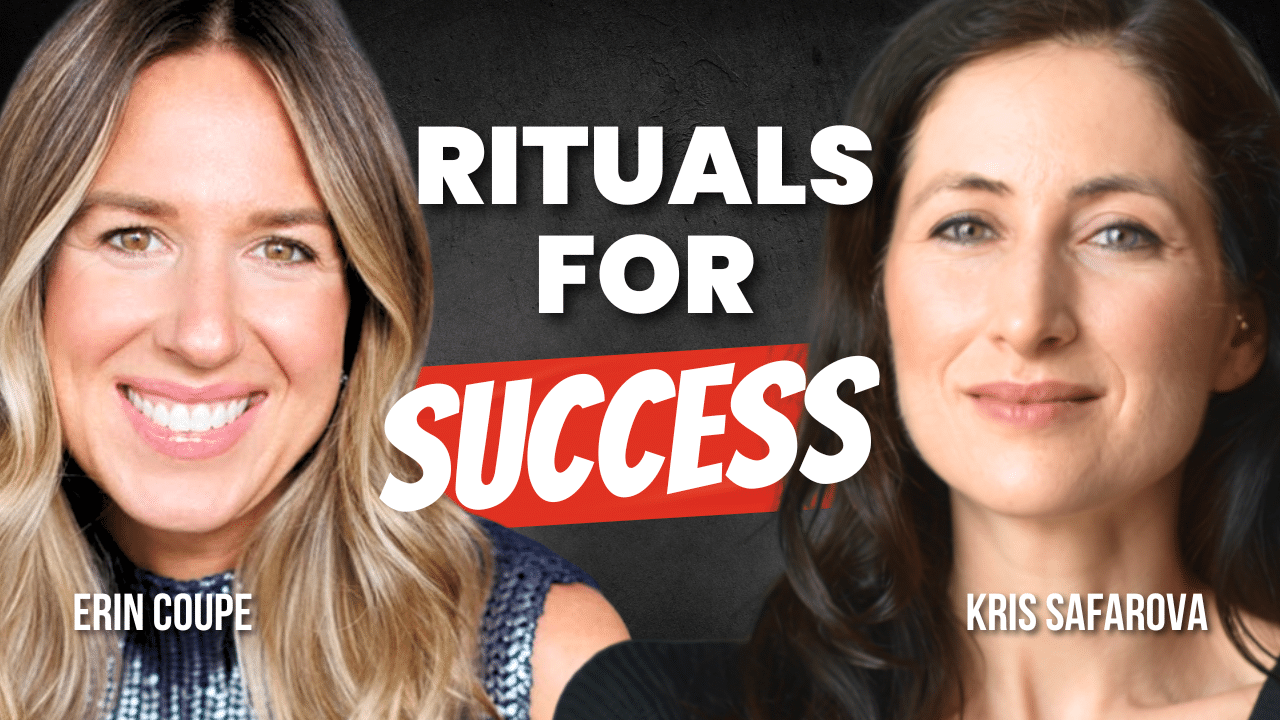
Former Goldman Sachs executive Erin Coupe shares how she transformed her life and career by replacing routines with rituals, practicing meditation, and stepping into self-leadership.
In this episode of the Strategy Skills Podcast, Kris Safarova and Erin dive deep into practical lessons for entrepreneurs, consultants, and online business owners who want more clarity, energy, and independence.
Based on her book I Can Fit That In: How Rituals Transform Your Life, Erin explains how to:
- Build rituals that fuel focus, creativity, and business growth.
- Use meditation to calm your mind and access deeper ideas.
- Lead yourself first — so you can lead teams, clients, and businesses better.
- Align achievement with values to avoid burnout and emptiness.
- See AI not just as a tool for efficiency, but as a partner in self-discovery.
This conversation is perfect for online business owners, consultants, authors, and executives building a life and career on their own terms.
Learn more about Erin here: https://www.erincoupe.com/
Get Erin’s book here:
Here are some free gifts for you:
Overall Approach Used in Well-Managed Strategy Studies
Enjoying this episode?
Get access to sample advanced training episodes
Episode Transcript:
Kris Safarova 01:10
Welcome to the Strategy Skills podcast. I’m your host, Kris Safarova, and the show is brought to you by our firm, FIRMSconsulting, the team behind StrategyTraining.com. If you want to become a stronger strategist, more effective leader, we have built StrategyTraining.com to be your go-to platform. We offer advanced training used by clients at major companies, including consulting firms, but not only consulting firms all over the world. And to get started, you can get free resources we prepared for you, number one is the Overall Approach Used in Well-Managed Strategy Studies. You can get it at staging-df81-firmsconsulting3.wpcomstaging.com/overallapproach. You can also get McKinsey and BCG-winning resume example, which is an actual resume, actually that got offers from both of those firms, and the resume you can get at staging-df81-firmsconsulting3.wpcomstaging.com/resumePDF. And you can also get Nine Leaders in Action, which is a bestselling book. It went the number one bestseller in multiple categories on Amazon. And you can get it at staging-df81-firmsconsulting3.wpcomstaging.com/gift. That’s all the housekeeping we have with us today. Erin Coupe, who is a founder of Authentically EC and the former Wall Street executive with 17 years at firms including Goldman Sachs and today, she advises professionals and organizations on integrating neuroscience, energy and modern leadership skills to drive clarity, resilience and performance. Erin, welcome.
Erin Coupe 02:39
Thank you, Kris. It’s good to be here.
Kris Safarova 02:42
So you spent nearly two decades succeeding in high pressure environments. We have it in common living very, very interesting roles in corporate world. At what point did you realize that performance alone was no longer enough for you? And what did that moment teach you about yourself?
Erin Coupe 03:02
Yeah, you know, I we do have that in common, because I know we both chose to step away from very high powered, high stakes, you know, roles and corporations. And you know, for me, I would say one of the most pivotal moments, and really realizing that my life had become so just about performance and about achievement and attainment. That pivotal moment was I had children in my mid 30s, and I realized, geez, I commute 10 hours a week. I work, you know, no less than 60 got a nanny for 55 hours a week, and I didn’t like how I felt in my own life anymore. And yes, I had a lot of the physical reactions that I know you also experienced in your body, where, you know, I was having fainting spells. I had unexplainable rashes that couldn’t be cured with anything but steroids, terrible migraine headaches. So I had a lot of those things going on, which were definitely signs that were, you know, my body was giving out. But I had to get to that place within myself where I really started to question why I was subscribing to that lifestyle still.
Kris Safarova 04:07
And what was the process of transitioning?
Erin Coupe 04:12
Oh, if it were a straight, linear path, then I would, I would probably be doing something different in the world right now, right? You know, it wasn’t, it wasn’t direct or straightforward. What happened for me, and in my experience of transition, is that I became really passionate about inner work. And when I say inner work, some people know what that means. Some people don’t, so I’ll just kind of, you know, elaborate on that a little bit. I became very passionate about working on myself in a way that I was transforming what it meant to be me, so I was no longer just the identity in my head or that my ego had learned to identify with. I was becoming more of my authentic self. I was becoming more of who I truly am and who I’m truly meant to be. And it meant that I had to look at parts of me that I had not healed and parts of me that I had sort of shunned or suppressed. I needed to do a lot of emotional work and get in touch with my own feelings, rather than numb them or project them, which I was very good at. I believe a lot of people in corporate worlds are very good at that is, we’re kind of taught that. And in doing a lot of that inner work, I became passionate about personal development, about mindset growth, and about how we can shift our lives based on how we get to know ourselves more fully and bring that to life. And in doing that, I started to write articles about these topics. And this is back when on LinkedIn. You know, this is around 2018, 1718, when we would actually post articles on LinkedIn. It wasn’t just a feed. And if you were going to write something, you had to write an article, which not a lot of people did, because it was a little terrifying at that time. So in writing those articles, I started to be asked to come in to corporations and speak on these topics. So one person in my network would say, Hey, can you, can you share this at our town hall? This is very inspiring. And someone else would say, Oh, could you do a workshop with our leadership team on this? This is really good stuff. So I was listening to the universe give me the signs that this is a calling, that I’m onto something, and I have a gift, and I need to offer that more broadly, that was, that’s essentially how my transition went. And again, not linear, but I just listened to the science, and then, of course, developed the business, you know, over time.
Kris Safarova 06:31
So you mentioned in the work, can you share with us more details on what was some of the types of work you have done as part of inner work that was very effective?
Erin Coupe 06:42
Yes, absolutely. So for one, I mean, I started to read a lot of books, and I’ve always loved reading, but in my adult years, you know, in those grinding years, and you know, these big corporate jobs, time was scarce, right, especially as I became a working parent, and so I got really I lost touch with reading, and that was something I really enjoyed as a hobby, so I just didn’t give time to that anymore. Well, what I did is I started to cut out some of the things that were no longer serving me in my life. For example, a 5:30pm glass of wine every night that took the edge off. Well, what did I need to take the edge off of? Right? Like, why was I not present enough in my life that I really didn’t realize that that’s what I was just doing out of habit for, you know, a couple of years, rather than being present in my evenings and then choosing accordingly. So as I started remove things like that, and by the way, I still love wine, I didn’t remove it every night, but, you know, several nights a week, I was more present with my kids. And then I would choose to journal, I would choose to read, take a salt bath, do things like that that were really fueling me and fueling my soul. And I would do those things after my kids were in bed, rather than, you know, zone out and watch Netflix and that. That was just a piece of how I set myself up for inner work. Then I went deep into meditation. And I had been meditating for gosh, I’ve been meditating since 2010 since I resigned from Wall Street, and I found meditation as a way of calming my nervous system, of allowing my mind to just do nothing, for a change, because it was always so active, and I got really deep into meditation in these years of focusing on my inner self and doing that work, another big part of it was energy healing. And so I am actually a certified Reiki Master. I don’t practice on others, I practice on myself and my family, but energy healing became something I was very interested in, and I started to learn a lot about things like our chakra system and our energy centers and our meridians and how energy flows within our bodies and our auras, and that became really interesting to me. And so as I was moving through my own levels of spirituality and neuroscience, and, you know, really shifting some of the limiting beliefs that I had held for so long, I was becoming lighter. And as I was becoming lighter, my interest in doing more of this emotional work, this energy work, and really understanding how our minds function, that’s, that’s the stuff that I was getting into. And I took it to a pretty, I would say, far degree, because I just was so passionate about it as I was transforming my own life. And then I wanted more and more people to learn some of the practices that I had learned, and to be able to teach them and guide them through what it means to do self work and to grow personally.
Kris Safarova 09:30
You mentioned identifying parts of yourself. Can you speak more about that?
Erin Coupe 09:34
Yeah, so, you know, we have a lot of these aspects of ourselves that I think for a long time, what we do is we live as this identity that does get created in our minds, and that identity oftentimes is attached to roles that we play. It is attached to achievements and accolades and accomplishments that we get recognized and validated for. And you could call it ego, right? Everyone has an ego. It’s not always bad, you know? It’s just when we use our ego to disadvantage others that it becomes a problem. But ego is not bad. It’s how we socialize in the world. And there’s great parts of it, many times, though, and this happened to me, and so I can speak very vulnerably and open from experience, our ego is actually a wounded version of who we are, and this wounded version of who we are holds these scripts, these narratives, these false stories that are just not real and not true, but they’re based on a lot of programming in our subconscious mind that holds negativity, that holds limitation, that tells us that we are not good enough, that tells us that we’ll never be like that person, or never sound like the other person, or never have what this person has, and it compares us, and it really keeps us what I would say, like confined and contracted into a small identity, and being able to know parts of yourself is taking a look under the hood and seeing what are those scripts? What are those limiting beliefs? What are those patterns of reaction that just keep playing out in my life, and the biggest part Kris is taking responsibility for all of it, because a lot of times, people don’t do that work. They don’t choose to do it. At least they get catalyzed into it. They don’t choose. Because when you look under the hood, it’s not pretty. You know, we all have these parts of ourselves that aren’t beautiful, that aren’t, you know, rainbows and unicorns and roses, but if we don’t look at those things. How can we change them or ourselves for the better? We cannot.
Kris Safarova 11:46
And you mentioned healing. What was effective in terms of healing from past trauma?
Erin Coupe 11:53
Yes, oh, there’s, there’s a lot there. I mean, I believe that we’re actually always on, you know, a healing journey, and we’re always on a personal development, personal growth journey. There is no arriving at perfection, and I want to make that clear like none of this is about perfection. What this is about is pushing ourselves for excellence, and we can do that daily. Each day is going to look different, each day is going to feel different, but we can expect out of ourselves what feels right to us in that day, what feels aligned for us in that day. And I always say this to my kids, you know, you can always right your wrongs, right? So if you say something that you wish you would have said, If you treat someone unkindly, and you really feel bad about that, and you realize it was the wrong thing to do, go back and apologize, you know, go and own up to it. And when you take your energy and you say, Hey, I don’t like what I presented to you. I don’t like what I projected onto you, I want to take that back. I own that, and I’m going to now heal that. That is absolutely what is possible. So for me, my journey with healing early on was a whole lot of no longer projecting onto others what I didn’t want to feel myself. And the biggest person that got the brunt of a lot of that was my husband, you know, like over the years, he was my safest place. So he was the place I could dump a lot of that resentment onto, a lot of that anger that I had felt that was very, very deep rooted. You know, it wasn’t about him, it was about all kinds of stuff in my background and in my life. It was about, you know, my childhood and growing up in poverty. And it was a lot of stuff that I didn’t realize where it was coming from, but it was really deeply seated in my subconscious. And so a big part of doing that work, that inner work, and healing ourselves emotionally, is about actually feeling in our bodies. What is the emotion? How does it make me feel? Where is it in my body? Where is it coming from? And then choosing to just be with it and allow it to be present. And then, guess what, choosing to let it go.
Kris Safarova 13:56
It’s so interesting because just yesterday, I was working on a training for my clients on this. And this morning, my colleague sent me a message about trauma, living in the body, which is exactly what I was focusing on yesterday. And then today we’re talking about this and how it all happening at the same time, I wonder what it means. What is the universe telling us here?
Erin Coupe 14:19
No coincidences.
Kris Safarova 14:21
That is very true. So what would you recommend to someone who is listening to us right now, and a lot of what we are talking about to them is very interesting, but they don’t even know where to start this process of doing inner work? What are some of the first steps they should take?
Erin Coupe 14:37
Yeah, well, I just put out a book on this. So I’d say one of the first things you can do, and not to even plug it, but realistically speaking, I didn’t know where to start. And I wish there would have been a place for me to actually go that I could have said, Okay, this one book is going to set me on this path, and I know exactly what practices I’m going to work with. Uh, my process was very different. It was, you know, way too much money, 10s and 10s of 1000s of dollars, retreats and modalities and learning experiences and seminars and conferences. And, you know, the 400 books I read in three years, and you know, a lot of it which did nothing, but, you know, there’s, there’s not necessarily a place where you can just go for like, I’m going to be healed and transformed. It doesn’t exist. Okay? So one of the things that we have to do is realize there are gurus in the world, but if you believe that you need a guru, I’m going to tell you right now you don’t. What you might need is guidance, and that’s okay. That’s like having, you know, a therapist for you know, bad anxiety or depression, you know you might need your holistic healer for your physical well being, right? Like these are guides. These are people who help you see things that you otherwise don’t see. Because a lot of us, we’ve got blinders on. You know, we can’t see our blind spots. So if you were to consider, where do I go to develop a relationship with myself, where I can see under the hood, where I can understand my patterns, where I can understand the limiting beliefs in my mind, and I can start to transform those? What you have to do is look for self awareness, practices, tools, right? It doesn’t mean you’re going to read something and you’re going to flip a switch. Doesn’t mean you’re going to hear something and flip a switch. What it means is when you develop a rhythm, a repetitious rhythm of practice that is allowing you and enabling you and empowering you to build a relationship with yourself, you will come to know yourself in more organic, natural ways that will eventually just be embodied and become you. So the practices are what you have to intentionally put into your life. And I call those rituals, when you intentionally put a ritual into your life, which is self reflection, which is journaling, which is meditation, which is time and nature, which is stillness, connection with others. You know, dancing while you listen, while you cook a cook a meal, or listen to music while you cook a meal. Like these are intentional moments of self honoring and reverence, that when you do that, you will come to build a relationship with you and feel more connected to who you truly are. So I say start with self awareness tools and practices. Where you go to get those is up to you, but if you want them from my book, that’s what my whole first part of my book is about.
Kris Safarova 17:38
And what are your rituals that you rely on the most?
Erin Coupe 17:42
Yeah. Number one, my mornings. Like no one can interrupt my mornings and nothing can interrupt my mornings. So I do not allow technology into my headspace until 7am now. What time I get up each day differs early on for the first by, say, three to four years of really doing some deep inner work, like the really, really deep stuff that I was really healing. I was up at about 515 Monday through Thursday. I gave myself, you know, a little bit more time to sleep Friday through Sunday. But I was up very, very early. And it was also because my kids, at the time were up at 6am around 6am so I just wanted 30 to 40 minutes of alone time. There is nowhere else that I could have been alone in my life, at that point in my life. So think about that. Where do you give yourself time and space? A lot of people will say, I don’t have time to give to myself, and that’s a problem, right? They do have time, if they look at some of their habits, some of their distractions, they have to see where they can cut those things out. So that’s the next step, is to be able to cut things away from your life, pull things out. Sometimes that’s people, it’s places, it’s activities, sometimes it’s just habits. But pulling the things out that are keeping you from focusing on you. I I always, I always say to people, the number one thing you can do for you when it comes to introducing rituals, when it comes to building a relationship with you, when it comes to healing, is to give yourself that time and space. So that’s mine, my morning, morning coffee, my journaling, my reading a book. Sometimes I’ll read a chapter, sometimes 10 chapters. It just depends. It’s not a routine. This is not something I’m doing to check the box, and I’m very big on let’s not check the box the moment we turn it into one of those things. It’s not a ritual anymore. It doesn’t become energizing. It becomes a task. And tasks are things we have to get done. They’re obligations. They are not rituals. They are not uplifting. You, right? Another one is, I mean, time with my husband, walking without our phones, talking. He’s in my business talking not about business, talking about everything else in our lives. That is one of our rituals. We’re very intentional about that. Time with each other, cooking a meal with my family, doing a puzzle I am all winter long. I do. 1000 piece puzzle like by myself, and it is one of the most cathartic things that I can do. I get lost in this sea of thought, and most of my thoughts I am directing intentionally while I’m doing the puzzle. So it’s a quite positive mind space for me to be in, rather than just mindless. So those are just a few of mine.
Kris Safarova 20:19
When you were going through this heavy learning journey, when you just started with retreats and so on, and I have gone through a similar journey. I’m always learning. I never stopped, really, but the numbers I spent are much high, so don’t feel bad at all. Was there 1, 2, 3, insights that came during that time, either through reflection and just it coming to you during meditation, for example, or maybe involuntary treats and so on. 1, 2,3, insights that really changed the way you lived your life from that point on, once you realized that.
Erin Coupe 20:56
Well, I’ll tell you one thing that changed the way that I looked at myself, and it’s not necessarily like something that’s teachable, but it is something that happened, and I was on a retreat in Bali that I had actually won. And so again, it was the universe giving me a sign that, you know, there was some reason I was supposed to go there, right? And ultimately, I knew those reasons. I just didn’t know it. You never know those things till hindsight. But I went and saw this, like this tarot card reader, and he, I mean, this guy literally looked like the Buddha. I mean, it was like, amazing. It was uncanny how much he looked like the Buddha. And I sat in front of him, and I didn’t have any belief in any of that kind of stuff at the point that I was doing this. But I was like, Hey, I’m in Bali. I may as well. And the guy said to me towards the end of our reading, he said, I want you to know you’re living a small life and you’re meant to live a big life. And I was like, what does that mean? He goes, that’s what you have to figure out. And I was like, whoa. And it was, it was so profound, but it touched my heart in a way that I was just really, like, almost kind of unnerved by, but also excited by, and I I kept that, I mean, I put that in my notes on my phone, and I’ve kept that close to me for a very long time, because what I realized when he said that is like he was right. I had been a shell of who I actually am for a long time. I was a fragmented version of me. I was a chameleon. I would show up this way in one place and a different way in a different place, thinking that I always had to conform to the environments around me, that I always had to say what everyone wanted to hear, that I had to be what they wanted me to be, and I didn’t ever feel like I could just be myself. No one told me I couldn’t be it was my own doing. It was the way that I was responding, or, should I say, at the time, reacting to the world around me to the people around me, rather than me standing in my sense of self, owning my self worth, and stepping into the environments and the situations around me from that place. And so that was one of the most eye opening things, I would say, from a like a tools perspective, some of those, those things that were really eye opening from the get go, learning about energy. I mean, learning how energy dynamics work and how our body responds to energy. And, you know, I did learn, you know, we have a sixth sense, and that is to sense other people and their energy, and also the energy of environments around us. So when you go into a big pitch and you’re sitting across the table from the, you know, opposing team on the other side, and you know, you’re, you’re pitching business, and you’re, you don’t know anyone in the room, and you’re hoping you win, and your whole team is, like, got this amplified level of energy that’s kind of nervous and, like, ratcheted up and ready to go. How does it feel for the people on the other side of the table, you know, and how does that room feel? And that’s how you define chemistry. Well, chemistry in a room or between people is just an energetic exchange, right? And so I started to learn just about a lot of those things. You know, I read books like anatomy of the spirit by Carolyn miss and the wheels of life. And like some of these books that were just teaching me about our energy centers and our energy system. And I was very, very moved by that, because it felt more real than anything I’d ever, ever learned in academia, actually. And then I would say, you know, one more thing that I found to be really intriguing when I went to retreats or conferences and seminars is this notion of meditation can really kind of take you to a transcendent place. And you know, we’ve all heard about people that, do, you know psychedelics or things like that, or go to these retreats for those things. Nothing against people that do that. It’s just not that’s not my jam. Um, but what I have found to be very profound in deepening my meditation practice over time, and this is going back. I mean, I probably have for about the last seven or eight years. Can get these interesting downloads or these dialogs that will happen within me, and I’m conversing with, call it source or God or my higher self, my soul, whatever you want to call that. I am getting these downloads and having these almost like two way conversations about things that I otherwise didn’t know. And I find that to be pretty also pretty profound and sacred and very sacred, very sovereign.
Kris Safarova 25:43
Yes, talk to us about meditation. How do you practice meditation? What technique you’re using?
Erin Coupe 25:48
Yeah. So it’s so funny because I am I’ve been like a type A person for a very, very long time in my life, and I have eased up on that as I have healed perfectionism and people pleasing tendencies, and, you know, a lot of the self sabotage in my life, but I used to be extremely type A and so something like meditation used to feel so foreign to me. It was like, Yeah, right. I’m never going to do that, or it’s never going to work. My mind will not stop. So when I first found meditation, it was by way of reading a mindfulness book called The Buddha Walks into a Bar, which I read in, I don’t know, 2010 2011 and I was resigning from Goldman, and I told my husband we were newly married. I said, I really want to learn how to meditate, but there’s not any way I can do this on my own. And at that point, also, it wasn’t mainstream at all, like no one really talked about meditation. So he found me this, this class that was like a mile away from our house in Chicago, and he said, Look, it’s on Wednesday night. Said, you know, seven o’clock, two hour class, and it was like 12 weeks long, and it was taught by a former priest turned Buddhist monk. And I’m thinking, this is way far out there for me, but okay, so taking that class was really instrumental, because I learned about, like, the science of meditation. You know, he had a really nice manual he created. And every class, we did an hour of, you know, conceptual learning about meditation, and then we did an hour of practice. The hour of practice was rough at first. I mean, I was falling asleep like it was definitely not really for me initially. But then after the class, I stuck with a cadence of, I can do this for 10 minutes a day, and I did it 10 minutes a day, just silent meditation for a long time. And then I got pregnant, and I started having babies, and I just totally lost touch with it as, you know, as these things happen, you know, we veer off center, and I started to feel this disconnect from myself deeply. And that’s where I was telling you earlier that I started to have some of these deeper questions come up within me, where I was just kind of going, Why am I living my life like this? Like this doesn’t feel right. Something feels off. I don’t feel good every day, but on paper, my life is good. So what is going on? Like, what’s happening within me? And that’s where I realized I’ve got to start my meditation practice again, because I had, I had almost like, like, veered off center from my heart, and I needed to come back into that, that place, and meditation really helped me with that. So I love silent meditation. It just is a time to really sit in my body, connect with my heart. I essentially talk to myself in meditation, right? I mean, this is in my mind. I am having a conversation, but I’m understanding the thoughts that are there, and then I’m choosing to let them go, or some of them, I’m holding on to it, but just letting myself know I’ll get to that later. It will be there. And then some people do Transcendental Meditation. Some people do guided, I say, for beginners. In this day and age, using an app like Insight Timer is such a great place to start. Like, I still use that app anyways, just because when I’m traveling and I’m in hotels and it’s loud, it’s a really great way to use guided meditation to allow yourself to just focus and create some stillness within your body and within your mind, and not try to control the process. We try to control it. Nothing’s going to happen. Trust me.
Kris Safarova 29:21
And when you meditate without using guided meditation, what is the step by step process?
Erin Coupe 29:27
You had to break it down. Yeah. Okay, so I love this question because I debunk a lot of myths about meditation. You do not need to sit a certain way. You can lay down if you wanted to. You don’t have to, you know, cross your legs. You can sit in a chair. One of the things I say is just have a straight spine. That is important, because the the spine is essentially like your your antenna, right? Like it’s your receptor. And so just have a straight spine however you’re sitting or however you’re laying down, and just close your eyes and take a few deep breaths. And I always say. Okay, breathe into your belly a lot of times, especially in our modern world, we are only shallow breathers, and we breathe into our chest only for not bringing the breath all the way down into the belly. We’re not getting the full experience of activating the parasympathetic nervous system, which is the calm and relax part of your nervous system. So you definitely want to do that with meditation, because it is going to calm your body and it will calm your mind. Do not try to control your thoughts. So when I first go into meditation, usually I am sitting, sometimes on a chair with my feet on the floor, and sometimes not close my eyes, three deep breaths, and then I just be I’m just present. My eyes are closed. I’m just listening to whatever’s happening in my mind. You know, we have to listen to those thoughts, because sometimes the thoughts that are coming in are actually divine thoughts or divine ideas, right? So we can’t discount everything that’s there. Some of the stuff that comes up is going to be like, Oh my gosh, I forgot to get a birthday present. Birthday present for my son’s friend. Okay, like, just let that one go. It’ll pop back up later. Don’t worry about it. But then other times, when there’s a new thought or something that’s come back up for you and maybe it evokes an emotion in your body. This happens for me. Often, all of a sudden, I feel something, and then I’m curious, well, what is that and why is that coming up? And, you know, just to give an example of this, in writing my book, I was on a silent retreat with myself so I could talk, but I was alone, and I decided to go to the mountains of Vermont so that I could focus for a full week only on connecting with myself, connecting with nature, and really bringing in what it is that I wanted this book to fully be about. Like, what did I what want this book to embody? And as I was doing that, and it was a lot of brainstorming and storytelling that I was just typing out stories. What came up for me was a lot of old stories I thought I had healed from, and then I realized I hadn’t healed from them, as I’m crying for, you know, an hour after a meditation, that stuff comes up because it needs to be seen, it needs to be accepted, and then therefore healed, because once you see it, and you no longer act like it’s not there or hold shame around it. Mine was, again, a lot of stories around my childhood, then I could actually allow myself to, you know, to be more Okay with that being a part of my story. And in meditation, that will happen for people. People get scared. So when you feel an emotion, when you see an old story, get curious about that. You know, that’s a big thing that will happen in meditation, and especially the more that you do it like you’re going to see these things from your subconscious.
Kris Safarova 32:54
And that’s a beautiful part of the process. How long do you usually meditate?
Erin Coupe 32:57
So these days, it’s like 10 to 15 minutes, and I’ve gone up and down with it over over time. So for a while, I was doing like five minutes a day, just because it was all I could really figure out how to fit in in my mornings, I like morning meditation better than any other time of day. That’s not to say morning is the right time. Each person has to figure out what works for them. I also don’t like to make it a routine, like I said. So I’m not saying to myself, if I didn’t get it done, then, like, I have to check it off at some point today. I’m not like that. If it didn’t happen and I feel like, you know what, tomorrow’s a new day, that’s fine. I give myself grace. This isn’t something I have to do, something I choose to do, and so that mindset is really, really important. People have to choose this because they want to be able to create this deeper relationship with themselves and with you know, whatever higher power they believe in.
Kris Safarova 33:53
When you were going through that class, your initial introduction to meditation, what were some key things you learned about meditation that you haven’t yet shared with us today.
Erin Coupe 34:03
Yeah, I mean, I learned in that class about how meditation is a form of connecting with the divine. I did learn that there, and I was very intrigued by that, even though, at that time I was still kind of Goldman Sachs, you know, type a Aaron, you know, and I was very like, I was so pragmatic, you know, everything to me was about logic. So it was like rigor and logic and hard work. And if it’s not those three things, then it’s not worth the time. So I’m, I’m a very different person now, I mean, hard work, rigor and logic are still a part of my life, but spirituality and belief and manifestation and actually creating in life is even a bigger part of my existence. I would say some of the science behind meditation was very interesting to learn because I thought that this teacher and the way that he brought it into our awareness, he did help. Us understand some of the things that happen in the brain when you meditate, right? So even things like learning about the nervous system, like he was teaching us those things because they were part of his learning, and that was very, very grounding for me to understand that, okay, this isn’t just something you do, just to do it, that there is also physiological change that occurs. You know, we have something called neuroplasticity in our brains, and so our brains will rewire and essentially form new neural networks when we do something like meditation, even just creating stillness for yourself, will do that, right? So even if you’re just in nature, your brain will do that. There’s so many ways that the brain will rewire itself and transform itself according to your environment and according to your inner environment.
Kris Safarova 35:50
And coming back to that very important message, you’re given a small life, but you’re meant to live a big life. What did you learn? What did you figure it out? He said, You need to figure it out.
Erin Coupe 36:02
Oh, well. I mean, again, in hindsight, things are so different, right? What I ended up figuring out is that I was trying to, first of all, kind of put myself as a square peg into a round hole. I was trying to make myself adaptable and conform to situations, places and people that did not fit me, that weren’t for me, and it never felt good, because it wasn’t who I am, and it wasn’t what I was meant to be doing or where I was meant to be, and so the bigger life that I was meant to live, was to step into my authenticity, to shine my light and to be who I truly am and guide others from a place of what I have learned in my human experience and how it can help them and I that’s exactly what I do in in my world now. And I’m also meant to create, right? I think creativity is is adult play. This is how we play in our lives, like we create things, we write, we connect, we share, and we also learn. You know, we grow like we’re always meant to be moving through the world in a way that is kind of like our five year old self, but in an adult context. And that was a part of my big life. If I was going to live a bigger life, I had to tap into my creativity again, not just be this person who just shows up and goes through the motions and waits for the day to be over and do it all again the next day.
Kris Safarova 37:38
Yes, and sometimes life gets so hard that you’re just going to sleep, and that’s the only rest, the only happy time you get if you like it, to even get exactly sometimes you cannot fall asleep even if you kind of like it, sometimes, right?
Erin Coupe 37:52
Yeah, I used to call it Groundhog Day, you know, or or the rinse and repeat. And I would always say, oh my gosh, this rinse and repeat routine is so exhausting, and now what I do is teach people the antithesis of that, right, like, ritualize your life. Like turn the routines into rituals if they’re important to you, and if they’re not important to you, drop them. It’s okay. You don’t have to. You’re not a failure if you drop an old routine that is draining you of your life and vitality.
Kris Safarova 38:23
For someone who will read the book, what would you want people to take away from the book?
Erin Coupe 38:29
A few key things, yeah. So my book is called I can fit that in, how rituals, not routines, transform your life. And I chose that title because it is a phrase that I have used in my entire journey of transformation. And I went from someone who said, I have no time for myself. I have no time for the things that fill me up. I have no time for the things that matter to me. I just have to be this, be here, do this, do that, and maybe one day far down the road, I will live in the way that I want to in the way that feels good to me, telling myself the opposite of that I can fit that in. I can fit in what matters to me. I can fit in five minutes in my morning to make myself a coffee instead of just grab it at Starbucks, I can fit in a moment to breathe deeper in between my meetings. I can fit in the yoga class like whatever it was. But when I started to say I can fit that in, it also it helped me see, initially, the things that I need to remove and sometimes, again, getting honest with yourself, like I had to get honest about how much time I wasted on social media and Netflix, right? Like these are things that I just had to do, but also being able for the reader to say I can fit that in is for them to empower themselves to. Design their days, essentially, design their life around what actually matters. And this is not about people going, well, work doesn’t matter to me. This is not what’s going to happen. Our work matters. Everyone’s work matters. It doesn’t it doesn’t. You know, if you’re in a corporate job, that’s great. There’s nothing wrong with a corporate job. Your work matters because it gives you your livelihood in exchange for the value and the time that you provide. You earn a salary, you earn income and that supports your lifestyle. So our work is a very important part of who we are, and we have to let go of this notion. And this is a big takeaway for people reframe the notion that we’re waiting for 65 to retire and ride off into the sunset, and that living our best life means not working. That’s not true. That’s a story we were sold. Living our best life does not mean not working. Living our best life means being aligned with our values, choosing intentionally where we give our focus and our attention, ultimately our time, and then being so grounded in who we are that we move through through life, allowing life to just be present in front of us, and we respond to it, and we create within it like that’s what I want people To take away. You can design your life intentionally, but you have to get very real with yourself in order to do that.
Kris Safarova 41:26
What do you feel is next for you in terms of this inner work that you are doing? What are you watching on now?
Erin Coupe 41:32
I mean, I’m always, always learning, like, I feel like there’s always something that I’m like, getting kind of jazzed by, because I don’t, I don’t really believe in complacency. I believe that again, we’re always we’re always evolving, right? So one of my major things is that, as a Reiki Master, I kind of go up and down with my practice, and it’s not something that’s just like riding a bike. It doesn’t just click back in so I need to really give myself some focused time to get more into studying that again, because it’s been a few years since I’ve really, really dive deep into that. But it’s, I believe, energetically, it’s just a really profound practice, and I want to deepen my awareness with that. You know, I’m always reading, so I read a lot of books, and I am, I’m at the point where I’m speaking with some universities around some of the work that I do with people, and, you know, self leadership, which, if you lead yourself well, you will lead others well, is really my mantra. So maybe turning some of my teachings into curriculum, whether that’s through an adjunct or a, you know, a course that kind of becomes a part of another curriculum. I’m not, not totally sure yet, but that’s an exciting thing, because I feel like there’s a lot of people, you know, whether it’s that age 18 to 24 or it’s, you know, graduate students or even executive education, I think that there’s a really great way to be a part of academia about things that are not as academic.
Kris Safarova 43:08
What are your thoughts on AI, how should our listeners think about it?
Erin Coupe 43:13
Oh, this is interesting. So I just read a book that is going to be published pretty soon by a dean of students at my alma mater, at the business school, and I went to a Jesuit college. And it’s the book is called with a bot and a prayer. And it really changed my thinking on AI, because what it comes from, it AI from is an angle or a lens that AI can actually be a tool of formation. And formation is a word that they are using for a sense of self, a sense of becoming, or as I talk about it, like being your authentic self, those are really synonymous. And you know, the way that I use language, and they use language, it’s it’s synonymous. And I never thought about AI as as that sort of companion of self discovery, but what they teach in this book is that you can actually use AI and allow it to get to know you and your aspirations and the way that you essentially think, and have it ask you deeper questions rather than just give you information. And I believe too many people right now are using it for as a tool of just efficiency and convenience and obtaining information. And of course, it’s helpful for that, don’t get me wrong, but if it were more so used as a tool for deeper reflection and deeper thought. You know, if you’ve got a friend sitting in front of you who asks you 10 questions about this one topic that you’re really focused on, that’s going to be a very insightful discussion, you’re probably going to learn some things from that. So being able to use AI in that way, that it actually is trained to ask you really insightful questions and allow you to lead yourself to some deeper answers or a deeper sense of knowing, I think that that’s going to be probably a big part of our future.
Kris Safarova 45:15
And what skills do you think our listeners need to strengthen work on to stay relevant.
Erin Coupe 45:23
I mean, the number one thing I think people need to work on, and I say this all the time, the corporate world isn’t bad. It’s the people in corporate that need help, and they got to help themselves. And so one of the things is, I mean, it’s personal growth, you know? It’s self improvement, it’s emotional maturity building self awareness. And if people, if more people, were self aware, and they, they stopped projecting some of their uh, wounded selves onto others, especially in business, I think it would look like a very different business world. And we would, we would have, I don’t want to say like we’d all have the same goals, because that wouldn’t happen, but we would all be in community, working towards things that were for the greater good for the most part. And sure, there’s going to be competition and all those things. But if it’s not a projection of ego, if it’s not a projection of, you know, inner hurt and wounds and trying to one up the person next to you, or, you know, degrade or demoralize the person next to you, then everyone’s going to feel different and feel better when they’re working in those environments. And I believe that self leadership is the number one skill that people need when it comes to business. They need to know how to lead themselves first, and they need to actually practice that.
Kris Safarova 46:43
And with so much on your plate, what do you go to waste to rest and recharge so that you can do this work and have the energy? Because I can see in you, it’s not rehearsed. It’s coming from you right now you care about this work. How do you recharge? For some of our business, we have a lot of people who are like you and me, very driven, very hard working, and some to the point that they forgot how to rest, right?
Erin Coupe 47:12
Right. Well, for one I mean, I know from my experience that achievement without alignment is not success, because at some point, to me, that’s going to feel super empty, and I’m going to be so drained that I actually can’t enjoy it. So then what is the point? So staying in alignment with my truth is my number one thing, and if I start to notice that I’m veering off of that, even when writing my book, for example, I mean, there were times where I’m like, No, I’m in the flow. I can’t give myself the space to go and cook a nutritious meal for myself while I’m on these writing trips. There’s no one else to cook for me. There’s nowhere to go get food. I’m going to have to cook for myself. So why not just allow myself to do that, rather than put the pressure on myself and say, no, no, I’ll do it later. No, I have to. I have to, that’s a value. My health is a value, a number one, number two, value of mine, and it’s very important. So I have to stay true to that. The other thing is, people might think that I’m an extrovert. I get that a lot. I’m actually an introvert, and I have got to refuel myself. So when I go on stage and I’m doing a keynote for 1000s of people, or with, I’m with, you know, at a company, doing a executive retreat, you know, for four hours or whatever, I’m doing a workshop online for a team. I have got to step away from that, and I purposely and intentionally create some space in my calendar where I can go do something for myself. I could go to yoga or pilates. I could take a walk. I can make a nice meal. I can make a nice tea or a coffee that’s going just something, whatever it is, I can create the time and the space for I’m going to intentionally do that, because that’s going to help me stay centered and stay grounded and and stay close to my values. I’m really big on salt baths, I believe that they, you know, they really help the muscles, of course, but I also have a belief that the salts also remove negativity from us, like from our bodies and some of that tension and that stress, and we do have a lot of that, right, because life is life. You know, you’re not immune to life. It’s just that you have different tools that you can use, different rituals you can enact in your life to stay grounded. And so those are a few of the ones that I use. And you know, my rituals are everything. Those are the practices that I’m choosing to really stay close to me.
Kris Safarova 49:32
And the last question, if you could go back before you have children, what advice would you give yourself? And that is, of course, advice for all the listeners who are parents.
Erin Coupe 49:42
Oh my gosh. Well, the number one thing that I would the number one is brush your teeth, because for like, my kids are 15 months apart. And I swear, for the first two years that I had babies, I was like, I was so worn down in every aspect of my life that I. Barely even gave myself the time to brush my teeth. And I paid for that because I had to get a lot of dental work done, and it was not fun. So that is just like a very practical point, and to be funny with it, but on a more serious tone, I would say, you know, especially for women who obviously, are the ones that carry the child and give birth, you do lose sight of yourself and just know that that’s absolutely normal. No one really talked about that. When I was going through that stage of my life, I felt like I had just given up a part of me and that I was no longer me, and that wasn’t true. It was just that my life was shifting, my priorities were shifting, my values were changing, and I just needed to understand myself better. So if you can do some of this inner work on yourself even before you get to that point, I think that that’s really going to serve so many people. I mean, I work with some people who are in, you know, team leadership roles, and they’re in their upper 20s, early 30s, and they don’t have children yet. And I’m, I’m really proud of them for stepping into it. And I just say, Gosh, you’re going to be set up so well for, you know, if you choose to step into something like parenting.
Kris Safarova 51:17
And thank you so much for being here. Where can our listeners learn more about you, buy your book, anything you want to share?
Erin Coupe 51:23
Yes, well, thank you for having me. This has been a really fun conversation. My website, erincoupe.com, so that’s E-R-I-N-C-O-U-P-E.com. I am on LinkedIn. I’m very active there, as well as Instagram, under the handle @authenticallyec.
Kris Safarova 51:37
Hey. Thank you so much. Again, such a pleasure. Really enjoyed our conversation. We could talk for a very long time, and we have so much in common. It is scary in a good way.
Erin Coupe 51:49
Yes.
Kris Safarova 51:50
Our guest today was Erin Coupe, author of I Can Fit That In. Such a good phrase to adapt for all of us. And when you feed it, then make sure you remove something that is not serving you. And this episode is brought to you by StrategyTraining.com. If you want to strengthen your strategy skills, here are some resources we prepared for you, the Overall Approach Used in Well Managed Strategy Studies. You can get it at staging-df81-firmsconsulting3.wpcomstaging.com/overallapproach. You can also get McKinsey and BCG winning resume example, which is an actual resume that got offers from both of those firms. You can get it at staging-df81-firmsconsulting3.wpcomstaging.com/resumePDF. And you can get Nine Leaders in Action, a book that went to number one bestseller in multiple categories on Amazon, and a book that we co-authored with some of our amazing clients, and you can get it at staging-df81-firmsconsulting3.wpcomstaging.com/gift. Thank you so much for listening, and I’m looking forward to connect with you all next time.
Leave a Reply