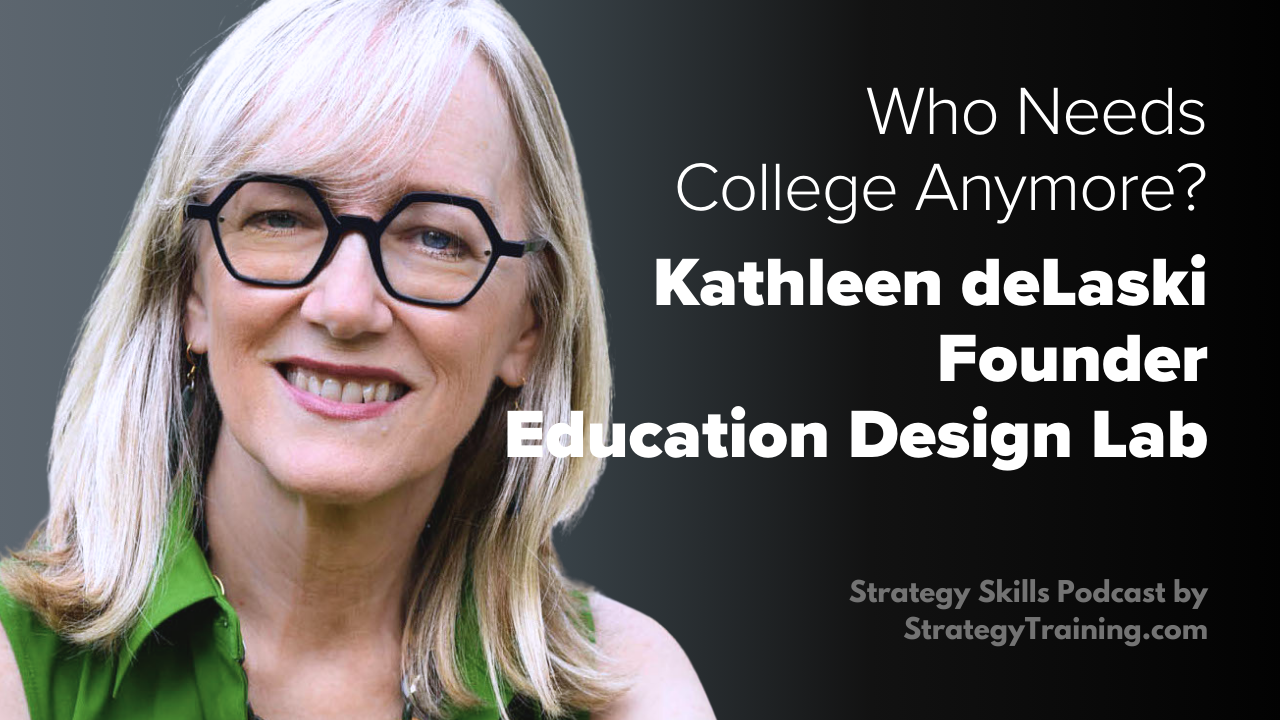
Welcome to Strategy Skills episode 529, an interview with the author of Who Needs College Anymore?, Kathleen deLaski.
In this episode, Kathleen shares her journey from journalism to education reform. She talks about her time as a TV and digital journalist, White House correspondent, and Pentagon spokesperson, as well as her transition to education reform, founding the Education Design Lab in 2013, and her work on higher education innovation. Kathleen discusses the changing role of college and the impact of the pandemic on workforce dynamics and the shift towards shorter, job-focused educational pathways. Her book, Who Needs College Anymore?, dives deeper into these topics.
I hope you will enjoy this episode.
Kris Safarova
Kathleen deLaski is an education and workforce designer, as well as a futurist. She founded the Education Design Lab in 2013 to help colleges begin the journey to reimagine higher education toward the future of work. Her non-profit has helped 1200 colleges, orgs and economic regions design shorter, more affordable pathways for learners to achieve their economic goals. She spends time as a senior advisor to the Project on Workforce at Harvard University and teaches human-centered design and higher ed reform as an adjunct professor in the Honors College at George Mason University. In a previous career, Kathleen spent twenty years as a TV and then a digital journalist, including time as ABC News White House correspondent. Followed by a political appointment as the first female Pentagon spokesperson.
Get Kathleen deLaski’s book here:
Who Needs College Anymore?: Imagining a Future Where Degrees Won’t Matter
Here are some free gifts for you:
Overall Approach Used in Well-Managed Strategy Studies
Enjoying this episode?
Get access to sample advanced training episodes
Episode Transcript:
Kris Safarova 00:45
Welcome to the Strategy Skills podcast. I’m your host, Kris Safarova. And our podcast sponsor today is StrategyTraining.com if you want to strengthen your strategy skills, you can get the Overall Approach Used in Well-Managed Strategy Studies. It’s a free download and you can get it at firmsconsulting.com/overallapproach. And you can also get McKinsey and BCG-winning resume, also free download. It’s a resume that got offers from both of those firms. And you can get it at firmsconsulting.com/resumePDF. And today we have with us Kathleen deLaski, who is an education and workforce designer as well as a futurist, she founded the Education Design Lab in 2013 to help colleges begin the journey to reimagine higher education towards the future of work, something we all have to do. And she spends time as a senior advisor to the project of workforce at Harvard University and teaches Human Centered Design and higher education reform as an adjunct professor in the Honors College at George Mason University. In the previous career, Kathleen spent 20 years as a TV and then as a digital journalist, including time as ABC News White House correspondent followed by a political appointment as the first female Pentagon spokesperson. Kathleen, welcome.
Kathleen deLaski 02:06
Thank you for having me. This is this is going to be fun.
Kris Safarova 02:09
It is. I’m looking forward to dive into your work, but before we do, I would love to speak about your career as a TV and then digital journalist and all the incredible roles you had. Maybe you could give us a little bit of an overview, and we could dig in in some of the areas.
Kathleen deLaski 02:26
Well, you know, just hearing you talk about my time as a journalist, it brings back sad, but sort of bittersweet memories, because that entire industry has been so disrupted since I which is the reason I left it. I was, you know, entered TV journalism in the early 80s, and covered was a local TV reporter and then made it to network news, and at a time when the networks, you know, that was sort of the golden age of television, and you actually knew the names of the people on the evening broadcast, right and and we tried to report the news in an objective fashion. And the 24 news cycle was just being born, so, you know, you had time to report the story. So things changed, very, very much so, and I actually left ABC News and left the White House correspondent job, because the new president, President Clinton, at that time, invited me to become the the Pentagon spokesman. And I had, I had, you know, been covering those issues, defense issues, and it was such an interesting time. And it just seemed because the Cold War was just ending, and it seems so exciting to be at the forefront of of defense policy, when, when the, you know, the Berlin wall comes down, and you suddenly that, you know, what is the role of the US in a world with, you know, no more, no longer having two superpowers. I mean, we’ve seen now what that world looks like. But it was fascinating to be in on the beginning of that. And then I went back to digital journalism, where I really, I feel like that, really, because it was the dawn, it was the dawn of the consumer internet age, where we, you know, we were just trying to figure out, you know, what do users want on this thing called the internet? It was 1995 was when I started, and we, my job was to figure out how to do news coverage and political coverage and help people engage in civic engagement. And so, you know, we produced like the first talk show, and we had this first digital, you know, digital talk show and chat rooms, and it was, all, you know, very exciting to be able to customize the news for you, but that also kind of taught me, what do users want and help me, you know, think about what became my next career in education reform, and looking at at education from the perspective of, you know, what are, how is the system not working for users, and how, how can we change it? So. I switched over into education. I was sort of fed up with journalism by about the year 2000 and have spent the past 25 years really working in in first K 12 education reform, mostly urban education, and then moving into higher ed, because to me, that’s where, that’s where a lot of the startup work was going. That’s where a lot of the innovation was starting to be possible. Around 2012 2013 when I started the education Design Lab.
Kris Safarova 05:33
Such an incredible career. I would love to read your memoir.
Kathleen deLaski 05:41
One podcaster said that. He said, You know, I think you snuck a memoir in this book. So, you know, it definitely has shades of memoir in it, even though it is mostly a book about how to think about how to redesign higher education Kathleen.
Kris Safarova 05:53
And if you go back to yourself in those early 80s, and you’re just starting out, and you could just sit down with yourself and give yourself advice. What would you tell yourself?
Kathleen deLaski 06:03
Well, that’s a really good question. I think it would probably be slow down. I was always in such a hurry to get somewhere, and, you know, then when you get there, like, you know, I was a very young television newscaster, you know, at ABC News. I was 28 years old, and I was sort of like, okay, I’ve arrived. You know, I was always trying to prove something, and then you’re and then you’re then, then you always feel like you’re trying to prove yourself when you’re much younger than everybody around you. I’m saying I was the Pentagon spokesman at 33 and I had generals reporting to me, and it was, you know, it was, it was, I always had imposter syndrome, right? And so I wish I’d slowed down and, you know, maybe not, tried to get those fabulous jobs that were opening up to women at that time, at such early ages, and that I had just kind of, you know, savored the moment and not been in such a hurry. I don’t know why it was in a hurry. I think it was just my type A personality.
Kris Safarova 07:07
And maybe if you were not in a hurry, you would not have opportunities to have those roles.
Kathleen deLaski 07:13
That could be true. And you, you know, you do. And when people say, Well, your career has been all over the map, and I say, yeah, and maybe all those pieces, I can figure out in each piece that I’ve done like it sort of adds up to what I’m, you know, what I’m doing now, which is trying to be a, I know, an advocate that can cross, You know, business, education, government. I’m also a philanthropist. And you know, the the truth is that you know to kind of speak truth to power in these settings, it helps build credibility and empathy if you’ve actually lived in each of these worlds. So the fact that I have this like all over the map resume, I feel like is is finally paying off?
Kris Safarova 08:02
Well, I think it definitely pays off. You’ve done so much during that period of time. You had many careers. You just packed it all together. So you mentioned savor in the moment. So what kind of moments would you want to really enjoy and slow down time to really thicken during those years?
Kathleen deLaski 08:19
Oh, that’s really interesting. Well, you know, one of the things, and if I ever write another book, which I don’t know if I will, was certainly, you know, on the home front, I was in the first generation of women who were convinced that we could do it all right. And so I tried to do it all. You know, I had a nanny. I had a full time nanny, you know, I had the children in my early 30s, and it, you know, looking back, I wish I had savored those moments, you know, maybe taken a few years off. I mean, it was unthinkable to do that as a TV reporter, because you would never be able to get back into it. And, you know, I did make the sacrifice to say, Okay, I’ll be a Washington correspondent, because I won’t have to travel as much. But you know, you, you know, looking back on it now, and I talked to my now grown daughters about this, and you know, we all agree, you know, would have been great. I should have taken a couple of years off and been, you know, been a stay at home mom, but at that time that they were so much pressure not to step off the the, you know, the escalator and sit back. So I’d say, I’d say the home front moments are the ones I most wish that I could have savored. And then I would say, you know, probably my two most exciting jobs for me were being the Pentagon spokesman at, you know, such an interesting moment. And then being, you know, on the front lines of AOL America Online, as was called. Then, you know, as we went to, you know, 500,000 members, a million members, 10 million members. You know, I was there during all those years. Years, and it was, you know, it was such an exciting moment as we were trying to figure out this new thing called the internet. And I, you know, I wish, I wish that I had kept a journal, you know, because I would love to write a book about that. But, you know, it was moving so fast, like I can’t remember everything that went on there, you know. So I think those two, those probably two work experiences, were the ones I wish I’d you know reflected upon more.
Kris Safarova 10:23
Makes a lot of sense. So going back to that moment of you sitting with yourself, any other advice would you give yourself work wise how to be successful, how to progress in a way in your career that is optimal for you?
Kathleen deLaski 10:39
Yeah, I mean, and then I will say it does feel like the workplace, like what worked then is not necessarily what works now, because I, you know, running a nonprofit organization over the last, you know, 12 years. I also, you know, felt firsthand how different it feels to be a lead, an organizational leader, you know, now, versus even 10 or 20 years ago. So some of the advice doesn’t really, you know, doesn’t really translate through the years. Because, you know, my first reaction to your question would be to say, have more confidence. I did not have a lot of confidence in any any role that I had, partly because I was always, as I mentioned earlier, doing it, probably before I should have been doing it. So I felt young and inexperienced. I was a woman, often in a room with mostly men. And so I was always, it was always, you know, hyperventilating on the way home from work. So, so confident, I think, like, and then watching other people that just seem so like they’re not, they’re not thinking too hard about it, right? They’re just being authentic, and they’re being leaders. I mean, I was always almost like, hyper empathetic about how, what will they think of that? How will they react to that? You know, in real time, which I think hampered my, my my success, definitely, I was almost I was too, too in my head about what I was doing, and it often came through, you know, I remember one boss said to me, you know, you’re, you’re, you’re, you’re too. You know, he said, My style was, I was not fluid enough. And I said, that’s because I’m thinking, you know, I’m like, I’m projecting out what I’m going to say, what I’m going to do. And he said, Well, it comes across as you’re being halting, and that’s not good. He was, you know, he’s trying to be helpful.
Kris Safarova 12:35
It’s a very powerful advice. I often tell clients that very same advice, and it makes such a big difference not being in your head, really being authentic, as you mentioned, but placing your attention on the other person, or in your situation you’re speaking to many people. Although I know that place attention on one person, even when you’re speaking to many people, is even more effective, because on the other side, there’s always only one person listening or watching you. I love that. What was it like to be White House correspondent?
Kathleen deLaski 13:03
I would say the hard part. I mean, there was, there was, it was really fun to be one of the, you know, they used to call it the boys on the bus, because there was a book written about journalists, you know, who would be on a beat. And, you know, was mostly men back in the day. And so to be one of the girls, or just people on the bus, you know, where you’re, you know, you’re following a candidate. Because we, I covered the very partly, the very end, Reagan on a part time basis. And then I covered Bush one. So Bush the dad, we call him. I covered him full time, you know, from like 19, it was like, for like, a year and a half, 1991 and then through the election, when he ran against Clinton. And so we were, you know, we’re always getting on an airplane and going off together as the press corps and and then covering, you know, covering the president. And you know, you’re going with him on vacation over Christmas, or, you know, Thanksgiving. You’re, you know, you’re following him to the NATO Summit. You know, wherever he goes, You go on the, you either go on the, on the plane behind, or some of you get to travel on a rotating basis in Air Force, one you know, which is really fun, and the President will come back and chat with you. And so we, you know, you there’s an and that’s what’s so different about today. Apparently, you know now, when you know there’s such antagonism between the press corps and and, and the press and and and the president in those days, you know, sure, you were kept at arm’s length, but it was not a hostile environment. And so, you know it was, it was a lot of fun to be, you know, banding back and forth with the news, you room humor, you know, a lot of you know cynicism and trading of ideas. You know, going out for drinks. You know that. So that was a lot of fun. The hard part was doing TV. You know, as my Brit Hume, who. Who later went on to Fox, was my, my, my comrade. And we sat in a little room in the in the just off the West Wing of the White House, and he would answer the phone, he would say, ABC News, scratching the surface all over the world, you know. And the my point there is that we never had enough information because, you know, we were covering everything that went through the White House, so you would be, I remember one time being out on the lawn, White House lawn at, you know, 5am with my my mic, having to cover trade talks. And you know, it’s not an expertise of mine. And yet, you know, you’re getting these questions thrown at you, and you’re like, totally faking it until you make it. Do I, you know, can I sound credible, describing what’s happening in Japan right now, you know, no, the answer. I mean, I always felt like the answer should be no, and so that that was, that was always the hard part, was to sound, you know, to sound responsible, and to be actually adding value, as opposed to just talking, you know, and I found that hard.
Kris Safarova 16:05
You had proximity to President for a long period of time. What do you think people don’t understand about what it is like to be President of the United States that you could see?
Kathleen deLaski 16:13
Well, the I think, I mean, you know, Trump is trying to change this paradigm. But I think one of the hard parts about being president and and George, George Bush, the dad, used to complain to us about this was, you know, you’re, you’re always hostage to the news cycle. And you you know, whatever the world is talking about, that’s what you have to talk about. And you know, it’s hard to change the agenda and get them to cover your story or what you want. Like I remember, you know, a few years later, when I was covering Bush too, as a candidate, and he came to AOL to do the first ever presidential live chat. You know, it was going to be a digital live chat, which was going to be aired, and we had a lot of press coverage, because the first time a presidential candidate had ever done an online chat, right? And I was the one interviewing him. And I remember he came back to the green room, and, you know, the backstage, he comes in and he meets me, and he’s like, Okay, we’re gonna talk about tort reform. And I said, I said, No, we’re not, you know. I said, this is, this is a live chat. We’re gonna talk about whatever, you know, the American public, you know, that, or whatever small portion at this point. This was the year two. This was 2000 whatever that, you know, public wants to talk about. And he is, you could just see it. He got nervous, you know, and ended up the front page of The New York Times the next morning. Was he flubbed an answer about who was the Prime Minister versus the president of India. Somebody was trying to, you know, gotcha him on his knowledge of foreign affairs, you know. And so that was the news, you know. So, I mean, I think that’s the hardest thing that, and it’s not really fair. And I think, you know, what we’re watching Donald Trump do right now is, you know, example of how he’s learned since the last time he was president, how to own the news cycle. He is doing that very well.
Kris Safarova 18:28
And then you became a spokesperson for pentagon. Remember the moment when it happened? What did you feel?
Kathleen deLaski 18:35
Well, yeah, I remember. It’s funny. It happened when I was on a White House Trip with President Clinton to we were at a naval base in Coronado Bay, San Diego, and I was just there last week, and I hadn’t been there since the day. I was standing in the parking lot, and somebody said, you know, like, White House on line three for you, you know, I was like, what? And, you know, and that was, wasn’t him calling, of course, me, it was somebody on the, you know, the team. And that was, that was that, you know. So I still remember, like, where I was standing when I got the call. Yeah, that was, and then my first day on the job, which was in July of 93 we announced the policy, don’t ask, don’t tell, you know, the gays in the military policy and you know, so I wasn’t involved in shaping it, but I had to be very involved in announcing it. And that was, that was a crazy first day.
Kris Safarova 19:33
What do you think was the reason they picked you from all the other people they could have picked?
Kathleen deLaski 19:38
Well, I think that, see, I was actually brought on six months into his his administration, and there had been someone else in the job that was picked first because he’d been, you know, just sort of the sidekick of the of Les Aspen, the congressman who was picked to be Secretary of Defense. And. He was he was failing. He was failing in the role, you know. So it was described to me because the press, you know, he was kind of at war with the press, and so they wanted to replace him with somebody who was from the press corps and had a good relationship with the press, you know, new defense issues. And so they knew me, some of the people on the defense team, you know, I had, I had been, they had been mentors of mine at when I was at the Kennedy, the Kennedy School of Government at Harvard, where I focused on defense policy.
Kris Safarova 20:38
And once you started in that role, can you take us through that period a little bit? What was it like?
Kathleen deLaski 20:45
Gosh, it was long time ago. Was I mean, it was hard for me because I had to win the respect of both the military side and the political side because the Clinton White House and the Clinton national security apparatus, you know, it wasn’t Clinton, was get, not getting a lot of accolades for his, you know, treatment with the military, and the way he was, you know, paying attention or not paying attention to the military. And so I actually found that because I was, you know, in the building with the generals, and Colin Powell was the joint Chairman of the Joint Chiefs of Staff at the time, and he was, you know, a very interesting leader to learn from, I felt like the Military supported me. And, you know, the generals I had to work with every day supported me more than the the politicals, the politicals across the river, you know, at the White House. So that was, that was a weird dynamic that I did not expect. But it, you know, I’d say we had ups and downs. I mean, you know, with it, it went, you know, some aspects went very well, but we were thrown a lot of tough, tough crises, you know, the biggest of which was the Somalia crisis, where, I think it was 18 died. It was the black, if you ever saw the movie Black Hawk Down, you know, I was the one who had to announce that, you know, I think it was 18 US soldiers, you know, were being dragged through the streets of Mogadishu, and that was, I think, the first time that we’d seen loss of life, you know, in a guerrilla combat situation, you know, since Vietnam. So, you know, that was horrible, and my boss ended up getting fired over it. And I ended up leaving about six months after that, or I didn’t leave the Pentagon, but I left that role because the new the new defense secretary, wanted to bring his own person in.
Kris Safarova 22:57
Why do you think your boss got fired over it?
Kathleen deLaski 23:01
Well, you know, in these military situations, and particularly when you know, the commander in chief feels that he’s, you know, weak on defense, he’s got to take a strong stand. And, you know, it’s like heads will roll. You know, somebody has to take the fall. And the military, that’s a kind of a thing. You know, the captain goes down with a ship, right? And, you know, that’s what happened. Somebody had to take the fall. And I went with Les Aspen to the to the White House the day he I stood outside the Oval Office while, you know, Bill Clinton thanked him for his service. And, you know, I think I later got fired because, I mean, I wasn’t, I was, I was, you know, sort of put in a different strategy job. But, you know, same thing really, because I was seen as, you know, not keeping, not keeping my, as they say, not keeping my principal in his lane, you know, to say the right things at the right time. He was, he was somebody who really liked to talk to the press. And, you know, I was seen as not controlling him, you know, my boss, which is, you know, as, as we all know, it’s very hard to control your boss, but, you know, that’s what, that’s what I was told about. You know, why I so I took on a very interesting job instead, which was kind of more of a of a communications policy role, of, you know, trying to help, like, how do we change the hearts and minds as we want to expand NATO and as we wanted to think about nuclear drawdowns, a lot of the stuff that’s now coming to roost years later, with Ukraine and with loose nukes, I was very involved in sort of awareness campaigns and national and international messaging campaigns around that. So it was, you know, it was a lot, it was quite interesting work.
Kris Safarova 25:03
And while you had this very challenging role, you had a family that you were raising as well. How did you do that?
Kathleen deLaski 25:11
Well, in fact, I was pregnant with my second Well, here’s, here’s when, when my boss got fired, I assumed I would be fired right away and and I’d wanted to have a second child. And so I thought, we thought, oh, let’s, you know, let’s start trying to have a heart number two. And I got pregnant right away. And then I wasn’t fired. And so then I was, you know, I was trying to travel the world with a, you know, while I was pregnant. And I think that’s one of the reasons that I got, you know, I got asked to do this other role, you know, we were doing trips to like, you know, Kazakhstan and, you know, Kyiv and, you know, under kind of rough conditions. And so, yeah, it was not easy. And we had a full time nanny, which we thought was, you know, the way to go, for continuity, for the, you know, for our child, because it was hard to be at daycare to pick them up at a certain time, right?
Kris Safarova 26:11
Two daughters, that’s incredible, yeah, very productive and very efficient and effective with your time. What you do now, of course, very demanding. But throughout your career, you had such demanding roles that usually, to be successful, they often have to cut out everything else in their life and just be that.
Kathleen deLaski 26:29
You know, you’re right. It is, it is hard. I mean, I think, and I wonder, you know about the next generation. And I talked to my daughters about this, and this is where I think I could write, maybe write another book called, can I have it all, or can we not have it all, or something? Because, I mean, I was very influenced when I was a kid by that. You’re too young to know this TV show. It was called The Mary Tyler Moore Show, and she was a in the show. She was a worked in a TV, a TV news setting. And, you know, she started out as a secretary, I think, and then she became a producer, and that was my first glimpse into this interesting TV world that looked like it was something women could do besides, you know, being a teacher or a nurse, which were great roles, but I knew that I would be not be good at them. And so I was, I was really paying attention to this TV show, and I was like, 12, and the song in the TV show, she throws up her hat and she says, you know, you’re going to make it after all, you know you can have it all. You know that that was sort of the mantra in the 70s, right?
Kris Safarova 27:35
It’s incredible how much we are influenced as children and very young adults by TV and books, and then it just sets our entire direction, where we are going and how careful we have to be now as adults, in terms of shaping what is available for younger people and what they are influenced and inspired by. So true. So to wrap up this incredible discussion, before we transition to what you’re doing now. I also want to touch on something. So you mentioned that after that, you continued in journalism for a while, and you mentioned that at that period of time, you really learned what users want. Could you talk about what did you discover that they actually wanted?
Kathleen deLaski 28:14
Yeah, well, it was before the terms UX or UI were invented, or at least I think so, and they weren’t used in the context of online, which, of course, they are now. And we started doing, we had a vice president of user experience, which to me, was like a mind blowing idea in the in the early 90s. And there was a lot of focus on, or actually was called member experience, because they, we really called members, you know, AOL members and what so in as we were starting to create these experiences for, you know, people who wanted, like, wanted to get their news, and you started to think for the first time, but Well, we could, gosh, they could talk about the issues they want to learn about, and we could send them an email, you know, that was like mind blowing, this idea that you could do it that way, and we could do live chats, and we could have a live chat just for Republicans and a live chat just for Democrats, and they were like, Oh no, but that’s going to create a bubble, and they won’t talk to each other, you know, that’s going to be a problem. And of course, we ended up doing that because that’s what users clearly wanted. They wanted to find their own people. And we ended up, you know, creating chat rooms by topic and by party and and then, when, when, when the analytics became available, where, for the first time, you could look at what users were clicking on a page. And, you know, we first started, you know, using the term click bait, you know, okay, what’s going to be click bait? And then those of us who came from, you know, true journalism, we were like, we can’t do click bait. You know, that would be, you know, immoral. And then the people who came from, you know, marketing, were like, what. Do you mean, of course, we should do clickbait, you know. And so there was that, you know, we called the battle for the homepage, because AOL homepage, you know, by the, you know, by 99 or 2000 you know, you’re having, I don’t know, 10s of millions of people coming through that page. And so the, you know, like, if you could buy the click on the homepage, and that was, that was huge. And, in fact, I feel that’s the reason we lost out to Google. I mean, this little startup named Google, you know, these guys show up and they were like, you know, we’re like, Who are these guys? You know, they’re like, and their their page was so ugly, you know, so plain and but, you know, those of us that were more purists and didn’t want to sell search, we’re like, they’ve got it. I mean, this is, this is the answer. You can’t sell search, right? You’re going to lose the trust of your users. And sure enough, you know, AOL. I believe that was one of AOL downfalls. But you know, we were, you know, the the purists or the, you know, the more journalistic people didn’t, didn’t win the day there. And so, you know, that’s an example of where I think it was fascinating being at the beginning of the period when you could start to learn, you know, what users were clicking on and how you could monetize that, or when you should monetize that. I was responsible for creating the news policy at AOL, where we, you know, decided, Okay, we’re gonna box things in and put sponsored content on that. And people were like, no, why don’t we have to do that? And, you know, we push for that, like, because, you know, someone’s paying to be there. It’s not necessarily the best search. And that was, you know, that was all fascinating, being the beginning of that and seeing how users responded to one type of of treatment on a on a on a web page, versus another.
Kris Safarova 31:50
So in your experience, people actually did not realize that what you were doing was for them, so that they get the best results. And they were kind of okay with clicking on sponsored links that were maybe not even often clearly marked by another provider.
Kathleen deLaski 32:06
Yeah, I think in the early days, it was really hard, you know, we, like, if somebody, you know, we had these different channels, like, you know, I was running the news channel and I was also running the parenting channel for a while. And, you know, in the parenting channel, it felt okay to have like, you know, Gerber foods sponsor the, you know, the diaper talk, you know, or something, or that, you know that. But it didn’t feel okay to have, you know, you know, IBM mixing its content in with the business news, right? And that’s the distinction that had not been, you know, people hadn’t learned to do that correctly or to do that ethically at the time.
Kris Safarova 32:46
So how do you transition from that to your work?
Kathleen deLaski 32:50
Now, from AOL, I went to I got a job I just wanted to do. I wanted to kind of get out of journalism, and I got a role as Head of Brand Marketing and Communications at Sallie Mae, you know, which was, it happened to be, you know, near, located near my house, I had two, you know, two small children at this point I wanted to, or two, actually, not so small, but young children. I wanted to, you know, kind of rein in the chaos in my life, and do but do something meaningful. And the reason I took the job was, was one piece of it was to start Sally May’s Foundation. They had just been given $50 million through an acquisition that had to be spent on, you know, philanthropic causes. And so my family had, we had a family foundation at this point. So, you know, I understood philanthropy a little bit, and I was very excited to think about, Gosh, how do I how do I help? You know, the nation’s largest student lender, like, make college more accessible by using this, you know, this money for, you know, to pick up where the business model leaves off. And that seemed kind of exciting. I was from, you know, my family, it was mostly entrepreneurs. And so, you know, the idea of getting into business was sort of interesting to me at that point.
Kris Safarova 34:22
And you recently wrote the book, who needs college anymore? What are some of the key things you wanted people to get from that book?
Kathleen deLaski 34:31
Well, so I spent, you know, in that journey. Once I got into education, I spent time in K 12, and I left Sallie Mae after eight years, and was involved in helping charter schools start up in mostly in urban areas. And then I was also on the board of a of a public university here in Virginia for eight years. And then while I was on that board, I. I, you know, got the idea, because it was when there was a lot of disruption beginning to happen, or at least talk of disruption happening in education around with the begin is, as in, like, 2012 2013 you had the kind of rise of the MOOCs. Do you remember MOOCs? You know, MOOCs are massive open online courses that groups like Stanford and MIT and Harvard were starting to let people like take courses for free that otherwise you’d have to, you know, pay, you know, 10s of 1000s of dollars, and you could only have access to it if you went to an exclusive school. And so there was talk of, like, unbundling higher education. At the same time, colleges were starting to, you know, struggle, like enrollment was starting to fall off a little bit, and they were very worried about, well, gosh, if they unbundle educate, you know, if private capital comes in, venture capital comes in and unbundles education and what’s going to happen to colleges. So I was very interested in starting a nonprofit. I along the way, had started some other ones to help colleges really look at how to kind of design their own future, and how to help design shorter pathways than college to get to help learners get to specific jobs that were in high demand. So kind of like the boot camp movement that was starting up then, how could colleges sort of boot camp themselves? You know, where needed and where desired by users, you know, by by consumers. And this, you know, proved harder at that point. It was really just a set of ideas. And I think if you fast forward to now, it’s really happening all over the country, you know, even you could say all over the world. And, you know, so the organization that I founded, I’ve now stepped down as CEO after 10 years, is is, you know, full in on that work doing what we call micro pathways, helping, helping colleges create micro pathways so that people can have, like, a six to 12 month, you know, academic journey instead, instead of or on the way to a two year or a four year degree.
Kris Safarova 37:21
For whom do you think college is still relevant and for whom it’s not relevant anymore?
Kathleen deLaski 37:27
Yeah, I have, I have a whole chapter on this, because, you know, the book is called, who needs college anymore? And so I actually do try to answer the question, because I, you know, in my in my work and just in my own, you know, home life, I get that question a lot, okay, does my kid need to go to college and and what it really comes down to? So I create, I use a human centered design methodology in the book, because that’s the the organization, the lab is, you know, bases its strategy on a human centered design methodology and and I, we, I create, like, typologies, or, you know, personas for who needs college and who doesn’t, or at least who could, who could forego it. Because, you know, as I say at the outset, you know, if you’ve got the bank role, if mom and dad are paying, you know, and you’ve got the time you know, you’re not encumbered as, you know, as a single mom, or, you know, a or, you know, have a like neuro divergent issues where you need, you know, different solution, absolutely, you know, go for it. You can always leave right, which, which? 40% of people do don’t fit. You know, don’t fit, you know, don’t finish college for whatever reason. So, you know, that’s my starting point. Give it a try if money’s not the not the issue. But that is that scenario is, or the scenario of not being able to afford at least the four year degree that could get you the really transformative experience is becoming is available to fewer and fewer folks. As college becomes more expensive and as, frankly, people become less willing to, you know, sit at the desk for four years. You know, they feel like so much is available, you know, in the palm of their hand, from learning on YouTube or or taking short form courses on Coursera, or, you know, any of these. You know, there’s a lot of offerings out there that can help you get to a certification or a certificate. And colleges themselves have started offering those. So what I say to folks is, if you’re, you know, if you’re over age, like if you’re, you know, in your mid to late 20s or older, and you have access to some funds, and you’re connected in some way, you’ve got some social capital, I would say College. Wouldn’t be your first, your first stop. It might be your second or third if you can’t make it work, or if you decide that you want a career, that you know, that only college can get you like you know, you decide you want to be a doctor or a clinical therapist or a lawyer, you know it’s going to be decades before those those careers don’t require college. What I think for those people, the good news, if you think, you know, four years or a couple $100,000 is to is, is too high a hurdle, is that the graduate schools and undergrads, you know, are starting a few undergrads are starting to come down in length, right? So I think the gauntlet will get shorter. But if you are looking at a career in, for example, many parts of tech, many parts of healthcare, besides, you know, doctor, nurse, therapist, advanced manufacturing, many parts of business, some parts of education. I mean, education is changing a bit. We can talk about that. It you have you have options. It’s not to say you wouldn’t benefit from college. You probably would, but you have options if it’s not available to you, if college isn’t available to you, and then the people who definitely need College, which, you know, which kind of this research kind of even surprised me, because I was looking at the numbers, and, you know, college is sort of holding steady, or college enrollment is holding steady Best for actually, lower income people and people of color. And you know, you might say, Oh, that seems counterintuitive, but I think the reason is that those are the folks for whom the college, the promise of college is, you know, college can be the ticket, like for if you are an immigrant family and you’re trying to transport your family, you know, from to the middle class, you need that. You know, you need that structured support system. You need someone else to, you know, help your children figure, you know, figure out the code switching and the and and the contacts and the social capital, you know, those are necessary ingredients to get where you want to go. And so, you know. So that’s probably the largest group of people that I would say, you know, absolutely, you know, let’s help you find a college that is lower cost, but has great social mobility records, you know. And there’s a guy named Raj Shetty who’s done research that I talk about in the book on which colleges, what type of colleges, a lot of the state colleges are particularly good at that. And then the other category or another category, because I won’t go into all of them. But another one that’s kind of interesting is this idea of legitimacy label, like, if you feel just yourself that you’re not taken seriously unless you have that piece of paper, then you should try to get it, you know? And I mean, I know I felt this way in the 70s, in the career I just described to you, I don’t know that I would feel that way now. I don’t know. I mean, if I were a young person, I mean, I, you know, confidence has never been my strong suit, so maybe I would, I I feel like one of my daughters definitely felt that way the the other. So I have one daughter who went to college and one who did not. And I interview in the book a woman from a family that where, you know, the the parents were just really pushing, you know, her to go, and she went all the way to get a PhD, you know, but, but it’s not, it’s not surprising that women of color hold the most college debt, I mean, as a group, and it, you know, and they have the most graduate, graduate school debt, too. And that’s, you know. That actually doesn’t surprise me, you know, based on these personas that I’m talking about and the, you know, legitimacy that that I think women in particular, and women of color even more so, feel that they need in the marketplace to sell themselves.
Kris Safarova 44:36
You know, such an important topic. Thank you so much for covering it. I know we only have few minutes left, and I would love to have another discussion on this. If you would like to go deeper into your work, because what you’re doing is very important. I wanted to wrap up today by asking you, probably we only have time for one last question before we wrap up. So I wanted to ask you my favorite question of all time, over the last few years, what were my. Two, three aha moments, realizations that really change the way you look at life, or the way you look at business.
Kathleen deLaski 45:05
Over the past few years. Let’s see. Well, I would say, you know, kind of I Am, kind of a, I like to think at a systems level. And I would say that, you know, one of them you know, came during the pandemic when, as an employer, you know, running, running, running, an organization that suddenly, you know, had to go virtual. And yet, we were at a point in our trajectory where the pandemic sort of actually gave more impetus to our work, because our work was about, how do we help people get to work faster? I mean, I was so fascinated by the great shakeup, you know, where in 2021 you know? Well, first in 2020 there were huge layoffs, and then people tried to find adjacent roles. And you could see just the movement of people trying to scramble into other jobs that weren’t, you know, frontline facing. And then in 2021 like 50 million people quit their jobs. And then in and then again, in 2022 another 50 million people quit their jobs. And I’m, you know, I’m an employer, in the middle of this thinking, you know, oh, blank, how, how do we keep people here? And we had people quit, and it’s like everyone at the same time, like, analyze their situation and tried to decide, am I, you know, am I happy with my kind of work? Am I happy with my, you know, my my profile, you know, in terms of how much time I my work life balance. And I just was so shocked that that many people would have the aha moment at the same time, and you know, that’s totally slowed down now we don’t see that kind of turnover anywhere, maybe partly because the economy is not doing as well, so people are afraid to leave their current jobs. But I found that staggering and tried to draw, I mean, the lesson I drew from that was, okay, we’re kind of experiencing a culture shift here, where, you know, my generation, as we talked about earlier, that I can do it all, is is giving way to the next generations, and they are rebalancing the, you know, the norm and the narratives. And I think they’re still, you know, they’re still in place, and that I found that fascinating.
Kris Safarova 47:41
Incredible Kathleen. Yes, such an incredibly sophisticated, interesting person that I could talk to forever. Oh, that will help my confidence. Thank you. I really enjoyed speaking with you. Thank you so much for being here and for being so open with us during this conversation, where can our listeners learn more about you by your book. Anything you want to share?
Kathleen deLaski 48:03
Yes, thank you. Well, I have created a website for the book, which also can get you to information about me and my LinkedIn and whatnot. But it’s a it’s the books name whoneedscollegeanymore.org. And that has it also has discussion guides if, I mean, we didn’t get to talk about how employers, you know, there’s a big role for employers to play in how the future of work can get weaved into the future of education. I have a chapter on that in the book, but that’s certainly I’ve got discussion guides in in the on the website that you can download.
Kris Safarova 48:42
Kathleen, thank you so much again for being here. Thank you. Our guest today again has been Kathleen deLaski. Check out her book. It’s called Who Needs College Anymore?. And our podcast sponsor today is StrategyTraining.com. If you want to strengthen your strategy skills, you can get the Overall Approach Used in Well-Managed Strategy Studies. It’s a free download, and you can get it at firmsconsulting.com/overallapproach. You can also get McKinsey and BCG-winning resume, which is a resume that got offers from both of those firms. And you can get it at firmsconsulting.com/resumePDF. And the last gift I will leave you with is a copy of a book that I co-authored with some of our amazing clients. You can get it as a gift at firmsconsulting.com/gift, and it is called Nine Leaders in Action. Thank you everyone for tuning in, and I’m looking forward to connect with you all next time.
Leave a Reply