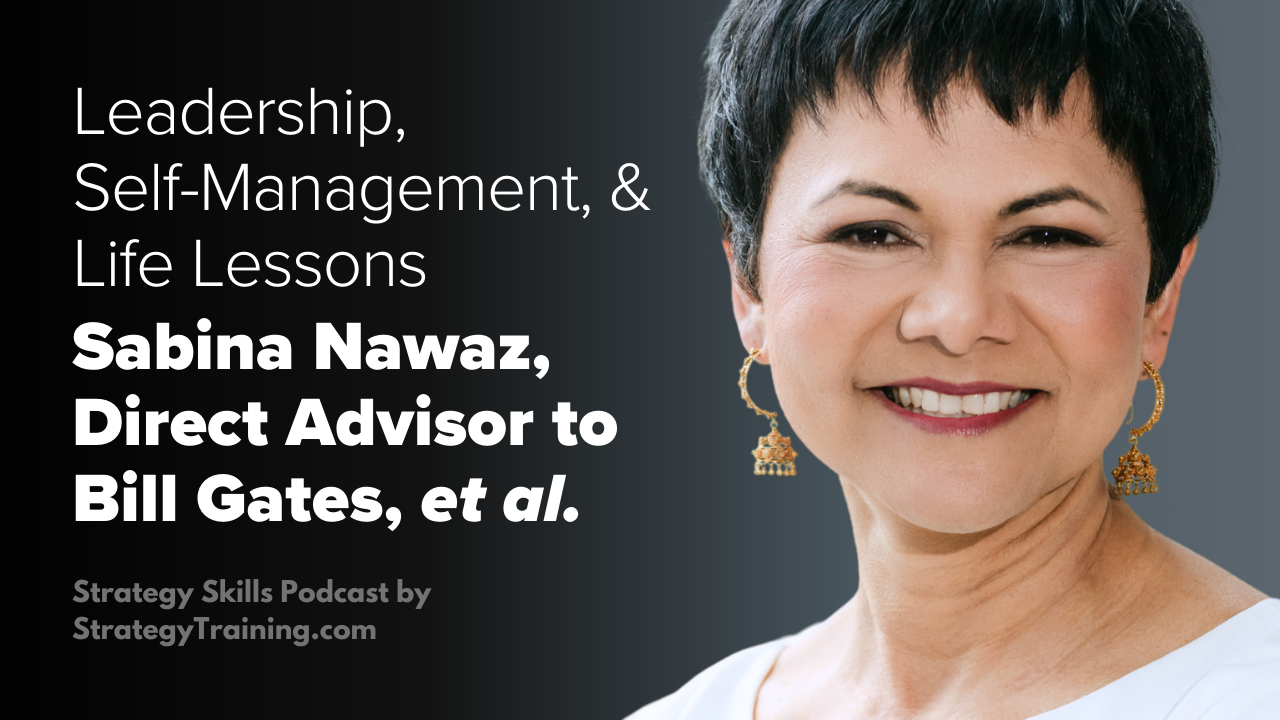
Welcome to Strategy Skills episode 530, an interview with a seasoned executive coach and the author of You’re the Boss: Become the Manager You Want to Be (and Others Need), Sabina Nawaz.
In this episode, Sabina shares her journey from software development at Microsoft to advising C-level executives. She explains the dangers of pressure overpowering leaders and advocates for self-care and emotional intelligence. Throughout her journey as a leader, she realized the need for effective communication, urging leaders to seek feedback and practice active listening. Sabina introduces tools like the “joyline” to identify what brings joy and fulfillment and emphasizes the importance of celebrating self-acceptance and prioritizing continuous development through micro-habits like journaling and meditation. Her new book, You’re the Boss, offers practical strategies for maintaining success and leadership effectiveness.
I hope you will enjoy this episode.
Kris Safarova
Sabina Nawaz who advises C-level executives and teams at Fortune 500 corporations, government agencies, nonprofits, and academic institutions around the world. During her fourteen-year tenure at Microsoft, she went from managing software development teams to leading the company’s executive development and succession planning efforts for over 11,000 managers and nearly a thousand executives, advising Bill Gates and Steve Ballmer directly.
Get Sabina Nawaz’s book here:
You’re the Boss: Become the Manager You Want to Be (and Others Need)
Here are some free gifts for you:
Overall Approach Used in Well-Managed Strategy Studies
Enjoying this episode?
Get access to sample advanced training episodes
Episode Transcript:
Kris Safarova 00:45
Welcome to the Strategy Skills podcast. I’m your host, Kris Safarova. And our podcast sponsor today is StrategyTraining.com. If you want to strengthen your strategy skills, you can get the Overall Approach Used in Well-Managed Strategy Studies. It’s a free download to be prepared for you, and you can get it at firmsconsulting.com/overallapproach. You can also get McKinsey and BCG-winning resume, which is a resume that got offers from both of those firms. And you can get it at firmsconsulting.com/resumePDF, and the last gift from me today is a copy of a book that we co-authored with some of our amazing clients, and you can get it at firmsconsulting.com/gift. And today we have with us Sabina Nawaz, who advises C-level executives and teams at Fortune 500 companies, government agencies, nonprofits, academic institutions around the world, and during her 14-year tenure at Microsoft, she went from managing software development teams to leading the company’s executive development and succession planning efforts for over 11,000 managers and nearly 1000 executives advising Bill Gates and Steve Ballmer directly. Sabina, welcome. Such an incredible career so far. So before we go into your current work, I would love to learn more about how did you ended up where you are today. Could you take us through the journey a little bit?
Sabina Nawaz 02:14
Well, I grew up in India and came over to study in my undergraduate studies computer science, and after grad school, worked at Microsoft, first in software development and then in HR as I was doing the things you described, but for the last 20 years, I have been coaching senior executives, CEOs, members of the C suite, doing leadership training and keynote speeches, And, of course, writing for Harvard Business Review, Wall Street Journal and now my book. So from a sequential process, that’s what got me here.
Kris Safarova 02:49
You went from leading software development teams at Microsoft to advising Bill Gates and Steve Palmer on executive development. What was the biggest internal shift you had to make to lead at that level?
Sabina Nawaz 03:01
The biggest shift first I had to make was realizing that I didn’t need to chase goals that I already knew how to achieve. When I was in a sabbatical while still working in software development, I had this moment of insight that I would becoming. I was going to become a corporate vice president. It had been my career goal up to that point, but once I realized that I could get there, I decided that it was not a good use of time to chase something that I already knew how to get there. So that was one big shift, the second shift when I moved into HR, I had no formal training. I had a lot of on the ground experience as a manager, I had spoken in front of a lot of audiences, but there was no formal training, and so initially, when I went into these meetings, particularly with high level executives, I kept wondering, When are they going to find out that I have no idea what I’m talking about? When am I going to get fired? Is this the moment that is going to happen? The shift I had to make inside me was to realize that I was sufficient, that I was enough, that everybody knew what my background was, if I wasn’t lying about the fact that I didn’t have this formal training. They had hired me. They had given me entrance into those rooms, not just despite that, but perhaps because of that. I brought in experience that they valued. Once I could let that go, I could show up with a lot more confidence and play more to my strengths. Of course, in the background, I started getting trained and certified and so on in my new profession, but it was more accepting that wherever I am, it’s sufficient, because otherwise no one would have hired me.
Kris Safarova 04:49
And looking back, what do you think was a defining leadership failure misstep in your career, and what did it teach you about managing yourself?
Sabina Nawaz 04:59
My mistake or blind spot it was. It was not just a single mistake, but it went on for a while. Is what led to me writing this book and getting curious about management and what makes some managers succeed and some managers fail under the same circumstances. And this was after I came back from parental leave, after my first child I the first day back as I’m driving to work, my assistant is reading a memo because she called me at home before I’d even left to say the CEO of the company was expecting me in his office as soon as I got in. And that set the pace for the next several years, relentless place pace and an infant that doesn’t sleep back at home. So the pressures really were pretty high in this job, and I was afraid that we would look stupid in front of senior execs, so I started to micromanage. I managed every single little detail. Even though I had an incredibly capable team, I did not take the time to connect with people, to give them positive recognition, to acknowledge the great work they were doing, or to even explain clearly what was needed. I just got frustrated and short tempered when they didn’t deliver according to expectations, expectations, by the way, that I had not communicated with them. And the hardest part of this is I thought I was doing a great job. I was being efficient. We look at all this stuff we were churning out, so I had no idea that I was having a pretty harsh impact on the people around me until a colleague of mine gave me that news. Once I realized that it was a big gut punch, because up until that point in my career Kris, I had received feedback that I was one of the best managers people had, that I cared deeply about my people, and here I was coming across uncaring, unhumane, careless about communication, etc. So it was a big wake up call and make me realize that it is not power that corrupts, but pressure and then power blinds us to the impact of that on people and on business results.
Kris Safarova 07:14
That is very interesting. So it is pressure that corrupts, not power. Do you remember the moment you realized that was going on.
Sabina Nawaz 07:21
I think it was as I got feedback from my colleague and realizing, Oh, how am I the same person who’s gotten this best boss ever feedback? Now is getting worse boss ever feedback? So what has changed? Well, the amount of pressure has changed. So, so that started to get me very curious about, well, does this happen to just me or other people as well?
Kris Safarova 07:45
How did you personally navigate the transition from peer to leader? I know we kind of went very fast to you being a leader, but if we step back, remember this transition of being peer and then being leader, and where there are moments of discomfort or realizations that maybe reshaped how you approached, the way you communicated, and the way you were leading your team.
Sabina Nawaz 08:07
It was, it was a tough transition. I was very young. I was in my 20s, and many of the people I managed were not just older than me, but a lot older than me. I was also, there weren’t very many technical women, so I was different in a number of ways. I was a peer to most of the people when I got promoted to being their manager, and then later, of course, hired people from scratch. It initially, I was very tentative, tentative to give any sort of corrective feedback to anybody. I was afraid of not being liked by them, so I over indulged in people pleasing and and therefore softening all my feedback, sometimes softening the feedback so much that people had no idea I was actually giving them a critique. You know, they thought I was just giving a pat on the back for a job well done, until you know the business results were suffering to the point where I really had to confront poor performance. For example, I think that was probably the hardest part of the transition Kris is having to now give your peers corrective feedback.
Kris Safarova 09:18
You earlier mentioned I was enough that you realized you were enough, but at the same time you were studying and developing the skills needed. Can you give us some insight into how do you manage continuous development so that you don’t stagnate and don’t lose skills, and instead develop your skills over time?
Sabina Nawaz 09:41
Well, there’s always formal development, even at this point in my career, I make sure I’m investing at least once a year in a week of formal development for myself so that you can do but I think most of your development happens on the job. And as a manager, you’re being tested every single day. Yeah. I was just doing a coaching call with one of my clients who’s had a game changing way in which she manages her own development. She journals for two minutes a day. She had tried journaling before. It wasn’t working because she was spending trying to spend 30 minutes, 20 minutes. And so I said, Why don’t we develop a just a micro habit, just a tiny, ridiculously small amount. What’s the shortest time you want to journal? And she said, Well, how about 10 minutes? And I said, No, that’s still too long. How about five I said, that’s still too long. She said, Okay, fine, I’ll do it for one to two minutes. So it’s so small that it would be ridiculous not to do it, and just those one to two minutes a day are giving her this oasis, this way, to zoom out and reflect on her day and capture what she’s learning. Today, she came after having done this for a couple of months, with several insights that she’s had, several ahas that she’s had, one of the ahas being that it’s really important to step back and reflect and not just do, do, do, do.
Kris Safarova 11:04
And is she journaling in some special way? How do you teach people to journal? Any way that works?
Sabina Nawaz 11:09
There is no prescriptive method. It’s the main point being to reflect back, to reflect, to stop doing some people draw. One person sends videos to themselves. And many people, of course, do the traditional sit down and write something that comes to mind.
Kris Safarova 11:30
So it’s about reflection on what happened versus planning.
Sabina Nawaz 11:35
Yes. Yes, yes. Key difference between reflection and planning on the rare occasions we do give ourselves time to sit down, we start to plan in the future.
Kris Safarova 11:44
And when you work with clients, what is your advice on planning portion? So they reflect every day. But how often should they plan?
Sabina Nawaz 11:52
I don’t give them any prescriptive advice on planning. These are people who are CEOs, who are senior executives. They usually have the planning part down pat. They also have a whole team that helps them with that.
Kris Safarova 12:05
I was thinking more about things that only they can come up with.
Sabina Nawaz 12:08
I see what you’re saying. Kris, yes. So one way to plan is to mentally prepare for what’s ahead that many of my clients do at the on a Sunday night or at the beginning of the week of what’s ahead for me this week? What’s ahead on the landscape, the market, the business, and how do I need to be mentally prepared for that? Where do I have a tough meeting? Do I have some space before that tough meeting to go for a little walk? Those kind of things? Absolutely, you’re right. They they are much more mindful about.
Kris Safarova 12:45
Sabina, and for some of our listeners, who are leaders, who are managing their team since currently, the unit is struggling, the world is changing. Customers are not as interested anymore in their product, and they’re not sure what to do. What would be your advice?
Sabina Nawaz 13:01
Yeah, I really have advice in those situations. It’s more a series of questions to understand what their goals are. So it’s really going back to anchoring on what is your purpose, what are your goals? And it’s going to change, because the world has changed. So are there some key tenets that you need to really ground yourself in, and that might result in a which I’m sure you see in your work, in a completely different line of business, but still staying true to whatever that purpose might be. So if your purpose is to showcase your region as a leader in a certain kind of technology, that can be happening in a variety of different ways, it doesn’t have to be with the kind of widget you are describing. So if one is anchoring to purpose, the other is really managing yourself and figuring out how you’re going to stay steady through these uncertain wins which so many people are facing these days, especially because that extra pressure is going to start to corrupt your actions.
Kris Safarova 13:59
And how could someone deal with the corruption of actions by pressure?
Sabina Nawaz 14:06
Well, because the higher up you are, people won’t tell you the effect of those actions. So simply saying, can everyone give me feedback, is not going to work very well, because it might do more harm than good, because people are going to give you this sort of disguised feedback, very muted, toned down feedback, and you might think everything’s fine and continue doing what you’re doing, so that could do more harm than good. To receive quality feedback, you have to ask quality questions. So instead of saying, How did I do, or how am I doing, because everybody’s going to say you’re doing fine, boss, even if it’s not true, make your question much more specific and pointed so people cannot wiggle out of answering them. You might say, What’s one thing I’m doing that’s working well for you, and what’s one thing that I could do even better to help you get your job done? Now I have. To answer that question because I’m answering it, asking it much more in a boundaried fashion. If you’re still not getting quality responses, you can also make it a third party. So you could say, if I were to ask our biggest critics, my biggest critics, what would they say? If I were to ask my biggest fans, what would they say? So you can have this person answer in third person that way, even if some of those opinions are theirs, they can hold it more lightly, and they’re more likely to share things with you.
Kris Safarova 15:34
Can we also go a little bit deeper into anchoring to purpose what people need to know about this?
Sabina Nawaz 15:42
It is the thing purpose is the thing that should be getting you up every morning. You can either wake up with purpose or you can wake up with fear. And so really thinking about, why am I doing this? And sometimes my book has a tool called joyline, where you which helps you go back to getting clear on your purpose by looking at the things in your life that have given you joy and the things in your life that have taken away joy, and using those and finding the common connections between those to say, Why do I do what I do in this one precious life with finite time? Why am I here so you could. You could be asking yourself that question every day, if you want to continue to stay steady, to stay steadfast in what you’re achieving, you could also take that purpose and start thinking about impact. You know, a lot of times Kris, when people describe what they do, they’ll do the what and the how, but they won’t describe the so what, so what, so what, that you did this whole stream of activities, and you had QBRs and OKRs and KPIs and all these other three letter acronyms. What was the? What was the end result of that? So what? Collect a library of so what stories? Go talk to customers, go connect with employees, go look at the data and create those impact stories. They’re great for PR, but they’re also really helpful for your own internal PR. You’re feeling down, you’re feeling stressed with all the pressures that have, that are surrounding you. You don’t you feel unrooted because of some sudden changes. Go back and read those. So what stories and they will anchor you back to purpose.
Kris Safarova 17:31
Sabine and how easy was it for you to figure out what is your purpose?
Sabina Nawaz 17:38
It’s hard. It’s hard to figure out. It also sometimes shifts over time, not because you’re changing your mind a lot, but because you’re getting clearer on what what your purpose is. There’s also purpose with a small p and purpose with a big P, like, what’s your big aspirational purpose, and what’s a purpose or an intention for the day, like when we set in yoga or meditation, for example. Often it helps people to talk to others, to get clear or to look at other people’s purpose or other organization’s purpose. One exercise I did with the leadership team for their off site. Before they came to the off site. They looked at a company that they admired, and for that company, they dug up as much information as they could on their purpose, on their values, and on how they did their work, what sorts of big aspirational goals they set. They brought those and we plastered them all on the wall, and people walked around looking at that through that they could do it. They could use analysis. They could say, yeah, what the common theme we’re finding across all the companies we admire is this. The thing that’s missing everywhere is this. And I think that’s where we can differentiate ourselves. So you can look at other people or companies that you admire and start to break that down, so you get ideas about what you want.
Kris Safarova 19:09
And this is good for purpose at the company level. And if you look at the individual, individual leader, their life is bigger than just their work, if someone is struggling with that answer, what is my purpose? Why am I even here? If they’re struggling with what will get them up in the morning, other than they do want to contribute, but that internal element is missing. What would be your advice?
Sabina Nawaz 19:34
And this is where I would have point them to the joy line, the tool that I was talking about, because it’s basically a line that is your life in sequence over the years. And then you’re pointing to at least 10 items that give you high joy, at least 10 items that give you low joy or take away joy. And then you start to connect the dots between those. It’s going to be obviously very, very personal and individual to each person. But. What purpose, then, is based on evidence. It’s based on data of how you felt. Did you feel alive? Did you feel energized? Or did you want to keep hitting the snooze button?
Kris Safarova 20:11
That is a great exercise to do. Let’s talk about skills. So the world is changing so fast now, and technology is incredible, what it can do. And every day, something is coming up. It feels like that. It just we can be so much more effective now without time because of technology. What do you think leaders need to focus on in terms of skills development, to remain relevant and remain needed by the system?
Sabina Nawaz 20:37
I think the biggest skill is around emotional intelligence, because the actual content of the work and the content of the technical skills are changing so much it’s really hard to predict, and you can scale up on something and it becomes irrelevant in no time whatsoever, especially with the advent of AI. So it’s it’s skills such as emotional intelligence, the capacity to manage yourself and manage interpersonal connections and stay motivated through it all. I think the other piece is a skill on dealing with ambiguity. How do you manage how do you run things when you don’t know anything and you don’t know when it’s going to change, it’s going to change in transformational ways at a moment’s notice. That’s the world we live in. So it’s managing yourself, managing others through emotional intelligence, and then dealing with ambiguity and increasing your capacity to deal with the unknown.
Kris Safarova 21:38
You worked with some of the world’s most powerful leaders. What patterns have you seen in how they manage themselves, and how have you incorporated those lessons into your own life?
Sabina Nawaz 21:51
The biggest lessons I’ve boiled down to so I based my book on 12,000 pages of data. This data was collected over over 1000 interviews of direct reports and what it’s actually like to work for their bosses, the people I was coaching, who were very successful, and analyzing that data showed me the kinds of things people are consistently praised for and the kinds of things people fail at. That’s that was that has given me the most guidance in how to lead or not to lead, what to think about. One of the lessons that I’ve learned the hard way is prioritizing self care. It always used to come last for me, and I realized that I cannot do my best job. So even if I don’t do it for myself, as long as I called it self care, it was harder to prioritize if I when I realized that I cannot do what I do for my clients or for my family, then it becomes much more important to incorporate self care. So I have, and it’s in the book called become the boss of yourself is around these things called micro habits, which are small ways to do this, because who has time to continuously go to the gym for 30 minutes. I do that now, but I started with tiny, 32nd micro habits on it. So these micro habits that you track in something called a yes list repeatedly, because what you track gets habituated. And those are the things that I’ve incorporated in my life. You have to be well rested, well taken care of before you can take care of others.
Kris Safarova 23:44
Sabina, and if you’re comfortable sharing, what is your personal yes list for leadership habits and for habits to basically maintain yourself as a effective, happy person?
Sabina Nawaz 23:54
Absolutely, great question. Absolutely I’m comfortable sharing my yes list varies over time, because once some things become very natural, they go off the list, and other things come in. Let me step back and say, What is a yes list? A Yes list is where you have three to five micro habits that you’re tracking. So those are in rows, and then the columns are the days of the week. So on Monday at night, it takes me less than 60 seconds to say yes or no, did I do this or not do this? And the reason to do this is every time you say yes, you get a little dopamine hit. You get that dopamine hit you’re motivated to do it again the next day. That’s what starts to seal habits also, because they’re so small, you’re more likely to do it. My yes list used to have meditation because for a long time I struggled with that. I just wanted to check my text or do something, not just sit there. Now I do meditation every day, and here’s how, some days it is a half hour meditation, but many days it’s simply one mindful inhale and one mindful exhale, and I call that good. So now that I do that. Truly all the time. It’s gone off my yes list, but it was on my yes list for a long time. I still have read for fun. And by read I mean one paragraph, not half a book. Every day, one paragraph for fun. I have connect with my children on my yes list. Now that might sound weird, and my children don’t live with me and so, but it might sound weird. Do you have to have a checklist to connect with your children? It’s a reminder to me at night, when I’m when I’m looking at my yes list. That’s when I’m most likely to go, oh, you know, I need to text them. I need to reach out to them. I didn’t do that today because something else happened. So that’s there laugh is on my yes list. I try to laugh at least once a day. So those are some of the items on my current yes list.
Kris Safarova 25:58
I love it. I used to do it my entire life. Oh, I remember when I was around 20 years old, I used to have a list that was at least 30 points, and I would check it every day, and very, very diligently. And as you said, what happens is something that you have to have on the list for a while, then become something that you cannot live without, exactly, and then you no longer need to check every day if you did it, because you do it exactly, exactly. What is a piece of conventional leadership wisdom that you believe is completely wrong?
Sabina Nawaz 26:32
Well, the one from my book of it’s not power that corrupts, but pressure. I think another one is that getting promoted is often the riskiest time in your career. So it’s wonderful, it’s great. It’s cause for celebration, but be careful, because getting promoted can sometimes be really, really risky for the rest of your career.
Kris Safarova 26:57
That is very true, because you don’t know what you’re walking into exactly the expectations.
Sabina Nawaz 27:03
Right. Right. And Kris, the things we did that got us successful now are going to be viewed very differently and less charitably by people who are not as elevated in their roles as us. So if I was very, let’s say, focused now, someone would look at me and think I’m, I’m standoffish. Let’s say I was very disciplined. People might think, look at me and think I’m, I’m rigid and inflexible.
Kris Safarova 27:33
And also, people think that it is a reward for all the hard work, but it’s really here is a new challenge for you, yeah, we think you are ready go. Yeah, get the job done. Yeah, exactly. What is the worst leadership advice you have ever received or given?
Sabina Nawaz 27:52
Wow, I don’t remember what the advice was I gave. I no longer give advice. How’s that for breaking conventional wisdom? I think advice is a terrible idea, usually, because I cannot possibly presume to know who you are, what your circumstances are. So showing up and doing a should is, is a bad idea. But many years ago, I’m thinking probably 2025, years ago, somebody was really distraught, and I gave them a very black and white piece of advice. They followed it. It did not work out well for them, and I, of course, felt terrible. I felt guilty, and that’s when I learned it’s not my place to give people advice.
Kris Safarova 28:33
How do you protect yourself from burning out because you have such a driven person? You also raise the family you are doing so much with the time you have, how you are able to not burn out, and did you ever actually experience burnout?
Sabina Nawaz 28:45
I absolutely experienced burnout. I was going to say, I’m not that great. When I was on sabbatical. I was exhausted. I was sleeping all the time. I even went to the doctors because I was convinced something was wrong with me, and they just said, You’re exhausted. You’ve been working 16 hour days, six, seven days a week. So that was the first time I experienced it. And then maybe about 15 years ago or so, I started to get this very severe vertigo where I could not function. I Everything was spinning, and I would throw up each time these episodes happen, and I think that was a way of my mind telling my body to complete or my body telling my mind to completely shut down. I was I was putting on too much stress on myself, and my life circumstances were such that made it challenging with young kids with a full job being the only breadwinner, my mother had Alzheimer’s and was in assisted living, so there was a lot of stuff, like many people do, and I was neglecting my self care and and that was a very strong wake up call. So from there is when I really started practicing micro habits, a yes list, and I do these things consistently. I’m. Diligent about my yes list and my yes list has so many items from, as I mentioned, from connection with other human beings to my own health and both emotional and physical.
Kris Safarova 30:13
I also wanted to ask you about clarity, and specifically clarity for yourself. Do you have any ritual or practice that you rely on when you need to gain clarity, when you need to make a decision, but it’s not clear what.
Sabina Nawaz 30:29
Yes, I do two things that are seemingly opposite of each other. I’m an extrovert, so I often when I hear myself talk, I actually get clear in my head about what I’m thinking. Now I don’t talk to myself usually, so I do call up. I have a set of friends who I really trust, and I trust them to tell me the truth, to be completely, brutally honest, and they also have great ideas. So I will often call up 234, people and describe the situation and get a sounding board, get them to give me feedback. Reflect also, because they’ve known me for a while, they’ll they’ll have some historical information that they can add to it. So that’s one thing I do, and the other I do, which research shows the best way for us to get clarity and insight is when we switch off our thinking brain. That’s why we get these ahas in the shower and a commute, etc. So sometimes I will deliberately go running. I’ll go on a 12 mile run, but with no music or podcast or or book to listen to, just silence. So silence really helps. And in my book, I have a practice called blank space, where I encourage my clients to take two hours back to back in a week and unplug and simply sit and think, sit and be. I follow that process myself as well, and that’s super helpful. Now we don’t always have the luxury of two hours, so I’m also very mindful, like, if I’m in the shower, if I am going from point A to point B, to cut down the noise, I’m already going to be spending that time, but spend it more in silence.
Kris Safarova 32:11
100% agree with you, for me, this walking outside, yes, in silence and just with nature, nice.
Sabina Nawaz 32:19
That’s an added bonus, Kris, right? With the fresh air and the beauty of nature and exercise.
Kris Safarova 32:25
So sitting in thinking, tell us more about that, very few people do it.
Sabina Nawaz 32:30
Yeah, and it’s very hard to do because people are so used to being quote, unquote productive, they don’t realize that this is a way to actually significantly boost your productivity and not spend time on all the extra busy, extra noisy activities that don’t really matter as much. For people who practice blank space, I actually encourage them to block a couple of hours the day before, to whack down their to do list so that their brain isn’t that busy thinking, Oh, I forgot to do this. Oh, I’ve got to get on email, etc. So let’s say you’re blocked off blank space time from nine to 11 on a Friday, from three to five on Thursday. Maybe you’re getting a lot of stuff done so that it’s calmer. That’s the first key. Another thing is to vary it up. Some people are okay just sitting for two hours, but many people are uncomfortable with that. So you could go for a walk, you could doodle and draw. I know somebody who brings a box of colored pencils and a sketchbook and draws, and that’s a way to stimulate our mind in different ways. Or someone else who creates a bunch of sticky notes over the course of the week, and then they bring all the sticky notes with them. And sometimes it’s nothing that’s on the sticky notes, but something that connects all the sticky notes together and realizing, Oh, wow, we’re missing this big opportunity because all these ideas are leading to this bigger idea. You could also take a theme for each week. You know those big ideas, Kris, where you go, Oh, I really want to, I want to carve out some time to think about this. But they don’t lend themselves well to the 15 minutes you have between meetings. So take those ideas and sit and think about them.
Kris Safarova 34:27
The sticky notes is an unusual approach. So they would write just ideas throughout the week and then it all into that right thinking session. Yes, and during the thinking session, do you recommend the journal?
Sabina Nawaz 34:42
So you could, you could. It’s different for each person, however they like to process. So yes, they could journal, they could draw, they could not do anything.
Kris Safarova 34:51
Was there a book mentor or experience that completely reshaped your approach to business or to life?
Sabina Nawaz 34:59
Numerous. Yes, numerous I’m trying to think, well, if I think back to very early on, I was quite shy and would never speak in meetings. And my manager at the time pulled me aside and he said, it’s really important that you speak in meetings. And I said, well, but I don’t, I don’t want to add to what’s I don’t if I don’t have anything new to say, I don’t want to just add my voice. He said, figure out a way where you have something unique to say. That’s a value. He didn’t really give me any more guidance than that. And initially I was completely lost. I was like, I don’t know what to do with this, but it just sat with me, and I still remember this decades later, it was it was a huge game changer for me.
Kris Safarova 35:47
Do you have an example from personal life?
Sabina Nawaz 35:51
The biggest example I have is grief. And my younger brother died when he was just shy of 46, years old, and then within the next, I want to say, 16 months or so, 10 people in my life died. It was a really, really tough, really tough period of my life by going through that intense grief for a prolonged period of time with multiple people dying, including my brother and my mother, I was a living cliche. All the things we talk about of, oh, life’s precious. Make the most of it, the things that it did for me are took away any hesitation I have at saying no, I am ruthless about prioritizing my time and focusing on the things that really matter. It sharpened my resolve to say yes, when my kids want to do something when we are with family, so relationally, I say yes without hesitation. A lot more so much so that earlier this year, we went on a vacation to Patagonia. And because my book is coming out, things have been very intense. There’s a lot of podcasts, articles, I’m writing, other stuff I’m doing that’s book related. And my husband said, Maybe you should stay home. You’re so stressed, you’re so tied up, maybe you should stay home. And I said, No way. So I did have to do some work every evening. But that was okay. I was willing to pay that price when I got to spend all day with my family. So it’s saying yes to the right things, not hesitating to say no to the wrong things. Here’s the other thing it taught me, is the Power of Feeling and feeling the whole range of your emotions. I have to apologize to friends and family who were bereaved before I became bereaved because I said the stupidest things to them that I now realize are just the wrong things to say. Grief is not on a timeline. Grief does not listen to reassurances. So feel the full fact spectrum of feelings, because that’s what gives you a life of vitality, when you can admit to and experience all kinds of emotions.
Kris Safarova 38:28
I’m so sorry about what you had to go through. Thank you. When this happened. Did it also change the way you look at that and the way you looked at how little time we have? How did you find peace for yourself?
Sabina Nawaz 38:40
Yeah, absolutely, absolutely, not just how little time, but how little control we have. It really removed the, you know, we all know that life is short, and we say that all the time, but we don’t really believe it. Somehow or some part of us hopes that that’s not true, or that we will be the exception. It removed that veil of innocence from me of yeah, this can happen overnight, like it happened with my brother. You just have absolutely no control. And so now that I didn’t have to put this on a yes list, but my ritual the first, completely unconsciously that I do the first thing I wake up is there’s a smile on my face, and the smile on my face says I’m alive. Things can only get better from here. The rest of the day, I’m alive. I get to live today.
Kris Safarova 39:35
You got another day? Yes. So with that mindset, how do you structure your days to make the most of them.
Sabina Nawaz 39:44
For me, in my job, every day is completely different. So it’s less about structuring the day. It’s making sure my rituals are in place, like my yes list items, things like that, and that I’m taking care of myself other than that. But my days vary a lot. It could be filled with one on one coaching sessions, it could be podcasts. It could be traveling somewhere to do a big keynote at a conference. So it’s it’s really different. The thing that I do manage in the day is manage how I eat that I have healthy food around me if possible. Can I move and do some some form of exercise?
Kris Safarova 40:26
What kind of food do you prefer to eat on a daily basis?
Sabina Nawaz 40:30
I guess for me, it’s more what I don’t want to eat, avoiding sugar, avoiding fried food, avoiding junk food. Whenever possible. Don’t get me wrong. Of course, I indulge in a lot of things that I shouldn’t be, but in general, it’s more clean eating, and my preference is for home cooked food versus processed food or food from the outside whenever I can manage it.
Kris Safarova 40:59
Because then you can control the ingredients, the salt, if any, and so on.
Sabina Nawaz 41:03
Exactly, exactly.
Kris Safarova 41:06
For your book, what do you want people to take away from it?
Sabina Nawaz 41:10
I want people to realize the book is targeted as people who are already successful, like your audience. So this is not about how to be become successful. It’s about how to remain successful, and the three takeaways are that the most dangerous time in your career is often when you get promoted, that it’s not power, but pressure that corrupts and that the more you know, the less you know about the effect your actions are happening to having on the people who work for you, because you’ve got these corruptive behaviors under pressure. So I’m hoping that people will take away a new way to think about power and pressure, and through the tools in the book, more importantly, learn how to manage those.
Kris Safarova 41:57
The last question I wanted to ask you is about communication pitfalls if you have something to say on that.
Sabina Nawaz 42:05
Communication is one of the most common areas of feedback bosses receive when I interview their team members. It is the longest chapter in my book, for a reason, because there are so many different fault lines around communication. Fault Lines as an opening up a chasm between us and others. By the way, just probably less than an hour ago, we just had a mini earthquake. So fault lines are are present in my mind right now, and a lot of that communication counter intuitively, has to do less with speaking and more with listening when you’re in positions of power. So one tool that people could apply immediately, without any extra time, is what I call the Shut up exercise, which is being at least the third person to speak, taking notes with your own ideas so you can park it until everybody else is done. Redefining how you’re being helpful in a room, not providing answers, but leaning into other people’s answers and asking more questions.
Kris Safarova 43:12
Very powerful. Sabina, thank you so much for being here. I really appreciate this conversation and all the work you are doing. Where can our listeners learn more about you, buy your book, anything you want to share?
Sabina Nawaz 43:22
Thank you so much for having me. Kris, I really appreciated the deep and wide range of questions you’re asking here. I feel like I got to know you just a little bit more as well through that books, books are available anywhere books are sold. People can also go to my website, sabinanawaz.com and get some resources and tools, and then follow me on LinkedIn, Instagram, all the usual social channels.
Kris Safarova 43:47
Sabina, thank you again, so much for being here. Our guest today again has been Sabina Nawaz. Check out her book. It’s called You’re the Boss. And our podcast sponsor today is StrategyTraining.com. If you want to strengthen your strategy skills, make sure you download one page we’ve prepared for you, and you can get it at firmsconsulting.com/overallapproach, and it is the Overall Approach Used in Well-Managed Strategy Studies. So a great overview if you are interested in that topic. And then if you are currently updating your resume, then you will find another gift from me today. Very valuable. And that is McKinsey and BCG-winning resume, which is basically a resume that got offers from both of those firms. And you can get it at firmsconsulting.com/resumePDF. And if you want another book on leadership, I have a book for you as a gift. It’s a book that I co-authored with some of our amazing clients, and you can get it at firmsonsulting.com/gift. Thank you so much everyone for tuning in, and I’m looking forward to connect with you all next time.
Leave a Reply