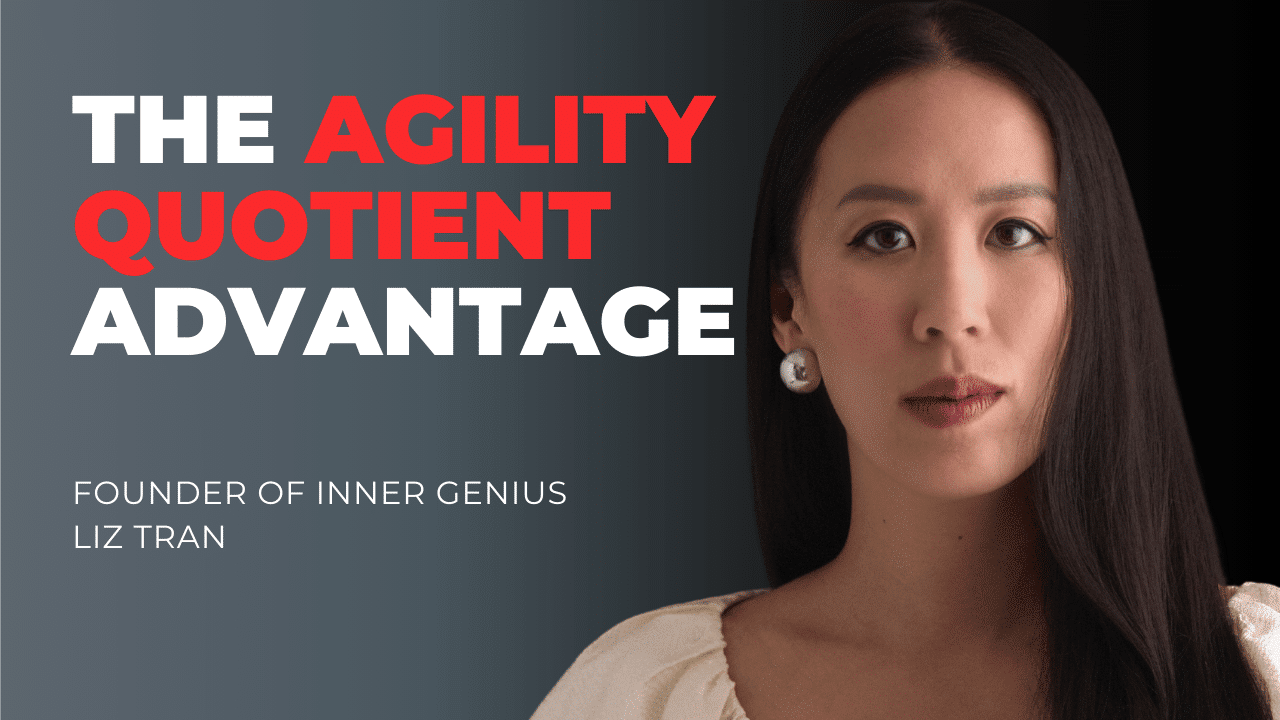
Liz Tran, former venture capital executive and author of AQ, examines why agility—not raw intelligence or experience—has become the defining capability for leaders operating amid persistent uncertainty. She introduces Agility Quotient (AQ) as the capacity to adapt thinking, identity, and decision-making when familiar structures no longer apply.
Tran explains how traditional markers of success, from credentials to past wins, can quietly become liabilities when environments shift. She describes how the pandemic, rapid AI adoption, and labor volatility exposed a gap between competence in stable conditions and effectiveness under change. Agility, in her view, is not a personality trait but a practiced discipline.
Key insights from the discussion include:
-
Why leaders who anchor identity too tightly to past success struggle most when conditions change, and how agility begins with loosening that attachment.
-
How burnout often reflects a loss of agency rather than excessive workload, and why articulating a future-facing personal strategy restores momentum.
-
What recent layoff patterns reveal about how organizations are selecting for adaptability rather than tenure or historical performance.
-
How a shift from a “know-it-all” posture to a “learn-it-all” posture improves judgment, learning speed, and organizational resilience.
-
Why confidence is built through repeated cycles of disruption and recovery, not through mastery alone.
-
How leaders can use AI as leverage without eroding core human capabilities such as critical thinking, synthesis, and judgment.
Tran also reflects on how early beliefs shape leadership behavior long after circumstances change, and why agility requires examining those assumptions rather than optimizing around them. She argues that reinvention is not episodic but continuous, and that career durability now depends on the ability to operate without fixed reference points.
This episode offers a practical framework for executives seeking relevance and steadiness in volatile environments, positioning agility quotient as a core leadership capability for the next decade.
Get Liz’s book, AQ, here:
Here are some free gifts for you:
Overall Approach Used in Well-Managed Strategy Studies
Enjoying this episode?
Get access to sample advanced training episodes
Episode Transcript (Automatic):
welcome to the strategy skills podcast. I’m your host, Kris Safarova and our podcast sponsor today as usual, strategytraining.com and we have some gifts for you. You can get five reasons why people ignore somebody in meetings in corporate world, but also in personal life. And you can get it as a free download at f, i, r, M, S, consulting.com forward slash, on the room, O, W, n the room. You can also access episode one of how to build a consulting practice at firms consulting.com forward slash build you can get the overall approach used in well managed strategy studies at firms consulting.com forward slash overall approach and McKinsey and BCG winning resume example, which is a resume that led to offers from both of those firms. And that template works for any level of seniority, and you can get it at firms consulting.com, forward slash resume, PDF. And today, we have with us Liz Tan, who is the author of AQ and a leadership coach. She is a former venture capital executive who has worked with companies like Facebook, Instagram, the Ford Foundation, and her work has been featured by The New Yorker, The New York Times, The Today Show, Bloomberg, entrepreneur, Fast Company.
Liz Tran 02:09
Liz, welcome. Thank you for having me. Kris, it’s such an honor.
Kris Safarova 02:13
So you had such an incredible career before we dive into your current work. Could you take us through your journey briefly and some of the defining moments and key lessons along the way?
Liz Tran 02:25
Yeah, absolutely. So I started my career in 2008 right after I graduated from university, and the very first lesson I learned was this idea that you just have to go where the action is. I initially wanted to work in publishing, but it was 2008 and there was the financial crisis, and I was in late stage interviews with some publishing houses, and the industry that was growing at the time was tech, and so I networked, and I got into tech. I started working at an early stage startup, and then my career grew from there, and I think relevant to the work that you help people do, I actually pivoted after a few years of working inside of different tech companies, and I launched my own consulting practice, and I would essentially help founders and leaders In tech companies to build out their people and talent infrastructure beyond the scope of where they are ready to build a team. And then in 2015, one of my clients said, Hey, do you Would you ever do this type of work that you do at a venture capital firm? Because my investor is looking for someone like you you know, who can help their portfolio, advise, consult founders on how to grow their businesses. And that’s what I did. So I joined a firm based in New York City who had been early investors in companies like Spotify and Instagram, and are currently, you know, lead investors in businesses like open AI and skims and I built a team, and essentially my work was to connect with the people that we had invested in, and then to help them grow themselves. And something that I was always trying to answer was, why are some people successful, and why are some people not? And if you account for similarities across background. You know, where people went to school, socio economic class, you still have a huge division of what why some founders, you know, wind up creating these, you know, billion billion dollar exits, and while other founders really can’t get product market fit off the ground, even if their backgrounds might seem so similar, and the answer for me, after years of researching this, both within venture capital as well as in my work as an executive coach, analyzing hundreds of founders, having them take personality assessments, interviewing them, was that it’s not necessarily. About how smart you are. Your IQ is not what matters. It’s not the primary factor of what’s going to lead you to a happy and successful life. The answer is actually your AQ, which is what my book is about, and that’s about your capacity to handle change, uncertainty and the unknown, and especially as we embark on this technology revolution, just of the past couple years in AI, this has become even more true as the curve that we’re all experiencing in our careers goes from linear to exponential. And you know, I think the generations, the younger generations, are already feeling this with Gen Z, anticipated to have 18 jobs across six industries in their adult lives. We need to prepare ourselves and the generations below us by digging into AQ, not necessarily just focusing on your IQ.
Kris Safarova 05:55
Why do you think it took so long for someone to bring it to the surface? Why we were not talking about it, because it seems obvious.
Liz Tran 06:03
Yeah, yeah. I mean, I think that IQ is a pretty long held cultural phenomenon. It was developed in the late 1800s when France started doing mandatory education, they needed a way to put students into the right classrooms. And then the government was like, oh, we need this too, so we can hire people to work for us. And the military said, Wow, we also need, we need IQ, because we need to, you know, decide what roles and ranks people are going to go into when they’re in the military. So that held for 100 years, until the 1990s when EQ came about the idea of interpersonal sensitivity, because suddenly people were working with others in different countries, across language barriers, across, you know, different focus areas. And suddenly, because the world had become so much more global, you needed to also have EQ, your interpersonal emotional intelligence, in addition to your IQ. And so I think that this has crept up on us for a while, but has been accelerated because we realized that during the pandemic in the past five years that you know, all of us, no matter how smart you were, felt really bombarded by change, because suddenly everything that seemed so stable that we had taken for granted was not a given anymore. I think all of us, no matter how organized, prepared, intelligent we might be, felt very unmoored by the changes and unexpected surprises of the pandemic. So I think post pandemic life, and now moving into this AI era, we are feeling it so prominently.
Kris Safarova 07:45
And of course, growing up, we all learned about what Darwin said about how it is not the strongest or the smartest that survives, but the one who is most adaptable to change. But somehow in business, we were not giving it enough attention, building on what you already shared. Now that it becomes evident that we should be focusing on that, how can someone evaluate their ability to adapt?
Liz Tran 08:09
Yeah, absolutely. So I think this is a really great question, and something I want to start off with is that to remind everyone that being highly adaptable, being agile, actually, is within all of us. We have that potential. It’s not something that only you know. Let’s say young people are good at all of us can have a high AQ and move through the world with high AQ, but it’s just a matter of prioritizing it. And that’s why, in my book, I make sure to describe it as a standalone intelligence that is on par to your IQ. And so I think that for all of us, as long as we’re prioritizing it, making it important, making our decisions based on that, that will be a huge part in US reorienting our lives to be AQ facing one example that I think is relevant from an individual level, but is a corporate example, is when in 2014 when Satya Nadella took over as CEO of Microsoft, and at the time, Microsoft’s stock prices had been flat for a number of years, and people really perceived them as a low AQ, not adaptable, slow moving, bureaucratic organization that had really missed out on key trends like social and gaming. They had completely missed, missed the boat on a lot of, you know, white space that other tech companies had taken from them, essentially. And so when he took over, of course, there was a lot for him to do from a strategy and decision perspective, but the first thing he did was to change the culture. And he basically said, I’m going to shift. Microsoft from a know it all culture, meaning everyone wanted to be right. Everyone wanted to be the smartest person in the room. And he said, That’s not what we can do here anymore. We’re moving to a learn it all culture, which is really a high AQ orientation towards life. And it’s not about being the smartest person in the room. It’s about asking the best questions. It’s not about knowing everything. It’s about being curious to grow your skill set. And it’s not about presenting as having the most knowledge or seniority. It’s actually about being someone who is enabling growth and learning for the people around you. And the way that Satya Nadella did this is he talked about this very openly with his executive team. They helped convey the message through stories through the whole organization. They put up posters in the hallways about being a learn it all culture, and then they also made these motivational coffee mugs that became so popular that people started trading them. And we all know the story of where that’s gone now. In the past 10 years, Microsoft has increased its stock price by 1,000% you know, they, they really are at the forefront of the AI revolution, making big bets and open AI before other organizations have done so. They led the way. They love the charge. They’ve really, you know, pioneer a lot around cloud computing and changed a lot of, you know, from from Microsoft Office into new products, and did a lot of really bold M and A over the past few years. And so I think that that can serve as an example for all of us, where once we stop prioritizing being the smartest person in the room, the most knowledgeable person in the room, we allow ourselves to start asking questions and move from being know it alls to learn it alls that is the first step to becoming a high AQ person.
Kris Safarova 11:46
And I think people listening to us right now feel look Kris, I already learned as much as I can. I have so much on my plate. I have a family I need to support. I have a very demanding career. I have to work across organization with a lot of people who are not reporting to me, and it is very complicated, and things are just certain minds, and there is not enough time to sleep even, what would you tell them?
Liz Tran 12:09
Yeah, you can do it in a lot of small ways. So as a for instance, I think about, you know, the other day, when I was, you know, finalizing some edits on a piece I was writing, and I, you know, shared it with my editor, and she said, it’s great, let’s just move forward. And then I actually paused, and it only took, you know, an additional 90 seconds, but I said, we can submit it as it is, but can you just give me some feedback about what I could actually possibly improve later on. And she said, yeah, like, I would do X, Y and Z, blah, blah, blah. And it only took 90 seconds. But it was this orientation of, instead of just, you know, be okay with good enough that I was able to, you know, dig in and learn something new. In addition, you know, taking an hour at the end of your day to try out some vibe coding tools doesn’t take that much longer, but thinking about how you can actually, you know, maybe streamline or automate some some processes in your life using new technology and and I hear you too, like, you know, we’re busy, we have families, and thinking about how being a high AQ person can actually help with Some of that frustration, I think, one of the most uncertain and changeable aspects of our lives, our relationships, our partners, our children, they especially children, if that’s what is on your plate, are always changing, and there’s always opportunity to think, okay, how can whatever experience I’m going through right now that I did not ask for? How is this making me a high AQ person? I think that the other day, like, I’ve actually been sick for three weeks because my I have a toddler at home, and she brings home all sorts of germs, and it set me back in terms of a lot of like deep work and planning work that I needed to do for the end of the year and work for my clients of you know, 2026 strategy planning. And I just thought, Okay, what is this trying to teach me from an AQ perspective,
Kris Safarova 14:11
I hope that you will feel better as soon as possible. And thank you for being on the podcast given that you’re not feeling well. Yeah, it’s such a pleasure speaking about being stressed. I know you work with people on how to avoid burnout, with organizations, and how to avoid burnout, given what is happening right now and how much stress people are under, they’re afraid to lose their job because of AI and other technological advancements and just uncertainty and some of the layoffs may be happening, not even because of AI, but just because AI is a good excuse to lay off some people without too much attention. So what would you recommend right now for someone who is working even more than they generally work and they already work really hard to begin with on a regular basis? How can someone avoid burnout? Out given current situation,
Liz Tran 15:01
yeah, definitely. You know, what’s interesting is, I was speaking to a friend the other day who works at LinkedIn, and LinkedIn just did some reductions in force. And this particular individual, his his team was reduced in half. And, you know, he was asked to step in and take over some management responsibilities. And this is a, you know, inherently stressful situation, because he didn’t know if he was going to be part of the people who are being let go or not. There was a lot of whispering and murmuring within the, you know, the higher up organizations that there was going to be this big layoff, you know, the executives had alluded to it during town hall meetings, etc, and what his manager said to him is, you know, your job is safe here, but I need to know that you are loyal to Our AI future, which seems like a, you know, an interesting ask to basically pledge allegiance to to AI, but I think that’s what organizations are looking for. When we think, when I look at the layoffs that happened throughout 2025 there were a number of them across a lot of different companies, and whenever you saw layoffs in the past, like pre 2025 it was always around this idea of reckoning with the past. So, you know, profit margins are lower, or revenue is lower, maybe a product was over invested in. And so layoffs were a way of, sort of right sizing the team and the resources to, you know, the mismatch of what they predicted the future would hold, but it didn’t actually happen. So very much. A, you know, a a fixing of the past to right size in the present moment. And then what you’re seeing in 2025 is that layoffs are all about the future. They’re not about the past. They’re about presenting some vision for the future in support of that. So for instance, Amazon, when they did their big layoffs, they said, We’re doing this because we need to invest in AI warehouse automation, and the resources to do that are going to come from streamlining some of this bureaucracy. When Lufthansa did a number of layoffs, they announced that they were going to lay off 4000 jobs by 2030 and in the same announcement, they also said we’re going to invest in 230 new aircraft carriers, 100 of which are going to use revolutionary new technology to do long haul flights. And so in the same breath that these organizations are talking about letting people go, they’re also sharing a new vision for the future. And so I what I would say is, for people who are feeling a lot of burnout and a lot of stress, know that you are not just a puppet, that you have agency. You have the ability to be in control of your future as well. But remember that part of that is doing what these companies are doing and saying, I’m going to think about what my vision for the future is. I’m going to create and craft that vision for myself to know where I’m going to put a lot of you know forethought into that. And I think this is a new skill, particularly for people who are pretty senior or pretty advanced in their careers. You sort of think I’ve been doing this for a while. I know what steps I’m supposed to be following next, but what this moment is asking of all of us, no matter how senior we are, is to take stock not just of where we are in the present moment, but where the future is going to take us. And I actually think that that helps combat some of the burnout, because oftentimes burnout is about feeling that you don’t have agency, that you don’t have the ability to take your life into control. And of course, burnout is about having, you know, a large degree of work in front of you, and, you know, putting in long hours over an extended period of time. But actually, one of the major causes a burnout is feeling like you do not have proactive agency over your own life. And so my advice is step back and remember that you do and intentionally think about what your vision for the future is and how it fits into you know, the broader shifts that are happening in the world.
Kris Safarova 19:19
Yes, and if you imagine someone at a large tech company, or even, let’s take someone in an example with LinkedIn, and they don’t know if they’re going to build it off or not, and they need to take control over on their own life. What specific things they can do?
Liz Tran 19:35
Yeah, over their own life. Well, one thing they can do is like, if they want to stay at their organization, they can think about where the company is going from a technology mandate, and then they can teach themselves those skills and show everyone around them that they are embracing this future vision, that they’re not going to stand in the way of the organization bringing this future vision to life, because that’s essentially the way people are making layoff decisions. It’s, are you someone who’s going to be part of your future? Are you someone who’s going to be part of the past? And so showing that you genuinely have an interest in a care for that future vision, I think, is really important. I think also you can start to retrain yourself. You can give yourself skills. Luckily, there are a lot of, you know, low cost options for learning that are out there. I think, you know, inclusive of some of what you offer as well, right? Like this kind of continuing skill set education. And I think, you know, just thinking about the assumptions of where our careers can go. So I make my living as an executive coach. I work with CEOs and founders, and I have a very, like, very abundant hourly rate that I charge. And the other day, I mean, this has been, over the course of two years, I’ve been thinking a lot about where the future of executive coaching is going, because it’s a very saturated market. It feels like everyone is becoming an executive coach. These days, there are a lot of executive coach training programs. I get emails from probably five people in my network every month that say, Liz, I know you’ve been coaching for several years. Can you give me some advice? I’m thinking about going into coaching. And I also think the price points are way too high. They’ve gotten very inflated over the past, you know, 10 years. I remember when I first started working in this field. You know, a normal hourly rate would be somewhere between 300 and, you know, $1,000 an hour at the high end. Now I hear about coaches who are straight out of training, who are trying to charge $2,000 an hour. And, you know, I think just the market is changing so much, and I had this realization that I probably need to do something about my job. And as a result, on the side, I’m creating an AI platform that actually gives people access to executive coaching at a much lower price point. So that brings accessibility to everyone, because I think that’s really where the world is heading. And instead of paying, you know, a coach $4,000 a month, you can have a coach for $20 and you have a seat with someone who isn’t a real person, but ideally is trained on real conversations. And some of the you know, the coaching is very much like therapy, where there are a lot of foundational philosophies and principles. And so I think things like that, where I suddenly felt more agency, because instead of just sitting around and waiting knowing that my job probably won’t exist in the same way over the next five years, I’m doing something about that. So I think there are little things that we can all do to push forward our vision for what we think is possible
Kris Safarova 22:28
for us. This is a great advice, Liz, and you mentioned learning. So for someone who was head down just working on the current project and feels that they fell behind, and obviously they know how to use chatgpt to some degree, but beyond that, they don’t really know much about AI. What would you recommend they do try what kind of apps and so on they test to start developing a stronger skill set?
Liz Tran 22:53
Yes, definitely. So I would first ask yourself, How do you like to learn. You know, what’s enjoyable for you? Because I think everyone has different personality styles, like, what will feel less like work? And so for someone who you know, likes to go for a walk, to clear their mind or exercise, and they like to, you know, hear from podcasts to learn. There are so many great AI podcasts that are out there that give you kind of a, you know, a sense for what’s happening in the industry. And there’s everything from, you know, kind of like larger, you know, macro explainers of what’s happening. And then there are also ones that sort of teach you how to use it day to day in your skill set. And then there’s newsletters out there, if you like to read newsletters. There are, you know, networking groups. There’s a WhatsApp group that I’m part of that like, just shares the latest in AI in the New York community. So there’s just a lot going on. I don’t think content is an issue. There’s a way to find it, but I think knowing yourself and the way that you want to consume that new information. And the second thing I’ll say is to practice, practice, practice, you know, to spend, you know, if you could set aside a couple hours a week to experiment with, you know, whether it’s the new AI editing tools on Adobe, or to, you know, photo editing tools on Adobe, or to try to build, you know, Some sort of app using replit, whatever you might lovable. It’s just fun to try out and to stay sharp in that way and just know that it’s gonna take time, and even just the action step of feeling uncomfortable, that is you building your AQ. And so I think that’s what’s really important, is like to know that you’re going to experience discomfort whenever you try something new that, and just to embrace that, not to see it as a sign that you’re doing anything wrong, but rather the opposite, that you’re on the right track, because you’re actually learning something. And so I think it’s going to be different for everyone, depending on what your job is. But I think content is not necessarily the. Problem. It’s just a little bit more about mindset. Because if it’s out there, if you want it, I think we all know that there’s, like, an abundance of great information that exists across, you know, lots of platforms, whether it’s like something that’s a little bit more, you know, polished, like masterclass, or it’s something that is a little bit more, you know, lone wolf Renegade, like, you know, an individual sub stack that you might be following. But I think my advice is just make it fun. Like, do the follow your intuition, do the thing that feels right for you, and just like, pursue it as if you’re pursuing a hobby, because it shouldn’t feel like another task or another chore. Make it enjoyable, make it interesting. Do it in a way that speaks to you in the way that you like to learn.
Kris Safarova 25:47
This is great advice. How would you recommend our listeners think about AI in terms of what they expect in the next three to five years? Yeah.
Liz Tran 25:57
I mean, I think it’s pretty undeniable that it has already changed the world over a very short period of time. Every student uses AI to do their papers. There’s no way around that. There has already been a decline in cognitive thinking, strategic thinking, creative writing, because people just aren’t forced to do as much of it anymore. I think that there is, I mean, these are a lot of like, the negative downsides that I’m mentioning, but I’ll get to kind of the upsides in a moment. I think that there is a proliferation of sameness, where because people are using AI to help them with their brainstorming, their thinking, their communications, a lot of it takes on the same tone, the same ideation. And so the way that I like to think about this is think of AI as doing all the things that don’t make you you right, like you can use it as like an assistant or a tool to help you with all the stuff that doesn’t really necessarily need to involve creative thinking, unique thinking, your your innate humanness as a person, because at the end of the day, we will all still have our humanity. You know, we all grew up. We all have our stories. We have the parents that we had we grew up in the countries we grew up in. We have the culture that that we experience, that is unique to us, and that is something that can never be replaced through AI. And so what I say is, like, embrace it, have it do the things that you don’t want to do right, or that don’t make you you, but then double down on all the things that make you uniquely human. So read novels, right, like go on trips, have experiences, build a community, meet people, double down on your relationships, create your own personal brand, you know, stand out as like a human in an individual, and know who you are as a unique and specific and singular individual. And so I believe that it’s about, you know, equally embracing with both hands, like with one hand. I say yes to everything with AI. As a rule of thumb, I always try to do it with AI first, like, just to see what it’s like. Why not? Right? That’s like, actually, advice that comes from a book by Ethan Malik, who’s a professor of AI at Wharton, and he basically says, like, try everything with AI. And then what I also say is recognize your innate sense of humanity and double down on that. And so I find myself trying to reach out more to people and connect with them. I’m going out of my way to see people in person, to make time for them, to, like, free up the time that I otherwise don’t have, and to actually see them and connect on a level that doesn’t feel so transactional and direct, because our network is also where a lot of opportunities are going to come from, and the more you can see people face to face, the more memorable you’ll be. And then, when I think about, you know, pedagogy for my children and my family, I want my daughters to learn AI, but I also want them to learn how to paint and how to be outside and how to be bored, and to have a lot of, you know, patience and ability to learn new things, and so I think that’s actually part of it too. Is like, you know, you’re not just, you know, embracing AI skills. You’re also embracing the unique human skills that make you who you are.
Kris Safarova 29:36
Beautifully said, could you share with us, if you feel comfortable, how do you use AI yourself?
Liz Tran 29:42
Yeah, I mean, I have it open. I have my chat, GPT window open all day, and anything I can use it for, in terms of, you know, analysis, summary, research, then. Do that, I use AI to transcribe all my coaching conversations. So as an executive coach, I meet with several people a day who I coach over the long haul, and I use it to run analyzes on what this person needs from me as a coach. So what has always made me really great as an executive coach, is I have a tremendous memory. So even before AI like, I would remember something that my client experienced in 2021 and I would say, hey, remember how you handled this problem in 2021 look how well you’re doing now. Like I’m mirroring back to you your growth. And my clients would always say, how do you remember that? How do you remember this conversation? I know the names of all their investors, their employees, I remember, you know, what their latest valuation is, what their newest products are, and so that has been one of my, you know, I guess identifying qualities as an executive coach. But honestly, I don’t really need it as much anymore, because I use AI to transcribe all our conversations. I send them follow ups. I even use it real time, sometimes in a conversation where, you know, let’s say I’m helping a client think about what speech they’re going to deliver to their team during their all hands. We might workshop it live, and then I’m transcribing it using otter AI or granola, and then I’ll go into the transcription, I’ll copy and paste it. I’ll drop it in chop chat GBT and say, Hey, take this conversation between me and Joe and turn it into, like, bullet points, talking points for a 15 minute conversation that Joe’s gonna have with his team. And then it does it really perfectly. Um, and so I think that, you know, while memory is something that I previously thought was, like, very unique to me as an individual. I can outsource my memory now, but what I do is I, like, take that extra time, and I use AI to, like, remind me of, you know, of like to basically be like, Okay, I want you to send me reminders of all these people’s birthdays, and, you know, to actually create that more human personal touch so I can have time to go out of my way to say, Hey, I remember that you had a board meeting. A board meeting today. How did that board meeting go? And so I actually use it for almost everything that I do. But when it comes to writing, which is a core part of my work, I always do it myself first, because I do not want to lose that faculty of being a critical thinker and a writer. So I actually will never sit down and have aI just write me something. Right off the bat, I will practice writing it myself first, and then I might feed it into AI and say, How can I improve this? But that’s a hard line that I’ve drawn for myself, where I say, because I make a living as a writer, I cannot let that faculty slip.
Kris Safarova 32:37
And this is critically important. I am also concerned about how it’s so easy for people to start losing the skills they had. They spent so much time developing an ability to write, an ability to think, and I think people started using AI heavily over the last year. I think even before that, it was still not so bad, but and now it is a slippery slope, and we really need to talk about this and warn people to protect their skills. It’s very, very hard to rebuild and especially with the ability to think it’s a dangerous thing to do, because there are so many things in life where we require good, critical thinking skills, where we may not even know what to ask AI to help us, and it just very, very dangerous path that many people are on right now.
Liz Tran 33:26
Yeah, I agree. I remember when I moved to New York, there was no, this is 2008 and there was no ability to get Google Maps on your phone. And so I wound up knowing how to navigate the whole city really well. You know, I knew where all the subways are. I knew how to get around. I knew the fastest way to get from here to there. My directional skills were so strong, my navigation and obviously it’s non existent, even though I’m going on almost 20 years of being in the city, and that was something that I really let slip away and feel like maybe I’m okay with it, because I get in the car, I put on my GPS, I don’t need to worry about where I’m going. But, yeah, I agree with you. I don’t want to lose the ability to think. I don’t want to lose the ability to to write. I don’t want to lose the ability to critically examine something, because I actually don’t think AI is great at that right now. It’s really good at summary. I mean, even just the way it operates, it looks at a number of tokens and then it tries to predict the next most likely token to occur in a sequence. Sometimes the best thinking isn’t about what’s the most likely token to predict. It’s about coming to the table with something that is completely off the wall, right, that is completely different, that no one would have ever thought about before, a non sequitur or a tangent, that actually winds up being the real answer to the problem. And that’s what we’re really good at. We’re good at not doing the most likely thing, but we’re doing the thing that is surprising, interesting, unique. Unique, you know, and very singular to the way that we think and how we brought that to the table.
Kris Safarova 35:07
Liz, how do you think our listeners could make sure they don’t lose their confidence and their own skills abilities, given what is happening and kind of building on everything that we already spoke about today, to specifically look at confidence and how it is impacting people’s confidence?
Liz Tran 35:26
Yes, absolutely. So people think that. I think people mistakenly believe that confidence occurs by being really good at things. So they think, if I’m really talented and I’m the best at something that I will be confident. But that’s not actually where confidence comes from. Confidence comes from doing something that was really hard and failing at it and then actually improving. So that’s actually the mechanism for confidence, is being bad at things you’re bad, and then you figure out a way out of it, and then you feel really good at yourself that you sorted it out, which is why children do not gain confidence when we do everything for them, or that, you know, it’s called, you know, Snowplow parenting, where you clear the way so that they can always succeed. That does not raise a confident child. And it’s the same thing with humans. And confidence is a muscle. It’s something that can be built. And so I think remembering that like that’s actually the really interesting part about all of this, is that for people who love feeling good at things all the time, you’re not going to build confidence, because you’re going to keep yourself in your comfort zone. And so just remembering that, the more you can toss yourself out of your comfort zone and actually thrash around a little bit and struggle and fail. That’s where the confidence comes from. And I think the second piece of that is remembering what your strengths are and articulating them. I have a quiz that you can take that’s if you go to aq quiz.com and it tells you what your AQ archetype is. There’s four different archetypes. One is the firefighter, one’s a novelist, there’s an astronaut, and there’s a neurosurgeon, and each of them are good in their own types of tasks and their own types of responsibilities. And so knowing who you are both from you know, an AQ standpoint, if you haven’t already done your Myers, Briggs type inventory, you should do that. You should learn everything you can about yourself so that you can be the person who is championing and codifying your own strengths, because no one’s going to do that for you, but you have to come to the table and say, This is what I’m good at. Maybe I’m not good at x, y and z, but either I’m working on it, or I’ve decided that I don’t care and I’m going to double down and exist in my zone of genius.
Kris Safarova 37:37
Liz, you work with many executives, of course, protecting everyone’s privacy. What are some of the key problems they are currently facing? Yeah.
Liz Tran 37:46
I mean, I think one of the maybe I can break down the things that I do with my clients, the first is, you know, acute problem solving, so they come to the table with a real issue. Maybe the company is being sued, or a competitor just raised a huge amount of funding, or their number one employee just quit, you know, like those are real time issues that we will problem solve around. And oftentimes what I’m doing is I am just opening space for them to work through the problem. So it is impossible for me to be a subject matter expert in everything, because my clients exist across a number of fields. They’re in healthcare, they are in consumer retail, they’re in food and beverage. They’re in, you know, hard data science, you know, maybe they’re former MIT PhDs, whatever it might be, it’s across a wide variety. So I will never be the domain expert, but I do, you know, hold space for them to walk through problems that don’t have a clear black and white answer. And so I do that through asking a lot of questions, you know, asking them what resources they have, what the problem is. And, you know, we could spend 50 minutes of a 60 minute coaching conversation, so the majority of it where I’m just asking questions about the problem, and then in that last 10 minutes, they arrive at the answer themselves, because they’ve been able to see it from a number of different directions. So that’s one bucket I’ll put in. Is just the day to day problems of being a CEO in business, and it varies across industries, but that’s why I pretty much only work with CEOs, is they have a lot of problems. The problems are never ending. And I think that’s actually fun and interesting. So, you know, lots of just, you know, questions of like, running a business, how do I deal with this tariff issue? How do I deal with the supply chain issue, whatever it might be, and then the second thing that I do is I help them with their own personal effectiveness. So what’s standing in the way of them operating at their best? And oftentimes, what’s standing in the way of them operating at their best is themselves. It’s their mindset. It is assumption. Questions that they have about the way that they need to exist in the world that are no longer true. And my catchphrase that I got from another coach named Marshall Goldsmith is what got you here, won’t get you there, and that’s very true. So I often help them stop being their own worst enemy. I note patterns that they’re doing. Oh, you are micromanaging your team, and you’re, you know, disincentivizing them, or you are spending all your time coding instead of actually running the business, you know. And so it’s like being able to step back and say, How are you not being as effective as you need to be? And then the last thing I do with them is I help them remember the big picture, because it’s very easy to get pulled into the day to day, fires, responsibilities, life is busy. The Days go by really fast, because you’re Go, go, go, go, go. And my job as an executive coach is to remind them you’re not just looking at this week or even this hour. You are looking at the next three, five years. What are we doing here? What’s the point? What’s the purpose? Where are you going? So those three categories, kind of day to day, acute problems. Two, personal effectiveness, and then three, holding that longer term chessboard of what’s happening holistically at the organization.
Kris Safarova 41:18
With regards to second bucket. Do you ever do work on rewiring someone’s beliefs?
Liz Tran 41:24
Yes, all the time, all the time. I think it’s the most important work that you could do is rewire someone’s beliefs. And sometimes I get frustrated because the same version of the same problem or different version of the same problem pops up over and over and over again. It’s because that person is being called to change their beliefs. And belief is everything. Mindset is everything. I really know this to be true. It’s if you can’t see it in your mind, it will never happen in real life. If you don’t believe it yourself, who’s going to believe it for you. And so that’s a huge chunk of the work that I do. And for me, it’s, it’s it’s hard, because at the end of the day, like I have tools and techniques, but the person has to want to do it. And I definitely have had clients in the past where they’re not willing to do that work or that change, and so I might have to say, you know, let’s pause on our work together until you’re ready to actually embrace a new way of seeing the world.
Kris Safarova 42:32
How do people use your lady act for that? I think
Liz Tran 42:35
it’s hard for them, because you know, if they’re going to be in denial about what their reality is, then they’re not going to understand what I’m saying. But to me, I find a lot of satisfaction around making an impact. That’s why I do my work, and so I’m not going to just sit and like, collect my fee for doing nothing and not being effective. It’s very frustrating to me, and so I’d rather just end and break that relationship, even if it is there’s some conflict there, than to waste everyone’s time. Because I think a lot of times people are happy to say, oh, yeah, I see what you’re saying. I totally agree with you, but when the rubber hits the road, they’re not actually going to make those behavioral changes that they need to. And I can lead the horse to water, but I can’t make them drink. And that’s like the same thing with every executive coach. You can build out your toolkit to be very effective, but at the end of the day, everyone’s on their own journey.
Kris Safarova 43:36
Would you be able to share with our listeners one effective way to revise someone’s beliefs if they are currently struggling with something, for example, I’m not good enough.
Liz Tran 43:46
Well, I think the first thing is that you have to make them understand that it’s a belief and it’s not a fact, and part of that is presenting evidence that it is not true, right? Like evidence to the contrary. But then again, they won’t believe it unless they’re incentivized to you. So maybe I’ll just give an example. So I have a client who was going to raise a round of fundraising, and she felt really demoralized because the meetings weren’t going well. And you know, she would feel frustrated that she had to go justify why her company deserved to be invested in. And she also had also gone out a year before that, and had failed at fundraising. So she was coming to the table with all this baggage, and basically, like I had to dangle a carrot. That carrot is different for every person, and this carrot was failure. I basically said, unless you change your mindset, you are not going to succeed. If you think that this round isn’t going to go well, then it’s not going to go well. And if you think that every time someone questions you in a meeting, then they’re right, then you’re never going to change their mind. You have to be the expert in your business. You have to be the person who convinces them why this market is. Worth investing in. And I gave her some examples of people who had done this in the past. I gave her exercises to do. So I made her, you know, read the confident mind, which is a book about gaining confidence. I had her create a list of, you know, all the assets and resources and strengths she had. I wanted her to review that every single time. I had her go to a hypnosis session with a hypnotist to rewire her brain and build a meditation there’s lots of different tools that people can use, but they really have to be committed to it, because a lot of times you’re breaking patterns that have existed since childhood.
Kris Safarova 45:33
Yes, that is the challenge. It’s all coming from childhood, and this so deeply ingrained and so many things we have that we don’t even know we have. It is there running and controlling our life, and I think working with an excellent coach makes a huge difference.
Liz Tran 45:49
Yes, definitely. I mean, I worked with a coach for years when I worked in venture capital, and she really helped me break a lot of patterns, and it was part of the reason why I wound up quitting that job and taking a leap to pursue my own thing, because I personally had held a belief that, because of my background, the way my family has existed, you know, we’re immigrants, and I believe that work is meant to feel like suffering, because I didn’t know anyone who liked their job when I was growing up, and she really helped me rewire my brain to believe that that doesn’t need to be true. Of course, work is hard. Sometimes you to do things that you don’t like, but it can also be soul fulfilling. It can be purposeful and it can be exciting. It should be exciting, definitely.
Kris Safarova 46:38
And I think based on my own experience of also working with executives. One of the most amazing experiences of being an executive coach and working with people, having this privilege of working with amazing leaders who want to contribute at a higher level, is that you see patterns that they don’t see. You help them see those patterns. You help them rewire what is happening in their mind, and then you can see how their lives changed trajectory completely because of few things that we remove that were basically on the way for them to realize the potential to a much higher degree.
Liz Tran 47:14
Yeah, and I think it’s really empowering too, when you could help them identify where that pattern came from. And oftentimes it’s not from it’s maybe even from their grandfather, right? Or something that their dad said, or or an example that their mother set. And then it’s so freeing to help them realize this isn’t you. This isn’t inherently who you are. It’s something that you just picked up along the way, and just as easily as you picked it up, you can leave it behind.
Kris Safarova 47:42
It is not even your belief. Yes,
Liz Tran 47:44
exactly. You don’t. You didn’t even come up with this.
Kris Safarova 47:48
Liz, I want to ask you my favorite question, which I ask when there is a little bit of a time left before the end of the interview of your entire life so far? What were two, three aha moments, realizations that really changed the way you look at life or the way you look at business. Yeah.
Liz Tran 48:06
I mean, I think I have my my my story is one that has been filled with a lot of aha moments, because, you know, I really, the first one is like, I really didn’t start doing the work that I really wanted to do until I was in my mid 30s. So you know, and I’m very grateful for this job that I had in venture capital, because it really helped me to realize a lot of dreams that I had previously. I grew up extremely financially insecure, so we lived in government subsidized housing. We lived below the poverty line. I was on, you know, free and reduced lunch going to school. Never had, you know, even $5 to go on a field trip. And, you know, my mom would pay for gas, literally, $1 at a time at the gas station just to get from here to there. And I got this job after years of working really, really hard in venture capital, through some luck, and also through, you know, just working all the time. I worked all of my 20s and all my 30s, and suddenly I had more money than I ever knew was possible, but I was deeply, deeply unhappy, and so I had worked really hard to get to a certain place, but I was so stressed, I was so unfulfilled. All my hair was falling out, and I wasn’t a very good friend or family member to the people around me. And I also didn’t have, you know, relationships in my life, and a lot of what has come to me has come to me later. So I quit that job when I was 34 I got married when I was 35 I had my first child when I was like, almost 39 I’m pregnant with my second child right now, and I’ll be 41 when I have her. And all that stuff is like, seems like it came later than most people would think. But. My aha moment was that that was my timing, and it actually worked out really great. Like, I wish I had had children earlier. It’s kind of hard being, like, 41 and being pregnant, and I wish that, like I had had more time. You know, I published my first book when I was 37 and like, I do wish I had started earlier, but my aha moment is that you can start anytime. And honestly, your 40s are just the beginning of your life. And I really think that that’s true. It’s like you just accumulate everything that you need. And there are oftentimes young people who say, Oh, like, I’ve wasted my whole career. I’m like, you’re just getting started. And never feel afraid to try something new. I love seeing my friends who are in their 40s and 50s starting new businesses, you know, embracing a new track, trying something different. And I just think you have so many more emotional and wisdom resources than you had in your 20s and 30s. Don’t give up now, keep going, keep putting your your foot on the gas. So that’s a big one. Is just that, you know, time is a construct, and that like there’s plenty of time left in the world. And I spent a lot of my life always feeling like I was behind other people, and I don’t feel that way now. And in fact, I feel excited about what my 50s and 60s are going to look like. You know, I really look at different women in business, who I see as role models, and I, you know, try to cultivate that body of wisdom for myself of seeing people, you know, like Julia Childs, she didn’t publish her first book until she was in her 50s. And you know, Maya Angelou, she started writing when she was in her late or she published her first book when she was almost 40. And she’s won so many prizes, and you know, she’s just so one of the best writers of our time. So that’s a big aha moment. And then the second one, I would say, is just that everything is possible, you know, like dream really big. Because why not? We are the ones who limit ourselves in our own imagination terms of what we can be. And they’re going to be a million people telling you that you can’t do whatever it is that you want to do, but don’t be the first person to give yourself that message. I remember when I on my birthday, when I turned 35 I was with a group of friends for the weekend, and I said, you know, by the time I’m 40, I want to write two books, and I want to be working on my third book. And they were both like, they’re all like, that’s impossible. How are you going to do that? And then I wound up doing that. Like, that’s the path that I am on now. And so I think that those are, like, the two biggest things is that, like, honestly, mindset is everything, and like, how you see yourself is so important, because that’s going to shape how the whole rest of your life flows.
Kris Safarova 52:48
Very true. Liz, thank you so much for being here and for everything you shared. Where can our listeners learn more about you? Buy your book, anything you want to share?
Liz Tran 52:57
Yeah, so you can find my book. It’s called AQ. Wherever books are sold. It comes out on February 3. My website is Liz hyphen Tran Comm, and you can find me on Instagram at Liz Tran rights, and there are fields where you can submit to reach out and contact me. And there’s lots of great resources on the book. On my website, you can also take the quiz that I mentioned there as well.
Kris Safarova 53:24
Thank you. Liz, so much. The last thing, if you could put one belief into every of our listeners hearts, what would
Liz Tran 53:32
it be that would be very, very cool if I could do that, I guess the belief would be that, like, that’s actually the one thing that I want for everyone in the world is like. I do believe my mission in life is like. I believe that everyone should be developed to their greatest potential. And My wish is that everyone who’s listening really grasps and understands why they are special and why they are unique, and what they have to offer. Because, especially in this age of AI, your unique, singular humanness is what is going to have help you separate from everyone else in the world. Liz, thank you so much again for being here. Thank you for having me. Thank you for making this podcast too. Our guest
Kris Safarova 54:19
today was Liz Tran, the author of AQ, and our sponsor today, podcast sponsor today, strategy training.com. You can get some gifts from us. You can get five reasons why people ignore somebody at firms, consulting.com. Forward slash, on the room. You can access episode one of how to build a consulting practice at firms, consulting.com forward slash build. You can also get the overall approach used in well managed strategy studies at firms consulting.com forward slash overall approach. And you can get McKinsey and BCG winning resume example, which is a resume that led to offers from both of those firms at firms consulting.com Forward slash resume PDF. That’s all for today. Thank you so much for tuning in, and I’m looking forward to connect with you all next time.
Leave a Reply