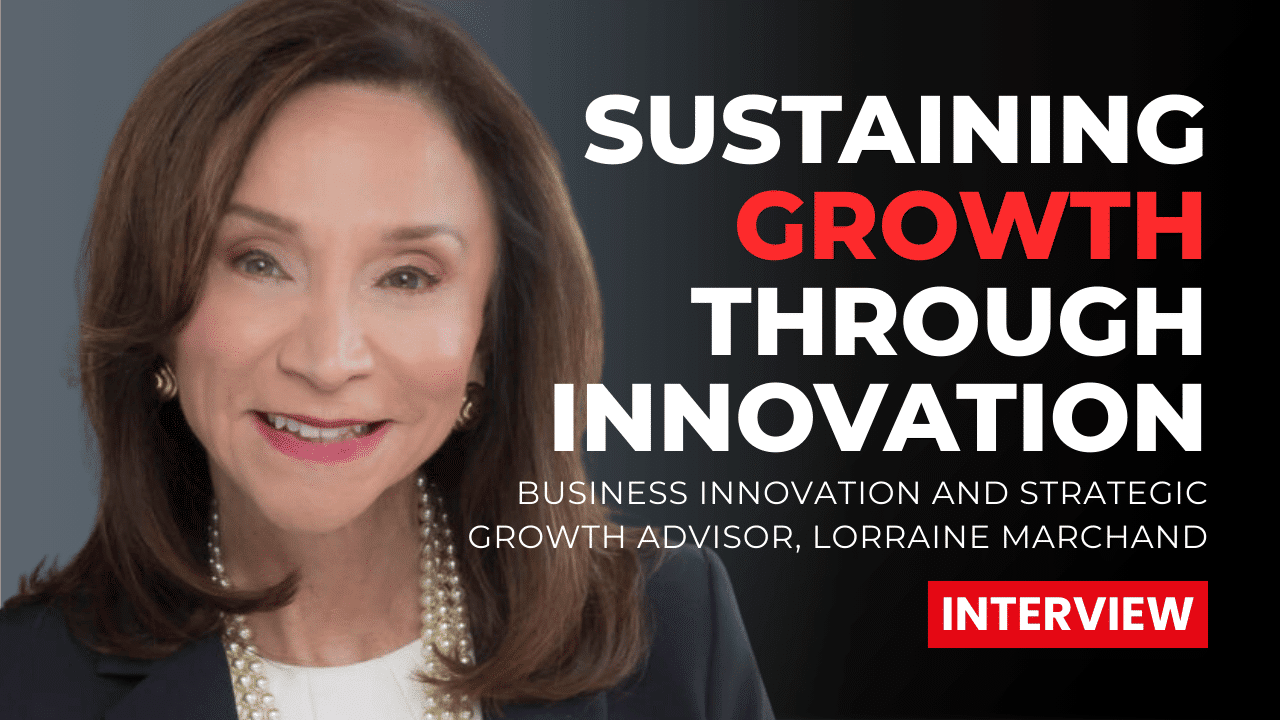
Lorraine Marchand, startup CEO, advisor to Johnson & Johnson, member of the Pharmaceutical Advisory Board at Columbia Business School, and faculty at Wharton, discusses how leaders can sustain growth through disciplined experimentation in an era shaped by AI and institutional risk aversion.
Marchand’s perspective is grounded in a career that spans large corporations and entrepreneurial ventures. Early in life, she learned to treat problem solving as an experiment rather than a test of personal worth. That principle later informed her approach to innovation in complex organizations.
Several practical themes emerge from the discussion:
1. Reframe failure as structured learning.
Marchand’s operating principle is “try, fail, learn.” The key is to set explicit learning objectives before undertaking a new initiative. When leaders define what they intend to learn, not just what they intend to achieve, they reduce fear and increase resilience. This mindset is particularly critical in startups and new ventures, where there is no playbook and early missteps are inevitable.
2. Innovation requires protected investment.
Drawing on research and executive interviews, Marchand highlights the value of disciplined portfolio allocation. A 70/20/10 model—70% core business, 20% adjacent opportunities, 10% new, exploratory ideas—creates room for experimentation without destabilizing the enterprise. The evidence she cites suggests that long-term growth frequently emerges from ideas that initially seemed peripheral.
3. Culture often suppresses experimentation.
Organizations frequently default to “playing it safe.” Marchand argues that leaders must explicitly create space for candor and reflection. Her practice of “Fail Free Friday”, a structured forum to discuss what is not working without defensiveness, illustrates how small rituals can normalize learning and surface risk before it compounds.
4. AI should assist thinking, not replace it.
Marchand observes both curiosity and fatigue around AI. Students and executives alike risk over-reliance, which can erode depth of analysis. Her discipline is simple: think independently first, then use AI as a research assistant to refine or challenge one’s reasoning. Senior leaders remain relevant not by competing with automation, but by asking the right questions, an ability rooted in experience and judgment.
5. Integration of technology requires business judgment.
Technology cannot be bolted onto processes indiscriminately. Leaders must understand workflows deeply enough to decide where automation adds value, where human ingenuity remains essential, and where both are required. This integration demands clarity about the business, not just familiarity with the tool.
6. The “who” and the “how” matter more than the “what.”
Late-career reflection led Marchand to conclude that outcomes achieved at the expense of people erode long-term value. Values alignment, integrity, and disciplined focus, often expressed through the willingness to say no, are strategic decisions, not personal preferences.
For senior professionals, the message is direct: sustained growth depends less on bold rhetoric and more on creating disciplined environments where experimentation is safe, technology is used thoughtfully, and people are encouraged to think independently. The capacity to ask better questions, protect time for reflection, and allocate resources to uncertain but promising ideas remains a defining leadership advantage.
Lorraine H. Marchand, an acclaimed author and innovator, is author of the new book NO FEAR, NO FAILURE and a leading consultant and educator on innovation with deep expertise in new product development. She has cofounded multiple start-ups, held senior roles at global companies including Bristol-Myers Squibb, Covance/LabCorp, and IBM, and advises top organizations while teaching at the Wharton School and Yeshiva University.
Get Lorraine’s book, No Fear, No Failure, here:
Here are some free gifts for you:
Overall Approach Used in Well-Managed Strategy Studies
Enjoying this episode?
Get access to sample advanced training episodes
Episode Transcript (Automatic):
Kris Safarova 00:47
Welcome to the strategy skills podcast. I’m your host, Kris Safarova, and our podcast sponsor today is strategy training.com and we have some gifts for you. You can get five reasons why somebody is ignored in a meeting. And you can get it at f, i, r, M, S, consulting.com forward slash on the room. You can access episode one of how to build a consulting practice at firms. Consulting.com forward slash build. You can have as well from us as a give the overall approach used in well managed strategy studies, and you can get it at firms, consulting.com forward slash overall approach, and McKinsey and BCG winning resume, which is an actual resume that led to offers from both of those great firms. And it works at any level of seniority. That template, we use it with clients who are very senior and with clients who are less senior, although most of our clients are very senior, and you can get it at firms consulting.com, forward slash, raising my PDF, that’s all the housekeeping for today. And we have with us Lorraine Marchant, who held leadership positions at companies including IBM, other great companies, and served as advisor to Johnson and Johnson and she serves on the pharmaceutical advisory board at Columbia Business School and teaches at the Wharton School of Business and other places. So I’m so excited to have you already with us.
Lorraine Marchand 02:13
Well, thank you, Kris. I’m delighted to be with you. I wanted
Kris Safarova 02:16
to start with asking you to give us a short overview of your journey up to this point, because you had such an incredible career so far, and I would love to share it with our listeners.
Lorraine Marchand 02:27
Oh, well, thank you. Well, my journey actually started when I was 13, but I promise you, I’m not going to take you through my chronology. But the reason I like to start there is that my dad was an inventor and an entrepreneur, and growing up around the house, he always encouraged my brother and I to spot problems and solve them. And one summer, he took us to a diner. And three mornings we had to study what was slowing down table turnover. It turned out that it was the way people were discarding of empty sugar packets, and true deform. He helped us to design solutions. We took one to prototype, we interviewed the staff at the diner, and I launched my first product when I was 13. It was called the sugar cube. We sold it to the diner. And the the the interesting aspect of the story is that diner evolved into what is today, Marriott International. So I like to say that my first product innovation going to market was something that the Marriott Corporation used. The reason that’s an important story Kris is because my dad taught me that problem solving and innovating was fun because it was based on learning. There was no fear of failure. We were experimenting. And as I got into my career, I learned that executives were not my dad and offices were not the diner, and as I was warned many times to try to stay in the safe zone, I found that that didn’t work for me, and so what’s guided my career has been an insatiable curiosity about problems. For me, it’s problems in the healthcare, in the pharmaceutical field, and just determining different ways that I can address those problems. So I didn’t join a company and decide to climb the proverbial corporate ladder. I decided to figure out how I could help get needed drugs to patients faster so that they could improve their health. And I decided to work on that problem from very different seats. And so I like to tell my my students this story too, because I think so often we land in careers where we find that we’re not happy and we’re not satisfied, and it’s because we’re not following our passion, we’re not solving a problem, and that’s. Not guiding the choices that we’re making. So I’ve been very fortunate that my dad taught me that valuable lesson, and I had the presence to decide how to use it throughout my career,
Kris Safarova 05:13
Lorraine and Were there moments where you felt you were starting to get disconnected from hearing your own voice and following your passion and doing what you feel is right in your heart, and doing what looks like a great opportunity to take and how did you came back to yourself?
Lorraine Marchand 05:30
Yeah, I mean, that happens to all of us, doesn’t it? Kris, so for example, you cited some of the large organizations that I’ve worked and I was really excited to join a large pharmaceutical company, Bristol Myers, Squibb, and be able to work on getting drugs to patients faster, but very quickly, I found myself spending all day in meetings and leading very large teams and managing budgets and having to get involved in corporate politics, even though I didn’t want to be In corporate politics. And so I found myself really disconnected from my mission and my passion of wanting to help patients, and instead, I was one of those bureaucratic fat cats, you know, flying all over the place and wearing those, what they call proverbial golden handcuffs. So, you know, fortunately, because I like to write and think. Every so often, I’ll sit down and recast where I am, what’s working, what’s not, and I was able to acknowledge that I wasn’t feeling satisfied, and to think back on those times when I felt the most satisfied in my career, and it was always when I was creating. It’s always when I was creating something new, innovating working with colleagues that like to look around corners, people that were collaborative and fun, and so that reflection always helped me to recast what it is I wanted to do and get myself back on the same path. Sometimes we have to stay in a career. For obvious reasons. We have to make a living. Our family’s depending upon us. But I learned that there were other ways that I could stay connected to my vision and my mission. And for me, it was volunteer work, it was teaching, it was writing, it was coaching and mentoring. So at different points along the way, even though I might not have been fully fulfilled in my career, I found other avenues to express my capabilities, my capacity, and to give back, which I thought was really important to do. Learning.
Kris Safarova 07:36
Can you take us to one or two moments in your career when you had choices and it was very hard
Lorraine Marchand 07:41
to choose, yes, well, actually, I had an opportunity to leave the corporate world and all of the safety of it, and launch a startup with a physician scientific founder who came out of Johns Hopkins, and we were looking at developing a diagnostic test for eye disease, and I deliberated a lot, because it would have been my first time to leave the comfort of the corporate world when I had a young family and launch something completely new, very scary to do, but I decided that if I didn’t Do it, then I was always going to kick myself and that I trusted myself, because my dad had taught me, you resilience and no fear, no failure, that I would be able to find my way back into the corporate world if it didn’t work out. So I decided that the risks were worth it, and that playing it safe was not going to be the right path for me, and so I embarked on my first startup at around the age of 40.
Kris Safarova 08:50
That’s a scary jump to make at 40, because it’s much harder to come back after 40 into the corporate world. It’s possible, but harder.
Lorraine Marchand 08:58
Yeah, that’s very true. I do encourage students, people that I mentor, if you’ve got that itch to scratch, try to do it at a younger age. I mean, you do have to get some company experience, otherwise you don’t have anything to leverage for the company that you’re starting up. So you have to get some experience. But the earlier you do it, I think the better, because you have more time ahead of you in order to make course corrections and get back on track. But it I did, I did go back into, eventually, a larger type of environment. I was a lot smarter, a lot more informed, and it really led to the development of my first book, The Innovation mindset, where I categorized all of the mistakes that I had made in that book, and I decided my job was to put this story together so that other people that decide to go out and have their startup adventure. Or didn’t make the same mistakes I did. So I think it’s really important, if you try new things, even if they don’t work out, that you reframe the experience as learning, that you capture it in some way, share it with others and continue moving forward. So I was able to take that experience and move translate it into something that helped me guide my career in the future, but also that I was able to share with others.
Kris Safarova 10:29
What were some of the key lessons from that startup experience?
Lorraine Marchand 10:33
Well, I think the number one was that there was no playbook to follow. Honestly, you can read a lot of different books by famous people, Steve Blank and Eric Ries. I have a lot of them on my shelf, but there’s no replacing the experience of making mistakes, and so many of those books don’t present the startup through the lens of mistakes. They present the startup through its final success, its exit, and then they tell you these rosy stories. And I just I had to learn the hard way. I had to meet every single individual, each investor, each strategic partner, people that were going to be on my board, meeting with IP attorneys. And it took me about a year to really meet all of the different stakeholders that I needed to meet, until I really had a clear understanding of the environment, the business and the potential. So I would say that that part took me a lot longer than I expected. I just thought that a lot of things were going to fall into place. I talked to some people. I’d figured out it figure it out fast, and I found that I did not figure it out fast. So it takes a lot longer to figure out what you don’t know, the questions that you don’t even know to ask. And I would say I was so naive I didn’t even know which questions to ask. So everybody that goes into a startup needs to create a board of advisors. And I don’t mean that in a formal session sense, people that you pay equity to, I mean some people that you can go to who will really tell you how it works, give you some important, hard feedback and be with you through that experience.
Kris Safarova 12:21
You mentioned that you learn from your dad, no fear, no failure. Can you explain to us what it means to you?
Lorraine Marchand 12:27
Well, my mantra is, try, fail, learn, and I believe that we never fail or experience failure as an outcome. If we try, we take an experimental view of the things that we’re trying and that we set learning objectives. And if you set a learning objective as you’re embarking on doing something, it recasts it, it reframes it as a continuous learning experience, and that fear of failure is able to disappear. And so as I went out in my career, for example, when I did the startup, I decided to set a learning objective, and the learning objective was, well, this will be my first time being the CEO of a diagnostic company, and I’m going to make sure that I learn everything that I possibly can about launching a startup. I just want to make sure that I’m a real student of it, and learn a lot of lessons, how you work with attorneys, how you work with regulators, how you hire staff. And so when I set those learning objectives later on, when things moved forward with the company and I ended up leaving, I was able to look back and I knew that I had accomplished my goal, and then that parlayed into my writing that first book. So try, fail, learn, set those learning objectives, and if you do, then your fear of a failure is going to be much reduced.
Kris Safarova 13:55
And do you remember when you learned that lesson from your dad?
Lorraine Marchand 13:58
I think that it probably started in the diner when he made problem solving and developing a product so much fun. And definitely he was that kind of parent, that kind of, you know, innovation leader around our home, if you will. So I learned that lesson from him early. And I think that as I went through my own career and I hit milestones where I had to make decisions about, you know, corporate or doing something on my own. I just realized that those early lessons were deep inside of me, and even though I probably didn’t recognize them as I grew up, they took hold, and I knew that they were part of my DNA, so they helped me as a true north to make those decisions as I went forward. So those early experiences definitely shaped me.
Kris Safarova 14:49
Can you say that as maybe one very challenging experience from your time in corporate world and some key lesson you learned?
Lorraine Marchand 14:58
Well, one of. My first one of my corporate experiences, what was at a very large technology firm, was a global technology firm, and that particular firm was based in India, and it was about 80% Indian men. And I came in as somebody that had a lot of experience in pharmaceutical clearly a woman that had come out of the corporate world, and I had an important role to play, because I was able to communicate with clients who tended to be us pharmaceutical executives. A lot of them were women, and so I had an important role to play in the company, external facing, but I had to navigate a culture where it was very much dominated by by men in that culture. And so that was a very interesting experience to me, to have to navigate, you know, different different kinds of culture and different kinds of biases and and make make an impact. So that was probably an interesting challenge that I that I needed to go through. And I think once I reframed that as a learning experience and decided, You know what? I bet I can learn a lot from them and their culture and their experience and their background, and I’m sure I have something to share with them. My perspective, the door started to come down, the wall started to come down, and I ended up making some of the dearest friendships that I still hold with me today. So I think that we need to make sure that we’re not scared of boundaries and differences. I like to tell my students that thinking outside of the box means getting out of your box and stepping into someone else’s box. And so that was a moment where I had to step out of my box and into someone else’s box, and I learned a lot through that experience that I think has shaped me in a very positive way.
Kris Safarova 17:09
Lorraine, you just mentioned working with students. Have you noticed significant changes, shifts from the time AI became accessible to most people in how students behave, how they approach studying, and just generally, what you’re seeing.
Lorraine Marchand 17:26
Well, that is a very important topic, for sure, Kris and yes, because I’ve taught at Columbia Yeshiva University, I now teach at Wharton, the Wharton School, and I think there are two things that have shaped students at the undergraduate and graduate level today. Number one is covid, and we can’t ignore the impact that covid had on these students who were in their house in formative years, not being able to socialize, go to sporting events, do their insurance, internships, in person. They were basically in the house on Zoom meetings for a very long period of time. So the one thing that I’ve noticed is students today put a very high value on in person social interaction. They want to be out there. They want an in person internship, they want an in person job. They want to do things with people at the same time, this focus on AI and the fact that we can have answers at our fingertips. And so I think in some ways, the socialization that they seek has to some extent, offset a little bit of the negative behaviors that we might see through AI, where you could just stay in your room all day and ask AI questions and get your work done. So I think covid has turned out to be a good offset for some of the behaviors that they could adapt through AI. And the other thing that I see is almost the students almost having a fear of AI, in that they’re concerned that they will become too dependent on it. They really are like they know that it’s important that they think for themselves. In fact, I had a student contact me last week, and I’m teaching him communications and writing, and he said that he knows that he’s overly dependent on AI for his writing and his assignments, and it’s really worrying him that it’s become such an automatic behavior as a knee jerk to use AI to solve problems, do assignments and write, and he wants to stop and he wants to learn how to write in his own voice and learn how to write properly, because he realizes that at some point that crutch may not be there, and he’s not going to learn how to think so, as much as we want the students to use AI. Be appropriately in class A research buddy, checking their grammar, seeing if there’s any other ideas that they could bring up. You can use it as an assistant. We don’t want them to become dependent on it to do their work for them. And so I think that we need to make sure that as adults, we’re really showing the students how to use AI correctly and still think for ourselves.
Kris Safarova 20:28
Are you noticing any issues in terms of impact on cognitive agility, on people’s ability to think critically? Because for tasks even not just even for writing, but for general thinking tasks that we used to do ourselves. Many people given it away to AI,
Lorraine Marchand 20:45
yeah, I do see that Kris, and it’s very easy to tell when that’s happened. You can tell when somebody’s bringing you a chat GPT idea, because, you know, first of all, it’s something that already exists in the literature, or it’s been done. The fact that chat GPT presents it to us means that it’s in a publicly available database somewhere. So you can tell that it’s not particularly creative, and it’s phrased in a rather generic fashion. It doesn’t have any color, it doesn’t have any empathy around it, and it maybe loses some of its personality. So I do, I do tend to see that. And again, I think bringing that to students attention and reminding them that this shouldn’t be a replacement for your own critical thinking skills is a very important thing to do.
Kris Safarova 21:37
What would be your advice for our listeners on what should they do now? And just to give you some context, most of our listeners are relatively senior or very senior. They’re leaders within major organizations, and they want, obviously, to be effective leaders. And many people have concern, how do I not become replaceable? How do I stay relevant and in demand?
Lorraine Marchand 21:59
Well, I think that in this day and age, we find ourselves competing as senior leaders with AI and technology. Definitely, for some of those tasks, we may find ourselves competing with a younger workforce that thinks differently, that’s engaged in social media and digital that tiktoks Everything you know, that writes differently, that uses text in different fashion. And I think that to stay relevant, the main thing that you can do is make sure that you keep honing those critical problem skills, critical thinking skills, and your ability to solve problems, because you know, there’s no replacement for the experience that you’ve had, the seniority that you possess, and the ability to ask good questions, and that’s probably one of the first telltale signs that critical thinking is falling by the wayside, is when people don’t know the right questions to ask. You don’t have to have all the answers, but as a senior leader, you need to be able to write, ask the right questions, and so I think that is the best way that you can stay relevant. People will pay attention. If you’re that kind of leader who comes in the room, you’re a quick study on the situation, you pose exactly the right one or two questions that you need to ask the team, and you make sure that everybody is moving in in the right direction. So that’s the most important thing that you can do. And I think for senior leaders, that should come pretty naturally, because that ability to ask the right kind of critical questions, it comes out of your experience. It comes out of your wisdom and your knowledge, and you can’t chat. GPT that.
Kris Safarova 23:41
Yes, very true. If you’re comfortable, could you share with us, how do you personally use AI in your work, in your life? What do you feel is appropriate and kind of how do you use it?
Lorraine Marchand 23:52
So in the educational sphere, there is a lot of work going on right now to examine how we can use AI in the classroom. So I would say, you know, one thing that you can do if you are developing a curriculum. I usually develop the curriculum first based on my own ideas, and then I might put it through an AI software like chat GPT. And maybe I’ll say, you know, is this something that is geared at a good at the appropriate level, like I want this to be an appropriate level course for sophomores? Is this going to is this going to resonate with sophomores? Is there anything in terms of the curriculum that might be missing that I should be adding to it? So I might ask questions like that to make sure I’ve got the audience right and that I haven’t missed anything. In terms of in the classroom, I would design assignments so that I have an opportunity to train students on using chat. So we might have an assignment, and I might say, You know what, we’re going to have a chat GPT prompt. Now I want you to put this. Question in and let’s compare notes and see what answers we get when we ask chat GPT to evaluate this formula or the sentence or this idea. And so stopping along the way in a classroom and giving them a prompt so that they can use it and that we can actually discuss the information and use our critical thinking skills to say, all right, is that a full answer? Is it a partial answer? Do you see any flaws in that answer? And so I use it in the classroom, and then for myself, personally, I might use it as a research aid. So again, if I’m researching a new subject, if I’m checking out my own information on, let’s say, nuclear physics, or an investment or something along those lines, then I might ask some very, very clearly worded questions around, who’s in the competitive set for this particular type of asset, or what are the risks of making this kind of an investment. So I might ask questions like that in order to get some other ideas. So almost using it like a research buddy is how I would describe it.
Kris Safarova 26:09
Do you ever have concerns when it comes to your own cognitive agility in terms of using AI and how do you protect yourself from negative impacts?
Lorraine Marchand 26:19
So that’s a very good question, too, Kris, and you know, just like with the students, if I’m going to preach discipline, then I have to demonstrate discipline. And so what I tell the students, and what I always do first, is think about it on your own. First, it’s kind of the Harvard method of learning is that you take your first try yourself, and then you might want to put your response that you received the answer that you’ve given yourself. Then you could put it in a chat GPT and ask, Is something missing? Does this make sense? Is there a better way to frame it out? Are there more questions I should be asking so the first attempt always has to be directly from my brain, and that I’m using chat again as a research assistant to help to tweak or refine so I’m very disciplined about doing that. And I would just say that if there have been times when I’ve been in a hurry and I posed a question to chat, I’ve always been disappointed in the answer that I got, because as somebody who has a lot of experience and discerns and reads other people’s work, I can tell when I’m getting something that sounds like it’s brochure wear or that it belongs on a website. And that’s a lot of times what you’re going to get when you just put, you know, basic prompts in there, you’re going to get something that reads like it’s a brochure, where it goes on a flyer, it’s on a website, and it just, it’s not authentic, it’s not deep thinking. And so then I say, you know, I would be embarrassed to bring this forward as my work, because it’s not deep enough. That is
Kris Safarova 27:58
very true. It’s actually incredible. When you have expertise in certain area, you can see how shallow it is.
Lorraine Marchand 28:05
Yes, that’s exactly right. I do have colleagues who might use it to write a letter for them. Maybe they’re short on time, or they don’t feel as though they have good grammar, and I can just always tell because it’s just devoid there’s a chat voice that has developed, and it’s almost like this staccato, short sentence, you know, maybe there’s some little barbs or little, you know, humor that they work into it. And so I’ve become pretty good at being able to identify the chat voice and knowing that somebody asked chat to write a letter for them. I can I can tell now,
Kris Safarova 28:45
yes, me too, definitely. What would be your advice on terms of skills to develop right now for what is coming? You mentioned critical thinking and problem solving. Anything else you want to add to that list?
Lorraine Marchand 28:59
Well, I think that we all need to be adept at using technology, and we need to understand the technology enough that we know where to plug it in. Because what I see in terms of technology, and this happened during the digital transformation too, by the way, we had a lot of bolt on of digital ideas, like we had some companies that were truly digital, Amazon comes to mind, or Uber or Airbnb, digital native companies, maybe 30% of them, and then all the rest of the companies were trying to bolt digital on because they didn’t really know what to do with it or where it worked. And so they just stuck it in different places because they didn’t want to miss the speeding train. And I think the same thing with technology. If we are executives in a company, and we have to be able to figure out where to put AI or the cloud or quantum computing or pick your technology, you need to understand enough about your business, your. Processes, your workflows where you need human ingenuity, that you decide the right places to put the technology. You don’t bolt it on. You think about workflows in a new way. Where does the technology go? Where do you need technology in a human and where do you still need a human? So you need to understand your business and the technology well enough that you can determine where you integrate it. That’s number one, that’s really critical to do, and it takes a lot of research and study to do that properly. And then number two, I think that human interpersonal skills, empathy, being able to communicate. I think they’re more important than ever before, and I think that particularly younger people, even though they’ve lived through covid and they want to be very socialized, they do have a phone, and they can get answers to almost anything that they need. And they could spend an entire day not actually sitting with anybody physically right. They could have their friends on the phone and don’t really need to socialize. And I do think that the skills of socializing, having a conversation, are starting to get lost. And so that idea of being with people, socializing, knowing how to have a conversation, knowing how to connect at a human level is really, really important. So I think all of those human connection skills are important to teach as well as to practice.
Kris Safarova 31:33
That is very true. And to add to what you were saying about problem solving skills, I just recently spoke to one of our members on veggietrain.com we teach the different skills that executives and leaders need, including problem solving, critical thinking. And he was saying that he’s not coming from the background of a management consultant and so on. So he was going to use our resources to learn those skills, but now he’s thinking, Oh, but I can use chatgpt. But the issue is that it’s never, as we mentioned, that is so shallow, and you will never realize that until you actually learn the skills. So I wanted to mention to all our listeners to be very careful about deciding not to learn certain skills, because you think that chatgpt can do it for you, because the only way it’s like being a manager, you can only be a very good manager once you know the work that people that are reporting to you are doing. So you can understand, is it up to standard, where are the holes? Or sometimes it’s completely wrong for your business. So we need the depth of understanding, and then we can work with an assistant.
Lorraine Marchand 32:44
Yeah, I think that’s absolutely true. And when you think about it, if you’re going to have chat, GPT answer question, answer a question for you, or do your work, and let’s say that you go into a meeting and now you’re asked in depth questions about what that report showed, and you can’t answer them because you didn’t do the work yourself. That’s going to be a very humiliating moment. So it’s, I just think it’s going to catch up with people if they’re using chat GPT inappropriately to do their work for it. So research aid, that’s great, but everybody needs to do their own thinking, and in the end, you’re only tricking yourself, you’re only fooling yourself, you’re only denying yourself the experience of thinking and learning and and really being very authentic in the business world. And I just think that people will catch on to that, because everybody’s got, everybody has chat now, so I could put the same prompt in a different type of chat, and I can get a very similar type of answer and see that you didn’t do any creative thinking on your own right, that you weren’t looking around corners or figuring out the things that weren’t obvious, because I know that there are going to be generative capabilities of chat that that’s being developed, you know, but still, so much of what it works on is published information that’s in the public domain. So it’s already known. It’s already been tested, it’s already out there. And only humans can think in a creative way on a plane of trying to figure out, you know, how we connect different dots and come up with new ways of thinking about things and doing things. So I do think that the order of magnitude of human thinking is going to be an even higher bar going forward, and that humans need to do that creative type of thinking that only they can do, and that will be one of the ways that you have to stay relevant.
Kris Safarova 34:48
And it’s also impacts someone’s growth. And then it will impact your decision making in your personal life as well. It will impact the business idea that maybe you would have gotten and created something amazing. And created generational wealth for your family and helped a lot of people. You will miss so much if you let yourself lose the skills you already built or not develop very important skills if you’re just starting out. Yeah.
Lorraine Marchand 35:15
I mean, you know, there was a prediction that we could reach a point where my computer will talk to your computer and make the decision right, and we’re practically there like you can use chat to frame up the question, you can use chat to answer the question, and you could take yourself out of the equation. But as you point out, what if it’s wrong? What if it lacks depth? What if it moves in the wrong direction, and you’ve just relegated yourself to this opinion between these two computers without applying any critical thinking to the situation. So I think your words of caution to your listeners are very well placed. And like anything that’s a bright, shiny object and we get excited about it. It’s going to have its pros and cons. It has places where it fits, and then it has ways that it really should not be used. And I think we’re just starting to understand ways that it’s not advantageous to use AI, and it’s not particularly healthy, and it’s not going to benefit us in the long run. So let’s use our critical thinkings to think about how to use AI appropriately.
Kris Safarova 36:22
And are you noticing that people are starting to get tired, that there’s so much information about the eyes, so much talk about it, and they want to go back to real life and other aspects of life and business.
Lorraine Marchand 36:34
So you think that maybe there’s some AI fatigue out there? Yeah, don’t you? Sometimes feel that yourself. I feel that myself. Sometimes that I have a little bit of AI fatigue, and I guess some of it’s because it’s hard to pick up the newspaper, whatever the newspaper means to you. It’s hard to open any kind of media without the first three headlines all being about AI. You know, new technology, how to use it, how not to use it, so we get fatigued that way. And then I think that, you know, we’ve got copilot and all of the different software that keep getting improved upon, and sometimes I just feel inundated with it. And you’re exactly right. It’s, it’s like going on vacation and wanting to turn your phone off. Sometimes I think I just want to go to a quiet space, turn the phone off, turn the AI off, and then just be alone to do some reflective thinking the old fashioned way. Because if you don’t, I think you can just get disconnected and the world starts to feel very routinized, automated, like a robot can do it, and it just makes us feel disconnected from each other, right? And real emotion and real experiences. So yes, I think we all feel a little bit of that, AI fatigue, and I think it’s really healthy to take a break, you know, experience life with other people, socialize, solve problems on your own and make sure that you have a healthy balance and especially what you’re role modeling to your children. Very important.
Kris Safarova 38:07
Very important. Definitely. Lorraine, so you recently wrote another book, and I wanted to ask you, when someone reads no fear, no failure, what do you want them to take away from it in terms of key things?
Lorraine Marchand 38:20
Well, the key thing that I want them to take away is that when it comes particularly to organizations, whether you’re in a not for profit, a corporation, a Government Association, all too often, this idea of playing it safe, of not taking risks can dominate the culture, and I’ve seen so often people, wonderful people, very talented who wanted to develop, get immersed in cultures where playing it safe was dominant and they weren’t encouraged to come up with any ideas anymore, because that’s not The way we do it. It’s not going to work. Just stay with your head down, getting your job done. And I think if we continue to behave that way, we are really selling ourselves short as organizations. We won’t be able to compete, because the research that I’ve done shows that innovation and growth comes from new ideas, creating and experimenting. That’s where the growth comes from. For example, Sergey Brin at Google learned that the 10% that they were investing in brand new, net new ideas, blue ocean, white sky, whatever your favorite metaphor is. Five years later, that’s where 70% of new growth was coming from, right? Those ideas that they invested in that they had no idea if they were going to work out five years earlier. So there’s just so much evidence that we need to be true to our human ability to innovate and to create, and that we need. Create an environment where people can experiment and learn. Satya Nadella, from Microsoft said it’s about going from a know it all mindset to a learn it all mindset. It goes back to that try, fail, learn mentality that I mentioned at the outset. So this book helps us to see the patterns where the culture is snuffing out true innovation because it’s playing it safe. And then I share a framework, the five C’s, for how you can start to unravel that culture and bring in a new spirit and a new framework for helping your organization to create, grow and innovate and get rid of that failure that’s holding everybody back. So that’s what I want people to do. I want them to observe it, know it first of all, and then I want them to have tools and a framework where they can start to be agents of change in their own organization. No matter where you sit, at a very junior level or at a very senior level, you can see the stiflingness that’s going on around you in terms of creativity and new ideas, and there’s something that all of us can do to recast that.
Kris Safarova 41:14
Lorraine, and what is your view on what is the right percentage that should be invested in new ideas?
Lorraine Marchand 41:21
Well, that’s a great question, Kris, and I actually posed that to the innovator circle. So I interviewed 120 executives, and I asked them that very question. And interestingly, these executives thought that about 30% of the budget should be invested in new ideas, and that’s a pretty big chunk. Now, when I press them to find out how much was actually being invested, it was far shy of 30% so I think the 10% the golden ratio that Sergey Brin developed, which has been written up in the Harvard Business Review in 2012 it was written up as the golden ratio, the 10% that feels pretty comfortable to me. I think it allows you to go out of your comfort zone. You’re still going to invest in the core business, you’re still going to invest in some adjacent markets and some new products, but you know now you’re going to have a cache of budget and people, by the way, where you say, You know what? Just come up with something brand new. Maybe it relates to business the way we’re doing it now. Maybe it doesn’t, but let’s set aside some of our time and some of our talent and some of our budget to try these new things, and let’s see if they lead to growth in the future. I think that that ratio works for shareholders. They don’t go crazy thinking that you’re spending too much money on it. You’re able to take that 10% and show what the return on it was three to five years later, and it’s a really good signal to your people that you value innovation. It’s not unbridled. It’s not without boundaries, because innovation has to exist within boundaries and within a disciplined process in order to perform in the organization. So we’re not saying that you throw everything at the wall and try everything that’s crazy, but you need to show your organization that you are willing to invest in some risks and take a chance to see what comes back from that, and also in your people to give them some room and some latitude to try new things. So I think that golden ratio of 7020, 10, I think that works pretty well as a starting point. If we could get, if we could get all organizations to do that, I would be thrilled. Because you know, as you speak with CEOs, and you ask them, what’s the most important strategic imperative they have, 95% of them will tell you, innovating growth through innovation. And they all say, we’re doing a terrible job at it. And so I think if we could just start with that 7020, 10 ratio, the Google used and the Jeff Bezos from Amazon used as well. By the way, I think we’d be going in the right direction.
Kris Safarova 44:11
And for our listeners, after listening to us today, after reading your book, if you could pick one action you really want them to take what would it be?
Lorraine Marchand 44:21
Well, so I started something in the last organization that I worked at, and it was called Fail free Friday. And on Fridays, I would get together with my team and we would talk about what wasn’t working. We wouldn’t put things under the carpet. We didn’t have can do thinking we didn’t even come to solve the problem. We just sat to have an open session about what wasn’t working, and it was so refreshing for people to express that with each other. So mark it on a day of the week, whatever the case might be, and just give yourself the freedom and the latitude to say. Say, Okay, what is happening here that I’m not happy with? What is not going so well? What problems still need to be solved? And let me just embrace that and encourage that and deal with it, instead of always feeling as though I’ve got to have the right answer, I’ve got to be solving every problem, or maybe even brushing certain problems under the rug. So start with having a fail free Friday. 30 minutes. That’s my advice. Kris, I love it.
Kris Safarova 45:27
I wanted to wrap it up with one or two of my favorite questions to ask, when this time of the last, let’s say even over your entire life so far, what were two, three aha moments, realizations that we haven’t yet discussed today that really changed the way you look at life or the way you look at business.
Lorraine Marchand 45:45
Well, I think the first one that I was came to a little too late in my career, is that the who and the how are more important than the what. And early in my career, I fell into the trap of getting the job done no matter what the impact was, let’s say, on people or a team. Because when you’re in a corporation, you can have periods of time when you’ve got to be a little bit of a mercenary. And I have really learned at this stage in my career, that what matters to me most is people, and so how I treat people, how I work with them, who I work with, that that is like the threshold question that I ask for anything that I do, I have to feel like our values are aligned. We’re on the same mission that they’re good people, they have integrity and they have to be fun. I want to work with people that have a sense of humor and that enjoy their work and are fun to be around. So for me, I’m sure that your listeners are much more astute than I am, and they came upon that lesson much earlier, but I’ve learned that it’s all about the people. I’ve also learned that it’s about doing less. I was also the kind of person in my career who was a type A personality, multitasking, getting as much done as I possibly could in a day, saying yes to everything, and then probably spreading myself so thin I wasn’t doing anything particularly well. And so I’ve also come to the realization that less really is more, and that when smart people like Warren Buffett or Bill Gates say when somebody asks you to do something, the first thing you should say is, no, it’s not because you’re mean. It really is because if you want to do a good job, you need to prioritize and to make way for those exciting new things. You have to delete something first. And so I live by this mantra now delete something first, because before I bring something new in and keep that in mind, that I need to have more time to do what I do well. So those would be two, and then my third one is this articulation of try, fail, learn, and making sure that I’m sharing that with others, that I’m embodying it, but that I’m explicitly stating it to my team, to students and others, to make sure that they know that it is okay. In fact, it’s preferred that you make a mistake, make the mistake, fix the mistake, move on. And too many students, particularly students at Wharton, for example, feel a lot of stress to do everything right and not to make mistakes. And I think that the biggest gift we can give them is to let them remove some of that stress and know that if you’re learning something, you’re going to make mistakes. And guess what? It’s okay. In fact, I want you to make some mistakes, because that’s the only way you do learn. If you get everything right, like chat, GBT, you’re never going to really learn anything, so you’ve got to get out there and try things on your own. So thank you for that question. I appreciated it, and those would be the three things that I’ve learned a little bit late in my career.
Kris Safarova 49:12
Thank you, Lorraine. And for our listeners, there’s more on deleting in your book. In Lorraine’s book, it’s such a critical advice, and when you were talking about mistakes, it reminded me of a story where somebody lost he was working in some organization. He lost $1 million a mistake he made was costing company $1 million and he came to his manager and said, I understand I will be fired for this. And he said, What are you talking about? I just spent $1 million on your education. You’re not getting fired.
Lorraine Marchand 49:45
I love that, Kris, that is a beautiful, beautiful story. What a fabulous manager and leader. I’m sure that that stayed with that person throughout that person’s life, and hopefully they’ve carried it forward.
Kris Safarova 49:57
Yes, and the very last question. For today is, if you could instill one belief in every listener’s heart, what would it
Lorraine Marchand 50:07
be that you have deep down inside of you? You are meant to create. You are meant to solve problems. You’re meant to innovate and let that come out of you, let it shine forward. And don’t think that because you’re not Steve Jobs or Bill Gates or some other brilliant innovator, that you can’t bring a new idea to market. There are ideas inside of you, problems that you spot every day, just like my dad at the hot shops with the sugar cube. And I just really encourage you to not fear failure. Let those ideas come forward. Keep a journal, whatever form that means. And as you see problems, write them down just every day. Make yourself a student of problems. Write them down. And those ideas, things that you’re going to create and innovate, they will start to come out of you. You have to make room for them.
Kris Safarova 50:59
Thank you. Lorraine, where can our listeners learn more about you? Buy your book, anything you want to share?
Lorraine Marchand 51:03
Yes, well, you can certainly find me on LinkedIn, Lorraine Marchand. You can also go to my website. Lorraine marchand.com and you can buy no fear, no failure, five principles for innovating and sustaining growth through change that’s on Barnes and Noble Amazon bookshop.org, and Columbia University Press.
Kris Safarova 51:27
Thank you, Lorraine. I hope you guys enjoyed our incredible session today. I really enjoyed it. And Lorraine is such a such a delight, and your students are very lucky to have you as a teacher.
Lorraine Marchand 51:39
Well, you’re very kind. Kris, I’ve enjoyed our time together. So thank you.
Kris Safarova 51:44
And our podcast sponsor today is strategy training.com you can get some gifts from us, five reasons people get ignored in meetings. You can get it at Friends consulting.com forward slash on the room. You can also access episode one of how to build a consulting practice at firms consulting.com forward slash build. You can get the overall approach Houston well managed strategy studies at firms consulting.com forward slash overall approach. And you can get a copy of McKinsey and BCG winning resume example, which is an actual resume that led to offers from both of those firms. Great template, and you can use it at every level of seniority, and you can get it at firms, consulting.com, forward slash resume. PDF. Thank you so much for tuning in, and I’m looking forward to connect with you all next time.
Leave a Reply