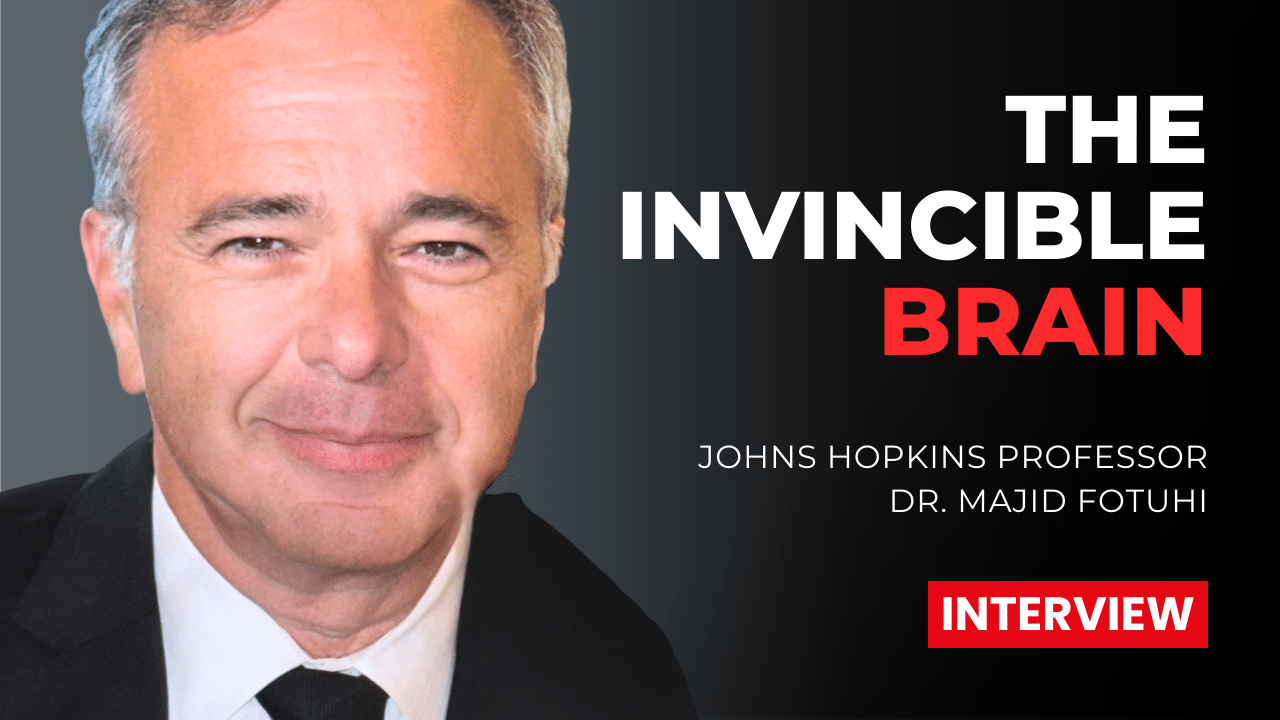
Dr. Majid Fotuhi, neurologist, neuroscientist, and adjunct professor at Johns Hopkins University, has spent decades studying how the brain ages and what determines whether cognitive performance declines or strengthens over time. In this discussion, he challenges one of the most widely accepted assumptions about aging: that deterioration of memory and thinking is inevitable. The evidence, he explains, points in a different direction. Cognitive health is strongly shaped by daily choices, and meaningful improvements can occur within weeks when those choices change.
Fotuhi organizes the science of cognitive resilience around five pillars: exercise, sleep, nutrition, stress management, and brain training. Each pillar affects the brain through measurable biological mechanisms. Exercise, for example, increases mitochondrial activity and stimulates the growth of new neurons in regions responsible for memory. Even modest activity matters. Walking several thousand steps daily has been associated with reduced markers of Alzheimer’s disease in the brain, while higher fitness levels correlate with stronger cognitive performance.
Sleep represents the second pillar. Consistent rest of seven to eight hours supports the brain’s ability to regulate stress hormones and maintain cognitive clarity. Persistent sleep disruption is often tied not to physiology but to unresolved concerns. Fotuhi notes that many professionals carry a large number of unresolved problems into the night. Creating clear plans for addressing those issues often reduces anxiety enough for normal sleep patterns to return.
Nutrition is the third pillar. Highly processed foods, particularly those containing trans fats, increase inflammation and are associated with smaller volumes in the hippocampus, the region of the brain responsible for memory. By contrast, a Mediterranean-style diet rich in fruits, vegetables, fish, and olive oil supports long-term brain health. Food, in this sense, functions as daily neurological input rather than simple fuel.
The fourth pillar is stress regulation. Chronic stress elevates cortisol, which can damage memory-related brain structures over time. Fotuhi emphasizes that much stress is generated internally through expectations and repeated negative thought patterns. Techniques such as cognitive behavioral therapy, meditation, and deliberate reframing help interrupt these cycles and allow the brain to operate in a more stable state.
The final pillar is brain training. Cognitive capacity strengthens when the brain is consistently challenged through activities that require learning and adaptation. Language study, music, strategic games, or complex physical skills all stimulate neural pathways. The key is sustained engagement in activities that are both demanding and enjoyable. The brain, like muscle, develops strength through repeated use.
Underlying these pillars is a broader insight about aging itself. Fotuhi argues that the second half of life can be a period of cognitive growth rather than decline if individuals adopt the habits that support brain health. The goal is not merely to avoid disease but to maintain clarity, memory, and mental energy well into later decades.
For senior professionals whose performance depends on sustained cognitive capacity, the implications are practical. The brain remains highly adaptable. With deliberate attention to exercise, sleep, diet, stress, and learning, cognitive capability can be preserved and, in many cases, strengthened over time.
Get Majid’s book, The Invincible Brain, here:
Here are some free gifts for you:
Overall Approach Used in Well-Managed Strategy Studies
Enjoying this episode?
Get access to sample advanced training episodes
Episode Transcript (Automatic):
Kris Safarova 00:47
welcome to the strategy skills podcast. I’m your host, Kris Safarova, and our podcast sponsor today is strategy training.com we have some gifts for you. You can get episode one of how to build a consulting practice at firms. Consulting.com forward slash build. You can also get the overall approach used in well managed strategy studies at firms consulting.com forward slash overall approach. And McKinsey and BCG winning resume, which is an actual resume that led to offers from both of those firms. And you can get it at firms consulting.com forward slash resume, PDF. And today, we are going to talk about one of the most important topics we can possibly talk about cognitive health. And we have with us Dr Majid futohi, who is MD, PhD, world renowned neurologist and adjunct professor at John Hopkins, who is redefining how they think about aging, intelligence and brain health, and in his new book The Invincible brain, Dr fatto, he reveals that in just 12 weeks, it’s possible to prevent and even reverse cognitive decline at any age. So I’m really looking forward to this discussion. Majid, welcome,
Dr. Majid Fotuhi 02:02
yes. Thank you very much for having our podcast. Really
Kris Safarova 02:04
appreciate it. What are some of the key things people generally don’t understand about cognitive health, and how can they maintain it and enhance it?
Dr. Majid Fotuhi 02:14
I think most people assume that with aging, their brain will decline and that there’s nothing they can do about it. Most people assume that cognitive decline is inevitable as you get older, and we now know that there are many things you could do to preserve your cognitive functions and even improve them. So let’s
Kris Safarova 02:35
talk about some of those things. Maybe. Let’s start from listing them, and then we can dive deeper into each Okay.
Dr. Majid Fotuhi 02:42
Well, I think that people need to keep in mind that there are five pillars of brain health, exercise, sleep, nutrition, stress management and brain training. Exercise is the most important thing you could do for your brain. When you exercise, you increase the number of mitochondria inside your cells, which provide more energy for them to function better. You increase the parts of the brain that are important for memory. You create new neurons in the parts of the brain for memory. Exercise is really the fountain of youth when it comes to the brain, that’s a no brainer. You really need to exercise, but then you have sleep, and sleep is very important. You need to get seven to eight hours of sleep. Unfortunately, in this part of the world, people work too much. They have so much anxiety, and not everybody gets there at least seven hours of sleep. However, I think people need to make that a priority. They really need to make an effort to go to bed at the same time and figure out what prevents them from getting good night’s sleep, and make sure they sleep at least seven hours. Next is nutrition. The food you eat makes a difference in the quality of your brain. When you eat junk food, things that are high in trans fats or high processed food, you increase the amount of inflammation in your brain, and that can cause difficulty with thinking, memory, problem solving, getting things done. So you really want to avoid junk food, and you want to try to eat a Mediterranean diet, basically a diet that is high in fruits and vegetables. You want to eat fish two three times a week, and you might drink plenty of water you want to use extra rich and olive oil, and really try to eat fresh food as much as possible, avoid boxed food and things that come in can send packages. Stress reduction is the next thing that is very important for brain health. When you stress, you increase levels of cortisol, which is a stress hormone and that can cause significant damage to your brain. So meditation, breathing exercises and changing of your mindset can make a difference on whether or not your brain is healthy. And finally, brain training is very important. Important you want to challenge your brain as much as possible. Every day, your brain is like a muscle, and the more you use it, the stronger it gets. So these are very simple things that people can do, and the secret that most people don’t appreciate that doing these things regularly and religiously for six weeks can make a difference in how well you feel, how well you function, and if you do it for 12 weeks, we can actually see increases in brain volume on MRIs. These interventions appear to be simple, but they’re powerful, definitely.
Kris Safarova 05:35
So let’s talk a little more about them. So exercise the questions that come up, of course. Okay, so what should I do? Should I go to the gym? Should I go for a run? What would you
Dr. Majid Fotuhi 05:46
recommend people need to do the kind of activity they enjoy doing, if you enjoy going for a run, or if you enjoy going to a gym and doing class exercises, or if you prefer to do weightlifting at home. Do it. It’s really not that different whether you do aerobic or weight training, both of them have been shown to improve cognitive function. When you do aerobic exercises, you increase your cardiac output, you increase the number of mitochondria on your brain, and you have a lot of health benefits. When you do weight training, you increase the amount of muscle you have in your limbs, and muscle seems to be a source of neuroprotective hormones when you exercise, especially when you do weight training, there are molecules called myokines that are released from the muscle reach the brain and seems to have protective properties in the brain. So ideal, ideally, you want to do a little bit of both. However, that should not prevent you from doing something. Going for a walk every day for half an hour is great. Simple walking 3000 to 5000 steps a day can actually reduce the footprints of Alzheimer’s disease in your brain. If you like, to go for a run. Even better, anything is better than nothing, and ideally, you want to exercise about three hours a week, if you could. You want to maintain a daily level of activity. You want to try to walk around as much as possible, and then you want to do three hours of exercise, maybe three one hour sessions throughout the week, and you can do 45 minutes of aerobic and then 15 minutes of weight training.
Kris Safarova 07:35
What are your thoughts on something like yoga?
Dr. Majid Fotuhi 07:38
Yes, you know, Yoga has many different shapes and forms, obviously, and when you do yoga, you increase your flexibility, and I think that is a very good thing to do, however, if you’re just doing stretching exercises and do different yoga poses, that really accounts more for mindset stress reduction, reducing cortisol levels in your brain and calming your mind, not so much as physical activity, because you really are not exerting yourself that much. I think the minimum amount of exercise is for 20 minutes of something that gets your heart rate up a little bit you want to get to the point of huffing and puffing like you want to feel a little exercise. And if you’re doing yoga or tai chi, that’s are a series of stretching exercises and postures without really getting your heart rate up a little bit. It’s still a good thing to do, but it won’t go in their pocket for exercise. This is what I
Kris Safarova 08:42
wanted to confirm. So I’m so glad you mentioned the heart rate. Can someone overdo exercise?
Dr. Majid Fotuhi 08:49
Yes, that’s a good point. I think you want to be fit. There is a measure of fitness called vo two Max. You go on an exercise machine. They put a mask on your face to measure the amount of oxygen and carbon dioxide, and they ask you to pedal as hard as you can. After 20 minutes or 30 minutes, they keep increasing the resistance of the pedal so it’s harder to keep going. And then comes a moment that you can’t push any further. And that peak is called vo two Max, the maximum amount of oxygen you can use at peak exercise. VO two Max is an indication of how fit you are. And there are tables for standards of fitness in men and women different age groups, for example, in someone between ages of 60 and 65 the good vo two Max is like 3035 and then optimal vo two Max is 35 to 40. And I know mine is 40, so I know where I am, and I am trying to keep it at that. Level for women is slightly lower, but again, it’s standardized. You want to measure your VO two Max, and these days, many smart watches can give you your VO two Max, just find it on different options, and it’s already been recorded, so you have it in your smart watch already. Now some people exercise, like, 10 hours a week. I think the benefits of exercise are the most for people who are doing nothing and they do something. So if you do nothing at all, and you go for 10 minute walks, you see a huge benefit. If you go for a half an hour watch, oh, my god, great benefit. But if you go from one hour exercise to two hours exercise, the benefit may be 5% and if you go from two hours exercise to like six hours exercise, there’s no evidence that the benefits would quadruple. The benefits seem to plateau. There are benefits, obviously, for endurance, you want to be have endurance. And some people like, I do long distance biking. Sometimes I do it for fun of it. I don’t do it because I have to or that I am required to. I do it because I enjoy doing it. In general, three hours of exercise is the sweet spot for most people. If you want to do a little bit more, like I probably do more than that. I do about an hour and a half, three or four times a week, but I think I enjoy doing it. It should not be a chore. People need to pick an exercise they enjoy doing. That’s the most important thing. It could be dancing. Could be bowling. It could be going for a hike, skiing, tennis, pickleball, there are so many things it could do. In my book, I made a list of like 30 things that people can
Kris Safarova 11:48
consider Majid. And would you say that going for a walk increases your heart rate enough to consider it an exercise?
Dr. Majid Fotuhi 11:57
Yes, again, anything is better than nothing, and some exercise has significant benefits. And there are at least five studies that I know which have shown people who walk anywhere between 3000 steps a day to 10,000 steps a day reduce the footprints of Alzheimer’s disease in the brain. It actually reduces the amyloid that’s the marker of Alzheimer’s disease in the brain. And people who walk 10,000 steps a day, that’s a lot of walking. You know, somebody whose job it requires a lot of walking would walk 10,000 steps a day, they reduce the risk of Alzheimer’s disease by 50% so exercise, the weight bearing activity you carry your weight. So even though you walk for, let’s say, 2030, minutes, it’s not the same thing as you know when you sit at something and you exercise because you’re sitting, one of the advantages of walking is as a weight bearing exercise, and it’s surprising that you know an hour of walking, it’s a simple walking your neighborhood can have profound benefits for your brain, even if you don’t get to the point of huffing and puffing,
Kris Safarova 13:07
but you will still recommend getting to huffing and puffing.
Dr. Majid Fotuhi 13:10
That’s what I do. Yes, you want to increase if you want to be really serious about it, there are two ways to look at it. You want to be casual, like, Ah, I want to have a better brain, but I’m good anyway. Or, look, this is a high priority for me. I want to have a tip top brain. The same goes with your body. You can say, Look, I have I’m okay shape. I want to keep it like that. Or you want to say, look, I want to be in tip top athletic shape. You know, the interventions would be different. So when it comes to brain health, if you want to just maintain good brain health and slow down the effects of aging in your brain, you just can go for walks, and it works very well. But if you say, Listen, I want to be mental athlete. I want to be super sharp. I want to be so sharp that I can memorize long lists. I can be quick. In that case, exercise is a very important intervention, and you want to measure your VO two Max, and then bring your VO two max on top of the range for you. So for example, if you’re 55 year old woman, their optimal vo two Max may be 25 to 30 and you measure your two Max, and you’re not there, and then you try to do things that increase your endurance, your stamina. That means that you probably do need to go for a brisk walk, or maybe should go for a jog, or you should go on a treadmill, or you should go on peloton, or you should, you know, go a rowing machine. You really want to push yourself to increase your VO two Max, your VO two Max will not go up with just a walk in the park.
Kris Safarova 14:48
And are there any dangers for your brain if you push too hard? So we discussed how your returns getting less and less if you’re exercising already for six hours a week and. You add another four hours on top of it, you’re not going to get much more in terms of returns. But let’s say you are really pushing yourself very hard. At some point, you push yourself to a point that it is bad for your brain.
Dr. Majid Fotuhi 15:13
No, to my knowledge, there is no evidence that excessive exercise, like people do a marathon or do Iron Man will have any harms to their brains. There’s no evidence that the benefits would be cumulative. It’s not linear. It’s not like the more you do, the better will be for your brain. There comes a point where you reach a plateau. Look at your muscles, for example, you can work out. You can lift 50 pounds, 10 100 pounds, 120, pounds. Out there, 50 pounds, and your muscles bulge, but at some point they’re not going to be like how it is huge. At some point is toned. Your muscles are toned, but they’re not three times as big as it would be if you just sit exercise for one hour and your brain is in same situation where the benefits increase, but at some point it’s not linear, plateaus, very helpful.
Kris Safarova 16:13
Thank you so much. Last question on exercise, at least so far, what is your exercise of choice for yourself? Yes, I
Dr. Majid Fotuhi 16:20
usually, as I mentioned, I exercise three or four times a week. I have a peloton machine at home, so I exercise. I do a biking for one hour, and then I do 45 minutes of weight training, exercises, and I don’t do huge weights either. Some videos on YouTube that I watch, and they’re mostly body weight, like doing push ups and sit ups and, you know, lunges and things like that. I I don’t go to extremes. Every when the weather is nice, I go for long bike rides. I enjoy going to nature and biking for 60 miles, 80 miles, sometimes 100 miles is like a score for six to eight, sometimes eight hours, I just go to nature, lose myself in nature, and I love it these days, a little chilly around here, so I don’t get to do it. Thank you.
Kris Safarova 17:14
Eight hours that takes a lot of stamina to bike for eight hours, that is amazing.
Dr. Majid Fotuhi 17:19
I think once you built your stamina, then it’s not that hard. And I don’t do it thinking I’m exercising. I’m just having fun in the nature. I’m just biking, and I’m not really I do pause for lunch for half an hour. I break for lunch, and along the way, I may have like, five minute, 10 minute breaks that I drink some water, but I love it. It’s nature is beautiful. And I’m actually not that tired, because I go on my own pace. I don’t I’m not racing the whole time. I’m going at my own pace. I enjoy listening to birds and seeing the deers and watching, you know, just animals around, and it’s so relaxing. I love it.
Kris Safarova 18:01
Of course, I understand definitely. Let’s talk about sleep. I think this one is very important, because with all the other things, people feel they have it under control. If they wanted to, they could improve nutrition. If they wanted to, they could exercise more. But with sleep, many people feel that they cannot really control it, because they cannot fall asleep,
Dr. Majid Fotuhi 18:21
you’re right. Well, like there, like anything else, there’s always solution for problems. You know, this is not a unique problem, it’s a very common problem, and there are solutions for it. In my book, I have a whole chapter about all the things that can cause sleep problems and all the solutions for it, but let’s talk about some main things. One of the main reasons people can’t fall asleep is because they have too many things on their mind. They’re worrying about mortgages. They’re worrying about the contracts that they have to sign, about children having issues, about marital issues, family issues. And the solution to that is you need to sort things out. You can’t have a lot of loose ends in your brain. You need to take ownership of your problems. You have to have a plan. See as a doctor, I see patients. When a patient comes, it gives me all their problems. I make a list of priorities, and we make an action plan. For example, a person has obesity, diabetes, hypertension, Insomnia, Sleep Apnea, centered lifestyle, stress problems and a poor diet, all of those things. And then I sit with them, and I said, For this, we’re going to do this. And for each one of them, we have an action plan. Then I say in the first three weeks, we’re going to work on your walking. So during that time, we’re not going to worry about sleep. We’re not going to be able to do everything at once. So so they work on their walking for a few weeks, and. Then we try to increase it from five minutes a day to 10 minutes a day, to half an hour a day to 45 minutes a day. That’s the goal. Once they get there, say, Okay, now let’s talk about your food choices. We educate them with the food choices. And then we talk about no. When you see chocolate, you can eat it. Chocolate is good for you, but when you see donut, you should not eat it. Donut, it spikes your sugar level, has high levels of trans fats, has zero nutritional value for you. Don’t eat donuts. Don’t, not once ever think of it as smoking. Don’t. So for three weeks, we work on education, about diet, and then, you know, we could talk about stress reduction and so forth. So if you have trouble falling asleep, and there’s a lot of things in your life, you just sit down, write them down, type them in on on a app you like, and set priorities and realize that a lot of things just have to wait, and that, you know what? Most things don’t matter that much. They say a kid is not studying. Of course, as a parent, you think, My God, my kids are studying. They’re not going to get good college. The future is ruined. Well, not really. Life will go on, and you don’t have to really, you know, worry about it that much it will work out. Let’s work on issue number one, but if that is a priority, then look back to see what things have worked in the past, what things have worked for other people. Let’s have plan of action where we look at three things. Let’s say I need negotiate and give a reward for every a so you get $100 every time you have an A. See that works. If it doesn’t work, we go to the punishment route. You know, every time you know you don’t do well, we’re going to take your phone for four hours from you see what happens. But the point is, in your mind, you have an action plan. In your mind, you have a system of how you’re going to handle the thing that’s keeping you up at night, and that allows you to have peace of mind and fall asleep. That applies to mortgages, to relationships, to everything else. So number one reason for people having difficulty falling asleep or waking up in the middle night is anxiety and stress, and as I said, you need to own your problems and have an action plan that helps a lot. The idea that helps is meditation or just doing slow breathing exercises. Another option is to just read a book. Now, scrolling on your phone does not help falling asleep. You really need to get a book, either, you know, an audible book, or a book on screen or actual hard copy paperback book, but I mean that one that really helps people fall asleep. I mean, I will always fall asleep if I read a book. I mean, this is incredible, how you can your arms just go to sleep. Point is, there are solutions for these problems, and these days, there’s abundance of problems. Cannot GDP like, tell me, this is my problems. What are the solutions? You know, the sleeping problems have many solutions and many causes. For some people, it’s caffeine. They may not know that the soda they had with dinner had caffeine in it. Or, you know, maybe they ate too much. Sometimes spicy food can help. I don’t really recommend supplements for sleeping. However, there are herbal teas chamomile and other herbal teas that help. Magnesium helps. Most important thing is to have the right mindset. And of course, the other thing can happen, and sometimes people are not physically tired. If your body and your brain are not physically tired, then your body is not really ready to sleep. Now, physically means you’ve gone to the gym, you’ve walked a lot, or you walked around the house, you cleaned the house, you did the dishes, and also mental workup. You know, when I do my work on my desk for four or five hours in the evening, I’m tired. My brain is tired. I just fall asleep. So you’re right. Sleep is not something that we have that much control, because we just have to let go and for this to happen. It’s not the same thing as having control on how many minutes you exercise, but our physiology is built around sleeping, and we need to understand what is preventing us from sleeping, eliminate those and provide the environment that will allow us to fall asleep.
Kris Safarova 25:00
I heard from a few people that they use alcohol to fall asleep. What are your thoughts on that
Dr. Majid Fotuhi 25:06
I’m not a fan of alcohol. Alcohol at small amounts used to be considered safe and even protective for the brain. Over the past five years, we’ve learned that even a small amount of alcohol seems to be detrimental for the brain. Studies have shown that even one or two drinks a day can reduce the brain volume just a little bit over many decades. However, I think if you’re exercising, you’re eating right, you’re meditating. You do everything right, and you really want to enjoy your glass of wine. Just go ahead and enjoy it. Don’t, let Don’t, don’t, don’t with no don’t prevent yourself from enjoying life with the concern that that little alcohol would affect your brain in the future. It definitely does not help with sleep. You may fall asleep, but then you wake up in the middle of night. In general, it’s better to avoid alcohol as much as possible. I drink alcohol myself on occasional weekends that we go to social gatherings, I should have one or two drinks just social gatherings. I don’t drink at home, I will definitely not recommend it for sleeping purposes. It’s definitely bad for sleep.
Kris Safarova 26:26
I’m also not a fan. 100% agree with you. What would you recommend to someone who is struggling with sleep because they see nightmares?
Dr. Majid Fotuhi 26:35
That’s complicated, that’s complicated. I think it will be helpful for them to see a sleep specialist. It could be related to unresolved stressful situations, even childhood trauma. And I have had patients who had nightmares and really affected the quality of their life, and they dreaded falling asleep because they didn’t want to have the nightmares. However, that’s a rare condition. It’s not that common, and seeing a sleep specialist helps us.
Kris Safarova 27:13
What do we need to share regarding nutrition on top of what he already shared?
Dr. Majid Fotuhi 27:18
Yes, food is like medicine. You know, just to think of it, you put all these things in your mouth, and they go to your GI tract, and they find it a way in the bloodstream, and they go to everywhere, including your brain, your heart, your kidney, your Liver, your skin, everywhere. So food is really medicine. However, if you have food that contain molecules that are harmful for the brain, then you’re harming your brain. And a common molecule found in junk food that affect the brain are trans fats. These are a form of fat that is usually made in factories to help food stay on the shelves for a longer period of time. So somebody is selling a muffin, and they want to sell it and put in a Walmart shelf, and they wanted to stay in the shelf for a month. Instead of going bad in a week, they add trans fats to those muffins, which will help them stay on the shelf for a longer period of time. And those trans fats increase inflammation in their brain, and they also shrink the brain. People have higher levels of trans fats in the brain. Have a smaller part of the brain for memory, called hippocampus. So junk food harms the brain significantly, and if you want to have a healthy brain, step number one is to minimize junk food. Don’t eat french fries, cookies, ice cream, Donut chips. If there’s no nutritional value and it’s not fresh, try to avoid them. Now you know, you go to a party and everybody’s watching the football, and there is some chips. Okay, you can have some chips, but don’t make a habit of having cookies all day or having donuts or or muffins all day, or, you know, things that are clearly sugary or have high trans fats or highly processed food are harmful for your eyes, for your skin, for your brain, for your heart, for everything. Because it’s not just the brain that’s affected. All our body parts will be affected, and that’s something we do have control over. Now, there’s a thing about addiction. People who eat sugary food, they’re addicted to the sugar component of, let’s say, sweetened sodas, the sugary sodas cause addiction because of the sugar triggers the reward parts of the brain. And when you don’t have enough, you get withdrawal symptoms, which makes you go and seek more of the coke or other sugary so that you’re having so be more. Mindful of the fact that you may be addicted to certain food and be stronger to avoid them.
Kris Safarova 30:08
Makes a lot of sense. Are there types of foods where most people think it’s good for you, but it’s actually very bad for you, especially for your brain, or inclusion for your brain?
Dr. Majid Fotuhi 30:18
I can’t think of any food that you should really avoid, even though it sounds to be good, fruits and vegetables are good for you now, sometimes there are some fruits that can increase your sugar levels quickly, like I love watermelon. I love watermelon. I love the taste of it. You know, some real cold watermelon and a hot summer day, and I love it. And I would sometimes sit and eat a whole bowl of watermelon, and I loved it, and I learned that actually watermelon has a high sugar content. Even those are the natural food, it does increase the sugar level. So I dread knowing that. I wish I didn’t know that it ruined my enjoyment. So now I still eat a lot of water melon, but instead of eating in the whole bowl, I’ll have like a quarter of a bowl. I really don’t finish the whole bowl, because I know that I’m otherwise doing everything right, like I have done all my things right? And I’m not going to, you know, deprive myself of the pleasure of, you know, enjoying this watermelon that I love so much. So, you know, some natural fruits do have a high sugar content. And you want to be mindful that just because something is healthy doesn’t mean you can eat five pounds of it. You know, you can’t say you like kiwi, or you’re like watermelon, or, you know, honeydew or something. You can’t just eat, you know, a lot of it at once. You’re still putting a lot of sugar in your body. Other than that, I think as long as you have a reasonable, balanced diet, you’re fine. There’s no secret thing that people think it’s good, but
Kris Safarova 32:05
it’s really not good. Jason, how much water do you think we need? Or, you know, how much we need? So let us know.
Dr. Majid Fotuhi 32:11
I think you should drink when you’re thirsty. Some people overdo it. I think many people don’t drink enough. You should have a glass of water here and there throughout the day, and you should maintain hydration, but your body tells you how much water you need. Like, you know, if I go for a long bike ride, I drink a lot because I know I can’t wait for my body to tell me I’m thirsty I need to sort of pre hydrate when I get on my on my bike. So in general, I think you should drink water when you’re thirsty, and also have occasional glass of water here and there. You can’t be really obsessed that you’re not getting enough water. I don’t think it’s necessary to walk around with a bottle of water everywhere and keep drinking water throughout the day, because the water drinking you’re just gonna urinate. It’s not gonna stay in your body. Your kidney carefully regulates how much water you need, how much sodium, how much potassium, much magnesium need to stay in your body, and any variation gets corrected by the kidney. So if you drink a lot of water, you’re just making your kidney work more to excrete all that extra water. So you need to be reasonable and drink five, six cups of water a day as you’re thirsty. But don’t force yourself to drink extra unless you’re doing something like a marathon or a long bike ride or you’re going to exercise class. You know you’re going to sweat a lot. The bottom line and a lot of things, is it turns out that taking care of your brain does not require extreme interventions. A lot of reasonable things can have a huge difference in your brain health. So a little bit of exercise, you know, getting your sleep right, being reasonable, what you do, they can, they all can help.
Kris Safarova 34:03
And when you say five, six cups of water, would you say that tea does not count?
Dr. Majid Fotuhi 34:09
Yes, because tea and coffee can actually increase urination, which means that whatever you had will be urine, you know, we’ll go in a toilet and at the end. So in general, that five, six cups a day does not include to your coffee you
Kris Safarova 34:26
drink, makes sense. Yes, I knew that, but I wanted to double check for all our listeners and to make sure we have it so everyone knows. So let’s talk about stress reduction. And then I wanted to start with you probably also have patients who went through traumatic experiences, especially in early childhood, and that impacted development of the brain and how the brain functions, and that also impacts the level of stress they feel and how much they can handle before body goes into a state where it really. Is stressed to a high degree. What would be your recommendation to our listeners who had such background when it comes to protecting their brain and enhancing cognitive abilities?
Dr. Majid Fotuhi 35:11
Yes, stress can be a source of brain shrinkage. High levels of stress increase levels of cortisol, and cortisol is toxic to this part of brain for memory, called hippocampus, mindset makes a huge difference on your daily experiences. If you repeat that, when I was a child, somebody treated me poorly, and ever since, I’m not the same, and you repeat that thought, it’s called repetitive negative thought that reinforces increase of cortisol and reinforces the thought. So the more you think about it, the more you repeat it, the more you are stuck in repeating it. Your brain has a high degree of malleability. Your brain can change a lot. So for example, when you learn to play the piano, when you practice the piano, you are reinforcing pathways involved in coordinating your hand eye coordination. When you have learned how to play basketball and you learn how to throw the ball just right, you’re enhancing the strength of connections that are important for hand eye coordination. So your brain is not fixed. Your brain is constantly changing at a very small level, but nevertheless, at the level that we can see on MRIs. So after three months of exercise, after three months of learning the piano, there will be measurable changes on MRI. After three months of learning how to play golf or any other sport, there are measurable changes in your brain. Similarly, when you have a negative thought and you repeat it and you repeat it and you repeat it, you’re reinforcing those negative Pathways because the brain doesn’t make a distinction between good and the bad. Your brain makes it utilizes you repeated something, and those pathways are getting stronger. So that’s why it becomes more difficult when somebody has had a thought since childhood, or they had a bad childhood experience, and those thoughts get repeated. For so many decades, those thoughts have been repeated and have become a part of their life. The good news is that they can change. They can put a stop on those thoughts. It’s not easy. It requires what’s called cognitive behavioral therapy. Some people surprisingly snap out of it. There are people who have one session with a therapist and they say, Oh, my God, I wasted 30 years of my life going over a thought that really doesn’t help me, to think that my mother abused me, or my father was rude to me, or if only I had lived in a different city, or we shouldn’t have come to this part of the world, or I should have lived separately. All of those things don’t help you. Now, the past is past. The future is not here. You need to enjoy the moment. Some people actually have an aha moment and snap out of it. But in most cases, a cognitive behavior therapy session can be very helpful, and psychologists and therapists have experienced in this can really help patients free themselves. Are these negative thoughts?
Kris Safarova 38:36
As I heard very good things about behavioral therapy. So let’s talk about, generally stress reduction. How can we manage stress, especially given what’s happening now and for all our listeners, we have very driven successful people who have a lot of obligations, responsibilities and a lot of stress in their lives.
Dr. Majid Fotuhi 38:54
Stress is self generated. People often forget that the stress they perceive is perception, not reality. For example, you expect to reach certain milestones in what you have set for yourself, in your in your career, you decide to have this, any clients or you have so you decided you’re going to make this much money in three months or six months or so forth, and you have financial obligations based on those things. In reality, you have created those stresses for you. There is really nothing that’s real. Don’t think that’s real. If there’s a fire in the house, there’s a snowstorm outside, child is really sick and has cancer or something. Those are real stresses where it’s not your perceiving it, but your perception of you know, why should. Didn’t things happen the way you want them to happen is your problem. You know, for example, if somebody is chewing next to me and the chewing sound is bothering me, well, it’s up to me to be bothered or not. They shouldn’t be doing that. That’s correct, but I have the choice of stress about it or not stress about it. You know, it may sound simple, but it’s really profound, and it’s very true. It is very true that your stresses are self generated. You make most of the things that are stressful yourself and it really helps to pause and set priorities as to what things are important. And one of the things that happens a lot in in United States is that people are busy. They have a lot of work to do. You know, you have to go to work, they come home, they have to pick up the kids on the way, they have to prepare the meal, they have to take care of all the bills, and they have all the social obligations. A lot of people in midlife have parents or older, and they have issues, and the kids have issues. And of course, co workers are not always nice, and so it’s a lot. And the way to look at it is, well, you created this life. You know, maybe you don’t have to take the kids in four different classes. You know, if you don’t have time, maybe they should not be on a piano lesson, on a soccer team and also be a part of the band. If you don’t have the time, you signed up for them. You are the one who initiated it, so it’s your problem, and okay, now it’s a problem. Deal with it, but for next semester, don’t do it again. You will not be a worst parent in the world if your kids don’t go to five six different classes, or if you really think that’s a priority, then maybe you should work two days a week and spend more time at home. See the Real the expectations are unrealistic that you want to have a full time job and you want to be a full time mom or a full time dad and you want to be able to attend to your social gatherings. In some ways, when you look at someone says, Oh, my God, I have so much work to do. They’re telling you about their failure to manage their time. And you know, there are lots of people who, when you talk to they seem to have a lot of time, all the time. They seem to be relaxed. They seem to be fine. And it’s not like they’re lucky. Some of them may be lucky, but most of them are not just lucky. They decided to manage their time. The other thing that people don’t do in this part of world is that they don’t allow a buffer for things to go wrong. There’s no buffer for the kid to be sick and you stay home. People are pushing themselves to the minute. They work till five, they go to the gym. At 515 they go home at 730 dinner is 745 and it is such a tight schedule, there is no room for the traffic to interfere with their schedule, or their mom decide to come visit them, or something else to happen. Bottom line is this, there is in my book I talk about 30 different types of intelligence. Intelligence is not just math and physics and logic and processing speed. Intelligence is a broad term that covers all our our cognitive capacities, our ability to read, write, type, drive, do our taxes, do our works. These are all cognitive abilities and so people. Some people are innately good in some things and not other things. Like some people are just good with music. Some people are just good with math or with numbers. Some people are just good with memory. So those called innate intelligence, and they’re acquired intelligence, where you become good at something, and our brain has the capacity to become good at something. One of the 30 different types of intelligence that I describe in my book is a lifestyle intelligence, which means you know that exercise and diet and sleep and meditation are good for you. How successful have you been in leading a life that has allowed you to do all those five pillars of brain health? And if you’re doing it, you have what I call lifestyle intelligence, because there’s no question these days that these things are good for you. Nobody has said, you know, exercise straight, not that important. Nobody says that. And it’s I’m not the first person. And nobody says, eat what you want. It doesn’t matter. Matter. I mean, people know these things. There have been enough of the scientific evidence for these things that people don’t question what I call the five pillars of brain health. So if you’re doing it and you seem to make it easy, that you seem to be in good shape, and you’re exercising, you’re eating it good for you, you get a start label for your what I call lifestyle intelligence. And if you don’t have that lifestyle intelligence, then figure it out. Look at some people who seem to be doing it. Learn from them and gradually change it. All of those things will help you to have less stress and feel more in control of life in general, you want to be in control of life instead of feeling that you’re chasing things, that you’re always just keeping your head about the water. See, a lot of people have that sensation that they’re sinking and they’re just keeping their head about the water with all the things are around them. And eliminating source of stress is one of the best ways for you to feel you’re on top of the world, that you’re in control. And you have some extra time. You have some extra time to help people. You have some extra time just do nothing at all. You just want to sit and do nothing. You know, it’s actually a good thing to be bored once in a while. And you know, so you can decide how much you want to cut on your social media time, which is usually not the productive, useful time spent on your phone. And instead of that, go for a walk with your kid, for example. Very good advice.
Kris Safarova 46:33
And let’s cover brain training to make sure we wrap it up. And I think this one is where people will know the least about how they could improve that area. What would you recommend?
Dr. Majid Fotuhi 46:44
Your brain is like a muscle, and the more you use it, the stronger it gets. The important point is how you use it and the choices you make. You want to pick challenging activities that are fun if you decide to do crossword puzzles and you hate them or don’t do them, you know you need to enjoy the process. We’re talking about exercise. How you pick something that you like and you make that your form of exercise. Same thing goes with brain exercises you want to do stucco or portal or taking dance lessons or taking music classes to learn a new language. Again, I have a whole list of things at the end of each chapter, about 30 different things people can do, but take something that resonates with you that when you’re doing it, it’s not a chore. For example, I like learning languages. So, you know, I know few languages, and every once in a while, I practice them and I enjoy it. I know it’s good for me because I want to improve my French, for example. So it’s good for me, it’s useful, and it counts as my brain training box. You know, in my in my head, I think of these buckets of the five pillars of brain health, and every day, I try to put something in that bucket. So with exercise bucket, you know, I don’t force myself, if I don’t feel like exercising, I may just do a little bit, or I may do it in afternoon, or may I do it next day? And so that’s my exercise bucket. And then for a food bucket, that’s easy. I just don’t eat junk food, and I don’t eat too much, and I don’t buy bad food. So our fridge never contains any sodas or junk food, period. And I’m, I’m always tired. I always fall asleep. I don’t have a problem with sleep. And then I do some breathing exercises during the day, and I, my sister was quite low, and I do something for Brain Training. And so it’s, it’s not that complicated. So you’re not that complicated to incorporate these factors of brain health and have a state of mind where you’re in control of life, everything’s okay, and you’re just smooth sailing in life.
Kris Safarova 49:11
Such an incredible discussion. Anything else you wish that I asked you and I
Dr. Majid Fotuhi 49:16
didn’t, I think the most important thing for people is to change their mindset about aging. They need to stop thinking that aging means becoming frail. When I go to like long run, bike runs, or sometimes I do a triathlon, and I see that people who are 30 years older than me are just keeping up with me. I love it. I tell myself, I want to be like them. I want to be in my 80s and early 90s and be jogging and running and doing things and writing books and, you know, to all that things. And so I would like people to have that mind switch. Kris to start looking at the second half of life as a new beginning, as a time where you flourish and blossom and you enjoy life.
Kris Safarova 50:09
Last question, my favorite question to ask over your entire lifetime so far, what were two, three aha moments, realizations that really changed the way you look at life or the way you look at business?
Dr. Majid Fotuhi 50:22
Yeah, I remember I was a kid. I was probably seven years old. It was summer day and a weekend, and my father and I were in a backyard, a small little garden, and and we’re just playing around with planting some please. And my father was something. I’m just sitting next to him on my knees, playing with soil and, and he said something about everyone is the architect of his own life. And I said, What do you mean? So? Well, you build the life that you want, but you build it. You can’t blame other people. You are the architect of your life. I remember like my hands were filled with soil, and I’m just playing with these things. And I thought building a house that I am building the house and what kind of house I want to build, and if it’s my future, what kind of future I want to build? And I felt like, oh, so I better have good foundations. And if I’m the architect in my life, I want to build a beautiful house, a beautiful life. And that really was an aha moment that I realized. So I built the life that I want. It’s not like people build a life for me. And you know, when I was 13 or 14 years old, I wrote a book about seven secrets to becoming successful as a kid. You know, back then I wrote this book was never published, but I wrote it anyway, and I sort of searched the literature back then. I went to library and I looked at quotations from Thomas Edison, John F Kennedy, Gandhi, other famous people, as how they became successful and what they were doing and what was, what did they say about what their secret was, which was, often feel passionate about what you do. Be persistent. Have a sense of purpose. Be kind, be generous, don’t give up and things like that. But I wrote it, and that really built the foundation of the life that I went on to build
Kris Safarova 52:35
that is incredible. Thank you so much. I really enjoyed the discussion today. Thank you for being here,
Dr. Majid Fotuhi 52:40
yes, yes. Kris, thank you very much for inviting me. Of course.
Kris Safarova 52:45
Where can our listeners learn more about you? Buy your book, anything you want to share.
Dr. Majid Fotuhi 52:49
I have a website. There’s Dr futuhi.com D, R, F as in Frank O, T as in Tom, U, H, I, Dr futuhi.com Also, I have social media posts on Instagram and Tiktok and LinkedIn, Facebook, and if people put just the invincible brain.com it will also take them to My website. I’m working on an online course that contains information. And I’m also working on an app so people who type my last name, they will find a lot of resources to look for.
Kris Safarova 53:31
Thank you. Thank you, Majid. Our guest today was Dr Majid fattohi, his book is the invincible brain, and our sponsor today for the podcast is strategy training.com and we have some gifts for you. You can access episode one of how to build a consulting practice at firms, consulting.com forward slash build. You can get the overall approach used in well managed strategy studies at firms, consulting.com forward slash overall approach, and you can get McKinsey and BCG Binion resume example, which is an actual resume that led to offers from both of those firms. And you can get it at firms consulting.com forward slash resume PDF, and that template works for any seniority level. Thank you very much for tuning in, and I’m looking forward to connect with you all next time.
Leave a Reply