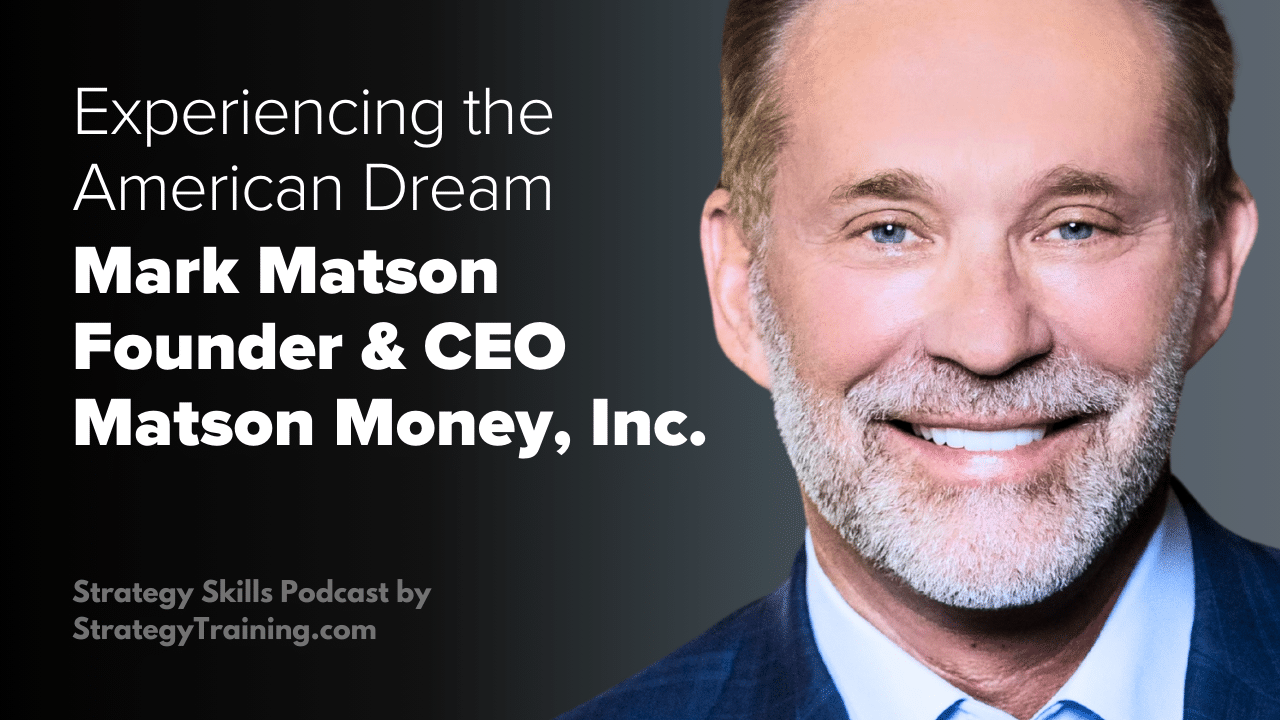
What if the financial advice you trust is actually hurting your future? Mark Matson believes it is — and he has the data to prove it.
In this episode, I sit down with Mark Matson, founder of Matson Money and a pioneer in the evidence-based investing movement. With over $9 billion in assets under management, Mark has helped thousands of families and advisors break free from Wall Street myths, media-driven panic, and the illusion of market timing.
But Mark didn’t start in finance. In fact, he nearly gave up on the entire industry — until a few key realizations (and one powerful idea from a Nobel Laureate) reshaped his approach to wealth entirely.
We talk about:
- The dangerous psychology behind most investing decisions — and how to fix it
- Why traditional financial advice often fails to deliver real value
- What Wall Street doesn’t want you to understand about your money
- The importance of storytelling in transforming investor behavior
- Why “doing nothing” is sometimes the smartest move in volatile markets
Mark also shares how he trains financial advisors to become coaches — not salespeople — and why aligning your portfolio with purpose is key to long-term success.
Whether you’re an investor, advisor, or entrepreneur, this conversation will change how you think about money — and what it really means to grow wealth with integrity and intention.
I hope you will enjoy this episode.
Kris Safarova
Mark Matson is an American entrepreneur, author, and innovator in the fields of investing science and financial education. He is the creator of educational experiences, platforms, and tools that make Nobel Prize winning investing research accessible to investors and transform their relationship to money. Most notably, he is the creator of The American Dream Experience and the Matson Method.
Get Mark’s book here:
Here are some free gifts for you:
Overall Approach Used in Well-Managed Strategy Studies
Enjoying this episode?
Get access to sample advanced training episodes
Episode Transcript:
Kris Safarova 00:45
Welcome to the Strategy Skills podcast. I’m your host, Kris Safarova. And our podcast sponsor today is StrategyTraining.com. If you want to strengthen your strategy skills, you can get the Overall Approach Used in Well-Managed Strategy Studies. It’s a free download. And you can get it at firmsconsulting.com/overallapproach. You can also get McKinsey and BCG-winning resume, which is a resume that got offers from both of those firms. And you can get it at firmsconsulting.com/resumepdf. And the last gift from me for today is a copy of a book we co-authored with some of our listeners, some of our clients. And you can get it at firmsconsulting.com/gift. And today we have with us Mark Matson, who is the CEO of Matson Money, which he built from $0 to over $10.6 billion in assets under management. Mark, welcome.
Mark Matson 01:44
Thank you. It’s great to be with you today.
Kris Safarova 01:47
So incredible journey so far. If you go back to the early days, what do you think were some of the critical things you have done that resulted in the business becoming successful?
Mark Matson 01:59
Yeah, well, I think with the first thing that I did to help the business be successful was that I had a shift in the way that I always wanted to be like my dad, and he was an insurance agent, a financial planner, did investments and such. So when I went to school, I took I got a degree in finance and degree in accounting, I went to work with him, and within a relatively short period of time, about three years, I discovered how broken the investing industry really was. You know, we would tell our clients this money managers beat the market for 20 years, you should put your money there, and this partnership is going to make you 15% put money there and and within a very short period of time, it was obvious that the money managers we were using, no matter how long of a period they beat the market, were underperforming the market after we started putting our clients money in them. And when I brought this to the attention of the broker dealer I worked for, they didn’t care. They said, What’s your problem? Just sell them something new and earn a new commission. And it became, I found out early on that stock picking and market timing and track record investing, what most people do with their money is actually gambling and speculating. And I just it just was like a gut punch, and I knew that I couldn’t do that to my clients or and we were investing the money our own money the same way. So I went to school. I went to University of Chicago, I went to find the academics that were doing groundbreaking research on how money in the markets really worked. And I left behind the broker dealer world of speculating and gambling and took on academic investing principles. And when I started the company, I had this, I had a yellow pad, and I had an overhead projector, and that was all I had, and 30, $30,000 in debt. And that started my journey with when I was 27 years old.
Kris Safarova 03:56
Mark, how did you think about the initial client acquisition? Because at the time, you didn’t have the credibility the brand.
Mark Matson 04:03
Yeah, so I had, my dad always told me, when you don’t have credibility, borrow it. And I knew at 27 years old, it was going to be difficult to move billions of dollars of assets from large, huge broker dealers that seemingly have the credibility. So the first 100 million dollars, I had clients of my own. And so the first 100 million dollars were basically my own clients. And then after that, then I started going out and meeting with other financial advisors and showing them how broken the industry really was. And then the very first meeting I ever did was in Worcester, Ohio, in an advisors living room for about 12 people. So I would do these workshops, you know, like Jerry Maguire in the in the living room with and that’s how I started off. And it just was one client at a time. Them one family at a time, showing them the academic investing principles versus what they were doing, and that’s how and that’s how it all started.
Kris Safarova 05:09
And do you remember how you were getting those initial meetings?
Mark Matson 05:13
Yeah, it was kind of like I viewed myself as a truth teller as Okay, here’s the industry. The industry is broken. The the bullies of the industry have control, and they’re hurting investors. So I viewed myself as I still do today, as a person who’s standing up for the investor, telling them the truth and protecting them from the toxic investments of the of the of the investing world. And that’s that’s the positioning. That was the positioning. Then I wrote the book experiencing the American dream, and inside of that, I talk about the bullies in Wall Street and how they hurt investors, and how to protect yourself from them. I also viewed it as most Investment Advisors want to keep their clients in the dark. They want to make it overly complicated. They don’t want to spend a lot of time educating them. They want to make it seem so difficult that only they can do it. And it leaves the investors feeling very unsettled, very little. I mean, look at right now. You got the s, p, year to date down 10% you got NASDAQ stocks, which most people have a lot of a lot of down 16% year to date. People are panicking. They’re afraid. The tariffs are making them afraid. They’re afraid of you. Currency going down in the United States. So in these periods of fear, great fear and apprehension that people are taken advantage of, and they tend to do really, really disastrous things with their portfolios. So standing up against the the industry and standing up against the bullies, that’s the positioning, and that’s what that’s what we do.
Kris Safarova 06:56
Do you remember some of the most challenging experiences during those early days, but most difficult?
Mark Matson 07:04
Yeah, so one of the things I was really wrong about, I thought at 27 I thought once people, financial advisors, investment professionals, and then investors found out the truth about investing that they would there would be this grand renaissance that people would stop gambling. They’d stop speculating, that that, you know, maybe my business model only had 10 years, you know, to go before people, you know, got on board and figured it out for themselves. But what I was the thing that I was wrong about more than anything else in the last 30 years is that never happened. Is a matter of fact, there’s more speculating and gambling and destruction and toxic investing now than there was was even 34 years ago. And the reason is because even when you know something, that doesn’t mean you’re going to do it. I mean, you can know how to lose weight but still eat a pizza and not exercise or cheesecake. So knowing something doesn’t ensure that you’re going to do it. So knowing the rules of investing doesn’t mean you’re going to follow them. And then there’s so many more toxic investment alternatives now, like, you know, options and commodities and Bitcoin and crypto currencies and 1500 ETFs, 99% of them no one should actually own. So there’s it’s more toxic. And with this, you can gamble and speculate with your money on websites you know, like Robin Hood, the same, same way you would gamble with Draft Kings. So the technologies made it so hard for people to be disciplined. I think that’s the number one thing. And when we had $300 million I had three invest three advisors came to me and said, Look, if you don’t give us, all US investments, because we’re internationally diversified. If you don’t just dump it all in the US, because five US had had good five year run, then we’re going to pull the money. I said, Well, that’s gambling and market timing, because you’re trying to guess what’s going to happen next to the market. And they said, We don’t care. We still want it, and if you don’t do it, we’re going to pull our money. I said, Well, you’re going to have to pull the money, because I’m not You’re not going to force me into gambling with your clients money. I’m not going to do it. And that was a big way awakening for me, because it took me 10 years to get probably the first 300 million under management, and then we lost a third of it like that, just overnight. And that was one of my first biggest challenges.
Kris Safarova 09:40
That is very rare for someone to really stand up for what they believe, even if it means making a giant step back in terms of your business development journey.
Mark Matson 09:49
I couldn’t remember. It was probably two in the morning. I got up and I got my spreadsheet out. I was like, Okay, how much revenue am I going to lose? And it was going to be about 600,000 Dollars a year in revenue I was going to lose. And I knew I was like, this is this is my value add. Is the discipline. So like, right now, when the US is down International, International is up like 7% and fixed income is up and tech stocks are down 16% so what we do is rebalance. We sell the things that are up relatively and then buy the things that are down. And it’s the exact opposite of what everybody else does. They they tend to buy more of the things that are up and sell the things that are down. And that’s an it’s a very difficult discipline to follow. Everybody says they want to do it, and then very few people actually ever do it?
Kris Safarova 10:41
Yes, those things can be scary. And there are so many, many reasons during those early days, What mistakes did you make that you feel really derailed the business in some way?
Mark Matson 10:55
Yeah, the biggest mistake I made really early on is I underestimated. So there’s two pieces of how to invest and grow your money and fulfill in your American dream. The first is you got to get the investing part right. And there’s hard science and math and three things called Modern Portfolio Theory, efficient market theory and the five factor model. Don’t expect anybody to know that. They can look it up on the internet if they want to, but those are academic investing principles developed over the last 60 years in academia with very few people know anything about even financial professionals. But there’s the strategy of how you build the portfolio. And if I figured, if I educated people on that math and science, then they would be able to stay disciplined for 30 years and do the right thing. But what I what I underestimated, to your question, is I underestimated the power of the human mind to derail everything. So, for example, there are over 180 biases that the human brain makes, and we all do it around money, and those destroy the models. So for example, one of those is hurting bias as human beings, with everybody’s buying Apple, everybody’s buying meta, everybody’s buying the video, everybody’s talking about it. They’re talking about on the news. They’re talking about it on podcasts. They’re talking about it, you know, with their buddies playing golf or, you know, you know, going to Napa Valley and while they’re having wine tour. I mean, they’re talking about what they’re buying. And as human beings, we like to follow the herd, and herding is great for zebra, but it’s terrible for investors, and that’s how people lose so much money. Another one is recency bias, which means that whatever did good in the last three or four years, everybody’s only looking at that, and they’re not looking at 60 years of data and anything that lost money in the last year or two, everybody’s looking at that, and that’s all they’re looking confirmation bias means that once you have something in your head, like I want to buy something or sell something, you turn on TV, and you start watching the news or looking on the internet, and then information that supports your instincts and your emotions, you highly value that and discount the things that are against what you say, The what you want to do, but that’s only three of 180 so you’ve got your instincts, you’ve got your emotions, you’ve got your biases, and even if you know how to build the perfect pie, pie to fulfill on your future, the human brain is not Designed for discipline and long term investing, because it’s because the idea of investing only really is about 100 years old. Markets are only about 100 to 200 years old, but human beings have been around for 10s of 1000s of years, so our brains just haven’t developed yet to be able to handle it. So you have to coach people on how they’re to think about how they think, and to be suspicious of their own thoughts, and then to use coaching and training to offset their emotions and their instincts and their biases. And that’s been, that’s been the key breakthrough, I think, that we’ve, we’ve created as a way to educate and train people not to follow their brain, not to get derailed, not to panic, not to chase, and that’s that’s a very human thing, and that’s why I don’t I think that technology like AI might help you eventually kind of look at how to build a model, but it will never, ever, ever Help with the human side of investing, because there’s always going to be a button on your screen right next to the prudent button called speculate and gamble, and soon as you hit that button, you’re back off to the races again, and AI is not going to control for that only human beings can.
Kris Safarova 14:55
And to take step back again a little bit, because I feel we need to explore a little more that. Point when you decided you know what it can be done differently, and I can do it better, and clients deserve better. So how did you educate yourself during that period? How did you decide what you’re going to do differently?
Mark Matson 15:15
Yeah, so the first thing that I did was I I taught myself to be very suspicious. Of my own instincts and emotions, seeing that left to your own devices with my dad always taught me one of the greatest things you can be as coachable, and that’s why I’ve tried to build into my kids and the people I coach so most people think they’re coachable. Very few people really are. My son plays baseball, right? I’m like, you don’t have to be the fastest, you don’t have to be the strongest. What you have to do if you really want to see skinny is you have to be the most coachable. And that means that when your coach tells you to do something, do it. Number two is eliminate the Yeah, but yeah, but I don’t want to do that or Yeah, but I don’t want to learn a new way to swing. And then number three is do it even if you don’t understand. And furthermore, do it even if you disagree. You find somebody in the world that’s gotten the response and the results you want in life. And then you get them to be your coach, your trainer, your consultant, and then you do what they say, because they’ve already accomplished what you want to accomplish, and eliminate your own garbage and noise and your resistance to doing the right thing. So what I did is I got Eugene Fauci, Nobel Prize winner in economics from University of Chicago. Dr art laffer, economist had helped Ronald Reagan engineer his the recovery in the Reagan years. Dr Harry markowit, Nobel Prize winner from also from the University of Chicago. So I went out and got these brain scientists and these economists and mathematician and statistics people, and put them together to form a mastermind, if you will. And then, and then I do what they say to do, and I eliminate my own little petty instincts and emotions in the process. And then I teach people to be coach to the best of my ability. I teach people to be coachable, which is not an easy task.
Kris Safarova 17:27
Very interesting. And you personally worked with them?
Mark Matson 17:31
Yeah, yeah. I’ve worked with Dr Heyer Markowitz and Dr Fauci, Dr David Eagleman at Stanford University. He’s a neuroscientist. I’ve also talked to them, consulted with him about when I wrote the book, and I’ve been working with them off and on and taking coaching in their research for the last 34 years. And that’s how I keep myself disciplined. And if I don’t hear it from them, then I don’t do it, and it’s a very hard thing to do, even people that do the research end up speculating and gambling with their money, because the human urge to do it is just so strong.
Kris Safarova 18:13
For those of our listeners who are paying attention right now and thinking, You know what, I’m in my field, I also know we can do it differently. And I also want to go to top people, top thinkers, and see what can be done differently. Can you give any advice? How did you approach them? How did you convince them, in a way, to work with you?
Mark Matson 18:33
I’ve done a lot of podcasts. That’s the first time I’ve had that question. That’s a great question, because there was a lot of pushback. Because I was 27 years old, I remember hearing a debate between Rick sinfeld, who was an academic, and Donald yachtman, who was an active gambler and speculator ran a mutual fund. And this was when I was 27 and after the speech, I just knew that I had to use academics and not broker broke. What’s being, you know, thrown around at these broker dealer conventions. And I went up to Dan Wheeler, who worked for the this academic company, and I said, I want, I want to work with you guys. I want you to teach me. I want you to show me. And he said, You’re too young is you’re only 20, you look like you’re in your 20s. And I only work with people that are for in their 40s or above, because they’ve made the mistakes and they can actually accept the truth. And I said, Look, I don’t need another you know, 13 years of making them these mistakes, I want to stop solve this right now. And then I used my dad. My dad was, of course, he was in his 40s at the time, early 50s. I said, Well, you should come talk to my dad, I said, and so he got in the plane, and he came to Cincinnati, where we lived at the time, and we spent like, three hours together. I said, I don’t need I said, I see the science. I see the math. I. I don’t need another 13 years of destroying my clients wealth to accept the truth and then just just persistency, just because there was no there was no money. So we would go out and we would, we would fly to these different advisors home offices. We’d we’d go see them in their offices and try to show them the academics versus what they were doing. And it was, it was tough. It was really, really tough at first, and then I asked Rex sinfeld and David booth, who the booth Business School is named after at University of Chicago, I asked him to be on my academic board. And I said, Look, you know, I’m young, I’m aggressive, I’ll work really hard, and we’ll go out there and we’ll change the world. And I put billions of dollars of assets on for you guys. And there was some skepticism, but they didn’t really have much to lose at the time, so they said, Okay, we’ll support you. Let’s go. But it was tough. I think the other thing is, over the years, those relationships have gotten better, and they’ve gotten better because they’ve actually watched what I say and what I do, and they and they, I build up a lot of credibility with them, because everything that I say that I do, I actually do, and if I don’t do it, I stop saying it. No one’s gonna be perfect, but cleaning things up if they go wrong, and then staying disciplined. And that goes a long way the older I get. I’m 61 now I really value loyalty and commitment and the strength of relationships. And I think in today’s modern world with technology, I think that gets undervalued a lot. Everyone’s looking for the next software, the next AI, the next email drip system that that’s going to make them rich. And I think they’ve lost touch ever, especially ever since COVID, with the human, the human realities and how powerful real relationships can be.
Kris Safarova 22:09
Thank you so much for sharing this. And do you have any advice on maintaining the relationships? Because I get a sense that you are incredible at that.
Mark Matson 22:20
In the book, I talk about the American dream, and that it’s still available to everyone about innovation, creativity, freedom. You know, America’s not perfect, but no place is perfect. We get to have this great conversation today, because we live in a country where we can freely express ourselves, and we don’t have to agree with each other on everything, but we have this great, this great freedom, the freedom of speech, the freedom of creativity, the freedom of self expression, the freedom of religion, the freedom to own a company, the freedom to try and fail. There’s no conversation like this going on in Russia right now, there’s no conversation going on in Venezuela like this, or China or Cuba or Iran. This is the greatest country on the face of the planet, and we live in the greatest time. I know some people would doubt that, but we have just 100 years ago, you didn’t really have anesthesia for surgery. You had no artificial hips. You had no heart valves. You had, I mean, you could literally just get an infection and no no, no antibiotics, you can cut get a little scratch on your leg, and they’d have to cut your leg off and you die. I mean, it’s just, we live in such a great time if you can’t be happy. Now in America, you just can’t be happy because it’s the greatest. There’s miracles every day around all around us. So I try to teach, you know, my employees and my advisors, I work with our clients, the beauty of the American dream, but it takes hard work. And I tell them, if you want your American dream, there’s the surest way to help you get your American dream is to help other people get theirs. And if you have enough, you help enough people to get their American dream, you will automatically get your American dream. And that one of the key, you know, the key concepts in the book.
Kris Safarova 24:22
This is actually what I do with my life. I agree with everything you’re saying about the incredible country we live in and how blessed we are, and I think that we should never take it for granted and agree with you that the more value we bring to other people, the faster we can build our own American dream.
Mark Matson 24:40
That’s very cool. It’s emotional, isn’t it? Yes, because it’s the emotion.
Kris Safarova 24:45
It’s so cool. It is so cool, I agree. And as I was saying, I love the background of your studio. I think that really perfect right now is fall for what we’re talking about. So coming back to relationships, to dive a little deeper. So you you started those three relationships at 27. How did you maintain them through all these years?
Mark Matson 25:07
Relationships, and this is why technology is great, but technology also separates human beings from human beings. So one of the things that I’ve done is I’ve created workshops and training to reinforce relationships. So it’s very unusual in this space of investing, because most people think of investing as just one person talking to another person, say, Here’s your portfolio, or maybe just doing it yourself at home or whatever. But what we’ve discovered is that you actually can learn more, retain more, grow more, see more if you’re being taught and educated in groups, because you can learn from each other, you can share with each other. And that’s why I call it the you know, the American Dream experience is because we have a two day training program, and then once you do that training program, then you have ongoing training. You know, for life, we have a series of educational workshops that advisors use with their clients. And I view it as constant content. You got to constantly be meeting with people, talking with people, experimenting with people, sharing with people. Look, it’s not just business. It’s it’s life. So no matter what business you’re in, you hit, I think it’s critical to be aware of what your clients and customers are dealing with. They’re not just numbers or asses and seats. In our industry, it’s asses and seats and, you know, buying units, and it’s so degrading. These are people so your clients, I mean, they’re dealing with life, and life can be really hard. They find out their wife’s got cancer, they’ve, you know, their child, kid, has to go into rehab. They lose a job. They have to deal with, you know, Alzheimer’s, or they have to deal with, you know, one of their kids getting divorced, or they’re getting divorced, and there’s just so much chaos in life, pain and suffering. And to see people as people, not just as customers that could buy from you, but real people that you want to be involved with and really, truly help, and be there, even not as a therapist, but as a friend, when things like that happen, and they can tell, people can tell, by the way, they can tell when you’re there, you’re they’re getting bullshitted, and when somebody actually really cares about them, and you can’t teach that either you’re a caring, loving person or you’re not. And so, you know, some people might say, I just want to listen to a podcast and make me some money. Well, I find out that those kind of people, in the long run, don’t make the most money. It’s the people that actually love and care about their clients that make money.
Kris Safarova 28:00
That is very true. Yes, if you do something with love, you put a lot of attention, time, effort and love, you cannot fail.
Mark Matson 28:07
We say we have a thing about our purpose at teaching the class is to create freedom, fulfillment and love. And I think people are a little bit shocked, and I’ve told them, yeah, I said that. I said love, you know, because money, money can really be a source of of pain and suffering for people, because it creates jealousy, can create animosity, can create fear. Money. Having a lot of money for a family doesn’t necessarily mean it brings the family together. Having a lot of money in the family can actually tear and rip families apart. I think a lot of people are shocked by that a little bit initially, but money brings a lot of responsibilities and a lot of challenges and a lot of jealousies within families. When you own a small when business, well, it’s not small anymore, but it was small. When you own a business, you have children. A lot of them want to go work for you. Maybe, well, you might hire them initially, but they don’t do a good job, so you got to fire them. I’ve had to fire my own kids multiple times. That creates stress and anxiety in the inside of the family, but you got to do the best thing for your clients and the best thing for your business, and you can’t have nepotism in a company, and won’t work for those of you that have kids.
Kris Safarova 29:35
Very true, and it’s a very common issue with hiring your family members, and they’re not doing a good job not caring. And over time, you realize it’s just easier to help financially.
Mark Matson 29:50
Yeah, I’ve had to do that too eventually. You know, my kids are older now, right? So I had to turn off the spigot on some of them. And. Say you got to go out and do your own thing. Now. You really need to grow up here, stop depending on daddy and mommy. But yeah, money can hurt. Money can tear families apart, especially they say two things more than anything else, cause divorces. One is money, and the other one we probably don’t need to talk about, but those things rip families apart.
Kris Safarova 30:26
Let’s talk about client retention. What is your approach to that?
Mark Matson 30:30
Well, the first thing for people to understand is it’s much, much more profitable to maintain an existing client than it is to go out and get a new one. I don’t know the exact number is, it’s five or 10 times more expensive to get a new one. I guess it’s probably different, but in each and every industry, about what that number actually is, but it’s much easier. You know, when we did, when we used to do commissions, it was a it was like being on a hamster wheel, right? Because you’d sell a commission, you meet 50 new families a year, but then you’d have to meet another new 50, and then another new 50 and another new 50. So you never got off that. You know that that treadmill when, when we work on, we work on fees, not commissions, so it’s a small, very, small percentage of the assets that we manage. Now you can focus more of your time on servicing and relationships and helping people with issues in their life, and training and coaching them, because you’re not out there trying to hunt down new new money every day, and then you can really be there for everybody, but you got, you know, back to that, things that we talked about, you have to really care about people. I you know, part of what we do is sales training and for the advisors we coach. And I was telling, you know, guys, stop trying to sell people stuff, and start trying to have relationships there. Well, how do we do marketing? I said, well, first of all, stop thinking of the marketing. Secondly is go out there in the world and meet people. My dad told me, because my dad, because he’s a great coach and great teacher, and he’s still around. He’s 85 years old, and he said, Look, you in this business, you got to go out there and be of service. So he would say he used to wake us up when we were eight years old on Sundays, like, at five in the morning, and I’m like, where are we going? He’s like, we’re going to church. I said, Okay, well, we don’t, we didn’t usually go to church. That wasn’t my family’s thing back then. I said, Why are we going to church? He said, we’re going to do a pancake breakfast. I said, What? What? He said, Well, it’s for charity. We’re going to go, we’re going to make pancakes and sausage, and then people are going to come, and then we’re going to they’re going to buy it, and then we’re going to give the money to kids that have cancer. Oh, okay, let’s go make pancakes. And later, he told me, because he got a lot of clients from working with the Kiwanis and different social charities, but he said, I never once used it to market. What I did was I took all the jobs that nobody else wanted to take, like getting up at five in the morning, go cook the pancakes. And people around me would go, Wow, man, you really you work hard. You really are great. You really are helping the kids. And they’d go, what do you do for a living? He’d never tell him. He’d always make him ask him, right? And he just showed up and he let people see how committed he word was to helping people. And from there, it would just centers of influence and different associations and, you know, and it would grow that way. I think that’s undervalued today, because most of my new, new people I meet, they want a magic email, they want the magic Instagram posts. They want, you know, the magic reel on Facebook. They they don’t want to go out in the real world. And I think, I think we’ve gotten soft since COVID. I think human beings, it seems like the service has gone down, the quality has gone down, the prices have gone up, and the personal attention and the personal relationships have diminished, and I’m not sure that we’ve recovered from that yet, as a society, which is an opportunity for anyone that’s really willing to do it, to get out there in the world.
Kris Safarova 34:24
Mark, what is your approach to incorporating current technology, like AI into your business?
Mark Matson 34:30
Yeah, well, you got to do it. So if you look, because we are in the middle of a seismic change, and it’s hard, anytime you have such a seismic change, it’s hard to tell what’s going to happen. Remember, literally, when I started the company, it was a overhead projector in the yellow pad. We didn’t have email. I remember when our clients bought us, when we added it, what we don’t want an email. We didn’t have smartphones, we didn’t have the internet. We didn’t have 24k 24/7 cable channels. We didn’t have podcasts, we didn’t have I mean, none of the technology that we have that. I mean, it was like in the dark ages, right? So as all this new technology comes on, you have to figure out how to integrate it into your company. You can’t ignore it. So I tell our client, our our employees, we got to reinvent ourselves every three years now, our values and our morals and our and what we do to help people don’t doesn’t change, but how we do it changes, and we have to innovate it and make it better, because if we don’t innovate it and make it better, we’re going to end up like Blockbuster. When Netflix went to Blockbuster to ask them to buy them out for $50 million the CEO of Netflix said, No, we’re not in that business, and you’re not real competition, so we’re not buying you out. And then, of course, Netflix destroyed blockbuster, and there’s none left today. So change is brutal. So there’s two things. There’s AI, which itself is Game Change, obviously. And number two is quantum quantum computing. A modern day computer is a million times faster than the human brain. A quantum computer is a million times faster than a modern day computer. So you can imagine, if you take AI and then you take quantum computing, you put those together, you’re going to have all kinds of massive change in the world that’s unpredictable. So what you have? So as an entrepreneur, I ask myself, what can I provide that no matter what the technology changes, that’s at the human level that that AI and quantum computing or a robot can’t change, molten can’t change, and I think for us, it’s the human nature of the relationship and the coach ability. I don’t foresee a time when a Super Bowl team is going to be coached by a robot. I think that’s a human endeavor. And while we need technology, we’ll use technology. We’ll implement technology. We have to find ways that the human experience supersedes the technology piece of it, and that that’s our challenge. Use it, but don’t allow it to destroy the human element of what we do.
Kris Safarova 37:23
We spoke about education as part of your approach. How did you integrate education into your business without creating friction, and what are some of the challenges that you you had to deal with?
Mark Matson 37:36
Oh, yeah, yeah. It created friction. It still creates friction to this day. Look, people are lazy. Most people are lazy. You know, I you know the book I wrote, throw me one of those books real quick. The book I wrote is 360 pages, right? Well, most people won’t read a book I asked my dad when I was 10 years old, he came to him, and he said, Mark, if you want to learn anything in the world, there’s probably a book already about it. And he handed me this book called Think and Grow Rich. And I looked at it, I’m saying, Well, wait a minute, this book says Think and Grow Rich. So why doesn’t everybody read the book and then do what it says on the book and get rich. He said, Well, there’s two problems. Number one, most people are lazy and they won’t read it. He said, second problem is, even the people that read it again, they’re lazy and they’re not going to actually do what it says to do in the book. But almost anything you want to accomplish in life, could you have me one of those, books, almost anything you want to accomplish in life, you can get from a book and from a consultant and a trainer, but you gotta, but you gotta hustle. Thanks. So this is, this is experiencing the American dream, six time shameless plug, six time national bestseller. This was Think and Grow Rich that my dad gave me when I was 10 years old. But you have to actually do what’s in the book, and that’s where the friction comes is actually doing what it actually says to do in the book or in the training course, oh, two days to learn about money and investing and getting trained and getting developed. I tell people, Look, the best thing you can get from my book, or any book, is not hints and tips. Everybody wants hints and tips. Give me a hint on how to do this a little better. Give me a tip of how to do this a little better. Well, if it was, if hints and tips would work, then everybody would be 4% body fat and making ten million a year. It doesn’t work, and have great relationships. Hints and tips don’t work. Hard work works, dedication and commitment works. But most people will read or go to a coach or go to a consultant, and then they this is. The really twisted part of it, they’ll make a commitment. I want to get in shape. I want to make a million dollars. I want my own company. I want I want to educate a group of 1000 people in a room. And then, once they start getting into it, they see how hard it is, and then they become a victim of their own commitment and start to Aesop. Called it sour grapes. Oh, I didn’t really want it anyway. I didn’t really want to be in shape. I didn’t really want to have that great relationship. I didn’t really want to teach that class. That’s too you know, I’m going to go over here and do this. I didn’t really have that. I didn’t really want that. So then you’re they’re going to have excuses, or you’re going to have results one or the other. And most people settle for excuses, reasons why they couldn’t do it or didn’t it didn’t happen. And that’s an education is, whether it’s education on how to build a business, how to raise kids, how to have a great marriage, how to be a leader. The best investment you can make is in yourself. I always tell people in your own personal self development, so focus on that. The rest of the stuff is going to come. But most people are not interested in fundamentally changing how they see the world so that they can get better results in life. And those are, those are extremely rare and powerful people, and they normally become leaders. But as a leader, you’re either exalted or you’re you’re hated. So and the more successful you become, the more hate you will take on. So you can’t the criticism, the naysayers, the haters you gotta you gotta shut that out and and focus on only the people that want what you have to offer that will value what value your your your value proposition, and then you have to protect. You have to protect what you created. You have intellectual property, you have relationships. You gotta, you gotta protect that because they’re because when you become successful, everyone will attack the space that you created. That’s capitalism, and that’s okay. That’s what it’s supposed to be. But, but you, but I view it as almost a form of war, because you’re competing for employees, you’re competing for clients, you’re competing for market, and there are people out there in the world who’s real, who are competing to put you out of business, and they don’t care if you lose your house, they don’t care if your kids can’t go to college. They don’t care if you have to fire your employees. So this is serious. This is just a serious stuff.
Kris Safarova 42:49
Very true. Mark, if you are open to sharing, I wonder if you could share with us. How do you stay up to date on what’s happening in the world? How do you educate yourself? How do you continuously learn so you stay up to date and grow?
Mark Matson 43:04
This is, this is a great question. I think it’s critical to constantly learn about the world and constantly study. I’m a huge reader, so I read things that are going on the world today. I read history that happened 5000 years ago. I recently read a book by Hanson about the end of everything, about a history of the major Carthage and Athens and war and power and politics. And very instructive. So I constantly read. I stay up to date. I have consultants like, I’m going to meet with Steve Moore here, a little bit of economists who have a great relationship. We’ll be going to talk about tariffs and things that are going on in the world. Dr art laffer, who is very connected with President Trump and very connected with what’s going on in the world. But in addition to something I think most people miss, is you also want to stay up with pop culture. You want to know what’s you know. You want to know about Yellowstone. You want to know about 1923 you want to know about white lotus. You want to know you want to know the mind and the state so you can relate to people. And I think most people underplay paying attention to what’s going on the world is universal. Building a new part in the park. What’s happening to Snow White versus the King of Kings movie? What’s happening? Because it’s all part of the human experience, and people spend a lot of time in pop culture, whether it’s Instagram, whether it’s this podcast, or whether it’s meta, you want to stay connected, because if you don’t, you lose touch, and you don’t want to be isolated and lose touch with what’s going on in the world, it’s a very dangerous place for a leader.
Kris Safarova 44:56
That is very true. And I also want to ask you my favorite. Question, just to make sure we have enough time for it over the last few years, but can also be over your entire lifetime. What were two, three aha moments, realizations that really changed the way you look at life or the way you look at business?
Mark Matson 45:16
Yeah, so about 15 years ago, I was diagnosed with I had a CAT scan because I was having trouble breathing, and they did a CAT scan, and they found my aorta, that’s the main artery coming off the heart, and it pumps blood this way, and it goes up, and then it goes back down, and it feeds your whole body. So my aorta, where all the blood runs through to feed your whole body, was too big. It was like 44 millimeters. It should be about 33 and the doctor said, We’ll watch it. We’ll do a CAT scan every year. We’ll see what happens. You could just been born that way, but if it’s growing, we’re gonna have to do something about it. So every year I’d have a CAT scan. Two years ago, it finally got up to 51 millimeters, and he said, Oh, all right, if we don’t fix this, it could bust you’ll bleed into your chest, and you’ll be dead in about three minutes. Like, okay, well, let’s not do that. So, so what? So I went in for surgery, and it was open heart. They had to split me down the middle, open everything up. And what they did is they cut out a little, about an inch and a half piece of the aorta, and they replaced it, literally, with a piece of hose. Literally hose now, but to do that, they had to put me i, which I didn’t know until that day, that it was going to happen. I should have known they had to stop my heart and they had to stop my lungs, so I was literally dead for 16 minutes, and then they brought me back after they did the repair that changed the way I looked at everything. And everybody knows that life is limited. But when you go through something where you could actually lose your life in a second, it gives you urgency and focus that your time on the planet is not limitless. It ends. It ends. And it made really clear to me the value of purpose. That’s one of the things in the book, is that creating a purpose for life and money that’s greater than money itself and it and it also showed me that Pain is pain isn’t just so it took, because it took a long time to heal. Pain isn’t give me empathy for people in pain, because pain is not something that just happens in it’s gone 10 minutes, and you can move on. Sometimes it’s chronic, and sometimes it lasts years, and sometimes it never goes away at all, and you die. And it just gave me a lot of empathy and urgency to build better relationships, to really use the time I have here on this planet for a purpose greater. It strengthened my faith in God, because I was literally God. I some I’ve been asked a lot, well, when you were dead, what did you see? And I didn’t see anything. I said, it would have been cool, though I could have wrote a book 16 minutes in heaven. That would have been probably a best seller, but, but I guess it wasn’t my time, so I didn’t see anything that I remember, but relationships and love in in closeness with people, it elevated that feeling for me, so that that’s that’s probably the most traumatic and the most life impacting thing that I’ve had here in the last four or five years.
Kris Safarova 48:50
I’m so glad that you’re okay.
Mark Matson 48:53
Thank you. Thank you. The miracle is that once they repair it, you’re better than new so no heart damage and no, you know, no other problems. It’s really a miracle. Also made me very grateful for the book for modern medicine. I mean, to be able to go in and stop your heart and make you dead for 16 minutes and bring you back to life. I mean, that’s, that’s incredible stuff. So really, really grateful.
Kris Safarova 49:16
And I’m grateful as well to them, because I think the world mean to you. And what you wanted to say? Thank you. So you just wrote a book. What do you want people to take away some of the key things from your book.
Mark Matson 49:29
The subtitle is, how to create, how to how to invest your time, energy and money to create an extraordinary life. Most books are either kind of a personal development book or an investing book or a memoir book. What I did would, which was pretty aggressive, pretty pretty abnormal, actually, is I took investing. I took. Personal Development, and how I grew my business and memoir storage from my life, and I integrated him, and I did that at the advice of Rob Lowe, the actor. We’ve been friends for a number of years. And I wrote the first introduction to the book, and I sent it to him, and I thought, wow, he’s going to really love this. And it was a rainy day in Cincinnati. I was there. It was cold, wet snow. I was there to see my mom, who was in the hospital. And Rob called me, and I said, Hey, buddy, what do you think about it? He said, I don’t like it. What do you mean I like it? I said, everybody I showed likes it. He says, No, this isn’t it. He said, what you want to do is you want to start your story in West Virginia, where you were born. And you want to start your story with your dad and your grandpa and the abject poverty that they went through and how your dad saw the world versus how your grandpa saw the world. And you want to tell your family story about how, how your dad got you out of there and taught you the American dream, and then how you use the American dream to help people. And then you want to keep that family saga running throughout the whole the whole book. And I had a writing coach, and I called him and I said, Dude, you know, Rob’s like, so I took, like, a month of writing and threw it away and started over, and a month later, I had the what’s the introduction is now? And I sent it back to rob, and he said, dude. He said, this is, this is a book worth reading. He said. I said, Well, would you write the forward to it? And he said, You know what? I will write the forward to it. So that was a big honor. But I want people to get that there’s amazing things possible. You can live the American dream no matter your race, your gender, your religion, your politics, your you know that that we have more that unite us than really separate us, if we’ll just, you know, try to be more human with people, and that it’s in a great time to innovate and create value, and there’s miracles All around us and and to have a purpose for money in life that’s greater than money itself, because if you don’t, then money just becomes a means to its own in and that’s a very destructive thing. I call it the the destructive cycle of wealth and and money can’t make you happy. As a matter of fact, money is often a source of unhappiness, and you don’t have to look far, people like Howard, Hughes, Marilyn, Monroe, Elvis Presley, Prince, John Baluchi, all these, the list goes on, of all these people that had all the money, had all the power, had all the fame, and not not. Not only did it not make them happy, it destroyed them. So you have to have a purpose for life and money that’s bigger than money, and that’s what I hope people can get from the book.
Kris Safarova 53:13
I agree 100% if you could instill one belief in every listener’s heart, what would it be?
Mark Matson 53:23
It would be that there’s a God? I spent most of my life being an atheist, until my 30s, my late 30s and and I discovered that trying to run my life on my own led to a lot of destruction and pain and fear and arrogance, and it didn’t work, and it led my life down a very, very dark path of of anguish and depression. And I had a buddy of mine, you know, that said, Well, are you done? I said, done what? He said, done. Trying to run your life on your own. Yeah, I’m done. I can’t do this. And so from that moment on, I said a prayer with him. He said it with me, because I didn’t know how to pray. And but after in one second, everything changed. I went from a screen of no god to a screen of there is a God, and I’m going to follow him and his his Savior, and not recruiting here, I’m just saying what works for me, and it changed everything. And today I have a great marriage and a great business and great relationships. And do I have problems? Sure, I do all the time. But I can pray with my kids at night, and we can go to sleep, and we can know that we have a higher power, and that there’s, there’s a life after this one. So it helps me live a better life now, and it helps me, I think, going to live a better, a better existence in the in the afterlife. So. That’s what I would do. I know it’s not a business thing, but it’s just a personal thing.
Kris Safarova 55:05
Thank you so much. Thank you. You are incredible. You are a blessing to everyone in your life. I can see that, and I’m so glad that the world got your book now and got to hear from you more, because you’re now on podcasts, and I’m looking forward to learning more from you as well.
Mark Matson 55:23
Thank you very much. Thanks for having me. Was a very kind of emotional, uplifting kind of talk with you. Thank you for those great questions. That’s one of the strategies in the book. By the way, ask a good question, and you asked a ton of them. It was great.
Kris Safarova 55:38
Thank you, Mark. Where can our listeners learn more about you? Buy your book? Anything you want to share?
Mark Matson 55:43
Yeah, you can get my book Experiencing the American Dream. You can get it on Amazon. You can also get it on Audible. If you’re not a reader. I that was another decision I made. The publishers were like, we’ll get an actor to read the book. And I said, No, I spent 40 hours in a booth over a period of several weeks, cranking it out. So that’s me on the book, if you want to listen to it in my own words. And then it’s, you know, I’m fun to telling people, Look, if you believe in the American dream and it’s made a difference in your life, study it, learn it, and then pass it on to your children and your grandchildren. Because if you don’t, the American Dream is only one generation from dying, because you’re not born with the American dream, it has to be taught, and it’s our responsibility, the people that believe in it, to pass it on to the next generation. And that’s another reason that, you know, my my son is a 12 years old Gage, and he gave it to his one of his teachers, and said, Here’s my book my dad wrote. And teachers like, Oh, I love this book, you know. So we’re going to put it in the library at school. So I wrote it for families so that they could learn it, read, read it, and come closer together and and it’s been helping people humbly say that. So if you believe in the American dream, you want to share it with your family, it’s a great place to start.
Kris Safarova 57:18
Thank you again, Mark. Our guest today, again has been Mark Matson. Check out his book. It’s called Experiencing the American Dream. And our podcast sponsor today is StrategyTraining.com. If you want to strengthen your Strategy Skills, you can get the Overall Approach Used in Well-Managed Strategy Studies. It’s a free download, and you can get it at firmsconsulting.com/overallapproach. You can also get McKinsey and BCG-winning resume, which is a resume that got offers from both of those firms. And you can get it at firmsconsulting.com/resumePDF. And you can also get a copy of a book we co-authored with some of our listeners, some of our clients, and it is called Nine Leaders in Action, and you can get it at firmsconsulting.com/gift. Thank you so much for tuning in, and I’m looking forward to connect with you all next time.
Leave a Reply