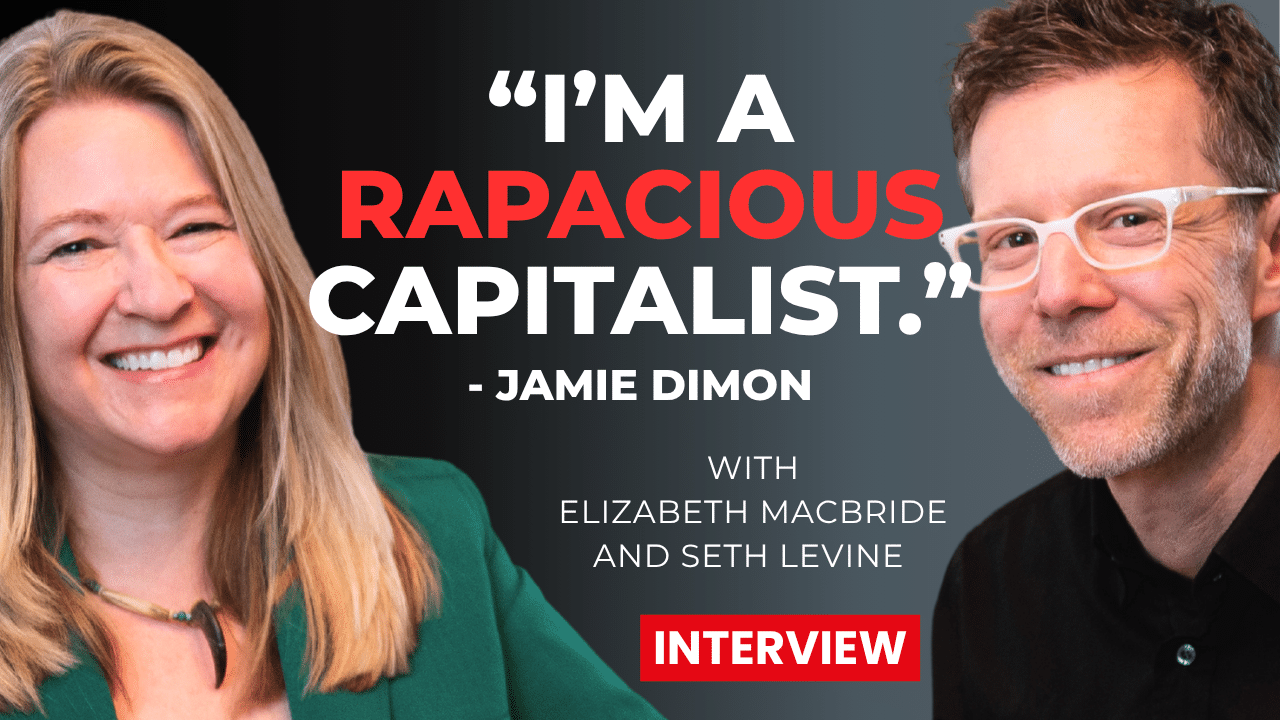
In this must-watch episode, authors Seth Levine and Elizabeth McBride discuss insights from their book Capital Evolution, sharing what they learned from interviewing top CEOs including Jamie Dimon, Dan Schulman (PayPal), Peter Stavros (KKR), and others who are helping to reshape the social contract of business.
They explore:
- Why Jamie Dimon led 200 top CEOs to declare that companies should serve more than just shareholders.
“If you ask Jamie Dimon, are you a capitalist? Because we asked him that, he said, I’m a rapacious capitalist.” – Seth Levine
- Why the old model of shareholder primacy is failing
- How economic mobility has collapsed:
“50 years ago, if you were born in the bottom 25th percentile of wealth, you had about a 25% chance of dying in the top 25th… Today, it’s about 5%.”
- Why ownership, not just wages, is key to the next phase of capitalism:
“Ownership is a key to this new future that we see.”
- How businesses, not just governments, must now lead on economic reform:
“We believe in this current environment that businesses have the largest power and some responsibility to reshape the norms.”
🎙️ Featuring stories from PayPal, KKR, Apollo, and others, this conversation is packed with ideas for business leaders, investors, and citizens alike.
More about this book: www.thecapitalevolution.com
Here are some free gifts for you:
Overall Approach Used in Well-Managed Strategy Studies
Enjoying this episode?
Get access to sample advanced training episodes
Episode Transcript:
Kris Safarova 01:13
Welcome to the strategy skills podcast. I’m your host, Kris Safa, this episode is sponsored by strategy training.com you can access episode one of how to build the consulting practice, which is one of the gifts we prepared for you in new gift. And you can get it at f, i, r, M, S, consulting.com forward slash build. You can also get the overall approach used in well managed strategy studies at terms consulting.com forward slash, overall approach also another gift, and the last gift for today is a copy of a McKinsey and BCG winning resume, which is a resume that got offers from both of those firms, a great example at any level. If you are looking for another role, take a look and see what you can borrow for your own resume, and you can get it at firms, consulting.com, forward slash resume, PDF. And today we have with us Elizabeth McBride, who is an award winning journalist, author, expert in finance and based on technology and certainly being who is a long time venture capitalist and works with venture funds and companies around the globe. Guys, welcome so great to have you with
Elizabeth MacBride 02:21
- Thank you so much. Thank you for
Kris Safarova 02:23
having us so you recently wrote the book. Yes, you opened with a question, does capitalism have a future at all? What do you want to say about that?
Elizabeth MacBride 02:34
Oh, what a great question. That’s what we started the book with. And actually, that’s what we were asking ourselves three years ago, in the summer of 2022 Seth and I got together. We had written a previous book, the new builders, about the small business economy, and we were hanging out together in Colorado, talking about whether we wanted to write a new book. And the topic came up because Seth had been in New York hearing from executives that they were getting asked to weigh in on questions that really were not in the business purview, right? Take positions on a lot of values, on what to do about the George Floyd case, right? All these thorny questions for a CEO, and I was down in Washington, kind of living in the academic and the think tank world, and they were asking that question there of, do we need a fundamental shift right away from capitalism? And so we started to explore that question. We were lucky to have access to some of the leading business executives across the country, and so we just started asking that question, does capitalism have a future and what does it look like? And the answer was yes, it does have a future. We We firmly believe it is the best way to organize economies and societies, but we also think it needs to change, and that’s what we explore in the
Seth Levine 04:04
book. But I think it’s interesting. Also, one of the things that we I maybe hadn’t recognized just because of the groups that we travel in, is that in particularly younger people, so people, let’s say, under 40, but it’s how they’ve cut it in the statistics, but are much more likely to be pessimistic about capitalism, and that surprised, I think both of us, having both of us are, you know, in our 50s and have grown up with this notion that capitalism has been this incredible engine for for growth, for progress, for humanity, in our in our minds, and It has been being questioned now in a way that we we really hadn’t, sort of hadn’t realized, and it caused us to take a step back and say, well, rather than dismiss that completely, what are the points that people are trying to make? And it’s and by the way, I want to be super clear, it wasn’t a political point, whether there are young people on both sides of the political spectrum or all sides of the political. Spectrum that are questioning whether capitalism makes sense. They have different answers. They have different reasons why they don’t think it’s working, but, but we kind of pause to stop and talk about it. Ask ourselves this question and and what we quite quickly came to the conclusion that we felt like it was worth defending, but, but we wanted to be thoughtful about how we defended it, because it’s the neoliberal version of capitalism that we’ve been living under the last 50 years. Maybe needed an update, and that’s really what we ultimately ended up writing about. But that’s why we started the book with that question, because it was the question that kind of led us to decide to write it.
Kris Safarova 05:35
And of course, we have a lot of listeners right now who are even terrified that we even ask this question, if capitalism is a social contract, what assumptions are being renegotiated today, and who do you think has the power to shape the new terms?
Elizabeth MacBride 05:52
Yeah, those are great questions which go right to the heart of the book. So it is a social construct, right? We ended up defining it the same way a Harvard professor defined it back in the 60s, right? Seth, which is a contract between the people, the government, and businesses, companies. And we think the central question that is being asked right now is really, what should drive business behavior. It has been a very particular rule. It has turned into a rule that shareholders should get the gains, should get the profits of a company. And that’s been around since the 1970s shareholder driven capitalism really came to life with Milton Friedman in the 1970s and was adopted broadly, not only in the United States and the United Kingdom, who really led the way, but then around the world, people who are following in the path of the United States. So that central idea is really coming under question, and has been for some time, two decades, probably, companies and business leaders have been asking, Is that really the right way to organize a society, and is it really the right way to run my business? So that question is front and center, and then the second issue we really take on in the book, and we have a tagline across the back that says business overtook government, because we believe in this current environment, that businesses have the largest power and some responsibility to reshape the norms and to ask these questions.
Seth Levine 07:30
And I should add, I think that you know, as we ask the question is just to shareholder primacy makes sense? Maybe, did it ever make sense? But does it make sense for now that we’re not alone in asking that question. Right in 2019 the Business Roundtable, which a group I’m sure your listeners are familiar with, but comprises around 200 of the most sort of successful and powerful CEOs in the country, issued a new statement of the purpose of a corporation under the leadership of Jamie Dimon, is someone we were fortunate to get to spend some time with and interview. And interview for the book. So we had to ask him about this. And in that 2019 proclamation, they actually said, well, there are other people that matter to a business, right, especially if you think about business, not just through a short term. How do I maximize profit next week, next month, this quarter, but how do I build a business it’s sustainable over some period of time. And they singled out other people, customers, employees, of course, suppliers, etc. And I think that that was a recognition that the current construct, or the construct back then, of shareholders only, was falling short and it wasn’t serving the purposes of their business. And you know, if you when you ask Jamie Dimon, are you a capitalist? Because we asked him that, he said, I’m a rapacious capitalist, right? So he is a he gave a very forceful defense of capitalism, yet, at the same time, led the organization of the most powerful CEOs in the country to say, wait a minute, actually, there’s other people that we need to care about. And of course, if you talk, and you’ve talked to so many CEOs, if you ask them what’s the most important asset in your business, essentially everyone says they’re employees, right? But that that can sometimes get lost in the conversation when the only thing you’re you’re focused on is profits. And hopefully we’ll have a chance to get into some of the stories of some of the CEOs that we talked about, who really explained how they put that into action with employees or suppliers or other people that matter to their businesses.
Elizabeth MacBride 09:33
And I should, I want to just add too quickly that I know people are panicking, panicking, are worried and fearful at this moment in time that that capitalism is really it feels like the earth is shaking under our feet a little bit, but our book is fundamentally very optimistic. There are CEOs that are navigating this incredibly tumultuous time. There are people who are embracing the idea of values and adapting to this. New World and being very successful in it.
Kris Safarova 10:02
And you argue that capitalism is a philosophy as much as an academic model, which I 100% agree with you on. What do you think are the key first principles of
Elizabeth MacBride 10:12
capitalism? I might let Seth take that, because he’s got capitalists in his job title. That’s true.
Seth Levine 10:22
I that’s a wonderful way of framing this discussion, right? And the answer is incredibly complicated. And in fact, one in one of the chapters we tell the story of a business school professor, Deborah spar who teaches a class on capitalism. And you know, up until maybe five or six years ago, they never really talked about, well, what’s the definition of capitalism? And now, over the last handful of years, that’s how she starts each semester. Is with several class sessions where the only thing they talk about is, well, what does it mean to be What does capitalism mean? Elizabeth mentioned, and you mentioned in an earlier question, we talk a lot about capitalism, less as an economic construct and more as a sort of an agreement between parties, right, a social compact, as we described it, and you you described it in your question. But of course, there are some things that that are important to free market and capitalist societies, right, one of which is that market sets prices. Another is that that there is the the the private ownership of assets, right? Otherwise the state owns everything, and it’s not capitalist. And so those are, those are pretty key attributes of capitalism. But actually what you find if you go and start asking people, including asking people who just study capitalism for their lives. Once you get beyond a couple things like that, free markets, market set prices, ability to apply your labor or your product in the way that you want to write private ownership. That’s a list of like four things. Once you get past that, people kind of disagree, which is a little bit of where we came to this conclusion that it’s less of a set of, you know, here’s the 30 economic rules that define capital. It’s in much more a social construct, construct between people and P and specifically people in their government as well, right? It’s not just between people, but it’s also what’s the role of government. And in the book, we talk a lot about what is the right role for government. Where does government overreach? Where can government be helpful and try to take a non political view of that question.
Kris Safarova 12:29
And what do you think critics most often get wrong when they suggest that capitalism is inherently exploitative? Wow.
Elizabeth MacBride 12:37
What do they most get wrong? Well, we actually agreed that it is inherently exploitative, because in a capitalist system, the power and the money tends to run in the direction toward those who already have it right? That’s that’s the way capitalism works, and that’s why government and social norms do have a big role to play, so that that isn’t unchecked, right? And we need to build systems so that wealth and that power is distributed. We’re not talking about taxes, we’re not having that that kind of redistribution, but we’re talking about systems that are really built on social norms that Do ensure that everybody living in a country has a decent chance right as an opportunity to shape the life that they want. To shape opportunity in the economy is one of the things that is a bedrock of the United States, and we really argue for it in the book and talk about ways to restore it.
Seth Levine 13:39
Yeah, there’s an entire chapter that’s titled, is capitalism exploitative by nature, and so we felt like we needed to address it, even though there are aspects of capitalism that can tend towards exploitation. That doesn’t mean that there’s like capitalism. That cites the old Winston Churchill quote, right? Like capital is the worst, democracy is the worst, except for everything else. Like capitalism the worst except for everything else. Capitalism the worst except for everything else. Like we strongly believe that capitalism is the way the best path forward, and if you look at history, has been, by far and away the best path to economic prosperity, really, globally, anywhere that you’ve looked at it. And yet there are challenges with capitalism. And I think the US, for a period of time, actually did a pretty good job of addressing many of those challenges. We we like to think of our country. It’s very meritocratic. Rightly. You can pull yourself up by your bootstraps. You are only sort of limited by your own ambition. And for a long time in the US, that was generally the case, right? We were a place where people could come really from all over the world and find a better life. That certainly was true for my my family, my great grandparents, who emigrated here, and my grandfather, for example, who didn’t graduate from high school even right? But my dad has a PhD like that is a form of the American, American dream, and one of the things that we talk about. Out is that one of the things that has made the last sort of several decades in particular, but say, 50 years more challenging as we moved away from what used to be titled The or what is titled The Golden Age of capitalism, which is really the sort of 50s and 60s, maybe, maybe into the 70s, a little bit, but where there was broad prosperity and there was a lot of chance for people to create value for themselves. We’ve kind of moved away from that in ways that I think people don’t recognize, and so a lot of the book. Well, one statistic about that that’s important to understand is 50 years ago, if you were born in the bottom 25th percentile of wealth, you had about a 25% chance of dying in the top 25/25 percentile of wealth, right? There was a lot of economic mobility. We had what economists would term economic dynamism, or a dynamic economy. And that was really important. It was part of what laid the groundwork for the US being the leading economy in the world over the last, certainly last 100 years, but but the last 50 years as well. And we’ve really gotten away from that right today, you have about a 5% chance if you’re born in the bottom 25% percentile wealth of dying in the top 25% there’s a whole bunch of reasons for that and that, that may be longer than we can go into in this in this format, but we do uncover and unpack a lot of that in the book, because we want to ask the question, how and why are we not as meritocratic as we used to be? Because it’s so important to maintain that that type of of economic mobility in our economy, and we do eventually in the book, it’s not a policy book, but we do have some suggestions about what should we do to organize our economy in a way that still captures all the benefits of capitalism but allows for a bit more of that mobility and allows people to sort of make themselves, if you will.
Kris Safarova 16:54
How do you define dynamic capitalism?
Elizabeth MacBride 16:57
So you know, we didn’t go over that Seth in our answers. So maybe this is one.
Elizabeth MacBride 17:07
Yeah, but I’m curious, Kris, can I turn it to you for one second and just ask you, particularly, since you were born in the Soviet Union, and you asked us a question about where you refer to the fact that you agree that capitalism is a philosophical construct. It sounds like you have thought about this as well. Can you just tell us a little bit more about how you think capitalism is defined? Well,
Kris Safarova 17:33
I think that it’s still an incredible system compared to other systems available. And while it’s very hard to break out of your orbit multiple times to get to top 25% and so on, I’m an example of someone who didn’t have a family here, didn’t have any money, had to start from completely Ground Zero, immigrated three times, and finally got here and was able to build a life here. So it’s all possible. It’s still very possible here. You just have to work really hard and have a little bit of luck. But mostly, I wouldn’t say that I was incredibly lucky. I was lucky that I was alive throughout this entire time and in relatively good health, so I was able to push myself to the limits. But I think that system that we have here in the United States, yes, we need to make some adjustments, but it isn’t still the land of opportunities for people who want to put
Elizabeth MacBride 18:26
in the work. Yeah, yeah, that’s really what our book is focused on. Is that idea of, okay, we need to come together around that as our common goal. Because I think everybody, almost everybody, agrees with that, that this idea of mobility and meritocracy and opportunity, we can all build a society and an economy around that, that idea. And then the question is, only you know, how do we come together in different coalitions and create policies, and what do businesses do to make sure that that happens for their employees or for their communities, right? It’s a way bringing this conversation to the fore is a way of really looking at getting deeper, right, and looking at the nuances of how capitalism is defined, and then so that we can create a new social compact that works for more people.
Seth Levine 19:19
And I think fundamentally, we’re in part asking, what role do businesses have to play in creating a dynamic economy and a dynamic society? And I think that, you know, the truth is, I mean, as humans, we have this like attribution problem, right? Which is that we tend to believe that people, people’s circumstances, are solely the result of their hard work and character, right? And sort of nothing else. And while hard work and character plays a huge role, right? And we all you just gave your example like working hard, I don’t know that. I agree you didn’t like, Well, yeah, the way that, the that I sometimes like to say it is like, the harder you work, the luck. You get and so it’s really luck, it’s actually just work, but, but I think that, I think that that there is actually more that we need to do and that won’t just get done by government, right? I mean, I think that one of the things that we talk about in the book is we can’t just look to government to sort of solve, I’m using air quotes here for people that are listening, but solve all of the problems of society, but we should also recognize that there is not always and for everyone the ability just to simply work hard and and prosper, right? And I think this is where, this is the that that question is kind of the crux of so many political and philosophical debates, right is sort of like, how much is one circumstance the result of where, where and how they were born and who their parents were and other attributes that they had nothing potentially to do with? And how much is the result of working really, really hard? And I think that it’s important to recognize that both things play a role, and that sometimes hard work isn’t enough to just overcome circumstances, even though hard work is always required, right? So I don’t want to take anything away from that, and I think what part of what we’re asking in the book is, well, what’s the role of companies, then in society, where government is maybe not as trusted as much and has become more politicized. And again, the book isn’t political. We don’t take specific views on on public policies, or it’s not written from a left wing or right wing perspective, but we do ask the question about, okay, was gov, if government isn’t working in the way that it used to be working, certainly isn’t trusted in the way that it used to be trusted. Then who’s going to step in? And we basically challenge companies within reason to think about how they’re organizing. And it’s we’re really writing about what’s happening, like we’re, you know, in part, it’s a call for people that sort of haven’t thought about it. But, I mean, you know, when we’re talking to Jamie Dimon or Dan Schulman from PayPal, or Lisa Hall from Apollo, or Peter Stavros from KKR, right? I mean, they’re, you know, they’re telling us about the things that they’re already doing to help create more profitable, better businesses, but also help distribute those profits in a way that helps lift people up, not because that’s like, just an altruistic thing to do, right? I mean, KKR is in business to make money. It’s a big private equity firm, but they they do it because that ultimately, they believe it drives better outcomes for all of the owners, right? And so I think that’s a really important thing to remember and keep in mind,
Kris Safarova 22:34
if there are no customers who are willing to buy your products, then it
Elizabeth MacBride 22:39
goes back to that old Henry Ford idea, right, that if you pay your workers well, they’ll have enough money to buy your cars. You know, it’s a, it’s a and it used to be that our model for for distributing the profits of a company to the employees was based on labor and how many hours you work. And that worked well when we had a manufacturing based economy, but now that technology is reducing the number of workers and the number of hours of labor we need, we need to find another way to compensate people that gives them more security and a bigger share of the of the wealth. And we talk about that in the book as well. Right? The idea that ownership is a key to this new future that we see, and that’s why Peter safaros came in, right? He’s, he’s famously leading this within KKR, which has actually been involved in redefining capitalism for a long time, maybe even back to the 1990s and we talked about some of that history as well. But Peter safaros work, you know, based on his when he was growing up as the kid of a union worker, right? And he could see that everybody needs the dignity and ability to have a share in what the company is achieving. And he’s created, he’s creating, along with many others, but new systems for establishing that in our economy.
Seth Levine 24:08
Kris, you said something really important that I want to, I don’t want to, I don’t want to lose, which is that this isn’t about altruism, right? This is about creating a stable consumer class. And one of the things that I think maybe we don’t recognize there’s different statistics on sort of what constitutes middle class. And, you know, we quote some some statistics in the book from Pew, which describes a shrinking middle class, and, and, but whether it’s growing or shrinking, it’s under strain, right? And, and we’ve treated, we’ve treated the middle class as a resource to be extracted from, and the way that we did that is we enabled them to take on huge piles of debt. And so when you look at the debt load in the country, it sort of mimics everything in the country right now. You look at stock ownership, you look at wealth, you look at income. It’s all excused towards. Top, and income growth in particular, skews towards the top and and so and that’s happening in the middle class as well. They are incredibly debt burdened. That was not ever sustainable, but it was at least a little bit more sustainable during the zero interest environment, the zerp environment, but then as interest rates kicked up, and in particular, the type of debt that many middle class Americans have tends to be not exclusively but tends to be more variable in nature versus fixed. So it fluctuates with interest rates, and that’s just become truly unsustainable. And so if we want the middle class, 70% of the economy is driven by consumer consumption, right by consumer buying behaviors. If we want that to continue, we need to empower the middle class and make sure that there’s there’s more wealth distributed to that group of people. And we talk about a bunch of ideas around it, many of which relate to just ownership and things like that. Elizabeth touched on this, but you know, back 50 or 60 years ago, a significantly higher percentage of revenue got paid out in the form of wages labor. And now that’s not true. If you think about the biggest companies in the world right now, there tend to be technology, mostly technology businesses thinking about Nvidia and Apple and Microsoft and others, and they’re very efficient from a employee perspective. And certainly we’re not arguing that they should over hire employees. But if that’s the model now that that more profits drop to owners, well, we got to figure out a way to get more owners. And from from our perspective, that means, how do we create more capitalists? Right? I mean, I think we really sort of are leaning into that, right? And so we talk about a bunch of different ways in the book of creating more capitalists, because we think the more people that have a stake in the capitalist society, the more people will want to work to make it as effective and prosperous as possible.
Kris Safarova 26:50
And of course, what many people are struggling with now is they’re afraid to lose their jobs working for companies you mentioned. Yeah, and they may listen to us right now and think I’m not even thinking about being an owner,
Elizabeth MacBride 27:02
yeah, which, I mean, look, I share, I think almost everybody across the economy shares that fear, and it’s an existential fear in a country that has a fairly limited social safety net, and both Seth and I have gone on the record many times before about the healthcare system and the fact that that that’s just an injustice, right, that you lose your job and you lose your good health care, and I think that’s part of why that existential fear exists for most people. But there’s, there are new options opening up beyond employment, that includes an ownership stake, right? There’s two key ones, one is starting a business or being an entrepreneur, and that we are actually in the midst of a boom in entrepreneurship in the United States. So there’s that. And Seth and I also work on ways to get more capital to small businesses and entrepreneurs. And then the other the other thing is financial literacy and increasing ownership in the existing public stock market, because that you’re going to need in this new system that we see evolving right the state is not really a great thing to rely on in terms of your retirement, neither is your employer. So you’ve really got to do that. That piece of the ownership economy falls on you, and it’s not that difficult to do if you start young. And we talk about this too different accounts that are available now federally, also the state level, to begin to buy into the public stock market are really important part of this new
Seth Levine 28:36
world. We talk a lot about this. This one piece about spurring entrepreneurship is important, and we talk a lot about the ways in which layers of government actually prevent that, right? And we saw this during the pandemic. We cite some examples in the book, and these aren’t all necessarily things that can be fixed at the federal level, but but the the ability for people in certain types of jobs to, you know, take that job somewhere else, you cut hair that might be a county by county or city by city license that you need to get as an as an example, right? And there’s tons and tons of trades that look like that and and maybe that made sense. And, you know, whatever 1890 when those laws were passed. But there’s so many inhibitors to economic mobility that exist at the federal, state, city, you know, county, city, local level that we argue should be revisited. And so, you know, against we’re not going to do it justice here in, you know, hour long podcast discussion, but, but we, we’re asking people to be a bit thoughtful about how we create more economic mobility, and how we enable people in all sorts of different ways, right? Some of that’s, how do we how do we make it easier for companies to implement ownership plans and make it tax advantageous for them to do that? Others are, how do we make it easier to start a business through lower regulations and things like that? And also, how do we make it easier for people to move their business around? Right? We’re much more mobile than we used to be as a society, and yet we have all of these prohibitions to being able to do that. So these are all parts of the of the solutions.
Kris Safarova 30:11
Let’s spend some time speaking about AI because it’s such an important topic and such a huge disruption. And of course, technology overall. You compare AI disruption to the automation wave of the 1990s What do you think is the key lesson from that time that policymakers business leaders are not paying enough attention to?
Elizabeth MacBride 30:31
Yeah, that’s a great question, and I think it’s twofold. So the first part of the answer is in the 1990s when that wave of automation started to roll over the US, and really a little bit earlier than that, even in the 1980s there was this idea that we would educate people to adapt to the new workforce, and we do need to educate people into the new workforce, And we did a terrible job of actually doing that right. There were a lot of promises made, and the programs that were put in place were insubstantial and not effective, and they didn’t, they didn’t recognize that. People are you, education is really a complicated and professional endeavor, and we’ve we’ve lost even the respect for educators in the United States. And so we need to come back to that idea of education as a platform that you build on yourself, as something you participate in. You’re in a relationship with your teachers, with the institutions, and building a critical thinking mindset so that you can adapt so that wasn’t totally lost in that wave of aid that was given out to some extent during that earlier wave of automation. And then the second thing, I think, and Seth will probably have stuff to add to this, but I think the second big mistake that policymakers at that time made was not recognizing how devastating the damage would be to communities across America as that historical source of jobs went away, and so that, I think was really I have some angry feelings in my heart toward like policymakers in Washington, people in New York who just were not in touch with the rest of the United States and not seeing that people in smaller communities were really suffering. And that’s, you know, when the opioid crisis took root in those other smaller cities. And so I think if there had been an attempt to be more in touch and to be listening to those communities, we would have done a better job reconstructing the society and the economy that we needed for that wave of technology.
Seth Levine 32:55
Yeah, there was really just a either a refusal of or, just a, I don’t know, huge blind spot for policymakers in particular, but people in general, to recognize how devastating some of those shifts in manufacturing flows was going to be for the for the economy. We’re obviously reckoning with that a little bit now in another way, right, which is, did we shift too much offshore? And now we have some things that we feel like are very strategic to our country that we can’t make here. Those are two separate questions, and I think what, what maybe, is a little bit different about AI, it makes me somewhat hopeful about how we’re going to deal with it is two things. One is that the manufacturing shift was very localized, in the sense that it was, you know, you’d have a big manufacturing plant in a town, right? It would be a plant town, and when that plant went away, it was devastating in the way that Elizabeth just described. AI’s broader kind of affects, sort of everything, and so that maybe will make it less localized. But still, it’s a huge, huge thing to think about. And two is that we’re talking about it right, and I think that, you know, there are lessons to be learned. Question that you asked, and I think it’s the right question, like, what are the lessons that we should learn from that? I i also want to just sort of add a note of caution in terms of, like, let’s not freak out too much too early, because I think that there is a tendency to be afraid of new technology. And I love the way I was listening to Reid Hoffman. He just wrote a book about this. I haven’t read the book yet, but I listened to him describe it. Reid is the founder of LinkedIn, and it just a super thoughtful, thoughtful guy has written a number of books, and he talks about like, things that we think of as technology, or, sorry, did we don’t think of as new technology. We’re new technology, right? And cars as a great example. And when cars first came out, you had to have someone, you had to pay someone to walk in front of the car. Because you you know, like the cars are crazy, like we can’t have these things on the road, like, you know, people won’t know to do with them. And now we. Obviously we it’s a funny example, but it’s true in terms of how it was rolled out way back in the day like now, we take it for granted, right? So technology is if cell phones were kind of the same way. Remember how novel it went with people who are our age? Remember? Remember that maybe some of your younger listeners will not but I remember how novel it was to first have, like, the first person I knew, who’s, you know, mom or dad, had like, a car phone, right? Because they were so big you couldn’t, like, carry them around. And then eventually, when, when you saw people on the phone, you know, wandering around or having cameras everywhere, right? There’s a huge debate about, like, whether you could bring your phone into the gym locker room. I remember this back from in the, you know, from the 90s, because when now, all of a sudden, phones had cameras, and that’s super scary, and we’ve you know, you develop social norms around that, and the new technology becomes less scary. So really long way of saying AI feels very scary because it’s new, and we don’t yet know how our economy is going to adapt to this new technology. We did a very bad job of adapting to the outsourcing of manufacturing. We did a great job of adapting to the change in our economy from an agrarian economy, right? 30% of Americans 100 years ago made their living in agriculture, and today it’s less than 2% right? We did a great job of adapting to that. So it’s not it’s not a fait accompli that AI is going to all of a sudden mean that a whole bunch of people don’t have jobs, right? And I think the right thing to do. And I have kids that are in their now late teens, early 20s, as is Elizabeth. And I mean, what I’m suggesting to them and encouraging them is like, go be expert in AI. Like, let’s lean in. Not be afraid of it. Let’s lean into AI. I feel like that. For the companies I work with. I feel like that for the educational institutions that I have some connections to, like, how do we we’re not going to just create a box and pretend like it doesn’t happen, right? And when we did that in the in the manufacturing world, that was completely devastating to many towns. And instead, if we recognize that something is happening and we try to lean into it and figure out, how do we make how does this work better? And, you know, I think we can. I mean, I’m an optimist, so I think Elizabeth as well, and certainly the book is, we don’t talk about AI a lot in the book, just because it’s moving so fast. We felt like, by the time we got it published, it would, it would be out of date, but, but I feel very encouraged about the potential for AI, and I think we need to be talking about it, because it will also, will also be disruptive, not may will be disruptive.
Elizabeth MacBride 37:29
I just want to, I think I want to add to that, because I then I do have the slightly different views on AI, but they’re not fundamentally different. But I would just say that if I were a CEO or a leader in a company, I would be making sure that I had a direct and honest line of communication to my employees and to my community, right to the school systems that are producing the employees that I eventually hire, because I am seeing now, from my perspective, that We’re in that phase of a new technology where everyone is terrified and they’re like, if I don’t pretend to love AI and be like, leader in AI, leader in AI, I’m going to be left out of the club and and that can tend I think that’s what happened in the automation wave of the 20 years ago, right? That if you weren’t on the boat, you felt like you were gonna get left behind. And because of that, there was a real breakdown in communication about what was happening in communities, and I think it could be a similar breakdown in communication about what’s happening in companies, because AI is definitely not a fix, all right, it’s actually causing some problems within companies that jump into projects too quickly. It does. It is like some of the the generative AI is starting to degrade because the sources of data are not perfect, right? This is a process, and if you want to figure out where people are seeing what’s actually happened, you need to be talking to them and making sure that they don’t feel like they have to tell you only the positive, because there’s going to be negative.
Kris Safarova 39:09
What do you think leaders need to do now to make themselves future? Ready? Seth, I know you already mentioned what advice is to your kids, but anything else you want to add on this topic?
Seth Levine 39:20
There’s a statistic that I that we uncovered it was actually we figured it out and discovered it in writing our last book. And we included in this book because I think it’s really interesting, and I want, especially your the listeners who are leading companies, to think about this for a second. The half life of the Fortune 500 is 20 years. So 20 years from now, half of those companies, 250 companies, won’t be fortune, 500 companies. And that, to me, that speaks to the challenge of being a leader generally, right? That’s been true across, you know, decades now, but it speaks to the challenge of being a. Leader, and then in the need to be open to being disruptive of yourself, right? So I’m giving you a little bit of a sort of ethereal or meta answer here, but I feel like the fact that I mean, and these are companies that are incredibly resourced, right? So it actually was surprising to me, at least, that the turnover was so so rapid. And in some respects, that’s good, right? That means that, you know, our economy is incredibly dynamic, and we’re creating lots and lots of big businesses. But as a leader, I think I always think about how, like, what are my what are the assumptions that I have about the world, and how there’s a bunch of those that are wrong, and how do I think about those being wrong? Now, to answer the AI question specifically about sort of, how to future proof your business. Like every business, it’s funny, we’re having this. We have these discussions about, like, how do you regulate AI, for example, and I keep trying to explain to people that all of software is AI. Now, like, AI is software. It’s not like this special, different thing, generative AI is this really cool software, but it’s run on algorithms. It’s not, you know, it’s a thing, right? They weight responses, and you figure out what the next word is, and it’s tokenized and things like that. But, like, it’s just software, and so it’s really powerful next generation software. But how do you leverage software? And certainly, I mean, in my role as an investor, I’m thinking, for each of my companies that I work with as AI gets better and better. How does this is this good for this business or bad for this business? If it’s bad for this business, we better be working on it right away. And then obviously there’s just the practical like, Okay, well, how do I leverage AI to make myself more efficient, both personally, but also in all the businesses we work with, and to redeploy that capital in some way to help us grow faster, to help us expand product to help us serve more people or more customers. And so I think that those are the types of things that I think that all companies should be thinking about again with this backdrop of, if I, you know, if I’m in a room of CEOs, and I look to my left and I look to my right, one of those CEOs is not going to be, you know, that business will not reach its potential and and I think that that’s something that, like everyone should keep in mind if they’re running a business.
Kris Safarova 42:05
What do you think are the effects of AI adoption that we are still underestimating or even not realizing
Elizabeth MacBride 42:14
so well, there is emerging evidence that AI adoption does tend to degrade our critical thinking skills, and so I think that’s just the number one thing that people are not grappling with again, because we’re in that FOMO stage right. Silicon Valley is famous for FOMO stage and we’re not paying attention to what’s going to happen with that wholesale adoption, especially again, relating to the education system, right? Companies are going to have to be part of this conversation about what education system we need to be producing productive members of our society. They’re not going to have employees or consumers if they don’t start to grapple with that in a real way. And so that’s one major aspect of AI that I don’t think we’re, we’re talking about enough,
Seth Levine 43:04
and I think that, I mean, I again, I sort of think about this a little bit just as a parent, right? Like, what do I talk to my kids about around AI and and, you know, AI is not a replacement for critical thinking or work, right? Ai should be an enhancement for work. I think Kris, what you said earlier, like I worked, you worked really hard, and AI should help you work harder and more effectively, but it’s never a replacement for doing the actual work. And I think where AI is most powerful is not just as a co pilot, right? So I don’t want people to misinterpret what I’m saying is when you when you point AI towards things that give you leverage to do more critical thinking, right? And so I think about just where I use AI in my work. It’s entirely to do exactly that. Where do I spend time doing things that are more mundane, that actually aren’t using the most important parts of my brain and my experience, I’d love to outsource as much of that to AI as possible, and then we and that could be completely outsourced, in some cases, right, things that I just don’t do at all anymore, because AI can do it for me. And there are other places where AI enhances what I do. But I always thinking like, am I, am I letting ai do the thinking, or am I doing the thinking? And I’m guiding the AI to help me be a better thinker. And then there are some things where, you know, I just think AI isn’t a substitute, right? I read a lot for as a sort of silly example, but a true one, like, I like to read. I don’t need, I don’t need an AI. To give me a summary of the thing I want to read. I want to read what the authors I mean? I guess, now that I’ve written two books, I feel even more strongly this way, like we put a lot of time, and we spent, you know, 1000s of hours writing and editing, but, but actually, but it’s a good example, because I do know some people, they’re like, I don’t read anymore. I just give, let AI give me the summary of the book, and I’m like that that doesn’t feel right to me. So those are just some examples for me, but
Kris Safarova 44:57
you cannot possibly get what you’ve. Can get from the book from a summary?
Seth Levine 45:02
No, you can’t. I mean, the book is already a summary of what was in the author’s head, right? So, you know, now you’re getting a summary of a summary like it does, just doesn’t work that way. Yeah?
Elizabeth MacBride 45:10
And really, you know, one of the aspects I think we’re missing a lot is that writing is so fundamental to our brains, narrative construction, word choice. Linguistics, like human babies are born knowing, hardwired to do two things, one is language and one is music. And if a it is taking over the language creation and formation. That’s getting at a very fundamental part of of being human, and that that is something that I do worry about.
Kris Safarova 45:42
Yeah. So thank you so much for providing practical examples. Elizabeth, anything that you can share from your life or something you teach your children to help yourself, help your children not to lose critical thinking skills and Seth, would you come up with any other examples? Of course, feel free.
Elizabeth MacBride 45:59
Yeah, well, I do really emphasize reading, so I just sent my younger daughter to college, so I’m in the midst of, like, the very bittersweet thing of cleaning up their bedrooms that they left in a big mess. So I’m reorganizing, but feeling very happy as I look at their bookshelves that they are readers and engaged in the creative connections with people who write, and they’re writers themselves and poets, so I encourage that a lot. And the other thing that I talked to my older daughter about, she’s more emerging into the workforce. She’s an EMT, and will probably end up in occupational health or being a paramedic. She knows it already, but this idea of engagement in physical labor and the physical world, and not to steer away from that, and the fact that that’s healthy and a great, great thing to invest your time and energy, that connection between our bodies and our brains, that, if I’m being optimistic about AI, that’s my hope that we actually just all quit sitting in front of computers all the time and get out, be with people, engage in work that we love to do with our hands, be out hiking Seth and I are both big outdoors people, right? That’s the kind of advice I give my kids, and I
Seth Levine 47:22
think to relate that to the to the executives that are listening to this, you know, AI cannot replace, like, get being out in the field, right? Like, like, getting on customer calls, going on sales calls, you know, sitting with your engineering team. Like, you know, you can’t just get abstracts of everything in the same way we sort of describe, like, where you can’t just get an abstract of a book, and you get the full nuance of it. Like, you can’t just get a report, that’s an, you know, AI summary of some other reports about what your you know, customer, you know helpline is receiving. Like, you need to go sit in your customer call center and listen in, or even take some calls and understand what’s going on. Right? You need to go on sales calls as a sales there, like, you can’t, you can’t abstract from that. I think the many of the CEOs that we talked to had various stories that kind of related that we weren’t talking about AI specifically in this context. But it does make me think about like, how do we not let AI get, you know, allow us to be lazy, and part of what we need to do is like, actually get out the real world and do real things. And that might mean do your actual projects, things like that. And one of my one of my daughters, is a studio arts major in college, and I love that for her, right? Like it is actually my other my other child is in college, is a, like, an ecology major, and so they’re out in the field and doing things that are, you know, physical with your hand. I love that part of it, right? Because it is not the only thing that each of them do, but for their studies, but it kind of forces them to, like, have a physical relationship with the things that they’re studying. And I think that that that actually translates to running a business. How do you actually have a physical, in person relationship to the things that matter to your business?
Kris Safarova 48:59
Thank you so much. Such a great discussion. I want to wrap it up with one last question, and then ask you about where people can tell them about you. So my last question for today, what is a belief you held at the start of this project that didn’t survive the process?
Elizabeth MacBride 49:15
That’s a great question. I would say I started out thinking that when we investigated and interviewed these, these big CEOs and really some of the biggest in the world, we talked to Jamie Dimon and Kenichi Hori of Mitsui, which is a big Japanese company, Dan Schulman, I expected them to be more that I didn’t expect to like them as much as I did so I was I was surprised to find that they were worried about and grappling with exactly the same questions that I. Was thinking about, and that the people in the world of academia and the think tanks, the World Bank, where I’m a consultant, right, everyone is thinking about these same questions, and then the only task ahead of us, really is to start talking about them together, and to take some actions together to reshape the economy in a direction that works better for
Seth Levine 50:21
everybody. For me, maybe it was. It’s just the time we live in is so politicized. And I it might just be the types of people we ended up ultimately talking to, though we talked to, I mean, hundreds of academics, media people, workers, CEOs, as Elizabeth just described, I was very I thought politics would play a bigger role, and I thought things would be identified much more as you know, this is left and this is right, and these ideas are one, and these ideas are another from a political perspective. And I was, and I was ready to, kind of like, figure out, how do we navigate that and whatever, and I we really didn’t have to do that at all right. And I think that that surprised me, and in a very happy way, right? I feel like I don’t, I don’t really want to live in a super politicized world, and I have very different, differing and nuanced views on different subjects that don’t necessarily lend themselves to being, you know, sort of straight down the line of one political party or another, let’s say. And I was really happy, pleasantly surprised that that, that that actually felt like kind of how everyone we talked to, you know, the hundreds of people we spoke to, it was, it was not overtly political at all.
Kris Safarova 51:27
Thank you so much. Where can our listeners learn more about you? Buy your book. Anything you want to share
Seth Levine 51:32
our book. Website is the capital evolution.com and there’s a little bit more information on the book, little bit more information about Elizabeth and obviously some ways to buy the book. The book comes out. December 9 is when it actually ships, so there’s plenty of time to pre order. And specifically for your audience, we have some packages of larger book orders that also include, sort of speaking and doing some workshops and things like that. And so people are interested. They can contact us through the website or or find us online, and we’d love to talk to you about
Kris Safarova 52:08
that Seth, Elizabeth, thank you again. Thank you for doing this work. Thank you for being here. Really enjoyed our conversation.
Elizabeth MacBride 52:16
Thank you, Kris, you asked such thoughtful questions. I really, we really appreciate it.
Seth Levine 52:20
It was great. Thank you.
Kris Safarova 52:22
Thank you. Our guests today were Elizabeth McBride and Seth Levine, authors of capital evolution. And this episode is sponsored by strategy training.com you can get few gifts that we prepared for you. You can download the overall approach used to involve manage strategy studies at terms consulting.com forward slash overall approach. You can also get McKinsey and BCG winning resume at firms consulting.com forward slash resume PDF. And that is an actual resume that got offers from both of those firms. And a great example to take a look at, if you are updating your resume, regardless of how senior you are, it’s always great to have a good one. And the last one is access to one of the episodes of how to build a consulting practice level one, and you can get it at firms consulting.com forward slash build. Thank you so much for listening, and I’m looking forward to connect with you all next time.
Leave a Reply