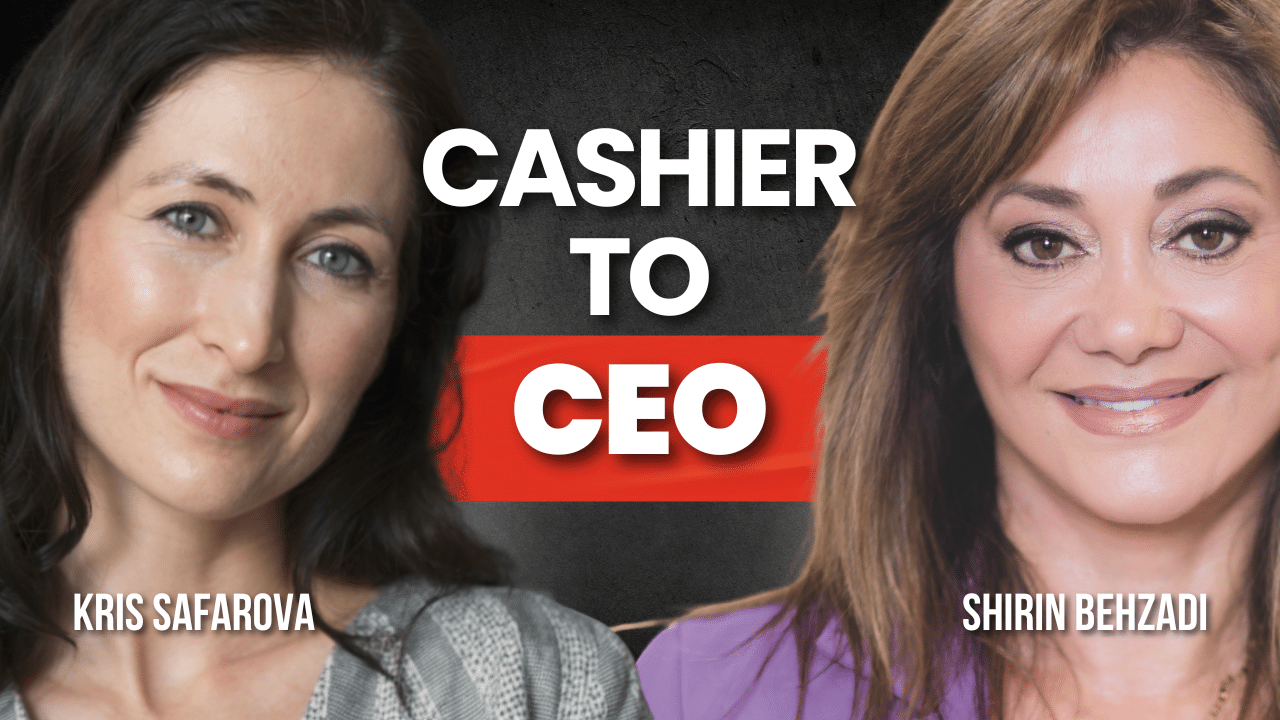
What does it really take to go from working as a gas station cashier to leading a billion-dollar company?
In this Strategy Skills Podcast episode, host Kris Safarova speaks with Shirin Behzadi, author of The Unexpected CEO and former CEO of Home Franchise Concepts, where she scaled the business to nearly $1B in sales across 12,000 cities.
This is a remarkable entrepreneurship journey and CEO story filled with powerful leadership lessons, proof that resilience in leadership is a superpower, and insights into how to do well despite adversity.
You’ll learn:
-
How to define a vision and reverse-engineer your career growth
-
Why asking for opportunities (even when it feels risky) can change your life
-
The “secret sauce” of scaling a company to nearly $1B
-
How to build personal growth through adversity
-
What the future of leadership looks like with AI in business
Here are some free gifts for you:
Overall Approach Used in Well-Managed Strategy Studies
Enjoying this episode?
Get access to sample advanced training episodes
Episode Transcript:
Kris Safarova 01:08
Welcome to the strategy skills podcast. I’m your host, Kris Safarova, and the show is brought to you by our firm, firms consulting.com the team behind strategy training.com if you want to become a strong strategist and leader, we have built strategytraining.com to be your go to platform. We offer advanced training used by clients at major companies, not just consulting firms, but many other organizations, like top tech firms, banks and so on. To get started, you can get this free resources. Number one is the overall approach used in well managed strategy studies. You can get it at f, i, r, M, S, consulting.com forward slash overall approach. You can also get McKinsey and BCG winning resume example, which is a actual resume that got offers from both of those firms. And you can get it at firms consulting.com forward slash resume PDF. And you can also get nine leaders in action, which is a book we co authored with some of our clients. And you can get it at firms consulting.com forward slash gift. And that book actually went to become number one bestseller in multiple categories on Amazon. And today we have with us Shirin benzadi, who is Iranian American entrepreneur, author, former CEO of home franchise concepts, where she scaled the company to nearly 1 billion in sales across 12,000 cities, very few people, and she serves as a speaker, advisor and investor.
Shirin Behzadi 02:40
Shane, welcome. Thank you. Thanks for having me. Shirin, so
Kris Safarova 02:44
you went from gas station to scaling a billion dollar company. What do you think was the single hardest decision you had to make that got your way here today?
Shirin Behzadi 02:56
Wow, a lot of hard decisions. I think the road is paved with hard decisions, I want to say, staying true and focused on where I wanted to go, which was I knew, even then as a gas station cashier, and I said that to people, that suddenly I was going to run a run a big company. So that informed my decisions along the way. So when you go back to asking, Where are those junctures, where are some tough decisions? The tough decisions had to do with saying no to some opportunities because I wanted to be on the path that I wanted to be, which is to get to running a big company. I did well with jobs that I was in, and decided to leave those jobs because they were not consistent with where I wanted to go. For some time, the jobs were fantastic and effective, and I learned a lot from them, but then we’re reached the point where I had to make a decision, do I continue working for as a CFO or for corporation, or all any of that. Or do I take a step out and do something on my own? That’s a tough decision to make, especially for someone that comes from the background that I came from, which is not just working at a gas station. I was a teenager on my own, no parents, very little money, a lot of financial insecurity. So making a decision to leave safety to explore and want to build something on my own was tough, and I made that decision over and over again,
Kris Safarova 04:38
and this is so critical what you said, I hope everyone got that insight, because we are so busy, some people are listening while driving and so on. Be careful, guys, if you’re driving. But this is such a critical insight that you set that goal for yourself at the very beginning, and then you first engineered what it will take for you to get there.
Shirin Behzadi 04:58
Yes, I wanted to say that it. Was, you know, we now use the word vision. I didn’t have the word for it at the time, but I could just see myself. I was like, I’m going to someday. I used to say back then, for General Motors was, you know, the company to think about and talk about. It was so large. I was like, maybe not General Motors, but I’ll run a big company. And so therefore, when I was working, let’s say, as an accountant, I learned a lot. It’s important. I think accounting is foundationally so important in understanding business. But when I reached a point where I thought, well, if I’m going to stay here, am I going to continue to be a better let’s say, in that case, an auditor. Is that what I want, or if my goal, if my vision, is to someday run a big company, maybe I need to learn operations too. Do you see how that would inform your decision? Had it been early on, I wanted to be a fantastic CPA, then the road would have been very
Kris Safarova 05:57
different. Where do you think that vision came from, that you wanted to run a big company? Yes, that’s a
Shirin Behzadi 06:03
very good question. I’m not sure, but it was not just a dream. It was an expectation. It was knowing that was going to happen. If I were to guess, it has a lot to do, or had a lot to do with childhood and growing up in a very challenging environment, right? I grew up in Iran. Part of my life. I left as a young teenager on my own, and maybe it was about having learned through those trials and tribulations that I had resilience, that I started building resilience, and then I understanding that I can problem solve, maybe I can manage situations that are seemingly dire, right? I was in Turkey alone as a 17 year old didn’t speak the language learning that I found my way through them. Could have set the stage to say, why not? I can then run away company, if I could survive on my own, not having ever been on my own with very little money in a country that didn’t know no parents, if I could survive that and find my way to the United States and find my way to a gas station and survive all of it? What is it that I can’t do? Maybe I can run a big company.
Kris Safarova 07:19
If you try to go back to that time. Do you remember how that thought came to you?
Shirin Behzadi 07:24
Okay, you’re gonna maybe laugh at this. Maybe not. But couple of things I do have an actual vivid memory that I wrote about in my book. By the way, it’s one of the memories that just you know how sometimes memories just stick out in your mind. I remember I the gas station I worked at was a bulletproof gas station. It was not in a nice neighborhood like you had, was dead bolted and bulletproof. And I would take my textbooks with me, because I worked full time, right? So as I was studying for my accounting degree, I didn’t have a lot of time. So I would take my textbook, and between customers I would study. A gentleman walked up to give me his cash and said, What are you studying over there? Now, the title is a math major. I hadn’t switched yet, so I had a calculus book. I said, I’m studying calculus. And he said, What are you going to be when you grow up? You know, because a young girl at a bulletproof gas station as a cashier, obviously poor, I look straight at him when I said, I’m going to run a big company, and he just laughed at me, because, oh my gosh, okay, good luck with that. Walked away, but that’s where it’s the first time I would say I openly uttered it, and then I decided I was going to print a business card. So that may sound funny, but I was working at a gas station, but I printed the business card for myself, as if almost to have a tangible evidence that I was going to run run a big company. I didn’t print a business card that says I’m a gas station. I was a CEO already on that business card,
Kris Safarova 09:02
I can listen so much with your story. And also was a teenager without any support, immigrated. And in fact, I was looking for my first job for something like eight months, applying for every job. And one of those interviews was at the gas station. I was asked to do some Excel work as a test, and they locked me in the room. They actually locked the door. So that was very scary, and it was very bad neighborhood as well. Yeah, very dangerous neighborhood as well. So I really can resonate with what you felt, because you’re literally in a situation where you often don’t have money to buy, even bread to eat, and yet you are able to think big, and that was the same way as you. So that is incredible. I’m looking forward to see how our conversation will unfold. So take us to that moment. So you are printing those cards. What happens next? What is the next move? Hmm.
Shirin Behzadi 10:00
Um, so I, like I said, I was a math major, and then realized language of business is accounting, so I decided to switch to accounting and and then I learned I didn’t go, I went to a state school, a great state school, but not necessarily on top of the list of business schools, you know. So I learned about there was big eight back then, not to age myself, but I thought, Okay, well, I want to get a job with one of the big eight. And somebody said internships help with that. So I went to the career office, and I asked them about internships with a big eight accounting firm. And she, she was very pleasant. She just said, you know, you can try, but I don’t want you to get disappointed. Those firms don’t usually recruit from here, and especially not for internships, because those are fewer positions. So this is, this was one of my first lessons learned in, you know it’s good to hear people out, but oftentimes they give you advice that may be coming from their own way of being, perhaps their limitations, their fears, whatever it may be. So you take what you hear and you assess it and decide whether or not it’s the right decision for you. I thought, Well, that may be her opinion, but I’m going to go for it. So I did, and I was granted an internship with EY, one of the only eight positions in greater LA area, which is huge, and there, from there, of course, doors opened when it was time then to get a full time job, I had offers from all the big eight. The fact that I had worked full time at a gas station, and then the later years, I moved on and added more to my list of things that I did helped, because it was clear that I was so enthusiastic, interested in wanting to do good work. And of course, at EY, as soon as I got in there, I was keen on getting the toughest clients that not toughest in the way of degree of difficulty, like, how much more can I learn here? How quickly can I learn? How much more can I learn? And I from that point on, that’s basically what I opted in to do, learn, learn, learn.
Kris Safarova 12:25
I think we need to unpack a little bit the path between you working at the gas station and you getting into school and being able to study and work. Can you elaborate a little bit on that part of the journey? Because those are the toughest
Shirin Behzadi 12:40
days. Those are tough times, yes, but in order to explain that, well, you’ve got to go, in my case, go back to where I came from. And so in growing up in Iran, I was there when the government was toppled and the new regime, which is now the Islamic Republic, took over. So I saw that transition, and in that in the process of that transition, as a young person, we were caught in the middle of a lot of chaos and change. So I was arrested a couple of times because that’s what happened in Iran at the time, and witnessed lots of atrocities, lots of challenges, and, of course, the war. So when my parents decided to send me out of the country, it wasn’t because I, you know, it was, it was nice journey to take on. It was because, literally, it felt like survival depended on it, and so before I knew it, and really, seemingly overnight, it wasn’t overnight, I was sent to Turkey on my own, by myself to find my way out of Turkey. Not that there’s anything wrong with Turkey, it’s great. It’s a great country to visit. But where I ended up was in a very tough neighborhood in Istanbul, because that’s where you went when you were going over without a lot of preparation. And where I stayed was in a home that a woman ran so very quickly, I had to learn to be independent on my own and find my way through I didn’t even have a passport. So as I was solving for all of these I knew that one of the only ways out of Istanbul, probably the only way out of Istanbul to the United States, especially because of the terrible relationships the Islamic Republic had with the West was through college admission. So it was through basically the school that I went to, because I went to the school for the gifted folks that were connected with the United States did find admission for me. Kris to a college in the United States. So that’s how I came here. But of course, couldn’t afford that. It was a private school, and found my way through lots of you know, twists and turns to be able to go to a state school. And of course, I had to support myself. That’s how it how
Kris Safarova 15:18
happened. That makes a lot of sense. So you’re starting at one of the big eight? Yes, what happens next? How do you go from there to becoming CFO at 28 Yes,
Shirin Behzadi 15:29
I worked at EY. Loved it. I thought it was a really, really good experience, fantastic. And I took on, like I said, a lot of really good, interesting, complicated clients. Learned a lot. I was getting a lot of really good reviews and feedback, until one day, I was working at a banking client, and I had some time to think, and I had an epiphany. I thought, if I were to stay here much longer, I’m going to get I’m going to become really, really good at auditing. But is that what I want? I also looked at people ahead of me, right? Because that’s an indication, unfortunately, at the time, not a lot of women, now there are, and that’s a good thing, but at the time, no, and I knew very clearly that someday I wanted to be a mother. This is where I think, for me, having a core value has really literally saved my life and also has created my ability to build what I wanted. My core value was that I wanted to be an engaged mother. I always said I wanted to be a mother who happened to work, not a working mother. So between those two factors, one understanding that I was becoming more skilled at being an auditor and not necessarily an operator, and that I didn’t look like it was an environment that allowed me to be an engaged mother. I had to make a very difficult decision. I decided to move on, and I remember it was extremely emotional, very difficult, kind of shocking for the partners that I was working with, because I was doing so well, like, Why would you leave now? But I, through EY found a position of one of our clients, the clients, that client of eys I was looking and, you know, I was introduced to them. Started off, not in as a CFO. I started off working in their loan servicing as a mortgage bank, and I explained more of that in the book, but basically the overarching story is that I learned a lot. And as the organization went through growth, the CFO left for a different position, and I opted in, and I asked our CEO if he could see me, of course, the previous CFO thought I would be a good fit, but I didn’t come from the accounting department, so that was a kind of a lateral move in a weird way. And again, coming back to the idea of people said, Don’t go ask. And maybe it may backfire. And I thought, you know, I’m gonna ask, like I did with the internship. I’m like, I’m gonna ask. So I did, and I was, became CFO of a pretty good sized mortgage bank. We had a billion dollars of loan servicing. We were originating $100 million of loans a month, and this is like the 90s. So those are, those were big numbers, a big job, a lot of learning. And yeah, through that process, not only did I learn more about the world of mortgage banking and finance, but also operations, because we also had 22 branches, like I said, we had a loan servicing portfolio. So that’s a that’s a lot of operations that go into play. Great learning experience. It is
Kris Safarova 19:02
when I was in I used to manage portfolio for a billion dollars. And then just highlight how much responsibility I was carrying on my shoulders. If there’s you were part of a company and you were a CFO of that company, and you guys were managing a portfolio, yeah, it comes at a big cost. So that is incredible. So what happens next? So you become CFO, and I love that, the part that you ask the CEO, I think that’s another big learning moment I want to highlight for everyone. We need to use the opportunity like that. You have to speak up. You have to ask, and they may say Yes, right?
Shirin Behzadi 19:38
So, because I knew I was gonna go. I was a good fit. You know, I knew it. If I thought I’m overreaching, it would be a different of course, I’m overreaching, but not overreaching. I was reaching for a higher position, but it wasn’t overreach. I thought I was a good fit, and I knew that I had the best interest of the company and the accounting department in mind. So. Actually, when I did go in and ask, and he was, didn’t take a minute, like, he was like, What are you? What have you been waiting for? My relationship with the accounting department, the controller and so on, from that point on, was fantastic. So it was obviously the right fit, and I had noticed it. So from there, when we continued to grow. We were a mortgage bank, so our main product was mortgages. Interest rates went up quite a bit. And you know, that wreaks havoc into the whole industry, especially in our case, because looking back, a mortgage bank was a, effectively one product company, you know, variations of that product, but it’s definitely more dependent on you don’t have a range of services per se that you offer. So we had a decision to make, because with the increase, the business was severely impacted. So we had to figure out how to best continue to service these loans, and how do we best manage the company with the significant drop in business. The final decision was to sell it to a bigger bank, and so we worked that out. I worked with the transition, I worked with the negotiations, which was a great experience, and then worked through the transition. And then I had another choice to make. At the beginning of this conversation, you did say, what are those decisions? This was another, another decision point. So now I’ve been with EY, and then pretty quickly, I’ve become CFO of a pretty good sized mortgage bank, and now I have this experience of transactions and selling and blah, blah, blah, all of that good work. I could have found another CFO position that would have been, that would have made sense, but by then, I had one child, and I thought, okay, maybe it’s time to pursue what I had set out to pursue, which is which was to be more of an entrepreneur. So I decided that I was going to go out on my own. Now, I figured there are companies that would be looking for someone who could be there. Call it off site, CFO, and that wasn’t a thing. Then there are many great organizations now that do it, but back then, it wasn’t that well known. So I didn’t quite know how to build it, but I ended up building it, and in that process, I came across the company where I stayed up for 20 years. Yes, yes, it was. It was scary. Kris, you know that because I now had left, and it sounds in hindsight, you go, Well, it worked out. But for the first few years, it did not work out right. It was, it was a lot of trials and tribulations. And you know, asking yourself, doubting yourself, why did I do this? And your peers are moving up, like the ones that had stayed at EY are now, like doing fantastically well. And you ask yourself, why did I sign up for this again? Am I doing the right thing?
Kris Safarova 23:17
Yeah. How did you land this particular client? Because initially it was a client, and you a CFO there. How did you land that
Shirin Behzadi 23:25
client? They were looking for a relatively small project, it seemed like. And I I’m not sure, somebody introduced us. I met them on the phone that I met them in person, and then as I left, I realized, you know, these are good people, and I feel like there’s room for growth. It wasn’t obviously a big company, yet it was doing okay, but it wasn’t like enormous, and I thought, I think they’re missing financial management. That’s where, like, the question is, where are you going to go and how are you going to get there? It’s one thing to feel you want to go somewhere, but it’s another to actually be able to manage and measure and all of that. So later on, when they called me, that is what I told them. I said, I think you need someone to help you with financial management. And then, you know, it just happened, seemingly gradually it we started off working, you know, fewer hours and fewer engagements, and it just grew from there. We became friends, and I also knew that I had more to add. You know, that there was that spirit of entrepreneurship that I had would be useful. Here it was. We worked very, very well as a team.
Kris Safarova 24:45
So to step a little bit back, when you went on your own, you mentioned those very few difficult years, yes, how did you approach client acquisition during that
Shirin Behzadi 24:58
that was the toughest thing, right? Right? Where do you start? Who do you start with? Luckily, I had, even though I’ve been really busy and building, helping build the previous bank, and, you know, operating as a CFO, I had just had a child, but I had managed to meet people, meet connections through all of that, and somehow I had remained in touch with them. So first thing I did was, okay, Shireen, this is the role Rolodex, Rolodex era, right? So just go through it and let people know that you’re available and ready to do this. And as it happens, it’s, you know, you start spreading your wings, and you cast a wide net, and people show up. I want to say that probably my first client came in because of some it was a woman that worked with banks. She did consulting work with banks with regards to all kinds of instruments. So I had told her, and she had met a group that was looking for someone like me, and she connected us. And so it kind of grew from there. What are the challenges that was the first client? Well, one of the challenges was lack of awareness. Right now, people are talking about off site or fractional see executives. That is something people are aware of, but back then they weren’t. So it wasn’t like people are were out there, maybe some, but not very common. It wasn’t like people are out there specifically looking for working with headhunters or whomever. Find me a fractional CFO or an off site CFO? That wasn’t the situation. So it was a bit more education too, that I had to do,
Kris Safarova 26:49
of course, and you were a mom at the same time running your own business, just starting out your own business, that is very, very hard, very hard. Let’s fast forward. Now. You’re working as a CFO with the company you ended up working with for 20 years. What happens there? How do you build the kind of relationships where they say, You know what you should do with this company?
Shirin Behzadi 27:13
So when we started working together, like I said, we were just working on making sure they’re set up right. And as we started digging in, I was able to be engaged with conversations with them, internally about growth plans, operations. It was clear that what I brought to the table, it was one of the elements that helped them. So when you have various people taking on various responsibilities, there are gaps, and that was one of the gaps that basically I filled. And it wasn’t just if an accounting gap, it was not just a financial gap, it was also financial operations management that we cut. We could all work together. One thing about an entrepreneurial company in its growth phase and its early stages is that positions may be called one thing, but they’re, in reality, very different. People have basically roll up their sleeves and do what needs to be done in a lot of ways, and that’s exactly how we did things. We sort of we were friends. We would do lunch every day, and we would collaborate on a lot because we were of the size that we could collaborate. And for the first few years, it was tough. It was tough because anybody who’s ever built anything knows growth. It doesn’t come overnight. For some people do their unicorns in the market, but most of us have to earn it. And it was really trying to figure out how to how to grow more rapidly. We were growing gradually, but not at a pace that we wanted to. So it wasn’t until the four years I had been there that we landed on what I I call it the secret sauce, which is what unlocked the growth potential for us. From that point, we started growing pretty rapidly in the world of franchising. And eventually asked ourselves, do we continue to grow and grow this system, or do we get into other ways of doing business? Do we do manufacturing? Do we do retail, or do we do more franchising? And we realized that perhaps we liked and thought we were good at franchising, so we created yet another franchise system from the ground up, both in the home what would say Home Improvement space, not home services, mostly home improvement, because they’re more heavy. And then the great recession hit, and so that was very difficult. It was definitely an existential crisis, because the whole market, of course, fell apart. But if. As if you remember great recession was housing led, and we weren’t home improvement. Like, who would be spending money improving their homes if they’re losing their homes? So how do you manage that? How do you recover from that, after the initial shock, really figuring out, okay, what do we do with this now, how do we best still reach out to customers that may be willing, there will be a smaller group, but may be willing to do it. How do we how do we create products, programs, warranties, pricing, that would appeal to them? We need to. We needed to make some enhancements and changes. How do we change our marketing to reach out to them in a different language that we had been used to. So we basically had to go through a lot of ways of doing business. How do we support our franchises in this very tumultuous environment? We went through a lot of facets of the business and enhanced it all, changed it all to be able to adjust to the new way of doing business, and of course, that was one of the reasons we were able to then, once the market recovered, for us to grow really rapidly. So this is why I always talk about adversity is a superpower. It. We don’t it doesn’t sound like it, but that’s the story of my life, and definitely the story of the Great Recession, dealing with that adversity, facing it, growing through it, was one of the toughest things we had done, but basically one of the best ways to grow beyond because our trajectory was significantly higher after we came out of it. That, of course, met was met with lots of personal challenges. It was a very difficult era for me. With I lost my father, I lost my loving nephew, and then I was diagnosed with brain tumor that I had to deal with while going through all of this,
Kris Safarova 31:59
I’m so sorry you had to go through so much. I’m very sorry about passing of your father and surgery you had to go through. I’m so glad you’re here with us. Thank you. What were some of the most important things that you adjusted so you mentioned you figured out, okay, there are still clients who want what we offer. So how do we reach them, and what do we offer them that they want? What were some of the most effective decisions there or things you uncovered?
Shirin Behzadi 32:28
Yes, so in the world of franchising, you definitely do a lot of marketing work nationally. Right? Franchises pay into national advertising fund. Use those funds effectively to advertise on behalf of the system. They also spend dollars locally on their own local advertising. So there’s a lot of marketing that goes on, obviously to the consumer. Prior to the Great Recession, our messaging was perhaps a little bit more brand branding than anything else. Once the great recession was here and we saw significant drop in business, we had to really get sharp and focused on generating leads. So we used to say, what would make the phone ring? Because the phone would ring at the time, right? We switched almost all of our efforts to most like direct response, which was effective. It took some time, but it worked, because we were able to then generate leads for our franchisees that kept them in business. So the other efforts that we took on had to do with making sure franchises are supported. Not that we didn’t support them. We supported them really, really well, but it was a different kind of support that they needed this time around. It made us better, actually, at understanding what is the most effective way of supporting them. Yes, train them to install this train them to design, but also train them to figure out their own financial health. How do the how can they, how can we best teach them to go from a lead to your to your closing rate, and how do you close that gap? How do you make your closing rate better? How do you make sure you go back to the leads that you had generated and recoup some of the leads that you may have lost, so you really get more granular with the kind of support they needed in order to run their business. Which wasn’t done is with as much detail as we started doing from that point on. Of course, we also had all kinds of financial aid for them that we introduced, including royalty relief and other approaches that we took on, which meant it meant less to the bottom line of the company, but it helped keep people in business and a clean sweep, like I said. Earlier of our offerings, what is the customer looking for? Today was the question we asked ourselves, and how do we make sure that we get as close to what they’re looking for? How do we bring in our suppliers, our manufacturers, to help us create those products and programs? So we went back to the negotiation table with our suppliers and manufacturers and made it clear that in order for them to survive, we would have to survive, our franchisees would have to survive. So wouldn’t it be better if we all got together and partnered in this process? Do we then we design warranties, programs, we did credit pricing that was more attractive to the customers. We just got better at putting our own business to be honest.
Kris Safarova 35:52
And what did you discover that customers wanted this?
Shirin Behzadi 35:55
This is the customer of 2008 which is a very different customer that we have today. But even then, they were very interested in making changes to enhance their home without having to spend 1000s and 1000s of dollars. So some of our products that we offered would Americans at the time were moving every four to seven years, right? Well, because of the Great Recession, that wasn’t quite a possibility, because there was not enough equity left in their homes and so on, so people were not moving as much, but that didn’t mean that they didn’t need to enhance their homes. So how do we come up with products that would help them enhance at a reasonable, affordable price? And how do we let them know that these products exist? That’s basically the problem was solved for
Kris Safarova 36:43
Sherman. How did you guys figure out that is what they wanted? Did you speak to potential customers or current customers, or did maybe look at research on
Shirin Behzadi 36:53
the industry? One of the beauties of franchising done right is that you have people that are facing and talking to their local people all the time, right? So in the case of a franchise system, you have a franchisee that has a finite number of households in their area. They’re known in their area, if they’re do it right, they’re involved in their communities. They’re baseball coaches and, you know, are around their customers on a daily basis. A good franchise system is one that has a feedback loop, so those franchisees that are working with customers understand their customers because they’re right there with them. If you are able to and willing to hear back from them, then you have the best intelligence, it’s on the ground floor, and that that’s how we learn industry data is important and interesting, but oftentimes it’s historical, right? What we have have the advantage of as a franchise system is is much more real
Kris Safarova 37:56
time, of course. And you also mentioned that at some point you guys discovered secret sauce. Yeah, what was the secret sauce? It was
Shirin Behzadi 38:05
a combination of things. So this was back in 2003 we had been really perfecting the way we were doing things, including how we supported our franchisees, how we connected with them, how we train them, all of those different elements, we had been rethought perfecting, but it was putting it all together in a package that made sense and priced right is what got things going for us. So it was a it wasn’t an overnight. It was years and years of tweaking and changing and being like a Mad Chemist, of moving things around and see this is going to work. Is that going to work? And until we were able to find and put it all together, and I’m telling you, pricing it appropriately, is what happened?
Kris Safarova 38:53
Were you pricing it too low? But how did you
Shirin Behzadi 38:55
figure out the pricing? We realized that we were pricing it too low. Yeah, it was an increase in price that worked.
Kris Safarova 39:02
How did you realize that? I think how market reacts that
Shirin Behzadi 39:07
was people attending different conferences and coming across different franchise systems. And the feedback was, wait, why are we lower than them? Because sometimes people perceive lower prices business off. They don’t understand that it’s a real business. So, yes, makes a lot of sense.
Kris Safarova 39:27
So let’s return to this period where you going through a lot of things. How did that change you? What did you understand about yourself during that period?
Shirin Behzadi 39:37
It was the most amazing gift that nobody has ever asked for, but once it’s here, it’s a gift. My family always say it was my life. Was life before my brain surgeries and right life after and the life after is so much better in every way. Okay, it was because I had to slow down, just because I had to, and I couldn’t really speak that well, so I had to listen more. I became an observant, not by choice, but by force. And being an observant was very enlightening. But I also had to deal with life and death, right? So the second time I had two brain surgeries, the second time I was supposed to die, apparently, didn’t know that. And so after that one, which was, you know, within 10 days, I had 15 hours of brain surgery. And the second one was basically to save my life. After that, I was very, very sick, and I had to, couldn’t keep my balance, so I had to learn to walk. And the idea of one step forward and two step back, one step at a time. These cliches are not really cliches. They’re like that’s exactly how it works. And one of my major principles I share in my book, too, is my brain surgeon said to me, you heal by moving since the moment I was able to I was expected to move with assistance. Of course, if you combine all of those lessons, that’s absolutely life changing. How do you find your balance? How do you find your balance in life? How do you learn to be patient with setting smaller goals to reach bigger goals. The smaller goals was, can I take two more steps today right to someday be able to walk around all of being an observant, listening and then, of course, understanding the environment, all of those taught me to be much more in tune with life, with what I wanted, what I could see in people. I would say that all of my senses were heightened, down to the way I saw things and I felt things, and because it was because of that, that when I recovered, I made fundamental changes in my life. What were the changes made? So when it comes to business, because we’re talking about business, it had become apparent that much like a lot of entrepreneurial companies, we had grown past the experience, expertise, know how, or the desire of some people that were in the business, right? Because we were successful, we were doing well. Company was making money. But Nothing ever stays the same. You either continue to grow, or you allow yourself to fall backwards. And we were in this strange situation where what we need to either kick it into gear and continue to grow, which was a much loftier goal than it would have been, right, because the bigger the company, the harder it is to continue to grow it, or we would just have to call it a day. So I personally had to have some soul searching, and I brought it up to everybody, and I said, maybe it’s time for us to consider selling, because for years we’ve been wanting to sell like ever since I came on board, everyone had a number in mind to sell at which was much smaller than what ended up being when this conversation was being had. So everybody agreed, because it was clear, it was clear that a lot of the energy, excitement and momentum wasn’t there to push the company forward. So I set out to learn to how to bring in private equity. What does that word look like? Took me a couple of years to land on the right bankers, and from that point, we started putting the all of our ducks in a row for a transaction. The idea was, let’s if we could sell that at a value that we were looking at. Because, remember, we were not doing this because we were in some kind of a financial crisis. Weren’t but it was a crisis nevertheless, like, you can’t not update your systems and your trainings, and, like, not have, you know, a lot of the work that needs to be done, and expect things to be, you know, hunky dory. So it was through that process we thought we were going to sell and everybody was going to leave, that we learned that we could find really good partners, but that they expected me to stay and run it to our expectation, to their expectation, which was the expectation we had set
Kris Safarova 44:56
forth. Makes a lot of sense. And what changes have you made? It in your personal life,
Shirin Behzadi 45:01
in my personal life, I have become so much more in tune and authentic with people that I invite him to my life, people that I spend energy and time with. I have moved on from a marriage. I am remarried, and I’ve, yeah, I’ve been so much more focused on making sure that I have my core values intact. And somebody in the company, when I was running it, one of our consultants, said, Well, you have a motto. And I go, what I have a motto? She goes, Yeah, you have a motto. You go, what is it? She says? You always say, doing well by doing good. I go, that’s it. You’re right. I always say that. So point is, I decided to live by that motto. And by doing good, I don’t only mean doing philanthropy or doing good by the community. I mean good work. Bring good products. Do good, you know, by others be a good partner at work, like a lot of ways of doing good that also bled into my personal life, which is doing, what am I doing good with
Kris Safarova 46:11
your book? For someone who is reading it, who will finish it, what are the key things you want people to take away?
Shirin Behzadi 46:18
I think, probably the sort of significant messaging in the book have to do with that regardless of circumstance that is possible, that it’s possible to live, grow, build, accomplish what you envision, and that it’s possible to do all of that while staying true to your core values, to your empathy, to your ability to connect with others, the two don’t have to be mutually exclusive, and that you do heal by moving that oftentimes, especially in a world, especially the world that we live in today, with a lot of change, a lot of challenge, if, if you’re in a situation where you’re transitioning from one phase of life to another, just basically change and challenge. It’s always around, but it’s picking up speed now, right? So in those circumstances of change and challenge, it can be confusing and demoralizing. The book explains that change and challenge may very well be your best friends, if not, if you know how to use them, right? That’s why I call it the superpower of adversity. It’s not adversity for the sake of adversity, it’s growing through it and from it. There’s evidence of that in the book with examples of how it’s applied to business multiple times, but also how it could be applied to your personal life. So basically, all together, it’s a book about hope, but it’s not hope without specific guidance. There are lessons in there that and principles in there that I share, that I didn’t create. I learned them. It’s like the law of gravity. Somebody discovers a law of gravity. It doesn’t mean they created it. I didn’t create these principles, but I’ve learned them over the years, and I am doing this to be able to share it with others, so that perhaps we can help each other. I can have an impact in potentially in allowing or helping others build what they’re looking for, accomplish what they want, just be who they want to be, by maybe applying some of those lessons, maybe finding some of it useful, effective in their lives.
Kris Safarova 48:43
What do you think one being you would want every listener to have ingrained in their heart and their mind,
Shirin Behzadi 48:52
that you can, because you can, you can that wherever you are in life, whether you’re in early on in your career, or you’re moving on to not working, if you’re building a company from the ground up, or you’re halfway through and you want to grow it from phase one to phase two, or if you’re taking on a new role, or if you’re taking on a new phase, if you’re taking on a new way of life, all of those circumstances are ones that are designed to help you grow and build what you can but not what you can’t what you desire And that at the end of the day, you can that’s what it’s about.
Kris Safarova 49:45
Sheridan, what would be your advice to leaders on how they should think about AI and how they should upskill themselves, or whatever else they need to do to stay relevant and just to have a sense of well being and. Things unfold.
Shirin Behzadi 50:01
Well, I always say a good leader is like an orchestra conductor. Your job is making sure that every musician is in the right seat, right somebody who knows how to play the violation of me playing the drums or vice versa. The same is true in an organization. Your first job is to making sure that all of the players are in the right seats that’s suited for them. They need to all have a playbook that they can use. Those are ways that their performance is measured, their guidance has done. And then your job is to harmonize as a conductor, harmonizing meaning making sure that everybody understands where the company is going, the organization is going, that they work well together. One of those tools is AI. AI isn’t just a tool. Is transformational. If it’s used right, utilized correctly, your job as a leader is to making sure that the the tool that’s AI, the transformational tool that’s AI, is weaved into those seats of these orchestra players your organization in the in a fashion that helps elevate and lift them and helps the organization as a whole achieve what it needs to do, which is the goal of or the North Star of The organization. That is your job. So the question wouldn’t be, in my opinion, that whether or not AI can help with one task or another, whatever that may be, but look at holistically as the organization, and ask yourself, in what places and what forms can AI assist lift the company as a whole,
Kris Safarova 51:40
and what is your advice in terms of skills development? If you have anything additional to say on that,
Shirin Behzadi 51:45
well, I think it’s our job to continue to grow our skills, but you’ve got to make sure that you’re focused on the skills that are meaningful to what you’re trying to do. Right? I’m never going to be a basketball player, so am I going to zoom in on skills? Not to be ridiculous, but the same is within the organization. If you understand who you are and what value proposition you have, what is it that you bring to the organization that’s where you want to stay focused and make sure that you are the best at what you bring to the table, and places where you don’t have either the skills or the passion or the desire are not consistent with you. You better make sure you have the right people in those places.
Kris Safarova 52:26
Sharon, thank you so much. Where can our listeners learn more about you? Buy your book, anything you want to
Shirin Behzadi 52:31
share? Oh, thank you. The book is called The unexpected CEO, and it’s available everywhere. It’s also available on my website, which is Shireen bezadi.com I’m also on LinkedIn and Instagram with the same Shireen bezadi, not an easy name to spell, but I’m sure you can do it. Definitely.
Kris Safarova 52:53
Our listeners definitely can do it. We have some of the most brilliant, amazing, hard working people
Shirin Behzadi 53:01
within the description as well. Basically, well, the unexpected CEO is easier to remember, so maybe they can just start there. Find me. Yeah,
Kris Safarova 53:09
our guest today was Shireen bexaiti, author of The unexpected CEO. This episode is brought to you by strategy training.com if you want to strengthen your strategy skills and leadership skills. Here are some resources from us as a gift, the overall approach used in value, managed strategy studies. You can get it at f, i, r, M, S consulting.com, forward slash overall approach. You can also get McKinsey and BC chipping in resume, which is a resume that got offers from both of those firms. And you can get it at firms consulting.com forward slash resume PDF. And lastly, you can get nine leaders in action, which is a book that went to number one bestseller on Amazon in multiple categories. And you can get it at firms consulting.com forward slash gift. Thank you so much for listening, and I’m looking forward to connect with you all next time,
Leave a Reply