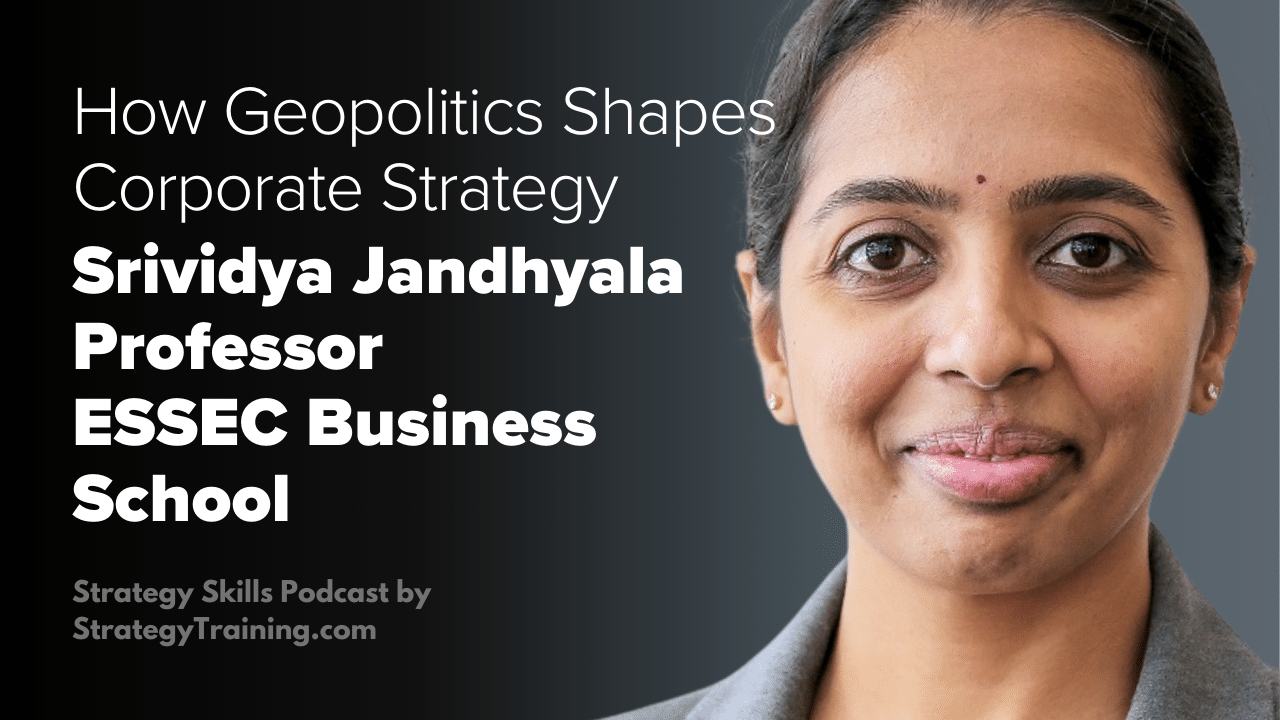
Srividya Jandhyala, professor of management at ESSEC Business School and author of The Great Disruption, offers a clear framework for how geopolitics is reshaping corporate strategy. Her central thesis is direct:
“The fundamental idea, ‘Where are you from?’—the nationality of the company—is the defining feature of the type of reactions you face from all stakeholders, not just governments, but also customers, suppliers, and clients”.
She explains why geopolitics now sits inside business decisions rather than adjacent to them. Corporate choices create externalities that trigger responses from states and nonmarket actors. For example, decisions around semiconductors illustrate how commercial moves collide with concerns about national security and dependence in key markets. The implication is that access, permissions, and standards increasingly compete with price and product as decisive variables.
Srividya Jandhyala distills four structural foundations every multinational should monitor:
- Market access — Where tariffs, export controls, or rivalries may close doors.
- Level playing field — Corporate nationality can tilt advantage or disadvantage against competitors.
- Investment security — Whether assets, workforce, and property rights will be safe and returns can be repatriated.
- Institutional alignment — The “USB vs. power plug” analogy: some systems work seamlessly, while others clash. Geopolitics is increasingly a contest of standards
Practical Takeaways
- Build a repeatable discipline. Go beyond headline news by scanning developments, personalizing them to the firm’s footprint, planning responses, and pivoting as conditions change.
- Map exposure by corporate nationality. Quantify where origin shapes market permissions, customer sentiment, or partner constraints.
- Treat corporate diplomacy as a core capability. Relationship-building with governments and stakeholders now consumes significant CEO time, creating both opportunities and trade-offs.
- For CEOs: View geopolitical flux as a field for advantage, not just risk. “Be imaginative about how you can exploit your corporate nationality, your position in the value chain, and your global market presence.”
- For middle managers: Expect new roles and metrics; government engagement, redundancy planning, and cross-functional information brokering are becoming central.
- Use the right cognitive frame. Executives must decide explicitly whether and where geopolitics deserves share of mind, recognizing that equally astute observers may reach different conclusions.
Jandhyala’s counsel is rigorous but pragmatic: geopolitics is now part of the operating environment. Companies that treat it as noise will miss risks and opportunities. Those that build structural awareness and corporate diplomacy into strategy will be better positioned to compete when “permissions, politics, and standards” define the terms of play.
Get Srividya Jandhyala’s book here:
Here are some free gifts for you:
Overall Approach Used in Well-Managed Strategy Studies
Enjoying this episode?
Get access to sample advanced training episodes
Episode Transcript:
Kris Safarova 01:16
Welcome to the Strategy Skills podcast. I’m your host, Kris Safarova, and the show is brought to you by our firm, FIRMSconsulting, the team behind StrategyTraining.com. If you want to become a stronger strategist and leader, we have built StrategyTraining.com to be your go-to platform. We offer advanced training used by clients at major companies, including consulting firms. But well beyond consulting firms. And to get started, you actually can get free resources. Number one is the Overall Approach Used in Well-Managed Strategy Studies. You can download it at staging-df81-firmsconsulting3.wpcomstaging.com/overallapproach. You can also get McKinsey and BCG-winning resume example, which is an actual resume that got offers from both of those firms. And you can get it at staging-df81-firmsconsulting3.wpcomstaging.com/resumePDF. And lastly, you can get a copy of one of our books that we actually co authored with some of our clients. And you can get it at staging-df81-firmsconsulting3.wpcomstaging.com/gift. And today we have with us Srividya Jandhyala, such a beautiful name. I hope I pronounced it correctly. Srividya is a Professor of Management at ESSEC business school. Her research focuses on global strategy, geopolitics, something we all need to pay a lot of attention to, and international business, and she’s author of The Great Disruption, and she holds PhD from the Wharton School University of Pennsylvania. Srividya, welcome.
Srividya Jandhyala 02:49
Thank you very much for having me.
Kris Safarova 02:51
So you didn’t just study geopolitics. You made it your life’s work. Walk me through the inflection point where you chose this path.
Srividya Jandhyala 03:00
I think I was just curious about these topics. And when I was introduced to them in graduate school, I was just curious about these topics, and I was very interested, also, as someone who has experienced firsthand the possibilities that exist in a world that was globalizing, that was changing, that was opening up more opportunities, and having experienced some of that myself firsthand, I was very curious to learn more about this, and so I started in graduate school on these topics, and I have pretty much thought about how companies expand internationally and how Global strategies matter for companies of different types and sizes and across different locations and countries, and so that’s how I came to this.
Kris Safarova 03:48
When you think about time at Wharton, what do you feel shaped you the most there?
Srividya Jandhyala 03:53
I think graduate school is a very it’s an amazing experience for those of us who have been lucky to be through that. One of the things that happens in in most graduate programs, a lot gets thrown at you, so you’re it’s like drinking from from the water fountain, right? So, or the fire horse. There’s so much coming at you, and everything seems amazing, and everything seems like things that you might want to explore further. So I think there’s that that’s certainly like a really exciting aspect. The second aspect is you get to meet so many different types of people, experts in so many different domains, and people who are working at the cutting edge of their field, which is, I think, a very exciting place to be in, and to kind of think about being submerged in that environment and absorbing everything around you.
Kris Safarova 04:44
And of course, many bright scholars, researchers, burnout or plateau. You build momentum. What did you protect or sacrifice to sustain it?
Srividya Jandhyala 04:58
I think I from. So for my own part, I think everybody has their own way of being productive and thinking about what they want to do and what they don’t for. For myself, I think I was just interested in these topics even when others were not that interested in these topics. And by that I mean there wasn’t as much attention, for example, to international business or or thinking about the politics of foreign investment, or topics of geopolitics. 20 years ago, it was there people in there were several people who were doing this work, but it wasn’t as broad and as widespread as it is today that so many people are interested in these topics today. So for me, I think it was just picking something that I was curious about, that I wanted to explore more, and I’ve kind of stuck with it because that’s something that I was inherently interested in, and that affected me in ways that shaped me and and I’ve been thinking about, and I’m sure other people come to come to their paths in different ways. But for me, this was, this was my experience.
Kris Safarova 06:04
And as you were building your career, do you feel that you had to sacrifice certain things to be able to do this work at this level?
Srividya Jandhyala 06:10
Certainly, I mean, I think there’s always a little bit of you know what, what else I could be doing with my life, or what else I could be doing if I were not doing this? And there’s certainly some elements that you know, you think about what, what else you could have done? Or I remember early on in my career, one of the things that I thought very carefully about was, did I want to have immediate impact by being a practitioner, by being on the in the field, by doing work that showed me tangible results immediately, versus taking a more slower approach and thinking about these over a long period of time, but thinking through more carefully and thinking about this in terms of research and academic work, so suddenly, there was these kinds of trade offs that I think are inherent in these choices for me, I think the longer I thought about it, I realized that I wanted to take the slower path, but certainly early in my career, I wondered, if you know, I wanted to be making a difference on the field today, rather than thinking about these ideas. And I saw a little bit of trade off over there, of course.
Kris Safarova 07:21
And are there specific routines that you follow success habits so to say that allow you to be productive and effective.
Srividya Jandhyala 07:29
So one thing that I have always tried to do is find other successful people. And I try to always find what is it that I can learn from people that I admire, that I see as being doing interesting things, or being innovative in ways that I would like to be as well. So something this is something that I’ve actively sought out and tried to do, is maybe a little bit of try to copy others who seem to have the playbook better than I have at any given point in time. So that was suddenly one thing, and the other thing was to just, it took me a while to maybe understand this idea that everybody kept telling me, but it was basically just get the work done. Sometimes it’s, it’s boring, it’s tedious, it’s, it’s, you want to be doing anything else but this. But sometimes it’s just powering through and getting the work done.
Kris Safarova 08:24
Very critical thing to do. So you mentioned learning from others. What are some of the key things you think you learned that really made a difference?
Srividya Jandhyala 08:31
I think there are many people that I’ve learned this from, and I think all of my collaborators, my advisors, my co authors, my colleagues, people that I’ve worked with, people that I have had conversations with, all the management practitioners that I’ve had chats with. So learning comes from many different people, from the students that I teach, from the different programs that I engage with. So one is that learning comes from all kinds of people from all kinds of different sources. And the other thing I would say is they’ve all kind of shown me a slightly different side of the problem. So in a way, I think I’ve been interested in pretty much the same topics for a long time, but I’ve thought about these topics differently. I’ve thought about these topics in a slightly different way than some nuance that I didn’t realize before, by having a conversation with with someone, or by being, you know, given a citation or to look up, or being a book a recommendation and and they come from many, Many different possible sources, like you’re reading widely, and you’re kind of listening and talking to so many people. So I think that, for me, has been a way of trying to figure out how to keep learning.
Kris Safarova 09:50
That is critical. Do you feel that you are often or sometimes underestimated? I can say from my experience as a minority not being born in countries where ended up living and studying and working, also being a woman and so on, and if so, how do you turn that into some kind of leverage?
Srividya Jandhyala 10:10
That’s a great question. I think I try to think, I try to look at the upside, which is, if you’re underestimated, that actually gives you a great opportunity. If people underestimate you, you can do amazing things because they don’t think you’re, you know, probably doing this or on the path to doing something else, while suddenly, you know, there are certainly downsides to not having access to the same types of networks or resources. But at the same time, I do think that, in a way, being underestimated also means that you have the freedom to explore in ways that maybe you wouldn’t have if you were forced to stick to a certain part, or if the part seems clear to you. So you explore a bit more, you’re willing to take bigger chances. You’re willing to do things that are maybe not, quote, unquote, traditional. And I think there’s also this opportunity, in a way, to explore things that you might otherwise not have done.
Kris Safarova 11:15
And then, for me, it was also looking for opportunities that are available only because you’re a minority. So for example, when I just started in consulting, I found out that there was a project going on focused on Russia and so on that part of the world, and I was the only person speaking Russian understanding the market. So looking, yes, you have a lot of disadvantages, but where is the advantage there that you can find?
Srividya Jandhyala 11:39
Absolutely I think, for for in my case as well, it was something similar. So I grew up in in India, and I was part of the cohort of people who experienced India’s opening up in the early 90s and and subsequently the changes that happened in the economy after that. But part of the big realization is at the time, was that there is this big, wide world out there, and somebody who has experienced this stark difference between before and after, having experienced or lived through these experiences of of what the state looked like before and what the state looked like After, just what what you can buy on this in the stores, and what opportunities exist for you as a, you know, a college graduate now, jobs were available in certain sectors that didn’t even exist five years ago. I think these were the kinds of fundamental things that shaped my thinking and made me interested in in the topics of international expansion of companies, understanding multinationals, thinking about what government policies actually facilitate or shape these types of interactions. And again, it’s not that somebody who hasn’t lived through this experience cannot do, but it certainly put me in a position to not only appreciate but also be somewhat unique in in having lived through this and been talk about it in a way that that continues to be the topic of my research.
Kris Safarova 13:12
Can you recall specific instances where your background allowed you to see certain opportunities or certain things that others just did not see?
Srividya Jandhyala 13:21
I wouldn’t say others did not see, but certainly it put me in a camp where there were fewer people who were seeing things the same way as I did. One was certainly when I was interested. Early on, I was, I was very interested in studying companies that were that were globalizing from emerging markets. And I was interested in how multinational corporations were looking at markets in far off countries where they had no presence before and a relatively unfavorable regulatory environment, and yet they saw the market potential as there was more liberalization and there was more globalization, and they had to figure out a way to compete and work in these environments. And so I think I was curious about these topics, and I wouldn’t say that there was nobody else who was interested in this. Suddenly, there were people doing this kind of work as well, but I think my kind of background and experience kind of made me naturally suited to study these kinds of questions.
Kris Safarova 14:31
Of course, and some woman and minorities listening to us right now probably want me to ask this Question, what were the unwritten rules? So to say you learned to navigate power structures.
Srividya Jandhyala 14:47
I’m still learning, I guess. But I think there are two things. Maybe one is just figuring out what the structures are. That itself takes a long time, because everything was new, like this was not an environment that I was familiar with when I. At graduate school, for example, I barely knew what graduate school was all about, so just figuring out what the system is and what possibilities exist, I think navigating that takes a long time. So don’t beat yourself up about it, if you feel like you’re a fish out of water. Give yourself the space to learn and and understand that you will eventually figure it out. But at the same time, I think also give yourself the space to be who you are, as you were just pointing out. We bring different types of experiences and and backgrounds and strengths, and I think finding a way to combine your own experience and your own expertise to the new structures or to the different environments that you are operating in, I think is the way to maybe make the best out of the situation.
Kris Safarova 15:55
And do you feel that there is something different about you? What do you think is the one thing, if you would have to prioritize one thing, what do you think was that one thing that allowed you to be where you are today, because you are obviously much more successful than an average person? So what do you think that one thing is?
Srividya Jandhyala 16:13
I mean, I think just being maybe grounded in that, having a recognition of all the things that are going on at any given point in time at work, but also not work with life, just just being grounded, but also being, I think, extremely lucky to have had the set of circumstances and opportunities that I did.
Kris Safarova 16:37
Do you feel that there was maybe a failure that made you who you are today. So if you would look at we all had certain things that did not go our way, did not go the way we wanted, although in retrospect, you often look and think that’s the best thing that could have happened, because it had to happen to get me where I am today. But if you look back and you look at all the situations that did not go well for you in your interpretation at that time, which one do you think really was pivotal to make you the person you are today?
Srividya Jandhyala 17:08
So I would say academia is a great place to have a lot of setbacks. Just the nature of the profession you receive a lot of, let’s say you receive a lot of feedback that may be not as positive as you would like. You might work on a piece of research for years and have that rejected by a journal, or have reviewers tell you all the 25 ways that it doesn’t fit and it’s not necessarily the right way to think about this question in the beginning, this was extremely disheartening for me to have worked on something for years at a time, and having had multiple people look at it and take their feedback and try to improve it, and yet have when you finally try to get it published, you Get rejection after rejection. And I think that was maybe extremely disheartening at first, but what I now, in retrospect, I think that’s probably something that is actually really helpful, because it really forces you in us in a way that I don’t know any other place that it does. I think the academic environment really forces you to, with the peer review system, really take what may be critical or what may be what you need to fix to get your ideas through, and forces you to think through carefully, to figure out what it is that you need to do how to get this to the next level. And I think, in retrospect, I think that that, having been through that process, and I continue to go through that process, I think that’s a strength of the system, I think, and helps me come out of the other side, thinking, when I do get something published, I do think that not only is this a validation or a certification of the fact that I managed to communicate my ideas successfully, but it’s also validation of the fact that I probably didn’t mess up too much if others in the field, working as peers and working as reviewers, and through a double blind system, review system, for example, have sought, kind of found that this is relatively solid piece of work. So I have more confidence in my findings. I have more confidence in in the research. I have more confidence in, in just what I’m saying having gone through the process.
Kris Safarova 19:45
And if you could go back and talk to yourself, and you just started submitting your work, and it going through peer review, and so on, what advice would you give yourself?
Srividya Jandhyala 19:54
I would tell myself, and and I continue to try to do this to this day, is to say you. Know, maybe the reviewers are not wrong. Maybe there is something that we’re all wired to say. The first thing when we get negative feedback is to say, oh, this person didn’t understand what I was trying to do, or, you know, kind of but I think what I would tell myself is to say, take a moment vent. Maybe that’s fine, but then come back and take a look at what somebody is trying to tell you. See what it is that you could have done better to communicate your ideas more effectively. What is it that you could have done to strengthen the work that you’re doing? And I think that’s a very useful conversation to have with yourself.
Kris Safarova 20:41
Of course. So you recently wrote the book. Congratulations. How did that came about?
Srividya Jandhyala 20:48
Thank you. So my my book was mostly on this topic, at this intersection of international business and geopolitics. And as we were talking earlier, one of the things that I realized was a lot of companies in today’s context and environment. They really have managers, leaders of companies that went through a very different global environment in the past than they are where they are today. What I mean by that is today you have the people who are leading companies, the people who are managing a lot of the businesses. They came of age at a time that was somewhat different. They came of age they went to business school maybe several years ago. They experienced a world where there was a much different political context, where countries were opening up, there was more market opportunities, and they were trying to figure out how to navigate these environments. And they studied things like, how do I make money? How do I read a financial statement? They went to business school, and they focused on, how do I sell to new and old customers? How do I analyze a financial statement. They they really had very little or no thinking about they didn’t spend much time thinking about political environments. They didn’t spend a whole lot of time trying to figure out, how do I navigate a political system or or a global political issues that are going to influence my business. And so today, they find themselves in a situation where they’re having to catch up, where they’re kind of having to figure out on the fly, how do I navigate this world? How do I this is not what my experience has taught me. This is not what my training has given me. So the book really was a was a way to try to combine and bring a little bit more nuance into the discussion, to have a little bit more context, and some of the research that we have on some of these topics already, but also connected to contemporary issues that companies are facing, and Trying to bring a more nuanced understanding and identifying effective strategies that might work as the environment is changing.
Kris Safarova 23:06
What do you want people to take away? Maybe some key things that you want for someone to really take away and for it to stay with them after they read the book.
Srividya Jandhyala 23:17
So I think I would say a couple of things. One is understanding that geopolitics influences businesses. It influences companies. It influences the strategies that you adopt. It influences all of this because of what we like to call externalities, and by that I mean your company’s business decisions usually are driven by business motives. So if you want to make a decision, should I expand to this market or not? Do I introduce a new product or not? Do I optimize my production process? Usually, we think of these as business decisions, but the reason why geopolitics impacts your companies is because of the potential externalities of what you do, and by that I mean how others are affected by the company’s choices. So if you think about an example like semiconductor chips, sure, Nvidia wants to sell semiconductor chips, if you think about one of the motives, maybe to find more markets, and having customers in China is a one potential market opportunity that they would like to exploit, but at the same time, another actor not connected directly to the business, which would be, let’s say, the US government is worried about national security issues, or worried about the fact that If high level semiconductor chips are available in the Chinese market, and what does what implications does that have for the Chinese technological development and Chinese military applications at the same time, you can think of a different actor, maybe this time, the Chinese government, and they are worried about dependence of China’s economy on a four. Foreign company, and what implications will that have for the continued access and and so on. So these are the types of externalities that a business decision. In this case, you know, how do I expand my market, or how do I generate greater revenues has on other types of actors who are prioritizing different objectives? Try to think about national security implications, trying to understand, what does this business decision of a single company, how does this impact the broader context in which the different stakeholders are thinking about so I think that would be one message to say, geopolitics. The geopolitics is about economics, in some sense, to have this interdependence between economic actors, economic outcomes, and the broader geopolitical interests. And then the second thing that I would say is that if you understand this way of of thinking, and if you kind of agree with the premise of this thinking, then the biggest risk for companies in terms of how geopolitics affects companies really is about corporate nationality. And by that, I mean the risk that a company faces because of geopolitical forces is going to be because of who you are. The key question is this, where are you from? And that can be a polarizing question, even if we are individuals, and we are asked this kind of question, but it certainly is the case for companies as well. This fundamental idea, where are you from, the nationality of the company, the country of origin is the defining feature of the type of reactions you face from all types of stakeholders, not just governments, but also customers or suppliers or clients. And then the competition no longer is about product quality or the innovativeness of your products and services, or your ability to provide customer service or after sales follow up. But then it becomes, really, do I have access to this market or not? Depends on where I’m from or where my Do I have a competitive position in the market really is a function of where I am from relative to where my competitors are from. So I think I would say these are maybe the two big messages from the book. One is that geopolitics is about economics because of the externalities that exist. And the second is that the fundamental defining feature of geopolitical risk for global companies really is about corporate nationality, or where are you from.
Kris Safarova 27:38
And what are the most important geopolitical forces. Do you think our listeners really need to pay attention to and track?
Srividya Jandhyala 27:45
That’s a great question. I think I keep getting questions like this often, and my response would be to say, we can think about what would be the factors that the geopolitical events that maybe we should be paying attention to, and certainly there’s a role for that. But I would say, if you are a company, a global company, maybe the bigger questions that you should be asking yourself is, what does this mean for the structural foundations that I rely on to expand to international markets. So the events may be of many different types, and the today, it might be about specific realignment of certain countries, or it might be about supply chains resilience. But fundamentally, if you are a globalizing company, if you are a company that’s working in global markets, what you need to ask yourself is, what are the fundamental building blocks that any of these kinds of events are going to shape? And as I lay out in the book, there’s, I think, four aspects to this. One is about market access. And so this is about how do these types the tools are many, whether this is tariffs, whether this is supply chain, whether this is export controls, whether this is, you know, rivalry between specific countries. The tools are many, but one central idea is controlling access to markets. So as a company, you’ve got to ask yourself, Where do I which markets Am I vulnerable in which markets are the markets that I see market access being an issue that I will no longer have access to the customers, clients, suppliers, workforce. So one is about market access. The second is about thinking about a level playing field. And so geopolitics, I think, has brought to light very clearly that even though we might have had this idea of, you know, we all work on in one market and and the playing field is level, actually it’s not. And we’ve got to ask ourselves, as a company, what is my relative? Of advantage or disadvantage while competing with others, and corporate nationality is a big part of that. So understanding what are the factors that shape this level playing field is going to be critical. And then the third one is kind of being aware of and paying attention to the investment security, security of assets, security of workforce, security of partners and suppliers. So is it the case that I can still go and invest in a foreign market? Am I going to do this if I feel confident that my investments are going to be secure, that I could still repatriate returns when I when I want to, or am I going to be putting workforce, or whether it’s going to be safe and secure or not. And I think geopolitical factors often play into this element as well, in changing how secure or how safe, or how the investment feels secure and property rights are secured. And then the final element, I think, is, to what extent are we looking at institutional alignment or misalignment? So if you think about, you know, if you think about a USB stick, it’s very easy. No matter anywhere in the world. You take a USB stick, you stick it into a computer, it generally works. But if you think about your power card, it doesn’t work. So this is the these are the types of frictions that global companies face when you go to different markets. There are a lot of these frictions that we face because the institutions are different, because we are required to work on on different assumptions and different technology standards and so on. But geopolitics is also becoming a contestation of standards. So I think ultimately, companies global companies need to pay rather than thinking about specific events. I would say what you need to understand is how are the structural factors that support your ability to go and compete in a foreign market to expand internationally. How are those being reshaped? And in particular, it is about market access. It’s about having a level playing field. It’s about investment security, and it’s about institutional alignment.
Kris Safarova 32:13
Srividya and someone listening to us right now who is, let’s say they are a partner at a major consulting firm focusing on healthcare, or they are working there, relatively senior at Amazon or at the major other organization, but they’re not really. They never started geopolitical forces or anything related to geopolitics. They read news like everyone else. But is there something you would recommend they do differently to really track what is happening.
Srividya Jandhyala 32:41
Yeah. So I think my suggestion would be to say, of course, you’re reading and you’re keeping up with with the news, and there are plenty of sources of information as well, including external consultants, internal teams. A lot of companies are doing this kind of stuff. So I would say the most critical aspect is filtering that information into how that impacts your company. So there is this, this scanning that happens, which is the first stage, which is, you know, whether we rely on external consultants, whether we develop this capability in house to track information, to track, the latest developments, and, for example, tariff rates or the changing export control requirements. So of course, this is something that we need to be aware of, and this is important to track. But I think the harder part of the problem, or what companies really need to invest in, is the next stage, which is personalizing this information. So what is relevant for my business or my company, and oftentimes, maybe the headline figures that you see are not really applicable to you, or the news that that is coming out today may actually offer use different opportunities that there might be opportunities as well. So really, the personalization of the information that is needed for your business or your company. So you could look at average tariff rates, for example, and, you know, look at the data, and it shows you that average tariff rates in the United States, for example, have gone up, but they haven’t gone up that much for certain industries. So really thinking about personalizing the information there’s there’s a lot of noise, so filtering that, thinking about what is relevant for for my business or my company, and then the really hard part, I think, is figuring out how this goes not just personalized, but the planning, so what if this is the information that is relevant to my company? So what? What am I going to do with this? And here is where I think there’s a lot of creativity and imagination that comes into strategy, making, really thinking about we have this set of conditions. Questions we see the environment that is moving and shifting in a way that’s relevant for my company, and then, so what do I do about it? So I would say, like going through this process of scanning, personalizing, planning, and then potentially having to pivot your business if necessary.
Kris Safarova 35:18
And another issue many listeners facing is that they have so much on their plate. They don’t have time to sleep. They don’t have time to spend time with the tiny kids. They don’t get the chance to see them grow properly. If they had to select two three sources to pay attention to, what would you recommend those sources should be for someone in United States, for example.
Srividya Jandhyala 35:41
So I would say, rather than specific sources, I think this is about how you think about the problem. So managers are busy people, but they are smart people, and like they they only pay attention to things that they need to pay attention to, because otherwise they would be completely overwhelmed. And it was for good reason that they were not paying that much attention to geopolitics in the past, right? So it was, it was a tailwind. It was opening up new opportunities. They didn’t have to spend a lot of time thinking about this. So today, rather than saying specifically, you know, rather than pointing to a specific source, what I would say is, think about, is this what you want to be spending your time on? And even very, very astute observers may come to different conclusions about this. So you might decide that, you know, this is business as usual, this is noise, because a lot of this does not affect my company or is not relevant to the particular sector that I am in, and then you should continue your regular operations as you were before. But others may come to the conclusion that actually, I see an opportunity over here, or I see that I need to pivot my company in in ways that we never thought of before. And so I would say that it’s it’s more about trying to figure out and understand to what extent these changes are relevant for your company. But at the same time, this is really about cognitive frames. This is about thinking to what extent like, Why should I be paying attention to this and and, you know, I think two very keen observers of the same trends might come to different conclusions because they see different possibilities and different opportunities.
Kris Safarova 37:29
Do you feel that people listening to us right now need to focus on developing new skills or strengthening certain skills to be able to really track the Jeopardy?
Srividya Jandhyala 37:41
Yeah, so I think one of the big changes has been the type of work as well for many companies that are finding themselves increasingly at this intersection of business and politics, are fundamentally rediscovering this idea that we need to spend a lot of time on corporate diplomacy. And this is, you know, it is intense work. It is painful, slower relationship building, type of work. And we see companies spending a lot of time on this, all the way up to the very top of the of the company, right? So CEOs are probably more so involved in this than other levels of the organization, just as a shift and change in how much time they’re spending on on these types of activities. So this is something that I would certainly say is something that that is becoming more critical carefully thinking about what these how do I engage in the not market, but the non market sphere? How do I think about the different stakeholders that maybe in the past, I didn’t pay that much attention to, because they weren’t so central in my thinking or in my business model, and so corporate diplomacy, I think, is one big aspect of this. But I also say that with a little bit of caution in that everything that you know, there are opportunity costs of doing this as well, right? So if you are, if your CEO is spending 20% of their time trying to meet different stakeholders and trying to advocate for certain positions or trying to ensure that your company still has access to certain markets or suppliers, then that’s 20% of the time that they were not doing this before that they were probably spending on operations or just a regular running of the company. So there is this trade off in terms of how much time I spend on this and how actively I want to dedicate to this, but suddenly corporate diplomacy is a very important, valuable part of this story.
Kris Safarova 39:48
And if you had to give one practical takeaway to executives and CEOs and also to middle managers navigating these changes, what would each be?
Srividya Jandhyala 40:00
I think for maybe for CEOs, I would say that geopolitical flux is not just about risk, that this is not just about how the adverse consequences for your company, but it’s also about opportunities. There’s there’s new ways of of doing business in in a changing world. And I would say that probably a good thing to do is explore imaginative ways to leverage your position, to think about how you can exploit the your corporate nationality, or the position that your company has in a specific industry or the global market, and be more creative and imaginative with that. And then for middle managers, I would say, maybe really rethinking and understanding and recognizing that there are new roles that are coming up. There’s much more of government engagement, information brokers, more thinking about redundancy. So really, I would say you need to plan for a different type of project team and perhaps even different metrics to gage what success is.
Kris Safarova 41:05
And when you think about your own legacy. And of course, you have a lot of work to do ahead of you, but what do you hope this particular book changes and how managers lead?
Srividya Jandhyala 41:16
Yeah, I think it’s way too early to think of a legacy. But what I what I was really hoping to do with the book, is have more conversations, and it having this opportunity to engage with different types of stakeholders and different, you know, practitioners and and people who are seeing this firsthand, who are kind of in the field, going through this, this process, but and just having more conversations about this, and one of the goals of my book was to kind of just provide a framework or way of thinking around this that shows not just why is this relevant for us, but also how can we think about This in a systematic way that makes us also see some possibilities and opportunities, not just as as risk, as as it is.
Kris Safarova 42:08
I want to wrap up today with my favorite question, stepping away from this important topic of your entire life, what went to three aha moments, realizations that really changed the way you look at life, or the way you look at business or your work?
Srividya Jandhyala 42:23
That’s a hard question, but I think if I were to talk about something that maybe changed the way I was approaching life, maybe was actually an article that I read many, many years ago, which was about, this was the kana and palipu article on institutional voids in emerging economies. And that was an article that deeply resonated with me, and I read it as I think I was an undergraduate or a master student at the time. I was maybe early 20s. Had never read anything about business before. I was trained as an engineer, and I happened to come across that article, and that was an article that deeply resonated with me, as in I was able to say, Oh, I get this. I understand what they’re talking about. And that was one that led me to think about these types of topics, but I still didn’t really think that I would build a career on these topics until I got to graduate school. And so my second kind of aha moment was when I was in a doctoral seminar and I was introduced to the research on this, and I was that was an aha moment, in the sense of I realized that people were doing this, and it was possible to to think about this and build a career around this. So I think for me, those two were were big moments.
Kris Safarova 43:50
Where can our listeners learn more about you, buy your book, anything you want to share?
Srividya Jandhyala 43:55
Sure. My website that’s www.sjandhyala.com, to learn more about me, and the book is available in major bookstores and retailers. So and feel free to reach out to me if you would like to have more conversations.
Kris Safarova 44:12
Thank you so much for being here. Thank you for doing this important work. Our guest today was Srividya Jandhyala, author of The Great Disruption. This episode is brought to you by StrategyTraining.com. If you want to strengthen your strategy skills, you can get these free resources. Number one is the overall approach used in well managed strategy studies. You can get it at staging-df81-firmsconsulting3.wpcomstaging.com/overallapproach. You can also get McKinsey and BCG-winning resume example, which is a resume that got offers from both of those firms. And you can get it at staging-df81-firmsconsulting3.wpcomstaging.com/resumePDF. And you can also get Nine Leaders in Action, a book we co-authored with some of our amazing clients. And you can get it at staging-df81-firmsconsulting3.wpcomstaging.com/gift. Thank you so much for listening, and I’m looking forward to connect with you all next time.
Leave a Reply