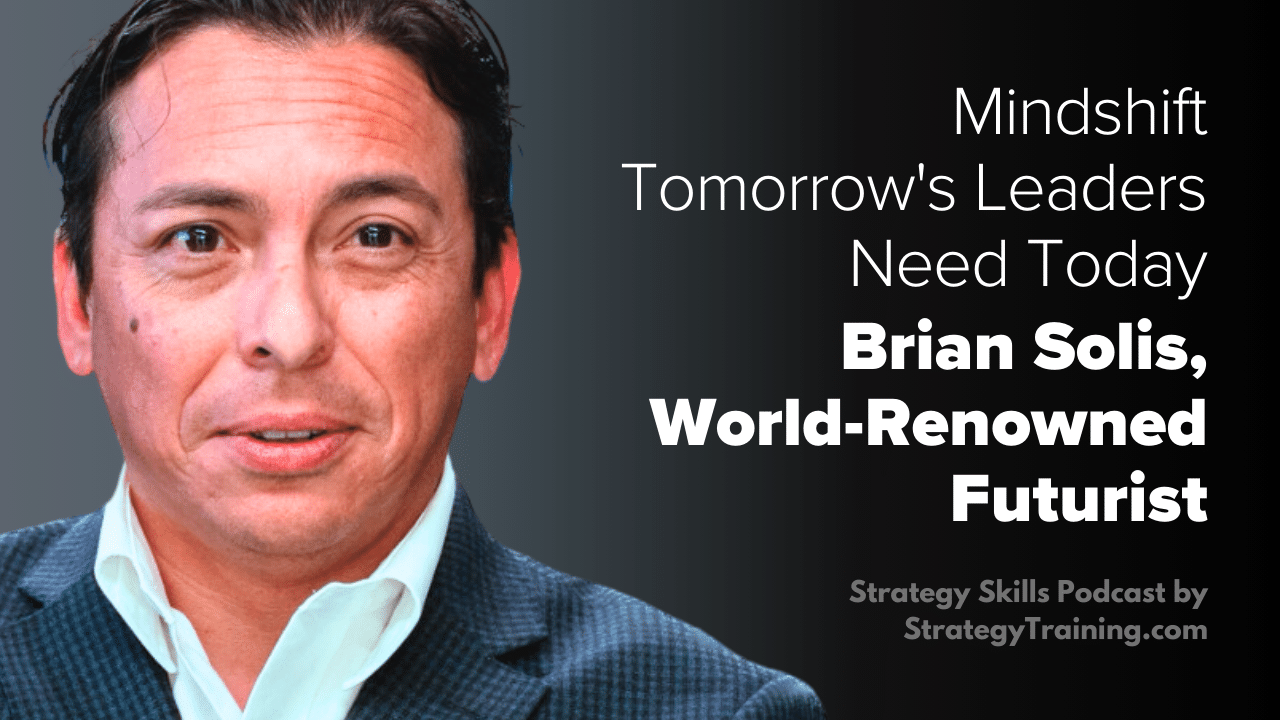
Welcome to Strategy Skills episode 494, an interview with the author of Mindshift: Transform Leadership, Drive Innovation, and Reshape the Future, Brian Solis. In this episode, Brian discusses the concept of ‘Mindshift’—moving beyond industrial-era, business-as-usual mindsets to become a visionary for a future that has yet to emerge. He also explores the importance of a beginner’s mind, emphasizing the need for curiosity and awareness in leadership, which opens the door to new possibilities and fosters innovation.
Brian Solis is a world-renowned futurist, keynote speaker, and author of over 60 industry-leading research publications and 8 best-selling books exploring disruptive trends, corporate innovation, business transformation, and consumer behavior.
Forbes has called him “one of the more creative and brilliant business minds of our time” and The Conference Board described Brian as “the futurist we all need now.”
Brian serves as the Head of Global Innovation at ServiceNow where he leads vision, strategy, and program innovation for the company’s global Innovation Centers. Brian also studies disruptive technologies, emergent trends, and market shifts to advise business executives on innovation and transformation strategies.
Brian continues to publish business and technology thought leadership in industry publications such as CIO, Forbes, and Worth, and has consistently been recognized as one of the world’s leading thinkers in innovation, business transformation, and leadership for over two decades.
Get Brian’s book here:
Mindshift: Transform Leadership, Drive Innovation, and Reshape the Future
Here are some free gifts for you:
Overall Approach Used in Well-Managed Strategy Studies
Enjoying this episode?
Get access to sample advanced training episodes
Episode Transcript:
Kris Safarova 00:45
Welcome to the Strategy Skills podcast. I’m your host, Kris Safarova, and today’s episode is brought to you by strategytraining.com and we have a gift for you. It’s a book called Nine leaders in action, a book I co written with some of our amazing clients, and you can get it at firmsconsulting.com forward slash gift. And today we have with us Brian Solis, who is a futurist, digital anthropologist and international keynote speaker. And he is someone who is very passionate about predicting what is going to happen and making sure that we make the most of the time now to create the most value, and Forbes actually has called him one of the more creative and brilliant business minds of our time. Brian, welcome.
Brian Solis 01:28
Thank you, Kris, and thank you for that lovely introduction. And hello everyone.
Kris Safarova 01:32
Let’s start with your career. So you spent some time at Salesforce. You’re doing very exciting work now with executives all over the world. Can you give us a little bit of overview of your journey up to here?
Brian Solis 01:43
Yeah, absolutely. I’ve been a long time digital analyst. I was principal analyst and partner in a firm called Altimeter Group. And my partners, including Charlene Lee, Jeremiah, all Yang, Susan etlinger, Alan Weber, we just, we were probably, at the time, the premier analyst firm studying emerging and disruptive technologies. And we also disrupted the industry a bit by publishing our research for free so that everybody had access to it. And that way, we were able to gain a lot of visibility at scale all around the world, and those were some of the best years of my life. I’ve written eight books. Now I have number nine, which is mind shift. That is brand, brand new book that we could talk about as well. But after publishing 60 research reports eight books, we sold our firm to a group called profit, and became part of the profit team headquartered in San Francisco, but offices all over the world. I decided to slow down a bit and spend more time with my daughters. I joined Salesforce as as in a global innovation role, and then I joined ServiceNow as the head of Global Innovation where I’ve been, I’ve been there for about a year and a half now, and I’m working with customers all around the world to help them accelerate their AI, first business transformation initiatives. It’s a lot of fun, and publishing a book, again after all these years, is really inspired by all of the customers I work with on a daily basis who are trying to figure out what to do moving forward.
Kris Safarova 03:27
What do you feel leaders need to understand, to prepare themselves, to be able to think and see the opportunities to be aI first company?
Brian Solis 03:36
This is a great question, and there is no one singular answer, but for me, and not to be promotional, the inspiration behind the book mind shift was because I feel like every leader today needs a mind shift. And that came about by constantly using the words mindset shift, and decided to just make it one word, mind shift. And the reason how this all came about is, if you think about AI coming to market as the fastest growing technology ever in November 2022 but that’s coming off of two years of a pandemic where the world was kind of shut down. Digital transformation was accelerating all around the world because businesses were suddenly overnight, caught by not having their digital transformation implementations have happened already. So you have employees now working from home, you have customers now shopping and engaging from home. And so a lot of infrastructure had to be built, but because it was done so fast, digital transformation really became less about transformation and more about digitizing yesterday’s processes. So that mindset has followed decision makers to now this AI era where they’re looking at taking yesterday’s processes and not just. Digitizing them, but automating them, to help with cost takeout, to help with cost controls, to help with productivity and optimization. And look, those are all good things, but the mind shift that needs to happen now to one to become AI first is to ask, what? How is AI challenging fundamental, fundamental assumptions that I have about my business, if automating yesterday is what everybody’s doing, how can artificial intelligence help me unlock net new value? How can it help me do the work that I wasn’t doing yesterday tomorrow in order to achieve exponential outcomes? So the mind shift is really how do we look at the present and the future differently than making the past better tomorrow.
Kris Safarova 05:44
This makes a lot of sense. So for someone listening now and thinking, Brian, you have no idea what my life is like. I have no time to even see my children. I have so much on my plate. I understand it is important, but I have sold it all time. I don’t even know how to educate myself in the most effective way. What would be your advice?
Brian Solis 06:04
First, I’d have to say, I totally get it. None of us have enough time. I don’t have enough time. I’m trying to figure out things that I’ve never had to think about before. AI has been to me, and let’s just say generative AI, because AI itself has been around for a while, but generative AI has been so swift and so sweeping in its impact that we were quick to try to respond to it, and I don’t know that We were slow in how to consider what the best response should be. So now my advice to people is to take a step back before you move forward, and that step back is to really assess, what are you trying to do and what’s possible. Don’t not spend time with your kids, but it really is a moment where you have to prioritize, where your time is focused. So it’s natural for everybody want to, want to spend their time to do what we’ve always done, which is, how can we make the biggest impact? How can we be more successful in what we’re doing today? How can I help achieve or surpass my goals and expectations? And that keeps us really busy. The routine of that keeps us incredibly busy. We’re essentially trying to perform against yesterday’s standards and keep up with yesterday’s processes in order to keep up. So whether that’s achieving your goals, whether that’s responding to emails, whether that’s sitting in meetings, if you think about most of that activity, is to reinforce the stuff you did yesterday. So the question is, I can’t do it all moving forward. So what do I need to prioritize? The other question is, what can I leave behind, and what do I swap that activity out with to achieve even greater outcomes? So for example, Vinod Khosla, the prolific and world famous venture capitalist out of Silicon Valley, tweeted or posted on X in the last month something that really struck me. He said that businesses don’t understand what’s about to hit them, and he said only a couple 100 people in the world really understand what’s going on. And what he said was that leaders, today’s leaders don’t understand how the rules of engagement are changing and are about to change forever. So I thought, What does he mean by rules of engagement? What does he mean by companies don’t understand what’s about to hit him. What does he mean by only a couple 100 people in the world understand what’s going on, because he didn’t. He didn’t allude to much more than that, but whatever it was, was enough to make him share that with the world. So I thought, well, here is an opportunity to be a leader, to take the opportunity to mind shift and to try to answer those questions, how are the rules of engagement changing? And this is what a futurist does in many regards, depending on which field you practice, but one that I enjoy scenario planning, like, what does he mean by that? If, if I believe this future to be true? And this is a potential scenario. What do I do about it? What does it look like? How does it impact me? And then, how do I best prepare between now and then for that to happen? And you develop multiple scenarios, likely scenarios, using the best data and resources you have, but going through that exercise even if I’m not. Right in my my scenarios and the possibilities around that, I then have better insight, or better a better idea, sorry about the dog barking, by the way, a better idea of what is likely to happen. And I now am doing the things that helped me be successful toward it, and that already sets me apart from everyone else, and that, I think, is an answer to the question is we have to challenge ourselves to how we are spending our time. What are we prioritizing? What are we valuing? And then, what is the opportunity cost of not doing these other things in terms of getting us ready for the future today, because I guarantee you that the companies that succeed in the future, the leaders who succeed in the future, not just in AI, but in general, are those who understand how to leverage potential disruptions towards their advantage, assuming that everyone else is going to look at these disruptions and just try to fold it back into business as usual.
Kris Safarova 11:01
And one of the things that could help here is something you mentioned in your book, a Chinese philosopher who said, a wise person is one who doesn’t lose the child’s heart and mind. So having this sense of wonder, having that curiosity, and that gives you more energy. And then it’s not an obligation, oh, I have to learn about this. It’s the sense of one that I have to learn about this. This is so interesting. And think about what we can create if you understand what is happening. So in your book, you have a chapter titled, executives don’t know what they don’t know. So what executives should know?
Brian Solis 11:37
Well, first of all, thank you for for looking at the book you know really quickly to to talk about something you said in terms of wonder, we don’t spend enough time with curiosity. We don’t spend enough time trying to address the unknown, because we spend all of our time trying to maximize efficiencies and and and outcomes for what we do know. So for example, I don’t know if you can see this, but this is an example of a wonder wall in the book where I put around any type of thing I want to think about all the different questions I have about it, and then try to prioritize those questions, and then try to find answers to them. So that my Wonder wall becomes sort of this activation wall. It’s a wall of enlightenment. I probably should have put that in the book, that it helps transform wondering and curiosity into more tangible opportunities to do something about it. I always say that if you’re waiting for someone to tell you what to do, you’re on the wrong side of innovation, and this is why we need new leaders. This book is written not just for today’s leaders, but for those of us who want to help today’s leaders, or for those of us who become tomorrow’s leaders, but for in the very least, that we all start challenging conventions and the status quo and assuming that we can’t just keep experiencing disruption after disruption after disruption and try to go back to normal, it’s just this. If we were ever given a sign to do something new, to go invent and go create, to go wonder and imagine new possibilities towards better, new futures, it’s now. So when I say that executives don’t know what they don’t know, let me back up and kind of explain the philosophy of what that means. We say, if you think about like today’s comfort zones, if you think about today’s leaders, they operate in a center of reference where they know what they know and they know what they don’t know. And that creates sort of this circumference, this circle, this comfort zone of how they execute, their experience, their success, their failure. They all contribute to this moment and these moments that define their thinking, that define their standards, that design their measures, that dictate their leadership style and their leadership routines. But the outer circle is executives don’t know what they don’t know, and that is uncertainty. That is ambiguity. And most executives don’t wonder. They’re not curious about this outer realm. They’re just focused on these inner circles. Yet in this outer circle. This is where opportunity lies. This is where innovation lives. This is where wonder thrives, where Curiosity connects the dots, where creating a wonder wall helps make the uncertainty. Certain clear bringing clarity into the unknown. So the the entire book, this, the entire second half of the book is really about putting structure around this outer circle, so that even though you don’t know what you don’t know, you use that as a competitive advantage. You use that as a skill. You use that as a means to identify opportunities for value creation. So if I can take one more step back to make it even more tangible, if you think about every major revolution we’ve ever had, think about the last 20 years, like 1999 2000 with internet, web 1.0 if you think about web 2.0 and social media, you think about 2007 with the mobile smartphone revolution. Think about 2022 with with chat GPT. If you think about every, every disruption in between that like Uber and Lyft and DoorDash and Uber Eats and iTunes and then Spotify and Roblox robot Roblox. Sorry, my kids play that. You think I would know that by heart? You think about all of these things, you think about Bitcoin, they’ve all introduced opportunities to operate in this realm of the unknown and realm of uncertainty. And certainly, startups have figured that out. Certain founders have figured that out. Venture capitalists have figured that out. But businesses, for the most part, have dabbled in here, but boxed it in those two realms. I know what I know and I know what I don’t know, but once you start to unlock the world of I don’t know what I don’t know, but I’m going to do something about it. Every one of those disruptions could have been a new value creator for an organization, or a new value creator for all of the startups that we saw come out of that. And that’s what this is about. It’s about giving yourself permission to explore the unknown, to find some sense of clarity, and then to bring people with you who were afraid of exploring that outer realm and who just wanted to keep things the way that they have, try to make them better every single day. And if you don’t explore that outer realm, you get what I call iteration, which is doing what we did yesterday better today, doing what we did yesterday better, more efficiently at scale, less costly tomorrow. All good. You need to do that. But when something like chatgpt or generative AI comes along and every wave that follows it, you also have to say, okay, yes, I am going to do those things. But how can I also create new value? What can I do differently because then iteration is doing what you did yesterday, better today and tomorrow. Innovation becomes what you didn’t do yesterday, what you didn’t know to do yesterday or today, but you’re going to do it tomorrow, and some of it might not work, some of it will work. And what you do is you create a value cycle that is linear and exponential at the same time. And that’s that’s what’s a long answer to your question by, but that’s why this moment is so powerful.
Kris Safarova 18:12
It is. And in your book, you talk about something you call change agents. So in a way, it requires someone to become a change agent, to be the person who is willing to do things differently and not focus on iteration, but focus on innovation the way you explain it. So what are some of the things that you want to mention about change agents, and how can someone become one if they feel within themselves, they want to step up.
Brian Solis 18:38
Change is scary for anyone and for anyone who’s willing to put their neck out to try to do things differently, the risk is losing your job, losing stature. There’s a lot of there’s a lot of reasons why people will not do something like that, but this is also part of the opportunity, because no one wants to do that. So someone has to do that. And so change agents inspired me, because I’ve always been one, for better or worse. And Steve Jobs has been a change agent too. You know, Steve Jobs and Walt Disney are two of my biggest you know, wish I could have had them as mentors people, but tried to learn everything I could from them. I wrote a report before I published this book called the Digital change agents manifesto, and it had studied, can’t remember the exact number, but 30 people who were impactful in pushing for change at companies like Coca Cola and just just some of the biggest NFL I remember, as well being some of the biggest companies in the world, were they able to they were able to make change happen, and they told their stories. And this was something that I had as part of other research I had been doing, like the state of digital transformation, the six stages of digital transformation, really. Research I had done in corporate innovation, and I sat on all this research and realized, wow, every one of these stories was really powerful, and there were patterns in what they were doing to be successful. And so I published that as research that’s it’s freely available, the digital change agents manifesto. And then as I was writing this book, I realized that I should revisit those patterns, those disciplines, and how they were successful, so that we could talk about the fact that being a change agent doesn’t always have to be scary, and I also talk about how we have to think about things like narrative and storytelling and inclusivity, so that people don’t feel like you’re coming in to try to rock their world or change what they do or not appreciate what they do today, but to help people feel like there could be a better tomorrow and that they could be part of it. And so those are there’s chapters dedicated to how to do that, and I honestly wish that we saw more of that type of inclusivity in bringing about meaningful change that’s not just good for you or just for me, but for everyone. And people feel like they want to be part of it. And I actually, I believe, like that’s why we need new leaders, because we keep reinforcing yesterday’s standards, and we have all kinds of new opportunities to create standards that are better for all of us.
Kris Safarova 21:19
And of course, we all have this voice in our head. No, right? I don’t think I am a change agent. I think that I probably don’t have enough experience. I’m too young, I’m too old, I’m too busy. I don’t have the right education. I didn’t go to the right school, but naysay within us, and you mentioned Stephen Pressfield in your book, I also read that work, and so he calls it resistance. So how do we confront that voice and quiet it?
Brian Solis 21:44
But I don’t know that you ever permanently choir it, quiet it. I I have my own challenges myself. The book before this was called Life scale, how to live a more creative, productive and happy life, I had to take several years out of out of my my work, to regain my composure, to regain my creativity, to regain my ability to imagine like I used to, and we all have to struggle with that. But look, I can tell you, and I know you know this better than anyone. We can find every reason why we can’t do something. It could be because of us. It could be because of fear. It could be because we know people don’t have resources or money or desire to go in that certain direction, or that people don’t want to do that, or people are just happy or content where they are. And if you think, if we let any of those things win all the time, we would never progress as individuals or as a society, and you don’t have to move forward in the absence of fear. The key is, how do you move forward while still having fear? How do you move forward? How do you be courageous while still being fearful, and that’s the art, and I actually walk people through that in these chapters. Some of it is based on my experience, like how I’ve done it. I’ve helped launch over 1000 startups in my career. Still have to work for a living, but every single one of those were creating companies in an era where the market for them didn’t exist yet, right? So you’re always operating in the unknown. You’re always operating in the state of fear. Like, what if I fail? What if this doesn’t work? My reputation is tied to this. Is tied to this, but it is. It is because of those experiences. It’s because of shadowing and spending time with venture capitalists and helping to facilitate deals between startups and venture capitalists. Like, how do they measure success in an era of unknown? Like, how are they going to get 1,000x on a market that doesn’t exist yet? Why are they so confident about it? Because they have formulas. They make the intangible tangible. And so I learned from people who do these things and practice them and work with them and also help people feel heard and understood, because you can’t change anything if people don’t want to come along with it.
Kris Safarova 24:08
You touched on it a little bit, the fear of failure, but some people, they struggle with it a lot more than others, and they may not even have the naysay as much. They may think that they have the experience and they can do it, but that fear of failure because of the childhood they had or something like that, often stops them to do what they know inside they are the right person to do any advice for someone like that, listening to us right now,
Brian Solis 24:32
the secret that I’ve learned in my work is it comes back to that saying, if you’re waiting for someone to tell you what to do, you’re on the wrong side of innovation, because people have a position of leader or a power or of stature doesn’t mean you can’t have those things, either it just has to be proven or shown and. That you have purpose when you have good intentions, and that in the end, really, you’re not trying to gain power as much as you’re trying to gain trust because, because you believe in something so much that there can be no other way forward. And if you were to not pursue your idea or this opportunity or this partnership or whatever it is, or this investment, that you would never lose the regret. And yet we all give in, we all sacrifice, we all give up, we all acquiesce, almost every day, and that just becomes its comfort zone for us, and we start to just build up within ourselves. Maybe, maybe regret is part of it, but also I wonder what if, and let me tell you, I’ve worked with some of the biggest startups in the world where I just didn’t see it all the way through. I wouldn’t be here if I had seen it all the way through. I’d probably be on some island I own. And so I do carry all of that myself, and at some point, you know, there’s enough. There’s enough. Is enough. I try to help people not make the same mistakes that I did, and I’ve tried to learn ways to help people feel like they’re not as much taking risks as they are making investments in new possibilities, because it’s just a matter of framing a lot of times.
Kris Safarova 26:51
And of course, we cannot lead others if we are not good at leading ourselves. And some of the things to consider there, in addition to what we already spoke about, such as fear of failure and the naysay in your head is that feeling of worthiness, that you’re worthy and that you have the potential to be the right person, building yourself up instead of breaking yourself down. Any advice on how to do this.
Brian Solis 27:15
Sometimes, the most dangerous voice in your life is the voice in your head. And we tend to beat ourselves up quite a bit. And if we beat ourselves up enough, you know, we could start to believe it. And that’s that’s just nowhere, nowhere to be, nowhere to live, and definitely not a path towards growth. I read a book as I was writing my book, and I never do that once. I once, I decide I’m writing a book, I commit to it and don’t, don’t take on the additional tasks of reading other books. But I did, I did this time, and it was the act of creativity by Rick Rubin, and a lot of that is about him helping you as the reader, build the competence and trust in yourself that your ideas matter, that your thoughts matter, that your creativity matters, and that the world needs more creativity. And when I build off of that in my last book, Life scale, creativity becomes skill that teaches you to show up differently. You might not even see it subconsciously, you just have more ideas. You’re you’re more confident, and you show up in meetings differently. You’re talking differently. It becomes a little bit more contagious. You’re exercising that creativity and all the things that you do. Maybe you’re picking up new hobbies, like for me, I ended up picking up picking up cooking, and lately I’ve been focused on, like, hardcore Italian cooking and just allowing your individual expression to come through those might, you know, your first meal might not be the best, but your second, your third, your fourth. I mean, you just get better with it, and you’re having fun, and it becomes an exercise. But what your brain is learning is it’s rewiring itself to be able to do those things. And therefore, once it’s wired that way, when someone says, We’ve got this problem, what are we going to do about it? You’re firing differently than you would have, say a month or two months or three months before that. So I think embracing creativity, like I put in this book, embracing curiosity, wondering perspective. I tell the story about the frog in the well, allowing yourself to see and feel the things that you didn’t do before becomes a building block of which then the next thing you know, little by little, you’re up here and you were here, and that’s powerful. And there’s one day, you look back and say, Wow, look how far I’ve come.
Kris Safarova 29:45
Very true. And there’s momentum that is building up over time. And also, sometimes you feel nothing is happening, nothing is happening. And then, boom, the end of chapter, the new chapter began. You cannot even return to whatever was before it, and you already broke to the next. Level. So talk to us about the power of the beginner’s mind. Another important topic for us to cover.
Brian Solis 30:07
There’s a saying that in the expert’s mind, there are very few options. In the beginner’s mind, anything is possible, and this is the hardest This is the hardest mindset to get, because you have to pretty much accept that you’ve been coming to every decision as the expert. And look, there’s nothing wrong with this how you’ve gotten this far, but in order to think differently, in order to see new possibilities, in order to think about iteration and and innovation a beginner’s mind is the heart of a mind shift, which is recognizing that it’s your experiences, as we talked about earlier, that got you to where you are today, but it’s your also your experiences, that contribute to your expert’s mind. So in order to recognize that there are steps that we talk about in the book, like self awareness and the importance of self awareness, most of us, most of us would like to think that we’re self aware, but our own biases, our own cognitive biases, get in the way. They sort of prevent us from seeing the mistakes we make, or protecting us from not having to see things differently, because we know what’s going to happen if we make this decision, we’ll get these outcomes. So self awareness becomes a gift that we give ourselves, and I teach in the book how to how to give yourself the gift of self awareness. So I’ll give you an example of why that’s important, how it contributes to beginner’s mind. I was at an innovation event in Italy recently, and it was full of CEOs and consultants and some of the smartest people in the world, and everyone was discussing a new future, forward in an era of AI and no offense to everybody, it was some super smart people in that room, but I heard a lot of ideas and scenarios that were really rooted in yesterday’s philosophy. Like, how are we going to do this to take 10% cost out? How are we going to do this to improve these things at scale? How are we going to do this to consider upskilling or or unfortunately, layoffs? You just every, every aspect of that conversation was was discussed, and so I said, when it was my time to speak, I said the one thing that I don’t feel in this room is humility, and I don’t feel humility in this room because I don’t feel like we are all practicing some highly understood mode of self awareness. So therefore, every single idea that I’ve heard has been built off of the expert’s mind. Everyone in that room was an expert, and every idea was based on that power of each individual expert. But I heard nothing from a beginner’s mind. What if? Why can’t we all led by different questions? Because someone’s mind was so clear that it was more childlike in terms of wonderment and imagination than it was of being that 30 year veteran in that particular industry. And I’m not saying that one is better than the other, I’m just saying you need both and to practice that beginner’s mind is a form of creativity, and creativity is a form of Well, it’s actually not just a form. It’s a pillar of innovation.
Kris Safarova 33:46
In your book, you talk about Maslow called peak experiences, I would love for you to explain to our listeners what peak experiences are and why we need to pay attention to them and try to make sure we put ourselves in situations where we can have some.
Brian Solis 34:00
Well, peak experiences, I’m actually, actually had to flip to that. As you can see, I’m reading my own book. Peak experiences are when I’ll just read this passage. Here are when people transcend their own personal concerns and see from a higher perspective. Maslow described peak experiences as rare, exciting, oceanic, deeply moving, exhilarating, elevating experiences that generate an advanced form of perceiving reality, and are even the way he described it, are even mystic and magical in their effect upon the person experiencing this. And so how I interpreted that was giving yourself a beginner’s mind is giving yourself the space to be awestruck, to be moved, to be inspired in a way that you might have. Resisted against because you had excuses, or you didn’t believe in something, or that your experiences told you otherwise, or that your gut is telling you this, so you can never see the wonderment if you’re operating from that expert’s mind. But the other thing that I learned as I was going through this is that peak experiences were the thing that we don’t usually associate with Maslow. We usually see the top of the pyramid, which he never actually communicated his ideas in terms of a pyramid, but at the top of the pyramid as it was visualized of people studying his work, that was self actualization. You becoming but in his work that would subsequently be studied later, Transcendence was the peak experience. It was when you allowed your mind to see these new things, to feel these new things, to therefore experiment with these new things, that you would become transcended, and he would write, write it this way. It transcends your own identity. It causes a shift in perception. It triggers curiosity. It creates new openings or expands one’s minds. It ignites imagination and helps people see things in new ways. It inspires one to become part of something larger than themselves. It sparks a desire to connect with others, and it’s linked to a willingness to take more risks and find different levels of comfort in uncertainty. That’s, that’s, that’s a foundation for transcendent and to use his own words, Transcendence refers to the very highest and most inclusive or holistic levels of human consciousness, behaving and relating as ends rather than means, to oneself, to significant others, to human beings in general, to other species, to nature, into the cosmos. So he just really thought that we were limiting ourselves by trying to not do these things, and we do, like you said earlier, find every reason why we can’t do these things.
Kris Safarova 37:08
And this is such an amazing example of something I observed where there is something that we all believe, almost every one of us believe, is that is how it is, but it’s actually definitely not true, and somehow that lie just continues on and on. All of us are taught the Master’s hierarchy of needs. And for me, self actualization always felt, well, this is kind of outdated pyramid in my mind then, because obviously there are higher levels when you basically transcend. You go to the next level. You expand your identity. You expand how you see the world. You expand what you can create for the world, the value you can create for the world. Why do you think we as humans, for example, even if we look just in this particular situation, why do you think we just completely emitted this other layer that you had
Brian Solis 37:58
for the most part, he it was like his life’s work. And I just don’t think that a lot of people, or if they did, it wasn’t as popular read his his work as he was starting to near the end of his life. Because as he got older, he started to write more and more about transcendence, being above self actualization, and I spent a lot of time as I was writing this book, recognizing that in his later life, what he was writing and thinking about resonated with me as I was trying to put together a framework around a mind shift, and I guess it’s just an example of how we take things at face value. Certainly, that pyramid is everywhere, but no one really questioned what could be more? I just happened to do that, and it unlocked an entire new set of learnings. But I’ll give you an idea. We’re so ready sometimes, to just deal with what we know, or deal with the standard, standard quote. When I was writing a book a few books ago, I was talking about this concept that I had used as a constant theme in my research called digital darwinism. And one of the quotes I don’t know what verbatim right now, but it was something like this. The strongest of the species isn’t what just evolves. It’s those who adapt. And that quote is shared everywhere, attributed to Charles Darwin, but it’s actually not. It’s actually a professor who taught the work of Darwin. I can’t think of his name right now, but we just never question it. Therefore we quote. There’s a blog dedicated to things quotes Einstein never said, and it’s because we’re not taking the time to challenge our own our own thinking, our own work. So we just. Easily, sort of attributed to whatever we find. But then, if you think about one of my favorite examples is ketchup. I know it’s gonna sound strange, but if you think about how many decades, well, actually, a century, we think about the bottle of ketchup that we use, we just learned to live with it, and like everybody, had a way to get ketchup out of it, whether it was hitting the palm of your hand or shaking it, or putting a knife in there. And then somebody comes up with this idea to have a squeezable bottle. And so you squeeze, you have gravity, you get the ketchup out. It’s a lot easier. It’s a lot better. It’s recyclable. But even still, we took it for face value and we squeeze the ketchup out, but it’s actually called a gravity container, which is a thing, and most of us don’t know this, that you don’t squeeze it from the front and back. You squeeze it from the sides, because the sides lock. Once you squeeze it, it locks in. The ketchup actually comes out automatically. So you just do one thing, and it comes out automatically. So we’re still not even using that ketchup bottle the right way. And so it’s just a long way of saying that we are just content with a lot of superficial things or things that reinforce our own biases, or things that reinforce our own thinking or experiences, and we we we tend not to challenge our own beliefs, and that’s where we get into trouble.
Kris Safarova 41:25
Well, Said, I want to ask you a question that I think will be very helpful for our listeners, and that is, you talk about how we need to focus on making sure that our companies are AI first, and not everyone have tech background and so on. What are reading sources that you would recommend to someone if they decided you know what? After this episode, I’m going to take it seriously, and I’m going to invest time in educating myself, but there’s just so many things you can read and listen to. Are there specific sources you would recommend?
Brian Solis 41:58
To use it is to understand the opportunity. I i write a newsletter called AI insights, and my sole purpose for doing that isn’t to get subscribers, although I appreciate everyone who does subscribe, I use that as a mechanism to force myself to understand every trend and every tool and what it means, and more so to think it through from the mindset of, say, the audience that you’re describing. Where do people go for information? What do I need to know about this? And so my tagline for AI Insights is making sense of AI trends for executives who don’t have the time to go and try to figure all this stuff out. And I learn a lot in that process, but I’ve also learned to follow certain people like Connor grenin from NYU Stern, or Ali K Miller, who I think has 1.5 million followers on LinkedIn, like Jeremiah all Yang, who is one of my former colleagues at Altimeter Group. There are no shortage of voices, but what you want to do is align with the voices who reflect your aspiration, who reflect your ambition, who reflect your your desire to learn something for a particular reason, because there’s too many voices if you’re just trying to figure out generative AI or AI in business, and they all have different personas or stakeholders who they’re trying to reach, or certain experiences that they they, they reflect. I am going after people who either want to be that executive, like the CEO whisperer, maybe the the Chief Digital Officer, the Chief Innovation Officer, the Chief Information Officer, so I’m trying to help them connect with each other so that they’re not operating in the silos that they used to to better understand these opportunities and how they can work together to achieve new outcomes, but everyone else, find the people who reflect your voice and your ambition, but also understand that you can’t make decisions about artificial intelligence thinking AI is the strategy I see so many people making decisions about AI because they have to, not because they have an idea of where it’s going to make an impact in their organization, from an iteration standpoint and an innovation standpoint, all very important. So find, find your voice, Accept where you are with where you are not and where you would like to be. I always believed in this. I talked about it in my last book as well be do get figure out, at least initially, who are you trying to be? What are you trying to do? Where are you trying to go? What. You have to have some ambition, and we all do, just take a moment again when you take a step back just figure that out. Because then once you figure out who you want to be, then start to do the things to be that person. Who do you need to listen to? What do you need to learn? What experience do you need? So as you figure out who you want to be, you start doing the things that help you be that person you ultimately get what it is you set out to be. So be do get?
Kris Safarova 45:28
That is a very good advice. Always go big picture. So just to build on that quickly, are there any books that you would recommend?
Brian Solis 45:38
Well, aside from mind shift, yes, actually, I have one out here. It’s written by the team. I’m actually reading it right now. So you think I would know the name of it. We might have to put it in the show notes because it’s outside my door. But that one I’m reading right now, it’s about enterprise wide, AI strategy. It’s, it’s, it’s written by one of the global consultancies, and I want to get it wrong, which is why I’m hesitating on, on saying what it is, but it’s a, it’s a great book, and then also, really, any book related to thinking and creativity, like Rick Rubin’s book The act of creativity, while it’s not a how do you build an AI business? The point is, is that if you go back to the conversation you had earlier around we don’t know what we don’t know. So therefore, if you start reading books about what to do in an era of AI by people who haven’t challenged what they don’t know, they don’t know. You’re going to get a lot of iteration strategies and not a lot of innovation strategies. But if you read a book about creativity or how to open your mind and practice looking at disruptions and trends and making sense of them so that you can make decisions about those trends and make them more familiar, what you’re going to do is actually start to uncover opportunities for innovation with AI, and you’re going to become the thought leader. You’re going to become the subject matter expert on a topic that everyone’s looking for answers on. And that’s, that’s, that’s truthfully, where I go when I need to get smart on something. And I read something about creativity, I practice creativity, and then I use whatever it is that I’m trying to figure out, and I make sense of it, and suddenly, now I have a voice. I have a perspective on something that is different from everyone else. And last but not least, one of my secrets has always been in the absence of having the answers become the person asking the questions, because everyone wants to be the expert, and not everyone’s willing to do the homework or the transformation work to understand what’s meaningful here. So I have found some of my best work has been done by shutting off all the other voices and trying to figure things out. And it’s actually, to be honest, a very beautiful experience.
Kris Safarova 48:08
Brian, thank you so much. Where can our listeners learn more about you? Your work, get your book. Anything you want to share?
Brian Solis 48:16
Well, my website is for the book Mindshift dot ing, so mindshift.ing. It’s very cute. URL, briansolis.com, and then on, it’s on Amazon. It’s bookstores everywhere. It’s just out. It’s fantastic. I actually like it because I’m reading it and making it’s like, it’s like a first time all over again. And I’m at Brian Solis, pretty much on every network,
Kris Safarova 48:43
Brian, thank you so much for being part of this. I really appreciated your time and everything you shared.
Brian Solis 48:49
Oh, Kris, thank you. It’s been a really wonderful conversation. I hope it helps. I hope it helps everyone who’s listening. You have questions, you can catch me online, and I would appreciate not only if you read the book, but share your feedback with me. I want us to build a community of change agents. I want us to build a community of people who believe in a better future, and together, we’re going to work together to make that happen.
Kris Safarova 49:13
Yes, we need more leaders who want to move the world forward towards something better and kinder and a world where there’s less pain more support from other humans, our guest today, again, has been Brian Solis. Check out his book. It’s called mind shift, and today’s episode is sponsored by strategytraining.com you can get a gift that we prepared for you. It’s a book that I co written with some of our amazing clients, and it’s called Nine leaders in action. It’s all about how to be an effective leader. And you can download your copy at firmsconsulting.com/gift. Thank you everyone for tuning in, and I look forward to connect with you all next time.
Leave a Reply