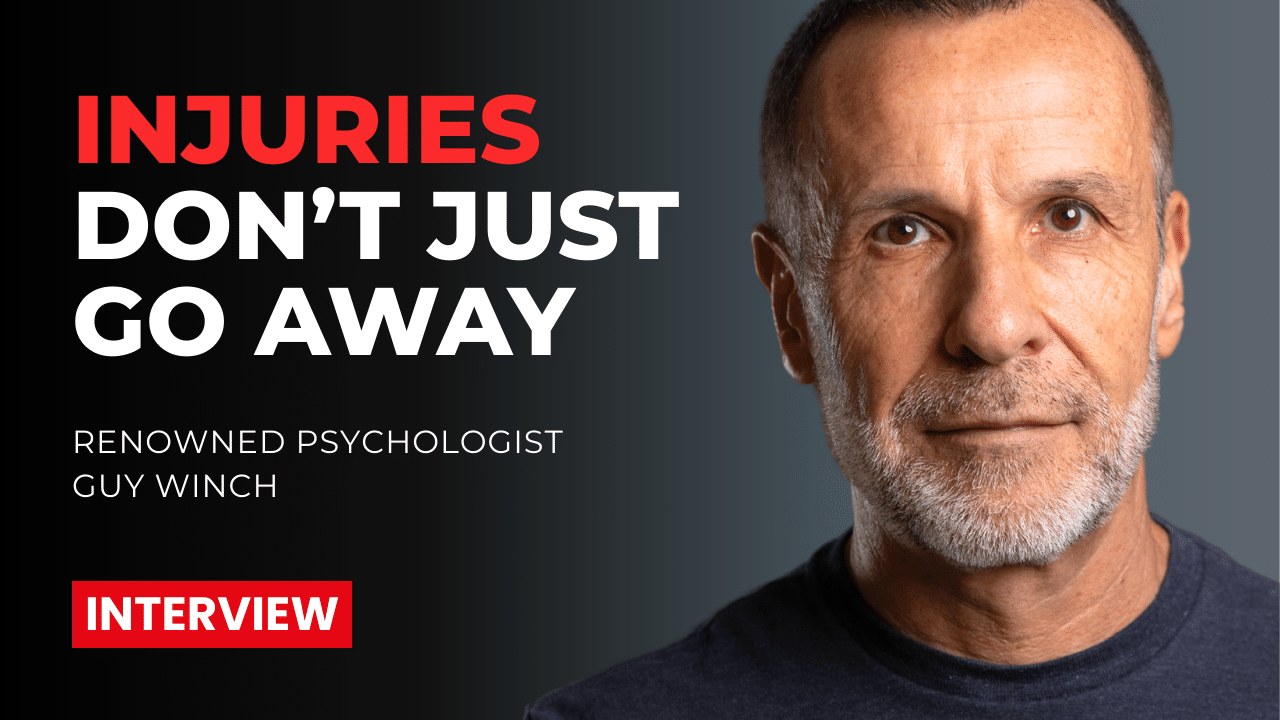
Dr. Guy Winch explains why we must treat emotional injuries with the same urgency as physical ones. “We ruminate, we beat ourselves up, we criticize ourselves, we think we’re weak… and we end up compounding the emotional injury.” He introduces the idea of “emotional first aid” and why we need a psychological toolbox to stop that downward spiral.
Guy breaks down the difference between how we respond to physical pain versus emotional pain. “We go to the medicine cabinet for a physical injury, but we have no cabinet for emotional injuries.” He explains why we must learn emotional hygiene: “The injuries don’t just go away.”
We also discuss how emotional neglect works and the long-term consequences of unacknowledged wounds. “The mind does not heal itself. The mind broods.”
Finally, Guy offers a new model for how to respond when people open up to you emotionally. “Start with compassion. You can offer logic later.”
Key Insights:
Insight 1:
“We ruminate, we beat ourselves up, we criticize ourselves, we think we’re weak… and we end up compounding the emotional injury.”
This explains why emotional pain often intensifies over time without care — because we engage in harmful self-dialogue instead of healing practices.
Insight 2:
“The mind does not heal itself. The mind broods.”
Guy challenges the myth that emotional wounds naturally heal. Without intervention, the mind tends to replay and deepen the pain.
Insight 3:
“We go to the medicine cabinet for a physical injury, but we have no cabinet for emotional injuries.”
He contrasts our well-established responses to physical pain with the absence of tools for emotional distress — and why this gap needs to be closed.
Insight 4:
“Emotional hygiene is about treating those injuries when they occur and trying to prevent them in the first place.”
He introduces emotional hygiene as a proactive and reactive strategy, just like physical hygiene protects against illness and injury.
Insight 5:
“Start with compassion. You can offer logic later.”
This is a clear framework for responding to others in distress — showing why empathy should precede problem-solving.
Action Items:
- “Start with compassion. You can offer logic later.”
Use this sequence when someone shares emotional pain. - “The first step is to recognize the injury for what it is.”
Acknowledge when you’ve been emotionally hurt. Label it. - “Would I say this to a friend? If the answer is no, then don’t say it to yourself.”
A reframe technique to interrupt self-criticism. - “You don’t take one antibiotic and stop. You have to do the course. It’s the same with emotional first aid.”
Practice emotional tools consistently, not just once. - “Rumination is like a psychological infection. And so what you need to do is stop the infection from spreading.”
Interrupt rumination cycles early. - “You have to override your own instinct.”
Emotionally healthy responses often require pushing against our natural urges to withdraw or self-blame.
Get Mind Over Grind, here: https://tinyurl.com/49mshdmv
Here are some free gifts for you:
Overall Approach Used in Well-Managed Strategy Studies
Enjoying this episode?
Get access to sample advanced training episodes
Episode Transcript (Automatic):
Kris Safarova 00:47
welcome to the strategy skills podcast. I’m your host, Kris Safarova, and this episode is sponsored by strategy training.com and we also have some gifts for you. You can get access to Episode One of how to build a consulting practice at firms consulting.com forward slash build. You can download the overall approach used in well managed strategy studies at firms consulting.com forward slash overall approach, and you can get McKinsey and BCG winning resume, which is a resume that led to offers from both of those firms and a great example of a resume to use at any level of seniority, firms, consulting.com forward slash resume PDF. And today we have with us guy winch, who is a PhD, internationally renowned psychologist who advocates for integrating the signs of emotional health into our daily lives. And his books have been translated into 30 languages, and his TED talks were viewed over 35 million times. Guy, welcome.
Guy Winch 01:53
Thank you very much for having me
Kris Safarova 01:57
so such an important topic. We are all so busy, both of us have to finish exactly at the end of this hour, and all of our listeners will be familiar with this feeling that there’s almost no time to just breathe, relax and to recharge. How can someone start fixing this issue? Because obviously, it’s very bad for your health. It’s bad for your relationships. It is bad for your ability to do your best work and contribute in a way you can contribute.
Guy Winch 02:27
Well, yes, I mean, you say that this is very bad for us to be working all the time, to be busy all the time, and to barely have a moment to catch our breath. But many people know that, or they’ve heard that, but they don’t really believe that. And there’s something especially when I work with people who are excited about their careers, who feel really driven and impatient to get there, to succeed. So yeah, I know, I know it’s not too great if you’re working too hard, or they say, No, I know it’s not amazing if you don’t have enough time, but I feel very productive, and I’m and I’m and I’m moving ahead and I’m learning and I’m advancing, but it really is a very dangerous thing that we do, and for two reasons. Number one, chronic stress has huge dangers to our physical health, and overworking has big dangers to our physical health, and when we are constantly switched on and working, that means we are literally in fight or flight mode all the time, and you might be in your office, but your body doesn’t distinguish well between the Fight or flight mode that you experience on a battlefield, and the fight of flight mode that you experience in the conference room or in a meeting or in the boardroom. And so it is as if you are at battle all the time. And the problem is that even when you are at battle as a soldier, you get R and R, you get rest and recuperation. You get time to go back, you know, to behind the front lines, so you can rest and recharge. But we don’t do that when we’re working. We keep working into the evenings. We keep responding to emails, we keep ourselves switched on. So physically, that’s dangerous for us, but psychologically, what I found when I did this research for my book is that what happens is that work starts to invade every part of our lives. Outside of work, it truly hijacks our sense of identity, our relationships, how we spend our leisure. It hijacks almost every part of our being without us necessarily noticing it. So we actually lose ourselves from work, and we become this two dimensional professional person who’s lost any richness about they who, about who they actually are outside of work. How can
Kris Safarova 04:57
someone start regaining as. Of who they are outside of work. It, you know,
Guy Winch 05:02
it’s interesting. Some people, when I say to them, Well, what did you enjoy doing before you get so busy at work? What were your passions? What were your hobbies? What would I catch you doing on a Saturday night or in an evening? Some people are very, very clear, and some people are not anymore. They’re like, I don’t know anymore. It’s been too long. I don’t even have time to ask myself what I would do if I weren’t working. Because they’re in some way or form, working all the time. 24/7, on weekends, they’re constantly checking email. You know, on the evenings, they’re constantly doing things. And so it’s actually important if you don’t know the answer to that, then you need to find out. But if you do, you have to ask yourself this question. There are other parts of yourself that are not expressed during the work day, the funny part, the goofy part, the creative part, the athletic part, the adventurous part, whatever it is, when are those aspects of your personality getting some stage time? When are you actually able to express that part of yourself? Because if you don’t, it is a narrowing of who you are as a person, and that’s why people are getting burnt out, by the way, not just because of the hours, not just because of the chronic stress and being in fight or flight all the day and then once they come home and then on weekends, but because there’s no oxygen to those parts of themselves that isn’t on that work Battlefield, mentally or not, physically or not and and so it’s so important to figure out, well, who am I other than work and You don’t need to spend five hours a day doing something if you’re a pianist, 15 minutes of practice will make you feel like a pianist again. You know a quick workout will make you feel like an athlete again. You know a little bit of painting will make you feel like an artist again. But you have to find ways to give some of that space and room in your life.
Kris Safarova 07:01
I used to be a pianist at the beginning of my career, and what was interesting about the way my life unfolded is I did not had any time. From the time I was around seven years old, there was almost no time. So if, for example, if I wanted to read a book, I read it through the night, because there was just no time during the day. And that continued for years and years and years, because I was in two schools, and both schools were very far away from home. And then sometimes you stay on a bus stop for a very long time. It was Russia, former Soviet Union, and then collapse. So it’s very interesting, I think that I’m an extreme case of having this kind of life, starting from very early age and then continuing into my adult life as well.
Guy Winch 07:48
I don’t think you’re that much of an exception, actually, unfortunately. Now, yes, you had three hours of travel on busses and delays, and piano is one of those instruments that takes a ton of practice time. I’m a twin when, when we were young, parents said, choose an instrument, and my brother chose the guitar, and I chose the piano, and we went for a week to lessons, and he came home after one lesson playing obla de oblada of The Beatles, because it’s only two chords. And I came home doing this the it took a year before I could play anything, you know, and so, because it takes so much more time with the piano, it’s very, very, you know, I think demanding. But today, what happens is kids are overly scheduled. And it’s not necessarily academics or piano. It can be sports a lot of the time, because they have the volleyball practice here, and then the soccer practice then. And on the weekends, they have the games, and they’re two siblings, so they parents have to take both siblings to one person’s game and then take the others to the other person’s game. And so there’s no free time to figure out. Like you never hear kids today saying, I’m bored because they have a minute to have, you know to be born, and that also teaches you to be scheduled and doing something all the time, every minute of the day, every minute of the evening. I think it’s very, very bad for children, and I think it’s very bad for adults as well, because, look, part of why we have so much burnout, and burnout is interesting today, because our awareness of work life balance of the importance is going up. We’re all talking about that. I’m sure you’re talking about that with all your guests, much more than we were five years ago, our awareness of why stress is bad has gone up. So with all this awareness going up, how come burnout is still going up? And the reason is still going up is because it’s not contained to the workplace, because work is built over it’s it’s taking over all those other aspects of our lives. It’s not leaving us time to not be working or productive, or thinking about work and thinking about being productive, and that’s the danger. So even though it starts at a young age, and again, I think here in the US very much. Kids are many places are completely over scheduled, as you were, and it’s not good for them, but adults even more so. And if you have the young children that you’re parenting, then you really have no time for yourself. And it just feels like, well, I can’t possibly start doing things. But again, you don’t have to do a lot. You have to just find the moments where you can back down from that stress where you can do the thing for 15 minutes that will feel recharging to you.
Kris Safarova 10:27
So your recommendation is, if you have 15 minutes to rest, don’t sit down and watch TV, but find something that allows you to connect to something you really enjoy.
Guy Winch 10:39
Yes, but look, resting is important, but so is recharging. So I think actually both are important, but what happens is our unconscious mind. In the book I talk a lot about, I try and explain about how our unconscious mind works, because it’s actually quite important for people to understand that, for example, when you come home, you can come home and say at six o’clock, not saying you, but like someone comes home at six o’clock or seven o’clock after a draining day at work. Now, what did they do all day? Basically, they sat face the screen or face the meeting. They sat all day. You come home, you feel drained from it, but our unconscious mind confuses physical exhaustion with mental exhaustion. So even though you’re not physically tired, you didn’t do anything. You sat all day, your mind is telling you, oh no, don’t do anything. You’re exhausted. Just rest on the couch, just watch TV or scroll social media. And your mind is telling you, don’t get up and do something. You’ll be you’re too tired for that, but you’re not too tired for that. That’s your unconscious mind running the show and confusing you telling you not to do something active because you’re drained when you’re not physically drained. And people know that when they force themselves to get up from the couch and go out and go to the gym or do the social thing or do the activity that they thought maybe I should do, when they come back, they feel more energized than before they left. They left. You can go to the gym and work out for an hour, expend energy, and you will feel more refreshed when you come back than had you stayed on the couch and didn’t do anything. People know that, but they forget it, because their unconscious mind is saying, no, no, it’s too exhausting. You’re too tired. Just stay where you are. We have to override these instincts and these impulses we have because they’re the things that are keep sending us in the wrong direction,
Kris Safarova 12:24
guy, and what is the mechanism that allows us to recharge, for example, when we go for an event or we go to the gym.
Guy Winch 12:32
So look, it’s very individual recharging. You have the things that we charge you, I have the things that we charge me. And we all have to kind of, I know that or figure that out. You know, if you’re a social person, then socializing will recharge you, and if you’re an introvert, it’ll drain you. So you need some alone time and again. If you’re a creative person, and you’re not expressing your creativity at work, then finding some time to do something creative will it will really make you feel kind of recharge, and so you have to kind of identify what that thing is for yourself. And if you don’t know to experiment until you find it, you will know you found it when you go into the state called flow. I’m sure you’re familiar with what that is, but for listeners who might not be a state of flow is a psychological state where you’re so absorbed in what you’re doing that you completely lose track of time. It’s the kind of thing that, oh, I just started to do these things, like, I’m an organizer. I started organizing my closet before I knew it, it was three hours went by, or I started drawing something, and then two hours went by, and I didn’t even realize because you were so absorbed in this task. It’s usually something you do with your hands, something that you can see progress, like drawing or writing, or, you know, doing, building. And so if you can go into flow doing something that’s something that’s recharging for you, because flow is a very revitalizing experience. Now you don’t have to lose two hours. Like I said, most people don’t have two hours to lose. But if it’s something that you you know did like to do, try it out. Do it for 15 minutes. Do it for 20 minutes, get up early and do it for 15 minutes before work, you will see that it actually accesses a different part of your brain and makes you feel refreshed in a way that no amount of screens will do okay.
Kris Safarova 14:15
And what are some critical things that we need to understand about our subconscious mind?
Guy Winch 14:20
So one of the things we need to understand is our subconscious mind is very primitive, so it doesn’t prefrontal cortex, where we have all the decision making and strategy and impulse control and thinking about consequences that’s recently evolved. The unconscious mind evolved earlier, and so it’s much more basic. It just wants to give you relief in the moment. It’s very emotional in the sense that if you’re feeling overwhelmed, I will give you relief. You’re thinking of doing this task that you really don’t want to do. You’re feeling overwhelmed by it, I will get you to procrastinate. I will get you to put it off. Or if you’re feeling upset about some. Saying, I will get you to like, you know what? I’m just going to surf social media for 10 minutes instead of, let’s say, getting up and taking a walk outside. You know, doing so our emotional mind finds very short term, quick solutions, which can be useful for a minute, but they’re not necessarily useful when we are stressed out. They’re not necessarily useful when we are overwhelmed. We need to be more strategic in our thinking, and they’re not useful for this kind of chronic daily work stress that we experience, because their idea of a break will be go check social media. Aren’t you curious to see if so and so liked your post? Don’t you want to see what your friend had for brunch yesterday, or where the other person cousin was on vacation? No, that doesn’t that’s not going to do anything for you, nothing. It’s not going to make you feel any better. But that’s the impulse, so you have to override it, and your unconscious is going to be like short term thing that feels like a good solution but is not thought through, you know, or you’re feeling upset, go tell your co worker what you think or why you’re upset. No, you’ll start a fight if you’re upset with a co worker, that’s your unconscious mind going, Hey, solve it quickly. Go do the thing. You’ll get relief. No, be a little more strategic. Figure out what’s going on. What are the politics? What’s the outcome you’re looking to achieve? How can you best achieve that outcome? All those things happen in the prefrontal cortex. That’s a deliberate, conscious, intentional process, but if you don’t pause to think first, if you just allow the impulse of I’m annoyed, I want to go express it, then it’s your unconscious mind taking over, and it will screw you up, because it’ll get you into an argument or get you into conflict, and it won’t resolve anything because you haven’t taken a second to figure out, what do I actually want here?
Kris Safarova 16:40
Many people are working incredibly hard because they have this belief that I’m not good enough, and they constantly trying to prove to themselves and people around them that they are good enough. And a lot of it is even happening on subconscious level, that belief that is driving your life. How can someone start taking charge of their own life, if that belief is sabotaging their life, basically.
Guy Winch 17:05
So yeah, beliefs can very much be extremely limiting. And the problem with beliefs is that we tend to hold on to them despite any evidence to the contrary. Once we believe, for example, that, Oh, I’m really lucky to get this job, and everyone else seems war. You know much better at it than me, and I’m not competent, and they’re all competent, and I just have to work five times harder than anyone else. If that’s what you believe about yourself, that you’re not good enough and you actually have to work harder, or that maybe you’re not good enough, that will impact your product, that will impact how you think. It’s as if you’re tying one hand behind your back and working only with one hand, because you believe you only have one hand. You to be able to maximize your productivity, you have to have accurate beliefs. And so those limiting beliefs are problematic, and they become a self fulfilling prophecy, because then you will overwork and try and overcompensate by working more, as opposed to working smarter, as opposed to figuring out. When I say to people, it’s like, okay, let’s pause for a minute when you say, I’m not good enough. Let’s say global assessment. It’s never global. You have many, many, many skill sets. Tell me the ones you’re really strong at, and tell me the ones you think you’re not as strong. What are your core competencies? What are you actually quite good at? And what are you not as good as you would like to be at? Be more distinctive, because then it’s not then it’s okay. Well, this actually speaks to where I’m competent and where I’m good. So I don’t have to worry about that that I can do. Well, here’s an area of weakness for me. So here’s where I actually want to spend more time, not just generally spend more time you don’t need to spend. We all have our strengths and weaknesses. If you don’t know what they are, you’re just trying to spend more time for no reason without actually spending it more wisely on where you need to spend it so and again, that’s our unconscious mind kind of just shoving the leafs at us or fears. These are anxieties, really, rather than just beliefs and us responding to it, as opposed to saying, no, no, wait, what am I good at? Oh, I have to do this task again at work. Well, the last one I did, I did pretty well at maybe I don’t have to stress out too much, but if it’s this task and this one I kind of screwed up a bit last time. Here’s where I want to be much more cautious. And maybe I want to get some advice, and maybe I want to show it to a co worker before I submit it. And maybe I want to get myself more time to do it. You have to be strategic in how you manage yourself.
Kris Safarova 19:37
Are there any exercises you could share with our listeners on reprogramming a particular belief that they feel is a huge limiting belief that is holding them back and forces them to work too much, not valuing themselves enough, not letting themselves rest enough.
Guy Winch 19:53
Yeah, so, so here’s, here’s something. Well, I explained it this way. Where does this belief get? So? Set up. Where do the limit limiting beliefs get set up? Most of them, and there are exceptions, but most of them got set up years ago. They’re not fresh, they’re not new. They’re like something we’ve carried with us years ago. And what that means is that there are years out of date. We’ve had years of evidence that we’re ignoring that is not changing that belief, because we do hold on to our beliefs. It’s the same with our self esteem, right? It gets set up when we were 1415 years old, based on the feedback of by the way, 14 and 15 years old, you know, year olds now, we wouldn’t walk around as adult today basing our self esteem on what a 15 year old told us, but we kind of do because that’s what got set up when we were 15, and we haven’t updated that. So we have to update our beliefs. I believe in an exercise I call doing a software update for your internal beliefs, for your self esteem, for your competencies, for how you feel about yourself, and that means you actually have to look at current data. So when you have a limiting belief, ask yourself, what is the belief? Write down what the belief is, and ask yourself where that got created. When did you first start feeling that or believing that? And it’s probably going to be quite a while ago, and then ask yourself, what evidence is there to the contrary? Like, what are the most recent things that happened that actually contradict that belief? Maybe there’s some things that support it. There’s always going to be mixed, but they’re going to be some things that contradict it. And then you have to literally do this kind of update by reminding yourself, like, oh, but all these things have happened. So this is actually more of a fear than a belief. It’s more of an old wound that I’m still, you know, bleeding in a way, because I’ve showed myself over and over again that I can do this thing. I speak to people who like me, who are writers. Every time they have a new book, oh, I’ll never be able to write it. And then I say to them, yep, you said that about every book. No, I know, but this time, this time, I really won’t be able to write it, yeah, but you say this time every time, and it’s like, you know, you show them that like but you always say the same thing, and you always manage. So instead of saying to yourself this time I won’t be able to, why not say to yourself, I always feel like I won’t. I always worry that I won’t, but I always manage, at the end, why not give yourself the reassuring belief to balance out the historic, inaccurate, limiting one, and that’s the exercise to kind of identify where the limiting one comes from, and then to come up with a reassurance based on data, not make something up based on recent data, which you will find. And then every time you have this unconscious impulse of like, Oh, but I can’t or Oh, but I’m not good at that, or Oh, but people are better, yes, but actually, I did that well last time. Or it took a lot of effort, but I ended up doing quite decently, or this is the time that I was quite successful. So I’m reminding myself of that too. This is consciously balancing out, deliberately adding in the plus when the unconscious is sending you the minus.
Kris Safarova 23:15
Do you have any additional thoughts for people who have symptoms of ADHD and how they should approach the situation of not being completely exhausted all the time.
Guy Winch 23:27
So look, I have a specific belief about ADHD, and I believe it’s a potential, potential superpower, because ADHD, it’s, I mean, I don’t like the name. I think the name is a is a mistake, because it’s attention deficit disorder and hyperactivity, perhaps. But in fact, people with ADHD, when they find the right task, can hyper focus. They’re known to be able to like zoom. If it’s something that interests them, they will zoom in like crazy, they will be great at hyper focusing. So it’s more like a a light that you need to focus like a laser, and then you’ll do well. But ADHD requires a lot of self discipline and habit change. You have to know that whenever you have the impulse of, Oh, I know what I’ll do now. I have a great idea. I’ll do that other thing rather than the thing that I’m supposed to do. You have to have the self discipline to develop habits, like, when you start something, finish it. You must finish it if you want to move on, finish this first. You know, whether it’s a small task for the moment or, you know, like if you’re working on a bigger project and Oh, but I have an idea for another project. No, no, you don’t get to do the other one until you finish this one. That’s about self discipline. It’s catching the impulse. Oh, great idea. That’ll be better. You just spent two hours on this. Finish this. Don’t handle it five times. Handle it once. I. Don’t procrastinate. People with ADHD procrastinate a lot. They like to put things off. Why? Because they’re unpleasant and they’re boring potentially. So that’s boring. I don’t want to do it and well, but you’re going to have to do it at some point. So what happens if you put it off is that half an hour of stress becomes a week long of stress, because for a week you’re going to think in the back of your mind, I have to do that thing, but I won’t do it now, but I really have to do that thing, okay, but not now. So it’s actually constantly there and nagging at you, and you’re allowing yourself to supersize the stress. And what I recommend to people, and I talk about this in the book a bit, is like the best way to deal with the impulse to procrastinate, which is again, very common to people with ADHD, is to think of these tasks rather than as unpleasant or boring or annoying as nuisances. Because nuisances are small things we take care of right away, like if you have a pebble in your shoe or an amazing tag that’s in the back of your shirt that’s annoying you you don’t walk around with a pebble in your shoe all day going, Oh, I’ll do that later. You just stop and take it out because it’s a nuisance. You just rip the tag out because it’s annoying. Think of the tasks as nuisances to get rid of rather than procrastinate. And there’s one other thing I talk about in the book that’s highly related to people with ADHD, and that is time management. People with ADHD often are not so great with time management. They often late to places with tasks, it’s quite it’s quite common, and often the blind, often, is because of a blind spot. You know, it’s not just, I mean, because if you’re come to work every day late, and you take the same route from your home to the office, how have you not figured out when to leave in order to make that happen. And this is what your boss is going to think like, but it’s the same route every day. How are you constantly late? Why can’t you just leave earlier? And the reason you can’t leave earlier is a because, oh, I’ll just do one more thing before I leave. That’s going to take two minutes. It will take 10 you’ll be late, but now I can do it. So catching those kinds of blind spots, or they do the math, no, the commute takes this long, and the subway takes this long, and the bus and the train take this long. You know what? They don’t count. How long it takes to get from the subway to the exit, how long it takes to get from the Parker, from the car park to the office building, how long you have to wait for the elevators sometimes, or how long it takes to get from the elevator to your desk, which could be three minutes away, and all those things add up. And so there are certain blind spots. And in the book, I talk a lot about different blind spots we experience in the workplace, time management being one of them, office politics, being another and all kinds of blind spots that really trip us up and ending up costing us quite a bit, and how to catch them, and what methods you need to put in place in order to catch them. People with ADHD really need a lot of that. We call it scaffolding, like the external supports, because their internal ways of doing things are faulty. And if you can put the scaffolding in place to avoid those pitfalls, you’ll be able to avoid a lot of them. And then suddenly your diffuse attention can get focused, and then you become having a superpower.
Kris Safarova 28:36
By the way, this is incredibly helpful. You need to write a book on ADHD.
Guy Winch 28:40
Well, there’s a lot of it in this one, because, you know, it’s a common thing.
Kris Safarova 28:46
What is very common with ADHD symptoms is even when you try to finish a task, let’s say you already invested a lot of time, and it goes to ridiculous lens. You can write a book, you have spent a year writing it, you have 2% left, and you leave it, and it never gets done. And what is very common is you get stuck. Something becomes too difficult to figure out the right way to do it, and you get stuck, and then you leave that project, and it seems to be connected to perfectionism, but maybe it is something else, what they think it is.
Guy Winch 29:23
So yes, but I want to get into a little bit more detail about the stuck point, because yes, you do get stuck. But here’s what happens to most people. They feel stuck, that strong feeling of being stuck, like I can’t get past whatever the point is that they’re at in the project, and that’s where it ends. In other words, they don’t do a deeper dive to figure out, why am I stuck here? Why am I stuck now? And before they can figure it out, they will think of another brilliant idea that, Oh, I know. I’ll do this project instead. I needed to do that anyway. And then they just then, that’s when the distractibility happens, and off they are doing something else. The stuck point is often about something that’s unresolved. And I don’t mean psychologically, I mean strategically, like, let’s say, you say writing a book, there’s something that’s not working at the point that they’re at something isn’t quite working. So rather spend the time analyzing what isn’t working for me here. Is it that I’ve come all this way, but now where I think it’s going to go isn’t going to be good enough? Do I have to go back and re tweak something two chapters ago? Or is there a conflict here that, oh, now this is actually a contradiction, so I have to figure out what’s the contradiction. In other words, they don’t dive deeper into what the problem is. They just feel like it’s not working, and they don’t do the deeper dive, and then that feeling of it’s not working feels like I’m stuck. I’m stuck, or, you know, people say like I have, you know, like I have writer’s block, and I’m like, there is no such thing as write writer’s block happens only one time. When you start with a blank page and without a plan, then you’re going to have writer’s block because you don’t know what you’re supposed to work on at any other point, whether it’s a novel, whether it’s a book, whether it’s an essay, whether it’s an article, whether it’s a report, it doesn’t matter. Then did you have an outline? What’s supposed to happen next? Why are you having trouble going from where you are to what’s supposed to happen next? Spend time figuring that out, because there’s something there that’s tripping you up. Once you figure it out, fix that. And if you’re not sure what it is, go back a few pages, read and then your head will come up, because something’s not right. Figure out what’s not right? You can’t figure it out. Put it aside for a day. Read it with fresh eyes. You write on a computer, read it on a phone. Read it in a different format that will trick your brain into thinking you’re reading somebody else’s work. Read it aloud. It’ll often help you figure out something’s not but spend the time figuring out where you’re stuck and why you’re stuck, and fix that. It’s that, it’s that analysis that people with ADHD skip, and it just they have the bad feeling that something’s not working, and that’s why they give up instead of analyze. But what’s not working? Why isn’t it working? I wasn’t I was excited up until 10 pages ago. What happened here? Let me go back 10 pages and figure out, what do I need to do to be excited again, spend the time on that, and once you fix it, you’ll be able to go forward.
Kris Safarova 32:28
So that point when you get stuck, you shouldn’t treat it as a nuisance, which was your early advice,
Guy Winch 32:33
because that’s actually a bigger law. The nuisance is a quick thing. Just finish the expense report. Finish that email that you don’t like writing because it’s a difficult email. This is a little bit more. This requires analysis. This requires thought like what is not working for me here, and the discipline of you may not start a new thing until you finish this.
Kris Safarova 32:55
This is a very, very powerful rule for yourself, and they have it written in my notebook as well for myself, because I have that issue as well, and many, many highly driven people have this issue too. You’re probably familiar with the book The Body Keeps the Score, and in that book, the author writes that, if I recall correctly, they did a study, and out of people who had trauma in childhood, about 80% of them had ADHD or ADD right.
Guy Winch 33:26
Look, here’s my concern about, you know, it’s a great book today, my experience on social media is that it is this, this the use of trauma is way overused. People are, well, I’m traumatized. I have trauma when they don’t have actual trauma. Actual trauma is a life threatening situation, or one that seems life threatening, that truly changes the rewire, the wiring in your brain. It has a huge physiological impact, and people are using that term today way too casually about things that are not official trauma. They’re upsetting, they’re scarring, maybe in some way, but they’re not bonafide traumatic. Actual trauma is not as common as we tend to think. We’re just overusing that word, and unfortunately, many of us are using it not to figure something out, but to excuse something. I can’t do that because of trauma. I’m not successful because of trauma. I acted poorly because of trauma. I can’t, you know, do the things I would like to because of trauma. It’s true for some people, but way fewer than are saying it. And so I’m a little cautious about that term. It’s a, you know, it’s something that should be used very, very carefully and really based on extraordinarily life circumstance, which many people have. I’m not saying that’s that’s not true, but, but you have to ask yourself. How am I using trauma like? What is that? Let’s say I feel I have trauma. So then what are you saying? I have trauma, therefore I cannot or I have a trauma, therefore I need to figure out how to get over this challenge, because it will be more challenging for me. Is that a reason to stop the journey or to not start a journey? Or is it a reason to understand why this journey might be a little bit more difficult for me. I have to figure out how to do things in a slightly different way. Because of that, if it’s used as a reason to not have a concern, if it’s used as a information to explain why you need to think about certain things strategically, or maybe find a detour here or go about it slightly differently, fine, but why are you using it? What is it justifying in your own head? That’s what you have to be careful with, definitely.
Kris Safarova 35:48
And in the study, it was actually people who had real trauma, as per your definition, and I agree with you, you have to be very careful.
Guy Winch 35:56
And just one thing, even in that study, that’s true. So people who have studied are much more likely to have who have trauma are much more likely to have ADHD. Oh, okay, so then what? What is that? So? What? So, yes, so you have to have more of the scaffolding. You have to have more self discipline in certain ways. You have to be a little bit more intentional about how you do things because you have ADHD that might have come from trauma, but that’s the so what? It’s not like, oh, I, you know, like, well, I didn’t do well because I have trauma. If you know that, then how are you working around it, or working with it, or working despite it? You know what I mean, that that’s like, yes, so you have from trauma. So what are you doing about it? So how are you using that to go forward anyway, as opposed to using it to excuse why you’re not
Kris Safarova 36:49
definitely, I also wanted to ask you about sleep issues. So for people who are highly driven, people who are listening to us right now, they often have an issue with falling asleep, because the mind is keep on working and thinking about all the issues they have to address. What would be your recommendation for our listeners on how to get better sleep and fall asleep easier?
Guy Winch 37:13
So look, I’ll tell you this. When I give talks, I give talks a lot to companies and corporations, and I ask the audience, some people say, What time does your work day end? And they’ll say, six o’clock or seven o’clock or eight o’clock. They’ll give me the hour at which they either leave the office or close their laptop at home, say, and that is not when your work day ends. Your work day only ends when you stop thinking about work. That’s when your work day ends. So you might not be in the office, you might not be sitting by your laptop, but if you are ruminating about work, if you are still thinking about work, you’re still at work mentally and again, your body doesn’t care whether you’re physically there or not. It’s still activated like you’re at work. It’s still in fight or flight a lot of the time. And so people get home, they keep checking emails, they keep talking about work. They keep ruminating about work, they keep thinking about work and surprise, surprise, they can’t fall asleep. Well, no, you can’t go from the battlefield to bed. Where’s How do you where do you quiet your mind? Where do you come down from that? You know, we have the sympathetic nervous system that activates that gets us into fight or flight mode, and we have the parasympathetic nervous system that calms things down. When are you engaging your parasympathetic your parasympathetic nervous system? When are you actually exhaling and stopping to think about work? When are you switching off? And so people have trouble sleeping when they’re not switching off. And I’m sorry if you’re going to bed at 11, you can’t switch off at five to 11 and think they’re going to fall asleep. Your body needs this is not an instantaneous thing. It takes time for your brain to calm down, to cool down, like an engine, if it just ran like crazy for 12 hours, give it time to cool off. You can’t just turn it off and then start the ignition again. You like, it won’t start. So you have to build in some kind of, you know, coming down, calming, quiet moments. And by moments, I mean ideally, two hours, an hour, if you don’t have two hours, 45 minutes, but you can’t go from i just finished this last email about it. Now I’m going to bled. Good luck. You’re not going to fall asleep for that obvious reason. And people say, Well, I’m not a child. My child needs to like, you know, when you have kids, you’re like to start coming down now, because sleep time is coming. So we want to be quiet. Indoor voices, no excitement. You change the music. We’re the same as the kids. Our brain is the same. We need the quiet. We need to actually do something to, you know, relax and in whatever relaxes us, you know, before we go to sleep. Otherwise, we won’t fall asleep.
Kris Safarova 40:20
What are some of the effective ways for someone who is not even sure what to do, everything seems to not help them to calm down their mind. Even if they try to watch a show or they try to read, it just doesn’t stop the mind keeps racing.
Guy Winch 40:35
Yes, but here’s the thing, if the mind is when the mind is racing, it’s usually racing about something, and let’s say, usually about work in that kind of scenario. And we call that ruminating because ruminating is when you are just kind of repeating the same thoughts or worries or scenarios, replaying them over and over again. And so let’s say you had a, you know, like you’re under pressure. You have to produce this thing. There’s a deliverable you have to get to by the end of the month, or you’re having conflict with a co worker, or your boss is, like, really kind of, you know, micromanaging you, and you don’t like it, and you’re obsessing about that at night. So ruminations are intrusive thoughts when you’re trying to not think about work, and thoughts about work are popping into your head intrusively. That’s rumination, and it’s actually very difficult to control, because when we are ruminating about that thing, the boss said that really upset us, it feels like we’re doing something really important. No, I need to be thinking about it. Well, you’ve been thinking about it for three hours. Yeah. For three hours and you’re just replaying the meeting over and over again. Like people tell me, like, oh, I had this meeting and the boss said something really annoying, and I spent the entire evening thinking I could have said this, and what if I had said that? I know I should have. I should have said this and then said that, and like, it’s done. It happened. Why are you writing scripts about how it could have gone differently the moment passed, that’s pure rumination. There’s no point to it. Now. It feels really compelling. It feels momentarily satisfying to imagine. Ah, that’s what I could have said, great. But you’re going to keep thinking about it anyway. So when you’re ruminating, you have to catch yourself, and the way you know you’re ruminating is a, you’re repeating the same thoughts over and over and B, you feel it in your body, wherever you feel stress, if your chest gets tight, if it’s your shoulders, if it’s your stomach churning, if it’s a headache, where you feel stress, you feel it because you’re generating that stress over and over again by these ruminative thoughts. It is your unconscious mind wanting you to keep thinking about work because it, you know, because you’re so activated you’re in fight or flight again. Unconscious mind thinks that’s like a battlefield. Let’s you can’t turn your back on the war. You got to keep thinking about it. You got to keep on alert, you know. But it’s not a war, it’s an office you can turn to being alert at 1030 you know. And so you you have to catch that you’re ruminating. Step one, you have to label the repetitive thought or the repetitive thing that you keep thinking about as rumination, so that you know it’s pointless. It’s useless. Step two and step three, you have to convert it into a problem solving question. Because when you convert something into a problem solving question and you answer that question, it eases stress. When you just swirling and ruminating, it makes stress bigger. So you want to convert that thing into a problem solving question. So let’s say your boss said something rude, and you’re rude, and you’re ruminating about that and fantasizing about everything you would have said. The problem solving question there is, do I want to do something about this tomorrow? Do I need to talk to my boss about, hey, that was very embarrassing, the way you did that in the meeting. Or should I figure out why my boss did that? Were they annoyed with me, or was it that I actually cut them off a little bit earlier? Or were they upset with me for something else? Let me figure out why they did that, and then whether I want to address it. Or maybe my boss is not that emotionally intelligent, and they didn’t realize they were being rude. They were just they tend to do it to anyone. It’s not personal, and it doesn’t mean they don’t like me. It’s just how they are. They’re just kind of a bull in a china shop. They were and I just That’s them. I don’t need to take it personally. Whatever the question is that you’re trying to figure out pose it as a problem, like, is there something to be done? If there’s something to be done, what? And what’s the best way to achieve that goal? And what am I trying to achieve by saying something? And if so, how do I do it? And if not, Bill, that’s just my boss. I need to get used to it. Then, all right, but do I need to think more carefully about speaking up in meetings? Because if they can just do that, it feels so unpleasant, maybe I’ll just be super confident that I’m saying something they won’t disagree with it. First, you can strategize, but the minute you figure it out, you can let it go. Now, if you’re just repeating and swirling and going through the same worries over and over again, it stays there. It sticks so that’s the step like identify that you’re ruminating because you’re repeating the same thoughts over and over again, and you’re feeling, you know, in your body, the feelings of the stress, the upset, the distress, whatever it is. Label it as rumination, convert it into a problem to be solved, solve the problem and put it aside.
Kris Safarova 45:29
That makes a lot of sense, guy, and what will be your recommendation for our listeners who are currently worried about what’s happening with AI technology, worried that they will become obsolete, that they may lose their job, and all the work they have invested over decades to get top grades and get into great MBA program and then get into a great company, and all of that just seems to be under threat now.
Guy Winch 45:56
There is a ton of worry and anxiety about AI in many, many sectors, in the workplace, and for good reason, you know that a there’s some sectors that know that they’re going to, you know they’re already experiencing, you know, cuts and cutbacks, and there are others that they know they will. So the question is a more general one, about, what do we do with job uncertainty? What do we do when we’re in one of those companies that we know layoffs are coming in three months? And you know, the companies that I worked with and people in the companies I’ve worked with who’ve had mergers that went on for two years with three rounds of layoffs, and the minute they were done, they merged with another company. So another people have been living under the threat of layoffs for years. It’s that same question about uncertainty. Job uncertainty is very, very damaging to us. We do not get used to it. It’s not something we adapt to. There’s certain kinds of stresses we can adapt to quite well, and we get used to Job uncertainty is not one of them. It’s actually really, really damaging. It really stresses us out. It makes us feel dread, and it will keep us up at night. And what keeps us up at night is the uncertainty and the lack of control we have in the situation. The one good part there is that a feeling of certainty and control is a psychological concept. You can give yourself feelings of more control than you might actually have. So just as a general example, you’re in a sector that you think might be influenced by it might be impacted by AI. It is already you think it will be. You’re living in that worry about what you know, everything that I’ve done. Number one, how do you gain control? Okay, number one, Plan B. What’s the plan B? Let’s say AI will start impacting. Start thinking ahead. What can I do? Where can I pivot? What kind of specializations do I need to have, or if there’s going to be a lot of cuts, what specific, special skills do I need to have that they’ll be like, Well, let’s not use let’s not lose her, because she’s the only one who can do this. How do I make myself indispensable? How do I make myself more valuable to you know, what are the extra education? What experiences do I need to volunteer for at work? What how do i maneuver politically? Are there any re specializations in the future that I can think of, if AI does come in at what level would it come in and what jobs will still be necessary? Do I need to get promoted to a certain level now? Or actually is my time that is spent not focusing on getting promoted, but in specialized in what I’m doing already, because that will, you know, it’s a problem to be solved. It’s a strategy. It’s a it’s a professional career strategy that you have to start mapping out. So I’m not minimizing I’m saying take it super seriously. But if there’s a threat coming, plan for it. Have a Plan B. Have a Plan C. Figure out what you can start doing now, what you can start doing in the future, once you have it be like, Okay, what’s the first sign that I might see that this is happening? Am I going to be in the first line of people? Am I like first out, first last in, first out, or do I have a little bit more, you know, you know, coverage and some, some buffer room. You know, the minute you start to strategize, the minute you have a plan, the minute you start taking actions to mitigate risk that you might have professionally, you will feel less anxious and you will feel less dread because you are doing things you are taking control of a situation in which you don’t have a lot of control. Like, but here’s what I can do. In the meantime, I can do stuff. Let me figure some of this out. Let me do what I can do that will reassure you and strategically, it’s important to do anyway.
Kris Safarova 49:30
Guy, thank you so much. This hour just flew by and loved speaking with you. Thank you so much. Where can our listeners learn more about you? Buy your books, anything you want to share?
Guy Winch 49:39
So my website is Guy winch.com that’s W, I n, C, H. The new book is called mind of the grind, how to break free when work hijacks your life. It’s out February 10, so I hope it’s out already by the time this airs, and it can be and it is in bookstores anywhere you can order, it will be online. It’s an e book. It’s in hardcover, and it’s in an audio. The book, which I narrate myself and other information and everything about me you can find and links to my social media you can all find through the website, which, again, is Guy winch.com
Kris Safarova 50:11
thank you again, so much for being here. Thank you so much for having me. Our guest today have been guy winch. Such an amazing discussion. I hope you guys enjoyed it just as much as I did. You can get guys book mind over grind. And you can also get some gifts from us. You can get access to Episode One of how to build a consulting practice at firms, consulting.com forward slash build. You can get the overall approach used to involve manage strategy studies at f, i, r, M, S, consulting.com forward slash overall approach, you can get McKinsey and BCG winning resume example, which is a resume that led to offers from both of those firms at firms consulting.com forward slash resume. PDF. Thank you so much for tuning in, and I’m looking forward to connect with you all next time.
Leave a Reply