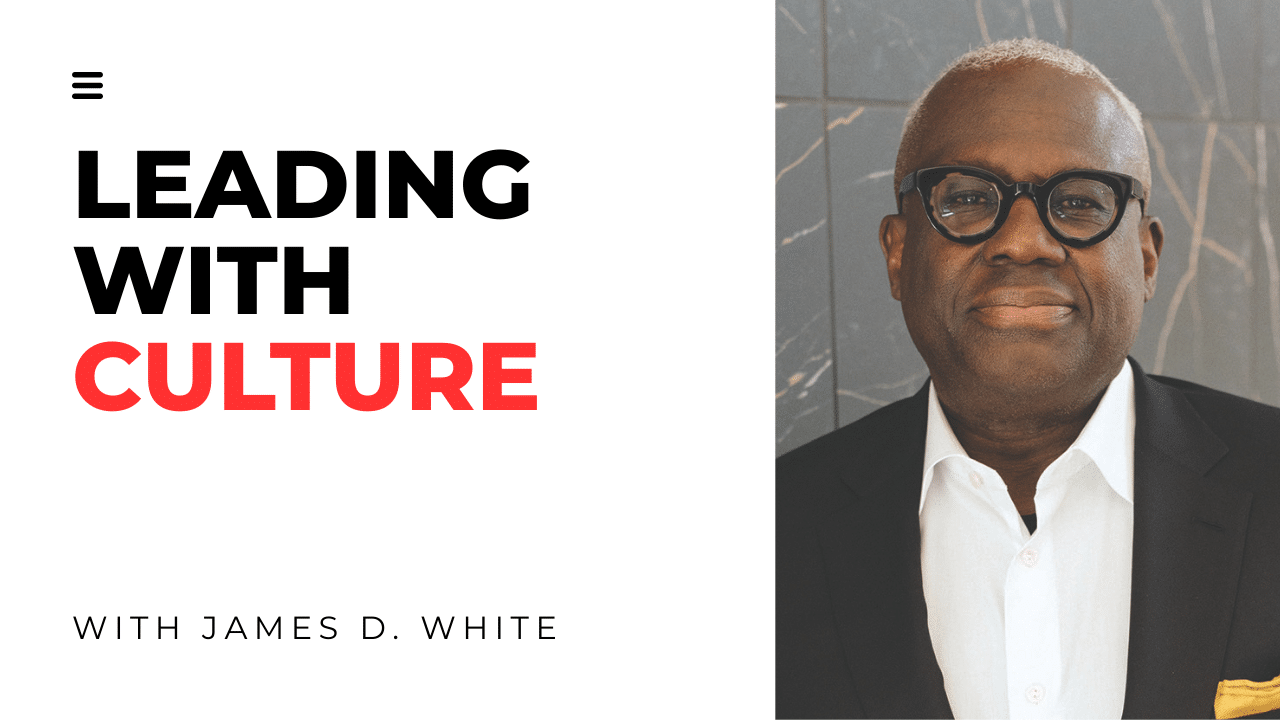
James D. White, former CEO of Jamba Juice, current board chair, and coauthor of Culture Design, shares how culture becomes a management discipline rather than a slogan. Drawing on his eight-year turnaround of Jamba, service on more than 15 boards, and leadership toolkit, he explains how listening, rituals, and disciplined systems embed values into sustained performance.
Selected takeaways for senior leaders:
- Start with stakeholder listening. White began his turnaround with nearly 200 “start, stop, continue” inputs across employees, suppliers, and board members. “I always start by listening,” he says, because the people inside the company “actually know what’s required to make the company run better.”
- Make culture intentional. “Companies have culture by design or default.” Define what matters, create rituals that reinforce it, and remove practices that contradict stated values.
- Reduce the say–do gap. “The really important things from a leadership perspective is what we say versus what we do, and minimizing the say–do gap.” Simple rituals—forums, recognition, measurement—align words with actions.
- Invest in people individually. “People don’t care how much you know until they understand how much you care about them personally.” One-on-ones and role design that lean into strengths unlock discretionary effort.
- Demand transparency. White is direct: “I want bad news first.” Candor allows leaders to respond before problems multiply.
- Design mechanics, not just rhetoric. From anonymous feedback channels to departmental listening sessions, operating processes must “make it easier for our stores to deliver great products in the most efficient fashion.”
- Balance preservation and change. Protect what works—“fantastic products” and passionate employees—while reallocating resources. One example was adding steel-cut oatmeal for colder markets, paired with smoothies.
- Measure what matters. “Anything that matters, you always measure it.” White combines Gallup Q12 surveys, pulse checks, and qualitative indicators like recognition letters to monitor engagement.
- Clarify board vs. CEO roles. “The CEO is responsible for running the company… the board chair is a facilitator of the collective board.” A strong chair–CEO relationship unburdens management while channeling board expertise.
- Exit with care. Not every role fits every person: “You often… get to a place where you free up people’s future to go do something else. You do it with kindness and grace and thoughtfulness.”
For executives facing turnaround, scaling challenges, or governance decisions, this episode offers a tested blueprint: start with listening, design culture deliberately, align actions with words, and lead with humanity.
Get James’s book here:
Here are some free gifts for you:
Overall Approach Used in Well-Managed Strategy Studies
Enjoying this episode?
Get access to sample advanced training episodes
Episode Transcript:
Kris Safarova 01:08
Welcome to the Strategy Skills podcast. I'm your host, Kris Safarova, and this episode is sponsored by StrategyTraining.com. You can download the Overall Approach Used in Well-Managed Strategy Studies at staging-df81-firmsconsulting3.wpcomstaging.com/overallapproach. You can also get McKinsey and BCG-winning resume, which is a resume that got offers from both of those firms. And you can get it at staging-df81-firmsconsulting3.wpcomstaging.com/resumePDF. And lastly, you have a new gift today, and it is access to the first episode of the program, How to Build a Consulting Practice, and you can get it at staging-df81-firmsconsulting3.wpcomstaging.com/build. And today, we have with us James White, who is a former CEO of Jamba Juice, where he led the successful turnaround of that company. He's an experienced corporate director and advisor serving on more than 15 public and private boards. And James currently chairs the board of the Honest Company, and he is also a co-author of the book culture design. James, welcome.
James D. White 02:14
Kris, thanks for having me. Just thrilled to be with you and your audience.
Kris Safarova 02:18
I would love to start a little bit with your story, and the first question I have for you today is, what in your childhood prepared you for executive work, even if you didn’t realize it at the time?
James D. White 02:31
I think one of the things that I firmly believe is the challenges that we have in life and the lessons that we learned through those challenges really prepares for leadership later in life. So for me, one of the critical stories was really early in life. I struggled in a fourth grade class and was tracked to a slow fifth grade class and one of the first really important leadership lessons I learned was from my mom, as she intervened on my behalf and was such a fantastic coach and showed such great empathy both of those that brought with me to all my future leadership roles. She also reinforced the power of learning to really change a life, and I think that applies from a corporate perspective. I view myself as a lifelong continuous learner, both when I was in operating executive running companies and also in the boardroom.
Kris Safarova 03:36
And what did your mom do that made such a big impression?
James D. White 03:40
I think the the main thing is she listened to me. She created space for me to do my very best work in my own unique way. And she was a huge advocate for for me as an individual, and I think all those things become really important as we think about leading companies with great empathy and seeing kind of humanity in all the people that we lead and the companies that we run.
Kris Safarova 04:20
Yes, when we have a mom that believes in us, nothing can stop us. This is everything is possible. When you were a teenager, did you already see business as your part, or did something changed?
James D. White 04:31
Business relatively early on, was my path, but I thought I would play sports. And you know, one of the actually fortunate. Other life lessons for me is that basketball wasn’t going to be in the cards for me beyond the junior varsity in high school, and after being cut in basketball, I ended up being joining the debate team, and that helped me build really great communications. Skills and storytelling skills that aided me from a business perspective, but I ended up towards the end of high school, being exposed to business, and that became my path, kind of after I gave up basketball.
Kris Safarova 05:14
Do you remember the first time when you realize you know what I’m going to run a company one day?
James D. White 05:18
That was probably a decade into my professional career, for me, my background, I was the first member of my family to graduate from college. So it’s a far stretch for me to believe that I’d run a company or sit on public company board. So the first time I was at a place where I could see that it might be possible, as I had really significant early leadership success at both the Coca Cola company and then later at Nestle Purina, I had successive leadership roles, and was clear that I could have an opportunity to run a company somewhere in the future.
Kris Safarova 05:59
When you first got senior roles, what surprised you?
James D. White 06:05
I think the biggest surprise is I moved into Senior Operating roles was the lack of leadership capabilities that I saw around me as I looked at peers. So one of the things I learned early on, my first management role of people was at the age of 24 at the Coca Cola company. And one of the early lessons is people don’t care how much you know until they understand how much you care about them personally. The other lesson that I learned at really an early age is you lead teams and organizations individually, and the best leaders learn early on to get discretionary effort out of their team. We all have work that we do because we’re paid, but the discretionary effort comes from trust and belief and kind of the one on one connection to the leaders that we work with.
Kris Safarova 07:05
Well, those of our listeners who are currently thinking, I definitely feel I can get a lot more out of my team. What would be your advice?
James D. White 07:13
I think the biggest advice that I would have is to invest time in your team individually, and get to really know the human beings that make up your team, and really understand the things that motivate them individually, and then work as hard as you can to remove barriers that sit before the team, and to make investments in places where you think they can learn and grow, and maybe the most important lesson is to find the things that the team and individuals are strong at and encourage them to really leverage those strengths. Most leaders look at what we can’t do and have us to work on those things. And I always focus on strengths and really want individuals to leverage their gifts and their strengths to really impact the company and the business differently.
Kris Safarova 08:10
James and when you have a team member who is talented but then not committed enough or really disorganized so you never can rely on them, at what point you will decide, okay, I’ve done everything I could coach them, and maybe another role will be a better fit for them, or even maybe not within this organization.
James D. White 08:29
I think the main thing is, once the leader is investing more in the individual’s development and growth and spending more time than the individual is committed to. You get to a place in time where you want to understand if the challenges or a skill based challenge, where you can make investment and grow skills and the individual can make progress, or if it’s a will challenge, whether it’s just a lack of interest in this world for whatever reason you often, as I say, get to a place where you free up people’s future to go do something else. You know, because not every individual is a perfect fit for every organization or the expectations of the organization.
Kris Safarova 09:15
Absolutely so when you go through this process of freeing up someone’s future, what are some of the things people should keep in mind to do it?
James D. White 09:24
Well, I think you’ve got to be kind, you’ve got to be thoughtful, and you’ve got to be human. And for me, what I always think about is I want to interact with people and treat people the way I would want to be treated. So as long as you’re having open, honest and straightforward and direct conversations. I think you get to a place and if, if the end result is that there is a transition where someone’s future is being freed up, you do it with kindness and grace and thoughtfulness.
Kris Safarova 09:56
So Jamba was a turnaround. What is the first thing? You looked at when you took over?
James D. White 10:02
Well, what I attempted to do when I took the job at Java was to do as much homework as I could. I talked to as many stakeholders outside of the company and importantly, kind of inside the company. So one of the processes that I always go through with a new role or opportunity is I want to have stakeholder discussions, and I went through a process in some initial Town Hall discussions with the team, and I wanted to know what are the things they wanted as they thought about what Java might do differently, what things should we stop doing that weren’t value added? What things should we start doing that were new that would help the company perform better, and what are the things that were working well that we should continue? And I collected about 200 inputs early on from the organization, work those into themes and use that as a really critical input to how we would move forward, especially as it related to shaping and refining the culture and the value, values of the company.
Kris Safarova 11:17
How open people were when you were as a new boss, talking to them and getting the input?
James D. White 11:23
Well, building trust and the openness kind of takes time, so we did two things, we did Town Hall discussions, and then we created a process for anonymous feedback on just an index card that was submitted anonymously to my executive assistant. We collected those anonymously, and I could go through those, but we also did a series of departmental meetings to get incremental input, and then I did a ton of one on one discussions, really across the entirety of the organization also had one on one discussions with the board members, investors, suppliers, just to really make sure we had a full 360 view of what was working and what wasn’t working inside the company.
Kris Safarova 12:15
Once you did that exercise, if you can share, what were some of the key things you had to change?
James D. White 12:21
I think the critical things that needed to change is we we needed to really focus on making the culture more performance oriented. We needed to make sure that we work more cross functionally as an organization, and then we needed to make sure that we preserve the things that were special about job. We had fantastic products. We had great team members working at our stores, and we needed to make sure that our all of our headquarter resources worked in a way to make it easier for our stores to deliver great products in the most efficient fashion to our customers, and I think importantly, we work really hard to work in a different way to create more innovation with our suppliers. And we work to create lots of different mechanisms to get feedback and listen to our customers.
Kris Safarova 13:23
And of course, setting up a plan is much easier. It’s not easy, but it’s much easier than actual execution. So once you started focusing on execution, what were some of the most challenging things you had to face?
James D. White 13:35
Well, I think the challenges for us at Jamba is we had lots of locations and lots of people you know. Unlike a technology company where you have an application that can be universally applied, it really required great leadership at the store or general management level. So there needed to be trust that was rebuilt across the organization. There need to, needed to be systems and processes that enabled each of the members of the team to do their very best work, to deliver the the 10s of 1000s of smoothies that we would deliver, you know, on a weekly, monthly, kind of daily basis, to customers with excellence.
Kris Safarova 14:22
When you were doing this focus interviews, were there things that really surprised you that you did not expect that that was the case?
James D. White 14:29
I think I was really surprised at the at the significant amount of strengths that the company had, and the passion that the employees had for this great brand and company, and those were the things that I really wanted to leverage and make an investment in. I was also surprised at some of the great talent that we were likely under leveraging by not being more inclusive in how we led. Uh, the organization. So all of those were force multipliers that made it a lot easier to do the turnaround and transformation of the company.
Kris Safarova 15:08
And other than culture, you had to make changes in terms of making culture performance oriented. Other than that, were there any other key changes that were required?
James D. White 15:19
Well, the big changes were strategic decisions we had to make around the menu and where to make investments. As an example, Java was largely a smoothie company. We operated in lots of cold weather climate. So one of the big product innovations that we launched kind of early in my tenure, tenure was a still cut oatmeal, which was really well received by consumers and just gave us another way to create value with our customers that loved our smoothies in cold weather climates, they were able to pair a still cut oatmeal with a smoothie or a juice drink. So that was significant. And then we also needed to, you know, really raise capital, because this was the context. This would have been 2008 so we were in the middle of the great recession at that point, so we were coming through that, and needed to recapitalize the firm. So we were able to get investors that believed in this new plan that we had for the organization, and then we had to execute, which really is all driven by culture.
Kris Safarova 16:39
James, and when you look at this period, 2008 and I think you stayed until 2016 if I remember correctly. That period of time. Do you feel that something really changed for you personally, in terms of maybe certain priorities in your life and so on because of that role?
James D. White 16:56
I think the role of CEO is a role that can have great isolation, because there’s not many people that you can go to, and you really have to be able to show up in a consistent and thoughtful fashion, because everybody’s watching, including investors and suppliers, and most Importantly, the teams and organizations that you lead. So for me, it was a period of time where I needed to be more thoughtful in terms of over communicating what we value and what we stand for. I had to be really thoughtful as a listener to really understand what was happening in the lives of the or of the people that were in the organization, so that over a period of time, we could make the adjustments to make the company the strongest that we could make it over that period of time. And I’m, you know, pleased to report that we, you know, from the start till the time I left, we were able to increase our market cap by 500% over that period of time. We had lots of innovations, and we grew our store Cafe footprint to be global over that period of time, and had 800 or 900 locations by the close of my tenure at Java.
Kris Safarova 18:22
That is incredible. Such good results. They were lucky to have you. When you were executing the plan, did you face resistance and how did you deal with it? Because what often happens for a new leader coming in, there is resistance, and you have to find a way. Sometimes it is to a point that it is ridiculous when people not sharing with you critical information, they locking you out of important meetings and so on.
James D. White 18:47
I think the critical thing, and you know, for me, I was greatly benefited by having great leadership experiences prior to taking on the CEO job, so I knew that there would be trust that I’d have to build, really with my board of directors. I needed to build trust across my management team and kind of into the organization. And I spent, you know, every day, trying to make sure that I strengthened the relationships, so that when there was an issue, I had a really requirement. I want bad news first. I mean, the good news is fine, but I actually want the bad news of the challenges real time. And I think that’s a little bit of an art and science for leaders to be able to develop those kind of sensing and listening capabilities. But I think the best companies and leaders have way, ways for people to deliver challenging or bad news.
Kris Safarova 19:48
Definitely. Do you remember a day when you felt, when you thought, for the first time, the turnaround is working?
James D. White 19:56
It was probably about seven or eight months you. And we were showing signs of really strengthen momentum around our same story. Sales were improving. The launch of our steel cut oatmeal work. We were starting to refine the culture, and that was starting to click, where the general managers and store leadership was all focused in the same direction, and we just finished raising additional capital, you know, which was a lifeline for us to be able to continue forward as an enterprise. But that was a really important time, and probably about a year in one of the agreements I had with the poor chair is once he was confident that there was a significant enough turnaround of the company, he would step down. I’d be appointed as chair, and we would, you know, kind of move forward, and that happened about a year into my tenure as CEO.
Kris Safarova 21:04
That is amazing. What was the hardest part of handing it off once the time came to hand it off?
James D. White 21:11
The biggest challenge is when you put in, you know, such time and effort into an organization, it becomes like an appendage or a family member, a baby, if you will. And you really want the baby to have a good next leader that Embraces the good parts of the culture, and then, you know, obviously brings their own values to the company. But, you know, after almost eight years in the seat, that was a good transition for me. I was headed to the next phase of my work life, which was really leadership work in the boardroom, which is what I ended up doing next.
Kris Safarova 22:01
And now you are chair at Honest Company. How different is your lens in the chair role versus CEO?
James D. White 22:09
It’s dramatically different. I mean, the CEO is, she’s responsible for the running of the company and the operations of the company. The board chair role is really a role of facilitating the culture of the members of the board. I work as a close confidant and interface with our CEO, but really have no operating responsibility, so I like to think that my role is that of wise counsel, helping the CEO see what’s beyond the current horizon, and then making sure that we can leverage our very talented board members so that their value added To the management team and the in the CEO, but the work is really focused on the board culture and how we add value and support the company and the management team.
Kris Safarova 23:12
What would you say are some of the key challenges you faced and had to overcome once you moved from being a CEO to being the chair and so on, being on board?
James D. White 23:23
I just think the main thing, and I would maybe reframe the question, the difference between being an operating executive and a board member was dramatically different. I mean, as CEO or any operating executive, I was working inside the company when I moved to the board roles that I’ve subsequently moved into is really about, how do I add value to this particular company and set of executives in a way that’s meaningful to them? And one of the things that I talk about is I think about good board governance. I say most days when I’m in the boardroom, I want to look like help to the management team versus work. And those are different. I mean, there, there are board members that are unproductive, that that lurch into management responsibilities that make requests of the management team that are not value added. What I always want to do is understand the context of the company’s board that I’m sitting on. What are the challenges and then, what are the ways that I might uniquely add value, whether it’s leveraging my rolodex of contacts if that’s relevant and helpful, or leveraging my functional experience over time to provide some different ways for the leaders to think about it, or if it’s simply mentoring, whether it’s the CEO or another executive on the management team.
Kris Safarova 24:59
Do you make sure you support the CEO without getting in their way?
James D. White 25:03
I just think that’s always, you know, kind of top of mind for me. The benefit I have is I’ve set in their seats. I’ve sat in the CEO seat, and I know what looked like help to me, you know, from the best board members that I work with when I was CEO of Java, and I know what the worst board members look like, and I try to, I try to be, be most days, and model the best board members that you know have experienced over time versus the board members that were less value added.
Kris Safarova 25:40
James and what is the job of a chair that most people don’t understand?
James D. White 25:46
The part of the chair role is one of facilitator of the collective board. So there are, there are practices and processes that really help support the management team positions each individual board member to add value uniquely, whether it’s in committees or mentoring particular members of the management team, but probably Most importantly is the strength of the relationship between the chair and the CEO, that relationship unburdens the CEO to run the company in a thoughtful way, but to access all the talent and insight and wisdom of The Board and the practices and processes and the culture that gets built in the boardroom can often determine the success of failure both the company and the CEO.
Kris Safarova 26:52
You recently wrote a book. Congratulations! What would you like people to take away? Critical things to take away, because we are all bombarded with so much information, it’s hard to retain a lot, but if someone would only retain a few things, what would you want them to retain from your book?
James D. White 27:09
I think the main thing our book is culture design, how to build high performing, resilient companies with purpose. As I look at this moment in time, with all the challenges that CEOs and leaders are facing globally, there’s never been more a more important time for leaders to be thoughtful and intentional about culture. Employees are asking for thoughtful and courageous leadership in one of the things we talk about in the book is companies have culture by design or default. There’s a there’s a quote that we used in the book from Danny Meyer, the restaurant purveyor that said culture is the combination of all the things that you say you stand for, minus the things that you accept. So if you think about culture being here’s what we say our values are. Here are the things that we say we stand for, and then here are all the things that we accept that are counter to what we say we stand for. There was another leader we interviewed in the book, Tony wells, who’s just a fantastic board member and Mark, former marketing executive, he describes culture as the operating system that the company runs on. And as we thought about the book, the three big pillars of the book is one, knowing what matters, which is really all about the context in which the company is operating, doing what matters. How do we operationalize what are all the rituals and processes and things that bring our values and culture to life? And then, in business, anything that matters, you measured and then measuring the things that matter to fuel the good culture in an iterative fashion moving forward.
Kris Safarova 29:09
Is there something about culture that you used to believe early on in your career, but you don’t anymore?
James D. White 29:16
No, for me, this has been a ongoing kind of theme.
James D. White 29:23
I think the thing that I’ve learned over time is how important culture is, and the more challenging the environment, the more important culture is. A lot of people believe that culture is something that you get to after you finish running the business, and I bring a counter perspective that says in the most challenging time. So I think about the CEOs that are in your and leaders that are in your audience that have gone through covid and a series of tariffs, disruptions to the supply chain, all the social issues that lead. Are being challenged to have a point of view on these are the moments when it’s really important for for leaders, and in particular, people in the organization, to know where the company stands what we value, and to find ways to reinforce that on an ongoing basis. We interviewed another CEO in the book, and he views culture is so important. He spends two one hour sessions every month, and he’s been doing it for five years, where he talks about the company values. He’ll have someone in the company that demonstrates the value that he wants to talk about for a particular meeting, and they all have anonymous questions that he’ll answer. And this is a technology company about 2000 people. And his point to us as we interview him for the book, is that as long as long as I have 200 people that show up for this session, it’s worth me embedding what we believe in terms of our values and our culture. And he’s been doing it for five years. We thought that was fantastic. The other point that I’d make is a number of the leaders that we talked to in different ways, said the really important things from a leadership perspective is what we say versus what we do, and minimizing the say do gap in terms of what we say we value and what we say we, you know, really believe in, versus what we actually do, and trying to minimize those gaps. And then the final point I’d make is just creating as many ways as we can to listen to and hear and see employees, and that happens in lots of different ways.
Kris Safarova 31:50
That is very important. What do you think leaders miss about culture?
James D. White 31:56
Mostly this. I think the main thing, and kind of the thesis of our book is every company has a culture, so you might as well create the one that you want. So this is an intentional, methodical, kind of thoughtful process to making sure that culture and values are lived, versus just having them happen. And it requires process and discipline to continue to refine. And you know, move a comp culture is kind of living and breathing, and it really determines how effectively companies execute their strategies.
Kris Safarova 32:41
And if you had to help a company that has toxic culture, where would you start?
James D. White 32:47
I think the place that I always start is by listening. And there’s a process very similar to the my initial days at Jamba, and I’ve got a client that I’ll be going to spend some time with after we finish this discussion. And I’ll ask really three questions, what should the company start doing? What should we stop doing? And what should we continue doing? And then I’ll ask a few deeper questions that of of the leaders. If you’re going to give advice to either me as the CEO or to your own CEO or management team, what are the things that we need to know that we don’t know that if we could fix, change or reshape, some things that would strengthen the way our company perform, and you’d be surprised, Kris, when you ask those open ended questions, the floodgates open up and the answers because the people inside the company actually know what’s required to make the company run better. And I’ve never had an instance where you go through these stakeholder interviews that you don’t learn at least a handful of things thematically that would improve the company if they were fixed or adjusted or corrected over time.
Kris Safarova 34:11
I agree with you. People do know what is the most counterintuitive thing you have learned about ensuring high performance?
James D. White 34:19
Really two things, and I don’t know if it’s counterintuitive, but just having open, direct lines of communication really allow us all to get to our very best work. So the way I think about it, from a leadership perspective, my job as the leader is to create an environment where every person on the team can do his or her very best work. So that’s whether that’s making sure we’ve got thoughtful processes for meetings, whether we’ve got clarity around objectives for both. Individuals in the teams, or were there just good quality feedback on on performance on a regular basis? Those really go a long way in in building high performance and trust. One of the exercises that we do with executives to try to build trust is what I would describe as a lifeline or a life journey exercise. So if you took a sheet of a blank sheet of paper and you drew a line horizontally from birth to whatever your age is today, and you plot it the highs and lows across your life, we’ll have people do that exercise, and I did that with a CEO yesterday, to have him think about the highs and lows and when he performs his best, what’s his best operating environment, and had him to think about the themes those discussions, when you can have teams to do that kind of exercise and then share it. We find the things that we have in common. We educate others on what our best working mode and environment is, and it strengthens the team and allows us to build trust over time. But building trust is just critically important.
Kris Safarova 36:21
Are there certain things you learned about culture where you could help leaders to make it more measurable?
James D. White 36:29
Yeah, see again, anything that matters, you always measure it, and the measurements are both quantitative and qualitative. So the CEO I referenced earlier that does these culture and values discussions with his team, you know, he simply, I mean, the way to quantify it is he does 24 of these discussions on an annual basis. He’s been doing it for five years. So that’s a, you know, kind of a qualitative measurement. There is another CEO. Former CEO is a friend of mine. Doug Conant was the CEO of Campbell Soup. He writes letters of gratitude to recognize people in the organizations that he leads. And he’s written 30,000 of those letters over time. So that’s another qualitative measure. But there are other ways to measure engagement of the organization that are more quantitative. I’m a fan of the Gallup Q 12, which is literally 12 questions that gage the relative engagement of the organization. And it has simple questions is, do I have the tools that I need to do my job? Do I have a best friend at work? Those are things that I’ve done over time on an annual basis. And then there are pulse survey kinds of tools where you do quarterly metrics to measure really specific progress in specific areas. But measurement really matters, and the best companies actually tie measurement back to performance metrics for the leaders and in some way reward good leadership and the leaders that have the most engaged teams inside of companies.
Kris Safarova 38:32
James, and if you look back at your career so far, what was the hardest culture decision that you had to make?
James D. White 38:40
I think the biggest, you know, challenge always is when you need to drive significant change in a culture to better the performance of the company. And I had significant change in culture work that I needed to do when I worked as an executive at the Gillette company, and what what you’ll find is there is some resistance, but if you do good listening, the adjustments and changes in the culture that you make will really benefit the masses, Mostly, and as you work your way through the change process, it ends up being a force multiplying kind of accelerator for the performance of the team. And that was certainly my experience at Gillette.
Kris Safarova 39:32
James and to wrap up our amazing discussion today, for someone listening to us right now, and they’re looking at your career, they’re already relatively senior, but they want to have more impactful role, more senior roles, all the way to running a large company, being the chair and so on, things that you have accomplished. What would be your advice to them? Key things they need to focus on?
James D. White 39:54
I think the main thing is focused on always being curious and. Well, for me, I was always curious about how to be a better leader. From a leadership perspective, I always focused on creating environments that work for the entire team. So I view myself as a leader that builds processes and systems that work for all and as you have an opportunity to move into leadership roles, think really hard about how you build the best company culture.
Kris Safarova 40:34
James, where can our listeners learn more about you? Buy your book? Anything you want to share?
James D. White 40:41
Have your listeners to connect with me on LinkedIn, and I’ll I’d be happy to actively engage and the book Culture Design is available for pre order on both Amazon and Barnes and Noble online, and we would love to have you join us on this leadership journey and the building of great cultures on purpose.
Kris Safarova 41:05
James White, our great guest today, a former CEO of Jamba Juice who currently chairs the board of the Honest Company and the author of Culture Design. And this episode is sponsored by StrategyTraining.com. Download the Overall Approach Used in Well-Managed Strategy Studies. You can get it at staging-df81-firmsconsulting3.wpcomstaging.com/overallapproach. You can also get McKinsey and BCG winning resume at staging-df81-firmsconsulting3.wpcomstaging.com/resumePDF, and that is a resume that got offers from both of those firms. So even if you are a senior, it is a good idea to take a look and see what you can adjust when you look at your resume. And you can also get the first episode of How to Build a Consulting Practice. You can get access to it at staging-df81-firmsconsulting3.wpcomstaging.com/build. James, thank you so much for being here again. Kris, thank you for having me, everyone. Thank you for listening. I hope you learned a lot, and I’m looking forward to connect with you all next time.
Leave a Reply